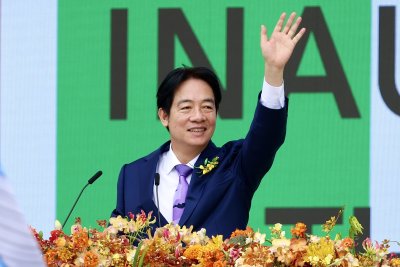
Taiwan President William Lai Ching-te, pictured, and Premier Cho Jung-tai will undergo impeachment proceedings after Taiwan’s legislature approved an impeachment motion on Friday. File Photo by Ritchie B. Tongo/EPA-EFE
Dec. 26 (UPI) — Taiwan President William Lai Ching-te and Premier Cho Jung-tai face impeachment proceedings filed by opposition party leaders accusing them of constitutional and legislative violations.
Members of Taiwan’s KMT and TPP parties and two independent lawmakers secured enough support on Friday to advance impeachment proceedings to go before Taiwan’s Constitutional Court,Al Jazeera reported.
The impeachment effort is viewed as symbolic because a two-thirds majority is needed to impeach an official holding public office in Taiwan.
“It’s not possible to have a real impeachment,” Yen-tu Su, a constitutional law and democratic theory expert at Taiwan’s Academia Sinica, told Al Jazeera.
“They want to make a record that President Lai would be the first president considered impeached in the history of Taiwan’s democracy,” he said. “It’s a way to register their protest.”
The Legislative Yuan approved an impeachment motion with a 60-51 vote on Friday, but it would take 76 of its 113 seated members to impeach the president and premier.
The conflict arises from Lai’s administration refusing to enact a legislatively approved amendment that would give more public funding for local units of government, according to the South China Morning Post.
The Legislative Yuan is controlled by opposition parties, but Lai’s refusal to enact the law change created conflict, and Cho Jung-tai declined to sign the amendment.
Lai became president in 2024, but Taiwan’s legislature has been divided and mostly deadlocked since.
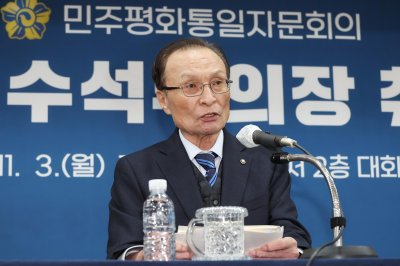
Former Prime Minister Lee Hae-chan, new senior vice chairman of the presidential Peaceful Unification Advisory Council, speaks dung a ceremony at the council’s secretariat in Seoul, South Korea, 03 November 2025, to mark his inauguration. The council advises the president on unification issues for policymaking purposes. Photo by YONHAP/EPA
Dec. 26 (Asia Today) — A South Korean public opinion survey released Friday found majority support for a concept described as a “peaceful two-state” approach aimed at long-term unification, with respondents saying tensions should be eased first to pursue peaceful coexistence.
The Democratic Peaceful Unification Advisory Council said its fourth-quarter national unification opinion survey found 55.5% agreed with the view that hostility between South and North Korea should be resolved first to achieve peaceful coexistence and pursue long-term unification. About 40.5% disagreed.
The survey also found 56.8% approved of the Lee Jae-myung administration’s North Korea policy direction, including goals described as a Korean Peninsula “free from war worries,” “a new era of peaceful coexistence” and “joint growth” between the two Koreas. About 35.1% disapproved.
On prospects for inter-Korean relations next year, 49.4% said they expected no change, 34.3% predicted improvement and 13.6% forecast deterioration.
Asked about the necessity of unification, 68% said it is necessary, down 0.6 percentage points from the previous quarter. The most-cited reasons were economic development, at 28.2%, and eliminating the threat of war, at 27.6%.
Views of North Korea were nearly split, with 44% seeing it as an object of vigilance and hostility and 42.7% seeing it as an object of cooperation and support.
The council said the survey was conducted over three days from Friday through Sunday among 1,000 adults ages 19 and older. It reported a 95% confidence level and a margin of error of plus or minus 3.1 percentage points, using proportional allocation by gender, age and region and a combined telephone interview method on landlines and mobile phones.
The Thai military moves armored vehicles on Thursday near the Thai-Cambodian border as cease-fire negotiations continue following military actions on Friday morning. Photo by Rungroj Yongrit/EPA
Dec. 26 (UPI) — The Thai military advanced on Cambodia’s Banteay Meanchey Province on Friday morning after carrying out air strikes as the two nations continue negotiating a possible cease-fire.
Thai tanks, armored vehicles and infantry advanced into Chouk Chey Village in the O’Chrov District of Banteay Meanchey Province, which is located in northwestern Cambodia and along its border with Thailand, the Khmer Times reported.
Thai F-16 fighter jets dropped about 40 bombs onto the area from 6:08 a.m. local time to 7:15 before the Thai military’s ground forces advanced into it.
The air strikes were done “in the most ruthless and inhumane manner” as they destroyed public infrastructure, civilians’ homes and private property, Cambodian Defense Ministry spokeswoman Lt. Gen. Maly Socheata said.
“The brutal actions above are indiscriminate attacks by the Thai military,” Socheata said.
She called the attacks a “serious violation of international humanitarian law” and said the Cambodian military continues to perform its duties to defend the nation’s territories.
“We will protect our dignity with courage and unwavering resolve, at any cost, and without succumbing to coercion or intimidation in any form,” Socheata said.
Thai Air Force officials denied attacking civilians and their homes, and told the BBC that they struck a “fortified military position” after civilians evacuated the area.
Friday’s military actions were intended to give Thailand control of the village of Nong Chan.
Meanwhile, respective Cambodian and Thai negotiators continue discussing a potential cease-fire while meeting at a border checkpoint for a third day and are scheduled to meet again on Saturday.
Fighting between the two nations resumed earlier in December despite agreeing to a cease-fire in July amid border disputes dating back to the early 20th century.
At least 41 have died and about a million more are displaced since the fighting resumed this month along the 500-mile border separating the two nations.
The hostilities started in May when a Cambodian soldier was killed during a clash between the opposing forces and escalated when the Cambodian military fired rockets into Thailand on July 24.
Chinese and U.S. officials each have tried to mediate a lasting peace in the matter.
A young girl sits in front of a nativity scene in Manger Square, outside the Church of Nativity, in the biblical town of Bethlehem, West Bank, on December 23, 2025. Photo by Debbie Hill/UPI | License Photo
People wave South Yemen flags on Thursday during a rally in Aden, Yemen, calling for the region’s independence that was organized by the Southern Transitional Council separatist group. Photo by Najeeb Mohamed/EPA
Dec. 26 (UPI) — Saudi Arabia has reportedly fired on the eastern Hadramout province in Yemen.
The Southern Transitional Council, a separatist group in Yemen, claims that the Saudis fired warning airstrikes at its forces.
The STC seized two oil-rich provinces in December. The group is backed by the United Arab Emirates. It released a video showing the airstrikes that it said were close to its positions in Wadi Nahab in the Hadramaut province.
The strikes haven’t been independently verified.
Saudi Arabia on Thursday made a diplomatic appeal urging the STC to abandon Hadramaut and al-Mahra, which it recently captured . The strikes would be the first military action by Saudi Arabia since that plea.
“The kingdom remains hopeful that the public interest will prevail through ending the escalation by the Southern Transitional Council and the withdrawal of its forces from the two governorates in an urgent and orderly manner,” Saudi Arabia said in a statement on Thursday.
“The kingdom stresses the importance of cooperation among all Yemeni factions and components to exercise restraint and avoid any measures that could destabilize security and stability, which may result in undesirable consequences,” the statement said.
On Thursday, there were large demonstrations in the port city of Aden calling for STC President Aidarous al-Zubaidi to declare independence from Yemen. The U.N. and several other gulf states back Yemen and want it to stay whole. The United States hasn’t taken a side.
The Houthis have controlled the northern areas of Yemen since 2015.
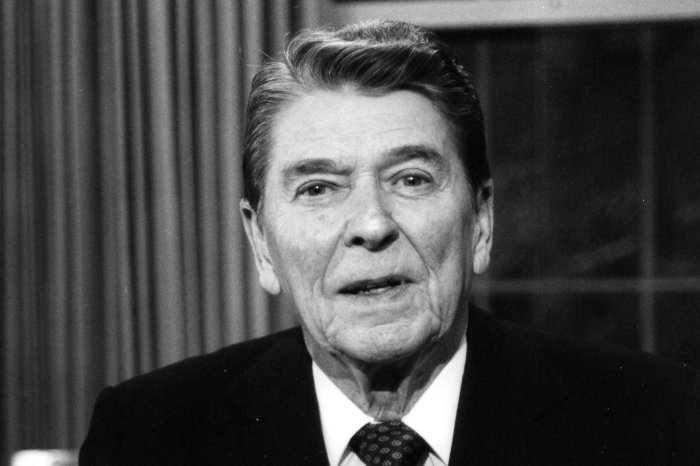
Former actor and sports broadcaster Ronald Reagan, known for films such as “Knute Rockne, All American” and “Kings Row,” is pictured in the Oval Office after delivering his farewell address to the nation on January 11, 1989. Reagan later served as the 40th president of the United States. Photo by Joe Marquette/UPI | License Photo
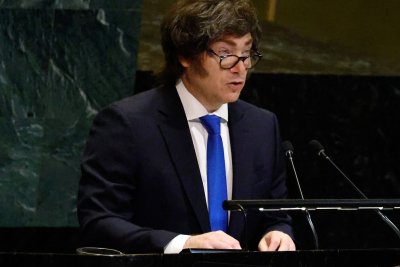
BUENOS AIRES, Dec. 26 (UPI) — Argentine President Javier Milei’s government is promoting a reform that seeks to redefine the role of the state in public education, curb direct government intervention and give families greater control over their children’s schooling.
A proposed law would legalize homeschooling, expand school choice and grant parents a more active role in school governance, including mechanisms to influence the appointment or removal of principals.
The stated goal is to introduce greater competition among educational institutions to attract students. The initiative has been submitted to Congress, and debate could begin in March.
The reform focuses primarily on basic education, which includes preschool, primary and secondary levels, while also introducing changes to the university financing system.
If approved, it would fully replace the current National Education Law in force since 2006.
“Argentina faces a deep educational crisis, as shown by our students’ results in national and international assessments,” a report by the Ministry of Deregulation and the Secretariat of Education said.
Internationally, PISA tests, which measure skills in math, reading and science, show stagnation or a sustained decline in the performance of Argentine students.
“Compared with other countries in the region, Argentina consistently ranks among the worst performers,” the report said.
Domestically, national assessments show that more than 80% of students in their final year of secondary school fail to reach satisfactory levels in math, while more than 40% have difficulties with reading comprehension.
The official diagnosis also describes the system as overly centralized and bureaucratic, with little room for pedagogical innovation and oversight mechanisms considered weak and lacking transparency.
“The family is the natural and primary agent of education; civil society is the space where it develops through various institutions and projects; and the state has the obligation to guarantee access, continuity and completion of studies at all levels,” the draft law says.
At the secondary level, reform would promote agreements between schools, companies and the productive sector to improve general education and vocational guidance.
Basic education also would be declared an essential service, requiring a minimum level of classes.
The bill recognizes multiple teaching modalities, including in-person, hybrid, community-based, home-based and distance learning, all subject to supervision and evaluation under national and local standards.
Julio Alonso, an academic at the University of Buenos Aires, told UPI the education reform is part of a broader package of changes pushed by the government.
“It is not an isolated measure. It is linked to labor and tax reforms,” he said.
According to Alonso, the central change lies in redefining the role of the state relative to that of families.
“The state takes on a subsidiary role. It guarantees access, but the main decisions fall to parents. The family is formally established as the central actor in the education system,” he said.
Another key point, he said, is the abandonment of a unified national curriculum. Provinces and the country’s capital would assume full responsibility for education, while the federal government would be limited to setting common minimum content.
“The idea of a national education project is left behind. In practice, responsibilities are further delegated to provincial governments,” Alonso said.
He added that the initiative also decentralizes education financing by eliminating the legal spending floor equivalent to 6% of gross domestic product.
“Under this reform, provinces would cover costs with their own resources, while the national government would concentrate spending on direct transfers to families,” he said.
A third pillar of the proposal concerns teachers, with greater family participation in evaluation processes, though not in hiring decisions.
Alonso warned, however, that the reform faces political and social obstacles. The ruling coalition lacks a majority in Congress and depends on support from provincial lawmakers — a weakness recently seen during the budget debate.
On the social front, Alonso anticipates strong resistance, particularly over cuts to the university system, with possible strikes and protests.
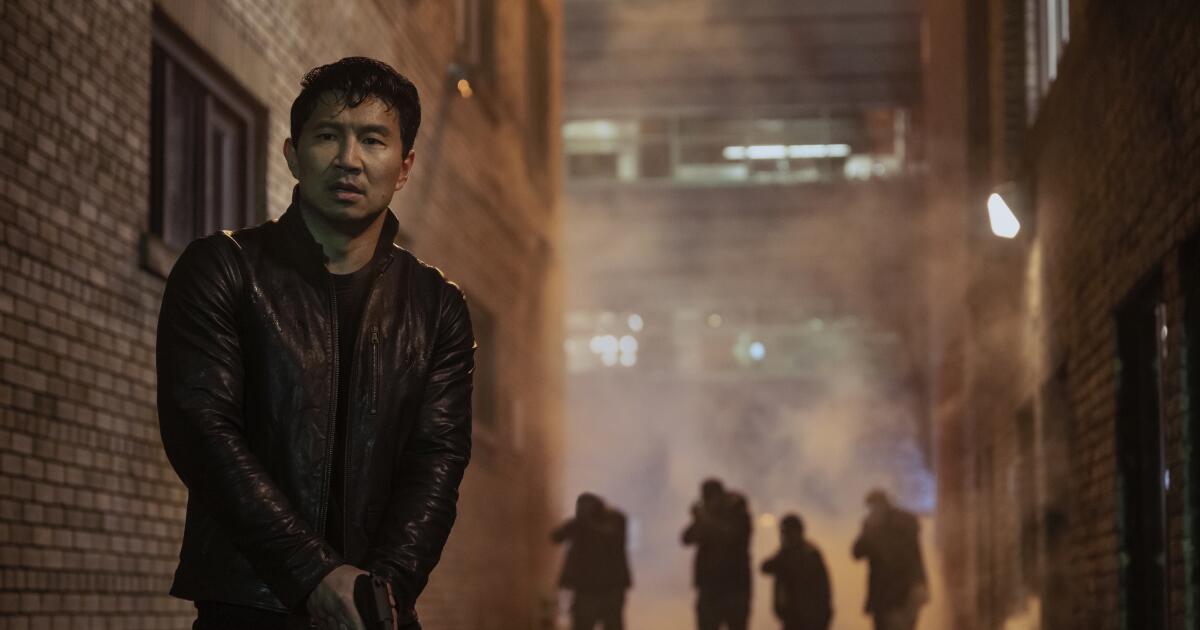
Most things in this world have their good points and their not-so-good points, and this is certainly true of “The Copenhagen Test,” a science-fiction spy story about a man whose brain has been hacked. Without his knowing it, everything he sees and hears is uploaded to an unknown party, in an unknown place, as if he were a living pair of smart glasses. Created by Thomas Brandon and premiering Saturday on Peacock, its conceit is dramatically clever, if, of course, impossible. What do you watch when you learn that what you’re watching is being watched?
In a preamble, we meet our hero, Andrew Hale (Simu Liu, “Shang-Chi and the Legend of the Ten Rings”), a first-generation Chinese American Green Beret, rescuing hostages in Belarus. A voice in his headset instructs him that there is enough room for one on a departing helicopter and that he must prioritize an American citizen. Instead he picks a foreign child. This, we will learn, is the less-preferred choice.
Three years later, Hale is working for the Orphanage, a shadowy American intelligence agency that spies on all the less-shadowy American intelligence agencies — watching the watchers. (So much watching!) Its proud boast is that, since its inception in the Bush I administration, it has never been compromised. (Until someone started looking through Hale’s eyes, that is.) There is a secret entrance to their giant complex, accessed by locking eyes with a statue in a library — it’s thematically appropriate, but also very “Get Smart!” That is a compliment, obviously.
The lower floor is where the analysts toil; entry to the upper floor, where the action is, is by the sort of fancy key that might have been used to open an executive washroom in 1895. (The decor is better there, too, with something of the air of an 1895 executive washroom.) Hale, who has been been listening to and translating Korean and Chinese chatter, dreams of moving upstairs, which will come with the discovery that his head is not entirely his own.
Meanwhile, he has been suffering migraines, seizures and panic attacks. Ex-fiancée Rachel (Hannah Cruz), a doctor, has been giving him pills under the table. Other characters of continuing interest include Michelle (Melissa Barrera), a bartender who will spy on Hale from the vantage point of a girlfriend, sort of; Parker (Sinclair Daniel), a newly promoted “predictive analyst” with a gift for reading people and situations; Victor (Saul Rubinek), an ex-spook who runs a high-end restaurant and has known Hale forever; Cobb (Mark O’Brien), a rivalrous colleague whose Ivy League persona has been drawn in contrast to Hale’s; and Cobb’s uncle, Schiff (Adam Godley), who also has spy knowledge. Peter Moira (Brian d’Arcy James) runs the shop, and St. George (Kathleen Chalfant) floats above Moira.
As parties unknown look through Hale’s eyes, the Orphanage is watching Hale with the usual access to the world’s security cameras. (That bit of movie spycraft always strikes me as far-fetched; however, a conversation in the privacy of my kitchen will somehow translate into ads on my social feeds, so, who knows?) “The Copenhagen Test” isn’t selling a surveillance state metaphor, in any case; this is just one of those “Who Can You Trust?” stories, one that keeps flipping characters to keep the show going, somewhat past the point of profitability.
Like most eight-hour dramas, it’s too long — “Slow Horses,” the best of this breed, sticks to six — and over the course of the show, things grow muddied with MacGuffins and subplots. While it’s easy enough to enjoy what’s happening in the moment, it can be easy to lose the plot and harder to tell just who’s on what side, or even how many sides there are. (It doesn’t help that nearly everyone is ready to kill Hale.) I can’t go into details without crossing the dreaded spoiler line, but even accepting the impossible tech, much of “The Copenhagen Test” makes little practical sense, including the eponymous test. (Why “Copenhagen?” Det ved jeg ikke. Danish for “I don’t know.”) I spent so much time untwisting knots and keeping threads straight that, though I continued to root in a detached way for Hale, I ceased to care entirely about the fate of the Orphanage and the supposedly free world.
The show is well cast. While the characters on paper are pretty much types, each actor projects the essence of the part, adding enough extra personality to suggest a real person. (And they’re all nice to look at.) When not keeling over from pain, or engaged in a shootout or hand-to-hand combat, Liu is an even-keeled, quiet sort of protagonist — rather in the Keanu Reeves vein — and as a Chinese Canadian actor, still a novelty among American television action heroes. He does have a kind of chemistry with Barrera, who has screen chemistry all on her own, though it’s somewhat limited by the demands of the plot.
The ending, including a diminished-chord twist, is pretty pat, if happier than one might imagine given the ruckus that’s gone before. Neat bows are tied — though at least one has been left loose in hopes, according to my own predictive analysis, of a second season. And though releasing a series in the last week of the year doesn’t exactly betoken confidence, I can predict with some confidence that there might be one.
Israeli police pictured in September secure the entrance to the King Hussein Bridge Border Crossing. On Friday, an assailant allegedly ran over a 68‑year‑old man in Beit Shean before driving to Ein Harod, where he fatally stabbed an 18‑year‑old woman and injured a teenager. File Photo by Debbie Hill/ UPI | License Photo
Dec. 26 (UPI) — Israeli police said a Palestinian man from the West Bank killed two people in a so-called “terror attack” in northern Israel on Friday.
The assailant allegedly ran over a 68‑year‑old man in Beit Shean before driving to Ein Harod, where he fatally stabbed an 18‑year‑old woman and injured a teenager.
Hebrew-language media identified the victim of the northern Israel terror attack as 19‑year‑old Aviv Maor of Kibbutz Ein Harod. The other victim’s identity was not released.
A civilian shot and wounded the suspect, who was taken to a hospital.
The two victims were declared dead on scene.
Defense Minister Israel Katz ordered a military response in the attacker’s hometown of Qabaitya to prevent further violence.
Meanwhile, Israel’s military stated it was “preparing for an operation” in the area.
A young girl sits in front of a nativity scene in Manger Square, outside the Church of Nativity, in the biblical town of Bethlehem, West Bank, on December 23, 2025. Photo by Debbie Hill/UPI | License Photo
Shinhan Card headquarters in Seoul. The company has reported massive data leaks. Photo by Yonhap
SEOUL, Dec. 26 (UPI) — Shinhan Card, one of the country’s top credit card issuers, reported a massive data leak Tuesday.
The Seoul-based company said more than 190,000 cases of potential data exposure have been identified that involve merchant partners’ personal and business information.
The incident seems to stem from employee actions rather than an external cyberattack. Against this backdrop, Shinhan Card CEO Park Chang-hun issued a formal apology.
“We would like to express our deepest apologies,” he said. “Upon discovering the incident, we immediately took measures to block any further leaks and completed a thorough review of our internal processes.”
“To ensure the protection of personal information in the future, we will conduct a full investigation into the cause and circumstances of the leak and strictly discipline the employees involved,” he said.
Despite the steps, criticism intensified as a series of security failures have taken place throughout this year.
In late November, the country’s leading online retailer, Coupang, acknowledged that the names, email addresses, phone numbers and delivery addresses of 33.7 million customers had been leaked.
The New York Stock Exchange-listed corporation could face fines amounting to a maximum of 3% of its related revenue, which is levied by the state-run Personal Information Protection Commission.
Since Coupang logged sales of some $28 billion in 2024, potential fines could surpass $800 million.
Earlier this year, SK Telecom admitted that a cyberattack had breached its network, exposing sensitive data and compromising critical information of about 23 million subscribers.
As a result, the top mobile operator was fined $92 million and ordered to suspend adding new customers for nearly two months, in accordance with government guidelines.
Criticizing companies that failed to protect customer information, Prime Minister Kim Min-seok vowed to more than triple the fines for similar violations.
“Urgent legislative tasks, such as the introduction of punitive administrative fines, will be swiftly advanced so that they can be passed as soon as possible,” Kim said at a government meeting Wednesday.
“For repeated and serious violations, we will introduce punitive fines of up to 10% of a company’s total revenue and strengthen the obligation to notify individuals of personal data breaches,” he said.
When corporate data leaks are reported, the South Korean government is quick to lash out at companies. However, critics argue that the government and state-operated organizations have failed to adequately protect their own data.
In 2021, the Atomic Energy Research Institute, the state-run outfit responsible for nuclear power research, was breached by a suspected North Korean state-backed group through a virtual private network server.
Last year, police found that North Korean hackers had stolen data from the National Court Administration during June 2021 and January 2023. The compromised data exceeded 1 terabyte, equivalent to more than 1.5 billion pages of documents, including personal information.
Despite these threats, the government is reluctant to spend more money to mitigate cybersecurity risks.
For example, the Seoul administration cut the 2026 budget for the operation and maintenance of integrated security control centers run by local governments by almost 30% compared with this year.
It also reduced the 2026 budget for reinforcing security and protection facilities at government complexes by more than 40%.
This contrasts with the 8.1% year-on-year increase in the national budget for 2026.
“When hacking incidents occur, harsh penalties are imposed on private enterprises. For government agencies, however, it seemingly ends up with only a slap on the wrist. Such asymmetric punishments are not difficult to understand,” economic commentator Kim Kyeong-joon, formerly vice chairman at Deloitte Consulting Korea, told UPI.
“Moreover, the government is required to strengthen the country’s cybersecurity infrastructure. And leaks of public data or documents are even more dangerous when they are related to national defense. I wonder whether our government is doing enough in these areas,” he said.
Park Tae-hwan, head of the AhnLab CyberSecurity Center, called for stronger efforts to counter online threats and data breaches. AhnLab is the country’s leading cybersecurity vendor.
“Following a series of cyber intrusion incidents of late, regulations centered on bigger fines and punitive measures have come to the forefront, raising the burden on companies,” Park told UPI.
“To enable a meaningful shift in perception, a parallel policy approach is needed, like one that provides incentives to companies with strong security practices, thus encouraging greater voluntary investment in cybersecurity by the private sector,” he said.
Dec. 26 (UPI) — Nigerian President Bola Tinubu gave the U.S. government the “go-ahead” to carry out airstrikes on ISIS targets, Nigeria’s foreign minister said Friday.
U.S. President Donald Trump announced the strikes Thursday, calling them retaliation against “ISIS terrorist scum” for violence on “primarily, innocent Christians.”
Nigerian Foreign Minister Yusuf Tuggar told Al Jazeera the country cooperated with the U.S. Defense Department on the “fight against terrorism” in the northwestern region.
Citing local news sources, the news outlet said at least one missile landed in the village of Jabo in Sokoto state. Residents told Al Jazeera there were no casualties in the village.
“The bomb fell and burst into many pieces. There were two big pieces of debris. One of them was carried by two people,” resident Abdulrahman Mainasara said.
Resident Ismail Umar told the outlet the village hadn’t received any armed attacks from ISIS in more than two years.
Tuggar said the Nigerian government provided intelligence to the U.S. government, and he spoke with U.S. Secretary of State Marco Rubio on the phone twice before the strikes. He added that Tinubu was also involved in the decision-making process.
“Now that the U.S. is cooperating, we would do it jointly, and we would ensure, just as the [Nigerian] president emphasized yesterday before he gave the go-ahead, that it must be made clear that it is a joint operation, and is not targeting any religion nor simply in the name of one religion or the other,” Tuggar said in an appearance on Channels Television‘s Sunrise Daily program.
Tuggar and other officials, though, took issue with Trump’s rhetoric saying that ISIS violence targets only Christians in Nigeria.
“We are a multi-religious country, and we are working with partners like the U.S. to fight terrorism and safeguard the lives and properties of Nigerians,” Tuggar said.
Auwal Musa Rafsanjani, the director of the non-profit organization Civil Society Legislative Advocacy Centre, said suggestions that ISIS is primarily targeting people based on religion could incite ethnic and religious tensions in Nigeria.
“Muslims are being killed and harassed every day by the same criminals,” Rafsanjani said, according to the local news outlet Leadership. “This conversation should be about human life, not religion or geography.”
Clouds turn shades of red and orange when the sun sets behind One World Trade Center and the Manhattan skyline in New York City on November 5, 2025. Photo by John Angelillo/UPI | License Photo
Chung Dong-young, South Korea’s unification minister, speaks during a post-briefing following a policy report at the government complex in Seoul. Dec. 19, 2025. Photo by Yonhap News Agency
Dec. 24 (Asia Today) — Unification Minister Chung Dong-young met separated families ahead of the year-end holidays and said South Korea will seek to resolve humanitarian issues through inter-Korean dialogue, the ministry said Tuesday.
The ministry said Chung visited Kim Bong-hwan, 105, on Tuesday. Kim told Chung he has spent his life hoping to meet younger siblings in North Korea after being separated from his parents and siblings during the Korean War. He asked that authorities at least confirm whether his family members in the North are alive or dead, the ministry said.
Chung said separated families represent one of the deepest tragedies created by the division of the peninsula. With most separated family members elderly, time is short, he said, adding the government will pursue multiple avenues to address humanitarian issues, including inter-Korean dialogue.
The ministry said Chung also delivered New Year’s cards and consolation gifts to 100 elderly separated family members.
It said it plans to continue projects aimed at supporting separated families and expanding the foundation for exchanges, including a Separated Family Day event held annually on the 13th day of the eighth lunar month, invitation events, DNA testing and video letter production.
The ministry said it also visited some families of detainees and abductees during the year-end holiday season.
Families of detainees and abductees said Vice Unification Minister Kim Nam-joong and ministry officials met families of detainees to offer support and that schedules were being coordinated for meetings with families of post-war abduction victims.
However, groups representing families of wartime abductees and Korean War prisoners of war said there has been no discussion or coordination so far on meetings with the ministry around the year-end and New Year holidays.
People Power Party lawmaker Park Chung-kwon speaks on Ato TV’s “Shin Yul’s Political Check” in Seoul on Wednesday, Dec. 24, 2025. Photo by Asia Today
Dec. 24 (Asia Today) — People Power Party lawmaker Park Chung-kwon, a former North Korean defector, criticized the Unification Ministry’s plan to change the designation for North Korean defectors to “Northbound residents,” calling it “an idea you’d expect from a dictatorship.”
Park made the remarks Wednesday on Ato TV’s “Shin Yul’s Political Check,” saying he felt uneasy about what he described as a political intent to curry favor with the North Korean regime.
Park said some defectors feel discomfort with the current term, but argued the cause was misidentified. Changing the label to “Northbound residents” would not improve matters, he said.
He said the discomfort stems from social prejudice and alienation tied to their identity as people from North Korea, not from the wording itself.
Park said the fundamental solution is for defectors to settle successfully and integrate into South Korean society as citizens. He also claimed most defectors oppose the proposed change.
Park said the term “North Korean defectors” reflects people who came to South Korea seeking freedom and escaping oppression by the North Korean regime, and argued that meaning is not reflected in “Northbound residents.”
He also alleged the Unification Ministry conducted a survey on the name change targeting defectors and provided their personal information to a polling company without their consent. Park said he requested materials related to the survey results but the ministry has not disclosed them. He claimed there was no consensus among defectors and no discussion on the change.
Separately, Park criticized the revised Information and Communications Network Act passed in a National Assembly plenary session Wednesday, saying authorities label information as false to shut down the media and the public when it does not suit the ruling camp.
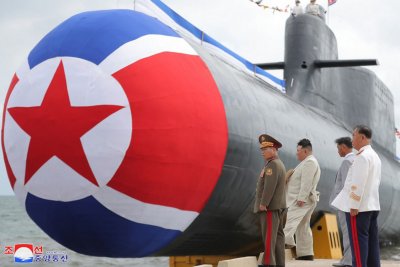
Dec. 25 (Asia Today) — North Korea released images of Kim Jong-un inspecting what it called a nuclear-powered submarine construction project, a move analysts said was aimed at casting South Korea’s debate over nuclear-powered submarines as a security threat while justifying Pyongyang’s own push to strengthen its strategic nuclear forces.
The Korean Central News Agency reported Thursday that Kim described South Korea’s pursuit of nuclear-powered submarines as a threat that must be countered and offered remarks defending North Korea’s development of nuclear-powered submarines. Analysts said the message used Seoul’s discussion as a pretext to portray North Korea’s strategic weapons buildup as inevitable.
North Korea has previously unveiled undersea capabilities, including what it called a Sinpo C-class ballistic missile submarine, the “Kim Gun Ok Hero Submarine,” which it claimed was its first “tactical nuclear attack submarine” when it was introduced in September 2024, according to state media.
South Korean maritime defense experts, including Hanyang University professor Moon Geun-sik, said the latest disclosure appears intended to showcase parallel development of what North Korea described as an 8,700-ton nuclear-powered strategic guided missile submarine – believed by analysts to be a ballistic missile submarine – along with an underwater unmanned system, believed to be an underwater drone.
KCNA said Kim called for a “qualitative leap” in maritime nuclear forces and described nuclear-powered submarines as a core pillar of North Korea’s nuclear deterrent.
Experts said North Korea’s claims about a “threat” from South Korea diverge from how Seoul has described its own debate. Moon and Jeong Seong-jang, deputy director at the Sejong Institute, said South Korea’s discussion has not been framed around nuclear armament or preemptive strikes. They said it has been presented as a defensive option to support longer submerged operations and covert tracking to counter North Korea’s nuclear and submarine-launched ballistic missile threats.
North Korea experts also say Pyongyang has pursued sea-based missile capabilities in recent years, including efforts they describe as adapting the KN-23 short-range ballistic missile into a sea-based short-range submarine-launched ballistic missile and conducting an underwater test launch from a new 3,000-ton diesel-electric submarine.
Analysts said Kim’s remarks amount to political framing meant to discredit South Korea’s nuclear submarine discussion while rationalizing North Korea’s strategic weapons development. They said North Korea has steadily unveiled intercontinental ballistic missiles, submarine-launched ballistic missiles and tactical nuclear weapons and is now presenting nuclear-powered submarines as a further step in that progression, with an eye toward both internal cohesion and external pressure.
Attention has also focused on the suspected construction site. Experts reviewing the newly released video and images alongside past satellite analysis pointed to shipyard facilities in the Sinpo area of South Hamgyong Province as the most likely location.
Sinpo is widely viewed by analysts as North Korea’s primary hub for submarine and submarine-launched ballistic missile activity, with infrastructure and specialized personnel linked to construction and testing, including launch test facilities and underwater launch barges.
Some experts urged caution about North Korea’s technical capacity to field and operate an 8,700-ton nuclear-powered submarine, noting it would require reliable reactor miniaturization and shielding, radiation safety and a fuel cycle and maintenance system that can support long-term operations. Jeong and other analysts said it remains unclear whether North Korea has achieved those capabilities on a stable basis.
Still, analysts said the strategic impact can be felt regardless of the project’s maturity. Once North Korea publicly declares a nuclear-powered submarine program, they said, it reduces ambiguity and can heighten instability in the maritime environment around the Korean Peninsula.
Experts said Seoul should avoid being drawn into North Korea’s rhetorical framing while recognizing that sea-based nuclear and missile threats are becoming more entrenched. They said South Korea’s nuclear-powered submarine discussion should be refined as a defensive option within international norms and alliance cooperation and paired with broader maritime deterrence steps, including underwater surveillance, anti-submarine warfare and unmanned systems.
KCNA also reported Thursday that Kim reviewed the progress of what it described as newly developed underwater weapons and outlined plans tied to naval force reorganization and the creation of new units.
Analysts said that while Kim’s statement about South Korea’s nuclear submarine push was directed at Seoul, the broader objective was to justify North Korea’s own strategic weapons advancement. They said South Korea should separate principle from reality in its response and focus on capability building and international legitimacy rather than mirror rhetoric.
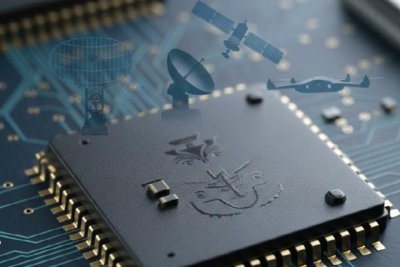
A composite image shows defense semiconductor chips with silhouettes of military platforms such as radars, satellites and drones. Dec 25, 2025. Photo by Asia Today
Dec. 25 (Asia Today) — South Korea’s defense procurement agency is accelerating efforts to develop and certify defense-grade semiconductors, warning that reliance on foreign supply chains for critical chips could delay weapons deployment and weaken long-term competitiveness in arms exports.
Modern weapon systems increasingly depend on semiconductors for core functions including missile guidance and navigation, radar detection and tracking, encrypted military communications and autonomous operation in drones and unmanned platforms, defense officials and industry experts say.
Analysts say dependence on overseas sources for such components creates vulnerabilities that go beyond cost. If access is disrupted by export controls, manufacturing changes or supply discontinuation, military programs can face delays because defense-grade parts often require retesting and recertification even after minor design or packaging changes.
The Defense Acquisition Program Administration said it launched a task force in January 2024 to prepare for a Defense Semiconductor Center and has been building a roadmap for project planning and management along with a dedicated reliability evaluation and certification function, according to a notice posted on the government innovation portal.
In a December policy briefing, the agency said it began research and development projects tied to defense semiconductors, including high-power radio-frequency components for radars and semiconductors for space communications.
Defense semiconductor applications span a growing set of systems, including transmit-receive modules for active electronically scanned array radars, processing chips for synthetic aperture radar on unmanned aerial vehicles, satellite communications components for small satellites and tactical-grade inertial sensors, analysts said.
DAPA has pursued center establishment in parallel with research programs aimed at building a domestic ecosystem. The agency said it selected five core technology projects in May, with four expected to begin within the year. In December, it announced the start of projects including space semiconductors for small satellite communications, tactical-grade gyro sensors, chips for unmanned aerial vehicle synthetic aperture radar and chips for active electronically scanned array radars, emphasizing a goal of reducing reliance on foreign technology.
The agency also held a defense semiconductor development forum in November that brought together government officials, industry and researchers, according to the report.
Experts said the next hurdles are less about initial research and more about building an ecosystem that can certify reliability and support sustained production.
Defense-grade semiconductors must perform under extreme conditions including temperature swings, vibration, shock, electromagnetic exposure and long storage periods, requiring testing infrastructure and standards that differ from civilian certification methods.
Analysts also said South Korea will need an end-to-end supply chain covering design, manufacturing, packaging and verification. Because defense chips are often produced in small volumes across multiple specialized variants, they can be deprioritized on commercial foundry and packaging lines unless trusted production capacity is secured.
Specialized investment will also be needed in areas such as compound semiconductors and radiation-hardened components used in radars, electronic warfare systems and satellites, the report said.
To ensure research translates into deployment, experts said development should be structured around early joint design involving military users, system integrators and component makers.
Analysts said defense semiconductors should be treated as national security infrastructure that affects the speed of force deployment, operational sustainability and export reliability, rather than as an optional industrial policy goal.
This image, released on September 8, 2023, by the North Korean Official News Service (KCNA), shows North Korean leader Kim Jong Un during the launch of the country’s first tactical nuclear attack submarine at Sinpho shipyard. According to state media, the tactical nuclear attack submarine, No. 841, the first of its kind, was transferred to the East Sea Fleet of the KPA Navy and named the “Hero Kim Kun Ok.” File Photo by KCNA/UPI | License Photo
Dec. 25 (Asia Today) — North Korea’s Rodong Sinmun on Thursday showcased what it described as the construction site of an 8,700-ton “nuclear-powered strategic guided missile submarine,” calling it a “revolutionary change” in the country’s war deterrence capability.
Photos of the vessel suggest the exterior is close to completion and may already include a small reactor, which would be required for operations, analysts said. The conning tower also appeared to show what could be launch tubes for submarine-launched ballistic missiles, or SLBMs, similar in concept to North Korea’s existing 3,000-ton Kim Gun Ok submarine, the report said.
North Korea has pursued nuclear submarine development as a key defense goal since the ruling party’s 2021 congress, when it set out what it called five major tasks for strengthening national defense capabilities, Rodong Sinmun reported.
During the site visit, Kim Jong-un said North Korea had built a “nuclear shield” to safeguard national security and had secured the ability to expand it as much as necessary, according to the newspaper. He said the country would continue pursuing naval nuclear armament on both strategic and tactical levels.
Kim also said there would be no change in North Korea’s security policy and warned that if an adversary threatens what he called the country’s strategic sovereignty and security, it would “pay the price,” the report said.
The disclosure drew attention to whether North Korea can actually operate a nuclear-powered submarine of that size. The report noted questions about whether North Korea has mastered small reactor technology and large submarine construction even as it maintains uranium enrichment capabilities. It said some assessments link the possibility of technological support to North Korea’s closer ties with Russia since the Russia-Ukraine war, including speculation that North Korea could have acquired relevant technology from Russia.
The public rollout also comes as South Korea’s own debate over nuclear-powered submarines has gained momentum, and some analysts viewed North Korea’s disclosure as a show of force aimed at Seoul, the report said.
Cho Han-beom, a senior research fellow at the Korea Institute for National Unification, said the visible SLBM tubes on the conning tower indicate North Korea’s technology remains limited and suggested the disclosure may have been rushed in response to South Korea’s discussion. Yoo Yong-won, a People Power Party lawmaker, said the altered conning tower appears designed to accommodate as many as 10 SLBMs and resembles the Kim Gun Ok submarine, which he said has drawn criticism for its unusual shape.
Rodong Sinmun also reported on a congratulatory message that Russian President Vladimir Putin sent to Kim on Dec. 18, saying Putin praised North Korean troops’ “heroic participation” and highlighted expanded ties across politics, trade and the economy and other areas.
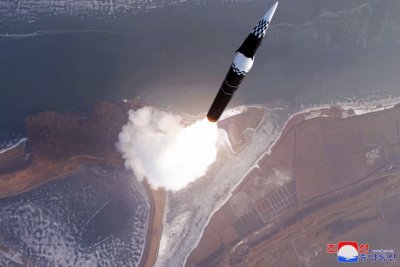
This image, released on January 7, 2025, by the North Korean Official News Service (KCNA), shows the test-fire of a new intermediate-range hypersonic ballistic missile on January 6. The launch, which was witnessed by North Korean leader Kim Jong Un, was meant to demonstrate that the country’s “hypersonic missile system will reliably contain any enemies in the Pacific region that can affect the security of our state.” File Photo by KCNA/UPI | License Photo
Dec. 25 (Asia Today) — North Korea said it conducted a first test launch of a high-altitude long-range surface-to-air missile system under development, but a South Korean defense expert said the launch appeared to be a flight test because no interception footage was released.
North Korea’s Korean Central News Agency said the Missile Bureau carried out the test Wednesday to evaluate the system’s tactical and technical characteristics. The agency said the missile hit and destroyed a simulated high-altitude target at a range of 200 kilometers.
The Missile Bureau said the test was part of routine work by the bureau and its research institutes to advance the country’s air defense capabilities. State media said Kim Jong-un observed the launch and praised the results.
The missile was first shown publicly at an event marking the 80th anniversary of North Korea’s air force last month, according to the report.
Shin Jong-woo, secretary general of the Korea Defense and Security Forum, said North Korea claimed it intercepted a simulated target but did not release footage of the intercept. He said that suggests the test focused on flight performance and reflects an effort to develop a new surface-to-air missile as North Korea’s SA-5 long-range system ages.
South Korea’s Joint Chiefs of Staff said it detected the launch Wednesday but did not disclose it publicly at the time.
The Joint Chiefs of Staff said it had detected indications of a launch in advance and was prepared. It said that around 5 p.m. Wednesday it detected multiple projectiles believed to be surface-to-air missiles launched from the Sondok area in South Hamgyong Province toward the East Sea.
The Joint Chiefs of Staff said it is closely monitoring North Korea’s activities under the South Korea-United States combined defense posture and remains ready to respond to any provocation.
A handout photo made available by the presidential office shows South Korean President Lee Jae Myung (L) and first lady Kim Hea Kyung (R) participate in a Christmas Mass at Myeongdong Cathedral in central Seoul, South Korea, 25 December 2025. Photo by SK PRESIDENTIAL OFFICE HANDOUT SOUTH KOREA/EPA
Dec. 25 (Asia Today) — President Lee Jae-myung and first lady Kim Hye-kyung attended a Christmas service Thursday with about 130 worshippers at Haein Church in Incheon, the presidential office said.
Spokesperson Kim Nam-joon said in a written briefing that the visit was meant to reflect on the meaning of Christmas, offer a message of comfort and hope to the public beyond religion and reaffirm the value of social integration.
Kim said Lee met Pastor Lee Jun-mo and his wife, Pastor Kim Young-sun, upon arriving at the church and thanked them for the opportunity to share Christmas greetings there.
The pastors offered well-wishes and urged Lee to embrace vulnerable members of society, the spokesperson said.
Haein Church was founded in 1986 as what the presidential office described as a workers-funded “people’s church.” It is located in Gyeyang District, which was Lee’s constituency when he served as a lawmaker. The church is known for community projects supporting people including the homeless and victims of domestic violence, the presidential office said.
After the service, Lee and Kim had bibimbap with church members in the church dining hall, the spokesperson said. They later visited the Notre Dame Convent in Gyeyang District to exchange Christmas greetings.
Lee also attended a Christmas Mass Thursday afternoon at Myeongdong Cathedral in Seoul, which the presidential office said drew about 1,000 worshippers, including Archbishop Chung Soon-taek of Seoul.
To rebel is to defy. It is to understand that the world as it is can and should be better.
So it’s no surprise rebels were everywhere on our movie screens in 2025. Filmmakers in the U.S. and abroad depicted the lengths to which people will go to stand up against the bland (and at times violent) vision of conformity they see around them. It’s a theme that comes through most organically in these films’ costume designs.
In “Wicked: For Good,” for instance, Cynthia Erivo’s Elphaba Thropp stands apart from the glossy superficiality of the Emerald City. Paul Tazewell, an Oscar winner earlier this year for the first “Wicked,” once again wrapped Elphaba’s defiant spirit in the very fabric of her costumes. As she fights for animal rights and defies the authority of that fraud of a Wizard, the titular witch dons dresses and capes (and, yes, even a knitted cardigan that had the internet abuzz) that ground her in that land “made of dirt and rock and loam” she sings about.
Cynthia Erivo as Elphaba in “Wicked: For Good.”
(Giles Keyte / Universal Pictures)
Not that all rebels choose to stand out. In Paul Thomas Anderson’s politically urgent thriller “One Battle After Another” — costumed by four-time Oscar winner Colleen Atwood — members of the French 75 revolutionary group know better than to draw attention to themselves.
“Take Deandra [played by Regina Hall], for instance, who’s always lived off the grid,” Atwood tells The Envelope. “They have lives, but they are still somewhere on the wanted list, and some weirdo can suddenly know who they are. So they really have to blend in. They have to be not noticeable. That was a big goal with everybody’s costume in the movie, all the French 75 costumes — and Leo as well.”
That’s why DiCaprio spends much of the film in a red bathrobe, making him both incredibly hard to miss and also decidedly ordinary-looking. “Would you wear it the whole time?” Atwood remembers asking herself: “Would he get rid of it? And Paul goes, ‘Why would you take off your clothes if you’re running?’”
Leonardo DiCaprio, left, and Benicio Del Toro in “One Battle After Another.”
(Warner Bros. Pictures)
Atwood’s choice to put Benicio Del Toro in a gi and a turtleneck was similarly driven by this approach: These are all people who move through the world wanting to disrupt the system without making such disruption all that conspicuous. Here we may also add the off-the-rack suits Teddy and Don (Jesse Plemons and Aiden Delbis) wear in “Bugonia” to face their kidnapped CEO; the beret-and-turtleneck-wearing revolutionary (Richard Ayoade) in “The Phoenician Scheme”; and the stylish, delightfully unbuttoned shirts Wagner Moura wears throughout “The Secret Agent.”
Not all instances of rebellion are so obviously political. Take Harry Lighton’s deliciously kinky dom-com “Pillion,” which finds shy young Colin (Harry Melling) entering into a BDSM relationship with an enigmatic biker called Ray (Alexander Skarsgård).
“Ray’s an anomaly; he’s the rebel, you can’t place him,” costume designer Grace Snell says. When we first meet him, he is wearing a striking white leather biking outfit: “I wanted him to be like a light at night on this bike and a shiny toy for Colin.”
Harry Melling, left, and Alexander Skarsgård in “Pillion.”
(Festival de Cannes)
The leather and kink gear that Skarsgård, Melling and the rest of the “Pillion” cast wear allowed Snell to give audiences the Tom of Finland fantasy Lighton’s film clearly demands. Yet the film is about a quieter rebellion.
“Colin’s kind of testing his boundaries and understanding who he is as a gay man, and exploring what that means for him,” Snell says. It’s why he spends much of the film in uniform, as a traffic warden, as a member of a barbershop quartet, and later as the new member of Ray’s biker gang.
“Pillion” is about self-fashioning at its most elemental: how gear and uniforms, roles and positions, can help you bloom into yourself; how in losing yourself in another you can find who you want to be.
Blending such a lesson in ways political and personal is Bill Condon’s “Kiss of the Spider Woman,” also costumed by Atwood. The musical is framed by the tension between Valentin (Diego Luna), a righteous revolutionary, and Molina (Tonatiuh), a gay hairdresser, who share a prison cell under Argentina’s military regime.
Diego Luna and Jennifer Lopez in “Kiss of the Spider Woman.”
(Roadside Attractions)
Along with designer Christine L. Cantella, Atwood aimed to honor the history the film was depicting and the message it embodies. “Not only is it set in a revolutionary time, but it’s also about two people opening each other’s eyes to the world,” Atwood says, “in a way that is such a great message for today.”
Atwood and Cantella had to balance the dingy reality of the prison — where Molina finds modest beauty in his silk robes — and the movie musical he loses himself in — where Jennifer Lopez’s Aurora is dressed like a silver-screen siren throughout. Lopez’s big number, where she dons an ode to the all-white ensemble Chita Rivera wore in the original Broadway show, including a fedora to match, is all about the lure of escapist Hollywood fantasy: “Turn off the lights and turn on your mind,” she sings.
As the ending of the musical attests, there may be a way to do both, to be politically engaged and still enjoy the beauty of the world around you. For, as these varied films attest, a rebel doesn’t just voice their discontent at the status quo. They wear it proudly.
Istanbul officials on Thursday announced they detained 115 suspected members of ISIS who were planning terror attacks in Turkey aimed at mostly non-Muslim people at Christmas and New Year events, such as the Christmas mass at Saint Antuan Church pictured in 2022. File Photo by Erdem Sahin/EPA
Dec. 25 (UPI) — Police in Turkey detained 115 people on Thursday suspected of planning to stage terror attacks at Christmas and New Year’s Day celebrations in the country.
The Istanbul Provincial Police Department, on instruction from the city’s Chief Public Prosecutor’s Office, carried out 124 raids targeting 137 suspected members of ISIS, officials said in a press release.
“These suspects were identified as being in contact with conflict zones within the scope of terrorist organization activities,” the prosecutor’s office said in a press release posted to X.
The suspects, prosecutors said, were “planning attacks and issuing calls for action targeting our country — specifically aimed at non-Muslim individuals — within the context of upcoming Christmas and New Year events.”
Officials apprehended 115 of the 137 suspects and seized pistols, cartridges and “numerous organization documents” during the raids.
The Turkish National Intelligence Organization had earlier captured what it said is a senior ISIS figure who is suspected of being sent to carry out a suicide attack in Turkey, the Daily Sabah reported.
Other ISIS operators had as a result been investigated in Turkey after spending time in the Afghanistan-Pakistan border region where they trained and planned for potential security attacks, according to Turkish intelligence figures.
Turkey, which shares a border with Syria, where ISIS continues to operate, has worked with Syria’s new president, as well as officials in the United States and Europe, to investigate and root what is left of the terrorist group, the BBC reported.
A young girl sits in front of a nativity scene in Manger Square, outside the Church of Nativity, in the biblical town of Bethlehem, West Bank, on December 23, 2025. Photo by Debbie Hill/UPI | License Photo
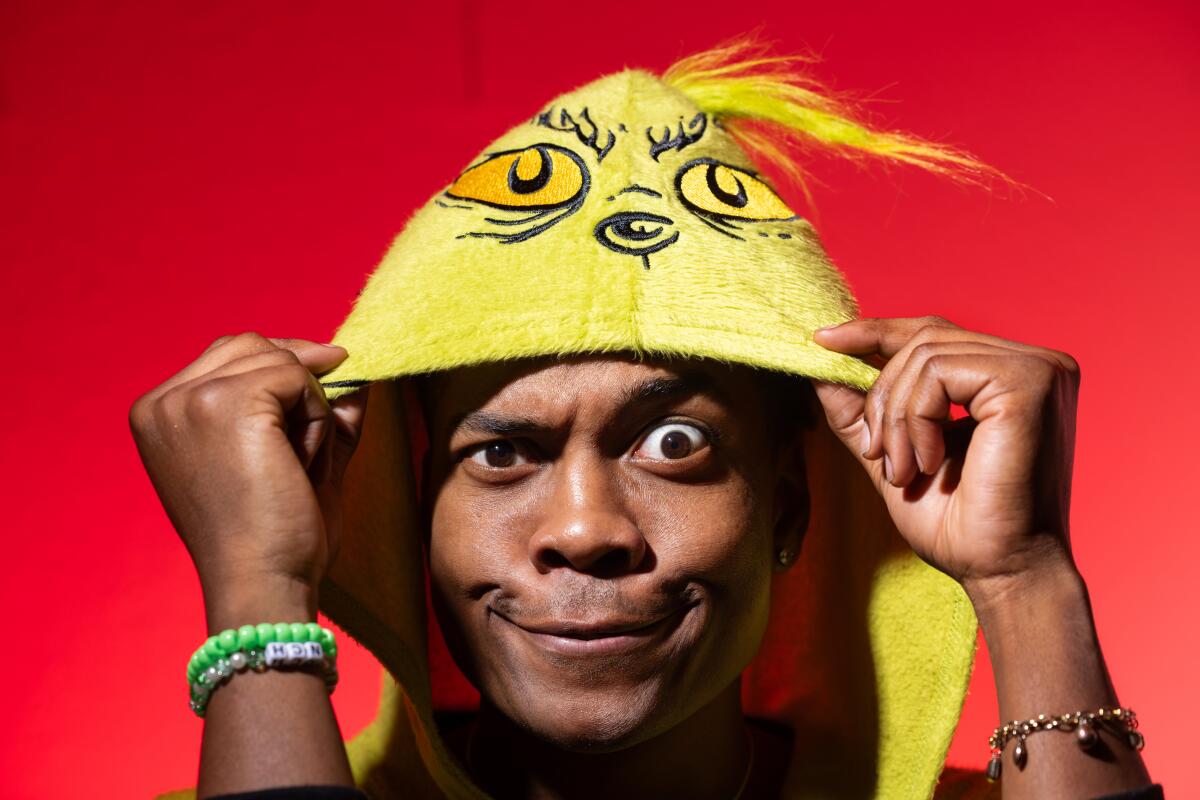
It takes a lot for sweet-tempered 28-year-old Nick Darnell to transform himself into Christmas’ most sought-after sourpuss.
There’s colored contacts and facial prosthetics, a protruding belly and at least an hour of makeup. But for the devout Christian and preternaturally cheerful young actor, the real metamorphosis is psychological.
“People today love to connect with the villain,” said the viral Grinch impersonator. “The world is just a darker world now.”
Darnell called the chartreuse baddie he portrays “the modern-day Santa.”
Dr. Seuss’ holiday parable “How the Grinch Stole Christmas!” has been a seasonal favorite since it was published in 1957, ranking among the most popular and profitable of the author’s iconic rhyming picture books.
The story’s sassy, brassy antihero has likewise adorned Christmas trees and school library shelves for generations. His hornlike fur forelocks and pathological refusal to assimilate have led some critics to call the Grinch ambiguouslyantisemitic, but those concerns have largely been glossed over by years of nostalgia.
Experts say 2025 heralds the Grinch’s ascent from Yuletide bit player to Christmas A-lister. He now crowds out Kris Kringle in store displays, social media feeds and holiday meet-and-greets.
Unlike Santa, who ho-ho-hos his way through the holiday season, Grinches twerk and pout and scream in kids’ faces. Compilations of their antics on YouTube and TikTok routinely rack up millions of views.
“I do the things that people think,” Darnell said of the role. “I’m not restrained.”
Despite the Grinch’s anti-consumerist zeal, the market for his visage has exploded in recent years.
Target touts its “Grinchmas,” while Walmart has “WhoKnewVille.” McDonald’s sells Grinch fries, Starbucks features a “secret menu” frappuccino. Hanna Andersson, a popular purveyor of holiday pajamas, boasts roughly a dozen different Grinch patterns, compared to three Hanukkah options and just one Santa design in two colorways.
“I’m not restrained,” Grinch impersonator Nick Darnell, 28, says of his role.
(Christina House/Los Angeles Times)
Ownership of the Grinch’s likeness is guarded as jealously as the villain protects his lair: Dr. Seuss Enterprises holds the rights to the children’s book, Warner Bros. Discovery the 1966 animated TV special, and Universal Studios the 2000 live-action Jim Carrey film, which ranks among the highest-grossing Christmas movies of all time.
But impersonators, academics and even working Santas agree: Americans’ embrace of the Grinch in 2025 goes far beyond consumerism.
“It’s definitely more popular,” said ‘Santa’ Ed Taylor, the famed Los Angeles Santa behind the Worldwide Santa Claus Network, a training camp for the art of Christmas cheer. “It’s a little yin and yang. Maybe we need a little bit of both.”
Costume companies across Los Angeles say they’ve seen a deluge of demand for the Grinch this year. At Etoile Costume & Party Center in Tarzana, nearly half of Christmas costume rentals are now furry green villains.
“It’s about equal to Santa,” one employee said. “Maybe 40% Grinch and the rest Santa.”
Ryan Ortiz, dressed in a Grinch costume, stands next to his 1969 Volkswagen Bus in San Diego on Dec. 21.
(K.C. Alfred / The San Diego Union-Tribune via Getty Images)
Fans of the hirsute sourpuss seek him out for his in-your-face edge — the opposite of Santa’s remote joviality. Santa enforces his regime of goodness through lists and surveillance. The Grinch will get in your face and yell at you to shut up.
“[Santa]’s supposed to be mysterious and unknown,” said Darnell’s fiancee JadaPaige. “He’s supposed to just come in the night and you’re never supposed to see him.”
“I grew up obsessed with Santa Claus — I did not grow up obsessed with the Grinch,” Darnell said. “I was the kid waiting up in the middle of the night, peeking, wondering if Santa’s down there. A lot of modern day kids aren’t having that journey.”
Instead, many Gen Alpha youths look to the Grinch for his views on “corruption or poverty or the oversaturation of commercialism,” Darnell said.
“Santa is looked at more like a godly figure, while the Grinch is a more everyday man,” the actor explained. “The world is so sinister and negative. [The Grinch] tells you how it is, rather than telling you everything is going to be fine.”
TikTok turbocharged that trend, with the infamous green meanie matching or beating his red rival in holiday clout.
Grinch impersonator Nick Darnell said the character he plays has become popular because, “He has aura.”
(Christina House/Los Angeles Times)
Today’s professional Santas are often retirees with a bit of a belly and some time on their hands. Grinches, by contrast, are more likely to be working actors like Darnell, who look reverently to Carrey’s performance as a blueprint for the character’s slapstick antics and snarky reads.
Still, experts say the Grinch’s 2025 glow-up likely owes as much to holiday exhaustion and broad consumer pessimism as it does vertical video virility.
“The Grinch is the opposite side of Christmas,” said Oscar Tellez, who owns Magic Dream Costumes and Party Rentals in East Los Angeles and says he’s seen a spike in Grinch requests even as overall holiday rentals have sagged.
“Especially with the Latino community, I don’t think they feel the enthusiasm to celebrate,” Tellez said. “They are more worried about what’s gonna happen next.”
Pop culture experts agreed.
“The economy is in big trouble, our political situation is chaotic, there’s a lot of hate — it’s no wonder that we would seek to express that through the embodiment of a monster like the Grinch,” said Michael M. Chemers, director of the Center for Monster Studies at UC Santa Cruz.
“You’ve seen these nativity displays popping up all over the country that have the Jesus figures removed and it says ‘ICE was here,’ ” he added. “I think there’s just a lot of Grinchy feeling right now in the world.”
Chemers and other scholars say the emergence of the Grinch as a foil to Santa is less a departure than a return to form: the Grinch is a “PG version” of the mythical Krampus, a shaggy, fork-tongued Germanic goat man who beats and even abducts naughty children, working as an enforcer for Father Christmas.
An “organillero,” or traditional street musician, dressed as the anti-Christmas character known as the Grinch plays on a central street in Mexico City on Dec. 9.
(Yuri Cortez/AFP via Getty Images)
“He’s been called the Christmas devil,” said Jeff Belanger, author of “The Fright Before Christmas,” a compendium of so-called “Yuletide monsters.”
“[Krampus] represented the consequence of bad behavior, while St. Nick rewards good behavior,” he said.
Krampus likely evolved from older, pre-Christian deities, just as Christmas absorbed solstice and midwinter customs, the author explained. The Christmas most Americans grew up with only emerged as a national holiday in the wake of the Civil War, he said, about a decade after the formal introduction of Thanksgiving in 1863. It was around this time that Christmas trees became popular in the United States.
“In 1867, Charles Dickens came over to Boston and that’s when he read his ‘Christmas Carol’ for the first time in America,” spurring President Ulysses S. Grant to declare Christmas a federal holiday, Belanger said. “It was truly on the back of that story.”
The holiday’s corpulent, white-bearded dandy arrived even later, his schmaltzy persona skimmed from bony St. Nicholas between Reconstruction and 1931, when Coca-Cola debuted its iconic, brandy-flushed Santa Claus.
“That’s when Christmas turned purely commercial, and there was no room for consequences anymore,” Belanger said.
Seuss’ Grinch sits somewhere in the middle — cuddlier than Krampus and pricklier than Santa — making him the perfect avatar for a moody, uncertain age.
Workers check Grinch inflatables ready for export at a factory in Suixi County in central China’s Anhui Province on March 19.
(Wan SC/Future Publishing via Getty Images)
Grinch boosters point out that the villain repents and reforms at the end of the story, shedding his pathological hatred of Christmas.
“I always tell people, ‘Don’t you just love how his heart grew three sizes?’ ” Taylor, the famous Santa, said of his increasingly popular crossover events.
Others note that it’s never the repentant Grinch who marauds through schools and holiday parades or blows up on social media.
“Once he’s rehabilitated, he’s no fun anymore,” Chemers said.
That makes it hard for the holiday villain to visit sick kids in the hospital, as legions of Santas do every year, or comfort children who confide in him about bullying.
“The message is one of encouragement and positivity and acknowledgment of accomplishments and encouragement to strive harder,” Taylor said. “It’s these beautiful personal development messages that Santa gets to be the conduit for.”
The Grinch, by contrast, can affirm where you are, without ever asking you to be better.
“He can hear you and know what you’re thinking, because he has the same thoughts,” Darnell said of his beloved version of the character. “People want to know his heart and his mind, and that’s something they wouldn’t be able to ask Santa.”
Dec. 24 (UPI) — Christians in Israel and Palestine are celebrating Christmas for the first time in two years now that Israel and Hamas have entered a cease-fire.
In Bethlehem, in the West Bank, tourism normally boosts the economy this time of year as Christians come from around the world to see the city where Jesus was born. But due to the fighting, tourists have avoided the region.
This year, the cease-fire emboldened Bethlehem Mayor Maher Canawati to bring back the annual Christmas tree-lighting ceremony, which drew visitors from around the region, but very few from international locations.
“[In] Bethlehem, you know, we are living from tourists, from tourism and from pilgrims who come to stay in our hotels, to eat in our restaurants, to buy our souvenirs that we’re producing here,” Canawati told CBS News. “And there was a complete halt on tourism for the past two years.”
The lack of tourists has driven Bethlehem unemployment to 70%.
Muhammad Abu Jurah’s Bethlehem souvenir shop has been in his family for generations, but he’s had to lay off all his staff.
“We don’t have a lot of tourists because, you know, the war,” he told CBS. “So, this is why they have a big problem in Bethlehem without tourists.”
Bethlehem tour guide Matthew Qasis said he wants the tourists to return.
“Come back, because Bethlehem belongs to everyone, and Bethlehem is a message of love and peace, a message needed now more than ever, and a prayer of hope that the faithful return to the place where it’s believed Christmas began,” he told CBS.
Cardinal Pierbattista Pizzaballa, the Catholic Church’s top leader in the Holy Land and the Latin patriarch of Jerusalem, led a procession Wednesday from Jerusalem to Bethlehem.
One day earlier, he led a Christmas Eve Mass at Holy Family Church in Gaza City, at which he baptized a new member: Marco Nader Habshi, The Washington Post reported.
Gaza Christians have been unable to celebrate their holidays openly for years. The Christian population in Gaza, mostly Catholic and Greek Orthodox, has dropped from 1,000 to 500.
“The celebrations of Christian and Muslim festivals were shared,” said Yousef AlKhouri, a Gaza native and dean at Bethlehem Bible College in the West Bank, about when he was young. He told The Post that there was always a sense of solidarity among “Palestinian Christians and Muslims in Gaza: going to school together, playing together, going to the YMCA.”
But since Hamas took control of the enclave, Christians have mostly celebrated privately.
“There is an assumption that Gaza has no Christian population, or no Christian history,” AlKhouri said. “And that’s not true.”
Holy Family Church served as a sanctuary for many Christians during the war. Elias al-Jilda, an Orthodox Christian in Gaza, had to shelter at the Catholic church after his home was destroyed one month into the war, he told The Post. He and his family now have a rented home but are still working to furnish it.
The holiday celebration “will not be full of joy, but it is an attempt to renew life,” Jilda, 59, who serves on the council of the Arab Orthodox Church in Gaza, said of this season’s holiday celebration. He told The Post he remembers Christmas in Gaza when Muslims and Christians came together to celebrate city-wide. “It was a special occasion; an opportunity for us to breathe.”
At the Sunday Mass at Holy Family, Pizzaballa told the Christians in Gaza to hold on to hope.
“We are called not only to survive, but to rebuild life,” he said. “We must bring the spirit of Christmas — the spirit of light, tenderness and love. It may seem impossible, but after two years of terrible war, we are still here.”
A young girl sits in front of a nativity scene in Manger Square, outside the Church of Nativity, in the biblical town of Bethlehem, West Bank, on December 23, 2025. Photo by Debbie Hill/UPI | License Photo
This article contains spoilers for the Season 1 finale of Apple TV’s “Pluribus.”
Fellow misanthropes, Season 1 of “Pluribus” is done. Now what do we do, other than lean into our usual harsh judgment and mistrust of others?
Our spirit series left us wondering who or what will put the final nail in humanity’s collective coffin: an alien virus or a malcontent with an atomic bomb. As for saving everyone? Cranky protagonist Carol Sturka (Rhea Seehorn) struggled to find ways to preserve the human race for much of the series, but by the finale, she was fairly convinced that the planet would be better off without us.
For those of you who haven’t kept up with the best show on television this year, Carol’s among 13 people left on Earth who are immune to an alien virus that’s otherwise fused all of humanity’s consciousness together into one blissful hive mind. Now everyone thinks alike and has the same knowledge base, which means TGI Fridays waiters can pilot passenger planes and children can perform surgeries. No one is an individual anymore. They simply occupy the body formerly known as Tom or Sally or whomever. “Us” is their chosen pronoun.
This army of smiling, empty vessels just wants to please Carol — until they can turn her into one of them. Joining them will make her happy, she’s told. It’s a beautiful thing, having your mind wiped. But the terminally dissatisfied Carol would rather stew in her own low-grade depression and angst that forfeit her free will. Plus, her ire and rage is kryptonite against those who’ve been “joined.” When confronted with her anger, they physically seize up and stop functioning. Their paralyzing fear of Carol’s ire is empowering, pathetic and hilarious. The world literally comes to a standstill when she snaps. No wonder she’s my hero.
“Pluribus” comes from Vince Gilligan, the same brilliant mind behind “Breaking Bad” and “Better Call Saul.” The Apple TV series is nothing like his previous successes except that it’s set in Albuquerque, stars Seehorn and is singularly brilliant. And like those other seminal dramas, it plumbs deeper questions about how we see ourselves, who we really are and who we strive to be.
To be fair, Carol was irritated by the human race long before the alien virus converted them into worker bees. She was convinced most people were sheep — including those who loved the flowery writing and cheesy romance plots of her novels. But the the total loss of a free-thinking community isn’t all that satisfying, either.
In the finale, she connects with Manousos Oviedo (Carlos-Manuel Vesga), a fellow survivor who’s also immune to the virus. He wants nothing to do with the afflicted, no matter how peace-loving they appear. In the before times, it appears he was a self-sufficient loner. Postapocalypse, he travels all the way from Paraguay to meet Carol after he receives a video message from her. He drives most of the way before arriving at the treacherous Darién Gap, where he’s sidelined after falling into a thorny tree — but “they” save him, much to his chagrin. He eventually continues the journey, via ambulance.
Now saving the human race is up to two people who never had much love for it in the first place. They converse through a language translation app, which makes their arduous task all the more complicated — and hilarious.
Multiple theories have sprung up around what “Pluribus” is really about. One prevailing thought is that “the joining” is a metaphor for AI creating a world where all individual thought and creativity are synthesized into a single, amenable voice. Surrender your critical thinking for easy answers, or in the case of “Pluribus,” an easy life where you’ll never have to make a decision on your own again. Most humans would rather be a doormat than a battering ram, regardless of the urgency or circumstance.
Optimists might say, “Why pick one extreme or the other? There’s surely a place in the middle, where we can all live in harmony while holding onto our opinions and sense of self.” That’s sweet. Carol and I heartily disagree given the arc of history and all.
Just how my favorite new antihero will deal with her disdain for the Others is yet to be seen. Save the world or destroy it? We’ll all have to wait until next season to find out. Until then, “Pluribus” just needs some space.
Dec. 24 (UPI) — Italy’s antitrust authority accused Mark Zuckerberg-owned Meta Platforms of antitrust violations Wednesday and ordered it to immediately suspend its WhatsApp business solution terms to support access by artificial intelligence competitors.
Officials for Italy’s Autorita Garante Della Concorrenza e del Mercato (the Italian Antitrust Authority) accused Meta Platforms Inc. officials of abuse of a dominant position regarding Meta’s integration of its Meta AI into WhatsApp.
The accusation arises from the messaging app more prominently displaying the Meta AI service on WhatsApp than competing AI services and the pending exclusion of Meta AI competitors from WhatsApp as of Jan. 15.
“Meta’s conduct appears to constitute an abuse, since it may limit production, market access or technical developments in the AI Chatbot services market to the detriment of consumers,” AGCM officials said.
Wednesday’s order applies to Meta Platforms Inc., Meta Platforms Ireland Ltd., WhatsApp Ireland Ltd. and Facebook Italy Srl.
The antitrust authority is working with the European Commission to ensure Meta’s conduct is addressed effectively.
It began investigating the matter in July to determine if Meta engaged in an illegal abuse of a dominant position and expanded the investigation to include the new WhatsApp business solution terms that were added Oct. 15.
Investigators determined Meta’s conduct rises to the level of abuse that could limit production, market access or technical developments in the AI chatbot services market.
Such abuse could harm consumers and Meta’s competitors, while undermining contestability, the authority said.
Meta Platforms owns Facebook, Instagram and WhatsApp and is controlled by majority shareholder Zuckerberg.
Clouds turn shades of red and orange when the sun sets behind One World Trade Center and the Manhattan skyline in New York City on November 5, 2025. Photo by John Angelillo/UPI | License Photo