World

Korea sees decline in ‘junior pays’ custom as agencies push Dutch pay

Exterior of the Ministry of the Interior and Safety, Dec. 28, 2025. Photo by Asia Today

Dec. 28 (Asia Today) — South Korea’s Interior Ministry said Sunday that a long-criticized public-sector custom in which junior officials take turns paying for meals for senior executives has declined, as central and local governments expand measures such as anonymous reporting systems and Dutch pay.

Seoul’s city government has set up an anonymous reporting channel inside its electronic personnel system to curb the practice, known as “hosting days,” in which subordinates feel pressured to cover a superior’s meal. Reports can be filed anonymously by staff at headquarters or affiliated agencies, triggering investigations aimed at treating cases as an organizational issue rather than a personal complaint.

In South Jeolla Province, officials have promoted a “sympathy pay” campaign to formalize a Dutch treat principle under which each person pays their share. The province also banned the use of pooled office funds to cover department dinners or meal costs.

The Ministry of the Interior and Safety said its review of eradication efforts across central and local governments found “tangible improvements.” The custom refers to employees treating executives to meals at their own expense, a practice critics say undermines integrity and a horizontal workplace culture.

A joint survey by the Interior Ministry and the Personnel Innovation Ministry found that the share of central government employees who said they had paid for a superior’s meal in the past month fell to 7.7% in April from 10.1% in November last year. Among local government workers, the rate fell to 12.2% from 23.9% over the same period, a larger decline than in central agencies.

The ministry said agencies have combined integrity education with internal surveys, emphasizing awareness and voluntary participation rather than relying only on crackdowns or one-time campaigns. Efforts have also focused on changing communication patterns inside organizations, it said.

The Food and Drug Safety Ministry said its head personally urged elimination of the practice and operated an intensive reporting period. It also sought to ease hierarchical meal culture through events such as lunchtime communication sessions between senior officials and staff.

Asan, a city in South Chungcheong Province, held a “cushion word” contest to encourage softer expressions as part of broader efforts to reshape workplace culture starting with everyday language use. The Korea Forest Service promoted a “warm words” campaign to encourage communication based on mutual respect.

Programs aimed at narrowing generational and rank gaps are also expanding. The Personnel Innovation Ministry’s “Blue Out of Indigo” program allows young civil servants to share commuting-related difficulties with executives and seek improvements together. Gangwon Province’s “Lunch&Learn” runs as a reverse mentoring program, with Grade 6 and below employees mentoring senior officials during lunch breaks, officials said.

Other efforts pair employees across departments. The Overseas Koreans Agency runs a “Random Coffee” program that matches staff from different units. Buk-gu District in Gwangju subsidizes team discussion costs through a program called “A Spoonful of Communication,” which officials say is meant to encourage freer exchanges of opinion.

The Interior Ministry said it has held meetings with organizational culture officials across central and local governments along with the personnel ministry and the Anti-Corruption and Civil Rights Commission, while sharing best practices through official guidance and on-site discussions.

The ministry said it plans another joint survey with the Personnel Innovation Ministry in the first half of next year and will share best practices identified in the review. Vice Interior Minister Kim Min-jae said it was meaningful that agencies are continuing improvements tailored to their circumstances, adding that the goal is to eliminate unreasonable practices such as “executive day” and build a public service culture that supports open communication across generations and ranks.

— Reported by Asia Today; translated by UPI

© Asia Today. Unauthorized reproduction or redistribution prohibited.
Source link

Democratic Party urges apology from rivals over media lawsuits

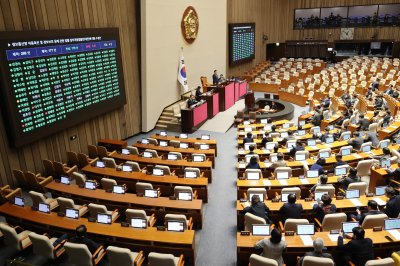
The National Assembly, led by the ruling Democratic Party, passes an anti-fake news bill during a plenary session in Seoul, South Korea, 24 December 2025. Lawmakers of the main opposition People Power Party left the session in protest, abstaining from a vote on the bill. Photo by YONHAP/EPA

Dec. 28 (Asia Today) — South Korea’s ruling Democratic Party of Korea on Saturday urged the opposition People Power Party to apologize for what it called past efforts to suppress critical media through high-value lawsuits, before criticizing a proposed revision to the Press Arbitration Act.

At a press conference, Democratic Party spokesperson Kim Hyun-jung said the party had focused on “fact-setting” by respecting procedures such as correction and rebuttal reports, while accusing the People Power Party of being “obsessed with shutting down media outlets through massive lawsuits.”

“The very forces that trampled on the press with physical force and money are now talking about ‘freedom,'” Kim said. “Before attacking the revision to the Press Arbitration Act, they should first apologize for using money to trample press freedom.”

Her remarks came after the People Power Party criticized the Democratic Party-backed bill as a “gag law,” arguing it would create a climate that silences both the public and the press.

The Democratic Party countered by citing what it described as examples of media suppression under former President Yoon Suk Yeol’s administration. Kim said certain media outlets were barred from boarding the presidential plane and were threatened with lawsuits over reporting on vulgar language, which she described as attempts to silence the press through both direct and financial pressure.

She added that data from the Press Arbitration Commission showed all 65 high-value damage claims exceeding 50 million won (about $37,000) filed through September this year were brought by the People Power Party, with none resulting in court-ordered damages.

“Even a child can tell what real oppression is,” Kim said. “The Democratic Party will push ahead with media reform to protect press freedom and the public’s right to know.”

— Reported by Asia Today; translated by UPI

© Asia Today. Unauthorized reproduction or redistribution prohibited.

Source link

Korean won ends week stronger but 2025 average nears record

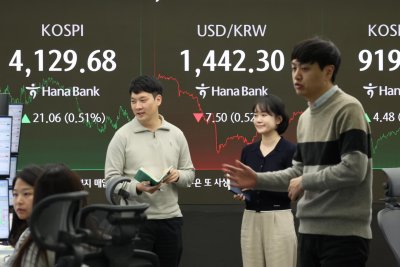
Dealers talk at Hana Bank’s dealing room in Seoul on Dec. 26 as the won closed at 1,440.3 per dollar, up 9.5 won. The KOSPI ended up 0.51%. Photo by Yonhap News Agency

Dec. 28 (Asia Today) — South Korea’s won strengthened sharply last week after market-stabilization steps by authorities and currency-hedging moves by the National Pension Service, but the currency’s annual average exchange rate still posted its highest level since the financial crisis, keeping investors on edge.

In Seoul trading, the won closed at 1,440.3 per U.S. dollar at 3:30 p.m. Friday, its lowest level in about six weeks since Nov. 4, when it ended at 1,437.9.

The exchange rate had neared this year’s peak earlier last week, briefly moving past the 1,480 level. It then fell more than 30 won (about 2 cents) per dollar on Wednesday after foreign exchange authorities announced supply-and-demand measures along with an unusually pointed verbal warning to the market. On Friday, reports that the National Pension Service had carried out strategic currency hedging pushed the exchange rate into the 1,420 range during the session.

After the drop, the year-end closing rate set to be finalized Tuesday is now likely to end below last year’s 1,472.5 per dollar, a benchmark used by companies and financial institutions to value foreign-currency liabilities on financial statements.

Seo Jeong-hoon, a senior research fellow at Hana Bank, said a high year-end exchange rate could hurt the credit profile of firms and financial institutions with large foreign-currency debts, potentially weighing on corporate lending and investment next year.

Even so, volatility concerns are expected to persist as the exchange rate remains elevated by historical standards. Through Friday, the average exchange rate this year based on weekly closing prices was 1,421.9 per dollar, above the 1998 average during the foreign exchange crisis of 1,394.9, data from the Seoul foreign exchange market showed.

Market talk has increasingly described the weak won as a “new normal.” Major global investment banks have forecast the won-dollar exchange rate will average between 1,420 and 1,440 next year. Three-month forecasts from 12 investment banks, including Standard Chartered and Nomura, averaged 1,440, while six-month forecasts averaged 1,426, the report said.

The International Monetary Fund last year estimated the appropriate won-dollar exchange rate at around 1,330, suggesting those forecasts imply the won would remain weaker than its estimated fair value next year.

Moon Jeong-hee, chief economist at KB Kookmin Bank, said an annual average exchange rate in the 1,420 range is “excessively high” relative to South Korea’s economic fundamentals. If it becomes entrenched, she said, expectations of a structurally weak won could take hold and further dampen domestic investment.

— Reported by Asia Today; translated by UPI

© Asia Today. Unauthorized reproduction or redistribution prohibited.
Source link

Pentagon report projects China could field nine carriers by 2035

Royal Navy aircraft carrier HMS Prince of Wales(R09) arrives at Tokyo International Cruise Terminal in Tokyo, Japan on Thursday, August 28, 2025. File Photo by Keizo Mori/UPI | License Photo

Dec. 27 (Asia Today) — China’s push to become a major aircraft carrier power, which gained momentum after it commissioned its first carrier in 2012, could expand into a fleet of nine carriers by 2035, according to a new U.S. Defense Department report.

China had no aircraft carriers before it commissioned the Liaoning in September 2012 after purchasing the unfinished former Soviet carrier Varyag from Ukraine in 1998 and refitting it for 14 years, according to Beijing-based sources familiar with military developments.

China later commissioned the Shandong in December 2019, its first domestically built carrier, and recently added a third carrier, the Fujian, which U.S. officials described as China’s first indigenously designed flat-deck carrier.

Foreign media reports have said China plans to operate six aircraft carriers by 2035, including two nuclear-powered ships, a target that some analysts consider plausible given the pace of its buildup since 2012.

However, the U.S. Defense Department’s annual report on China’s military power, released Tuesday, said “the PLAN aims to produce six aircraft carriers by 2035 for a total of nine,” raising the possibility that China’s carrier force could approach U.S. levels within a decade.

Chinese media have reported that China’s fourth aircraft carrier could enter service in 2027 and may be nuclear-powered with a displacement of about 120,000 tons, as Beijing continues to expand its blue-water capabilities.

— Reported by Asia Today; translated by UPI

© Asia Today. Unauthorized reproduction or redistribution prohibited.

Source link

China industrial profits post steepest drop in 14 months

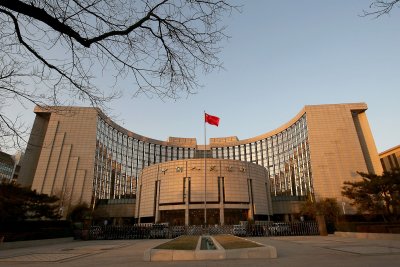
China’s national flag flies in front of the People’s Bank of China, the country’s central bank, in Beijing on Monday, January 18, 2021. The world’s second largest economy grew 2.3% in 2020, the slowest in decades but showing slow recovery even as the rest of the world was upended by the coronavirus pandemic. File Photo by Stephen Shaver/UPI | License Photo

Dec. 27 (Asia Today) — China’s industrial profits in November posted their sharpest year-on-year decline in 14 months amid weak domestic demand and deflation concerns, according to data released Friday.

Reuters and other outlets reported that China’s National Bureau of Statistics said industrial profits in November fell 13.1% from a year earlier. The decline followed an October drop of 5.5%, marking the second consecutive monthly fall and the weakest reading since September last year, when profits fell 27.1%.

Cumulative industrial profits for January through November rose 0.1% from a year earlier, slowing from 1.9% growth in the January-October period, the bureau said.

By sector, mining profits fell 27.2% in the January-November period, while profits rose in manufacturing (+5.0%) and utilities such as electricity and water (+8.4%).

Coal mining and ore processing profits fell 47.3% over the first 11 months of the year, the data showed. Profits rose in computer, communications and other electronic equipment manufacturing (+15.0%) and automobile manufacturing (+7.5%).

Reuters said industrial profits remain sluggish despite strong exports, reflecting weak domestic demand and fueling calls for additional stimulus measures.

The report said Beijing has not announced new stimulus as the government’s “around 5%” growth target for this year is seen as within reach, though expectations for further support persist as authorities have repeatedly pledged to boost domestic demand and promote employment next year.

China’s industrial profits are calculated based on enterprises with annual main business revenue exceeding 20 million yuan, about 4.1 billion won ($3.1 million).

— Reported by Asia Today; translated by UPI

© Asia Today. Unauthorized reproduction or redistribution prohibited.

Source link

World Darts Championship 2025 results: Rob Cross sets up Luke Littler tie as Gary Anderson progresses

Former winner Rob Cross cruised through at the PDC World Championship and set up a last-16 tie against defending champion Luke Littler.

Cross, who won the event in 2018, brushed aside Australian and 16th seed Damon Heta in a comfortable 4-0 win.

The 17th seed was joined in round four by two-time winner Gary Anderson, who edged a final-set thriller against Dutchman Gary Wattimena.

Scot Anderson went 3-1 up in a game played at a ferocious pace, and was impressive in averaging 121 in set three.

He missed three match darts in the fourth set, hitting double eight with his first dart with 32 required, before missing the same target twice.

Wattimena powered back and forced a final set, despite Anderson missing more match darts at tops in set four.

Anderson went eight darts into the nine-darter in the final set, before going high on the double 12, and eventually claimed the set 5-3 to continue his quest to be the tournament’s oldest winner at 55.

He averaged 102.24 – the eighth-highest average in this year’s tournament – and was at 37.5% on the checkouts.

“It’s no good for my age. It’s hard, especially with Jermaine on you. What a game,” Anderson told Sky Sports.

“The last two games, 4-0, 4-0. I hope that’s made up for it. I’m going to lie down now.

“I bottled the nine-darter, like I bottled a lot of doubles. I was getting excited, I don’t often do that up there. But I got it done.”

Sunday’s action began with 20th seed Ryan Searle reaching the fourth round for the first time since 2021 with a 4-0 demolition of Germany’s Martin Schindler.

Source link

Lee Jun-seok slams Democrats over special prosecutor

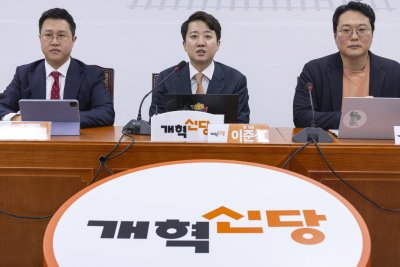
Lee Jun-seok (C), leader of the minor New Reform Party, speaks during a meeting of its Supreme Council at the National Assembly in Seoul, South Korea, 24 December 2025. Photo by YONHAP/EPA

Dec. 26 (Asia Today) — Lee Jun-seok, leader of the Reform Party, on Tuesday accused the Democratic Party of Korea of twisting itself “in every possible way” to avoid a special prosecutor investigation, pledging to step up talks with the People Power Party on joint action after Christmas.

Speaking to reporters after a Supreme Council meeting at the National Assembly, Lee said discussions on coordinated resistance would intensify once Christmas had passed, citing the physical toll of a near 24-hour filibuster carried out by People Power Party lawmaker Jang Dong-hyuk.

“There may be talk of hard-line measures such as hunger strikes or head-shaving protests,” Lee said. “But for now, the priority is to pressure the Democratic Party to give a clear answer.”

Lee noted that he himself had engaged in a prolonged hunger strike nearly nine years ago, adding that he was neither afraid of political confrontation nor short of ideas.

He branded the Democratic Party’s stance as “classic double standards,” arguing that while aggressive investigations had already been pursued against one political camp, similar scrutiny was being blocked when directed at the party itself. “That does not meet any reasonable standard of fairness,” he said.

Lee also pointed to the case of Kwon Seong-dong, a former People Power Party floor leader, who has been standing trial in detention for months based on testimony from the same individual. “If that measure was justified, then the special prosecutor into the Unification Church should be handled just as swiftly,” Lee argued, warning that delays could be seen as allowing time for evidence destruction or coordination of statements.

On prospects for passing the special prosecutor bill before the end of the year, Lee again pressed the Democratic Party, criticizing it for claiming time constraints while continuing to push through other legislation. He questioned whether efforts to revise laws aimed at removing National Assembly Vice Speaker Joo Ho-young should take precedence over the special prosecutor issue.

Lee dismissed suggestions from within the People Power Party to pursue the bill through a fast-track procedure, calling the idea unrealistic. “Rather than scattering the debate, this issue demands a serious and weighty response, as the public is watching closely,” he said.

–Copyright by Asiatoday

Source link

Japan okays $58B defense budget amid tensions with China

Dec. 26 (UPI) — The Japanese government on Friday approved a record $58 billion defense budget for the 2026 fiscal year amid worsening diplomatic tensions with China.

The allocation is 9.4% more than budgeted for defense in 2025 and is a new record for defense spending when the new fiscal year starts in April.

The funds will help pay for cruise missiles and unmanned defense systems as Japan enters the fourth year of its five-year plan to bolster its military, Newsweek reported.

During that time span, Japan is investing about 2% of its annual gross domestic product to modernize its military with state-of-the-art equipment, including drones.

It also demonstrates a significant shift in Japan’s defensive priorities after spending relatively little on national defense for several decades.

The new spending will bolster Japan’s land, sea and air coastal defenses with unmanned assets and a greater ability to attack enemies from beyond their respective ranges, according to The Japan Times.

Japan is building up its Synchronized, Hybrid, Integrated and Enhanced Littoral Defense drone system that commonly is referred to as SHIELD.

“This system will enable Japan to adopt new warfare methods, firmly protect the lives of personnel and halt enemy invasions of islands at the coastline,” Japanese Defense Minister Shinjiro Koizumi told media.

The system is slated to go into service in 2027 and will provide Japan with an ample supply of “inexpensive unmanned aerial, surface and underwater vehicles” that can be used to attack enemy targets and conduct reconnaissance.

A large quantity of relatively affordable drones is available from the United States, Australia, Turkey and other nations.

Japan also is improving its counterstrike capabilities with better anti-ship missiles and intends to acquire hypersonic missiles that can fly five or more times faster than the speed of sound.

Such improvements would improve Japan’s ability to strike enemy targets from a long distance and more effectively deter potential aggression against the island nation.

Source link

Thailand, Cambodia agree to 72-hour cease-fire amid border war

Cambodian Defense Minister Tea Seiha, left, and Thai Defense Minister Natthaphon Narkphanit exchange cease-fire agreement documents after three days of negotiations to end a weeks-long battle along the two countries border. Photo by Defense Ministry of Thailand/EPA

Dec. 27 (UPI) — Weeks into a vicious border war that has killed dozens of people and displaced roughly half a million, Thailand and Cambodia agreed to a 72-hour cease-fire on Saturday.

The countries announced in a joint statement that they would not conduct any military activities along the border, although their troops can stay there, in an effort to have a prolonged period of peace to see if the cease-fire will hold, The New York Times and Financial Times reported.

The agreement comes after several days of negotiations to end renewed fighting that has plagued the border region for weeks, including Thai air strikes on Cambodia’s Banteay Meanchey Province early Friday morning.

“The signing is not the end, but the beginning of proving sincerity through action,” Thailand’s Air Chief Marshal Prapas Sornchaidee said in a statement posted to X.

“Thailand will proceed based on the same principles it has consistently communicated to the international community,” said Sornchaidee, who is acting as director of the joint press center and principle spokesperson on the border negotiations.

The cease-fire was due to start at 12:00 p.m. local time, with all fighting and military activity halted and both sides avoiding “unprovoked firing or advancement or movement of troops toward the other side’s positions,” according to the agreement.

The agreement requires both sides to refrain from any type of provocative actions, to avoid disseminating “false information or fake news” and to commit to efforts for both countries to better work together.

Additionally, if the cease-fire holds for the full 72 hours, Thailand agreed to return 18 Cambodian soldiers — something it initially agreed to do in October — and both sides will start to allow civilians to return to their homes along the 500-mile border between the countries.

The soldiers were captured in July after weeks of fighting, which also had resulted in a cease-fire and an eventual peace accord signed in October in Kuala Lumpur.

That cease-fire and peace agreement rumbled in November when Thailand accused Cambodia of laying new landmines along its border — weapons that both countries have employed — Financial Times reported.

The new agreement, which was signed at 10:30 a.m. local time on Saturday morning, follows recent overtures from the United States and China to increase diplomatic efforts and end the conflict, the New York Times reported.

“The United States welcomes this announcement from Cambodia and Thailand on reaching a cease-fire that halts hostilities along their border,” U.S. Secretary of State Marco Rubio said in a statement. “We urge Cambodia and Thailand to immediately honor this commitment and fully implement the terms of the Kuala Lumpur Peace Accords.”

With a cease-fire agreed to after three days of negotiations, a trilateral meeting between the foreign ministers of Cambodia, Thailand and China will be held on Sunday and Monday to continue working toward a more lasting peace, Cambodian officials said.

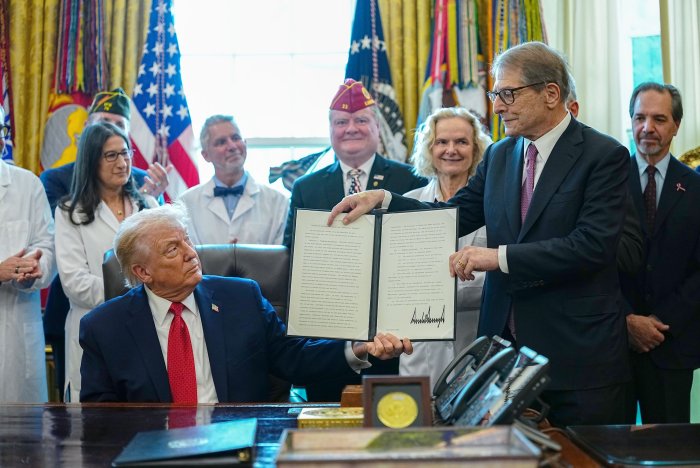
President Donald Trump holds a signed executive order reclassifying marijuana from a schedule I to a schedule III controlled substance in the Oval Office of the White House on Thursday. Photo by Aaron Schwartz/UPI | License Photo

Source link

Magnitude 6.6 earthquake near Taiwan disrupts rail services

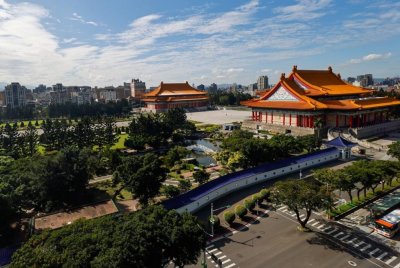
A 6.6-magnitude earthquake about 20 miles off Taiwan’s east coast briefly disrupted rail services and power to 3,000 homes late Saturday night. Photo by Ritchies B. Tongo/EPA

Dec. 27 (UPI) — A 6.6-magnitude earthquake was recorded off Taiwan’s northeastern coast on Saturday night, but no injuries or significant damage were reported.

The earthquake struck offshore at 11:05 p.m. local time and was located 20 miles east of Yilan County Hall.

The epicenter was 45 miles beneath the Earth’s surface, which largely protected Taiwan against harm and helped to prevent a tsunami warning.

The earthquake was felt in 17 of Taiwan’s 22 counties, which created a seismic intensity of 4 on the island’s 7-point scale.

Six of Taiwan High Speed Rail’s trains temporarily stopped upon detecting seismic alerts near Nangang and Yunlin.

Metro rail services in Taipei and Taichung reduced their respective speeds for a short time before resuming normal speeds late Saturday night.

More than 3,000 homes in Yilan lost power for a short period, but it was restored.

The U.S. Geological Survey recorded the earthquake as magnitude 6.6, but Taiwan’s Central Weather Administration reported it as magnitude 7.0.

Taiwan is located in an active seismic zone and on Wednesday recorded a 6.1-magnitude earthquake that impacted the coastal county of Taitung in the southeastern part of the island.

That earthquake also shook buildings in the capital city of Taipei.

Source link

Italian authorities arrest 9 alleged Hamas fundraisers

Italian officials on Saturday announced the arrests of nine people who are accused of using charities to raise $8.2 million, most of which funded Hamas. File Photo by Mohammed Saber/EPA

Dec. 27 (UPI) — Nine people who are accused of raising more than $8 million in Italy to help fund Hamas have been arrested by Italian authorities.

The nine are accused of raising $8.2 million over the past two years to help fund Hamas after it carried out the Oct. 7, 2023, attack on Israeli civilians and started the war in Gaza.

“The operation completed this morning by the State Police and the Guardia di Finanza (Financial Police) is a very important and significant one, with the arrest of nine people, including the most well-known Mohammad Hannoun,” Italian Interior Minister Matteo Piantedosi said in a post on X on Saturday.

“Despite the necessary presumption of innocence that must always be recognized at this stage, the veil has been torn away on behaviors and activities that, behind the facade of initiatives to benefit the Palestinian population, concealed support for and participation in organizations with actual terrorist aims of an Islamist nature,” Piantedosi said.

“This is a danger to which our government is paying the utmost attention,” he added.

A joint investigation by Italy’s counter-terrorism and financial police forces started after the 2023 attack on Israel by Hamas and Islamic Jihad.

Investigators uncovered a fundraising system with headquarters in Genoa and associates in Milan that raised the funds under the pretext of supporting Gazans.

“The suspects collected donations intended for the civilian population of Gaza,” a police statement said.

“However, it emerged that 71% of these funds were diverted to Hamas’ coffers to finance its military wing and support the families of suicide bombers or those detained for terrorism,” the police officials said.

Central to the investigation is Hannoun, who is the president of the Palestinian Association that is based in Italy and has denied being a financier for Hamas.

The funds allegedly were raised by Hannoun and eight other defendants through three charities and laundered to hide their true destination.

Hamas is a designated foreign terrorist organization by the United States and many other nations.

President Donald Trump holds a signed executive order reclassifying marijuana from a schedule I to a schedule III controlled substance in the Oval Office of the White House on Thursday. Photo by Aaron Schwartz/UPI | License Photo

Source link

Deadly Russian attacks continue ahead of Trump-Zelensky meeting

1 of 4 | Russia targeted Kyiv with 40 missiles and nearly 500 drones that killed one and injured 27 during an early morning aerial assault on the Ukrainian capital on Saturday. Photo by Sergey Dolzhenko/EPA

Dec. 27 (UPI) — Russian attacks on Kyiv killed at least one and injured 27 early Saturday morning as Ukrainian President Volodymyr Zelensky prepares to meet with President Donald Trump on Sunday.

The Russian aerial assault started at 1:30 a.m. local time in Kyiv with missiles and attack drones dispatched in waves, causing Kyiv Mayor Vitali Klitschko to warn residents to stay in air raid shelters, The New York Times reported.

An estimated 40 missiles and 500 drones knocked out power in much of the city during the aerial assault.

Zelensky said the attack is the latest example of why Ukraine needs its international partners to help guarantee the nation’s security before agreeing to end the war that started when Russia invaded on Feb. 24, 2022.

Zelensky and Trump are scheduled to meet in Florida on Sunday, and the Ukrainian president is hopeful of securing a legally binding security guarantee.

“This depends primarily on President Trump,” Zelensky told media. “The question is what security guarantees President Trump is ready to give Ukraine.”

The Ukrainian president has drafted a 20-point peace plan that includes the creation of a demilitarized zone between Russia and Ukraine.

He told Axios that he hopes it will lead to a framework for a cease-fire and a lasting peace that the Ukrainian people would support.

That framework might include a 60-day cease-fire to give Ukraine time to schedule and hold a national referendum, which may include territorial concessions to end the war.

Russian officials have said they understand the need for a referendum, but they want a shorter timeframe to get it done.

Before Sunday’s meeting, Zelensky is stopping in Canada on Saturday to meet with Canadian Prime Minister Mark Carney and hold virtual discussions with European leaders.

Carney and Zelensky will meet in Halifax, Nova Scotia, and have scheduled joint calls with leaders from the United Kingdom, France, Italy and Germany, according to Sky News.

President Donald Trump holds a signed executive order reclassifying marijuana from a schedule I to a schedule III controlled substance in the Oval Office of the White House on Thursday. Photo by Aaron Schwartz/UPI | License Photo

Source link

Israel’s recognition of Somaliland slammed across world capitals | Politics News

Regional blocs join nations in condemning Israel’s move to formally recognise breakaway Somali region as independent.

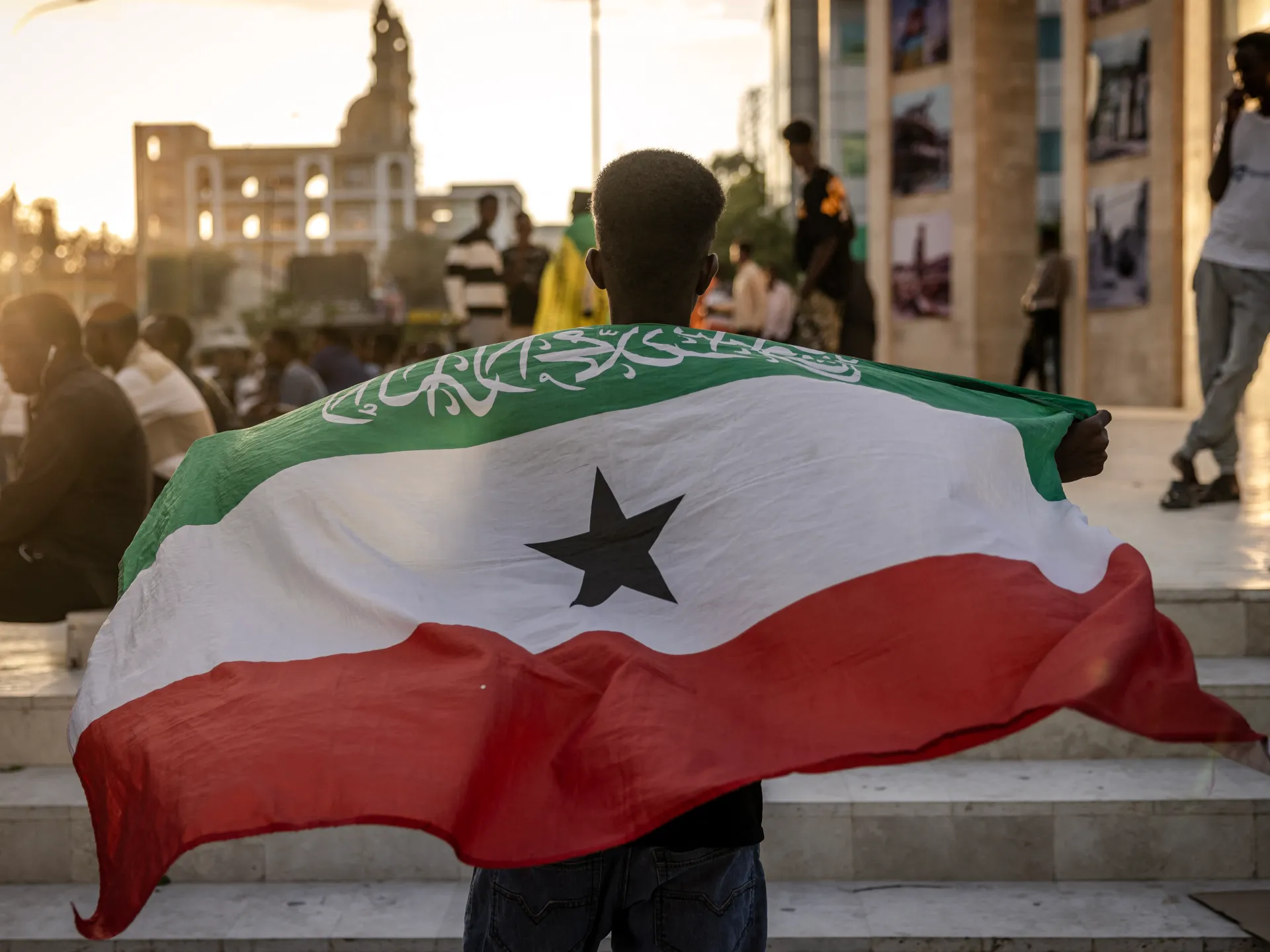
The Arab League, the Gulf Cooperation Council (GCC) and the African Union (AU) have joined numerous countries decrying Israel’s formal recognition of the northern Somali breakaway region of Somaliland as an independent state.

Somaliland, a region in the Horn of Africa, declared independence from Somalia in 1991 and has pushed for international recognition for decades, with President Abdirahman Mohamed Abdullahi making it a top priority since taking office last year.

Recommended Stories

list of 4 itemsend of list

Israel announced on Friday that it viewed Somaliland as an “independent and sovereign state”, becoming the first country to make such a declaration.

The announcement prompted Somalia to call the decision a “deliberate attack” on its sovereignty that would undermine regional peace.

In a statement on Friday, the AU continental bloc rejected Israel’s move and warned that it risked “setting a dangerous precedent with far-reaching implications for peace and stability across the continent”.

The AU Commission chair, Mahmoud Ali Youssouf, said the institution “firmly rejects any initiative or action aimed at recognising Somaliland as an independent entity, recalling that Somaliland remains an integral part of the Federal Republic of Somalia”.

‘Dangerous precedent’

Arab League Secretary-General Ahmed Aboul Gheit called Israel’s action “a clear violation of international law and a flagrant infringement of the principle of the unity and sovereignty of states”.

“Any attempt to impose unilateral recognitions constitutes an unacceptable interference in Somalia’s internal affairs and sets a dangerous precedent that threatens regional and international security and stability,” he warned.

The GCC called the development “a grave violation of the principles of international law and a blatant infringement” of Somalia’s sovereignty.

“This recognition represents a dangerous precedent that will undermine the foundations of stability in the Horn of Africa region and open the door to further tensions and conflicts, contradicting regional and international efforts aimed at strengthening international peace and security in the region,” GCC Secretary-General Jasem Albudaiwi said in a statement.

The European Union said it respected Somalia’s territorial integrity and sovereignty, calling for dialogue between the Somali national government and Somaliland.

The foreign ministers of Somalia, Egypt, Turkiye and Djibouti also condemned Israel’s recognition of Somaliland, saying: “The ministers affirmed their total rejection and condemnation of Israel’s recognition of the Somaliland region, stressing their full support for the unity, sovereignty and territorial integrity of Somalia.”

Egypt’s Ministry of Foreign Affairs made the statement following a phone call between the countries’ top diplomats on Friday.

Somalia demands reversal of recognition

Qatar, Iran, Saudi Arabia, Pakistan and China were among the other countries that condemned Israel’s move.

The Palestinian Authority and Hamas also rejected Israel’s recognition of Somaliland.

On Friday, Somalia demanded Israel reverse its recognition of Somaliland as independent, condemning the move as an act of “aggression that will never be tolerated”.

However, Somaliland leader Abdullahi hailed Israel’s decision as a “historic moment” and said in a post on X that it marked the beginning of a “strategic partnership”.

As world leaders weighed in, Somalia’s al-Qaeda-linked armed group al-Shabab pledged on Saturday to fight any attempt by Israel “to claim or use parts of Somaliland”.

“We will not accept it, and we will fight against it,” the group that has waged a decades-long armed rebellion in the region said in a statement.

United States President Donald Trump also commented on the issue.

Asked by the New York Post newspaper whether Washington planned to also recognise Somaliland, Trump said “no”.

“Does anyone know what Somaliland is, really?” he added on Friday.

Source link

Ministry rebukes Coupang over data probe claim

South Korean Minister of Science and ICT Bae Kyung-hoon (2R on right row), speaks during an inter-agency government meeting on Coupang’s personal data leak at the government complex in Seoul, South Korea, 30 November 2025. Photo by YONHAP/EPA

Dec. 26 (Asia Today) — South Korea’s Ministry of Science and ICT (MSIT) said Thursday it had lodged a strong protest after Coupang unilaterally disclosed what it called investigation results into a customer data breach, stressing that the claims have not been verified by the ongoing joint probe.

In a press release, the ministry said a public-private joint investigation team is still closely examining the type, scale and cause of the data leak. “The assertions made by Coupang have not been confirmed by the joint investigation team,” MSIT said.

Earlier in the day, Coupang posted a notice on its website stating that it had identified the leaker and secured all devices and hard disk drives used in the breach. The company claimed that, based on its investigation to date, the leaker stored customer information limited to about 3,000 accounts and subsequently deleted all of it.

Coupang also said it used forensic evidence, including “digital fingerprints,” to identify a former employee responsible for the leak, adding that the individual confessed to all actions and provided a detailed account of how customer information was accessed.

MSIT reiterated that any conclusions regarding the incident must come from the joint public-private investigation, cautioning against premature disclosures that could mislead the public while the probe remains underway.

–Copyright by Asiatoday

Source link

Trump gifts White House golden key to Lee

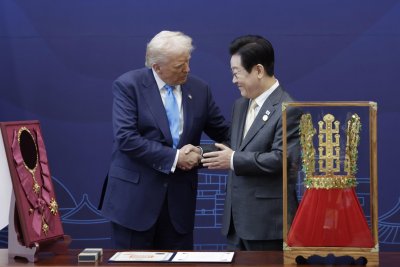
South Korean President Lee Jae Myung (R) shakes hands with US President Donald Trump (L) after conferring the state-awarded Grand Mugunghwa Medal, South Korea’s highest order of civil merit, on Trump ahead of their talks at the National Museum in Gyeongju, North Gyeongsang Province, southeastern South Korea, 29 October 2025. In front of Lee is a replica of a Korean gold crown from a royal tomb of the Silla Kingdom (57 B.C.–A.D. 935) that was gifted to the US leader. Photo by YONHAP/EPA

Dec. 26 (Asia Today) — US President Donald Trump has presented South Korean President Lee Jae-myung with a symbolic “Key to the White House,” returning a diplomatic gesture after receiving a replica of a Silla-era gold crown earlier this year.

Kang Hoon-sik, chief of staff at the presidential office, said on Facebook on Tuesday that Trump sent Lee one of only five specially made golden keys associated with the White House, noting it was the final remaining piece. Trump reportedly decided to send the gift after receiving a particularly meaningful present during his visit to South Korea in October.

During the October APEC summit in Gyeongju, Lee presented Trump with a model of the gold crown excavated from Cheonmachong, a royal tomb from the ancient Silla Kingdom, as part of a bilateral summit between the two leaders.

According to Kang, the golden key was delivered on Dec. 16 when South Korea’s ambassador to the United States, Kang Kyung-wha, met Trump for talks. During the meeting, Trump was quoted as saying, “I really like him,” referring to Lee, and highlighting what he described as a strong cooperative relationship between the two presidents.

The White House golden key is said to have been personally designed by Trump to be given only to select guests of special significance. The key presented to Lee is engraved with the U.S. presidential seal and the words “Key to the White House.”

The honor places Lee among a small group of recipients that includes Israeli Prime Minister Benjamin Netanyahu, former Japanese Prime Minister Taro Aso, Tesla CEO Elon Musk, and football star Cristiano Ronaldo.

Kang also recalled an anecdote from a memoir by Trump’s son-in-law, Jared Kushner, which described Trump jokingly telling Netanyahu that even after leaving office, showing the key at the White House gate would grant him entry.

“This golden key, carrying special meaning, is hoped to become a symbol of the strong South Korea-U.S. relationship,” Kang said, adding that the administration would continue working toward a solid future for the bilateral alliance.

–Copyright by Asiatoday

Source link

Hanwha rises as hub of US shipbuilding revival

Hanwha Group Vice
Chairman Kim Dong-kwan, second from right, explains the conglomerate’s
shipbuilding facilities to US Navy Secretary John Phelan, far right, at Hanwha’s
Geoje shipyard in South Korea, Wednesday. Photo courtesy of Hanwha Ocean

Dec. 26 (Asia Today) — Hanwha Group is positioning itself as a central player in the United States’ drive to revive its shipbuilding industry, with its Philadelphia shipyard emerging as a key operational base for Washington’s plan to restore naval power under President Donald Trump’s so-called “Golden Fleet” initiative.

Hanwha hosted a media day on Dec. 22 at its Hanwha Philly Shipyard in Pennsylvania, showcasing not just facilities but what executives described as a ready-to-execute platform aligned with U.S. national strategy to rebuild shipbuilding capacity and strengthen naval forces.

The significance of the site was underscored the same day when Trump publicly announced his Golden Fleet vision – aimed at countering China’s expanding naval power – and explicitly cited cooperation with South Korean conglomerate Hanwha. Trump recalled that during World War II, the United States built more than four ships a day on average, vowing to restore that capability.

Industry officials say the Philadelphia shipyard represents the point where political ambition meets practical execution.

Tom Anderson, head of shipbuilding at Hanwha Defense USA, said the shipyard should be seen not as a future possibility but as a fully prepared asset. The Golden Fleet concept centers on large, potentially nuclear-capable platforms and advanced surface vessels, while also elevating domestic production capacity as a political priority.

Rather than limiting cooperation to a single frigate program, Anderson said Hanwha is targeting the U.S. Navy’s core platform – the Virginia-class nuclear-powered submarine. “Hanwha Philly Shipyard has the capability to build nuclear-powered submarines,” he said, stressing that readiness extends beyond any single model to the entire class of nuclear-propulsion platforms.

The U.S. Navy currently requires two submarines per year but produces only about 1.2 due to capacity bottlenecks. To address this gap, Anderson proposed leveraging proven designs instead of starting from scratch, applying South Korea’s shipbuilding expertise in shortening construction timelines to the Virginia-class framework.

Acknowledging the complexity of nuclear submarine construction, Anderson outlined key prerequisites: workforce expansion, deployment of skilled Korean technicians, recruitment of personnel with Virginia-class experience, and close coordination with the U.S. Navy’s Naval Reactors program.

On the sensitive issue of nuclear material control, Anderson drew clear boundaries. “The reactor compartment is provided by the U.S. government,” he said, adding that strict safeguards and procedures for nuclear material management are already in place. Hanwha, he said, would comply with the same standards applied to all U.S. nuclear-submarine shipyards.

Questions at the briefing focused on timing. While declining to commit to a specific schedule, Anderson emphasized Hanwha’s readiness to move quickly once government decisions are made. “We fully recognize the urgency of submarine production,” he said.

Supply-chain resilience also emerged as a key theme. Anderson said Hanwha plans to integrate South Korea’s robust shipbuilding supply network to stabilize schedules and accelerate delivery, while maintaining the principle of “Made in the USA” production. In effect, Korean suppliers would serve as the arteries supporting U.S.-built vessels.

Cho Jong-woo, head of Hanwha Philly Shipyard, said expanded shipbuilding in the United States would allow Korean component makers and partner firms to enter global supply chains and grow alongside the U.S. naval buildup.

As Washington seeks to turn shipbuilding revival from slogan into strategy, Hanwha’s U.S. foothold is increasingly viewed as a critical pillar in rebuilding America’s maritime power.

–Copyright by Asiatoday

Source link

Lee orders review of juvenile age threshold

South Korean President Lee Jae Myung delivers a speech during a press conference to mark his first 30 days in office at the Yeongbingwan (state guest house) of the Blue House, in Seoul, South Korea, 03 July 2025. Photo by Kim Min-Hee /EPA

Dec. 26 (Asia Today) — President Lee Jae-myung has ordered a formal review of lowering the age threshold for juvenile offenders exempt from criminal punishment, reviving a long-running debate amid growing public concern over youth crime. Legal experts broadly support the intent but caution that the move may have only limited deterrent effects.

During a policy briefing with the Ministry of Justice on Dec. 19, Lee instructed officials to place the issue of lowering the minimum age for criminal responsibility on the Cabinet agenda, according to officials.

Under South Korea’s Criminal Act, established in 1953, children aged 10 to under 14 are classified as juvenile offenders and are exempt from criminal punishment, instead receiving protective measures focused on education and rehabilitation. The system was designed to prioritize the reformability of minors over punitive sanctions.

Critics argue, however, that crimes committed by juvenile offenders have risen sharply in both number and severity. According to the Supreme Court’s Judicial Yearbook 2025, 7,294 juvenile offenders received protective dispositions in 2024, more than double the 3,465 recorded in 2020.

Serious offenses, including sexual crimes and acts of extreme violence, have also increased. Police data show that between Jan. 1 and Sept. 10, 2024, juveniles under 14 accounted for about 20 percent – 63 out of 318 suspects – arrested in deepfake-related sexual crimes, highlighting concerns over new forms of digital abuse.

Many in the legal community agree that the age standard should reflect changes in adolescents’ physical and mental maturity as well as the social environment. Kim Ji-yeon, an attorney with Lawyers for a New Future for Youth, said the widespread perception that offenders under 14 cannot be criminally punished has been exploited. “Some youths commit serious crimes like deepfake offenses believing authorities cannot punish them,” she said, noting that the non-disclosure of juvenile criminal records has also been abused.

Kim added that lowering the age by about one year could help address these problems, even if it partially conflicts with the system’s rehabilitative purpose. “In reality, victims are often even younger, and protecting minor victims must be a priority,” she said.

Shin Hye-sung, a lawyer at Yulwoo Law Firm and a former juvenile court judge, also voiced support for lowering the age in cases involving sexual crimes. “Many 13-year-olds today are far more mature than in the past and capable of committing serious offenses,” he said. “Allowing the possibility of criminal trials could have a necessary deterrent effect.”

Still, Shin stressed the limits of such a reform. “Lowering the age will not bring dramatic change,” he said, noting that the rise in juvenile cases is largely driven by school violence. “Contrary to public perception, it is extremely rare for children under 14 to commit crimes serious enough to warrant criminal trials. Since such cases are uncommon, the overall impact of an age cut would likely be modest.”

As the issue returns to the National Assembly agenda, attention is focused on whether the proposal – which has repeatedly stalled in the past – can gain enough consensus to move forward this time.

–Copyright by Asiatoday

Source link

Ashes 2025-26: Ben Stokes says there would be ‘hell on’ if MCG pitch for England win over Australia was produced elsewhere in the world

Prior to the Test, stand-in Australia captain Steve Smith described the pitch as “furry and green” and said “batters would have to be on their game”.

Speaking after his side were beaten, Smith said he was “not sure” why MCG head groundsman Matthew Page had opted to leave so much grass on the pitch for the Boxing Day Test – a marquee event in the Australian sporting calendar. Page will talk to the media on Sunday.

“We let them judge it and do what they see fit,” said Smith.

“I said before the game it looked like it was going to offer a fair amount and it probably did more than we thought it was going to.

“It’s tough as a groundsman, always looking for the right balance. Maybe if he took it from 10mm to eight it would have been a nice, challenging wicket, maybe a little bit more even. Groundsmen are always learning and maybe he’ll take something from that.”

Former England captain Michael Vaughan had criticised the MCG pitch after day one and said it had “done too much” and the result was an “unfair” contest between bat and ball.

Pitches and outfields that have hosted international matches are given a rating by the International Cricket Council (ICC).

Following the 2017 Ashes Test on this ground, the MCG pitch was given a “poor” rating for being too friendly for batting. Only 24 wickets fell across the entire Test and England’s Alastair Cook made an unbeaten 244.

On this occasion, England batter Joe Root, who also played in 2017, said this pitch was “challenging” to bat on.

“The argument is was it too one-sided – bat v ball? People are more qualified to judge that,” said Root. “It was certainly challenging from my point of view.

“You have a world-class attack and the ball is moving a considerable amount. Your job is to get on the right side of the result.”

Source link

Progressives also call disinformation law unconstitutional

1 of 4 |
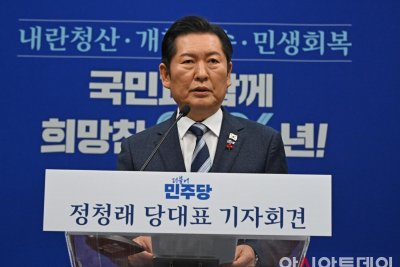
Jung Cheong-rae, leader of South Korea’s Democratic Party, speaks during his first news conference after taking office at the National Assembly in Seoul on Dec. 26. Photo by Asia Today

Dec. 26 (Asia Today) — A controversial revision to South Korea’s Information and Communications Network Act, driven through the National Assembly by the ruling Democratic Party, is facing a growing backlash not only from conservatives but also from within the broader progressive camp, with critics urging President Lee Jae-myung to exercise his veto.

The amendment, often dubbed the “anti-disinformation law,” passed the Assembly on Dec. 24 as the Democratic Party leveraged its 170-seat majority. However, smaller progressive allies – including the Progressive Party, the Basic Income Party and the Social Democratic Party – either opposed the bill or abstained, warning that it could violate constitutional protections on freedom of expression.

“The criteria for judging what constitutes harm to the public interest are unclear,” Sohn Sol, senior spokesperson for the Progressive Party, said in a statement on Wednesday. “There is a serious risk the law could be abused as a tool to arbitrarily suppress speech critical of those in power,” she said, calling on the president to return the bill to the Assembly.

During the plenary vote, Progressive Party lawmaker Jung Hye-kyung voted against the bill, while Sohn abstained. Lawmakers Yong Hye-in of the Basic Income Party and Han Chang-min of the Social Democratic Party also cast abstentions. Even Park Joo-min, a Democratic Party lawmaker, abstained, later saying that key provisions he had championed – including the complete repeal of criminal defamation for statements of fact and changes to complaint-based prosecution – were not included in the final version.

The revised law allows courts to award punitive damages of up to five times the assessed harm against media outlets or YouTubers found to have intentionally disseminated fabricated or manipulated information. It also empowers the Korea Communications Commission to impose fines of up to 10 billion won ($7.7 million) on those who repeatedly distribute content ruled to be false by the courts. Supporters argue the measures are necessary to dismantle profit-driven fake news operations.

Despite criticism from both opposition parties and parts of the progressive bloc, the Democratic Party has held firm. Party leader Jung Cheong-rae said “irresponsible freedoms that fuel chaos and profit from malicious agitation cannot be left unchecked,” while Supreme Council member Han Jun-ho dismissed warnings about chilled speech as “overblown.”

The main opposition People Power Party said it would seek legal remedies, including filing a jurisdictional dispute with the Constitutional Court, calling the law “an unconstitutional gag order that suffocates liberal democracy.” Floor leader Song Eon-seok urged President Lee to “immediately exercise his veto.”

Attention has also turned to the Justice Innovation Party, which played a swing role in the legislative process. While the party initially pushed alternative proposals – including limits on punitive damages claims by public officials and repeal of criminal defamation for factual statements – those demands were not fully reflected. The party ultimately backed the Democratic Party’s bill, citing future discussions on criminal law revisions, while securing amendments to strengthen defendants’ rights for journalists and other targets of lawsuits.

–Copyright by Asiatoday

Source link

The best New Year’s Eve movies playing this week, plus more showing in L.A.

Hello! I’m Mark Olsen. Welcome to another edition of your regular field guide to a world of Only Good Movies.

Even as the year winds down, there are still some exciting new releases hitting theaters.

Few films this year are arriving on quite the wave of expectation behind Josh Safdie’s “Marty Supreme,” in part because of the unhinged, go-for-broke promo push from its star Timothée Chalamet. The film tells the story of Marty Mauser, a shoe salesman in 1950s New York who dreams of becoming a champion table tennis player and will stop at nothing to make it happen.

As Amy Nicholson put it in her review, “Like Marty, Chalamet was raised in New York City, and since he arrived on the scene, there’s never been a doubt he’ll win an Oscar. The only question is, when? To Chalamet’s credit, he’s doing it the hard way, avoiding sentimental pictures for pricklier roles about his own naked ambitions. … The movie’s moxie makes it impossible not to get caught up in Marty’s crusade. We’re giddy even when he’s miserable.”

The surprise winner of the Golden Lion at this year’s Venice Film Festival, Jim Jarmusch’s “Father Mother Sister Brother” is a gently enigmatic film revolving around, as the title suggests, parents and siblings. Told in three separate stories — set in New Jersey, Dublin and Paris — the film stars Adam Driver, Tom Waits, Mayim Bialik, Cate Blanchett, Vicky Krieps, Charlotte Rampling, Luka Sabbat and Indya Moore.

A man sits alone in a living room.

Tom Waits in Jim Jarmusch’s movie “Father Mother Sister Brother.”

(Atsushi Nishijima / Mubi)

In his review, Tim Grierson wrote, “The film’s persistent brittleness may make some viewers antsy. That’s partly the point, but hopefully, they’ll soon be swept away by the movie’s melancholy undertow. … Eventually, we learn to look past Jarmusch’s deceptively mundane surfaces to see the fraught, unresolved issues within these guarded families. The characters occasionally expose their true selves, then just as quickly retreat, fearful of touching on real conflict.”

Tim Grieving spoke to composer Daniel Blumberg, who won an Oscar earlier this year for “The Brutalist,” about his work on “The Testament of Ann Lee,” director Mona Fastvold’s portrait of the founder of the Shaker religious movement. Singing and dance were an integral part of the Shakers’ spiritual practice, so the music for the film was of special importance.

“Ann Lee was very radical and extreme,” said Blumberg, “and Mona is as well.”

De Los also recently published a list of the 25 best Latino films of 2025 as picked by Carlos Aguilar. His favorites include Amalia Ulman’s “Magic Farm,” Pasqual Gutierrez and Ben Mullinkosson’s “Serious People,” Diego Céspedes’ “The Mysterious Gaze of the Flamingo,” Petra Costa’s “Apocalypse in the Tropics” and Kleber Mendonça Filho’s “The Secret Agent.”

All three of this year’s Envelope roundtables are now available to watch: actors, actresses and directors.

New Year’s Eve at the movies

A man and a woman embrace on a city street.

Daniel Day-Lewis and Vicky Krieps in the movie “Phantom Thread.”

(Laurie Sparham / Focus Features)

When people talk about holiday films, they typically mean Christmas. But what if the movies that featured a New Year’s Eve scene were sneakily better? To judge by the titles playing around town this week, an argument could be made.

Take for example Kathryn Bigelow’s “Strange Days.” An exciting techno-thriller set during the last two days of then-future 1999, it’s about a hustler (Ralph Feinnes) who finds himself in way over his head. The film builds to a huge millennial New Year’s Eve street party filmed in downtown Los Angeles. Still something of a rarity on streaming, “Strange Days” will be showing in 35mm at the New Beverly on Friday afternoon and then at the Aero on Wednesday 31, early enough in the evening to leave time for more fun after.

Then there is Paul Thomas Anderson’s achingly romantic and bitingly funny “Phantom Thread,” in which the controlling fashion designer Reynolds Woodcock (Daniel Day-Lewis) initially refuses to leave the house on New Year’s Eve, but then races to be with his muse and lover Alma Elson (Vicky Krieps) after she goes out without him. The movie will be showing on New Year’s Day in 70mm at the Aero.

Anderson’s 1997 “Boogie Nights,” which will show in 35mm at Vidiots on the afternoon of Dec. 31, features a very different take on New Year’s Eve. In a pivotal sequence, many of the film’s characters converge on a NYE party to ring in the transition form 1979 to 1980. It does not go well.

Two people sit on a couch in a living room.

jack Lemmon and Shirley MacLaine in 1960’s “The Apartment.”

(Bettmann Archive / Getty Images)

Billy Wilder’s “The Apartment” will play in 35mm at the New Beverly on Saturday and Sunday and also at the American Cinematheque’s Los Feliz Theater on Dec. 30. In the film Jack Lemmon is a lonely office drone who finds his complex relationship with a co-worker (Shirley MacLaine) ultimately coming to a head on a fateful New Year’s Eve.

Rob Reiner’s 1989 “When Harry Met Sally…” will likely be playing several times over the next weeks in tribute to the filmmaker. Starring Meg Ryan and Billy Crystal as two friends trying to figure out if their relationship can (or should) be something more, the film features not one but two memorable New Year’s Eve scenes. It will be playing at the New Beverly on Tuesday, Wednesday and Thursday.

Two women sit at a party.

Katie Holmes, left, and Sarah Polley in the movie “Go.”

(Tracy Bennett / Columbia Pictures)

Doug Liman’s “Go,” from a screenplay by John August, is not strictly speaking a New Year’s Eve movie, but it does take place in the sort of liminal zone of ongoing partying that occurs during holiday time. With a cast that includes Sarah Polley, Katie Holmes, Timothy Olyphant and many more, the film revolves around a few grocery store co-workers, some low-stakes drug dealing, questionable choices and a lot of miscommunication. The movie shows at Vidiots on Tuesday.

In a review of the film, Kevin Thomas wrote, “When all is said and done, ‘Go’ is a film about people going too far, which works precisely because its makers know when to hold back. ‘Go’ keeps us guessing … but it never forgets it’s a comedy; if it was too serious it would burst like a bubble. So uniformly skilled and talented is the film’s cast, which has 15 featured players, that it is impossible to single out any one. ‘Go’ is perfectly titled: Exhilarating and sharp, it never stops for a second.”

Points of interest

The Marx Brothers’ eternal comic mayhem

Three brothers dance and fight wildly at a party.

Chico Marx, left, Groucho Marx, Harpo Marx and Margaret Dumont in the movie “Animal Crackers.”

(Universal)

It has become a tradition around town for theaters to show Marx Brothers movies at the holidays, and who are we to argue with that? For pure whimsy and comedy that hits somewhere deep in the unconscious, the Marx Brothers are still pretty much unbeatable.

The New Beverly played some Marx Brothers movies on Christmas Day. For those who still want more, Vidiots will be showing 1935’s “A Night at the Opera,” directed by Sam Wood and including the famous stateroom scene in which more and more people cram into a single room on an ocean liner.

On New Year’s Day, the Aero will show 1933’s “Duck Soup,” directed by Leo McCarey, in which the brothers take over the fictional nation of Freedonia. That will be followed by 1930’s “Animal Crackers,” directed by Victor Heerman, in which Groucho Marx plays African explorer Rufus T. Firefly.

Eric Rohmer’s ‘The Green Ray’

A woman comforts a crying friend in a garden.

A scene from Eric Rohmer’s “The Green Ray.”

(Janus Films)

Initially released as “Summer” in the U.S., Eric Rohmer’s “The Green Ray” won Venice’s Golden Lion in 1986. The film follows Delphine (Marie Rivière, who co-wrote the script with Rohmer), a single woman in Paris, as she struggles to find someone to go on a holiday trip with her, leading to a series of serio-comic misadventures. The film will show Thursday in 35mm at the American Cinematheque’s Los Feliz Theater.

Reviewing the film in 1986, Michael Wilmington asked if watching a Rohmer film is really, to quote Gene Hackman on Rohmer movies in “Night Moves,” like watching paint peel? “Not at all,” Wilmington wrote. “‘Summer’ is one of the masterpieces of 1986. It’s one of the most finely wrought, stimulating films of an erratic year. It’s intellectual in the best sense: engaging you emotionally and mentally. It moves faster, wastes less time, and has more to offer than most movies now on view — and those who are skipping it are missing one of the year’s real treats.”

Source link

South Korea to open North Korea’s Rodong Sinmun to public access

1 of 2 | A foreign journalist who covered North Korea’s Punggye-ri nuclear test site demolition reads the Rodong Sinmun, the official newspaper of the country’s Workers’ Party, on a North Korean chartered flight heading to Beijing, China, 26 May 2018. Reporters from South Korea, China, Russia, the United States and Britain were invited to watch the dismantlement of the site, which was carried out on 24 May through a series of explosions over several hours. Photo by YONHAP/EPA

Dec. 26 (Asia Today) — South Korea’s Unification Ministry said Friday it will move ahead next week with administrative steps to make North Korea’s state newspaper, Rodong Sinmun, publicly accessible.

The ministry said a consultative meeting of supervisory agencies held Friday confirmed a consensus to reclassify Rodong Sinmun from “special materials” to “general materials,” clearing the way for broader public access.

Participants in the meeting included the Ministry of Unification, the National Intelligence Service, the Ministry of Culture, Sports and Tourism, the Ministry of Education, the Ministry of Science and ICT and the Korea Communications Commission.

Following completion of required administrative procedures, including the issuance of official notices to supervisory and handling agencies, the ministry said the reclassification will take effect next week.

Deputy Unification Ministry spokesperson Jang Yun-jeong said earlier Friday that the government has been reviewing ways to expand public access to North Korean materials. She noted that many such materials, including Rodong Sinmun, are currently designated as special materials and can be handled only by authorized agencies.

In a written response submitted Thursday to the office of Yoon Gun-young, the intelligence service said it plans to decide on reclassification through interagency consultations, citing the public’s right to know and the promotion of inter-Korean exchanges.

The Unification Ministry also said it is pushing to amend the Information and Communications Network Act and enact a separate law on the management and use of North Korean materials, a move that would allow access to North Korean websites and publications such as Rodong Sinmun.

President Lee Jae-myung has said the public should not be treated as inherently vulnerable to propaganda or agitation.

The plan has drawn mixed reactions. Some experts have urged a cautious, phased opening of North Korean media, while others have called for countermeasures against Pyongyang’s sophisticated propaganda efforts and warned of potential cybersecurity risks from North Korean websites.

— Reported by Asia Today; translated by UPI

© Asia Today. Unauthorized reproduction or redistribution prohibited.

Source link

Lee misunderstood question on North detainees, families unconvinced

Family members of victims of abductions, detentions and forced disappearances attend a public hearing calling for international solidarity at the Ministry of Unification in Seoul on Aug. 29, 2024. From left: Choi Jin-young, Kim Jeong-sam, Lee Shin-hwa, Choi Seong-ryong and Park Hye-ja. Photo by Yonhap News Agency

Dec. 26 (Asia Today) — South Korea’s Unification Ministry and the National Security Office have told families of South Korean nationals detained in North Korea that President Lee Jae-myung’s recent remarks on the issue resulted from a misunderstanding of a question and problems with on-site interpretation, according to relatives.

Family members said Unification Vice Minister Kim Nam-joong and officials from the ministry met relatives of detainees, including the families of missionaries Kim Jeong-wook and Choi Chun-gil, ahead of Christmas. They offered condolences and said the government would address the detainee issue, while explaining that Lee’s comments at a foreign press briefing on Dec. 3 stemmed from a misunderstanding of the question.

Relatives also said the National Security Office contacted families after the Dec. 3 briefing at the presidential guesthouse and said the detainee issue had been reported to Lee in September. Officials said Lee confused it with a separate case involving a South Korean detained in connection with a Cambodia scam incident, and said interpretation problems prevented an appropriate response, the families said.

At the Dec. 3 briefing, Lee responded to a question about South Koreans detained in North Korea by saying he was hearing about it “for the first time” and asked national security adviser Wi Sung-lak whether it was true. After the question was clarified, Lee said he lacked specific details and would review the matter.

The presidential office said the next day that six South Korean nationals, including defectors, were detained from 2013 to 2016 on charges including espionage.

Choi Jin-young, the son of detained missionary Choi Chun-gil, said he was told Lee knew about the detainees but there had been “a slight misunderstanding.” Choi said the government promised to handle the issue going forward.

But he said the explanations “sounded like nothing but excuses” and argued the case risks being forgotten. He said he urged the government to at least run a public awareness campaign.

Choi also criticized remarks in government briefings suggesting there is little that can be done without inter-Korean dialogue, saying families consider that “heartbreaking.” He said the government could still pursue cooperation by raising the issue with senior Chinese officials.

Kim Jeong-sam, brother of detained missionary Kim Jeong-wook, said he hoped the incident would prompt the government to focus more on the detainee issue. He said he was told the matter is included in the administration’s 100 key policy tasks, adding that the explanation about Lee’s remarks eased some concerns.

South Korea says six of its nationals have been detained in North Korea since 2013 through 2016 on charges including espionage. They include missionaries Kim Jeong-wook, detained in October 2013, Kim Guk-gi, detained in October 2014, and Choi Chun-gil, detained in December 2014, along with three former North Korean defectors. A defector journalist working for a North Korea-focused outlet is also reported to have been abducted by North Korea in China.

— Reported by Asia Today; translated by UPI

© Asia Today. Unauthorized reproduction or redistribution prohibited.
Source link