Facing an overmatched opponent that allowed him to freely tinker with his lineups, UCLA coach Mick Cronin tried plenty of mixing and matching Tuesday afternoon.
Perhaps the biggest takeaway was that a three-guard lineup might be the way to go after the continued struggles of centers Xavier Booker and Steven Jamerson II.
“We’ve got to find a way to play our best players and win, whoever they are, because it’s not Little League,” Cronin said after his team’s 97-65 victory over UC Riverside at Pauley Pavilion. “You’ve either got to give us some rebounding and defense or somebody else has got to play.”
The leading candidates for a larger role based on what happened against the Highlanders appear to be reserves Trent Perry, Jamar Brown and Brandon Williams.
Perry was a playmaking force with his scoring and smart passes. Brown did a little bit of everything in an energetic fashion. Williams showed plenty of toughness as the second big man in small lineups also featuring Tyler Bilodeau, who was an offensive juggernaut against a team that provided little defensive resistance.
“The biggest thing I care about is winning,” said Bilodeau, who finished with a career-high 34 points while making 12 of 19 shots to go with six rebounds. “So whatever we need to do to get that done.”
Cronin joked afterward that Bilodeau shouldn’t have missed any shots because he needlessly took fadeaway jumpers.
“They don’t double [team],” Cronin said of the Highlanders, “so I said, ‘Buddy, you’ve got one night here where they’re just going to let you keep dribbling until you shoot, so go have fun. Keep going at the rim until you score.’ ”
Guard Skyy Clark added 14 points to help UCLA (10-3) post its third consecutive victory going into an extended winter break. Forward Osiris Grady finished with 20 points for the Highlanders (6-8), who shot 42.6% to the Bruins’ 50%.
The game’s biggest revelations came off the UCLA bench. Perry might have been the biggest, running the offense at a high level while finishing with 14 points, seven assists and zero turnovers in 24 minutes. Cronin went with some lineups in the second half featuring Perry alongside starting point guard Donovan Dent (seven points and three assists in 19 minutes).
“Three-guard lineup, we’ve been pushing in transition a lot more,” Perry said. “I mean, we’re just finding the groove before Big Ten” play.
Brown contributed across the board, tallying four points, seven rebounds and four steals in 24 minutes.
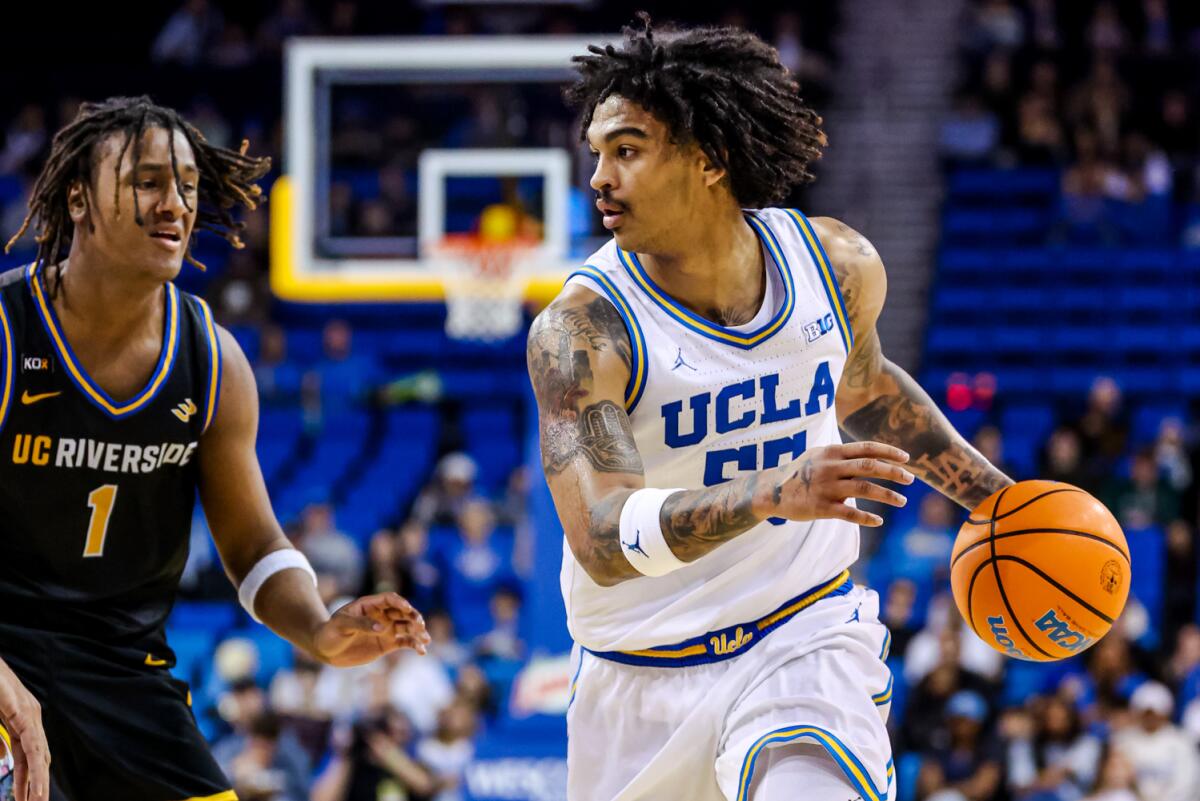
UCLA guard Skyy Clark drives against UC Riverside guard De’Undrae Perteete Jr. during the Bruins’ win on Tuesday.
(Jan Lim / UCLA Athletics)
“A tremendous portal find,” Cronin said of the transfer from the University of Missouri-Kansas City. “Great toughness. He’s a winning player.”
Williams’ biggest factor was his defense during a performance in which he had three points, one rebound and one steal in 18 minutes. The big question was whether he was providing more than the player whose spot he took.
Booker finished with six points and one rebound in 13 minutes, unfurling a second consecutive subpar showing after being limited to three minutes against Cal Poly because of matchups. Jamerson played only seven choppy minutes, once being yanked after an 11-second stint because of an inability to keep the Highlanders from reaching the rim with ease.
“Got to get better,” Cronin said of his centers. “I just talked to them about that.”
UC Riverside repeatedly made the mistake of leaving Bilodeau open in the first half and the forward made the Highlanders regret their decision by making five of nine shots on the way to 13 points. After having been UCLA’s primary center last year, Bilodeau said he was happy to go back to that role if that’s what his coach needed.
“Tyler would probably tell you he gets more open shots when he’s playing the five,” Cronin said, “because the other team’s five man is guarding him.”
Cronin said the issue that arises when going small is the need to be an elite offensive team — territory the Bruins might be approaching. Their offensive efficiency is ranked No. 27 nationally by the metrics of basketball analyst Ken Pomeroy, their best since they were No. 21 during the 2022-23 season that ended in the Sweet 16 of the NCAA tournament after season-ending injuries to Jaylen Clark and Adem Bona.
If this is the best version of the Bruins, Cronin appeared ready to roll with it.
“All that matters is who you become, not in the last game or the game previous to that, so we’re on a search,” Cronin said. “Just like every team, it’s not who you are now, it’s who you are at the end and can you get enough wins along the way?”
Our picks for this year’s best in arts and entertainment.
Thankfully, we can still turn to our bookshelves — and podcasts — to ground us. We tapped science doyenne Alie Ward, the host of the funny cult favorite “Ologies” podcast, to share her picks for the best science books of 2025.
Spanning fascinating subjects from bees to human anatomy, Ward’s insightful list reminds us that books remain a timeless vessel for truth and knowledge.
“Dr. Li is the botanist of our dreams… the way he talks about ferns and why he loves them, and about growing up in Taiwan (in essentially a fern forest), and how the sexual reproduction of ferns has been a great way to draw attention to the LGBTQ and nonbinary community is so charming and funny. They even named a whole genus after Lady Gaga because they were listening to ‘Born This Way’ a lot in the lab and also because there are sequences in their DNA that are ‘GAGA.’
“Laura Silburn’s illustrations are gorgeous — they really put a lot of texture into some of these plants that are really tiny. Every page is like looking at a botany poster. As we’ve seen so much science research being underfunded, especially in the last year, there’s this big question by the culture at large of why does it matter? Why does studying the fern genome matter? It has real-world impacts — that’s fewer pesticides on your crops because we figured out something from a foreign genome. I always love when something is overlooked or taken for granted and because of someone’s passion and their dedication to studying it, we learn that it can change our lives.”
“Krystle is an astounding photographer and an incredible visual artist. Her passion for native bees is infectious. A lot of people, when they think of bees, they think of honeybees. And honeybees are not even native to North America. They’re not native to L.A. They’re not native to this country. They’re feral livestock. What I love about her book is it opens your eyes to all of these species that are literally right under our noses that we wouldn’t even consider — and that a lot of people wouldn’t even identify as bees.
“The other reason why I love this book is that she puts these essays into it that are about her experiences going to find the bees. So you’re getting to see these gorgeous landscape pictures. You’re getting to see what it took to find the bee, how to look for it, and more about this particular species. It’s organized in these ABCs that you can pick up at any chapter and check out a bee you’ve never heard of before.”
“Justin is hilarious. He is such a good writer, and his voice is really, really approachable. The way that he writes about science is through such a wonderful pop culture and pop science lens. You feel like you’re reading a friend’s email who just has something really interesting to tell you.
“This book is all about anthropomorphizing everything from our toasters to why we like some spiders but hate other spiders. This is a discussion that is so important in this time when we literally have bots on our phones that are like, ‘I’ll be your best friend.’
“Justin speaks to human psychology and our need to want to be friends or villainize objects —or technology or animals — and project our own humanity onto them in ways that are sometimes helpful and sometimes dangerous.
“As a science communicator, you can tell people the most fascinating facts and can give them the best stories. But unless you can give people a takeaway, then a lot of times it doesn’t stick or the interest isn’t there. He really addresses the question of ‘Well, what does this mean for my life?’”
“The humanity that she brings is such a wonderful base for how our bodies fail us sometimes and what we are trying to do to bring them back. From her being present during orthopedic surgeries and the way that she describes the sound of hammer on bone (and just the kind of jovial atmosphere in an operating room that, as a patient, you would never be clued in about because you are passed out half dead on a slab). She really soaks up a vibe that you would never have access to. She goes to Mongolia to learn about eye surgery there in yurts. She takes you to places you would never be able to go. She’s rooting around in archives and old papers — she just makes anything interesting.
“Mary really is both an ally and an outsider, and I think that that’s a really beautiful thing in her book.”
“Anna Gifty Opoku-Agyeman is an absolute force. I’ve followed her work in economics and in equity for years, and I was really excited for this book to come out. We did an episode on kalology, which is the study of beauty standards, years ago and I have always loved the conversation of how different members of society have a certain tax on them — these extra resources that they are expected to provide.
“I was really excited to read about specifically women of color, because that is something that I don’t feel is discussed at large. Anna combines the sociology of it with the reality of her experience and other women of color. Because she is so deft when it comes to policy and economics, she also considers, ‘What can we do about this?’ It’s not just enough to discuss this, but what can be done?
“She has totals of what the gender gap is and what the double tax is, and it’s written up like a receipt. This book really addresses the double tax in a way that, even if you have no insight or it’s something that you haven’t thought about — or you are someone who hasn’t experienced this — it’s laying it out economically in a way that is really accessible and has a lot of impact.”
Recinos is an arts and culture journalist and creative nonfiction writer based in Los Angeles. Her first essay collection, “Underneath the Palm Trees,” is forthcoming in early 2027.
Alfred Hitchcock never won an Oscar for directing. Neither did Stanley Kubrick nor Robert Altman nor Sidney Lumet nor Federico Fellini nor Orson Welles.
It’s a group almost as distinguished as the list of winners.
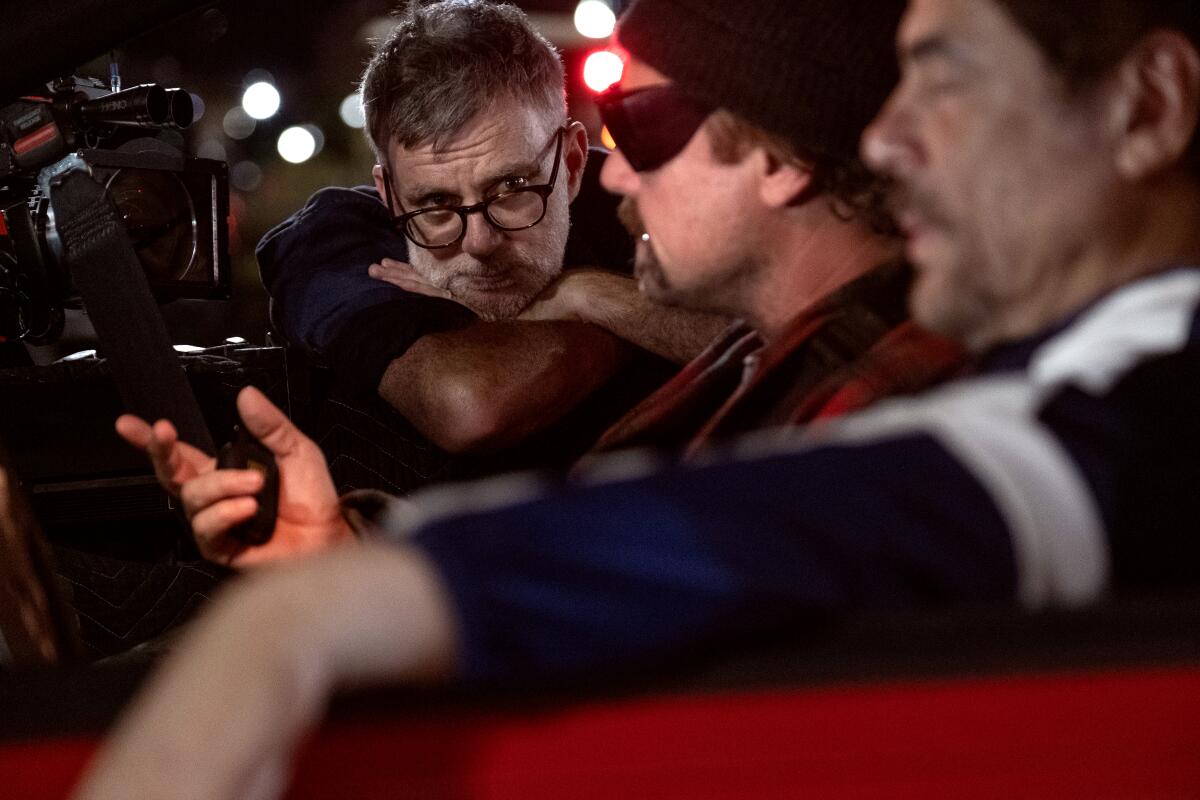
But we’re likely going to cross one name off that ignominious list this year — Paul Thomas Anderson.
I’m Glenn Whipp, columnist for the Los Angeles Times and host of The Envelope newsletter. I already gave away who’s on top of our Oscar power rankings for director. How does the rest of the list shake out? Let’s take a look.
Sign up for The Envelope
Get exclusive awards season news, in-depth interviews and columnist Glenn Whipp’s must-read analysis straight to your inbox.
1. Paul Thomas Anderson, ‘One Battle After Another’
Anderson has three Oscar nominations for directing — “There Will Be Blood,” “Phantom Thread” and “Licorice Pizza.” That feels light. He has 11 Oscar nominations in all, including five as a writer and three as a producer. He has never won. That feels wrong. So with “One Battle After Another,” he checks off both of the main boxes that Oscar winners often possess — he directed the year’s best movie and he’s well overdue for an honor. Like Sean Baker for “Anora” last year, Anderson likely will come home with an armful of Oscars, as he also produced and wrote the movie.
2. Jafar Panahi, ‘It Was Just an Accident’
Panahi has never been nominated for an Oscar, though his films have won the top prizes at the Venice Film Festival (“The Circle”), the Berlin Film Festival (“Taxi”) and, this year, the Cannes Film Festival (“It Was Just an Accident”). That movie’s withering takedown of the cruelty and corruption of authoritarianism packs a punch; it’s also unexpectedly funny in its clear-eyed social critique. Panahi has been imprisoned by the Iranian government many times for speaking out and was recently again sentenced, in absentia, to a year in prison on charges of “propaganda activities against the system.” Like we needed another reason to celebrate the man and his work.
3. Ryan Coogler, ‘Sinners’
(Eli Ade / Warner Bros. Pictures)
Coogler has two Oscar nominations, but they aren’t what you might expect. He was nominated for producing “Judas and the Black Messiah,” the thrilling 2021 historical drama looking at the politics of race. And he earned a songwriting nod for the Rihanna ballad “Lift Me Up” from “Black Panther: Wakanda Forever.” Coogler should have landed an adapted screenplay nomination for the first “Black Panther” movie, a more inventive, world-building work than the umpteenth remake of “A Star Is Born.” But that’s the past. Coogler, like Anderson, figures to be feted in multiple categories at the upcoming Oscars and may well bring home the prize for original screenplay.
4. Chloé Zhao, ‘Hamnet’
(Agata Grzybowska / Focus Features)
Zhao owns two Oscars for directing and producing “Nomadland,” the empathetic and searching portrait of America that felt like a balm when it premiered during the pandemic. After an ill-fitting detour into the Marvel Cinematic Universe with “Eternals,” Zhao came all the way back with “Hamnet,” a deeply felt look at love, loss and the cathartic power of art. Even those who find it overwrought laud the movie’s climactic sequence, a performance of “Hamlet” at the Globe Theatre. I’d argue the ending works so well because of the care Zhao took earlier in establishing the wonder and joy of the family’s life. “Hamnet,” to my damp eyes, is her best film.
5. Joachim Trier, ‘Sentimental Value’
(Lewis Joly / Invision / AP)
From here, you could shuffle the five through eight slots and make a good case for any of these directors landing the fifth slot in the field. Trier has much to recommend his subtle interweaving of past and present, hope and hurt in “Sentimental Value.” He received a screenplay nomination for his last movie, “The Worst Person in the World,” also starring Renate Reinsve. The directors branch boasts a strong contingent of voters from all over the world, a group that could easily nominate the filmmakers behind two of the year’s most celebrated international feature contenders. Plus, “Sentimental Value’s” salty view of Hollywood is bound to appeal to this bunch.
6. Guillermo del Toro, ‘Frankenstein’
The affable, movie-loving Del Toro has won many fans inside and outside the industry over the years, along with Oscars for directing and producing the 2017 best picture winner “The Shape of Water” and for “Pinocchio,” the enchanting 2022 movie that snagged animated feature. “Frankenstein” is far from his best work, but it probably has enough admirers to land a best picture nomination and mentions in several other categories. Director, though? If Del Toro didn’t make the cut for “Nightmare Alley,” he’s probably a near-miss for this one too.
7. Josh Safdie, ‘Marty Supreme’
(Atsushi Nishijima / A24)
It’s “Marty Supreme” week! The movie finally arrives on Christmas and, over the holidays, we’ll begin to have the sorts of conversations that will shed some light on the movie and its Oscar chances beyond the certain nominations for best picture and lead actor Timothée Chalamet. Is the title character, a single-minded ping-pong player oblivious to anything but his own advancement, a jerk? Or is he just like any other man in his 20s? Is the film’s last shot a sign of growth or a man contemplating his own death sentence? We’ll have time to discuss and, yes, revel in the unhinged chaos Safdie unleashes here.
8. Clint Bentley, ‘Train Dreams’
(Daniel Schaefer / BBP Train Dreams)
And finally, we arrive at the man behind “Train Dreams,” a contemplative film about an ordinary man puzzling through loss, guilt, the mundane and the magnificent. It’s the anti-”Marty Supreme” — quiet, painterly, a tad slow, sure, but hypnotic in the way it evokes a bygone America. Just the second movie Bentley has directed, following the little-seen 2021 drama “Jockey,” it has built a devoted following since landing on Netflix last month.
It has been a year. And for many of us, not a great one. Fires, political chaos, rising unemployment, thelossofbelovedculturalicons — it’s understandable if you want to toss 2025 in the trash heap where it belongs.
And you should, at least symbolically. Ending a collective or personal era with a closing ritual can be therapeutic and allow you to make room for something new. The goal is not to work abracadabra-type magic, but to “enact a symbolic shift,” as University of British Columbia anthropologist Sabina Magliocco puts it.
“When you do a New Year’s ritual, you are symbolically shifting to a new beginning,” she said. “That might involve rituals to usher in good luck or health, more prosperity, more creativity, or just out with the old, in with the new.”
Humanity has been enacting rituals to transition from one year to the next for millennia, and they are part of our lives today — drinking sparkling beverages, watching the ball drop in Times Square, cheering as the clock strikes midnight — these are all ways of celebrating the completion of one cycle and welcoming the start of the next one with joy and the hope that this time may be better.
We’ve collected and created 25 practices to help you say goodbye to 2025. Some of our rituals are serious, others more lighthearted, yet all should be done with intention for maximum effect. We’ve included some places around L.A. that would be ideal for these activities — for instance, Downtown’s Rage Ground where you can (safely) smash a car, or San Pedro’s Cabrillo Beach, where you can plunge into water that’s freezing by L.A. standards (it’s about 59 degrees).
So sweat it out, sweep it out, dance it out or melt it away. Whichever way you choose to say good riddance, we hope it brings you a bit of peace and helps you slide purposely into the new year (which surely, hopefully, God-willing has to be better than the one we just finished, right?).
— Deborah Netburn
1. Scream into the void
“Scream therapy,” or “primal scream therapy,” dates back to the early ‘70s and is an underrated — and free — way to release bottled-up tension and anger (or a relentlessly stressful year). Find an open expanse with a dramatic view — check out our guide to shout-worthy spots in L.A. — take a few deep breaths, engage your core and let out an unbridled scream. Not ready to howl in a place where other people may be in the vicinity? A primal scream into a pillow at home can offer a similar sense of release. — Deborah Vankin
2. Sweat 2025 out of your system
Koreatown’s Wi Spa, open 24/7, has five progressively hot saunas in a coed community space. But its single hottest sauna — one of the toastiest in all of L.A. — is the Bulgama sauna. It looks like an igloo from the outside, though the interior is made mostly of oak wood. The sauna is set at an intense 231-degrees (by contrast, my gym’s dry sauna is 160-180 degrees). There are no benches to sit on; guests lie on the floor or sit upright against the wall, their faces flushing scarlet and sweat dripping down their cheeks and limbs. Tough it out for as long as you possibly can, perhaps while meditating on all you want to let go of, and sweat out every bit of this difficult year. Just be sure to hydrate afterward. — D.V.
3. Roll down a hill
If the heaviness of 2025 has you feeling stuck, shake up your perspective by making like a 5-year-old and rolling down a grassy hill. Luckily, L.A. is filled with hills perfect for rolling, including the popular Hancock Park near the La Brea Tar Pits and Museum. I guarantee that you’ll feel different at the end of your roll than you did at the start. (And if I’m wrong, try climbing the hill and rolling down again!) — Deborah Netburn
4. Jump into the ocean
The “polar bear plunge” is a popular tradition in many places, including San Pedro’s Cabrillo Beach, where people have been jumping into the water on New Year’s Day for at least 73 years. The Cabrillo Beach Polar Bears name a king and queen and hand out polar bear certificates — in fact, so many people joined in last year that the club ran out of certificates. The water in San Pedro is typically about 59 degrees. But this tradition persists in places much colder — for instance, Scheveningen, the Netherlands. There, as many as 10,000 brave bathers show up each New Year’s Eve to dip into the North Sea, which is usually between 37 and 48 degrees Fahrenheit. — Christopher Reynolds
5. Rage … and smash a car!
When I’m angry — like fuming, stomping, raging mad (which is a lot, lately, considering the state of, well, everything) — I often think of Swiss artist Pipilotti Rist’s video, “Ever Is Over All.” In it, Rist saunters down an urban sidewalk in a light blue sundress smashing car windows as she goes. The crinkly, cacophonous sound of shattering glass is amplified each time she bashes a car. Sounds awesome, right? You can do the same at L.A. Rage Rooms such as Rage Ground and Break Room Los Angeles. Visitors don protective gear while wrecking an entire automobile — windows, doors, headlights and all — to the angry playlist of their choice. Unleashing rage can be cathartic and healing — not a bad way to put 2025 behind you for f— good! — D.V.
6. Burn some incense — or join a safe, fire department-sanctioned communal blaze
Maybe you’ll spark some sage, as people do when hoping to rid a room of bad vibes. You could also burn a little incense, cedar, yerba santa, palo santo, rosemary, mugwort, juniper or sandalwood. Or, if you crave a bigger blaze, you could head up to Solvang, where on Friday, Jan. 9, the Santa Barbara County Fire Department will supervise a community Christmas Tree Burn. Local authorities bill the event as “a powerful safety demonstration” in the empty lot next to the Mission Santa Ines (1760 Mission Drive). But you’ll know that it’s really about purging the vile remnants of the last year. — C.R.
7. Walk a labyrinth
Labyrinths can be a great tool for release. To make a labyrinth walk extra meaningful, find a trinket or stone that represents 2025 to you and then walk slowly toward the labyrinth’s center, infusing the stone with whatever you want to leave behind in 2025. When you get to the center of the labyrinth, drop the stone, and breathe out the year. As you leave the center, imagine filling yourself up with your hopes for the new year. Looking for a labyrinth to walk? Check out our list of great labyrinths in the L.A. area, including the one at Peace Awareness that uses the same pattern design as the labyrinth at the Chartres Cathedral in France — D.N.
8. Travel through time
If you visit the Time Travel Mart in Echo Park or Mar Vista, you’ll come to understand that its true mission is to promote literacy and writing skills among kids. But the goofball retail goods in both shops — alleged supplies for chrononauts — are a comfort to anyone seeking maximum distance from 2025. Buy candles honoring patron saints of time travel (including theoretical physicists Stephen Hawking, Albert Einstein and Ronald Mallett). Pick up some robot milk or canned mammoth. Or, perhaps best of all, grab a copy of “The Time Traveler’s Almanac,” a 2013 collection of 72 literary “journeys through time” by writers including Douglas Adams, Isaac Asimov, Ursula K. Le Guin, George R.R. Martin and H.G. Wells. As the largest collection of time-travel stories ever assembled, it won’t just take you to 2026, but far beyond. — C.R.
9. Dance it out
Shake your booty, swing your limbs, wriggle your hips. Literally shake off the year while working up a sweat at any number of dance events. I do it at Zumba class; others at nightclubs and dance parties. LA Dance Project offers weekly, community dance classes for all levels; Wiggle Room holds improvisational movement workshops; Pony Sweat, a “fiercely noncompetitive dance aerobics celebration,” holds $10 classes on Monday nights; and Ecstatic Dance LA is a “substance-free, all ages community celebration” of dance. Even the Los Angeles Public Library holds free ‘80s-era dance classes. Or travel to another part of the world for the night at ¡BAILE!, a recurring world music dance party — one of many in L.A. You’ll forget all about 2025, if just momentarily. — D.V.
10. Challenge yourself with one of L.A.’s hardest hikes
You made it through a hard year. Celebrate by making it through a hard hike. For a serious challenge, try the Vital Link Trail at Wildwood Canyon Park in Burbank where you’ll do an elevation gain of 1,700 feet in just two miles. Because the trail is sandy and has some erosion, it’s best to navigate it with trekking poles. Also, remember that “challenging” is a relative term. If Vital Link Trail is not for you, check out other options on our list of local hikes for all skill levels. — D.N.
11. Write a year-end letter
This could be a pep talk, a condemnation of the last 12 months, a breakup letter to your past self or a hopeful letter to your future self. Or take control of your life by starting a diary, as the main character does in the Helen Fielding novel and subsequent Renée Zellweger movie “Bridget Jones’s Diary.” Maybe with less smoking, drinking and mixing it up with Hugh Grant. — C.R.
12. Visit a cemetery to reflect on the past
L.A.’s legendary Hollywood Forever Cemetery just held an end-of-year event with a cord-cutting meditation meant to help participants “dispel the shadows” of their lives and let go of what no longer serves them. You could create a similar ritual. Visit one of the city’s many cemeteries and as you stroll through the space, think about laying to rest what’s been weighing on you most this past year. — Michelle Woo
13. Be your own Death Bear
More than a decade ago, New York performance artist Nate Hill created a Death Bear character. He would appear at people’s homes in a strange black PVC costume, then remove items that triggered bad memories and take them away forever to his Death Bear Cave, location unspecified. Hill seems to have retired Death Bear, but you could always create your character to vanquish bad memories. — C.R.
14. Bury the year
You could throw 2025 in the trash, but consider composting it instead. Write down “2025” on a small scrap of paper along with an few aspects of the year you would like to leave behind. Bury the paper in a garden or a flower pot along with some seeds of your choice. Over the next few weeks, watch with satisfaction as a budding seedling transmutes 2025 into something beautiful and fresh. — D.N.
15. Shed 2025 along with your dead skin with an intense body scrub
Vigorous, bracing, borderline painful, there is nothing like a no-frills full-body scrub at one of L.A.’s many Korean spas. For as little as $50 you will feel like you’ve removed the hard crust of the bygone year from your body, emerging shiny, soft and new. Let the shedding begin! — D.N.
16. Cut your hair
Or change it. Various cultures have ideas about this and exactly when you should do it. I say the sooner we turn the page, the better. Along with shedding skin, getting a trim is one of the most literal ways you can change your body to signal a new era. — C.R.
17. Purge your closet — and donate
This summer, the fluff and fold I bring my laundry to burned down — with three enormous bags of my clothing and linens inside. At first I was upset: beyond its practical function, our clothing is an extension of our identity and often beloved items house emotional memories from the places they’ve traveled to. It felt like a loss, not to mention a financial burden. But surprisingly quickly, silver linings surfaced. My closet was roomier and more navigable — it was easier to put outfits together. Friends and family offered blankets, sheets and sweaters, and I felt supported. I somehow also felt lighter? A purposeful, DIY closet purging can feel cathartic at the end of year. And in hauling off a bag or two of your clothing to Goodwill or the Salvation Army, you’ll not only be releasing a little bit of 2025, but helping others, who need your recycled goods, in the process. — D.V.
18. Cry in the shower
I get my best creative ideas in the shower. And I indulge my fiercest sobbing sessions there as well. The act of crying — anywhere — lowers stress hormones such as cortisol and releases feel-good hormones like oxytocin. But there’s something about being in a cozy, private space, ensconced by rushing water and plumes of steam, that allows me to fully release and opens the floodgates. Try it. Bonus: no tear-stained face afterward. — D.V.
19. Rearrange your house
Switch up the energy in your home by switching up the placement of your furniture. It will help you see your space, and perhaps your life, in a fresh light. The bed in that corner? That was so 2025. The dresser on that wall? Last year’s news! Try working with the items you have before going out to buy something new. — D.N.
20. Sweep the worst of 2025 out the door
Deep cleaning followed by ritually sweeping misfortune and bad energy out of your home before the start of the Lunar New Year is a tradition in Chinese culture. I’ve also seen ritual sweeping practiced by modern witches and other spiritual questers. The ritual itself is simple but deeply symbolic: For a fresh start to the new year, fully clean your house top to bottom and then finish by holding a broom just a bit off the floor and use a sweeping motion to push the bad energy out of your house. — D.N.
21. Make a physical threshold and cross it
New Year’s Eve party idea: Just before midnight create a physical threshold on the ground using a stick, a piece of string, or draw an actual line in the sand if you happen to be at the beach (this is L.A. after all). As the clock strikes midnight, invite guests to cross the threshold one by one and cheer as you step into 2026 and leave 2025 behind. — D.N.
22. Watch 2025 melt away
Find a small candle and carve “2025” onto the side of it using a small knife. Light the candle and let it burn until 2025 has melted away. — D.N.
23. Watch the sunset
Is there a more symbolic way to say farewell to 2025 than watching the sun literally dip below the horizon for the final time on this god-awful year? Consider this nature’s ball drop. — D.N.
24. Toss 2025 into the waves
Tashlich is a Jewish new year ritual of symbolically releasing your sins by throwing them into a natural body of water. When I was a kid, my family used bread crumbs to represent our sins. Now I use small stones or torn-up bits of leaves to keep from polluting the environment. Whatever you use, hold it in your hand and imagine what it is that you want to release. Then toss it into the water and imagine yourself letting it go. The Jewish new year holiday, Rosh Hashanah, is celebrated in early fall, but there’s no reason you can’t give this ritual a whirl on the Gregorian calendar’s new year too. — D.N.
25. Take a final photo
2025 may not have looked like how you hoped it would look, but now you are in control. As the year draws to a close, set yourself a task of taking one final photo of the year that is meaningful to you. Sad or hopeful, lush or desolate: you decide. Perhaps it is someone or something you love. Or a representation of the loss you experienced. We take photos all the time without thinking. Choose to make this one count. — D.N.
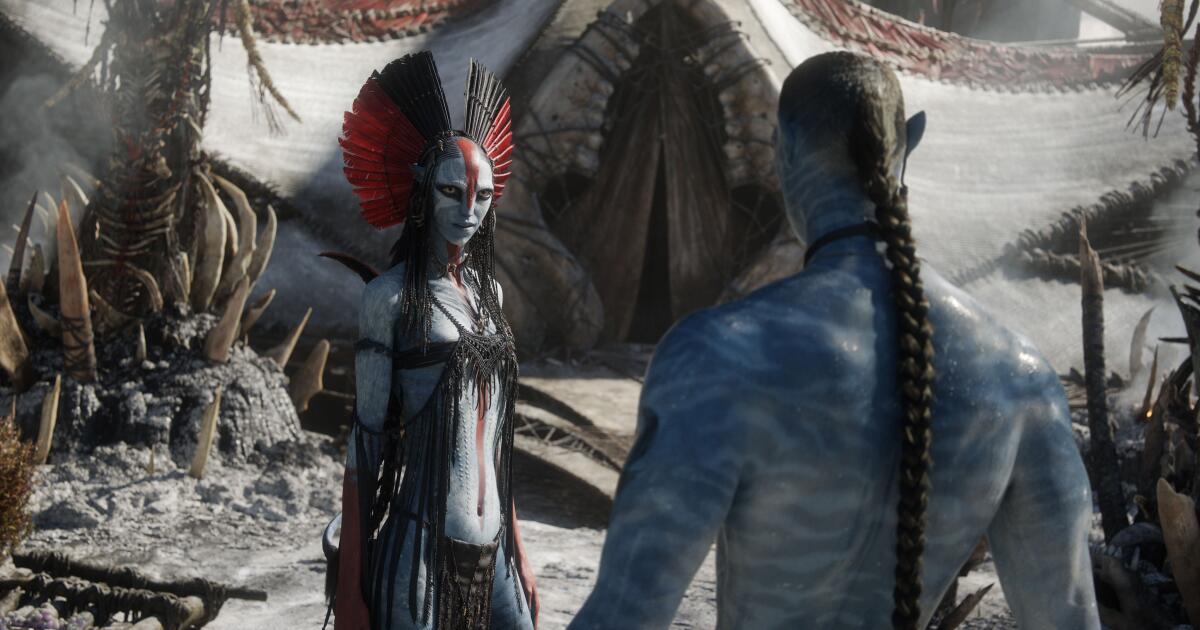
The Na’vi won the battle of the box office this weekend, as “Avatar: Fire and Ash” hauled in a hefty $88 million in the U.S. and Canada during its opening weekend.
The third installment of the Disney-owned 20th Century Studios’ “Avatar” franchise brought in an estimated total of $345 million globally, with about $257 million of that coming from international audiences. The movie reportedly has a budget of at least $350 million.
Box office analysts had expected a big international response to the most recent film, particularly since its predecessor “Avatar: The Way of Water” had strong showings in markets like Germany, France and China.
In China, the film opened to an estimated $57.6 million, marking the second highest 2025 opening for a U.S. film in the country since Disney’s “Zootopia 2” a few weeks ago. (That film went on to gross more than $271.7 million in China on its way to a global box office total of $1.1 billion.)
The strong response in China is another sign that certain movies can still do well in the country, which was once seen as a key force multiplier for big blockbusters and animated family films but has in recent years cooled to American movies due to geopolitics and the rise of its domestic film industry.
Angel Studio’s animated biblical tale “David” came in second at the box office this weekend, with an estimated domestic gross of $22 million. Lionsgate thriller “The Housemaid,” Paramount Animation and Nickelodeon Movies’ “The Spongebob Movie: Search for Squarepants” and “Zootopia 2” rounded out the top five.
The weekend’s haul likely comes as a relief to theater owners, who have weathered a roller coaster year.
After a difficult first three months, the spring brought hits like “A Minecraft Movie” and “Sinners” before the summer ended mostly flat. A sleepy fall brought panic to the exhibition business until closer to the Thanksgiving holiday, when “Wicked: For Good” and “Zootopia 2” drew in audiences.
“Democrats have been relentless in their targeting of TINA PETERS, a Patriot who simply wanted to make sure our elections were fair and honest,” Trump said in a typically gaseous, dissembling post on social media.
“Tina is sitting in a Colorado prison for the ‘crime’ of demanding Honest Elections,” the president went on. “Today I am granting Tina a full pardon for her attempts to expose voter fraud in the rigged 2020 Presidential Election.”
That’s because Trump has precisely zero say over Peters’ fate, given the former Mesa County elections chief was convicted on state charges. The president’s pardon power — which Trump has twisted to a snapping point — extends only to federal cases. If we’re going to play make-believe, then perhaps Foo-Foo the Snoo can personally escort Peters from prison and crown her Queen of the Rockies.
That’s not to suggest, however, that Trump’s empty gesture was harmless. (Apologies to Foo-Foo and Dr. Seuss.)
Some extremists, ever ready to do Trump’s malevolent bidding, have taken up Peters’ cause, using the same belligerent language that foreshadowed the Jan. 6, 2021, attack on the U.S. Capitol. In fact, threats have come from some of the very same thugs whom Trump pardoned in one of the first shameless acts of his presidency.
“WE THE PEOPLE ARE COMING TO BREAK TINA PETERS OUT OF PRISON IN 45 DAYS,” Jake Lang, a rioter who was charged with attacking police with an aluminum baseball bat, said on social media. “If Tina M. Peters is not released from La Vista Prison in Colorado to Federal Authorities by January 31st, 2026; US MARSHALS & JANUARY 6ERS PATRIOTS WILL BE STORMING IN TO FREE TINA!!”’
(Capitalization and random punctuation are apparently the way to show fervency as well as prove one’s MAGA bona fides.)
Enrique Tarrio, the former head of the Proud Boys extremist group whom Trump also pardoned, shared a screenshot of the president’s social media post. “A battle,” Tarrio said, “is coming.”
Trump’s pretend pardon is not the first intervention on Peters’ behalf.
In March, the Justice Department asked a federal judge to free her from prison, saying there were “reasonable concerns” about the length of Peters’ sentence. The judge declined.
In November, the administration wrote the Colorado Department of Corrections and asked that Peters be transferred to federal custody, which would presumably allow for her release. No go.
Earlier this month, apparently looking to up the pressure, the Justice Department announced an investigation of the state’s prison system. (Perhaps Peters was denied the special “magnetic mattress” she requested at her sentencing, to help deal with sleep issues.)
Like any child, when Trump doesn’t get his way he calls people names. On Monday, he set his sights on Colorado’s Democratic governor, Jared Polis — “a weak and pathetic man” — for refusing to spring Peters from state prison.
“The criminals from Venezuela took over sections of Colorado,” Trump said, “and he was afraid to do anything, but he puts Tina in jail for nine years because she caught people cheating.”
While Trump portrays Peters as a martyr, she is nothing of the sort.
As Polis noted in response to Trump’s “pardon,” she was prosecuted by a Republican district attorney and convicted by a jury of her peers — a jury, it should be noted, that was drawn from the citizenry of Mesa County. The place is no liberal playpen. Voters in the rugged enclave on Colorado’s Western Slope backed Trump all three times he ran for president, by margins approaching 2-to-1.
If Peters’ sentence seems harsh — which it does — hear what the judge had to say.
Peters was motivated not by principle or a search for the truth but rather, he suggested, vanity and personal aggrandizement. She betrayed the public trust and eroded faith in an honestly run election to ingratiate herself with Trump and others grifting off his Big Lie.
“You are as privileged as they come and you used that privilege to obtain power, a following and fame,” Judge Matthew Barrett told Peters in a lacerating lecture. “You’re a charlatan who used and is still using your prior position in office to peddle a snake oil that’s been proven to be junk time and time again.”
Peters remains unrepentant.
In petitioning Trump for a pardon, her attorney submitted nine pages of cockamamie claims, asserting that Peters was the victim of a conspiracy involving, among others, voting-machine vendors, Colorado’s secretary of state and the Venezuelan government.
To her credit, Peters has rejected calls for violence to set her free.
“Tina categorically DENOUNCES and REJECTS any statements or OPERATIONS, public or private, involving a ‘prison break’ or use of force against La Vista or any other CDOC facility in any way,” a post on social media stated, again with the random capitalization.
Perhaps the parole board will take note of those sentiments when the 70-year-old Peters becomes eligible for conditional release in January 2029, a date that just happens to coincide with the end of Trump’s term.
Which seems fitting.
Keep Peters locked up until then, serving as an example and deterrent to others who might consider emulating her by vandalizing the truth and attacking our democracy.
It’s odd the moments you remember after someone’s gone.
Scrolling through a seemingly infinite number of clips featuring Rob Reiner being compassionate and kind, scenes from his movies that feature a bone-deep empathy for the ways human beings struggle and strive to be better, I kept thinking back to a little wink in “This Is Spinal Tap,” the 1984 mockumentary Reiner directed and co-starred in, playing filmmaker Marty DiBergi.
I’ve seen this movie so many times that I could probably act out the whole thing upon request. It provided a soundtrack to a family trip to Stonehenge several years ago. But thinking about Reiner in the wake of the horrible news that he and his wife, Michele Singer Reiner, were found dead in their home on Sunday night, their son Nick subsequently charged with their murders, I randomly landed on the scene where DiBergi talks with Spinal Tap lead singer David St. Hubbins (Michael McKean) after guitarist Nigel Tufnel (Christopher Guest) leaves the band.
St. Hubbins blithely insists he won’t miss Nigel any more than insignificant band members who played briefly in the group. DiBergi is stunned. He loves Spinal Tap and fears for its future. Reiner plays the moment with such sincere heartbreak, partly in character, but mostly I think because that’s who he was. Reiner couldn’t help it. He felt things deeply and spent much of his life working to make things better for those on society’s margins. He will be missed in so many ways.
I’m Glenn Whipp, columnist for the Los Angeles Times and host of The Envelope newsletter. How to describe this week? None more black will do. But Christmas is coming, and that Vince Guaraldi song never fails to make me smile. Let’s look at some good news for those who made the Oscar shortlists this week.
Sign up for The Envelope
Get exclusive awards season news, in-depth interviews and columnist Glenn Whipp’s must-read analysis straight to your inbox.
The film academy announced shortlists for 12 categories at the 98th Oscars, whittling down the list of contenders and offering a few indications about what films are scoring early points with voters.
Ryan Coogler’s critically acclaimed, genre-defying blockbuster “Sinners” picked up eight mentions, as did “Wicked: For Good.” Both movies placed two songs on the original song shortlist and both were cited in the newly created casting category.
The bounty for “Sirât,” the Oliver Laxe thriller that is unquestionably one of the most memorable movies of the year, offered an indication that the word of mouth on this movie is strong enough to land it a spot among the nominees for international feature.
Can it do better than that? It should. Here are five suggestions for voters, including “Sirât,” as the lists are narrowed ahead of Oscar nominations on Jan. 22.
Cinematography: ‘Sirât’
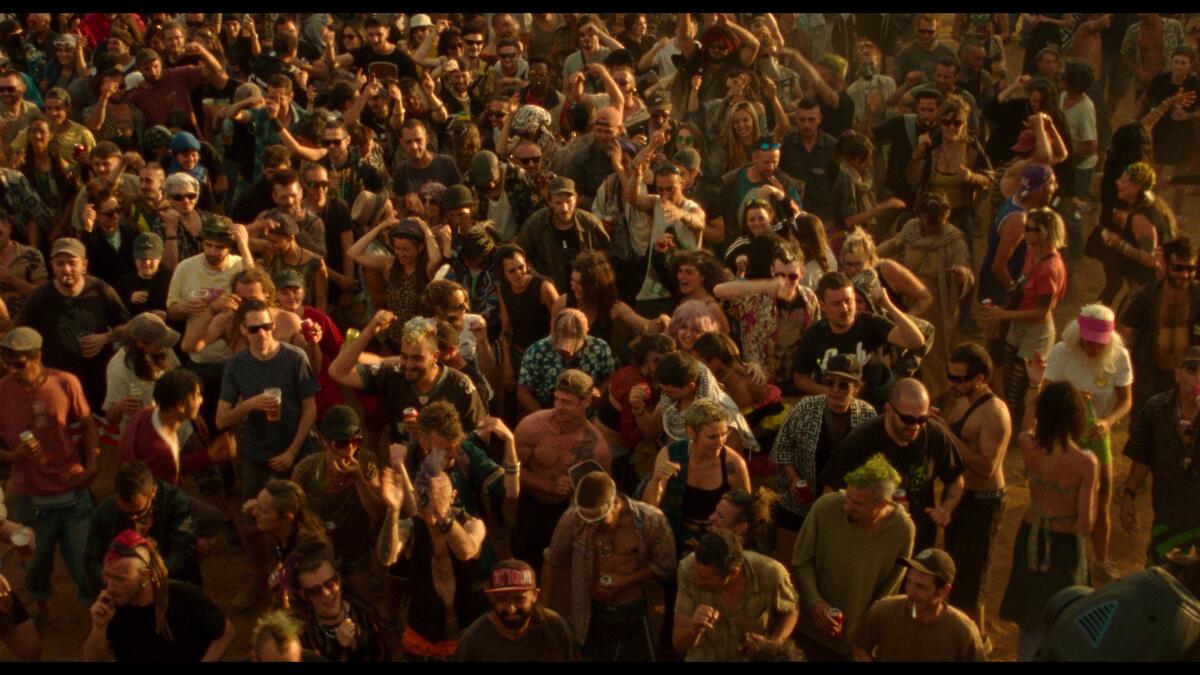
“Sirât” contains so many surprising twists and turns that when asked to describe the plot, I simply tell people that it’s about a father who shows up at a rave in southern Morocco with his young son looking for his missing daughter. The long desert journey they end up taking is astonishing, and cinematographer Mauro Herce, shooting on 16mm film, captures every treacherous mile in dramatic detail.
Original score: ‘Marty Supreme’
Voting with the Los Angeles Film Critics Assn., I cast my ballot for Kangding Ray’s hypnotic score for (you guessed it) “Sirât.” But that was just one of many soundtracks that found its way into my life this year. Hans Zimmer’s synth-heavy “F1” score makes for propulsive listening while pedaling on an exercise bike and ranks among the celebrated composer’s best work. And I share Times film editor Josh Rothkopf’s enthusiasm for Daniel Lopatin’s throwback electronic beats in “Marty Supreme,” a delight for anyone who grew up listening to the ethereal soundscapes created by Tangerine Dream.
Casting: ‘Weapons’
I’m highlighting Zach Cregger’s horror-mystery “Weapons” here partially because of its inexplicable absence in the makeup and hairstyling category. I guess voters knew it was Amy Madigan in that bright red wig all along. That omission aside, “Weapons” is a prime example of what a great casting director can do, making use of familiar faces (Josh Brolin, Julia Garner, Madigan) in unexpected ways, finding the right child actor (Cary Christopher) to deliver big emotional moments and elevating emerging talent (Austin Abrams) to unexpected heights. Allison Jones, one of the greats, belongs among the casting category’s inaugural set of nominees.
Documentary: ‘My Undesirable Friends: Part 1 — Last Air in Moscow’
Julia Loktev’s five-hour chronicle of the chilling Russian crackdown on independent journalists has won documentary honors from both the Los Angeles and New York film critics. The doc begins in 2021, when the journalists, mostly women, are forced to label themselves as “foreign agents” simply for doing their jobs, covering Putin’s regime in a factual manner. Things intensify after Russia’s invasion of Ukraine, turning “My Undesirable Friends” into a cautionary tale about the perils of bending to an autocrat. It goes without saying, but this is essential viewing.
Phil Wickham has released 14 Christian worship albums, has been Platinum certified and nominated for American Music Awards, Dove Awards, Billboard Music Awards and Grammys — but all of his vocal training and performances couldn’t prepare him to step into the shoes of one of his Biblical heroes with the upcoming animated musical film “David.”
Directed by Phil Cunningham and Brent Dawes, “David” marks the second animated film this year for Angel Studios. April’s “The King of Kings” made $60 million and is the second-highest-grossing film from the studio following “Sound of Freedom,” which made $184 million. The film hits theaters on Friday. If the release date sounds familiar, it could be because the third installment in the multibillion-dollar “Avatar” franchise, “Avatar: Fire and Ash,” is released on the same day. Presale numbers for “David” are at $15 million on 3,100 screens, but with “Avatar” tracking to open between $135 million and $165 million, and “The SpongeBob Movie: Search for SquarePants” also tracking between $13 million and $20 million, it would seem to be a true David vs. Goliaths for ticket sales.
That in itself could be daunting, but for Wickham, the biggest obstacles came long before release dates were decided. Despite playing in arenas with thousands of fans, he had a “secret dream” of voicing a character in an animated film. A character “that carried courage and faith and had some grand adventure.” But because he’d never chased that dream, he realistically put a limit on that particular goal. Even when the opportunity arose, he was hesitant when going into a casting meeting.
“I’m unoffendable. [I said to producers], if I suck, then just tell me because I don’t want to waste anybody’s time. And also, I don’t want to be bad in a movie as much as you don’t want to make a bad movie,” says Wickham.
The contemporary Christian artist, who recently finished sold-out concerts at Downey Calvary Chapel and the Wiltern, had never tried his hand at voice acting. Not only did he get the role, but he also had to help bring to (animated) life one of the most well-known stories in the Bible. The tale of David — the boy who was anointed to become the king and along the way felled the giant Philistine warrior Goliath with a rock and a slingshot — has become synonymous as the most famous of underdog representations and tests of faith in the Bible. The character and story is also one of Wickham’s favorites.
Phil Wickham always wanted to voice an animated character, especially after seeing “The Lion King.”
(Colton Dall)
“When this came across my desk, so to speak, I was just like, man, I could tell you that story, but I didn’t know if I had it in me. I didn’t know if I was a good actor. I didn’t know if I could voice a character, but I knew I wanted a shot,” said Wickham.
A curious revelation for Wickham was discovering that the singing that he’d been doing most of his life would not work on-screen, at least not for this project. He was asked to tone down things, to sometimes “talk through” lyrics and to generally make the music more dramatic for the screen.
“I thought, OK, I got this. This is why they hired me, because I’m a singer. But that ended up being the hardest part because they didn’t want me to sound like me,” Wickham said.
“Singing became a background to just being the character, which honestly, in some ways, was the hardest thing. Maybe even for my ego as as an artist.”
It was definitely a process that required lots of fine-tuning and looking at David as not just the king and hero that Wickham had grown up reading about at home and in Southern California churches. Sitting in the pews in Downey, the singer reflected on why he got into music and why Christian entertainment is on the rise.
“I found out really quick that I loved being a part of moments where people were encountering the same hope and faith that I encountered in my room alone,” Wickham said of songwriting and performing. He grew up with Christianity all around him, but has seen a spike in popularity for music and movies dealing with faith-based fandom.
“For this movie ‘David’ to come out at this time … I think that the world is looking for stuff to hope in. I think people are just searching and finding out more and more the truth that if we look around us at the world of man, we’re not going to find real solutions. So that maybe if we look up, we will.”
SEATTLE — In a matter of minutes, the home of the Seattle Seahawks went from a painfully quiet Lumen “Library” to a rollicking madhouse that sent seismologists scrambling for their ground-motion sensors.
Call it the Sheesh-Quake Game.
In a historic comeback, the Seahawks dug their way out of a 16-point, fourth-quarter ditch to beat the Rams in overtime, 38-37.
Oh, the visitors will agonize over some of the bizarre calls, some deserving of further explanation from the NFL. An ineligible-man-downfield call that wiped out a Rams touchdown when they were a yard away from the end zone? That had people scratching their heads. Then there was that do-or-die two-point conversion that seemingly fell incomplete… but later was reversed. More on that in a moment.
Share via
Gary Klein breaks down what went wrong for the Rams in their 38-37 loss to the Seattle Seahawks at Lumen Field on Thursday night.
When the Rams wincingly rewind the video of the collapse, they’ll be peering through the cracks in their fingers.
You’ve heard of a no-look pass? This was a no-look finish.
As soothing wins go, this was a warm bubble bath for the Seahawks, who secured a playoff berth and assumed the driver’s seat in the race for the NFC’s No. 1 seed.
“You hear people late in the year have losses, and you hear people come up here and say, like, ‘Man, this is going to be a good thing for us,’” said Seahawks receiver Cooper Kupp, a onetime Rams hero. “It’s much better to be up here right now saying this is going to be a good thing for us.”
Kupp atoned for his first-half fumble with a successful two-point conversion in the fourth quarter — the first of three in a row for the Seahawks — and a 21-yard reception on the winning drive in overtime.
“If you find a way to get a win when you do turn the ball over three times, you do end up down 16 points, or whatever it was, in the fourth quarter, just finding ways to win games when the odds are against you and things aren’t going right — finding a way to fight back — it’s going to be a good thing for us,” Kupp said. “A good thing for us to draw on.”
The Rams are sifting through the debris of a different lesson. It was a reminder that this charmed season, with Matthew Stafford in line to win his first Most Valuable Player honor, can come crashing down at any moment. There’s no more smooth glide path to Santa Clara for the Super Bowl.
As good as it was for most of the game, picking off Sam Darnold twice and sacking him four times, the Rams defense failed to hold up when it counted most. Shades of the three-point loss at Carolina.
Darnold will have a story to tell. He exorcised a lot of demons. The Rams sacked him nine times in the playoffs last season when Darnold was playing for Minnesota, and intercepted six of his passes in two games this season.
“It’s not great when you have interceptions and turnovers, you want to limit that,” said Darnold, the former USC star. “But all you can do is fight back. For us, I was just going to continue to plug away.”
Darnold came through when it counted, completing five passes on the winning drive, then finding the obscure tight end Eric Saubert — his fourth option — wide open in the end zone on the triumphant conversion.
Seattle Seahawks quarterback Sam Darnold looks to pass against the Rams in the first half Thursday.
(Lindsey Wasson / Associated Press)
The second of the three conversions was the game’s most controversial moment. The Seahawks needed it to forge a 30-30 tie with a little more than six minutes remaining in regulation.
Darnold fired a quick screen pass to his left, trying to get the ball to Zach Charbonnet. Rams defender Jared Verse jumped the route and knocked down the pass. Everyone thought the play was dead, including Charbonnet, who casually jogged across the goal line and picked up the ball as it lay in the end zone.
That proved critical because officials — after what seemed like an eternity — ruled that Darnold had thrown a backward pass and the ball was live when Charbonnet picked it up. Therefore, a fumble recovery and successful conversion, tying the game.
Asked later if it felt like a backward pass, Darnold had a half-smile and said, “Um, yeah. It felt like I threw it kind of right on the side. I’m glad Charbs picked it up, and that turned out to be a game-changing play.”
Was that designed to be a backward pass?
“It just happened to be backwards,” he said. “It wasn’t necessarily talked about. We were just trying to get it in down there on the goal line.”
The Seahawks were lined up to kick off when officials announced that, upon review, the previous play was successful. Suddenly, the most improbable of come-from-victories was within reach.
Earlier in the fourth quarter, when the home team was trailing, 30-14, the Amazon Prime crew had to do some vamping to keep viewers engaged. Al Michaels and Kirk Herbstreit told some Kurt Warner stories from the “Greatest Show on Turf” days. Hey, it had to be more interesting than this game.
Michaels delivered an obscure stat: When leading by 15 points or more in the fourth quarter, the Rams were 323-1.
Informed of that, Seahawks running back Cam Akers — once shown the door by the Rams — had a wry response.
“Now, they’ve lost two,” he said.
Celebration in one locker room. Silence in another.
I was in awe of the cavern’s striations and white globs of minerals dripping from its ceiling. The experience stuck with me, enough that in this week’s Wild, we’re exploring more about the geology of our local mountains.
And we’re in luck! This week, the Natural History Museum in Exposition Park debuted “Unearthed: Raw Beauty,” an exhibit of rare earth minerals, including several from Southern California.
Visitors will see blue cap tourmaline, crystals named after their blue tops, and other tourmaline crystals mined in San Diego. They’re estimated to be 100 million years old!
Tourmaline grows in Southern California inside rocks called pegmatites, which are “basically granite that had time to grow large crystals. These rocks form when hot magma cools and hardens into solid rock inside Earth’s crust,” according to the museum. (We’ll talk more about pegmatites in a minute.)
While at the opening night event for the exhibit, I spoke to two experts to better understand all that rocks and rolls around us: Aaron Celestian, the curator of mineral sciences at Natural History Museum of Los Angeles County and Kriss Leftwich, collections manager of mineral sciences at the Natural History Museum.
My main question for them was: How can hikers better understand what they’re seeing and hiking over and around?
Let’s dive into what I learned, which I’ve compiled for you into a brief beginner’s guide. It rocks!
A lone hiker takes in sweeping views of the Santa Monica Mountains at Eagle Rock along the Backbone Trail in Topanga State Park.
(Brian van der Brug / Los Angeles Times)
What minerals can be observed in the Santa Monica Mountains?
The sediment and minerals of the Santa Monica Mountains were formed over millions of years, including through a process of ocean transgression and regression, Celestian said.
As Earth went through its natural periods of warming and cooling, ice sheets would melt and grow, causing sea levels to rise and fall. When sea levels rose, water moved further inland, covering ancient beaches and sandstone in layers of marine sediment, including shells and skeletons of sea animals. When the sea levels would fall, the water would recess, causing more beach material and sediments close to the shore to layer over the marine layers, he said.
Parts of the Santa Monicas were previously a beach-type environment that eventually developed into sandstone that we see while out hiking, Celestian said.
As this geologic report on the Santa Monica Mountains points out, “Sediments that were deposited in marine settings millions of year (sic) ago now sit high in ridges and peaks of the park as a result of tectonic forces and the uplift.”
The sunset seen from the Ray Miller Backbone Trail in Point Mugu State Park.
(Jaclyn Cosgrove / Los Angeles Times)
The Santa Monica Mountains were formed over millions of years through a process called “compression,” where tectonic plates force land upward, and tectonic folding, where the rock bends instead of breaking.
Celestian said the Santa Monica Mountains originally ran along the coastline, but “they started to rotate horizontally … [because] there’s a fault that actually rotated the Santa Monicas perpendicular.”
“They call them the Transverse Ranges because they got twisted,” he added.
Because of the diversity of our mountains and how they were formed, geologists (or lucky hikers) might find surprising micro-environments with unexpected minerals.
One way these can be formed is through the cooling process of a magma chamber. “It’s releasing lots of water, and that water is like a convection cell, and it circulates through it, and it concentrates metals in various areas. So you can get these little pockets of random crystals that you’ve never seen before because of how the water cooled,” deep underground, Celestian said.
While out hiking recently in the Santa Monica Mountains, he found lots of invertebrate fossils at the top of a mountain. And then he found a “huge pocket of quartz underneath a tree” with nothing else around it, likely due to a geological process that developed a micro-environment.
A close look at a tourmaline on feldspar on display at the “Unearthed: Raw Beauty” exhibit at the Natural History Museum.
(Ronaldo Bolaños / Los Angeles Times)
What types of minerals might we notice while hiking in the San Gabriels?
As you hike in the San Gabriels, you may notice striations in rock walls, like large white rock with little black veins. That was likely a quartz-rich rock with mica, a flaky, “very glittery” mineral that will resemble the texture of eye shadow, Leftwich said.
“When it’s black, it’s biotite, and when it’s purple, it’s lepidolite,” Leftwich said, adding there are several other types of mica.
If lucky, hikers might observe pegmatite, which is essentially a rock with large crystals forming within it, she said.
Leftwich said the pegmatite on display at the museum could have been in a cooling magma chamber or a similar environment. The large hunk of rock — visitors are encouraged to touch it — features large plates called albite or cleavelandite, which are types of feldspar, a group of minerals “distinguished by the presence of alumina and silica in their chemistry,” according to Minerals Education Coalition.
Celestian said the reason that hikers might observe a lot of quartz, feldspar and mica in the San Gabriel Mountains is because the range is “mostly like old basement volcano rocks.”
“It was like magma chambers that cooled down deep in the earth, and over time, that got pushed up to the surface, and that’s what we have in the San Gabriels and surrounding mountains,” he said.
A tourmaline on quartz on display at the “Unearthed: Raw Beauty” exhibit. The piece is from the tourmaline King Mine in San Diego County and is estimated to be 100 million years old.
(Ronaldo Bolaños / Los Angeles Times)
Are there any tools I can carry as a hiker to help me identify rocks?
Celestian has tested apps that claim to be able to identify rocks and has found they’re correct only about 10% to 15% of the time.
“A lizard is going to have the same morphology every single time. A bird is going to have the same morphology every single time. A mineral is not,” Celestian said.
Hence why it’s so hard to develop an app. Calcite, he said, can grow in hundreds of different forms, making it near impossible for an app to recognize it just by using a phone’s camera.
Still, the best tool for beginners is your phone’s camera because you can take photos of the rock in question for later research.
Taking pictures and “just trying to figure out your environment is really exciting,” Celestian said. “It matters a lot because all of the resources that we have available to us today came from the earth, and knowing more about how that came about, how much time it takes to create these things, adds a different perspective of Earth’s resources and how we appreciate them.”
A pegmatite rock on display at “Unearthed: Raw Beauty.” Attendees are allowed to touch and interact with the rock as part of the exhibit.
(Ronaldo Bolaños / Los Angeles Times)
To take the most useful images for mineral identification, I’d recommend reading the rock key from the Mineralogical Society of America before heading out. It will help you understand the types of pictures you need to take (especially since on our public lands, you’ll be leaving the rock where you found it).
For example, the first question on the rock key is, “Is the rock made of crystal grains? (Does it have a lot of flat, shiny faces — maybe tiny to small — that reflect light like little mirrors? You may need to use a magnifier.)” To answer that question, you’d want to ensure you captured those characteristics in your photographs.
A piece of gold stands on on display at “Unearthed: Raw Beauty.” The piece is from the Mother Lode District in El Dorado County.
(Ronaldo Bolaños / Los Angeles Times)
How can a hiker learn more about our local geology?
One of my biggest takeaways from my conversations with Celestian and Leftwich was our local geology varies widely, and thus, there’s a lot to learn. But that complexity opens up a great opportunity to find community.
You can join one of several local geology groups where hopefully you’ll find not only knowledge but also new friends. And for anyone wanting to dive a little deeper, there are local caving groups like the SoCal Grotto, which teaches its members how to explore safely and responsibly, along with hosting experts at its meetings where members learn about a range of earth science topics.
A final thought
“Look under the rock before you pick it up — because of spiders and snakes,” Celestian said.
3 things to do
(Jaclyn Cosgrove / Los Angeles Times)
1. Celebrate New Year’s Day hiking around L.A. California State Parks will host its annual First Day Hikes on Jan. 1 at more than 60 of its parks, including across L.A. At the Santa Susana Pass State Historic Park near Simi Valley, hikers can arrive by 11 a.m. for a stroll past its narrow canyons and hulking rocks. Mount San Jacinto State Park will host a snowshoeing hike at 11 a.m. for hikers willing to take the tram up. Or if you’re perhaps feeling like a later start, Malibu Creek State Park will host a guided night hike at 5 p.m., where hikers will trek under an almost full moon. Learn more, including how to register, at parks.ca.gov.
2. Nurture native plants in Agoura National Park Service and Santa Monica Mountains Fund need volunteers from 9 a.m. to noon Saturday to restore native plants around Cheeseboro Canyon. Participants will plant hundreds of live plants grown from locally collected seed. Register at eventbrite.com.
3. Capture the sunset in Borrego Springs The Anza-Borrego Foundation will host photographer Paulette Donnellon to teach a sunset photography class from 1:30 to 6:30 p.m. Jan. 3 at the park. Donnellon will share tips on how to shoot wildlife and landscapes before leading students into the desert for both golden hour and “blue hour” just after sunset. The class is $100. Register at theabf.org.
The must-read
Joseph Brambila vanished on Mt. Whitney in early November. This image is from a previous climb in the summer of 2025.
(Joseph Brambila)
Like many Southern California hikers, 21-year-old southeast L.A. County resident Joseph Brambila had fallen in love with Mt. Whitney. Only a four-hour drive north of L.A. to its trailhead, Mt. Whitney is the nation’s tallest mountain outside of Alaska. In early November, Brambila was reported missing, his last known location being Mt. Whitney. Times staff writer Jack Dolan spoke to Brambila’s family about the budding alpinist, highlighting what kept Brambila coming back to the mountain. “He always said he loves to disconnect from the real world,” his girlfriend, Darlene Molina, said. “He just wanted to be out there and enjoy life. … It was just him, nature, and God.” On Monday, the Inyo County Sheriff’s Office announced it had recovered the body of a young male hiker that fit the description of Brambila. He is the second person believed to have died near a steep, icy section of trail known as the 99 Switchbacks.
In reading Dolan’s story, I felt like I got a brief glimpse into the excitement and love that Brambila carried with him into the mountains. It’s an energy we can all relate to, one that keeps us returning for more.
Happy, safe adventuring,
P.S.
This is the final Wild for 2025. If you’d like to catch up on all we’ve covered, head over to our archives or my author page. The most-read Wild of the year was this piece about Austin Nicassio, founder of Accessible Off-Road, a nonprofit aimed at bringing off-road mobility devices to parks and trails around L.A. If you’re reading this as an email, consider replying and letting me know what you’d like to see more of. Yes, I read your last emails and I do plan to write more in 2026 about hikes in Orange and Ventura County. I love hearing from you and I cannot thank you enough for your support of The Wild. Happy holidays, friends!
For more insider tips on Southern California’s beaches, trails and parks, check out past editions of The Wild. And to view this newsletter in your browser, click here.
Luka Doncic was back at it again, this time surprising the Lakers and staff members with more than 100 e-bikes for Christmas gifts.
Doncic, who took his teammates to a Porsche Driving Experience in October as a way to bond, gave the gifts away Tuesday after practice.
“I just wanted to give everybody something,” he said. “Everybody works hard, even the people you don’t see in the back, so I want to do something for them too.”
Said teammate Jake LaRavia: “Shout-out to Luka, man. What a guy.”
In the latest episode of The Envelope video podcast,Oscar Isaac opens up about the connection he forged with director Guillermo del Toro for “Frankenstein” and Wunmi Mosaku reflects on the way her own heritage informed her work in “Sinners.”
Kelvin Washington: Hello, everyone, and welcome to a new episode of The Envelope. Kelvin Washington here, and you know who we have: We have Yvonne Villarreal, we have Mark Olsen, and you as well, so thank you for being here. Happy holidays to the both of you. First off, the green memo [gestures to Villarreal].
Mark Olsen: I feel like you guys have left me off the group text again.
Washington: We did.
Olsen: I’m not getting these messages.
Washington: By the way, tomorrow will be Christmas trees — but we’ll talk about that later. Don’t worry about that. Quickly, Christmas list. One thing you’re looking for.
Villarreal: A break. …. Sorry, I answered before you even finished.
Washington: You know our bosses and producers are looking at us right now. You deserve one. Mark, you?
Olsen: That sounds good, sure.
Washington: All right, that was it, thank you for watching this episode of … All right, let’s get into it. Yvonne, you had a chance to speak with Oscar Isaac, who’s taking on the role, of course, as Frankenstein in Guillermo del Toro’s adaptation of this classic. Tell me a little bit more.
Villarreal: He plays the brilliant but egotistical scientist Victor Frankenstein, who creates life with this monstrous experiment, and the result is the Creature, played by Jacob Elordi. It was really nice speaking with Oscar about some of the themes that the film explores, the father-son dynamic and breaking cycles of generational trauma. And he was talking a lot about where he pulled from, the conversations he had with Guillermo about what they wanted to delve into. And it was really fun also hearing him talk about the rock star inspiration, for his take on Victor. So it was fun.
Washington: All right, we’re looking forward to that. We’ll get there in just a moment. Mark, I swing to you. You had a chance to speak with Wunmi Mosaku, who in my mind was the kind of the breakout star of Ryan Coogler’s vampire thriller “Sinners.” I want to hear more about what you had to talk about.
Olsen: Exactly. I mean, this has been such a breakout role for her. Obviously, the film was a huge hit when it came out earlier in a year. And she, you know, she’s been acting for years now. I think a lot of people know her for when she was on “Lovecraft Country,” another sort of horror-themed story. Here she plays Annie, the former partner of Smoke, one of the two characters by Michael B. Jordan in the film. And just on a practical level, it was great to hear her talk about working with Michael, where he’s playing these two parts and the way he made it seem so effortless to shift back and forth between them. But then also on an emotional level, you know, she was born in Nigeria, raised in England, lives here in Los Angeles, and yet she just forged such a deep personal and emotional connection to this character from 1930s Mississippi. And so to hear her talk about that, there was just something really wonderful in the conversation. It was really terrific.
Washington: This happens all the time, as you all know, that moments like this, scenes like those in the movie, like she’s gonna become someone that’s, “Hey, you know what? We need to look into her more.” So I’m happy for her to have that breakout moment. All right, without further ado, here’s Yvonne and Oscar.
Oscar Isaac in “Frankenstein.”
(Ken Woroner / Netflix)
Villarreal: Oscar, thanks so much for being here.
Isaac: Very happy to be here.
Villarreal: I have to say, driving down the 110, I came across buses with your face wrapped around them.
Isaac: I’m so sorry.
Villarreal: It was a pleasant sight in L.A. I know you encounter a level of this with each project, but this does feel a little bit different. How you’re feeling in this moment with “Frankenstein”? How do you take stock of the small moments in this big production?
Isaac: There aren’t too many small moments with this, to be honest. Everything’s very big-sized. In a way, it’s the most I’ve really done to support a movie. I’d say even more than “Star Wars” to a certain extent, because it straddles so many things. It’s a big fun popcorn movie. It’s also an intense emotional drama. It’s a platform release, a few theaters then the streaming platform itself. So there’s been a lot of things to do for that. And it can be tiring, but the thing is when it’s in service of Guillermo [del Toro, the director] and his vision and it’s his love letter to cinema, it’s the story he’s always wanted to tell — that’s an energizing thing. Being able to do it with him. And with Jacob [Elordi] and Mia [Goth].
Villarreal: Have you come across a bus with your face on it yet?
Isaac: Maybe not a bus. I’ve seen billboards. I’ve seen bus stops, but the actual moving thing itself, no, I haven’t yet.
Villarreal: I know Guillermo has said that he has long seen you as the person to play this role of Victor, even before there was a screenplay. What do you remember about that lunch you had with him? What did he say that he saw in you for this?
Isaac: I wish I could really go back and like just parse it all out. We just immediately started speaking as friends, as fellow Latinos, as immigrants trying to navigate our way through this industry, as both having very intense relationships with our fathers and the way that’s changed over time, both becoming fathers and wanting to not necessarily follow in some of the same footsteps, but also recognizing what an incredible source of of life our fathers have been. But all the pain that came from that, and forgiveness. We talked about those things without any relation to a movie in my mind. It wasn’t until after that where he started talking about this project and he said, “I think you need to play Victor Frankenstein.”
Villarreal: I feel like Mary Shelley’s “Frankenstein” is so steeped in the culture because the creature, the monster, is such a part of pop culture. When did you first encounter the book? Did you have to read it in high school?
Isaac: I encountered it a little later. It was shortly after high school. I wanted to have a read because it’s such a famous, legendary, iconic book. I enjoyed it, but it didn’t really hit so hard for me. When I left that that meeting, Guillermo gave me Mary Shelley’s “Frankenstein” and the Tao Te Ching. He’s like, “Read these two books.” Going back to the book again, reading it, really hearing her voice, really hearing her voice in all of the characters — I thought that was very interesting, that everybody kind of sounds a little bit like her. And I love that Guillermo took that idea and did the same thing with his movie. He made it very autobiographical.
Villarreal: For “The Card Counter,” you also had to read a book about the way that we store trauma. Did you find yourself returning to that at any point?
Isaac: “The Body Keeps Score.” That’s right. Incredible book. I did, very much. Also, parts therapy. This idea that we’re all these different parts and different voices and we’re not any one thing. And gestalt therapy, this idea of, like, being able to hold that child-self of you that’s broken. For me, that was a very big one in thinking of the Creature. The Creature is a reconstruction of Victor’s broken child that has to chase him down to forgive him — to make him look at him, face him and forgive him.
Villarreal: Did you find that you wanted to understand both Victor and the Creature?
Isaac: Guillermo and I spoke very explicitly about the idea that they’re one and the same. That there are two halves of one full person. And that actually was really helpful in the playing of it, particularly in that one scene when the Creature comes back and demands a companion. That scene in particular was played on my part as if that’s his voice, his inner child, his addict, that darkness within him that he’s trying to suppress.
Villarreal: How did you both discuss Victor in terms of, is he a reliable narrator telling the story?
Isaac: We spoke that he’s very much an unreliable narrator. It is his remembrance. It’s a memory play. Did Elizabeth really look like his mom? Probably not, but that’s how he remembers it. That’s who he saw. And the sets are these massive archetypal Jungian visions that feel very much like they’re part of his inner conscious, his subconscious, and not so much objective reality.
Villarreal: I want to talk about the the look and vibe of Victor. I know that you’ve talked before about looking to some rock icons for inspiration, whether it’s Prince or David Bowie. I think Guillermo mentioned Mick Jagger at one point. How did you both arrive at that and what were the videos or the performances that you locked in on?
Isaac: That first meeting that we had, it wasn’t so much like he saw me and he’s like, “You’re my Victor.” It’s a conversation. And out of that conversation, inspiration starts to happen. That is what ultimately led for this thing to happening between us. And that conversation just keeps going. As he writes it, he has a few ideas, I look at a few scenes, I see where he’s going with it, we start talking about it more. He starts talking about the way he wants Victor to occupy space, especially in his memory, that he remembers himself like conducting a concert, like a rock star, like holding court and having this punk rock, iconoclastic energy. He’s like Mick Jagger. And suddenly “like Mick Jagger” becomes, “well, like a rock star.” Well, how does he move? What is it about Mick Jagger? What is it about these other musicians, these artists that that’s the form of expression to think about? Not so much the scientist or the mad scientist, but the passionate artist. Then those ideas mix with the incredible genius Kate Hawley, who does these costumes, who also is bringing in all of her ideas of punk rock in London in the ’60s and Jimi Hendrix and those bell-bottoms and those hats that have a bit of a Gothic-Romantic thing going for it. Then these little boots. And then suddenly I see these boots and I see this hat, but for me that looks more like prints to me. All these things are just conversations and pieces and things being put together that create a character. It is this amazing collaboration that happens, this collage that gives the impression of a character, and that’s really special.
Villarreal: You’re working opposite Jacob Elordi, and I think a lot of people come in with preconceived notions about maybe who he is as an actor based on his past work. He’s such a revelation in this film in terms of the work and prep that he did to get here. First, talk to me about seeing him as the Creature for the first time, but also what he was like as a scene partner.
Isaac: We only met briefly in Guillermo’s office at one point, and he seemed like a nice young fella. He had his little 35mm camera, was taking a lot of analog pictures, which was cool. And the first scene we shot was the last scene of the movie. That was the first time I saw him in the full getup. So he walked in and immediately I was really moved by how graceful he was. I remember him coming in, like, fingers first; his hands were like animals, like [a] sea anemone. There’s just like incredible movements that were happening and I found it really lonely and heartbreaking. I thought it was an amazing coincidental, if you believe in those, opportunity that that was the first scene that we were going to get to do together — the last scene, the time when these characters finally actually see each other for the first time. He was amazing and then so graceful and gentle and very emotionally available.
In between takes, I’d see this big lumbering monster taking photos with his little camera, which was incredible. What was incredible about that too is that he was loose. He was just taking everything in. And that’s a very hard thing to do in those high-pressured situations. People can kind of get, like, tunnel vision and narrow in and try just to do the thing that they want to do, but he was [operating from] open awareness, which is a place that we all hope to start from as artists.
Villarreal: Did you both have an idea of, “Do we need to approach this a certain way to be true to these characters, with the friction or tension that they have, or can we turn that off in between takes?”
Isaac: There was no need to do any of that. That would have been just extra work, more like an ego idea. It was very free on set, and that’s Guillermo; that comes from the top down. He’s ebullient, he’s joyous, he’s loud, he’s inclusive of everything. So there’s no secrets. If he likes something, everybody knows it. If he doesn’t like something, everybody knows it. Whatever he’s working on, everybody knows it. And so it feels like a team. There wasn’t really space for this kind of sheltering away or trying to manufacture some kind of dynamic.
Villarreal: Did your view or perspective on Victor shift over the course of making this film? As a son and as a father, how did you see him in the beginning and how did it change by the end?
Isaac: It’s funny because I have a lot of friends that have kids that have texted me saying, “Wow, man, that made me feel really guilty watching you do that,” because we can all think of those moments where we lose our patience and we yell or we get angry at these very innocent beings that didn’t ask to be here and yet they’re being forced to conform to these rules. And the idea that what we think is right trumps everything and that our children are just extensions of ourselves, accessories, things to be judged in relation to us, as either prideful or shameful. That horrible cycle that happens and those patterns that we fall into. So that became more and more evident, especially in those scenes with Jacob as the Creature, with the shaving and the washing and the being tired and all things that were additions from Guillermo that are not in the book. Because in the book, Victor leaves right away. But this is more of like a slow retreat from the responsibilities of bringing somebody into the world.
Villarreal: I want to unpack that more, because it’s been interesting to see the discourse online of people very much relating to this element of Guillermo’s take, the themes of generational pain and a father’s desire for redemption. Obviously, Victor is physically and emotionally abused by his father, and we see how the cycle repeats itself with the Creature. This idea of breaking generational trauma, like you said, it’s something that we try to be mindful of in how we work every day. Did you find yourself unpacking some of those emotions in the process, or is it just something that you’re sort of reflecting on now that it’s over?
Isaac: We spoke about those things at that first meeting, so that was actually like the touchstone of the whole thing. That’s what kept everything grounded. It’s a very heightened performance. It’s not naturalistic. It’s meant to be quite expressive. It also brings in modalities and forms of telenovelas and and Mexican melodrama. We watch those things very carefully to bring some of those elements out in this kind of fever dream that is this film. But we were only able to do those kinds of things knowing at the core it is about this generational trauma and this idea of what we inherit from our fathers or from our parents. And as much as we try to run away from them, we get blinded often by our own constructions of ourselves and our own egos and our own desires and are blind to repeating these exact same things again. And especially as artists — I can definitely relate to the idea of “Well, if I can just figure out this one thing, this character, this piece, if I can find the breakthrough here, then everything will make sense. Everything will be worth it, all the limbs that I’ve cut off, all the villages I’ve burned. The trail of debt I’ve left behind me will will mean something if I can figure this thing out.” Then you get to the other side of that and that’s not the answer. We very much were conscious of that.
Villarreal: I guess I ask because the interview I was referencing before, your interview with Terry Gross, which was around the time of “The Card Counter,” I was so struck by you talking about your [father and] upbringing in an evangelical household and this feeling like doom was around the corner. And I was so struck by how you talked about that. And you talked about your home in Florida being demolished by the hurricane. In my rewatch of “Frankenstein,” being focused on you and your character in particular, I was thinking about how much of that was playing in your head, especially in the scene where the place is burning down. Like, do you go directly to those kind of moments? How was it playing in your head?
Isaac: I don’t necessarily try to summon that specific moment. I think part of the preparation is reading and feeling; as I read through the script and as I think about it, where I connect with it emotionally. And sometimes if something feels far away, I do have to be like, “OK, well, how do I bridge the gap to this thing? How can I relate to it? Oh, well, I guess, yeah, I had to deal with this in my life. And how did I respond to it? Well, how would Victor respond to it? How would I respond to it if I had Victor’s circumstances?” That is some of the fun of meditating on the piece and thinking about what all the possibilities are. But with this, I didn’t find myself, like, literally reaching to stories in my past. I just allowed that to be available.
I did a bit with the last scene, thinking about, “When was the last time I was at a deathbed with a loved one?” And what was that like and what do I remember physically of that, what was the energy and what was the tone of that and how is it appropriate with this and how is it different? You use whatever’s available, and sometimes just the other person across from you is enough and sometimes you need to kind of summon it from the ancestors or from wherever to get through that performance ritual.
Villarreal: When you’re channeling those intense emotions, is it, like, hard to keep them under control sometimes for the good of the scene?
Isaac: Well, actually, that happened with this last scene. I’d spent a a day getting into that mode and summoning, and we did the scene and it was quite volatile sometimes. A lot of the emotions would come through and Guillermo would say, “OK, let’s do another one, but maybe tamp that down a little bit.” It’s like, “OK, let’s try that again.” We did it a bunch of different ways. And funny enough, even though it was a great day and everyone was happy, we ended up coming back and reshooting it. And it was done last minute. I didn’t have time to do all of this preparation, and we just went and that’s actually what ended up being in the movie. Because I wasn’t expending any energy trying to reach for something. It just was more reactive and it was a bit more sober and less an idea. It’s that balance sometimes between wanting to get to something, explore something, but also letting it go and allowing something to emerge that is not willed.
Villarreal: I want to talk more about the collaboration with Guillermo. What does that look like in practice? What is a note from him like? I saw another interview where you mostly spoke in Spanish with each other. How did that allow you to understand what he’s after more easily?
Isaac: That first meeting we only spoke in Spanish. So it set the tone. And my Spanish is good, but it’s like maybe seventh-grade vocabulary.
Villarreal: I feel a kinship.
Isaac: I would speak in Spanish to my mom. That was the person that I would only speak in Spanish to. And then when she passed eight years ago, I kind of lost that. I have my aunts and I talk to them, but it kind of starts to go away. So to suddenly have Guillermo show up, and that was the way that we really first interfaced. And with him, even though he could hear me sometimes, doing it in Spanglish or trying to get to it, he just was committed. It’s like, we speak in Spanish. He didn’t have to say it. That’s just what it is. It just created this real, almost, like, subconscious intimacy because it’s the mother tongue. That is the first thing that I heard. Even though when I learned to speak, it was in the United States, it was both always at the same time, then the English took over. But it just hits something different to have to communicate, to have to try to find a way to express myself in Spanish to Guillermo, talking about really difficult things. What would be great about it is it forced me to be simple and just, like, get to the f— point, and not like all this intellectual stuff around all these definitions and acting terms and all this. That was a really special thing.
Villarreal: We’ve talked a little bit about we’re working through, for lack of a better term, some daddy issues during the making of this. I know that “Hamlet” is such a seminal text in both your personal life and in your career. And obviously, this is a film that has parallels. With the passing of your mom, and working on this, especially with that last scene, how did you feel your mother while working on this project?
Isaac: Wow, that’s a very kind question. So, so, so much. She would have loved this movie. The last movie we saw actually was “The Handmaiden.” Super erotic too. I was like, “Mom, we’re sorry; close your eyes, Mom.” But it was so beautiful and kind of dark and opulent — she loved that stuff. She was always incredibly, incredibly present. Even the Elizabeth character — my mom had red hair as well. And this is in Mary Shelley’s text about the feminine and the masculine and those warring kind of energies. And for Victor, ironically, really tapping into more of the feminine energy with him in some ways. What he does is obviously — the penetrating nature, is a masculine thing, but at the same time, that freedom and the liquidity of that femininity was very important too. That last scene, it was interesting. That first time we did the scene, there was a lot of my mom there. Then when I had to let it go and I had to just respond, suddenly dad showed up. And that was really wild. There’s a bit of that warring energy with Victor all the time, and that was really surprising.
Villarreal: There was also the the detail that people really picked up on, which was the drinking of the milk. How did that inform you as you played Victor?
Isaac: Once his mom dies, he gets stunted. He never grows from that point on. His body grows. What he’s doing, his intellect grows, but emotionally, he stays that little boy that’s been hit in the face by his dad and rejected. And rejected by his mom because she died. It’s not rational, but that’s what it is. He’s orphaned. That’s also why mom feels so present. He’s just always looking for her. He’s always looking for her everywhere, everywhere, everywhere. The milk is just looking for her. It’s just comfort. La lechita. It’s also very funny because it’s so simple too. He likes playing with the saint-sinner thing, this guy that paints himself as the victim. He’s not a drug addict. The only thing he does is milk. And milk’s good for you, right? He starts off as Jesus Christ and ends up as Charles Manson. That’s what that milk does.
Villarreal: Do you have a sense — especially with a little bit of hindsight now, though I know you’re still in the whirlwind of it — what the character of Victor has done for you?
Isaac: What was surprising is that he is a sadist, but in like the Marquis de Sade kind of way. That wasn’t something that I thought about, but as it progressed, what was surprising to me was the pleasure that the character was giving me. For someone that is so dark and has such capacity for cruelty, the fact that he just felt so good, it was so free and so energized and kind of joyful. And I asked Guillermo at one point, I was like, “Maybe something’s wrong here? Because, like, shouldn’t it be a little darker and heavier?” He’s like, “The movie tells you what it needs.” You listen to the movie, and this is somebody that doesn’t have any doubts. And that feels pretty good to not have any doubts, until he crashes. He wakes up from this dream, this fever dream of no consequences. There’s no consequences, nothing matters, the rule of nature is dominance and cruelty, and actually pain is the same as pleasure. And the more perfect the crime, which is against something that’s virtuous and innocent, the more perfect an act that is, philosophically, nihilistically. So that is pure freedom. Pure freedom and pure pleasure, it’s like f— it. To play somebody like that, and to allow myself to be blind to the feeling of consequence and to just shoot like a rocket, that was incredibly freeing and pleasurable. Then suddenly to stop back and look back and be like, “Oh, what an awful thing. What awful things he did. He couldn’t see what he was doing.” But in the moment, that was unexpected.
Villarreal: We talked about the intensity of filming that last scene. What was the scene where you just felt so free and happy or excited?
Isaac: Creating the creature. Creating the creature was just like the rain coming down, the running up and down the stairs in the little high-heeled boots, the screaming at Christoph Waltz, you know, and his body flying down and him being like, “f— it, gotta throw him in the freezer, gotta keep this thing moving.” That energy, you know, climbing up the tower, putting the spear up there. He’s like a Gothic hero, a Gothic superhero. That kind of mutability within the character — it’s kinda like what I was saying about the artist. It’s like, “This I know; I know how to do this, and if I can do this, everything will make sense.” So that moment of just purely going for that thing, that was a really exciting moment. And also in that set, in Tamara [Deverell’s] incredible set, with Dan [Laustsen’s] lighting and Guillermo sitting there in the corner like this little crazy Mexican Buddha, just wanting more, more, more, that was electrifying. Pardon the pun.
Villarreal: I’ve wondered what it’s like walking into one of his creations, those sets. I can’t imagine. It feels like you’re in a dream.
Isaac: You do, and what’s the most incredible thing is that he’s surrounded himself with people for the last 30 years that are like an extension of himself. Through a process of elimination, he’s gotten these people that are just as passionate, just as detailed, and have ownership of the movie. The set decorator, the painter, the greens person that puts the moss in is like, “Do you see where I put the moss right there? You see the moss right there?” That kind of artisanal passion over it. So you walk in, sure, it’s inspiring for the imagination, but it’s also inspiring as a crafts person to be like, “OK, how do I bring the same amount of detail and passion and love for it?”
Villarreal: I’m asking this teasingly, but what’s the worst thing about Guillermo as a director? Is it that he wants so many takes, or is it that he just thinks you can do anything?
Isaac: I was gonna say what was challenging was to have somebody quilting the movie as we were shooting it. So that you would do a take and sometimes it would go straight into the edit and he could show you it in the movie itself. And as an actor, that could be tough because you’re like, “Oh, I’m not ready to see that yet.” But he was making it as it goes because the camera was always moving, so he needed to see that it was always connecting to the next thing. I had never experienced that before. For instance, that last scene, we did it, the next day he came in, and it was all edited with some temp score on it and I saw it, I was like, “Oh no, I don’t think that’s… “ But in that case, it was good that I saw it and had that reaction because we got to have another go at it. But it is dealing with like, “How much do I want to see? How self-conscious am I?” But it’s his openness. He’s not afraid.
Villarreal: Was he open with Jacob having his dog Layla on set?
Isaac: Yeah. That’s the thing. He was just free. He was really free. He’s like, “Whatever you need, man. Whatever anybody needs, that’s it.” He would embrace everything. Every mistake, he’d embrace.
Villarreal: Before we wrap things up, we’ve talked about swirling in this space of loss and renewal. In addition to tapping into that with “Frankenstein,” your wife, who’s a filmmaker, Elvira Lind, has this documentary, “King Hamlet,” where she documented a very transformative period in your life as you dealt with the loss of your mother, but also the birth of your child, while working on a staging of “Hamlet.” How has it been to sort of live in this space and have these parallel moments between these two projects?
Isaac: In a way, it’s like the father and the mother of these projects here. And the strange synchronicity of when they’re coming out at the same time, it’s kind of a beautiful thing, because “Frankenstein” is this massive thing, it’s very expressive, it has a lot of people, so much energy behind it. Having to do that and then flying to New York and showing a small group of people this tiny little movie made by just a handful of people, mostly my wife, this incredible documentary filmmaker, but made by her again by hand about this really small, quiet time of a play that we did that maybe a few thousand people saw, there is something quite grounding about that. It also feels generous because it’s about something that she’s made. But also it’s about showing a little peek for anybody, but also for artists as well, at what it costs sometimes and what it takes and how this particular family dealt with all this happening and the desire and the need to process it and create something out of it.
Wunmi Mosaku in “Sinners.”
(Warner Bros. Pictures)
Mark Olsen: “Sinners” obviously opened earlier in the year, and it’s really just hung in there. It’s a movie people are still talking about. What does it mean to you that the movie has already had such an enduring life?
Wunmi Mosaku: Oh, it means so much to me. I feel like you take a job because you believe in it and you trust the filmmakers and you’re excited, and then you get on set and you do your best and then all of a sudden you remember that it’s going to be out there and people are going to judge it and they might not like it and they may not like you and they might not respond to it. And we would turn to each other sometimes and be like, “Do you think they’re going to feel how we feel about this? I really hope so.” Because we really felt like it was so special. And so seeing the reaction has been so affirming and pretty magical because it’s not always the case that it translates the same as how it feels for you, that the audience feels that too.
Olsen: And what do you think it is that audiences are responding to? Mosaku: I think Ryan Coogler, his way of creating art is always based in truth and connection and honoring the people on the screen and the people that they represent in and around his life. And so I feel like people are responding to the fact that it feels truthful. Even though it’s got horror aspects and a musical aspect, it really just has heart and depth and it’s about community, it’s about freedom, it’s about the price of freedom. It’s about so many things that affect people every day. Capitalism, selling out, cultural appropriation. It’s deep and it’s layered, and it’s all rooted in truth.
Olsen: And now when you say that as you were shooting the movie, it felt special to all of you — can you describe that for me? What do you think you were feeling as you were shooting the movie?
Mosaku: I felt a deep connection to my ancestry, to my purpose, to how what I do today will reverberate in the future. My lineage, my child’s future. I just felt the film links the past to the present. It links West African traditional spirituality and it connects it to hip-hop and blues and all these different types of dance and culture. It feels kind of sprawling and encompassing of the Black diaspora experience. And it makes you feel connected to everyone in the diaspora. I felt really awakened to my position in that web of creativity. And artists like Ryan, who have this visionary, revolutionary way of creating, they just kind of feel like guiding lights, diamonds, in this web of us. It feels like, “Oh wow, he really is this jewel to be cherished, and I’m connected to that now.” So it was very multilayered, the connection I felt.
Olsen: That does sound like more than just a typical day at work. Mosaku: There was nothing typical about it. It felt like, vibrationally, it changed all of us.
Olsen: As I understand it, when you auditioned for the film, you were given this seven-page scene that introduces your character of Annie. It’s you and Michael B. Jordan’s character of Smoke, and from that scene you thought the film was a romantic drama. What did you make of it when you found out what the movie was really about?
Mosaku: Ryan explained the movie to me in and around the scene, and my mind was blown because it made complete sense, but it came completely out of left field for me. I had the themes that we see in the movie of the evolution of blues to modern-day music and ancestors and future ancestors, they weren’t quite there when he was explaining it to me, but it was there in the spirit of what he was explaining to me. So I knew it was epic and that there was depth, but then there was also vampires. I can’t explain how he explained it, but I felt the weight of all of the themes and messages, and it seemed to work with the idea of vampires coming in and taking blood. It was a surprise, but it made sense. I was completely hooked and in from the first scene, but his description, I was like, “This is genius.”
Olsen: I like the idea that you were still able to process your story in the movie, Annie’s story, as that of a romance. Even with everything else that’s happening in the film, there still is that story at the core of it. Mosaku: Because he only works with truth. Even in a fantastical world of vampires and spirits, he still works within the truth of relationships and character dynamics, and so their love is the community, the love and the bond between all of the characters, that is the heart of the movie. Sammie’s desire to leave the plantation and see the world, that’s the heart of the movie. These two people who love each other dearly and are insatiable for each other but can’t be together because of racism and the color of their skin, that heartbreak is the heart of the movie. A woman who just wants to sing and is young and is married to this old church type — that line I think is cut from the movie, but Jayme [Lawson]’s character says he’s older, church type — and she just wants to be completely free on the stage. That she gets to explore and to have this thrilling night in the community in the juke joint, I mean that’s the heart of the movie too. These relationships are the beating heart.
Olsen: But there’s something I’ve heard you talk about, that Annie relates to the character that most of us know as Smoke, as both Smoke and Elijah, his given name. Can you untangle that for me? It’s really compelling to think that she is relating to both sides of his personality. Mosaku: Well, everybody has a representative, right? Like, this is my representative. And then there’s Wunmi at home without the glam, the truth. So yes, she met Smoke. She fell in love with Smoke, but she knew Elijah. In Yoruba, we have your given name and then you get given an Oriki name, and the Oriki name is a pet name that your grandmother or your mom would call you and when they call you by that name, when you hear someone speak your Oriki name, you can’t say no. It’s like, “That person knows me like no one else, and they’ve used this name for a purpose.” So almost like Elijah is his Oriki name because everyone knows him as Smoke. He has his defenses up, he has his heart guarded, Smoke’s been through war, Smoke’s been through the gangster stuff in Chicago, but Elijah lost his daughter. So when she calls him by his name that’s like calling his Oriki. Olsen: You’ve spoken as well about how much you feel you’ve learned about yourself in playing this role, that it changed you. How so? Mosaku: I mean, even the fact that I can talk about Oriki names. I didn’t have an Oriki name. I didn’t understand the meaning of the Oriki name until I really just kind of immersed myself more in my culture that I feel like I had no choice in not being a part of. I came to England when I was 1½, and you try and assimilate, you try and fit in. And that is at the expense and the tax of your birth culture. And that’s something people don’t really pay attention to, what’s lost in order to feel safe in another culture. Researching Annie, I had to look back at where I’m from, because she’s a hoodoo priestess and hoodoo is a derivative of Ifa, and Ifa is the traditional Yoruba religion. That is where my people come from. That is part of my survival, that’s why I’m here. Their knowledge, their belief systems, that is why I’m here. And so having to research that just opened up a whole treasure trove of truth for me and inquiry and self-reflection and self-love and admiration of all the people that came before, the difficult decisions my parents made, and then the difficult decisions I’ve had to make in navigating being an immigrant in another country.
Olsen: What does it meant to you to connect with that part of yourself?
Mosaku: I’m unable to put it into words. It’s changed me profoundly. It’s changed my relationship to the world, my culture, my home. I feel inspired in so many different ways to reconnect, feel connected. I’ve been doing Yoruba lessons for five years, and only in the last year has it really stuck. And I think the sticking is because of the exploration, the real exploration, not just an intellectual “trying to learn a language.” It’s unlocked something emotionally in me. The language is sticking.
Olsen: “Sinners” is rooted so specifically in the world of the Jim Crow South here in America. Was that still something that you could relate to? Were there aspects of the story that still felt familiar to you?
Mosaku: Yeah, I can relate to being Black in America, I can relate to being Black in a different culture. But there’s a lot of research that has to be done. A lot of people in the cast were pulling upon the people that they knew in their history and their ancestry, whether it was Ryan and his uncle James who inspired the movie or Miss Ruth [E. Carter, costume designer, who] said my dress, the velvet dress was inspired by a picture of her grandma in a velvet dress on the stairs with her grandfather. They have different things they can pull on that are really from the time and the people. I do research in a different way, because I don’t have that same history to pull from, but I have an admiration and a love of the African American culture. My daughter’s African American. So I feel I have a respect and a duty to do my research, not just for my character work but for my family. I can relate to aspects, but I don’t have that shared cellular memory that the rest of the cast do.
Olsen: So what did you draw on for research? Mosaku: I spoke to hoodoo priestesses and that was really my main research, was kind of the faith, because that is who she is. That’s her foundation. And that’s her power. So that was my main research. Obviously, researching the era, Prohibition, Jim Crow South, the Great Migration. For me it’s about respect and honoring as truthfully as I can, if someone has trusted me with this role. And also I’ve said no to roles that I don’t think should be played by Black Brits or Nigerians. I’ve said no to roles that I think should be specifically for African Americans. There’s something about Annie that feels really close to me and really important to me, and I think she’s like a bridge, and I do think of myself sometimes in that way, of in the middle. I’m someone who was born in Nigeria but was never raised there, someone who was raised on a land that has never felt like my own, and then someone who’s come here and has, not inherited, but I have a daughter with this inherited history. And so I have a responsibility for her to understand all three aspects, and then I’m sure there are more aspects of her history that I am yet to figure out what they are. It’s my responsibility to understand that and guide her with it.
Olsen: When you’re shooting these kind of stories or dealing with sort of heavy topics, do you have anything that you like to do at the end of the day to pull yourself out of it?
Mosaku: I talk to my husband and I spend time with my daughter. I speak to my family. I go home.
Olsen: And I don’t think I’m spoiling anything, but I want to be sure to ask you about your last moments in “Sinners.” It’s deeply moving. You reappear in the film as a vision to Smoke. You’re nursing your infant daughter. Can you talk to me about that moment in the film and what it means to you?
Mosaku: It’s purity. He drops his representative, he drops Smoke. He has to drop Smoke in order to join us. The initial cost of this never-ending life as a vampire, it sounds like there’s a glamour to it, there’s a capitalism to it. Stack and Mary are still young and beautiful but there is such a great cost. They never get to see the sun, they never get to hold their loved ones again. And actually they’re not truly free. Whereas Smoke and Annie have chosen true freedom that fully incorporates everything that they love truly. It’s not money, it’s not eternal life, it’s not eternal darkness. They are basking in the sun with their ancestors and it’s purity, it’s love, it’s freedom.
Olsen: I have to ask you about the musical number where sort of the past and the future sort of collapse in on themselves. What did that read like in the script? And what was it like to be on set that day?
Mosaku: It read very much like it felt when you watched it. I had read a version without the future and past ancestors, where it was just about the two brothers and their women and reconnecting and it was beautiful. I loved it. And then before the read-through, we got given another draft, and it had the ancestors and the roof going on fire, and I threw the script down and I ran into my living room and was like to my husband, “Oh, my God, oh, my God, it’s amazing, it’s amazing. I think this is the most amazing thing I’ve ever read. I think it’s the most amazing thing that’s ever going to happen onscreen.” That’s how it felt. And on the day filming it, it very much felt magical. Sammie and Delta Slim have this scene where Delta talks to him about his gift and where it comes from. It comes from the homeland, it comes from your ancestors, it comes from home, Africa. And it’s such a powerful gift and to really guard it with all he has. Then Miles [Caton], who plays Sammie, is talking to the the older guy, Papa Toto, who plays his past ancestor. Who has the little guitar behind him, I don’t know what it’s called, like the original guitar. And he’s behind him in the scene, and then I kind of wander over to them, and Papa Toto basically does the exact same speech, never having read the script, to Miles about his gift and where it comes from and like how he should cherish it and keep it protected. That’s what they’re both talking about, protecting their gifts. And I was just like, “Oh, my gosh, this is magical. He doesn’t even know that this is the scene in the script.” It was a really special day.
Olsen: I’m going to ask this as politely as I can, but I found “Sinners” to be a much bawdier movie, it’s a much more sensual and sexy movie, than I expected. I’m curious how you found those scenes in the script and in particular what it was like for you shooting your scene with Michael.
Mosaku: It explores so many different emotions and feelings. It feels palpable, it feels tangible, it feels like it’s pulsing. It also feels kind of inevitable. Again, it just felt true, and it wasn’t difficult because we created such a safe space for everyone, and there’s no nudity in it, and it just feels really sensual and safe.
Olsen: What was it like shooting scenes with Michael where he’s playing both Stack and Smoke? I would imagine just him having to switch out for the scenes, how did that impact the rhythm and the momentum for the rest of you? Mosaku: It was pretty easy for us, honestly. We didn’t have to do anything. Michael had a stand-in, Percy Bell, and both would learn both twins’ lines, and then Michael would shoot as Stack, and Percy would do Smoke, and we would lock this, we would rehearse it, rehearse it, rehearse it, and then shoot it, shoot it, shoot it, find the one we liked and lock it. So then, if this is Percy and this is Stack, what they would do is he would go get changed, be Smoke, and we would kind of mime the scene. It was really harder for Mike, I don’t know how he did it. We would kind of mime the scene. They would play the scene back so he was responding to us in the real time of the scene that they had chosen. That was it. That was the only scene that we were going with. And then he would trace Percy’s steps and physique to make sure he wouldn’t step on Stack or whatever. So it was very easy for us. Like, we just had to play the scene. And I honestly don’t know how Mike did it. I have no idea how he did it.
Olsen: What has the response to the movie been like for you professionally? Do you find that you’ve gotten some offers? Are you finding yourself in rooms that maybe you wouldn’t have been in before? Mosaku: Everyone has been so complimentary and lovely about the movie. I think work has come from it, and I was in a room at the Governors Awards with Tom Cruise and Debbie Allen and Phylicia Rashad. I was like, “Well, this is new.” Me, Jayme [Lawson], Hailee [Steinfeld] got awarded one of the Elle Women in Hollywood awards yesterday, which was again really surreal, like, “Oh, hey, Jennifer Aniston. Hey, Rose Byrne. Hey, everyone. Hi, we’re in this room with you. Cool.” So a lot of really lovely things have come of it. Very grateful.
Olsen: And what does it mean to you that it’s for this movie in particular? Mosaku: This is the movie that just keeps on giving. I loved it from the first time I read those seven pages and I have grown as a person, as an actor, as a mom, as a wife. And now I’m experiencing this, which is really lovely, really nice. Olsen: You also have an upcoming role in “The Social Reckoning,” Aaron Sorkin’s sequel to “The Social Network.” Is there anything you can tell us about your role in the movie? Mosaku: I have no idea what I’m allowed to say about it. I’ve not been prepped on press for that yet, so I’m sorry. Olsen: You shot your part? Mosaku: I’ve shot a lot.
A different type of British invasion had EDM fans in a trance at the Queen Mary in Long Beach.
Armed with turntables, social media-star-turned-professional-party-starter Fish56Octagon made his U.S. festival debut Nov. 21 and 22 at Insomniac’s Dreamstate SoCal, where he performed alongside some of the world’s most preeminent electronic artists, including Tiësto, Paul Oakenfold, Gareth Emery, Ferry Corsten and Chicane.
Fish, as he’s called, is a 46-year-old from the London suburbs who joined TikTok on a drunken whim after being introduced to the app by friends in 2021. Now boasting over a million followers across platforms, he’s seen his life flip because of that choice — quitting a full-time marketing career to become a DJ, produce music and play sets at some of the world’s biggest music festivals in the four years since he uploaded his first video.
Share via
Though his initial post was about his watch collection, the self-described “petrol head” quickly went deep into creating content about cars and made a successful side hustle within a couple years. Crossover between auto enthusiasts and the music lovers in his audience meant the dance songs he used to soundtrack his car videos and sporadic vinyl-haul unboxings spawned passionate discussion in the comments about the classic rave songs Fish was sharing with the world.
He also benefited from an accidental, scroll-stopping visual hook repeated across videos born from his employer asking him to ensure it didn’t look like he was posting during business hours: middle-aged, thin and bald, dropping dad moves in front of his sprawling Technics decks and pumping his fists to the beat between bites of Weetabix biscuits, all while wearing a red and black dressing gown (what Americans would call a robe), gifted to Fish’s wife by his mother.
Screen shot of Fish DJing on TikTok in his bathrobe
(TikTok)
“That gown is elegant,” wrote a fan in the comments.
“It was legit my mum’s but she found it too hot,” Fish responded.
“You the same build as your mum” another person wrote back, punctuating the comment with a sweating smiley face emoji.
Fish also began to livestream on TikTok late into the night, playing his own mixes for the first time in 20 years.
“I remember seeing people commenting on the Live going, ‘Mate, we were watching you before we went out. We’ve just gone on a whole night out in our city, come back and you’re still here playing,’” Fish said. “I just love it. Sharing and being able to get out those obscure records. Sometimes it’s the big anthems everyone knows and sometimes it’s a tune that was an anthem to me.”
He’s had a decades-long education in electronic music. Fish was introduced to the genre on the cusp of his teen years through an episode of the British detective show “Inspector Morse.” One episode took place in the illegal rave scene and he thought it looked like fun to party in an old warehouse.
Fish’s taste quickly developed by listening to pirate radio and vinyl. He pieced together his first setup with two hi-fi record players his dad had in the attic. Only one had pitch control. He learned to beatmatch by plugging a player into each side of his amplifier and using the balance knob to fade between them. He was given Soundlab DLP-1 belt-driven turntables for his birthday and his obsession accelerated over the next several years.
Fish56Octagon performing at the Dreamstate music festival in Long Beach.
(Niyaz Pirani)
“By then I was just spending every penny that I had on vinyl building my record collection up. It was all rave music, early old school, hardcore jungle, and then happy hardcore, drum and bass around that sort of time, early to mid-’90s,” he said. “I played quite a few house parties.”
He became a de-facto resident DJ in college, spinning vinyl in the student union, and dabbled in music production at the same time. He eventually sold his analog kit and synthesizers when he switched to Ableton. He downsized his record collection as he converted them to MP3s.
The demands of his post-college marketing career meant the DJ dream disappeared for many years. That was until his TikTok Live sets gave him a second chance as club promoters reached out in the hope of booking him. Fish admits a lack of confidence caused him to stay on the sidelines. It was an offer in February 2024 to play a solo show at Hidden in Manchester — about the same time he switched his channel over entirely to music — that got him out of his house and onto a stage.
“Even if I wasn’t sure that people would come, I knew that anyone that did come would be coming to see me,” he said. “ … I ended up putting a night on where I played for five hours straight, just me from the start to the end. When the tickets went on sale, it sold out a good couple of months before the event.”
Fish wondered if it was a one-off event or the beginning of a life-changing run. Then the offers came in from other big U.K. cities — FishTales in Newcastle; acid techno at Beaverworks in Leeds; raves in Liverpool and Birmingham. He hired an agent. Dropped some merch.
“Not sure how this happened! But I’m here for it and hope you are too,” he wrote online.
A 20-date summer tour featured three different sets at the famed Glastonbury Festival, and appearances at Reading and Creamfields. He also traveled to Ireland, Scotland and Malta, marking his first time playing professionally outside of England.
He quit his day job in August 2024 to DJ and focus on music production full time with the support of his wife, children and parents.
“They support me even though it comes at a cost that I can’t always spend as much time with them, but they understand that I’m following my dream, following my passion, and doing something positive,” he said.
He’s gained an appreciation as a historian of the genre. Fish’s followers have grown to include Skrillex, David Guetta, Disclosure, Bicep and more of the artists he has admired and now counts among his peers.
“For about the first year, I often would wake up in the morning — I’m gonna get a little bit emotional just talking about this — but I’d wake up in the morning and just think, ‘Wow, that was all a dream, wasn’t it?” he said. “Then I look at my phone. I can see that actually it was real.”
Fish attributes his success to social media, though he said it’s a mistake to think just having social media followers guarantees bookings and the upward trajectory of one’s career.
“They’re actually a function of each other. It’s because I was making content that proved to be popular about music that I managed to build up a following and have those opportunities come my way,” he said. “I’ve now played, getting on for, 200 professional gigs at various clubs, festivals, events, raves, all around the world.”
Fish waited until November 2025 to make his first trek to North America with an 11-date run featuring his first U.S. festival booking. He chose Dreamstate because he’s always had a special place in his heart for trance and the emotional connection people have with the music.
“I love all dance music, but trance is the one that can kind of tug at your heartstrings a bit with those melodies, and the chord progression, and the way that the beats can be so crisp when they come in, and the way the bass hits,” he said.
Fish performed Friday night on “The Vision.” It’s the same stage played by legends Chicane and Paul Oakenfold this year and Darude last. He also co-headlined an hour-long B2B with Night 1 Dreamstate headliner Gareth Emery early Sunday morning, as the top-billed act for the festival’s afterparty in the Grand Salon of the iconic Queen Mary.
He made his way to LAX after stepping off stage at 3 a.m. to fly to New York and play the last three hours of a 24-hour rave.
Chicane and Fish56Octagon run into each other in the lobby of the Long Beach Hilton after playing the same stage Night 1 of Dreamstate.
(Niyaz Pirani)
Fish has tour dates in New Zealand and Australia toward the end of the year, plus the largest show of his career March 28 at London’s O2 Academy Brixton. He’s also releasing music for himself and others under his record label Octagon Discs.
As his audience multiplies, Fish’s earliest followers remain enthralled by his seemingly infinite rise.
“How did the dude who recommends second-hand cars get to this. So happy for you dude,” one fan wrote in the comments of his Dreamstate recap video post.
“Music was my number 1 passion but i thought I was too old. Thanks for the support bro,” Fish replied.
“Amazing,” another chimed in. “But I would not recognize u in the wild without the bathrobe.”
USC and Brown have mutually agreed to cancel their upcoming men’s basketball game at Galen Center on Sunday, in light of the recent mass shooting on Brown’s campus.
USC announced the cancellation on Tuesday morning while sending its support to Brown and those affected. The school said in a statement that it plans to announce a new nonconference opponent to fill the same slot on Sunday.
The matchup with Brown was slated to be USC’s nonconference finale. The Trojans have yet to lose outside of Big Ten play this season, currently standing at 9-0.
USC was set to be Brown’s first opponent since this past Sunday, when two people were killed and nine were wounded in a deadly shooting on campus.
Gottlieb said that a former teammate of hers had a daughter still hiding from the gunman in the basement of a library at the time of Sunday afternoon’s game.
“It doesn’t need to be this way,” she said. “Sending thoughts and prayers to my teammates who have kids there. To the parents that have to worry about their children, I’m just going to end it with that, but just to say we’re the only country that lives this way.”
The Trojans (10-1) led by three with five minutes remaining, but outscored the visitors 13-9 down the stretch to notch their second straight win.
Jacob Cofie led the way with 21 points and 10 rebounds and Chad Baker-Mazara added 19 points, six rebounds and five assists. Ezra Ausar had 13 points and was nine of 11 from the free-throw line.
Rihards Vavers led the Cougars (3-8) with 13 points.