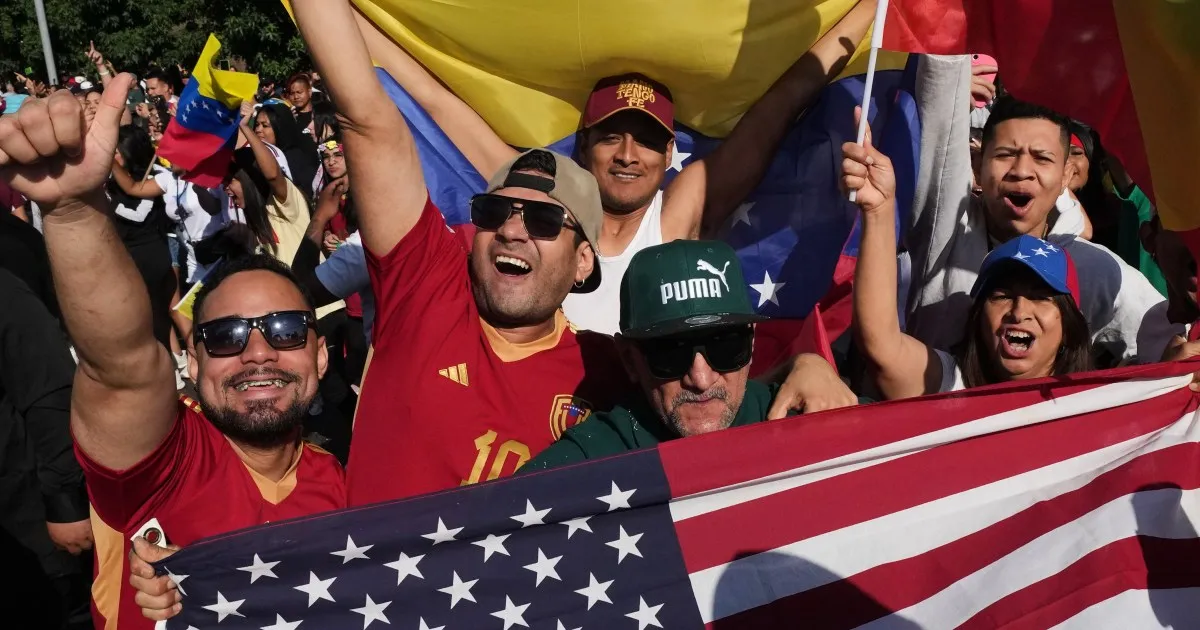
Fear, joy, hope: Venezuelans react to Maduro capture
Venezuelans reacted with everything from fear to joy as the US claims to have captured Nicolas Maduro.
Source link
Venezuelans reacted with everything from fear to joy as the US claims to have captured Nicolas Maduro.
Source link
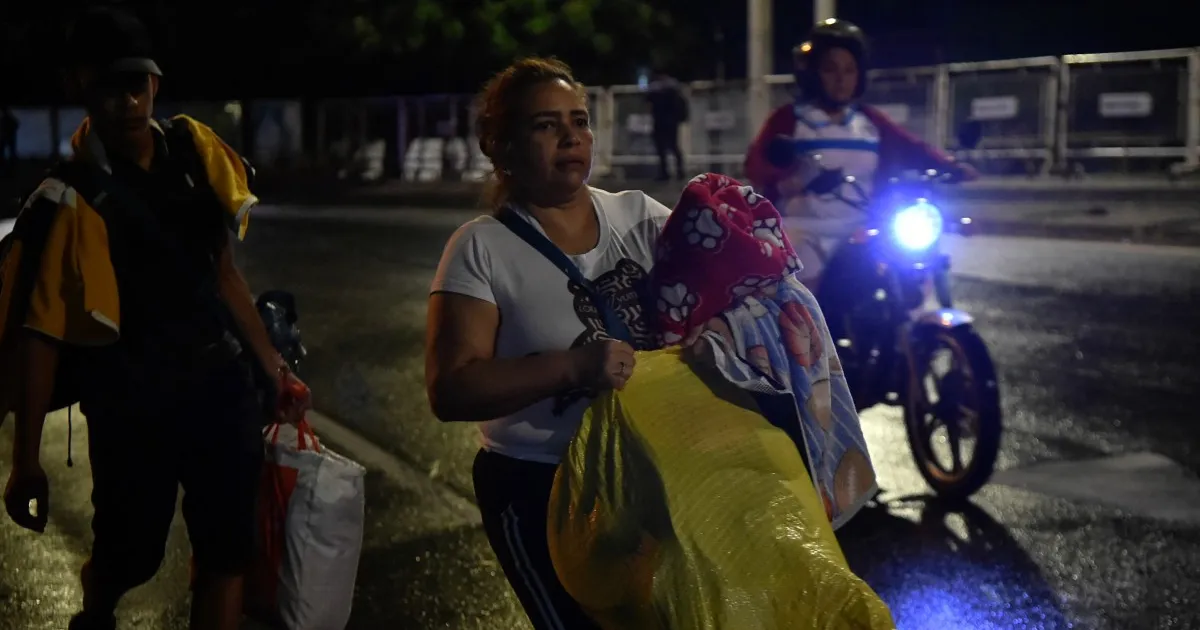
Medellin, Colombia – The shock removal of Venezuelan leader Nicolas Maduro by the United States military has triggered alarm in bordering Colombia, where analysts warn of the possibility of far-reaching repercussions.
The Colombian government condemned Washington’s early Saturday morning attacks on Venezuela – which included strikes on military targets and Maduro’s capture – and announced plans to fortify its 2,219-kilometre (1,378-mile) eastern land border, a historic hotbed of rebellion and cocaine production.
list of 3 itemsend of list
Security analysts also say Maduro’s deposition could aggravate an already deteriorating security situation in Colombia, while refugee advocacy groups warn the country would bear the brunt of possible migration waves triggered by the fallout from the intervention.
The Colombian government held an emergency national security meeting at 3am (09:00GMT), according to President Gustavo Petro.
“The Colombian government condemns the attack on the sovereignty of Venezuela and Latin America,” wrote the president in an X post, announcing the mobilisation of state forces to secure the border.
The National Liberation Army (ELN), a left-wing group and the largest remaining rebel force in the country, have been vocal as recently as December in its preparations to defend the country against “imperialist intervention”.
Security analysts say the primary national security risk to Colombia following the attacks stems from ELN, which controls nearly the entire border with Venezuela.
“I think there is a high risk now that the ELN will consider retaliation, including here in Colombia, against Western targets,” said Elizabeth Dickinson, deputy director for Latin America at Crisis Group International.
The rebel group is heavily involved in cocaine trafficking and operates on both sides of the border; it has benefited from ties with the Maduro government, and US intervention threatens the group’s transnational operations, according to analysts.
The ELN, which positions itself as a bastion against US imperialism in the region, had already stepped up violence in response to the White House’s threats against Colombia and Venezuela. In December, it ordered Colombians to stay home and bombed state installations across the country, an action it described as a response to US aggression.
The Colombian government has ramped up security measures in anticipation of possible retaliatory action by the ELN following Maduro’s removal.
“All capabilities of the security forces have been activated to protect the population, strategic assets, embassies, military and police units, among others, as well as to prevent any attempted terrorist action by transnational criminal organisations, such as the ELN cartel,” read a statement on Saturday morning issued by Colombia’s Ministry of Defence.
In addition to fears of increased violence, Colombia also stands to bear the brunt of any migration crisis initiated by a conflict in Venezuela.
In an X post on Saturday morning, Petro said the government had bolstered humanitarian provisions on its eastern border, writing, “all the assistance resources at our disposal have been deployed in case of a mass influx of refugees.”
To date, Colombia has received the highest number of Venezuelan refugees worldwide, with nearly 3 million of the approximately 8 million people who have left the country settling in Colombia.
The previous wave of mass migration in 2019 – which followed opposition leader Juan Guaido’s failed attempt to overthrow Maduro – required a massive humanitarian operation to house, feed, and provide medical attention to refugees.
Such an operation is likely to prove even more challenging now, with Colombia losing roughly 70 percent of all humanitarian funds after the Trump administration shuttered its USAID programmes in the country last year.
“There is a real possibility of short-term population movement, both precautionary and forced, especially if instability, reprisals, or power vacuums emerge,” said Juan Carlos Viloria, a leader of the Venezuelan diaspora in Colombia.
“Colombia must prepare proactively by activating protection mechanisms, humanitarian corridors, and asylum systems, not only to respond to potential arrivals, but to prevent chaos and human rights violations at the border,” added Viloria.
Analysts say Maduro’s removal raises difficult questions for Petro, who has been engaged in a war of words with Trump since the US president assumed office last year.
The Colombian leader drew Trump’s ire in recent months when he condemned Washington’s military buildup in the Caribbean and alleged a Colombian fisherman had been killed in territorial waters. In response, the White House sanctioned Petro, with Trump calling him a “thug” and “an illegal drug dealer”.
“Petro is irascible at the moment because he sees Trump and his threats no longer as empty, but as real possibilities,” said Sergio Guzman, Director at Colombia Risk Analysis, a Bogota-based security consultancy.
Indeed, Trump has on multiple occasions floated military strikes against drug production sites in Colombia. However, experts say it is unlikely the White House would take unilateral action given their historic cooperation with Colombian security forces.
Despite Petro condemning Washington’s intervention in Venezuela, he previously called Maduro a “dictator” and joined the US and other nations in refusing to recognise the strongman’s fraudulent re-election as president in 2024.
Rather than supporting Maduro, the Colombian leader has positioned himself as a defender of national sovereignty and international law.
On Saturday, Petro called for an emergency meeting of the United Nations Security Council, which Colombia joined as a temporary member just days ago.
“Colombia reaffirms its unconditional commitment to the principles enshrined in the Charter of the United Nations,” wrote the president in an X post.
This story has been published in conjunction with Latin America Reports.
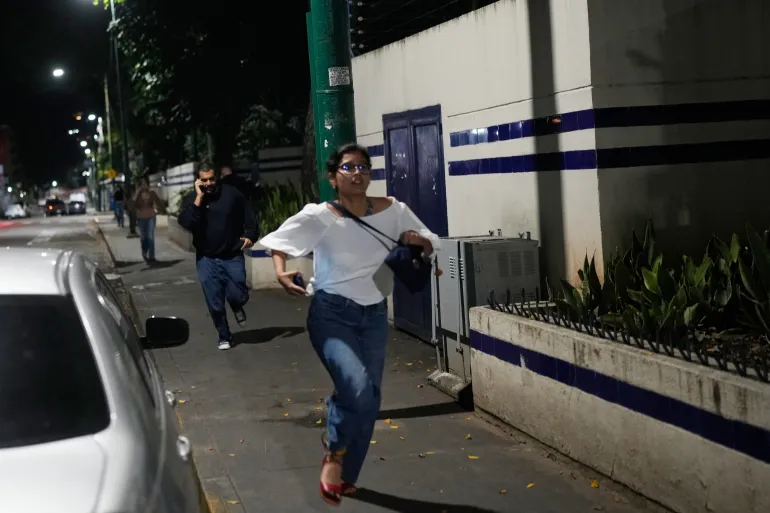
United States President Donald Trump announced on Saturday morning that his country’s forces had bombed Venezuela and captured the South American nation’s president, Nicolas Maduro, and First Lady Cilia Flores in a dramatic overnight military attack that followed months of rising tensions.
Venezuela’s government said that the US had struck three states apart from the capital, Caracas, while neighbouring Colombia’s President Gustavo Petro released a longer list of places that he said had been hit.
The operation has few, if any, parallels in modern history. The US has previously captured foreign leaders, including Iraq’s Saddam Hussein and Panama’s Manuel Noriega, but after invading those countries in declared wars.
Here is what we know about the US attacks and the lead-up to this escalation:

At least seven explosions were reported from Caracas, a city of more than three million people, at about 2am local time (06:00 GMT), as residents said they heard low-flying aircraft. Lucia Newman, Al Jazeera’s Latin America editor, reported that at least one of the explosions appeared to come from near Fort Tiuna, the main military base in the Venezuelan capital.
Earlier, the US Federal Aviation Administration had issued instructions to American commercial airlines to stay clear of Venezuelan airspace.
Within minutes of the explosions, Maduro declared a state of emergency, as his government named the US as responsible for the attacks, saying that it had struck Caracas as well as the neighbouring states of Miranda, Aragua and La Guaira.
The US embassy in Bogota, Colombia, referred to the reports of the explosions and asked American citizens to stay out of Venezuela, in a statement. But the diplomatic mission did not confirm US involvement in the attacks. That came more than three hours after the bombings, from Trump.

In a post on his Truth Social platform, Trump said, a little after 09:00 GMT that the US had “successfully carried out a large scale strike against Venezuela and its leader, President Nicolas Maduro, who has been, along with his wife, captured and flown out of the Country”.
Venezuela has not yet confirmed that Maduro was taken by US troops — but it also has not denied the claim.
Trump said that the attack had been carried out in conjunction with US law enforcement, but did not specify who led the operation.
Trump announced that there would be a news conference at his Mar-a-Lago resort in Florida at 11am local time (16:00 GMT) on Friday, where more details would be revealed.

While neither the US nor Venezuelan authorities have pinpointed locations that were struck, Colombia’s Petro, in a social media post, listed a series of places in Venezuela that he said had been hit.
They include:

Trump has, in recent months, accused Maduro of driving narcotics smuggling into the US, and has claimed that the Venezuelan president is behind the Tren de Aragua gang that Washington has proscribed as a foreign terrorist organisation.
But his own intelligence agencies have said that there is no evidence that Maduro is linked to Tren de Aragua, and US data shows that Venezuela is not a major source of contraband narcotics entering the country.
Starting in September, the US military launched a series of strikes on boats in the Caribbean Sea that it claimed were carrying narcotics. More than 100 people have been killed in at least 30 such boat bombings, but the Trump administration is yet to present any public evidence that there were drugs on board, that the vessels were travelling to the US, or that the people on the boats belonged to banned organisations, as the US has claimed.
Meanwhile, the US began its largest military deployment in the Caribbean Sea in at least several decades, spearheaded by the USS Gerald Ford, the world’s largest aircraft carrier.
In December, the US hijacked two ships carrying Venezuelan oil, and has since imposed sanctions on multiple companies and their tankers, accusing them of trying to circumvent already stringent American sanctions against Venezuela’s oil industry.
Then, last week, the US struck what Trump described as a “dock” in Venezuela where he claimed drugs were loaded onto boats.

Trump has so far framed his pressure and military action against Venezuela and in the Caribbean Sea as driven by a desire to stop the flow of dangerous drugs into the US.
But he has increasingly also sought Maduro’s departure from power, despite a phone call in early December that the Venezuelan president described as “cordial”.
And in recent weeks, some senior aides of the US president have been more open about Venezuela’s oil: the country’s vast reserves of crude, unmatched in the world, amounted to an estimated 303 billion barrels (Bbbl) as of 2023.
On December 17, Trump’s top adviser Stephen Miller claimed that the US had “created the oil industry in Venezuela” and that the South American country’s oil should therefore belong to the US.
But though US companies were the earliest to drill for oil in Venezuela in the early 1900s, international law is clear: sovereign states — in this case Venezuela — own the natural resources within their territories under the principle of Permanent Sovereignty over Natural Resources (PSNR).
Venezuela nationalised its oil industry in 1976. Since 1999, when socialist President Hugo Chavez, Maduro’s mentor and predecessor, came to power, Venezuela has been locked in a tense relationship with the US.
Still, one major US oil company, Chevron, continues to operate in the country.
The Venezuelan opposition, led by Nobel Peace Prize laureate Maria Corina Machado, has publicly called for the US to intervene against Maduro, and has pointed to the oil reserves that American firms could tap more easily with a new dispensation in power in Caracas.
Oil has long been Venezuela’s biggest export, but US sanctions since 2008 have crippled formal sales and the country today earns only a fraction of what it once did.

While Venezuela has not confirmed Maduro’s capture, Vice President Delcy Rodrigues told state-owned VTV that the government had lost contact with Maduro and First Lady Flores and did not have clarity on their whereabouts.
She demanded that the US provide “proof of life” of Maduro and Flores, and added that Venezuela’s defences were activated.
Earlier, in a statement, the Venezuelan government said that it “rejects, repudiates and denounces” the attacks.
It said that the aggression threatens the stability of Latin America and the Caribbean, and places the lives of millions of people at risk. It accused the US of trying to impose a colonial war, and force a regime change — and said that these attempts would fail.

In a statement posted on X, Trump’s Attorney General Pam Bondi announced that Maduro and his wife have been indicted in the Southern District of New York.
Maduro has been charged with “Narco-Terrorism Conspiracy, Cocaine Importation Conspiracy” among other charges, Bondi said. It was unclear if his wife is facing the same charges, but she referred to the Maduro couple as “alleged international narco traffickers.”
“They will soon face the full wrath of American justice on American soil in American courts,” she added.
Mike Lee, a Republican senator from Utah, earlier posted on X that he had spoken to US Secretary of State Marco Rubio, who had told him that Maduro had been “arrested by US personnel to stand trial on criminal charges in the United States, and that the kinetic action we saw tonight was deployed to protect and defend those executing the arrest warrant.”
In 2020, US prosecutors had charged Maduro with running a cocaine-trafficking network.
But US officials remain silent on the illegality of Maduro’s capture and the attacks on Venezuela, which violate UN charter principles of sovereignty and territorial integrity of nations.
Russia and Cuba, close Maduro allies, condemned the attack. Colombia, which neighbours Venezuela and has itself been in Trump’s crosshairs, said that it “rejects the aggression against the sovereignty of Venezuela and of Latin America” – even though Bogota itself does not recognise Maduro’s government.
Most other nations have been relatively muted in their response to the US aggression so far.

Constitutionally, Rodriguez, the vice president, is next in line to take charge if Maduro indeed has been plucked out of Venezuela by the US.
Other senior leaders seen as close to Maduro and influential within the Venezuelan hierarchy include Interior Minister Diosdado Cabello, National Assembly President — and Delcy’s brother — Jorge Rodriguez, and military chief General Vladimir Padrino López.
But it is unclear whether the state apparatus that Chavez and Maduro carefully built over a quarter century will last without them.
“Maduro’s capture is a devastating moral blow for the political movement started by Hugo Chavez in 1999, which has devolved into a dictatorship since Nicolas Maduro took power,” Carlos Pina, a Venezuelan analyst based in Mexico, told Al Jazeera.
If the US does engineer — or has already engineered — a regime change, the opposition’s Machado could be a front-line candidate to take Venezuela’s top job, though it is unclear how popular that might be. In a November poll in Venezuela, 55 percent of participants were opposed to military intervention in their country, and an equal number were opposed to economic sanctions against Venezuela.
Trump might be mistaken if he thinks the US can stay out of the chaos that’s likely to follow in a post-Maduro Venezuela, suggests Christopher Sabatini, a senior research fellow for Latin America, the US and North America programme at Chatham House.
“Assuming even if there is regime change – of some sort, and it’s by no means clear even if it does happen that it will be democratic – the US’s military action will likely require sustained US engagement of some sort,” he said.
“Will the Trump White House have the stomach for that?”
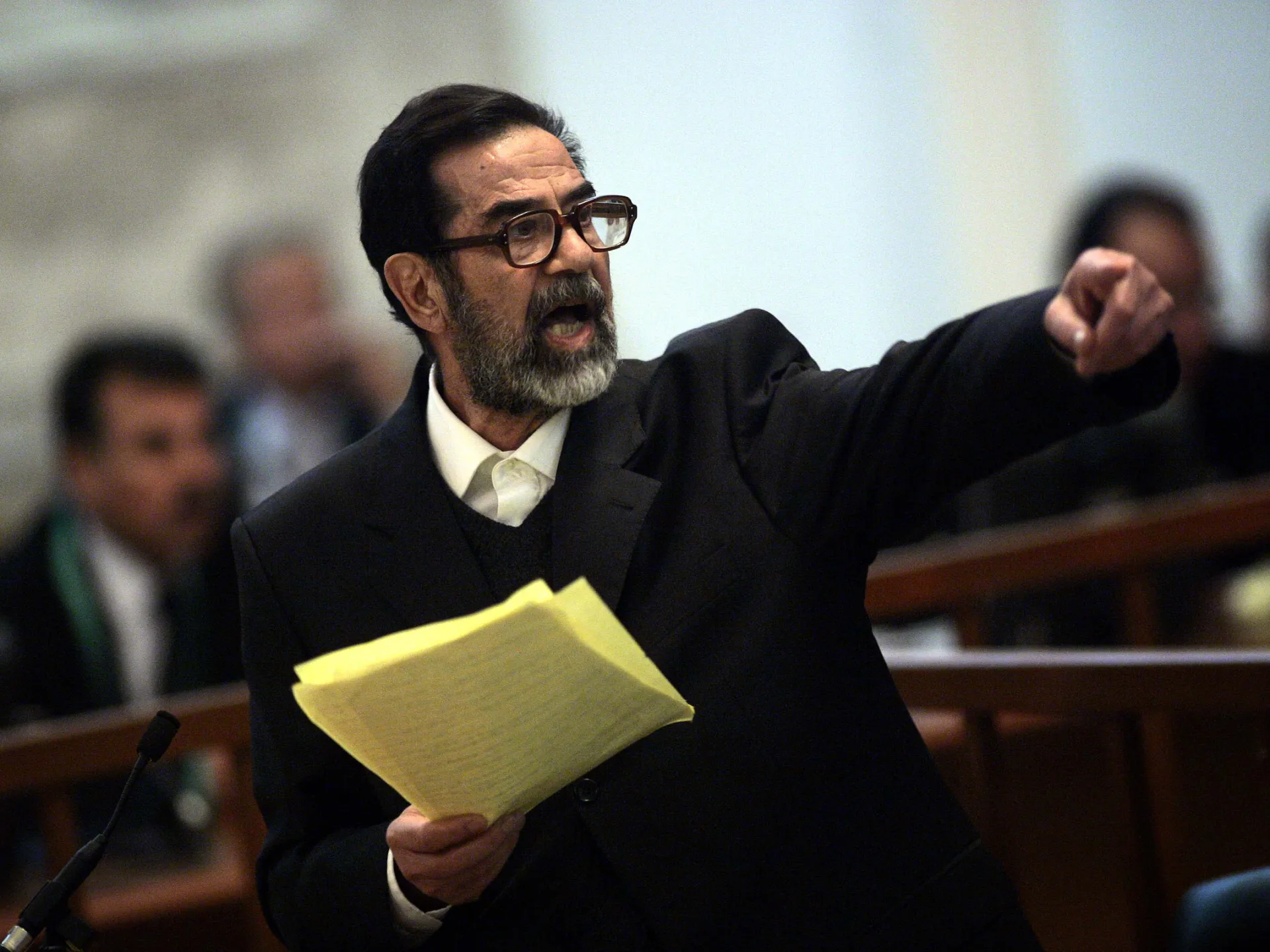
The reported capture of Venezuelan president evokes previous eras when other leaders were seized by the US.
President Donald Trump’s claim that the United States has captured his Venezuelan counterpart Nicolas Maduro and his wife amid “large scale” attacks on Venezuela, has stunned the world.
Venezuela’s Vice President Delcy Rodriguez says the government does not know the whereabouts of Maduro and his wife, Cilia Flores.
list of 4 itemsend of list
In an audio message broadcast on state television on Saturday, Rodriguez said the government was demanding proof that Maduro and Flores are still alive.
The rapidly escalating developments follow repeated deadly strikes by US forces in the Caribbean Sea and eastern Pacific Ocean on what Washington claims are drug-smuggling boats, and an attack on a docking area for alleged Venezuelan drug boats.
The reported capture of Maduro evokes previous eras when other leaders, such as Panama’s former military leader Manuel Noriega and former Iraqi President Saddam Hussein, were seized by the US.
In another direct intervention into Latin America, the US invaded Panama in 1989 to depose military and de facto leader Manuel Noriega, citing the protection of US citizens in Panama, undemocratic practices, corruption and the illegal drug trade.
Before attacking Panama, the US indicted Noriega for drug smuggling in Miami in 1988, just as it has targeted Maduro.
Noriega forced Nicolas Ardito Barletta to resign in 1985, cancelled the elections in 1989 and backed anti-US sentiment in the country, before the operation took place.
The US foray into Panama was at the time the largest US combat operation since the Vietnam War. The US government trotted out various justifications for the operation, such as improving the lot of the Panamanians by hauling Noriega off to the US to face drug-trafficking charges.
When the general began to show signs of being less obliging to US regional designs, however, he was rendered persona non grata by Washington.
He was tried on the Miami indictment after being flown to the US and was imprisoned there until 2010, when he was extradited to France to face another trial. France then sent him back to Panama a year later.
Noriega died in prison in Panama in 2017, where he was serving a sentence for his crimes.
Iraqi President Saddam Hussein was captured by US forces on December 13, 2003, nine months after the US-led invasion and occupation of Iraq started based on false intelligence of Baghdad possessing weapons of mass destruction (WMD).
Like Noriega, Saddam had for years been a key Washington ally, in his case, during the years of the Iraq-Iran war in the 1980s that killed one million people.
The US also claimed in the build-up to the 2003 war, without basis, that Saddam supported armed groups like al-Qaeda.
However, no WMDs were ever found in the country.
Saddam was found hiding in a hole near his hometown of Tikrit.
He stood trial in an Iraqi court and received the death penalty, leading to his execution by hanging for crimes against humanity on December 30, 2006.
The case of Honduras’s Hernandez demonstrates what some observers suggest is a hypocritical approach by the US.
Hernandez was captured in his home in Tegucigalpa in an operation by the US agents and Honduran forces in February 2022 – only days after he left his position as president of his country.
In April 2022, he was extradited to the US over his alleged involvement in corruption and the illegal drug trade, and in June of the same year, he was sentenced to 45 years in prison.
However, Hernandez was pardoned by US President Donald Trump on December 1, 2025.
Days later, Honduras’s top prosecutor issued an international arrest warrant for Hernandez, intensifying legal and political turmoil just days after the ex-leader walked free from a United States prison.
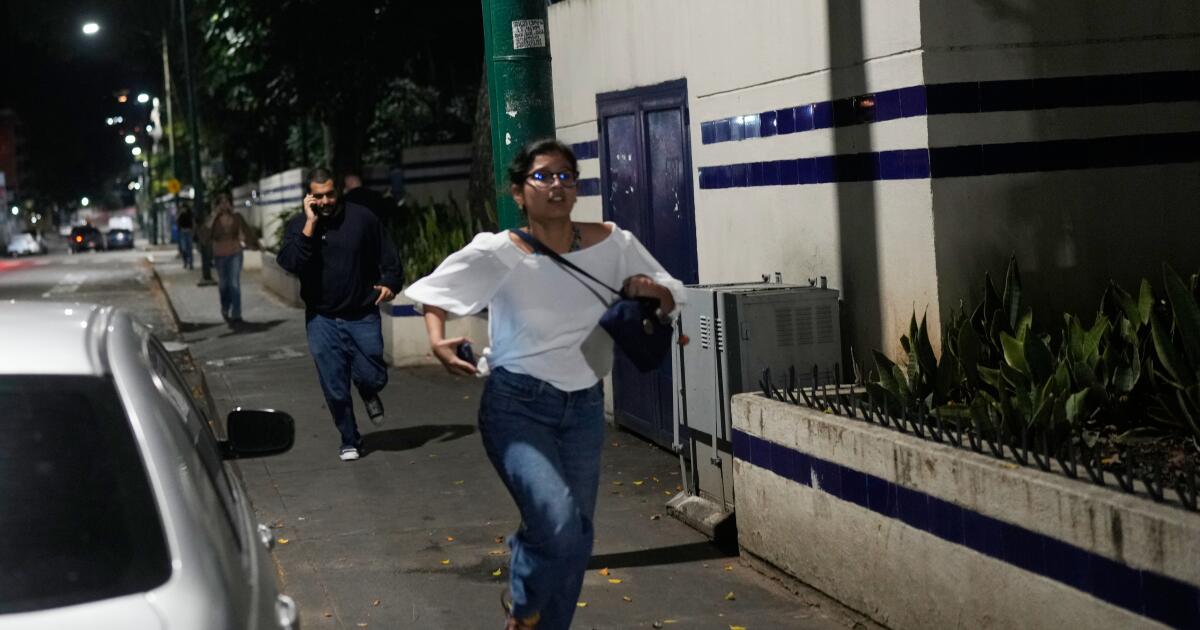
CARACAS, Venezuela — The United States hit Venezuela with a “large-scale strike” early Saturday and said its president, Nicolás Maduro, had been captured and flown out of the country after months of stepped-up pressure by Washington — an extraordinary nighttime operation announced by President Trump on social media hours after the attack.
Multiple explosions rang out and low-flying aircraft swept through Caracas, the capital, as Maduro’s government immediately accused the United States of attacking civilian and military installations. The Venezuelan government called it an “imperialist attack” and urged citizens to take to the streets.
It was not immediately clear who was running the country, and Maduro’s whereabouts were not immediately known. Trump announced the developments on Truth Social shortly after 4:30 a.m. ET. Under Venezuelan law the vice president, Delcy Rodríguez, would take power. There was no confirmation that had happened, though she did issue a statement after the strike.
“We do not know the whereabouts of President Nicolás Maduro and First Lady Cilia Flores,” Rodriguez said. “We demand proof of life.”
Maduro, Trump said, “has been, along with his wife, captured and flown out of the Country. This operation was done in conjunction with U.S. Law Enforcement. Details to follow.” He set a news conference for later Saturday morning.
The legal implications of the strike under U.S. law were not immediately clear. Sen. Mike Lee (R-Utah) posted on X that he had spoken with Secretary of State Marco Rubio, who briefed him on the strike. Rubio told Lee that Maduro “has been arrested by U.S. personnel to stand trial on criminal charges in the United States.”
The White House did not immediately respond to queries on where Maduro and his wife were being flown to. Maduro was indicted in March 2020 on “narco-terrorism” conspiracy charges in the Southern District of New York.
Maduro last appeared on state television Friday while meeting with a delegation of Chinese officials in Caracas.
The explosions in Caracas, Venezuela’s capital, early on the third day of 2026 — at least seven blasts — sent people rushing into the streets, while others took to social media to report hearing and seeing the explosions. It was not immediately clear if there were casualties on either side. The attack itself lasted less than 30 minutes and it was unclear if more actions lay ahead, though Trump said in his post that the strikes were carried out “successfully.”
The Federal Aviation Administration issued a ban on U.S. commercial flights in Venezuelan airspace because of “ongoing military activity” ahead of the explosions.
The strike came after the Trump administration spent months escalating pressure on Maduro. The CIA was behind a drone strike last week at a docking area believed to have been used by Venezuelan drug cartels — the first known direct operation on Venezuelan soil since the U.S. began strikes in September.
For months, Trump had threatened that he could soon order strikes on targets on Venezuelan land following months of attacks on boats accused of carrying drugs. Maduro has decried the U.S. military operations as a thinly veiled effort to oust him from power.
Armed individuals and uniformed members of a civilian militia took to the streets of a Caracas neighborhood long considered a stronghold of the ruling party. But in other areas of the city, the streets remained empty hours after the attack. Parts of the city remained without power, but vehicles moved freely.
Video obtained from Caracas and an unidentified coastal city showed tracers and smoke clouding the landscape sky as repeated muted explosions illuminated the night sky. Other footage showed an urban landscape with cars passing on a highway as blasts illuminated the hills behind them. Unintelligible conversation could be heard in the background. The videos were verified by The Associated Press.
Smoke could be seen rising from the hangar of a military base in Caracas, while another military installation in the capital was without power.
“The whole ground shook. This is horrible. We heard explosions and planes,” said Carmen Hidalgo, a 21-year-old office worker, her voice trembling. She was walking briskly with two relatives, returning from a birthday party. “We felt like the air was hitting us.”
Venezuela’s government responded to the attack with a call to action. “People to the streets!” it said in a statement. “The Bolivarian Government calls on all social and political forces in the country to activate mobilization plans and repudiate this imperialist attack.”
The statement added that Maduro had “ordered all national defense plans to be implemented” and declared “a state of external disturbance.” That state of emergency gives him the power to suspend people’s rights and expand the role of the armed forces.
The website of the U.S. Embassy in Venezuela, a post that has been closed since 2019, issued a warning to American citizens in the country, saying it was “aware of reports of explosions in and around Caracas.”
“U.S. citizens in Venezuela should shelter in place,” the warning said.
Inquiries to the Pentagon and U.S. Southern Command since Trump’s social media post went unanswered. The FAA warned all commercial and private U.S. pilots that the airspace over Venezuela and the small island nation of Curacao, just off the coast of the country to the north, was off limits “due to safety-of-flight risks associated with ongoing military activity.”
U.S. Sen. Mike Lee, R-Utah, posted his potential concerns, reflecting a view from the right flank in the Congress. “I look forward to learning what, if anything, might constitutionally justify this action in the absence of a declaration of war or authorization for the use of military force,” Lee said on X.
It was not clear if the U.S. Congress had been officially notified of the strikes.
The Armed Services committees in both houses of Congress, which have jurisdiction over military matters, have not been notified by the administration of any actions, according to a person familiar with the matter and granted anonymity to discuss it.
Lawmakers from both political parties in Congress have raised deep reservations and flat out objections to the U.S. attacks on boats suspected of drug smuggling on boats near the Venezuelan coast and the Congress has not specifically approved an authorization for the use of military force for such operations in the region.
Regional reaction was not immediately forthcoming in the early hours of Saturday. Cuba, however, a supporter of the Maduro government and a longtime adversary of the United States, called for the international community to respond to what president Miguel Díaz-Canel Bermúdez called “the criminal attack.” “Our zone of peace is being brutally assaulted,” he said on X. Iran’s Foreign Ministry also condemned the strikes.
President Javier Milei of Argentina praised the claim by his close ally, Trump, that Maduro had been captured with a political slogan he often deploys to celebrate right-wing advances: “Long live freedom, dammit!”
The U.S. military has been attacking boats in the Caribbean Sea and the eastern Pacific Ocean since early September. As of Friday, the number of known boat strikes is 35 and the number of people killed is at least 115, according to numbers announced by the Trump administration.
They followed a major buildup of American forces in the waters off South America, including the arrival in November of the nation’s most advanced aircraft carrier, which added thousands more troops to what was already the largest military presence in the region in generations.
Trump has justified the boat strikes as a necessary escalation to stem the flow of drugs into the U.S. and asserted that the U.S. is engaged in an “armed conflict” with drug cartels.
Cano and Toropin write for the Associated Press. Toropin and AP journalist Lisa Mascaro reported from Washington.
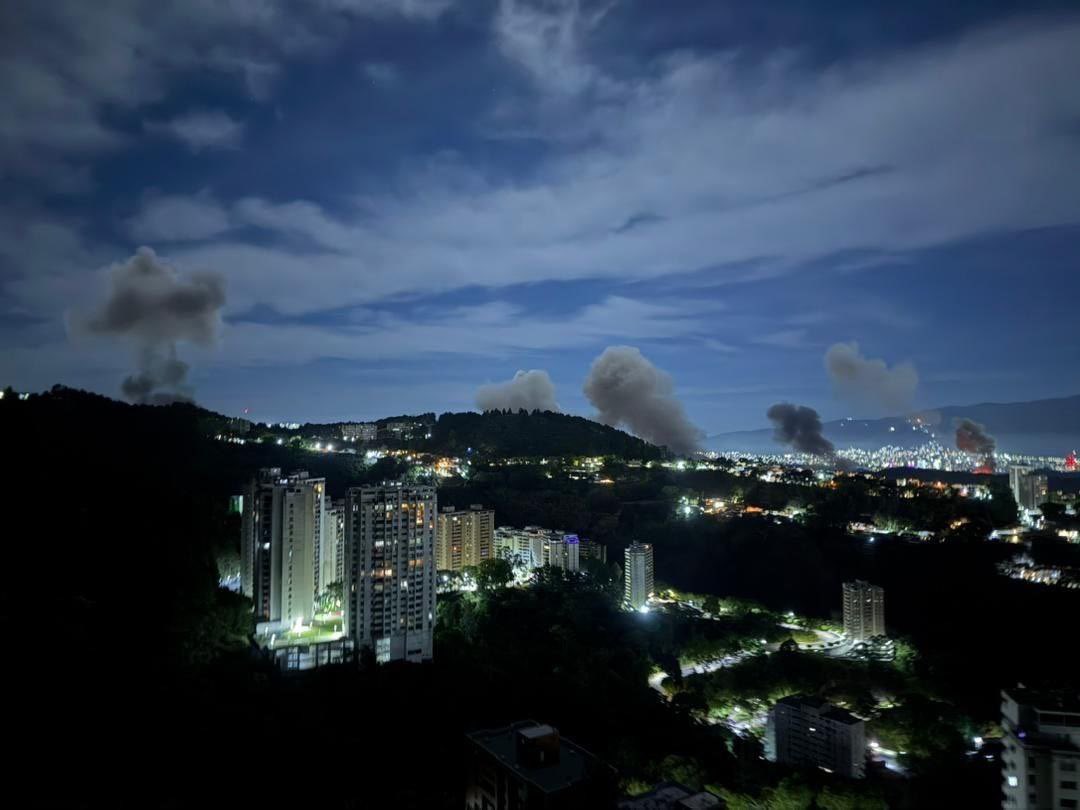
Caracas, January 3, 2026 (venezuelanalysis.com) – US President Donald Trump has claimed that US Special Forces have captured Venezuelan President Nicolás Maduro during a miltary operation against Venezuela in the early hours of Saturday.
In a social media message, Trump stated that the US had “successfully carried out a large scale strike against Venezuela” and that Maduro and first lady Cilia Flores had been “captured and flown out of the country.”
Venezuelan Vice President Delcy Rodríguez confirmed that Maduro and Flores’ whereabouts are unknown and demanded that the Trump administration provide proof of life.
US attacks began around 2 am local time, with loud explosions felt in the capital and nearby states.
Multiple military sites, including Fuerte Tiuna in Caracas, were reportedly bombed. Social media users reported low flying aircraft and active air defenses. The port in La Guaira was likewise among infrastructures hit.
Videos on social media also showed helicopters flying over the Venezuelan capital, with military analysts claiming that US Special Forces were deployed.
In a statement published on state outlets, the Venezuelan government accused the United States of carrying out a military attack against Venezuelan territory, describing it as a violation of the UN Charter and a threat to regional peace.
Authorities announced the activation of national defense plans, the deployment of the armed forces, and the declaration of a state of “External Commotion” nationwide. The Maduro government also called for popular mobilization and said it would raise formal complaints before international bodies, including the United Nations.
Venezuelan Defense Minister Vladimir Padrino Lopez issued a statement confirming US bombings in Caracas and surrounding areas.
Padrino reported that Venezuelan authorities are assessing damages and casualties from the attacks, claiming that US helicopters fired missiles on residential areas. The armed forces chief urged the international community to condemn Washington’s “criminal aggression.”
The Trump administration has escalated regime-change threats against Caracas im recent months and vowed to strike land targets.
[Story in development]
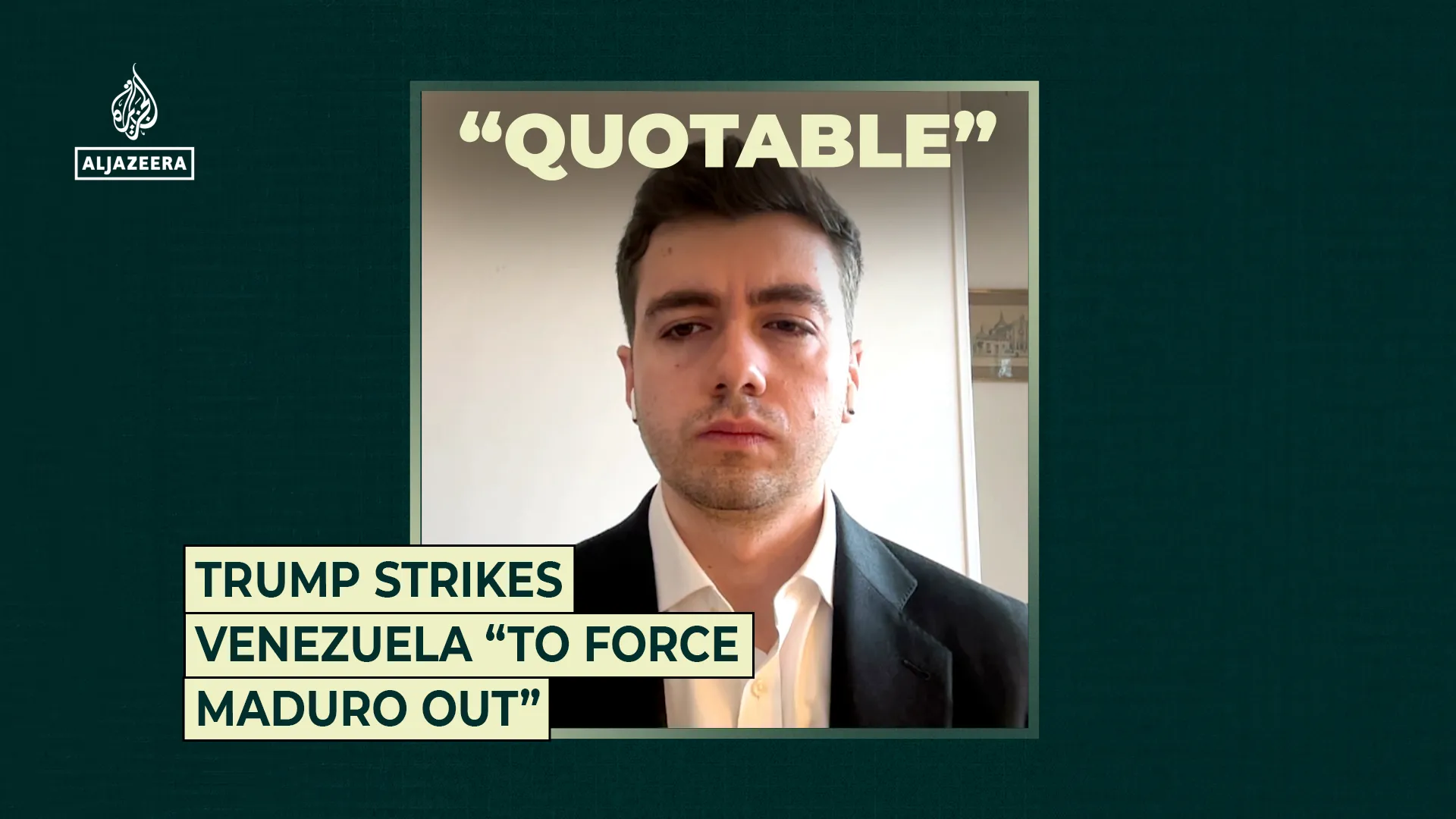
The US strikes in Venezuela aim at removing president Nicolas Maduro, says analyst Elias Ferrer
Source link
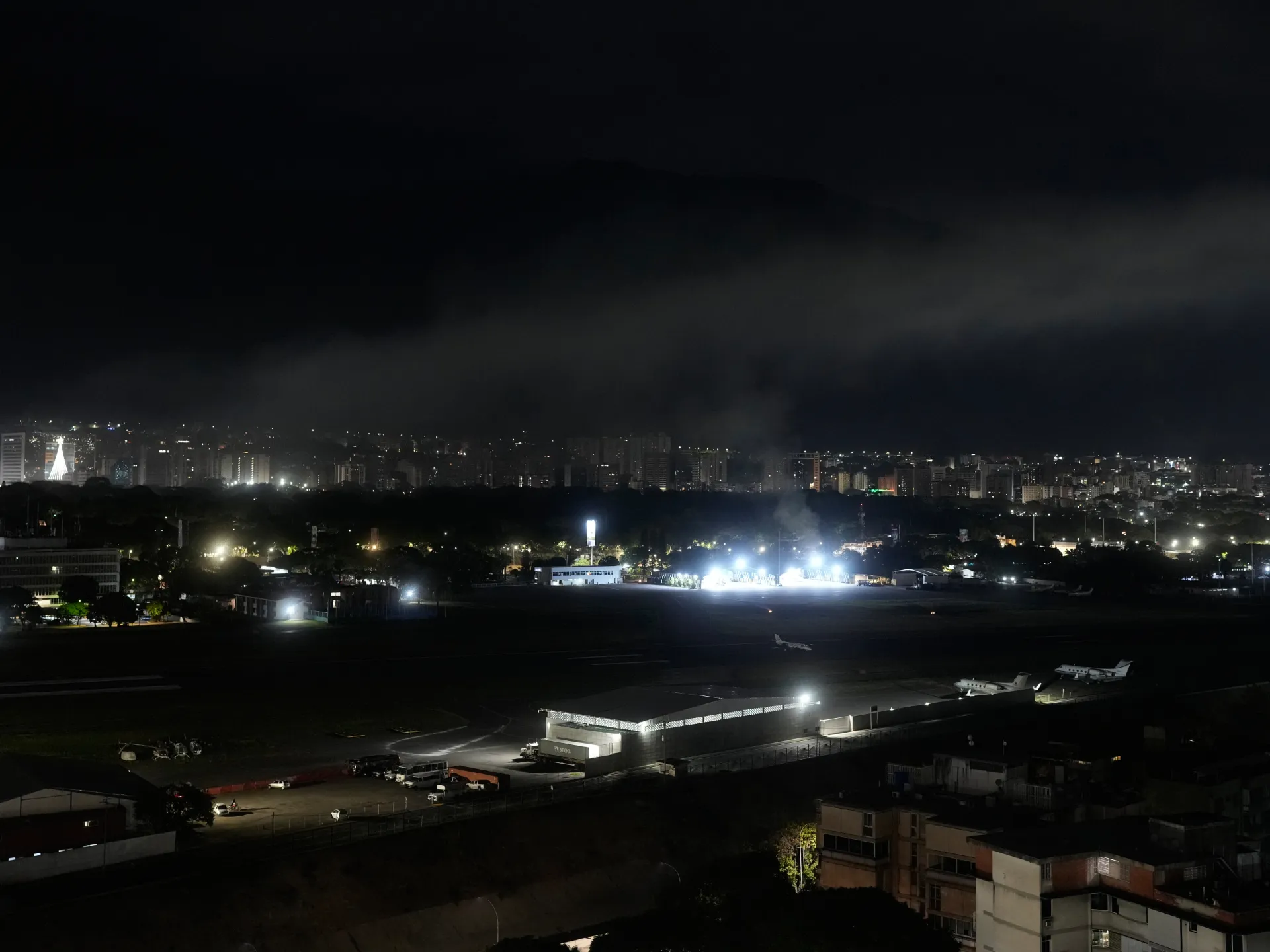
At least 7 explosions have been heard in Venezuela’s capital, Caracas, followed by a low-flying aircraft, according to The Associated Press.
Published On 3 Jan 20263 Jan 2026
Share
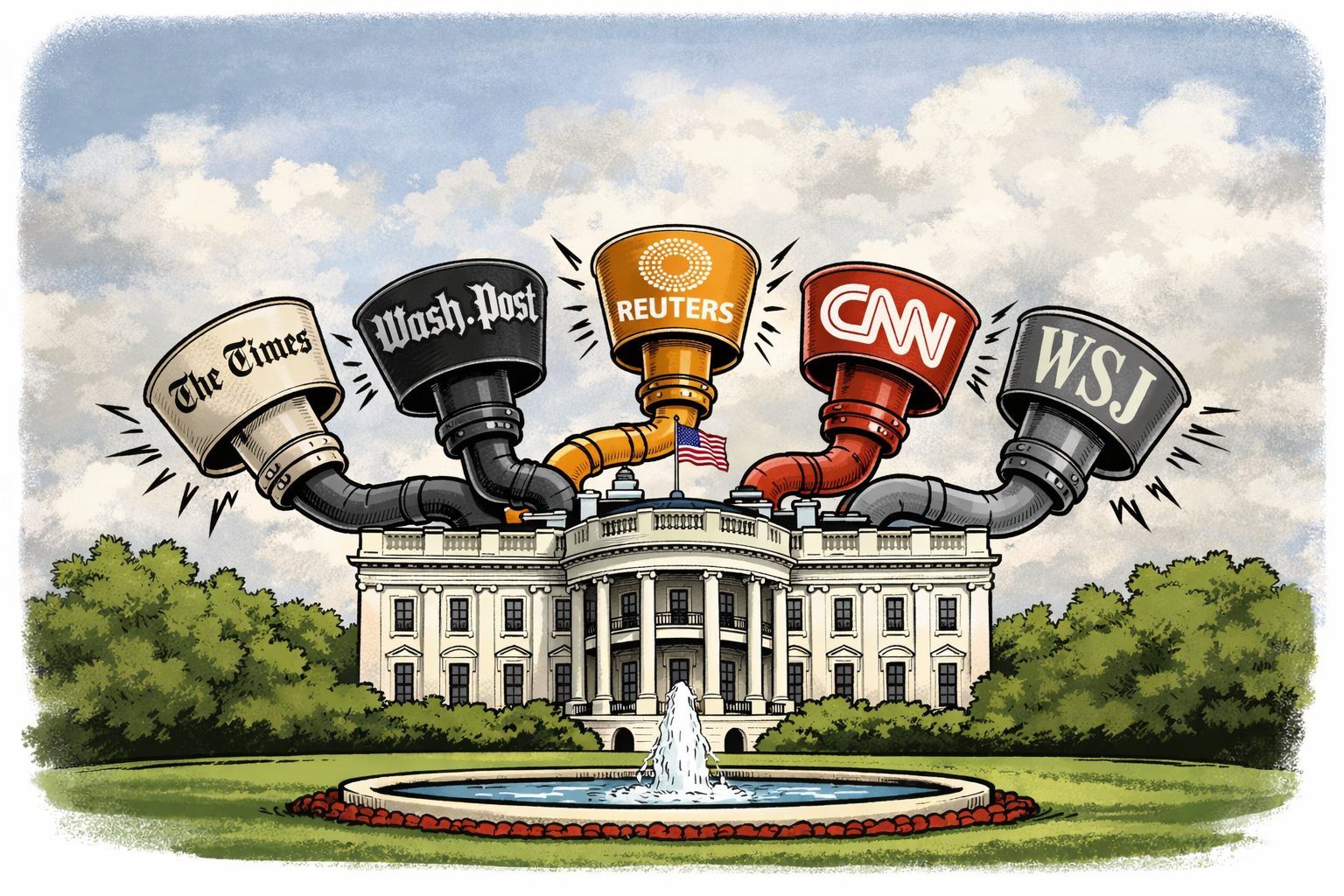
Mainstream outlets work directly to spread official US narratives. (Image created with AI)
Washington’s unprovoked aggression against Venezuela, and the likely coming ground attack, are an attempt at reimposing “proud, stable democracy” in the country, in the words of the US front surrogate, Maria Corina Machado.
When you decode the meaning of those words and the pretexts put forth for US aggression, you will find a remarkable culture of terrorism and gangsterism on display. Let us take a look.
The initial pretext was that Venezuela was an exporting “narco-terrorist” state. The knowingly fraudulent story did not merit even laughter by US intelligence agencies and the DEA. In the DEA’s most recent report, Venezuela is mentioned in only a single paragraph. In fact, Venezuela did not merit even a single mention in the one-hundred pages long 2025 UN World Drug Report, just like the EU’s own annual drug assessment report.
Nevertheless, Western media still incessantly report the fabricated charges without comment, while omitting the conclusions from Western intelligence, since it reached the wrong conclusion. The servility could not be more startling.
US propaganda then had to shift its main focus back to its staple: Maduro the dictator must be removed. “Maduro ramps up repression in Venezuela,” noted CNN, which failed to mention that the country is, after all, under a multi-pronged attack by a superpower.
CNN did not mention, either, that no opposition funded and directed by a hostile superpower would ever be tolerated in the West’s best friends, like Egypt, Israel, the Philippines and so on. Countries that routinely murder – not just imprison – their opposition under far less onerous circumstances.
The thought that such “opposition” would parade the capital calling for the overthrow of the government in any of these states is plainly absurd. However, that is exactly what happened in Venezuela, with CIA-sponsored figurehead Juan Guaido in 2019. It is Venezuela alone that must live up to such standards.
The idea that democracy promotion could be the real motivation behind the hostility is too ridiculous to merit even a comment. After all, the West lends its full support and sends hundreds of billions in arms to ICJ- and ICC-indicted Israel, Saudi Arabia (which doesn’t even pretend to have elections), Egypt and so on.
Incidentally, for those interested in actual election fraud in Latin America, there is certainly no shortage of issues to be concerned about. Namely, the election manipulations that are run out of Washington, which is by far the league leader.
Just to pick some examples known to all media offices – though few, if any, care: Trump was effectively “bribing Honduran voters” to “restore [the] narcotrafficking government to power”. Trump demanded that they vote for Tito Asfura, the colleague of the indicted narco-trafficker he just pardoned, Juan Orlando Hernández. Or else the US would withhold aid to the country, effectively “threatening to destroy the Honduran economy unless the country elects the oligarch-run National Party”. “Trump deployed the same strategy in Argentina’s October 2025 midterm elections,” in which he threatened to withhold a $20 billion bailout, “successfully strong-arming voters there into backing the party of the country’s mentally unstable president, Javier Milei.”
With a naval armada outside their shores to display what will happen if countries disobey, Washington thus sends the appropriate message: “you are free to choose as long as it is the right guys; otherwise you will starve.”
Thus, no reason for going to war with Venezuela worthy even of consideration from anyone with two functioning brain cells has been put forth.
The actual reason is explained openly by the aggressors themselves. In Trump’s own words: “When I left, Venezuela was ready to collapse. We would have taken it over. We would have gotten all that oil. It would have been right next door.” More recently, perhaps tired of the “narco-terrorism” script, Trump conceded that he wants “the oil and land rights.”
Congresswoman Maria Elvira Salazar boasted that “Venezuela, for the American oil companies, will be a field day, because it will be more than a trillion dollars in economic activity.”
This pitch was further explained by Washington’s minion Machado in a speech to the America Business Forum. As soon as she leads a “proud, stable democracy” there will be a “massive privatization program,” offering “a $1.7 trillion opportunity.” “We will open markets … And American companies are in, you know, a super strategic position to invest. … This country, Venezuela, is going to be the brightest opportunity for investment of American companies,” which “are going to make a lot of money.”
The only criticism found in the political and media establishment against an attack, then, is tactical concerns. Will it work? Will Trump get away with aggression?
Thus, coup plotter Elliott Abrams explained that Venezuela “previously was” a democracy, and “has a long democratic history,” with which he must mean as a US-run junta and staged colony, if words have any meaning whatsoever. If aggression is successful, “oil production can start rising again … As it was before the Chávez-Maduro years, Venezuela can be a major supplier of oil to the United States and a partner in Latin America.” Hopefully “Cuba, and Nicaragua” will fall too, but aggression could hurt American “clout on the international stage.” Abrams concludes by complaining that the “economic and diplomatic pressure we put on Maduro in the first term was simply not enough.”
“For 26 years, the U.S. has tried to restore democracy in Venezuela through negotiations, concessions, sanctions and a combination of carrots and sticks. Nothing has worked,” noted former OAS ambassador and Harvard lecturer Arturo McGields.
An illegal economic siege, eradicating perhaps 75% of the country’s GDP, and which has killed tens or hundreds of thousands of civilians, a failed mercenary invasion, and numerous coup attempts are not wrong in principle, only tactically unfortunate, since none of it “has worked.”
The euphoria liberals display at this show of sadism is quite revealing. For example, Rebecca Heinrichs pointed out that Cuba could fall if Venezuela is sufficiently squeezed. ”If you pressure” Venezuela “so much” and eliminate “80 to 85% of the revenue” through the illegal naval blockade imposed on them, then ”you are immediately going to have further crises” for the civilian population, and ”they are going to feel that pressure even more, and they will blame Maduro” – Cuba-style, in other words.
James Story, one of the key architects of the illegal regime change operations against Venezuela in recent years, wrote an op-ed repeating all the standard propaganda charges. Story gloated that the recent oil blockade on Venezuelan exports “is a more effective and acceptable way” of overthrowing the government, since “squeezing this revenue stream would” starve the population sufficiently so as to “recognize that life without him [Maduro] in power is preferable to him remaining”.
You will notice the transparent hypocrisy, since the US a month prior to its “total and complete blockade” on Venezuela denounced “Iran’s use of military forces to conduct an armed boarding and seizure of a commercial vessel in international waters [which] constitutes a blatant violation of international law, undermining freedom of navigation and the free flow of commerce”.
It is not that Western journalists do not know about Washington’s propaganda plot when it condemned Iran only to then conduct global piracy itself, since it was publicly reported. Rather, connecting the dots would expose the media as totally servile to state propaganda, and give the game away.
To be sure, there is nothing that causes more outrage than Venezuela supposedly collaborating with the “enemy states.” Even if the charges are true, this illustrates the leading principle that must be accepted if you wish to be part of the debate: no country, however weak, has the right to defend itself against unprovoked Western aggression.
Thus, Elliot Abrams demanded the US attack Venezuela due to its supposed “cooperation with China, Cuba, Iran, and Russia, which gives countries hostile to U.S. interests a base of operations on the South American mainland,” with weapons that can “reach U.S. territory from Venezuela”. Abrams has no issues with the “legality” of such strikes, only “doubts about the chances of success.” “Merely starving” the country “will not be enough: it must be forced out of power with military strikes, which will throw the regime’s support structures, including in the military, into disarray and make them fear for their own futures.”
No doubt the Nazi press “criticized” Operation Barbarossa on the same grounds before invading the Soviet Union. Their ideological heirs have learned that “starving” the population is not enough to win; they must smash their opponents “and make them fear for their own futures.”
In fact, without a hint of irony, we read that it is Venezuela with “Castro’s Cuba” who are “attacking” the US “asymmetrically” in Machado’s words – not the other way around, of course. The goal of US aggression is to open “an extraordinary frontier for US investment in energy, infrastructure, technology and agriculture.”
In short, Washington and its allies cannot tolerate that Venezuela is “associated with” those that the Mafia Don has prohibited, as liberal media darling David Frum put it. So the “goal is to restore the Venezuelan democracy that existed before [Hugo] Chávez and Maduro” – which, again, must refer to the US-directed junta and staged oligarchy.
This is what is called “public debate,” in which the outermost “critics” warn that Western aggression simply may not succeed, while the hawks joyfully celebrate that “military strikes” can “make them fear for their own futures.”
The deep totalitarian streak in Western intellectual culture is beautifully illustrated by these statements, as well as the reactions to them: nil.
Loyal and brainwashed Westerners cannot notice that the same type of arguments could just as well be used by Putin if he wished to invade Sweden, Ayatollah Khamenei to invade Israel or Xi Jinping to invade Taiwan.
This shows that Western intellectuals reflexively view world order and violence the same way they claim Putin does: “we have our sphere of influence, and must boss it as we please.” Such simple observations cannot be uttered in cultivated circles, no matter how obvious they may be.
Through such means, the Western media have effectively become servants of one of the century’s textbook examples of an unprovoked campaign of aggression against a sovereign state.
Andi Olluri is a freelance writer on propaganda and foreign affairs, publishing mostly in European and occasionally in American leftist papers. In his professional life, he does research in epidemiology and evidence-based medicine, studying at Sahlgrenska Academy University Hospital (Gothenburg, Sweden).
The views expressed in this article are the author’s own and do not necessarily reflect those of the Venezuelanalysis editorial staff.
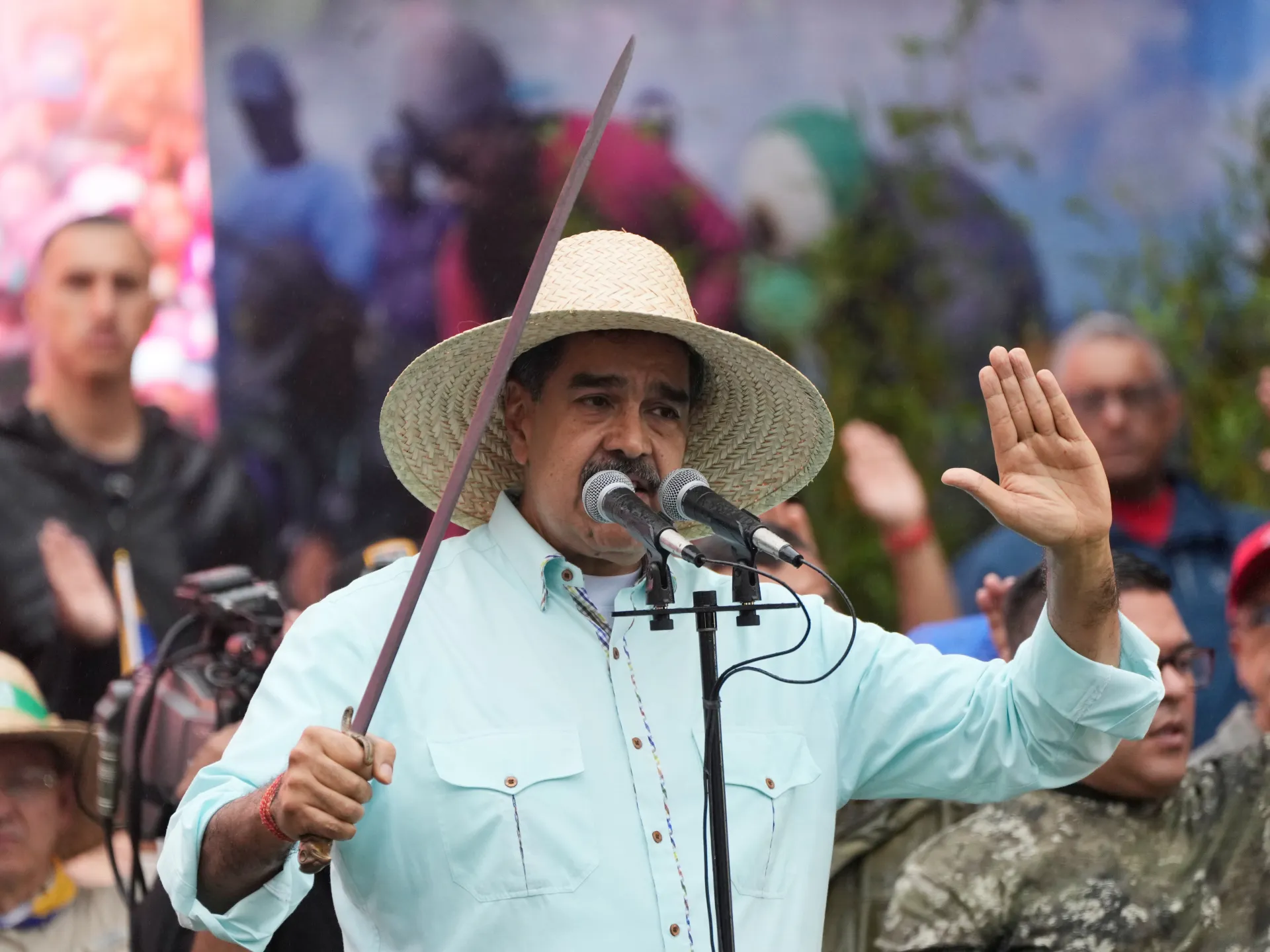
Venezuela leader strikes conciliatory tone while renewing claim US wants to topple government to access vast oil reserves.
Venezuela is open to negotiating a deal with the United States to combat drug trafficking, President Nicolas Maduro has said, even as he remained silent on a reported CIA-led strike on his country last week.
The latest statement, made during an interview that aired on Thursday, comes as Maduro has struck a more conciliatory tone towards the US amid Washington’s months-long sanctions and military pressure campaign.
list of 3 itemsend of list
That included, on Thursday, the release of more than 80 prisoners accused of protesting his disputed victory in the 2024 election, the second such release in recent days.
“Wherever they want and whenever they want,” Maduro told Spanish journalist Ignacio Ramonet of the idea of dialogue with the US on drug trafficking, oil and migration in an interview on state TV.
He stressed that it is time for both nations to “start talking seriously, with data in hand”.
“The US government knows, because we’ve told many of their spokespeople, that if they want to seriously discuss an agreement to combat drug trafficking, we’re ready,” he said.
Still, Maduro renewed his allegations that the US is trying to topple his government and gain access to Venezuela’s vast oil reserves through Washington’s months-long sanctions and military pressure campaign.
“If they want oil, Venezuela is ready for US investment, like with Chevron,” he added, referring to the US oil giant, which is the only major oil company exporting Venezuelan crude to the US.
Asked point-blank by Ramonet if he confirmed or denied a US attack on Venezuelan soil, Maduro said: “This could be something we talk about in a few days.”
To date, Maduro has not confirmed a US land attack on a docking facility that allegedly targeted drug boats.
For months, the US has launched numerous strikes on alleged drug smuggling boats originating from Venezuela, in what rights groups have decried as extrajudicial killings. The Trump administration has also imposed a blockade on sanctioned oil tankers entering and exiting Venezuela’s coast.
Tensions further escalated after Trump revealed earlier this week a strike on a docking area for alleged Venezuelan drug boats, in the first known attack on Venezuelan territory of the US campaign.
Trump has not confirmed widespread reports in US media that the attack was a CIA operation or where it occurred, saying only it was “along the shore”.
“There was a major explosion in the dock area where they load the boats up with drugs,” he told reporters at his Mar-a-Lago resort in Florida.
“So we hit all the boats and now we hit the area, it’s the implementation area, that’s where they implement. And that is no longer around.”
The US president has repeatedly threatened ground strikes on drug cartels in the region, which he has labelled “narcoterrorists”. He has claimed, without providing evidence, that Maduro leads a trafficking organisation that aims to destabilise the US by flooding it with drugs.
However, regional experts have noted that Venezuela is not known to be involved in the illicit fentanyl trade, which far and away accounts for the highest number of overdose deaths in the US. Trump has labelled the drug a “weapon of mass destruction”.
Maduro has said the Trump administration’s approach makes it “clear” that the US “seek to impose themselves” on Venezuela through “threats, intimidation and force”.
Maduro’s interview was taped on New Year’s Eve, the same day the US military struck five alleged drug-smuggling boats, killing at least five people.
The latest attacks bring the total number of known boat strikes in the Caribbean and eastern Pacific to 35 and the number of people killed to at least 115, according to numbers announced by the Trump administration.
Venezuelans and Colombians have been among the victims.
Second release of prisoners related to 2024 election protests seen as possible conciliatory move from Maduro.

Published On 1 Jan 20261 Jan 2026
Share
The government of Venezuelan leader Nicolas Maduro has released dozens of prisoners held for protesting his disputed victory in the country’s 2024 election.
The release of at least 87 prisoners comes as the administration of United States President Donald Trump has continued its pressure campaign against Caracas.
list of 3 itemsend of list
It was the second release within a week, in what some observers have viewed as an effort by Maduro to strike a more conciliatory tone, even as he has accused Trump of seeking to topple his government and seize Venezuela’s vast oil reserves.
Two rights groups, the Committee for the Freedom of Political Prisoners and the Committee of Mothers in Defense of the Truth, confirmed the release on Thursday.
“On the morning of January 1, mothers and relatives reported new releases of political prisoners from Tocoron prison in Aragua state” in northern Venezuela, the Committee for the Freedom of Political Prisoners wrote on social media.
Venezuela’s government had previously announced the release of 99 prisoners on December 25, calling it “a concrete expression of the State’s commitment to peace, dialogue and justice”.
However, Foro Penal, a leading Venezuelan rights group, said afterwards it was only able to verify the release of 61 prisoners at the time.
Maduro claimed victory in the July 2024 vote, maintaining he had secured a third six-year term. The opposition has alleged widespread fraud, publishing results later verified by independent experts showing that Edmond Gonzalez had won by a landslide.
Gonzalez ran in place of opposition leader Maria Corina Machado after she was banned from standing in the election. Machado recently emerged in Oslo, Norway, after spending months in hiding.
The disputed vote prompted widespread protests across the country, resulting in at least 28 deaths and thousands of arrests.
Official records show that at least 2,000 people have since been released, while more than 700 people are still believed to be held for political reasons.
The disputed election has, in part, undergirded the Trump administration’s pressure against Maduro, whom they have accused of running a drug trafficking operation that aims to destabilise the US.
The Pentagon has surged military assets off the coast of Venezuela since August, with Trump earlier this week revealing the first attack on Venezuelan soil targeting a dock allegedly used to load drug boats earlier this week.
The US has also blockaded sanctioned oil tankers entering and exiting Venezuela, while simultaneously carrying out strikes on alleged drug boats in the Caribbean and eastern Pacific, in what rights groups say amount to extrajudicial killings.
More than 100 people have been killed in the strikes so far.
From exile, Machado has vocally supported the US pressure campaign. She has been more circumspect on strikes on Venezuelan territory, while maintaining that Venezuela has been “invaded” by “terrorist groups” and “drug cartels”.
Venezuela experts have warned that many opposition groups in the country oppose US military action.
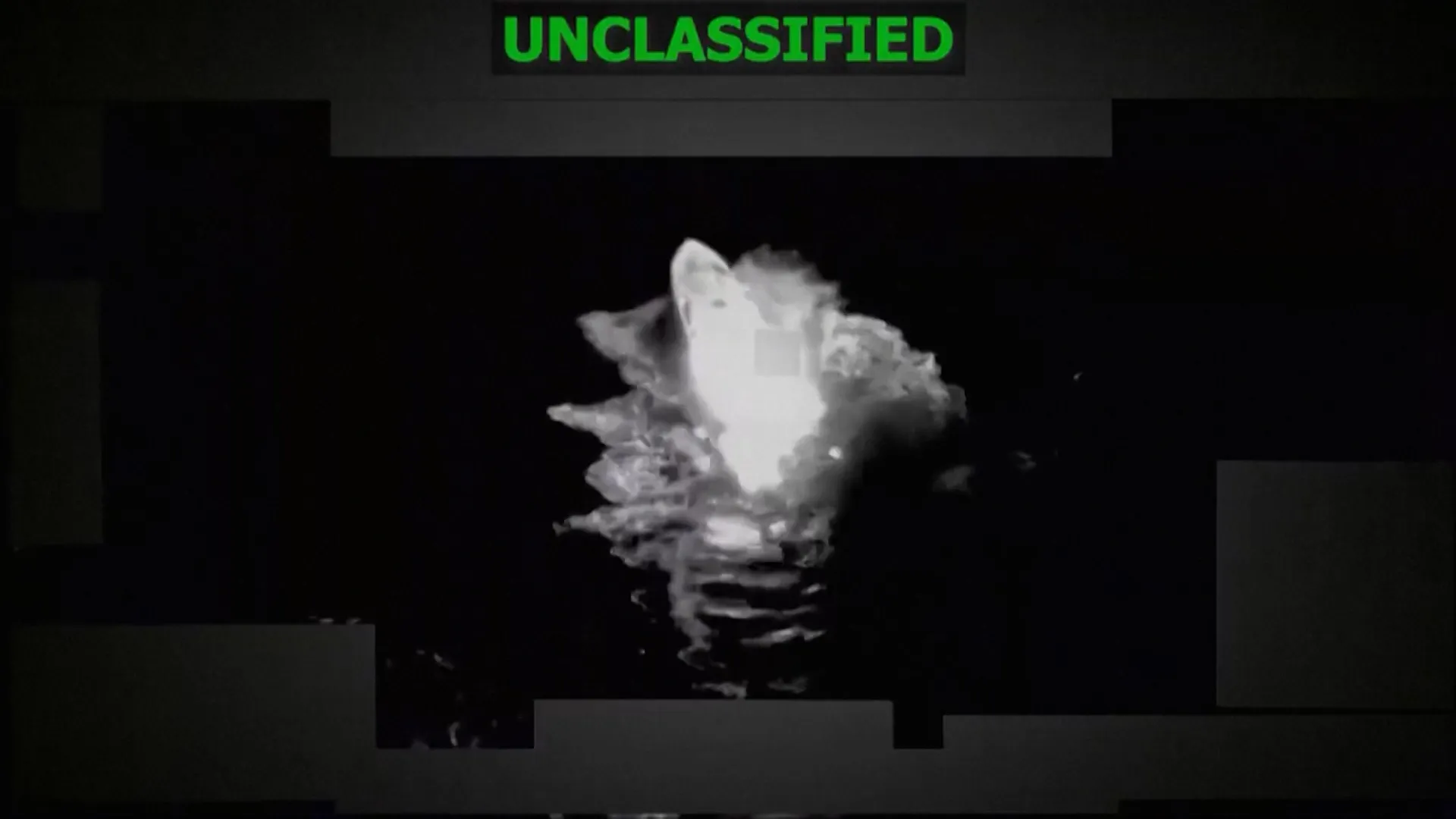
The US says a search is underway for survivors after it bombed what it said was a suspected drug trafficking convoy. The attack is believed to have taken place off the coast of Venezuela.
Published On 1 Jan 20261 Jan 2026
Share
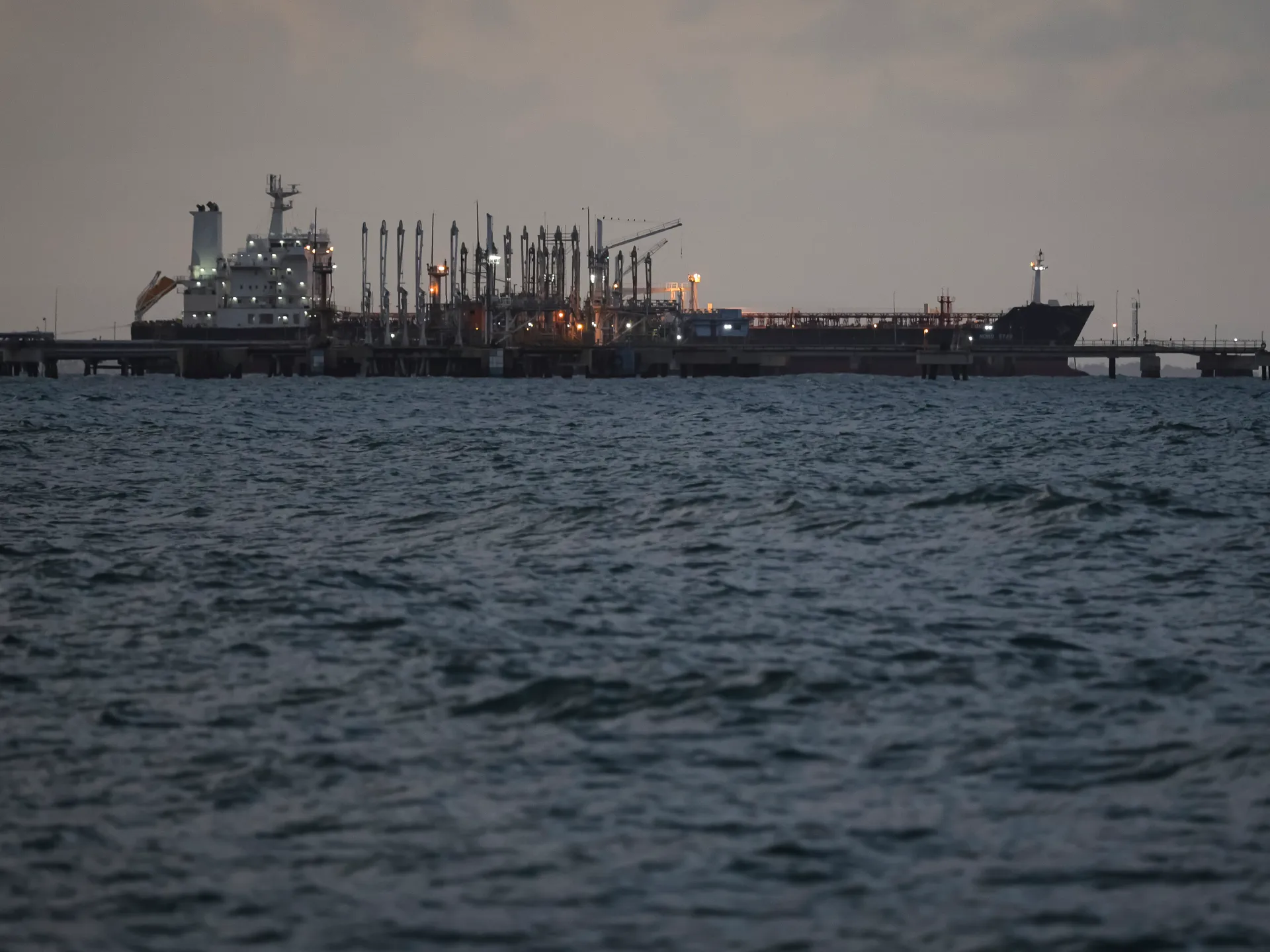
The United States Department of the Treasury has issued a new round of sanctions aimed at isolating Venezuela’s oil industry, as part of President Donald Trump’s pressure campaign against the South American country.
The sanctions announced on Wednesday target four companies and their associated oil tankers, which are allegedly involved in transporting Venezuelan oil.
list of 3 itemsend of list
Trump has claimed that Venezuelan leader Nicolas Maduro leads a so-called “narco-terrorist” government that seeks to destabilise the US, a charge repeated in the latest sanctions announcements.
“Maduro’s regime increasingly depends on a shadow fleet of worldwide vessels to facilitate sanctionable activity, including sanctions evasion, and to generate revenue for its destabilizing operations,” the Treasury said on Wednesday.
Petroleum is Venezuela’s primary export, but the Trump administration has sought to cut the country off from its international markets.
Wednesday’s notice accuses four tankers – the Nord Star, the Rosalind, the Valiant and the Della – of helping Venezuela’s oil sector to circumvent existing sanctions, thereby providing the “financial resources that fuel Maduro’s illegitimate narco-terrorist regime”.
“President Trump has been clear: We will not allow the illegitimate Maduro regime to profit from exporting oil while it floods the United States with deadly drugs,” said Treasury Secretary Scott Bessent.
“The Treasury Department will continue to implement President Trump’s campaign of pressure on Maduro’s regime.”
The sanctions come a day after Washington imposed sanctions on a separate Venezuelan company it says assembled drones designed by Iran.
In recent months, the Trump administration has cited several motives for ratcheting up pressure against Venezuela, ranging from immigration to Maduro’s contested election in 2024.
Trump, for instance, has framed the pressure campaign as a means of stemming the trade of illegal drugs, despite Venezuela exporting virtually none of the administration’s main target, fentanyl.
Critics have also accused Washington of seeking to topple Maduro’s government to take control of the country’s vast oil reserves.
Trump officials have fuelled those suspicions with remarks seeming to assert ownership over Venezuela’s oil.
On December 17, a day after Trump announced a “total and complete blockade” of sanctioned oil tankers entering and leaving Venezuela, his top adviser, Stephen Miller, claimed that the US “created the oil industry in Venezuela”.
He suggested that the oil was stolen from the US when Venezuela nationalised its petroleum industry, starting in 1976.
That process accelerated after the 1998 election of socialist President Hugo Chavez, who reasserted state control over Venezuela’s oil sector, ultimately leading to the seizure of foreign assets in 2007.
That “tyrannical expropriation” scheme, Miller alleged, “was the largest recorded theft of American wealth and property”.
Still, one major US oil company, Chevron, continues to operate in the country.
Trump has echoed Miller’s claims, writing online that the US “will not allow a Hostile Regime to take our Oil, Land, or any other Assets”.
He added that all of those assets “must be returned to the United States, IMMEDIATELY”.
In recent months, the Trump administration has tightened its focus on Venezuela’s oil industry, taking a series of military actions against tankers.
On December 10, the administration seized its first tanker, the Skipper, followed by a second seizure 10 days later.
The US military has reportedly been pursuing a third tanker as it crosses the Atlantic Ocean.
The attacks on the oil tankers come several months after the US began surging aircraft, warships and other military assets to the Caribbean region along Venezuela’s coast.
Since September 2, the US military has conducted dozens of bombing campaigns against alleged drug-smuggling boats in international waters in the Caribbean Sea and eastern Pacific, in what rights groups call extrajudicial killings.
More than 100 people have been killed, and the administration has offered scant legal justification for the attacks.
On Monday, Trump told reporters that the US had struck a “dock area” in Venezuela he claimed was used to load the alleged drug boats.
The dock bombing is believed to be the first of its kind on Venezuelan soil, though Trump has long threatened to begin attacking land-based targets.
While the administration has not officially revealed which agency was behind the dock strike, US media has widely reported it was conducted by the Central Intelligence Agency (CIA).
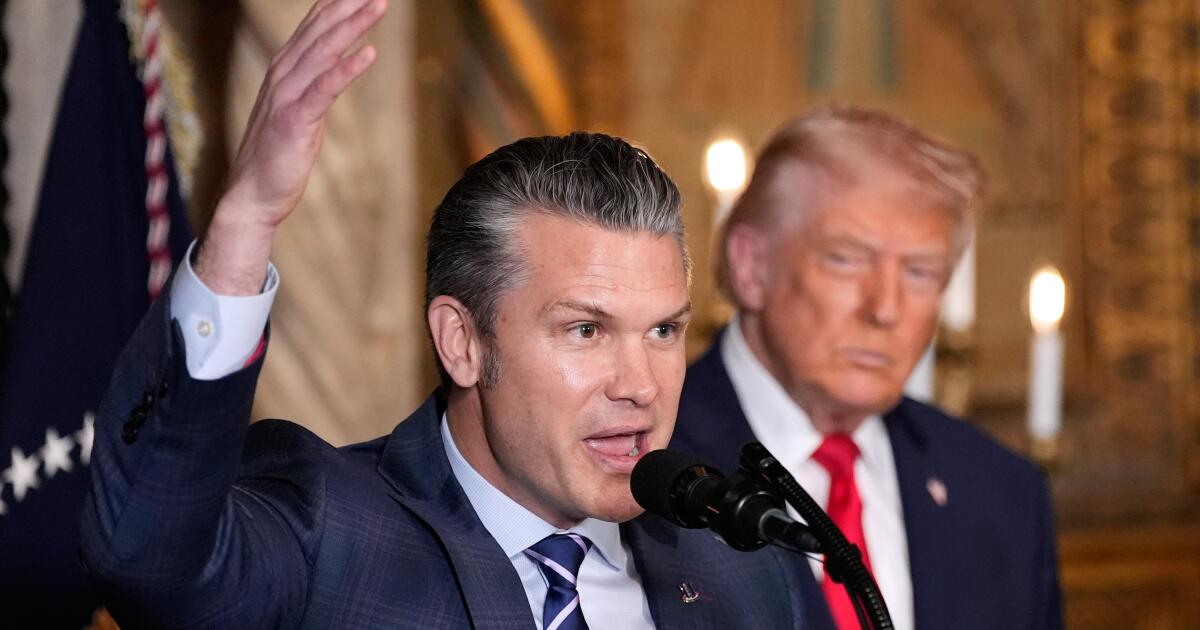
WASHINGTON — The day after Christmas is typically quiet in the nation’s capital. But President Trump’s decision to acknowledge a covert U.S. strike on Venezuelan territory, in an interview with an obscure local news outlet on Friday, set off a scramble in a drowsy Washington that has become a hallmark of the president.
Officials working on Latin America policy for the administration that had been closely tracking reports of refinery fires and other curious events throughout Venezuela couldn’t immediately figure out which target the president was talking about, three sources familiar with the matter told The Times.
Trump would later detail that the strike targeted a “dock area where they load the boats up with drugs.” But initial confusion from within his own government signaled just how tight a circle within the West Wing is determining whether to climb the escalation ladder toward war with Caracas.
Trump initially confirmed he had authorized CIA actions in Venezuela in an exchange with reporters on October. While the administration is obligated to report covert CIA operations to Congress, more robust congressional authorization is required for the use of military force.
“I authorized for two reasons, really. No. 1, they have emptied their prisons into the United States of America,” Trump said at the time. “And the other thing, the drugs, we have a lot of drugs coming in from Venezuela, and a lot of the Venezuelan drugs come in through the sea.”
The strike comes as Venezuelan authorities have increased the number of U.S. citizens detained in their custody, the New York Times first reported on Friday. Caracas had freed 17 Americans and permanent residents held in notorious Venezuelan prisons at the start of the Trump administration.
Evan Ellis, who served in Trump’s first term planning State Department policy on Latin America, the Caribbean and international narcotics, said it was “unclear whether the initial plan was for this operation to be publicly announced in an interview by the president.” Venezuela’s dictatorial president, Nicolás Maduro, “was certainly confused about it,” he said.
“It would make sense for them to do something like that, rather then a military strike, especially right now when there’s a delicate line between military operations and other things,” Ellis added. “My sense is — to the extent the president has acknowledged it — that this was them carrying out their mission to shape the battlespace in support of broader national objectives.”
But Trump has yet to articulate the full scope of those objectives, leaving observers to wonder whether regime change in Venezuela is his true, ultimate aim.
Trump has repeatedly told the media that Maduro’s days in power are numbered. The administration refers to him and his regime as an illegitimate narco-state terrorizing American communities. On a bipartisan basis, going back to Trump’s first term and throughout the Biden administration, the United States has recognized a democratic opposition in Venezuela as its rightful government.
But a military war on the drug trade would make little sense targeting Venezuela, where only a fraction of illicit narcotics smuggled into the United States originate. Trump has hinted in recent weeks at other motives driving his calculus.
Over the last four months, the Trump administration slowly ramped up its pressure campaign on Maduro, first by targeting boats allegedly carrying narcotics and drug smugglers in international waters before announcing a blockade of Venezuelan oil tankers. Venezuela’s oil exports have consequently plummeted by half over the course of the last month.
On Wednesday, the Treasury Department also issued sanctions against four companies that it said were either operating in Venezuela’s oil sector or as accompanying oil tankers.
“Maduro’s regime increasingly depends on a shadow fleet of worldwide vessels to facilitate sanctionable activity, including sanctions evasion, and to generate revenue for its destabilizing operations,” the department said in a statement. “Today’s action further signals that those involved in the Venezuelan oil trade continue to face significant sanctions risks.”
The Pentagon, meanwhile, has stationed nearly a quarter of the U.S. naval fleet in the Caribbean since the summer, in what Trump has referred to as a “massive armada” without precedent in the region.
While Venezuela’s current oil output is modest, the nation sits on the world’s largest known oil reserves, offering significant potential access to any future strategic partners. China is currently the largest importer of Venezuelan oil, and at least one tanker subjected to the U.S. blockade has sought protection from Moscow, Maduro’s chief military ally.
Addressing the blockade in an exchange with reporters, Trump said he had spoken with top U.S. oil executives about what the Venezuelan market would look like with Maduro no longer in power. And he suggested the U.S. government would keep whatever barrels are seized, hearkening back to Trump’s campaign, throughout the 2010s, for the United States to control the oil fields of Iraq as the spoils of its war there.
“We’re going to keep it,” Trump said last week, of the 1.9 million barrels of Venezuelan oil on the first tanker seized. “Maybe we’ll sell it. Maybe we’ll keep it. Maybe we’ll use it in the strategic reserves. We’re keeping it.”
“We’re keeping the ships, also,” he added.
The TWZ Newsletter
Weekly insights and analysis on the latest developments in military technology, strategy, and foreign policy.
A picture has emerged that looks to show Iran’s Mohajer-6 drone has entered service, at least on a limited level, with the Venezuelan military. The Mohajer-6 can perform surveillance and reconnaissance missions and be armed with small guided munitions. The appearance of the image followed the announcement of new U.S. sanctions on Iran and Venezuela, directly related, in part, to the local assembly of Mohajer-6s in the latter country.
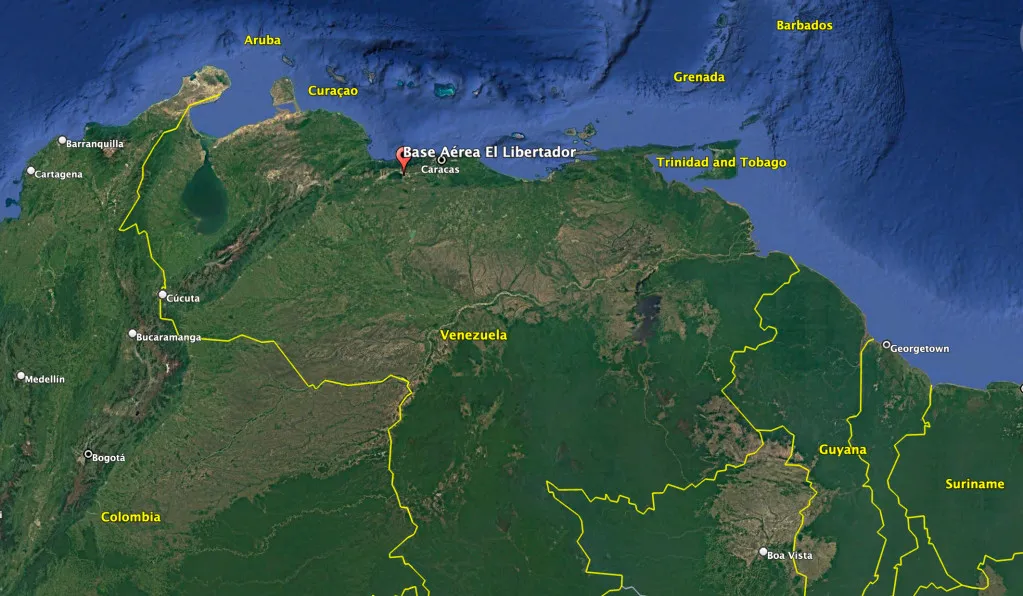
The image in question, seen below, began circulating on social media late yesterday, and is said to have been taken at the Venezuelan Air Force’s El Libertador Air Base (Base Aerea El Libertador in Spanish and often abbreviated as BAEL) in the context of an exercise. TWZ has not been immediately able to independently confirm where or when the picture was taken. El Libertador is situated relatively close to Venezuela’s Caribbean coastline, as well as the capital, Caracas. It is also notably home to the country’s remaining fleet of U.S.-made F-16 fighters, which you can read more about here.

However, as mentioned, the U.S. government offered a separate confirmation of at least the presence of Mohajer-6s in Venezuela in its sanctions announcement yesterday.
“Venezuela-based Empresa Aeronautica Nacional SA (EANSA) maintains and oversees the assembly of QAI’s [Iran’s Qods Aviation Industries] Mohajer-series UAVs in Venezuela and has directly negotiated with QAI, contributing to QAI’s sale of millions of dollars’ worth of Mohajer-6 UAVs to Venezuela,” according to a press release from the U.S. Treasury Department. “The Mohajer-6, a combat UAV with intelligence, surveillance, and reconnaissance capabilities, is manufactured by QAI. EANSA was also involved in the assembly of aircraft that QAI sold to Venezuela.”
It is also well documented that Venezuela has been working to acquire Mohajer-6s since at least 2020, though there has not previously been any evidence of the drones actually being in the country. Venezuelan authorities have shown models of Mohajer-6s at official events in the past, including at EANSA’s facilities. Iran has also exported Mohajer-6s to several other countries, including Russia, which has employed them in the ongoing conflict in Ukraine.
A small mockup of a #Iran|ian UCAV Mohajer-6 was spotted during a speech by the #Venezuela|n President Maduro. The speech was about the future production of multiple-purpose drones. There is thoughts and now speculation that the #IRGC affiliated EP-FAB and EP-FAA flights took… pic.twitter.com/JOhIqK9YJy
— Aurora Intel (@AuroraIntel) November 20, 2020
Iran first unveiled the Mohajer-6 in 2016, and serial production is said to have begun in 2018. The drone has a high-mounted main wing, with a span of nearly 33 feet (10 meters), and a twin-boom tail configuration. The drone is just over 18 and a half feet (5.67 meters) long overall and is powered by a small internal combustion engine driving a single pusher propeller. It has fixed tricycle landing gear and takes off and lands like a traditional aircraft. It has a maximum takeoff weight of around 1,320 pounds (600 kilograms) and an endurance of 12 hours, according to the U.S. Army’s Operational Environment Data Integration Network (ODIN) training portal.

Mohajer-6s can be controlled by operators on the ground via line-of-sight links or fly along a preset route using a built-in autopilot. The drones are understood to carry a mix of electro-optical and infrared cameras to perform their surveillance and reconnaissance and strike missions, as well as to help with basic navigation. Small guided munitions can be carried on up to four pylons under each wing. Iranian media reports have also raised the possibility of the drones being capable of carrying electronic warfare packages.
Exactly how Venezuela’s Mohajer-6 might be configured is unknown. However, circa 2022, pictures also emerged that were said to show Iranian Qaem munitions, which are small guided glide bombs, on display in Venezuela. Qaem is one of the munitions that Iran has integrated onto the Mohajer-6.

Venezuela’s pursuit of the Mohajer-6 is also just one part of a larger push on the country’s part to bolster its drone arsenal, which traces back to the early 2010s and has been carried out with significant assistance from Iran. The Venezuelan armed forces have previously shown examples of another drone, referred to variously as the Arpia or ANSU-100, which was also referenced in the U.S. government’s newly announced sanctions yesterday. This design is a locally-produced derivative of the smaller Iranian Mohajer-2, which is primarily intended for surveillance and reconnaissance missions. Venezuelan authorities have shown examples with underwing munitions, or mockups thereof, but whether this reflects a real capability is unclear. Venezuela has also acquired other weapon systems from Iran, including anti-ship cruise missiles and fast attack boats.


In general, the Mohajer-6 offers the Venezuelan military a new means for conducting aerial surveillance and reconnaissance, and likely armed attacks, with an appreciable endurance. The drones could help patrol the country’s Caribbean coast and inland borders, and potentially offer a way to immediately strike targets of opportunity. In an actual conflict, they could also help bolster the country’s limited traditional tactical aviation capabilities.
“Between 2009-16, Venezuelan drones were used mainly for surveillance and patrol. Since 2022, with the development of the ANSU-100, the focus has shifted: the drones not only observe, they can attack,” according to a detailed report earlier this year from the Miami Herald on Venezuelan drone developments, in general. “Analysts describe this as an ‘Iranization’ of Venezuela’s military doctrine, seeking to compensate for conventional shortcomings through armed drones and what are called ‘loitering’ munitions, or suicide drones. These are expendable unmanned aerial weapons with a built-in warhead that can hover over a target area before crashing and exploding on a target.”
It is possible Mohajer-6s, as well as ANSU-100s, could be employed as longer-range kamikaze drones, and in significant volumes where they could be particularly effective in overwhelming defenders. At the same time, doing so on any real level would require a steady pipeline of new drones, and come at a commensurate cost. Venezuela is also known to be pursuing a purpose-built long-range kamikaze drone, the Zamora V-1. The V-1’s design is at least heavily inspired by Iran’s delta-winged Shahed series, if it is not just a direct clone or derivative. This reflects a global trend in the fielding of Shahed-type drones, with and without Iranian assistance, including now in the United States. Shahed has become something of a household name, in no small part because of Russia’s extensive use of a growing number of variants and derivatives of them in the conflict in Ukraine.

When it comes to Mohajer-6s, how many Venezuela currently has is unknown, and the capability of that force to perform any mission set at present is unclear.
In general, the Venezuelan government is certainly in a position now where having any kind of increased aerial surveillance coverage, both internally and offshore, and more flexibility to respond to threats kinetically, would be a major boon. Last Friday, U.S. President Donald Trump disclosed a first-of-its-kind covert attack on a target inside Venezuela, which was later reported to have been carried out somewhere along that country’s coast by a CIA drone, as you can read more about here.
There also continues to be the prospect of more overt U.S. military action against Venezuela amid a massive ongoing buildup in the region, ostensibly tied to expanded counter-drug operations, which TWZ has been tracking very closely. Especially with their ability to operate across longer distances via autopilot, armed Venezuelan Mohajer-6s (or ones turned into kamikaze drones) would present a potential threat to American forces in and around the Caribbean. Even if the danger they pose is very limited, it is still one that U.S. commanders would have to take into account, along with other threats that TWZ has highlighted previously.
The Venezuelan military’s efforts to acquire Mohajer-6s also underscore its general interest in expanding its drone capabilities, which could further grow into a more complex deterrent as time goes on. The delivery of large numbers of Shahed-type drones, in particular, would create major complications for American forces at sea and on land. The Shahed-136’s range is at least around 1,000 miles, more than enough to get to Puerto Rico, as well as other U.S. operating locations around the Caribbean. Iran has also claimed that the drones can fly out to 1,500 miles, which would put areas of southern Florida in reach. Large numbers of U.S. aircraft and other assets are currently sitting largely out in the open in sites in the region. For years now, TWZ has been highlighting the risks that kind of posture creates, especially to drone attacks. Uncrewed aerial systems also present very real and still growing threats to ships.
The video below includes a montage of clips from Iranian state media showing Shahed-136s being employed during an exercise.

Баражуючий іранський боєприпас «Shahed 136»
Otherwise, American authorities make no secret of the fact that they are engaged in a steadily escalating pressure campaign targeting the country’s dictatorial President Nicolas Maduro and his regime. Earlier this month, this effort expanded to include a maritime blockade targeting the Venezuelan oil sector, which has included seizing oil tankers.
All of this may well have provided new impetus in Venezuela to get even a limited number of Mohajer-6s in actual service. With the appearance of the picture said to show one of the drones at El Libertador, more details may now begin to emerge.
Contact the author: joe@twz.com
Washington accuses Tehran and Caracas of ‘reckless proliferation of deadly weapons’ amid spiraling tensions.

Published On 30 Dec 202530 Dec 2025
Share
Washington, DC – The United States has issued sanctions against a Venezuelan company over accusations that it helped acquire Iranian-designed drones as Washington’s tensions with both Tehran and Caracas escalate.
The penalties on Tuesday targeted Empresa Aeronautica Nacional SA (EANSA), a Venezuelan firm that the US Department of the Treasury said “maintains and oversees the assembly of” drones from Iran’s Qods Aviation Industries, which is already under sanctions by Washington.
list of 3 itemsend of list
The department also sanctioned the company’s chairman, Jose Jesus Urdaneta Gonzalez, accusing him of coordinating “with members and representatives of the Venezuelan and Iranian armed forces on the production of UAVs [unmanned aerial vehicles] in Venezuela”.
“Treasury is holding Iran and Venezuela accountable for their aggressive and reckless proliferation of deadly weapons around the world,” Treasury official John Hurley said in a statement.
“We will continue to take swift action to deprive those who enable Iran’s military-industrial complex access to the US financial system,” he said. The sanctions freeze any assets of the targeted firms and individuals in the US and make it generally illegal for American citizens to engage in financial transactions with them.
In its statement, the US alleged Tehran and Caracas have coordinated the “provision” of drones to Venezuela since 2006.
Iran’s Ministry of Defence and Armed Forces Logistics (MODAFL) has been under US sanctions since 2020 for what Washington said is its role in both selling and procuring weapons. The US is by far the largest weapons exporter in the world.
On Tuesday, the US Treasury Department also imposed new sanctions against several Iranians it accused of links to Iran’s arms industry.
The actions came a day after President Donald Trump threatened more strikes against Iran if the country rebuilds its missile capabilities or nuclear programme.
The US had joined Israel in its attacks against Iran in June and bombed the country’s three main nuclear sites before a ceasefire ended a 12-day escalation.
“Now I hear that Iran is trying to build up again, and if they are, we’re going to have to knock them down,” Trump said on Monday during a joint news conference with visiting Israeli Prime Minister Benjamin Netanyahu. “We’ll knock them down. We’ll knock the hell out of them. But hopefully, that’s not happening.”
Iran was quick to respond to Trump’s threats.
“The response of the Islamic Republic of Iran to any oppressive aggression will be harsh and regrettable,” President Masoud Pezeshkian wrote in a social media post.
The Trump administration has also taken a confrontational approach towards Venezuela.
The US president announced this week that the US “hit” a dock in the Latin American country that he said was used to load drug boats. Details of the nature of the strike remain unclear.
Trump and some of his top aides have falsely suggested that Venezuela’s oil belongs to the US. Washington has also accused Venezuelan President Nicolas Maduro, without evidence, of leading a drug trafficking organisation.
The Trump administration has simultaneously been carrying out strikes against what it says are drug-running vessels in the Caribbean Sea and eastern Pacific Ocean, a campaign that many legal experts said violates US and international law and is tantamount to extrajudicial killings.
Over the past month, the US also has seized at least two oil tankers off the coast of Venezuela after Trump announced a naval blockade against the country.
Venezuela has rejected the US moves as “piracy” and accused the Trump administration of seeking to topple Maduro’s government.
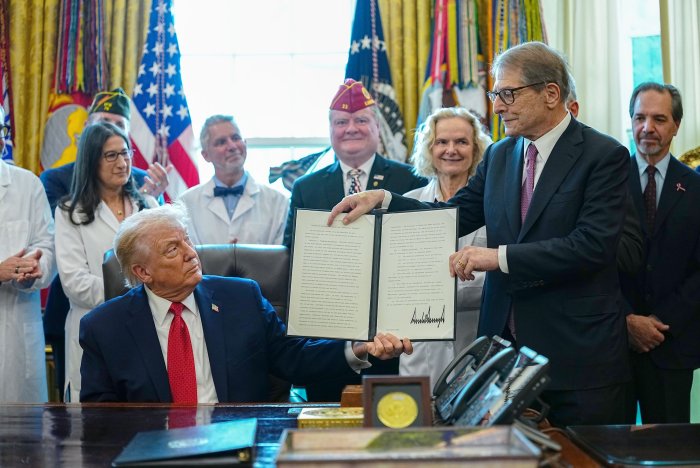
Dec. 29 (UPI) — President Donald Trump on Monday confirmed that the United States struck a “dock area” that officials believe is used to transfer drugs to boats for international distribution.
The U.S. military has struck dozens of ships in the Caribbean near Venezuela, as well as in the Pacific, that are allegedly shipping drugs from South America to the United States and other countries, but the dock would be the first time that an onshore target has been struck.
Trump said Friday in a radio interview that a “big facility” had been “knocked out” in Venezuela that was not widely publicized until Monday when reporters at Mar-a-Lago asked him about it, ABC News and The New York Times reported.
According to CNN, the dock was targeted by the CIA in a drone strike based on intelligence from the U.S. Special Forces that it was being used by the Venezuelan gang Tren de Aragua as a shipping facility for drugs.
A spokesperson for U.S. Special Operations Command told CNN that “Special Operations did not support this operation to include intel support,” the network noted, adding that the Special Operations Forces continue to be involved in Venezuela.
Despite officials offering few details about the strike, Trump, on Monday, appeared to confirm that U.S. forces struck a dock in Venezuela and why it was targeted.
“There was a major explosion in the dock area where they load up the boats with drugs,” Trump told reporters. “They load the boats up with drugs. So we hit all the boats, and now we hit the area, it’s the implementation area, that’s where they implement, and that is no longer around.”
The U.S. military for months has built up a military presence in the Caribbean in international waters offshore of Venezuela, culminating in the arrival of the USS Gerald R. Ford aircraft carrier and its carrier strike group in November.
A month before that, in mid-October, Trump told reporters that he had authorized the CIA to conduct operations in Venezuela, and noted that they had been doing so for months at that point.
He said at the time that the military had been striking ships because “a lot of Venezuelan drugs come in through the sea, so you see it,” but that the United States would “stop them by land, also” — acknowledging that the administration was considering strikes inside Venezuela.
The Ford’s presence, in addition to more than a dozen other warships, has built up a 15,000 troop presence in the Caribbean that the Pentagon has dubbed Operation Southern Spear.
In addition to striking alleged drug boats in the Caribbean and Pacific, Trump also has ordered a naval blockade to prevent Venezuela from shipping its sanctioned oil to Iran and China.
The administration so far has apprehended three oil tankers leaving Venezuela.
Trump has said he is aiming to depose Venezuelan President Nicolas Maduro based on accusations that Maduro runs the Tren de Aragua gang, has emptied the country’s prisons and sent criminals to the United States to wreak havoc in the country, and is pumping drugs into the United States.

The TWZ Newsletter
Weekly insights and analysis on the latest developments in military technology, strategy, and foreign policy.

U.S. President Donald Trump added new details on Monday to his claim that the U.S. carried out an attack last week inside Venezuela; however he did not provide any proof. If true, such a strike would mark a significant escalation of a months-long pressure campaign on Venezuelan dictator Nicolas Maduro and the cartels. Until now, U.S. publicly acknowledged kinetic actions have been limited to attacks on alleged drug-running boats, even as Washington’s military presence in the region continues to grow.
You can catch up with our most recent coverage of Operation Southern Spear here.
“We hit all the boats and now we hit the area, it’s the implementation area. That’s where they implement,” the president said while at Mar-a-Lago, standing alongside Israeli Prime Minister Benjamin Netanyahu. “And that is no longer around.”
🚨 BREAKING: TRUMP CONFIRMS FIRST U.S. LAND STRIKE ON VENEZUELA DRUG DOCK – THIS IS A GAME-CHANGER! 💥
Meeting with Netanyahu, Trump just revealed: U.S. forces obliterated a key Venezuelan dock used for loading drug boats – FIRST LAND ATTACK after months of sea ops.
This… pic.twitter.com/qIJHgLzsez
— Javier Fernandez (@itshabeeair) December 29, 2025
Trump declined to say whether it was the U.S. military or the CIA that carried out the attack.
Asked by @Kevinliptakcnn if strike was carried out by US military or CIA, Trump says:
“I don’t want to say that. I know exactly who it was, but I don’t want to say who it was. But you know, it was along the shore.” https://t.co/hF5Vd3fvoa
— Zachary Cohen (@ZcohenCNN) December 29, 2025
Trump first made the claim of the attack inside Venezuela last week during a phone call with WABC radio in New York.
“I don’t know if you read or you saw, they have a big plant, or a big facility where they send the, you know, where the ships come from,” Trump told John Catsimatidis, the billionaire Trump supporter who owns the radio station. “Two nights ago, we knocked that out. So we have hit them very hard, but drugs are down over 97% Can you believe it?”
president trump: united states has “just knocked out a big facility where the ships come from” in a strike on venezuelan territory (at 3:10 in call)
don’t understand why this isn’t being reported widely. https://t.co/1mvWgNDdxL
— ian bremmer (@ianbremmer) December 28, 2025
Trump has yet to offer proof of any attacks inside Venezuela. During their conversation, Catsimatidis didn’t press him on the matter. Anonymous American officials told The New York Times that the president was “referring to a drug facility in Venezuela and that it was eliminated, but provided no details.”
The White House has not responded to requests from The War Zone and many other news organizations for corroboration of an attack inside Venezuela. U.S. Southern Command, which oversees Southern Spear, declined to comment to us. The Pentagon referred us to the White House. The Central Intelligence Agency (CIA), which Trump previously authorized to conduct covert operations inside Venezuela, did not immediately respond to questions about whether it was involved in this claimed attack.
There have been no official comments from Venezuelan authorities about this alleged attack and no independent confirmation from people near the facility. However, videos emerged online suggesting that an explosion and fire at a Primazol chemical plant near Lake Maracaibo may have been the target of a U.S. attack.
Me pregunto si ésta explosión a las ~2am del 24 de Diciembre en galpones de la empresa Primazol, compañía dedicada a producción de productos químicos localizada en Zona Industrial del municipio San Francisco, estado Zulia, es el ataque al que se refirió Trump en el programa de… https://t.co/d9g5YxvR14 pic.twitter.com/T2elsWI219
— 𝘼𝙧𝙧𝙚𝙘𝙝𝙤 (@Arr3ch0) December 28, 2025
While the incident at the chemical plant lines up with the strike timeline proffered by Trump, the company pushed back against suggestions it was attacked.
“We categorically reject the versions circulating on social media that seek to damage the reputation of our founder and the organization,” Primazol explained in a statement. “We responsibly clarify that these claims have no relation whatsoever to the incident and are neither official nor verified.”
The War Zone cannot independently verify any connection, and we reached out to Primazol for more information.
🚨 | Compañía Primazol, cuya sede en Zulia estalló en la madrugada del 24 de diciembre, “rechaza” la versión de que su edificio fue víctima de un ataque de EEUU.
Sin embargo, no deja claro cuál es la razón de la explosión del edificio. En un primer comunicado dice que fue un… pic.twitter.com/GvXuhhT4sg
— Orlando Avendaño (@OrlvndoA) December 29, 2025
In a post on X, Jhorman Cruz, a local journalist, cautioned against making a connection between Trump’s claim and the fire.
“Residents DID NOT see anything unusual, nor drones, nor cars, nor the presence of foreigners,” he stated. “Be careful with strange hypotheses.”
El 24Dic reportamos el incendio de la empresa Primazol en la zona industrial de San Francisco, Zulia. Es prudente decir que aún no sabemos qué inició el fuego.
Pobladores NO vieron nada extraño, ni drones, ni carros, ni presencia de extranjeros. Cuidado con raras hipótesis. pic.twitter.com/2zy2yZKVKy
— Jhorman Cruz (@Jhormancruz1) December 29, 2025
Trump’s radio interview followed his Christmas Eve phone call to sailors aboard the USS Gerald Ford, the world’s largest aircraft carrier, which is now deployed to the Caribbean. Trump called the region an “interesting place” to be, and said once again that the U.S. would be “going after the land.” He offered no further explanations.
Trump’s claim about the facility strike inside Venezuela was prefaced by a short discussion with the radio station owner about the destruction of alleged drug smuggling vessels. Trump repeated his claim that each drug boat attack saves 25,000 lives in the U.S. To date, SOUTHCOM has hit more than two dozen of these vessels in the Caribbean and eastern Pacific, killing more than 100. The strikes have generated a great deal of controversy, with claims they violate the rules of armed conflict and have been carried out without Congressional or judicial approval. The White House and Pentagon have pushed back on those claims. Earlier this month, Congress closed out investigations into the first of these attacks, on Sept. 2, which were called after it was revealed that survivors of the first strike were killed in a follow-on attack.
.
On Dec. 22, at the direction of @SecWar Pete Hegseth, Joint Task Force Southern Spear conducted a lethal kinetic strike on a low-profile vessel operated by Designated Terrorist Organizations in international waters. Intelligence confirmed the low-profile vessel was transiting… pic.twitter.com/LGzEaQSTiR
— U.S. Southern Command (@Southcom) December 23, 2025
Regardless of Trump’s attack claim, the U.S. continues to grow its military presence in the Caribbean and especially its special operations forces (SOF). Over the weekend, aircraft spotters said they saw at least 10 MC-130J Commando II multi-mission combat transport planes at Rafael Hernandez International Airport (RHIA) in Puerto Rico. That’s double the amount seen at the airport last week.
At least five of the MC-130Js appear to be outfitted with the full Capability Release 2 (CR-2) set of modifications, which includes Raytheon’s new AN/APQ-187 Silent Knight terrain-following/terrain avoidance radars, a satellite communications system, and other equipment.
Recent images from Reuters show that at least five of the ten MC-130Js deployed to Puerto Rico are in full CR-2 configuration.
Capability Release 2 (CR-2) includes:
– AN/APQ-187 Silent Knight Radar
– Honeywell JetWave SATCOM
– AN/ALQ-251 Radio Frequency Countermeasures (RFCM) https://t.co/puF2NxdDRK pic.twitter.com/QkJEVSX6Ns— LatAmMilMovements (@LatAmMilMVMTs) December 29, 2025
In addition, satellite imagery, which you can also see below, now shows at least 11 Air Force Special Operations Command CV-22B Osprey tilt-rotor aircraft there as well. We previously reported the presence of nine or 10 Ospreys at RHIA. U.S. Special Operations Command declined comment and Air Force Special Operations Command has not returned a request for comment. You can read more about the significance of these aircraft and the growing SOF presence in the Caribbean to Southern Spear in our story here.
As we previously noted, the airport also plays host to MQ-9 Reaper drones, images of which first began appearing online in September. MQ-9s have been used in boat attacks as well.
🔎🇺🇸Reapers in the Caribbean
Unclassified satellite imagery reveals two MQ-9 Reaper drones at Coast Guard Air Station Borinquen in Puerto Rico (Aguadilla).With a long endurance and advanced sensors, these assets are critical for counter-narcotics and maritime surveillance,… pic.twitter.com/MUq70nhxNC
— MT Anderson (@MT_Anderson) September 11, 2025
In an apparent effort to keep its assets out of the public eye, personnel have been seen obstructing the fence through which photographers have been capturing images of aircraft gathered at RHIA.
As we previously noted, a compendium of satellite imagery dating back to early October shows a large-scale construction project at the airport

Satellite imagery also shows increasing expansion at the Jose Aponte de la Torre Airport in Puerto Rico. The former Roosevelt Roads Navy base has become a key staging ground for U.S. aircraft and troops deployed for Southern Spear.
As of Saturday, an E-11A Battlefield Airborne Communications Node, or BACN was tracked by aircraft spotters to Luis Munoz Marine International Airport in San Juan, Puerto Rico’s largest.
BACN07 (22-9047) the U.S. Air Force E-11A (Battlefield Airborne Communications Node) is still located at at Luis Muñoz Marín International Airport in San Juan.
It was tracked on the ground today at 12:35(EST)/17:35(UTC). pic.twitter.com/Rr3xIjp4sv
— FrozenFrequency (@FrozenFrequency) December 27, 2025
Meanwhile, as the Trump administration increases military pressure on Maduro, it is also continuing to take aim at Venezuelan oil shipments in an effort to squeeze him economically as well. As one of the world’s largest oil producers, Venezuela relies heavily on it. Since Trump enacted a blockade on sanctioned ships entering or leaving Venezuela, the U.S. has seized two and has pursued a third.
“The United States hasn’t given up its pursuit of the massive, rusted oil tanker it chased into international waters near Venezuela last weekend, and officials are now contemplating moving additional resources into the area to forcibly board the ship,” CNN reported on Friday, citing people familiar with the matter.
Last known visual we have of BELLA 1 (9230880) is from five days ago, when it was spotted in satellite imagery. Here’s older footage from the bridge. pic.twitter.com/l7ml2gOyu9
— Christiaan Triebert (@trbrtc) December 24, 2025
Russian Foreign Ministry spokesperson Maria Zakharova denounced the blockade and seizures on Sunday.
“In principle, we reject attempts to exert pressure on sovereign countries in general, including in the energy sector,” she said. “We understand that behind such a policy there is only a neo-colonial desire to achieve economic advantages through non-competitive political methods.”
“We trust that the Administration of U.S. President Donald Trump will refrain from sliding further into a large-scale armed conflict, which threatens to have unpredictable consequences for the entire Western Hemisphere,” she added.

Satellite images captured on Dec. 24 show elements of the Iwo Jima Amphibious Ready Group (ARG) in close proximity to the M/V Ocean Trader, a special operations mothership. It should be noted that most of the ARG’s aviation combat element (ACE) was moved to Roosevelt Roads several weeks ago and remains there. The presence of these ships so close together, and the aircraft, landing equipment and troops embarked on board, is another indication that U.S. is poised for action beyond hitting suspected drug boats.
Most, if not all, of the aviation combat element (ACE) assigned to the 22nd MEU aboard the Iwo Jima ARG was moved to the former NAS Roosevelt Roads, PR several weeks ago, and remain there.
— TheIntelFrog (@TheIntelFrog) December 24, 2025
Much about Trump’s claim that the U.S. attacked inside Venezuela remains unknown. Regardless, the large U.S. military presence in the Caribbean seems to be coalescing toward additional kinetic action.
Contact the author: howard@thewarzone.com
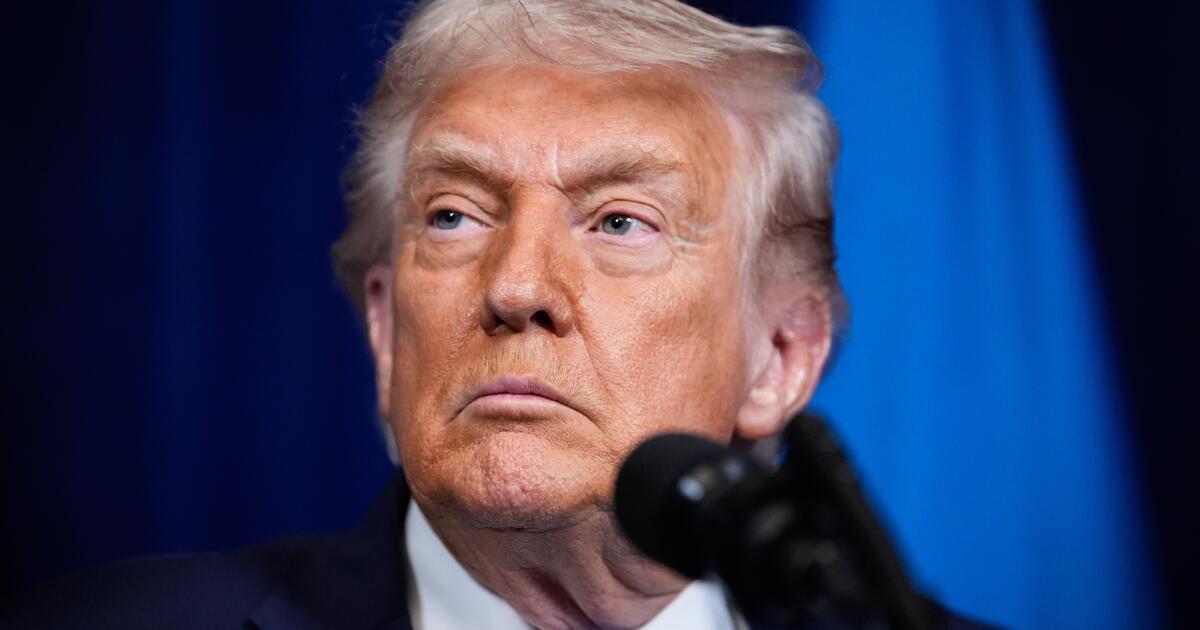
WASHINGTON — President Trump has indicated that the U.S. has “hit” a facility in South America as he wages a pressure campaign on Venezuela, but the U.S. offered no other details.
Trump made the comments in what seemed to be an impromptu radio interview Friday.
The president, who called radio host John Catsimatidis during a program on WABC radio, was discussing U.S. strikes on alleged drug-carrying boats in the Caribbean Sea and eastern Pacific Ocean, which have killed at least 105 people in 29 known strikes since early September.
“I don’t know if you read or saw, they have a big plant or a big facility where they send the, you know, where the ships come from,” Trump said. “Two nights ago, we knocked that out. So, we hit them very hard.”
Trump did not offer any additional details in the interview, including what kind of attack may have occurred. The Pentagon on Monday referred questions to the White House, which did not immediately respond to a message seeking comment.
Defense Secretary Pete Hegseth or one of the U.S. military’s social media accounts has in the past typically announced every boat strike in a post on X, but they have not posted any notice of any strike on a facility.
The press office of Venezuela’s government did not immediately respond Monday to a request for comment on Trump’s statement.
Trump for months has suggested he may conduct land strikes in South America, in Venezuela or possibly another country, and in recent weeks has been saying the U.S. would move beyond striking boats and would strike on land “soon.”
In October, Trump confirmed he had authorized the CIA to conduct covert operations in Venezuela. The agency did not immediately respond to a message seeking comment Monday.
Along with the strikes, the U.S. has sent warships, built up military forces in the region, seized two oil tankers and pursued a third.
The Trump administration has said it is in “armed conflict” with drug cartels and seeking to stop the flow of narcotics into the United States.
Venezuelan President Nicolás Maduro has insisted the real purpose of the U.S. military operations is to force him from power.
White House chief of staff Susie Wiles said in an interview with Vanity Fair published this month that Trump “wants to keep on blowing boats up until Maduro ‘cries uncle.’”
Price writes for the Associated Press. AP writers Konstantin Toropin in Washington and Regina Garcia Cano in Caracas, Venezuela, contributed to this report.
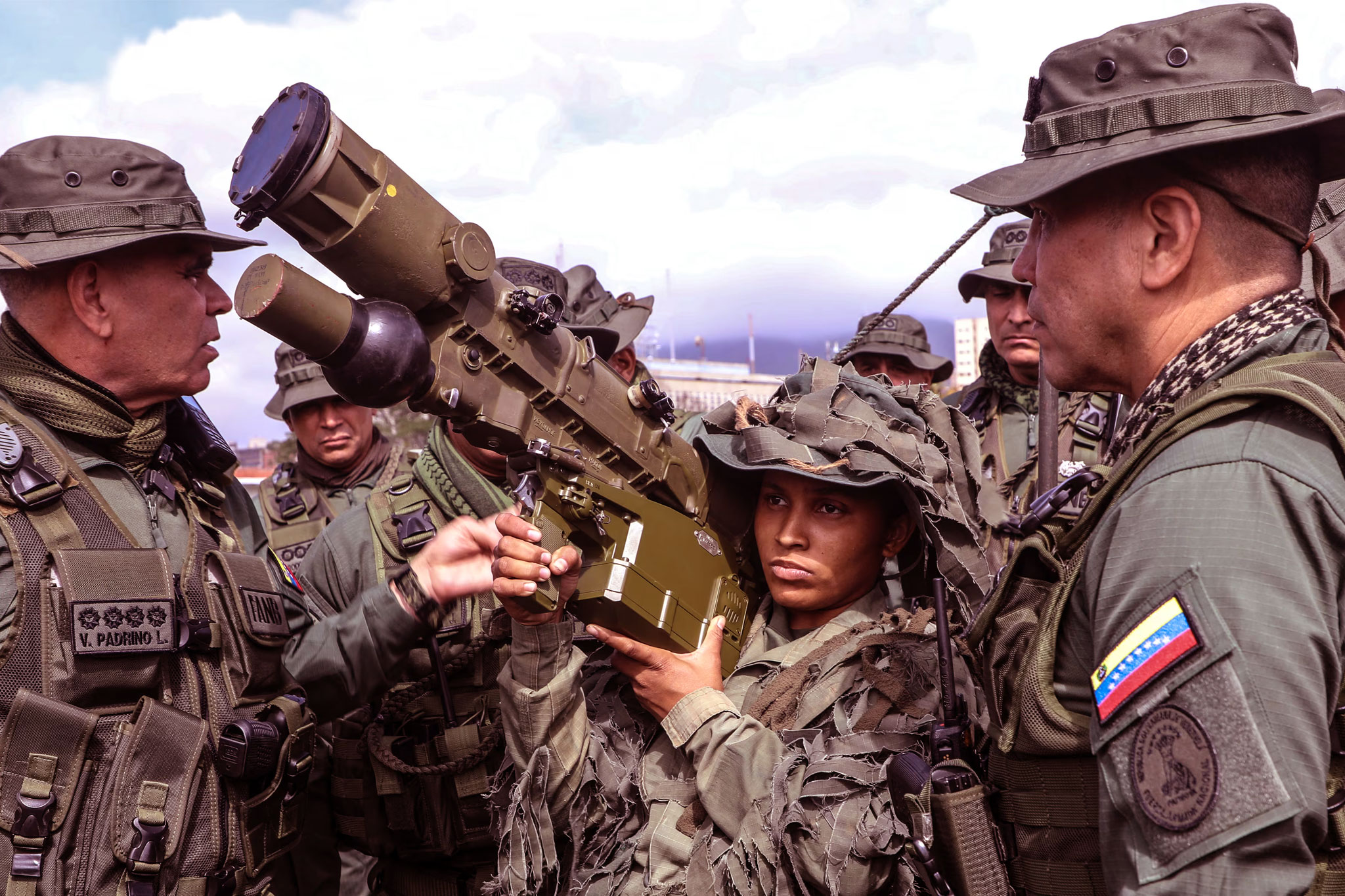
Venezuelan armed forces have held defense exercises in the face of US threats. (Archive)
Since 2002, the date of the 47-hour coup against Hugo Chávez, Washington has unsuccessfully sponsored and supported regime change in Venezuela time and again. In the name of human rights, freedom, and democracy, economic sanctions, color revolutions, oil strikes, recognition of illegitimate leaders, theft of foreign currency and infrastructure, assassination attempts, media offensives, military uprisings, and threats of ground invasion have been instigated or combined without interruption.
Many of these attacks, aimed at seizing the largest oil reserves on the planet, are acts of international piracy. They have caused immense damage to the country and enormous suffering to its people. They have resulted in billions of dollars in lost oil revenue. Countless Venezuelans have been forced to migrate to other nations to survive. Meanwhile, a segment of the old, corrupt oligarchy lives the high life in their mansions in Miami and Madrid.
But despite the lethality of the punishments and the harshness of the siege, the Bolivarian Revolution continues. Certainly, some Chavista political leaders have betrayed the cause. A few military and intelligence officers have gone over to the enemy ranks. Intellectuals have succumbed to the siren song of metropolitan power. But, against all odds, the majority of the population draws a line in the sand against gunboat democracy; they remain loyal to a project that allowed them to recover their dignity and advance in popular power.
For 27 years, Bolivarianism has won almost every election. Desperate in the face of this setback, the empire has tried other formulas for regime change. In December 2007, Enrique Krauze laid his cards on the table. “If Hugo Chávez has thought of turning Venezuela into a Cuba with oil, the Venezuelans who oppose him have discovered the antidote. It is the student movement,” he wrote. So the far right latched onto this movement and tested an insurrectionary scheme. However, the reactionary forces clashed with a reality that wasn’t in their playbooks. So they left to make their fortunes abroad.
All imperial attempts at regime change have run up against what, until now, seems insurmountable: the unity of the Bolivarian National Armed Forces (FANB). There is not a single indicator showing any internal divisions. Part of the key to this unity is the development of a new military doctrine known as the Comprehensive Defense of the Nation. This doctrine seeks to confront the US military threat based on a set of actions designed to deter a technologically and numerically superior enemy.
This strategy has three central elements: strengthening military power, deepening the civil-military union (between the people and the soldiers), and bolstering popular participation in national defense tasks. Previously, the armed forces were fragmented into divisions and brigades. Commander Chávez organized the country into regions, and each region has a military structure with all its components: Army, Navy, Air Force, National Guard, militias, and the people.
If someone attacks a region, that region has the capacity to defend itself. It doesn’t need to move units from elsewhere. On February 23, 2019, under the pretext of bringing in humanitarian aid from Colombia, the Contras and Washington attempted to establish a beachhead in Táchira that would give the illegitimate Juan Guaidó control of a strip of Venezuelan territory to establish a “seat of government.” For 17 hours, fierce clashes erupted between Chavistas and Venezuelan paramilitaries and guarimberos, who operated mostly from the Colombian side. The skirmish ended with the opposition’s defeat.
There, amidst the events, at the military installation beside the Simón Bolívar Bridge, I spoke with Diosdado Cabello, then president of the National Constituent Assembly. Most of the FANB (National Bolivarian Armed Forces) chiefs were also present, whom he introduced to me as his friends and as longtime collaborators of Hugo Chávez. I asked him about the resolve of his troops. In good spirits, he explained:
“President Maduro has visited every barracks. He shows up in the early morning. He arrives, runs with them, shares, does military exercises with them. We have total contact with them. We are like brothers. Many of us have been in this movement since we were children. We support each other and follow each other. We are a family. They will not break us…”
Regarding the role of the militias, he told me: “For the friends of the State, they are a diamond. For the enemies of the State, they are the worst news.” A military intervention by a foreign country in Venezuela is very complicated, and not only because of the civil-military alliance.
Caracas has modernized its weaponry by acquiring it from Russia, China, and Iran, with whom it also maintains an alliance. Furthermore, it covers an area of almost one million square kilometers. Its topography is highly diverse: the Andes mountain range, the Coastal Range, and the Guiana Shield, along with the extensive Orinoco River basin. It boasts 4,208 kilometers of coastline and dense rainforests. The poor neighborhoods of cities like Caracas are dangerous. It shares a 2,341-kilometer border with Colombia, a 2,199-kilometer border with Brazil, and a 789-kilometer border with Guyana.
No neighboring country desires armed conflict on its borders. Venezuela possesses the men, weapons, determination, and territory capable of sustaining a prolonged popular resistance, turning any attempt to occupy the country into a quagmire for whoever tries it. Regardless of what might happen on the day of the occupation, the true military challenge for an invading force lies in what to do in the days that follow. However, beyond what may happen in the future, in Venezuela, today is the time for peace.
The views expressed in this article are the author’s own and do not necessarily reflect those of the Venezuelanalysis editorial staff.
Luis Hernández Navarro is the Opinion editor of La Jornada, and the author of numerous books, including Chiapas: La nueva lucha india and Self-Defense in Mexico: Indigenous Community Policing and the New Dirty Wars.
Translated by Mexico Solidarity Media.
Source: La Jornada
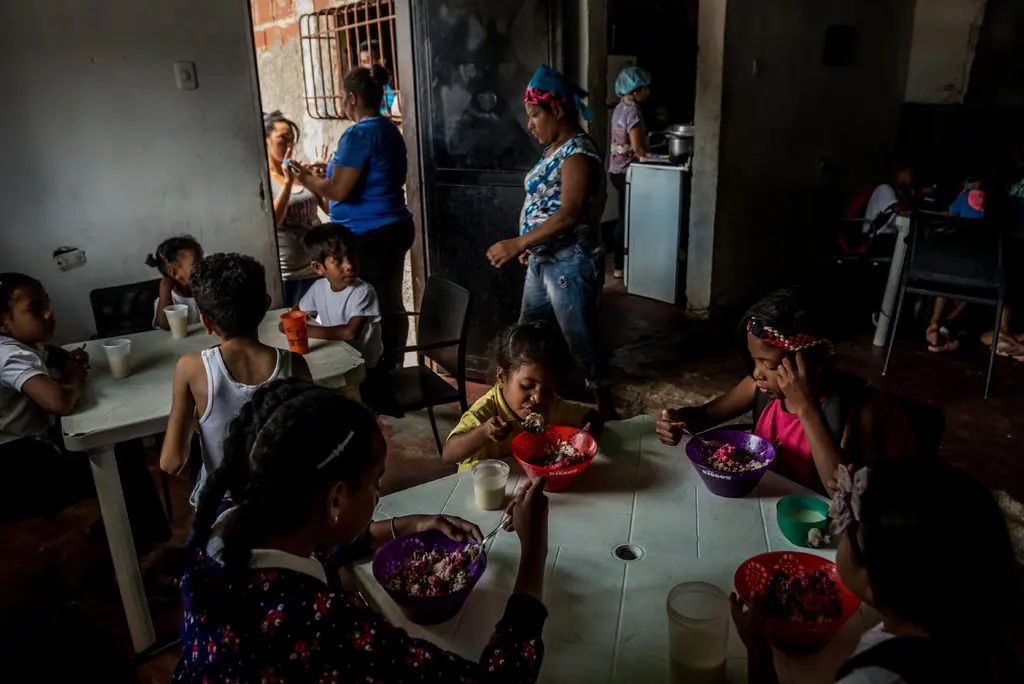
Ramped up economic sanctions could lead to a quick deterioration of living standards. (Meridith Kohut)
The loudest question in Washington right now is whether Donald Trump is going to invade Venezuela. The quieter, and far more dangerous, reality is this: he probably won’t. Not because he cares about Venezuelan lives, but because he has found a strategy that is cheaper, less politically risky at home, and infinitely more devastating: economic warfare.
Venezuela has already survived years of economic warfare. Despite two decades of sweeping U.S. sanctions designed to strangle its economy, the country has found ways to adapt: oil has moved through alternative markets; communities have developed survival strategies; people have endured shortages and hardship with creativity and resilience. This endurance is precisely what the Trump administration is trying to break.
Rather than launching a military invasion that would provoke public backlash and congressional scrutiny, Trump is doubling down on something more insidious: total economic asphyxiation. By tightening restrictions on Venezuelan oil exports, its primary source of revenue, Trump’s administration is deliberately pushing the country toward a full-scale humanitarian collapse.
In recent months, U.S. actions in the Caribbean Sea, including the harassment and interdiction of oil tankers linked to Venezuela, signal a shift from financial pressure to illegal maritime force. These operations have increasingly targeted Venezuela’s ability to move its own resources through international waters. Oil tankers have been delayed, seized, threatened with secondary sanctions, or forced to reroute under coercion. The objective is strangulation.
This is illegal under international law.
The freedom of navigation on the high seas is a cornerstone of international maritime law, enshrined in the UN Convention on the Law of the Sea. Unilateral interdiction of civilian commercial vessels, absent a UN Security Council mandate, violates the principle of sovereign equality and non-intervention. The extraterritorial enforcement of U.S. sanctions, punishing third countries and private actors for engaging in lawful trade with Venezuela, has no legal basis. It is coercion, plain and simple. More importantly, the intent is collective punishment.
By preventing Venezuela from exporting oil, which is the revenue that funds food imports, medicine, electricity, and public services, the Trump administration is knowingly engineering conditions of mass deprivation. Under international humanitarian law, collective punishment is prohibited precisely because it targets civilians as a means to achieve political ends. And if this continues, we will see horrific images: empty shelves, malnourished children, overwhelmed hospitals, people scavenging for food. Scenes that echo those coming out of Gaza, where siege and starvation have been normalized as weapons of war.
U.S. actions will undoubtedly cause millions of Venezuelans to flee the country, likely seeking to travel to the United States, which they are told is safe for their families, full of economic opportunities, and security. But Trump is sealing the U.S. border, cutting off asylum pathways, and criminalizing migration. When people are starved, when economies are crushed, when daily life becomes unlivable, people move. Blocking Venezuelans from entering the United States while systematically destroying the conditions that allow them to survive at home means that neighboring countries like Colombia, Brazil, and Chile will be asked to absorb the human cost of Washington’s decisions. This is how empire outsources the damage. But these countries have their own economic woes, and mass displacement of Venezuelans will destabilize the entire region.
Venezuela is a test case. What is being refined now—economic siege without formal war, maritime coercion without declared blockade, starvation without bombs—is a blueprint. Any country that refuses compliance with Washington’s political and economic demands should be paying attention. This will be the map for 21st-century regime change.
And this is how Trump can reassure the United States Congress that he is not “going to war” with Venezuela. He doesn’t need to. Economic strangulation carries none of the immediate political costs of a military intervention, even as it inflicts slow, widespread devastation. There are no body bags returning to U.S. soil, no draft, no televised bombing campaigns. Just a steady erosion of life elsewhere.
Trump’s calculation is brutally simple: make Venezuelans so miserable that they will rise up and overthrow Maduro. That has been the same calculation behind U.S. policy toward Cuba for six decades—and it has failed. Economic strangulation doesn’t bring democracy; it brings suffering. And even if, by some grim chance, it did succeed in toppling the government, the likely result would not be freedom but chaos—possibly a protracted civil war that could devastate the country, and the region, for decades.
People in Venezuela celebrate Christmas and New Year’s gathered around the table to eat hallacas wrapped with care, slices of pan de jamón, and dulce de lechoza. They will share stories, dance to gaitas, and make a toast with Ponche Crema.
But if this economic siege continues, if Venezuelan oil is fully cut off, if the country is denied the means to feed itself, if hunger is allowed to finish what bombs are no longer politically useful to accomplish, then this Christmas may be remembered as one of the last Venezuelans were able to celebrate in anything resembling normal life, at least in the near future.
Polls consistently show that nearly 70 percent of people in the United States oppose a military intervention in Venezuela. War is recognized for what it is: violent, destructive, unacceptable. But sanctions are treated differently. Many people believe they are a harmless alternative, a way to apply “pressure” without bloodshed.
That assumption is dangerously wrong. According to a comprehensive study in medical journal The Lancet, sanctions increase mortality at levels comparable to armed conflict, hitting children and the elderly first. Sanctions do not avoid civilian harm – they systematically produce it.
If we oppose war because it kills, we must also oppose sanctions that do the same, only more quietly, more slowly, and with far less accountability. If we don’t act against economic warfare with the same urgency we reserve for bombs and invasions, then sanctions will remain the preferred weapon: politically convenient but equally deadly.
Michelle Ellner is the Latin America Campaign Coordinator at CODEPINK. Born in Venezuela, she holds a bachelor’s degree in Languages and International Affairs from Université Paris-Sorbonne (Paris IV). Her work focuses on U.S. foreign policy, economic sanctions, and solidarity with Latin America and the Caribbean.
The views expressed in this article are the author’s own and do not necessarily reflect those of the Venezuelanalysis editorial staff.
Source: Code Pink
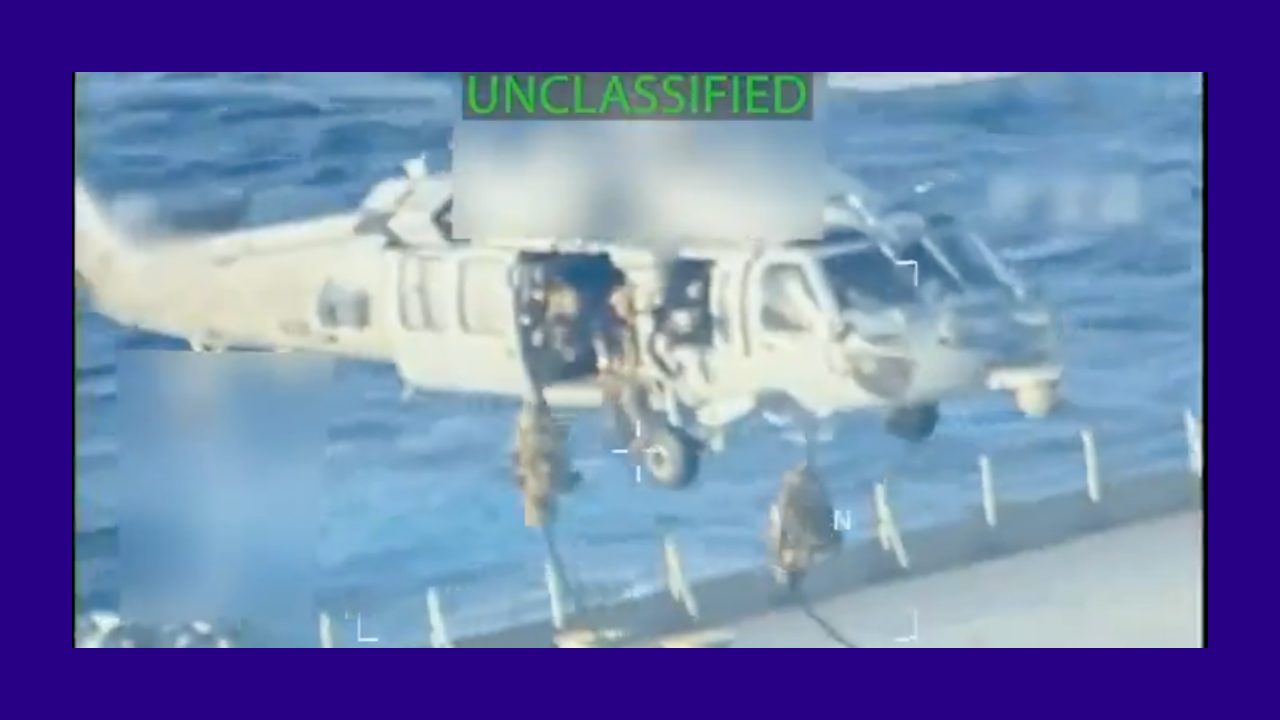
US troops descend from helicopters onto the “Skipper” tanker’s deck as part of an operation to seize the oil vessel. (Screen capture)
Mexico City, Mexico, December 11, 2025 (venezuelanalysis.com) – Venezuela accused the United States of committing “international piracy” after US authorities seized an oil tanker in the Caribbean, denouncing the action as part of a long-running US campaign to strip the country of its energy resources.
US President Donald Trump announced Wednesday that Washington seized an oil tanker sanctioned by the US off Venezuela’s coast. He described the vessel as the largest oil tanker ever seized and indicated that the United States would retain the crude aboard.
The move was met with a sharp rebuke from Caracas.
“The Bolivarian Government will appeal to all existing international bodies to denounce this grave international crime and will defend its sovereignty with absolute determination,” read the communiqué. “Venezuela will not allow any foreign power to take from the Venezuelan people what belongs to them by historical and constitutional right.”
According to Reuters, the “Skipper” tanker loaded an estimated 1.8 million barrels of crude at Venezuela’s José terminal early this month before unloading 200,000 to a Cuba-bound ship. The remaining cargo was believed to be destined for Asian markets. The move was viewed as aggression against Cuba as well, which relies on Venezuelan oil shipments for energy and income.
Cuban Foreign Minister Bruno Rodríguez Parilla condemned “the vile act of piracy” as a violation of international law.
Michael Galant, member of the Progressive International Secretariat, said that calling the US seizure an act of piracy fell short.
“This is the deliberate immiseration of the Cuban people, already suffering debilitating fuel shortages, blackouts, and a chikungunya outbreak thanks to the US blockade,” wrote Galant on social media.
US Attorney General Pam Bondi posted a video on social media on Wednesday evening showing armed US forces boarding the vessel. There was reportedly no resistance from the crew nor any casualties. The assault involved Coast Guard members, Marines, and special forces who were seen in the video descending from helicopters onto the ship’s deck.
The seizure of the tanker comes only days after Delaware District Judge Leonard P. Stark approved the sale of Venezuela’s US-based refiner CITGO to Amber Energy, a process that Venezuela called a “barbaric theft” of a Venezuelan asset via a “fraudulent process.”
In past years, the United States has intercepted shipments of Iranian fuel bound for Venezuela, ultimately taking control of the gasoline and selling it at auction. While US-led sanctions have created significant challenges for the sale of Venezuelan oil on international markets, Wednesday’s seizure marks the first time the US has directly impeded a crude shipment of from Venezuela. Reuters reported that buyers in Asia were demanding further discounts on Venezuelan crude as a result of the seizure.
Trump’s latest move is a significant escalation in the latest US effort to oust the Nicolás Maduro government from power. Since September, the US has built up its forces in the region, including the mobilization of the Gerard Ford Carrier Fleet, and has carried out deadly strikes on boats that the administration claims are tied to drug trafficking.
Washington’s decision to seize the tanker drew scrutiny from US lawmakers who have questioned the true intentions behind military mobilization and campaign in the Caribbean.
“If Trump’s aggression in the Caribbean is about drugs, why did he just seize an oil tanker?” asked US Representative Nydia Velázquez. “This is yet another dangerous escalation that brings us closer to a regime change war.”
Senator Mark Warner, who serves as the top Democrat on the Senate intelligence committee, questioned how the US was able to seize an oil tanker but has opted to strike alleged drug smuggling boats from the skies without an effort to arrest the occupants or seize the purported contraband.
Democratic Senator Chris Van Hollen spoke Wednesday on the floor of Congress to call on lawmakers to stop Trump’s ”regime change war” against Venezuela.
Caracas maintains that the US attacks are motivated by a desire for regime change in order to secure access to Venezuela’s natural resources.
Venezuelan opposition leader María Corina Machado, speaking from Oslo where she traveled to receive her Nobel Peace Prize, publicly endorsed the seizure of the tanker as a “very necessary step.”
Juan González, Joe Biden’s former chief Latin America adviser and the architect behind the former president’s Venezuela policy, said that a US Naval blockade was “potentially a viable option” despite admitting that it would constitute an act of war against Venezuela.
The White House has repeatedly threatened further escalation, including land strikes. The New York Times reported that US officials expected additional seizures in the coming weeks. This action would constitute an act of force and place additional pressure against Venezuela’s oil industry.
The United Nations (UN) Charter expressly prohibits all Member States from using or threatening force against the territorial integrity or political independence of another state. Blockades imposed without a declaration of war or that are not sanctioned by the UN Security Council are not considered legal. Likewise, UN independent experts have consistently maintained that the extraterritorial application of unilateral sanctions is contrary to international law.
Edited by Ricardo Vaz in Caracas.