Venezuela

Missile Fragments Add To Evidence MQ-9 Reaper Drone Carried Out Venezuela Strike

Evidence that the United States employed AGM-114 Hellfire or AGM-179A Joint Air-to-Ground Missiles (JAGM) in a covert strike on a target in Venezuela has now emerged. The U.S. military also recently disclosed an attack on what it says was a trio of drug-smuggling boats sailing in a convoy. Just earlier this week, TWZ highlighted exactly these potential scenarios in the broader context of recent sightings of U.S. MQ-9 Reaper drones flying over the Caribbean with unusually heavy weapons loads.

Spanish-language television network Telemundo, headquartered in Miami, Florida, first broadcast imagery of U.S. missile fragments, which we will come back to in a moment, that it said were recovered in Venezuela’s far northwestern Alta Guajira region. What looks to be the full video clip that those images were taken from is also now circulating online. NBC News had previously reported that members of Venezuela’s Wayuu indigenous community had witnessed a mysterious explosion in Alta Guajira on December 18. U.S. President Donald Trump had first disclosed that the U.S. government had carried out a covert U.S. strike on Venezuelan soil on December 26, but it remains unconfirmed exactly where or when that occurred. Other details, including that the operation targeted a “port facility” or “dock” and that it was carried out by a Central Intelligence Agency (CIA) drone, have been reported since then, as you can read more about here.

Sería el 1er ataque estadounidense, directo, en suelo de #AméricadelSur. Se ven restos de rocket de motor de 52 kilogramos encontrado en la Alta Guajira. Esto es un fragmento del video original donde se infiere inicio de ataques de 🇺🇸 a objetivos terrestres en 🇻🇪 pic.twitter.com/U7uw3SVkgg

— Plácido Daniel Garrido D. (@DanielGarrido) January 1, 2026

Imágenes obtenidas por Telemundo desde la Alta Guajira muestran fragmentos destruidos cuyas características coinciden ampliamente con las de un Hellfire. Este nuevo indicador sugiere que un ataque encubierto de Estados Unidos tuvo lugar al noroeste de Venezuela. pic.twitter.com/wARjIy6mFG

— Daniel Blanco (@DanielBlancoPaz) January 1, 2026

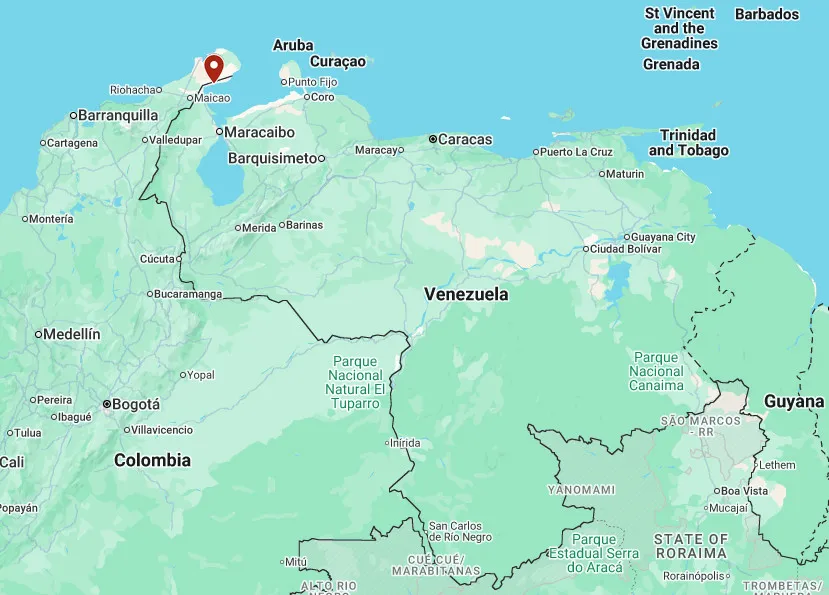
A map highlighting the location of Venezuela’s Alta Guajira region in relation to the rest of the country. Google Maps

Returning to the missile fragments reportedly found in Alta Guajira, they are relatively small, but have distinctive “WARNING” and “52.0” markings that are clearly visible. This is fully consistent with the markings seen on AGM-179A Joint Air-to-Ground Missiles (JAGM), as well as some variants of the AGM-114 Hellfire. Similar fragments have been seen on many occasions following confirmed and reported U.S. drone strikes around the world, including ones tied to the CIA and the U.S. military’s secretive Joint Special Operations Command (JSOC).

A missile fragment reportedly recovered in Venezuela’s Alta Guajira region with “WARNING” visible in lettering. capture via Telemundo/X
Another missile fragment with “52.0” in white letting still legible. capture via X
An example of a similar missile fragment. This one was recovered following the U.S. strike that killed Iranian General Qassem Soleimani in Iraq in January 2020. via X

The AGM-179A is derived directly from the AGM-114R variant, and both missiles share an identical rear body. JAGM’s main area of improvement over its predecessor is its new dual-mode seeker, with laser and millimeter-wave radar guidance modes, which gives it more flexibility to engage targets, as you can read more about here. Every JAGM and Hellfire has a label at the tail end that says “WARNING” and “2-MAN LIFT,” and lists their weight in kilograms and pounds. Each JAGM is roughly 115 pounds (52 kilograms). The stated weight of the baseline R model Hellfire is approximately 110 pounds (49 kilograms). However, there are many subvariants of the AGM-114R, some of which have very different configurations from the standard type. This includes the R9X version, which features an array of pop-out sword-like blades instead of a traditional high-explosive warhead.

A briefing slide showing a general breakdown of the components of the AGM-179A JAGM, including portions directly carried over from the AGM-114R Hellfire. US Army
An official Army infographic that provides details on various Hellfire variants, including their weights. US Army

MQ-9s armed with AGM-114s have been flying from Rafael Hernandez Airport in Aguadilla in Puerto Rico since September 2025, ostensibly in support of expanded counter-drug operations in the Caribbean. Starting last month, local spotters noticed Reapers operating from the airport carrying steadily larger loads of Hellfires, up to as many as 10 at a time. The drones have not been seen with JAGMs, or any other munitions, under their wings. The U.S. military still does not appear to have officially confirmed the integration of JAGM onto the MQ-9, but adding the missiles to the Reaper’s arsenal is at least planned, and there has been evidence in the past that it has already occurred.

New publicly available images show that nine USAF MQ-9As have flown/are flying out of Aguadilla (BQN/TJBQ) 🇵🇷 in support of ongoing counternarcotics ops in the Caribbean.

The nine serials are: 14-4242, 14-4269, 14-4275, 17-4348, 17-4355, 17-4356, 19-4390, 19-4398, 20-4408. https://t.co/1vL60eEoG6 pic.twitter.com/1cUkfIfB2W

— LatAmMilMovements (@LatAmMilMVMTs) December 24, 2025

The U.S. military does have other aircraft, fixed-wing and rotary, that can employ Hellfires and/or JAGMs. However, the MQ-9 would still be particularly well-suited for a covert strike on Venezuela, given the ranges and other likely operational parameters involved.

As TWZ wrote in our recent exploration of Reaper operations in the Caribbean:

“The aforementioned descriptions of the target [of the covert strike] in Venezuela as being a ‘port facility’ and a ‘dock’ would seem to point to something of substantial size. This, in turn, could well have necessitated the employment of a relatively large amount of ordnance, such as what we’ve recently been seeing on Puerto Rico-based MQ-9s, to ensure adequate destruction.”

“More clandestine assets could still have been used instead, but there also would have been no real need to do so if something like a Reaper could have accomplished the job with a reasonable level of survivability. The strike on the target in Venezuela, which did not prompt any kind of immediate response on the part of Venezuelan authorities, at least that we know of, raises additional questions about the effectiveness of the country’s air defenses. Whether or not any standoff electronic warfare support, of which there is plenty in the region currently in the form of Navy EA-18 Growler jets and at least one Air Force EC-130H Compass Call plane, was utilized during the operation is unknown, but this seems likely to have been the case. As TWZ has explored in detail in the past, Venezuela’s air defense capabilities are limited, but could certainly present real threats.”

It is also worth noting here that Colombian President Gustavo Petro separately claimed this week that the United States had struck a target in or around Venezuela’s port city of Maracaibo, which lies to the immediate south of Alta Guajira. Petro described it as a “factory” tied to Colombian leftist guerrilla group Ejército de Liberación Nacional (ELN; National Liberation Army), where “we fear they mix coca paste there to make it cocaine,” according to a machine translation of a post from his official account on X. At the time of writing, this all remains unconfirmed. The ELN is understood to regularly operate in Alta Guajira, which is in close proximity to the Colombian border.

Resulta que muchas lanchas atacadas con misiles, como está pasando en las incautaciones.que hacemos en Colombia o, con ayuda nuestra fuera de Colombia, no llevaban cocaína sino cannabis.

Problema paradójico: en EEUU, en muchísimas partes es legal. Y el Congreso de Colombia no… https://t.co/EJb6yxZKat

— Gustavo Petro (@petrogustavo) December 30, 2025

In addition, Venezuela’s dictatorial president Nicolas Maduro said that he “might discuss” the U.S. government’s direct action against his country “in a few days,” in a recent interview with the Telesur television network. Telesur is jointly sponsored by the governments of Venezuela, Cuba, and Nicaragua. Maduro also took that opportunity to focus blame for drug-trafficking in the region onto Colombian groups, and claim his willingness to work with American authorities on a variety of issues. Maduro is currently under indictment in the United States on charges related to illicit narcotics, including his alleged leadership of a cartel now officially designated as a foreign terrorist organization (FTO).

Asked about a reported CIA drone strike in Venezuela, Maduro declined to comment, saying it “could be something we talk about in a few days.” pic.twitter.com/qC0wlYe3GJ

— Clash Report (@clashreport) January 2, 2026

Maduro:

All of the cocaine that is moved in this region is produced in Colombia. All of it. All of the cocaine.

We’re the victims of Colombian drug trafficking, not from today, from decades. pic.twitter.com/A4SEtafVwp

— Clash Report (@clashreport) January 2, 2026

In TWZ‘s recent detailed look into U.S. MQ-9s flying over the Caribbean with ever-larger loads of AGM-114 Hellfires, we also wrote:

“As already noted, it is not otherwise clear what new mission requirements and/or intelligence streams may have fueled the decision to begin arming MQ-9s flying from Puerto Rico with the significantly larger loads of Hellfires. The need to respond to drug cartels sending out larger waves of boats in order to survive, or to provide armed overwatch due to concerns about surface threats from small boats, are possibilities, but there are no indications so far of either of these being the case.”

On New Year’s Eve, U.S. Southern Command (SOUTHCOM) shared videos of “kinetic strikes against three narco-trafficking vessels traveling as a convoy,” which it said had occurred the day before.

The released footage does include clips that show impacts consistent with aerial gunfire, pointing to the involvement, at least in part, of an Air Force AC-130J Ghostrider gunship. MQ-9s and AC-130Js are among the platforms understood to be involved in this controversial campaign of strikes on alleged drug-smuggling boats, which has been ongoing since September 2025.

On Dec. 30, at the direction of @SecWar Pete Hegseth, Joint Task Force Southern Spear conducted kinetic strikes against three narco-trafficking vessels traveling as a convoy. These vessels were operated by Designated Terrorist Organizations in international waters. Intelligence… pic.twitter.com/NHRNIzcrFS

— U.S. Southern Command (@Southcom) December 31, 2025

SOUTHCOM said the strikes on the trio of boats on December 30 killed “three narco-terrorists,” but that other individuals survived, and that it had contacted the U.S. Coast Guard to conduct a search for survivors. The Coast Guard subsequently confirmed that request, and, by extension, that the strikes had occurred somewhere in the Eastern Pacific Ocean, rather than the Caribbean. At the time of writing, that effort is still ongoing, but there have been no reports of anyone being recovered. Colombian President Petro has also offered his country’s assistance and shared a map showing what he says is the approximate location where the boats were struck.

On Dec. 30th, the @uscg was notified by the @DeptofWar of mariners in distress in the Pacific Ocean.  The U.S. Coast Guard is conducting search and rescue operations. Updates will be provided when available.

— USCG Pacific Area (@USCGPACAREA) January 1, 2026

The Coast Guard is continuing the search for survivors from a U.S. military strike against suspected drug vessels that took place earlier this week. We now know roughly where those strikes took place: Approximately 400 nautical miles southwest of the Mexico/ Guatemala border.

— Idrees Ali (@idreesali114) January 2, 2026

Aviso a todos los gobiernos de la zona. Está parece ser la zona exacta donde cayeron los lancheros que se arrojaron de embarcaciones que fueron bombardeadas.

Se sabe que tres personas murieron, el resto quedó viva porque se arrojaron al mar.

Información conseguida por nuestra… pic.twitter.com/Xj5oJo2AcD

— Gustavo Petro (@petrogustavo) January 2, 2026

SOUTHCOM later announced strikes on two more alleged drug smuggling boats on New Year’s Eve, but did not explicitly say whether they had been sailing together or separately. Where those vessels were targeted is not clear.

On Dec. 31, at the direction of @SecWar Pete Hegseth, Joint Task Force Southern Spear conducted a lethal kinetic strike on two vessels operated by Designated Terrorist Organizations. Intelligence confirmed the vessels were transiting along known narco-trafficking routes and… pic.twitter.com/4AE5u4cEff

— U.S. Southern Command (@Southcom) January 1, 2026

There is certainly a visible trend now toward the targeting of multiple boats in a single day, which would mark a notable uptick in tempo in these operations. As TWZ has previously noted, between September 2 and December 29, the U.S. military is known to have attacked 31 vessels in the Caribbean Sea, as well as the Eastern Pacific Ocean, an average of one strike on a single boat every four days.

This all follows a major, months-long build-up of U.S. air, naval, and ground forces in the region, which is still ongoing. There has also been a steady ratcheting up of the U.S. government’s pressure campaign against Maduro, specifically, now punctuated by at least one covert strike. Whether that may evolve into overt action against the regime in Caracas still remains to be seen.

In the meantime, there is still-growing evidence that the role of U.S. MQ-9 drones in the region is expanding in scale and scope. Altogether, U.S. operations in and around the Caribbean have already taken an increasingly kinetic turn in recent weeks.

Contact the author: joe@twz.com

Joseph has been a member of The War Zone team since early 2017. Prior to that, he was an Associate Editor at War Is Boring, and his byline has appeared in other publications, including Small Arms Review, Small Arms Defense Journal, Reuters, We Are the Mighty, and Task & Purpose.


Source link

Venezuelans divided after US attack and Maduro’s abduction | US-Venezuela Tensions

NewsFeed

Venezuelan officials say US air strikes killed at least 40 people, destroyed parts of the capital and violated their national sovereignty with the abduction of President Nicolas Maduro. Venezuelans are divided between fear of ongoing US intervention and celebrating his removal.

Source link

Who is Venezuelan Vice President Delcy Rodriguez, now leading the country? | Nicolas Maduro News

A brief power vacuum had emerged in Venezuela in the sudden chaos and confusion after the abduction of President Nicolas Maduro by the United States.

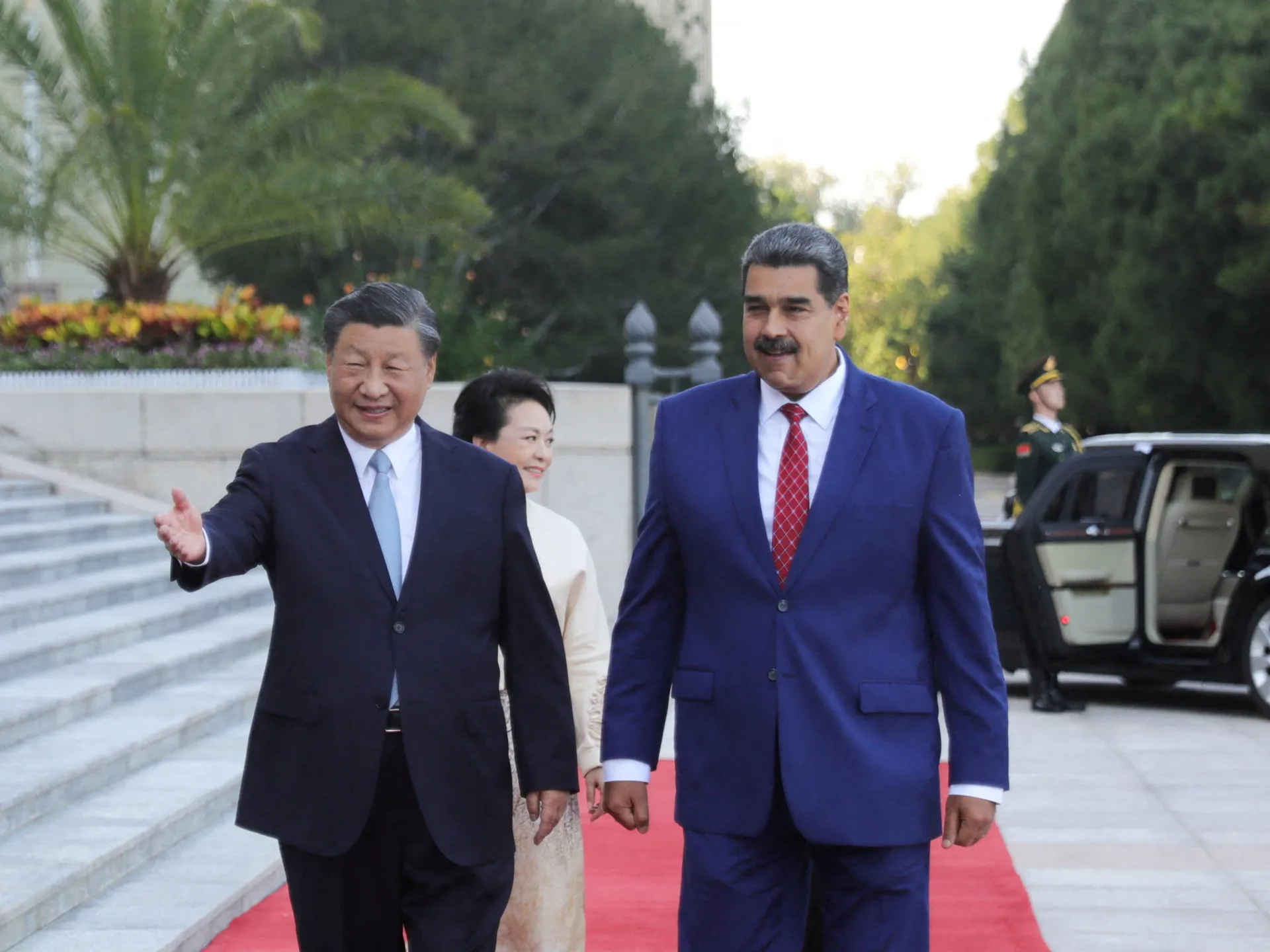
But shortly after the US military rained strikes down on Caracas and other areas on Saturday, US President Donald Trump – in a surprise snub against Venezuelan opposition leader Maria Corina Machado, who was awarded last year’s Nobel Peace Prize – noted that Vice President Delcy Rodriguez, 56, had been sworn in as interim president.

Recommended Stories

list of 4 itemsend of list

The right-wing Machado – who had cosied up to Trump, especially after her October Nobel win, an honour that he himself coveted and she dedicated to him – was described by the US president as not having enough support or “respect” to be Venezuela’s leader.

Trump said Rodriguez had talked to US Secretary of State Marco Rubio and was “essentially willing to do what we think is necessary to make Venezuela great again”.

“I think she was quite gracious,” Trump added. “We can’t take a chance that somebody else takes over Venezuela that doesn’t have the good of the Venezuelan people in mind.”

However, Rodriguez’s remarks soon after the strikes and abduction were diametrical: She criticised the US military action as “brutal aggression” and called for Maduro’s immediate release.

“There is only one president in this country, and his name is Nicolas Maduro,” Rodriguez said defiantly on state television as she was flanked by top civilian officials and military commanders.

Who, then, is the current acting president of Venezuela?

Revolutionary roots

A Caracas native, Rodriguez was born on May 18, 1969. She is the daughter of left-wing rebel fighter Jorge Antonio Rodriguez, who founded the Socialist League party in the 1970s. Her father was killed while tortured in police custody in 1976, a crime that shook many activists of the era, including a young Maduro.

Rodriguez’s brother, also named Jorge, also holds a key role in government as the head of the National Assembly.

She is an attorney who graduated from the Central University of Venezuela and rose rapidly through the political ranks in the past decade. Rodriguez has a long history of representing on the world stage what late President Hugo Chavez called his socialist “revolution” with those carrying on his legacy referred to as Chavistas.

She served as communication and information minister from 2013 to 2014, foreign minister from 2014 to 2017 and as the head of a pro-government Constituent Assembly, which expanded Maduro’s powers, in 2017.

Economic prowess

Rodriguez is sometimes perceived as more moderate than many soldiers who took up arms with Chavez in the 1990s.

Rodriguez’s roles as finance and oil minister, held simultaneously with her vice presidential post, have made her a key figure in the management of Venezuela’s economy and gained her major influence with the country’s withered private sector. She has applied orthodox economic policies in a bid to fight hyperinflation.

Maduro added the oil ministry to Rodriguez’s portfolio in August 2024, tasking her with managing escalating US sanctions on Venezuela’s most important industry.

Rodriguez developed strong ties with Republicans in the US oil industry and on Wall Street who balked at the notion of a US-led change in Venezuela’s government.

Among her past interlocutors were Blackwater security company founder Erik Prince and, more recently, Richard Grenell, a Trump special envoy who tried to negotiate a deal with Maduro for greater US influence in Venezuela.

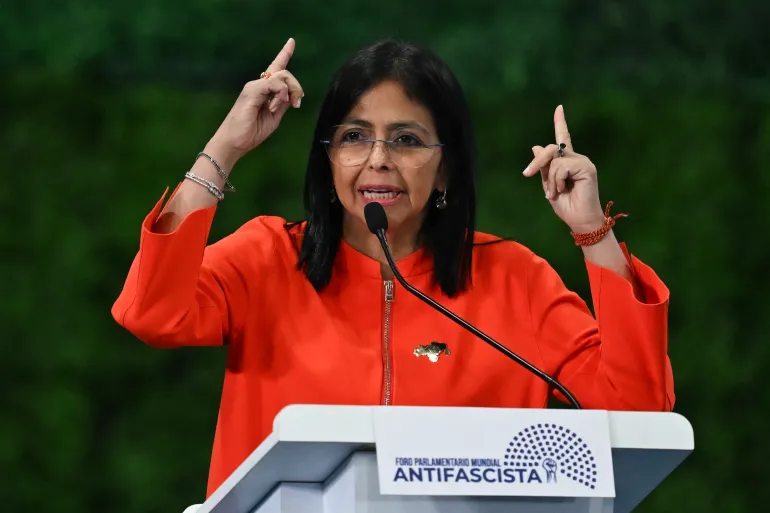
(FILES) Venezuela's Vice President Delcy Rodriguez speaks during the Antifascist Global Parliamentary Forum in Caracas on November 5, 2024.
Venezuelan Vice President Delcy Rodriguez speaks during the Antifascist Global Parliamentary Forum in Caracas [File: AFP]

A ‘tiger’

Despite being perceived as more moderate, Maduro has called Rodriguez a “tiger” for her die-hard defence of his socialist government.

When she was named vice president in June 2018, Maduro described her as “a young woman, brave, seasoned, daughter of a martyr, revolutionary and tested in a thousand battles”.

After Maduro’s abduction on Saturday, Rodriguez demanded the US government provide proof of life for Maduro and his wife, Cilia Flores, and minced no words in denouncing the US actions.

“We call on the peoples of the great homeland to remain united because what was done to Venezuela can be done to anyone. That brutal use of force to bend the will of the people can be carried out against any country,” she said in an address broadcast by the state television channel VTV.

The Constitutional Chamber of Venezuela’s Supreme Court later on Saturday ordered Rodriguez to serve as acting president.

The court ruled that Rodriguez will assume “the office of President of the Bolivarian Republic of Venezuela, in order to guarantee administrative continuity and the comprehensive defence of the Nation”.

Source link

We just witnessed power kidnapping the law | Nicolas Maduro

The United States intervention in Venezuela to abduct President Nicolás Maduro is not law enforcement extended beyond its borders. It is international vandalism, plain and unadorned.

Power has displaced law, preference has replaced principle and force has been presented as virtue. This is not the defence of the international order. It is its quiet execution. When a state kidnaps the law to justify kidnapping a leader, it does not uphold order. It advertises contempt for it.

The forcible seizure of a sitting head of state by the US has no foothold in international law. None. It is not self-defence under Article 51 of the United Nations Charter. It was not authorised by the UN Security Council. International law is many things, but it is not a roving moral warrant for great powers to perform regime change by abduction.

The claim that alleged human rights violations or trafficking in narcotics justifies the removal of a foreign head of state is particularly corrosive. There is no such rule. Not in treaty law. Not in custom law. Not in any serious jurisprudence.

Human rights law binds states to standards of conduct. It does not license unilateral military seizures by self-appointed global sheriffs. If that were the rule, the world would be in a permanent state of sanctioned chaos.

Indeed, if the US were serious about this purported principle, consistency would compel action far closer to home. By the logic now advanced, there would be a far stronger legal and moral case to seize Israeli Prime Minister Benjamin Netanyahu, given the extensive documentation of mass civilian harm and credible allegations of genocide arising from Israel’s conduct in Gaza.

Yet no such logic is entertained. The reason is obvious. This is not law. It is power selecting its targets.

Regime change is not an aberration in American foreign policy. It is a habit with a long paper trail, from Iran in 1953 to Guatemala in 1954, Chile in 1973 and Iraq in 2003.

But the kidnapping of a sitting president marks a new low. This is precisely the conduct the post-1945 legal order was designed to prohibit. The ban on the use of force is not a technicality. It is the central nervous system of international law. To violate it without authorisation is to announce that rules bind only the weak.

The US understands this perfectly. It is acting anyway and in doing so is conducting the autopsy of the UN Charter system itself.

The rot does not stop there. Washington has repeatedly violated its obligations under the UN Charter and the UN Headquarters Agreement. It has denied entry to officials it disfavours. Preventing the Palestinian president from addressing the UN General Assembly in person last year was not a diplomatic faux pas. It was a treaty breach by the host state of the world’s principal multilateral institution.

The message was unmistakable. Access to the international system and adherence to the UN Charter is conditional on American approval.

The UN was designed to constrain power, not flatter it. Today, it increasingly fails to constrain serious international law violations. Paralysed by vetoes, bullied by its host and ignored by those most capable of violating its charter, the UN has drifted from the supposed guardian of legality to a stage prop for its erosion.

At some point, denial becomes self-deception. The system has failed in its core promise. Not because international law is naive but because its most powerful beneficiary has decided it is optional.

It is, therefore, time to say the unsayable: The UN should be permanently relocated away from a host state that treats treaty obligations as inconveniences. And the international community must begin a serious, sober conversation about an alternative global structure whose authority is not hostage to one capital, one veto or one currency – or a system whose powers supersede the UN precisely because the UN has been hollowed out from within.

Law cannot survive as a slogan. Either it restrains those who wield the most force, or it is merely rhetoric deployed against those who do not. What the US has done in Venezuela is not a defence of order. It is a confirmation that international order has been replaced by preference. And preferences, unlike law, recognise no limits.

The views expressed in this article are the author’s own and do not necessarily reflect Al Jazeera’s editorial stance.

Source link

How the US attack on Venezuela, abduction of Maduro unfolded | US-Venezuela Tensions News

In a move that stunned the world, the United States bombed Venezuela and toppled President Nicolas Maduro amid condemnation and plaudits.

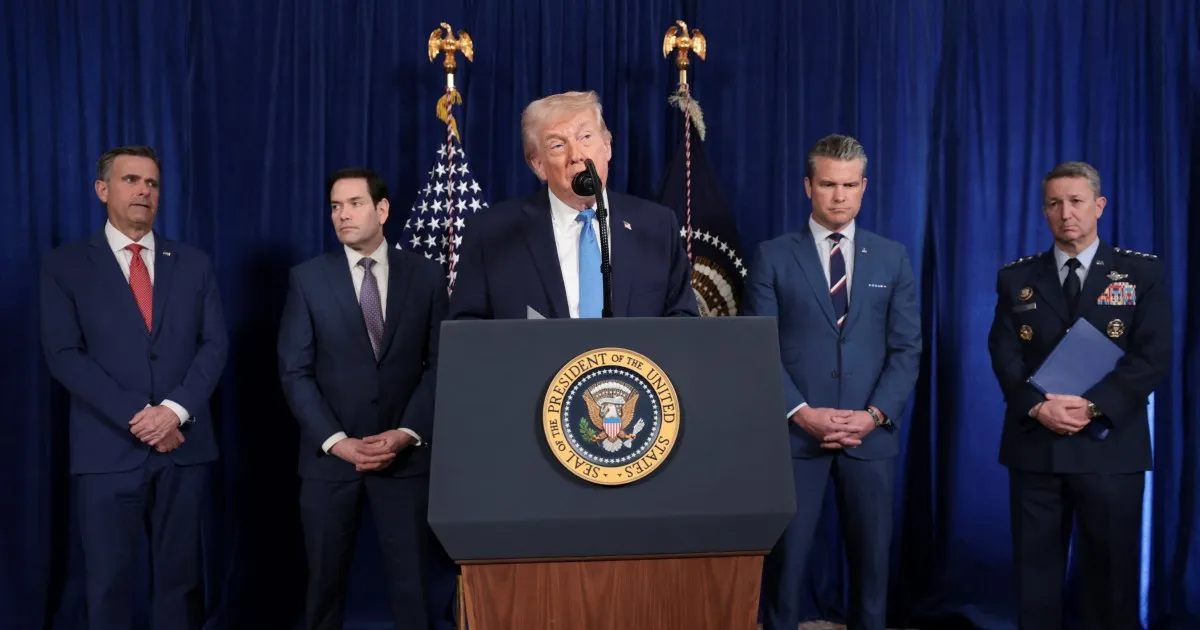
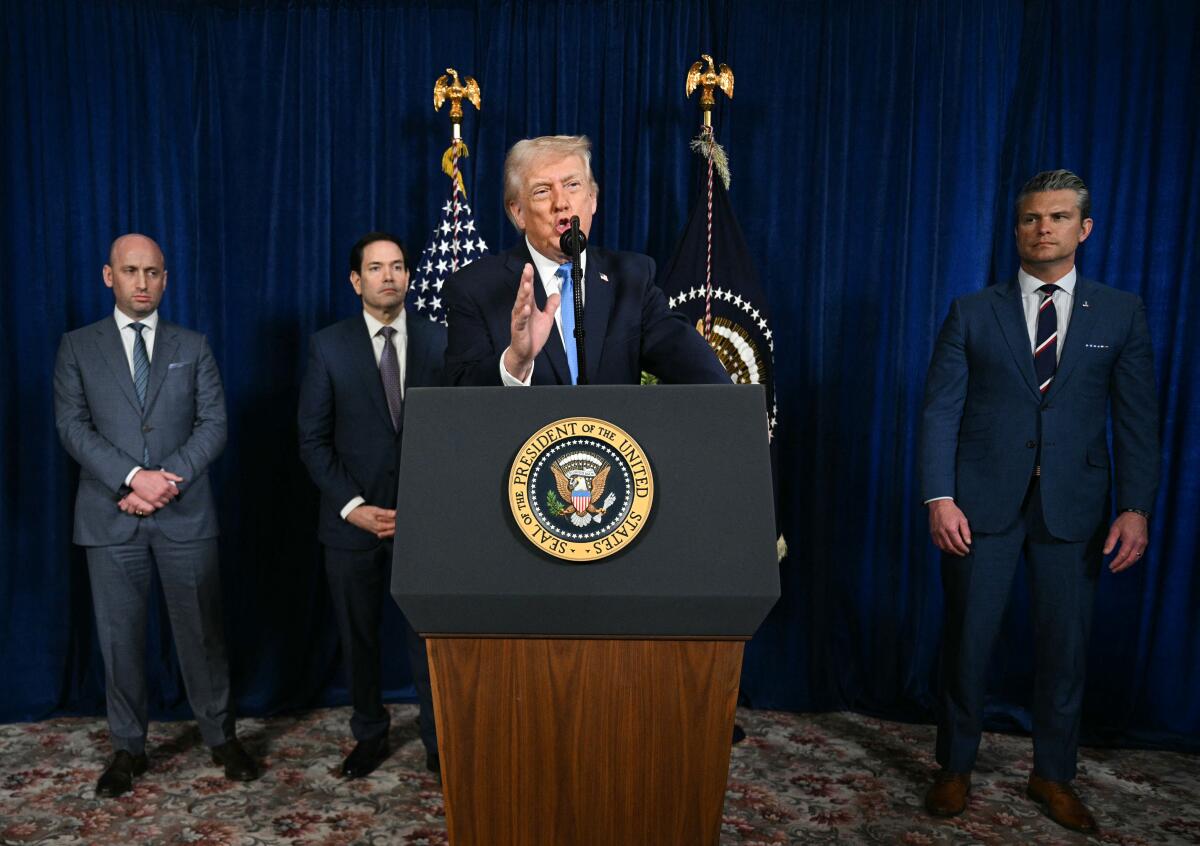
In a news conference on Saturday at his Mar-a-Lago resort in Florida, President Donald Trump praised the operation to seize Maduro as one of the “most stunning, effective and powerful displays of American military might and competence in American history”.

Recommended Stories

list of 4 itemsend of list

It was the riskiest and most high-profile military operation sanctioned by Washington since the US Navy’s SEAL team killed al-Qaeda leader Osama bin Laden in a safe house in Pakistan’s Abbottabad in 2011.

News of the 63-year-old Maduro being abducted took over the global news cycle.

After months of escalation and threats over Maduro’s alleged involvement in shipping drugs to the US, the Trump administration had increased pressure on Caracas with a military build-up in the Caribbean and a series of deadly missile attacks on alleged drug-running boats that had killed more than 100 people and whose legality has been heavily questioned by the United Nations and legal experts.

The US had also previously offered a $50m reward for information leading to Maduro’s arrest.

But while the military was conducting operations in the Caribbean, US intelligence had been gathering information about Maduro, his eating habits, and special forces covertly rehearsed a plan to remove him from power forcibly.

Here’s everything we know about how Maduro and his wife, Cilia Flores, were “captured”.

How was Maduro abducted?

The operation, named “Absolute Resolve”, was carefully rehearsed for months, according to General Dan Caine, chairman of the Joint Chiefs of Staff, who spoke at Trump’s news conference.

Trump also told Fox News that US forces had practised their extraction of Maduro on a replica building.

“They actually built a house which was identical to the one they went into with all the same, all that steel all over the place,” Trump said.

At 11:46pm local time on Friday (03:46 GMT on Saturday), Trump gave the green light.

On Friday night, Caine said, “the weather broke just enough, clearing a path that only the most skilled aviators in the world could move through”, with about 150 aircraft involved in the operation, taking off from 20 different airbases across the Western Hemisphere.

As part of the operation, US forces disabled Venezuela’s air defence systems, with Trump saying the “lights of Caracas were largely turned off due to a certain expertise that we have”, without elaborating.

Several deafening explosions rang out across the capital, with Pete Hegseth, the defence secretary, describing it as part of a “massive joint military and law enforcement raid” that lasted less than 30 minutes.

US helicopters then touched down at Maduro’s compound in the capital at 2:01am (06:01 GMT) on Saturday, with the president and his wife then taken into custody.

There has been no readout on whether there was an exchange of fire, in a chaotic scramble, or if they were taken without a struggle.

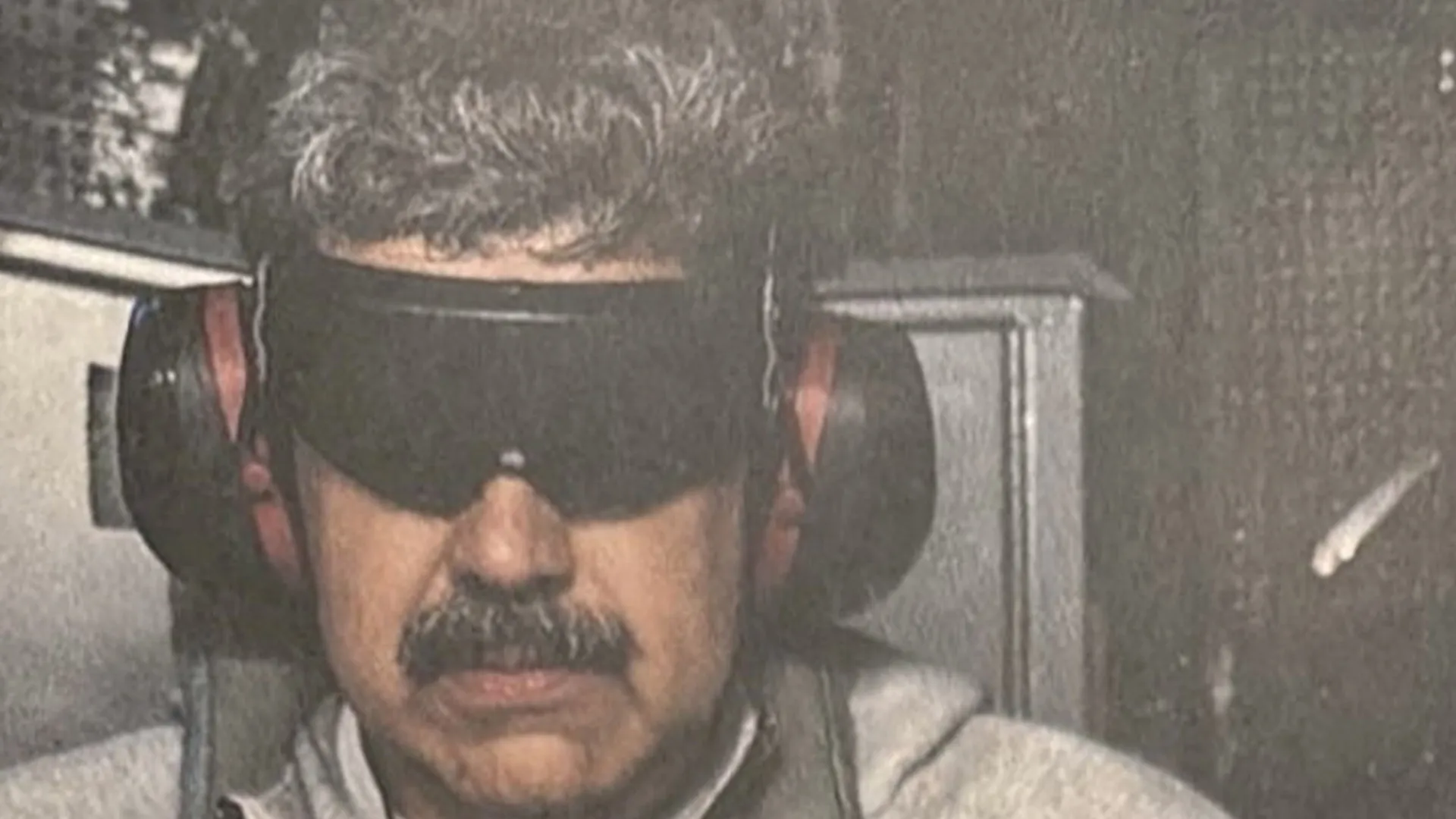
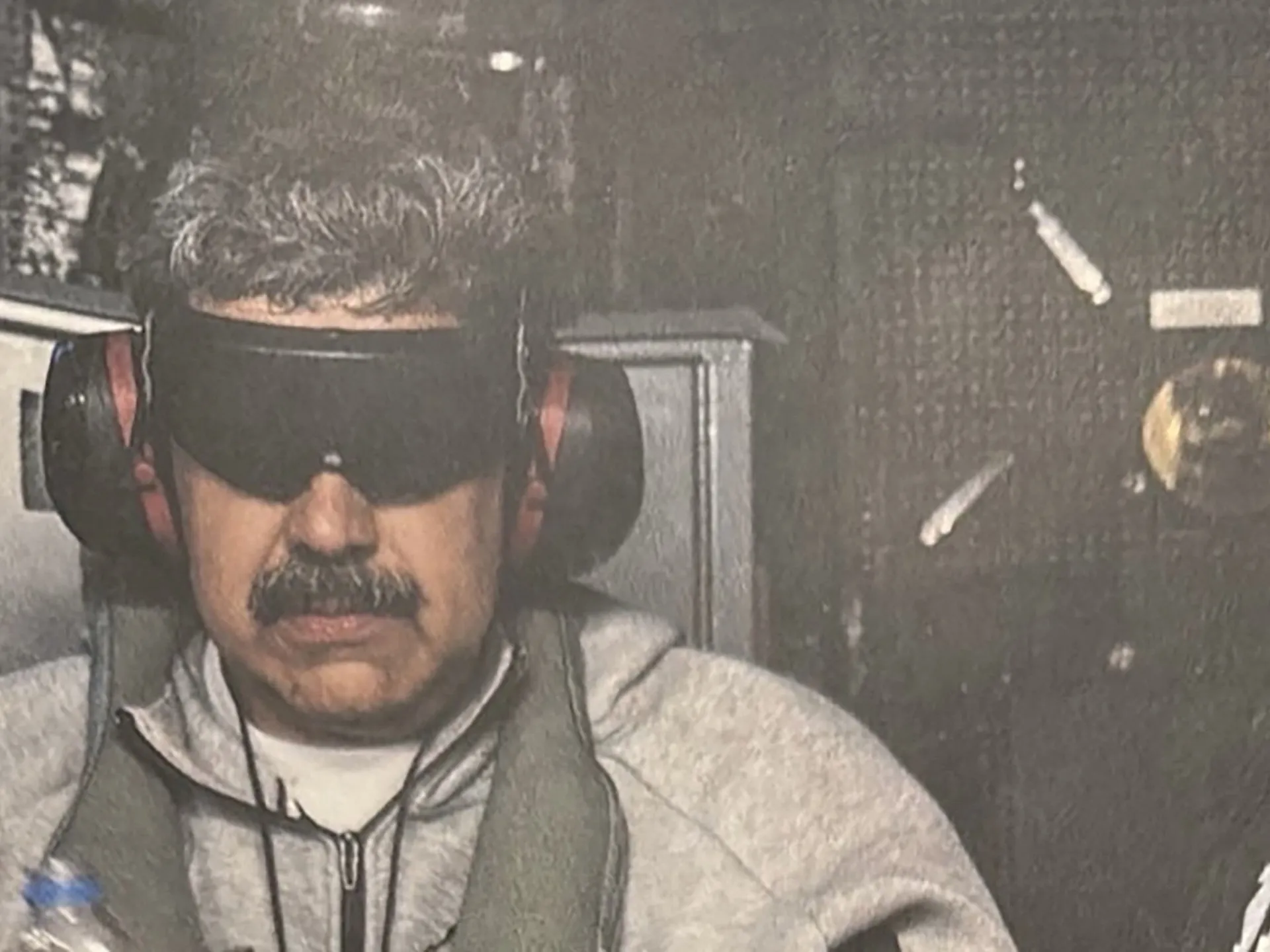
At 4:29am (08:29 GMT), just two and a half hours later, Maduro was put on board a US aircraft carrier, en route to New York. Trump later posted a photograph of the Venezuelan leader on his Truth Social social media platform, blindfolded, wearing a grey tracksuit.

After departing the USS Iwo Jima, US forces escorted Maduro on a flight, touching down in New York’s Stewart Air National Guard Base at about 4:30pm (21:30 GMT).

How many people were killed in the US strikes on Venezuela?

The US strikes hit Caracas as well as the states of Miranda, Aragua and La Guaira, according to the Venezuelan government.

To Linda Unamumo, a public worker, the US attacks caused an explosion that was so strong it destroyed the roof of her house.

“Even up until a little while ago, I was still crying … I was crying because I was so scared … I had to leave my house with my daughter, with my family, and go to another house, a neighbour’s house. It was really traumatic. I wouldn’t wish it on anyone, really,” she told the AFP news agency.

While official casualty counts have yet to be released, an official told The New York Times newspaper on condition of anonymity that at least 40 people had been killed in the attacks.

According to Trump, a few US members were injured in the operation, but he believed no one was killed.

What’s next for Venezuela?

During his news conference on Saturday, Trump announced that the US would “run” the country until a new leader was chosen.

“We’re going to make sure that country is run properly. We’re not doing this in vain,” he said. “This is a very dangerous attack. This is an attack that could have gone very, very badly.”

The president did not rule out deploying US troops in the country and said he was “not afraid of boots on the ground if we have to”.

Trump also, somewhat surprisingly, ruled out working with opposition figure and Nobel Peace Prize winner Maria Corina Machado, who had dedicated her prize, which he so wanted to win himself, to the US president.

“She doesn’t have the support within or the respect within the country,” he said.

The Constitutional Chamber of Venezuela’s Supreme Court ordered Vice President Delcy Rodriguez to serve as acting president following the US’s abduction of Maduro.

The court ruled that Rodriguez will assume “the office of President of the Bolivarian Republic of Venezuela, in order to guarantee administrative continuity and the comprehensive defence of the Nation”.

The court also said it would work to “determine the applicable legal framework to guarantee the continuity of the State, the administration of government, and the defense of sovereignty in the face of the forced absence of the President of the Republic”.

Trump had said earlier on Saturday that the US would not occupy Venezuela, provided Rodriguez “does what we want”.

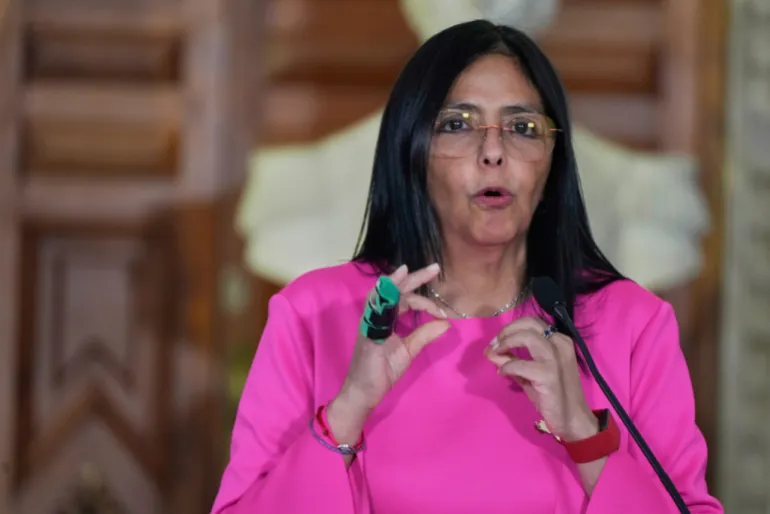
Delcy Rodriguez addresses the press
Venezuelan Vice President Delcy Rodriguez speaks to the press at the Foreign Office in Caracas, Venezuela, on August 11, 2025 [Ariana Cubillos/AP Photo]

Source link

China urges US to ‘stop toppling’ Venezuelan government, release Maduro | Nicolas Maduro News

China has called on the United States to immediately release Venezuelan President Nicolas Maduro after Washington carried out massive military strikes on the capital, Caracas, as well as other regions, and abducted the leader.

Beijing on Sunday insisted the safety of Maduro and his wife Cilia Flores be a priority, and called on the US to “stop toppling the government of Venezuela”, calling the attack a “clear violation of international law“.

Recommended Stories

list of 4 itemsend of list

It was the second statement issued by China since Saturday, after US President Donald Trump said Washington had taken Maduro and his wife and flown them out of the country.

On Saturday, Beijing slammed the US for “hegemonic acts” and “blatant use of force” against Venezuela and its president, urging Washington to abide by the United Nations charter.

China is closely watching developments in Venezuela, according to Andy Mok, a senior research fellow at the Center for China and Globalisation.

Mok told Al Jazeera that a Chinese delegation had met Venezuelan officials just hours before the US action, adding that Beijing was not surprised by Washington’s move, given the scale of US strategic and economic interests in the region.

What did stand out, he said, was how the operation was carried out, as it may “represent the long-term US strategy in the region”.

China is Venezuela’s largest buyer of oil, Mok added, although the country accounts for only 4-5 percent of its total oil imports. Beyond energy, he said, China has growing trade and investment interests across Latin America, meaning Beijing is paying close attention to political shifts in the region.

Mok warned that if a future US administration were to revive a Monroe Doctrine-style policy, it could increase tensions with China, as Latin America is a “pillar of China’s Global South strategy”.

Still, China is likely to limit its response to the events in Venezuela to diplomatic protest rather than hard power, according to China-based analyst Shaun Rein.

“I think China has issued a very strong condemnation of the United States, and they’re working with other Latin American and Caribbean countries to say this isn’t right,” Rein, founder of the China Market Research Group, told Al Jazeera.

Rein said Beijing is deeply alarmed but constrained, and its options are limited.

“There’s not a lot of things that China can do. Frankly, it doesn’t have the military power. It only has two military bases outside of China, while America has 800,” Rein noted, stressing that, “historically, China is not warlike”.

“China is just going to make proclamations criticising the United States’ actions, but they’re not going to push back with military action, and they’re probably not going to push back with economic sanctions.”

Global condemnations, celebrations

World reaction has poured in since the US military action in Venezuela, with opinion firmly split over the intervention.

Left-leaning regional leaders, including those of Brazil, Colombia, Chile and Mexico, have largely denounced Maduro’s ouster, while countries with right-wing governments, from Argentina to Ecuador, have largely welcomed it.

Australian Prime Minister Anthony Albanese on Sunday said he backed a “peaceful, democratic transition” of power in Venezuela, but urged that international law be respected.

His government was “monitoring developments”, he said in a statement.

South Korea also responded on Sunday, calling for a de-escalation of tensions.

“Our government urges all involved parties to make utmost efforts toward easing regional tensions. We hope for a quick stabilisation of the situation via dialogue, ensuring democracy is restored, and the will of the Venezuelan people is honoured,” its Ministry of Foreign Affairs said.

Venezuela has been increasingly isolated, particularly after Maduro’s contested election in 2024.

China and Russia, however, continue to maintain strong economic and strategic ties, and alliances have grown with Iran over their shared opposition to US policy.

Source link

Trump just sent a very dangerous message to Latin America | Nicolas Maduro

Within hours of a massive operation of regime change in Venezuela, United States President Donald Trump revelled in his “success”. He posted a photo of Venezuelan President Nicolas Maduro in handcuffs and then addressed the American public.

He praised the military for launching “one of the most stunning, effective and powerful displays of American military might” in US history, allegedly rendering Venezuelan forces “powerless”. He announced that Maduro and his wife would be indicted in New York for “narcoterrorism” and claimed – without evidence – that US operations have reduced maritime drug trafficking by 97 percent.

Trump went further, declaring that the US would “run the country” until an unspecified transition could be arranged, while openly threatening a “second and much larger attack”. Crucially, he framed these claims within a broader assertion of US “domination over the Western Hemisphere”, explicitly invoking the 1823 Monroe Doctrine.

The US military intervention in Venezuela represents something far more dangerous than a single act of aggression. It is the latest manifestation of a centuries-old pattern of US interference that has left Latin America scarred. The regime change operation in Caracas is a clear sign the Trump administration is embracing this old policy of interventionism with renewed fervour. And that bodes ill for the region.

That this attack targeted Maduro’s repressive and corrupt government, which was responsible for the immense suffering of many Venezuelans, makes the situation no less catastrophic. Washington’s long history of supporting brutal dictatorships across the region strips away any pretence of moral authority. Trump himself can hardly claim any moral high ground given that he is himself embroiled in a major political scandal due to his close ties with convicted paedophile Jeffrey Epstein and has maintained unconditional support for Israel’s genocide in Gaza.

The Trump administration’s attack on Venezuela solidifies a catastrophic pattern of violations of international law. If the US can unilaterally launch military strikes against sovereign nations at a whim, then the entire framework of international law becomes meaningless. This tells every nation that might and power trump legality and sovereignty.

For Latin America specifically, the implications are chilling. To understand why this attack reverberates so painfully across the region, one must take a quick look at its history. The US has orchestrated or supported coups and military dictatorships throughout the region with disturbing regularity.

In Guatemala in 1954, the CIA overthrew the democratically elected government of Jacobo Arbenz. In Chile in 1973, the US backed the coup that brought Augusto Pinochet to power and ushered in an era of unchecked political violence. In 1983, the US invaded and occupied the island of Grenada to overthrow its socialist government. In Argentina, Brazil, Uruguay, and throughout Central America, Washington provided training, funding and political cover for military regimes that tortured dissidents and murdered civilians.

The new question now is, if the US carried out regime change in Venezuela so easily, who is next? Colombia’s President Gustavo Petro, who has been at odds with the Trump administration, was quick to react – and is right to be concerned, as in December, Trump threatened an intervention, saying “he’ll be next“. Others in the region are also nervous.

Beyond the looming threat of US intervention, Latin America now also faces the potential regional instability that a regime change in Caracas is likely to create. The political crisis under Maduro had already spilled beyond its borders into neighbouring Colombia and Brazil, where Venezuelans fled poverty and repression. One can only imagine the ripple effect the US-enacted regime change will have.

There are probably many Venezuelans who are celebrating Maduro’s ouster. However, the US intervention directly undermines the political opposition in Venezuela. It would allow the regime, which appears to retain power, to paint all opposition as foreign agents, eroding its legitimacy.

The Venezuelan people deserve democracy, but they have to achieve it themselves with international support, not to have it imposed at gunpoint by a foreign power with a documented history of caring more about resources and geopolitical dominance than human rights.

Latin Americans deserve better than to choose between homegrown authoritarianism and imported violence. What they need is not American bombs but genuine respect for self-determination.

The US has no moral authority to attack Venezuela, regardless of Maduro’s authoritarian nature. Both can be true: Maduro is a dictator who caused immense harm to his people, and US military intervention is an illegal act of aggression that will not resolve the crisis of democracy in Venezuela.

The region’s future must be determined by people themselves, free from the shadow of empire.

The views expressed in this article are the author’s own and do not necessarily reflect Al Jazeera’s editorial stance.

Source link

Trump says US will ‘run’ Venezuela after Nicolas Maduro seized | Donald Trump News

United States President Donald Trump has said that Washington will “run” Venezuela until a political transition can take place, hours after US forces bombed the South American country and “captured” its president, Nicolas Maduro.

Speaking during a news conference on Saturday, Trump said the US would “run the country until such time as we can do a safe, proper and judicious transition”.

Recommended Stories

list of 3 itemsend of list

“We don’t want to be involved with having somebody else get in, and we have the same situation that we had for the last long period of years,” he said.

The Trump administration launched attacks on Venezuela’s capital, Caracas, and seized Maduro and his wife in the early hours of Saturday.

A plane carrying the Venezuelan leader landed in New York state on Saturday evening, according to US media.

Footage broadcast by CNN, Fox News and MS Now showed US officials escorting a person they identified as Maduro off a plane at the Stewart international airport, about 97 kilometres (60 miles) northwest of New York City.

Maduro’s capture took place after a months-long US pressure campaign against his government, which included US seizures of oil tankers off the Venezuelan coast, as well as deadly attacks on alleged drug-smuggling boats in the Caribbean. The attacks were widely denounced as extrajudicial killings.

Washington had accused the Venezuelan leader, who has been in power since 2013, of having ties to drug cartels. Maduro had rejected the claim, saying the US was working to depose him and take control of Venezuela’s vast oil reserves.

During Saturday’s news conference, Trump said that “very large United States oil companies” would move into Venezuela to “fix the badly broken… oil infrastructure and start making money for the country”.

He added that his administration’s actions “will make the people of Venezuela rich, independent and safe”.

The Trump administration has defended Maduro’s “capture, saying the left-wing leader faced drug-related charges in the US.

These charges include “narco-terrorism conspiracy, cocaine importation conspiracy, possession of machine guns and destructive devices, and conspiracy to possess machine guns and destructive devices against the United States”, US Attorney General Pam Bondi said.

“They will soon face the full wrath of American justice on American soil in American courts,” she added in a post on X.

A Justice Department official told the Reuters news agency that Maduro is expected to make an initial appearance in Manhattan federal court on Monday.

‘Illegal abduction’

But legal experts, world leaders and Democratic Party lawmakers in the US have condemned the administration’s actions as a violation of international law.

“Attacking countries, in flagrant violation of international law, is the first step towards a world of violence, chaos, and instability, where the law of the strongest prevails over multilateralism,” Brazilian President Luiz Inacio Lula da Silva wrote on X.

Ben Saul, the United Nations special rapporteur on human rights and counterterrorism, slammed what he called Washington’s “illegal abduction” of Maduro. “I condemn the US’ illegal aggression against Venezuela,” Saul wrote on social media.

A spokesperson for UN chief Antonio Guterres said he was “deeply alarmed” by the situation, describing the US’s actions as setting “a dangerous precedent”.

“The Secretary-General continues to emphasize the importance of full respect – by all – of international law, including the UN Charter. He’s deeply concerned that the rules of international law have not been respected,” Guterres’s office said in a statement.

Earlier on Saturday, Venezuela’s defence minister released a defiant statement in response to the US attacks, urging people to remain united.

“We will not negotiate; we will not give up,” Vladimir Padrino Lopez said, stressing that Venezuela’s independence is not up for negotiation. “We must maintain calm and [be] united in order to prevail in these dire moments.”

Uncertainty prevails

It remains unclear how exactly the US plans to “run” Venezuela, and how long the purported transitional period will last.

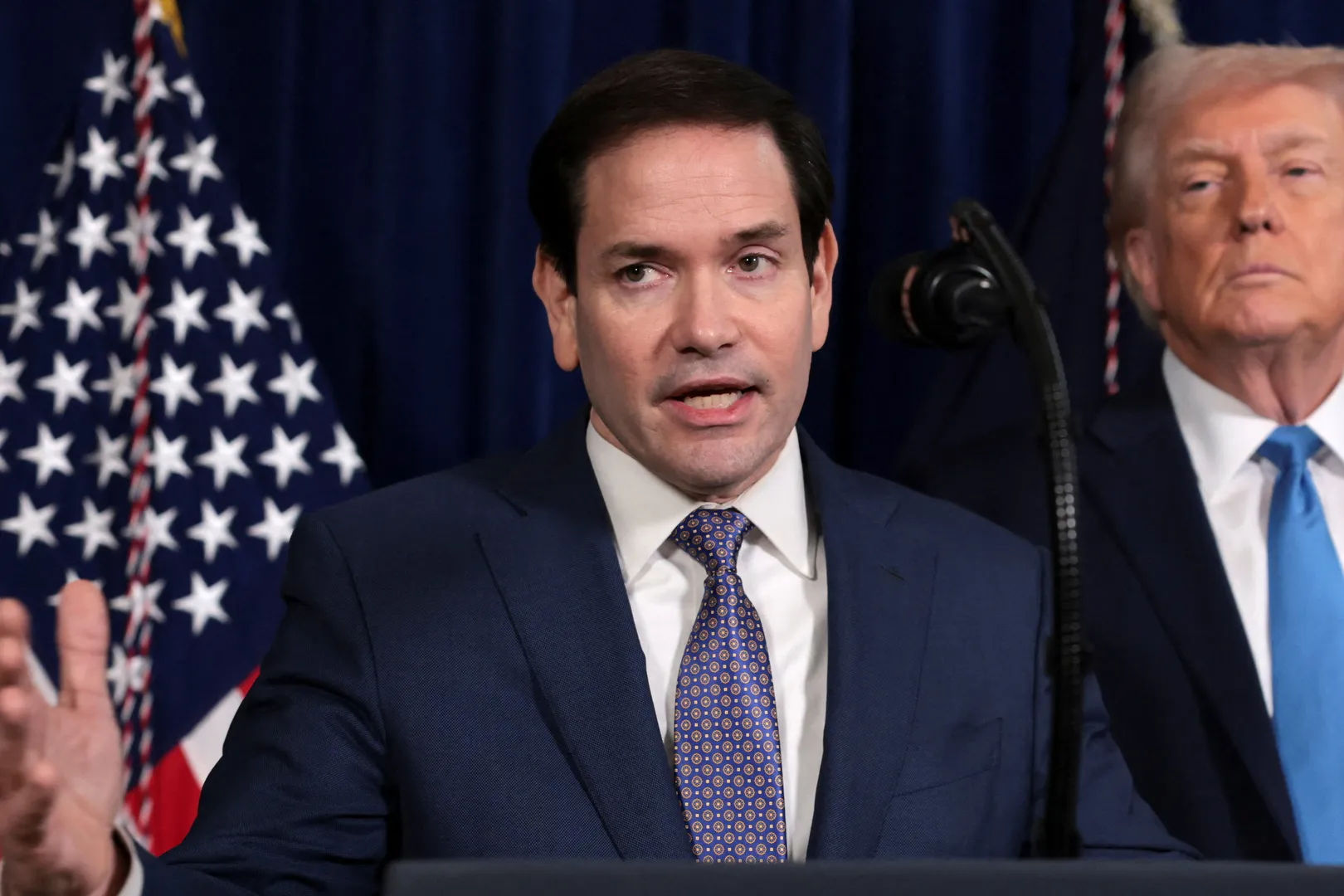
During Saturday’s news conference, Trump said that US Secretary of State Marco Rubio had spoken with Venezuelan Vice President Delcy Rodriguez.

“She was sworn in as president just a little while ago,” Trump told reporters. “She had a long conversation with [Rubio], and she said, ‘We’ll do whatever you need’. I think she was quite gracious, but she really doesn’t have a choice.”

Rodriguez appeared to contradict that in a news conference in Caracas later in the day.

“We demand the immediate release of President Nicolas Maduro and his wife. The only president of Venezuela is President Nicolas Maduro,” she said.

“We are ready to defend Venezuela. We are ready to defend our natural resources, which should be for national development,” she added.

Al Jazeera’s Latin America editor Lucia Newman, reporting from Chile, said that, if Rodriguez is “on board” with the US plan for Venezuela, as Trump and Rubio have suggested, “she certainly didn’t sound like it” during her address.

“She sounded like her typical, fiery self, very much on the side of… Maduro, demanding that he be released and saying that Venezuela would not be a colony of the United States,” Newman said.

The events of the day have brought “a rollercoaster of emotions” to “Venezuelans both inside and outside of the country”, said Caracas-based journalist Sissi de Flaviis.

“When we first heard that Maduro was taken out of the country, there was a mix of reactions,” she said. “A lot of people couldn’t believe it. Other people were pretty much celebrating. Other people were kind of on standby, waiting.”

After Trump’s news conference announcing US plans to run Venezuela, “there’s been a shock”, de Flaviis added.

“People are a bit concerned about what this will actually mean for us, what this will mean for the government and who is going to lead us in the next few days, months and years.”

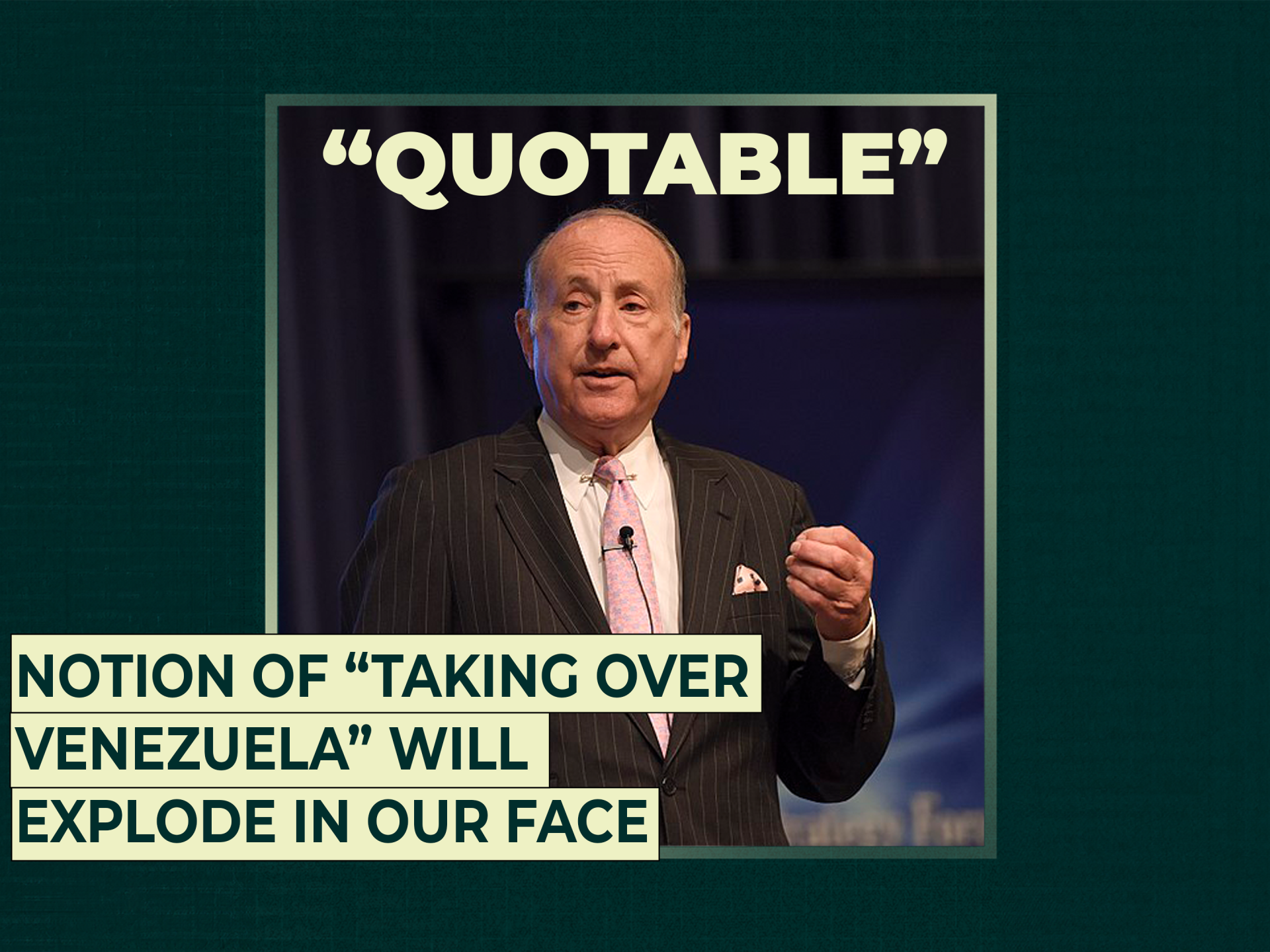
Meanwhile, Harlan Ullman, a former US naval officer, told Al Jazeera that “the notion of America taking over Venezuela is going to explode in our faces”.

“When Trump says, ‘We’re going to run the country’: We’re not capable of running America, how are we going to be able to run Venezuela?” Ullman said.

“I do not believe that we have a plan for dealing with Venezuela,” he added. “A country is extraordinarily complex. We lack the knowledge, understanding and all the logistics to do this.”

Source link

US Republicans back Trump on Venezuela amid faint MAGA dissent | US-Venezuela Tensions News

Since coming down the escalator in 2015 to announce his first presidential run, Donald Trump has presented himself as a break from the traditional hawkish foreign policy in the United States.

The US president has even criticised some of his political rivals as “warmongers” and “war hawks”.

Recommended Stories

list of 3 itemsend of list

But Trump’s move to abduct Venezuelan President Nicolas Maduro and announce that the US will “run” the Latin American country has drawn comparisons with the regime change wars that he built a political career rejecting.

Some critics from Trump’s Make America Great Again (MAGA) movement, who backed his message of focusing on the country’s own issues instead of conflicts abroad, are criticising Washington’s march to war with Venezuela.

Still, Trump’s grip on Republican politics appears to remain firm, with most legislators from the party praising Trump’s actions.

“To President Trump and his team, you should take great pride in setting in motion the liberation of Venezuela,” Senator Lindsey Graham wrote in a social media post.

“As I have often said, it is in America’s national security interest to deal with the drug caliphate in our backyard, the centrepiece of which is Venezuela.”

Graham’s reference to a “drug caliphate” seems to play on Islamophobic tropes and promote the push to liken the US attacks on alleged drug traffickers in Latin America to the so-called “war on terror”.

The US senator heaped praise on the winner of the FIFA Peace Prize – handed to Trump by the association’s chief, Gianni Infantino, in December – and called him “the GOAT of the American presidency”, which stands for “the greatest of all time”.

Muted criticism

While it was expected that Graham and other foreign policy hawks in Trump’s orbit would back the moves against Venezuela, even some of the Republican sceptics of foreign interventions cheered the abduction of Maduro.

Former Congressman Matt Gaetz, one of the most vocal critics of hawkish foreign policy on the right, poked fun at the “capture” of the Venezuelan president.

“Maduro is gonna hate CECOT,” he wrote on X, referring to the notorious prison in El Salvador where the Trump administration sent hundreds of suspected gang members without due process.

Libertarian Senator Rand Paul, who has been a leading voice in decrying Congress’s war-making power, only expressed muted disapproval of Trump’s failure to seek lawmakers’ authorisation for military action in Venezuela.

“Time will tell if regime change in Venezuela is successful without significant monetary or human cost,” he wrote in a lengthy statement that mostly argued against bringing “socialism” to the US.

“Best though, not to forget, that our founders limited the executive’s power to go to war without Congressional authorisation for a reason – to limit the horror of war and limit war to acts of defence. Let’s hope those precepts of peace are not forgotten in our justified relief that Maduro is gone and the Venezuelan people will have a second chance.”

Early on Saturday morning, Republican Senator Mike Lee questioned the legality of the attack. “I look forward to learning what, if anything, might constitutionally justify this action in the absence of a declaration of war or authorisation for the use of military force,” he wrote on X.

Lee later said that Secretary of State Marco Rubio told him that US troops were executing a legal arrest warrant against Maduro.

“This action likely falls within the president’s inherent authority under Article II of the Constitution to protect US personnel from an actual or imminent attack,” the senator said.

Dissent

Republican Congresswoman Marjorie Taylor Greene was one of the few dissenting voices.

“Americans’ disgust with our own government’s never-ending military aggression and support of foreign wars is justified because we are forced to pay for it and both parties, Republicans and Democrats, always keep the Washington military machine funded and going,”  Greene wrote on X.

Greene, a former Trump ally who fell out with the US president and is leaving Congress next week, rejected the argument that Trump ordered Maduro’s “capture” because of the Venezuelan president’s alleged involvement in the drug trade.

She noted that Venezuela is not a major exporter of fentanyl, the leading cause of overdose deaths in the US.

She also underscored that, last month, Trump pardoned former Honduran President Juan Orlando Hernandez, a convicted drug trafficker who was serving a 45-year sentence in a US jail.

“Regime change, funding foreign wars, and American’s [sic] tax dollars being consistently funneled to foreign causes, foreigners both home and abroad, and foreign governments while Americans are consistently facing increasing cost of living, housing, healthcare, and learn about scams and fraud of their tax dollars is what has most Americans enraged,” Greene said.

Congressman Tomas Massie, another Republican, shared a speech he delivered in the House of Representatives earlier this month, warning that attacking Venezuela is about “oil and regime change”.

“Are we prepared to receive swarms of the 25 million Venezuelans, who will likely become refugees, and billions in American treasure that will be used to destroy and inevitably rebuild that nation? Do we want a miniature Afghanistan in the Western Hemisphere?” Massie said in the remarks.

“If that cost is acceptable to this Congress, then we should vote on it as a voice of the people and in accordance with our Constitution.”

While Massie and Greene are outliers in their party, Trump’s risky moves in Venezuela were a success in the short term: Maduro is in US custody at a minimal cost to Washington.

Similarly, few Republicans opposed the US war in Iraq when then-President George W Bush stood under the “mission accomplished” sign on the aircraft carrier USS Abraham Lincoln after toppling Iraq’s leader, Saddam Hussein, in 2003.

But there is now a near consensus across the political spectrum that the Iraq invasion was a geopolitical disaster.

The fog of war continues to hang over Venezuela, and it is unclear who is in charge of the country, or how Trump will “run” it.

The US president has not ruled out deploying “boots on the ground” to Venezuela, raising the prospect of a US occupation and the possibility of another Vietnam, Iraq or Afghanistan.

“Do we truly believe that Nicolas Maduro will be replaced by a modern-day George Washington? How did that work out in… Libya, Iraq or Syria?” Massie warned in his Congress speech.

“Previous presidents told us to go to war over WMDs, weapons of mass destruction, that did not exist. Now, it’s the same playbook, except we’re told that drugs are the WMDs.”

Source link

Venezuela temporarily closes border with Brazil following US strike | US-Venezuela Tensions News

Sao Paulo, Brazil – Venezuela has temporarily closed its border with Brazil following the United States’s early morning attack on Caracas, in which US forces also “captured” President Nicolas Maduro and his wife, Cilia Flores.

The border crossing between the Brazilian city of Pacaraima and Santa Elena de Uairen in Venezuela had been closed on the Venezuelan side for about five hours, blocking citizens from entering Brazil, a Brazilian military official told Al Jazeera.

Recommended Stories

list of 3 itemsend of list

“There was no formal protocol from Venezuela regarding entry and exit criteria. The fact is that Brazilians are allowed to leave, while Venezuelans face restrictions. But this could change at any time,” said the official, who spoke on condition of anonymity because he is not authorised to speak on the matter.

The head of Brazil’s Federal Police also announced the temporary closure, and the governor of the state of Roraima told Reuters that the border had been reopened after the brief closure.

Brazil’s government said it is monitoring the border and has sent military personnel to the region to bolster security.

“The Minister of Defense indicated that there is no abnormal activity on the border between Brazil and Venezuela, which will continue to be monitored, and that he is in contact with the Governor of Roraima,” read a statement from Brazil’s Ministry of Foreign Affairs.

Venezuelans make up Brazil’s largest foreign population, according to the Brazilian Institute of Geography and Statistics. The state of Roraima alone is home to 77,563 immigrants from the country. In all, some 8 million Venezuelans have fled their homes in the past decade, with more than 6 million resettling in other Latin American countries.

“I think it’s very possible that there will be an exodus of Venezuelans to Brazil, and, in fact, we are already seeing concrete signs of it,” Jessica Leon Cedeno, a Venezuelan journalist who lives in Sao Paulo, told Al Jazeera.

“Millions of people have left the country in search of better living conditions and opportunities.”

Lula says US attacks could ‘destabilise’ the region

Brazilian President Luiz Inacio Lula da Silva said on Saturday that US President Donald Trump’s actions inside Venezuela were “unacceptable”.

“The bombings on Venezuelan territory and the capture of its president cross an unacceptable line,” wrote Lula on X. “These acts represent a grave affront to Venezuela’s sovereignty and yet another extremely dangerous precedent for the entire international community.”

Brazil’s leader has urged restraint for months amid an increased US military buildup off Venezuela’s coast.

Analysts worry that Maduro’s removal could plunge Venezuela into chaos, potentially resulting in another wave of mass migration, as it witnessed in 2019 after a failed attempt to remove Maduro.

Joao Carlos Jarochinski Silva, a professor of international relations at the Federal University of Roraima, said that a potential wave of migration would depend on multiple factors, including whether Washington continues its military campaign inside the country and whether what remains of Maduro’s regime will put up a fight.

“What is the resilience capacity of Chavismo within Venezuela?” Jarochinski Silva said, referring to the political movement named after former President Hugo Chavez. “This could have consequences that are truly worrying, but given the current scenario, there is no context of fear.”

He added that Trump has so far focused on applauding his military’s action inside Venezuela and has not addressed key humanitarian concerns. Earlier this year, the Trump administration cut funding to the US government’s main agency for foreign aid, USAID, which heavily affected Venezuela’s neighbours, Brazil and Colombia.

“The United States has been cutting humanitarian resources lately,” he said, adding that there will be consequences to the US military actions inside the country. “For example, refugees, other people who may be affected by this. He doesn’t commit to this agenda at any point.”

Source link

What are the implications of US ‘capture’ of Nicolas Maduro? | Nicolas Maduro

US special forces have seized Venezuela’s president and his wife.

US special forces seized Venezuela’s president, Nicolas Maduro, in an attack that has taken the country and the world by surprise.

Maduro has long denied accusations by US President Donald Trump of heading a narcotics cartel.

So, what are the implications of Washington’s actions?

Presenter: James Bays

Guests:

Phil Gunson – senior analyst for the Andes Project at the International Crisis Group

Richard Weitz – US security analyst and senior fellow at the NATO Defense College

Temir Porras – foreign policy adviser to former Venezuelan President Hugo Chavez and former chief of staff to Maduro

Source link

Many U.S. Venezuelans praise Maduro capture, but some protest in Los Angeles

Maria Eugenia Torres Ramirez was having dinner with her family in Los Angeles on Friday night when the flood of messages began. Word had begun to circulate that the U.S. was invading Venezuela and would seize its president, Nicolás Maduro.

Torres Ramirez, 38, fled her native country in 2021, settled in L.A. and has a pending application for asylum. Her family is scattered throughout the world — Colombia, Chile and France. Since her parents died, none of her loved ones remain in Venezuela.

Still, news that the autocrat who separated them had been captured delivered a sense of long-awaited elation and united the siblings and cousins across continents for a rare four-hour phone call as the night unfolded.

“I waited for this moment for so long from within Venezuela, and now that I’m out, it’s like watching a movie,” said Torres Ramirez, a former political activist who opposed Maduro. “It’s like a jolt of relief.”

Many Venezuelans across the U.S. celebrated the military action that resulted in Maduro’s arrest. Economic collapse and political repression led roughly 8 million Venezuelans to emigrate since 2014, making it one of the world’s largest displacement crises.

About 770,000 live in the U.S. as of 2023, concentrated mainly in the regions of Miami, Orlando, Houston and New York. Just over 9,500 live in L.A., according to a 2024 U.S. Census estimate.

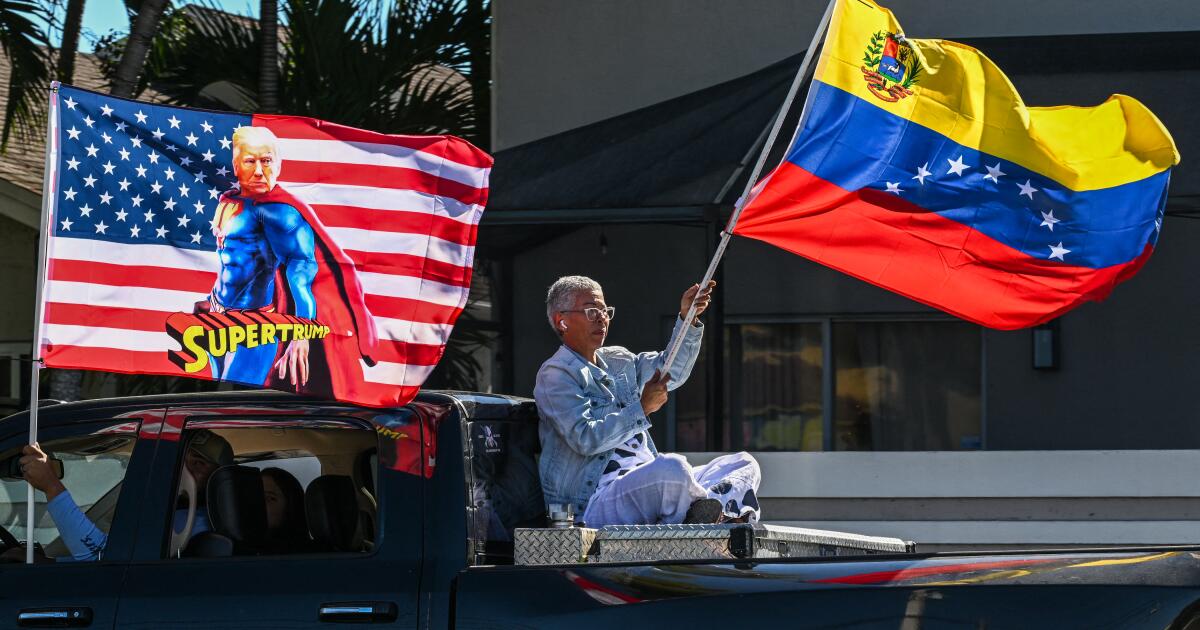
In the South Florida city of Doral, home to the largest Venezuelan American community, residents poured into the streets Saturday morning, carrying the Venezuelan flag, singing together and praising the military action as an act of freedom.

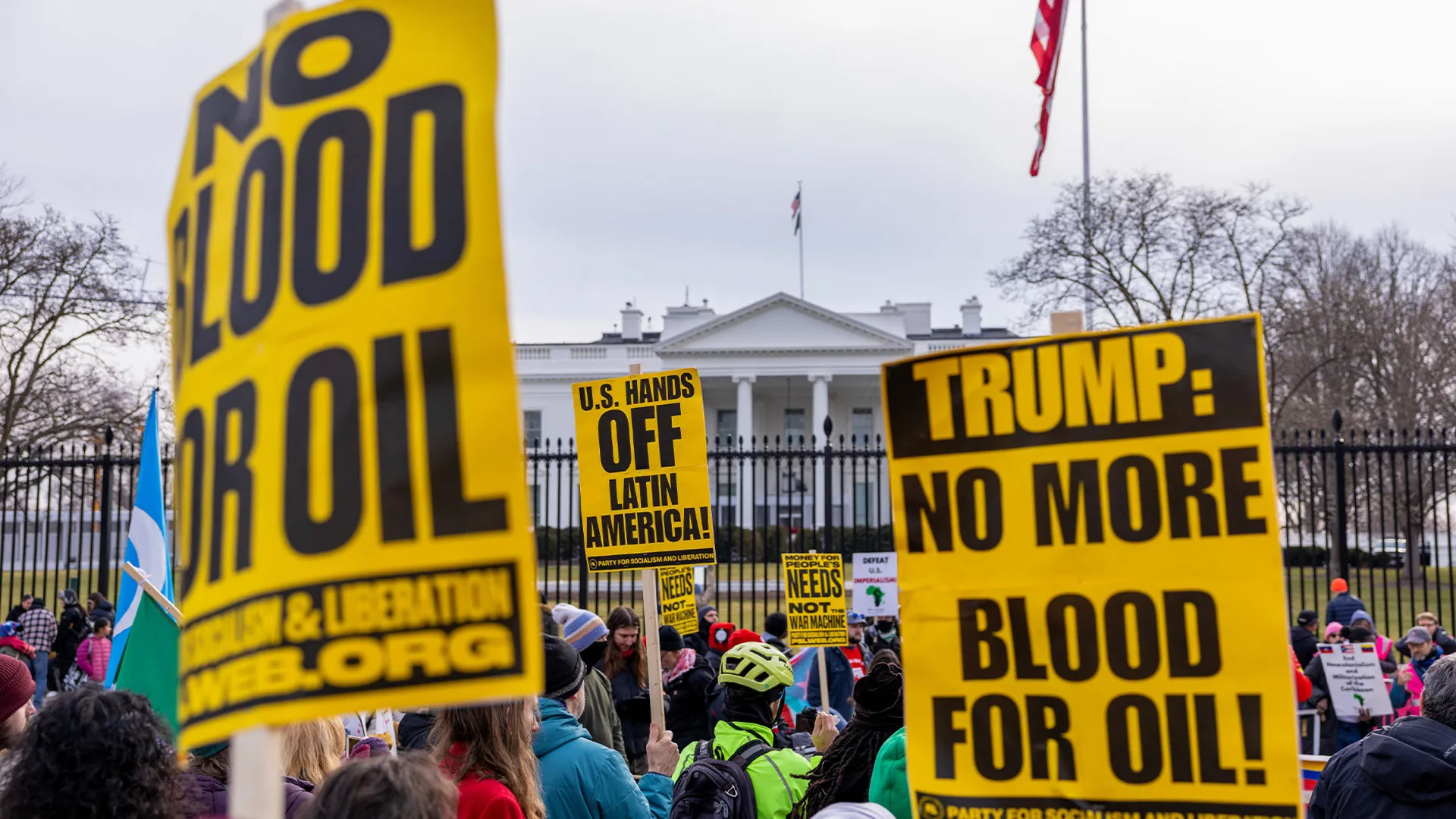
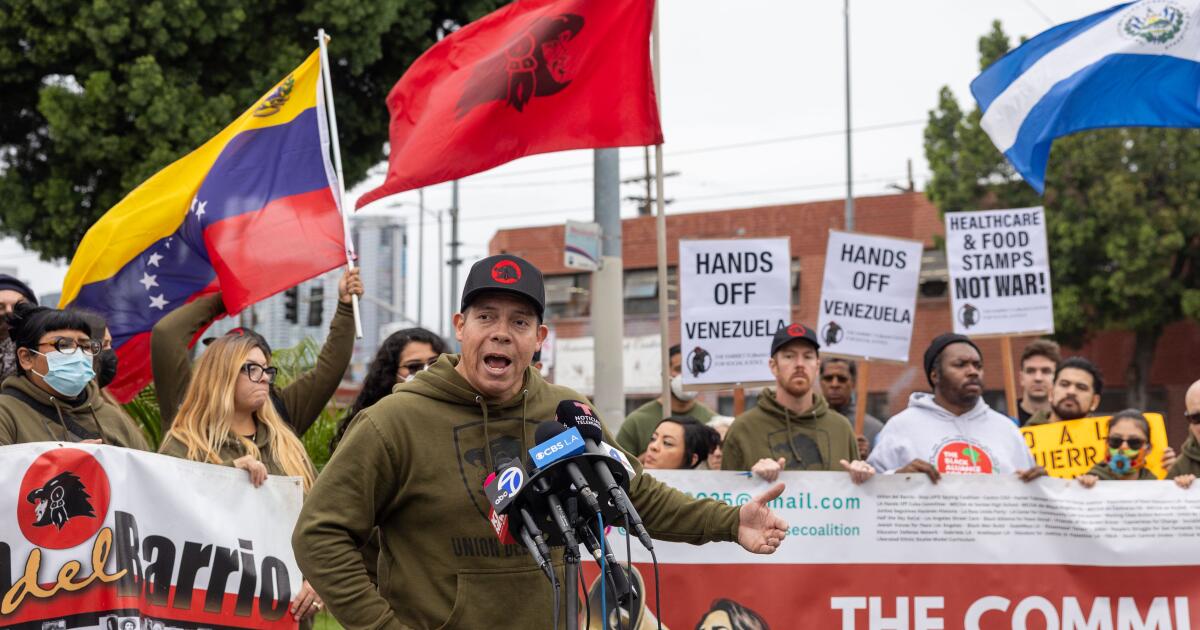
In Los Angeles, a different picture emerged as groups opposed to Maduro’s arrest took to the streets, though none identified themselves as being of Venezuelan descent. At a rally of about 40 people south of downtown Los Angeles, John Parker, a representative of the Harriet Tubman Center for Social Justice, called the raid a “brutal assault and kidnapping” that amounted to a war crime.

The United States’ intervention in Venezuela had nothing to do with stopping the flow of drugs, he said, and everything to do with undermining a legitimate socialist government. Parker called for Maduro to be set free as a few dozen protesters behind him chanted, “Hands off Venezuela.”

Parker said when he visited Venezuela a few weeks ago as part of a U.S. peacemaking delegation, he saw “the love people had for Maduro.”

A later demonstration in Pershing Square drew hundreds out in the rain to protest the U.S intervention. But when a speaker led chants of “No war in Venezuela,” a woman draped in a Venezuelan flag attempted to approach him and speak into the microphone. A phalanx of demonstrators circled her and shuttled her away.

At Mi Venezuela, a restaurant in Vernon, 16-year-old Paola Moleiro and her family ordered empanadas Saturday morning.

A portion of one of the restaurant’s walls was covered in Venezuelan bank notes scrawled with messages. One read: “3 de enero del 2026. Venezuela quedo libre.

Venezuela is free.

Around midnight the night before, Paola started getting messages on WhatsApp from her relatives in Venezuela. The power was out, they said, and they forwarded videos of what sounded like bomb blasts.

Paola was terrified. She’d left Venezuela at age 7 with her parents and siblings, first for Panama and later the U.S., in 2023. But the rest of her family remained in Venezuela, and she had no idea what was going on.

Paola and her family stayed up scanning television channels for some idea of what was happening. Around 1:30 a.m., President Trump announced that U.S. forces had captured Maduro.

“The first thing I did, I called my aunt and said, ‘We are going to see each other again,’” she said.

Because of the Venezuelan state’s control over media, her relatives had no idea their leader had been seized by U.S. forces. “Are you telling me the truth?” Paola said her aunt asked.

Paola hasn’t been home in nine years. She misses her grandmother and her grandmother’s cooking, especially her caraotas negras, or black beans. As a child, she said, certain foods were so scarce that she had an apple for the first time only after moving to Panama.

Paola said she was grateful to Trump for ending decades of authoritarian rule that had reduced her home country to a shell of what it once was.

“Venezuela has always prayed for this,” she said. “It’s been 30 years. I feel it was in God’s hands last night.”

For Torres Ramirez, it was difficult to square her appreciation for Trump’s accomplishment in Venezuela with the fear she has felt as an immigrant under his presidency.

“It’s like a double-edged sword,” she said. “Throughout the course of this whole year, I have felt persecuted. I had to face ICE — I had to go to my appointment with the fear that I could lose it all because the immigration policies had changed and there was complete uncertainty. For a moment, I felt as if I was in Venezuela. I felt persecuted right here.”

During a news conference Saturday morning, Trump said Maduro was responsible for trafficking illicit drugs into the U.S. and the deaths of thousands of Americans. He repeated a baseless claim that the Maduro government had emptied Venezuela’s prisons and mental institutions and “sent their worst and most violent monsters into the United States to steal American lives.”

“They sent everybody bad into the United States, but no longer, and we have now a border where nobody gets through,” he said.

Trump also announced that the U.S. will “run” Venezuela and its vast oil reserves.

“We’ll run it professionally,” he said. “We’ll have the greatest oil companies in the world go in and invest billions and billions of dollars and take that money, use that money in Venezuela, and the biggest beneficiary are going to be the people of Venezuela.”

Torres Ramirez said that while she’s happy about Maduro’s ouster, she’s unsure how to feel about Trump’s announcement saying the U.S. will take over Venezuela’s oil industry. Perhaps it won’t be favorable in the long term for Venezuela’s economy, she said, but the U.S. intervention is a win for the country’s political future if it means people can return home.

Patricia Andrade, 63, who runs Raíces Venezolanas, a volunteer program in Miami that distributes donations to Venezuelan immigrants, said she believes the Trump administration is making the right move by remaining involved until there is a transition of power.

Andrade, a longtime U.S. citizen, said she hasn’t been to Venezuela in 25 years — even missing the deaths of both parents. She said she was accused of treason for denouncing the imprisonment of political opponents and the degradation of Venezuela’s democracy under Maduro’s predecessor Hugo Chavez. She said she worries that Venezuela’s remaining political prisoners could be killed as payback for Maduro’s arrest.

“We tried everything — elections, marches, more elections … and it couldn’t be done,” she said. “Maduro was getting worse and worse, there was more repression. If they hadn’t removed him, we were never going to recover Venezuela.”

While she doesn’t want the U.S. to fix the problems of other countries, she thanked Trump for U.S. involvement in Venezuela.

She said she can’t wait to visit her remaining family members there.

Source link

On the ground in Venezuela: Shock, fear and defiance

It was about 2 a.m. Saturday Caracas time when the detonations began, lighting up the sullen sky like a post-New Year’s fireworks display.

“¡Ya comenzó!” was the recurrent phrase in homes, telephone conversations and social media chats as the latest iteration of U.S. “shock and awe” rocked the Venezuelan capital. “It has begun!”

Then the question: “¿Maduro?”

The great uncertainty was the whereabouts of President Nicolás Maduro, who has been under Trump administration threat for months.

The scenes of revelry from a joyous Venezuelan diaspora celebrating from Miami to Madrid were not repeated here. Fear of the unknown kept most at home.

Hours would pass before news reports from outside Venezuela confirmed that U.S. forces had captured Maduro and placed him on a U.S. ship to face criminal charges in federal court in New York.

Venezuelans had watched the unfolding spectacle from their homes, using social media to exchange images of explosions and the sounds of bombardment. This moment, it was clear, was ushering in a new era of uncertainly for Venezuela, a nation reeling from a decade of economic, political and social unrest.

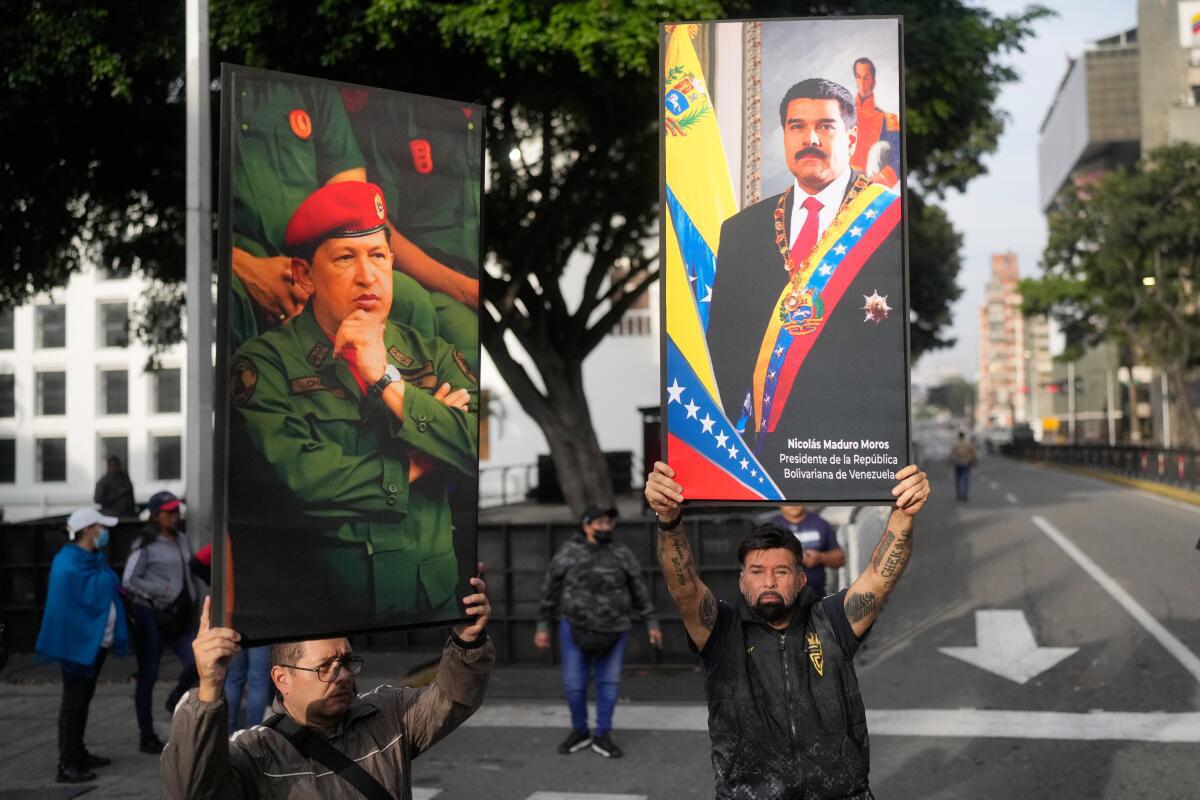
Government supporters display posters of Venezuelan President Nicolás Maduro, right, and former President Hugo Chávez

Government supporters display posters of Venezuelan President Nicolás Maduro, right, and former President Hugo Chávez in downtown Caracas on Saturday.

(Matias Delacroix / Associated Press)

The ultimate result was an imponderable. But that this was a transformative moment — for good or bad — seemed indisputable.

By daybreak, an uneasy calm overtook the city of more than 3 million. The explosions and the drone of U.S. aircraft ceased. Blackouts cut electricity to parts of the capital.

Pro-government youths wielding automatic rifles set up roadblocks or sped through the streets on motorcycles, a warning to those who might celebrate Maduro’s downfall.

Shops, gas stations and other businesses were mostly closed. There was little traffic.

“When I heard the explosions, I grabbed my rosary and began to pray,” said Carolina Méndez, 50, who was among the few who ventured out Saturday, seeking medicines at a pharmacy, though no personnel had arrived to attend to clients waiting on line. “I’m very scared now. That’s why I came to buy what I need.”

A sense of alarm was ubiquitous.

“People are buying bottled water, milk and eggs,” said Luz Pérez, a guard at one of the few open shops, not far from La Carlota airport, one of the sites targeted by U.S. strikes. “I heard the explosions. It was very scary. But the owner decided to open anyway to help people.”

Customers were being allowed to enter three at a time. Most didn’t want to speak. Their priority was to stock up on basics and get home safely.

Rumors circulated rapidly that U.S. forces had whisked away Maduro and his wife, Cilia Flores.

There was no immediate official confirmation here of the detention of Maduro and Flores, both wanted in the United States for drug-trafficking charges — allegations that Maduro has denounced as U.S. propaganda. But then images of an apparently captive Maduro, blindfolded, in a sweatsuit soon circulated on social media.

There was no official estimate of Venezuelan casualties in the U.S. raid.

Rumors circulated indicating that a number of top Maduro aides had been killed, among them Diosdado Cabello, the security minister who is a staunch Maduro ally. Cabello is often the face of the government.

But Cabello soon appeared on official TV denouncing “the terrorist attack against our people,” adding: “Let no one facilitate the moves of the enemy invader.”

Although Trump, in his Saturday news conference, confidently predicted that the United States would “run” Venezuela, apparently during some undefined transitional period, it’s not clear how that will be accomplished.

A key question is whether the military — long a Maduro ally — will remain loyal now that he is in U.S. custody. There was no public indication Saturday of mass defections from the Venezuelan armed forces. Nor was it clear that Maduro’s government infrastructure had lost control of the country. Official media reported declarations of loyalty from pro-government politicians and citizens from throughout Venezuela.

In his comments, Trump spoke of a limited U.S. troop presence in Venezuela, focused mostly on protecting the oil infrastructure that his administration says was stolen from the United States — a characterization widely rejected here, even among Maduro’s critics. But Trump offered few details on sending in U.S. personnel to facilitate what could be a tumultuous transition.

Meantime, Venezuelan Vice President Delcy Rodríguez surfaced on official television and demanded the immediate release of Maduro and his wife, according to the official Telesur broadcast outlet. Her comments seemed to be the first official acknowledgment that Maduro had been taken.

“There is one president of this country, and his name is Nicolás Maduro,” the vice president said in an address from Miraflores Palace, from where Maduro and his wife had been seized hours earlier.

During an emergency meeting of the National Defense Council, Telesur reported, Rodríguez labeled the couple’s detention an “illegal kidnapping.”

The Trump administration, the vice president charged, meant to “capture our energy, mineral and [other] natural resources.”

Her defiant words came after Trump, in his news conference, said that Rodríguez had been sworn in as the country’s interim president and had evinced a willingness to cooperate with Washington.

“She’s essentially willing to do what we think is necessary to make Venezuela great again,” Trump said.

Pro-government armed civilians patrol in La Guaira, Venezuela

Pro-government armed civilians patrol in La Guaira, Venezuela, on Saturday after President Trump announced that President Nicolás Maduro had been captured and flown out of the country.

(Matias Delacroix / Associated Press)

Somewhat surprisingly, Trump also seemed to rule out a role in an interim government for Marina Corina Machado, the Venezuelan Nobel Peace Prize laureate and longtime anti-Maduro activist.

“She’s a very nice woman, but doesn’t have respect within the country,” Trump said of Machado.

Machado is indeed a controversial figure within the fractured Venezuelan opposition. Some object to her open calls for U.S. intervention, preferring a democratic change in government.

Nonetheless, her stand-in candidate, Edmundo González, did win the presidency in national balloting last year, according to opposition activists and others, who say Maduro stole the election.

“Venezuelans, the moment of liberty has arrived!” Machado wrote in a letter released on X. “We have fought for years. … What was meant to happen is happening.”

Not everyone agreed.

“They want our oil and they say it’s theirs,” said Roberto, 65, a taxi driver who declined to give his last name for security reasons. “Venezuelans don’t agree. Yes, I think people will go out and defend their homeland.”

Special correspondent Mogollón reported from Caracas and staff writer McDonnell from Boston. Contributing was special correspondent Cecilia Sánchez Vidal in Mexico City.

Source link

‘Act of war’: Expert rejects Trump rationale for Venezuela attack | News

US President Donald Trump and his allies have defended the US attacks on Venezuela and the removal of President Nicolas Maduro from power amid widespread condemnation that the actions violate international law.

Trump told reporters on Saturday that Maduro was “captured” after US military strikes on the Venezuelan capital, Caracas, for carrying out a purported “campaign of deadly narco-terrorism against the United States”.

Recommended Stories

list of 3 itemsend of list

He said the US government would “run” the South American country during a political transition, promising the Venezuelan people that they would become “rich, independent and safe”.

But Claire Finkelstein, a professor of law at the University of Pennsylvania, has rejected the Trump administration’s arguments in defence of the attacks and removal of Maduro, as well as its plans to exert control over Venezuela.

“I don’t think there’s any basis under international law for the action that occurred overnight by the US government,” Finkelstein told Al Jazeera, describing the attacks as an “illegal use of force [and] a violation of Venezuelan sovereignty”.

“Maduro has personal jurisdiction rights, so not only is it a violation of Venezuelan sovereignty, but it’s a violation of his personal, international rights,” she said.

Numerous statutes of international law – including the UN Charter – prohibit states from attacking another country without provocation.

“All Members shall refrain in their international relations from the threat or use of force against the territorial integrity or political independence of any state, or in any other manner inconsistent with the Purposes of the United Nations,” the UN Charter says.

The US actions came amid a months-long pressure campaign against Maduro, whom the Trump administration accused, without evidence, of being linked to drug traffickers.

Washington had carried out deadly strikes on alleged drug-smuggling boats in the Caribbean, seized vessels carrying oil off the Venezuelan coast, sanctioned members of Maduro’s family, and threatened to launch attacks on the country’s soil.

“Nicolas Maduro wasn’t just an illegitimate dictator, he also ran a vast drug-trafficking operation,” US Congressman Tom Cotton, a top Trump ally, wrote on social media on Saturday, welcoming the moves against the Venezuelan leader.

Before he was seized, Maduro had said he was open to dialogue with the US on drug trafficking. He also had accused the Trump administration of seeking to depose him and seize control of Venezuela’s vast oil reserves.

‘No imminent threat’

Democratic Party lawmakers in the US had been demanding answers from the Trump administration about its aims in Venezuela, accusing the Republican president of seeking to unlawfully carry out acts of war without congressional oversight.

Under the US Constitution, only Congress has the power to declare war.

But that authority has been weakened over the last several decades, with the US carrying out military strikes around the world during its so-called “war on terror” based on loosely-interpreted congressional authorisations.

On Saturday, Gregory Meeks, the top Democrat on the House of Representatives Foreign Affairs Committee, said that, despite the Trump administration’s claims, “there was no imminent threat to the United States” from Venezuela, “certainly not one that justified military action without congressional authorization”.

“These actions violate both US and international law and, by Trump’s own admission, this is not a limited operation,” Meeks said in a statement shared on social media.

This was echoed by the University of Pennsylvania’s Finkelstein, who said there was no “immediate threat” to the US that would justify the executive branch carrying out attacks without notifying Congress.

“It was an act of war against Venezuela, and we did not have the kind of self-defence justification that would normally justify bypassing Congress,” she told Al Jazeera.

“Even if you believe the US is at grave danger because of drug trafficking, there isn’t the kind of imminence there that would justify the president moving unilaterally and not turning to Congress and trying to get them on board.”

Finkelstein also rejected Trump’s plans for the US to “run” Venezuela as “incredibly illegal”.

“States have sovereignty rights, and you cannot just invade them and take them over,” she said.

“Even if Maduro were to fall of his own accord and we had not brought that about, we don’t have the right to go in and start running their government,” Finkelstein said.

“Democracy is premised on the idea that the people are sovereign and the people choose their own leaders, and that’s something we should be promoting in Latin and South America, not trying to undermine.”

Source link

U.S. capture of Maduro in Venezuela criticized as violation of international, U.S. law

President Trump’s decision to send U.S. forces into Venezuela to capture President Nicolás Maduro and his wife and return them to the U.S. to face drug charges elicited condemnation from legal experts and other critics who argued that the operation — conducted without congressional or United Nations approval — clearly violated U.S. and international law.

Such criticism came from Democratic leaders, international allies and adversaries including Mexico, France, China and Russia, United Nations Secretary-General Antonio Guterres and experts on international law and wartime powers.

“Nicolás Maduro was a thug and an illegitimate leader of Venezuela, terrorizing and oppressing its people for far too long and forcing many to leave the country. But starting a war to remove Maduro doesn’t just continue Donald Trump’s trampling of the Constitution, it further erodes America’s standing on the world stage and risks our adversaries mirroring this brazen illegal escalation,” Sen. Adam Schiff (D-Calif.) wrote on X.

A U.N. spokesman said Guterres was “deeply alarmed” by the U.S. operation and “deeply concerned that the rules of international law have not been respected.”

China’s foreign ministry said “such hegemonic acts of the U.S. seriously violate international law and Venezuela’s sovereignty,” while France’s foreign minister said the U.S. operation “contravenes the principle of the non-use of force that underpins international law.”

Republicans largely backed the president, with both House Speaker Mike Johnson (R-La.) and Senate Majority Leader John Thune (R-S.D.) defending the operation as “decisive” and legally justified. However, other Republicans questioned Trump’s authority to act unilaterally, and raised similar concerns as Schiff about other world leaders citing Trump’s actions to justify their own aggression into neighboring nations.

Rep. Don Bacon (R-Neb.) defended Trump’s actions as “great for the future of Venezuelans and the region,” but said he was concerned that “Russia will use this to justify their illegal and barbaric military actions against Ukraine, or China to justify an invasion of Taiwan.”

Trump defended the operation as a legitimate law enforcement action necessary to combat threats to the U.S. from Maduro, whom he accused of sending violent gang members and deadly drugs across the U.S. border on a regular basis.

“The illegitimate dictator Maduro was the kingpin of a vast criminal network responsible for trafficking colossal amounts of deadly and illicit drugs into the United States,” Trump said at a news conference. “As alleged in the indictment, he personally oversaw the vicious cartel known as Cartel de los Soles, which flooded our nation with lethal poison responsible for the deaths of countless Americans.”

However, Trump also made no secret of his interest in Venezuela’s oil. He said U.S. officials would be running Venezuela for the foreseeable future and ensuring that the nation’s oil infrastructure is rebuilt — to return wealth to the Venezuelan people, but also to repay U.S. businesses that lost money when Maduro took over the industry.

Atty. Gen. Pam Bondi announced that Maduro, who had previously been indicted in the U.S. in 2020, is now the subject of a superseding indictment charging him, his wife and several others with narco-terrorism conspiracy, cocaine importation conspiracy, possession of machine guns and destructive devices and conspiracy to possess such weapons and devices.

“They will soon face the full wrath of American justice on American soil in American courts,” Bondi wrote on X.

Secretary of State Marco Rubio also framed the operation as a law enforcement effort, and defended the lack of advance notice to Congress.

“At its core, this was an arrest of two indicted fugitives of American justice, and the Department of War supported the Department of Justice in that job,” Rubio said. “It’s just not the kind of mission that you can pre-notify, because it endangers the mission.”

Trump said Congress could not be notified in advance because “Congress will leak, and we don’t want leakers.”

Michael Schmitt, an international law professor at the University of Reading in the United Kingdom and a professor emeritus of international law at the U.S. Naval War College, said Trump’s actions were a “clear violation” of international law.

He said the U.S. had no authority from the U.N. Security Council to conduct military operations in Venezuela, nor any legitimate justification to act in self-defense against an armed attack — which drug trafficking does not amount to.

Schmitt said the operation in Venezuela went far beyond a normal law enforcement action. But even if it were just a law enforcement action, he said, the U.S. would still lack legal authority under international law to engage in such activity on Venezuelan soil without the express permission of Venezuelan authorities — which it did not have.

“International law is clear. Without consent, you cannot engage in investigations or arrest or seizure of criminal property on another state’s territory,” he said. “That’s a violation of that state’s sovereignty.”

Because the operation was illegitimate from the start, the resulting occupation and interference in Venezuela’s oil industry are also unlawful, Schmitt said — regardless of whether the country’s nationalizing of U.S.-tied oil infrastructure was also unlawful, as some experts believe it was.

“That unlawfulness — of seizing U.S. business interests, nationalizing them, in a way that was not in accordance with the required procedures — is not a basis for using force,” Schmitt said.

Matthew Waxman, chair of the National Security Law Program at Columbia Law School, said that in the days ahead, he expects the Trump administration to try to justify its actions not just as a law enforcement operation, but “as part of a larger campaign to defend the United States against what it has characterized as an attack or invasion by Maduro-linked drug cartels.”

“All modern presidents have claimed broad constitutional power to use military force without congressional authorization, but that is always hotly contested. We’ll see if there’s much pushback in Congress in this case, which will probably depend a lot on how things now play out in Venezuela,” Waxman said. “Look at what happened last year in Iran: The president claimed the power to bomb nuclear program infrastructure, and when the operation didn’t escalate, congressional opponents backed off.”

Already on Saturday, some members of Congress were softening their initial skepticism.

Within hours of posting on X that he was looking forward “to learning what, if anything, might constitutionally justify this action in the absence of a declaration of war or authorization for the use of military force,” Sen. Mike Lee (R-Utah) had posted again, saying Rubio told him that the military action was “to protect and defend those executing the arrest warrant” for Maduro.

Such action “likely falls within the president’s inherent authority under Article II of the Constitution to protect U.S. personnel from an actual or imminent attack,” Lee added.

Others remained more skeptical.

Rep. Thomas Massie (R-Ky.) said Trump’s remarks about taking over the country and controlling its oil reserves did not seem “the least bit consistent” with Bondi’s characterization of the operation as a law enforcement effort.

Source link

Trump: US ‘captures’ Maduro in ‘dead of night’ | Nicolas Maduro

NewsFeed

US President Donald Trump says the US “successfully captured” Venezuela President Nicolas Maduro and his wife “in the dead of night” and they will “face American justice” for alleged narcoterrorism. Trump said the US will run Venezuela until there is a “safe… and judicious” transition of power.

Source link

Trump says U.S. will ‘run’ Venezuela after capturing Maduro in audacious attack

An audacious overnight raid by elite U.S. forces that seized Venezuelan President Nicolás Maduro from his bedroom in Caracas plunged the country into turmoil on Saturday, prompting international concern about Venezuela’s future and President Trump’s decision to take control of a sovereign nation.

Trump justified the stunning attack by accusing Maduro of sending “monsters” into the United States from Venezuelan prisons and claiming his involvement in the drug trade. But Trump focused more on Venezuela’s vast oil reserves, accusing the Venezuelan government of stealing U.S. oil infrastructure in the country decades prior and vowing that, under new U.S. government control, output would increase going forward.

The president spoke little about democracy in Venezuela, dismissing a potential role for its longstanding democratic opposition in running the country in the immediate aftermath of the operation. Instead, Trump said his team was in touch with Maduro’s hand-picked vice president, Delcy Rodriguez, whom he called “very gracious” and said was “essentially willing to do what we think is necessary to Make Venezuela Great Again.”

“We’re going to run the country until such time as we can do a safe, proper and judicious transition,” Trump said. “We’re going to have our very large United States oil companies, the biggest anywhere in the world, go in, spend billions of dollars, fix the badly broken infrastructure, the oil infrastructure and start making money for the country.”

“We’re not afraid of boots on the ground,” he added.

President Trump, alongside others, speaks at a lectern.

President Trump, alongside Deputy Chief of Staff Stephen Miller, Secretary of State Marco Rubio, and Defense Secretary Pete Hegseth, speaks to the media on Saturday following U.S. military actions in Venezuela.

(Jim Watson / AFP via Getty Images)

The president did not offer a timeline for how long a transition would take, or which Venezuelan factions he would support to assume leadership.

Maria Corina Machado, a leader of the Venezuelan opposition and a recipient of the Nobel Peace Prize, said Saturday that she and her team were prepared to assume control of Venezuela.

“The hour of freedom has arrived,” she wrote on social media. “We are prepared to assert our mandate and take power.”

But in a surprising statement, Trump told reporters on Saturday that he did not believe Machado had the “respect” needed to run the country.

Trump instead focused on how the United States intends to run Venezuela in the immediate aftermath, saying American oil companies are ready to descend on the oil-rich country and begin “taking out tremendous amount of wealth out of the ground.”

“That wealth is going to the people of Venezuela and people from outside of Venezuela that used to be in Venezuela, and it goes to the United States of America, in the form of reimbursement for the damages caused to us by that country,” Trump said.

The operation began with explosions throughout Caracas, as more than 150 U.S. aircraft, including F-35 fighter jets, B-1 bombers and remotely piloted drones, cleared away Venezuelan air defenses to make way for the interdiction team, which included U.S. law enforcement officers. Electricity was cut throughout much of the city as the assault unfolded, Dan Caine, chairman of the Joint Chiefs of Staff, told reporters.

A Delta Force unit penetrated Maduro’s heavily fortified compound at 2:01 a.m. local time, capturing him and his wife as they attempted to escape into a safe room, U.S. officials said. Only one helicopter in the U.S. fleet was hit by Venezuelan fire, but was able to continue flying through the mission. No U.S. personnel were killed, Caine said.

Trump, who had ordered the CIA to begin monitoring Maduro’s movements months ago, watched as the operation unfolded from a room at his Mar-a-Lago estate in Florida, “literally like I was watching a television show,” the president said in an interview with Fox News on Saturday morning.

From there, Maduro and his wife, Cilia Flores, were taken to the USS Iwo Jima, stationed in the Caribbean alongside a third of the U.S. naval fleet, before the ship set course for New York, where Atty. Gen. Pam Bondi said Maduro will face “the full wrath of American justice” over his alleged ties to illicit drug trafficking.

“If you would’ve seen the speed, the violence,” Trump told Fox. “Amazing job.”

In Caracas on Saturday, the mood was tense. Long lines formed at supermarkets and pharmacies as shoppers, fearful of uncertainty, stocked up on essentials.

Maduro’s supporters gathered throughout the city, many bearing arms, but seemed unsure of what to do next. Across Latin America, reaction to the U.S. operation was mixed. Right-leaning allies of Trump including Argentina’s Javier Milei and Ecuador’s Daniel Noboa backed the U.S. attack, while leftists broadly condemned it.

Colombian President Gustavo Petro criticized an “aggression against the sovereignty of Venezuela and Latin America” and said he was ordering the deployment of the Colombian armed forces along his nation’s 1,300-mile-long border with Venezuela.

Brazilian President Luiz Inácio Lula da Silva said that the U.S. “crossed an unacceptable line” and compared the action to remove Maduro to “the darkest moments of [U.S.] interference in Latin America and the Caribbean.”

Trump, meanwhile, boasted that the U.S. operation in Venezuela would help reassert U.S. dominance in Latin America.

“American dominance in the Western Hemisphere will never be questioned again,” he said. “We are reasserting American power in a very powerful way in our home region.”

Source link