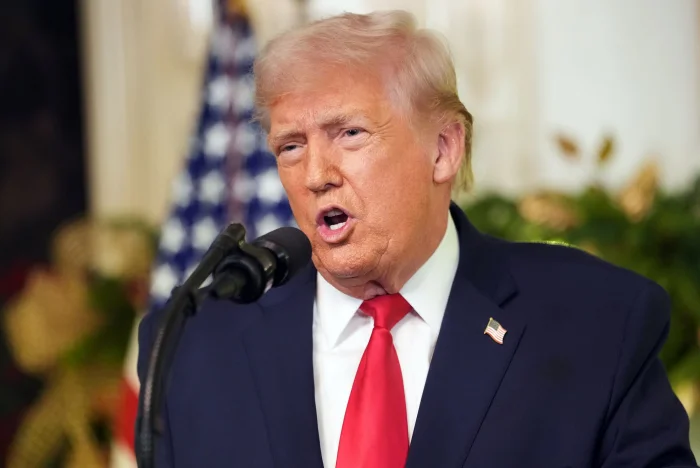
Dec. 19 (UPI) — President Donald Trump‘s name was affixed Friday to The Kennedy Center for the Performing Arts in Washington, D.C., with one Kennedy family member threatening to chisel the change out.
Signage now reads: Donald J. Trump and The John F. Kennedy Center for the Performing Arts.” Workers added Trump’s name before one honoring the former president.
The change has drawn opposition, including members of the Kennedy family.
“Three years and one month from today, I’m going to grab a pickax and pull those letters off that building, but I’m going to need help holding the ladder,” Kerry Kennedy, the daughter of former Attorney General Robert F. Kennedy, posted on X. “Are you in? Applying for my carpenter’s card today, so it’ll be a union job!!!”
On Thursday, Trump’s handpicked board of trustees voted to rename the building to also honor Trump. Eleven months ago, after he became president for the second time, he dismissed the entire board with new members and named himself chairman.
The name change requires a vote by U.S. Congress as mentioned in the U.S. Code that says no new “memorials or plaques in the nature of memorials shall be designated or installed in the public areas of the John F. Kennedy Center for the Performing Arts.”
Trump also changed something else that requires congressional approval: the Defense Department to the War Department.
White House press secretary Karline Leavitt posted on X, the it was changed “because of the unbelievable work President Trump has done over the last year in saving the building.
“Not only from the standpoint of its reconstruction, but also financially, and its reputation.”
Trump said he was “surprised and honored” by the news, though he hinted about the change while he emceed the Kennedy Center Honors earlier this month.
In August, he posted on Truth Social about new honorees: “GREAT Nominees for the TRUMP/KENNEDY CENTER, whoops, I mean, KENNEDY CENTER.”
Kerry Kennedy said Trump doesn’t represent the values of her uncle.
“President Kennedy proudly stood for justice, peace, equality, dignity, diversity, and compassion for those who suffer. President Trump stands in opposition to these values, and his name should not be placed alongside President Kennedy’s.”
Maria Shriver, the former President Kennedy’s niece and former first lady of California, wrote on X.: “It is beyond wild that he would think adding his name in front of President Kennedy’s name is acceptable. It is not. Next thing perhaps he will want to rename JFK Airport, rename the Lincoln Memorial, the Trump Lincoln Memorial. The Trump Jefferson Memorial. The Trump Smithsonian. The list goes on.”
Robert F. Kennedy’s grandson, former Rep. Joe Kennedy III of Massachusetts,posted on X that the center is “a living memorial to a fallen president and named for President Kennedy by federal law. It can no sooner be renamed than can someone rename the Lincoln Memorial, no matter what anyone says.”
Six Democratic lawmakers, who serve as ex-officio members of the Kennedy Center board, said in a statement to CNBC: “Beyond using the Kennedy Center to reward his friends and political allies, President Trump is now attempting to affix his name to yet another public institution without legal authority. Federal law established the Center as a memorial to President Kennedy and prohibits changing its name without Congressional action.”
Congress’ two Democratic leaders, Sen. Chuck Schumer and Rep. Hakeem Jeffries, signed the statement.
Another ex-officio member of the board, a Republican, didn’t vote for the change. Sen. Shelly Moore Capito, R-W.V., told reporters at the Capitol on Thursday: “The Kennedy Center, in my view, is the Kennedy Center.”
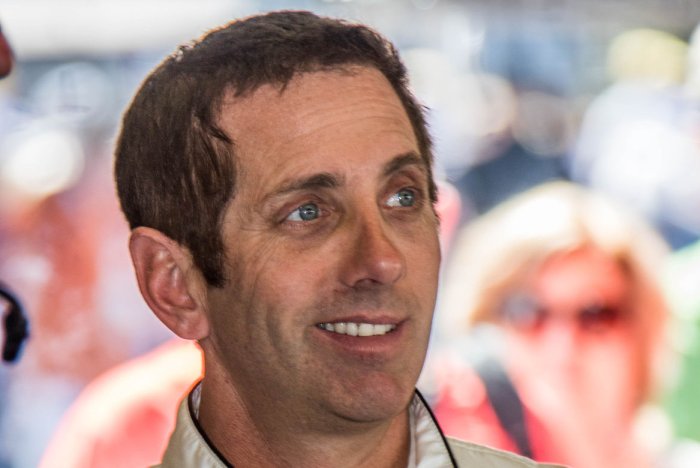
Greg Biffle
Former NASCAR driver Greg Biffle waits for a chance to return to practice at Daytona International Speedway in Daytona, Fla., on February 20, 2016. Biffle, his wife and two children were among six people killed in a small plane crash on December 18. Biffle was 55. Photo by Edwin Locke/UPI | License Photo
The recent decision by the United States Navy (USN) to cancel the Constellation-class frigate program after eight years of development and billions of dollars in investment represents a significant setback in US naval modernization drive. The Constellation-class was meant to become a modern, multi-mission combat vessel capable of relieving operational pressure from Arleigh Burke-class destroyers and narrowing the growing numerical advantage of the China’s People’s Liberation Army Navy (PLAN). Instead, continuous design changes, and subsequent delays changed what was supposed to be an easy-to-construct warship platform into a costly and significantly delayed project. After failure of several major projects like Zumwalt destroyer and Littoral Combat Ships (LCS), the cancellation of the Constellation-class frigate project has degraded Washington’s efforts to sustain the naval balance of power against rapidly expanding naval fleet of PLAN.
The Constellation-class project was a product of USN’s urgent need to fill the gap left behind Oliver Hazard Perry-class (OHP) frigates which were phased out from USN services in 2015. The OHPs, despite lack of built-in vertical launch system (VLS), were regarded for their reliability, and versatility in missions ranging from open-ocean escorting to anti-submarine warfare (ASW) and anti-surface warfare (ASuW). The retired hulls of OHPs were purchased by navies of several US allies including Australia, Bahrain, Chile, Egypt, Pakistan, Spain, Taiwan, and Turkiye. Their withdrawal from USN created a capability void that the Littoral LCS program – comprising of Freedom class and Independent class vessels – was expected to fill. However the LCS encountered numerous mechanical failures in hulls and propulsion system, cost overruns, and capability gaps that rendered it unsuitable for missions in contested naval environments.
As USN halted further procurement and early retirement of LCS, it attempted to follow a new approach, i.e., opt for a proven design tailored to meet USN requirements. Franco-Italian FREMM frigate design was chosen as the baseline for a modern, affordable American Constellation-class frigate. At initial stage, it appeared a sound idea. The FREMM platform had already proven itself in European naval forces, and the USN specific variant was modified to carry 32 Mk-41 VLS cells capable of firing SM-series interceptors and even Tomahawk cruise missiles, alongside Naval Strike Missiles. This program committed to be a potent yet affordable and rapid addition in USN fleet while retaining 85 percent commonality with original design. But as USN continued to impose new requirements, complications in construction, and alteration in designing began to inhibit the efficiency of the program. Constellation-class frigate undertook major size increment than parent FREMM design, stretching from 466 feet to nearly 500 and increasing to over 7,200 tons. Instead of leveraging a proven design, USN trapped itself with a pseudo-original design which now shared mere 15 percent commonality with the original design. By 2024, the first frigate was already three years behind schedule, and the program’s cost enlarged well beyond initial estimations. Faced with increasing costs, long delays, and design complications, the USN eventually axed the Constellation-class frigate program too, leaving behind a significant gap in USN surface fleet which this frigate was supposed to fill.
USN now wants a new frigate class structured on proven American design by 2028. Reportedly, the design of US Coast Guard (USCG) Legend Class cutter will be used as baseline to develop a USN specific variant. These 4,600 tons class ships are capable of conducting blue water operations and support 57mm deck gun, Phalanx CIWS, and flight deck with hanger to support rotary wing operations. Its USN specific frigate version can accommodate a 16-cell Mk-41 VLS module, 8x Harpoon/NSM cruise missiles in canisters, RIM-116 Sea RAM, and torpedo tubes. Using an American proven design for mass producing USN specific frigate of relatively smaller size and low tonnage will allow USN to produce and commission larger number of hulls in relatively less time. But on flip side, this new frigate class will be far less capable than recently cancelled Constellation-class as they are unlikely to carry Aegis CMS, and will have significantly less range, endurance, and weapon load-out.
Nowhere is this challenge more evident than in the rapid growth of China’s naval power. PLAN is now commissioning highly capable naval combatants including flat-deck aircraft carrier (Fujian), next generation destroyers (Type-055 and Type-52DL) and frigates (Type-54B), and new class of conventional as well as nuclear submarines. Chinese coast guard, and maritime militia collectively operate more than 750 vessels – more than twice the number of hulls under US control. While the US Navy still retains qualitative advantages, especially in nuclear submarines and carrier aviation, trends in shipbuilding capacity significantly favor Beijing. China commands more than half of global commercial ship production, while the US share barely registers at a tenth of a percent. This allows China to mass produce modern warships for PLAN at a pace the United States cannot simply match.
Although USN plans to expand its fleet from 296 manned warships to 381 manned warships and 134 unmanned vessels by 2045, but so far trends of decline hull strengths have been observed. Ticonderoga class cruisers are gradually retiring, next-generation DDG(X) destroyers are still in far future, Ford class nuclear aircraft-carriers and Columbia-class ballistic missile submarines (SSBNs) are facing delays, and Arleigh Burke Flight-III destroyers are not producing at rate faster enough to accommodate these growing gaps. Unmanned vessels are sometimes perceived as a viable solution to fill-up the gaps but these vessels cannot replace manned warships on one-on-one basis. In sum, aforementioned projects expose the persistent limitations of ship production capacity of US shipyards. The Congressional Budget Office estimates that reviving the shipbuilding sector to meet the USN long-term needs would require annual investments of more than $40 billion for three consecutive decades—a staggering commitment that would require political consensus and sustained strategic vision.
The cancellation of the Constellation-class frigate, just like past projects of Zumwalt and LCS- thus represents a persistent crisis in US naval build-up. As China accelerates its naval production and expands power projection into the Indo-Pacific, the United States finds itself struggling to revive its own shipbuilding capacity. Whether Washington can reverse this trajectory will depend on its ability to reform procurement processes, invest in industrial capacity, and adopt realistic designs aligned with strategic needs. Without such changes USN risks entering the next decade with too few ships to meet global demands.
Dec. 19 (UPI) — A federal judge has stopped the Trump administration from changing the conditions for allocating $3.9 billion in federal funds to homeless support programs.
U.S. District Court of Rhode Island Judge Mary McElroy issued a preliminary injunction on Friday that stops officials with the Housing and Urban Development Department from significantly changing how the funding approved by Congress would be spent, NPR reported.
“Continuity of housing and stability for vulnerable populations is clearly in the public interest,” McElroy said while ordering HUD to abide by the prior funding requirements.
The ruling applies to HUD’s Continuum of Care program that provides funding for local non-profits and other organizations that help people who are homeless to learn about and access housing resources, according to Politico.
A group of 20 states, 11 local units and several nonprofits sued HUD after its leadership in November revoked prior funding notices and changed how the funds would be distributed.
The changes greatly reduce federal grants to permanent housing, which McElroy said likely go against the requirements set forth in the McKinney-Vento Homeless Assistance Act, which mostly applies to educational opportunities for children.
HUD officials said the new policies are intended to “restore accountability” and support “self-sufficiency” by focusing on the causes of homelessness, including “illicit drugs and mental illness.”
HUD officials also said they increased the total amount available from $3.6 billion to $3/9 billion.
Opponents to the changes argue that they put 170,000 people at risk of losing their homes and the relatively sudden change in funding requirements makes it very hard for impacted programs to file new funding applications.
Complicating the matter is the 43-day federal government shutdown that started on Oct. 1 and ended on Nov. 12.
McElroy, who was appointed to the bench by President Donald Trump in 2019, said the plaintiffs are likely to win their case when she issued the preliminary injunction.
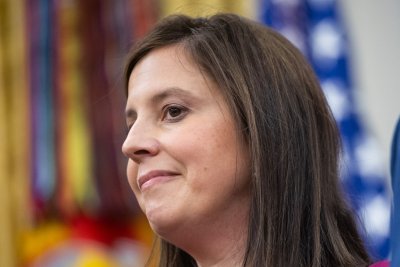
Dec. 19 (UPI) — enRepublican U.S. House Rep. Elise Stefanik on Friday announced she was ending her run for New York governor after 1 1/2 months and won’t seek another term in Congress.
On Nov. 7,On Nov. 7,Stefanik launched a campaign bid in an effort to challenge Democratic Gov. Kathy Hochul in November 2026.
“While spending precious time with my family this Christmas season, I have made the decision to suspend my campaign for Governor and will not seek re-election to Congress,” Stefanik, 41, wrote on X. “I did not come to this decision lightly for our family.
“I am truly humbled and grateful for the historic and overwhelming support from Republicans, Conservatives, Independents, and Democrats all across the state for our campaign to Save New York.”
Stefanik is married to Matthew Manda, who works in marketing and communication, and they have a 4-year-old son.
“And while many know me as Congresswoman, my most important title is Mom,” she wrote. “I believe that being a parent is life’s greatest gift and greatest responsibility. I have thought deeply about this and I know that as a mother, I will feel profound regret if I don’t further focus on my young son’s safety, growth, and happiness – particularly at his tender age.”
Her main primary opposition was Nassau County Executive Bruce Blakeman, who announced his run 10 days ago.
“However, as we have seen in past elections, while we would have overwhelmingly won this primary, it is not an effective use of our time or your generous resources to spend the first half of next year in an unnecessary and protracted Republican primary, especially in a challenging state like New York,” Stefanik wrote.
The last Republican governor in New York was George Pataki, who served three terms from 1995 to 2006.
The last time a Republican presidential candidate won New York was in 1984, when incumbent Ronald Reagan defeated Democrat Walter Mondale.
Former Vice President Kamala Harris won the state by 13 points, down from former President Joe Biden‘s 23-point victory in 2000.
“Elise Stefanik has finally acknowledged reality: If you run against Governor Kathy Hochul, you are going to lose,” Hochul spokesperson Ryan Radulovacki told Politico. “As Donald Trump raises costs on New Yorkers and targets this state relentlessly, Governor Hochul has cut middle-class taxes, put money back in New Yorkers’ pockets, and fought this administration and won when New York has come under attack.”
Stefanik has represented the rural conservative upstate New York district since 2014, becoming the youngest woman ever elected to Congress at that time.
The 21st Congressional District covers the northernmost part of the state, bordering Canada to the north and Vermont to the east. Major cities include Plattsburgh, Watertown, Glens Falls, Ogdensburg and Rome.
In November 2024, she was overwhelmingly re-elected by 24 percentage points as Trump carried the conservative region by more than 20 points.
When President Trump was elected president last November, he nominated her to serve as U.S. ambassador to the United Nations. But the nomination was pulled because of the narrow Republican edge in the House, with Trump saying it was “essential that we maintain EVERY Republican seat in Congress.”
Hochul would have called for a special election.
Republicans now have a 220-213 advantage with two vacancies in seats by Democrats who have died.
Stefanik rose in House leadership, serving as the fourth-ranking House Republican, a position she first attained in May 2021 by replacing Liz Cheney. She was succeeded in this specific role by Lisa McClain for the 119th Congress.
After her nomination was pulled, Speaker Mike Johnson named her chairwoman of House Republican Leadership.
She originally was a critic of Trump but became one of his most vocal allies.
Stefanik fell a little out of favor with the president after she called New York City Mayor-elect Zohran Mamdani a “jihadist.”
During a meeting with Mamdan in the White House, the president reduced to label the Democratic socialist that description. He is a Muslim and South Asian.
Trump hadn’t endorsed either candidate, including when Stefanik was in the White House’s Oval Office when he signed legislation awarding the 1980 U.S. Olympic ice hockey team the Congressional Gold Medal. The teams won the gold medal in Lake Place, which includes Stefdanik’s district.
Ed Cox, chairman of the New York Republican Party, endorsed Blackman after Stefanik’s decision. In a statement, he also said Stefanik would “remain a leader in our party and a powerful voice for our principles. We respect her decision and thank her for her efforts.”
White House press secretary Karoline Leavitt served as Stefanik’s communications director from 2020-23.
“Elise Stefanik has been an incredible advocate for the people of her district in Upstate New York, and she will always be a true friend to President Trump,” she posted on X. “On a personal note, Elise is my former boss. She is a great leader, and an even better person. We love you, posted.
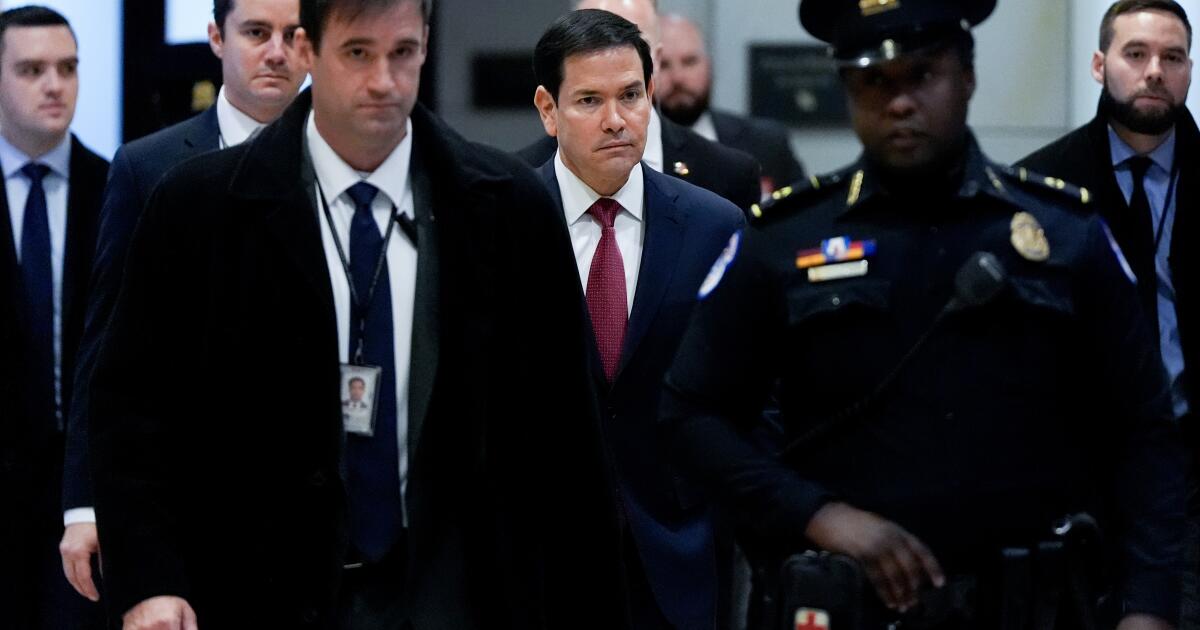
Dec. 19 (UPI) — U.S. Secretary of State Marco Rubio said Friday that U.S. negotiators have made “progress” attempting to end the war between Russia and Ukraine, but ultimately “it’s not our war.”
The Russian invasion of Ukraine was one of several global issues Rubio addressed during his 2-hour year-end news conference with reporters. He said despite the progress in negotiations, “we have a ways to go” to end the nearly four-year war in eastern Europe.
“And obviously, the hardest issues are always the last issues,” he said during the briefing.
“Maybe that happens this week, maybe that happens next month, maybe that’s not ready for a few months,” Rubio said of a deal.
His comments came ahead of a weekend meeting in Miami between U.S. and Russian negotiators. He said that while the United States is trying to work on a deal that would make both parties happy, he’s not willing to force a plan.
“It’s not our war. It’s a war on another continent.
“We can’t force Ukraine to make a deal. We can’t force Russia to make a deal. They have to want to make a deal.”
White House officials said they were optimistic this weekend’s meeting would result in an agreement. Previous talks resulted in about “90%” consensus on terms, the officials told The Hill.
Those terms included a multi-national force deployed to Ukraine to respond to acts of aggression against the country in the future. Earlier this week, European leaders pledged to provide military support to Ukraine in protection against Russia, however Ukrainian President Volodymyr Zelensky conceded over the weekend his country may have to give up its dream of joining NATO to end the war.
As peace talks have gone on, U.S. negotiators have put pressure on Ukraine to make more concessions to Russia, which has remained staunch in its demands, which including giving up land. Politico reported that the Trump administration believes Russia will accept EU membership for Ukraine as well as offers of mutual defense from the United States and European countries.
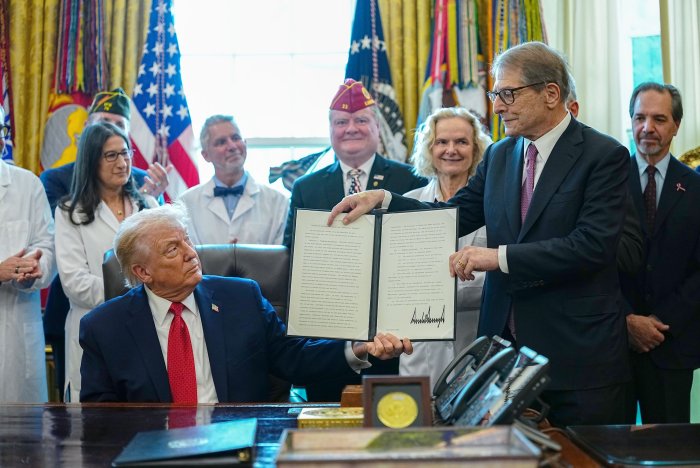
President Donald Trump holds a signed executive order reclassifying marijuana from a schedule I to a schedule III controlled substance in the Oval Office of the White House on Thursday. Photo by Aaron Schwartz/UPI | License Photo
WASHINGTON — Secretary of State Marco Rubio weighed in on Russia-Ukraine and Israel-Hamas peace efforts and defended the Trump administration’s increasing military pressure on Venezuela during a rare, end-of-year news conference Friday.
In a freewheeling meeting with reporters running more than two hours, Rubio also defended President Trump’s radical overhaul in foreign assistance and detailed the administration’s work to reach a humanitarian ceasefire in Sudan in time for the new year.
Rubio’s appearance in the State Department briefing room comes as key meetings on Gaza and Russia-Ukraine are set to be held in Miami on Friday and Saturday after a tumultuous year in U.S. foreign policy. Rubio has assumed the additional role of national security advisor and emerged as a staunch defender of Trump’s “America First” priorities on issues ranging from visa restrictions to a shakeup of the State Department bureaucracy.
The news conference is taking place just hours before Trump’s special envoy Steve Witkoff meets with senior officials from Egypt, Turkey and Qatar to discuss the next phase of the Republican president’s Gaza ceasefire plan, progress on which has moved slowly since it was announced in October.
Witkoff and other U.S. officials, including Trump son-in-law and informal advisor Jared Kushner, have been pushing to get the Gaza plan implemented by setting up a “Board of Peace” that will oversee the territory after two years of war and create an international stabilization force that would police the area.
On Saturday, Witkoff, Kushner and Rubio, who will be at his home in Florida for the holidays, are to meet with Russian President Vladimir Putin’s adviser Kirill Dmitriev in Miami to go over the latest iteration of a U.S.-proposed plan to end the Russia-Ukraine war.
Rubio said there would be no peace deal unless both Ukraine and Russia can agree to the terms, making it impossible for the U.S. to force a deal on anyone. Instead, the U.S. is trying to “figure out if we can nudge both sides to a common place.”
“We understand that you’re not going to have a deal unless both sides have to give, and both sides have to get,” Rubio said. “Both sides will have to make concessions if you’re going to have a deal. You may not have a deal. We may not have a deal. It’s unfortunate.”
The U.S. proposal has been through numerous versions with Trump seesawing back and forth between offering support and encouragement for Ukraine and then seemingly sympathizing with Putin’s hard-line stances by pushing Ukrainian President Volodymyr Zelensky to agree to territorial concessions. Kyiv has rejected that concession in return for security guarantees intended to protect Ukraine from future Russian incursions.
On Venezuela, Rubio has been a leading proponent of military operations against suspected drug-running vessels that have been targeted by the Pentagon in the Caribbean Sea and the eastern Pacific Ocean since early September. The Trump administration’s actions have ramped up pressure on leftist Venezuelan President Nicolás Maduro, who has been charged with narco-terrorism in the U.S.
In an interview with NBC News on Friday, Trump would not rule out a war with Venezuela. But Rubio and Defense Secretary Pete Hegseth have publicly maintained that the current operations are directed at “narco-terrorists” trying to smuggle deadly drugs into the United States. Maduro has insisted the real purpose of the U.S. military operations is to force him from office.
Rubio sidestepped a direct question about whether the U.S. wants “regime change in 2026” in the South American country.
“We have a regime that’s illegitimate, that cooperates with Iran, that cooperates with Hezbollah, that cooperates with narco-trafficking and narco-terrorist organizations,” Rubio said, “including not just protecting their shipments and allowing them to operate with impunity, but also allows some of them to control territory.”
Rubio defended Trump’s prerogatives on Venezuela and said the administration believes “nothing has happened that requires us to notify Congress or get congressional approval or cross the threshold into war.” He added, “We have very strong legal opinions.”
Trump has spoken of wanting to be remembered as a “peacemaker,” but ceasefires his administration helped craft are already in trouble due to renewed military action between Cambodia and Thailand in Asia and Rwanda and the Democratic Republic of the Congo in Africa. Rubio, however, said those deals helped create a list of commitments that can now be used to bring both sides back to peace.
“Those commitments today are not being kept,” Rubio said of the Thailand-Cambodia conflict, which now threatens to reignite following Thai airstrikes. ”The work now is to bring them back to the table.”
Rubio’s news conference comes just two days after the Trump administration announced a massive $11-billion package of arms sales to Taiwan, a move that infuriated Beijing, which has vowed to retake the island by force if necessary.
Trump has veered between conciliatory and aggressive messages to China since returning to the Oval Office in January, hitting Chinese imports with major tariffs but at the same time offering to ease commercial pressure on Beijing in conversations with China’s President Xi Jinping. The Trump administration, though, has consistently decried China’s increasingly aggressive posture toward Taiwan and its smaller neighbors in disputes over the South China Sea.
Since taking over the State Department, Rubio has moved swiftly to implement Trump’s “America First” agenda, helping dismantle the U.S. Agency for International Development and reducing the size of the diplomatic corps through a significant reorganization. Previous administrations have distributed billions of dollars in foreign assistance over the last five decades through USAID.
Critics have said the decision to eliminate USAID and slash foreign aid spending has cost lives overseas, although Rubio and others have denied this, pointing to ongoing disaster relief operations in the Philippines, the Caribbean and elsewhere, along with new global health compacts being signed with countries that previously had programs run by USAID.
“We have a limited amount of money that can be dedicated to foreign aid and humanitarian assistance,” Rubio said. “And that has to be applied in a way that furthers our national interest.”
Lee and Klepper write for the Associated Press. AP writer Bill Barrow contributed to this report.
Dec. 19 (UPI) — Wisconsin’s Republican leaders will begin impeachment proceedings against Milwaukee County Circuit Judge Hannah Dugan if she does not resign after her felony obstruction conviction.
State Assembly Speaker Robin Vos and Assembly Majority Leader Tyler August, both of whom are Republicans, issued the ultimatum in a joint statement, the Milwaukee Journal Sentinel reported on Friday.
“Judge Hannah Dugan, while wearing judicial robes of the state of Wisconsin, attempted to impede the lawful work of federal Immigration and Customs Enforcement (ICE) agents,” Vos and August said.
“The last time a Wisconsin judge was impeached was in 1853,” they said. “If Judge Dugan does not resign from her office immediately, the Assembly will begin impeachment proceedings.”
A jury of 12 on Thursday found Dugan guilty of obstructing federal agents as they attempted to arrest a man who was scheduled to appear on an unrelated matter in her courtroom in April.
The jury found her guilty of one count of obstruction, which is a felony punishable by up to five years in prison and a $250,000 fine. The jury acquitted her on one count of concealment.
Dugan’s legal team said they will appeal her felony conviction.
Vos cited the Wisconsin Constitution’s Article XII, Section 3(2), which says no individual who has been convicted of a felony is eligible to serve in “any office of trust” in the state, unless that person is pardoned according to WISN.
Federal prosecutors tried Dugan in the U.S. District Court for Eastern Wisconsin in Milwaukee after she interfered with ICE agents’ efforts to arrest Eduardo Flores-Ruiz for illegally being in the United States on April 18.
Court records show Dugan engaged the ICE agents in the court’s hallway after she helped Flores-Ruiz and his attorney use an entrance for jurors to exit the courthouse.
ICE agents arrested Flores-Ruiz after chasing him on foot.
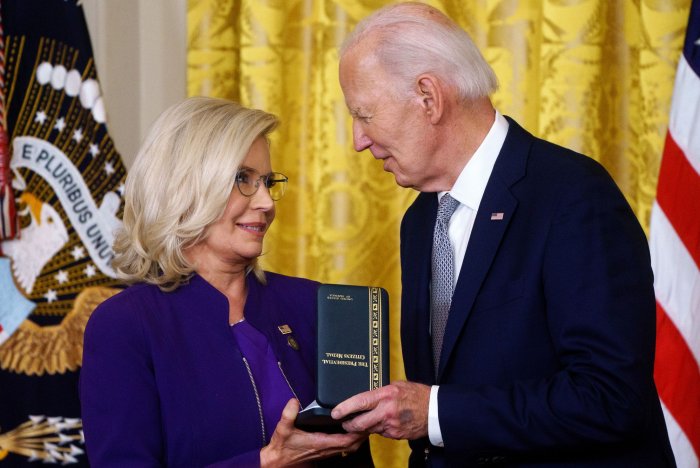
Former President Joe Biden presents the Presidential Citizens Medal to Liz Cheney during a ceremony in the East Room of the White House in Washington, on January 2, 2025. The Presidential Citizens Medal is bestowed to individuals who have performed exemplary deeds or services. Photo by Will Oliver/UPI | License Photo
French President Emmanuel Macron indicated that Europe may need to directly engage with Russian President Vladimir Putin if U.S.-led efforts toward a Ukraine peace deal fail. European leaders have been dissatisfied with their exclusion from peace talks led by the Trump administration and have been focused on supporting Ukraine’s negotiating position from afar. During remarks in Brussels, Macron emphasized the necessity for a solid peace agreement with security guarantees, suggesting that without this, Europe should prepare to re-establish direct dialogue with Russia. This comes after EU leaders decided to provide Ukraine with a 90 billion euro loan, utilizing the EU’s budget rather than frozen Russian assets, amid internal divisions.
Macron argued that the EU cannot afford to lose its communication channels with Moscow, particularly as U.S. officials prepare for talks with Russian negotiators. Most EU nations, except Hungary and Slovakia, have halted communication with Putin since the invasion of Ukraine. Macron highlighted the need for a strategic approach to facilitate renewed discussions with Russia, warning that continued inaction might leave EU leaders isolated and marginalized in negotiations.
Moreover, some EU leaders expressed concerns about diminishing public support for sustaining Ukrainian resistance to the ongoing war. The summit’s outcome aims to support Ukraine financially, reflecting a recognition of the war’s broader implications for European security, despite worries about increasing political pressure and potential public fatigue regarding the conflict. Danish Prime Minister Frederiksen noted that Putin is likely counting on a combination of war fatigue and societal uncertainty to undermine European resolve.
WASHINGTON — President Trump suspended the green card lottery program on Thursday that allowed the suspect in the Brown University and MIT shootings to come to the United States.
Homeland Security Secretary Kristi Noem said in a post on the social platform X that, at Trump’s direction, she is ordering the United States Citizenship and Immigration Services to pause the program.
“This heinous individual should never have been allowed in our country,” she said of the suspect, Portuguese national Claudio Neves Valente.
Neves Valente, 48, is suspected in the shootings at Brown University that killed two students and wounded nine others, and the killing of an MIT professor. He was found dead Thursday evening from a self-inflicted gunshot wound, officials said.
Neves Valente had studied at Brown on a student visa beginning in 2000, according to an affidavit from a Providence police detective. In 2017, he was issued a diversity immigrant visa and months later obtained legal permanent residence status, according to the affidavit. It was not immediately clear where he was between taking a leave of absence from the school in 2001 and getting the visa in 2017.
The diversity visa program makes up to 50,000 green cards available each year by lottery to people from countries that are little represented in the U.S., many of them in Africa. The lottery was created by Congress, and the move is almost certain to invite legal challenges.
Nearly 20 million people applied for the 2025 visa lottery, with more than 131,000 selected when including spouses with the winners. After winning, they must undergo vetting to win admission to the United States. Portuguese citizens won only 38 slots.
Lottery winners are invited to apply for a green card. They are interviewed at consulates and subject to the same requirements and vetting as other green-card applicants.
Trump has long opposed the diversity visa lottery. Noem’s announcement is the latest example of using tragedy to advance immigration policy goals. After an Afghan man was identified as the gunman in a fatal attack on National Guard members in November, Trump’s administration imposed sweeping rules against immigration from Afghanistan and other counties.
While pursuing mass deportation, Trump has sought to limit or eliminate avenues to legal immigration. He has not been deterred if they are enshrined in law, like the diversity visa lottery, or the Constitution, as with a right to citizenship for anyone born on U.S. soil. The Supreme Court recently agreed to hear his challenge to birthright citizenship.
BUCHAREST, Romania — American rapper Wiz Khalifa was sentenced by a court in Romania on Thursday to nine months in jail for drug possession, more than a year after he took part in a music festival in the Eastern European country.
Khalifa was stopped by Romanian police in July 2024 after allegedly smoking cannabis on stage at the Beach, Please! Festival in Costinesti, a coastal resort in Constanta County. Prosecutors said the rapper, whose real name is Cameron Jibril Thomaz, was found in possession of more than 18 grams of cannabis, and that he consumed some on stage.
The Constanta Court of Appeal handed down the sentence after Khalifa was convicted of “possession of dangerous drugs, without right, for personal consumption,” according to Romania’s national news agency, Agerpres. The decision is final.
The decision came after a lower court in Constanta County in April issued Khalifa a criminal fine of 3,600 lei ($830) for “illegal possession of dangerous drugs,” but prosecutors appealed the court’s decision and sought a higher sentence.
Romania has some of the harsher drugs laws in Europe. Possession of cannabis for personal use is criminalized and can result in a prison sentence of between three months and two years, or a fine.
It isn’t clear whether Romanian authorities will seek to file an extradition request, since Khalifa is a U.S. citizen and doesn’t reside in Romania.
The 38-year-old Pittsburgh rapper rose to prominence with his breakout mixtape “Kush + Orange Juice.” On stage in Romania last summer, the popular rapper smoked a large, hand-rolled cigarette while singing his hit “Young, Wild & Free.”
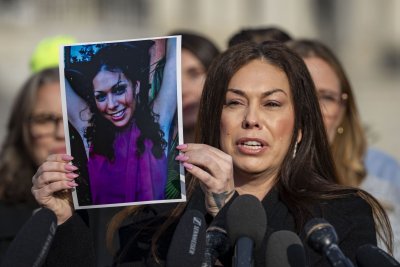
Convicted sex offender Jeffrey Epstein victim Haley Robson speaks during a press conference with other victims on the Epstein Files Transparency Act outside the U.S. Capitol in Washington, DC, in November. The House Oversight Committee is investigating as many as 95,000 photos of Epstein with high profile politicians and power brokers. File Photo by Bonnie Cash/UPI | License Photo
Dec. 18 (UPI) — Congressional Democrats released 68 photos from the Jeffrey Epstein estate on Thursday, bringing the total number to more than 95,000 that have been turned over to the House Oversight Committee investigating names on a list of prominent people who were associated with the now deceased sex offender.
Epstein, the former financier and friend of the ultra-wealthy and politically powerful, was convicted of sexual behavior with minor girls. He later died by suicide in a Manhattan prison while awaiting trial.
While not dyeing their association with the convicted sex offender, all have denied wrongdoing. None have been charged.
The latest trove of photographs was released prior to a Friday deadline, when the Justice Department will be required to release all of the government’s Epstein files with a few exceptions.
Rep. Robert Garcia, D-Calif., said the committee is reviewing materials from the Epstein estate and working with victims shown in the photographs who are not identified or threatened.
“Certainly the most disturbing photos are certainly the ones that are more sexual in nature,” Garcia said during a Thursday briefing on the Capitol steps. “We’re having a conversation about the best way to deal with those and talking to the lawyers and the survivor groups, because we want to be very cautious of the trauma that the survivors are going through.”
The new law says the photos must be published online and in a publicly searchable database.
The White House has accused Garcia and other Democrats of releasing “cherry-picked photos with random reactions to try to create a false narrative” with the intention of putting Trump in a negative light.
Dec. 19 (UPI) — A 12-person jury has found Milwaukee County Judge Hannah Dugan guilty of obstructing federal agents attempting an immigration arrest near her courtroom in April.
The jury deliberated for more than six hours before delivering its guilty verdict on one count of obstruction, but acquitted her on a second count of concealment.
She could face up to five years’ imprisonment and a $250,000 fine when sentenced. A sentencing date has not been set.
The ruling is a victory for President Donald Trump and his administration, who have portrayed Dugan as an example of judges interfering with their immigration enforcement policies.
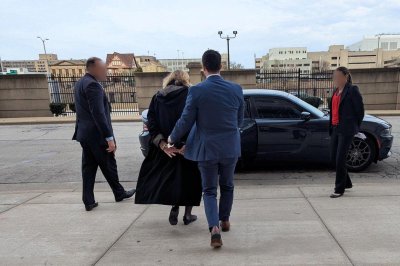
Dugan was arrested by FBI agents in late April and charged with knowingly concealing a person whose arrest warrant had been issued in order to prevent their apprehension, and corruptly endeavoring to influence, obstruct and impede the administration of law enforcement.
Federal prosecutors said she misdirected federal agents on April 18 to allow undocumented migrant Eduardo Flores-Ruiz to evade arrest.
Court documents state that she confronted federal agents in the court’s hallway after escorting Flores-Ruiz and his counsel out of her courtroom.
Flores-Ruiz was arrested by immigration enforcement agents following a foot chase.
The arrest came amid the early stages of Trump’s immigration crackdown, part of which was the rescinding of a Biden administration policy prohibiting immigration enforcement action in or near courthouses.
Critics and justice advocates — including nearly 150 former state and federal judges — rebuked the arrest as an effort to intimidate the judiciary, warning it threatened judicial independence and the Constitution.
Interim U.S. Attorney Brad Schimel for the Eastern District of Wisconsin told reporters following the jury verdict that while some have sought to make the case about a larger political battle, “it’s ultimately about a single day — a single bad day in a public courthouse.”
“The defendant is certainly not evil, nor is she a martyr for some great cause. It was a criminal case, like many that make their way through this courthouse every day,” he said.
“And we all must accept the verdict.”
Steven Biskupic, Dugan’s lead attorney, told reporters the defense was “obviously disappointed” with the verdict and that it does not make sense for his client to be found guilty on one count and acquitted on the other since they are based on the same elements.
“I would just say the case is a long way from over,” he said.
Norm Eisen, executive chair of the nonpartisan Democracy Defenders Fund, issued the same sentiment in a statement emailed to UPI.
“This case is far from over. Substantial legal and constitutional issues remain unresolved, and they are exactly the kinds of questions appellate courts are meant to address,” Eisen said.
“Higher courts will have the opportunity to determine whether this prosecution crossed the lines that protect the judiciary from executive overreach.”
Republicans and members of Trump’s administraiton swiftly celebrated the ruling, with Deputy Attorney General Todd Blanche remarking that “nobody is above the law” and Rep. Tom Tiffany of Wisconsin stating, “Now, lock her up.”
Weekly insights and analysis on the latest developments in military technology, strategy, and foreign policy.
As military and economic pressure builds on Venezuelan dictator Nicholas Maduro,an E-3 Sentry Airborne Warning and Control System (AWACS) aircraft was tracked on FlightRadar24 flying close to the Venezuelan coast. To our knowledge, at least in recent days, these aircraft have not been present on flight tracking software in this increasingly high-activity area. And if they have popped-up, their presence has been impersistent at best. At the same time, E-3s are no stranger to this region though and have played a role in drug interdiction operations for years in this exact area.
🇺🇸🇻🇪⚡️- A U.S. Air force E-3C Sentry, airborne early warning and control aircraft, is currently loitering off the coast of Venezuela. pic.twitter.com/oujrc0CpxA
While E-3s may have been present but not trackable over the Caribbean in recent days, this one being trackable is not a mistake. U.S. military aircraft executing easily trackable sorties very near Venezuelan airspace has been a key component of the pressure campaign placed on Maduro.
The reappearance of the E-3s is a relatively important development, as they would be key to any major kinetic operation against Venezuela. While the carrier-based E-2D Hawkeye, which have been a staple of operations in the area for weeks, is extremely capable, and in some ways more so than the E-3, they are not as well suited for providing airborne early warning, data-sharing and command and control functions for a large and diverse force beyond the carrier air wing. The E-3 also has a higher perch for its radar and passive sensors to take advantage of. It can also better integrate with USAF forces.
Meanwhile, other U.S. combat aircraft made their closest and most sustained publicly-known presence near the northern Venezuelan coast on Thursday. It’s worth mentioning that we do not know how close aircraft with transponders turned off have been getting, as we can only see the flights that are publicly trackable. These missions are part of Operation Southern Spear, a counter-narcotics mission that morphed into one aimed at Maduro and Venezuelan oil, the country’s main source of income.
Amid all this aerial activity, President Donald Trump today said he was open to notifying Congress before a direct attack on Venezuela. His comments to reporters at the White House today came a day after the House of Representatives shot down measures requiring the president to obtain prior permission for such an action.
“I wouldn’t mind telling them,” Trump said when asked if he would seek permission from lawmakers for land and boat attacks against Venezuela. He added that prior notification is not required.
“I don’t have to tell them,” he posited. “It’s been proven, but I wouldn’t mind at all. I just hope they wouldn’t leak it. You know, people leak it. They are politicians, and they leak like a sieve, but I have no problem.”
BREAKING: Reporter: Will you be seeking any authorization from Congress for any land attacks on cartels in Venezuela?
Trump: I don’t have to tell them, but I would not mind it at all. I just hope they would not leak it. They are politicians, and they leak like a sieve. pic.twitter.com/UpFHPtt2vX
Trump’s views on Congressional authority have generated debate on Capitol Hill that broke down almost completely along party lines, with nearly all Republicans in agreement and Democrats opposed.
Under the 1973 War Powers Resolution, the Commander-In-Chief must notify Congress within 48 hours after“introducing United States Armed Forces into hostilities or into situations where imminent involvement is clearly indicated by the circumstances.” The Resolution also says any such actions are limited to 60 days without subsequent Congressional authorization, though the President can extend that timeline by 30 days with a written certification of the need for the continued use of force.
Donald Trump does NOT have the authority to carry out his current plans to use military force in the Caribbean without authorization from Congress.
If he acts without congressional authorization, the Senate will move a bipartisan resolution to prevent the unauthorized use of…
Trump, who ordered a blockade against sanctioned ships carrying oil to and from Venezuela, continues to assert that the U.S. has a right to that oil. On, Wednesday, Trump doubled down on his blockade warning, telling reporters that the U.S. is “not gonna let anybody go through that shouldn’t go through.”
Trump on Venezuela:
It’s a blockade, not gonna let anybody going through that shouldn’t be going through…
The blockade announcement sparked a separate debate in Congress and elsewhere about its legality.
“American presidents have broad discretion to deploy U.S. forces abroad, but Trump’s asserted blockade marks a new test of presidential authority,” international law scholar Elena Chachko of U.C. Berkeley Law School told Reuters.
Meanwhile, Venezuela condemned the blockade and said it would take its case to the United Nations.
Venezuela has released a statement. Here is the English translation of both pages:
On the night of today, December 16, 2025, the President of the United States, Donald Trump, violating International Law, free trade, and freedom of navigation, has issued a reckless and serious… https://t.co/dS3e4Yib1Xpic.twitter.com/Irf9ECnaux
Despite Trump’s pronouncement, several ships carrying oil byproducts from the South American country sailed from Venezuela’s east coast under escort from that country’s Navy “between Tuesday evening and Wednesday morning,” The New York Times reported.
“The ships transporting urea, petroleum coke and other oil-based products from the Port of José were bound for Asian markets,” per that story, citing anonymous sources. “The Venezuelan government imposed the military escort in response to Mr. Trump’s threats.”
🇻🇪🇺🇸 Venezuela’s government has ordered its Navy to escort ships carrying petroleum products from port following Trump’s blockade announcement.
Several ships sailed from the country’s east coast with a naval escort between Tuesday evening and Wednesday morning, according to… pic.twitter.com/xY9huYtMqa
— Status-6 (Military & Conflict News) (@Archer83Able) December 17, 2025
The blockade announcement came after the U.S. government had already seized one sanctioned oil tanker, the M/T Skipper. That mission, which occurred on December 10, was led by the U.S. Coast Guard with elements of the U.S. military providing support.
Today, the Federal Bureau of Investigation, Homeland Security Investigations, and the United States Coast Guard, with support from the Department of War, executed a seizure warrant for a crude oil tanker used to transport sanctioned oil from Venezuela and Iran. For multiple… pic.twitter.com/dNr0oAGl5x
A U.S. Sailor directs an F/A-18F Super Hornet onto a catapult during flight operations aboard the world’s largest aircraft carrier, USS Gerald R. Ford (CVN 78), while underway in the Caribbean Sea in support of Operation Southern Spear (U.S. Navy photo) Petty Officer 3rd Class Gladjimi Balisage
The presence of aerial refueling tankers is also growing. KC-46 Pegasus tankers have been flying sorties out of the U.S. Virgin Islands for months, with a ramp-up in activity in recent weeks. There are now at least 10 KC-135 Stratotanker refuelers deployed to the Dominican Republic.
While these assets, along with about 15,000 deployed U.S. troops, are capable of limited sustained operations, it is far from the force that would be required for a land invasion or any large ground operation in Venezuela.
US Air Force KC-135 tankers forward deployed in the US Southern Command area of responsibility. USAF
Since September, U.S. military operations in the Caribbean Sea, as well as the Eastern Pacific, have already included nearly two dozen strikes on boats allegedly involved in drug smuggling. The first of these strikes, which came on September 2, has become the focus of particular controversy, including allegations that it may have constituted a war crime.
The Sept. 2 incidenthas spurred numerous Congressional briefings, but on Wednesday, the Chairman of the House Armed Services Committee, Mike Rogers, an Alabama Republican, said he was satisfied by testimony about that strike and that no further hearings would be held. It is unclear if there will be other Congressional action, though, since the Senate Armed Services Committee has also been investigating the matter.
The boat attacks continued on Wednesday, with another four suspected traffickers killed, bringing the total number of fatalities to about 100.
On Dec. 17, at the direction of @SecWar Pete Hegseth, Joint Task Force Southern Spear conducted a lethal kinetic strike on a vessel operated by a Designated Terrorist Organizations in international waters. Intelligence confirmed that the vessel was transiting along a known… pic.twitter.com/Yhu3LSOyea
Amid all this tension, Brazilian President Luiz Inacio Lula da Silva offered to serve as an intermediary between Trump and Maduro to “avoid armed conflict.”
Lula told reporters on Thursday that Brazil was “very worried” about the mounting crisis between Venezuela and the United States. He added that he told Trump that “things wouldn’t be resolved by shooting, that it was better to sit down around a table to find a solution.”
The Brazilian leader suggested that he may speak to Trump again before Christmas to reinforce this offer “so that we can have a diplomatic agreement and not a fratricidal war.”
“I am at the disposal of both Venezuela and the US to contribute to a peaceful solution on our continent.”
🇧🇷🇺🇸🇻🇪 | Lula da Silva: “Estoy pensando que, antes de Navidad, posiblemente tenga que conversar con el presidente Trump otra vez, para saber en que puede contribuir Brasil para que tengamos un acuerdo diplomático y no una guerra fraticida”
TikTok has finalized a deal with Oracle and two other investors that will allow the popular social video platform to continue its business in U.S.
The deal, expected to close on Jan. 22, will be 50% held by a new investor consortium that includes tech giant Oracle, Silver Lake and MGX, a technology fund in the United Arab Emirates (with each holding 15%). The rest of the group is made up of ByteDance owning 19.19% and affiliates of existing ByteDance investors holding 30.1%, TikTok said in a memo to employees.
“With these agreements in place, our focus must stay where it’s always been — firmly on delivering for our users, creators, businesses and the global TikTok community,” TikTok CEO Shou Zi Chew wrote in his memo.
The company’s future for many years in the U.S. had been uncertain, amid security concerns among legislators about ByteDance’s ties to China. TikTok’s parent company, ByteDance had been under pressure to divest its ownership in the app’s U.S. operations or face a nationwide ban, due to a law Congress passed that went into effect in January. President Trump has signed orders that have allowed TikTok to keep operating in the country and in September signed an executive order outlining the new joint venture.
The venture, which would oversee U.S. data protection, algorithm security, content moderation and software assurance, would be governed by a seven-member board that is majority American, Chew said in his memo. Oracle will be the security partner responsible for “auditing and validating compliance with the agreed upon National Security Terms,” Chew wrote.
Oracle Chief Executive Larry Ellison is also a party in effort to buy Warner Bros. Discovery.
Oracle did not return a request for comment. Silver Lake declined to comment. The White House on Thursday referred questions about the deal back to TikTok. In September, Trump said that Chinese President Xi Jinping had approved the deal.
“These safeguards would protect the American people from the misuse of their data and the influence of a foreign adversary, while also allowing the millions of American viewers, creators, and businesses that rely on the TikTok application to continue using it,” Trump stated in his executive order.
The announcement will come as a relief to some creators and businesses who rely on TikTok to entertain and reach fans and customers.
“I hope it just stays true to the platform and the independence we get from it,” said Yasmine Sahide, who posts comedy videos on TikTok and has 2.4 million followers. “I hope we’re still able to monetize our videos the same way because without that, I think a lot of people would leave or feel uninspired.”
Keith Lee, a TikTok creator who posts videos about food, said he expects the algorithm to change.”I just hope that we can still stay connected with our community and reach an audience the same way as before,” said Lee, who has 17.3 million followers.
Many TikTok creators are based in Southern California, close to TikTok’s office in Culver City. Over the years when TikTok’s future appeared uncertain, some of those creators diversified, posting their content to other platforms like YouTube and Instagram.
“It’s a smart way to avoid ownership and data issues,” said Ray Wang, principal analyst at Constellation Research, of the deal.
If finalized, the deal would remove a persistent issue in Beijing-Washington relations and signal progress in broader talks. But it would also deprive China’s most valuable private company of total control of an American social media phenomenon.
ByteDance’s coveted algorithms are considered central to TikTok’s business. Under the the deal proposed by Washington, ByteDance will license its AI recommendation technology to a newly created U.S. TikTok entity, which will use the existing algorithm to retrain a new system that is secured by Oracle, according to Bloomberg. The algorithm will be retrained on U.S. user data by the U.S. joint venture, according to TikTok.
Some industry observers questioned whether the deal addresses the larger concerns surrounding TikTok in the law Congress passed.
“While these executive orders positively have allowed the platform to operate and maintain the venue for speech, they do not resolve the underlying concerns about the law, which could be applied to other platforms in the future and raise questions about executive power,” said Cato Institute senior fellow in tech policy Jennifer Huddleston in a statement.
“Just because TikTok remains available under such orders does not mean that the policy concerns about the underlying law have been resolved.”
Dec. 18 (UPI) — The U.S. Department of Health and Human Services announced new regulations on Thursday that restrict the ability for transgender minors to access gender-affirming healthcare.
The regulations work to “carry out President Trump’s executive order directing HHS to end the practice of sex-rejecting procedures on children that expose young people to irreversible harm,” a press release said.
The new rules will ban hospitals from “performing sex-rejecting procedures on children under age 18 as a condition of participation in Medicare and Medicaid programs.”
“These actions will ensure that the federal government in no way funds directly gender transition procedures on minors and also does not fund facilities that perform these procedures,” a department official told reporters Thursday.
The department said what it calls “sex-rejecting procedures” on children, including puberty blockers, hormones and surgery, “expose them to irreversible damage, including infertility, impaired sexual function, diminished bone density, altered brain development, and other irreversible physiological effects.”
HHS Secretary Robert F. Kennedy Jr. and other department officials will offer details about the moves later Thursday.
Gender-affirming care is a holistic approach to treating gender-dysphoria and is supported by every major medical association as treatment for both adults and children.
It includes a range of therapies, from psychological and behavioral to medical interventions, with surgeries for minors being exceedingly rare.
The medical practice, however, has been a target for conservatives for years amid a larger campaign that civil rights organizations see as a threat to the rights of LGBTQ Americans.
St. Louis pediatrician Dr. Kenneth Haller called HHS’ actions “anti-science” during a Human Rights Campaign press briefing. He pointed out that these efforts still allow the treatments for children with other conditions that affect hormone production.
Haller said that as long as the condition doesn’t change a child’s gender, “these people don’t have a problem with [prescribing hormones]. That same care for kids who are transgender is what they say is wrong. There’s no science behind it.”
HHS said the Food and Drug Administration would send warning letters to manufacturers and sellers of breast binders for minors alleging they are doing illegal marketing, the department official said.
“Illegal marketing of these products for children is alarming, and the FDA will take further enforcement action such as import alerts, seizures, and injunctions if it continues,” FDA Commissioner Dr. Marty Makary said in a statement.
The Human Rights Campaign said these rules infringe on the rights of families.
“Families deserve the freedom to go to the doctor and get the care that they need and to have agency over the health and wellbeing of their children,” said Kelley Robinson, president of the Human Rights Campaign, in a statement. “But these proposed actions would put [President] Donald Trump and RFK Jr. in those doctor’s offices, ripping healthcare decisions from the hands of families and putting it in the grips of the anti-LGBTQ+ fringe.”
And Advocates for Trans Equality told UPI in an emailed statement that are a “discriminatory attack” that lacks credible medical or financial basis.
“These sets of rules mark a serious escalation in this administration’s ongoing efforts to dismantle healthcare programs and services for trans youth,” Fiadh McKenna, A4TE senior staff attorney, said in the statement.
“Targeting healthcare for trans people is unlawful and discriminatory; no one should be denied healthcare because of who they are.”
The new CMS rules will be finalized after a 60-day comment period on the Federal Register, the department official said.
Trump has issued several executive orders against transgender people. In May, the Pentagon began removing transgender service members from the military. In March, the Department of Veterans Affairs began phasing out medical treatments for gender dysphoria. In February, Trump signed an executive order banning transgender women from participating in women’s sports. In January, Trump signed an executive order that restricts gender-affirming care for minors.
President Donald Trump holds a signed executive order reclassifying marijuana from a schedule I to a schedule III controlled substance in the Oval Office of the White House on Thursday. Photo by Aaron Schwartz/UPI | License Photo
Dec. 18 (UPI) — Closing arguments began Thursday in the trial for Judge Hannah Dugan after the court heard testimony from fellow Milwaukee County judicial officials about a lack of court policy on immigration arrests in public areas.
The testimony came on Day 4 of Dugan’s trial. She pleaded not guilty earlier this year to federal charges including one count of obstructing an official proceeding and concealing a person from arrest, and another of concealing an individual to prevent his discovery and arrest.
The case stems from an incident on April 18, when Immigration and Customs Enforcement officials came to her courtroom and notified her they planned to arrest undocumented immigrant Eduardo Flores-Ruiz. They said she sent the agents to the chief judge’s office before going back to her courtroom, pushing Flores-Ruiz’s case to the front of her docket, then helped him and his lawyer leave from a private jury door.
The ICE agents ultimately found and arrested Flores-Ruiz outside the courthouse.
The defense called two fellow circuit court judges — Katie Kegel and Laura Gramling Perez — to the stand on Thursday to ask them about an email chain also involving Dugan. The email was about the courthouse and county policy on federal Immigration and Customs Enforcement arrests on courthouse grounds.
Kegel said she sent the email after people were “snatched up out of my gallery while waiting for their hearing” and wanted to know about any policies on “detentions of any sort from inside the courtroom.” She said she saw someone who wasn’t in law enforcement clothing — whom she was later told belonged to a federal task force unrelated to immigration — carrying out activity in the gallery of her courtroom.
Grayling Perez said Chief Judge Carl Ashley had scheduled online training via Zoom about ICE activity in the courthouse and that Dugan had had trouble registering for the training session. Gramling Perez said the training indicated that ICE can conduct enforcement actions in public areas of the courthouse with certain “statutory and policy limitations.” She suggested the court develop a policy for such incidents, including a requirement that federal agents consult with the chief judge beforehand.
Gramling Perez said she had concerns about ICE operating in the courthouse, as did Dugan, USA Today reported.
“We are in some uncharted waters with some very serious and even potentially tragic community interests at risk in the balance,” Dugan wrote in an email as testified by Gramling Perez.
Defense attorneys also called former Milwaukee Mayor Tom Barrett to testify to Dugan’s character, describing her as “extremely honest” and someone who “will tell you how she feels. Barrett said he’s known Dugan for more than 50 years and that they went to high school together.
The defense rested its cause after hearing from Barrett and closing arguments were underway.
President Donald Trump delivers an address to the nation from the Diplomatic Room of the White House on Wednesday. Trump touted what he described as successes achieved by his administration during his first year back in office, while bashing his predecessor, former President Joe Biden, and the Democrats. Pool Photo by Doug Mills/UPI | License Photo
Dec. 18 (UPI) — The Powerball prize has risen again with $1.5 billion now up for grabs this weekend with an estimated to be $686.5 million in cash.
Saturday’s prize is the fifth-biggest Powerball and seventh-largest U.S. jackpot.
“This jackpot is set to deliver the ultimate windfall,” according to Matt Strawn, Powerball’s product group chair and the Iowa Lottery‘s CEO.
No ticket matched all six winning numbers — 25, 33, 53, 62, 66 and Powerball 17 — so the jackpot increased as a result.
Meanwhile, lottery officials urged players to check tickets as many still won cash prizes.
Six players across the United States won $1 million each by matching all five white balls with winning tickets sold in Connecticut, New York, Pennsylvania and Tennessee.
Two more tickets sold in Arizona and Massachusetts doubled their prize to $2 million via Power Play. The drawing also yielded 72 winners of $50,000 and 14 winners of $200,000.
However, California prizes vary based on sales and number of winners.
A Florida ticket hit all five numbers in the Double Play draw that won $500,000. Double Play, a $1 Powerball add-on, gives players a second shot at prizes of up to $10 million in a separate live-streamed draw on Powerball.com.
Saturday marks the 45th Powerball drawing in the current jackpot streak and the longest in game history.
The last jackpot win was on September 6, when tickets in Missouri and Texas shared $1.787 billion.
This is just the second time Powerball has seen consecutive jackpots over $1 billion, the first being in 2023 when California winners claimed prizes of $1.08 billion in July and $1.765 billion in October.
“The jackpot grows with every $2 ticket sold, and a portion of each ticket supports local public programs and services. We encourage everyone to have fun and play responsibly,” Strawn added.
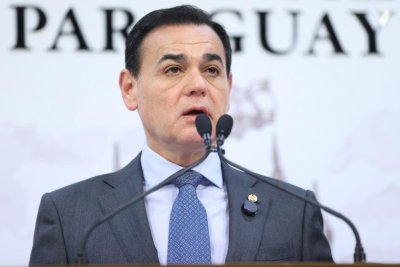
Paraguayan Foreign Minister Ruben Ramirez (shown) and U.S. Secretary of State Marco Rubio signed a security cooperation agreement to strengthen efforts against organized crime, drug trafficking and other transnational threats, Photo by Juan Pablo Pino/EPA
Dec. 18 (UPI) — Paraguay signed a security cooperation agreement with the United States to strengthen efforts against organized crime, drug trafficking and other transnational threats, as Asuncion seeks to reinforce its role as a strategic partner of Washington in central South America.
The agreement was signed this week by Paraguayan Foreign Minister Ruben Ramirez Lezcano and U.S. Secretary of State Marco Rubio. The document sets out general guidelines for joint work and must be sent to Paraguay’s Congress for review and approval.
Paraguay is a landlocked country between Brazil, Argentina and Bolivia. Its location has made it a key transit point for drug trafficking and smuggling routes across South America, which has led the government of President Santiago Pena to strengthen international security cooperation.
The agreement covers actions against transnational crime, training of military personnel, information sharing, humanitarian assistance and coordination in response to emergencies and natural disasters.
At the signing ceremony, Ramirez Lezcano highlighted the Paraguayan government’s commitment to shared goals with the United States.
“President Santiago Pena is deeply committed to continuing to work strongly on the relationship between our countries and on shared objectives such as fighting transnational organized crime, drug trafficking, human trafficking and corruption,” the foreign minister said.
He added that what is at stake “is not only security, but the freedom of people,” and said the agreement represents an important step to protect both values.
Rubio said the agreement also creates “the opportunity to train together, cooperate, exchange information directly and quickly, and respond to any humanitarian situation that may arise in the future, not only in Paraguay, but in the region.”
“It is a security agreement, but what also exists here is the opportunity to cooperate at the economic level, where there are many opportunities to use Paraguay’s potential so that it becomes a wealthier country,” Rubio said.
He added that Paraguayans are expected to have greater economic opportunities through cooperation with U.S. companies and interests “that are willing to invest responsibly and effectively in the economy and also help create jobs, work and sources of income for the citizens of your country.”
The United States and Paraguay have maintained decades of cooperation in areas such as security, counter-narcotics efforts, institutional strengthening and humanitarian assistance, according to official records from both governments.
Paraguay’s Foreign Ministry has said the relationship with the United States is strategic and has deepened in recent years amid a regional context marked by the advance of transnational organized crime.
The agreement signed in Washington adds to other bilateral instruments already in force and seeks to update cooperation mechanisms in response to emerging threats in South America.
WASHINGTON — Today’s political consensus crosses all ages, demographics and party lines: Three out of four Americans think the economy is in a slump. It is not just in their heads. Economic growth this year has been practically stagnant, save for one exception, economists say.
You’re reading the L.A. Times Politics newsletter
George Skelton and Michael Wilner cover the insights, legislation, players and politics you need to know in 2024. In your inbox Monday and Thursday mornings.
Hundreds of billions of dollars invested by California-based tech giants in artificial intelligence infrastructure accounted for 92% of the nation’s GDP growth this year, according to a Harvard analysis, supported by other independent economic studies.
It is a remarkable boon for a handful of companies that could lay the groundwork for future U.S. economic leadership. But, so far, little evidence exists that their ventures are expanding opportunities for everyday Americans.
“You have to watch out for AI investments — they may continue to carry the economy or they may slow down or crash, bringing the rest of the economy together with them,” said Daron Acemoglu, an economics professor at MIT. “We are not seeing much broad-based productivity improvements from AI or other innovations in the economy, because if we were, we would see productivity growth and investment picking up the rest of the economy as well.”
Even in California itself, where four of the top five AI companies are based, the AI boom has yet to translate into tangible pocketbook benefits. On the contrary, California shed 158,734 jobs through October, reflecting rising unemployment throughout the country, with layoffs rippling through the tech and entertainment sectors. Consumer confidence in the state has reached a five-year low. And AI fueled a wave of cuts, cited in 48,000 job losses nationwide this year.
“It is evident that the U.S. economy would have been almost stagnant, absent the capital expenditures by the AI industry,” said Servaas Storm, an economist at the Institute for New Economic Thinking, whose own analysis found that half of U.S. economic growth from the second quarter of 2024 through the second quarter of 2025 was due to spending on AI data centers.
The scale of investments by AI companies, coupled with lagging productivity gains expected from AI tools, is spawning widespread fears of a new bubble on Wall Street, where Big Tech has driven index gains throughout the year.
The top 10 stocks listed in the Standard & Poor’s 500 index, most of which are in the tech sector, were responsible for 60% of the yearlong rally, far outperforming the rest of the market. And the few who benefited from dividends fueled much of the rest of this year’s economic growth, with the vast majority of U.S. consumption spending attributed to the richest 10% to 20% of American households.
“There were ripple effects into high-end travel, luxury spending, high-end real estate and other sectors of the economy driven by the financial elite,” said Peter Atwater, an economics professor at William & Mary and president of Financial Insyghts, a consulting firm. “It tells the average consumer that while things are good at the top, they haven’t benefited.”
Stan Veuger, a senior fellow in economic policy studies at the American Enterprise Institute and a frequent visiting lecturer at Harvard, said that slowing growth and persistently high inflation were diminishing the effects of the AI boom.
“Obviously, that’s not a recipe for sustainable growth,” he said.
U.S. growth today is based on “the hope, optimism, belief or hype that the massive investments in AI will pay off — in terms of higher productivity, perhaps lower prices, more innovation,” Storm added. “It should tell everyday Americans that the economy is not in good shape and that the AI industry and government are betting the farm — and more — on a very risky and unproven strategy involving the scaling of AI.”
Trump’s AI bet
The Trump administration has fully embraced AI as a cornerstone of its economic policy, supporting more than $1 trillion in investments over the course of the year, including a $500-billion project to build out massive data centers with private partners.
Trump recently took executive action attempting to limit state regulations on AI designed to protect consumers. And House Republicans passed legislation this week that would significantly cut red tape for data center construction.
Administration officials say the United States has little choice but to invest aggressively in the technology, or else risk losing the race for AI superiority to China — a binary outcome that AI experts warn will result in irreversible, exponential growth for the winner.
But there is little expectation that their investments will bear fruit in the short term. Data centers under construction under the Stargate program, in partnership with OpenAI and Oracle, will begin coming online in 2026, with the largest centers expected to become operative in 2028.
“AI can only fulfill its promise if we build the compute to power it,” OpenAI Chief Executive Sam Altman said at the launch of the Stargate project. “That compute is the key to ensuring everyone can benefit from AI and to unlocking future breakthroughs.”
In the meantime, the Americans expected to benefit are those who can join in the investment boom — for as long as it lasts.
“2025 has been a very good year for people who already have significant wealth, a mediocre year for everyone else,” said Kenneth Rogoff, a prominent economist and professor at Harvard. “While the stock market has exploded, wage growth has been barely above inflation.”
“Whether the rest of the economy will catch fire from AI investment remains to be seen, but near term it is likely that AI will take away far more good jobs than it will create,” Rogoff added. “The Trump team is nevertheless optimistic that this will all go their way, but the team is largely built to carry out the president’s vision rather than to question it.”
Dec. 18 (UPI) — The United States has approved a massive $11.1 billion arms deal with Taiwan, the self-government Asian island announced Thursday.
The U.S. Congress was informed of the sale on Wednesday, the president’s office said in a statement.
The package includes eight items, such as HIMARS rocket systems, TOW missiles, Javelin anti-tank missiles, anti-armor loitering munition systems, spare attack helicopter parts and the Taiwan Tactical Network military communication platform and Tactical Awareness Kit, among other lethal equipment.
Taiwan’s foreign ministry said in a statement that it “welcomed” the announcement and expressed its “sincere appreciation for the United States’ long-standing support for regional security and Taiwan’s self-defense.
The arms sale is the second to Taiwan of President Donald Trump’s second administration and comes as China increases its military pressure on the self-governing island.
Hours prior to the deal being announced, Taiwan’s Ministry of National Defense said 40 sorties of Chinese fighter jets and eight navy vessels were detected operating around the island. Of the fighter jets, 26 had crossed the median line and entered Taiwan’s northern, central, southwestern and eastern Air Defense Identification Zone.
A day earlier, 23 sorties of fighter jets were detected and nine fighter jets and seven navy vessels were spotted a day before that.
China views Taiwan as a breakaway province and has vowed to take it back by force if necessary. Taiwan is a self-governing island that Beijing has never ruled.
The office of Taiwanese President Lai Ching-te said the arms deal highlights the close partnership between the two countries and demonstrates “the importance the U.S. government attaches to Taiwan’s national defense needs.”
Presidential Office spokesperson Karen Kuo added that due to increasing security concerns, Taiwan will raise defense spending to more than 3% of GDP next year and aims for it to be 5% by 2030.
“Taiwan will continue to reform national defense, strengthen whole-of-society defense resilience, demonstrate our determination for self-defense and maintain peace through strength,” Kuo said.
The U.S.-Taiwan Business Council said it was a record single U.S. security package for Taiwan and was in response to the threat posed by China and a potential Beijing ground invasion.
“We continue to see the prioritization of platforms and munitions that address a D-Day-style attack on the island,” USTBC President Rupert Hammond-Chamber said in a statement.
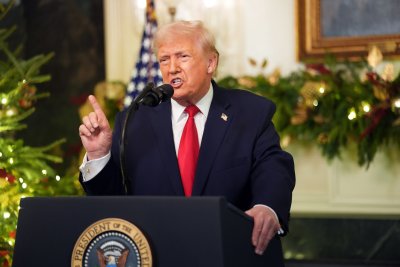
Dec. 17 (UPI) — In a relatively brief, campaign-style speech on Wednesday night, President Donald Trump touted what he described as successes achieved by his administration during his first year back in office, while bashing his predecessor, former President Joe Biden, and the Democrats.
Before Christmas trees and a Christmas laurel decorating the mantel of the Diplomatic Reception Room fireplace, the commander-in-chief said he has returned the United States from a place of destitution to a level of unparalleled success.
“Our country is back stronger than ever before. We’re poised for an economic boom the likes of which the world has never seen,” he said.
“We will celebrate the 250th anniversary of the Declaration of Independence. There could be no more fitting tribute to this epic milestone than to complete the comeback of America that began just one year ago.”
The speech comes amid economic concerns and fears of war in the United States, though Trump only touched on the former during the address. A day earlier, the Bureau of Labor Statistics reported unemployment had risen to its highest level since September 2021 during the pandemic. An ongoing U.S. military buildup in the Caribbean continues, and on Tuesday, Trump ordered a naval blockade of Venezuela oil tankers.
In the 18-minute speech, Trump described the country he inherited as a “mess” marked by inflation, high prices, rampant illegal immigration, unaffordability, transgender women playing women’s sports, “transgender for everybody,” censorship and crime.
“This is what the Biden administration allowed to happen to our country, and it can never be allowed to happen again,” he said.
“Our country was laughed at all over the world, but they are not laughing anymore.”
In the last 11 months, Trump said he has ushered more positive change into Washington “than any administration in American history.”
“There’s never been anything like it. And I think most would agree,” he said.
Trump also trumpeted his border policies, claiming they have resulted in “zero” undocumented migrants allowed to enter the United States. — an apparent reference to Customs and Border Protection data showing that, beginning in May, no migrants apprehended at the border were released into the U.S. interior.
“Do you remember when Joe Biden said he needed Congress to help with legislation to close the border?” he said. “As it turned out, we didn’t need legislation, we just needed a new president.”
MEXICO CITY — President Trump has ordered a partial blockade on oil tankers going to and from Venezuela, potentially crippling the nation’s already battered economy, and accused Caracas of stealing “oil, land other assets” from the United States — a significant escalation of Washington’s unrelenting campaign against the government of President Nicolás Maduro.
Asked about Venezuela on Wednesday, Trump said the United States will be “getting land, oil rights and whatever we had.”
“We want it back,” Trump said without further elaboration. It was unclear if Trump planned to say more about Venezuela in a televised address to the nation late Wednesday night.
The blockade, which aims to cripple the key component of Venezuela’s faltering, oil-dependent economy, comes as the Trump administration has bolstered military forces in the Caribbean, blown up more than two dozen boats allegedly ferrying illicit drugs in both the Caribbean and the Pacific, and threatened military strikes on Venezuela and neighboring Colombia.
“Venezuela is completely surrounded by the largest Armada ever assembled in the History of South America,” Trump said in a rambling post Tuesday night on his Truth Social site. “It will only get bigger, and the shock to them will be like nothing they have ever seen before.”
Not long after Trump announced the blockade Tuesday night, the government of Venezuela denounced the move and other Trump efforts as an attempt to “rob the riches that belong to our people.”
Leaders of other Latin American nations called for calm and United Nations Secretary-General Antonio Guterres, after a phone call with Maduro, called on U.N. members to “exert restraint and de-escalate tensions to preserve regional stability.”
Also Wednesday, Trump received rare pushback from the Republican-dominated Congress, where some lawmakers are pressuring the administration to disclose more information about its deadly attacks on alleged drug boats.
The Senate gave final approval to a $900-billion defense policy package that, among other things, would require the administration to disclose to lawmakers specific orders behind the boat strikes along with unedited videos of the deadly attacks. If the administration does not comply, the bill would withhold a quarter of Defense Secretary Pete Hegseth’s travel budget.
The bill’s passage came a day after Hegseth and Secretary Marco Rubio came to Capitol Hill to brief lawmakers on the U.S. military campaign. The briefings left lawmakers with mixed reaction, largely with Republicans backing the campaign and Democrats expressing concern about it.
The White House has said its military campaign in Venezuela is meant to curb drug trafficking, but the U.S. Drug Enforcement Administration data shows that Venezuela is a relatively minor player in the U.S.-bound drug trade.
Trump also declared that the South American country had been designated a “foreign terrorist organization.” That would apparently make Venezuela the first nation ever slapped with a classification normally reserved for armed groups deemed hostile to the United States or its allies. The consequences remain unclear for Venezuela.
Regional responses to the Trump threats highlight the new ideological fault lines in Latin America, where right-wing governments in recent years have won elections in Chile, Argentina and Ecuador.
The leftist leaders of the region’s two most populous nations — Brazil and Mexico — have called for restraint in Venezuela.
“Whatever one thinks about the Venezuelan government or the presidency of Maduro, the position of Mexico should always be: No to intervention, no to foreign meddling,” Mexican President Claudia Sheinbaum said Wednesday, calling on the United Nations to look for a peaceful solution and avoid any bloodshed.
Brazilian President Luiz Inácio Lula da Silva has also urged Trump to pull back from confrontation. “The power of the word can outweigh the power of the gun,” Lula said he told Trump recently, offering to facilitate talks with the Maduro government.
But Chile’s right-wing president-elect, José Antonio Kast, said he supports regime-change in Venezuela, asserting that it would reduce migration from Venezuela to other nations in the region.
“If someone is going to do it, let’s be clear that it solves a gigantic problem for us and all of Latin America, all of South America, and even for countries in Europe,” Kast said, referring to Venezuelan immigration.
In his Tuesday post, Trump said he had ordered a “complete blockade of all sanctioned oil tankers going into, and out of, Venezuela.” While potentially devastating to Venezuela’s economy, the fact that the blockade will only affect tankers already sanctioned by U.S. authorities does give Venezuela some breathing room, at least for now.
Experts estimated that only between one-third and one-half of tankers transporting crude to and from Venezuela are likely part of the so-called “dark fleet” of sanctioned tankers. The ships typically ferry crude from Venezuela and Iran, two nations under heavy U.S. trade and economic bans.
However, experts said that even a partial blockade will be a major hit for Venezuela’s feeble economy, reeling under more than a decade of of U.S. penalties. And Washington can continue adding to the list of sanctioned tankers.
“The United States can keep sanctioning more tankers, and that would leave Venezuela with almost no income,” said David A. Smilde, a Venezuela expert at Tulane University. “That would probably cause a famine in the country.”
The growing pressure, analysts said, will likely mean the diminishing number of firms willing to take the risk of transporting Venezuelan crude will up their prices, putting more pressure on Caracas. Purchasers in China and elsewhere will also likely demand price cuts to buy Venezuelan oil.
Trump has said that Maduro must go because he is a “narco-terrorist” and heads the “Cartel de los Soles,” which the While House calls is a drug-trafficking syndicate. Trump has put a $50 million bounty on Maduro’s head. Experts say that Cartel de los Soles is not a functioning cartel, but a short-hand term for Venezuelan military officers who have been involved in the drug trade for decades, long before Maduro or his predecessor and mentor, the late Hugo Chávez, took office.
In his comments on Tuesday, Trump denounced the nationalization of the Venezuelan oil industry, a process that began in the 1970s, when Caracas was a strong ally of Washington.
Echoing Trump’s point that Venezuela “stole” U.S. assets was Stephen Miller, Trump’s homeland security advisor, who declared on X: “American sweat, ingenuity and toil created the oil industry in Venezuela. Its tyrannical expropriation was the largest recorded theft of American wealth and property.”
Among those believed to be driving Trump’s efforts to oust Maduro is Secretary of State Maro Rubio, the son of Cuban immigrants to Florida. Rubio has long been an outspoken opponent of the communist governments in Havana and Caracas. Venezuelan oil has helped the economies of left-wing governments in both Cuba and Nicaragua.
Christopher Sabatini, a senior fellow for Latin America at Chatham House, said Rubio has been on a long-time campaign to remove Maduro.”He has his own political project,” Sabatini said. “He wants to get rid of the dictators in Venezuela and Cuba.”
Staff writers McDonnell and Linthicum reported from Mexico City and Ceballos from Washington. Contributing was special correspondent Mery Mogollón in Caracas.