Israeli Prime Minister Benjamin Netanyahu and President Donald Trump talk with reporters at the White House in Washington, D.C., in February. Netanyahu is scheduled to visit Trump Monday in Florida. File Photo by Shawn Thew/UPI | License Photo
Dec. 29 (UPI) — Israeli Prime Minister Benjamin Netanyahu will visit with President Donald Trump Monday in Florida to discuss the peace plan with Gaza.
Netanyahu is also likely to lobby the president for help with Iran as it continues its work on nuclear weapons.
The meeting will happen at Trump’s Mar-a-Lago resort in Palm Beach, Fla. On Sunday, Trump met with Ukrainian President Volodymyr Zelenskyat the resort to continue working on a peace plan between Ukraine and Russia.
Local officials have said that more than 400 people have been killed in Gaza since the cease-fire, NBC News reported.
The Trump administration wants to see progress on the plan’s second phase in January. That means a Palestinian technocratic government would be created. Hamas would disarm, and the Israeli Defense Forces would pull out of Gaza.
But some believe that Netanyahu will stall the process and demand Hamas fully disarm before the IDF withdraws. Hamas has said it will disarm as progress moves toward an independent Palestinian state.
Netanyahu and his staff have repeatedly rejected Palestinian statehood since October.
Israeli Defense Minister Israel Katz said last week that Israel will build settlements in Gaza and “never fully withdraw” even as Hamas disarms, the BBC reported. This would violate the cease-fire agreement.
Secretary of State Marco Rubio will meet with Netanyahu before Trump’s meeting.
Two other tenets of the cease-fire haven’t yet emerged: A “Board of Peace” led by Trump is planned for governance of Gaza, and the International Stabilization Force, led by the United Nations, which will help with peacekeeping in Gaza.
Rubio has said those measures will be in place “very soon.”
Israeli officials are concerned that Iran is moving forward with its plans for ballistic missiles, and Netanyahu is expected to discuss options with Trump at Monday’s meeting.
WASHINGTON — More than a quarter of federal immigration judges in California have been fired, retired or quit since the start of the Trump administration.
The reduction follows a trend in immigration courts nationwide and constitutes, critics say, an attack on the rule of law that will lead to yet more delays in an overburdened court system.
The reduction in immigration judges has come as the administration scaled up efforts to deport immigrants living in the U.S. illegally. Trump administration officials have described the immigration court process, in which proceedings can take years amid a backlog of millions of cases, as an impediment to their goals.
Nationwide, there were 735 immigration judges last fiscal year, according to the Executive Office for Immigration Review, the arm of the Justice Department that houses immigration courts. At least 97 have been fired since President Trump took office and about the same number have resigned or retired, according to the union representing immigration judges.
California has lost at least 35 immigration judges since January, according to Mobile Pathways, a Berkeley-based organization that analyzes immigration court data. That’s down from 132. The steepest drop occurred at the San Francisco Immigration Court, which has lost more than half its bench.
“A noncitizen might win their case, might lose their case, but the key question is, did they receive a hearing?” said Emmett Soper, who worked at the Justice Department before becoming an immigration judge in Virginia in 2017. “Up until this administration, I had always been confident that I was working in a system that, despite its flaws, was fundamentally fair.”
Our government institutions are losing their legitimacy
— Amber George, former San Francisco Immigration Court judge
The administration intends to fill some judge positions, and in new immigration judge job listings in Los Angeles, San Francisco and elsewhere seeks candidates who want to be a “deportation judge” and “restore integrity and honor to our Nation’s Immigration Court system.”
The immigration judges union called the job listings “insulting.”
Trump wrote on Truth Social in April that he was elected to “remove criminals from our Country, but the Courts don’t seem to want me to do that.”
“We cannot give everyone a trial, because to do so would take, without exaggeration, 200 years,” he added.
The National Assn. of Immigration Judges said it expects a wave of additional retirements at the end of this month.
“My biggest concern is for the people whose lives are left in limbo. What can they count on when the ground is literally shifting every moment that they’re here?” said Amber George, who was fired last month from the San Francisco Immigration Court. “Our government institutions are losing their legitimacy.”
Because immigration courts operate under the Justice Department, their priorities typically shift from one presidential administration to the next, but the extreme changes taking place have renewed longtime calls for immigration courts to become independent of the executive branch.
The Trump administration recently added 36 judges; 25 of them are military lawyers serving in temporary positions.
This summer, the Pentagon authorized up to 600 military lawyers to work for the Department of Justice. That took place after the department changed the requirements for temporary immigration judges, removing the need for immigration law experience.
The Department of Justice did not respond to specific questions, but said judges must be impartial and that the agency is obligated to take action against those who demonstrate systemic bias.
Former judges say that, because terminations have happened with no advance notice, remaining court staff have often scrambled to get up to speed on reassigned cases.
Ousted judges described a pattern: In the afternoon, sometimes while presiding over a hearing, they receive a short email stating that they are being terminated pursuant to Article II of the Constitution. Their names are swiftly removed from the Justice Department website.
Jeremiah Johnson is one of five judges terminated recently from the San Francisco Immigration Court.
Johnson said he worries the Trump administration is circumventing immigration courts by making conditions so unbearable that immigrants decide to drop their cases.
The number of detained immigrants has climbed to record levels since January, with more than 65,000 in custody. Immigrants and lawyers say the conditions are inhumane, alleging medical neglect, punitive solitary confinement and obstructed access to legal counsel. Requests by immigrants for voluntary departure, which avoids formal deportation, have surged in recent months.
Many of those arrests have happened at courthouses, causing immigrants to avoid their legal claims out of fear of being detained and forcing judges to order them removed in absentia.
“Those are ways to get people to leave the United States without seeing a judge, without due process that Congress has provided,” Johnson said. “It’s a dismantling of the court system.”
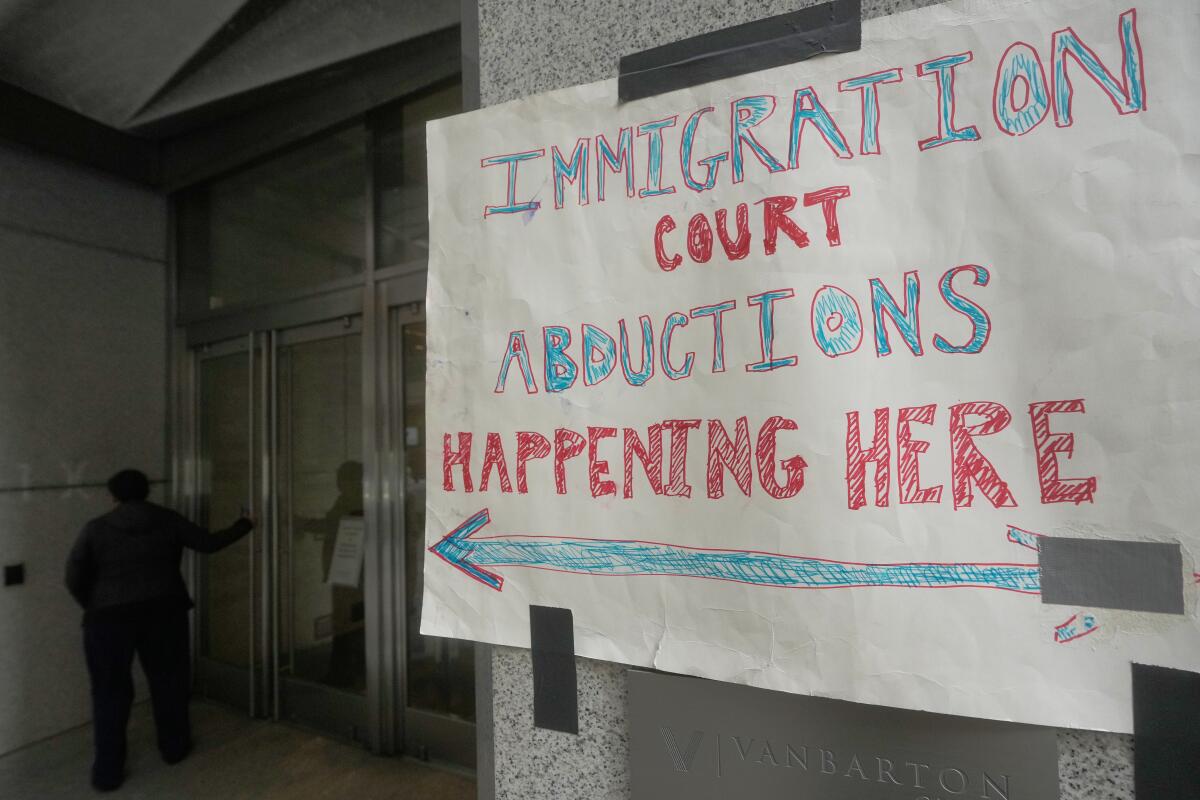
A sign posted outside the San Francisco Immigration Court in October protests enforcement actions by immigration agents. The court has lost more than half of its immigration judges.
(Jeff Chiu / Associated Press)
The judges in San Francisco’s Immigration Court have historically had higher asylum approval rates than the national average. Johnson said grant rates depend on a variety of circumstances, including whether a person is detained or has legal representation, their country of origin and whether they are adults or children.
In November, the military judges serving in immigration courts heard 286 cases and issued rulings in 110, according to Mobile Pathways. The military judges issued deportation orders in 78% of the cases — more often than other immigration judges that month, who ordered deportations in 63% of cases.
“They’re probably following directions — and the military is very good at following directions — and it’s clear what their directions are that are given by this administration,” said Mobile Pathways co-founder Bartlomiej Skorupa. He cautioned that 110 cases are a small sample size and that trends will become clearer in the coming months.
Former immigration judges and their advocates say that appointing people with no immigration experience and little training makes for a steep learning curve and the possibility of due process violations.
“There are multiple concerns here: that they’re temporary, which could expose them to greater pressure to decide cases in a certain way; and also they lack experience in immigration law, which is an extremely complex area of practice,” said Ingrid Eagly, an immigration law professor at UCLA.
Immigration courts have a backlog of more than 3 million cases. Anam Petit, who served as an immigration judge in Virginia until September, said the administration’s emphasis on speedy case completions has to be balanced against the constitutional right to a fair hearing.
“There are not enough judges to hear those cases, and this administration [is] taking it upon themselves to fire a lot of experienced and trained judges who can hear those cases and can mitigate that backlog,” she said.
Complementary bills introduced in the U.S. Senate and House this month by Sen. Adam Schiff (D-Calif.) and Rep. Juan Vargas (D-San Diego) would prevent the appointment of military lawyers as temporary immigration judges and impose a two-year limit of service.
“The Trump administration’s willingness to fire experienced immigration judges and hire inexperienced or temporary ‘deportation judges,’ especially in places like California, has fundamentally impacted the landscape of our justice system,” Schiff said in a statement announcing the bill.
The bills have little chance in the Republican-controlled Congress but illustrate how significantly Democrats — especially in California — oppose the administration’s changes to immigration courts.
Former Immigration Judge Tania Nemer, a dual citizen of Lebanon and the U.S., sued the Justice Department and Atty. Gen. Pam Bondi this month, alleging that she was illegally terminated in February because of her gender, ethnic background and political affiliation. In 2023, Nemer ran for judicial office in Ohio as a Democrat.
Atty. Gen. Pam Bondi, seen here at the White House in October, has dismissed complaints by a former immigration judge who alleged she was fired without cause.
“Most recently, yesterday, I was sued by an immigration judge who we fired,” she said Dec. 2. “One of the reasons she said she was a woman. Last I checked, I was a woman as well.”
Other former judges have challenged their terminations through the federal Merit Systems Protection Board.
Johnson, of San Francisco, is one of those. He filed his appeal this month, claiming that he was not given cause for termination.
“My goal is to be reinstated,” he said. “My colleagues on the bench, our court was vibrant. It was a good place to work, despite all the pressures.”
Ukrainian President Volodymyr Zelensky, pictured during a meeting at the White House with U.S. President Donald Trump in August, arrived at Mar-a-Lago on Sunday morning to work on a proposed 20-point peace plan between Russia and Ukraine. File Photo by Aaron Schwartz/UPI | License Photo
Dec. 28 (UPI) — Ukrainian President Volodymyr Zelensky on Sunday arrived at Mar-a-Lago in Palm Beach, Florida, to meet with U.S. President Donald Trump about a proposal for a cease-fire and end to Russia’s war in Ukraine.
Zelensky and his entourage arrived Sunday to discuss a 20-point plan — that may include conceding territory and shared operation of a nuclear power plant — to potentially end the war that started more than three years ago with Russia’s invasion of Ukraine.
Ahead of the meeting, Trump spoke with Russian President Vladimir Putin by phone for more than an hour, during which reportedly agreed that a long-term peace deal is preferable to a cease-fire, with Putin calling for Zelensky to make a “courageous, responsible political decision,” The New York Times reported.
Zelensky arrives for the meeting as Russia has amped up its attacks on Kyiv and other parts of Ukraine in recent days, which some have called a tactic on Russia’s part to force the Ukrainians hand in making a peace deal.
“Given the situation on the front lines, Kyiv must not delay making that decision,” Yuri Ushakov, one of Putin’s foreign policy aides, said during a press briefing on Sunday.
Trump told reporters when he welcomed Zelensky to Mar-a-Lago that he believes “we have the makings of a deal,” and that both Putin and Zelensky are both serious about making a peace deal, CNN reported.
Zelensky, Trump and representatives from both of their administrations are negotiating the 20-point peace plan that Zelensky reworked from a U.S.-proposed 28-point plan earlier this year.
Plans have also been drawn up for a three-party security guarantee between Ukraine, the U.S. and Europe, as well as a bilateral deal with the United States, in addition to economic cooperation to rebuild Ukraine, which has been brutally battered by Russia for the last three years, the Kyiv Independent reported.
According to the BBC, Putin and Trump are likely to speak later on Sunday after the meeting at Mar-a-Lago.
President Donald Trump holds a signed executive order reclassifying marijuana from a schedule I to a schedule III controlled substance in the Oval Office of the White House on Thursday. Photo by Aaron Schwartz/UPI | License Photo
Dec. 28 (UPI) — More than 30 years after New York City switched from tokens to the magnetic swipe of a MetroCard to ride its subways and buses, the card’s era is about to end.
Starting on Jan. 1, 2026, transiting residents and tourists alike will be required to move into the 21st century by using a contactless form of paying fares by tapping a phone, credit card or other device as they enter stations and buses.
Although the contactless system was introduced in 2019, 94% of subway and bus trips in the city already use the OMNY system for their travel payments, ABC News reported.
“New Yorkers have embraced tap and ride and we’re proud to see that as more and more people return to the city, they are choosing mass transit,” Shanifah Rieara, chief customer officer for New York City’s Metropolitan Transit Authority (MTA), said in a press release.
“As the end of MetroCard sales nears, we are focusing on reaching the remaining 6% to make the switch and unlock the benefits and convenience of tap and ride technology,” Rieara said.
According to the MTA, the last day to purchase or reload a MetroCard will be Dec. 31, while the last day to use one of the magnetic swipe cards will be some time in mid-2026.
The OMNY system offers three ways for riders to pay: with their phone using a digital wallet or contactless bank card, as well as a physical OMNY card that works with the digital system.
MTA said that by eliminating MetroCards and move to a single method of fare collection, the agency expects to save at least $20 million, as well as gain the ability to offer customer promotions and fare discounts more easily.
From 1953 until 1994, the New York City subway system’s main method for paying were dime-sized tokens with a hole in the middle shaped like a “Y,” which the MTA at the time said made it easier to increase fares without having to accept a variety of coinage, CNN reported.
In 1983, as other large cities had started using magnetic swipe technology for their public transportation systems’ payments, the MTA started moving toward the reloadable cards that have been an essential part of life for New Yorkers for more than three decades.
Pope Leo XIV celebrates the Christmas vigil Mass on Christmas eve on Wednesday in St. Peter’s Basilica in Vatican City, Vatican. Photo by Stefano Spaziani/UPI | License Photo
EDMONTON, Canada — Jason Hills grew up in a rural hamlet in southern Alberta so small there were no traffic lights. Which wasn’t a problem because there wasn’t any traffic either.
But there was a curling rink.
“There was nothing else really to do,” Hills said. “So if you weren’t curling you’d go hang out at the curling rink. It’s a community thing. It’s like everyone gets together.”
In much of the world curling is a curiosity, a sport which, like luge or the biathlon, surfaces every four years at the Winter Olympics — as it will do in February in Cortina D’Ampezzo, Italy — then quickly fades from view.
Canada’s Tracy Fleury (R) releases the stone during a gold medal match against Switzerland at the World Women’s Curling Championship in Uijeongbu on March 23.
(JUNG YEON-JE/AFP via Getty Images)
In Canada, however, it’s as much a part of the culture as poutine and maple syrup.
More than 2.3 million people — or one of every 18 Canadians — participate in the sport annually. That’s about 100 times the level of participation in the U.S. And more than 11 million Canadians watched the sport on TV in 2024, according to estimates from Curling Canada, the national governing body for the sport.
“It’s just embedded in the fabric of Canada,” said Elaine Dagg-Jackson, an Olympic bronze medalist and now one of Canada’s top curling coaches. “Canadians have a real identity with what curling is and what it stands for. It’s a gracious sport where people are being polite. They shake hands before and after the game.
“The curling rink was just a really good place to be in Canada. And still is. It just really suits the culture.”
The objectives of the sport are simple: Teams of two to four players slide 44-pound granite stones, also known as rocks, down a narrow 150-foot-long sheet of ice toward a target area called the house, aiming to get their stone closest to the center of the house. One or two players from the throwing team use carbon-fiber brooms to sweep the ice in front of the moving stone, influencing its path and speed.
A round of play ends when each team has thrown eight stones; in Olympic curling, a match consists of 10 ends, eight in mixed curling, with games typically lasting two to three hours.
The simplicity of the sport is both its charm and its curse. Because there is no running, jumping or lifting of heavy objects, everyone from young children to octogenarians can, and do, compete in amateur curling in Canada.
“It’s relatively inexpensive and it’s relatively accessible,” said Heather Mair, an associate professor at the University of Waterloo. “It’s not a hard sport to play and have fun at. It’s hugely entertaining. And you can really play your whole life.
“I don’t know too many sports you could go out with your grandfather and participate. It can be really family-oriented as a sport.”
But while it looks easy, to excel at the highest levels, where millimeters separate winners from losers in competitions that can stretch for as long as seven hours over multiple days, the sport requires surprising strength, stamina, precision and agility.
Canada’s Brett Gallant curls the stone during the 2022 Winter Olympics in Beijing on Feb. 17, 2022.
(LILLIAN SUWANRUMPHA/AFP via Getty Images)
“It definitely takes a toll on your body,” Rachel Homan, a three-time Canadian Olympian and three-time world champion, said during a break in training on a bright Edmonton morning. “That part of the game is maybe overlooked; the physical toll it takes. It’s definitely demanding.”
The curling events at February’s Winter Olympics will be held at the Cortina Olympic Stadium in Cortina D’Ampezzo, one of four event clusters in and around Milan. Canada, which has medaled in curling in every Olympics in the modern era, winning a record six golds, will send a dozen athletes — including Homan, the reigning world champion — to Italy to compete in the men’s, women’s and mixed doubles.
The U.S., which has won two Olympic curling medals, both in the men’s competition, will also have a dozen curlers in Italy competing in all three events. But if the sport is a national pastime in Canada, one that competes with hockey for fans and media attention, it remains something of an oddity in the U.S., where it draws huge TV audiences every four years during the Olympics, then fades from view until the next Winter Games.
“It’s so frustrating to see curling become the next best thing to sliced bread for a month and then it comes off the radar for four years,” said Korey Dropkin, a five-time U.S. champion and a 2023 world champion in mixed doubles. “I want to see something that’s on national television in the U.S. every week. I want to be able to expose our amazing sport to the U.S. audience day in, day out.
“I hope that in the near future we’ll be able to create more opportunities for exposure for curling.”
Curling was born in Scotland in the early 16th century but grew up centuries later on the Canadian prairies, where the severe weather, rural landscape and boredom provided fertile ground.
“In many parts of the country there’s long, long winters,” Dagg-Jackson said. “The farmers would be busy all summer, but in the winter they were looking for something to do. So the old adage in Canada is you could go to any town in rural Canada and find a grain elevator and a curling rink.”
Members of the Highland Curling Club, formed in 1898, play on flooded sheets of ice on Jan. 11 in Inverness, Scotland.
(Jeff J Mitchell / Getty Images)
The sport, which predates hockey by several decades, was brought to Montreal by Scottish emigrants during the colonial period, more than a half-century before Canada became a country. It then moved west as settlers pushed into what would become the central provinces, where the game was played on ponds and lakes before coming indoors.
In many ways the sport and the harsh conditions in which it thrived embodied the traditional values and traits — resilience, community, politeness, resourcefulness — that have come to define Canada’s unique “northern character.”
Mair, the Waterloo professor, has studied the role curling played in creating social and inter-generational connections and found the sport may have been more important from a mental perspective than from a physical one.
“I don’t know if you can appreciate what a Canadian winter is like, but anything that gets us out of our homes and talking to one another is really, really important,” she said. “We know how necessary it is that we spend time socializing with one another, especially in the dark winter days.”
As a result, it quickly became hugely popular, but for reasons that went beyond sport. Most curling rinks, Mair said, provide social spaces where players can visit with the people they’re competing against.
“So you’re sitting there for half an hour with people that you might never run into in any other part of your life and you start to build social relationships,” she said. “In really small rural communities, those are pretty essential. That’s kind of how it started.”
Aksarban Curling Club president Steve Taylor demonstrates how to push off the hack to deliver a stone in front of an all-ages group learning about the sport in Omaha, Neb., in 2018.
(Nati Harnik / Associated Press)
It’s also why the flat lands of Saskatchewan, Manitoba and Alberta became the earliest hotbeds of curling, which aligned well with the farming season. But the sport didn’t stay there. Curling clubs soon sprung up on Army bases and in fishing communities, in big cities and small towns, where it was taught in schools and played in retirement homes. (Curling has taken a different path in the U.S., where it has become popular in nontraditional winter-sports areas such as North Carolina, Florida, Texas and the San Francisco Bay area.)
“There were entire generations, for the most part, who really had a sense of the game,” Mair said. “The[re] were plumbers and carpenters and teachers, they had regular day jobs and yet they were these really talented athletes who would take the sport to these elite levels.
“So you could come from a teeny, tiny club and you might know someone who’s playing in the national championship.”
That romanticism inspired a radio play and novella by W.O. Mitchell, a writer and broadcaster who chronicled life on the Canadian prairies in the mid 20th century. In “The Black Bonspiel of Willie MacCrimmon,” which was also adapted for television, a cobbler from a small town in rural Alberta strikes a deal with the devil to trade his soul for curling success.
American John Shuster watches Matt Hamilton, center, and Colin Hufman, left, sweep his throw during a match against Canada at the Beijing Winter Olympics in 2022.
(Brynn Anderson / Associated Press)
But as curling moved from the prairies to the cities, the object lessons the sport taught changed as well. If Mitchell’s tale is a decades-old take on the timeless tug of war between good and evil, “The New Canadian Curling Club,” a 2018 comedy by playwright Mark Crawford in which four immigrants show up for a learn-to-curl class, is a modern exploration of multiculturalism and acceptance.
What the immigrants share, however, is a belief that understanding Canada starts with understanding curling.
“It’s weird and wonderful. And like all good things, it takes a little time to appreciate,” Mair, who teaches in the department of recreation and leisure studies at Waterloo, said of the sport. “At first glance you’re not totally sure what’s going on. And then as the layers start to kind of unfold, you realize just how interesting and complicated and engaging it can be.
“It’s fun. It really is. It’s quirky and fun. And I think we need more of that.”
But, she added, much of that has changed since curling entered the Olympics.
“We’re at a bit of a crossroads,” she said. “Elite sport is doing just fine in a lot of ways. [But] we need to have a different conversation about community sport. It’s not about a pathway to Olympic gold. It’s about rebuilding our communities and providing safe and accessible sports for everything. And curling is just so special in that way.”
Curling debuted in the Winter Games in 1924 with just three countries taking part; Great Britain, which fielded a team of Scottish curlers, won the gold medal. But the sport didn’t return to the official Olympic program for another 74 years and when it did, the exposure fueled interest in winter sports powerhouses such as China, Japan and South Korea, but also in Afghanistan, Andorra, Bolivia, the Virgin Islands, Kuwait and Mexico, which are all among the 67 members of the World Curling Assn.
“There’s a little bit of perception from America that curling is small potatoes. And it probably is compared to the big four sports,” said Marc Kennedy, a world and Olympic champion from Canada who will be competing in his fourth Olympics in Italy. “But it’s a big deal. Arguably one of the fastest-growing sports internationally. It’s massive in Asia. Some of our most popular athletes are from Japan.”
That added competitiveness — 30 countries attempted to qualify for this year’s Olympic tournament — has not only raised the stakes and professionalized the sport, it also threatens to crush curling’s gracious and polite traditions in a stampede for the top of the medal podium. In last spring’s world championship in Canada, for example, Chinese athletes were accused of touching a stone with a broom, kicking a stone and illegal sweeping — all forbidden acts.
In most other sports, that would have been considered gamesmanship. In curling, the accusations alone were an affront to the sport’s tradition and dignity.
Team Shuster’s Chris Plys throws the rock during the U.S. Olympic curling team trials in Omaha, Neb., on Nov. 20, 2021.
(Rebecca S. Gratz / Associated Press)
“In curling you always divulge that you broke a rule … and apologize,” said Dagg-Jackson, the former Olympian turned coach.
“It’s supposed to be a gentleman’s game. You’re supposed to call your own fouls,” added Chris Plys, a three-time U.S. Olympian. “Now we’re starting to see people doing questionable things.
“It’s sad because the best part of the game is just how honest everything is. And there’s people out there 1766928496 that are willing to do whatever it takes to win.”
Those athletes certainly aren’t cheating for the money since curlers, even at the highest level, have often had to work regular jobs to pay the bills. That could change this spring with the launch of the Rock League, the sport’s first professional competition, which will begin play shortly after the Milan-Cortina Olympics.
“The Rock League is going to be a huge new chapter to the sport,” said Dropkin, the Olympian who will captain the U.S. Rock League team. “That is going to present a whole lot of opportunities to curlers. Curlers now, curlers [in] the pipeline. They can actually make a living.”
The five-week circuit will feature six teams of five men and five women — one from the Asian-Pacific, two from Canada, two from Europe and one representing the U.S. — playing a variety of formats during stops in the U.S. and Canada. Competitors will not just earn money based on performance, but will receive salaries as well.
Historically the sport has relied heavily on prize money, which doesn’t go far. Kennedy’s winning five-man team at the 2025 Brier, the annual Canadian men’s championships, split $108,000 of the tournament’s $300,000 purse last March, which didn’t leave much after paying for travel and housing at the 10-day event.
The Dodgers will pay Shohei Ohtani more than that every time he comes to the plate over the next 10 seasons.
“I don’t think any of us get into curling with the idea of making millions of dollars,” said Kennedy, 43, a father of two who sold his frozen-food franchise 14 years ago to support his curling career. “You’ve got a lot of curlers out there that still play for the love of the game and for the opportunity to represent Canada at the Olympics or World Championships.
“If money was your motivation, then you’re probably in the wrong sport.”
Rachel Homan throws a rock during Canadian Olympic curling trials in Halifax, Nova Scotia, Canada, on Nov. 25.
(Darren Calabrese / Associated Press)
For Homan, 36, a mother of three young children who has traditionally relied on sponsorships, stipends from the national federation and winnings from underfunded tours such as the Grand Slam of Curling to make ends meet, the Rock League has the potential to change not only her life, but her legacy as well.
“In this league, being a part of it, might not mean anything for me financially right now. But it’s more about what you’re leaving behind and what you’re helping create,” said Homan, who will captain one of the league’s two Canadian teams.
Financing a professional league isn’t the only challenge curling will face coming out of the Milan-Cortina Games, though. Because while the Olympics may help the sport gather viewers, it has done little to reverse a steady decline in participation at the grassroots level, which is robbing the sport of its future athletes.
“It’s just hard to get young kids introduced to it and have access to it,” Kennedy said. “Back in the ‘50s, ‘60s, ‘70s and ‘80s it was the community center. Everybody kind of learned curling, especially out west. That’s what was driving a huge part of our sport for a long time.”
Not any more. Canada, like the U.S., has seen millions of people flee rural areas for big cities over the last several decades and as a result the local curling rink is no longer the civic hub it was when Jason Hills was growing up on the frigid plains of central Alberta. And what investment there is in the sport is now being directed to events such as the Olympics, the Grand Slam of Curling or the fledgling Rock League, not to building more community rinks.
“Curling had to pivot a bit,” said Dagg-Jackson, who takes her five grandchildren curling. “It used to be all about membership, about the thousands and thousands of curlers across the country. Now those few competitive curlers that shine in the spotlight are known to all Canadians because they’re on television all the time and they draw attention to the sport.
“Fifty years ago you just waited at the rink and people showed up because it was the place to be. Big events, Olympics, pro leagues, that’s the future of curling. But the culture and the lore, the history of curling, it’ll always be there.”
Dec. 27 (UPI) — The FBI Hoover headquarters in Washington soon will be vacant as the federal law enforcement agency prepares to make a permanent exit in favor of a more modern structure.
FBI Director Kash Patel plans to make a permanent move into the former headquarters of the recently closed U.S. Agency for International Development sometime soon, according to Bloomberg.
“After more than 20 years of failed attempts, we finalized a plan to permanently close the FBI’s Hoover headquarters and move the workforce into a safe, modern facility,” Patel said in a social media post on Friday.
Moving into the former USAID headquarters will save taxpayers almost $5 billion, which was allocated to build a new FBI headquarters that would not have opened until 2035, Patel said.
“We scrapped that plan,” he explained. “Instead, we selected the already-existing Reagan Building, saving billions and allowing the transition to begin immediately with required safety and infrastructure upgrades underway.”
When the improvements are done, Patel said the FBI staff will move into the Reagan Building, which is located at 1300 Pennsylvania Ave. N.W., between the White House and the Capitol. He did not say when the move might occur.
The Hoover Building will be shut down after the FBI vacates it, the FBI director added.
While Patel said the move will save taxpayers billions of dollars, Maryland lawmakers are not happy about the change in plans.
Congress had approved the allocation to build a new FBI headquarters in Maryland during the Biden administration, but the change in plans has canceled that.
“Not only was this decision final, [but] the Congress appropriated funds specifically for the purpose of the new, consolidated campus to be built in Maryland,” the state’s Democratic Party Congressional delegation said in a joint statement in July.
“Now the Administration is attempting to redirect those funds — both undermining Congressional intent and dealing a blow to the men and women of the FBI — since we know that a headquarters located within the District [of Columbia] would not satisfy their security needs,” the delegation said.
Maryland officials in November filed a federal lawsuit accusing the Trump administration of improperly diverting $555 million when it announced the change of plans for the FBI headquarters.
“These actions flouted Congress’s explicit direction to choose a site from the three specified sites, as well as other specific statutory directives concerning the selection of the site and the use of the funds,” state attorneys say in the federal lawsuit.
The J. Edgar Hoover Building opened in 1974 and has been the FBI’s headquarters for the past 50 years.
Prior to that, the FBI was headquartered in the Justice Department building.
Former actor and sports broadcaster Ronald Reagan, known for films such as “Knute Rockne, All American” and “Kings Row,” is pictured in the Oval Office after delivering his farewell address to the nation on January 11, 1989. Reagan later served as the 40th president of the United States. Photo by Joe Marquette/UPI | License Photo
A man carrying 55 pounds of suspected methamphetamine in gift-wrapped boxes was arrested for drug trafficking near Louisville, Ky., on Monday. File Photo by Justin Lane/EPA-EFE
Dec. 27 (UPI) — A Nebraska man was arrested near Louisville, Ky., when police found 55 pounds of suspected methamphetamine in Christmas wrapping inside his vehicle’s trunk on Monday.
Jeffersontown Police Department officers arrested Jacob Talamantes, 23, while he was at a shopping center near the Bluegrass Parkway after a police dog detected drugs in his 2013 Chevrolet Malibu.
Police officers searched his vehicle and found the meth in gift-wrapped boxes inside the trunk and arrested him.
“No amount of festive wrapping can disguise the harm these drugs inflict on families and communities,” JPD Chief Richard Sanders said in a news release.
“The coordinated efforts of partner agencies ensured these holiday-wrapped packages never reached the streets,” Sanders said.
The police were conducting a drug investigation at the shopping center when the dog alerted them to the drugs when Talamantes arrived in the vehicle, WLWT reported.
He tried to walk away from the police, but they detained him.
Talamantes told officers he was driving from Iowa and intended to traffic the drugs, and he was arrested and charged with first-degree trafficking in a controlled substance.
The Drug Enforcement Agency and Kentucky State Police assisted with the arrest and are helping with the investigation into the matter.
Jeffersontown is located about 15 miles southeast of Louisville.
Dec. 27 (UPI) — President Donald Trump and Treasury Sec. Scott Bessent urged an end to the Senate filibuster rule ahead of an anticipated budget battle in January.
Bessent submitted an op-ed that The Washington Post published on Saturday and blames Senate Democrats and the filibuster for blocking passage of a resolution to keep the federal government open while negotiating the 2026 fiscal year budget and causing a record 43-day shutdown of the federal government.
“The American people are just now emerging from the longest and most devastating government shutdown in U.S. history,” Bessent said.
“While the blame lies squarely with Senate Democrats, we cannot ignore the weapon they used to hold the country hostage: the legislative filibuster,” Bessent wrote.
With the continuing resolution expiring on Jan. 30, Bessent said there is a strong likelihood that Senate Democrats again will use the filibuster to block passage of a budget and force the government to close again.
“Democrats inflicted tremendous harm on the nation, including $11 billion in permanent economic damage” as the federal government was “held for ransom by the left’s demands,” Bessent said.
He said the shutdown caused the nation to lose 1.5 percentage points in gross domestic product growth during the fourth quarter, triggered 9,500 canceled flights and caused 1.4 million federal workers to miss their paychecks.
He called the filibuster a “historical accident that has evolved into a standing veto for the [Senate] minority and a license for paralysis.”
The Constitution does not mention a filibuster, and its “framers envisioned debate, but they expect majority rule,” Bessent said.
He said the filibuster has its roots in an 1806 Senate rules decision that deleted a “previous question” motion, which unintentionally removed the Senate’s mechanism for ending debate with a majority vote.
Senators later realized they could “delay or block” legislative action with unending debate, and just the threat of a filibuster is enough to trigger the filibuster rule requiring a supermajority of 60 votes to end it, Bessent explained.
He said it is likely that Senate Democrats again will force the federal government to shut down at the end of January by blocking the 2026 fiscal year budget vote.
President Barack Obama called the filibuster a “‘Jim Crow relic,'” but Bessent said Senate Democrats always use it to their advantage whenever possible, and the president agrees.
“It’s time to end the filibuster,” Trump said while agreeing with Bessent in a social media post that includes Bessent’s op-ed.
He also told Politico that the GOP must end the filibuster when interviewed on Friday night.
Doing so will help his administration to undo damage that he said was caused by the Biden administration and led to very high inflation that he is trying to fix to make life more affordable in the United States, Trump said.
The president has urged Senate Republicans to end the filibuster as soon as possible and said Senate Democrats will do it the first chance that they get when they eventually win a majority in the Senate.
Senate Democrats in September and afterward overwhelmingly opposed a clean continuing resolution to keep the federal government open and instead submitted a resolution that would add $1.5 trillion in spending over the next 10 years to extend Affordable Care Act subsidies that expire at the end of December.
Senate Democrats control 47 seats, including two occupied by independents who caucus with Senate Democrats, while the GOP controls 53 seats, so neither party can overcome the filibuster rule without help from the other.
The Senate GOP could not muster the 60 votes needed to overcome the filibuster rule until eight Senate Democrats joined with most Senate Republicans to support the continuing resolution to end the 43-day government shutdown that began when the 2026 fiscal year started on Oct. 1.
Senate Democrats in 2022 tried to end the filibuster rule but could not obtain a simple majority due to opposition from Sens. Kyrsten Sinema of Arizona and Joe Manchin of West Virginia, both of whom were Democrats but have retired from politics.
A federal judge this week canceled the trial of Kilmar Abrego Garcia, the Salvadoran man who was mistakenly deported by the Trump administration, and scheduled a hearing on whether the prosecution is being vindictive in pursuing a human smuggling case against him.
Abrego Garcia has become a centerpiece of the debate over immigration after the Trump administration deported him in March to a notorious prison in El Salvador. Facing mounting public pressure and a court order, the Trump administration brought him back to the U.S. in June, but only after issuing an arrest warrant on human smuggling charges in Tennessee.
Abrego Garcia has denied the allegations, and argued that prosecutors are vindictively and selectively targeting him. Judge Waverly D. Crenshaw Jr. wrote in Tuesday’s order that Abrego Garcia had provided enough evidence to hold a hearing on the topic, which Crenshaw scheduled for Jan. 28.
At that hearing, prosecutors will have to explain their reasoning for charging Abrego Garcia, Crenshaw wrote, and if they fail in that, the charges could be dismissed.
When Abrego Garcia was pulled over in 2022, there were nine passengers in the car, and the officers discussed among themselves their suspicions of smuggling. But Abrego Garcia was eventually allowed to continue driving with only a warning.
A Department of Homeland Security agent previously testified that he did not begin investigating the traffic stop until after the U.S. Supreme Court said in April that the Trump administration had to work to bring Abrego Garcia from El Salvador, where he was deported.
Years earlier, Abrego Garcia had been granted protection from deportation to his home country after a judge found he faced danger there from a gang that targeted his family. That order allowed Abrego Garcia, who has an American wife and child, to live and work in the U.S. under Immigration and Customs Enforcement supervision.
The Trump administration has accused Abrego Garcia of being a member of the MS-13 gang. He has denied the accusations and has no criminal record.
Abrego Garcia’s defense attorney and the U.S. attorney’s office in Nashville did not immediately respond to requests for comment.
Post-holiday travelers on Frontier Airlines and virtually all others are experiencing flight delays and cancellations amid stormy weather from coast to coast. File Photo by CJ Gunther/EPA-EFE
Dec. 26 (UPI) — Winter Storm Devin is slowing road traffic and impacting flights amid post-holiday travel in the Great Lakes and Northeast, while torrential rain and localized flooding are affecting travel in California.
Airlines for America estimated a record 52.6 million airline passengers from Dec. 19 through Jan. 5, with Friday and Saturday seeing the most, CNBC reported.
The record number of flight passengers means a large number of passengers will be affected by flight cancellations and delays due to the stormy weather.
A total of 5,902 flights were delayed and 1,865 canceled so far at U.S. airports as of 5 p.m. EST on Friday, according to FlightAware.
The airport affected the most is John F. Kennedy International, with 153 outbound flights canceled and 143 delayed, and another 220 inbound flights canceled and 67 delayed and affecting about 45% of inbound and outbound flights.
Newark Liberty International in New Jersey has 104 outbound flights canceled and 163 delayed, and 140 inbound flights are canceled and 98 delayed.
New York City’s LaGuardia Airport also has a significant number of flights impacted, with 87 outbound flights canceled and 97 delayed, and 153 inbound flights canceled and 43 delayed.
The airlines most impacted are Delta Air Lines, JetBlue, Republic and Southwest, but virtually all airlines have scheduled flights affected, so travelers are advised to check well ahead and watch for updates before traveling to respective airports.
AAA earlier forecast 109.5 million people would travel more than 50 miles by car to reach their holiday destinations over Christmas, millions of whom could encounter very poor driving conditions while heading home.
Snow, sleet and freezing rain in the Northeast and Great Lakes have triggered an ice storm warning in central and western Pennsylvania, while southern New York and the Tri-State area are subject to a winter storm warning into Saturday.
Stormy weather also continues in Southern California and along the West Coast, with heavy rainfall causing flooding, mudslides and debris flows in low-lying areas and snowstorms at higher elevations.
Pope Leo XIV celebrates the Christmas vigil Mass on Christmas eve on Wednesday in St. Peter’s Basilica in Vatican City, Vatican. Photo by Stefano Spaziani/UPI | License Photo
Dec. 26 (UPI) — A federal judge has blocked the deportation of a British man targeted by President Donald Trump.
Imran Ahmed, founder and CEO of the Center for Countering Digital Hate, was one of five people placed on a visa ban after the government accused him of censorship.
Ahmed filed suit against Secretary of State Marco Rubio and Attorney General Pam Bondi to prevent “the imminent prospect of unconstitutional arrest.”
The suit said the case comes from “the federal government’s latest attempt to abuse the immigration system to punish and punitively detain noncitizens for protected speech and silence viewpoints with which it disagrees.”
Ahmed is a legal permanent resident of the United States, where he lives with his American wife and child. He praised the judge’s decision.
“I will not be bullied away from my life’s work of fighting to keep children safe from social media’s harm and stopping antisemitism online,” Ahmed said.
The speed of the judge’s decision was telling, said his lawyer Roberta Kaplan.
“The federal government can’t deport a green card holder like Imran Ahmed, with a wife and young child who are American, simply because it doesn’t like what he has to say,” the BBC reported she said.
Rubio said in a statement Tuesday that the five had “led organized efforts to coerce American platforms to censor, demonetize and suppress” the views of Americans with whom they disagreed.
“These radical activists and weaponized NGOs have advanced censorship crackdowns by foreign states — in each case targeting American speakers and American companies,” Rubio said. He described the five as “agents of the global censorship-industrial complex.”
The others included in the ban are former European Union technology commissioner Thierry Breton; Anna-Lena von Hodenberg and Josephine Ballon of Berlin-based non-profit HateAid; Clare Melford, co-founder of Global Disinformation Index.
Ahmed told The Guardian that it was another attempt to deflect accountability and transparency.
“This has never been about politics,” he said. “What it has been about is companies that simply do not want to be held accountable and, because of the influence of big money in Washington, are corrupting the system and trying to bend it to their will, and their will is to be unable to be held accountable. There is no other industry that acts with such arrogance, indifference and a lack of humility and sociopathic greed at the expense of people.”
Ahmed said he had not formally received any notification from the government.
“I’m very confident that our first amendment rights will be upheld by the court,” he told The Guardian.
He is expected to be in court Monday, when the protective order will be confirmed.
In 2023, Elon Musk‘s company X sued the CCDH after it reported on a rise in hate speech on the platform since Musk’s takeover. The case was dismissed but X appealed the decision.
Simon Cowell, the judge on the TV series “American Idol” strangles the show’s host Ryan Seacrest during the May 15, 2003 photo op for the 2003 Fox Upfront at New York’s Grand Central Station in New York City. Photo by Ezio Petersen/UPI | License Photo
Dec. 26 (UPI) — A red, white and blue glass ball will drop on July 3 in New York City’s Times Square to celebrate the nation’s 250th birthday in a first for the city.
The event will mark the first time that Times Square has hosted a second ball drop after the ad-hoc America250 committee announced the decision on Friday, The Hill reported.
“One Times Square has long been a place where the world comes together to celebrate pivotal moments — from the end of World War II to the moon landing,” said Michael Phillips, who leads the company that owns One Times Square.
“We’re proud to serve as the starting point of this historic year, showcasing the nation’s celebration on a global stage.”
The committee said it will connect the traditional New Year’s ball drop with the July 3 event.
The Times Square ball to be used in the New Year’s celebration will drop at midnight on New Year’s Day in its traditional manner.
It then will be illuminated with red, white and blue lights and rise again to above a “2026” sign, where it will drop a ton of red, white and blue confetti at 12:04 a.m. EST, according to the New York Post.
A “dynamic pyro finale” will close out the New Year’s Day event as “America the Beautiful” plays.
The same ball will return to Times Square on July 3 to honor the 250th anniversary of the United States and the 1776 signing of the Declaration of Independence, which gave birth to the country.
“To ring in the 4th of July, starting with the same type of festivities that you would normally see on New Year’s Eve — what better way to represent this global impact that we as a country have and the responsibility that comes with that?” America250 chairwoman Rosie Rios told The Post.
“It’s going to be huge,” she added, “and it’s going to be beyond anyone’s expectations.”
The America250 committee also is sponsoring a contest for youth in grades 3 through 12 to earn an opportunity to visit “some of the nation’s most iconic historic and cultural landmarks” while participating in “America’s Field Trip.”
Students will share their perspectives on what the United States means to them in essays, and 250 will be selected to participate in the field trip or opt for a cash prize.
President Donald Trump holds a signed executive order reclassifying marijuana from a schedule I to a schedule III controlled substance in the Oval Office of the White House on Thursday. Photo by Aaron Schwartz/UPI | License Photo
Conor McDermott-Mostowy would like to compete at the Milano Cortina Winter Olympic Games. And he certainly has the talent, desire and ambition to do so.
What he lacks is the money.
“You could definitely reach six figures,” David McFarland, McDermott-Mostowy’s agent, said of what the speedskater needs annually to live and train while chasing his Olympic dream.
In the last year, finding that money has been increasingly difficult because McDermott-Mostowy is gay. Since President Trump returned to the White House in January, bringing with him an agenda that is hostile to diversity, equity and inclusion, sponsors who once embraced LGBTQ+ athletes and initiatives have turned away from the likes of McDermott-Mostowy, with devastating effect.
“There’s definitely been a noticeable shift,” said McFarland, who for decades has represented straight and gay athletes in a number of sports, from the NFL and NBA to professional soccer. “Many brands and speaking opportunities that previously highlighted LGBTQ athletes are now being pulled back or completely going away.”
“And these aren’t just symbolic partnerships,” he added. “They’re vital income opportunities that help athletes fund training, fund their competition and their livelihoods.”
The impact is being felt across a wide range of sports where sponsorship dollars often make the difference between winning and not being able to compete. But it’s especially acute in individual sports where the athletes are the brand and their unique traits — their size, appearance, achievements and even their gender preferences — become the things that attract or repel fans and financial backers.
“What’s most frustrating is that these decisions are rarely about performance,” McFarland said. “They’re about perceptions in the LGBTQ community. And that kind of fear-driven retreat harms everyone involved because, beyond the human costs, it’s also very short-sighted. The LGBTQ community and its allies represent a multitrillion-dollar global market with immense buying power.”
Travis Shumake, the only openly gay driver on the NHRA circuit, ran a career-high five events in 2022 and said he once had deals with major brands such as Mission Foods, Procter & Gamble and Kroger while using a rainbow-colored parachute to slow his dragster.
Kroger is the only one whose support has yet to shrink and as a result, Shumake had to keep his car in its trailer for the final eight months of the year.
And when he did race, his parachute was black.
Travis Shumake competes at the NHRA Nationals at Las Vegas Motor Speedway in November 2024.
(Marc Sanchez / Icon Sportswire via Getty Images)
“It was looking very optimistic and bright,” said Shumake, who spends about $60,000 for an engine and as much as $25,000 for each run down the dragstrip. “Being the only LGBTQ driver would have been very profitable. I ended last season with plans to run six to eight races. Great conversations were happening with big, big companies. And now it’s, I did one race, completely based on funding.”
“When you’re asking for a $100,000 check,” he added, “it’s very tough for these brands to take that risk for a weekend when there could be a large backlash because of my sexual identity.”
A sponsorship manager for a Fortune 500 company that had previously backed Shumake said he was not authorized to discuss the decision to end its relationship with the driver.
Daniel T. Durbin, director of the Institute of Sports, Media and Society at the USC Annenberg school, said there could be several reasons for that. A shrinking economy has tightened sponsorship budgets, for example. But there’s no doubt the messaging from the White House has had a chilling effect.
“It certainly makes the atmosphere around the issue more difficult because advertising and promotion tied to social change has come under fire by the Trump administration,” Durbin said.
In addition, corporate sponsors that once rallied behind diversity, whether out of conviction or convenience, saw the election results partly as a repudiation of that.
“We may be pissing off 50% of the population if we go down this path. Do we really want to do that with our brand?” Durbin said of the conversations corporations are having.
Backing away from causes such as LGBTQ+ rights doesn’t necessarily mean those corporations were once progressive and are now hypocritical. For many, the only color of the rainbow they care about is green.
“You’re trying to give people a philosophy who don’t have a philosophy,” Durbin said. “And even if they believe in causes, they’re not going to self-destruct their company by taking up a cause they believe in. They’re going to take it up in part because they think it’s positive for the bottom line.
“That’s the way it works.”
As a result, others have had to step up to try to help fill the funding gap. The Out Athlete Fund, a 501(c)(3) organization, was recently created to provide financial assistance and other support to LGBTQ+ athletes. McDermott-Mostowy was the first to get a check, after a November event in West Hollywood raised more than $15,000.
“We’re here to help cover their costs because a lot of other people aren’t doing it,” said Cyd Zeigler, a founding board member of the group and co-founder of OutSports, a sports-news website focused on LGBTQ+ issues.
That kind of retrenching, from deep-pocketed corporate sponsors to individuals giving their spare change, is threatening to derail the careers of athletes such as McDermott-Mostowy, who relies on his family and a modest U.S. Olympic & Paralympic Committee stipend for most of his living and training expenses. And since he’ll turn 27 before the Milano Cortina Olympic Games open in February, he may not be able to wait for the pendulum to swing back to have another chance at being an Olympian.
“I’m 99% sure I qualify for [food] stamps,” said McDermott-Mostowy, who medaled in the 1,500- and 500-meter events in October’s national championships, making him a strong contender for the U.S. heading into the Olympic long track trials Jan. 2-5 in Milwaukee. “What really saves us every year is when we travel. Almost all of our expenses are paid when we’re coming [with] the team.
“If I didn’t make the World Cup one year, I would be ruined.”
McDermott-Mostowy’s past success and his Olympic potential are what he pitches to sponsors, not that he’s gay. But that’s what makes him stand out; if he qualifies for Milano Cortina, he would be one of the few gay athletes on the U.S. team.
“I have always been very open about my sexuality. So that wasn’t really a debate,” he said.
“I have definitely heard from my agent that, behind closed doors, a lot of people are like ‘Oh, we’d love to support queer athletes. But it’s just not a good time to be having that as our public face.’”
The debate isn’t a new one, although it has evolved over the years. Figure skater Amber Glenn, who last year became the first out queer woman to win the U.S. championship, remembers gender preferences being a big topic of discussion ahead of the 2014 Games in Russia, where public support for LGBTQ+ expression is banned.
“At that point I wasn’t out, but I was thinking, ‘What would I do? What would I say?’” Glenn said. “Moving forward I hope that we can make it where people can compete as who they are and not have to worry about anything.
“Figure skating is unique. We have more acceptance and more of a community in the queer space. That’s not the case for all sports. We’re definitely making progress, but we still have a long way to go.”
Conor McDermott-Mostowy hopes to be competing for the U.S. in speedskating at the Milano Cortina Olympic Games in February.
(Dean Mouhtaropoulos / Getty Images)
In the meantime, athletes such as McDermott-Mostowy and Shumake may have to find ways to re-present themselves to find new sources of support.
“It’s not like I’m going back in the closet,” said Shumake, who has decided to rent out his dragster to straight drivers next year rather than leave it parked and face bankruptcy. “It’s just that maybe it’s not the main storyline at the moment. I’m trying a bunch of different ways to tell the story, to rebrand.”
“It’s been weird to watch,” added Shumake, who once billed himself as the fastest gay guy on Earth. “I know it will swing back. I also fear, did I make the right choices when I had a partnership with Grindr and I had rainbow parachutes? Like did I come on too strong?
“I’ve chosen to go the gay race car driver route and it’s just a little bit of a slowdown. I don’t think I need to blame myself. It’s just a fear people are having at the moment.”
A fear that’s proving costly to the athletes who can least afford to pay.
Dec. 26 (UPI) — Nigerian President Bola Tinubu gave the U.S. government the “go-ahead” to carry out airstrikes on ISIS targets, Nigeria’s foreign minister said Friday.
U.S. President Donald Trump announced the strikes Thursday, calling them retaliation against “ISIS terrorist scum” for violence on “primarily, innocent Christians.”
Nigerian Foreign Minister Yusuf Tuggar told Al Jazeera the country cooperated with the U.S. Defense Department on the “fight against terrorism” in the northwestern region.
Citing local news sources, the news outlet said at least one missile landed in the village of Jabo in Sokoto state. Residents told Al Jazeera there were no casualties in the village.
“The bomb fell and burst into many pieces. There were two big pieces of debris. One of them was carried by two people,” resident Abdulrahman Mainasara said.
Resident Ismail Umar told the outlet the village hadn’t received any armed attacks from ISIS in more than two years.
Tuggar said the Nigerian government provided intelligence to the U.S. government, and he spoke with U.S. Secretary of State Marco Rubio on the phone twice before the strikes. He added that Tinubu was also involved in the decision-making process.
“Now that the U.S. is cooperating, we would do it jointly, and we would ensure, just as the [Nigerian] president emphasized yesterday before he gave the go-ahead, that it must be made clear that it is a joint operation, and is not targeting any religion nor simply in the name of one religion or the other,” Tuggar said in an appearance on Channels Television‘s Sunrise Daily program.
Tuggar and other officials, though, took issue with Trump’s rhetoric saying that ISIS violence targets only Christians in Nigeria.
“We are a multi-religious country, and we are working with partners like the U.S. to fight terrorism and safeguard the lives and properties of Nigerians,” Tuggar said.
Auwal Musa Rafsanjani, the director of the non-profit organization Civil Society Legislative Advocacy Centre, said suggestions that ISIS is primarily targeting people based on religion could incite ethnic and religious tensions in Nigeria.
“Muslims are being killed and harassed every day by the same criminals,” Rafsanjani said, according to the local news outlet Leadership. “This conversation should be about human life, not religion or geography.”
Clouds turn shades of red and orange when the sun sets behind One World Trade Center and the Manhattan skyline in New York City on November 5, 2025. Photo by John Angelillo/UPI | License Photo
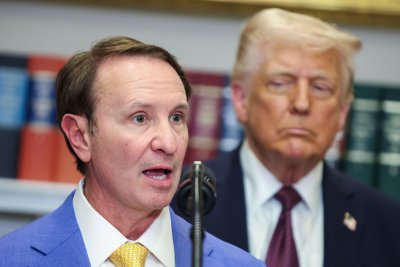
Louisiana Gov. Jeff Landry, left, is deploying up to 350 Louisiana National Guard members to New Orleans through February to ensure safety and assist the Trump administration’s federal immigration law enforcement efforts there. File Photo by Samuel Corum/UPI | License Photo
Dec. 25 (UPI) — Up to 350 Louisiana National Guard members began deploying this week in New Orleans and will stay through February to help maintain peace and safety during New Year’s and special events.
The deployment also comes amid efforts to locate and deport those who illegally are in the United States.
“These National Guard troops will support federal law enforcement partners, including the Department of Justice and the Department of Homeland Security, as they enforce federal law and counter high rates of violent crime in New Orleans and other metropolitan areas in Louisiana,” Defense Department spokesman Sean Parnell said in a prepared statement on Tuesday.
Louisiana Gov. Jeff Landry maintains his command and control of the state’s National Guard, whose mission is to enhance safety.
He said the troops will be fully deployed ahead of New Year’s Eve and will stay in New Orleans at least through February.
The deployment was announced after the Supreme Court on Tuesday struck down President Donald Trump’s effort to deploy the Illinois National Guard in Chicago over the protests of Illinois Gov. J.B. Pritzker and Chicago Mayor Brandon Johnson.
The troops will be tasked with ensuring safety in the French Quarter during New Year’s celebrations and during the Sugar Bowl and Mardi Gras.
“We know how to make cities safe, and the National Guard complements cities that are experiencing high crime,” Landry said during an appearance on The Will Cain Show.
He cited President Donald Trump’s National Guard deployment in Washington, D.C., as an example of how the troops can make cities safer for residents and visitors.
“When he wanted to send the National Guard into Washington, D.C., Louisiana was one of the first to raise its hand and say our troops will go there,” Landry said. “And the city is so much better.”
The National Capital Planning Commission will review the Trump administration’s plans to modernize the White House’s East Wing, including ballroom construction, during a Jan. 8 meeting. File Photo by Bonnie Cash/UPI | License Photo
Dec. 25 (UPI) — The National Capital Planning Commission has added the East Wing Modernization Project at the White House to its Jan. 8 agenda to review construction of a new ballroom and other improvements.
Trump administration officials will provide the commission with an informational presentation on the ballroom construction and other planned improvements, according to The Hill.
No public testimony will be heard and no vote taken on the project during the meeting, according to the NCPC.
“This is an opportunity for the project applicant to present the project and for commissioners to ask questions and provide general observations prior to formal review, which we anticipate this spring,” the NCPC said in a FAQ published on the commission’s website.
The NPC has no authority over White House demolitions or site preparations and only reviews building exteriors, per the National Capital Planning Act, but it does review proposed new construction or permanent site improvements.
The National Environmental Policy Act does give the NCPC the authority to review projects within the District of Columbia to ensure compliance with the NEPA.
The National Historic Preservation Act, though, does not apply in the matter as the White House and its grounds are excluded from its provisions.
The Trump administration initially said the construction of a new ballroom in the East Wing of the White House would cost $200 million, and said that the project will be funded by private donations.
President Donald Trump last week said the project could cost twice that amount but that donors would cover all additional costs, too.
The president earlier announced the ballroom construction, which he said is needed to provide a modern event space inside the White House.
Officials with the National Trust for Historic Preservation challenged the construction in federal court and sought an injunction to halt all work.
A federal judge denied the injunction request but ordered the Trump administration to undergo a review process for the project.
President Donald Trump holds a signed executive order reclassifying marijuana from a schedule I to a schedule III controlled substance in the Oval Office of the White House on Thursday. Photo by Aaron Schwartz/UPI | License Photo
Dec. 25 (UPI) — The remains of two Iowa National Guard soldiers killed in an ambush in Syria arrived at the Iowa National Guard base in Des Moines, with funeral services for both scheduled for this weekend.
The bodies of Staff Sgt. William Nathaniel Howard and Staff Sgt. Edgar Brian Torres-Tovar were carried off a KC-135 on Wednesday afternoon at the base as Gov. Kim Reynolds, Sen. Joni Ernst, U.S. Rep. Zach Nunn, leaders from the Guard and their families looked on, Iowa Public Radio and KCCI Des Moines reported.
“Today’s honorable transfer of Sgt. Howard and Sgt. Torres-Tovar marks their return to Iowa,” Reynolds said in a post on X. “They can now be laid to rest after making the ultimate sacrifice in defense of our nation.”
Today’s honorable transfer of Sgt. Howard and Sgt. Torres-Tovar marks their return to Iowa. They can now be laid to rest after making the ultimate sacrifice in defense of our nation. Please join me in continuing to pray for their families and honor the service and legacy of these… pic.twitter.com/zlXpziDdYI— Gov. Kim Reynolds (@IAGovernor) December 24, 2025
Howard and Torres-Tovar, who were promoted to the rank of staff sergeant posthumously, and a civilian U.S. interpreter were killed in an attack in Palmyra, Syria, on Dec. 13, in a lone gunman attack.
Their flag-draped caskets were saluted by Ernst, Nunn and Guard leaders before their families had a moment alone with them.
Iowa state and Des Moines police officers then escorted processions to Marshalltown, where Howard’s visitation and funeral will be held on Saturday, and south Des Moines, where Torres-Tovar’s visitation will be held Sunday, ahead of his funeral and burial on Monday.
Three other Guard members were also injured in the attack, two of whom are receiving treatment in the United States, while the other was treated in Syria.
President Donald Trump holds a signed executive order reclassifying marijuana from a schedule I to a schedule III controlled substance in the Oval Office of the White House on Thursday. Photo by Aaron Schwartz/UPI | License Photo
U.S. Immigration and Customs Enforcement summoned Afghans residing in the U.S. to present their documents during the holiday season, marking the latest effort by the Trump administration to crack down on migrants from the Asian nation.
ICE is seeking appointments for a “scheduled report check-in,” with one requesting such a meeting on Christmas Day and another asking for one on New Year’s Day, according to copies of letters sent to different people seen by Bloomberg News. Other notices were for check-ins around the holidays on Dec. 27 and Dec. 30.
The immigration agency has arrested migrants who appear at its offices in response to such formal requests, including those attending interviews for their green cards. Recipients of the letters had previously gained legal protection and were deemed “Afghan allies” as part of a program started by former President Joe Biden in August 2021 to protect those who fled to the U.S. after the American military’s withdrawal from Afghanistan and the Taliban’s subsequent takeover of the war-torn country.
“ICE is using federal and religious holidays to detain Afghans when access to legal counsel, courts, and advocates is at its lowest,” Shawn VanDiver, founder of the nonprofit group AfghanEvac that supports Afghans who assisted the U.S. war effort, said in a statement criticizing the call-ins and their timing. “This is not routine administrative scheduling.”
A Department of Homeland Security spokesperson, however, called the check-ins “routine” and “long-standing” without elaborating on how many letters were sent out. The spokesperson added that ICE continues its standard operations during the holidays.
Christmas and New Year’s Day are federal holidays when most government offices are closed.
The call-ins follow substantial changes to the U.S. immigration policy under President Donald Trump targeting Afghans in the wake of the November shooting of two National Guard troops by Rahmanullah Lakanwal, an Afghan national who worked with U.S. forces and the CIA in Afghanistan before arriving in the US in 2021. Homeland Security Secretary Kristi Noem said that Lakanwal, who has been charged with murder, came to the U.S. through the Biden program known as Operation Allies Welcome.
Since the November shooting, the Trump administration has announced it will re-review the cases of all refugees resettled under the Biden administration and freeze their green card applications, and will consider among “significant negative factors” a country’s inclusion on the president’s vast travel ban.
In another blow to Afghans, the administration’s refugee cap for fiscal year 2026 was vastly lowered to 7,500 from 125,000. The presidential determination indicated it will favor White South Afrikaners and did not mention Afghans.
The administration also removed an exemption for Afghan nationals with Special Immigration Visas — which offers those who provided services to the US government or military in Afghanistan — when it expanded its entry ban list to nationals of more than 30 countries from 19 previously. Afghan nationals were already on the entry ban list prior to the expansion.
The State Department earlier this year shuttered the office that helped resettle Afghan refugees who assisted the American war effort. An effort on Capitol Hill to compel the administration to restart the operations failed to make it into the defense policy bill that Trump signed this month.
With assistance from Alicia A. Caldwell. Lowenkron writes for Bloomberg.
The Bush Administration’s long-heralded gag order–a regulation that prevents federally funded family planning centers from providing abortion counseling–went into effect Thursday, leaving a bureaucratic ball of confusion for California clinics leading a nationwide fight to thwart the rule.
The state’s 220 clinics, which receive $12 million a year in federal family planning funds, have implemented an elaborate bookkeeping plan that takes advantage of state law, which contradicts the federal regulation by mandating that clinics suggest abortion as an option for pregnant women.
Under the plan, staff members whose salaries are paid with state or private money will continue to offer the counseling while those who are paid by the federal government will not.
Barbara Jackson, director of public affairs for Planned Parenthood of Orange and San Bernardino counties, said her organization simply made adjustments to use state money for pregnancy testing and options counseling and to redirect federal money for approved services. “We’re not changing our service one iota,” Jackson said Thursday. “We’re providing the same level of care for our patients that we always have and always will.
“We had made the decision that we could not deny our patients information, and we’ve not renegged on that commitment to our patients. We’ve simply been practical and decided that if we can’t use federal money for that service, we’ll use other money for that service.”
At Planned Parenthood’s five Orange County clinics Thursday, patients found signs explaining that federal money was not sudisidizing pregnancy counseling or testing. Those patients who received those services signed release forms stating that they understood that their care was funded by the state, not the federal government.
“The only thing different is simply making it clear to our patients, to anyone that is concerned about this issue, that these particular services are not funded by federal dollars,” Jackson said.
Last year, Planned Parenthood of Orange and San Bernardino counties received $122,000 in Title 10 federal funds–those that cannot now be used for pregnancy testing and counseling. That is only about 3.7% of the program’s $3.3-million budget, which made it somewhat simple to divert the funds from the prohibited activities, Jackson said. Because California has a state family planning office that funds clinics, the ruling “has a much greater impact in other parts of the country.”
But even in Southern California, some clinic’s found Thursday that while the fund-diversion plan sounded good in theory, it was not easy in practice–and could put the clinics on shaky legal ground.
At the T.H.E. Clinic for Women in Los Angeles’ Crenshaw district–where 2,500 largely poor, mostly minority women come each year for family planning services–nurse practitioners must account for every hour of their time and who is paying for it.
If a woman tests positive for pregnancy in the morning, when the nurses are being paid with state funds, she will receive counseling and pamphlets outlining her options–carrying the baby to term and raising it, placing the child up for adoption or in a foster home, or terminating the pregnancy.
But if a patient visits in the afternoon, when the nurses’ salaries are drawn from federal money, any discussion of abortion will be taboo and the woman will be told euphemistically to come back another time if she wants to talk about further options.
Across the nation, many family planning centers are following California’s lead, said Judith DeSarno, executive director of the National Family Planning and Reproductive Health Assn., which represents 90% of the nation’s 4,000 federally funded family planning clinics. “Everyone is trying a variation of the California theme,” she said.
The new system was put to the test Thursday morning at T.H.E. Clinic for Women, when nursing director Marilyn Norwood received a visit from a 21-year-old college student who is 10 weeks pregnant and wanted information about abortion. During the session, Norwood told the young woman–who had not heard of the gag order–that she would have been out of luck if she had arrived an hour later. Norwood found the encounter frustrating–and infuriating.
“I am angry,” said the bespectacled, 61-year-old nurse practitioner who has worked at the clinic for 18 years. “Now, (in the afternoons) all of a sudden I have to sit there like I have tape across my mouth?”
To Sylvia Drew Ivie, the clinic’s executive director, the plan is “a real bureaucratic nightmare. . . . We have never before had to account for time spent on what you are permitted to say and what you are not permitted to say.”
But the real hardship, Ivie said, will be on patients, many of whom have to take public transportation to the clinic and have difficulty coming for visits–let alone coming back a second time at a precise hour for counseling that was once available any time.
In rural Tulare County, Family Planning Program Inc. serves 7,000 patients each year in its three clinics. Executive Director Kay Truesdale said the program’s one full-time bookkeeper must design a system for keeping track of which money is spent on what. Truesdale is worried that the clinics will be forced to spend more on administration, which could mean a cutback in other services.
“It’s going to be difficult. We are a very small agency and it’s going to add a burden to our clinic. . . . Each layer of (bureaucracy) adds to the cost of doing business and that takes away from the money that we can use to see patients, no matter how you slice it.”
The gag order, initiated by President Ronald Reagan in 1988, goes into effect amid a flurry of activity in Washington that has opponents hoping the regulation will not remain in effect for long. The Senate on Thursday overrode President Bush’s veto of a bill that would have nullified the regulation, although the House is expected to sustain the veto.
Meanwhile, two legal challenges are pending. A federal judge in Washington may rule today on a request brought by the National Family Planning and Reproductive Health Assn. for an injunction to delay implementation of the rule. And an appeals court hearing is scheduled Oct. 14 in another lawsuit, also brought by that group.
In the interim, DeSarno said, her organization is concerned that the government could crack down on California and other states that are using creative maneuvers to get around the rule, particularly because the U.S. Department of Health and Human Services has not given explicit approval to their methods. Health and Human Services officials have only said that the California plan is under review.
“There are severe federal penalties if you say you are going to comply with regulations and then you don’t,” DeSarno said. “It’s considered fraud. We now don’t know–are we complying or are we not complying? People are being put at great risk. The California clinics may be put at great risk.”
California clinic administrators have been outspoken opponents of the abortion gag rules. Officials of the California Family Planning Council said more than a year ago that the clinics would forfeit federal assistance rather than deny women full discussion of their options. Instead, the clinics decided to try the new plan–a decision that was encouraged by a favorable court ruling in one of the lawsuits and wavering by the federal government on the precise scope of the regulations.
Sima Michaels, associate director of the council, said the organization has instructed its member clinics to post signs informing clients that federal funds are not being used for pregnancy counseling. In addition, she said, patients are being asked to sign consent forms stating that they understand that federal money is not being used for the services.
“So far,” she said, “we have not heard that our plan is not acceptable. We are complying with the gag rule. We’re just being creative about it.”
Times staff writer Jodi Wilgoren contributed to this story.
DIVISIVE ISSUE: Senate votes to override Bush abortion counseling veto. A27
BP announced Wednesday that it’s selling its majority ownership of Castrol to pay debts. File Photo by Neil Hall/EPA
Dec. 24 (UPI) — BP is selling its majority stake in Castrol to U.S. investment company Stonepeak in an effort to pay down its debt.
The company is selling its $10 billion, 65% ownership in the lubricants business to the investment firm. It will keep a 35% stake in the business through a joint venture.
The deal is expected to close at the end of 2026, the company said.
BP will use the $6 billion in proceeds to pay down some of its $26 billion in debt, the company said.
“We concluded a thorough strategic review of Castrol that generated extensive interest and resulted in the sale of a majority interest to Stonepeak,” said Interim CEO Carol Howle in a statement. “And with this, we have now completed or announced over half of our targeted $20 billion divestment program, with proceeds to significantly strengthen BP’s balance sheet. The sale marks an important milestone in the ongoing delivery of our reset strategy. We are reducing complexity, focusing the downstream on our leading integrated businesses and accelerating delivery of our plan. And we are doing so with increasing intensity – with a continued focus on growing cash flow and returns, and delivering value for our shareholders”
BP announced last week that Meg O’Neill would become CEO of BP in April. Murray Auchincloss stepped down as CEO and board director. Howle is interim CEO until O’Neill takes over.
O’Neill, an American raised in Boulder, Colo., is CEO of Woodside Energy.
Maurizio Carulli, analyst at the investment company Quilter Cheviot, called the Castrol deal “a positive step forward for BP, reinforcing its ongoing strategy reset and the aim to reduce its net debt and refocus its downstream business,” The Guardian reported.
Dec. 24 (UPI) — High winds, torrential rains and localized river flooding could make the Christmas holiday particularly challenging across much of Southern California.
A storm system is forecast to bring between 4 and 7 inches of rainfall to valleys and coastal areas located south of Santa Barbara County’s Point Conception on Thursday and Friday before dissipating on Saturday, KTLA reported.
Further east in San Bernardino County, heavy rainfall caused flash flooding and debris fields early Wednesday.
The potential for heavy rainfall and localized flooding caused the National Weather Service in Los Angeles-Oxnard to issue a flash flood warning for Santa Barbara and Ventura Counties from 4:02 a.m. to noon PST on Wednesday.
“Turn around, don’t drown when encountering flooded roads. Most flood deaths occur in vehicles,” NWS forecasters said. “Be especially cautious at night when it is harder to recognize the dangers of flooding.”
NWS forecasters also advise holiday travelers and others to be aware of their surroundings and to avoid driving on flooded roads.
“In hilly terrain, there are hundreds of low water crossings, which are potentially dangerous in heavy rain. Do not attempt to cross flooded roads. Find an alternate route,” NWS forecasters advised.
Small creeks and streams, urban areas, highways, streets and underpasses are particularly vulnerable to flash flooding, according to the NWS. So are low-lying areas and others with poor drainage.
“Some locations that will experience flash flooding include: Santa Barbara, Lompoc, Santa Ynez, Montecito, Point Conception, Carpinteria, Solvang, Isla Vista, El Capitan State Beach, Refugio State Beach, Highway 101 through Gaviota State Park, Summerland, Rincon Point, La Conchita, Goleta, Buellton, Lake Cachuma, Highway 154 over San Marcos Pass, Santa Barbara Airport and Hope Ranch,” NWS forecasters warned.
Areas north of Point Conception are expected to get between 2 and 4 inches of rainfall in coastal and valley areas and between 4 and 7 inches in foothills and mountains through Friday.
Those south of Point Conception are expected to see heavier rainfall amounts of between 4 and 7 inches in coastal and valley areas and between 6 and 14 inches in foothills and mountains through Friday.
Heavy rainfall would become especially dangerous and destructive in local burn areas, where flooding and debris flows are more likely.
The rainfall could be accompanied by strong and gusty southeast and south winds on Wednesday and Thursday, with gusts of between 60 and 80 mph predicted across Santa Barbara and San Luis Obispo Counties, in the Ventura and Los Angeles mountains and Antelope Valley.
Winds gusting to between 35 and 55 mph are predicted in other areas, and high wind warnings and wind advisories remain in effect until the storm system passes on Saturday.
Former President Joe Biden presents the Presidential Citizens Medal to Liz Cheney during a ceremony in the East Room of the White House in Washington, on January 2, 2025. The Presidential Citizens Medal is bestowed to individuals who have performed exemplary deeds or services. Photo by Will Oliver/UPI | License Photo
Dec. 24 (UPI) — The United States is witnessing an unprecedented decline in murders with 2025 projected to mark the largest one-year drop on record, an analysis of crime data indicates.
Crime analyst Jeff Asher, using data from the Real Time Crime Index, said murders have fallen nearly 20% nationwide between 2024 and 2025 following a 13% decline the previous year.
Several major cities hardest hit by gun violence were reporting sharp decreases.
Baltimore has been down 31%, Atlanta 26%, Albuquerque 32% and Birmingham at nearly 49%.
Nationally, robberies, property crime and aggravated assaults have also fallen by 18%, 12% and 7%, respectively.
The Hill attributed the decline to post-pandemic stabilization and heightened anti-violence initiatives at the local and federal level.
In Memphis alone, murders dropped by almost 20% while Chicago recorded a 28% decrease.
Asher estimates roughly 12,000 fewer homicides occurred in 2024-2025 than during the pandemic peak though final FBI data is still pending.
Clouds turn shades of red and orange when the sun sets behind One World Trade Center and the Manhattan skyline in New York City on November 5, 2025. Photo by John Angelillo/UPI | License Photo