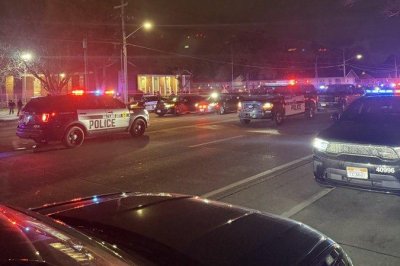
Jan. 8 (UPI) — Salt Lake City police are searching early Thursday for suspects after two people were killed and six others wounded in a shooting outside a church where a funeral was taking place Wednesday evening.
No suspects are in custody, and authorities said they are following leads and won’t stop until those responsible have been apprehended.
“Our officers are working hard, and we will work until we bring these individuals to justice,” Salt Lake City Police Chief Brian Redd told reporters during a press conference.
“We are confident we will bring these individuals to justice.”
Authorities said that the shooting occurred outside The Church of Jesus Christ of Latter-day Saints following an altercation in the parking lot on Redwood Road.
Police are investigating if there were more than one shooter involved, and Redd said they do not believe that the shooting targeted the church.
“It’s probably too early to say it’s gang related, but yes, our gang detectives are here and we are definitely looking at that angle,” he said.
Of the wounded, three were in critical condition, according to a Salt Lake City Police Department statement on X.
Dozens of people were attending the funeral when the shots rang out, and they are currently being interviewed, Redd said.
We are on scene of a shooting at 660 N. Redwood Road.
2 people were killed and at least 6 more have been injured with at least 3 of those in critical condition.
The suspects are still outstanding, but our officers have obtained solid leads and are working to locate those… pic.twitter.com/SleDVievfv— Salt Lake City Police Department (@slcpd) January 8, 2026
Salt Lake City Mayor Erin Mendenhall said the shooting should never have happened.
“This should never have happened at a place of worship. It should not have happened at a celebration of life that was occurring inside of the church tonight,” she said.
“Our condolences continue to grow and we know that this impacts not only those victims and their families, the community that was at the church, but the entire community here in Salt Lake City on the West Side.
A spokesman for The Church of Jesus Christ of Latter-day Saints said in a statement to local media that they were aware of the shooting and were cooperating with law enforcement.
According to The Gun Violence Archive, which tallies gun violence in the United States, the incident was the 9th mass shooting to take place in the country so far this year.
There were 406 mass shootings, which involved four or more victims, for all of 2025.
Weekly insights and analysis on the latest developments in military technology, strategy, and foreign policy.
U.S. forces have secured the runaway Russian-flagged oil tanker Marinera, a U.S. official has confirmed to TWZ. Elements of the U.S. Army’s 160th Special Operations Aviation Regiment and other American aviation assets had previously deployed to the United Kingdom ahead of an apparent effort to board the ship. Readers can get caught up on the pursuit with our latest coverage here.
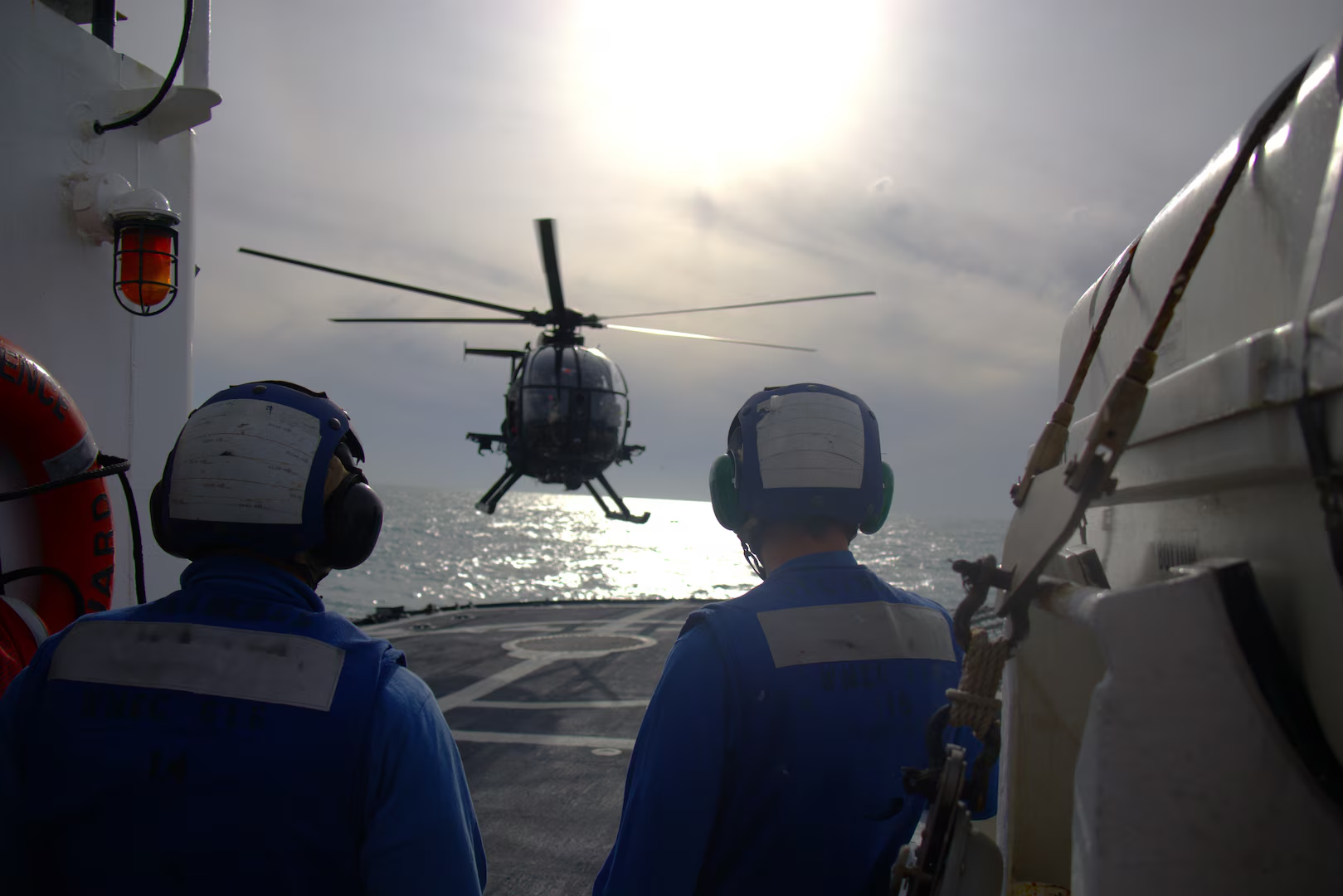
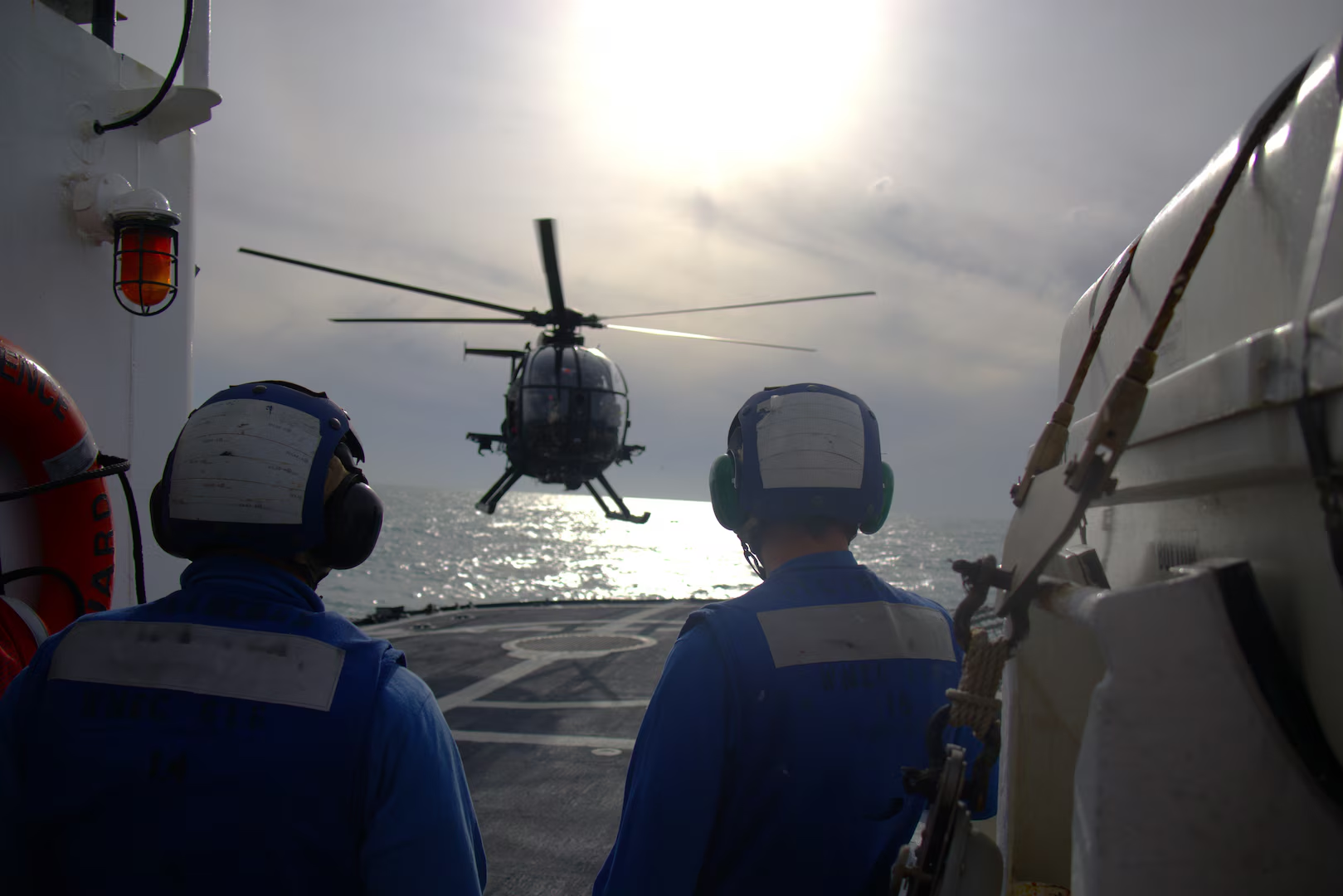
Personnel from the U.S. military and the U.S. Coast Guard carried out the boarding operation, according to reports from Reuters and The Wall Street Journal. Russian news outlet RT had earlier released imagery said to have been taken from the deck of the Marinera showing an MH-6 Little Bird helicopter, a type operated by the 160th SOAR, approaching the ship.
In the past several hours, open source flight tracking had also shown a large number of aircraft from bases in the United Kingdom heading north toward where the ship is located.
UPDATE 1200Z 07/JAN/2026 – We’ve confirmed a few of the earlier RAF flights are involved in other routine operations, but we now have a confirmed stream of US support aircraft, ISTAR and other platforms heading for the UK-Iceland gap, likely staging for the tanker Op!#BELLA1… https://t.co/knpNOL2oNKpic.twitter.com/wX2dBUluUQ
Ship tracking data available online had also shown the Marinera, which had been shadowed by a wide range of aviation assets and a U.S. Coast Guard cutter for weeks now, making a sharp turn to the south in the direction of the United Kingdom and Ireland.
Marinera (IMO 9230880) formally Bella 1 made a sudden southbound turn at 11:26 UTC near 60.9386N, 16.37014W, slowing from ~9 kn to ~8 kn.
Known until recently as the Bella-1 before it was re-registered and the crew painted a Russian flag on it, the Marinera is part of a so-called shadow fleet. These vessels are accused of transporting oil for Russia, Iran, and Venezuela in violation of sanctions imposed by the United States and other countries. On December 20, the Coast Guard had previously attempted to board the ship, which is not carrying any oil at present, as it headed toward Venezuela. However, the crew refused to allow it, and the ship began sailing back toward Europe. Reports earlier this week said that new U.S. plans to interdict the boat had subsequently been drawn up, tied to the aforementioned deployment of special operations forces and other assets to the United Kingdom.
The Wall Street Journal reported yesterday that the Russian military had sent a submarine and other naval assets to escort the Marinera. Reuters has reported that Russian Navy vessels were in the vicinity when the boarding operation occurred.
Where the Marinera may now be headed and what its ultimate fate may be remains to be seen.
TWZ will continue to update this story as it develops.
Update: 9:14 AM Eastern –
U.S. European Command released a statement about the seizure on X.
It has been pointed out that Little Birds are not capable of being refueled in flight and likely would not have had the range to reach the tanker from bases on land in the region. It is more likely that any MH-6s involved in this operation launched from a ship closer by. The 160th SOAR is known to train to operate its Little Birds from Coast Guard cutters. Night Stalker helicopters also have a long history of flying from U.S. Navy ships, including recently during the operation to capture Venezuelan dictator Nicolas Maduro.
A Little Bird aboard the Coast Guard cutter Diligence during a 2023 interdiction mission. (USCG)
We have reached out to the Pentagon and U.S. Coast Guard for more details and will update this story with any pertinent information provided.
Update: 9:32 AM Eastern –
The U.K. Defense Ministry (MoD) provided us with a statement about its aircraft observed over the North Atlantic.
“Quick Reaction Alert Typhoon fighter aircraft were launched on 6 Jan from RAF Lossiemouth…after unidentified aircraft were tracked flying towards UK airspace. The aircraft remained outside of our area of interest (UK FIR) and no intercept took place. The launch of RAF QRA aircraft from RAF Lossiemouth and supporting AAR Voyager from RAF Brize Norton was not associated with any form of maritime surveillance operations.”
Update: 9:36 AM Eastern –
War Secretary Pete Hegseth weighed in on the seizure, saying that “the blockade of sanctioned and illicit Venezuelan oil remains in FULL EFFECT – anywhere in the world.” The Marinera, however, never arrived in port and was not carrying any fuel.
Meanwhile, as the seizure of the Marinera was taking place, the U.S. also boarded another sanctioned oil tanker in the Caribbean, according to U.S. Southern Command (SOUTHCOM).
“In a pre-dawn action this morning, the Department of War, in coordination with the Department of Homeland Security, apprehended a stateless, sanctioned dark fleet motor tanker without incident,” SOUTHCOM announced on X. “The interdicted vessel, M/T Sophia, was operating in international waters and conducting illicit activities in the Caribbean Sea. The U.S. Coast Guard is escorting M/T Sophia to the U.S. for final disposition. Through Operation Southern Spear, the Department of War is unwavering in its mission to crush illicit activity in the Western Hemisphere. We will defend our Homeland and restore security and strength across the Americas.”
In a pre-dawn action this morning, the Department of War, in coordination with the Department of Homeland Security, apprehended a stateless, sanctioned dark fleet motor tanker without incident.
The interdicted vessel, M/T Sophia, was operating in international waters and… pic.twitter.com/JQm9gHprPk
Officials in the U.K. would likely have had to sign off on this operation, The Times reported.
The British government would have given the green light for the American mission to seize a Venezuela-linked oil tanker, a senior UK military source tells @thetimeshttps://t.co/RNMph9P1zz
British aviation journalist Gareth Jennings notes that the Little Birds can be equipped with a 62-gallon auxiliary fuel tank, giving them an operating radius of about 670 kilometers (about 416 miles).
They can be equipped with a 62 US gallon auxiliary Goliath fuel tank to double the capacity of the 62 US gallon main fuel tank. Would give an approx 670 km operating radius.
There are several ways Little Birds can take part in a mission like this, as our editor-in-chief Tyler Rogoway notes.
Update: 9:57 AM Eastern –
U.S. Homeland Security Secretary Kristi Noem also released a statement, confirming that the Coast Guard Legend class cutter trailing the Marinerawe wrote about yesterday was the Munro.
“One of these tankers, Motor Tanker Bella I, has been trying to evade the Coast Guard for weeks, even changing its flag and painting a new name on the hull while being pursued, in a desperate and failed attempt to escape justice,” Noem stated on X. “The heroic crew of the USCGC Munro pursued this vessel across the high seas and through treacherous storms— keeping diligent watch, and protecting our country with the determination and patriotism that make Americans proud. These brave men and women deserve our nation’s thanks for their selfless devotion to duty.”
In two predawn operations today, the Coast Guard conducted back-to-back meticulously coordinated boarding of two “ghost fleet” tanker ships— one in the North Atlantic Sea and one in international waters near the Caribbean. Both vessels —the Motor Tanker Bella I and the Motor… pic.twitter.com/EZlHEtcufX
“In accordance with the norms of the 1982 UN Convention on the Law of the Sea, a regime of freedom of navigation operates in the waters of the high seas, and no state has the right to use force against ships properly registered in the jurisdictions of other states,” the message said.
“According to the department, the ship received a temporary permit to sail under the Russian state flag on December 24th,” the official Russian RIA Novosti media outlet reported on Telegram. The vessel was boarded at 3 p.m. local time (7 a.m. Eastern).
The first official statement from the Russian government following the seizure of Russia-flagged MARINERA / BELLA-1 tanker by the United States.
Russian Ministry of Transport refers to the UN Convention on the Law of the Sea:
— Status-6 (War & Military News) (@Archer83Able) January 7, 2026
Update: 10:39 AM Eastern –
Flight tracking data claims to show that U.S. Air Force Special Operations Command (AFSOC) AC-130J Ghostrider gunships were overhead during the Marinera operation. While we can’t independently confirm this, TWZ has written about the value Ghostriders can bring to this kind of maritime interdiction operation, which you can read about here.
Ok so we have N103MC, and N167MC. We’ll have to find more.
I totally think these are tactical regs/hexes they are using for ops. https://t.co/imxwlH2gfY
As we previously reported, these aircraft arrived at RAF Mildenhall on Sunday. Local photographer Andrew McKelvey shared some photos of one of those Ghostriders, ARSON17, taking off from Mildenhall at about 9:45 a.m. local time (4:45 a.m. Eastern). AFSOC declined comment.
In a post on his Truth Social site yesterday, Trump explained that Venezuela will be turning over tens of millions of barrels of oil to the U.S. to sell.
“I am pleased to announce that the Interim Authorities in Venezuela will be turning over between 30 and 50 MILLION Barrels of High Quality, Sanctioned Oil, to the United States of America,” Trump proclaimed on Truth Social. “This Oil will be sold at its Market Price, and that money will be controlled by me, as President of the United States of America, to ensure it is used to benefit the people of Venezuela and the United States! I have asked Energy Secretary Chris Wright to execute this plan, immediately. It will be taken by storage ships, and brought directly to unloading docks in the United States.”
( @realDonaldTrump – Truth Social Post ) ( Donald J. Trump – Jan 06 2026, 6:46 PM ET )
I am pleased to announce that the Interim Authorities in Venezuela will be turning over between 30 and 50 MILLION Barrels of High Quality, Sanctioned Oil, to the Unit… pic.twitter.com/OKsLNqPShe
— Donald J Trump Posts TruthSocial (@TruthTrumpPost) January 7, 2026
Update: 12:04 AM Eastern –
The rhetoric from Moscow about the Marinera operation is ramping up.
“We need to attack with torpedoes and sink a couple of American patrol boats,” Alexei Zhuravlev, the first deputy head of the State Duma’s Defense Committee, said today. “The U.S. needs a military response to the Marinera situation. The U.S., which is enjoying a kind of euphoria of impunity after the special operation in Venezuela, can only be stopped now with a slap in the face like this.”
Update: 12:42 PM Eastern –
During her afternoon briefing, White House Press Secretary Karoline Leavitt was asked several questions about the seizure of the Marinera, as well as the Sophia. She was also queried about whether she had any information about the Russian submarine that The Wall Street Journal on Tuesday said was deployed to escort the ship. Below are some of those interactions.
Q: Russia specifically asked the United States not to seize that tanker. Does this action risk a larger conflict with Russia?
A: The vessel this morning was seized in the North Atlantic pursuant to a warrant issued by a U.S. Federal Court after being tracked, and this was a Venezuelan shadow fleet vessel that has transported sanctioned oil. And the United States of America under this president is not going to tolerate that. I would also just add the vessel had a judicial seizure order and the crew, so that means the crew is now subject to prosecution for any applicable violation of federal law, and they will be brought to the United States for such prosecution.
Q: Are you concerned about increasing tensions with Russia because of the tanker?
A: “…with respect to these ships seizures, that means enforcing the embargo against all Dark Fleet vessels that are illegally transporting oil and only legitimate commerce. To answer your question … that’s the policy of this administration, and he’s not afraid to implement it.
Q: Was there any engagement with that submarine … and what is the deconfliction on the Russian use ahead of that type of warning package?
A: Again, this was a Venezuelan shadow fleet vessel that has transported sanctioned oil. The vessel was deemed stateless after flying a false flag, and it had a judicial seizure order, and that’s why the crew will be subject to prosecution.
Update: 12:57 PM Eastern –
The U.K. “provided enabling support to the United States at their request to interdict the vessel,” according to the MoD, which is using the ship’s previous name to reference it.
“U.K. armed forces provided pre-planned operational support, including basing, to U.S. military assets interdicting the Bella 1 between the U.K. and Iceland following a U.S. request for assistance,” the MoD said in a statement. “RFA Tideforce is providing support for U.S. forces pursuing and interdicting the Bella 1, while the RAF provided surveillance support from the air.”
“This ship, with a nefarious history, is part of a Russian-Iranian axis of sanctions evasion which is fuelling terrorism, conflict, and misery from the Middle East to Ukraine,” Defense Secretary John Healey said. “The UK will continue to step up our action against shadow fleet activity to protect our national security, our economy, and global stability – making Britain secure at home and strong abroad.”
“Deterring and disrupting the Russian shadow fleet is a priority for the U.K.,” MoD added. “To date, we have imposed sanctions on 520 Russian shadow fleet vessels. This is working. For example, Russia’s critical oil revenues are down 27% compared to October 2024, the lowest since the start of the war in Ukraine.”
Update: 1:57 PM Eastern –
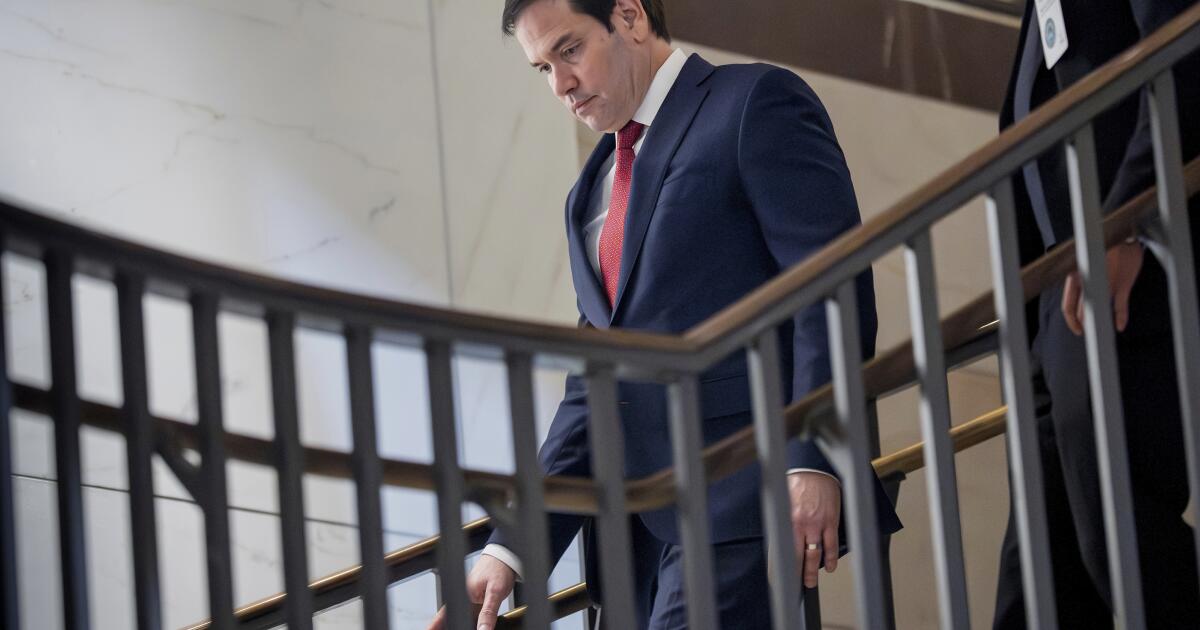
Speaking to reporters on Capitol Hill in between Congressional briefings on Venezuela, Secretary of State Marco Rubio claimed that the Venezuelans want the oil from the seized tanker Sophia to be part of the aforementioned deal Trump stated on Truth Social.
NEW: Sec. Hegseth and Sec. Rubio speak after Senate briefing on Venezuela:
“They want that oil that was seized to be part of this deal. They understand that the only way they can move oil and generate revenue and not have economic collapse is if they cooperate and work with the… pic.twitter.com/EbUz1LNaA4
“We are going to take between 30 and 50 million barrels of oil. We’re going to sell it in the marketplace at market rates, not at the discounts Venezuela was getting. That money will then be handled in such a way that we will control how it is dispersed in a way that benefits the… pic.twitter.com/HdUEYRi8zO
Jan. 7 (UPI) — President Donald Trump said Wednesday night that he will withdraw the United States from dozens of international organizations and treaties, escalating the U.S. policy shift from multilateral engagement under his second administration.
The 66 international organizations, conventions and treaties affected were those deemed “contrary to the interests of the United States,” according to a statement from the White House.
The withdrawal was initiated via a presidential memorandum, which names 35 non-United Nations organizations and 31 U.N. entities. Among them are the landmark U.N. Framework Convention on Climate Change, established in 1992, and several others that fight climate change, the U.N. Entity for Gender Equality and the Empowerment of Women, U.N. Oceans and the U.N. Alliance of Civilizations.
“The Trump administration has found these institutions to be redundant in their scope, mismanaged, unnecessary, wasteful, poorly run, captured by the interests of actors advancing their own agendas contrary to our own, or a threat to our nation’s sovereignty, freedoms and general prosperity,” Secretary of State Marco Rubio said in a statement.
“President Trump is clear: It is no longer acceptable to be sending these institutions the blood, sweat and treasure of the American people, with little to nothing to show for it.”
Since returning to the White House in January, Trump has used his executive powers to expunge left-leaning ideology and initiatives from U.S. domestic and foreign policy. Rubio argued that the dozens of organizations and treaties the United States was exiting are those where progressive ideology “detached from national interests.”
“From DEI mandates to ‘gender equity’ campaigns to climate orthodoxy, many international organizations now serve a globalist project rooted in the discredited fantasy of the ‘End of History,'” he said.
“These organizations actively seek to constrain American sovereignty,” he continued. “Their work is advanced by the same elite networks — the multilateral ‘NGO-plex’ — that we have begun dismantling through the closure of USAID.”
A fact sheet from the White House claims that many of the organizations named Wednesday “promote radical climate policies, global governance and ideological programs that conflict with U.S. sovereignty and economic strength.”
“By exiting these entities, President Trump is saving taxpayer money and refocusing resources on America First policies.”
Trump has frequently rallied against international organizations that have stood counter or even criticized his policies. He has twice removed the United States from the World Health Organization, first during his first term and again on his first day in office of his second after President Joe Biden reinstated the United States’ membership in the world’s leading health organization.
The same day he pulled the United States from the WHO he directed the withdrawal from the U.N. Framework Convention on Climate Change, also known as the Paris Agreement.
He has also twice withdrawn the United States from The U.N. Educational, Scientific and Cultural Organization, better known as UNESCO. He also withdrew the United States from the U.N. Human Rights Council and prohibited future funding to the U.N. Relief and Works Agency for the Near East.
During his first term, he withdrew the United States from the landmark Obama-era multinational accord that aimed to prevent Iran from gaining a nuclear weapon and the Intermediate-Range Nuclear Forces Treaty.
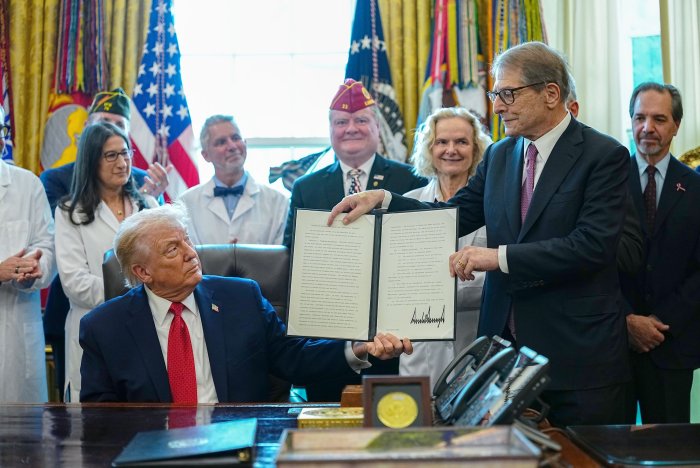
“I’ve always felt that the U.N. has tremendous potential. It’s not living up to that potential right now — it really isn’t — hasn’t for a long time,” Trump said Wednesday before signing the memorandum in the Oval Office.
“There are great hopes for it, but it’s not being well run, to be honest.”
President Donald Trump holds a signed executive order reclassifying marijuana from a schedule I to a schedule III controlled substance in the Oval Office of the White House on Thursday. Photo by Aaron Schwartz/UPI | License Photo
WASHINGTON — The Trump administration will withdraw from dozens of international organizations, including the U.N.’s population agency and the U.N. treaty that establishes international climate negotiations, as the U.S. further retreats from global cooperation.
President Trump on Wednesday signed an executive order suspending U.S. support for 66 organizations, agencies and commissions following his instructions for his administration to review participation in and funding for all international organizations, including those affiliated with the United Nations, according to a White House statement on social media.
Most of the targets are U.N.-related agencies, commissions and advisory panels that focus on climate, labor and other issues that the Trump administration has categorized as catering to diversity and “woke” initiatives, according to a partial list obtained by The Associated Press.
“The Trump Administration has found these institutions to be redundant in their scope, mismanaged, unnecessary, wasteful, poorly run, captured by the interests of actors advancing their own agendas contrary to our own, or a threat to our nation’s sovereignty, freedoms, and general prosperity,” the State Department said in a statement.
Trump’s decision to withdraw from organizations that foster cooperation among nations to address global challenges comes as his administration has launched military efforts or issued threats that have rattled allies and adversaries alike, including capturing autocratic Venezuelan leader Nicolás Maduro and indicating an intention to take over Greenland.
This is the latest U.S. withdrawal from global agencies
The administration previously suspended support from agencies like the World Health Organization, the U.N. for Palestinian refugees known as UNRWA, the U.N. Human Rights Council and the U.N. cultural agency UNESCO as it has taken a larger, a-la-carte approach to paying its dues to the world body, picking which operations and agencies they believe align with Trump’s agenda and those which no longer serve U.S. interests.
“I think what we’re seeing is the crystallization of the U.S. approach to multilateralism, which is ‘my way or the highway,’” said Daniel Forti, head of U.N. affairs at the International Crisis Group. “It’s a very clear vision of wanting international cooperation on Washington’s own terms.”
It has marked a major shift from how previous administrations — both Republican and Democratic — have dealt with the U.N., and it has forced the world body, already undergoing its own internal reckoning, to respond with a series of staffing and program cuts.
Many independent nongovernmental agencies — some that work with the United Nations — have cited many project closures because of the U.S. administration’s decision last year to slash foreign assistance through the U.S. Agency for International Development, or USAID.
Despite the massive shift, the U.S. officials, including Trump himself, say they have seen the potential of the U.N. and want to instead focus taxpayer money on expanding American influence in many of the standard-setting U.N. initiatives where there is competition with China, like the International Telecommunications Union, the International Maritime Organization and the International Labor Organization.
The global organizations from which the U.S. is departing
The withdrawal from the U.N. Framework Convention on Climate Change, or UNFCCC, is the latest effort by Trump and his allies to distance the U.S. from international organizations focused on climate and addressing climate change.
UNFCC, the 1992 agreement between 198 countries to financially support climate change activities in developing countries, is the underlying treaty for the landmark Paris climate agreement. Trump — who calls climate change a hoax — withdrew from that agreement soon after reclaiming the White House.
Mainstream scientists say climate change is behind increasing instances of deadly and costly extreme weather, including flooding, droughts, wildfires, intense rainfall events and dangerous heat.
The U.S. withdrawal could hinder global efforts to curb greenhouse gases because it “gives other nations the excuse to delay their own actions and commitments,” said Stanford University climate scientist Rob Jackson, who chairs the Global Carbon Project, a group of scientists that tracks countries’ carbon dioxide emissions.
It also will be difficult to achieve meaningful progress on climate change without cooperation from the U.S., one of the world’s largest emitters and economies, experts said.
The U.N.’s population agency, which provides sexual and reproductive health across the world, has long been a lightning rod for Republican opposition and Trump himself cut funding for the agency during his first term in office. He and other GOP officials have accused the agency of participating in “coercive abortion practices” in countries like China.
When President Joe Biden took office in January 2021, he restored funding for the agency. A State Department review conducted the following year found no evidence to support these claims.
Other organizations and agencies that the U.S. will quit include the Carbon Free Energy Compact, the United Nations University, the International Cotton Advisory Committee, the International Tropical Timber Organization, the Partnership for Atlantic Cooperation, the Pan-American Institute for Geography and History, the International Federation of Arts Councils and Culture Agencies and the International Lead and Zinc Study Group.
The State Department said additional reviews are ongoing.
Lee and Amiri write for the Associated Press. Amiri reported from the United Nations. AP writer Tammy Webber reported from Fenton, Mich.
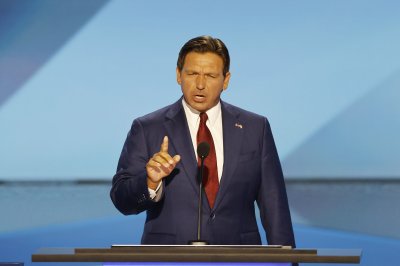
Jan. 7 (UPI) — Florida Gov. Ron DeSantis issued a proclamation on Wednesday calling on the state Legislature to hold a special session for the purpose of redistricting its U.S. House seats.
The special session is to occur in April and will last no more than 20 consecutive days, unless extended by a three-fifths vote in each chamber, the proclamation says.
“Every Florida resident deserves to be represented fairly and constitutionally,” DeSantis said in a news release.
“Today, I announced that I will be convening a special session of the Legislature focused on redistricting to ensure that Florida’s congressional maps accurately reflect the population of our state and to comply with an upcoming U.S. Supreme Court ruling,” he said.
“This special session will take place after the regular legislative session, which will allow the Legislature to first focus on the pressing issues facing Floridians before devoting its full attention to congressional redistricting in April.”
He said the redistricting will better ensure that race is not a predominant factor in determining Florida’s federal congressional districts and cited a Supreme Court case challenging recent redistricting in Louisiana that created a congressional district comprising mostly of racial minority populations.
That case accuses Louisiana of violating the 14th and 15th Amendments to the U.S. Constitution by using race as a basis for creating congressional districts.
DeSantis’ proclamation says there is no law against the state redrawing its congressional district mid-decade, and a majority vote in both chambers of Florida’s bicameral Legislature is required to legally redraw the districts ahead of the 2026 mid-term elections.
Florida has 28 U.S. House seats after gaining one in 2022 as a result of the 2020 census, with Republicans holding 20 seats and Democrats eight.
Florida’s redistricting effort comes after several other states have announced their intent to do the same or already have, with Texas and California being the most-publicized efforts.
WASHINGTON — President Trump’s administration on Wednesday sought to assert its control over Venezuelan oil, seizing a pair of sanctioned tankers transporting petroleum and announcing plans to relax some sanctions so the U.S. can oversee the sale of Venezuela’s petroleum worldwide.
Trump’s administration intends to control the distribution of Venezuela’s oil products globally following its ouster of President Nicolás Maduro in a surprise nighttime raid. Besides the United States enforcing an existing oil embargo, the Energy Department says the “only oil transported in and out of Venezuela” will be through approved channels consistent with U.S. law and national security interests.
That level of control over the world’s largest proven reserves of crude oil could give the Trump administration a broader hold on oil supplies globally in ways that could enable it to influence prices. Both moves reflect the Republican administration’s determination to make good on its effort to control the next steps in Venezuela through its vast oil resources after Trump has pledged the U.S. will “run” the country.
Secretary of State Marco Rubio suggested that the oil taken from the sanctioned vessels seized in the North Atlantic and the Caribbean Sea would be sold as part of the deal announced by Trump on Tuesday under which Venezuela would provide up to 50 million barrels of oil to the U.S.
“One of those ships that was seized that had oil in the Caribbean, you know what the interim authorities are asking for in Venezuela?” Rubio told reporters after briefing lawmakers Wednesday about the Maduro operation. “They want that oil that was seized to be part of this deal. They understand that the only way they can move oil and generate revenue and not have economic collapse is if they cooperate and work with the United States.”
Seizing 2 more vessels
U.S. European Command said on social media that the merchant vessel Bella 1 was seized in the North Atlantic for “violations of U.S. sanctions.” The U.S. had been pursuing the tanker since last month after it tried to evade a blockade on sanctioned oil vessels around Venezuela.
Homeland Security Secretary Kristi Noem revealed U.S. forces also took control of the M Sophia in the Caribbean Sea. Noem said on social media that both ships were “either last docked in Venezuela or en route to it.”
The two ships join at least two others that were taken by U.S. forces last month — the Skipper and the Centuries.
The Bella 1 had been cruising across the Atlantic nearing the Caribbean on Dec. 15 when it abruptly turned and headed north, toward Europe. The change in direction came days after the first U.S. tanker seizure of a ship on Dec. 10 after it had left Venezuela carrying oil.
When the U.S. Coast Guard tried to board the Bella 1, it fled. U.S. European Command said a Coast Guard vessel had tracked the ship “pursuant to a warrant issued by a U.S. federal court.”
As the U.S. pursued it, the Bella 1 was renamed Marinera and flagged to Russia, shipping databases show. A U.S. official, who spoke on the condition of anonymity to discuss sensitive military operations, said the ship’s crew had painted a Russian flag on the side of the hull.
The Russian Foreign Ministry said it had information about Russian nationals among the Marinera’s crew and, in a statement carried by Russia’s state news agencies Tass and RIA Novosti, demanded that “the American side ensure humane and dignified treatment of them, strictly respect their rights and interests, and not hinder their speedy return to their homeland.”
Separately, a senior Russian lawmaker, Andrei Klishas, decried the U.S. action as “blatant piracy.”
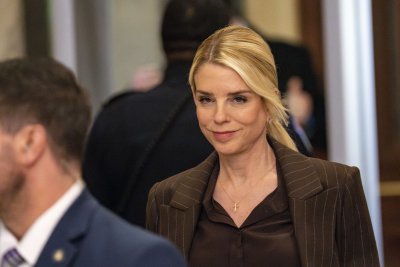
The Justice Department is investigating crew members of the Bella 1 vessel for failing to obey Coast Guard orders and “criminal charges will be pursued against all culpable actors,” Atty. Gen. Pam Bondi said.
“The Department of Justice is monitoring several other vessels for similar enforcement action — anyone on any vessel who fails to obey instructions of the Coast Guard or other federal officials will be investigated and prosecuted to the fullest extent of the law,” Bondi said on X.
The ship had been sanctioned by the U.S. in 2024 on allegations of smuggling cargo for a company linked to Lebanese militant group Hezbollah, which is backed by Iran.
Easing sanctions so U.S. can sell oil
The Trump administration, meanwhile, is “selectively” removing sanctions to enable the shipping and sale of Venezuelan oil to markets worldwide, according to an outline of the policies published Wednesday by the Energy Department.
The sales are slated to begin immediately with 30 million to 50 million barrels of oil. The U.S. government said the sales “will continue indefinitely,” with the proceeds settling in U.S.-controlled accounts at “globally recognized banks.” The money would be disbursed to the U.S. and Venezuelan populations at the “discretion” of Trump’s government.
Venezuelan state-owned oil company PDVSA said it is in negotiations with the U.S. government for the sale of crude oil.
“This process is developed under schemes similar to those in force with international companies, such as Chevron, and is based on a strictly commercial transaction, with criteria of legality, transparency and benefit for both parties,” the company said in the statement.
The U.S. plans to authorize the importation of oil field equipment, parts and services to increase Venezuela’s oil production, which has been roughly 1 million barrels a day.
The Trump administration has indicated it also will invest in Venezuela’s electricity grid to increase production and the quality of life for people in Venezuela, whose economy has been unraveling amid changes to foreign aid and cuts to state subsidies, making necessities, including food, unaffordable to millions.
Ships said to be part of a shadow fleet
Noem said both seized ships were part of a shadow fleet of rusting oil tankers that smuggle oil for countries facing sanctions, such as Venezuela, Russia and Iran.
After the seizure of the now-named Marinera, which open-source maritime tracking sites showed was between Scotland and Iceland earlier Wednesday, the U.K. defense ministry said Britain’s military provided support, including surveillance aircraft.
“This ship, with a nefarious history, is part of a Russian-Iranian axis of sanctions evasion which is fueling terrorism, conflict, and misery from the Middle East to Ukraine,” U.K. Defense Secretary John Healey said.
The capture of the M Sophia, on the U.S. sanctions list for moving illicit cargos of oil from Russia, in the Caribbean was much less prolonged.
The ship had been “running dark,” not having transmitted location data since July. Tankers involved in smuggling often turn off their transponders or broadcast inaccurate data to hide their locations.
Samir Madani, co-founder of TankerTrackers.com, said his organization used satellite imagery and surface-level photos to document that at least 16 tankers had left the Venezuelan coast since Saturday, after the U.S. captured Maduro.
The M Sophia was among them, Madani said, citing a recent photo showing it in the waters near Jose Terminal, Venezuela’s main oil export hub.
Windward, a maritime intelligence firm that tracks such vessels, said in a briefing to reporters the M Sophia loaded at the terminal on Dec. 26 and was carrying about 1.8 million barrels of crude oil — a cargo that would be worth about $108 million at current price of about $60 a barrel.
The press office for Venezuela’s government did not immediately respond to an Associated Press request for comment on the seizures.
Toropin, Boak, Lawless and Biesecker write for the Associated Press. Lawless reported from London.
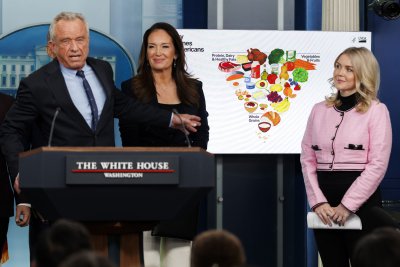
Jan. 7 (UPI) — The Trump administration announced Wednesday it created new dietary guidelines and created a new food pyramid.
“Under President Trump’s leadership common sense, scientific integrity and accountability have been restored to federal food and health policy,” a fact sheet from the Department of Health and Human Services announced. “For decades, the Dietary Guidelines favored corporate interests over common sense, science-driven advice to improve the health of Americans. That ends today.”
The new guidelines focus on high-quality protein, healthy fats, fruits, vegetables and whole grains, the fact sheet said. It calls for people to avoid highly processed foods and refined carbohydrates.
“The Dietary Guidelines are the foundation to dozens of federal feeding programs, and today marks the first step in making sure school meals, military and veteran meals, and other child and adult nutrition programs promote affordable, whole, healthy, nutrient-dense foods,” the fact sheet said.
The government also released a new website, Realfood.gov.
The American Heart Association said it welcomed the new guidelines on fruits, vegetables and whole grains.
The AHA “commends the inclusion of several important science-based recommendations, notably the emphasis on increasing intake of vegetables, fruits and whole grains while limiting consumption of added sugars, refined grains, highly processed foods, saturated fats and sugary drinks,” the AHA said in a statement.
But it took issue with some of the recommendations.
“We are concerned that recommendations regarding salt seasoning and red meat consumption could inadvertently lead consumers to exceed recommended limits for sodium and saturated fats, which are primary drivers of cardiovascular disease. While the guidelines highlight whole-fat dairy, the Heart Association encourages consumption of low-fat and fat-free dairy products, which can be beneficial to heart health,” the statement said.
The new guidance pushes protein at every meal and says to eat as much as twice the recommended daily allowance of 0.08 grams of protein per kilogram of body weight. It says to eat 1.2 to 1.6 grams. Proteins can be flavored with “salt, spices, and herbs,” it said.
The guidelines also recommend full-fat dairy, which is different from past recommendations of low-fat or fat-free dairy. Full-fat dairy has saturated fats. The fact sheet calls this “ending the war on healthy fats.”
“Paired with a reduction in highly processed foods laden with refined carbohydrates, added sugars, excess sodium, unhealthy fats, and chemical additives, this approach can change the health trajectory of America,” the fact sheet said.
“When [Diversity, Equity and Inclusion] impacts nutrition science, it enables special interests to argue the status quo is acceptable because it would violate ‘health equity’ principles to encourage Americans to eat healthier food,” the fact sheet added.
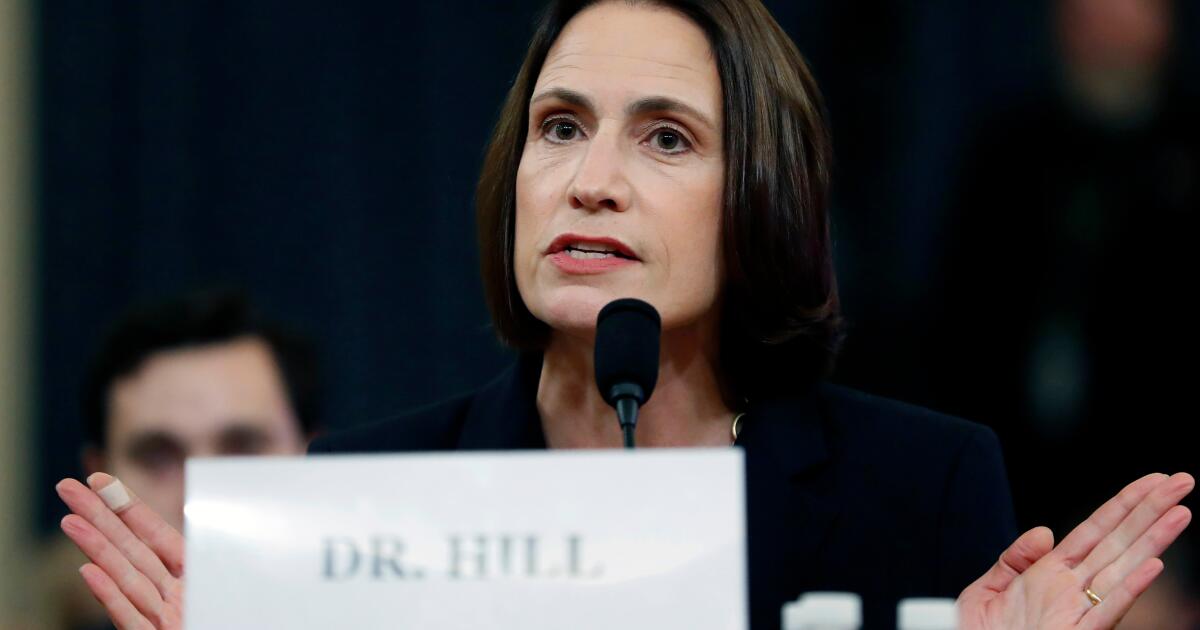
Russian officials indicated in 2019 that the Kremlin would be willing to back off from its support for Nicolás Maduro in Venezuela in exchange for a free hand in Ukraine, according to Fiona Hill, an advisor to President Trump at the time.
The Russians repeatedly floated the idea of a “very strange swap arrangement between Venezuela and Ukraine,” Hill said during a congressional hearing in 2019. Her comments surfaced again this week and were shared on social media after the U.S. stealth operation to capture Maduro.
Hill said Russia pushed the idea through articles in Russian media that referenced the Monroe Doctrine — a 19th-century principle in which the U.S. opposed European meddling in the Western Hemisphere and, in return, agreed to stay out of European affairs. It was invoked by Trump to justify the U.S. intervention in Venezuela.
Even though Russian officials never made a formal offer, Moscow’s then-ambassador to the United States, Anatoly Antonov, hinted many times to her that Russia was willing to allow the United States to act as it wished in Venezuela if the U.S. did the same for Russia in Europe, Hill told the Associated Press this week.
“Before there was a ‘hint hint, nudge nudge, wink wink, how about doing a deal?’ But nobody [in the U.S.] was interested then,” Hill said.
Trump dispatched Hill — then his senior advisor on Russia and Europe — to Moscow in April 2019 to deliver that message. She said she told Russian officials “Ukraine and Venezuela are not related to each other.”
At that time, she said, the White House was aligned with allies in recognizing Venezuelan opposition leader Juan Guaido as the country’s interim president.
But fast forward seven years and the situation is different.
After ousting Maduro, the U.S. has said it will now “run” Venezuela policy. Trump also has renewed his threat to take over Greenland — a self-governing territory of Denmark and part of the NATO military alliance — and threatened to take military action against Colombia for facilitating the global sale of cocaine.
The Kremlin will be “thrilled” with the idea that large countries — such as Russia, the United States and China — get spheres of influence because it proves “might makes right,” Hill said.
Trump’s actions in Venezuela make it harder for Kyiv’s allies to condemn Russia’s designs on Ukraine as “illegitimate” because “we’ve just had a situation where the U.S. has taken over — or at least decapitated the government of another country — using fiction,” Hill told AP.
The Trump administration has described its raid in Venezuela as a law enforcement operation and has insisted that capturing Maduro was legal.
The Russian Foreign Ministry did not immediately respond to a request for comment on Hill’s account.
Russian President Vladimir Putin has not commented on the military operation to oust Maduro but the Foreign Ministry issued statements condemning U.S. “aggression.”
1 of 2 | A member of the U.S. Coast Guard keeps watch on the Marinera, formerly known as the M/V Bella 1, in the North Atlantic. Photo courtesy of U.S. European Command
Jan. 7 (UPI) — The United States on Wednesday said that it seized two oil tankers — a Russian-flagged vessel in the North Atlantic and another in the Caribbean Sea.
U.S. Southern Command said, in coordination with the U.S. Department of Homeland Security, it “apprehended a stateless, sanctioned dark fleet motor tanker without incident.”
SOUTHCOM accused the vessel, the M/T Sophia, of carrying out “illicit activities” in international waters in the Caribbean Sea. In a post on X, the agency said the U.S. Coast Guard was escorting the vessel to the United States for “final disposal.”
U.S. European Command, meanwhile, announced it seized the Russian-flagged Mariners — formerly known as the M/V Bella 1 — a vessel it had been chasing across the Atlantic Ocean since December.
EUCOM, in a post on X, said it seized the tanker for violating U.S. sanctions and transporting Iranian oil.
“The vessel was seized in the North Atlantic pursuant to a warrant issued by a U.S. federal court after being tracked by USCGC Munro,” the agency said.
U.S. officials said Russia sent two naval ships and a submarine to escort the Marinera, which was between Iceland and Britain, heading northeast.
The United States deployed at least 10 special-ops military aircraft and transporter aircraft thought to be carrying helicopters to RAF bases in Britain in recent days, possibly in preparation for an interdiction.
The U.S. Coast Guard attempted to execute a warrant to seize the tanker in the Caribbean in December, when it was believed to be headed to Venezuela in contravention of a partial U.S. blockade.
The ship’s final destination was thought to be the Baltic Sea, or possibly the Russian port of Murmansk on the Barents Sea.
The Russian Foreign Ministry said it was monitoring the situation with “concern” and complained about what it said was unwarranted attention from the United States and its NATO allies.
The vessel refused to permit the Coast Guard to board on its first attempt Dec. 21 when it was en route from Iran to collect oil from Venezuela, changed course and headed back out into the Atlantic.
On the way, it painted a Russian flag on the hull, changed its name from Bella 1 to “Marinera” and listed on a Russian shipping registry, in a bid to shake off its U.S. pursuers.
The New York Times reported that Hyperion and at least three other vessels plying the Venezuela route, employed similar stealth tactics, swapping their original flags for Russian ones — exacerbating already tense relations strained over the U.S. attack on Venezuela which is backed by Moscow.
All the ships are suspected of being part of Russia’s so-called “shadow fleet,” moving Russian, Iranian and Venezuelan oil subject to sanctions imposed by the United States, European Union and other countries around the world.
The Russian Maritime Shipping Registry records show the ships, which are all sanctioned by the United States for transporting Iranian or Russian oil, changed their home ports to Sochi or Taganrog in southern Russia and switched flags.
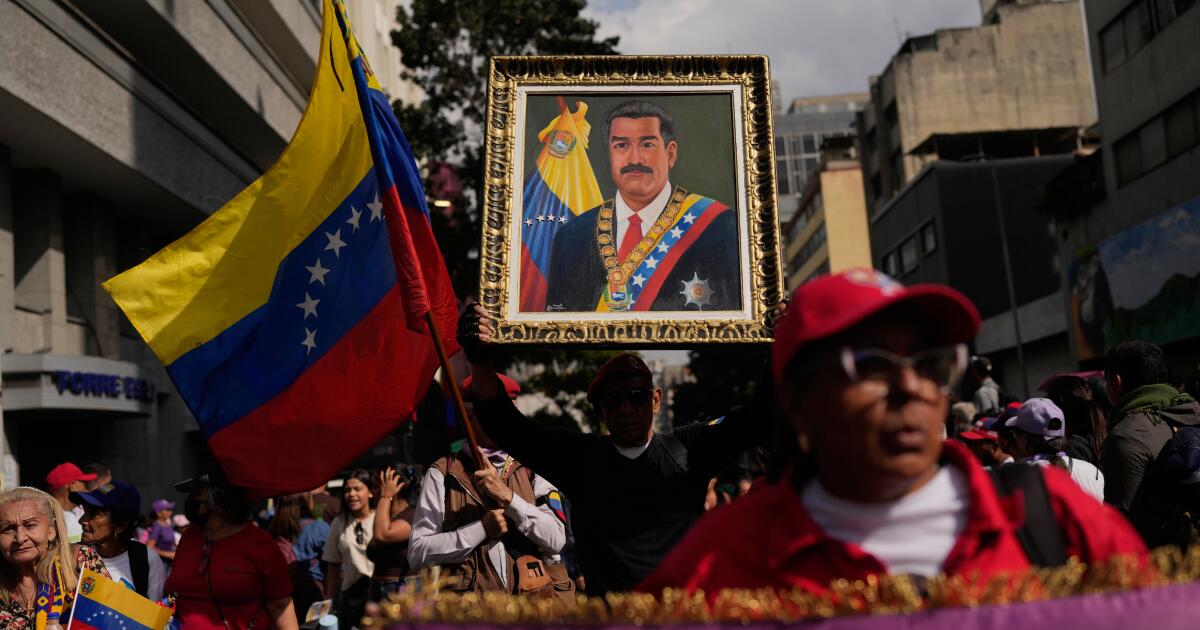
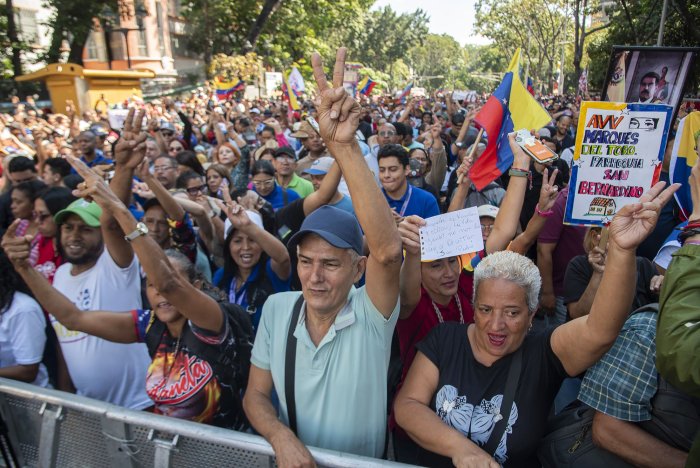
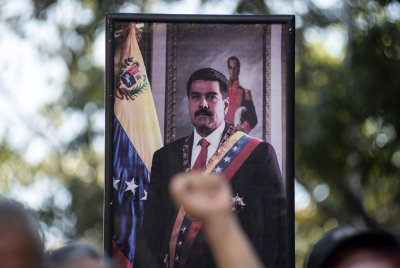
Supporters of ousted Venezuela’s President Nicolas Maduro carry his portrait during a rally outside the National Assembly in Caracas, Venezuela, on January 5, 2026. Photo by Jonathan Lanza/UPI | License Photo
U.S. District Judge David Novak ordered Lindsey Halligan to give an explanation of her continued use of the U.S. attorney title within seven days on Tuesday. File Photo by Al Drago/EPA
Jan. 7 (UPI) — President Donald Trump‘s first pick to serve as the U.S. attorney for the Eastern District of Virginia has been ordered to explain why she is still using the title despite her appointment being ruled unlawful.
U.S. District Judge David Novak ordered Lindsey Halligan to give an explanation of her continued use of the U.S. attorney title within seven days. Novak said her use of the title, including in court documents, may amount to false or misleading statements.
False and misleading statements in a court of law can result in punishment, including charges of perjury, fines and imprisonment.
Halligan, a Trump loyalist, was the president’s original pick to serve in the Eastern District of Virginia last year. A federal judge determined that the Department of Justice illegally appointed Halligan and barred her from assuming the role.
U.S. District Judge Cameron Currie ruled in November that Halligan was never eligible to hold the position of U.S. attorney for the Eastern District of Virginia. Her appointment had circumvented the standard appointment process, including a Senate confirmation. She also has no experience as a prosecutor.
Despite the ruling, the Justice Department has kept Halligan in office.
On Tuesday, Novak said that Halligan and the department cannot continue to ignore the ruling.
“It remains the binding precedent in this district and is not subject to being ignored,” Novak said in his order.
Erik Siebert, the acting U.S. attorney for the Eastern District of Virginia prior to Halligan’s appointment, resigned in September after refusing to prosecute New York Attorney General Letitia James.
After her appointment, Halligan filed charges against James and former FBI Director James Comey, who investigated Trump’s ties to Russia during Trump’s first term.
Both cases were dismissed when Currie ruled that Halligan was not qualified for the U.S. attorney role.
President Donald Trump holds a signed executive order reclassifying marijuana from a schedule I to a schedule III controlled substance in the Oval Office of the White House on Thursday. Photo by Aaron Schwartz/UPI | License Photo
Jan. 7 (UPI) — The Justice Department has sued Arizona and Connecticut for refusing to hand over their full voter registration lists, making them the 22nd and 23rd states to be targeted by the Trump administration in its litigious campaign over voter data ahead of the midterm elections.
The lawsuits were filed Tuesday, with Attorney General Pam Bondi arguing she is charged by Congress to ensure that states have proper and effective voter registration and voter list maintenance programs.
She also threatened that she has the Civil Rights Act of 1960 to demand the statewide voter registration lists.
“Accurate voter rolls are the foundation of election integrity, and any state that fails to meet this basic obligation of transparency can expect to see us in court,” she said in a statement.
The Justice Department has sent demands for the voter registration rolls to at least 40 states and the District of Columbia, according to the Brennan Center for Justice.
All states except North Dakota require citizens to register with election officials, with the information forming voter registration rolls.
The demands for these rolls, which include private and sensitive information, have raised concerns among both voting-rights groups, who say the Trump administration may try to undermine elections, and immigration advocates worried the rolls could be shared with the Department of Homeland Security.
The Trump administration has argued that it needs the lists to ensure election integrity, including that non-citizens are not voting. President Donald Trump continues to falsely claim that the 2020 election, which he lost to Joe Biden, was stolen from him.
The lawsuits overwhelming target Democratic-led states, and the effort comes ahead of November’s midterm elections, which Trump has increasingly become involved with.
Jesus Osete, principal deputy assistant attorney general for civil rights, posted the lawsuit naming Arizona as a defendant on X, saying the Democratic-led state “didn’t respond” to the Justice Department requests for the voter rolls.
Arizona Secretary of State Adrian Fontes responded to Osete with a video statement, saying they have responded to every Justice Department request, and that he will not break state and federal law to share unredacted voter data with the federal government.
“I would recommend that Mr. Osete read those correspondence and we will see you apparently in court,” he said.
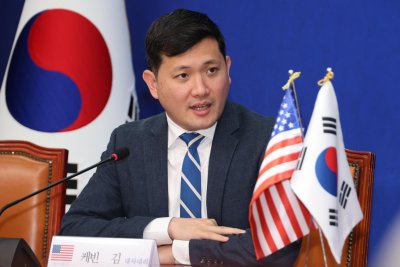
Acting U.S. Ambassador to South Korea Kevin Kim, seen here at the National Assembly in Seoul in December, has left his post and returned to the United States, the foreign ministry said Wednesday, File Photo by Yonhap
Acting U.S. Ambassador to South Korea Kevin Kim has left his post in Seoul and returned to the United States, the foreign ministry said Wednesday, amid speculation he may be assigned a new role in the Trump administration related to Korea issues.
Kim’s departure came just about two months after he took up the post as charge d’affaires at the U.S. Embassy in Seoul in October last year.
Kim succeeded then acting U.S. Ambassador Joseph Yun after the position had remained vacant since former U.S. Ambassador to Seoul Philip Goldberg left the post early last year following the launch of the second Trump administration.
Kim recently informed Seoul officials he returned to the U.S., according to the foreign ministry.
Jim Heller, deputy chief of mission at the U.S. Embassy in Seoul, is expected to serve as charge d’affaires until a new ambassador is appointed.
Sources say that Kim could be tapped for a new role handling Korea-related issues, possibly a position tasked with implementing the summit agreements reached between the allies on security and other matters, or dealing with North Korea issues.
Kim has likely been named a senior adviser to Allison Hooker, U.S. under secretary of state for political affairs, a diplomatic source said. Both Hooker and Kim were deeply involved in nuclear negotiations with North Korea during Trump’s first term, when denuclearization talks were in full swing.
Prior to his posting in Seoul, Kim served as U.S. deputy assistant secretary of state for China, Japan, Korea, Mongolia and Taiwan at the Bureau of East Asian and Pacific Affairs.
Kim’s departure leaves the ambassadorial post in Seoul vacant once again. Goldberg assumed the position more than a year after the Biden administration took office. It took about 18 months for Ambassador Harry Harris to take up the post under Trump’s first term.
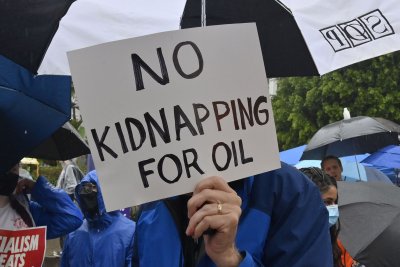
Activists denounce the U.S. military seizure of Venezuelan President Nicholas Maduro at Pershing Square in Los Angeles, Calif., on Saturday, January 3, 2026. President Donald Trump said Tuesday that Venezuela will give the United States upwards of 50 million barrels of oil. Photo by Jim Ruymen/UPI. | License Photo
Jan. 6 (UPI) — Venezuela will be turning over tens of millions of barrels of oil to the United States, President Donald Trump said Tuesday, days after the U.S. military seized the authoritarian president of the country, Nicolas Maduro.
Trump said Venezuela’s interim government, sworn in Monday, will be giving the United States between 30 million and 50 million barrels of “high quality, sanctioned oil.”
“This oil will be sold at its Market Price, and that money will be controlled by me, as President of the United States of America, to ensure it is used to benefit the people of Venezuela and the United States!” Trump said on his Truth Social platform.
It was unclear when the United States would receive the oil, but it will be brought to the United States aboard oil tankers.
Trump said Energy Secretary Chris Wright has been asked to “immediately” execute the plan.
The U.S. military seized Maduro from Venezuela in an early morning operation on Saturday following months of military buildup around the country and an escalating Trump administration pressure campaign. He and his wife, Cilia Flores, were brought to the United States to face narcotrafficking and other drug-related charges.
The Trump administration has been enforcing a naval blockade on Venezuelan oil since mid-December, with Trump arguing the South American country’s oil and assets of U.S. companies were “stolen from us,” referring to Caracas’ decades-old nationalization of its oil industry.
Delcy Rodriguez, former vice president under Maduro, was sworn in as president of Venezuela on Monday. However, Trump has said that the United States will be “running” the South American nation, though other administration officials, including Secretary of State Marco Rubio, have attempted to soften that stance.
Rodriguez is “essentially willing to do what we think is necessary to make Venezuela great again,” Rubio said Monday.
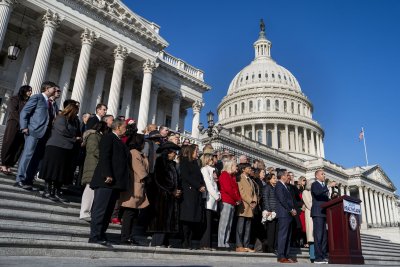
Jan. 6 (UPI) — President Donald Trump warned House Republicans on Tuesday that if they fail to hold on to the chamber in November’s midterm elections, the Democrats will impeach him.
“You got to win the midterms because if we don’t win the midterms, it’s just going to be, I mean — they’ll find a reason to impeach me. I’ll get impeached,” Trump told a few dozen GOP lawmakers in attendance at the Kennedy Center in Washington, D.C., for a House Republican policy retreat.
Trump has repeatedly expressed concern over the future of the GOP’s slim majority of the House ahead of next fall’s midterm elections, as the president’s party has historically suffered losses in the midterms and his first year back in office has been marked by divisive policies and rhetoric.
This summer, GOP-controlled Texas, under pressure from Trump, redrew its congressional district maps to secure more Republican seats in November — setting off gerrymander redistricting efforts by both parties in states they hold majorities.
Democrats and civil rights and voting advocacy groups have accused Trump of trying to undermine the election to hold on to the House, which the GOP currently maintains a 218-213 majority.
In his sprawling 90-minute speech, Trump attempted to project an image of confidence ahead of the election, stating the GOP House is among the most successful in history, while simultaneously expressing befuddlement that the electorate may vote to return the chamber to the Democrats.
“I wish you could explain to me what the hell’s going on with the mind of the public because we have the right policy. They don’t. They have horrible policy. They do stick together. They’re violent. They’re vicious, you know,” Trump said, referring to the Democrats. “They’re vicious people and they stick together like glue.”
Trump was twice impeached during his first term in office: In 2019, on accusations of threatening to withhold Congressionally approved military aid for Ukraine unless President Volodymyr Zelensky investigated the son of his political rival, Joe Biden; and in the wake of the Jan. 6, 2021, insurrection attempt of the Capitol.
He was acquitted both times.
Trump critics and Democrats have suggested since early in his second term that impeachment could be pursued over a range of presidential actions they say are unconstitutional, with some actions being questioned by legal experts and advocacy groups as violations of international law and potential war crimes.
Trump has attracted the most criticism over his immigration polices, which have seen migrants sent to a Salvadoran prison, as well as his anti-drug military actions that have seen more than 100 people killed in international waters. The United Nations high commissioner for human rights, Volker Turk, has said there is “no justification in international law” for the military strikes.
On Saturday, the U.S. military seized Venezuelan President Nicolas Maduro in what the Trump administration has called a law enforcement action, though it has raised questions domestically and internationally over the legality of the operation.
U.N. Secretary-General Antonio Guterres on Monday told the Security Council that he is “deeply concerned that the rules of international law have not been respected with regard to the 3 January military action.”
Trump has followed the operation by threatening to do the same to the leaders of Colombia and Cuba.
“The leaders who pay homage to him and show themselves to be servile to U.S. President Trump in an attempt to win his favor only humiliate themselves,” Chilean President Gabriel Boric Font said in a statement earlier Tuesday.
“Trump (and his administration) not only permanently violates International Law, but human dignity itself.”
The abduction of Maduro has amplified Democratic concerns and talk of impeachment.
“Today, many Democrats have understandably questioned whether impeachment is possible again under the current reality. I am reconsidering that view,” Rep. Maxine Waters, D-Calif., ranking member of the House Financial Services Committee, said in a statement on Saturday following the military operation.
“Even if Republicans refuse to act, Democrats cannot remain silent or passive in the face of actions this extreme from this administration.”
Waters continued: “What we are witnessing is an unprecedented escalation of an unlawful invasion, the detention of foreign leaders and a president openly asserting power far beyond what the Constitution allows. Democrats must take a firm stand against this abuse of authority. We cannot normalize it. We cannot excuse it.”
President Donald Trump holds a signed executive order reclassifying marijuana from a schedule I to a schedule III controlled substance in the Oval Office of the White House on Thursday. Photo by Aaron Schwartz/UPI | License Photo
William DeFoor, 26, damaged Vice President JD Vance’s family home in Cincinnati early Monday morning due to mental health issues and not politics, his attorney said. Photo Courtesy of the Hamilton County Sheriff’s Office
Jan. 6 (UPI) — The man accused of vandalizing Vice President JD Vance’s home in Cincinnati has a history of mental health issues, his defense attorney said in court Tuesday.
William DeFoor, 26, was arrested and is accused of vandalizing the Vance home at 12:15 a.m. EST on Monday while the vice president and second lady Usha Vance were in Washington, D.C.
DeFoor’s attorney, Paul Laufman, made the mental health claim during his client’s arraignment hearing in Hamilton County Municipal Court on Tuesday.
Laufman said the vandalism was not politically motivated, and Judge Janaya Trotter Bratton ordered DeFoor to post an $11,000 bond to be released from custody.
DeFoor writes “peaceful” prose in his poems, and his using a hammer to damage a vehicle driven by a federal agent watching Vance’s home and then several windows on the home were not intended as a political statement, Laufman told the court.
“I just don’t think there’s anything political going on,” Laufman said.
DeFoor is accused of felony damage, criminal trespass, criminal damage and obstructing official business.
He has a history of mental health-related cases heard by the Hamilton County Mental Health Court and has been arrested multiple times for vandalism.
When DeFoor arrived outside of Vance’s home, he tried to break the windows of a Secret Service vehicle that was blocking the driveway, according to a criminal complaint filed by FBI Assistant Special Agent Gavin Hartsell.
A Secret Service agent and Cincinnati police announced their presence and ordered DeFoor to “stop and drop the weapon” he was holding, Hartsell wrote.
“DeFoor ignored all commands and began to use a hammer to break glass windows,” located on the front of Vance’s home, he said.
Hartsell described the windows as “large, historic windows” that contained “enhanced security assets” owned by the federal government. He estimated the cost of damage at $28,000.
Vance on Monday said a “crazy person tried to break in by hammering the windows” on his family’s home and thanked the Secret Service and Cincinnati police for quickly responding to the matter in a social media post.
WASHINGTON — President Trump has made broad but vague assertions that the United States is going to “run” Venezuela after the ouster of Nicolás Maduro but has offered almost no details about how it will do so, raising questions among some lawmakers and former officials about the administration’s level of planning for the country after Maduro was gone.
Seemingly contradictory statements from Trump and Secretary of State Marco Rubio have suggested at once that the U.S. now controls the levers of Venezuelan power or that the U.S. has no intention of assuming day-to-day governance and will allow Maduro’s subordinates to remain in leadership positions for now.
Rubio said the U.S. would rely on existing sanctions on Venezuela’s oil sector and criminal gangs to wield leverage with Maduro’s successors.
The uncertainty on definitive next steps in Venezuela contrasts with the years of discussions and planning that went into U.S. military interventions that deposed other autocratic leaders, notably in Iraq in 2003, which still did not often lead to the hoped-for outcomes.
‘Disagreement about how to proceed’
The discrepancy between what Trump and Rubio have said publicly has not sat well with some former diplomats.
“It strikes me that we have no idea whatsoever as to what’s next,” said Dan Fried, a retired career diplomat, former assistant secretary of state and sanctions coordinator who served under both Democratic and Republican administrations.
“For good operational reasons, there were very few people who knew about the raid, but Trump’s remarks about running the country and Rubio’s uncomfortable walk back suggests that even within that small group of people, there is disagreement about how to proceed,” said Fried who is now with the Atlantic Council think tank.
Supporters of the operation, meanwhile, believe there is little confusion over the U.S. goal.
“The president speaks in big headlines and euphemisms,” said Rich Goldberg, a sanctions proponent who worked in the National Energy Dominance Council at the White House until last year and is now a senior adviser to the Foundation for Defense of Democracies, a hawkish think tank.
Goldberg does not see Rubio becoming “the superintendent of schools” but “effectively, the U.S. will be calling the shots.”
“There are people at the top who can make what we want happen or not, and we right now control their purse strings and their lives,” he said. “The president thinks it’s enough and the secretary thinks it’s enough, and if it’s not enough, we’ll know very soon and we’ll deal with it.”
If planning for the U.S. “to run” Venezuela existed prior to Maduro’s arrest and extradition to face federal drug charges, it was confined to a small group of Trump political allies, according to current U.S. officials, who note that Trump relies on a very small circle of advisers and has tossed aside much of the traditional decision-making apparatus.
These officials, who spoke on condition of anonymity to discuss their understanding of internal deliberations, said they were not aware of any preparations for either a military occupation or an interim civilian governing authority, which has been a priority for previous administrations when they contemplated going to war to oust a specific leader or government. The White House and the State Department’s press office did not return messages seeking comment.
Long discussion among agencies in previous interventions
Previous military actions that deposed autocratic leaders, notably in Panama in 1989 and Iraq in 2003, were preceded by months, if not years, of interagency discussion and debate over how best to deal with power vacuums caused by the ousters of their leaders. The State Department, White House National Security Council, the Pentagon and the intelligence community all participated in that planning.
In Panama, the George H.W. Bush administration had nearly a full year of preparations to launch the invasion that ousted Panama’s leader Manuel Noriega. Panama, however, is exponentially smaller than Venezuela, it had long experience as a de facto American territory, and the U.S. occupation was never intended to retake territory or natural resources.
By contrast, Venezuela is vastly larger in size and population and has a decadeslong history of animosity toward the United States.
“Panama was not successful because it was supported internationally because it wasn’t,” Fried said. “It was a success because it led to a quick, smooth transfer to a democratic government. That would be a success here, but on the first day out, we trashed someone who had those credentials, and that strikes me as daft.”
He was referring to Trump’s apparent dismissal of opposition leader Maria Corina Machado, whose party is widely believed to have won elections in 2024, results that Maduro refused to accept. Trump said Saturday that Machado “doesn’t have the support within or the respect within the country” to be a credible leader and suggested he would be OK with Maduro’s No. 2, Delcy Rodríguez, remaining in power as long as she works with the U.S.
Hoped-for outcomes didn’t happen in Iraq and Afghanistan
Meanwhile, best-case scenarios like those predicted by the George W. Bush administration for a post-Saddam Hussein Iraq that it would be a beacon of democracy in the Middle East and hopes for a democratic and stable Afghanistan following the ouster of the Taliban died painfully slow deaths at the tremendous expense of American money and lives after initial euphoria over military victories.
“Venezuela looks nothing like Libya, it looks nothing like Iraq, it looks nothing like Afghanistan. It looks nothing like the Middle East,” Rubio said this weekend of Venezuela and its neighbors. “These are Western countries with long traditions at a people-to-people and cultural level, and ties to the United States, so it’s nothing like that.”
The lack of clarity on Venezuela has been even more pronounced because Trump campaigned on a platform of extricating the U.S. from foreign wars and entanglements, a position backed by his “Make America Great Again” supporters, many of whom are seeking explanations about what the president has in mind for Venezuela.
“Wake up MAGA,” Republican Rep. Thomas Massie of Kentucky, who has bucked much of his party’s lockstep agreement with Trump, posted on X after the operation. “VENEZUELA is not about drugs; it’s about OIL and REGIME CHANGE. This is not what we voted for.”
Sen. Rand Paul, also a Kentucky Republican, who often criticizes military interventions, said “time will tell if regime change in Venezuela is successful without significant monetary or human cost.”
“Easy enough to argue such policy when the action is short, swift and effective but glaringly less so when that unitary power drains of us trillions of dollars and thousands of lives, such as occurred in Afghanistan, Iraq, and Vietnam,” he wrote on social media.
In addition to the Venezuela operation, Trump is preparing to take the helm of an as-yet unformed Board of Peace to run postwar Gaza, involving the United States in yet another Mideast engagement for possibly decades to come.
And yet, as both the Iraq and Afghanistan experiences ultimately proved, no amount of planning guarantees success.
George Conway, shown with his ex-wife Kellyanne Conway, has joined the race for the House of Representatives in Manhattan. He’s running for the seat being vacated by the retiring Rep. Jerry Nadler, D-N.Y. File Photo by Erik S. Lesser/EPA
Jan. 6 (UPI) — Vocal Trump critic George Conway officially announced his run for the House of Representatives as a Democrat in New York for the seat being vacated by Rep. Jerry Nadler.
“We have a corrupt president, a mendacious president, a criminal president whose masked agents are disappearing people from our streets, who’s breaking international law, and he’s running our federal government like a mob protection racket,” Conway said in his video.
Conway is a formerly conservative lawyer who rose to widespread fame when his then-wife, Kellyanne Conway, became an adviser to President Donald Trump in his first term. Despite his wife’s position, he was an outspoken voice against the president. They divorced in 2023.
“I know how to fight these people. They are corrupt, amoral people,” Conway said. “They will stop at nothing to rig the system for themselves. I’ve been fighting Trump for years, and nothing will stop me.”
Nadler, D-N.Y., announced in September that he would retire from Congress. The 78-year-old Nadler said he wanted to make room for a younger generation. He represents New York’s 12th District, which includes Midtown and the Upper West and Upper East sides of Manhattan.
The 12th District voted for Vice President Kamala Harris by 64 points in 2024.
The field for that primary is crowded. Other candidates include Jack Schlossberg, President John F. Kennedy‘s grandson; New York State Assemblypeople Micah Lasher and Alex Bores; activists Cameron Kasky and Mathew Shurka; journalist Jami Floyd; civil rights lawyer Laura Dunn; fundraiser Alan Pardee; nonprofit founder Liam Elkind; entrepreneur Micah Bergdale; and software engineer Christopher Diep.
“We’re at a crossroads in our country, and Donald Trump is the greatest threat to the Constitution and the rule of law and democratic government that we have ever seen in our lifetime,” Conway told NBC News.
Conway only recently moved back to the district, a point his opponents have made.
“This campaign welcomes George to the race. And the city. And the party,” Bores said in a statement. “I personally would be delighted to offer George local dining tips. Tell him to give me a call when he’s in town.”
Pardee made a statement and mentioned Conway’s “years living in D.C. advancing a conservative agenda before discovering the monster he helped create.”
Floyd, who was a White House fellow under President Bill Clinton, said, “I’m not concerned about George Conway.” She said he “is a life-long conservative Republican and not even from here. So why isn’t he running in Bethesda, Md., or Alpine, N.J., where he belongs?”
Conway said he spent his legal career working in the district and that it has “been the epicenter of my life.”
“I lived in this district for decades before moving out to the suburbs,” he said. “All four of my kids were born in this district, and my life is centered around this district.”
President Donald Trump holds a signed executive order reclassifying marijuana from a schedule I to a schedule III controlled substance in the Oval Office of the White House on Thursday. Photo by Aaron Schwartz/UPI | License Photo
Jan. 6 (UPI) — The 2026 midterm elections are coming later this year with 33 seats in the U.S. Senate and all 435 House seats on ballots across the country.
The Nov. 3 midterms are an opportunity for voters to respond to President Donald Trump‘s second term. Midterm elections are often viewed as a measure of voters’ response to the sitting president’s policies.
After a year of aggressive deportation practices, a withdrawal from the international arena and economic upheaval, 2026 has begun with the Trump administration abducting a foreign leader and launching offensives on foreign nations.
Republicans will seek to maintain a 219-213 majority in the House and three-seat majority in the Senate while Democrats hope to make gains and offer a check on Trump’s power. The results will signal approval or disapproval of how the country is being run and will set the landscape for the final two years of Trump’s presidency.
Retirements to bring changes to Senate
Nine senators have announced they are retiring from the chamber in 2026, including one of the most senior lawmakers.
Sen. Mitch McConnell, R-Ky., the longest-serving Senate party leader in history, will end his 40-year career at the end of the current term. He is one of four Republicans retiring from the Senate.
Six Republicans launched campaigns to succeed McConnell last year, along with eight Democrats. Kentucky has been a firmly Republican-leaning state, voting more than 65% for Trump in 2024.
Alabama voted similarly in 2024, with about 64% of votes going to Trump. Sen. Tommy Tuberville, R-Ala., is ending his time in the Senate to run for state governor.
Like Tuberville, Sen. Marsha Blackburn, R-Tenn., and Sen. Michael Bennet, D-Colo., will leave the Senate to run for governor of their respective states. Bennet has been a senator since 2009 while Blackburn entered the chamber in 2019.
Of the senators not running for re-election, Sen. Joni Ernst, R-Iowa, is leaving open a seat that is considered to be the most competitive. Ernst has been a senator since 2015.
Republicans are backing Rep. Ashley Hinson to take Ernst’s seat. Hinson was elected to the U.S. House in 2020.
Three candidates are in the Democratic primary seeking to challenge Hinson in November: state Sen. Zach Wahls, state Rep. Josh Turek and Nathan Sage, a military veteran.
Wahls was the youngest Iowa Senate Democratic Leader, serving in that role from 2020 to 2023.
The race for an open seat in North Carolina features former Gov. Roy Cooper on the ticket for the Democratic Party. Cooper served two terms as governor.
On the Republican side, former Republican National Committee Chairman Michael Whatley has earned the endorsement of Trump but he is being challenged in the primary by Michele Morrow. She ran an unsuccessful campaign for North Carolina’s superintendent of public instruction in 2024 and has never held public office.
North Carolina has historically been a tightly contested state. Trump earned about 50% of the vote there in 2024. Prior to that, the last time a presidential candidate received 50% of votes was 2012 when Mitt Romney received 50.4%.
North Carolina’s Senate seats have been held by Republicans since 2014. Kay Hagan was a state senator from 2009 to 2015 before being succeeded by Sen. Thom Tillis, R-N.C. Tillis is retiring at the end of the term.
The Democratic Party has tapped former Sen. Sherrod Brown to attempt a return to the chamber in 2026 after he lost a bid for re-election in 2024 to Republican Bernie Moreno.
Brown has launched a campaign to challenge Sen. Jon Husted, the Republican who was appointed to fill Vice President JD Vance’s seat that he vacated when Trump was elected president.
Sen. Jon Ossoff, D-Ga., is running for re-election in a state won by Trump in 2024. Three Republicans have entered their party’s primary to challenge Ossoff: Rep. Buddy Carter, Rep. Mike Collins and former college and pro football coach Derek Dooley.
Georgia Gov. Brian Kemp has given Dooley his endorsement.
Georgia’s 6th Congressional District re-elected Democrat Lucy McBath to the House in 2024 by nearly 50 points over her Republican challenger. Democrats hold both of the state’s Senate seats.
Sen. Susan Collins, R-Maine, will be challenged in 2026 but who will be on the other side of the ticket will not be known until the Democratic primary in June. Collins represents a state that former Vice President Kamala Harris carried by about seven points in 2024.
Maine Gov. Janet Mills and military veteran Graham Platner are campaigning in the Democratic primary.
Texas Sen. John Cornyn is running for re-election but will first have to win a contested Republican primary. Attorney General Ken Paxton, who has been a key figure in Texas’ redistricting battle and often opponent to Biden administration policies, will challenge Cornyn, along with Rep. Wesley Hunt.
In another battleground state, the retirement of Democratic Sen. Gary Peters will leave the race for a Michigan Senate seat open.
Former congressman Mike Rogers is expected to be on the ticket for Republicans after receiving an endorsement from Trump. Three candidates have entered the Democratic primary: Rep. Haley Stevens, state Sen. Mallory McMorrow and physician Abdul El-Sayed.
Congresspeople seeking new offices
Several members of Congress are running for different offices outside of the House chambers, including 11 running for governor. Meanwhile 18 members of the House are retiring, including former House Speaker Nancy Pelosi.
Republicans running for governor in their respective states include Iowa Rep. Randy Feenstra, South Dakota Rep. Dusty Johnson, Florida Rep. Byron Donalds and South Carolina Rep. Nancy Mace.
Rep Chip Roy, R-Texas, will not run for re-election as he will try to succeed Paxton as his state’s attorney general.
New Mexico’s 2nd Congressional District is held by Democrat Gabriel Vasquez but was won by Trump in 2024. New Mexico has voted for Democrats in every presidential election since 2008.
Vasquez faces a challenge from Republicans Greg Cunningham, a veteran of the U.S. Marines and former Albuquerque police officer. Cunningham ran for a seat in the state legislature in 2024 and lost.
Arizona’s 6th Congressional District seat, held by Republican Rep. Juan Ciscomani, had several Democrats looking to challenge Ciscomani in November.
Some candidates have begun dropping out of the Democratic primary as 2026 has arrived. JoAnna Mendoza, a military veteran, and engineer Chris Donat remain in the race. Mendoza has vastly outraised Donat, tallying $1.9 million in receipts compared to Donat’s $21,061, according to Federal Elections Commission data.
Trump won Arizona in 2024 with about 52% of the vote.
Colorado’s newest seat, District 8, is held by Republican Rep. Gabe Evans. He represents the district located in the northern Denver area after flipping the seat for Republicans in 2024.
Evans has a new challenger in the Republican primary as of November with former Air Force cadet and current Colorado Army Reserve Capt. Adam DeRito filing to run against him.
DeRito has been in a long legal battle with the U.S. Air Force which expelled him hours before he was set to graduate in 2010. He was denied a diploma for allegedly violating academy rules by fraternizing with a subordinate. DeRito claims these allegations were retaliation for him reporting sexual assaults at the academy.
The Democratic primary is set to feature five candidates, former state legislator Shannon Bird, state lawmaker Manny Rutinel, Marine veteran Evan Munsing, Denis Abrate and self-proclaimed former Republican John Francis Szemler.
Michigan is one of the biggest battleground states in 2026 with three seats expected to feature close races, along with an open Senate seat.
District 7, held by Republican Tom Barrett, has flipped in consecutive elections. Barrett, a U.S. Army veteran, will seek re-election with seven Democrats declared for their primary. He assumed the seat after Democrat Elissa Slotkin ran for and was elected to the Senate.
Among the Democrats vying to challenge Barrett is former U.S. Ambassador to Ukraine Bridget Brink, Michigan State professor Josh Cowen and William Lawrence, the founder of nonprofit environmental advocacy organization the Sunrise Movement.
District 10 will feature an open election as Rep. John James, a Republican, enters the state gubernatorial race.
FEC campaign data shows a field of six Democrats seeking their party’s nomination. Eric Chung, a former U.S. Department of Commerce official under the Biden administration, has raised the most out of any candidate, followed by Republican Robert Lulgjuraj, a former county prosecutor.
After some delay, District 4 Rep. Bill Huizenga, a Republican, announced last month that he will seek re-election. Four Democrats have filed to appear in the primary, including state Sen. Sean McCann.
PARIS — Ukraine’s allies met Tuesday in Paris for key talks that could help determine the country’s security after any potential peace deal is reached with Russia.
But prospects for progress are uncertain: The Trump administration’s focus is shifting to Venezuela while U.S. suggestions of a Greenland takeover are causing tension with Europe, and Moscow shows no signs of budging from its demands in its nearly 4-year-old invasion.
Before the U.S. capture of Venezuelan leader Nicolás Maduro, French President Emmanuel Macron had expressed optimism about the latest gathering of what has been dubbed the “coalition of the willing. They have been exploring for months how to deter any future Russian aggression should it agree to stop fighting Ukraine.
In a Dec. 31 address, Macron said that allies would “make concrete commitments” at the meeting “to protect Ukraine and ensure a just and lasting peace.”
Macron’s office said an unprecedented number of officials will attend in person, with 35 participants including 27 heads of state and government. The U.S. envoys, Steve Witkoff and Trump’s son-in-law Jared Kushner, met with Macron at the Elysee presidential palace for preparatory talks ahead of the gathering.
Moscow has revealed few details of its stance in the U.S.-led peace negotiations. Officials have reaffirmed Russia’s demands and have insisted there can be no ceasefire until a comprehensive settlement is agreed. The Kremlin has ruled out any deployment of troops from NATO countries on Ukrainian soil.
A series of meetings on the summit’s sidelines illustrated the intensity of the diplomatic effort and the complexity of its moving parts.
Ukrainian President Volodymyr Zelensky met with Macron ahead of the summit. French, British and Ukrainian military chiefs also met, with NATO’s top commander, U.S. Gen. Alexus G. Grynkewich, participating in talks that France’s army chief said focused on implementing security guarantees. Army chiefs from other coalition nations joined by video.
A news conference including Zelensky, Macron, British Prime Minister Keir Starmer and German Chancellor Friedrich Merz was planned later in the day.
Macron’s office said the U.S. delegation was initially set to be led by Secretary of State Marco Rubio, but he changed his plans after the U.S. military intervention in Venezuela.
Trump on Sunday renewed his call for the U.S. to take control of Greenland, a strategic, mineral-rich Arctic island.
The leaders of France, Germany, Italy, Poland, Spain and the U.K. on Tuesday joined Danish Prime Minister Mette Frederiksen in defending Greenland’s sovereignty in the wake of Trump’s comments about the self-governing territory of the kingdom of Denmark.
But the continent also needs U.S. military might to back up Ukrainian security guarantees and ward off Russia’s territorial ambitions. That could require a delicate diplomatic balancing act in Paris.
Participants are seeking concrete outcomes on five key priorities once fighting ends: ways to monitor a ceasefire; support for Ukraine’s armed forces; deployment of a multinational force on land, at sea and in the air; commitments in case of more Russian aggression; and long-term defense cooperation with Ukraine.
But whether that’s still achievable Tuesday isn’t so clear now, after the U.S. military operation targeting Maduro in Venezuela.
Ukraine seeks firm guarantees from Washington of military and other support seen as crucial to securing similar commitments from other allies. Kyiv has been wary of any ceasefire that it fears could provide time for Russia to regroup and attack again.
Recent progress in talks
Witkoff had indicated progress in talks about protecting and reassuring Ukraine. In a Dec. 31 post, he said “productive” discussions with him, Rubio and Kushner on the U.S. side and, on the other, national security advisers of Britain, France, Germany and Ukraine had focused on “strengthening security guarantees and developing effective deconfliction mechanisms to help end the war and ensure it does not restart.”
France, which with the U.K. has coordinated the multinational effort to shore up a possible peace plan, has given only broad-brush details about its scope. It says Ukraine’s first line of defense against a Russian resumption of war would be the Ukrainian military and that the coalition intends to strengthen it with training, weaponry and other support.
Macron has also spoken of European forces potentially being deployed away from Ukraine’s front lines to help deter future Russian aggression.
Important details unfinalized
Zelensky said during the weekend that potential European troop deployments still face hurdles, important details have not been finalized, and “not everyone is ready” to commit forces.
He noted that many countries would need approval from their lawmakers even if leaders agreed on military support for Ukraine. But he recognized that support could come in forms other than troops, such as “through weapons, technologies and intelligence.”
Zelensky said deployments in Ukraine by Britain and France, Western Europe’s only nuclear-armed nations, would be “essential.”
“Speaking frankly as president, even the very existence of the coalition depends on whether certain countries are ready to step up their presence,” he said. “If they are not ready at all, then it is not really a ‘coalition of the willing.’”
Leicester and Corbet write for the Associated Press. Volodymyr Yurchuk in Kyiv, Ukraine, contributed to this report.
Bystanders on the ground in Venezuela captured various videos of the U.S. assault on Saturday, which was officially dubbed Operation Absolute Resolve. In multiple clips, as seen in the social media post below, distinctly terrorizing high-pitched buzzing can be clearly heard, which are then followed immediately by explosions and/or other visual or auditory signs of munitions impacting the ground, all consistent with the use of one-way attack drones.
U.S. Special Operations Command (SOCOM) declined to offer any comment when asked for additional details about the use of drones, in general, during Operation Absolute Resolve. TWZ has reached out to U.S. Southern Command (SOUTHCOM) and the White House for more information.
Similar high-pitched buzzing sounds, which were followed by impacts and detonations, are featured in a mountain of existing confirmed videos of various types of kamikaze drones powered by small piston engines driving single pusher propellers hitting their targets. The distinctive acoustic signature, in particular, has been consistently present in footage of attacks involving these kinds of uncrewed aerial systems that have emerged from multiple conflict zones globally in the past five years or so. Ukrainian forces have even established a network of acoustic sensors to help spot incoming Russian drone attacks across their country to capitalize on this acoustic signature.
This is the footage of the russian Shahed drone attacking an oil mill belonging to the American company Bunge.
As the result, more than 300 tons of oil was spilled, causing serious damage to the mill and environment. pic.twitter.com/JflSn2NkBd
Footage released by Ukraine’s military show electronic warfare units disabling a Russian Shahed attack drone and forcing it to descend intact into the Black Sea, rather than detonating on impact. pic.twitter.com/PQfVscqBIM
In 2021, Azerbaijan’s Border Guard even released a video, seen below, focused on the sounds produced by the Israeli-made Harop loitering munitions that it had actively employed in a conflict with Armenia the previous year. At that time, TWZ highlighted the knock-on psychological effect this would have. Direct comparisons have also been drawn to the iconic sound of World War II-era dive bombers, and Nazi Ju-87 Stukas, in particular, swooping down onto their targets.
Qarabağ Azərbaycandır!
As mentioned, the U.S. military finally launched a new, concerted effort to expand the use of various types of one-way attack drones last year. The special operations community, which was front and center in this weekend’s operation in Venezuela, has been heavily involved in executing this initiative and has already been at the forefront of fielding other kinds of kamikaze drones within America’s armed forces for years now.
Just last October, U.S. Central Command (CENTCOM) disclosed the first known operational fielding of long-range one-way attack drones by a task force in the Middle East led by special operations forces. That unit, officially named Task Force Scorpion Strike (TFSS), is equipped with multiple versions of the Low-Cost Uncrewed Combat Attack System (LUCAS), a design notably reverse-engineered from the Iranian-designed Shahed-136. However, LUCAS drones can operate collaboratively in a fully networked swarm and beyond-line-of-sight links that enable them to attack targets, including ones that might suddenly pop up, in real time and far from their operators. This makes them far more capable than Iran’s original design, as well as variants and derivatives that Russia is now actively using against Ukraine.
CENTCOM
In December, TFSS, together with the U.S. Navy, also demonstrated the ability to launch LUCAS drones from ships. Other elements of the U.S. military have at least been experimenting with LUCAS, and those drones and/or other similar designs may already be in wider service within America’s armed forces.
“Bravo Zulu. U.S. Navy forces in the Middle East are advancing warfighting capability in new ways, bringing more striking power from the sea and setting conditions for using innovation as a deterrent.” – Adm. Brad Cooper, CENTCOM Commander https://t.co/TgQ4WLbph3pic.twitter.com/WUiAVojTht
The AEVEX Disruptor kamikaze drone seen here is one of the designs now known to be part of the Phoenix Ghost family. Jamie Hunter
It is worth noting that the Shahed-136 was itself directly influenced by Israeli kamikaze drones like the Harop, which were originally designed with an explicit focus on targeting enemy air defenses. Iran has shown Shaheds being employed in this role in exercises, as seen in the video below, though the drones have now proven themselves in real-world attacks on a much wider array of targets on land and at sea.
Баражуючий іранський боєприпас «Shahed 136»
In Venezuela this past weekend, U.S. forces could well have used long-range one-way attack drones, launched from ships off the coast or forward locations on land in the region, as part of the broader suppression and destruction of enemy air defenses (SEAD/DEAD) mission, which we know was central to the operation.
“As the force began to approach Caracas, the Joint Air Component began dismantling and disabling the air defense systems in Venezuela, employing weapons to ensure the safe passage of the helicopters into the target area,” Chairman of the Joint Chiefs of Staff U.S. Air Force Gen. Dan “Razin” Caine said during a press conference on Saturday. “The goal of our air component is, was, and always will be to protect the helicopters and the ground force and get them to the target and get them home.”
Caine also said that “numerous remotely piloted drones” were among the U.S. assets employed during Operation Absolute Resolve.
Long-range kamikaze drones would have also offered a way to stimulate enemy air defenses, helping to expose their exact locations and provide emissions to hone in on, after which they could then be struck by other platforms or avoided entirely. The U.S. spent months cataloging Venezuela’s electronic order of battle from standoff distances, but road mobile systems are something of a wild card. If they radiate, they could be rapidly geolocated and destroyed. Similar drones could have been employed purely as decoys or for stand-in (close proximity) jamming of key radars and communications systems, depending on their exact configuration.
Strikes on other targets in Venezuela during the operation that were clearly intended to prevent or disrupt the country’s security forces from responding effectively could also have involved the use of long-range kamikaze drones. Light armored vehicles and other assets on the ground at the sprawling Fuerte Tiuna base in Caracas were destroyed in the course of the mission. This is reportedly where Maduro and his wife were captured. Key communications nodes in the country were also unsurprisingly targeted.
Damaged Venezuelan Dragoon 300 APC at Fort Tiuna following US airstrikes, January 3, 2026.
Note that the vehicle has been modified into similar configuration to Cadillac Gage V-100 Commandos.
The 312th “Ayala” Armored Cavalry Battalion of the Venezuelan Army appears to have had all of its equipment and most of its armored vehicles entirely destroyed in last night’s strike operation by the United States, which heavily targeting the Fuerte Tiuna Military Complex in the… pic.twitter.com/VXmVHRK4ha
Parte de los sistemas de telecomunicaciones destruídos en la zona del Cerro El Volcan a las afueras de Caracas, en la vía Oripoto de Los Guayabitos, Sector El Volcán, Baruta –Edo. Miranda 🇻🇪 Coordenadas 10.416374,-66.849306 pic.twitter.com/Iyo8UObH42
There is the additional possibility that what is seen and heard in the videos are smaller loitering munitions, which U.S. forces could have utilized more dynamically in response to threats as they approached their objectives. The U.S. military now commonly uses the term “launched effect” to refer to these munitions, as well as other uncrewed aerial systems configured for other tasks, all of which are designed to be fired from aircraft, as well as ground and maritime platforms.
The U.S. Army’s elite 160th Special Operations Aviation Regiment (SOAR), better known as the Night Stalkers, elements of which were at the very core of the operation to capture Maduro, have at least been experimenting with employing launched effects from their MH-60 Black Hawk helicopters for years now, though this is not an operational capability, at least that we know of at present. This is a capability also planned for the Army’s conventional Black Hawk fleet, but it would not be surprising for the Night Stalkers to receive it first. With launched effects, MH-60s, or other platforms the 160th operates, would have a new way to react to air defenses, either striking them if they pop up along the way or jamming them. They could also strike small mobile targets if need be.
The video below, which the Army released in 2021, includes footage at around the 0:34 mark in the runtime of one of 160th SOAR’s MH-60 Black Hawk helicopters carrying a tube for a ‘launched effect’ under its right stub wing.
The U.S. Army Futures Command’s Future Vertical Lift Cross-Functional Team (FVL-CFT)
At the Association of the U.S. Army’s (AUSA) main annual conference last October, the current head of the 160th SOAR, Col. Stephen Smith, also talked explicitly about the current and future use of uncrewed systems, including launched effects, to lead the way for crewed helicopters, especially in higher-threat environments.
A graphic giving a broad “operational view” (OV) of a concept Air Force Special Operations Command (AFSOC) calls the Adaptive Airborne Enterprise (A2E), which has envisioned multiple types of drones and other capabilities able to operate across permissive, contested, and denied environments. Air and surface ‘launched effects’ are shown here. USAF
All this being said, the sounds and subsequent impacts heard and seen in the videos from Venezuela do seem to point more to the use of kamikaze drones that are larger than the ones that typically fall into the category of launched effects, especially air-launched types.
Regardless, the video clips do offer clear evidence of a possible first-of-its-kind use of U.S. kamikaze drones during Operation Absolute Resolve, and more details about their employment may emerge as more becomes known about the mission overall.
Supporters of ousted Venezuela’s President Nicolas Maduro carry his portrait during a rally outside the National Assembly in Caracas, Venezuela on Monday, January 5, 2026. Photo by Jonathan Lanza/UPI | License Photo
Jan. 6 (UPI) — Switzerland has frozen any assets in the country owned by U.S.-detained Venezuelan President Nicolas Maduro and others associated with him to ensure that if they were stolen from the Venezuelan people, they can be rightly returned.
The asset freeze went immediately into effect when it was announced on Monday, but does not impact members of the current Venezuelan government, Switzerland’s Federal Council said in a statement.
The freeze is to prevent funds from leaving the country. In the case that future legal proceedings show that the assets were illicitly acquired, Switzerland said it will “endeavor to ensure that they benefit the Venezuelan people.”
“The Federal Council wants to ensure that any illicitly acquired assets cannot be transferred out of Switzerland in the current situation,” it said. “It has therefore decided, as a precautionary measure, to freeze any assets held in Switzerland by Mr. Maduro and others associated with him.”
Maduro and his wife, Cilia Flores, were captured by the U.S. military in an early Saturday operation that involved air and ground assets in Caracas. Dozens of people were killed. There were no U.S. military casualties.
The authoritarian Venezuelan president has been indicted in the United States on narcotrafficking and other related drug charges. The operation has raised domestic and international legal questions over Maduro’s detention and has drawn condemnation, including from U.S. allies.
On Monday, Maduro and his wife pleaded not guilty to the charges, and Vice President Delcy Rodriguez was sworn in as the country’s new president.
Switzerland called for de-escalation, restraint and compliance with international law following the United States’ Saturday military operation and said it was “closely monitoring” the situation.
The new asset freeze is in addition to sanctions imposed against Venezuela under Switzerland’s Embargo Act in 2018. The new measure targets the assets of 37 individuals who were not previously blacklisted by sanctions, according to an ordinance on the action. Maduro’s wife and other relatives were named.
Switzerland said neither the reason for Maduro’s ousting nor whether it was legal plays a role in its decision to apply the asset freeze.
“The decisive factor is that a fall from power has occurred and that it is now possible that the country of origin will initiate legal proceedings in the future with regard to illicitly acquired assets,” the Federal Council said.
Jan. 6 (UPI) — The Department of Energy has announced it would award $2.7 billion in funding to three companies to increase domestic uranium enrichment over the next decade.
The announcement by the Department of Energy comes as President Donald Trump has sought to reinvigorate the United States’ nuclear energy industry as it moves away from foreign sources of energy.
However, the funding authority for the awards originated under President Joe Biden‘s Investing in America agenda and related legislation that aimed to increase uranium enrichment capacity in the United States to bolster U.S. energy security and resilience, while reducing dependence on Russian energy.
With the announcement, American Centrifuge Operating, General Matter and Orano Federal Services will each receive an award of $900 million.
ACO and GM will be tasked with creating domestic high-assay, low-enriched uranium enrichment capacity, while OFS will expand U.S. domestic low-enriched uranium enrichment capacity.
The three companies were chosen from six that were permitted last year to bid on future work.
“President Trump is catalyzing a resurgence in the nation’s nuclear energy sector to strengthen American security and prosperity,” Energy Secretary Chris Wright said in a statement.
“Today’s awards show that this administration is committed to restoring a secure domestic nuclear fuel supply chain capable of producing nuclear fuels needed to power the reactors of today and the advanced reactors of tomorrow.”
Orano said the funding marks a “key milestone” in accelerating the development of its $5 billion facility in Oak Ridge, Tenn.
According to the company, the United States imports two-thirds of the LEU needed to power the U.S. nuclear fleet from foreign sources, including Russia, and its new IKE facility will help reduce the United States’ dependence on Moscow, especially after the ban on Russian imports begins in 2028.
“The decision by the U.S. Department of Energy is a great source of pride as it identifies Orano as a proven nuclear fuel supplier,” Orano CEO Nicolas Maes said in a statement.
General Matter said under its contract with the Department of Energy, it will build domestic enrichment capacity that will help fuel “the next generation of American nuclear power” and enable “American leadership in AI, manufacturing and other critical industries.”
“Rebuilding U.S. domestic enrichment capacity will reduce our reliance on foreign providers, strengthen our nuclear industrial base and lower energy costs for utilities and consumers,” it said in a social media post.
“American reactors need American uranium. In partnership with the Department of Energy, we will deliver it.”