Trump

Justices block troop deployment in Chicago; 3 conservatives object

The Supreme Court ruled against President Trump on Tuesday and said he did not have legal authority to deploy the National Guard in Chicago to protect federal immigration agents.

Acting on a 6-3 vote, the justices denied Trump’s appeal and upheld orders from a federal district judge and the 7th Circuit Court of Appeals that said the president had exaggerated the threat and overstepped his authority.

The decision is a major defeat for Trump and his broad claim that he had the power to deploy military forces in U.S. cities.

In an unsigned order, the court said the Militia Act allows the president to deploy the National Guard only if U.S. military forces were unable to quell violence.

“At this preliminary stage, the Government has failed to identify a source of authority that would allow the military to execute the laws in Illinois. The President has not invoked a statute that provides an exception to the Posse Comitatus Act,” the court said.

Conservative Justices Clarence Thomas, Samuel A. Alito Jr. and Neil M. Gorsuch dissented.

The 9th Circuit Court of Appeals had allowed the deployments in Los Angeles and Portland, Ore., after ruling that judges must defer to the president.

But U.S. District Judge Charles Breyer ruled Dec. 10 that the federalized National Guard troops in Los Angeles must be returned to the control of California Gov. Gavin Newsom.

Trump’s lawyers had not claimed in their appeal that the president had the authority to deploy the military for ordinary law enforcement in the city. Instead, they said the Guard troops would be deployed “to protect federal officers and federal property.”

The two sides in the Chicago case, like in Portland, told dramatically different stories about the circumstances leading to Trump’s order.

Democratic officials in Illinois said small groups of protesters objected to the aggressive enforcement tactics used by federal immigration agents. They said police were able to contain the protests, clear the entrances and prevent violence.

By contrast, administration officials described repeated instances of disruption, confrontation and violence in Chicago. They said immigration agents were harassed and blocked from doing their jobs, and they needed the protection the National Guard could supply.

Trump Solicitor Gen. D. John Sauer said the president had the authority to deploy the Guard if agents could not enforce the immigration laws.

“Confronted with intolerable risks of harm to federal agents and coordinated, violent opposition to the enforcement of federal law,” Trump called up the National Guard “to defend federal personnel, property, and functions in the face of ongoing violence,” he told the court in an emergency appeal filed in mid-October.

Illinois state lawyers disputed the administration’s account.

“The evidence shows that federal facilities in Illinois remain open, the individuals who have violated the law by attacking federal authorities have been arrested, and enforcement of immigration law in Illinois has only increased in recent weeks,” state Solicitor Gen. Jane Elinor Notz said in response to the administration’s appeal.

The Constitution gives Congress the power “to provide for calling forth the militia to execute the laws of the union, suppress insurrections and repel invasions.”

The Militia Act of 1903 says the president may call up and deploy the National Guard if he faces an invasion, a rebellion or is “unable with the regular forces to execute the laws of the United States.”

Trump’s lawyers said that referred to police and federal agents. But after taking a closer look, the court concluded it referred to the regular military forces. By that standard, the president’s authority to deploy the National Guard comes only after the military has failed to quell violence.

But on Oct. 29, the justices asked both sides to explain what the law meant when it referred to the “regular forces.”

Until then, both sides had assumed it referred to federal agents and police, not the military.

Trump’s lawyers stuck to their position. They said the law referred to the “civilian forces that regularly execute the laws,” not the military.

If those civilians cannot enforce the law, “there is a strong tradition in this country of favoring the use of the military rather than the standing military to quell domestic disturbances,” they said.

State attorneys for Illinois said the “regular forces” are the “full-time, professional military.” And they said the president could not “even plausibly argue” that the U.S. soldiers were required to enforce the law in Chicago.

California Atty. Gen. Rob Bonta and Newsom filed a brief in the Chicago case that warned of the danger of the president using the military in American cities.

“On June 7, for the first time in our Nation’s history, the President invoked [U.S. law] to federalize a State’s National Guard over the objections of the State’s Governor,” they said.

“President Trump and Defense Secretary Hegseth transferred 4,000 members of California’s National Guard — one in three of the Guard’s total active members — to federal control to serve in a civilian law enforcement role on the streets of Los Angeles and other communities in Southern California.”

That has proved to be “the opening salvo in an effort to transform the role of the military in American society,” they said. “At no prior point in our history has the President used the military this way: as his own personal police force, to be deployed for whatever law enforcement missions he deems appropriate.

“What the federal government seeks is a standing army, drawn from state militias, deployed at the direction of the President on a nationwide basis, for civilian law enforcement purposes, for an indefinite period of time,” they said.

Source link

Trump says he’s inviting Kazakhstan and Uzbekistan to next year’s G20 summit in Miami

President Trump said he will be extending invitations to next year’s U.S.-hosted Group of 20 summit to Kazakhstan and Uzbekistan as the Republican administration looks to deepen its relationship with the Central Asian nations.

Trump announced the plan on Tuesday after holding separate phone calls with Kazakhstan President Kassym-Jomart Tokayev and Uzbekistan President Shavkat Mirziyoyev.

Neither country is a member of the G20, but the host country of the annual leaders’ gathering of major economies often invites non-members to attend the summit. The 2026 gathering is planned for Trump’s golf club in Doral, Fla., near Miami.

“The relationship with both Countries is spectacular,” Trump said in a social media post about the calls. Trump is currently on vacation at his Mar-a-Lago resort in Florida.

The Kazakh and Uzbek leaders visited Washington last month along with the leaders of Kyrgyzstan, Tajikistan, and Turkmenistan for talks with Trump.

The administration is giving greater attention to Central Asia, which holds deep reserves of minerals and produces roughly half the world’s uranium, as it intensifies the hunt for rare earth metals needed for high-tech devices, including smartphones, electric vehicles and fighter jets.

Central Asia’s critical mineral exports have long tilted toward China and Russia.

During last month’s visit, Tokayev announced that his Muslim-majority country will join the Abraham Accords, the Trump administration effort to strengthen ties between Israel and Arab and Muslim majority countries.

The largely symbolic move came as the administration is trying to revive an initiative that was the signature foreign policy achievement of Trump’s first term, when his administration forged diplomatic and commercial ties between Israel and the United Arab Emirates, Bahrain and Morocco.

Trump last month announced that he is barring South Africa from participating in next year’s summit at his Miami-area club and will stop all payments and subsidies to the country over its treatment of a U.S. government representative at this year’s meeting.

Trump chose not to have an American government delegation attend this year’s summit hosted by South Africa, saying he did so because its white Afrikaners were being violently persecuted. It is a claim that South Africa, which was mired for decades in racial apartheid, has rejected as baseless.

Madhani writes for the Associated Press.

Source link

DOJ releases third batch of Epstein files; shows Trump flights

Dec. 23 (UPI) — The Department of Justice Tuesday released a third cache of files from the Jeffrey Epstein case, including flight logs that show President Donald Trump flew on Epstein’s plane more than has been reported.

The logs show Trump flew on Epstein’s plane at least eight times in the 1990s. One of those flights included an unnamed 20-year old woman.

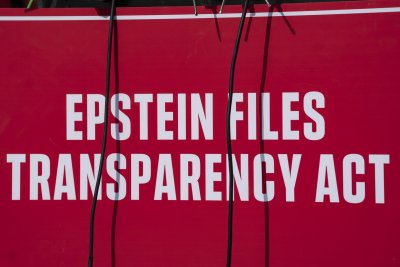
The documents are released to comply with the Epstein Files Transparency Act, which became law on Nov. 19, though the Justice Department didn’t release all the files on time.

Epstein was an American billionaire financier who was a convicted sex offender. He died by suicide in jail while awaiting trial.

The information about the flights comes from an email sent in January 2020 from a New York federal prosecutor to an unnamed person. The email doesn’t accuse Trump of any wrongdoing.

“For your situational awareness, wanted to let you know that the flight records we received yesterday reflect that Donald Trump traveled on Epstein’s private jet many more times than previously has been reported (or that we were aware), including during the period we would expect to charge in a [Ghislaine] Maxwell case,” the email said.

Ghislaine Maxwell, Epstein’s accomplice, is serving time for sex trafficking.

It said Trump “is listed as a passenger on at least eight flights between 1993 and 1996, including at least four flights on which Maxwell was also present. He is listed as having traveled with, among others and at various times, Marla Maples, his daughter Tiffany, and his son Eric,” it said.

“On one flight in 1993, he and Epstein are the only two listed passengers; on another, the only three passengers are Epstein, Trump, and then-20-year-old [redacted]. On two other flights, two of the passengers, respectively, were women who would be possible witnesses in a Maxwell case.”

The Justice Department said there were multiple references to Trump in the latest release. It called some of the mentions “untrue and sensationalist claims.”

“The Department of Justice has officially released nearly 30,000 more pages of documents related to Jeffrey Epstein. Some of these documents contain untrue and sensationalist claims made against President Trump that were submitted to the FBI right before the 2020 election. To be clear: the claims are unfounded and false, and if they had a shred of credibility, they certainly would have been weaponized against President Trump already,” the department said on X.

“Nevertheless, out of our commitment to the law and transparency, the DOJ is releasing these documents with the legally required protections for Epstein’s victims.”

Source link

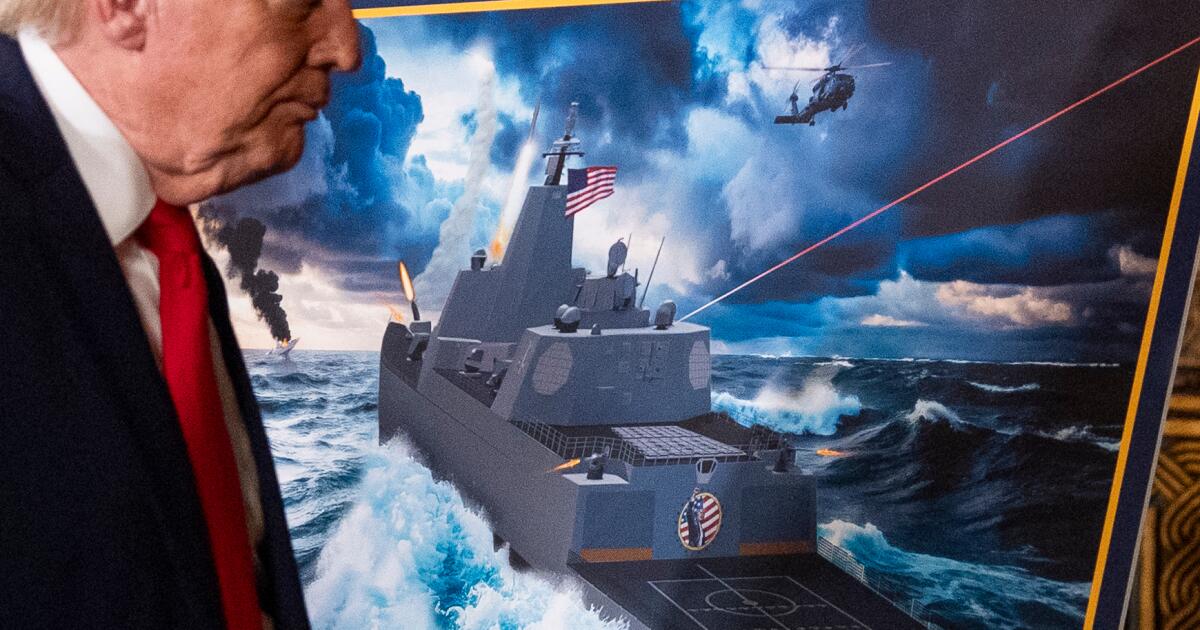
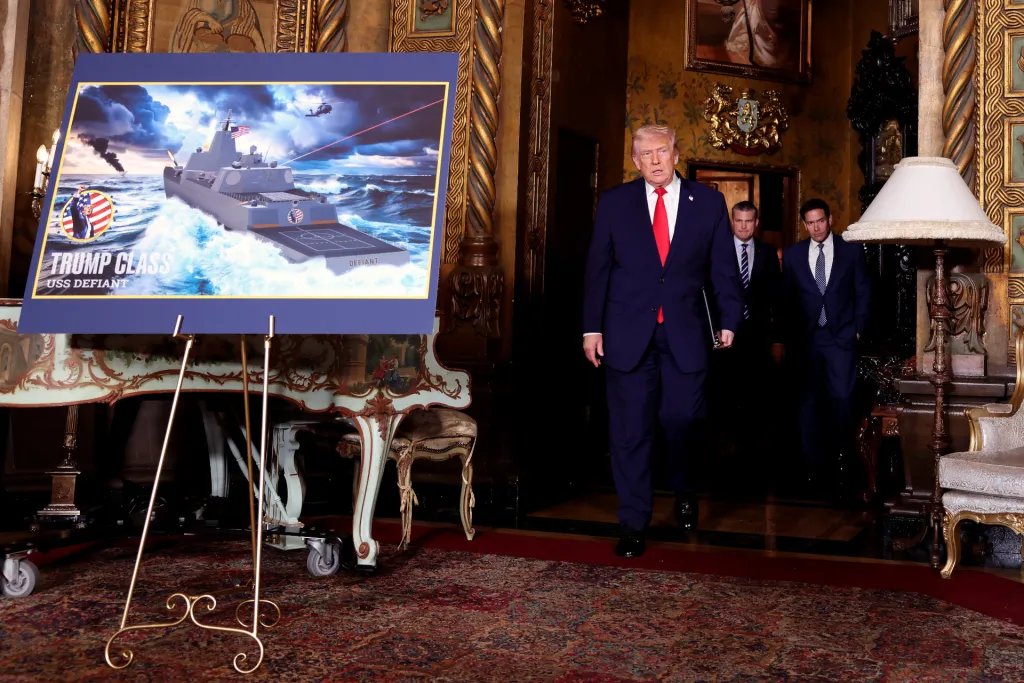
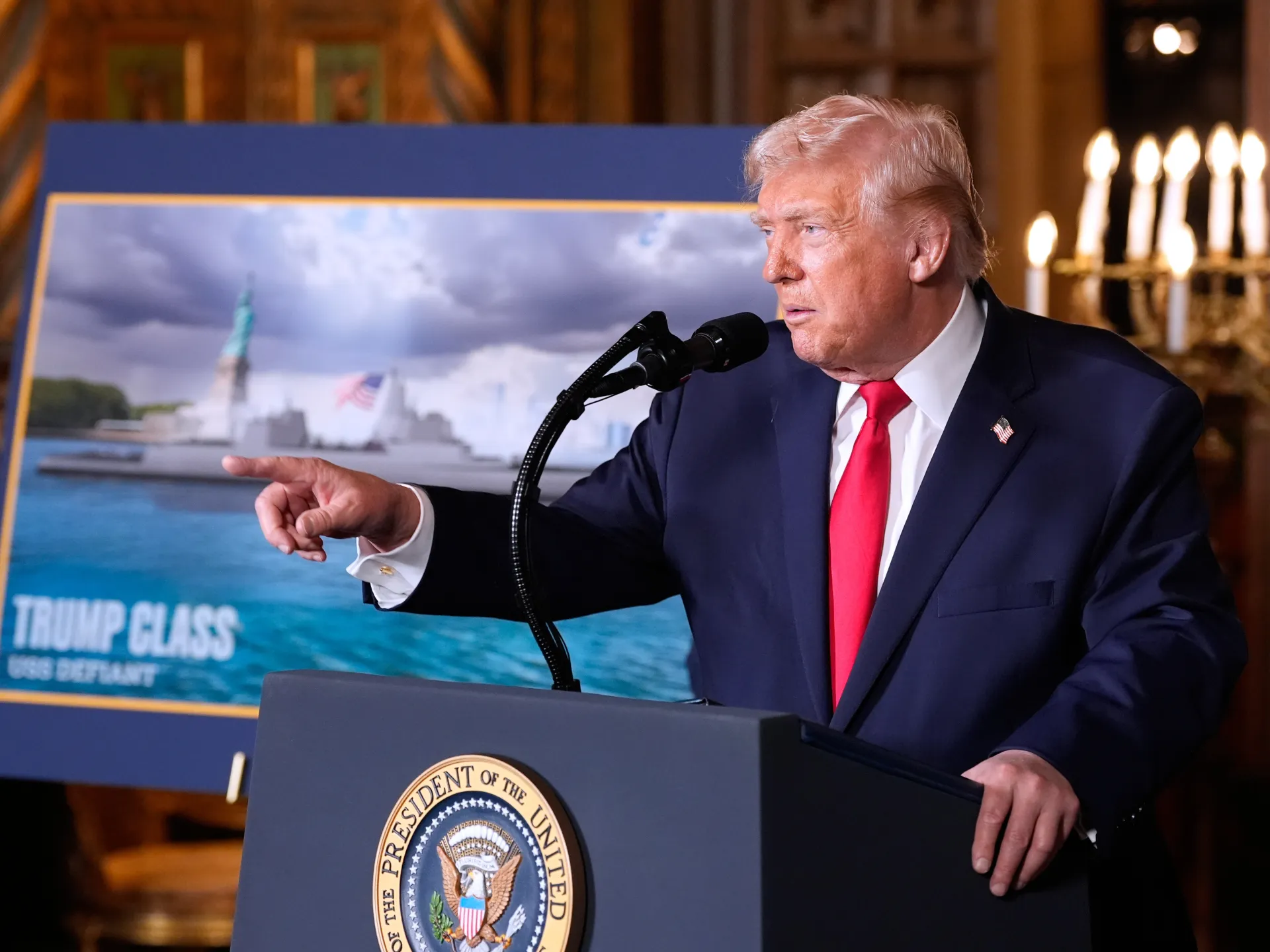
Trump announces plans for new Navy ‘battleship’ as part of a ‘Golden Fleet’

President Trump has announced a bold plan for the Navy to build a new, large warship that he is calling a “battleship” as part of a larger vision to create a “Golden Fleet.”

“They’ll be the fastest, the biggest, and by far 100 times more powerful than any battleship ever built,” Trump claimed during the announcement at his Mar-a-Lago resort in Florida.

According to Trump, the ship, the first of which will be named the USS Defiant, will be longer and larger than the World War II-era Iowa-class battleships and will be armed with hypersonic missiles, nuclear cruise missiles, rail guns, and high-powered lasers — all technologies that are in various stages of development by the Navy.

The announcement comes just a month after the Navy scrapped its plans to build a new, small warship, citing growing delays and cost overruns, deciding instead to go with a modified version of a Coast Guard cutter that was being produced until recently. The sea service has also failed to build its other newly designed ships, like the new Ford-class aircraft carrier and Columbia-class submarines, on time and on budget.

Meanwhile, the Navy has struggled to field some of the technologies Trump says will be aboard the new ship.

The Navy spent hundreds of millions of dollars and more than 15 years trying to field a railgun aboard a ship before finally abandoning the effort in 2021.

Laser technology has seen more success in making its way onto Navy ships in recent years, but its employment is still limited. One system that is designed to blind or disable drone sensors is now aboard eight destroyers after spending eight years in development.

Developing nuclear cruise missile capabilities or deploying them on ships may also violate non-proliferation treaties that the U.S. has signed with Russia.

A U.S. official, who spoke on condition of anonymity to discuss ongoing plans, told the Associated Press that design efforts are now underway for the new ship and construction is planned to begin in the early 2030s.

Both Trump and Navy Secretary John Phelan spoke about the new Trump-class warship as a spiritual successor to the battleships of the 20th century, but historically that term has referred to a very specific type of ship — a large, heavily armored vessel armed with massive guns designed to bombard other ships or targets ashore.

This type of ship was at the height of prominence during World War II, and the largest of the U.S. battleships, the Iowa-class, were roughly 60,000 tons. But after World War II, the battleship’s role in modern fleets diminished rapidly in favor of aircraft carriers and long-range missiles. The U.S. Navy did modernize four Iowa-class battleships in the 1980s by adding cruise missiles and anti-ship missiles, along with modern radars, but by the 1990s all four were decommissioned.

According to a newly created website for the “Golden Fleet,” this new “guided missile battleship” is set to be roughly the same size as Iowa-class battleships but only weigh about half as much, around 35,000 tons, and have far smaller crews — between 650 and 850 sailors.

Its primary weapons will also be missiles, not large naval guns.

Trump has long held strong opinions on specific aspects of the Navy’s fleet, sometimes with a view toward keeping older technology instead of modernizing.

During his first term, he unsuccessfully called for the return to steam-powered catapults to launch jets from the Navy’s newest aircraft carriers instead of the more modern electromagnetic system.

He has also complained to Phelan about the look of the Navy’s destroyers and decried Navy ships being covered in rust.

Phelan told senators at his confirmation hearing that Trump “has texted me numerous times very late at night, sometimes after one (o’clock) in the morning” about “rusty ships or ships in a yard, asking me what am I doing about it.”

On a visit to a shipyard that was working on the now-canceled Constellation-class frigate in 2020, Trump said he personally changed the design of the ship.

“I looked at it, I said, ‘That’s a terrible-looking ship, let’s make it beautiful,’” Trump said at the time.

He said Monday he will have a direct role in designing this new warship as well.

“The U.S. Navy will lead the design of these ships along with me, because I’m a very aesthetic person,” Trump said.

Phelan said the new USS Defiant “will inspire awe and reverence for the American flag whenever it pulls into a foreign port.”

Toropin and Madhani write for the Associated Press.

Source link

What We Know About The Trump Class “Battleship”

President Donald Trump has rolled out plans for new Trump class large surface combatants for the U.S. Navy. These are to be armed with a wide array of missiles, including nuclear-armed and hypersonic types, as well as electromagnetic railguns, laser directed energy weapons, and more. Trump says the goal now is to build at least two of these vessels, the first of which will be named USS Defiant, but that the fleet size could grow to 10 hulls or more. The 30,000-to-40,000-ton displacement ships are the centerpiece of a larger naval shipbuilding initiative called the Golden Fleet.

Trump, flanked by Secretary of War Pete Hegseth, Secretary of State and acting National Security Advisor Marco Rubio, and Secretary of the Navy John Phelan, unveiled the Trump class at his Mar-a-Lago estate in Palm Beach, Florida. The vessels are currently being referred to as “battleships,” a term historically applied to large warships with gun-centric armament and heavily armored hulls. The Navy decommissioned its last true battleships, the World War II-era Iowa class USS Missouri and USS Wisconsin, between 1990 and 1992. By which time they had been heavily upgraded. TWZ had highlighted the possibility of the Navy pursuing a warship in the general vein of the design shown today after the president had first teased this plan back in September.

President Donald Trump at Mar-a-Lago just before unveiling the Trump class warship plan. Tasos Katopodis/Getty Images

“From [President] Theodore Roosevelt, [and] the Great White Fleet … to the legendary [Iowa class] USS Missouri, whose massive guns helped win World War II, America’s battleships have always been unmistakable symbols of national power,” Trump said. The Trump class “will be the flagships of the American naval fleet, and there has never been anything built like them.”

All four of the Iowa class battleships that were built seen sailing together. USN

“American strength is back on the world stage, and the announcement of the Golden Fleet, anchored by new battleships, the biggest and most lethal ever, … marks a generational commitment to American sea power across the entire department,” Secretary Hegseth said. “New and better ships will provide that deterrent today and for generations to come.”

“We’re going to make battle groups great again,” Secretary Phelan added. “The USS Defiant battleship will inspire awe and reverence for the American flag whenever it pulls into a foreign port. It will be a source of pride for every American.”

“As we forge the future of our Navy’s Fleet, we need a larger surface combatant and the Trump class Battleships meet that requirement,” Chief of Naval Operations Adm. Daryl Caudle also said in a separate Navy press release. “We will ensure continuous improvement, intellectually honest assessments about the requirement to effectively deter and win in the 2030s and beyond, and disciplined execution resulting in a Fleet unparalleled in lethality, adaptability and strength.”

If all goes to plan, “when a conflict arises, you [the president] are going to ask not one, but two questions, where are the carriers and where are the battleships,” Phelan said today.

A rendering of a Trump class warship as seen from the side. White House/USN

Otherwise, the salient details about the Trump class shared today at Mar-a-Lago, as well as in the Navy’s release, are as follows:

USN
  • They also show what look to be multiple turreted 5-inch naval guns and other conventional guns.
  • In addition to their extensive armament, Trump class ships will also be command and control platforms, overseeing crewed and uncrewed platforms.
  • Unspecified artificial intelligence-driven capabilities will be part of the design, according to Trump.
  • The Trump class will be part of a high-low naval force mixture that also includes the future FF(X) frigates and new fleets of uncrewed vessels.
  • Focus first on the construction of two ships out of an expected initial batch of 10.
  • The Trump class could eventually grow to 20 to 25 hulls.
  • Trump said that the ships will be built in shipyards in the United States.
  • The president also alluded to the possible involvement of foreign-owned, but U.S.-based yards.
  • Secretary Phelan specifically highlighted the expected role of “new, non-traditional defense partners,” as well.
  • Overall, the Navy will leverage a base of “1,000 suppliers in nearly every state in America” to build the ships.
  • The Navy, in cooperation with industry, will lead the design of the ships.
  • Trump will also be directly involved in the design process, “because I’m a very aesthetic person.”

To the last point here, it is worth pointing out that Trump’s interest in naval shipbuilding, especially from an aesthetic perspective, is well established at this point. He has claimed to have personally made key design decisions in the past. Trump has also been outspoken for years in his desire to see battleship-type vessels, specifically, return to the Navy’s fleets.

This appears to be the first time a class of Navy ships has been named after a sitting U.S. president. The Navy has often drawn criticism in the past for naming ships after living individuals, in general. It is unusual for the lead ship in a class of U.S. Navy vessels not to bear the name of that class (USS Defiant here instead of something like USS Trump or USS Donald J. Trump), as well.

Major questions about the plans for the Trump class do remain, including when the USS Defiant might be launched, let alone enter service. What these ships might cost to produce, as well as operate and maintain, is another important open question.

Despite the comments at Mar-a-Lago today, the unveiling of the Trump class is still likely to prompt much new analysis and general discussion about the expected utility of these ships, including from TWZ. We already did a deep dive into the feasibility, as well as the operational relevance, of Trump’s “battleship” proposal after his remarks in September. As we noted at the time, a concept along the lines of what was shown today offers a compromise of sorts that could help justify its complexity and cost. Similar ‘arsenal ship’ concepts for the Navy have been put forward on several occasions over the past few decades. This includes a proposal from Huntington Ingalls Industries in the early 2010s for a derivative of the San Antonio class amphibious warfare ship with 288 VLS cells and otherwise optimized for the ballistic missile defense mission.

Artwork from the Defense Advanced Research Projects Agency showing a notional arsenal ship dating back all the way to the 1990s. DARPA
A rendering of the proposed San Antonio class-derived ballistic missile defense ship. HII/MDA

At the same time, what capabilities the Trump class might truly be able to bring to bear will be dependent on a host of factors, especially if they are only ever fielded in relatively smaller numbers. And regardless of how capable any warship is, it can only ever be in one place at one time, which is more often than not in port.

This all comes at a time when the Navy is stressing its glaring need for more surface warships, overall, not super capable ones built in small quantities.

On the other hand, there are concerning VLS cell gaps that are fast approaching on the horizon. The service is set to retire the last of its Ticonderoga class cruisers, each one of which has 122 VLS cells, at the end of the decade. The Navy will also need to make up for the impending loss of the huge missile launch capacity offered by its four Ohio class nuclear guided missile submarines, which are also set to be decommissioned before 2030. The Trump class will clearly feature a massive set of VLS arrays that could help offset some of this deficit.

The general length of time it takes to design and produce large warships creates additional uncertainty for any naval shipbuilding endeavor, as well. Since the end of the Cold War, the Navy has seen a number of major warship programs be severely truncated, or outright cancelled, for a variety of reasons. As one prime example, the service originally planned to acquire 32 Zumwalt class stealth destroyers before slashing that number to just three and drastically watering-down their capabilities. The Trump administration also just recently axed the Constellation class frigate program, which had turned into a major boondoggle, as you can read more about here.

The Trump class “battleship” announcement notably comes on the same day the Navy confirmed to TWZ that the first of its future FF(X) frigates will be delivered with the glaring omission of a VLS and are clearly meant to be produced as cheaply and quickly as possible. At least the first ships will have the same armament of the much-derided Littoral Combat Ship.

The Navy insists it is taking steps to avoid past pitfalls going forward, and to help revitalize America’s shipbuilding industry in the process, but there continue to be challenges on the horizon.

All this will prompt major debate about how the Navy is using its pool of resources that it constantly says is too small to meet its future obligations. Investing so much in a small number of hulls while stripping out capabilities of those ships that will be built in larger numbers will surely be a hot topic on Capitol Hill in the months to come.

Contact the author: joe@twz.com

Joseph has been a member of The War Zone team since early 2017. Prior to that, he was an Associate Editor at War Is Boring, and his byline has appeared in other publications, including Small Arms Review, Small Arms Defense Journal, Reuters, We Are the Mighty, and Task & Purpose.


Tyler’s passion is the study of military technology, strategy, and foreign policy and he has fostered a dominant voice on those topics in the defense media space. He was the creator of the hugely popular defense site Foxtrot Alpha before developing The War Zone.


Source link

‘It’s a Wonderful ICE?’ Trumpworld tries to hijack a holiday classic

For decades, American families have gathered to watch “It’s a Wonderful Life” on Christmas Eve.

The 1946 Frank Capra movie, about a man who on one of the worst days of his life discovers how he has positively impacted his hometown of Bedford Falls, is beloved for extolling selflessness, community and the little guy taking on rapacious capitalists. Take those values, add in powerful acting and the promise of light in the darkest of hours, and it’s the only movie that makes me cry.

No less a figure of goodwill than Pope Leo XIV revealed last month that it’s one of his favorite movies. But as with anything holy in this nation, President Trump and his followers are trying to hijack the holiday classic.

Last weekend, the Department of Homeland Security posted two videos celebrating its mass deportation campaign. One, titled “It’s a Wonderful Flight,” re-creates the scene where George Bailey (Jimmy Stewart in one of his best performances) contemplates taking his own life by jumping off a snowy bridge. But the protagonist is a Latino man crying over the film’s despairing score that he’ll “do anything” to return to his wife and kids and “live again.”

Cut to the same man now mugging for the camera on a plane ride out of the United States. The scene ends with a plug for an app that allows undocumented immigrants to take up Homeland Security’s offer of a free self-deportation flight and a $1,000 bonus — $3,000 if they take the one-way trip during the holidays.

The other DHS clip is a montage of Yuletide cheer — Santa, elves, stockings, dancing — over a sped-up electro-trash remake of Mariah Carey’s “All I Want for Christmas is You.” In one split-second image, Bedford Falls residents sing “Auld Lang Syne,” just after they’ve saved George Bailey from financial ruin and an arrest warrant.

“This Christmas,” the caption reads, “our hearts grow as our illegal population shrinks.”

“It’s a Wonderful Life” has long served as a political Rorschach test. Conservatives once thought Capra’s masterpiece was so anti-American for its vilification of big-time bankers that they accused him of sneaking in pro-Communist propaganda. In fact, the director was a Republican who paused his career during World War II to make short documentaries for the Department of War. Progressives tend to loathe the film’s patriotism, its sappiness, its relegation of Black people to the background and its depiction of urban life as downright demonic.

Then came Trump’s rise to power. His similarity to the film’s villain, Mr. Potter — a wealthy, nasty slumlord who names everything he takes control of after himself — was easier to point out than spots on a cheetah. Left-leaning essayists quickly made the facile comparison, and a 2018 “Saturday Night Live” parody imagining a country without Trump as president so infuriated him that he threatened to sue.

But in recent years, Trumpworld has claimed that the film is actually a parable about their dear leader.

Trump is a modern day George Bailey, the argument goes, a secular saint walking away from sure riches to try to save the “rabble” that Mr. Potter — who in their minds somehow represents the liberal elite — sneers at. A speaker at the 2020 Republican National Convention explicitly made the comparison, and the recent Homeland Security videos warping “It’s a Wonderful Life” imply it too — except now, it’s unchecked immigration that threatens Bedford Falls.

The Trump administration’s take on “It’s a Wonderful Life” is that it reflects a simpler, better, whiter time. But that’s a conscious misinterpretation of this most American of movies, whose foundation is strengthened by immigrant dreams.

Frank Capra

Director Frank Capra

(Handout)

In his 1971 autobiography “The Name Above the Title,” Capra revealed that his “dirty, hollowed-out immigrant family” left Sicily for Los Angeles in the 1900s to reunite with an older brother who “jumped the ship” to enter the U.S. years before. Young Frank grew up in the “sleazy Sicilian ghetto” of Lincoln Heights, finding kinship at Manual Arts High with the “riff-raff” of immigrant and working-class white kids “other schools discarded” and earning U.S. citizenship only after serving in the first World War. Hard times wouldn’t stop Capra and his peers from achieving success.

The director captured that sentiment in “It’s a Wonderful Life” through the character of Giuseppe Martini, an Italian immigrant who runs a bar. His heavily accented English is heard early in the film as one of many Bedford Falls residents praying for Bailey. In a flashback, Martini is seen leaving his shabby Potter-owned apartment with a goat and a troop of kids for a suburban tract home that Bailey developed and sold to him.

Today, Trumpworld would cast the Martinis as swarthy invaders destroying the American way of life. In “It’s a Wonderful Life,” they’re America itself.

When an angry husband punches Bailey at Martini’s bar for insulting his wife, the immigrant kicks out the man for assaulting his “best friend.” And when Bedford Falls gathers at the end of the film to raise funds and save Bailey, it’s Martini who arrives with the night’s profits from his business, as well as wine for everyone to celebrate.

Immigrants are so key to the good life in this country, the film argues, that in the alternate reality if George Bailey had never lived, Martini is nowhere to be heard.

Capra long stated that “It’s a Wonderful Life” was his favorite of his own movies, adding in his memoir that it was a love letter “for the Magdalenes stoned by hypocrites and the afflicted Lazaruses with only dogs to lick their sores.”

I’ve tried to catch at least the ending every Christmas Eve to warm my spirits, no matter how bad things may be. But after Homeland Security’s hijacking of Capra’s message, I made time to watch the entire film, which I’ve seen at least 10 times, before its customary airing on NBC.

I shook my head, feeling the deja vu, as Bailey’s father sighed, “In this town, there’s no place for any man unless they crawl to Potter.”

I cheered as Bailey told Potter years later, “You think the whole world revolves around you and your money. Well, it doesn’t.” I wondered why more people haven’t said that to Trump.

When Potter ridiculed Bailey as someone “trapped into frittering his life away playing nursemaid to a lot of garlic eaters,” I was reminded of the right-wingers who portray those of us who stand up to Trump’s cruelty as stupid and even treasonous.

And as the famous conclusion came, all I thought about was immigrants.

People giving Bailey whatever money they could spare reminded me of how regular folks have done a far better job standing up to Trump’s deportation Leviathan than the rich and mighty have.

As the film ends, with Bailey and his family looking on in awe at how many people came to help out, I remembered my own immigrant elders, who also forsook dreams and careers so their children could achieve their own — the only reward to a lifetime of silent sacrifice.

The tears flowed as always, this time prompted by a new takeaway that was always there — “Solo el pueblo salva el pueblo,” or “Only we can save ourselves,” a phrase adopted by pro-immigrant activists in Southern California this year as a mantra of comfort and resistance.

It’s the heart of “It’s a Wonderful Life” and the opposite of Trump’s push to make us all dependent on his mercy. He and his fellow Potters can’t do anything to change that truth.

Source link

U.S. signs new health deals with 9 African countries that mirror Trump’s priorities

The U.S. government has signed health deals with at least nine African countries, part of its new approach to global health funding, with agreements that reflect the Trump administration’s interests and priorities and are geared toward providing less aid and more mutual benefits.

The agreements signed so far, with Kenya, Nigeria and Rwanda among others, are the first under the new global health framework, which makes aid dependent on negotiations between the recipient country and the U.S.

Some of the countries that have signed deals either have been hit by U.S. aid cuts or have separate agreements with the Trump administration to accept and host third-country deportees, although officials have denied any linkage.

The Trump administration says the new “America First” global health funding agreements are meant to increase self-sufficiency and eliminate what it says are ideology and waste from international assistance. The deals replace a patchwork of previous health agreements under the now-dismantled U.S. Agency for International Development.

U.S. aid cuts have crippled health systems across the developing world, including in Africa, where many countries relied on the funding for crucial programs, including those responding to outbreaks of disease.

The new approach to global health aligns with President Trump’s pattern of dealing with other nations transactionally, using direct talks with foreign governments to promote his agenda abroad. It builds on his sharp turn from traditional U.S. foreign assistance, which supporters say furthered American interests by stabilizing other countries and economies and building alliances.

A different strategy

The deals mark a sharp departure from how the U.S. has provided healthcare funding over the years and mirrors the Trump administration’s interests.

South Africa, which has lost most of its U.S. funding — including $400 million in annual support — due in part to its disputes with the U.S., has not signed a health deal, despite having one of the world’s highest HIV prevalence rates.

Nigeria, Africa’s most populous country, reached a deal but with an emphasis on Christian-based health facilities, although it has a slight majority Muslim population. Rwanda and Uganda, which each have deportation deals with the U.S., have announced health pacts.

Cameroon, Eswatini, Lesotho, Liberia and Mozambique also are among those that have signed health deals with the U.S.

According to the Center for Global Development, a Washington think tank, the deals “combine U.S. funding reductions, ambitious co-financing expectations, and a shift toward direct government-to-government assistance.”

The deals represent a reduction in total U.S. health spending for each country, the center said, with annual U.S. financial support down 49% compared with 2024.

A faith-based deal in Nigeria, a lifeline for several others

Under its deal, Nigeria, a major beneficiary of USAID funds, would get support that has a “strong emphasis” on Christian faith-based healthcare providers.

The U.S. provided approximately $2.3 billion in health assistance to Nigeria between 2021 and 2025, mostly through USAID, official data shows. The new five-year agreement will see U.S. support at over $2 billion, while Nigeria is expected to raise $2.9 billion to boost its healthcare programs.

The agreement “was negotiated in connection with reforms the Nigerian government has made to prioritize protecting Christian populations from violence and includes significant dedicated funding to support Christian healthcare facilities,” the State Department said in a statement.

The department said “the president and secretary of State retain the right to pause or terminate any programs which do not align with the national interest,” urging Nigeria to ensure “that it combats extremist religious violence against vulnerable Christian populations.”

For several other countries, the new deals could be a lifeline after U.S. aid cuts crippled their healthcare systems and left them racing to fill the gaps.

Under its deal, Mozambique will get U.S. support of over $1.8 billion for HIV and malaria programs. Lesotho, one of the poorest countries in the world, clinched a deal worth over $232 million.

In the tiny kingdom of Eswatini, the U.S. committed to provide up to $205 million to support public health data systems, disease surveillance and outbreak response, while the country agreed to increase domestic health expenditures by $37 million.

No deal for South Africa after disputes

South Africa is noticeably absent from the list of signatories following tensions with the Trump administration.

Trump has said he will cut all financial assistance to South Africa over his widely rejected claims that it is violently persecuting its Afrikaner white minority.

The dismantling of USAID resulted in the loss of over $436 million in yearly financing for HIV treatment and prevention in South Africa, putting the program and thousands of jobs in the healthcare industry at risk.

Health compacts with countries that signed deportation deals

At least four of the countries that have reached deals previously agreed to receive third-country deportees from the U.S., a controversial immigration policy that has been a trademark of the Trump administration.

The State Department has denied any linkage between the healthcare compacts and agreements regarding accepting third-country asylum seekers or third-country deportees from the United States. However, officials have said that political considerations unrelated to health issues may be part of the negotiations.

Rwanda, one of the countries with a deportation deal with the U.S., signed a $228-million health pact requiring the U.S. to support it with $158 million.

Uganda, another such country, signed a health deal worth nearly $2.3 billion in which the U.S. will provide up to $1.7 billion. Eswatini also has started receiving flights with deported prisoners from the United States.

Magome and Gumede write for the Associated Press. AP writers Evelyne Musambi in Nairobi, Kenya; Dyepkazah Shibayan in Abuja, Nigeria; Mark Banchereau in Dakar, Senegal; and Matthew Lee in Washington contributed to this report.

Source link

Trump denies disaster aid requests for Colorado flooding, wildfires

Colorado Gov. Jared Polis (R) talks with President Donald Trump in the Cabinet Room of the White House in Washington, D.C., on May 13, 2020. On Monday, Polis called on Trump to reverse his recent decision to deny the state disaster relief for recent flooding and fire damage. File Pool Photo by Doug Mills/UPI | License Photo

Dec. 22 (UPI) — Colorado lawmakers have called on President Donald Trump to reverse a recent decision denying state disaster aid requests in the wake of “life-threatening flooding and historic wildfires.”

In a statement Sunday, Colorado Gov. Jared Polis announced Trump had rejected the state’s requests for help and accused the president of playing “political games.” He said the state would be appealing the decision.

“Coloradans impacted by the Elk and Lee fires and the flooding in Southwestern Colorado deserve better than the political games President Trump is playing,” Polis said.

“I call on the president’s better angels, and urge him to reconsider these requests. This is about the Coloradans who need this support, and we won’t stop fighting for them to get what they deserve,” the Democratic governor added.

Polis declared a disaster emergency on Aug. 3, for the Elk Fire and added the Lee Fire three days later. He filed an executive order by the end of August as the state revealed initial damage estimates from the fires and mudslides totaled more than $27 million.

In October, Polis declared a disaster emergency to unlock $6 million in state funding for flood response and recovery in Western Colorado.

Democratic Sen. Michael Bennet said, “Trump’s decision to deny Colorado’s request for critical federal assistance is unacceptable.”

“Communities in Western Colorado are in serious need of help after the life-threatening flooding and historic wildfires earlier this year,” Bennet added. “Trump continues to use Coloradans for political games; it is malicious and obscene.”

While a president can tap additional federal assistance with a major disaster under the Stafford Act, the Trump administration has recently denied some states’ requests for aid as it works to downsize the Federal Emergency Management Agency.

The White House said Monday, “there is no politicization to the president’s decisions on disaster relief.” White House spokeswoman Abigail Jackson explained Trump’s decision, adding that the administration sent two firefighting planes to Colorado to help fight the fires.

“The president responds to each request for federal assistance under the Stafford Act with great care and consideration,” Jackson said, “ensuring American tax dollars are used appropriately and efficiently by the states to supplement — not substitute, their obligation to respond to and recover from disasters.”

Source link

Trump warns Maduro not to ‘play tough’ as China, Russia back Venezuela | Donald Trump News

United States President Donald Trump has issued a new warning to Nicolas Maduro, saying “it would be smart” for the Venezuelan leader to leave power, as Washington escalates a pressure campaign against Caracas.

The warning on Monday came as Russia pledged “full support” for Maduro’s government, and China condemned the US’s seizure of two oil tankers off the coast of Venezuela.

Recommended Stories

list of 4 itemsend of list

Trump, speaking at his Mar-a-Lago resort in Florida alongside his top national security aides, Secretary of State Marco Rubio and Secretary of Defense Pete Hegseth, suggested that he remains ready to further escalate his four-month pressure campaign.

When asked if the ⁠goal was to force Maduro from power, Trump told reporters: “Well, I think it probably would… That’s up to him what he wants to do. I think it’d be smart for him to do that. But again, we’re gonna find out.”

“If he wants to do something, if he plays tough, it’ll be the ​last time he’s ever able to play ‌tough,” he added.

Trump levied his latest threat as the US coastguard continued for a second day to chase a third oil tanker that it described as part of a “dark fleet” that Venezuela uses to evade US sanctions.

“It’s moving along, and we’ll end up getting it,” Trump said.

The US president also promised to keep the ships and the nearly 4 million barrels of Venezuelan oil the coastguard has seized so far.

“Maybe we’ll sell it. Maybe we’ll keep it. Maybe we will use it in the strategic reserves,” he said. “We’re keeping it. We’re keeping the ships also.”

Maduro fires back

Trump’s campaign against Venezuela’s vital oil sector comes amid a large US military buildup in the region with a stated mission of combating drug trafficking, as well as more than two dozen strikes on alleged drug trafficking vessels in the Pacific Ocean and Caribbean Sea near the South American nation.

Critics have questioned the legality of the attacks, which have killed more than 100 people.

Venezuela denies any involvement in drug trafficking and insists that Washington is seeking to overthrow Maduro to seize the country’s oil reserves, which are the world’s largest.

It has condemned the US’s vessel seizures as acts of “international piracy”.

Maduro fired back at Trump hours after the latest warning, saying the US president would be “better off” if he focused on his own country’s problems rather than threatening Caracas.

“He would be better off in his own country on economic and social issues, and he would be better off in the world if he took care of his country’s affairs,” Maduro said in a speech broadcast on public television.

The exchange of words came on the eve of a United Nations Security Council meeting on Tuesday to discuss the growing crisis.

Russia’s Minister of Foreign Affairs Sergey Lavrov, in a phone call with his Venezuelan counterpart, Yvan Gil, slammed the US’s actions and expressed support for Caracas.

“The ministers expressed their deep concern over the escalation of Washington’s actions in the Caribbean Sea, which could have serious consequences for the region and threaten international shipping,” the Russian Ministry of Foreign Affairs said in a statement.

“The Russian side reaffirmed its full support for and solidarity with the Venezuelan leadership and people in the current context,” it added.

US blockade

China also condemned the US’s latest moves as a “serious violation of international law”.

“China opposes any actions that violate the purposes and principles of the United Nations Charter and infringe upon the sovereignty and security of other countries,” said Lin Jian, a spokesperson for the Chinese Foreign Ministry.

“Venezuela has the right to develop independently and engage in a mutually beneficial cooperation with other nations. China understands and supports Venezuela’s stance in safeguarding its legitimate rights and interests,” he added.

Last week, Rubio brushed aside Moscow’s stated support for Caracas.

Washington, he said, was “not concerned about an escalation with Russia with regards to Venezuela” as “they have their hands full in Ukraine”.

US-Russia relations have soured in recent weeks as Trump has voiced frustration with Moscow over the lack of a resolution on the war in Ukraine

Gil, on Monday, also read a letter on state television, signed by Maduro and addressed to UN member nations, warning that the US blockade “will affect the supply of oil and energy” globally.

“Venezuela reaffirms its vocation for peace, but also declares with absolute clarity that it is prepared to defend its sovereignty, its territorial integrity and its resources in accordance with international law,” he said.

“However, we responsibly warn that these aggressions will not only impact Venezuela. The blockade and piracy against Venezuelan energy trade will affect oil and energy supply, increase instability in international markets, and hit the economies of Latin America, the Caribbean, and the world, especially in the most vulnerable countries.”

Source link

Ex-CIA Director John Brennan wants ‘favored’ Trump judge kept away from Justice Department inquiry

Lawyers for former CIA Director John Brennan want the Justice Department to be prevented from steering an investigation of him and other former government officials to a “favored” judge in Florida who dismissed the classified documents case against President Trump.

The request Monday is addressed to U.S. District Judge Cecilia Altonaga, the chief judge in the Southern District of Florida, where federal prosecutors have launched a criminal investigation related to the U.S. government assessment of Russian interference in the 2016 presidential election. Brennan and other officials have received subpoenas, and his lawyers say Brennan has been advised by prosecutors that he’s a target of the investigation.

Brennan’s lawyers say the Justice Department is engaged in “judge shopping” and trying to arrange for the case to be handled by U.S. District Judge Aileen Cannon, who issued favorable rulings to Trump during the classified documents case and dismissed it last year. The letter asks Altonaga to exercise her “supervisory authority” as chief judge to ensure that the Justice Department is unable to steer the current election interference investigation into her courtroom.

“In short, we are seeking assurance that any litigation arising out of this grand jury proceeding will be heard by a judge who is selected by the court’s neutral and impartial processes, not by the prosecution’s self-interested maneuvering contrary to the interests of justice,” wrote Brennan’s attorneys, Kenneth Wainstein and Natasha Harnwell-Davis. The New York Times earlier reported on the letter.

It remains unclear what crime prosecutors in Florida believe was committed, but the subpoenas issued last month to Brennan and other former law enforcement and intelligence officials sought documents related to the preparation of the Obama administration’s intelligence community assessment, made public in January 2017, that detailed how Russia waged a covert influence campaign to help Trump defeat Democratic nominee Hillary Clinton.

Trump was investigated but not charged during his first term over whether his campaign conspired with Russia to tip the outcome of the election. He has long sought retribution over the Russia investigation and the officials who played a key part in it.

His Justice Department in September secured a false-statement and obstruction indictment against James Comey, the FBI director at the time the Russia investigation was launched, though the case was dismissed and its future is in doubt because of a judge’s ruling that blocked prosecutors from accessing materials they considered to be key evidence.

Brennan’s lawyers say the Trump administration’s Justice Department tried to “forum-shop” the investigation into Brennan to multiple jurisdictions, including Pennsylvania, before settling in Florida. But they say prosecutors have been unable to answer basic questions about why Florida is a proper venue for the investigation given that the intelligence community assessment at issue was produced by officials in the Washington, D.C., area.

The grand jury investigation is based in the Miami division of the Southern District of Florida, but Brennan’s lawyers say they’re concerned that the Trump administration may be poised to transfer the case to the smaller Fort Pierce division, where Cannon is the only judge. They cited as a basis for that alarm a Justice Department decision to seek an additional grand jury in Fort Pierce even though there’s no apparent caseload need.

“The United States Attorney’s efforts to funnel this investigation to the judge who issued this string of rulings that consistently favored President Trump’s positions in previous litigations should be seen for what it is,” Brennan’s lawyers wrote.

Tucker writes for the Associated Press.

Source link

NSA employee sues Trump administration over order on transgender rights and two ‘immutable’ genders

A transgender employee of the National Security Agency is suing the Trump administration and seeking to block enforcement of a presidential executive order and other policies the employee says violate federal civil rights law.

Sarah O’Neill, an NSA data scientist who is transgender, is challenging President Trump’s Inauguration Day executive order that required the federal government, in all operations and printed materials, to recognize only two “immutable” sexes: male and female.

According to the lawsuit filed Monday in a U.S. District Court in Maryland, Trump’s order “declares that it is the policy of the United States government to deny Ms. O’Neill’s very existence.”

The White House did not immediately respond to a request for comment.

The order, which reflected Trump’s 2024 campaign rhetoric, spurred policies that O’Neill is challenging, as well.

Since Trump’s initial executive action, O’Neill asserts the NSA has canceled its policy recognizing her transgender identity and “right to a workplace free of unlawful harassment,” while “prohibiting her from identifying her pronouns as female in written communications” and “barring her from using the women’s restroom at work.”

O’Neill contends those policies and the orders behind them create a hostile work environment and violate Section VII of the Civil Rights Act. The U.S. Supreme Court ruled in 2020 that Section VII’s prohibition on discrimination based on sex applied to gender identity.

“We agree that homosexuality and transgender status are distinct concepts from sex,” the court’s majority opinion stated. “But, as we’ve seen, discrimination based on homosexuality or transgender status necessarily entails discrimination based on sex; the first cannot happen without the second.”

O’Neill’s lawsuit argued, “The Executive Order rejects the existence of gender identity altogether, let alone the possibility that someone’s gender identity can differ from their sex, which it characterizes as ‘gender ideology.’ ”

In addition to restoring her workplace rights and protections, O’Neill is seeking financial damages.

Trump’s order was among a flurry of executive actions he took hours after taking office. He has continued using executive action aggressively in his second presidency, prompting many legal challenges that are still working their way through the federal judiciary.

Barrow writes for the Associated Press.

Source link

Trump’s appointment of envoy to Greenland sparks new tension with Denmark

The leaders of Denmark and Greenland insisted Monday that the United States won’t take over Greenland and demanded respect for their territorial integrity after President Trump ‍announced the appointment of a ‌special envoy to the semiautonomous territory.

Trump’s announcement on Sunday that Louisiana Gov. Jeff Landry would be the envoy prompted a new flare-up of tensions over Washington’s interest in the vast territory of Denmark, a NATO ally. Denmark’s foreign minister told Danish broadcasters that he would summon the U.S. ambassador to his ministry.

”We have said it before. Now, we say it again. National borders and the sovereignty of states are rooted in international law,” Danish Prime Minister Mette Frederiksen and her Greenlandic counterpart, Jens-Frederik Nielsen, said in a joint statement. “They are fundamental principles. You cannot annex another country. Not even with an argument about international security.”

“Greenland belongs to the Greenlanders and the U.S. shall not take over Greenland,” they added in the statement emailed by Frederiksen’s office. “We expect respect for our joint territorial integrity.”

Trump called repeatedly during his presidential transition and the early months of his second term for U.S. jurisdiction over Greenland, and has not ruled out military force to take control of the mineral-rich, strategically located Arctic island. In March, Vice President JD Vance visited a remote U.S. military base in Greenland and accused Denmark of under-investing there.

The issue gradually drifted out of the headlines, but in August, Danish officials summoned the top U.S. diplomat in Copenhagen following a report that at least three people with connections to Trump had carried out covert influence operations in Greenland.

On Sunday, Trump announced Landry’s appointment, saying on social media that “Jeff understands how essential Greenland is to our National Security, and will strongly advance our Country’s Interests for the Safety, Security, and Survival of our Allies, and indeed, the World.”

Landry wrote in a post on social media that “it’s an honor to serve you in this volunteer position to make Greenland a part of the U.S.”

Danish broadcasters TV2 and DR reported that in comments from the Faroe Islands on Monday, Danish Foreign Minister Lars Løkke Rasmussen said he summoned the U.S. ambassador in Copenhagen, Kenneth Howery, to his ministry.

Greenland’s prime minister wrote in a separate statement that Greenland had again woken up to a new announcement from the U.S. president, and that “it may sound significant. But it changes nothing for us here at home.”

Nielsen noted that Greenland has its own democracy and said that “we are happy to cooperate with other countries, including the United States, but this must always take place with respect for us and for our values and wishes.”

Earlier this month, the Danish Defense Intelligence Service said in an annual report that the U.S. is using its economic power to “assert its will” and threaten military force against friend and foe alike.

Denmark is a member of the European Union as well as NATO.

Anouar El Anouni, a spokesperson for the EU’s executive Commission, told reporters in Brussels on Monday that it wasn’t for him to comment on U.S. decisions. But he underlined the bloc’s position that “preserving the territorial integrity of the Kingdom of Denmark, its sovereignty and the inviolability of its borders is essential for the European Union.”

Moulson writes for the Associated Press.

Source link

Trump is leaning on son-in-law Jared Kushner for difficult diplomacy

As the dawn rose on President Trump’s second term, one key figure from his first administration stood back, content to focus on his personal business interests and not retake a formal government role.

Now, nearly a year into Trump 2.0, Trump’s son-in-law Jared Kushner has been drawn back into the foreign policy fold and is taking a greater role in delicate peace negotiations. Talks had initially been led almost solo by special envoy Steve Witkoff, a real estate mogul who had no government experience before this year.

The shift reflects a sense among Trump’s inner circle that Kushner, who has diplomatic experience, complements Witkoff’s negotiating style and can bridge seemingly intractable differences to close a deal, according to several current and former administration officials who, like others, spoke on condition of anonymity to discuss the internal deliberations.

That role was on display this weekend as Kushner and Witkoff took part in a blitz of diplomacy in Miami.

On Sunday, they concluded two days of talks with Russian negotiator Kirill Dmitriev in Miami on the latest proposals to end Russia’s war in Ukraine.

The talks with Dmitriev came after they met on Friday in Florida with the Ukrainian negotiating team, led by Rustem Umerov, as well as senior British, French and German national security officials. The Ukrainians and European officials stuck around Florida for more talks with U.S. government officials facilitated by Trump’s envoys.

Witkoff and Kushner also squeezed in meetings on Friday with Turkish and Qatari officials to discuss the fragile truce between Israel and Hamas in Gaza as they look to implement the second phase of Trump’s ceasefire plan.

Kushner and Witkoff employ contrasting styles

Witkoff, a longtime pal of Trump’s, is seen by some inside the administration as an oversize character who has traveled the world for diplomatic negotiations on his private jet and does not miss an opportunity to publicly praise the president for his foreign policy acumen, the officials say.

Kushner has his own complicated business interests in the Middle East and a sometimes transactional outlook to diplomacy that has distressed some officials in European capitals, a Western diplomat said.

Still, Kushner is seen as a more credible negotiator than Witkoff, who is viewed by many Ukrainian and European officials as overly deferential to Russian interests during the war that began with Moscow’s invasion in February 2022, the diplomat said.

“Kushner has a bit more of a track record from the first administration,” said Ian Kelly, a retired career diplomat and former U.S. ambassador to Georgia who now teaches diplomacy at Northwestern University. Kelly stressed, however, that the jury is still out on Kushner’s intervention.

Trump views Kushner as a “trusted family member and talented adviser” who has played a pivotal role in some of his biggest foreign policy successes, said White House deputy press secretary Anna Kelly.

Trump and Witkoff “often seek Mr. Kushner’s input given his experience with complex negotiations, and Mr. Kushner has been generous in lending his valuable expertise when asked,” Kelly added.

State Department spokesman Tommy Pigott called Kushner “a world-class negotiator.” Pigott noted that Secretary of State Marco Rubio is grateful for Kushner’s “willingness to serve our country and help President Trump solve some of the world’s most complex challenges.”

In an interview with CBS’ “60 Minutes” in October, Kushner spoke about his unconventional approach to diplomacy.

“I was trained in foreign policy really in President Trump’s first term by seeing an outsider president come into Washington with a different school of foreign policy than had been brought in place for the 20 or 30 years prior,” he said.

But some Democrats and government oversight groups have expressed skepticism about Kushner’s role in shaping the administration policies in the Middle East while he manages billions of dollars in investments, including from Saudi Arabia and Qatar’s sovereign wealth funds through his firm, Affinity Partners.

Similarly, Witkoff has faced scrutiny for his and his family’s deep business ties to Gulf nations. Witkoff last year partnered with members of Trump’s family to launch a cryptocurrency company, World Liberty Financial, which received a $2 billion investment from a United Arab Emirates-controlled wealth fund.

“What people call conflicts of interests, Steve and I call experience and trusted relationships that we have throughout the world,” said Kushner, who is not drawing a salary from the White House for his advisory role.

White House counsel David Warrington said in a statement that Kushner’s efforts for Trump “are undertaken in full compliance with the law.”

“Given that Jared Kushner was a critical part of the efforts leading to the historic Abraham Accords and other diplomatic successes in the first Trump Administration, the President asked Mr. Kushner to be available as the President engages in similar efforts to bring peace to the world,” Warrington said in a statement, referring to Trump’s first-term effort that normalized relations between Israel and several Arab nations. “Mr. Kushner has agreed to do so in his capacity as a private citizen.”

Kelly and other veterans of U.S. diplomatic encounters with the Russians over many years are also skeptical about Kushner’s ability to secure a Russia-Ukraine deal because Witkoff technically remains in the lead.

“I don’t see that the Witkoff approach is going to work,” Kelly said. “He doesn’t really read the Russians well. He misunderstands what they say and reports the misunderstandings back to Washington and the Europeans.”

“They seem to have this idea that the magic key is money: investment and development,” Kelly said. “But these guys don’t care about that, they are not real estate guys except in the sense that they want the land, period.”

Kushner was out of the spotlight until he wasn’t

For the first half of the year, Kushner stayed out of the spotlight, even as he pushed, unsuccessfully in some cases, to install some former associates — those with whom he worked on negotiating the Abraham Accords — into powerful roles in the new administration, according to the current and former administration officials.

Kushner had told Trump and others that while he would not be joining the second-term White House, he stood ready to offer his counsel if it was desired. That is a role he also played on a few occasions during the Biden years as the Democratic administration tried, without success, to expand the Abraham Accords.

Although Kushner remained an informal sounding board for Trump and top advisers, he resisted getting directly involved, even as the president expanded his peacemaking pursuits, until it became clear to him and others that the job might be too much for Witkoff to seal on his own, the officials said.

As Trump’s efforts to forge an agreement to end the Israel-Hamas war in Gaza faltered over the summer, Kushner came in, trading on his experience and contacts in negotiating the Abraham Accords to help Witkoff push Trump’s plan over the finish line.

Agreed to in late September after frantic talks surrounding the annual U.N. General Assembly, the 20-point plan is still a work in progress, but its implementation is being coordinated by Kushner and numerous members of his Abraham Accords team.

“We always bring Jared when we want to get that deal closed,” Trump told Israel’s parliament, the Knesset, shortly after the agreement. “We need that brain on occasion.”

As soon as the Gaza plan was finalized, Kushner said he was returning to his family and day job in Miami, where he heads a multibillion-dollar private equity firm. His involvement in high-stakes peacemaking was only temporary, Kushner said, joking that his wife, Ivanka, might change the locks if he did not get home soon.

“I’m gonna try to help set it up, and then I’m gonna hopefully go back to my normal life,” Kushner said in October.

But within weeks of shepherding the Gaza ceasefire, Trump turned again to his fixer-in-law to dive into the Russia-Ukraine negotiations. They had been deadlocked for months despite persistent efforts by the White House to lure both Russian President Vladimir Putin and Ukraine’s Volodymyr Zelensky into an agreement.

Trump hinted then that he would continue to lean on Kushner when the stakes are highest, just as he has done.

Lee and Madhani write for the Associated Press.

Source link

Column: A lump of coal for Trump, a governor focused on California and other Christmas wishes

You’re reading the L.A. Times Politics newsletter

Anita Chabria and David Lauter bring insights into legislation, politics and policy from California and beyond. In your inbox three times per week.

By continuing, you agree to our Terms of Service and our Privacy Policy.

I’ve got a wish list for Santa and it’s topped by this urgent request: a remodeled president with at least an ounce of humanity and humility.

Maybe a Ronald Reagan type. I’m not referring here to ideology or policies. Just common decency, someone who acts presidential.

I know, forget it. That’s beyond Santa’s reach. It would require a miracle. And that’s not likely to happen with President Trump, who seems increasingly to be auditioning for the devil’s disciple.

But you’d think as we approach our nation’s 250th birthday, America could be led by a president who at minimum doesn’t publicly trash the newly deceased.

Someone who follows the basic rules of good behavior and respect for others that our mothers taught us.

For Trump, the Golden Rule seems to be only about cheapening the historic Oval Office with tasteless gilded garnishments, turning it into an extension of his Mar-a-Lago resort. That’s what you’d expect from someone who would pave over the lovely Rose Garden.

But I’ve gotten off the point: the despicable way our unhinged president treats people he deems the enemy because they’ve criticized him, as we’ve got a right and often a duty to do in a democratic America.

What our president said about Rob Reiner after the actor-director-producer and his wife Michele were brutally stabbed to death in their Brentwood home, allegedly by their son Nick, should not have shocked us coming from Trump.

After all, this is a guy who once said that the late Sen. John McCain, a Navy pilot shot down over North Vietnam, tortured, maimed and held captive for five years, was “not a war hero … I like people that weren’t captured.”

He also once mocked a disabled New York Times reporter at a campaign rally, saying: “The poor guy, you ought to see this guy.” Then Trump jerked his arms around imitating someone with palsy.

He frequently attacks female reporters for their looks.

Recently, he called all Somali immigrants “garbage. … We don’t want them in our country.” As for Minnesota Rep. Ilhan Omar, a onetime Somalian refugee, “she’s garbage. Her friends are garbage.”

But even with Trump’s sordid history of insults and insensitivity, what he disrespectfully said about Reiner was stunning. He implied that the Hollywood legend was killed by someone angered by Reiner’s criticism of Trump. Again, everything’s all about him, in this egotistical president’s mind.

Trump said the Reiners died “reportedly due to the anger he caused others through his massive, unyielding and incurable affliction with a mind crippling disease known as TRUMP DERANGEMENT SYNDROME.”

Then the next day, he doubled down, telling reporters that Reiner “was a deranged person. … I thought he was very bad for our country.”

Topping off the holiday season for Trump, he orchestrated the renaming of Washington’s classy John F. Kennedy Center for the Performing Arts after himself. From now on, it’s to be called the Trump Kennedy Center.

What’s next? The Washington National Cathedral?

OK, next on my Santa’s wish list is a governor who spends his last year in office trying to improve California rather than his presidential prospects. Actually, he could do the latter by doing the former: making this state a better place to live and proving his ability to sensibly govern.

Too many of Gov. Gavin Newsom’s projects fall flat, collapse or are a waste of energy and dollars.

One recently announced Newsom venture particularly is questionable. He seems to be using state resources and tax money to expand his overdone war with Trump rather than helping Californians with their everyday lives.

The governor unveiled a new state-run website that tracks what his office calls Trump’s “criminal cronies.” It catalogs major criminal convictions that were followed by Trump pardons — from Jan. 6 rioters to former politicians and business tycoons.

Yeah, well, so what? I suppose some people may be interested in that. But at taxpayers’ expense? Will the information lower gas prices? Make it easier to buy a home? Pay for childcare?

Here’s just one example of a Newsom program that failed miserably:

Early in his administration the governor announced with great fanfare that he was increasing fees on telephone service to pay for upgrading California’s 911 emergency communication system. The state spent $450 million, couldn’t make the new stuff work and abandoned the project, the Sacramento Bee reported after a lengthy investigation. Now they’re apparently going to start all over.

A little hands-on supervision by the governor next time could help.

Also on my wish list: A Legislature that doesn’t hibernate through the winter and wait until late spring before starting to push bills.

They’d need to change legislative rules. But Democrats with their supermajorities could do practically anything they wanted — even work earnestly during the cold months.

Either that or just stay home.

Included in the gift package: Legislation focused more on quality and less on quantity. This year, the Legislature passed 917 bills. My guess is that 100 meaty measures would have sufficed.

There’s one more item on my Santa list that all of America needs: A new casual greeting to replace “How ya doing?”

Nobody really wants to hear how most people are doing and they probably don’t want to candidly say anyway — not in an elevator, on the sidewalk or in a restaurant.

“Bad stomach flu,” I might honestly answer. You really want to hear that while chomping on a hamburger.

So, what do we replace it with?

Maybe simply: “Good morning.” Or “Go Dodgers.”

Or “Go Trump” — far away out of earshot.

What else you should be reading

The must-read: Ronald Reagan biographer, legendary California journalist Lou Cannon dies
The TK: Newsom taps former CDC leaders critical of Trump-era health policies for new initiative
The L.A. Times Special: In a divided America, Rob Reiner was a tenacious liberal who connected with conservatives

Until next week,
George Skelton


Was this newsletter forwarded to you? Sign up here to get it in your inbox.

Source link

Is the US making a great gamble to reshape Iraq? | Donald Trump

United States President Donald Trump’s second administration has introduced a bold and unconventional strategy for the Middle East. The administration intends to recalibrate US influence in a region historically scarred by conflict, prioritising regional stability through economic strength and military consolidation by asserting a stronger, business-minded US presence.

At the centre of Trump’s ambitious goal is what the new US envoy to Iraq, Mark Savaya, described as his goal to “make Iraq great again”. This approach moves away from traditional endless war tactics towards a transactional, results-oriented diplomacy that aims to restore Iraqi sovereignty and economic vitality. It could be the “great gamble” for Trump, who seeks an Iraq that serves as a stable, sovereign regional hub rather than a battleground for foreign interests.

Trump’s primary plans and wishes for Iraq involve a twofold mission: consolidating all armed forces under the command of the legitimate state and drastically reducing the influence of malign foreign players, most notably Iran. The administration seeks to open Iraqi markets to international investment, upgrade the country’s infrastructure, and secure the independence of its energy sector. Hence, the plan is to ground a genuine partnership that respects Iraq’s unity while ensuring that it is no longer a central node for militia activity or external interference.

Militias and political gridlock

This assertive US strategy lands directly in a highly contested and fractured political environment in Iraq, which is less a single state than a patchwork of competing powers. The heart of the problem lies not just in parliament, but also in the persistent shadow influence of armed factions and militias that often operate outside the formal chain of state command. Those groups were among the biggest winners in the November 2025 elections.

Now the ongoing government negotiations have thrown a stark light on these non-state actors.

Their power raises crucial concerns for the future: How can Iraq enforce the law and, crucially, attract the foreign investment needed for revival if armed groups challenge state authority? The consolidation of the country’s armed forces under complete state control is an urgent necessity, underscored by rising regional tensions and security threats.

Moreover, the path to achieving genuine stability is severely obstructed by entrenched political interests.

For Iraq to achieve stability, it must urgently strengthen its institutional frameworks and clearly establish a separation of powers. Yet, many political parties seem more focused on maintaining control over lucrative state resources than on implementing the meaningful reforms the country desperately needs. The result is a governance model struggling to stand firm amid the crosscurrents of competing loyalties and power grabs.

Washington’s play

To achieve these high-stakes goals, Trump has bypassed traditional diplomatic channels by appointing Mark Savaya as the US special envoy to Iraq on October 19. Such an appointment signals a shift towards “deal-making” diplomacy. Savaya’s mission is to navigate the complex political turmoil following Iraq’s parliamentary elections to steer the country towards a stable transition. His job is to bridge the gap between institutional support and massive financial investment, acting as a direct representative of Trump’s business-centric foreign policy.

Savaya is an Iraqi-born, Detroit-based businessman lacking the traditional diplomatic background; his experience is rooted in the private sector in the cannabis industry, but he gained political prominence as an active supporter of Trump’s campaign in Michigan.

He played a key role in the delicate negotiations that secured the release of Elizabeth Tsurkov, the Israeli-Russian academic and Princeton University student who had been kidnapped by an Iraqi militia for more than two years.

Savaya’s communal and ethnic ties have given him significant access to Iraqi power centres that traditional diplomats often lack.

The Iran factor

Iraq’s position in a geopolitical tug-of-war is compounding the internal struggles, forced to balance its critical relationships with two giants: the US and Iran. On the one hand, Washington’s objective is clear: it wants to bolster Iraq’s sovereignty while simultaneously pushing back against the dominance of powerful, often Iran-backed, militias. The US believes that allowing these armed groups too much sway could leave the nation isolated and wreck its fragile economic stability.

But Iranian influence remains a formidable and enduring force. Tehran views Iraq not just as a neighbour but also as a crucial strategic ally for projecting its power across the entire region. The Islamic Revolutionary Guard Corps (IRGC) has been actively working to maintain unity among key Shia factions in Baghdad. This move clearly signals Iran’s deep and enduring interest in shaping Iraq’s political alignment and its future path. Iraq must therefore navigate this high-stakes balancing act to survive.

Savaya’s mission unfolds at a time when Iran’s regional “axis of resistance” is under unprecedented pressure. Having already lost their primary foothold in Syria after the fall of the Assad regime in late 2024, and seeing Hezbollah’s political and military standing in Lebanon severely decimated by the 2025 conflict with Israel, Iranian proxies now face the very real prospect of losing their grip on Iraq too.

In Lebanon, a new government is committed to regaining the state’s monopoly on the use of force, leaving Hezbollah increasingly isolated. This regional retreat means that for Tehran, maintaining influence in Baghdad is a final, desperate stand to remain a relevant regional power.

Other regional actors

The success of Trump’s gamble also depends on the roles of other regional players. Turkiye has recently recalibrated its strategy to integrate Iraq into ad hoc regional trade and security frameworks, effectively diluting Iran’s centrality. Simultaneously, Gulf monarchies such as Saudi Arabia and the United Arab Emirates are emerging as key economic and security partners for Baghdad, offering an alternative to reliance on Iran.

However, these regional actors also bring their own agendas — such as Turkiye’s focus on containing Kurdish movements — which may conflict with US objectives. If Savaya can successfully align these diverse regional interests with Trump’s plan, he may fundamentally rewrite Iraq’s turbulent future.

A realist pragmatism

The “Make Iraq Great Again” strategy reflects a pragmatic reassertion of US interests within the anarchic international system, prioritising Washington’s security and economic power over idealistic goals.

By appointing Savaya — an unconventional, business-oriented envoy — the Trump administration is employing “transactional realism”, utilising economic diplomacy and personal ties as strategic tools to pull Iraq away from Iran’s orbit. This approach views the US-Iran rivalry as a zero-sum game of power politics, where integrating Iraq’s armed forces under centralised state control is fundamental to restoring a state-centric order and sidelining non-state militias that currently feed Tehran’s regional influence.

The new US envoy to Iraq has made clear that “there is no place for armed groups in a fully sovereign Iraq”. His calls resonated with Iraqi officials and militia leaders alike – now at least three militias close to Iran have publicly agreed to disarm. However, other groups have yet to do the same, while rejecting the call from the outset.

However, this high-stakes attempt to shift the regional balance of power faces a significant “security dilemma”, as aggressive moves to diminish Iranian influence may trigger a violent defensive response from Tehran to protect its remaining strategic assets. While the strategy seeks to exploit a regional shift – leveraging the weakened state of Iranian proxies in Syria and Lebanon – it must contend with the “hybrid” power of Iraqi militias and the narrow self-interests of neighbouring players like Turkiye and the Gulf states.

The success of this gamble depends on whether the US can dismantle the shadow economies that facilitate foreign interference and establish a stable, autonomous Iraqi state capable of navigating the intense geopolitical tug-of-war between Washington and Tehran.

The stakes for Iraq’s future

Ultimately, the appointment of Savaya serves as the definitive stress test for Iraqi sovereignty, marking a high-stakes transition towards a transactional “America First” strategy aimed at “Making Iraq Great Again”. By attempting to consolidate military command under the state and dismantle the shadow economies fuelling Iranian influence, Savaya’s mission seeks to exploit the current regional weakening of Tehran’s proxies to transform Iraq into a stable, autonomous hub.

However, the success of this “Great Gamble” hinges on Savaya’s ability to overcome entrenched political opposition and reconcile the presence of US forces with the demand for national unity. If this unconventional diplomatic push can bridge internal divides — particularly between Baghdad and the semi-autonomous Kurdish region in the north — Iraq may finally secure a path towards economic independence; otherwise, the nation risks remaining a perpetual battleground caught in the geopolitical crossfire between Washington and Tehran.

The views expressed in this article are the author’s own and do not necessarily reflect Al Jazeera’s editorial stance.

Source link

Trump Bets on the Economy in Pivotal Midterm Campaign Push

NEWS BRIEF President Donald Trump launched his midterm election campaign push in North Carolina on Friday, seeking to reframe the economy as a winning issue despite sagging consumer confidence and low approval ratings. In a sprawling speech, he touted stock market gains, cooling inflation, and a recent pharmaceutical pricing deal while deflecting blame for persistent […]

The post Trump Bets on the Economy in Pivotal Midterm Campaign Push appeared first on Modern Diplomacy.

Source link

Colorado governor accuses Trump of playing ‘political games’ after disaster request denials

Colorado Gov. Jared Polis accused President Trump of playing “political games” Sunday after the federal government denied disaster declaration requests after wildfires and flooding in the state earlier this year.

Polis’ office said he received two denial letters from the Federal Emergency Management Agency late Saturday. The letters are in response to requests for major disaster declarations following wildfires and mudslides in August and what Polis had described as “historic flooding” across southwestern Colorado in October.

Polis and Colorado’s U.S. senators, fellow Democrats Michael Bennet and John Hickenlooper, decried the denials. Polis said the state would appeal.

“Coloradans impacted by the Elk and Lee fires and the flooding in Southwestern Colorado deserve better than the political games President Trump is playing,” he said in a statement.

Abigail Jackson, a White House spokesperson, said Trump responds to each request for federal disaster assistance “with great care and consideration, ensuring American tax dollars are used appropriately and efficiently by the states to supplement — not substitute — their obligation to respond to and recover from disasters.”

Jackson said there is “no politicization” in Trump’s decisions on disaster aid.

The Trump administration has also yet to act on California’s request for $33.9 million in long-term disaster assistance nearly a year after the Palisades and Eaton fires in Los Angeles. Gov. Gavin Newsom said FEMA officials refused his request for a meeting when he visited Washington a few weeks ago.

Trump has raised the idea of “phasing out” FEMA, saying he wants states to take more responsibility. States already take the lead in disasters, but federal assistance comes into play when the needs exceed what they can manage on their own.

Source link

Trump to demand that Mexican crews operating trains in U.S. can speak English

The Federal Railroad Administration has sent letters to two railroad operators demanding they make sure that Mexican crews can speak English and don’t operate a train more than 10 miles inside the United States.

A number of Mexican train crews who recently hauled trains over the border to rail yards in Texas had trouble understanding important safety information in English during inspections the Trump administration ordered, U.S. officials said.

Railroads Union Pacific and CPKC routinely rely on foreign crews at times to bring trains over the border to their rail yards in the U.S. before switching to American engineers and conductors. The Brotherhood of Locomotive Engineers and Trainmen union said handoffs used to happen at the border. The engineers union has been worried about using foreign crews for some time because of safety, security and job concerns.

Union Pacific and CPKC said the railroads are committed to ensuring safety and security and will work to ensure they are complying with the rules.

The Trump administration has also been cracking down on truck drivers who don’t speak English, saying it seeks to make sure crews can communicate in an emergency and understand crucial instructions.

“Whether you’re operating an 80-ton big rig or a massive freight train, you need to be proficient in our national language — English,” Transportation Secretary Sean Duffy said. “If you aren’t, you create an unacceptable safety risk.”

The Transportation Department has withheld $40 million from California, which it accused of not enforcing the English proficiency requirement. Duffy has also threatened to sanction several other states that he says have improperly issued commercial driver’s licenses to unauthorized immigrants.

That became a key concern after several deadly crashes involving semitrucks driven by immigrants in the country illegally.

Inspectors cite problems

Federal Railroad Administration Administrator David Fink told both railroads they could face enforcement action if inspectors find additional occurrences of train crews operating in the U.S. without being proficient in English.

Inspectors found problems in Union Pacific’s Eagle Pass rail yard and CPKC’s facility in Laredo, Fink said.

Union Pacific had a interpreter on hand to help its Mexican crews, but Fink said the railroad might try to remove that person in the future, and inspectors said they worried about how well the crews understood operating rules and required brake tests.

At CPKC’s rail yard, Fink said, inspectors found numerous instances of train crews having a hard time understanding operating bulletins and U.S. regulations that require information about hazardous materials and emergency responses to be maintained in English.

Unions support the move

The engineers union and the SMART-TD union that represents conductors welcomed the Trump administration’s move because they say Mexican crews aren’t as well-trained and need to understand crucial safety information.

Earlier this year, the engineers union also highlighted two arrests of members of Mexican crews on suspicion of smuggling — one accused of helping migrants cross the border illegally and the other for allegedly trying to bring drugs into the U.S.

“The administration should be commended for standing up for border security, public safety and American jobs by creating stronger safety standards for crews that bring trains from Mexico to the United States,” Brotherhood of Locomotive Engineers and Trainmen National President Mark Wallace said. “It’s critical that locomotive engineers are able to speak to dispatchers and first responders in English when trains are moving on U.S. soil.”

Railroads’ response

“We have the same goals — a safe, secure border that keeps the supply chain fluid,” Union Pacific spokesperson Kristen South said. “Part of ensuring safe operations is good communication.”

CPKC spokesperson Patrick Waldron said the railroad — which operates one continuous network across Canada, the U.S. and Mexico — makes sure international crews at both borders do not travel more than 10 miles into the U.S.

“Safety is foundational to everything we do,” he said.

Union Pacific picks up and hands off trains to its partner, FerroMex railroad, at the border. It said changing out crews at its rail yard seven miles over the border in Eagle Pass helps keep freight moving, because previously the switch was done at a single-track bridge, forcing rail traffic to come to a halt. The railroad said it worked with U.S. Customs and Border Patrol to make the change.

Funk writes for the Associated Press.

Source link

Nicki Minaj takes stage with Erika Kirk, praises Trump and mocks Newsom

Fireworks lit the stage and the audience roared as pop star Nicki Minaj walked out hand-in-hand with Erika Kirk Sunday in a surprise appearance at Turning Point USA’s annual convention in Phoenix.

“I love this woman; she is an amazing woman,” said Kirk, the widow of Charlie Kirk, who headed the right-wing student organization until he was killed in September. “Words are words, but I know her heart.”

Minaj, who has surprised some fans in recent months by embracing the MAGA movement, praised President Trump and mocked California Gov. Gavin Newsom.

“I have the utmost respect and admiration for our president,” Minaj said. “I don’t know if he even knows this but he has given so many people hope that there is a chance to beat the bad guys and to win and to do it with your head held high.”

Minaj then read some of her former social media posts mocking Newsom, calling him “Newscum” and “Gavie-poo.”

“Imagine being the guy running on wanting to see trans kids, haha, not even a trans adult would run on that,” she said. “Normal adults wake up and think they want to see healthy, safe, happy kids — not Gav.”

Minaj then urged boys to “be boys.”

“There is nothing wrong with being a boy,” she said. “How about that? How powerful is that? How profound is that? Boys will be boys and there is nothing wrong with that.”

Minaj praised Turning Point USA, saying the organization is encouraging youth to connect with God.

“There has been a lack of that in our media, in our everyday conversations,” she said. “Christians have been being persecuted right here in our country in different ways.”

Minaj drew attention from the Trump administration in November, when she publicly backed the president’s assertions that Christians face persecution in Nigeria, a claim the Nigerian government has disputed.

Source link

Will Trump’s ‘imperfect plan’ for ending the Ukraine war work? | Donald Trump

Some European leaders feel sidelined as US mediation takes Russian priorities into consideration.

After years of support from the United States for the Ukraine war to continue “as long as it takes”, the Trump administration is now pushing to end Europe’s war – quickly and imperfectly.

While details are still under negotiation, they include issues such as ensuring Ukraine never joins NATO and Russia’s control over about 20 percent of Ukraine.

To understand the implications for Europe, the US and their relations, host Steve Clemons speaks with Kurt Volker, Trump’s former special representative for Ukraine negotiations, and retired Colonel Heino Klinck, former director of US Army international affairs.

Source link

Trump issues a phony pardon for election fraudster Tina Peters

Just in time for the holidays, President Trump has issued another of his dubious pardons. Or rather, make that a “pardon.”

This one comes on behalf of a former Colorado elections official serving a nine-year sentence for election fraud.

“Democrats have been relentless in their targeting of TINA PETERS, a Patriot who simply wanted to make sure our elections were fair and honest,” Trump said in a typically gaseous, dissembling post on social media.

“Tina is sitting in a Colorado prison for the ‘crime’ of demanding Honest Elections,” the president went on. “Today I am granting Tina a full pardon for her attempts to expose voter fraud in the rigged 2020 Presidential Election.”

Actually, Peters’ crime was conspiring to let an unauthorized person access voting equipment as part of a nutty scheme to “prove” the November 2020 balloting was bogus, then lying and covering up her illegal actions.

And she’s not likely to leave jail anytime soon.

That’s because Trump has precisely zero say over Peters’ fate, given the former Mesa County elections chief was convicted on state charges. The president’s pardon power — which Trump has twisted to a snapping point — extends only to federal cases. If we’re going to play make-believe, then perhaps Foo-Foo the Snoo can personally escort Peters from prison and crown her Queen of the Rockies.

That’s not to suggest, however, that Trump’s empty gesture was harmless. (Apologies to Foo-Foo and Dr. Seuss.)

Some extremists, ever ready to do Trump’s malevolent bidding, have taken up Peters’ cause, using the same belligerent language that foreshadowed the Jan. 6, 2021, attack on the U.S. Capitol. In fact, threats have come from some of the very same thugs whom Trump pardoned in one of the first shameless acts of his presidency.

“WE THE PEOPLE ARE COMING TO BREAK TINA PETERS OUT OF PRISON IN 45 DAYS,” Jake Lang, a rioter who was charged with attacking police with an aluminum baseball bat, said on social media. “If Tina M. Peters is not released from La Vista Prison in Colorado to Federal Authorities by January 31st, 2026; US MARSHALS & JANUARY 6ERS PATRIOTS WILL BE STORMING IN TO FREE TINA!!”’

(Capitalization and random punctuation are apparently the way to show fervency as well as prove one’s MAGA bona fides.)

Enrique Tarrio, the former head of the Proud Boys extremist group whom Trump also pardoned, shared a screenshot of the president’s social media post. “A battle,” Tarrio said, “is coming.”

Trump’s pretend pardon is not the first intervention on Peters’ behalf.

In March, the Justice Department asked a federal judge to free her from prison, saying there were “reasonable concerns” about the length of Peters’ sentence. The judge declined.

In November, the administration wrote the Colorado Department of Corrections and asked that Peters be transferred to federal custody, which would presumably allow for her release. No go.

Earlier this month, apparently looking to up the pressure, the Justice Department announced an investigation of the state’s prison system. (Perhaps Peters was denied the special “magnetic mattress” she requested at her sentencing, to help deal with sleep issues.)

Like any child, when Trump doesn’t get his way he calls people names. On Monday, he set his sights on Colorado’s Democratic governor, Jared Polis — “a weak and pathetic man” — for refusing to spring Peters from state prison.

“The criminals from Venezuela took over sections of Colorado,” Trump said, “and he was afraid to do anything, but he puts Tina in jail for nine years because she caught people cheating.”

The only true part of that statement is that Colorado does, in fact, exist.

While Trump portrays Peters as a martyr, she is nothing of the sort.

As Polis noted in response to Trump’s “pardon,” she was prosecuted by a Republican district attorney and convicted by a jury of her peers — a jury, it should be noted, that was drawn from the citizenry of Mesa County. The place is no liberal playpen. Voters in the rugged enclave on Colorado’s Western Slope backed Trump all three times he ran for president, by margins approaching 2-to-1.

If Peters’ sentence seems harsh — which it does — hear what the judge had to say.

Peters was motivated not by principle or a search for the truth but rather, he suggested, vanity and personal aggrandizement. She betrayed the public trust and eroded faith in an honestly run election to ingratiate herself with Trump and others grifting off his Big Lie.

“You are as privileged as they come and you used that privilege to obtain power, a following and fame,” Judge Matthew Barrett told Peters in a lacerating lecture. “You’re a charlatan who used and is still using your prior position in office to peddle a snake oil that’s been proven to be junk time and time again.”

Peters remains unrepentant.

In petitioning Trump for a pardon, her attorney submitted nine pages of cockamamie claims, asserting that Peters was the victim of a conspiracy involving, among others, voting-machine vendors, Colorado’s secretary of state and the Venezuelan government.

To her credit, Peters has rejected calls for violence to set her free.

“Tina categorically DENOUNCES and REJECTS any statements or OPERATIONS, public or private, involving a ‘prison break’ or use of force against La Vista or any other CDOC facility in any way,” a post on social media stated, again with the random capitalization.

Perhaps the parole board will take note of those sentiments when the 70-year-old Peters becomes eligible for conditional release in January 2029, a date that just happens to coincide with the end of Trump’s term.

Which seems fitting.

Keep Peters locked up until then, serving as an example and deterrent to others who might consider emulating her by vandalizing the truth and attacking our democracy.

Source link