Trump

Trump leaves Venezuela’s opposition sidelined and Maduro’s party in power

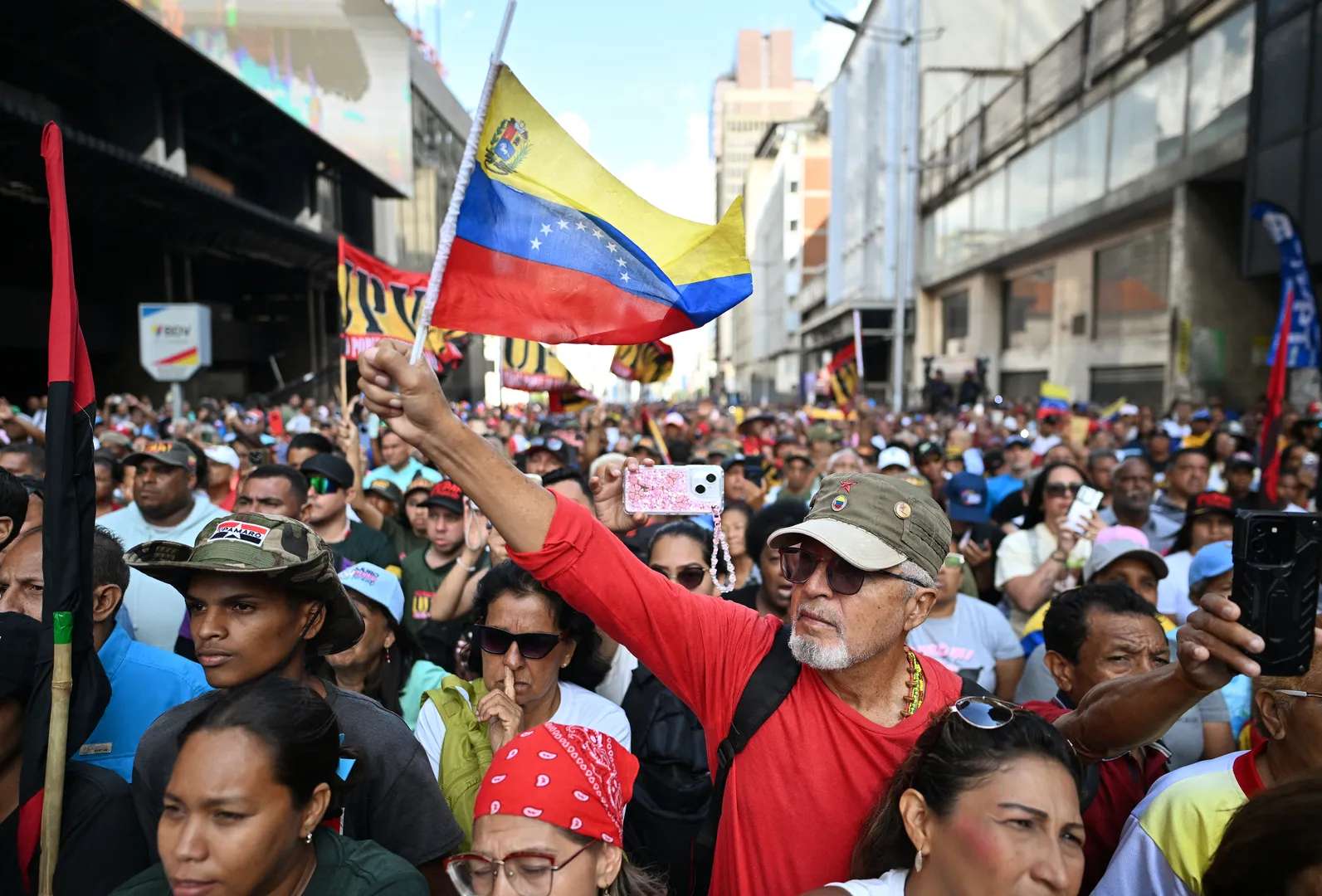
Venezuela’s opposition supporters have long hoped for the day when Nicolás Maduro is no longer in power — a dream that was fulfilled when the U.S. military whisked the authoritarian leader away. But while Maduro is in jail in New York on drug trafficking charges, the leaders of his repressive administration remain in charge.

The nation’s opposition — backed by consecutive Republican and Democratic administrations in the U.S. — for years vowed to immediately replace Maduro with one of their own and restore democracy to the oil-rich country. But President Trump delivered them a heavy blow by allowing Maduro’s vice president, Delcy Rodríguez, to assume control.

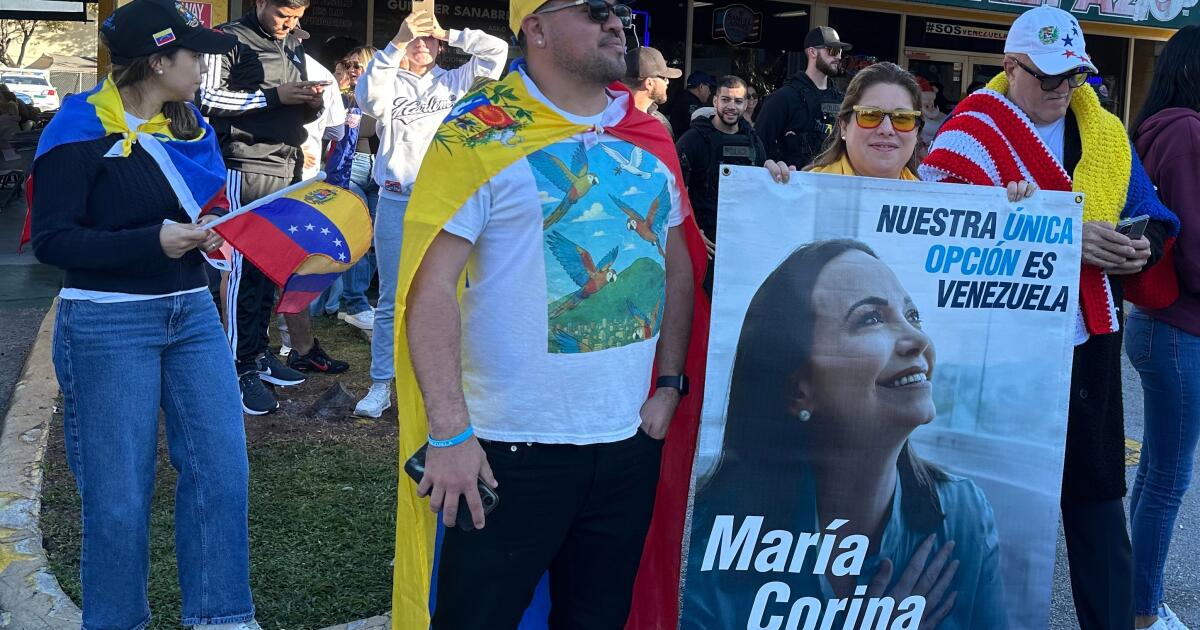
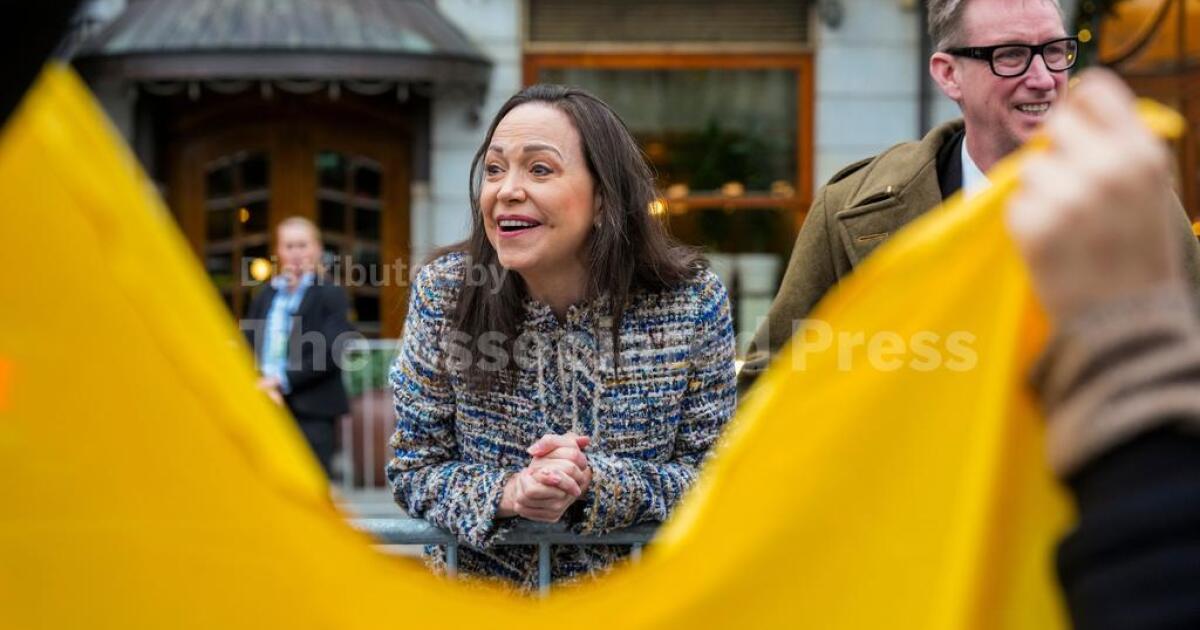
Meanwhile, most opposition leaders, including Nobel Peace Prize winner María Corina Machado, are in exile or prison.

“They were clearly unimpressed by the sort of ethereal magical realism of the opposition, about how if they just gave Maduro a push, it would just be this instant move toward democracy,” David Smilde, a Tulane University professor who has studied Venezuela for three decades, said of the Trump administration.

The U.S. seized Maduro and first lady Cilia Flores in a military operation Saturday, removing them both from their home on a military base in Venezuela’s capital, Caracas. Hours later, Trump said the U.S. would “run” Venezuela and expressed skepticism that Machado could ever be its leader.

“She doesn’t have the support within, or the respect within, the country,” Trump told reporters. “She’s a very nice woman, but she doesn’t have the respect.”

Ironically, Machado’s unending praise for the American president, including dedicating her Nobel Peace Prize to Trump and her backing of U.S. campaigns to deport Venezuelan migrants and attack alleged drug traffickers in international waters, has lost her some support at home.

The rightful winner of Venezuela’s presidential election

Machado rose to become Maduro’s strongest opponent in recent years, but his government barred her from running for office to prevent her from challenging — and likely beating — him in the 2024 presidential election. She chose retired ambassador Edmundo González Urrutia to represent her on the ballot.

Officials loyal to the ruling party declared Maduro the winner mere hours after the polls closed, but Machado’s well-organized campaign stunned the nation by collecting detailed tally sheets showing González had defeated Maduro by a 2-to-1 margin.

The U.S. and other nations recognized González as the legitimate winner.

However, Venezuelans identify Machado, not González, as the winner, and the charismatic opposition leader has remained the voice of the campaign, pushing for international support and insisting her movement will replace Maduro.

In her first televised interview since Maduro’s capture, Machado effusively praised Trump and failed to acknowledge his snub of her opposition movement in the latest transition of power.

“I spoke with President Trump on Oct. 10, the same day the prize was announced, not since then,” she told Fox News on Monday. “What he has done as I said is historic, and it’s a huge step toward a democratic transition.”

Hopes for a new election

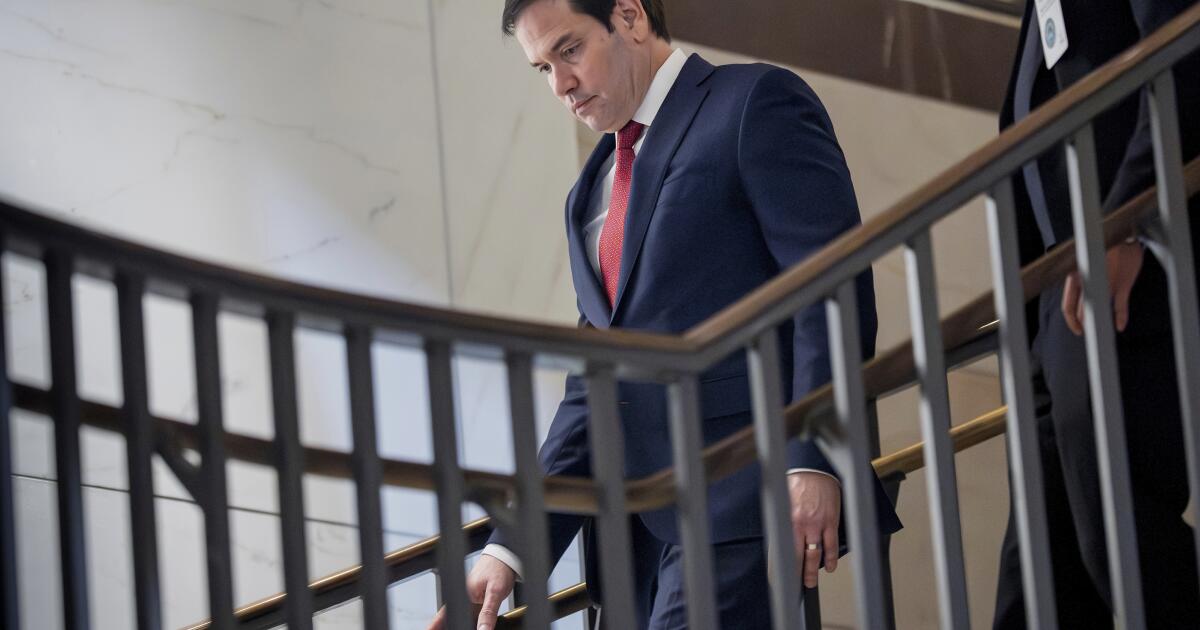
U.S. Secretary of State Marco Rubio on Sunday seemed to walk back Trump’s assertion that the U.S. would “run” Venezuela. In interviews, Rubio insisted that Washington will use control of Venezuela’s oil industry to force policy changes, and called its current government illegitimate. The country is home to the world’s largest proven crude oil reserves.

Neither Trump nor Rodríguez have said when, or if, elections might take place in Venezuela.

Venezuela’s constitution requires an election within 30 days whenever a president becomes “permanently unavailable” to serve. Reasons listed include death, resignation, removal from office or “abandonment” of duties as declared by the National Assembly. That electoral timeline was rigorously followed when Maduro’s predecessor, Hugo Chávez, died of cancer in 2013.

On Tuesday, U.S. Sen. Lindsey Graham, a close Trump ally who traveled with the president on Air Force One on Sunday, said he believes an election will happen but did not specify when or how.

“We’re going to build the country up – infrastructure wise – crescendoing with an election that will be free,” the South Carolina Republican told reporters.

But Maduro loyalists in the high court Saturday, citing another provision of the constitution, declared Maduro’s absence “temporary” meaning there is no election requirement. Instead, the vice president — which is not an elected position — takes over for up to 90 days, with a provision to extend to six months if approved by the National Assembly, which is controlled by the ruling party.

Challenges lie ahead for the opposition

In its ruling, Venezuela’s Supreme Court made no mention of the 180-day limit, leading to speculation that Rodríguez could try to cling to power as she seeks to unite ruling party factions and shield it from what would certainly be a stiff electoral challenge.

Machado on Monday criticized Rodríguez as “one the main architects of torture, persecution, corruption, narco-trafficking … certainly not an individual that can be trusted by international investors.”

Even if an election takes place, Machado and González would first have to find a way back into Venezuela.

González has been in exile in Spain since September 2024 and Machado left Venezuela last month when she appeared in public for the first time in 11 months to receive her Nobel Prize in Norway.

Ronal Rodríguez, a researcher at the Venezuela Observatory in Colombia’s Universidad del Rosario, said the Trump administration’s decision to work with Rodríguez could harm the nation’s “democratic spirit.”

“What the opposition did in the 2024 election was to unite with a desire to transform the situation in Venezuela through democratic means, and that is embodied by María Corina Machado and, obviously, Edmundo González Urrutia,” he said. “To disregard that is to belittle, almost to humiliate, Venezuelans.”

Cano writes for the Associated Press.
Source link

Trump says he wants to free up Venezuelan oil flow. What was blocking it? | US-Venezuela Tensions News

United States President Donald Trump and Secretary of State Marco Rubio say they want to free up the flow of Venezuelan oil to benefit Venezuelans after US forces abducted President Nicolas Maduro from Caracas.

“We’re going to rebuild the oil infrastructure, which requires billions of dollars that will be paid for by the oil companies directly,” Trump said at a media briefing at his Mar-a-Lago estate in Florida hours after Maduro was seized on Saturday. “They will be reimbursed for what they’re doing, but it’s going to be paid, and we’re going to get the oil flowing.”

Then, on Tuesday, the US president said he wanted to use proceeds from the sale of Venezuelan oil “to benefit the people of Venezuela and the United States”. Rubio has echoed Trump in his comments in recent days.

But what has been holding back the flow of Venezuelan oil, preventing the country from attracting investments and driving the country into poverty?

A key reason is one that Trump and Rubio have been silent about: Washington’s own efforts to strangle Venezuela’s oil industry and economy through sanctions, which also have set off a refugee crisis.

What has Trump said about Venezuelan oil?

In a post on his Truth Social platform on Tuesday night, Trump said Venezuela will turn over 30 million to 50 million barrels of sanctioned oil to the US.

Trump wrote: “This Oil will be sold at its Market Price, and that money will be controlled by me, as President of the United States of America, to ensure it is used to benefit the people of Venezuela and the United States!”

Trump added that he had directed his energy secretary, Chris Wright, to execute the plan “immediately”.

“It will be taken by storage ships, and brought directly to unloading docks in the United States,” Trump wrote.

During the news conference on Saturday, Trump said US oil companies would fix Venezuela’s “broken infrastructure” and “start making money for the country”.

Earlier Trump had accused Venezuela in a Truth Social post of “stealing” US oil, land and other assets and using that oil to fund crime, “terrorism” and human trafficking. Top Trump adviser Stephen Miller has made similar claims in recent days.

What does it mean for the US to take Venezuelan oil?

Oil is trading at roughly $56 per barrel.

Based on this price, 30 million barrels of oil would be worth $1.68bn and 50 million barrels of oil would be worth $2.8bn.

“Trump’s statement about oil in Venezuela is beyond an act of war; it is an act of colonisation. That is also illegal based on the UN Charter,” Vijay Prashad, the director of the Tricontinental Institute for Social Research based in Argentina, Brazil, India, and South Africa, told Al Jazeera.

Ilias Bantekas, a professor of transnational law at Hamad Bin Khalifa University in Qatar, told Al Jazeera that the US involvement in Venezuela was “less about Maduro as it is about access to Venezuela’s oil deposits”.

“This [oil] is the number one target. Trump is not content with just allowing US oil firms to get concessions but to ‘run’ the country, which entails absolute and indefinite control over Venezuela’s resources.”

According to the website of the US Energy Information Administration, the US consumed an average of 20.25 million barrels of petroleum per day in 2023.

What has Rubio said about Venezuelan oil?

In an interview on the NBC TV network’s Meet the Press programme that aired on Sunday, Rubio said: “We are at war against drug trafficking organisations. That’s not a war against Venezuela.”

“No more drug trafficking … and no more using the oil industry to enrich all our adversaries around the world and not benefitting the people of Venezuela or, frankly, benefitting the United States and the region,” Rubio said.

Rubio said in the interview that since 2014, about eight million Venezuelans have fled the country, which he attributed to theft and corruption by Maduro and his allies. According to a report by the Office of the UN High Commissioner for Refugees from May, nearly 7.9 million people have indeed left Venezuela.

But he was silent on the US’s own role in creating that crisis.

What are the US sanctions against Venezuela’s oil?

Venezuela nationalised its oil industry in 1976 under then-President Carlos Andres Perez during an oil boom. He established the state-owned Petroleos de Venezuela SA (PDVSA) to control all oil resources.

Venezuela continued to be a major oil exporter to the US for some years, supplying 1.5 million to 2 million barrels per day in the late 1990s and early 2000s.

After President Hugo Chavez took office in 1998, he nationalised all oil assets, seized foreign-owned assets, restructured the PDVSA and prioritised using oil revenue for social programmes in Venezuela.

From 2003 to 2007, Venezuela under Chavez managed to cut its poverty rate in half – from 57 percent to 27.5 percent. Extreme poverty fell even more sharply, by 70 percent.

But exports declined, and government authorities were accused of mismanagement.

The US first imposed sanctions on Venezuela’s oil in retaliation for nationalising US oil assets in 2005.

Under US sanctions, many senior Venezuelan government officials and companies have been barred from accessing any property or financial assets held in the US. They cannot access US bank accounts, sell property or access their money if it passes through the US financial system.

Critically, any US companies or citizens doing business with any sanctioned individual or company will be penalised and risk becoming subject to enforcement actions.

Maduro took over as president in 2013 after Chavez’s death. In 2017, Trump, during his first term in office, imposed more sanctions and tightened them again in 2019. This further restricted sales to the US and access for Venezuelan companies to the global financial system. As a result, oil exports to the US nearly stopped, and Venezuela shifted its trade mainly to China with some sales to India and Cuba.

Last month, the Trump administration imposed yet more sanctions – this time on Maduro family members and Venezuelan tankers carrying sanctioned oil.

Today, the PDVSA controls the petroleum industry in Venezuela, and US involvement in Venezuelan oil drilling is limited. Houston-based Chevron is the only US company that still operates in Venezuela.

How have sanctions hurt Venezuela’s oil flows?

Trump might today be interested in getting Venezuelan oil flowing, but it is US sanctions that blocked that flow in the first place.

Venezuela’s oil reserves are concentrated primarily in the Orinoco Belt, a region in the eastern part of the country stretching across roughly 55,000sq km (21,235sq miles).

While the country is home to the world’s largest proven oil reserves – at an estimated 303 billion barrels – it earns only a fraction of the revenue it once did from exporting crude.

[BELOW: The sentence above promises statistics that will show how much oil exports have dropped, but the next graf doesn’t deliver. We should add that figure]

According to data from the Observatory of Economic Complexity, Venezuela exported $4.05bn of crude oil in 2023. This is far below other major exporters, including Saudi Arabia ($181bn), the US ($125bn) and Russia ($122bn).

How have US sanctions hurt Venezuelans and the country’s oil infrastructure?

The US sanctions on Venezuelan oil prevent US and non-US companies from doing business with the PDVSA. Because the US is a market no one wants to lose, firms, including banks, are wary of taking any steps that could invite Washington’s sanctions.

In effect, that has meant Venezuela’s oil industry has been almost entirely deprived of international financial investment.

The sanctions additionally restrict Venezuela from accessing oilfield equipment, specialised software, drilling services and refinery components from Western companies.

This has resulted in years of underinvestment in the PDVSA’s infrastructure, leading to chronic breakdowns, shutdowns and accidents.

The sanctions have also resulted in broader economic turmoil.

The country’s gross domestic product per capita stood at about $4,200 in 2024, according to World Bank data, down from more than $13,600 in 2010.

From about 2012, the economy went into a sharp decline, driven by domestic economic policies, a slump that was later deepened by US sanctions. The resulting hardships have pushed millions of Venezuelans to leave the country – the same people who Trump and Rubio now argue should benefit from Venezuela’s oil revenues.

Does the US have any claim to Venezuelan oil?

US companies began drilling for oil in Venezuela in the early 1900s.

In 1922, vast petroleum reserves were initially discovered by Royal Dutch Shell in Lake Maracaibo in Zulia state in northwestern Venezuela.

At this point, US companies ramped up their investments in the extraction and development of Venezuelan oil reserves. Companies such as Standard Oil led development under concession agreements, propelling Venezuela to a position as a key global supplier, especially for the US.

Venezuela was a founding member of OPEC, joining at its creation on September 14, 1960. OPEC is a group of major oil-exporting countries that work together to manage supply and influence global oil prices.

But the claims by Trump and Miller that Venezuela somehow “stole” US oil are baseless under international law, experts said.

The principle of permanent sovereignty over natural resources, adopted by the UN General Assembly in a resolution in 1962, is clear that sovereign states have the inherent right to control, use and dispose of their resources for their own development.

In other words, Venezuela alone owns its oil.

Source link

How Delcy Rodríguez courted Donald Trump and rose to power in Venezuela

In 2017, as political outsider Donald Trump headed to Washington, Delcy Rodríguez spotted an opening.

Then Venezuela’s foreign minister, Rodríguez directed Citgo — a subsidiary of the state oil company — to make a $500,000 donation to the president’s inauguration. With the socialist administration of Nicolas Maduro struggling to feed Venezuela, Rodríguez gambled on a deal that would have opened the door to American investment. Around the same time, she saw that Trump’s ex-campaign manager was hired as a lobbyist for Citgo, courted Republicans in Congress and tried to secure a meeting with the head of Exxon.

The charm offensive flopped. Within weeks of taking office, Trump, urged by then-Sen. Marco Rubio, made restoring Venezuela’s democracy his driving focus in response to Maduro’s crackdown on opponents. But the outreach did bear fruit for Rodríguez, making her a prominent face in U.S. business and political circles and paving the way for her own rise.

“She’s an ideologue, but a practical one,” said Lee McClenny, a retired foreign service officer who was the top U.S. diplomat in Caracas during the period of Rodríguez’s outreach. “She knew that Venezuela needed to find a way to resuscitate a moribund oil economy and seemed willing to work with the Trump administration to do that.”

Nearly a decade later, as Venezuela’s interim president, Rodríguez’s message — that Venezuela is open for business — seems to have persuaded Trump. In the days since Maduro’s stunning capture Saturday, he’s alternately praised Rodríguez as a “gracious” American partner while threatening a similar fate as her former boss if she doesn’t keep the ruling party in check and provide the U.S. with “total access” to the country’s vast oil reserves. One thing neither has mentioned is elections, something the constitution mandates must take place within 30 days of the presidency being permanently vacated.

This account of Rodríguez’s political rise is drawn from interviews with 10 former U.S. and Venezuelan officials as well as businessmen from both countries who’ve had extensive dealings with Rodríguez and in some cases have known her since childhood. Most spoke on the condition of anonymity for fear of retaliation from someone who they almost universally described as bookishly smart, sometimes charming but above all a cutthroat operator who doesn’t tolerate dissent. Rodríguez didn’t respond to AP requests for an interview.

Father’s murder hardens leftist outlook

Rodríguez entered the leftist movement started by Hugo Chávez late — and on the coattails of her older brother, Jorge Rodríguez, who as head of the National Assembly swore her in as interim president Monday.

Tragedy during their childhood fed a hardened leftist outlook that would stick with the siblings throughout their lives. In 1976 — when, amid the Cold War, U.S. oil companies, American political spin doctors and Pentagon advisers exerted great influence in Venezuela — a little-known urban guerrilla group kidnapped a Midwestern businessman. Rodriguez’s father, a socialist leader, was picked up for questioning and died in custody.

McClenny remembers Rodríguez bringing up the murder in their meetings and bitterly blaming the U.S. for being left fatherless at the age of 7. The crime would radicalize another leftist of the era: Maduro.

Years later, while Jorge Rodríguez was a top electoral official under Chávez, he secured for his sister a position in the president’s office.

But she advanced slowly at first and clashed with colleagues who viewed her as a haughty know-it-all.

In 2006, on a whirlwind international tour, Chávez booted her from the presidential plane and ordered her to fly home from Moscow on her own, according to two former officials who were on the trip. Chávez was upset because the delegation’s schedule of meetings had fallen apart and that triggered a feud with Rodriguez, who was responsible for the agenda.

“It was painful to watch how Chávez talked about her,” said one of the former officials. “He would never say a bad thing about women but the whole flight home he kept saying she was conceited, arrogant, incompetent.”

Days later, she was fired and never occupied another high-profile role with Chávez.

Political revival and soaring power under Maduro

Years later, in 2013, Maduro revived Rodríguez’s career after Chávez died of cancer and he took over.

A lawyer educated in Britain and France, Rodríguez speaks English and spent large amounts of time in the United States. That gave her an edge in the internal power struggles among Chavismo — the movement started by Chávez, whose many factions include democratic socialists, military hardliners who Chávez led in a 1992 coup attempt and corrupt actors, some with ties to drug trafficking.

Her more worldly outlook, and refined tastes, also made Rodríguez a favorite of the so-called “boligarchs” — a new elite that made fortunes during Chávez’s Bolivarian revolution. One of those insiders, media tycoon Raul Gorrín, worked hand-in-glove with Rodríguez’s back-channel efforts to mend relations with the first Trump administration and helped organize a secret visit by Rep. Pete Sessions, a Texas Republican, to Caracas in April 2018 for a meeting with Maduro. A few months later, U.S. federal prosecutors unsealed the first of two money laundering indictments against Gorrin.

After Maduro promoted Rodríguez to vice president in 2018, she gained control over large swaths of Venezuela’s oil economy. To help manage the petro-state, she brought in foreign advisers with experience in global markets. Among them were two former finance ministers in Ecuador who helped run a dollarized, export-driven economy under fellow leftist Rafael Correa. Another key associate is French lawyer David Syed, who for years has been trying to renegotiate Venezuela’s foreign debt in the face of crippling U.S. sanctions that make it impossible for Wall Street investors to get repaid.

“She sacrificed her personal life for her political career,” said one former friend.

As she amassed more power, she crushed internal rivals. Among them: once powerful Oil Minister Tareck El Aissami, who was jailed in 2024 as part of an anti-corruption crackdown spearheaded by Rodríguez.

In her de-facto role as Venezuela’s chief operating officer, Rodríguez proved a more flexible, trustworthy partner than Maduro. Some have likened her to a sort of Venezuelan Deng Xiaoping — the architect of modern China.

Hans Humes, chief executive of Greylock Capital Management, said that experience will serve her well as she tries to jump-start the economy, unite Chavismo and shield Venezuela from stricter terms dictated by Trump. Imposing an opposition-led government right now, he said, could trigger bloodshed of the sort that ripped apart Iraq after U.S. forces toppled Saddam Hussein and formed a provisional government including many leaders who had been exiled for years.

“We’ve seen how expats who have been outside of the country for too long think things should be the way it was before they left,” said Humes, who has met with Maduro as well as Rodríguez on several occasions. “You need people who know how to work with how things are not how they were.”

Democracy deferred?

Where Rodríguez’s more pragmatic leadership style leaves Venezuela’s democracy is uncertain.

Trump, in remarks after Maduro’s capture, said Nobel Peace Prize winner Maria Corina Machado lacks the “respect” to govern Venezuela despite her handpicked candidate winning what the U.S. and other governments consider a landslide victory in 2024 presidential elections stolen by Maduro.

Elliott Abrams, who served as special envoy to Venezuela during the first Trump administration, said it is impossible for the president to fulfill his goal of banishing criminal gangs, drug traffickers and Middle Eastern terrorists from the Western Hemisphere with the various factions of Chavismo sharing power.

“Nothing that Trump has said suggests his administration is contemplating a quick transition away from Delcy. No one is talking about elections,” said Abrams. “If they think Delcy is running things, they are completely wrong.”

Goodman writes for the Associated Press.

Source link

Do Russia and China pose a national security threat to the US in Greenland? | Donald Trump News

US President Donald Trump sees Greenland as a United States national security priority to deter Washington’s “adversaries in the Arctic region”, according to a White House statement released on Tuesday.

The statement came days after Trump told reporters that the US needs Greenland from a national security perspective because it is “covered with Russian and Chinese ships”.

Recommended Stories

list of 4 itemsend of list

Here’s what you need to know about what Trump said, whether Russia and China are present in Greenland, and whether they do pose a threat to American security.

What has Trump recently said about Greenland?

“Right now, Greenland is covered with Russian and Chinese ships all over the place. We need Greenland from the standpoint of national security,” Trump told reporters aboard Air Force One on January 4.

The White House statement on Tuesday fleshed out further details on how the US would go about its acquisition of Greenland.

“The president and his team are discussing a range of options to pursue this important foreign policy goal, and of course, utilizing the US military is always an option at the commander-in-chief’s disposal,” the White House statement says.

Over the course of his second term, Trump has talked about wanting Greenland for national security reasons multiple times.

“We need Greenland for international safety and security. We need it. We have to have it,” he said in March.

Since 1979, Greenland has been a self-governing territory of Denmark, and since 2009, it has had the right to declare independence through a referendum.

Trump has repeatedly expressed a desire to take control of the island, which hosts a US military base. He first voiced this desire in 2019, during his first term as US president.

As a response, leaders from Greenland and Denmark have repeatedly said that Greenland is not for sale. They have made it clear that they are especially not interested in becoming part of the US.

On January 4, Denmark’s Prime Minister Mette Frederiksen said, “It makes absolutely no sense to talk about the US needing to take over Greenland.”

“The US has no right to annex any of the three countries in the Danish kingdom,” she said, alluding to the Faroe Islands, which, like Greenland, are also a Danish territory.

“I would therefore strongly urge the US to stop the threats against a historically close ally and against another country and another people who have very clearly said that they are not for sale,” Frederiksen said.

US special forces abducted Venezuelan President Nicolas Maduro during an operation in the Venezuelan capital, Caracas, on January 3.

Hours later, Katie Miller, the wife of close Trump aide and US Homeland Security Advisor Stephen Miller, posted a photo on X showing the US flag imposed on the map of Greenland.

Greenland’s Prime Minister Jens-Frederik Nielsen hit back in an X post, writing, “Relations between nations and peoples are built on mutual respect and international law – not on symbolic gestures that disregard our status and our rights.”

Why does Trump want Greenland so badly?

The location and natural resources of the Arctic island make it strategically important for Washington.

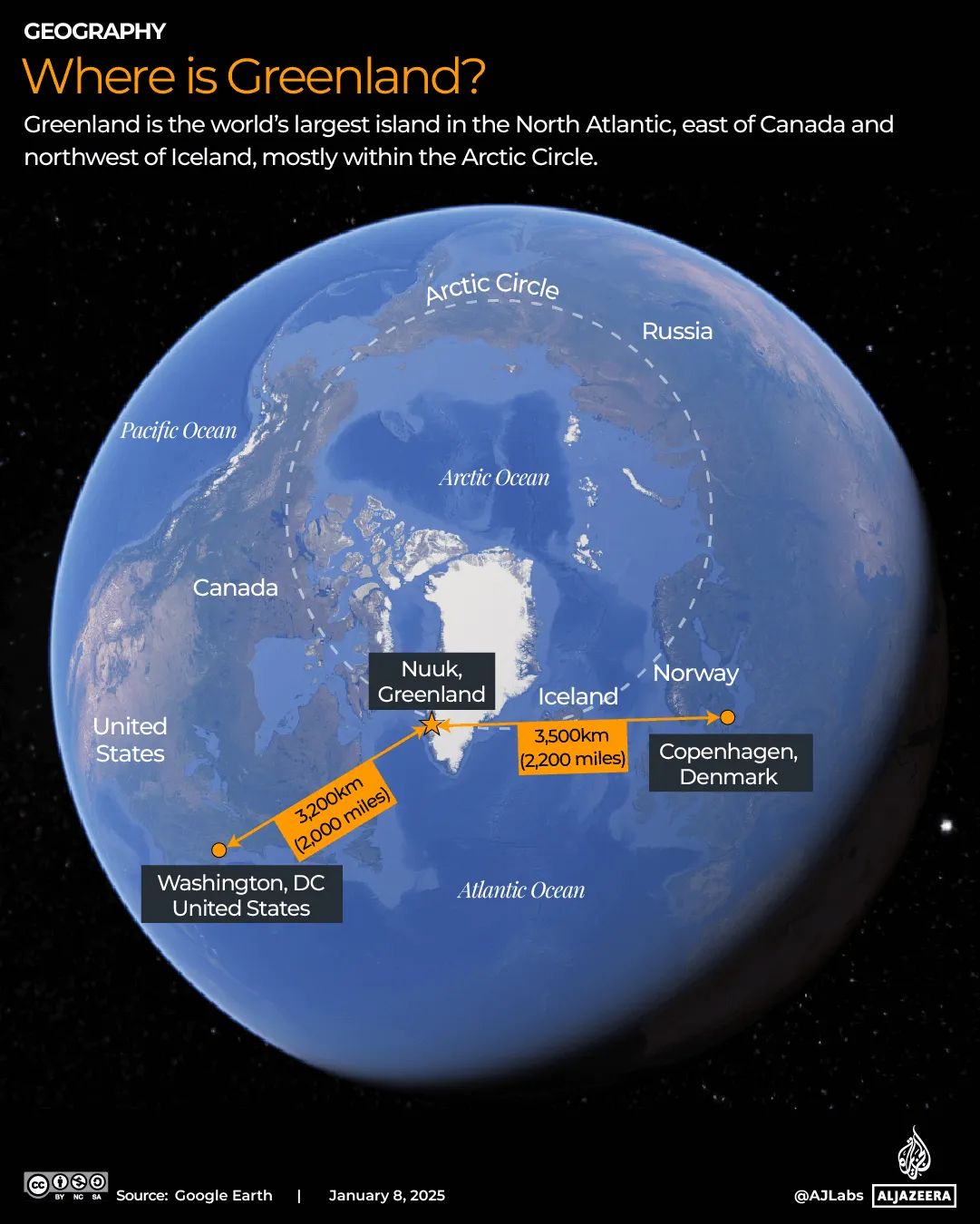
Greenland is geographically part of North America, located between the Arctic Ocean and the North Atlantic Ocean. It is home to some 56,000 residents, mostly Indigenous Inuit people.

It is the world’s largest island. Greenland’s capital, Nuuk, is closer to New York City  – some 2,900km (1,800 miles) away – than the Danish capital Copenhagen, which is located 3,500km (2,174 miles) to the east.

Greenland, a NATO territory through Denmark, is an EU-associated overseas country and territory whose residents remain European Union citizens, having joined the European Community with Denmark in 1973 but having withdrawn in 1985.

“It’s really tricky if the United States decides to use military power to take over Greenland. Denmark is a member of NATO; the United States is a member as well. It really calls into question what the purpose of the military alliance is, if that happens,” Melinda Haring, a senior fellow at the Atlantic Council Eurasia Center, told Al Jazeera.

Greenland offers the shortest route from North America to Europe. This gives the US a strategic upper hand for its military and its ballistic missile early-warning system.

The US has expressed interest in expanding its military presence in Greenland by placing radars in the waters connecting Greenland, Iceland and the United Kingdom. These waters are a gateway for Russian and Chinese vessels, which Washington aims to track.

The island is also incredibly rich in minerals, including rare earth minerals used in the high-tech industry and in the manufacture of batteries.

According to a 2023 survey, 25 of 34 minerals deemed “critical raw materials” by the European Commission were found in Greenland.

Greenland does not carry out the extraction of oil and gas, and its mining sector is opposed by its Indigenous population. The island’s economy is largely reliant on its fishing industry.

INTERACTIVE - Where is Greenland Map

Are Chinese and Russian ships swarming Greenland?

However, while Trump has spoken of Russian and Chinese ships around Greenland, currently, facts don’t bear that out.

Vessel tracking data from maritime data and intelligence websites such as MarineTraffic do not show the presence of Chinese or Russian ships near Greenland.

Are Russia and China a threat to Greenland?

The ships’ location aside, Trump’s rhetoric comes amid a heightened scramble for the Arctic.

Amid global warming, the vast untapped resources of the Arctic are becoming more accessible. Countries like the US, Canada, China and Russia are now eyeing these resources.

“Russia has never threatened anyone in the Arctic, but we will closely follow the developments and mount an appropriate response by increasing our military capability and modernising military infrastructure,” Russian President Vladimir Putin said during an address in March 2025 at the International Arctic Forum in the Russian city of Murmansk, the largest city within the Arctic Circle.

During this address, Putin said that he believed Trump was serious about taking Greenland and that the US will continue with efforts to acquire it.

In December 2024, Canada released a policy document detailing plans to ramp up its military and diplomatic presence in the Arctic. Russia is also constructing military installations and power plants in the region.

Meanwhile, Russia and China have been working together to develop Arctic shipping routes as Moscow seeks to deliver more oil and gas to China amid Western sanctions while Beijing seeks an alternative shipping route to reduce its dependence on the Strait of Malacca.

The Northern Sea Route (NSR), a maritime route in the Arctic Ocean, is becoming easier to navigate due to melting ice. The NSR can cut shipping trips significantly short. Russia is hoping to ramp up commerce through the NSR to trade more with Asia than Europe due to Western sanctions. Last year, the number of oil shipments from Russia to China via the NSR rose by a quarter.

China is also probing the region, and has sent 10 scientific expeditions to the Arctic and built research vessels to survey the icy waters north of Russia.

Source link

Trump administration suggests force an option to take over Greenland

Jan. 7 (UPI) — The White House said military force was among a range of options it was looking at in an effort to “acquire” Greenland for the United States.

Doubling down on comments by the administration officials in the past few days that the United States has a stronger claim to the Arctic Island than Denmark, in a statement Tuesday carried by The Hill, ABC News and the BBC, White House Press Secretary Karoline Leavitt said using the military was “always an option.”

“President Trump has made it well known that acquiring Greenland is a national security priority of the United States, and it’s vital to deter our adversaries in the Arctic region. The president and his team are discussing a range of options to pursue this important foreign policy goal, and of course, utilizing the U.S. Military is always an option at the Commander-in-Chief’s disposal.”

The statement came hours after European leaders pushed back hard on the renewed claims emanating from the administration since the U.S. military action in Venezuela at the weekend that the United States needs Greenland for its security, and by extension NATO’s, and that Denmark was not up to the job of defending Greenland.

In a joint statement of solidarity with Denmark, the leaders of France, Germany, Britain, Italy, Poland and Spain said Greenland belonged to its people and that “it is for Denmark and Greenland, and them only, to decide on matters concerning Denmark and Greenland.”

They insisted that security in the Arctic was a priority and that they were taking steps to boost their military “presence, investments and activities,” but stressed that security could only be achieved collectively and “sovereignty, territorial integrity and the inviolability of borders,” had to be upheld.

“These are universal principles, and we will not stop defending them,” read the statement.

In a closed-briefing on Capitol Hill on Monday, Secretary of State Marco Rubio suggested to lawmakers that Trump’s talk of taking Greenland by force was just rhetoric to pressure Copenhagen to come to the table, and his actual goal was to buy Greenland from Denmark.

However, later Monday, White House Deputy Chief of Staff Stephen Miller reignited fears, telling CNN, military force was a non-question because America’s overwhelming military superiority meant “nobody is going to fight the United States militarily over Greenland.”

He also questioned the basis of Denmark’s territorial claim.

Greenland has been closely tied to Denmark since the 18th century, initially as a colony and then as an incorporated, semi-autonomous region with representation in the Danish Parliament.

Danish control of Greenland was recognized by the United States in 1916, as part of a deal for the purchase of what is now the U.S. Virgin Islands from Denmark.

The government in Nuuk said Tuesday it had asked for a meeting with Rubio.

Source link

Trump: Venezuela to give U.S. tens of millions of barrels of oil

Activists denounce the U.S. military seizure of Venezuelan President Nicholas Maduro at Pershing Square in Los Angeles, Calif., on Saturday, January 3, 2026. President Donald Trump said Tuesday that Venezuela will give the United States upwards of 50 million barrels of oil. Photo by Jim Ruymen/UPI. | License Photo

Jan. 6 (UPI) — Venezuela will be turning over tens of millions of barrels of oil to the United States, President Donald Trump said Tuesday, days after the U.S. military seized the authoritarian president of the country, Nicolas Maduro.

Trump said Venezuela’s interim government, sworn in Monday, will be giving the United States between 30 million and 50 million barrels of “high quality, sanctioned oil.”

“This oil will be sold at its Market Price, and that money will be controlled by me, as President of the United States of America, to ensure it is used to benefit the people of Venezuela and the United States!” Trump said on his Truth Social platform.

It was unclear when the United States would receive the oil, but it will be brought to the United States aboard oil tankers.

Trump said Energy Secretary Chris Wright has been asked to “immediately” execute the plan.

“On it Mr. President,” Wright said in response on X.

“You have my attention to this matter.”

The U.S. military seized Maduro from Venezuela in an early morning operation on Saturday following months of military buildup around the country and an escalating Trump administration pressure campaign. He and his wife, Cilia Flores, were brought to the United States to face narcotrafficking and other drug-related charges.

The Trump administration has been enforcing a naval blockade on Venezuelan oil since mid-December, with Trump arguing the South American country’s oil and assets of U.S. companies were “stolen from us,” referring to Caracas’ decades-old nationalization of its oil industry.

Delcy Rodriguez, former vice president under Maduro, was sworn in as president of Venezuela on Monday. However, Trump has said that the United States will be “running” the South American nation, though other administration officials, including Secretary of State Marco Rubio, have attempted to soften that stance.

Rodriguez is “essentially willing to do what we think is necessary to make Venezuela great again,” Rubio said Monday.

Venezuela has the world’s largest oil reserves.

According to the U.S. Energy Information Administration, the United States consumed an average of 20.25 million barrels of petroleum per day in 2023.

Source link

Trump warns Republicans: Lose the House and ‘I’ll get impeached’

Jan. 6 (UPI) — President Donald Trump warned House Republicans on Tuesday that if they fail to hold on to the chamber in November’s midterm elections, the Democrats will impeach him.

“You got to win the midterms because if we don’t win the midterms, it’s just going to be, I mean — they’ll find a reason to impeach me. I’ll get impeached,” Trump told a few dozen GOP lawmakers in attendance at the Kennedy Center in Washington, D.C., for a House Republican policy retreat.

Trump has repeatedly expressed concern over the future of the GOP’s slim majority of the House ahead of next fall’s midterm elections, as the president’s party has historically suffered losses in the midterms and his first year back in office has been marked by divisive policies and rhetoric.

This summer, GOP-controlled Texas, under pressure from Trump, redrew its congressional district maps to secure more Republican seats in November — setting off gerrymander redistricting efforts by both parties in states they hold majorities.

Democrats and civil rights and voting advocacy groups have accused Trump of trying to undermine the election to hold on to the House, which the GOP currently maintains a 218-213 majority.

In his sprawling 90-minute speech, Trump attempted to project an image of confidence ahead of the election, stating the GOP House is among the most successful in history, while simultaneously expressing befuddlement that the electorate may vote to return the chamber to the Democrats.

“I wish you could explain to me what the hell’s going on with the mind of the public because we have the right policy. They don’t. They have horrible policy. They do stick together. They’re violent. They’re vicious, you know,” Trump said, referring to the Democrats. “They’re vicious people and they stick together like glue.”

Trump was twice impeached during his first term in office: In 2019, on accusations of threatening to withhold Congressionally approved military aid for Ukraine unless President Volodymyr Zelensky investigated the son of his political rival, Joe Biden; and in the wake of the Jan. 6, 2021, insurrection attempt of the Capitol.

He was acquitted both times.

Trump critics and Democrats have suggested since early in his second term that impeachment could be pursued over a range of presidential actions they say are unconstitutional, with some actions being questioned by legal experts and advocacy groups as violations of international law and potential war crimes.

Trump has attracted the most criticism over his immigration polices, which have seen migrants sent to a Salvadoran prison, as well as his anti-drug military actions that have seen more than 100 people killed in international waters. The United Nations high commissioner for human rights, Volker Turk, has said there is “no justification in international law” for the military strikes.

On Saturday, the U.S. military seized Venezuelan President Nicolas Maduro in what the Trump administration has called a law enforcement action, though it has raised questions domestically and internationally over the legality of the operation.

U.N. Secretary-General Antonio Guterres on Monday told the Security Council that he is “deeply concerned that the rules of international law have not been respected with regard to the 3 January military action.”

Trump has followed the operation by threatening to do the same to the leaders of Colombia and Cuba.

“The leaders who pay homage to him and show themselves to be servile to U.S. President Trump in an attempt to win his favor only humiliate themselves,” Chilean President Gabriel Boric Font said in a statement earlier Tuesday.

“Trump (and his administration) not only permanently violates International Law, but human dignity itself.”

The abduction of Maduro has amplified Democratic concerns and talk of impeachment.

“Today, many Democrats have understandably questioned whether impeachment is possible again under the current reality. I am reconsidering that view,” Rep. Maxine Waters, D-Calif., ranking member of the House Financial Services Committee, said in a statement on Saturday following the military operation.

“Even if Republicans refuse to act, Democrats cannot remain silent or passive in the face of actions this extreme from this administration.”

Waters continued: “What we are witnessing is an unprecedented escalation of an unlawful invasion, the detention of foreign leaders and a president openly asserting power far beyond what the Constitution allows. Democrats must take a firm stand against this abuse of authority. We cannot normalize it. We cannot excuse it.”

President Donald Trump holds a signed executive order reclassifying marijuana from a schedule I to a schedule III controlled substance in the Oval Office of the White House on Thursday. Photo by Aaron Schwartz/UPI | License Photo

Source link

US says military ‘always an option’ in Greenland as Europe rejects threats | Donald Trump News

The United States has raised the prospect of using military force to take control of Greenland as leaders in Europe and Canada rallied behind the Arctic territory, saying it belongs to its people.

In a statement on Tuesday, the White House said that US President Donald Trump sees acquiring Greenland, which is part of Denmark, as a national security priority, necessary to “deter our adversaries in the Arctic region”.

Recommended Stories

list of 4 itemsend of list

“The president and his team are discussing a range of options to pursue this important foreign policy goal, and of course, utilizing the ​US military is always an option at the commander-in-chief’s disposal,” it said.

Any attempt by the US to seize Greenland from longtime ally Denmark would send shockwaves through the NATO alliance and deepen the divide between Trump and European leaders.

The opposition has not deterred Trump, however.

His interest in Greenland, initially aired in 2019 during his first term in office, has been rekindled following the US’s abduction of Venezuelan President Nicolas Maduro in an attack on Caracas.

Emboldened by the operation, Trump has said that “American dominance in the Western Hemisphere will never be questioned again”, and has stepped up pressure on both Colombia and Cuba. He has also argued that controlling Greenland is vital to US national security, claiming the island “is covered with Russian and Chinese ships” and that Denmark lacks the capacity to protect it.

Greenland, the world’s largest island, but with a population of just 57,000 people, has repeatedly said it does not ‍want to be part of the US.

Its strategic location between Europe and North America makes it a critical site for the US ballistic missile defence system, while its mineral wealth aligns with Washington’s ambition to reduce reliance on Chinese exports.

Greenland ‘belongs to its people’

The White House statement on Tuesday came as leaders of France, Germany, Italy, Poland, Spain and the United Kingdom joined Danish Prime Minister Mette Frederiksen in issuing a statement reaffirming that Greenland “belongs to its people”.

“It is for Denmark and Greenland, and them only, to decide on matters concerning Denmark and Greenland,” they said.

Canadian Prime Minister Mark Carney also voiced support, announcing that Governor General Mary Simon, who is of Inuit descent, and Minister of Foreign Affairs Anita Anand would visit Greenland early next month.

In a separate statement, Nordic foreign ministers – from Finland, Iceland, Norway, Sweden and Denmark – also stressed Greenland’s right to decide its own affairs. They also noted they had increased their investments in Arctic security, and offered to do more in consultation with the US and other NATO allies.

Polish Prime Minister Donald Tusk also warned that threats against a NATO member undermined the alliance’s credibility. “No member should attack or threaten another ‌member of the North Atlantic Treaty Organisation. Otherwise, NATO would lose its meaning,” he said.

Greenland Prime Minister Jens-Frederik Nielsen welcomed the European leaders’ pledge of solidarity and renewed his ‌call to the US for a “respectful dialogue”.

Denmark, meanwhile, rejected Trump’s assertion that it is unable to protect Greenland.

“We do not share this image that Greenland ‍is plastered with Chinese investments… ⁠nor that there are Chinese warships up and down along Greenland,” Danish Minister for Foreign Affairs Lars Lokke Rasmussen said, adding that the US was welcome to invest more on the island.

Greenland’s government said it had asked for an urgent meeting with US Secretary of State Marco Rubio, together with Rasmussen, to discuss the situation.

Also on Tuesday, Louisiana Governor Jeff Landry, whom Trump appointed last month as US special envoy to Greenland, said he was not interested in talking to people in Denmark or European diplomats over Greenland.

Instead, he said he wants to have conversations directly with residents of Greenland. “I want to talk to people who want an opportunity to improve the quality of life in Greenland,” the Republican said on a Fox News radio show.

Separately, The Wall Street Journal reported that Rubio had told US lawmakers during a congressional briefing that the recent threats did not signal an imminent invasion of Greenland and that the goal is to ‌buy the island from Denmark.

The White House deputy chief of staff, Stephen Miller, also dismissed concerns about Danish sovereignty.

“You can ⁠talk all you want about international niceties and everything else,” Miller told CNN. “But we live in a world, in the real world, that is governed by strength, that is governed by force, that ​is governed by power.”

Members of Congress, including some of Trump’s fellow Republicans, pushed back.

“When Denmark and Greenland make it clear that Greenland is not for sale, the United States must honour its treaty obligations and respect the sovereignty and ‌territorial integrity of the Kingdom of Denmark,” said Democratic Senator Jeanne Shaheen and Republican Senator Thom Tillis, the co-chairs of the Senate NATO Observer Group.

Source link

Trump’s attacks on Venezuela put Mexico on edge | Donald Trump News

The attack on Venezuela and the abduction of President Nicolas Maduro over the weekend have sent shockwaves across Latin America, where many countries fear a return to a period of overt United States interventionism.

Those fears are particularly prominent in Mexico, the US’s neighbour and longtime ally.

Recommended Stories

list of 3 itemsend of list

The country was one of several — along with Cuba and Colombia — that US President Donald Trump singled out in remarks after Saturday’s attack on Venezuela, which killed dozens of people and was widely condemned as a violation of international law.

Trump suggested that the US could carry out military strikes on Mexican territory in the name of combating drug traffickers.

“Something’s going to have to be done with Mexico,” Trump said in an interview with Fox News on Saturday morning, after the Venezuela strikes.

“She [President Claudia Sheinbaum] is very frightened of the cartels,” he added. “They’re running Mexico.”

‘We are free and sovereign’

Sheinbaum has responded to Trump’s threats with a firm insistence on Mexican sovereignty.

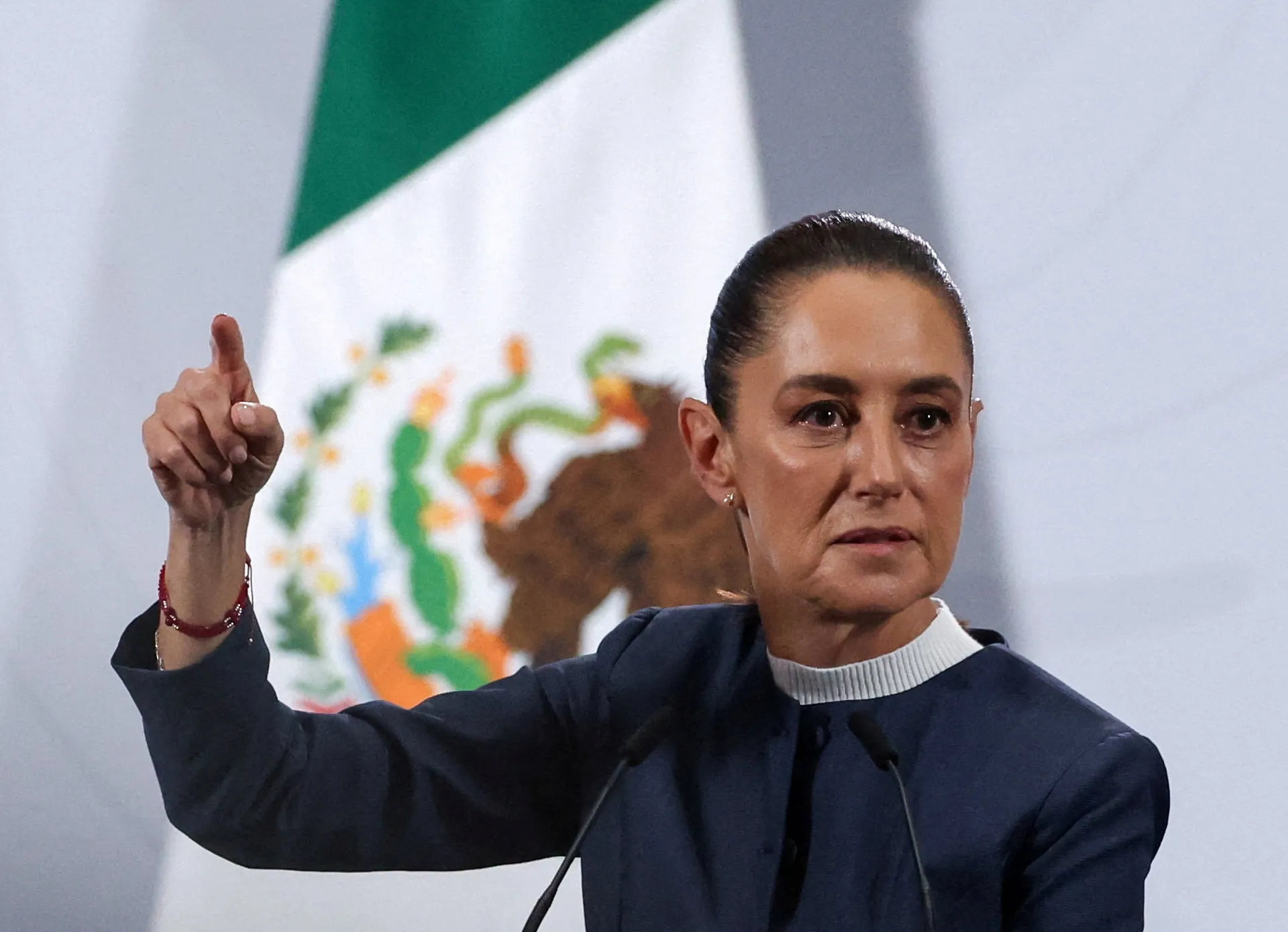
“We categorically reject intervention in the internal matters of other countries,” Sheinbaum said in comments to the media on Monday.

“It is necessary to reaffirm that, in Mexico, the people rule and that we are a free and sovereign country,” she added. “Cooperation, yes; subordination and intervention, no.”

Even in good times, Mexican leaders have walked a line between seeking productive relations with their powerful northern neighbour and defending their interests from possible US encroachment.

That balancing act has become more difficult as the Trump administration employs rhetoric and policies that have drawn parallels to earlier eras of imperial intervention.

“Historically, there’s a record of US intervention that is part of the story of Mexican nationalism,” Pablo Piccato, a professor of Mexican history at Columbia University, told Al Jazeera.

Many of those instances loom large in the country’s national memory. The US launched a war against Mexico in 1846 that saw US troops occupy Mexico City and annex enormous swaths of territory, including modern-day California, Nevada, and New Mexico.

Later, during the Mexican Revolution, from 1910 to 1920, US Ambassador Henry Lane Wilson worked with conservative forces in Mexico to overthrow the country’s pro-reform president.

US forces also bombed the port city of Veracruz in 1914 and sent forces into northern Mexico to hunt down revolutionary leader Pancho Villa.

“These are seen as important moments in Mexican history,” said Piccato.

“There is a quote attributed to Mexican President Porfirio Diaz, ‘Poor Mexico. So far from God, so close to the United States.’”

In recent statements, Trump has linked the US’s history in the region to his present-day agenda. While announcing Saturday’s strike, he cited the Monroe Doctrine, a 19th-century policy that the US has used to assert primacy over the Western Hemisphere.

“The Monroe Doctrine is a big deal, but we’ve superseded it by a lot, by a real lot. They now call it the ‘Donroe Doctrine’,” Trump said.

On Monday, the US State Department also shared an image of Trump on social media with the caption: “This is OUR hemisphere.”

‘Balancing on a thin wire’

Sheinbaum’s insistence on Mexican sovereignty has not prevented her from offering concessions to Trump on key priorities, such as migration, security and commerce.

When faced with Trump’s threats of 25 percent tariffs last February, Sheinbaum agreed to deploy 10,000 Mexican National Guard troops to her country’s border with the US, to help limit irregular immigration and drug-trafficking.

Mexico has also maintained close security ties with the US and cooperated in its operations against criminal groups, including through the extradition of some drug traffickers.

In February, for instance, Sheinbaum’s government extradited 29 criminal suspects that the US accused of drug trafficking and other charges. In August, it sent another 26 suspects to the US, earning a statement of gratitude from the Trump administration.

Washington has historically pressured Mexico to take a hardline stance towards combating drugs, leading to policies that some Mexicans blame for increasing violence and insecurity in their country.

Still, while Sheinbaum has received praise for managing relations with Trump, she has consistently said that unilateral US military action on Mexican territory would be a red line.

Experts say Sheinbaum’s willingness to cooperate should be an incentive for the US government not to launch attacks on Mexican soil.

“Sheinbaum has gone out of her way to cooperate with the US,” said Stephanie Brewer, the director of the Mexico programme at the Washington Office on Latin America (WOLA), a US-based research group. “There would be no rational reason to break this bilateral relationship by crossing the one red line Mexico has set out.”

But the strikes on Venezuela have also underscored the Trump administration’s increasingly aggressive posture towards Latin America.

“I don’t think US strikes on Mexican territory are any more or less likely than they were before the attacks in Venezuela,” said Brewer. “But they do make it abundantly clear that the Trump administration’s threats need to be taken seriously, and that the US is willing to violate international law in its use of military force.”

“Sheinbaum is doing a balancing act on an increasingly thin wire,” she added.

Source link

What Trump’s vow to withhold federal childcare funding means in California

Gov. Gavin Newsom and other state Democratic leaders accused President Trump of unleashing a political vendetta after he announced plans to freeze roughly $10 billion in federal funding for child care and social services programs in California and four other Democrat-controlled states.

Trump justified the action in comments posted on his social media platform Truth Social, where he accused Newsom of widespread fraud. The governor’s office dismissed the accusation as “deranged.”

Trump’s announcement came amid a broader administration push to target Democratic-led states over alleged fraud in taxpayer-funded programs, following sweeping prosecutions in Minnesota. The U.S. Department of Health and Human Services confirmed the planned funding freeze, which was first reported by The New York Post.

California officials said they have received no formal notice and argued the president is using unsubstantiated claims to justify a move that could jeopardize child care and social services for low-income families.

How we got here

Trump posted on his social media site Truth Social on Tuesday that under Newsom, California is “more corrupt than Minnesota, if that’s possible???” In the post, Trump used a derogatory nickname for Newsom that has become popular with the governor’s critics, referring to him as “Newscum.”

“The Fraud Investigation of California has begun,” Trump wrote.

The president also retweeted a story by the New York Post that said his Department of Health and Human Services will freeze taxpayer funding from the Child Care Development Fund, the Temporary Assistance for Needy Families program, which is known as CalWORKS in California, and the Social Services Block Grant program. HHS said that the impacted states are California, Colorado, Illinois, Minnesota, and New York.

“For too long, Democrat-led states and Governors have been complicit in allowing massive amounts of fraud to occur under their watch,” said Andrew Nixon, a HHS spokesperson. “Under the Trump Administration, we are ensuring that federal taxpayer dollars are being used for legitimate purposes. We will ensure these states are following the law and protecting hard-earned taxpayer money.”

HHS announced last month that all 50 states will have to provide additional levels of verification and administrative data before they receive more funding from the Child Care and Development Fund following a series of fraud schemes at Minnesota day care centers run by Somali residents.

“The Trump Administration is using the moral guise of eliminating ‘fraud and abuse’ to undermine essential programs and punish families and children who depend on these services to survive, many of whom have no other options if this funding disappears,” Kristin McGuire, president of Young Invincibles, a young-adult nonprofit economic advocacy group, said in a statement. “This is yet another ideologically motivated attack on states that treats millions of families as pawns in a political game.”

California pushes back

Newsom’s office brushed off Trump’s post about fraud allegations, calling the president “a deranged, habitual liar whose relationship with reality ended years ago.” Newsom himself said he welcomes federal fraud investigations in the state, adding in an interview on MS NOW that aired Monday night: “Bring it on … if he has some unique insight and information, I look forward to partnering with him. I can’t stand fraud.”

However, Newsom said cutting off funding hurts hard-working families who rely on the assistance.

“You want to support families? You believe in families? Then you believe in supporting child care and child care workers in the workforce,” Newsom told MS NOW.

California has not been notified of any changes to federal child care or social services funding. H.D. Palmer, a spokesperson for the Department of Finance, said the only indication from Washington that California’s childcare funding could be in jeopardy was the vague 5 a.m. post Tuesday by the president on Truth Social.

“The president tosses these social media missives in the same way Mardi Gras revelers throw beads on Bourbon Street — with zero regard for accuracy or precision,” Palmer said.

In the current state budget, Palmer said California’s childcare spending is $7.3 billion, of which $2.2 billion is federal dollars. Newsom is set to unveil his budget proposal Friday for the upcoming fiscal year that begins July 1, which will mark the governor’s final spending plan before he terms out. Newsom has acknowledged that he is considering a 2028 bid for president, but has repeatedly brushed aside reporters’ questions about it, saying his focus remains on governing California.

Palmer said while details about the potential threat to federal childcare dollars remain unclear, what is known is that federal dollars are not like “a spigot that will be turned off by the end of the week.”

“There is no immediate cutoff that will happen,” Palmer said.

Since Trump took office, California has filed dozens of legal actions to block the president’s policy changes and funding cuts, and the state has prevailed in many of them.

What happened in Minnesota

Federal prosecutors say Minnesota has been hit by some of the largest fraud schemes involving state-run, federally funded programs in the country. Federal prosecutors estimate that as much as half of roughly $18 billion paid to 14 Minnesota programs since 2018 may be fraudulent, with providers accused of billing for services never delivered and diverting money for personal use.

The scale of the fraud has drawn national attention and fueled the Trump administration’s decision to freeze child care funds while demanding additional safeguards prior to doling out money, moves that critics say risk harming families who rely on the programs. Gov. Tim Walz has ordered a third-party audit and appointed a director of program integrity. Amid the fallout, Walz announced he will not seek a third term.

Outrage over the fraud reached a fever pitch in the White House after a video posted online by an influencer purported to expose extensive fraud at Somali-run child care centers in Minnesota. On Monday, that influencer, Nick Shirley, posted on the social media site X, “I ENDED TIM WALZ,” a claim that prompted calls from conservative activists to shift scrutiny to Newsom and California next.

Right-wing podcaster Benny Johnson posted on X that his team will be traveling to California next week to show “how criminal California fraud is robbing our nation blind.”

California officials have acknowledged fraud failures in the past, most notably at the Employment Development Department during the COVID-19 pandemic, when weakened safeguards led to billions of dollars in unemployment payments later deemed potentially fraudulent.

An independent state audit released last month found administrative vulnerabilities in some of California’s social services programs but stopped short of alleging widespread fraud or corruption. The California State Auditor added the Department of Social Services to its high-risk list because of persistent errors in calculating CalFresh benefits, which provides food assistance to those in need — a measure of payment accuracy rather than criminal activity — warning that federal law changes could eventually force the state to absorb billions of dollars in additional costs if those errors are not reduced.

What’s at stake in California

The Trump administration’s plans to freeze federal child care, welfare and social services funding would impact $7.3 billion in Temporary Assistance for Needy Families funding, $2.4 billion for child care subsidies and more than $800 million for social services programs in the five states.

The move was quickly criticized as politically motivated because the targeted states were all Democrat-led.

“Trump is now illegally freezing childcare and other funding for working families, but only in blue states,” state Sen. Scott Wiener (D-San Francisco) said in a statement. “He says it’s because of ‘fraud,’ but it has nothing to do with fraud and everything to do with politics. Florida had the largest Medicaid fraud in U.S. history yet isn’t on this list.”

Added California Assembly Speaker Robert Rivas: “It is unconscionable for Trump and Republicans to rip away billions of dollars that support child care and families in need, and this has nothing to do with fraud. California taxpayers pay for these programs — period — and Trump has no right to steal from our hard-working residents. We will continue to fight back.”

Times staff writer Daniel Miller contributed to this report.

Source link

Trump says Venezuela to hand over up to 50 million barrels of oil to US | Donald Trump News

BREAKING,

US president says oil will be sold at market prices and that he will control resulting revenues.

United States President Donald Trump has announced that Venezuela will turn over between 30 and 50 million barrels of sanctioned oil.

“This Oil will be sold at its Market Price, and that money will be controlled by me, as President of the United States of America, to ensure it is used to benefit the people of Venezuela and the United States!” Trump said on his platform Truth Social on Tuesday.

“I have asked Energy Secretary Chris Wright to execute this plan, immediately. It will be taken by storage ships, and brought directly to unloading docks in the United States.”

More to follow…

Source link

CIA advised Trump against supporting Venezuela’s democratic opposition

A highly confidential CIA assessment produced at the request of the White House warned President Trump of a wider conflict in Venezuela if he were to support the country’s democratic opposition once its president, Nicolás Maduro, was deposed, a person familiar with the matter told The Times.

The assessment was a tightly held CIA product commissioned at the request of senior policymakers before Trump decided whether to authorize Operation Absolute Resolve, the stunning U.S. mission that seized Maduro and his wife from their bedroom in Caracas over the weekend.

Announcing the results of the operation on Sunday, Trump surprised an anxious Venezuelan public when he was quick to dismiss the leadership of the democratic opposition — led by María Corina Machado, last year’s Nobel Peace Prize laureate, and Edmundo González Urrutia, the opposition candidate who won the 2024 presidential election that was ultimately stolen by Maduro.

Instead, Trump said his administration was working with Maduro’s handpicked vice president, Delcy Rodríguez, who has since been named the country’s interim president. The rest of Maduro’s government remains in place.

Endorsing the opposition would probably have required U.S. military backing, with the Venezuelan armed forces still under the control of loyalists to Maduro unwilling to relinquish power.

A second official said that the administration sought to avoid one of the cardinal mistakes of the invasion of Iraq, when the Bush administration ordered party loyalists of the deposed Saddam Hussein to be excluded from the country’s interim government. That decision, known as de-Baathification, led those in charge of Iraq’s stockpiles of weapons to establish armed resistance to the U.S. campaign.

The CIA product was not an assessment that was shared across the 18 government agencies that make up the U.S. intelligence community, whose head, Director of National Intelligence Tulsi Gabbard, was largely absent from deliberations — and who has yet to comment on the operation, despite CIA operatives being deployed in harm’s way before and throughout the weekend mission.

The core team that worked on Absolute Resolve included Homeland Security Advisor Stephen Miller, Defense Secretary Pete Hegseth, Secretary of State Marco Rubio, Chairman of the Joint Chiefs of Staff Dan Caine and CIA Director John Ratcliffe, who met routinely over several months, sometimes daily, the source added.

The existence of the CIA assessment was first reported by the Wall Street Journal.

Signs have emerged that Trump’s team was in communication with Rodríguez ahead of the operation, although the president has denied that his administration gave Rodríguez advance notice of Maduro’s ouster.

“There are a number of unanswered questions,” said Evan Ellis, who served in Trump’s first term planning State Department policy on Latin America, the Caribbean and international narcotics. “There may have a been a cynical calculation that one can work with them.”

Rodríguez served as a point of contact with the Biden administration, experts note, and also was in touch with Richard Grenell, a top Trump aide who heads the Kennedy Center, early on in Trump’s second term, when he was testing engagement with Caracas.

While the federal indictment unsealed against Maduro after his seizure named several other senior officials in his government, Rodríguez’s name was notably absent.

Rodríguez was sworn in as Venezuela’s interim president Monday in a ceremony attended by diplomats from Russia, China and Iran. Publicly, the leader has offered mixed messages, at once vowing to prevent Venezuela from becoming a colonial outpost of an American empire, while also offering to forge a newly collaborative relationship with Washington.

“Of course, for political reasons, Delcy Rodríguez can’t say, ‘I’ve cut a deal with Trump, and we’re going to stop the revolution now and start working with the U.S.,” Ellis said.

“It’s not about the democracy,” he said. “It’s about him not wanting to work with Maduro.”

In an interview with Fox News on Monday, Machado said she had yet to speak with Trump since the U.S. operation over the weekend, but hoped to do so soon, offering to share her Nobel Peace Prize with him as a gesture of gratitude. Trump has repeatedly touted himself as a worthy recipient of the award.

“What he has done is historic,” Machado said, vowing to return to the country from hiding abroad since accepting the prize in Oslo last month.

“It’s a huge step,” she added, “towards a democratic transition.”

Source link

Fifth anniversary of the Jan. 6 attack brings fresh division to the Capitol

Five years ago outside the White House, outgoing President Trump told a crowd of supporters to head to the Capitol — “and I’ll be there with you” — in protest as Congress was affirming the 2020 election victory for Democrat Joe Biden.

A short time later, the world watched as the seat of U.S. power descended into chaos, and democracy hung in the balance.

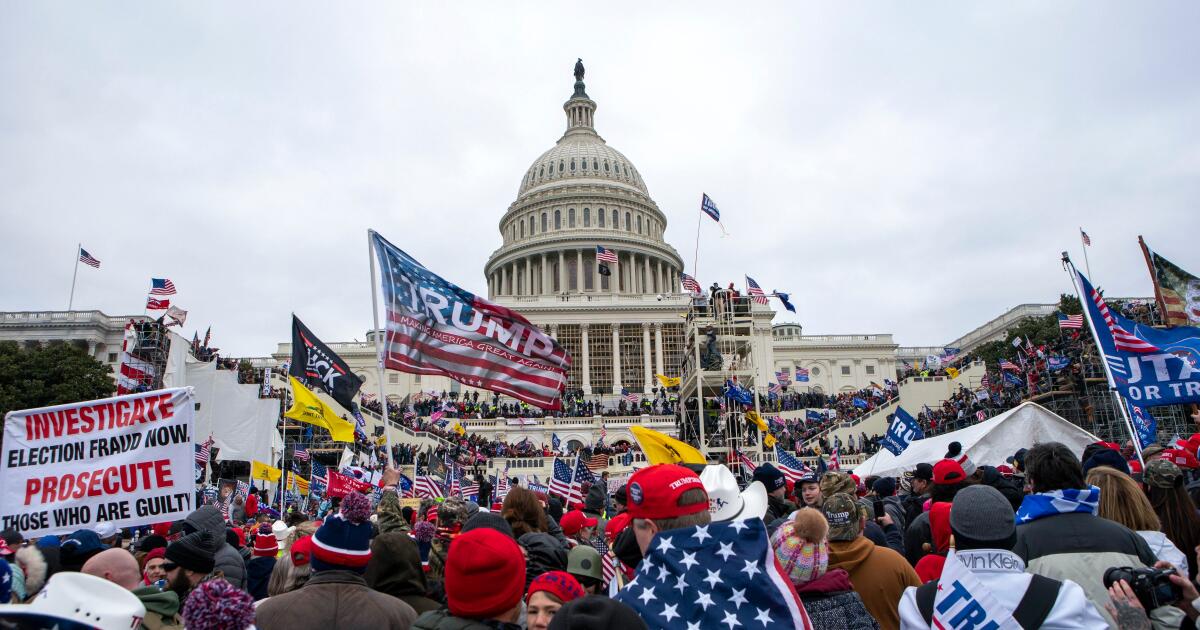
On the fifth anniversary of Jan. 6, 2021, there is no official event to memorialize what happened that day, when the mob made its way down Pennsylvania Avenue, battled police at the Capitol barricades and stormed inside, as lawmakers fled. The political parties refuse to agree to a shared history of the events, which were broadcast around the globe. And the official plaque honoring the police who defended the Capitol has never been hung.

Instead, the day displayed the divisions that still define Washington, and the country, and the White House itself issued a glossy new report with its revised history of what happened

Trump, during a lengthy morning speech to House Republicans convening away from the Capitol at the rebranded Kennedy Center now carrying his own name, shifted blame for Jan. 6 onto the rioters themselves.

The president said he had intended only for his supporters to go “peacefully and patriotically” to confront Congress as it certified Biden’s win. He blamed the media for focusing on other parts of his speech that day.

At the same time, Democrats held their own morning meeting at the Capitol, reconvening members of the House committee that investigated the Jan. 6, 2021, attack for a panel discussion. Recalling the history of the day is important, they said, in order to prevent what Rep. Jamie Raskin, D-Md., warned was the GOP’s “Orwellian project of forgetting.”

And the former leader of the militant Proud Boys, Enrique Tarrio, summoned people for a midday march and they began retracing the rioters’ steps from the White House to the Capitol, this time to honor Trump supporter Ashli Babbitt and others who died in the Jan. 6 siege and its aftermath. About 100 people gathered, including Babbitt’s mother.

Tarrio is among those putting pressure on the Trump administration to seek retribution against those who prosecuted the Jan. 6 rioters, and the White House in its new report highlighted the work the president has done to free those charged and turned the blame on Democrats for certifying Biden’s election victory.

“They should be fired and prosecuted,” Tarrio told the rally crowd Tuesday.

He was sentenced to 22 years in prison for seditious conspiracy for orchestrating the Jan. 6 attack, and he is among more than 1,500 defendants who saw their charges dropped when Trump issued a sweeping pardon on his return to the White House last year.

Echoes of 5 years ago

This milestone anniversary carried echoes of the differences that erupted that day.

But it unfolds while attention is focused elsewhere, particularly after the U.S. military’s stunning capture of Venezuela’s president, Nicolás Maduro, and Trump’s plans to take over the country and prop up its vast oil industry, a striking new era of American expansionism.

“These people in the administration, they want to lecture the world about democracy when they’re undermining the rule of law at home, as we all will be powerfully reminded,” House Democratic leader Hakeem Jeffries of New York said on the eve of the anniversary.

House Speaker Mike Johnson of Louisiana, responding to requests for comment about the delay in hanging the plaque honoring the police at the Capitol, as required by law, said in a statement that the statute “is not implementable,” and proposed alternatives “also do not comply with the statute.”

Democrats revive an old committee, Republicans lead a new one

At the morning hearing at the Capitol, lawmakers heard from a number of witnesses and others — including former U.S. Capitol Police officer Winston Pingeon, who said he thought he was going to die that day and if it hadn’t been for Jan. 6, he would still be on the force, as well as a Pamela Hemphill, a rioter who refused Trump’s pardon, and silenced the room as she blamed the president for the violence and apologized to the officer, stifling tears.

“I can’t allow them not be recognized, to be lied about,” Hemphill said about law enforcement.

“Until I can see that plaque up there,” she won’t be done, Hemphill said.

Pingeon implored the country not to forget what happened, and said, “I believe the vast majority of Americans have so much more in common than what separates us.”

Among those testifying were former Rep. Adam Kinzinger of Illinois, who along with former Rep. Liz Cheney of Wyoming were the two Republicans on the panel that investigated Trump’s efforts to overturn Biden’s win. Cheney, who lost her own reelection bid to a Trump-backed challenger, did not appear. Speaker Emerita Nancy Pelosi urged the country to turn away from the culture of violent threats on lawmakers and the police.

Republican Rep. Barry Loudermilk of Georgia, who has been tapped by Johnson to lead a new committee to probe other theories about what happened on Jan. 6, rejected Tuesday’s session as a “partisan exercise” designed to hurt Trump and his allies.

Many Republicans reject the narrative that Trump sparked the Jan. 6 attack, and Johnson, before he became the House speaker, had led challenges to the 2020 election. He was among some 130 GOP lawmakers voting that day to reject the presidential results from some states.

Instead, they have focused on security lapses at the Capitol — including the time it took for the National Guard to arrive and the failure of the police canine units to discover the pipe bombs found that day outside Republican and Democratic party headquarters. The FBI arrested a Virginia man suspected of placing the pipe bombs, and he told investigators last month he believed someone needed to speak up for those who believed the 2020 election was stolen, authorities say.

“The Capitol Complex is no more secure today than it was on January 6,” Loudermilk said in a social media post. “My Select Subcommittee remains committed to transparency and accountability and ensuring the security failures that occurred on January 6 and the partisan investigation that followed never happens again.”

The aftermath of Jan. 6

Five people died in the Capitol siege and its aftermath, including Babbitt, who was shot and killed by police while trying to climb through the window of a door near the House chamber, and Capitol Police Officer Brian Sicknick died later after battling the mob. Several law enforcement personnel died later, some by suicide.

The Justice Department indicted Trump on four counts in a conspiracy to defraud voters with his claims of a rigged election in the run-up to the Jan. 6 attack.

Former Justice Department special counsel Jack Smith told lawmakers last month that the riot at the Capitol “does not happen” without Trump. He ended up abandoning the case once Trump was reelected president, adhering to department guidelines against prosecuting a sitting president.

Trump, who never made it to the Capitol that day as he hunkered down at the White House, was impeached by the House on the sole charge of having incited the insurrection. The Senate acquitted him after top GOP senators said they believed the matter was best left to the courts.

Ahead of the 2024 election, the Supreme Court ruled ex-presidents have broad immunity from prosecution.

Mascaro writes for the Associated Press. AP writers Will Weissert, Joey Cappelletti and Gary Fields contributed to this report.

Source link

Maduro abduction shows influence, limits of US Secretary of State Rubio | Donald Trump News

Washington, DC – United States Secretary of State Marco Rubio has not been shy about his desire to see the toppling of Venezuelan President Nicolas Maduro.

Infamously, the former Florida senator even posted a series of photos of slain deposed leaders, including a bloodied former Libyan leader Muammar Gaddafi, as tensions with the US and Maduro’s government spiked in 2019.

Recommended Stories

list of 3 itemsend of list

But it wasn’t until the second administration of US President Donald Trump that Rubio’s vision of a hardline approach to Latin America and his longtime pressure campaign against leftist leaders was realised – culminating on Saturday with the illegal abduction of longtime Venezuelan leader Maduro.

Experts say Rubio has relied on an ability to capitalise on the overlapping interests of competing actors within the Trump administration to achieve this, even as his broader ideological goals, including the ousting of Cuba’s communist government, will likely remain constrained by the administration’s competing ambitions.

“It took a tremendous amount of political skill on his part to marginalise other voices in the administration and elsewhere who were saying: ‘This is not our conflict. This is not what we stand for. This is going to upset our base,’” Alejandro Velasco, an associate professor of history at New York University, told Al Jazeera.

Those agendas included US President Donald Trump’s preoccupation with opening Venezuela’s nationalised oil industry, US Secretary of Defense Pete Hegseth’s desire for a more pugilistic military approach abroad, and adviser Stephen Miller’s fixation on migration and mass deportation.

“So that’s the way that Rubio was able to bring into line not quite competing, but really divergent agendas, all of them to focus on Venezuela as a way to advance a particular end,” Velasco said.

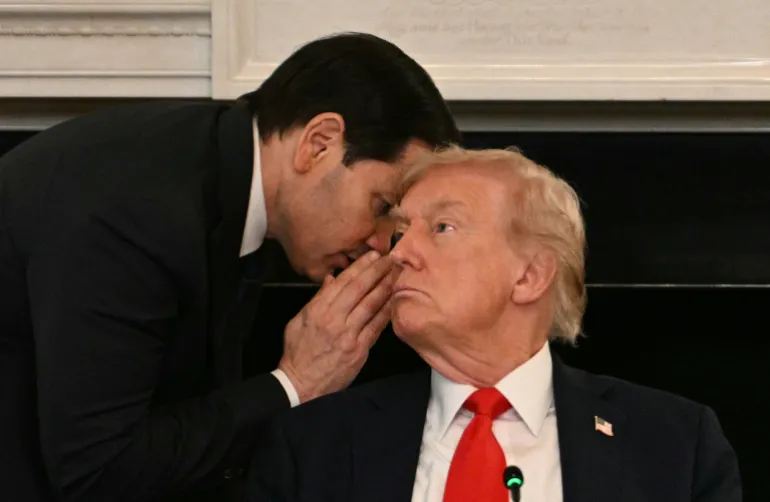
AFP PICTURES OF THE YEAR 2025 US Secretary of State Marco Rubio whispers in the ear of President Donald Trump during a roundtable about Antifa in the State Dining Room of the White House in Washington, DC, on October 8, 2025. (Photo by Jim WATSON / AFP) / NO USE AFTER JANUARY 31, 2026 23:00:00 GMT - AFP PICTURES OF THE YEAR 2025
US Secretary of State Marco Rubio whispers in the ear of President Donald Trump during a roundtable discussion about antifa in the State Dining Room of the White House in Washington, DC, on October 8, 2025 [File: Jim Watson/AFP]

A hawk in ‘America First’

A traditionalist hawk who has regularly supported US military intervention in the name of spreading Western democracy and human rights abroad, Rubio initially appeared to be an awkward fit to be Trump’s top diplomat in his second term.

His selection followed a campaign season defined by Trump’s vow to end foreign wars, eschew US-backed regime change, and pursue a wider “America First” pivot.

But the actual shape of Trump’s foreign policy has borne little resemblance to that vision, with the administration adopting a so-called “Peace Through Strength” doctrine that observers say has resulted in more room for military adventurism. That has, to date, seen the Trump administration launch bombing campaigns against Yemen and Iran, strike armed groups in Nigeria and Somalia, and attack alleged drug smuggling boats in the Caribbean.

The approach of Trump 2.0 has more closely aligned with Rubio’s vision of Washington’s role abroad, which has long supported maximum-pressure sanctions campaigns and various forms of US intervention to topple governments.


The US secretary of state’s personal ideology traces to his South Florida roots, where his family settled in the 1960s after leaving Cuba three years before the rise of Fidel Castro, in what Velasco described as an “acerbically anti-communist” political environment.

“I think for him, it started as a question of finally making real the hopes and dreams of Cubans in Florida and elsewhere to return to their homeland under a capitalist government,” Velasco explained.

“It went from that to what this could represent, if we think about it more hemispherically – a bigger shift that would not only increase, but in fact ensure, US hegemony in the region for the 21st century.”

‘Vacuum was his to fill’

After tangling with Trump in the 2016 presidential election, in which the future president deridingly dubbed his opponent “Little Marco” while Rubio decried him as a “con man”, the pair forged a pragmatic working relationship.

Rubio eventually endorsed Trump ahead of the 2016 vote, helping to deliver Florida. In Trump’s first term, Rubio came to be seen as the president’s “shadow secretary” on Latin America, an atypical role that saw the lawmaker influence Trump’s eventual recognition of Juan Guaido as interim president in opposition to Maduro.

Analysts note Rubio’s approach to Venezuela has always been directly aimed at undermining the economic support it provides to Cuba, with the end goal of toppling the island’s 67-year-old Communist government. Following Maduro’s abduction on Saturday, Rubio quickly pivoted to the island nation, telling reporters: “If I lived in Havana and I was in the government, I’d be concerned”.

Still, in the early months of Trump’s second term, Rubio appeared largely sidelined, with the president instead favouring close friends and family members to spearhead marquee negotiations on ceasefires in Gaza and Ukraine.

During this time, Rubio was slowly amassing a sizeable portfolio. Beyond serving as secretary of state, Rubio became the acting administrator of the Trump-dismantled US Agency for International Development (USAID) and the acting archivist of the US National Archives. Most notably, he became the acting director of National Security, making him the first top US diplomat to also occupy the impactful White House role since Henry Kissinger.

epaselect epa12624353 Venezuelans in Miami hold a picture of US Secretary of State Marco Rubio while taking part in a rally in response to the US military strikes in Venezuela, Miami, Florida, USA, 03 January 2026. President Trump announced that US forces have successfully captured Venezuelan President Nicolas Maduro and his wife during a series of large-scale strikes on Caracas on 03 January 2026. EPA/CRISTOBAL HERRERA-ULASHKEVICH
A Venezuelan in Miami holds a picture of US Secretary of State Marco Rubio during a rally in response to US military strikes in Venezuela; in Miami, Florida, the US, January 3, 2026 [Cristobal Herrera-Ulashkevich/EPA]

Rubio eventually found himself in a White House power vacuum, according to Adam Isacson, the director of defence oversight at the Washington Office on Latin America (WOLA).

“Rubio’s somebody who understands Washington better than the Grenells and Witkoffs of the world,” Isacson told Al Jazeera, referring to Trump’s special envoys Richard Grenell and Steve Witkoff.

“At the same time, other powerful figures inside the White House, like Stephen Miller and [Director of the Office of Management and Budget] Russ Vought haven’t cared as much about foreign policy,” he said, “so the vacuum was his to fill.”

Meanwhile, Rubio showed his ability to be an “ideological weather vane”, pivoting regularly to stay in Trump’s good graces, Isacson said. The National Security Strategy released by the White House in December exemplified that approach.

The document, which is drafted by the National Security adviser with final approval from the president, offered little in tough language towards Russia, despite Rubio’s previous hard lines on the war in Ukraine. It supported the gutting of US foreign aid, despite Rubio’s years-long support for the system. It offered little of the human-rights language with which Rubio had earlier in his career styled himself as a champion.

It did, however, include a “Trump corollary” to the Monroe Doctrine, which dovetailed with Rubio’s worldview by calling for the restoration of US “preeminence” over the Western Hemisphere.

A pyrrhic victory?

To be sure, the toppling of Maduro has so far proved a partial, if not pyrrhic victory for Rubio, far short of the comprehensive change he has long supported.

In a news conference immediately following Maduro’s abduction, Trump doused support for exiled opposition leader Maria Corina Machado, who has hewed close to Rubio’s vision for a future Venezuela. Several news agencies have since reported that US intelligence assessed that installing an opposition figure would lead to widespread chaos in the country.

Rubio has so far been the point man in dealing with Maduro’s former deputy and replacement, Delcy Rodriguez, who has been a staunch supporter of the Hugo Chavez-founded Chavismo movement that Rubio has long railed against. Elections remain a far-off prospect, with Trump emphasising working with the government to open the oil industry to the US.

The secretary of state has not been officially given a role connected to the country, but has earned the less-than-sincere title in some US media of “viceroy of Venezuela”.

On news shows, Rubio has been tasked with walking back Trump’s claim that the US would “run” the South American country, while selling the administration’s oft-contradicted message that the abduction of Maduro was a law enforcement action, not regime change, an act of war, or a bid for the country’s oil.

“I think he’s sort of lying through his teeth,” Lee Schlenker, a research associate at the Quincy Institute for Responsible Statecraft, told Al Jazeera.

“Even he doesn’t seem to believe a lot of the sort of rhetorical and discursive pretexts that have been deployed about drugs, about narco-terrorism, about a law enforcement-only operation, about just sort of enforcing a Department of Justice indictment,” he said.

Having to work with Rodriguez, and reportedly, Venezuela’s security czar and Minister of Interior Diosdado Cabello, has been a “bucket of cold water on Rubio’s broader illusions”, Schlenker added, noting that Rubio’s end goal still remains “the end of the Chavista project”.

Rubio is also likely to face further reality checks when it comes to his expected attempts to pitch the overthrow of what he will likely argue is a weakened Cuba.

The island, without the economic resources of Venezuela and no known drug trade, is seen as far less appealing to Trump and many of his allies.

“Compared to Venezuela,” Schlenker said, “there are a lot more reasons why Trump would have less interest in going after Cuba.”

Source link

Trump tries to rally House GOP as the party’s majority narrows

President Trump on Tuesday defended his actions during the Capitol riot five years ago, joked about being liberal-minded to win the votes of transgender people and mocked a predecessor’s use of a wheelchair while delivering a meandering speech to House Republicans as the party enters a critical election year facing a razor-thin majority in the House.

The remarks were intended to ensure both the GOP’s executive and legislative wings are aligned on their agenda heading into the November midterms that will determine party control of Congress. But Trump spent more time rehashing past grievances during the lengthy appearance than he did talking about the capture of Venezuela’s Nicolás Maduro or specific steps he’s taking to bring down prices as polls say inflation is the public’s top concern.

He also did not discuss new policy initiatives or legislation on his agenda for the year.

“We won every swing state. We won the popular vote by millions. We won everything,” Trump said, recounting his performance in the 2024 presidential election while seeming to acknowledge that history will side with the Democratic Party in November.

“But they say that when you win the presidency, you lose the midterm,” he said.

Political trends show that the party that wins the White House usually loses seats in Congress during the midterm elections two years later.

But Trump did try to rally the caucus at times, asserting that his first year back in office was so successful that Republicans should win in November on that basis alone. He briefly touched on Venezuela and talked about money coming into the U.S. through tariffs and direct investment and negotiations to bring down drug prices.

“You have so many good nuggets. You have to use them. If you can sell them, we’re going to win,” Trump said. He claimed that “we’ve had the most successful first year of any president in history and it should be a positive.”

The House GOP is facing a sudden narrowing of their already thin majority with the death of California Rep. Doug LaMalfa, announced Tuesday, and the resignation of former Rep. Marjorie Taylor Greene, which took effect at midnight.

“You can’t be tough when you have a majority of three, and now, sadly, a little bit less than that,” Trump said after paying tribute to LaMalfa, noting the challenges House Speaker Mike Johnson faces in keeping their ranks unified.

The president also noted that Rep. Jim Baird (R-Wis.) was recovering after a “bad” car accident, further slimming Johnson’s vote margins.

House Republicans convened as they launch their new year agenda, with healthcare issues in particular dogging the GOP heading into the midterm elections. Votes on extending expired health insurance subsidies are expected as soon as this week, and it’s unclear whether the president and the party will try to block its passage.

Trump said he would be meeting soon with 14 companies to discuss health insurance.

In remarks that approached 90 minutes, Trump also mused about unconstitutionally seeking a third term as president. He claimed it was never reported that he urged his supporters to walk “peacefully and patriotically” on Jan. 6, 2021, to the Capitol, where they rioted to try to overturn his election loss. He used his wife, First Lady Melania Trump, to poke at President Franklin D. Roosevelt, a Democrat who used a wheelchair.

According to the president, she thinks the dancing he does at his rallies is not presidential.

“She actually said, ‘Could you imagine FDR dancing?’ She actually said that to me,” Trump said. “And I said there’s a long history that perhaps she doesn’t know.”

GOP lawmakers were hosting a daylong policy forum at the Kennedy Center, where the board, stocked by Trump with loyalists, recently voted to rename it the Trump Kennedy Center. The move is being challenged in court.

Trump and Johnson are trying to corral Republicans at a time when rank-and-file lawmakers have felt increasingly emboldened to buck Trump and the leadership’s wishes, on issues such as the release of the Jeffrey Epstein files.

The meeting also comes days after the Trump administration’s dramatic capture of Nicolás Maduro in Venezuela, which occurred after a months-long U.S. campaign to pressure the now-deposed leader by building up American forces in the waters off South America and bombing boats alleged to have been carrying drugs.

The Maduro capture is reigniting the debate about Trump’s powers over Congress to authorize the campaign against Venezuela, though House Republican lawmakers have largely been supportive of the administration’s efforts there.

Kim and Superville write for the Associated Press. AP writers Lisa Mascaro and Will Weissert contributed to this report.

Source link

George Conway, persistent Trump critic, is running for Congress in New York

George Conway, who was once married to a former advisor to the president before becoming a prominent anti-Trump voice, announced on Tuesday that he is running for a U.S. House seat in New York City, testing whether he can turn his strong social media following into votes in a crowded Democratic primary.

Conway — who worked for years in New York City as an attorney but has more recently been living in Bethesda, Md. — said he was spurred to run for Congress after a conversation with a friend about her frustration with some Democrats’ decision to vote to end last year’s government shutdown.

Conway didn’t want to challenge his congressman in Maryland, Rep. Jamie Raskin, who he said he loves, so the friend suggested he instead look at a seat in Manhattan that was soon to be vacant following the retirement of Democratic Rep. Jerry Nadler.

Conway said he looked it up on Wikipedia, and realized it was his old stomping grounds.

“It was like, huh, it’s an open seat. This isn’t crazy. I should think about this,” he said in an interview.

He relocated back to Manhattan a few weeks ago, he said.

Conway joins a flood of Democrats looking to take over Nadler’s seat. Among the candidates are Nadler protégé and state lawmaker Micah Lasher, school shooting survivor and advocate Cameron Kasky and Jack Schlossberg, the grandson of John F. Kennedy.

In a campaign launch video, Conway, 62, positioned himself as a seasoned Trump foe whose extensive experience as an attorney would allow him to continue his years-long fight against the president from Congress.

“This is no ordinary time. And I will not be an ordinary member of Congress,” he said.

Conway, a former Republican who helped found the anti-Trump Lincoln Project, said that he doesn’t want to be a career politician but felt that “this is a moment where we need people who can fight Trump the way he needs to be battled.”

He supported Trump’s 2016 presidential run and had been married to Kellyanne Conway, a pollster and strategist who became a senior presidential advisor in the first Trump White House and was one of Trump’s fiercest defenders.

As Trump’s first term went on, George Conway began to criticize Trump with an aggressiveness that rivaled his then-wife’s ardent support of the president, drawing extraordinary attention to their relationship’s diverging political positions.

At one point, Trump fired back, calling George Conway “a stone cold LOSER & husband from hell!”

The Conways announced their divorce in 2023, writing in a statement that their marriage had included “many happy years.”

The district Conway is hoping to represent is considered solidly Democratic, consisting of Midtown Manhattan and the tony Upper East and Upper West sides.

Nadler, 78, last year said he would not run for reelection, with the longtime fixture of New York’s congressional delegation calling for generational change in Congress. His planned exit has led to a flood of Democratic candidates emerging to take over his seat.

Izaguirre writes for the Associated Press.
Source link

Petro calls on Colombians to defend sovereignty amid Trump threats

Colombian President Gustavo Petro called for a nationwide mobilization Wednesday and urged citizens to “defend sovereignty,” in response to statements by U.S. President Donald Trump that left open the possibility of military intervention. Photo by Carlos Ortega/EPA

Jan. 6 (UPI) — Colombian President Gustavo Petro has called for a nationwide mobilization Wednesday and urged citizens to “defend sovereignty,” responding to statements by the U.S. President Donald Trump that in Colombia have been widely interpreted as threats of intervention and direct attacks against the head of state.

The call, posted by Petro on X and echoed by government officials and political allies, urges rallies in public squares across the country starting at 4 p.m. local time, with the main protest planned for Bogota’s Plaza de Bolivar, the historic square that houses Colombia’s main government institutions. Petro said he will address the crowd.

The escalation follows remarks by Trump in which he referred to Petro in disparaging terms, accused him of backing drug production and left open the possibility of military action, according to reports by Colombian media.

In recent comments, Trump said a military operation against Colombia “sounds good,” following a U.S. military incursion in Venezuela. He also accused Petro of links to drug trafficking and said Colombia is “very sick.”

Petro publicly rejected the accusations and framed the dispute as a matter of national sovereignty. He said he would carefully assess the scope of Trump’s words before issuing a broader response but insisted that dialogue should be “the first path” and defended the legitimacy of his government.

“Although I have not been a soldier, I know about war and clandestinity. I swore not to touch a weapon again after the 1989 peace pact, but for the homeland, I would take up arms again, which I do not want,” Petro wrote, referring to the agreement that led to the demobilization of the M-19 guerrilla movement in which he once participated.

“I am not illegitimate, nor am I a drug trafficker. I own only my family home, which I am still paying for with my salary. My bank statements have been made public. No one has been able to say I have spent more than my salary. I am not greedy,” he added.

Separately, Colombia’s Foreign Ministry issued a statement after remarks attributed to Trump on Sunday and said it rejects what it considers unacceptable interference in matters of sovereignty and bilateral relations.

Vice President Francia Marquez joined those describing Trump’s statements as “threats” and called on Colombians to defend national sovereignty, according to local radio reports.

Demonstrations planned for Wednesday are expected in cities including Bogota, Medellin, Cali, Bucaramanga, Cartagena and Santa Marta, with calls to gather in central squares.

Petro described the protests as “peaceful” and urged Colombians to fly the national flag at their homes and bring it to public squares, El Espectador reported. He warned of the risks of military escalation and reiterated that the armed forces must follow their constitutional mandate to defend sovereignty.

The episode unfolds amid regional upheaval linked to Venezuela’s crisis and rising diplomatic tensions in Latin America.

According to daily El Tiempo, the situation has pushed Petro’s government to return to street mobilization as a political tool while Bogota seeks to manage relations with Washington without losing internal control.

Source link

Trump’s vague claims of the U.S. running Venezuela raise questions about planning for what comes next

President Trump has made broad but vague assertions that the United States is going to “run” Venezuela after the ouster of Nicolás Maduro but has offered almost no details about how it will do so, raising questions among some lawmakers and former officials about the administration’s level of planning for the country after Maduro was gone.

Seemingly contradictory statements from Trump and Secretary of State Marco Rubio have suggested at once that the U.S. now controls the levers of Venezuelan power or that the U.S. has no intention of assuming day-to-day governance and will allow Maduro’s subordinates to remain in leadership positions for now.

Rubio said the U.S. would rely on existing sanctions on Venezuela’s oil sector and criminal gangs to wield leverage with Maduro’s successors.

The uncertainty on definitive next steps in Venezuela contrasts with the years of discussions and planning that went into U.S. military interventions that deposed other autocratic leaders, notably in Iraq in 2003, which still did not often lead to the hoped-for outcomes.

‘Disagreement about how to proceed’

The discrepancy between what Trump and Rubio have said publicly has not sat well with some former diplomats.

“It strikes me that we have no idea whatsoever as to what’s next,” said Dan Fried, a retired career diplomat, former assistant secretary of state and sanctions coordinator who served under both Democratic and Republican administrations.

“For good operational reasons, there were very few people who knew about the raid, but Trump’s remarks about running the country and Rubio’s uncomfortable walk back suggests that even within that small group of people, there is disagreement about how to proceed,” said Fried who is now with the Atlantic Council think tank.

Supporters of the operation, meanwhile, believe there is little confusion over the U.S. goal.

“The president speaks in big headlines and euphemisms,” said Rich Goldberg, a sanctions proponent who worked in the National Energy Dominance Council at the White House until last year and is now a senior adviser to the Foundation for Defense of Democracies, a hawkish think tank.

Goldberg does not see Rubio becoming “the superintendent of schools” but “effectively, the U.S. will be calling the shots.”

“There are people at the top who can make what we want happen or not, and we right now control their purse strings and their lives,” he said. “The president thinks it’s enough and the secretary thinks it’s enough, and if it’s not enough, we’ll know very soon and we’ll deal with it.”

If planning for the U.S. “to run” Venezuela existed prior to Maduro’s arrest and extradition to face federal drug charges, it was confined to a small group of Trump political allies, according to current U.S. officials, who note that Trump relies on a very small circle of advisers and has tossed aside much of the traditional decision-making apparatus.

These officials, who spoke on condition of anonymity to discuss their understanding of internal deliberations, said they were not aware of any preparations for either a military occupation or an interim civilian governing authority, which has been a priority for previous administrations when they contemplated going to war to oust a specific leader or government. The White House and the State Department’s press office did not return messages seeking comment.

Long discussion among agencies in previous interventions

Previous military actions that deposed autocratic leaders, notably in Panama in 1989 and Iraq in 2003, were preceded by months, if not years, of interagency discussion and debate over how best to deal with power vacuums caused by the ousters of their leaders. The State Department, White House National Security Council, the Pentagon and the intelligence community all participated in that planning.

In Panama, the George H.W. Bush administration had nearly a full year of preparations to launch the invasion that ousted Panama’s leader Manuel Noriega. Panama, however, is exponentially smaller than Venezuela, it had long experience as a de facto American territory, and the U.S. occupation was never intended to retake territory or natural resources.

By contrast, Venezuela is vastly larger in size and population and has a decadeslong history of animosity toward the United States.

“Panama was not successful because it was supported internationally because it wasn’t,” Fried said. “It was a success because it led to a quick, smooth transfer to a democratic government. That would be a success here, but on the first day out, we trashed someone who had those credentials, and that strikes me as daft.”

He was referring to Trump’s apparent dismissal of opposition leader Maria Corina Machado, whose party is widely believed to have won elections in 2024, results that Maduro refused to accept. Trump said Saturday that Machado “doesn’t have the support within or the respect within the country” to be a credible leader and suggested he would be OK with Maduro’s No. 2, Delcy Rodríguez, remaining in power as long as she works with the U.S.

Hoped-for outcomes didn’t happen in Iraq and Afghanistan

Meanwhile, best-case scenarios like those predicted by the George W. Bush administration for a post-Saddam Hussein Iraq that it would be a beacon of democracy in the Middle East and hopes for a democratic and stable Afghanistan following the ouster of the Taliban died painfully slow deaths at the tremendous expense of American money and lives after initial euphoria over military victories.

“Venezuela looks nothing like Libya, it looks nothing like Iraq, it looks nothing like Afghanistan. It looks nothing like the Middle East,” Rubio said this weekend of Venezuela and its neighbors. “These are Western countries with long traditions at a people-to-people and cultural level, and ties to the United States, so it’s nothing like that.”

The lack of clarity on Venezuela has been even more pronounced because Trump campaigned on a platform of extricating the U.S. from foreign wars and entanglements, a position backed by his “Make America Great Again” supporters, many of whom are seeking explanations about what the president has in mind for Venezuela.

“Wake up MAGA,” Republican Rep. Thomas Massie of Kentucky, who has bucked much of his party’s lockstep agreement with Trump, posted on X after the operation. “VENEZUELA is not about drugs; it’s about OIL and REGIME CHANGE. This is not what we voted for.”

Sen. Rand Paul, also a Kentucky Republican, who often criticizes military interventions, said “time will tell if regime change in Venezuela is successful without significant monetary or human cost.”

“Easy enough to argue such policy when the action is short, swift and effective but glaringly less so when that unitary power drains of us trillions of dollars and thousands of lives, such as occurred in Afghanistan, Iraq, and Vietnam,” he wrote on social media.

In addition to the Venezuela operation, Trump is preparing to take the helm of an as-yet unformed Board of Peace to run postwar Gaza, involving the United States in yet another Mideast engagement for possibly decades to come.

And yet, as both the Iraq and Afghanistan experiences ultimately proved, no amount of planning guarantees success.

Lee writes for the Associated Press.

Source link

Is Polymarket Predicting Trump Will Invoke War Powers?

The betting markets suddenly jumped to near 100% that Trump will “invoke war powers” against Venezuela. What does it mean? The President, exercising his commander-in-chief authority, would order military action and then initiate the legal process that follows when U.S. forces are deployed into hostilities.

A few weeks ago we published a piece on what Polymarket and the debt surge could reveal about the Venezuela conflict. There was a nugget on what happened the day before María Corina Machado received the Nobel peace prize:

The 2025 Nobel Peace Prize awarded to Maria Corina Machado made the news due to the behaviour of the Polymarket odds. Machado had a winning probability of around 3.5% around 12 hours prior to the announcement. Then, it shot up to a 73% probability of Machado taking the prize. This led to speculation that information was leaked, giving some traders room to cash in on bets in her favour. The ability of the site to “predict” an outcome, in this case, seems to be no more than information asymmetry. Someone out there had better (insider) intelligence, and simply traded on that information.

Moreover, the night before the Maduro extraction, this happened:

Someone made $408,000 by placing a $30,000 bet in the nick of time. It obviously doesn’t mean that it’s going to happen in this case, pero cuando el río suena… One user placed around $15,000 during the past 6 hours on Trump invoking War Powers on Venezuela. Maybe someone knows something, or they’re just going on a limb because they saw The Verge post.

On War Powers

Under Article II of the US Constitution, presidents have long argued they can initiate certain military operations to defend U.S. interests without waiting for Congress, especially if they frame it as limited, urgent, or defensive. The War Powers Resolution (1973) was intended to impose limits on this authority: once forces are committed, the President must notify Congress within 48 hours, and the operation has a 60-day clock, unless Congress authorizes it or extends it. The US, after all, is a democracy with established separations of powers. Right? It’s likely to get messy in Congress, but we’ll see.

So why reach for that toolbox now, especially if Maduro has already been extracted? And why didn’t it need to before? Because Maduro’s removal was carried out through legal warrants, in coordination with the DEA, in other words, it was done through other legal motions. In this new transition, if the U.S. wants the option to use force quickly (without having to establish the legal basis for it every time), having the “war powers” gives Trump the legal framework to continue using force.

Now, Polymarket shows a sudden, overnight repricing of almost 100%, as if someone had entered the market with new information. Prediction markets can move on leaks or real inside signals. In other words: does someone know something and wants to profit out of it? Does it flag imminent action? The next few days will tell, but with confidence it is almost a certainty that Trump will request (or invoke!) such powers.

Source link

Congress’s role questioned as Democrats vow to rein in Trump on Venezuela | Donald Trump News

Washington, DC – It has become a familiar pattern. United States presidents conduct unilateral military actions abroad. Congress shrugs.

On Saturday, in the hours after the US military abducted Venezuelan leader Nicolas Maduro, Democrats in the Senate pledged to raise yet another resolution to rein in US President Donald Trump’s military actions.

Recommended Stories

list of 4 itemsend of list

Chuck Schumer, the top Democrat in the chamber, has said the party will push for a vote within the week. By all accounts, the odds of its success remain long.

Since Trump took office for a second term in 2025, Congress has weighed multiple bills that would force him to seek legislative approval before initiating a military strike.

But the latest attack on Venezuela offers a stark instance of presidential overreach, one that is “crying out for congressional action”, according to David Janovsky, the acting director of the Constitution Project at the Project on Government Oversight.

Experts say it is also one of the clearest tests in recent history of whether Congress will continue to cede its authority to check US military engagement abroad.

“There are a lot of angles where you can come at this to say why it’s a clear-cut case,” Janovsky told Al Jazeera.

He pointed out that, under the US Constitution, Congress alone wields the authority to allow military action. He also noted that the Venezuela attack “is in direct contravention of the UN Charter, which is, as a treaty, law in the United States”.

“Any of the fig leaves that presidents have used in the past to justify unilateral military action just don’t apply here,” Janovsky added. “This is particularly brazen.”

An uphill battle

Since August, the Trump administration has signalled plans to crank up its “maximum pressure” campaign against Venezuela.

That month, Trump reportedly signed a secret memo calling on the US military to prepare for action against criminal networks abroad. Then, on September 2, the Trump administration began conducting dozens of strikes on alleged drug-smuggling boats off the Venezuelan and Colombian coasts.

That deadly bombing campaign was itself condemned as a violation of international law and an affront to Congress’s constitutional powers. It coincided with a build-up of US military assets near Venezuela.

Trump also dropped hints that the US military campaign could quickly expand to alleged drug-trafficking targets on Venezuelan soil. “When they come by land, we’re going to be stopping them the same way we stopped the boats,” Trump said on September 16.

The strikes prompted two recent votes in the House of Representatives in December: one that would require congressional approval for any land strikes on the South American country, and one that would force Trump to seek approval for strikes on alleged drug-smuggling boats.

Both resolutions, however, failed roughly along party lines. A similar resolution in the Senate, which would have required congressional approval before any more attacks, also fell short in November.

But speaking to reporters in a phone call just hours after the US operation on Saturday, Senator Tim Kaine said he hoped the brashness of Trump’s latest actions in Venezuela would shock lawmakers into action.

Republicans, he said, can no longer tell themselves that Trump’s months-long military build-up in the Caribbean and his repeated threats are a “bluff” or a “negotiating tactic”.

“It’s time for Congress to get its a** off the couch and do what it’s supposed to do,” Kaine said.

In an interview with CNN’s Dana Bash, US Senator Chris Murphy also agreed that it was “true” that Congress had become impotent on matters of war, a phenomenon that has spanned both Democratic and Republican administrations.

Bash pointed to former President Barack Obama’s 2011 military deployment to Libya, which went unchecked by Congress.

“Congress needs to own its own role in allowing a presidency to become this lawless,” Murphy responded.

Republicans ho-hum about resolutions

Under the US Constitution, only Congress can declare war, something it has not done since World War II.

Instead, lawmakers have historically passed Authorizations for Use of Military Force (AUMFs) to approve committing troops to recent wars, including the US invasions of Iraq and Afghanistan and the strikes on alleged al-Qaeda affiliates across the Middle East, Africa and Asia.

No AUMFs have been passed that would relate to military action in Venezuela.

When lawmakers believe a president is acting beyond his constitutional power, they can pass a war powers resolution requiring Congressional approval for further actions.

Beyond their symbolism, such resolutions create a legal basis to challenge further presidential actions in the judiciary.

However, they carry a high bar for success, with a two-thirds majority in both chambers of Congress needed to override a presidential veto.

Given the current makeup of Congress, passage of a war powers resolution would likely require bipartisan support.

Republicans maintain narrow majorities in both the House and Senate, so it would be necessary for members of Trump’s own party to back a war powers resolution for it to be successful.

In November’s Senate vote, only two Republicans — co-sponsor Rand Paul of Kentucky, and Lisa Murkowski, of Alaska — split from their party to support the resolution. It failed by a margin of 51 to 49.

December’s vote on a parallel resolution in the House only earned 211 votes in favour, as opposed to 213 against. In that case, three Republicans broke from their party to support the resolution, and one Democrat opposed it.

But Trump’s abduction of Maduro has so far only received condemnation from a tiny fragment of his party.

Overall, the response from elected Republicans has been muted. Even regular critics of presidential adventurism have instead focused on praising the ouster of the longtime Venezuelan leader, who has been accused of numerous human rights abuses.

Senator Todd Young, a Republican considered on the fence ahead of November’s war powers vote, has praised Maduro’s arrest, even as he contended the Trump administration owed Congress more details.

“We still need more answers, especially to questions regarding the next steps in Venezuela’s transition,” Young said.

Some Democrats have also offered careful messaging in the wake of the operation.

That included Debbie Wasserman Schultz, a Democrat who represents a large Venezuelan diaspora community in Florida.

In a statement on Saturday, Wasserman Schultz focused on the implications of Maduro’s removal, while avoiding any mention of the military operation that enabled it. Instead, she asserted that Trump owed Congress an explanation about next steps.

“He has failed to explain to Congress or the American people how he plans to prevent the regime from reconstituting itself under Maduro’s cronies or stop Venezuela from falling into chaos,” she wrote.

In December, however, Wasserman Schultz did join a group of Florida Democrats in calling for Congress to exercise its oversight authority as Trump built up military pressure on Venezuela.

What comes next?

For its part, the Trump administration has not eased up on its military threats against Venezuela, even as it has sought to send the message that Maduro’s abduction was a matter of law enforcement, not the start of a war.

Trump has also denied, once again, that he needed congressional approval for any further military action. Still, in a Monday interview with NBC News, he expressed optimism about having Congress’s backing.

“We have good support congressionally,” he told NBC. “Congress knew what we were doing all along, but we have good support congressionally. Why wouldn’t they support us?”

Since Saturday’s attack and abduction, Trump has warned that a “second wave” of military action could be on the horizon for Venezuela.

That threat has extended to the potential for the forced removal of Maduro’s deputy, Delcy Rodriguez, who was formally sworn in as the country’s interim president on Monday.

“If she doesn’t do what’s right, she is going to pay a very big price, probably bigger than Maduro,” Trump told The Atlantic magazine.

The administration has also said that strikes on alleged drug-smuggling boats near Venezuela will continue and that US military assets will remain deployed in the region.

Constitutional expert Janovsky, however, believes that this is a critical moment for Congress to act.

Failure to rein in Trump would only further reinforce a decades-long trend of lawmakers relinquishing their oversight authorities, he explained. That, in turn, offers tacit support for the presidency’s growing power over the military.

“To say this was a targeted law enforcement operation — and ignore the ongoing situation — would be a dangerous abdication of Congress as a central check on how the United States military is used,” Janovsky said.

“Continued congressional inaction does nothing but empower presidents to act however they want,” he added.

“To see Congress continue to step back ultimately just removes the American people even farther from where these decisions are actually being made.”

Source link