Trump

Denmark, Greenland envoys met with White House officials over Trump’s call for a ‘takeover’

Denmark and Greenland’s envoys to Washington have begun a vigorous effort to urge U.S. lawmakers as well as key Trump administration officials to step back from President Trump’s call for a takeover of the strategic Arctic island.

Denmark’s ambassador, Jesper Møller Sørensen, and Jacob Isbosethsen, Greenland’s chief representative to Washington, met on Thursday with White House National Security Council officials to discuss a renewed push by Trump to acquire Greenland, perhaps by military force, according to Danish government officials who were not authorized to comment publicly and spoke on the condition of anonymity.

The White House did not respond to a request for comment about the meeting.

The envoys have also held a series of meetings this week with American lawmakers as they look to enlist help in persuading Trump to back off his threat.

Secretary of State Marco Rubio is expected to meet next week with Danish officials.

Trump, in a New York Times interview published Thursday, said he has to possess the entirety of Greenland instead of just exercising a long-standing treaty that gives the United States wide latitude to use Greenland for military posts.

“I think that ownership gives you a thing that you can’t do with, you’re talking about a lease or a treaty. Ownership gives you things and elements that you can’t get from just signing a document,” Trump told the newspaper.

The U.S. is party to a 1951 treaty that gives it broad rights to set up military bases there with the consent of Denmark and Greenland.

Meanwhile, Trump’s vice president, JD Vance, told reporters that European leaders should “take the president of the United States seriously” as he framed the issue as one of defense.

“What we’re asking our European friends to do is take the security of that landmass more seriously, because if they’re not, the United States is going to have to do something about it,” Vance said.

But the administration is starting to hear pushback from lawmakers, including some Republicans, about Trump’s designs on the territory.

In a floor speech Thursday, Sen. Lisa Murkowski (R-Alaska) warned that the rhetoric from some in the Trump administration is “profoundly troubling.”

“We’ve got a lot ahead of us in 2026,” Murkowski said. “Greenland — or taking Greenland, or buying Greenland — should not be on that list. It should not be an obsession at the highest levels of this administration.”

Danish officials are hopeful about the upcoming talks with Rubio in Washington.

“This is the dialogue that is needed, as requested by the government together with the Greenlandic government,” Danish Defense Minister Troels Lund Poulsen told Danish broadcaster DR.

The island of Greenland, 80% of which lies above the Arctic Circle, is home to about 56,000 mostly Inuit people.

Vance criticizes Denmark

Vance said on Wednesday that Denmark “obviously” had not done a proper job in securing Greenland and that Trump “is willing to go as far as he has to” to defend American interests in the Arctic.

In an interview with Fox News, Vance repeated Trump’s claim that Greenland is crucial to both the U.S. and the world’s national security because “the entire missile defense infrastructure is partially dependent on Greenland.”

He said the fact that Denmark has been a faithful military ally of the U.S. during World War II and the more recent “war on terrorism” did not necessarily mean they were doing enough to secure Greenland today.

“Just because you did something smart 25 years ago doesn’t mean you can’t do something dumb now,” Vance said, adding that Trump “is saying very clearly, ‘you are not doing a good job with respect to Greenland.’”

Right to self-determination

Earlier, Rubio told a select group of U.S. lawmakers that it was the Republican administration’s intention to eventually purchase Greenland, as opposed to using military force.

“Many Greenlanders feel that the remarks made are disrespectful,” Aaja Chemnitz, one of the two Greenlandic politicians in the Danish parliament, told the Associated Press. “Many also experience that these conversations are being discussed over their heads. We have a firm saying in Greenland, ‘Nothing about Greenland, without Greenland.’”

She said most Greenlanders “wish for more self-determination, including independence” but also want to “strengthen cooperation with our partners” in security and business development as long as it is based on “mutual respect and recognition of our right to self-determination.”

Chemnitz denied a claim by Trump that Greenland is “covered with Russian and Chinese ships all over the place.”

Greenland is “a long-standing ally and partner to the U.S. and we have a shared interest in stability, security, and responsible cooperation in the Arctic,” she said. “There is an agreement with the U.S. that gives them access to have bases in Greenland if needed.”

France’s President Emmanuel Macron has denounced the “law of the strongest” that is making people “wonder if Greenland will be invaded.”

In a speech to French ambassadors at the Elysee presidential palace on Thursday, Macron said: “It’s the greatest disorder, the law of the strongest, and everyday people wonder whether Greenland will be invaded, whether Canada will be under the threat of becoming the 51st state [of the United States] or whether Taiwan is to be further circled.”

He pointed to an “increasingly dysfunctional” world where great powers, including the U.S and China, have “a real temptation to divide the world amongst themselves.”

The United States is “gradually turning away from some of its allies and freeing itself from the international rules,” Macron said.

Surveillance operations for the U.S.

The leaders of Canada, France, Germany, Italy, Poland, Spain and the U.K. joined Denmark’s Prime Minister Mette Frederiksen on Tuesday in defending Greenland’s sovereignty in the wake of Trump’s comments about Greenland, which is part of the NATO military alliance.

After Vance’s visit to Greenland last year, Danish Foreign Minister Lars Løkke Rasmussen published a video detailing the 1951 defense agreement between Denmark and the U.S.. Since 1945, the American military presence in Greenland has decreased from thousands of soldiers over 17 bases and installations on the island, Rasmussen said, to the remote Pituffik Space Base in the northwest with some 200 soldiers today. The base supports missile warning, missile defense and space surveillance operations for the U.S. and NATO.

The 1951 agreement “offers ample opportunity for the United States to have a much stronger military presence in Greenland,” Rasmussen said. “If that is what you wish, then let us discuss it.”

‘Military defense of Greenland’

Last year, Denmark’s parliament approved a bill to allow U.S. military bases on Danish soil. The legislation widens a previous military agreement, made in 2023 with the Biden administration, where U.S. troops had broad access to Danish air bases in the Scandinavian country.

Denmark is also moving to strengthen its military presence around Greenland and in the wider North Atlantic.

Last year, the government announced a 14.6 billion-kroner ($2.3 billion) agreement with parties including the governments of Greenland and the Faroe Islands, another self-governing territory of Denmark, to “improve capabilities for surveillance and maintaining sovereignty in the region.”

Madhani and Ciobanu write for the Associated Press. AP writers Seung Min Kim, Konstantin Toropin in Washington and Sylvie Corbet in Paris contributed to this report.
Source link

Two wounded in a shooting with US federal agents in Portland, Oregon | Donald Trump News

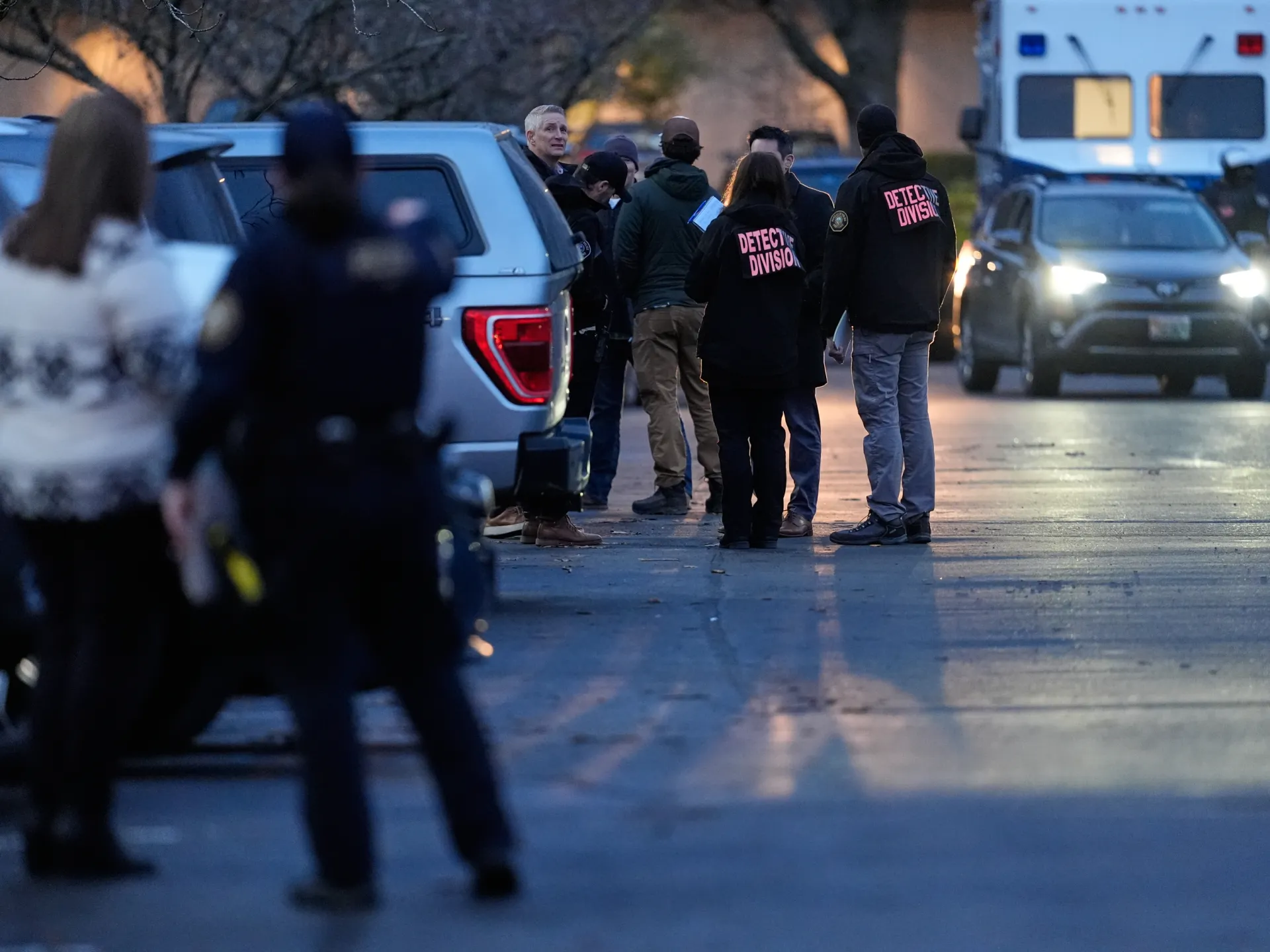
Federal agents in the United States have shot and injured two people in the city of Portland, Oregon, a city where the administration of President Donald Trump has led an immigration enforcement crackdown.

The shooting was the second time in less than a day that federal immigration authorities claimed to have fired upon a vehicle in self-defence, following a deadly shooting in Minneapolis, Minnesota.

Recommended Stories

list of 3 itemsend of list

On Thursday, the Portland Police Department announced they had responded to reports of gunfire on southeast Main Street at about 2:18pm local time (22:18 GMT).

“Officers confirmed that federal agents had been involved in a shooting,” the city said in a statement.

Emergency responders then received a call for assistance from one of the shooting victims, a man, at about 2:24pm (22:24 GMT) near Northeast 146th Avenue and East Burnside in Portland’s Hazelwood neighbourhood.

“Officers responded and found a male and female with apparent gunshot wounds,” the statement said. “Officers applied a tourniquet and summoned emergency medical personnel.”

The two shooting victims were transported to hospital. Their conditions remain unknown, according to the police, who were not involved in the shooting.

The local bureau of the Federal Bureau of Investigation (FBI) confirmed the shooting in a now-deleted post on social media, saying that the incident involved Customs and Border Patrol (CBP) agents.

“This remains an active and ongoing investigation led by the FBI,” Portland’s FBI bureau said in the post.

Later, the Department of Homeland Security (DHS) offered its own account of what happened, describing the shooting as self-defence during a “targeted vehicle stop”.

In a social media post, DHS said its target was a passenger travelling inside a vehicle, who was affiliated with a “transnational Tren de Aragua prostitution ring and involved in a recent shooting”. The driver, DHS claimed, was a member of Tren de Aragua, a Venezuelan gang.

“When agents identified themselves to the vehicle occupants, the driver weaponized his vehicle and attempted to run over the law enforcement agents,” DHS said in the post.

“Fearing for his life and safety, an agent fired a defensive shot. The driver drove off with the passenger, fleeing the scene.”

Second agent-involved shooting

Details about Thursday’s shooting remain unknown. But the administration of President Donald Trump has faced criticism for misrepresenting incidents where federal agents deployed violence as part of its nationwide immigration crackdown.

The Portland shooting comes one day after an agent with Immigration and Customs Enforcement (ICE) shot and killed Renee Nicole Good, a 37-year-old mother of three, in her car in Minneapolis, Minnesota.

“Just one day after the horrific violence in Minnesota at the hands of federal agents, our community here in Portland is now grappling with another deeply troubling incident,” Portland Mayor Keith Wilson said in a statement.

“We cannot sit by while constitutional protections erode and bloodshed mounts.”

Good’s death has triggered widespread outrage, as well as criticism that the Trump administration rushed to disseminate a misleading narrative about the Minneapolis shooting.

Video of Good’s shooting showed the 37-year-old stopped in her SUV on a snowy Minneapolis road, appearing to wave other drivers by.

A vehicle carrying ICE officers stopped next to her vehicle, and agents approached her, reaching for the handle of her car door. One approached the front of her vehicle. As her car appeared to turn and manoeuvre away, that agent fired multiple times into the vehicle, killing Good.

In that case, too, Trump administration officials claim the ICE agent acted in self-defence, despite the fact that the vehicle did not seem to make contact with his body.

Trump asserted – without evidence – that Good was a “professional agitator” who “violently, willfully, and viciously ran over the ICE Officer”. Homeland Security Secretary Kristi Noem also accused Good of a “domestic act of terrorism”, despite there being no evidence Good sought to harm the ICE agent.

Democratic officials have accused the Trump administration of spreading false narratives to distract from its own abuses during the immigration crackdown.

Still, officials in Portland repeatedly called for calm in the aftermath of Thursday’s shooting, while acknowledging the parallels between the incidents.

“We are still in the early stages of this incident,” Portland Police Chief Bob Day said in a statement.

“We understand the heightened emotion and tension many are feeling in the wake of the shooting in Minneapolis, but I am asking the community to remain calm as we work to learn more.”

Mayor Wilson, meanwhile, called for federal immigration agents to leave the city, arguing that they had endangered local citizens with their heavy-handed actions.

“Portland is not a ‘training ground’ for militarized agents, and the ‘full force’ threatened by the administration has deadly consequences,” Wilson said.

“As Mayor, I call on ICE to end all operations in Portland until a full investigation can be completed. Federal militarization undermines effective, community‑based public safety, and it runs counter to the values that define our region.”

Oregon Senator Jeff Merkley, meanwhile, expressed “huge concern” over the incident and suggested that responding with anger would only fuel the Trump administration’s fixation with Portland.

“Trump wants to generate riots,” he wrote. “Don’t take the bait.”

Portland under a microscope

Portland has long been a focal point of Trump’s immigration enforcement actions, and the increased federal presence has ignited largely nonviolent protests in response.

Long seen as a Democratic stronghold, Portland was identified in May as one of the “sanctuary jurisdictions” that the Trump administration identified as resisting its immigration crackdown.

The Republican president hinted he could surge federal agents to the area in response.

In September, those threats appeared to materialise when Trump wrote on his Truth Social platform that he would be sending the US military to support immigration operations in the city.

The announcement came five days after Trump declared antifa – the loose-knit antifascist movement – a “domestic terrorist organisation”.

“I am directing Secretary of War, Pete Hegseth, to provide all necessary Troops to protect War ravaged Portland, and any of our ICE Facilities under siege from attack by Antifa, and other domestic terrorists,” Trump wrote. “I am also authorizing Full Force, if necessary.”

It was the latest in the string of instances where Trump attempted to send federal troops to largely Democratic urban areas, including Los Angeles and Chicago, Illinois.

Local officials denounced the deployment as a violation of the law and a misuse of executive authority. But the Trump administration doubled down, describing Portland as overrun by criminal behaviour.

“ In Portland, Oregon, antifa thugs have repeatedly attacked our officers and laid siege to federal property in an attempt to violently stop the execution of federal law,” Trump said at an October roundtable.

In response, some protesters in Portland began arriving in inflatable frog costumes, in an effort to cast Trump’s warnings about violent extremists as absurd. The Portland Frog Brigade, as the protesters were called, inspired similar demonstrations nationwide.

State and local leaders fought Trump’s troop deployment in court, and on November 7, US District Judge Karin Immergut permanently blocked the deployment.

The US Supreme Court in December declined the Trump administration’s appeal to allow National Guard troops in areas where lower courts had barred them.

On Thursday, Mayor Wilson called for accountability in the recent shootings, saying he would protect local residents’ civil liberties.

“ICE agents and their Homeland Security leadership must be fully investigated and held responsible for their violence against the American people, in Minnesota, in Portland, and across the nation,” he said.

He repeated the message that Portland residents should not seek retribution in the aftermath of the gunfire.

“Portland does not respond to violence with violence. We respond with clarity, unity, and a commitment to justice. We must stand together to protect Portland,” he said.

Source link

Newsom counters Trump’s claims about California crime with stats

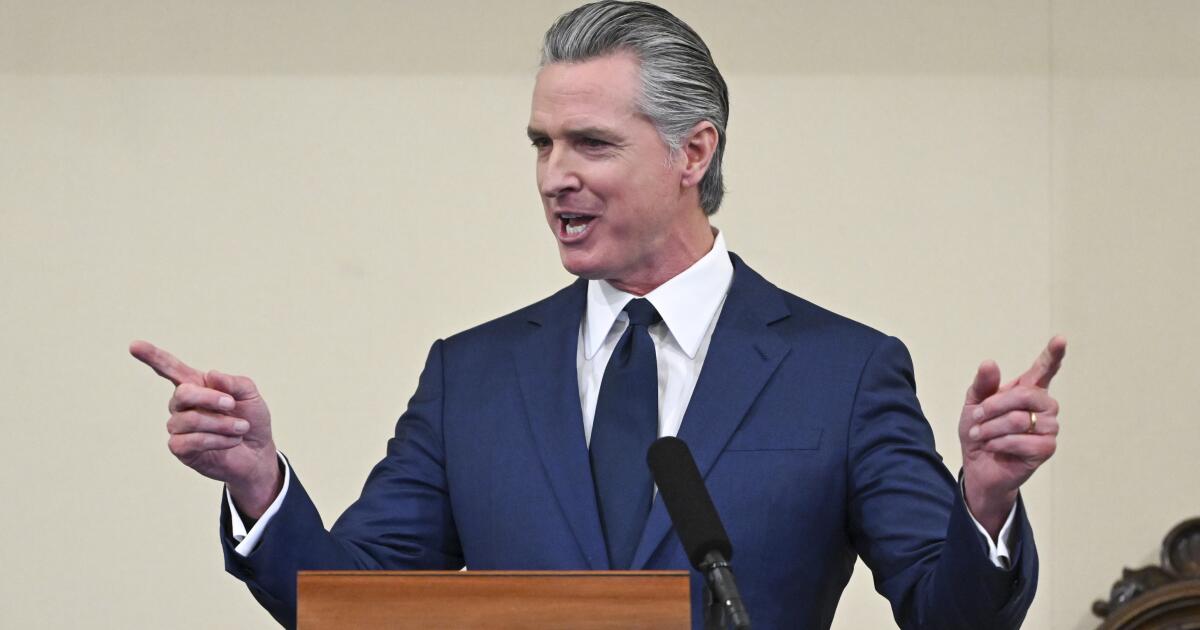
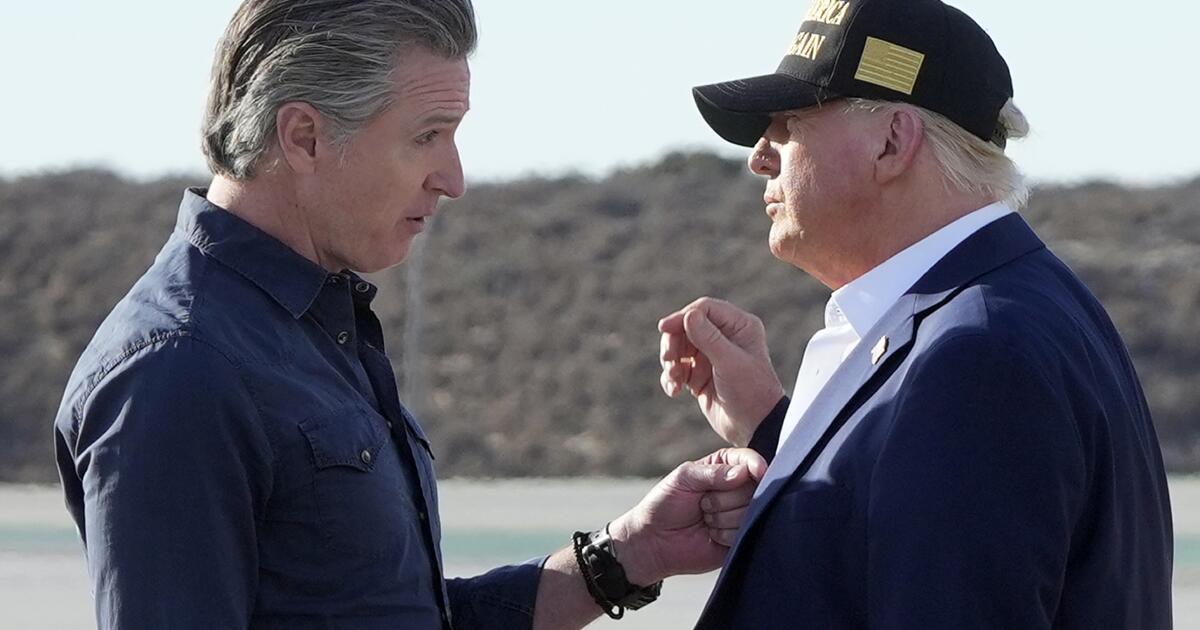
Gov. Gavin Newsom used his final State of the State address to underscore California’s jaw-dropping crime figures — stats that he said refute the president’s claims about widespread murder and mayhem.

To put in perspective some of the numbers cited by the governor on Thursday:

The last time homicides were this low in Oakland, Rev. Dr. Martin Luther King Jr. was visiting Joan Baez at Santa Rita Jail to commend her on her recent arrest in protest of the Vietnam draft.

Killings haven’t been so rare in San Francisco since superstar Marilyn Monroe wed baseball legend Joe DiMaggio at City Hall.

And violent deaths in the city of Los Angeles fell to rates not seen since the Beatles played Dodgers Stadium, their penultimate public show.

“We have seen double-digit decreases in crime overall in the state of California,” Newsom said. “We’ve got more work to do, but to those with that California derangement syndrome, I’ll repeat — it’s time to update your talking points.”

The governor’s remarks follow reporting by The Times that showed L.A.’s homicide rate is nearing a record low, mirroring trends in other cities nationwide.

With the counts based on data from the LAPD and other law enforcement agencies, President Trump’s insistence that crime in California is out of control has come to seem increasingly bombastic. Recently, the president has modified his message to warn of a possible crime resurgence.

“We will come back, perhaps in a much different and stronger form, when crime begins to soar again,” Trump said on Truth Social in a post announcing an end to his legal battle to maintain National Guard troops in L.A., Portland and Chicago. “Only a question of time!”

In his speech Thursday, Newsom credited the stark drop in violence to a flood of crime-fighting cash unleashed by the California Legislature.

“No one’s walked away from public safety,” Newsom said. “We didn’t turn a blind eye to this, we invested in it. We didn’t talk about it, we leaned in.”

But experts said the reality is more complicated. Those who study the root causes of crime say that it may take years, if not decades, to disentangle the causes of the pandemic-era surge in violence and the precipitous drop that has followed.

Trump hammered lawlessness in California’s streets during the 2024 presidential campaign and throughout his first year back in the White House. He rarely names Newsom without invoking crime and chaos, and regularly threatens to surge armed soldiers back into into the streets.

At the same time, the Trump administration has slashed hundreds of millions in federal funding from school safety grants, youth mentoring programs and gang intervention networks that experts say have been instrumental in improving public safety.

Proponents worry those cuts could threaten L.A.’s patchwork of alternative crisis response programs aimed at easing the city’s reliance on law enforcement. In recent years, scores of groups have sprung up to assist people dealing with homelessness, drug addiction and the symptoms of untreated mental health disorders — all of which can heighten the perception of crime, even when actual numbers go down.

Looming cuts in federal spending could hinder efforts to scale up these initiatives, some warned.

“I just don’t know how we can continue to trend in the right direction without continuing to invest in things that work,” said Thurman Barnes, assistant director of the New Jersey Gun Violence Research Center.

According to data published by the Major Cities Chiefs Assn., homicides were down in San Francisco, San José, Sacramento and Oakland. Other violent crimes, including rape, aggravated assault and robbery, also dropped, with a handful of exceptions.

Property crime was also down, the governor said Thursday.

Street-level disorder and perceptions of widespread lawlessness helped topple progressive administrations across California in 2024 and earned Trump an unexpected windfall in some of the state’s bluest cities.

Those concerns are “at the core” of California voters’ frustrations, Newsom acknowledged Thursday.

“We’re seeing results, making streets safer for everyone,” the governor said.

Jeff Asher, a leading expert in the field of criminology, said it’s hard to say whether the perception gap is closing “because we don’t necessarily track it super systematically.”

But he pointed to a Gallup poll from late last year that showed less than half of Americans believed that crime had gone up — the first time in two decades that that number had dipped below 50%.

“The pandemic broke us in a lot of ways, and we’re starting to not feel as broken,” he said.

Newsom also touted sharp declines in the number of people living on the streets.

Unsheltered homelessness dropped 9% in California and more than 10% in Los Angeles, the governor announced — data he sought to contrast with an 18% rise in homelessness nationwide.

The sight of encampments and people in the throes of psychosis in the streets drives perceptions of lawlessness and danger, studies show. Lowering it soothes those fears.

But California’s overall homeless population remains stubbornly high, with only modest reductions. Federal funding cuts could hamper efforts to further reduce those numbers, experts warned.

Rather than dig into the complexities of crime, Newsom sought to portray the president himself as the driver of lawlessness, calling the first year of his second term a “carnival of chaos.”

“We face an assault on our values unlike anything I’ve seen in my lifetime,” the governor said. “Secret police. Businesses being raided. Windows smashed, citizens detained, citizens shot. Masked men snatching people in broad daylight, people disappearing. Using American cities as training grounds for the United States military.”

“It’s time for the president of the United States to do his job, not turn his back on Americans that happen to live in the great state of California,” Newsom said.

Source link

Trump says he doesn’t need international law amid aggressive US policies | Donald Trump News

United States President Donald Trump has dismissed international law, saying only his “own morality” can curb the aggressive policies he is pursuing across the world after the abduction of Venezuela’s Nicolas Maduro.

“I don’t need international law. I’m not looking to hurt people,” Trump told The New York Times on Thursday.

Recommended Stories

list of 3 itemsend of list

Asked whether he needs to abide by international law, Trump said he does, but it “depends what your definition of international law is”.

Trump has shown a willingness to use the brute force of the US military to achieve his foreign policy goals.

On Saturday, the US launched an early-morning attack on Venezuela, with explosions reported across the capital Caracas and at Venezuelan military bases.

US troops ultimately abducted Venezuelan President Maduro from Caracas in what critics say was a clear violation of the United Nations Charter, which prohibits “the threat or use of force against the territorial integrity or political independence of any state”.

The attack on Venezuela appears to have supercharged the belligerence of the US president, who received the inaugural FIFA Peace Prize Award last month.

In the immediate aftermath of the attack, Trump said the US would “run” Venezuela and exploit the country’s vast oil reserves, though his administration has said it would cooperate with interim President Delcy Rodriguez.

Still, the Trump administration said it would “dictate” policy to the interim government and repeatedly threatened a “second wave” of military actions if US demands were disobeyed.

“If she doesn’t do what’s right, she is going to pay a very big price, probably bigger than Maduro,” Trump said of Rodriguez in a Sunday interview with The Atlantic.

Earlier this week, Trump also suggested that the US may carry out a strike against Colombia’s left-wing President Gustavo Petro, and he has escalated his campaign to acquire the Danish territory of Greenland.

In June, Trump joined Israel’s unprovoked war against Iran, ordering the bombing of the country’s three main nuclear sites.

Trump aide Stephen Miller has criticised the post-World War II international order, saying that, from here forward, the US would “unapologetically” use its military force to secure its interests in the Western Hemisphere.

“We’re a superpower, and under President Trump, we are going to conduct ourselves as a superpower,” Miller told CNN on Monday.

But experts warn that disregard for international law could have catastrophic consequences for the entire global community, including the US.

International law is the set of rules and norms that govern ties between states. It includes UN conventions and multilateral treaties.

Margaret Satterthwaite, the UN special rapporteur on the independence of judges and lawyers, told Al Jazeera earlier this week that US statements dismissing international law are “extremely dangerous”.

Satterthwaite said she is concerned the world may be returning to an “age of imperialism”, stressing that degrading international laws may embolden Washington’s adversaries to launch their own acts of aggression.

“International law cannot stop states from doing terrible things if they’re committed to doing them,” Satterthwaite told Al Jazeera.

“And I think that the world is aware of all of the atrocities that have happened in Gaza recently, and despite efforts by many states and certainly by the UN to stop those atrocities, they continued. But I think we’re worse off if we don’t insist on the international law that does exist. We’ll simply be going down a much worse kind of slippery slope.”

Yusra Suedi, an assistant professor of international law at the University of Manchester, warned against the belief that “might is right” and the trend towards disregarding international law.

“It signals something very dangerous, in that it gives permission to other states to essentially follow suit – states such as China, who might be eyeing Taiwan, or Russia with respect to Ukraine,” Suedi told Al Jazeera.

Ian Hurd, a professor of political science at Northwestern University, said history illustrates the perils of US policies in Latin America.

The region has witnessed more than a century of US invasions and US-supported military coups, leading to instability, repression and human rights abuses.

“There are innumerable examples historically of this, from Panama to Haiti to Nicaragua to Chile in the ’70s and on and on,” Hurd told Al Jazeera.

He added that Trump’s policies in Venezuela are “in line” with how the US has previously attempted to decide how other parts of the Americas are governed.

“You can see that in every one of those cases, the US came to regret its choice to intervene. These never work well.”

Source link

Newsom offers a sunny view of California to combat Trump’s darkness

In a State of the State speech that largely ignored any talk of the big, fat budget black hole that threatens to swallow the California dream, Gov. Gavin Newsom instead laid out a vision of the Golden State that centers on inclusivity and kindness to combat Trump’s reign of darkness and expulsion.

In a week dominated by news of immigration authorities killing a Minnesota mother; acknowledgment that “American First” really means running Venezuela for years to come; and the U.S. pulling even further out of global alliances, Newsom offered a soothing and unifying vision of what a Democratic America could look like.

Because, of course, far more than a tally of where we are as a state, the speech served as a likely road map of what a run for president would sound like if (or when) Newsom officially enters the race. In that vein, he drove home a commitment to both continuing to fight against the current administration, but also a promise to go beyond opposition with values and goals for a post-Trump world, if voters choose to manifest such a thing.

It was a clear volley against Republicans’ love of using California as the ultimate example of failed Democratic policies, and instead positioning it as a model.

“This state, this people, this experiment in democracy, belongs not to the past, but to the future,” Newsom told the packed Legislative chamber Thursday. “Expanding civil rights for all, opening doors for more people to pursue their dreams. A dream that’s not exclusive, not to any one race, not to any one religion, or class. Standing up for traditional virtues — compassion, courage, and commitment to something larger than our own self-interest — and asserting that no one, particularly the president of the United States, stands above the law.”

Perhaps the most interesting part of Thursday’s address was the beginning — when Newsom went entirely off script for the first few minutes, ribbing the Republican contingent for being forced to listen to nearly an hourlong speech, then seeming to sincerely thank even his detractors for their part in making California the state it is.

“I just want to express gratitude every single person in this chamber, every single person that shaped who we are today and what the state represents,” Newsom said, even calling out Assemblymember Carl DeMaio, one of his most vociferous foes, who released a questionable AI-generated “parody” video of Newsom in response to the speech.

It was in his off-the-cuff remarks where Newsom gave the clearest glimpse of what he might look like as a candidate — confident, at ease, speaking to both parties in a respectful way that the current president, who has labeled Democrats as enemies, refuses to do. Of course, he’d likely do all that during a campaign while continuing his lowbrow online jabbing, since the online world remains a parallel reality where anything goes.

But in person, at least, he was clearly going for classy over coarse. And gone is the jargon-heavy Newsom of past campaigns, or the guarded Newsom who tried to keep his personal life personal. His years of podcasts seem to have paid off, giving him a warmer, conversational persona that was noticeably absent in earlier years, and which is well-suited to a moment of national turmoil.

Don’t get me wrong — Newsom may or may not be the best pick for Democrats and voters in general. That’s up to you. I just showed up to this dog-and-pony show to get a close-up look at the horse’s teeth before he hits the track. And I’ve got to say, whether Newsom ends up successful or not in an Oval Office run, he’s a ready contender.

Beyond lofty sentiments, there was a sprinkling of actual facts and policies. Around AI, he hinted at greater regulation, especially around protecting children.

“Are we doing enough?” he asked, to a few shouts of “No,” from the crowd. This should be no surprise since his wife, Jennifer Siebel Newsom, has made oversight of artificial intelligence a priority in her own work.

Other concrete policy callouts included California’s commitment to increasing the number of people covered by health insurance, even as the federal government seeks to shove folks off Medicaid. In that same wellness bucket, he touted a commitment to getting processed foods out of school cafeterias and launching more medications under the state’s own generic drug label, including an $11 insulin pen launched last week.

On affordability, he found common ground with a proposal Trump put out this week as well — banning big investors from buying up single family homes. Although in California this is less of a problem than in some major housing markets, every house owned by a big investor is one not owned by a first-time buyer. Newsom called on the Legislature to work on a way to curtail those big buyers.

He also hit on our high minimum wage, especially for certain industries such as fast food ($20 an hour) and healthcare ($25 an hour), compared with states where the federal minimum wage still holds sway at just more than $7 an hour.

And on one of his most vulnerable points, homelessness, where Republicans and Trump in particular have attacked California, he announced that unsheltered homelessness decreased by 9% across the state in 2025 — though the data backing that was not immediately available. He also said that thousands of new mental health beds, through billions in funding from Proposition 1 in 2024, are beginning to come online and have the potential to fundamentally change access to mental health care in the state in coming years. This July, a second phase of Proposition 1 will bring in $1 billion annually to fund county mental health care.

Newsom will release his budget proposal on Friday, with much less fanfare. That’s because the state is facing a huge deficit, which will require tough conversations and likely cuts. Those are conversations about the hard work of governing, ones that Newsom likely doesn’t want to publicize. But Thursday was about positioning, not governing.

“In California, we are not silent,” Newsom said. “We are not hunkering down. We are not retreating. We are a beacon.”

It may not be a groundbreaking stand to have a candidate that understands politics isn’t always a battle of good and evil, but instead a negotiation of viewpoints. It’s surely a message other Democrats will embrace, one as basic as it is inspiring in these days of rage and pain.

But Newsom is staking that territory early, and did it with an assurance that he explained in a recent Atlantic profile.

He’d rather be strong and wrong than weak and right — but strong and righteous is as American as it gets.

Source link

Zelenskyy says US security guarantee text ready to be finalised with Trump | Russia-Ukraine war News

The comments come as the Kremlin slammed a plan for France and the UK to send peacekeepers to Ukraine after a ceasefire.

Ukrainian President Volodymyr Zelenskyy has said an agreement on a security guarantee from Washington is now “essentially ready” to be finalised by US President Donald Trump, following days of negotiations in Paris.

In a post on X on Thursday, Zelenskyy said the document – a cornerstone of any settlement to end the war, which would guarantee Washington and other Western allies would support Ukraine if Russia invaded again – was almost complete.

Recommended Stories

list of 4 itemsend of list

“The bilateral document on security guarantees for Ukraine ‍is now essentially ⁠ready for finalisation at the highest level with the president,” he said.

He said the talks in Paris, involving teams from the US and Europe, had addressed “complex issues” from the framework under discussion to end the nearly four-year war, with the Ukrainian delegation presenting possible solutions for these.

“We understand that the American side will engage with Russia, and we expect feedback on whether the aggressor is genuinely willing to end the war,” he said.

Washington, which on Tuesday endorsed the idea of providing security guarantees for Ukraine for the first time, is expected to present any agreement it reaches with Kyiv to Moscow, in its attempt to broker an end to the conflict.

Kyiv says legally-binding assurances that its allies would come to its defence are essential to deter Moscow from future aggression if a ceasefire is reached.

But specific details on the guarantees and how Ukraine’s allies would respond have not been made public.

Zelenskyy said earlier this week that he was yet to receive an “unequivocal” answer about what they would do if Russia did attack again.

Russia slams peacekeeper plan

Zelenskyy’s comments came as Russia rejected a plan that emerged from the Paris talks for European peacekeepers to be deployed to Ukraine as “militaristic”, warning they would be treated as “legitimate military targets”.

On Tuesday, French President Emmanuel Macron and UK Prime Minister Keir Starmer signed a declaration of intent with Zelenskyy in Paris, setting out the framework for troops from their countries to be deployed to Ukraine after a ceasefire was reached with Russia.

But in Russia’s first comments in response to the plan, Russian Foreign Ministry spokesperson Maria Zakharova denounced the proposal as “dangerous” and “destructive”, dampening hopes the plan could prove a step in bringing the war to an end.

“The new militarist declarations of the so-called Coalition of the Willing and the Kyiv regime together form a genuine ‘axis of war’,” Zakharova said in a statement.

“All such units and facilities will be considered legitimate military targets for the Russian Armed Forces,” she said, repeating a threat previously made by Putin.

Moscow has repeatedly warned that it would not accept any NATO members sending peacekeeping troops to Ukraine.

Russia attacks energy infrastructure

In his social media post, Zelenskyy also called for more pressure on Russia from Ukraine’s supporters, after further Russian missile attacks on energy infrastructure, which, he said, “clearly don’t indicate that Moscow is reconsidering its priorities”.

“In this context, it is necessary that pressure on Russia continues to increase at the same intensity as the work of our negotiating teams.”

The attacks left Ukrainian authorities scrambling to restore heating and water to hundreds of thousands of households in the Dnipropetrovsk and Zaporizhia regions.

“This is truly a national level emergency,” Borys Filatov, mayor of Dnipropetrovsk’s capital Dnipro, said on Telegram.

He announced power was “gradually returning to the hospitals” after the blackouts forced them to run on generators. The city authorities also extended school holidays for children.

About 600,000 households in the region remained cut off from power in Dnipropetrovsk, Ukrainian energy company DTEK said.

Source link

At home and abroad, Trump challenges anyone to stop him

Five years after the Jan. 6 assault on the U.S. Capitol by President Trump’s supporters, the White House released a website this week attempting to revise history.

Reasserting Trump’s false claim that he had won the 2020 presidential election, the administration doubled down on his decision to issue blanket pardons for the rioters, blamed Capitol Police for escalating tensions that day, and denounced Trump’s vice president at the time, Mike Pence, for “refusing to act” in defiance of the Constitution to stop congressional certification of Trump’s loss.

It was a display of political audacity that has become the hallmark of Trump’s second act — challenging anyone to stop him from asserting raw executive authority, both at home and increasingly abroad.

You’re reading the L.A. Times Politics newsletter

George Skelton and Michael Wilner cover the insights, legislation, players and politics you need to know in 2024. In your inbox Monday and Thursday mornings.

By continuing, you agree to our Terms of Service and our Privacy Policy.

Whether on foreign or domestic policy, lawmakers have struggled to respond to an administration that moves with unfettered restraint and exceptional speed. The U.S. Supreme Court has only facilitated Trump’s expansion of unitary executive power. And governments abroad accustomed to Trump’s lack of predictability now face a president whose entire philosophy toward foreign interventionism appears to have turned on a dime.

“There are political checks. They are checks, though, that have been degraded,” said William Howell, dean of the School of Government and Policy at Johns Hopkins University and author of “Trajectory of Power: The Rise of the Strongman Presidency.”

“They are checks that are looked upon not just with frustration, but an outward animosity by the president,” Howell added. “It’s a feature of his populist politics for him to say, ‘anything that stands in my way is illegitimate.’”

Unitary rule

Trump’s extraordinary use of executive authority has no comparison in recent times. The president has issued more than 220 executive actions in his first year back in office — more than the 220 orders he issued throughout his entire first term, and dwarfing the 276 actions that President Obama issued over eight years in office.

Directing the Justice Department to prosecute his political enemies, and deploying his pardon power to shield his friends and allies, Trump risks fueling the very sort of politicized system of justice he campaigned against as a presidential candidate.

And his administration has shown derision for Congress, controlled by the president’s own party, approving historically few bills and neglecting those that have passed, such as the Epstein Files Transparency Act. Trump has attempted to unilaterally rename the Defense Department and the Kennedy Center, despite straightforward laws requiring acts of Congress to do so, and has impounded funds appropriated by Congress for child care and family assistance allocated to Democratic states.

“The nature of presidential power is that it is given as much as taken,” said Andrew Rudalevige, a professor of government at Bowdoin College and author of “The New Imperial Presidency.” “You can’t have an imperial presidency without an invisible Congress. And certainly, the current Congress is setting new records for intentional invisibility.”

After Trump bulldozed the East Wing of the White House, a reporter asked his press secretary what was stopping him from knocking down the entire building. Karoline Leavitt demurred. “That’s a legal opinion that’s been held for many years,” she said, suggesting he could, in fact, demolish the rest of it.

“The institutional constraints on the unilateral presidency are weak,” said Dino Christenson, a political science professor at Washington University in St. Louis and co-author of “The Myth of the Imperial Presidency.” “The conservative majority of the [Supreme] Court has also recently chosen to back executive power.

“Arguably,” he added, “international constraints are even weaker, at least for powerful nations like the U.S.”

‘Governed by force’

Trump’s order over the weekend to depose Venezuela’s president, Nicolás Maduro, seizing him and his wife from their bedroom in a stunning military raid, was the type of rare exercise in American power that has defined past presidencies. But Trump said he was just getting started.

Beaming from the operational success in Caracas, Trump told reporters aboard Air Force One that he was considering military action against no fewer than five countries, allies and foes alike. His homeland security advisor, Stephen Miller, said that no one would even try to stop Trump from militarily taking over Greenland, an autonomous region of Denmark, a NATO ally and European Union member state.

“We live in a world,” Miller told CNN, “that is governed by strength, that is governed by force, that is governed by power.”

At the State Department, veteran U.S. diplomats waited anxiously for guidance from the administration on how it would justify the operation based on international law on the global stage. It never came. “At least with Iraq, Libya, Syria, there was an effort to seek legal cover,” one diplomat said, granted anonymity to speak candidly. “This is just grab-and-go.”

After the president vowed to run Venezuela going forward as a vassal state, Trump’s energy secretary said the United States would exert control over its oil production “indefinitely.”

And the Trump administration ordered the seizure of two foreign tankers on Wednesday in international waters that have violated its unilateral oil embargo against Caracas, risking precedent governing the laws of the seas that have for decades ensured international commercial flows.

It was a surprising turn for a president who had campaigned on a promise to focus on domestic policy, under a slogan of “America first.”

“So many of the claims that he was making — both in terms of his power and his politics — was about an inward turn, about standing up for America and attending to core problems that it had failed to face, whereas all these foreign entanglements were distractions to be avoided,” Howell said. “So it is striking that he has assumed this new posture of outward imperialism — land grabs, oil tankers, removing heads of state — all at once.”

Several Republican lawmakers expressed skepticism over Trump’s new posture, warning the president against entrenching the U.S. military in foreign conflicts. House Speaker Mike Johnson, a Republican from Louisiana, warned that U.S. military action against Denmark in Greenland “would not be appropriate” after the White House issued an explicit threat of force.

Scholars of the imperial presidency often say that public opinion — not the legislature or the courts — remains the strongest check on executive authority. Trump is ineligible for a third term in office, and has signaled in recent weeks that he recognizes that constitutional limit as unambiguous.

“I don’t think Trump is immune from the laws of political gravity,” Rudalevige said. “Despite his bluster, he is a lame duck. He has never had a Gallup approval rating above 50%, and that rating is in the 30s. His policy actions are even less popular.”

But he also said he believes the public supports him in his brash use of power, telling lawmakers there could be a “constitutional movement” to keep him in office.

“MAGA loves it,” Trump said in an interview with NBC News this week, defending his foreign policy approach. “MAGA loves what I’m doing. MAGA loves everything I do.”

“MAGA is me,” he added. “MAGA loves everything I do, and I love everything I do, too.”

What else you should be reading

The must-read: Palisades fire report was sent to mayor’s office for ‘refinements,’ Fire Commission president says
The deep dive: Michael Reagan’s death reverberates among Californians of both parties
The L.A. Times Special: One year since my childhood home burned

More to come,
Michael Wilner

Was this newsletter forwarded to you? Sign up here to get it in your inbox.

Source link

House to vote on overriding two Trump vetoes

Jan. 8 (UPI) — The U.S. House will vote Thursday on overriding two vetoes issued by President Donald Trump last week.

Lawmakers in the House are expected to pass the two bills again, based on their overwhelming support when they voted to send them to the president’s desk.

A two-thirds vote in support of the bills is required in the House and Senate to override a presidential veto. Thursday’s vote in the House is the first step toward overriding these vetoes.

The first bill, the “Finish the Arkansas Conduit Act,” would reduce payments for Colorado communities that receive water from a water pipeline tapped into the Pueblo Reservoir. The second, the “Miccosukee Reserved Area Amendments Act,” expands the Miccosukee Tribe’s land in Florida.

Both bills received bipartisan support, including strong support from Republicans in the affected states.

Rep. Lauren Boebert, R-Colo., pushed back on Trump following his veto of the Colorado-focused bill, writing on social media “This isn’t over.”

Boebert, typically a staunch Trump ally, was also one of the first Republicans to sign the petition forcing lawmakers to vote on the release of the Epstein files, despite Trump’s opposition. This was prior to him issuing the veto.

Republican senators in Florida championed the bill to add to Miccosukee Tribe land, including a portion of Everglades National Park. However, Trump has targeted this land to expand the immigrant detention center that opened last year, the Everglades Detention Facility referred to as “Alligator Alcatraz.”

Rep. Carlos Gimenez, R-Fla., introduced the bill to the House.

President Donald Trump holds a signed executive order reclassifying marijuana from a schedule I to a schedule III controlled substance in the Oval Office of the White House on Thursday. Photo by Aaron Schwartz/UPI | License Photo

Source link

Trump says he will seek $1.5T defense budget for 2027

Jan. 8 (UPI) — President Donald Trump said he would ask Congress to approve a massive $500 billion increase in defense spending to fund his “Dream Military,” taking the Pentagon’s 2027 budget to a record $1.5 trillion.

In a post on his Truth Social platform on Wednesday, Trump said “these very troubled and dangerous times” required the 50% hike for the good of the United States and that he had reached his determination after protracted, thorny debate with his cabinet and lawmakers.

“This will allow us to build the ‘Dream Military’ that we have long been entitled to and, more importantly, that will keep us SAFE and SECURE, regardless of foe. If it weren’t for the tremendous numbers being produced by tariffs from other countries, many of which, in the past, have ‘ripped off’ the United States at levels never seen before, I would stay at the $1 trillion dollar number,” he wrote.

The extra funding would pay for new hardware headed by his “Golden Dome” air defense scheme and a new class of guided-missile battleship — items totally out of reach at current budget levels.

Trump said the income that tariffs generated, unthinkable in the past, meant the United States was easily able to afford the $1.5 trillion, while at the same time producing “an unparalleled Military Force,” paying down debt and granting a “substantial dividend” to moderate-income Americans.

That claim was disputed by the Committee for a Responsible Budget, which said tariffs would only generate around half of the estimated $5.8 trillion the higher defense budget would add to the national debt through 2035.

In a post on X, the watchdog said its preliminary calculations showed the spending increase would boost defense spending by $5 trillion, plus $800 billion in interest, while revenue flowing into the Treasury from higher tariffs over the same period would only run $2.5 trillion, or about $3 trillion with interest.

Tariffs are import levies paid by U.S. companies when they bring in goods and materials from other countries, a cost they either absorb or pass onto to their customers in the form of high prices. Overseas companies may also opt to absorb tariff costs to preserve their market in the United States.

Despite Congress having yet to pass a defense spending bill for the $1 trillion Trump is seeking for FY26, was hailed by some Republican lawmakers and Defense Secretary Pete Hegseth who described it as “PEACE through STRENGTH.”

“President Trump is rebuilding our military — larger, stronger and more lethal than ever before,” Hegseth wrote in a post on X.

Raising the budget by such a significant amount will be tough, despite Trump convincing Congress to pass a reconciliation bill topping up this year’s budget by $150 billion, spread over five years, and support from some Republicans pushing for defense spending to rise to 5% of GDP, up from its current 3.5% level.

Rep. Don Bacon, R-Neb., an advocate of higher defense spending, called it “a good news story.”

“We think we need a permanent 4 % or better. That’s what it’s gonna take to build our Navy, our Air Force, our ICBMs, our bombers, and take care of our troops,” said the retired U.S. Air Force Brigadier-General.

Source link

Column: Trump’s 626 overseas strikes aren’t ‘America First.’ What’s his real agenda?

Who knew that by “America First,” President Trump meant all of the Americas?

In puzzling over that question at least, I’ve got company in Marjorie Taylor Greene, the now-former congresswoman from Georgia and onetime Trump devotee who remains stalwart in his America First movement. Greene tweeted on Saturday, just ahead of Trump’s triumphal news conference about the United States’ decapitation of Venezuela’s government by the military’s middle-of-the-night nabbing of Nicolás Maduro and his wife: “This is what many in MAGA thought they voted to end. Boy were we wrong.”

Wrong indeed. Nearly a year into his second term, Trump has done nothing but exacerbate the domestic problems that Greene identified as America First priorities — bringing down the “increasing cost of living, housing, healthcare” within the 50 states — even as he’s pursued the “never ending military aggression” and foreign adventurism that America Firsters scorn, or at least used to. Another Trump con. Another lie.

Here’s a stunning stat, thanks to Military Times: In 2025, Trump ordered 626 missile strikes worldwide, 71 more than President Biden did in his entire four-year term. Targets, so far, have included Yemen, Syria, Iraq, Somalia, Nigeria, Iran and the waters off Venezuela and Colombia. Lately he’s threatened to hit Iran again if it kills demonstrators who have been marching in Tehran’s streets to protest the country’s woeful economic conditions. (“We are locked and loaded and ready to go,” Trump posted Friday.)

The president doesn’t like “forever wars,” he’s said many times, but he sure loves quick booms and cinematic secret ops. Leave aside, for now, the attacks in the Middle East, Africa and the Caribbean and the eastern Pacific. It’s Trump’s new claim to “run” Venezuela that has signaled the beginning of his mind-boggling bid for U.S. hegemony over the Western Hemisphere. Any such ambition raises the potential for quick actions to become quagmires.

As Stephen Miller, perhaps Trump’s closest and most like-minded (read: unhinged) advisor, described the administration’s worldview on Monday to CNN’s Jake Tapper: “We live in a world, in the real world, Jake, that is governed by strength, that is governed by force, that is governed by power. These are iron laws of the world since the beginning of time.”

You know, that old, amoral iron law: “Might makes right.” Music to Vladimir Putin’s and Xi Jinping’s ears as they seek hegemonic expansion of their own, confident that the United States has given up the moral high ground from which to object.

But it was Trump, the branding maven, who gave the White House worldview its name — his own, of course: the Donroe Doctrine. And it was Trump who spelled out what that might mean in practice for the Americas, in a chest-thumping, war-mongering performance on Sunday returning to Washington aboard Air Force One. The wannabe U.S. king turns out to be a wannabe emperor of an entire hemisphere.

“We’re in charge,” Trump said of Venezuela to reporters. “We’re gonna run it. Fix it. We’ll have elections at the right time.” He added, “If they don’t behave, we’ll do a second strike.” He went on, suggestively, ominously: “Colombia is very sick too,” and “Cuba is ready to fall.” Looking northward, he coveted more: “We need Greenland from a national security situation.”

Separately, Trump recently has said that Colombia’s leftist President Gustavo Petro “does have to watch his ass,” and that, given Trump’s unhappiness with the ungenuflecting Mexican President Claudia Sheinbaum, “Something’s going to have to be done with Mexico.” In their cases as well as Maduro’s, Trump’s ostensible complaints have been that each has been complacent or complicit with drug cartels.

And yet, just last month Trump pardoned the former president of Honduras, Juan Orlando Hernández, who was convicted in a U.S. court and given a 45-year sentence for his central role in “one of the largest and most violent drug-trafficking conspiracies in the world.” Hernández helped traffickers ship 400 tons of cocaine into the United States — to “stuff the drugs up the gringos’ noses.” And Trump pardoned him after less than two years in prison.

So it’s implausible that a few weeks later, the U.S. president truly believes in taking a hard line against leaders he suspects of abetting the drug trade. Maybe Trump’s real motivation is something other than drug-running?

In his appearance after the Maduro arrest, Trump used the word “oil” 21 times. On Tuesday, he announced, in a social media post, of course, that he was taking control of the proceeds from up to 50 barrels of Venezuelan oil. (Not that he cares, but that would violate the Constitution, which gives Congress power to appropriate money that comes into the U.S. Treasury.)

Or perhaps, in line with the Monroe Doctrine, our current president has a retro urge to dominate half the world.

Lately his focus has been on Venezuela and South America, but North America is also in his sights. Trump has long said he might target Mexico to hit cartels and that the United States’ other North American neighbor, Canada, should become the 51st state. But it’s a third part of North America — Greenland — that he’s most intent on.

The icy island has fewer than 60,000 people but mineral wealth that’s increasingly accessible given the climate warming that Trump calls a hoax. For him to lay claim isn’t just a problem for the Americas. It’s an existential threat to NATO given that Greenland is an autonomous part of NATO ally Denmark — as Danish Prime Minister Mette Frederiksen warned.

Not in 80 years did anyone imagine that NATO — bound by its tenet that an attack on one member is an attack on all — would be attacked from within, least of all from the United States. In a remarkable statement on Tuesday, U.S. allies rallied around Denmark: “It is for Denmark and Greenland, and them only, to decide on matters concerning Denmark and Greenland.”

Trump’s insistence that controlling Greenland is essential to U.S. national security is nuts. The United States has had military bases there since World War II, and all of NATO sees Greenland as critical to defend against Russian and Chinese encroachment in the Arctic. Still, Trump hasn’t ruled out the use of force to take the island.

He imagines himself to be the emperor of the Americas — all of it. Americas First.

Bluesky: @jackiecalmes
Threads: @jkcalmes
X: @jackiekcalmes

Source link

Trump to withdraw US from dozens of UN, international organisations | Donald Trump News

The sweeping changes will see the US quit major forums for cooperation on climate change, peace and democracy.

United States President Donald Trump has announced that he plans to withdraw the US from 66 United Nations and international organisations, including major forums for cooperation on climate change, peace and democracy.

In a presidential memorandum shared by the White House on Wednesday evening, Trump said that the decision came after a review of which “organizations, conventions, and treaties are contrary to the interests of the United States”.

Recommended Stories

list of 4 itemsend of list

The changes would see the US cease participation and also cut all funding to the affected entities, Trump added.

The list shared by the White House included 35 non-UN organisations, including notably the Intergovernmental Panel on Climate Change (IPCC), the International Institute for Democracy and Electoral Assistance and the International Union for Conservation of Nature.

Although the IPCC was included in the list of non-UN bodies by the White House, it is a UN organisation that brings together top scientists to assess the evidence related to climate change and provide periodic scientific assessments to help inform political leaders.

In addition, the White House said it was withdrawing from 31 UN entities, including the UN’s top climate change treaty body, the UN Framework Convention on Climate Change (UNFCCC), the UN Democracy Fund and the top UN entity working on maternal and child health, the UNFPA.

Several of the UN entities targeted also focused on protecting at-risk groups from violence during wars, including the UN Office of the Special Representative of the Secretary General for Children in Armed Conflict.

In a note to correspondents on Wednesday evening, UN spokesperson Stephane Dujarric said that the UN expected to respond to the announcement by Thursday morning.

Despite publicly claiming he wants the US to have less involvement in UN forums, Trump has not held back from influencing decision-making at the international level.

In October last year, Trump threatened to impose sanctions on diplomats who formally adopted a levy on polluting shipping fuels that had already been agreed to at an earlier meeting, effectively sinking the deal for 12 months.

The Trump administration also imposed sanctions on UN special rapporteur Francesca Albanese, after she published a report documenting the role of international and US companies in Israel’s genocidal war on Gaza.

In 2017, Trump also threatened to cut aid from countries that voted in support of a draft UN resolution condemning the US decision to recognise Jerusalem as the capital of Israel.

As a permanent member of the UN Security Council, the US also holds considerable power at the United Nations, as one of only five countries able to veto measures it doesn’t like, a power the US repeatedly used to block efforts to end Israel’s war on Gaza before mediating a ceasefire late last year.

Since beginning his second term in January last year, Trump has already withdrawn the US from the World Health Organization (WHO), the Paris climate agreement and the UN human rights council.

Trump also quit these three organisations during his first administration, but the withdrawals were all later reversed by the administration of former US President Joe Biden.

The US withdrawal from the WHO is set to come into effect on January 22, 2026, one year after it was ordered by the White House.

Between 2024 and 2025, the US contributed $261m in funding to the WHO, amounting to about 18 percent of the funding the organisation receives for its work encouraging global cooperation on a wide range of pressing health issues, including tuberculosis and pandemics, like COVID-19.

The Trump administration has also continued a US funding ban on the UN agency for Palestinian refugees, UNRWA, that began under Biden.

Source link

Trump backs bill to sanction China, India over Russian oil, US senator says | Russia-Ukraine war News

Trump has ‘greenlit’ bipartisan push to sanction countries that buy Russian energy exports, Lindsey Graham says.

United States President Donald Trump has backed a bill to impose sanctions on countries that buy Russian oil, including China and India, an influential Republican senator has said.

Lindsey Graham, a senator for the US state of South Carolina, said on Wednesday that Trump had “greenlit” the bipartisan bill following a “very productive” meeting.

Recommended Stories

list of 4 itemsend of list

Graham’s Sanctioning Russia Act, drafted with Democrat Richard Blumenthal, would give Trump the authority to impose a tariff of up to 500 percent on imports from countries doing business with Russia’s energy sector.

“This bill will allow President Trump to punish those countries who buy cheap Russian oil fueling Putin’s war machine,” Graham said in a statement, referring to Russian President Vladimir Putin.

““This bill would give President Trump tremendous leverage against countries like China, India and Brazil to incentivize them to stop buying the cheap Russian oil that provides the financing for Putin’s bloodbath against Ukraine.”

China and Russia continue to be major buyers of Russia’s oil despite US and European sanctions imposed on the Russian energy sector in response to Moscow’s war in Ukraine.

China bought nearly half of Russia’s crude oil exports in November, while India took about 38 percent of exports, according to an analysis by the Centre for Research on Energy and Clean Air. Brazil dramatically ramped up its purchase of subsidised Russian oil after the invasion of Ukraine in 2022, but those imports have fallen substantially in recent months.

The latest US push to increase pressure on Russia comes as Moscow and Kyiv are engaged in Washington-brokered negotiations to bring an end to the nearly four-year war.

On Tuesday, the Trump administration for the first time gave its backing to European proposals for binding security guarantees for Ukraine, including post-war truce monitoring and a European-led multinational force.

Russia, which has repeatedly said that it will not accept any deployment of NATO member countries’ soldiers in Ukraine, has yet to indicate that it would support such security measures.

In his statement on his bill, Graham said the legislation was timely in light of the current situation in Ukraine.

“This will be well-timed, as Ukraine is making concessions for peace and Putin is all talk, continuing to kill the innocent,” he said.

Source link

Trump withdraws U.S. from dozens of international organizations, treaties

Jan. 7 (UPI) — President Donald Trump said Wednesday night that he will withdraw the United States from dozens of international organizations and treaties, escalating the U.S. policy shift from multilateral engagement under his second administration.

The 66 international organizations, conventions and treaties affected were those deemed “contrary to the interests of the United States,” according to a statement from the White House.

The withdrawal was initiated via a presidential memorandum, which names 35 non-United Nations organizations and 31 U.N. entities. Among them are the landmark U.N. Framework Convention on Climate Change, established in 1992, and several others that fight climate change, the U.N. Entity for Gender Equality and the Empowerment of Women, U.N. Oceans and the U.N. Alliance of Civilizations.

“The Trump administration has found these institutions to be redundant in their scope, mismanaged, unnecessary, wasteful, poorly run, captured by the interests of actors advancing their own agendas contrary to our own, or a threat to our nation’s sovereignty, freedoms and general prosperity,” Secretary of State Marco Rubio said in a statement.

“President Trump is clear: It is no longer acceptable to be sending these institutions the blood, sweat and treasure of the American people, with little to nothing to show for it.”

Since returning to the White House in January, Trump has used his executive powers to expunge left-leaning ideology and initiatives from U.S. domestic and foreign policy. Rubio argued that the dozens of organizations and treaties the United States was exiting are those where progressive ideology “detached from national interests.”

“From DEI mandates to ‘gender equity’ campaigns to climate orthodoxy, many international organizations now serve a globalist project rooted in the discredited fantasy of the ‘End of History,'” he said.

“These organizations actively seek to constrain American sovereignty,” he continued. “Their work is advanced by the same elite networks — the multilateral ‘NGO-plex’ — that we have begun dismantling through the closure of USAID.”

A fact sheet from the White House claims that many of the organizations named Wednesday “promote radical climate policies, global governance and ideological programs that conflict with U.S. sovereignty and economic strength.”

“By exiting these entities, President Trump is saving taxpayer money and refocusing resources on America First policies.”

Trump has frequently rallied against international organizations that have stood counter or even criticized his policies. He has twice removed the United States from the World Health Organization, first during his first term and again on his first day in office of his second after President Joe Biden reinstated the United States’ membership in the world’s leading health organization.

The same day he pulled the United States from the WHO he directed the withdrawal from the U.N. Framework Convention on Climate Change, also known as the Paris Agreement.

He has also twice withdrawn the United States from The U.N. Educational, Scientific and Cultural Organization, better known as UNESCO. He also withdrew the United States from the U.N. Human Rights Council and prohibited future funding to the U.N. Relief and Works Agency for the Near East.

During his first term, he withdrew the United States from the landmark Obama-era multinational accord that aimed to prevent Iran from gaining a nuclear weapon and the Intermediate-Range Nuclear Forces Treaty.

“I’ve always felt that the U.N. has tremendous potential. It’s not living up to that potential right now — it really isn’t — hasn’t for a long time,” Trump said Wednesday before signing the memorandum in the Oval Office.

“There are great hopes for it, but it’s not being well run, to be honest.”

President Donald Trump holds a signed executive order reclassifying marijuana from a schedule I to a schedule III controlled substance in the Oval Office of the White House on Thursday. Photo by Aaron Schwartz/UPI | License Photo

Source link

Trump threatens US defence firms over executive pay, slow production | Donald Trump News

United States President Donald Trump has issued a stern warning to defence contractors that supply the US military, accusing them of profiteering.

In a Truth Social post on Wednesday, he threatened to take action if the companies failed to take specific actions, including capping executive pay, investing in the construction of factories and producing more military equipment at a faster clip.

Recommended Stories

list of 3 itemsend of list

“MILITARY EQUIPMENT IS NOT BEING MADE FAST ENOUGH,” Trump wrote at one point in his lengthy, 322-word post.

“It must be built now with the Dividends, Stock Buybacks, and Over Compensation of Executives, rather than borrowing from Financial Institutions, or getting the money from your Government.”

Trump singled out the technology company Raytheon as the worst offender, in his eyes.

“I have been informed by the Department of War that Defense Contractor, Raytheon, has been the least responsive to the needs of the Department of War, the slowest in increasing their volume, and the most aggressive spending on their Shareholders rather than the needs and demands of the United States Military,” Trump wrote in a follow-up post.

The president threatened to sever government ties with Raytheon, now known as RTX, which earns billions from its defence contract work.

Just last August, the Department of Defence awarded the firm $50bn – the maximum possible – for a 20-year contract to supply the military with equipment, services and repairs.

“Our Country comes FIRST, and they’re going to have to learn that, the hard way,” Trump warned.

Defence spending fuels a significant portion of the US economy: As of 2024, Defence Department spending represented approximately 2.7 percent of the US gross domestic product (GDP).

Normally, the total defence budget hovers around $1 trillion. But in a Wednesday evening post on Truth Social, Trump announced that he would petition congressional Republicans to boost that amount to a record $1.5 trillion for fiscal year 2027.

“This will allow us to build the ‘Dream Military’ that we have long been entitled to and, more importantly, that will keep us SAFE and SECURE, regardless of foe,” Trump wrote.

Still, Trump’s threats sent stocks for defence contractors plummeting, amid uncertainty over the future of the high-stakes industry.

Since taking office for a second term, Trump has taken an aggressive, hands-on approach to private companies that have ties to national security concerns.

In June, for instance, the Trump administration was awarded a “golden share” in the metal company US Steel, in exchange for giving a green light to its merger with Japan’s Nippon Steel. That share allows the Trump administration to essentially have a veto over any major action US Steel may take to reorganise or dissolve.

Then, in August, the technology firm Intel struck a deal to sell the US government a 10-percent stake in its company, amid pressure from Trump.

The Trump administration has continued to snap up stakes in other private firms, most notably mining companies involved in the production of rare earth minerals and other raw materials used in technology.

It is not yet clear how Trump plans to enforce his demands for the defence contractors he blasted in Wednesday’s social media messages. Nor is it certain that Trump could legally enforce his orders.

But Trump aired a list of grievances against the companies, including that their executives’ pay was simply too large.

“Executive Pay Packages in the Defense Industry are exorbitant and unjustifiable given how slowly these Companies are delivering vital Equipment to our Military, and our Allies,” he wrote at one point.

At another, he called on the private firms to invest in new construction projects, a request he has made across industries, from the pharmaceutical sector to automakers.

“From this moment forward, these Executives must build NEW and MODERN Production Plants, both for delivering and maintaining this important Equipment, and for building the latest Models of future Military Equipment,” Trump said.

“Until they do so, no Executive should be allowed to make in excess of $5 Million Dollars which, as high as it sounds, is a mere fraction of what they are making now.”

He also complained that the defence companies were “far too slow” in offering repairs for their equipment.

Defence contractors are responsible for a range of services and products, from software to training to missiles and tanks. RTX, for example, designed the Patriot Missile, the US’s flagship surface-to-air missile system, and it keeps the US military supplied with spare parts and other updates.

Based in Virginia, the company boasted sales exceeding $80bn in 2024. Just this week, the US Federal Aviation Administration (FAA) awarded RTX a $438m contract to update its radar system.

Still, Trump maintained that too much of that income was going to shareholders, executive pay and stock buybacks, wherein a company purchases its own shares in order to limit their supply and increase their value.

“Defense Contractors are currently issuing massive Dividends to their Shareholders and massive Stock Buybacks, at the expense and detriment of investing in Plants and Equipment,” Trump wrote.

“This situation will no longer be allowed or tolerated!”

Source link

US suspends assistance to Somali government for alleged seizure of aid | Donald Trump News

The Trump administration has accused Somali officials of destroying a World Food Programme warehouse that contained US-funded food aid.

The United States says that it has suspended all assistance to the government of Somalia, alleging that officials destroyed a World Food Programme warehouse filled with food aid it funded.

In a social media post on Wednesday, the administration of US President Donald Trump alleged that Somali officials had seized 76 metric tonnes of donor-funded food aid that had been intended for Somalis in need.

Recommended Stories

list of 3 itemsend of list

“The US is deeply concerned by reports that Federal Government of Somalia officials have destroyed a US-funded World Food Programme (WFP) warehouse and illegally seized 76 metric tons of donor-funded food aid for vulnerable Somalis,” the post said.

“The Trump Administration has a zero-tolerance policy for waste, theft, and diversion of life-saving assistance.”

The announcement was made on the social media platform representing the US State Department’s Under Secretary for Foreign Assistance, Humanitarian Affairs and Religious Freedom.

Somali officials have not yet responded to the allegations of aid theft.

Still, the stark measure continues a recent trend under the Trump administration. In recent months, President Trump has leaned into criticism of Somalis living in the United States and placed restrictions on Somalis seeking to enter the US.

His administration has also stepped up air strikes targeting armed groups in Somalia itself.

Notably, in a December cabinet meeting, Trump personally levelled racist attacks against the Somali community in the US, saying they are “destroying America”. He also attacked Ilhan Omar, a Democratic representative from Somalia who arrived in the US as a child refugee.

“We’re going to go the wrong way if we keep taking in garbage into our country,” Trump said at the December 2 meeting.

“Ilhan Omar is garbage, just garbage. Her friends are garbage. These aren’t people that work. These aren’t people that say, ‘Let’s go, come on, let’s make this place great.’ These are people that do nothing but complain.”

As part of his tirade, Trump cited a fraud scandal in the midwestern state of Minnesota, which has seen some members of the large Somali community there charged with wrongdoing.

White House Press Secretary Karoline Leavitt has since indicated that Trump could use denaturalisation – the revocation of US citizenship – as “a tool” to penalise Somali Americans involved in the fraud scheme.

The Trump administration has also ramped up immigration enforcement raids in Minneapolis, Minnesota, a city with the largest Somali community in the US.

The Trump administration has dramatically scaled back US humanitarian assistance since returning to the White House in 2025, and it is not clear how much aid will be affected by the suspension of assistance.

Trump’s Democratic predecessor Joe Biden had provided about $770m in assistance for projects in Somalia, but only a small portion went towards the Somali government.

In announcing Wednesday’s aid freeze, the US State Department signalled that assistance could resume – but only with an acknowledgement of responsibility from the Somali government.

“Any resumption of assistance will be dependent upon the Somali Federal Government, taking accountability for its unacceptable actions and taking appropriate remedial steps.”

Source link

Trump administration creates a new food pyramid, launches website

Jan. 7 (UPI) — The Trump administration announced Wednesday it created new dietary guidelines and created a new food pyramid.

“Under President Trump’s leadership common sense, scientific integrity and accountability have been restored to federal food and health policy,” a fact sheet from the Department of Health and Human Services announced. “For decades, the Dietary Guidelines favored corporate interests over common sense, science-driven advice to improve the health of Americans. That ends today.”

The new guidelines focus on high-quality protein, healthy fats, fruits, vegetables and whole grains, the fact sheet said. It calls for people to avoid highly processed foods and refined carbohydrates.

“The Dietary Guidelines are the foundation to dozens of federal feeding programs, and today marks the first step in making sure school meals, military and veteran meals, and other child and adult nutrition programs promote affordable, whole, healthy, nutrient-dense foods,” the fact sheet said.

The government also released a new website, Realfood.gov.

The American Heart Association said it welcomed the new guidelines on fruits, vegetables and whole grains.

The AHA “commends the inclusion of several important science-based recommendations, notably the emphasis on increasing intake of vegetables, fruits and whole grains while limiting consumption of added sugars, refined grains, highly processed foods, saturated fats and sugary drinks,” the AHA said in a statement.

But it took issue with some of the recommendations.

“We are concerned that recommendations regarding salt seasoning and red meat consumption could inadvertently lead consumers to exceed recommended limits for sodium and saturated fats, which are primary drivers of cardiovascular disease. While the guidelines highlight whole-fat dairy, the Heart Association encourages consumption of low-fat and fat-free dairy products, which can be beneficial to heart health,” the statement said.

The new guidance pushes protein at every meal and says to eat as much as twice the recommended daily allowance of 0.08 grams of protein per kilogram of body weight. It says to eat 1.2 to 1.6 grams. Proteins can be flavored with “salt, spices, and herbs,” it said.

The guidelines also recommend full-fat dairy, which is different from past recommendations of low-fat or fat-free dairy. Full-fat dairy has saturated fats. The fact sheet calls this “ending the war on healthy fats.”

“Paired with a reduction in highly processed foods laden with refined carbohydrates, added sugars, excess sodium, unhealthy fats, and chemical additives, this approach can change the health trajectory of America,” the fact sheet said.

“When [Diversity, Equity and Inclusion] impacts nutrition science, it enables special interests to argue the status quo is acceptable because it would violate ‘health equity’ principles to encourage Americans to eat healthier food,” the fact sheet added.

Source link

Trump actively discussing potentially buying Greenland, White House says

US President Donald Trump and his officials are “actively” discussing a potential offer to buy the Danish territory of Greenland, the White House has confirmed.

It is “something that’s currently being actively discussed by the president and his national security team”, White House spokeswoman Karoline Leavitt told reporters on Wednesday.

Both Greenland and Denmark have repeatedly stressed the island was not for sale.

Asked why the Trump administration had previously said it was not ruling out using military force to acquire Greenland, Leavitt replied that all options were always on the table but Trump’s “first option always has been diplomacy”.

Concerns over the future of the territory resurfaced after Trump’s unilateral use of military force against Venezuela on Saturday to seize its President Nicolás Maduro. Denmark, a fellow Nato ally, says an attack on its territory would end the military alliance.

The Trump administration says Greenland is vital to US security.

Despite being the most sparsely populated territory, its location between North America and the Arctic makes it well placed for early warning systems in the event of missile attacks, and for monitoring vessels in the region.

Pituffik Space Base, formerly known as Thule Air Base, has been operated by the US since World War 2.

In recent years, there has also been increased interest in Greenland’s natural resources, including rare earth minerals, uranium and iron that are becoming easier to access as its ice melts due to climate change. Scientists think it could also have significant oil and gas reserves.

US Secretary of State Marco Rubio said on Wednesday that he will hold talks with Denmark next week.

Trump previously made an offer to buy the island in 2019, during his first presidential term, only to be told it was not for sale.

“The acquisition of Greenland by the United States is not a new idea,” Leavitt said.

“The president has been very open and clear with all of you and with the world, that he views it in the best interest of the United States to deter Russian and Chinese aggression in the Arctic region, and so that’s why his team is currently talking about what a potential purchase would look like.”

The White House said earlier this week that Trump had been discussing a range of options to acquire Greenland, including using military force.

“All options are always on the table for President Trump as he examines what’s in the best interests of the United States,” Leavitt said.

Earlier in the day, French Foreign Minister Jean-Noël Barrot said Rubio had “ruled out the possibility of an invasion” of Greenland in a phone call with him.

Barrot is due to discuss the Arctic island with his German and Polish counterparts later on Wednesday.

On Tuesday, European leaders issued a joint statement rallying behind Denmark.

“Greenland belongs to its people, and only Denmark and Greenland can decide on matters concerning their relations,” the leaders of France, the UK, Germany, Italy, Poland, Spain and Denmark said in a joint statement.

Stressing they were as keen as the US on Arctic security, the European signatories said this must be achieved by Nato allies, including the US, “collectively”.

They also called for “upholding the principles of the UN Charter, including sovereignty, territorial integrity and the inviolability of borders”.

A day after the US military action in Venezuela, Katie Miller, the wife of one of Trump’s senior aides, posted a map on social media of Greenland in the colours of the US flag, alongside the word “SOON”.

On Monday, her husband, Stephen Miller, said it was “the formal position of the US government that Greenland should be part of the US”.

Aaja Chemnitz, one of two MPs in the Danish parliament representing Greenland, told the BBC that the comments from the Trump administration were “a clear threat”.

“It’s completely disrespectful from the US side to not rule out annexing our country and to annex another Nato ally,” she said.

But Chemnitz said she saw this as unlikely – instead, “what we are going to see is that they will put pressure on us in order to make sure that they will take over Greenland over time”.

Aleqatsiaq Peary, a 42-year-old Inuit hunter living in Greenland’s remote northerly town of Qaanaaq, appeared indifferent to the potential of US ownership.

“It would be switching from one master to another, from one occupier to another,” he told the BBC. “We are a colony under Denmark. We are already losing a lot from being under the Danish government.”

Saying that he did not have “time for Trump”, he added that people were “in need”. Hunters like him, he explained, hunted with dogs on the sea ice and fish “but the sea ice is melting and hunters cannot make a living anymore”.

Additional reporting by Adrienne Murray in Copenhagen

Source link

Trump administration declares ‘war on added sugar’

The Trump administration announced a major overhaul of American nutrition guidelines Wednesday, replacing the old, carbohydrate-heavy food pyramid with one that prioritizes protein, healthy fats and whole grains.

“Our government declares war on added sugar,” Health and Human Services Secretary Robert F. Kennedy Jr. said in a White House news conference announcing the changes. “We are ending the war on saturated fats.”

“If a foreign adversary sought to destroy the health of our children, to cripple our economy, to weaken our national security, there would be no better strategy than to addict us to ultra-processed foods,” Kennedy said.

Improving U.S. eating habits and the availability of nutritious foods is an issue with broad bipartisan support, and has been a long-standing goal of Kennedy’s Make America Healthy Again movement.

During the news conference, he acknowledged both the American Medical Assn. and the American Academy of Pediatrics for partnering on the new guidelines — two organizations that earlier this week condemned the administration’s decision to slash the number of diseases that U.S. children are vaccinated against.

“The American Medical Association applauds the administration’s new Dietary Guidelines for spotlighting the highly processed foods, sugar-sweetened beverages, and excess sodium that fuel heart disease, diabetes, obesity, and other chronic illnesses,” AMA President Bobby Mukkamala said in a statement.

Source link

Trump’s former advisor said Russia offered U.S. free rein in Venezuela in exchange for Ukraine

Russian officials indicated in 2019 that the Kremlin would be willing to back off from its support for Nicolás Maduro in Venezuela in exchange for a free hand in Ukraine, according to Fiona Hill, an advisor to President Trump at the time.

The Russians repeatedly floated the idea of a “very strange swap arrangement between Venezuela and Ukraine,” Hill said during a congressional hearing in 2019. Her comments surfaced again this week and were shared on social media after the U.S. stealth operation to capture Maduro.

Hill said Russia pushed the idea through articles in Russian media that referenced the Monroe Doctrine — a 19th-century principle in which the U.S. opposed European meddling in the Western Hemisphere and, in return, agreed to stay out of European affairs. It was invoked by Trump to justify the U.S. intervention in Venezuela.

Even though Russian officials never made a formal offer, Moscow’s then-ambassador to the United States, Anatoly Antonov, hinted many times to her that Russia was willing to allow the United States to act as it wished in Venezuela if the U.S. did the same for Russia in Europe, Hill told the Associated Press this week.

“Before there was a ‘hint hint, nudge nudge, wink wink, how about doing a deal?’ But nobody [in the U.S.] was interested then,” Hill said.

Trump dispatched Hill — then his senior advisor on Russia and Europe — to Moscow in April 2019 to deliver that message. She said she told Russian officials “Ukraine and Venezuela are not related to each other.”

At that time, she said, the White House was aligned with allies in recognizing Venezuelan opposition leader Juan Guaido as the country’s interim president.

But fast forward seven years and the situation is different.

After ousting Maduro, the U.S. has said it will now “run” Venezuela policy. Trump also has renewed his threat to take over Greenland — a self-governing territory of Denmark and part of the NATO military alliance — and threatened to take military action against Colombia for facilitating the global sale of cocaine.

The Kremlin will be “thrilled” with the idea that large countries — such as Russia, the United States and China — get spheres of influence because it proves “might makes right,” Hill said.

Trump’s actions in Venezuela make it harder for Kyiv’s allies to condemn Russia’s designs on Ukraine as “illegitimate” because “we’ve just had a situation where the U.S. has taken over — or at least decapitated the government of another country — using fiction,” Hill told AP.

The Trump administration has described its raid in Venezuela as a law enforcement operation and has insisted that capturing Maduro was legal.

The Russian Foreign Ministry did not immediately respond to a request for comment on Hill’s account.

Russian President Vladimir Putin has not commented on the military operation to oust Maduro but the Foreign Ministry issued statements condemning U.S. “aggression.”

Burrows writes for the Associated Press.

Source link

Trump leaves Venezuela’s opposition sidelined and Maduro’s party in power

Venezuela’s opposition supporters have long hoped for the day when Nicolás Maduro is no longer in power — a dream that was fulfilled when the U.S. military whisked the authoritarian leader away. But while Maduro is in jail in New York on drug trafficking charges, the leaders of his repressive administration remain in charge.

The nation’s opposition — backed by consecutive Republican and Democratic administrations in the U.S. — for years vowed to immediately replace Maduro with one of their own and restore democracy to the oil-rich country. But President Trump delivered them a heavy blow by allowing Maduro’s vice president, Delcy Rodríguez, to assume control.

Meanwhile, most opposition leaders, including Nobel Peace Prize winner María Corina Machado, are in exile or prison.

“They were clearly unimpressed by the sort of ethereal magical realism of the opposition, about how if they just gave Maduro a push, it would just be this instant move toward democracy,” David Smilde, a Tulane University professor who has studied Venezuela for three decades, said of the Trump administration.

The U.S. seized Maduro and first lady Cilia Flores in a military operation Saturday, removing them both from their home on a military base in Venezuela’s capital, Caracas. Hours later, Trump said the U.S. would “run” Venezuela and expressed skepticism that Machado could ever be its leader.

“She doesn’t have the support within, or the respect within, the country,” Trump told reporters. “She’s a very nice woman, but she doesn’t have the respect.”

Ironically, Machado’s unending praise for the American president, including dedicating her Nobel Peace Prize to Trump and her backing of U.S. campaigns to deport Venezuelan migrants and attack alleged drug traffickers in international waters, has lost her some support at home.

The rightful winner of Venezuela’s presidential election

Machado rose to become Maduro’s strongest opponent in recent years, but his government barred her from running for office to prevent her from challenging — and likely beating — him in the 2024 presidential election. She chose retired ambassador Edmundo González Urrutia to represent her on the ballot.

Officials loyal to the ruling party declared Maduro the winner mere hours after the polls closed, but Machado’s well-organized campaign stunned the nation by collecting detailed tally sheets showing González had defeated Maduro by a 2-to-1 margin.

The U.S. and other nations recognized González as the legitimate winner.

However, Venezuelans identify Machado, not González, as the winner, and the charismatic opposition leader has remained the voice of the campaign, pushing for international support and insisting her movement will replace Maduro.

In her first televised interview since Maduro’s capture, Machado effusively praised Trump and failed to acknowledge his snub of her opposition movement in the latest transition of power.

“I spoke with President Trump on Oct. 10, the same day the prize was announced, not since then,” she told Fox News on Monday. “What he has done as I said is historic, and it’s a huge step toward a democratic transition.”

Hopes for a new election

U.S. Secretary of State Marco Rubio on Sunday seemed to walk back Trump’s assertion that the U.S. would “run” Venezuela. In interviews, Rubio insisted that Washington will use control of Venezuela’s oil industry to force policy changes, and called its current government illegitimate. The country is home to the world’s largest proven crude oil reserves.

Neither Trump nor Rodríguez have said when, or if, elections might take place in Venezuela.

Venezuela’s constitution requires an election within 30 days whenever a president becomes “permanently unavailable” to serve. Reasons listed include death, resignation, removal from office or “abandonment” of duties as declared by the National Assembly. That electoral timeline was rigorously followed when Maduro’s predecessor, Hugo Chávez, died of cancer in 2013.

On Tuesday, U.S. Sen. Lindsey Graham, a close Trump ally who traveled with the president on Air Force One on Sunday, said he believes an election will happen but did not specify when or how.

“We’re going to build the country up – infrastructure wise – crescendoing with an election that will be free,” the South Carolina Republican told reporters.

But Maduro loyalists in the high court Saturday, citing another provision of the constitution, declared Maduro’s absence “temporary” meaning there is no election requirement. Instead, the vice president — which is not an elected position — takes over for up to 90 days, with a provision to extend to six months if approved by the National Assembly, which is controlled by the ruling party.

Challenges lie ahead for the opposition

In its ruling, Venezuela’s Supreme Court made no mention of the 180-day limit, leading to speculation that Rodríguez could try to cling to power as she seeks to unite ruling party factions and shield it from what would certainly be a stiff electoral challenge.

Machado on Monday criticized Rodríguez as “one the main architects of torture, persecution, corruption, narco-trafficking … certainly not an individual that can be trusted by international investors.”

Even if an election takes place, Machado and González would first have to find a way back into Venezuela.

González has been in exile in Spain since September 2024 and Machado left Venezuela last month when she appeared in public for the first time in 11 months to receive her Nobel Prize in Norway.

Ronal Rodríguez, a researcher at the Venezuela Observatory in Colombia’s Universidad del Rosario, said the Trump administration’s decision to work with Rodríguez could harm the nation’s “democratic spirit.”

“What the opposition did in the 2024 election was to unite with a desire to transform the situation in Venezuela through democratic means, and that is embodied by María Corina Machado and, obviously, Edmundo González Urrutia,” he said. “To disregard that is to belittle, almost to humiliate, Venezuelans.”

Cano writes for the Associated Press.

Source link

Trump says he wants to free up Venezuelan oil flow. What was blocking it? | US-Venezuela Tensions News

United States President Donald Trump and Secretary of State Marco Rubio say they want to free up the flow of Venezuelan oil to benefit Venezuelans after US forces abducted President Nicolas Maduro from Caracas.

“We’re going to rebuild the oil infrastructure, which requires billions of dollars that will be paid for by the oil companies directly,” Trump said at a media briefing at his Mar-a-Lago estate in Florida hours after Maduro was seized on Saturday. “They will be reimbursed for what they’re doing, but it’s going to be paid, and we’re going to get the oil flowing.”

Then, on Tuesday, the US president said he wanted to use proceeds from the sale of Venezuelan oil “to benefit the people of Venezuela and the United States”. Rubio has echoed Trump in his comments in recent days.

But what has been holding back the flow of Venezuelan oil, preventing the country from attracting investments and driving the country into poverty?

A key reason is one that Trump and Rubio have been silent about: Washington’s own efforts to strangle Venezuela’s oil industry and economy through sanctions, which also have set off a refugee crisis.

What has Trump said about Venezuelan oil?

In a post on his Truth Social platform on Tuesday night, Trump said Venezuela will turn over 30 million to 50 million barrels of sanctioned oil to the US.

Trump wrote: “This Oil will be sold at its Market Price, and that money will be controlled by me, as President of the United States of America, to ensure it is used to benefit the people of Venezuela and the United States!”

Trump added that he had directed his energy secretary, Chris Wright, to execute the plan “immediately”.

“It will be taken by storage ships, and brought directly to unloading docks in the United States,” Trump wrote.

During the news conference on Saturday, Trump said US oil companies would fix Venezuela’s “broken infrastructure” and “start making money for the country”.

Earlier Trump had accused Venezuela in a Truth Social post of “stealing” US oil, land and other assets and using that oil to fund crime, “terrorism” and human trafficking. Top Trump adviser Stephen Miller has made similar claims in recent days.

What does it mean for the US to take Venezuelan oil?

Oil is trading at roughly $56 per barrel.

Based on this price, 30 million barrels of oil would be worth $1.68bn and 50 million barrels of oil would be worth $2.8bn.

“Trump’s statement about oil in Venezuela is beyond an act of war; it is an act of colonisation. That is also illegal based on the UN Charter,” Vijay Prashad, the director of the Tricontinental Institute for Social Research based in Argentina, Brazil, India, and South Africa, told Al Jazeera.

Ilias Bantekas, a professor of transnational law at Hamad Bin Khalifa University in Qatar, told Al Jazeera that the US involvement in Venezuela was “less about Maduro as it is about access to Venezuela’s oil deposits”.

“This [oil] is the number one target. Trump is not content with just allowing US oil firms to get concessions but to ‘run’ the country, which entails absolute and indefinite control over Venezuela’s resources.”

According to the website of the US Energy Information Administration, the US consumed an average of 20.25 million barrels of petroleum per day in 2023.

What has Rubio said about Venezuelan oil?

In an interview on the NBC TV network’s Meet the Press programme that aired on Sunday, Rubio said: “We are at war against drug trafficking organisations. That’s not a war against Venezuela.”

“No more drug trafficking … and no more using the oil industry to enrich all our adversaries around the world and not benefitting the people of Venezuela or, frankly, benefitting the United States and the region,” Rubio said.

Rubio said in the interview that since 2014, about eight million Venezuelans have fled the country, which he attributed to theft and corruption by Maduro and his allies. According to a report by the Office of the UN High Commissioner for Refugees from May, nearly 7.9 million people have indeed left Venezuela.

But he was silent on the US’s own role in creating that crisis.

What are the US sanctions against Venezuela’s oil?

Venezuela nationalised its oil industry in 1976 under then-President Carlos Andres Perez during an oil boom. He established the state-owned Petroleos de Venezuela SA (PDVSA) to control all oil resources.

Venezuela continued to be a major oil exporter to the US for some years, supplying 1.5 million to 2 million barrels per day in the late 1990s and early 2000s.

After President Hugo Chavez took office in 1998, he nationalised all oil assets, seized foreign-owned assets, restructured the PDVSA and prioritised using oil revenue for social programmes in Venezuela.

From 2003 to 2007, Venezuela under Chavez managed to cut its poverty rate in half – from 57 percent to 27.5 percent. Extreme poverty fell even more sharply, by 70 percent.

But exports declined, and government authorities were accused of mismanagement.

The US first imposed sanctions on Venezuela’s oil in retaliation for nationalising US oil assets in 2005.

Under US sanctions, many senior Venezuelan government officials and companies have been barred from accessing any property or financial assets held in the US. They cannot access US bank accounts, sell property or access their money if it passes through the US financial system.

Critically, any US companies or citizens doing business with any sanctioned individual or company will be penalised and risk becoming subject to enforcement actions.

Maduro took over as president in 2013 after Chavez’s death. In 2017, Trump, during his first term in office, imposed more sanctions and tightened them again in 2019. This further restricted sales to the US and access for Venezuelan companies to the global financial system. As a result, oil exports to the US nearly stopped, and Venezuela shifted its trade mainly to China with some sales to India and Cuba.

Last month, the Trump administration imposed yet more sanctions – this time on Maduro family members and Venezuelan tankers carrying sanctioned oil.

Today, the PDVSA controls the petroleum industry in Venezuela, and US involvement in Venezuelan oil drilling is limited. Houston-based Chevron is the only US company that still operates in Venezuela.

How have sanctions hurt Venezuela’s oil flows?

Trump might today be interested in getting Venezuelan oil flowing, but it is US sanctions that blocked that flow in the first place.

Venezuela’s oil reserves are concentrated primarily in the Orinoco Belt, a region in the eastern part of the country stretching across roughly 55,000sq km (21,235sq miles).

While the country is home to the world’s largest proven oil reserves – at an estimated 303 billion barrels – it earns only a fraction of the revenue it once did from exporting crude.

[BELOW: The sentence above promises statistics that will show how much oil exports have dropped, but the next graf doesn’t deliver. We should add that figure]

According to data from the Observatory of Economic Complexity, Venezuela exported $4.05bn of crude oil in 2023. This is far below other major exporters, including Saudi Arabia ($181bn), the US ($125bn) and Russia ($122bn).

How have US sanctions hurt Venezuelans and the country’s oil infrastructure?

The US sanctions on Venezuelan oil prevent US and non-US companies from doing business with the PDVSA. Because the US is a market no one wants to lose, firms, including banks, are wary of taking any steps that could invite Washington’s sanctions.

In effect, that has meant Venezuela’s oil industry has been almost entirely deprived of international financial investment.

The sanctions additionally restrict Venezuela from accessing oilfield equipment, specialised software, drilling services and refinery components from Western companies.

This has resulted in years of underinvestment in the PDVSA’s infrastructure, leading to chronic breakdowns, shutdowns and accidents.

The sanctions have also resulted in broader economic turmoil.

The country’s gross domestic product per capita stood at about $4,200 in 2024, according to World Bank data, down from more than $13,600 in 2010.

From about 2012, the economy went into a sharp decline, driven by domestic economic policies, a slump that was later deepened by US sanctions. The resulting hardships have pushed millions of Venezuelans to leave the country – the same people who Trump and Rubio now argue should benefit from Venezuela’s oil revenues.

Does the US have any claim to Venezuelan oil?

US companies began drilling for oil in Venezuela in the early 1900s.

In 1922, vast petroleum reserves were initially discovered by Royal Dutch Shell in Lake Maracaibo in Zulia state in northwestern Venezuela.

At this point, US companies ramped up their investments in the extraction and development of Venezuelan oil reserves. Companies such as Standard Oil led development under concession agreements, propelling Venezuela to a position as a key global supplier, especially for the US.

Venezuela was a founding member of OPEC, joining at its creation on September 14, 1960. OPEC is a group of major oil-exporting countries that work together to manage supply and influence global oil prices.

But the claims by Trump and Miller that Venezuela somehow “stole” US oil are baseless under international law, experts said.

The principle of permanent sovereignty over natural resources, adopted by the UN General Assembly in a resolution in 1962, is clear that sovereign states have the inherent right to control, use and dispose of their resources for their own development.

In other words, Venezuela alone owns its oil.

Source link