Top News

Top news of today about travel

British boxer Anthony Joshua injured in fatal car crash in Nigeria

Dec. 29 (UPI) — Anthony Joshua, a British heavyweight boxing champion, sustained injuries Monday in a car crash that killed two others in Nigeria, local authorities said.

Babaseyi Boluwatife, an Ogun State Police Command spokesperson, told CNN that Joshua incurred “minor bruises” in the crash around 11 a.m. (5 a.m. EST) on the Lagos-Ibadan Expressway. The highway connects Ogun State to the city of Lagos.

Nigerian media outlet Punch Newspapers reported the vehicle Joshua was in collided with a truck.

“The vehicle conveying Anthony Joshua, a Lexus SUV, was involved in the accident under circumstances that are currently being investigated,” Oluseyi Babaseyi, a spokesperson for Lagos police, told CBS News.

“He was seated in the rear of the vehicle, sustained minor injuries and (is) receiving medical attention.”

Boluwatife said two other occupants in the same vehicle as Joshua — both foreign nationals — died, including the driver.

Joshua, who was born to Nigerian parents, frequently visits the West African nation.

Joshua is a former two-time heavyweight boxing champion and most recently garnered attention for knocking out YouTube personality Jake Paul in a bout in Miami earlier this month.

Los Angeles Dodgers pitcher Yoshinobu Yamamoto (C) celebrates with teammates after the Dodgers defeat the Toronto Blue Jays 5-4 in 11 innings in Game 7 to win the World Series in Toronto on November 1, 2025. Photo by Aaron Josefczyk/UPI | License Photo

Source link

Netanyahu, Trump set to discuss Gaza peace plan at Mar-a-Lago

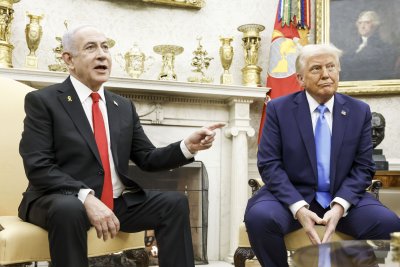
Israeli Prime Minister Benjamin Netanyahu and President Donald Trump talk with reporters at the White House in Washington, D.C., in February. Netanyahu is scheduled to visit Trump Monday in Florida. File Photo by Shawn Thew/UPI | License Photo

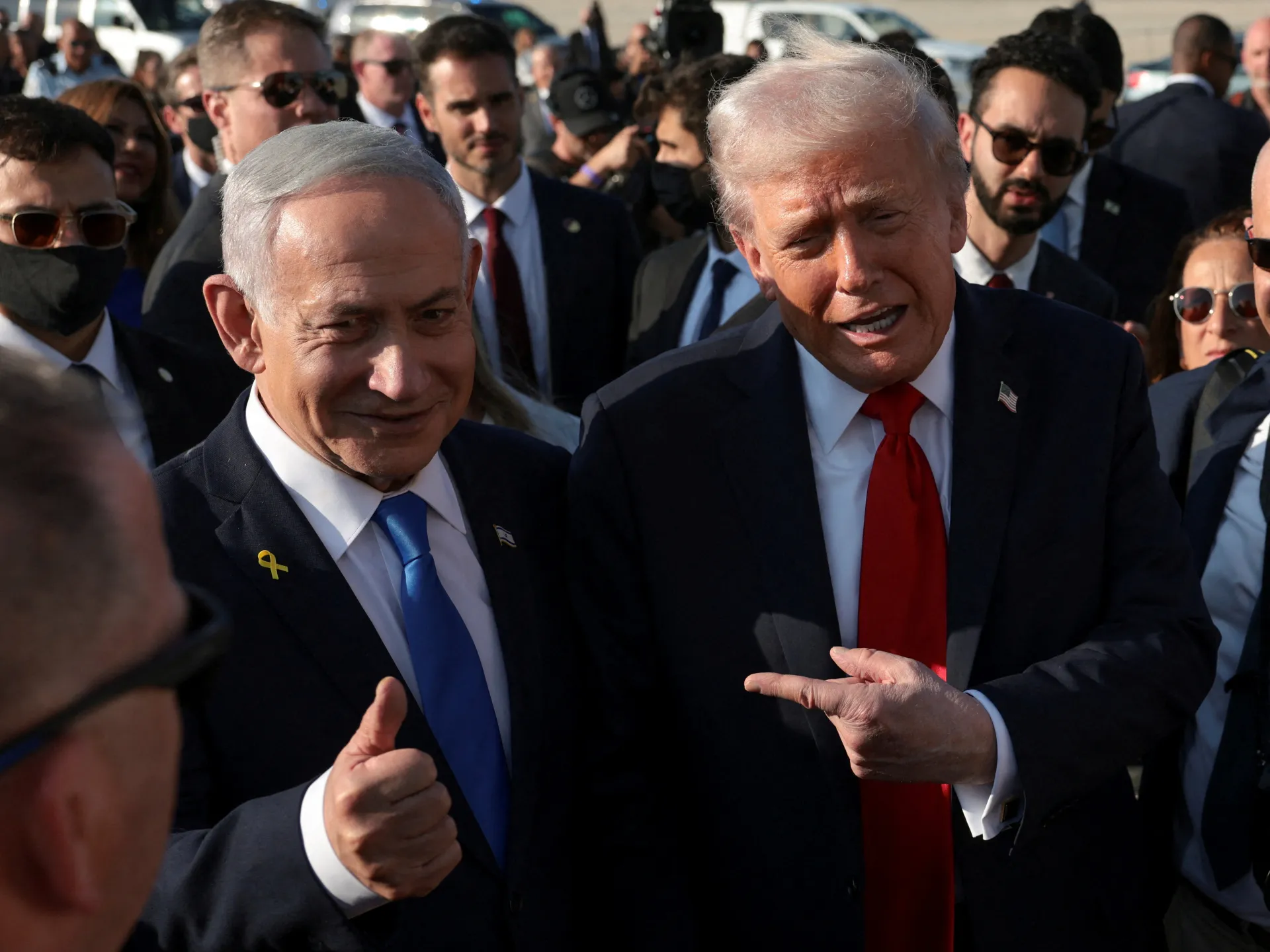
Dec. 29 (UPI) — Israeli Prime Minister Benjamin Netanyahu will visit with President Donald Trump Monday in Florida to discuss the peace plan with Gaza.

Netanyahu is also likely to lobby the president for help with Iran as it continues its work on nuclear weapons.

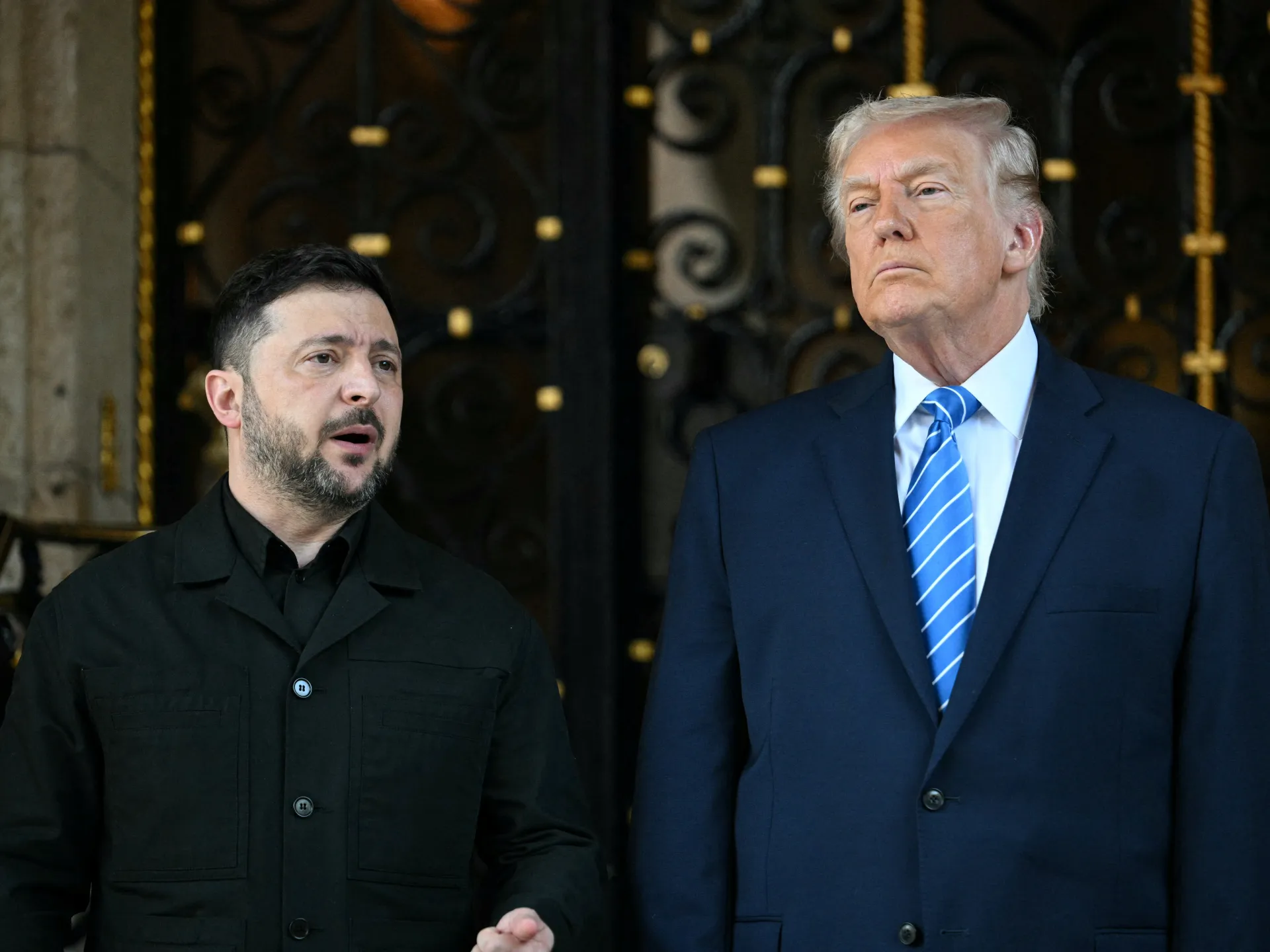
The meeting will happen at Trump’s Mar-a-Lago resort in Palm Beach, Fla. On Sunday, Trump met with Ukrainian President Volodymyr Zelensky at the resort to continue working on a peace plan between Ukraine and Russia.

Local officials have said that more than 400 people have been killed in Gaza since the cease-fire, NBC News reported.

The Trump administration wants to see progress on the plan’s second phase in January. That means a Palestinian technocratic government would be created. Hamas would disarm, and the Israeli Defense Forces would pull out of Gaza.

But some believe that Netanyahu will stall the process and demand Hamas fully disarm before the IDF withdraws. Hamas has said it will disarm as progress moves toward an independent Palestinian state.

Netanyahu and his staff have repeatedly rejected Palestinian statehood since October.

Israeli Defense Minister Israel Katz said last week that Israel will build settlements in Gaza and “never fully withdraw” even as Hamas disarms, the BBC reported. This would violate the cease-fire agreement.

Secretary of State Marco Rubio will meet with Netanyahu before Trump’s meeting.

Two other tenets of the cease-fire haven’t yet emerged: A “Board of Peace” led by Trump is planned for governance of Gaza, and the International Stabilization Force, led by the United Nations, which will help with peacekeeping in Gaza.

Rubio has said those measures will be in place “very soon.”

Israeli officials are concerned that Iran is moving forward with its plans for ballistic missiles, and Netanyahu is expected to discuss options with Trump at Monday’s meeting.

Israel damaged the operations in June, but it wants to attack again, NBC News reported.

Source link

2025: Trump’s year of ’emergency’, ‘invasion’ and ‘narcoterrorism’ | Donald Trump News

Washington, DC – For United States President Donald Trump, 2025 was a year of crisis.

Roaring into office on January 20 on the heels of a raucous political comeback, the president’s own telling describes a series of actions that have been swift and stark.

Recommended Stories

list of 3 itemsend of list

To name a few, he has envisioned rooting out a migrant “invasion” that includes staunching legal immigrants, and, potentially, targeting US citizens; he has touted a hard reset of uneven trade deals that pose “an unusual and extraordinary threat to the national security”; and, in the final months of the year, he has gone on the military offensive against “narcoterrorists” that he claims seek to topple the US through illicit drugs, possibly used as “weapons of mass destruction”.

For legal observers, Trump’s approach has been a yet-undecided stress test on presidential power, cranked by the gears of broadly interpreted emergency statutes and untrammelled executive authority.

Decisions by the court, lawmakers and voters in the 2026 midterm elections could determine how that strategy resonates or is restrained.

“The use or abuse of emergency powers is only one corner of a larger picture,” Frank Bowman, professor emeritus of law at the University of Missouri, told Al Jazeera.

“In many cases, the administration is simply doing stuff that certainly any pre-existing understandings of executive authority would have said you cannot do,” he said.

Emergency powers and ‘national security’

The US Constitution, unlike many countries, has no catch-all emergency power authorisation for presidents.

In fact, the US Supreme Court ruled in 1952 that presidents have no such implied authorities, explained David Driesen, professor emeritus at Syracuse University College of Law. Still, Congress has passed “numerous statutes that grant the president limited emergency powers under limited circumstances to do specific things”.

Nearly every modern president has used emergency powers with varying degrees of gusto, with Congress and the Supreme Court historically wary of reining in those actions.

Like many US presidents, Trump has also used broad and ambiguous national security claims to justify expanding his reach.

But several factors have set Trump’s second term apart, most notably the lack of distinct inciting events for many of the powers claimed, Driesen said.

“I’ve never seen a president invoke emergency powers to justify practically all of this policy agenda,” he told Al Jazeera, “and I’ve also never seen a president use them to seize powers that really are not in the statutes at all.”

Put simply, he added, “to Trump, everything is an emergency”.

The tone was set on day one, with Trump’s broad executive order declaring that irregular crossings at the southern border meant nothing less than “America’s sovereignty is under attack”. The order has been used to indefinitely suspend US asylum obligations, surge forces to the border, and seize federal land.

The same day, Trump declared a national emergency under the International Emergency Economic Powers Act (IEEPA) to designate Tren de Aragua (TdA) and La Mara Salvatrucha (MS-13) as “foreign terrorist organizations”, posing a threat to the “national security, foreign policy, and economy” of the US.

The administration has, in part, relied on and expanded that order in efforts to circumvent due process in its mass deportation push and to rhetorically justify a militaristic approach to Latin America.

Simultaneously, Trump also declared a wide-ranging energy emergency on his first day in office, laying the groundwork to bypass environmental regulations.

To be sure, as Bowman explained, Trump’s use of official emergency statutes has been only a piece of the puzzle, combined with his broad interpretation of constitutionally mandated power to reshape the government in ways big and small.

That has included cleaving civil servants from congressionally created government departments via the Department of Government Efficiency (DOGE), trying to fire heads of independent agencies, renaming institutions – possibly illegally – in his likeness, and allegedly bypassing required approvals to physically transform the White House.

But the invocation of emergency statutes has remained a backbone of his second term. Trump invoked an emergency to justify sanctioning the International Criminal Court (ICC) for its investigations into Israeli war crimes in Gaza.

He used the “emergency” of fentanyl smuggling to justify tariffs on Canada, Mexico and China, later unilaterally labelling the drug “weapons of mass destruction”.

In April, in one of his most challenged uses of an emergency authority, Trump cited an emergency statute to impose sweeping reciprocal tariffs against nearly all US trading partners.

A ‘mixed picture’

In review, 2025 has shown virtually no willingness from Congress, where both chambers remain narrowly controlled by Trump’s Republican Party, to challenge the president.

Rulings from lower federal courts, meanwhile, have offered a “mixed picture”, according to the University of Missouri’s Bowman, while the country’s top court has left wider questions unanswered.

Bowman noted the six conservative members of the nine-judge panel ascribe to varying degrees to the “unitary executive theory”, which argues the drafters of the constitution envisioned a strong consolidation of presidential power.

“On the one hand, Trump is obviously willing to declare emergencies where no rational person would really believe they exist,” Bowman said.

“On the other hand, at least the lower courts have pushed back, but it remains to be seen whether the Supreme Court will back them up.”

For example, Trump has been temporarily allowed to continue the deployment of National Guard troops in Washington, DC, a federal district where he declared a “crime emergency” in August. City officials have said the characterisation defies facts on the ground.

Despite claiming similar overlapping crime and immigration crises in liberal-led cities in states across the country, Trump has had far less success. Lower courts have limited deployments of the National Guard in California, Illinois, and Oregon.

Trump has also floated, but not yet invoked, the Insurrection Act, another law in the crisis portfolio dating back to 1792 that allows the president to deploy the military for domestic law enforcement to “suppress insurrections and repel invasions”.

A judicial response to the tactics behind Trump’s deportation drive has also been mixed.

Trump’s use of the Alien Enemies Act – a 1798 law designed to quickly expel foreign nationals during times of war – to swiftly deport undocumented individuals without due process has been constrained, but allowed to proceed by the Supreme Court with limited due process protections.

In one of the most-watched cases on the docket, the Supreme Court is expected to make a ruling when it returns to session in January on the legal justification of Trump’s reciprocal tariffs.

A lower court has previously ruled that Trump deployed the emergency statute illegally. Some conservative justices on the top court have also expressed wariness over the president’s claim.

The panel has appeared more amenable in a landmark case determining whether Trump can fire heads of independent agencies, also set to be decided in the new year.

The spectre of war

When it comes to unilaterally making war, Trump has been bounding down a well-trodden path of misused presidential power, according to Matt Duss, the executive vice president of the Washington, DC-based Center for International Policy.

The end of the year has been marked by US military strikes on alleged drug smuggling boats from Venezuela, decried by rights groups as extrajudicial killings.

The administration has claimed, without evidence, that over 100 people killed had sought to destabilise the US by flooding it with drugs. Trump has made a similar claim about the Nicolas Maduro-led government in Venezuela, as he has continued to rattle the sabre of land strikes.

The actions have been accompanied by a pugilistic rebranding of the Department of Defense as the Department of War, a reframing of criminal Latin American cartels as so-called “narcoterrorists” and declaring a new drive to bring the Western Hemisphere firmly under the US sphere of influence.

“We have to understand this in the context of multiple administrations of both parties abusing executive authority to essentially go to war,” said Duss, who explained that the practice accelerated in the so-called “global war on terror” post-September 11, 2001 attacks.

Most recently, Republicans – and a handful of Democrats – in the House of Representatives voted down two separate war powers resolutions that would require congressional approval for future strikes on alleged drug boats or on Venezuelan territory.

The vote, Duss said, underscored “Trump’s near-total control of the Republican Party despite the fact that he is blatantly violating his own campaign promises to end wars, rather than to start them”.

Public opinion

Trump’s control over his party and his influence writ-large over the country will largely be tested in next year’s midterm elections. The vote will determine control of the House and the Senate.

A slate of polls has indicated at least some degree of wariness in Trump’s use of presidential power.

In particular, a Quinnipiac poll released in mid-December found 54 percent of voters think Trump is going too far in his authority claims, while 37 percent think he is handling the role correctly. Another 7 percent believe Trump should go further in using the power of the presidency.

Another Politico poll in November found that 53 percent of US residents think Trump has too much power, while the president has seen an overall slump in his approval ratings since taking office.

To be sure, a panoply of factors determine US elections, and it remains unclear if voters were more likely to respond to the results of Trump’s approach to the presidency, or to the approach itself.

“Does the average person really think much about any of the theoretical bases for the things Trump is doing? And frankly, would the average person care very much if the results were, in the short term, results of which they approved?” University of Missouri’s Bowman mused.

“I don’t know the answer … How all this is perceived across the country, and what’s going to happen next, is anybody’s guess.”

Source link

Professor says China’s tax, labor rules give firms edge over Korea

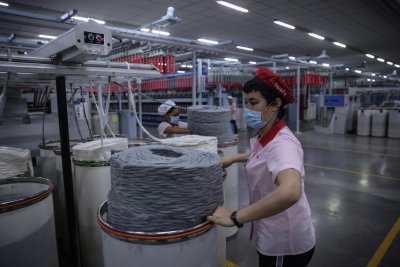
An Ethnic minority worker operates machinery at Aksu Huafu textile limited company in Aksu, western China’s Xinjiang Uyghur Autonomous Region during a government organized trip for foreign journalists, Aksu, China, 20 April 2021 (issued 30 April 2021). File Photo by WU HONG/EPA

Dec. 28 (Asia Today) — Hanyang University business professor Lee Woong-hee said South Korean companies face structural disadvantages versus fast-rising Chinese rivals, citing China’s lack of inheritance and gift taxes and fewer work stoppages tied to strikes.

In a column, Lee said many in South Korea view China as a socialist system with low economic freedom, but argued Beijing has increasingly tolerated business autonomy since its “reform and opening-up” era. He pointed to China’s 2004 constitutional recognition of private property rights as an example of what he described as a bold shift, even though the state retains land ownership.

Lee argued China has absorbed Western institutions such as private property rights and joint-stock companies into its system, rebranding them as “new socialism,” and said Chinese scholars have promoted theoretical justifications for that approach.

Lee said China holds advantages that South Korean firms do not, starting with taxation. He wrote that China does not currently levy inheritance, estate or gift taxes, unlike South Korea, where high inheritance and gift tax burdens can pressure founders to sell companies rather than pass them on to heirs.

He also said China faces fewer production disruptions from strikes. Lee noted China removed the right to strike from its 1982 constitution and allows only the All-China Federation of Trade Unions as a legal union structure, limiting independent organizing.

While acknowledging an increase in labor disputes, Lee cited reports estimating 1,509 labor incidents in 2024 and argued they remained relatively small-scale and dispersed, with authorities preventing wider escalation.

Beyond taxes and labor, Lee said China benefits from deeper pools of engineering talent and stronger industrial support. He also argued South Korea’s industrial electricity rates are significantly higher than China’s, and said Beijing offers broad policy backing for strategic industries.

Lee wrote that China’s startup momentum appears stronger, citing surveys suggesting higher startup rates among Chinese graduates and pointing to global rankings that placed Beijing among leading startup cities. He said China ranks second globally in the number of unicorn companies after the United States.

Lee concluded that China’s older socialist traits appear to be fading and that its entrepreneurial culture is reasserting itself, arguing it may only be a matter of time before China becomes more business-friendly than South Korea.

— Reported by Asia Today; translated by UPI

© Asia Today. Unauthorized reproduction or redistribution prohibited.

Caption:Professor Lee Woong-hee of Hanyang University’s business school. /Asia Today

Source link

At least 13 killed, scores injured in train crash in southern Mexico

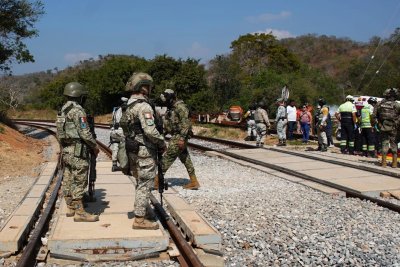
Mexican Navy troops secure the scene of a deadly train derailment in Asuncion Ixtaltepec municipality in Oaxaca, Mexico, on Sunday. At least 13 people were killed and 98 were injured, according to the Navy Secretariat which operates the country’s rail network. Photo by Luis Villalobos/EPA

Dec. 29 (UPI) — At least 13 people were killed and 98 injured after a train came off the tracks in the southern Mexican state of Oaxaca, authorities said.

The train, which was en route from Salina Cruz on the Pacific coast to Coatzacoalcos on the Gulf coast, derailed on a bend near Nizanda on Sunday.

President Claudia Sheinbaum said in an update on X early Monday that the injured, five of whom were in a serious condition, were being treated at four area hospitals, adding that she had instructed the Secretary of the Navy and the deputy interior minister to travel to the site and “personally attend to the families” of victims.

In an online post, Oaxaca Gov. Salomon Jara Cruz said of the 250 passengers and crew onboard, 139 were safe and 36 were continuing to receive medical treatment.

Expressing “deep regret,” Jara Cruz said that state authorities were working with federal agencies to assist those affected and pledged his administration would do all it could to help those caught up in the accident.

Attorney General Ernestina Godoy Ramos confirmed an investigation was underway.

The train comprising two locomotives and four passenger cars was on the Interoceanic Corridor route across the Tehuantepec Isthmus, the narrowest part of Mexico, connecting the Gulf coast with the Pacific, according to the Mexican Navy, which is responsible for Mexico’s railways.

The Interoceanic Train began operating in 2023 under former President Andres Manuel Lopez Obrador as part of an effort modernize passenger and freight links across the isthmus.

The long-term goal is to expand ports, railways and industrial infrastructure, stimulating development in the region to eventually create a global trade route to rival the Panama Canal.

Source link

People Power Party expels ex-lawmaker after minister nomination

Jang Dong-hyuk, leader of the People Power Party, drinks water during an all-night filibuster on a bill to create a special tribunal for cases tied to former President Yoon Suk Yeol’s Dec. 3 martial law at the National Assembly in Seoul on Dec. 23. File Photo by Asia Today

Dec. 28 (Asia Today) — South Korea’s People Power Party said Sunday it expelled former lawmaker Lee Hye-hoon after she accepted a nomination to serve as planning and budget minister in President Lee Jae-myung’s administration, calling the move an act that damaged the party ahead of local elections.

The party said its Supreme Council approved a resolution to expel Lee and void her party duties as an official. It said accepting the nomination amounted to misconduct because she agreed to join a Cabinet for the rival administration while holding a party post.

In a statement, the People Power Party said Lee, as a district party committee chair, “voluntarily agreed” to the appointment and thereby aided the current government. The party described it as an act of “disloyalty” with local elections six months away.

The party also said Lee continued party activities, including work related to evaluating elected officials, without disclosing her nomination as a State Council member, which it said disrupted party order and obstructed party operations.

The party warned it would respond “decisively and strictly” to any conduct that undermines its values and responsibilities, citing party rules and its constitution.

It also condemned President Lee and Lee Hye-hoon for what it described as turning a Cabinet post tied to national finances into an object of political bargaining and urged them to publicly apologize and take responsibility.

— Reported by Asia Today; translated by UPI

© Asia Today. Unauthorized reproduction or redistribution prohibited.

Source link

Yonsei team deploys AI system to draft medical records at Severance

Yoo Seung-chan, a professor at Yonsei University’s Department of Biomedical Systems Informatics, explains key features of Severance Hospital’s next-generation electronic medical records system, Y-NOT, on Dec. 18. Photo by Asia Today

Dec. 28 (Asia Today) — A research team at Yonsei University has built a generative AI-based medical record system that is now being used at Severance Hospital, aiming to cut doctors’ documentation time and allow more focus on patient care.

The system, known as Y-NOT and implemented through the hospital’s “Y-NOT” record platform, uses a large language model to draft admission and discharge notes for clinicians to review, according to Professor Yoo Seung-chan of Yonsei University’s Department of Biomedical Systems and Information Science.

“Why should we spend more time sitting in front of computers than seeing patients?” Yoo said, describing a question often raised by emergency care staff that helped drive the project.

Yoo said he began full-scale development last year as administrative burdens on medical staff intensified during tensions between doctors and the government. He said the team judged AI technology had matured enough to meaningfully reduce record-keeping workload and started development.

The project began in July last year and was deployed in clinical settings by November, Yoo said, with model development and hospital rollout carried out in parallel. He said the team focused first on achievable clinical usefulness rather than pushing only for maximum model performance.

Some medical staff initially expressed concerns, including the risk of errors in records, questions over responsibility for mistakes and worries that the system could infringe on physicians’ authority. Yoo said two surveys conducted after implementation showed those concerns eased, with especially strong satisfaction among older staff.

He said the team framed the system as supporting, not replacing, clinicians. Doctors continue to diagnose and make decisions, he said, while the AI drafts and organizes documentation for verification. Yoo added that some staff said the system made care easier because it reduced the need to manually search through past electronic records.

The “Y-NOT” system is now used beyond the emergency department, including operating rooms and inpatient wards, for broader record management, Yoo said.

The time required to create emergency room medical records fell by more than half, according to the report, dropping from 69.5 seconds to 32 seconds. Staff have said the reduced documentation burden gives them time to make eye contact with patients, Yoo said.

He said evaluations indicate record completeness and standardization have improved across care teams, including nurses, and that the time saved helps emergency physicians move quickly to the next patient or offer additional guidance to patients leaving the hospital.

Yoo said the longer-term goal extends beyond a documentation tool to an intelligent agent system designed to support safe care aligned with global standards. That direction is tied to Severance Hospital’s “Doctor Answer 3.0” project, he said, and future plans include exploring ways for patients to communicate with an AI system based on their own medical records.

Yoo said AI could help address rising medical demand tied to population aging and a decline in essential medical staff. He said it could support guideline-based care for clinicians and help patients maintain a sense of continuous connection to the hospital after discharge.

— Reported by Asia Today; translated by UPI

© Asia Today. Unauthorized reproduction or redistribution prohibited.

Source link

Korea sees decline in ‘junior pays’ custom as agencies push Dutch pay

Exterior of the Ministry of the Interior and Safety, Dec. 28, 2025. Photo by Asia Today

Dec. 28 (Asia Today) — South Korea’s Interior Ministry said Sunday that a long-criticized public-sector custom in which junior officials take turns paying for meals for senior executives has declined, as central and local governments expand measures such as anonymous reporting systems and Dutch pay.

Seoul’s city government has set up an anonymous reporting channel inside its electronic personnel system to curb the practice, known as “hosting days,” in which subordinates feel pressured to cover a superior’s meal. Reports can be filed anonymously by staff at headquarters or affiliated agencies, triggering investigations aimed at treating cases as an organizational issue rather than a personal complaint.

In South Jeolla Province, officials have promoted a “sympathy pay” campaign to formalize a Dutch treat principle under which each person pays their share. The province also banned the use of pooled office funds to cover department dinners or meal costs.

The Ministry of the Interior and Safety said its review of eradication efforts across central and local governments found “tangible improvements.” The custom refers to employees treating executives to meals at their own expense, a practice critics say undermines integrity and a horizontal workplace culture.

A joint survey by the Interior Ministry and the Personnel Innovation Ministry found that the share of central government employees who said they had paid for a superior’s meal in the past month fell to 7.7% in April from 10.1% in November last year. Among local government workers, the rate fell to 12.2% from 23.9% over the same period, a larger decline than in central agencies.

The ministry said agencies have combined integrity education with internal surveys, emphasizing awareness and voluntary participation rather than relying only on crackdowns or one-time campaigns. Efforts have also focused on changing communication patterns inside organizations, it said.

The Food and Drug Safety Ministry said its head personally urged elimination of the practice and operated an intensive reporting period. It also sought to ease hierarchical meal culture through events such as lunchtime communication sessions between senior officials and staff.

Asan, a city in South Chungcheong Province, held a “cushion word” contest to encourage softer expressions as part of broader efforts to reshape workplace culture starting with everyday language use. The Korea Forest Service promoted a “warm words” campaign to encourage communication based on mutual respect.

Programs aimed at narrowing generational and rank gaps are also expanding. The Personnel Innovation Ministry’s “Blue Out of Indigo” program allows young civil servants to share commuting-related difficulties with executives and seek improvements together. Gangwon Province’s “Lunch&Learn” runs as a reverse mentoring program, with Grade 6 and below employees mentoring senior officials during lunch breaks, officials said.

Other efforts pair employees across departments. The Overseas Koreans Agency runs a “Random Coffee” program that matches staff from different units. Buk-gu District in Gwangju subsidizes team discussion costs through a program called “A Spoonful of Communication,” which officials say is meant to encourage freer exchanges of opinion.

The Interior Ministry said it has held meetings with organizational culture officials across central and local governments along with the personnel ministry and the Anti-Corruption and Civil Rights Commission, while sharing best practices through official guidance and on-site discussions.

The ministry said it plans another joint survey with the Personnel Innovation Ministry in the first half of next year and will share best practices identified in the review. Vice Interior Minister Kim Min-jae said it was meaningful that agencies are continuing improvements tailored to their circumstances, adding that the goal is to eliminate unreasonable practices such as “executive day” and build a public service culture that supports open communication across generations and ranks.

— Reported by Asia Today; translated by UPI

© Asia Today. Unauthorized reproduction or redistribution prohibited.

Source link

Syrian gov’t troops deployed to Latakia, Tartous after deadly clashes | Syria’s War News

The deployment comes after deadly unrest amid protests by the Alawite minority in the coastal cities.

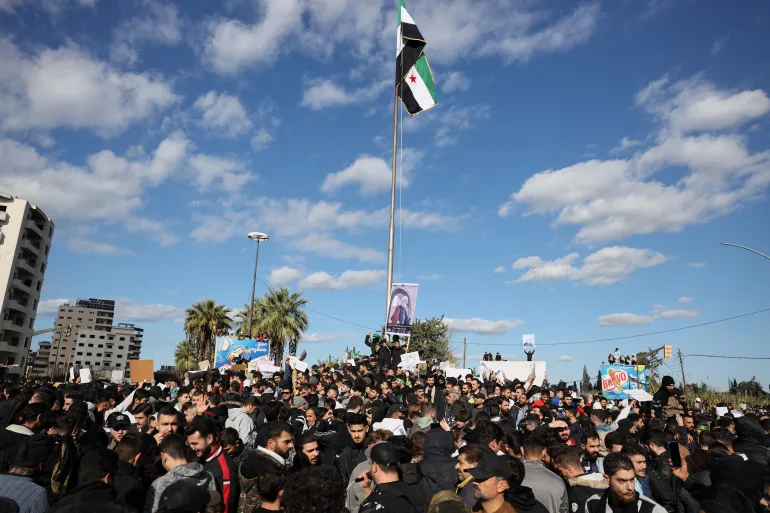
Syrian government troops have been deployed to the coastal cities of Latakia and Tartous after demonstrations led to deadly clashes in which at least three people were killed and 60 were injured.

It’s the latest turmoil to challenge President Ahmed al-Sharaa’s fledgling government, which has been pushing to stabilise the nation and reintegrate internationally after 14 years of ruinous civil war.

Syria’s Ministry of Defence announced on Sunday that army units with tanks and armoured vehicles had entered the centre of the cities in the country’s west in response to attacks by “outlaw groups” against civilians and security forces, with a mission to restore stability.

Syria’s state news agency SANA, quoting officials, reported that the attacks were carried out by “remnants of the defunct regime” of former President Bashar al-Assad during protests in Latakia.

SANA said 60 people were wounded by “stabbings, blows from stones, and gunfire targeting both security personnel and civilians”.

Clashes reportedly broke out as the protesters were confronted by pro-government demonstrators, and masked gunmen opened fire on security personnel.

The Ministry of Interior said in a statement that a police officer had been among those killed. An Al Jazeera team confirmed that gunfire was directed at Syrian security forces at the Azhari roundabout in Latakia, while two security personnel were also wounded in Tartous after unknown assailants threw a hand grenade at the al-Anaza police station in Baniyas.

Alawite protests

The violence has flared as thousands of Alawite Syrians took to the streets across the religious minority’s heartland in central and coastal parts of Syria on Sunday to protest against violence and discrimination.

The protests were called for by Ghazal Ghazal, an Alawite spiritual leader living outside the country, who had issued a call to “show the world that the Alawite community cannot be humiliated or marginalised” after the deadly bombing of a mosque in Homs on Friday.

The bombing, which killed eight people and was claimed by a Sunni group known as Saraya Ansar al-Sunna, was the latest act of violence against the religious minority, to which the ousted former President al-Assad also belongs and which had huge prominence under his rule.

The protesters also demanded that the government implement federalism – a system that would see power decentralised from Damascus in favour of greater autonomy for minorities – and the release of Alawite prisoners.

“We do not want a civil war, we want political federalism. We do not want your terrorism. We want to determine our own destiny,” Ghazal, head of the Islamic Alawite Council in Syria and abroad, said in a video message on Facebook.

Syrian Alawites protest
Protesters from the Alawite religious minority demonstrate in Latakia on Sunday, days after a bomb in an Alawite mosque in Homs killed eight people and wounded 18 [Omar Albam/AP]

‘We want federalism’

One of the antigovernment protesters on Sunday, Ali Hassan, said the demonstrators sought an end to the ongoing violence against the Alawite community.

“We just want to sleep in peace and work in peace, and we want federalism,” he said. “If this situation continues like this, then we want federalism. Why is it that every day or every other day, 10 of us are killed?”

A counterprotester, Mohammad Bakkour, said he had turned out to show his support for the government.

“We are here to support our new government, which from the very first day of liberation called for peace and for granting amnesty to criminals,” he said, accusing the antigovernment protesters of seeking to “sabotage the new path toward rebuilding the nation”.

“The entire people are calling for one people and one homeland, but they do not want one people or one homeland – they want sectarianism, chaos, problems, and federalism for their personal interests.”

Source link

Democratic Party urges apology from rivals over media lawsuits

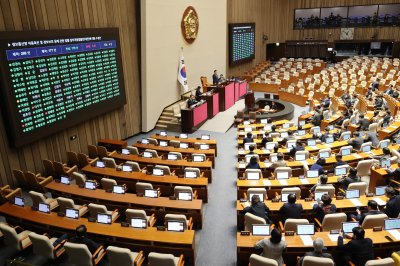
The National Assembly, led by the ruling Democratic Party, passes an anti-fake news bill during a plenary session in Seoul, South Korea, 24 December 2025. Lawmakers of the main opposition People Power Party left the session in protest, abstaining from a vote on the bill. Photo by YONHAP/EPA

Dec. 28 (Asia Today) — South Korea’s ruling Democratic Party of Korea on Saturday urged the opposition People Power Party to apologize for what it called past efforts to suppress critical media through high-value lawsuits, before criticizing a proposed revision to the Press Arbitration Act.

At a press conference, Democratic Party spokesperson Kim Hyun-jung said the party had focused on “fact-setting” by respecting procedures such as correction and rebuttal reports, while accusing the People Power Party of being “obsessed with shutting down media outlets through massive lawsuits.”

“The very forces that trampled on the press with physical force and money are now talking about ‘freedom,'” Kim said. “Before attacking the revision to the Press Arbitration Act, they should first apologize for using money to trample press freedom.”

Her remarks came after the People Power Party criticized the Democratic Party-backed bill as a “gag law,” arguing it would create a climate that silences both the public and the press.

The Democratic Party countered by citing what it described as examples of media suppression under former President Yoon Suk Yeol’s administration. Kim said certain media outlets were barred from boarding the presidential plane and were threatened with lawsuits over reporting on vulgar language, which she described as attempts to silence the press through both direct and financial pressure.

She added that data from the Press Arbitration Commission showed all 65 high-value damage claims exceeding 50 million won (about $37,000) filed through September this year were brought by the People Power Party, with none resulting in court-ordered damages.

“Even a child can tell what real oppression is,” Kim said. “The Democratic Party will push ahead with media reform to protect press freedom and the public’s right to know.”

— Reported by Asia Today; translated by UPI

© Asia Today. Unauthorized reproduction or redistribution prohibited.

Source link

Korean won ends week stronger but 2025 average nears record

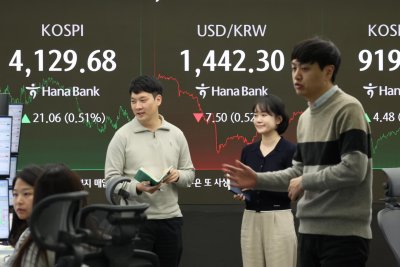
Dealers talk at Hana Bank’s dealing room in Seoul on Dec. 26 as the won closed at 1,440.3 per dollar, up 9.5 won. The KOSPI ended up 0.51%. Photo by Yonhap News Agency

Dec. 28 (Asia Today) — South Korea’s won strengthened sharply last week after market-stabilization steps by authorities and currency-hedging moves by the National Pension Service, but the currency’s annual average exchange rate still posted its highest level since the financial crisis, keeping investors on edge.

In Seoul trading, the won closed at 1,440.3 per U.S. dollar at 3:30 p.m. Friday, its lowest level in about six weeks since Nov. 4, when it ended at 1,437.9.

The exchange rate had neared this year’s peak earlier last week, briefly moving past the 1,480 level. It then fell more than 30 won (about 2 cents) per dollar on Wednesday after foreign exchange authorities announced supply-and-demand measures along with an unusually pointed verbal warning to the market. On Friday, reports that the National Pension Service had carried out strategic currency hedging pushed the exchange rate into the 1,420 range during the session.

After the drop, the year-end closing rate set to be finalized Tuesday is now likely to end below last year’s 1,472.5 per dollar, a benchmark used by companies and financial institutions to value foreign-currency liabilities on financial statements.

Seo Jeong-hoon, a senior research fellow at Hana Bank, said a high year-end exchange rate could hurt the credit profile of firms and financial institutions with large foreign-currency debts, potentially weighing on corporate lending and investment next year.

Even so, volatility concerns are expected to persist as the exchange rate remains elevated by historical standards. Through Friday, the average exchange rate this year based on weekly closing prices was 1,421.9 per dollar, above the 1998 average during the foreign exchange crisis of 1,394.9, data from the Seoul foreign exchange market showed.

Market talk has increasingly described the weak won as a “new normal.” Major global investment banks have forecast the won-dollar exchange rate will average between 1,420 and 1,440 next year. Three-month forecasts from 12 investment banks, including Standard Chartered and Nomura, averaged 1,440, while six-month forecasts averaged 1,426, the report said.

The International Monetary Fund last year estimated the appropriate won-dollar exchange rate at around 1,330, suggesting those forecasts imply the won would remain weaker than its estimated fair value next year.

Moon Jeong-hee, chief economist at KB Kookmin Bank, said an annual average exchange rate in the 1,420 range is “excessively high” relative to South Korea’s economic fundamentals. If it becomes entrenched, she said, expectations of a structurally weak won could take hold and further dampen domestic investment.

— Reported by Asia Today; translated by UPI

© Asia Today. Unauthorized reproduction or redistribution prohibited.

Source link

Pentagon report projects China could field nine carriers by 2035

Royal Navy aircraft carrier HMS Prince of Wales(R09) arrives at Tokyo International Cruise Terminal in Tokyo, Japan on Thursday, August 28, 2025. File Photo by Keizo Mori/UPI | License Photo

Dec. 27 (Asia Today) — China’s push to become a major aircraft carrier power, which gained momentum after it commissioned its first carrier in 2012, could expand into a fleet of nine carriers by 2035, according to a new U.S. Defense Department report.

China had no aircraft carriers before it commissioned the Liaoning in September 2012 after purchasing the unfinished former Soviet carrier Varyag from Ukraine in 1998 and refitting it for 14 years, according to Beijing-based sources familiar with military developments.

China later commissioned the Shandong in December 2019, its first domestically built carrier, and recently added a third carrier, the Fujian, which U.S. officials described as China’s first indigenously designed flat-deck carrier.

Foreign media reports have said China plans to operate six aircraft carriers by 2035, including two nuclear-powered ships, a target that some analysts consider plausible given the pace of its buildup since 2012.

However, the U.S. Defense Department’s annual report on China’s military power, released Tuesday, said “the PLAN aims to produce six aircraft carriers by 2035 for a total of nine,” raising the possibility that China’s carrier force could approach U.S. levels within a decade.

Chinese media have reported that China’s fourth aircraft carrier could enter service in 2027 and may be nuclear-powered with a displacement of about 120,000 tons, as Beijing continues to expand its blue-water capabilities.

— Reported by Asia Today; translated by UPI

© Asia Today. Unauthorized reproduction or redistribution prohibited.

Source link

China to stage drills around Taiwan in ‘stern warning’ to external forces | Military News

DEVELOPING STORY,

Beijing to impose sea, air restrictions for 10 hours, starting at 00:00 GMT on Tuesday, in five zones around Taiwan.

China has deployed air, navy and rocket troops to the waters around Taiwan for drills that its military said were aimed at testing combat readiness and delivering a “stern warning” against “separatist” and “external interference” forces.

The announcement on Monday came amid anger in Beijing over an $11.1bn weapons sale to Taiwan by the United States, as well as a statement by Japanese Prime Minister Sanae Takaichi, who suggested that the Japanese military could get involved if China were to attack the self-governed island.

Recommended Stories

list of 3 itemsend of list

Beijing considers Taiwan as part of its territory and has pledged to take control of the island by force if necessary.

In a statement, the Chinese military’s Eastern Theatre Command said it was dispatching army, navy, air force and rocket force troops to five zones around Taiwan for its “Just Mission 2025”, beginning on Monday.

The live-fire exercises will begin on Tuesday in the Taiwan Strait and areas to the north, southwest, southeast and east of the island, it said.

Shi Yi, a spokesperson for the Eastern Theatre Command, said the activities will focus “on ​training for maritime and aerial combat readiness patrols, gaining ‌integrated control, sealing off key ports and areas and conducting multi-dimensional deterrence”. The drills serve “as a serious warning to ‘Taiwan Independence’ separatist forces and external interference forces”, he added.

A separate statement with a map showed five large zones surrounding the island where “live firing activities will be organised” from 8am to 6pm (00:00-10:00 GMT) on Tuesday. “For the sake of safety, any irrelevant vessel or aircraft is advised not to enter the afore-mentioned waters and airspace,” the statement said.

The planned drills mark China’s sixth major round of war games since 2022 – after then-US House of Representatives Speaker Nancy Pelosi visited Taiwan – and were described by the state-owned Xinhua news agency as “a legitimate and necessary action to safeguard China’s sovereignty and national unity”.

During the drills, Shi said Chinese vessels and aircraft will approach Taiwan “in close proximity from different directions” and troops of multiple services will “engage in joint assaults to test their joint operations capabilities”, according to Xinhua.

While the Chinese military has practised port blockades around Taiwan during war games last year, this marks the first time it has publicly stated that drills around the island are aimed at deterring foreign military intervention.

Taiwan’s government condemned the drills.

A presidential office spokesperson urged China not to misjudge the situation and undermine regional peace, and called on Beijing to immediately halt what they described as irresponsible provocations.

“In response to the Chinese authorities’ disregard for international norms and the use of military intimidation to threaten neighbouring countries, Taiwan expresses its strong condemnation,” said Karen Kuo, the spokesman for the presidential office.

The island’s defence ministry said two Chinese military aircraft and 11 ships had been operating around the island over the last 24 hours, and that Taiwan’s military was on high alert and poised to carry out “rapid response exercises”.

That particular drill is designed to move troops swiftly in case China suddenly turns one ​of its frequent drills around the island into an attack.

“All members of our armed forces will remain highly vigilant and fully on ‌guard, taking concrete action to defend the values of democracy and freedom,” it said in a statement.

The exercises come after the US announced earlier this month that it had approved $11.1bn in arms sales to Taiwan in the largest ever weapons package for the island. The move drew a protest from China’s Ministry of National Defence and warnings that the military would “take forceful measures” in response.

Beijing last week also imposed sanctions against 20 US defense-related companies and 10 executives over the move.

In an interview aired on Sunday, Taiwanese President William Lai Ching-te told Sanli E-Television that the island must continue to raise the cost of aggression and strengthen its indigenous defence capabilities to deter China, stressing that peace can only be secured through strength.

“If China sets 2027 as the year to be ready for an invasion of Taiwan, then we have only one choice: to keep raising the difficulty so that China can never meet that standard. Taiwan will naturally remain safe,” Lai said.

Source link

Russia-Ukraine war: List of key events, day 1,404 | Russia-Ukraine war News

These are the key developments from day 1,404 of Russia’s war on Ukraine.

Here is where things stand on Monday, December 29:

Diplomacy

  • United States President Donald Trump hosted Ukrainian President Volodymyr Zelenskyy for talks at his Mar-a-Lago resort in Florida and said the two leaders were “getting a lot closer, maybe very close” to a deal to end the war in Ukraine.
  • Trump and Zelenskyy reported progress on two of the most contentious issues in the peace talks: security guarantees for Ukraine and the division of eastern Ukraine’s Donbas region that Russia has sought to capture.
  • On security guarantees, Zelenskyy said that a deal had been reached, while Trump said they were 95 percent of the way to such an agreement.
  • Both Trump and Zelenskyy said that the future of the mostly Russian-occupied Donbas had not been settled, though the US president said discussions were “moving in the right direction”. “It’s unresolved, but it’s getting a lot closer. That’s a very tough issue,” Trump said.
  • The two leaders did not offer further details or a deadline for completing the deal, but Zelenskyy said any peace agreement would have to be approved by Ukraine’s parliament or by a referendum.
  • Shortly after the Trump-Zelenskyy meeting, Russian President Vladimir Putin’s special envoy, Kirill Dmitriev, wrote on X that the “whole world appreciates” Trump and his team’s peace efforts.
  • Ahead of the meeting with Zelenskyy, Trump and Putin spoke for more than two hours on the telephone. The US president described the call as “excellent” and “productive”.
  • Trump said he would call Putin again after the meeting with Zelenskyy.
  • Kremlin foreign policy aide Yury Ushakov said the initial call was “friendly” and that Putin had told Trump that a 60-day ceasefire, proposed by the European Union and Ukraine, would simply prolong the war.
  • Ushakov said that a “bold, responsible, political decision is needed from Kyiv” on the Donbas region and other disputed matters for there to be a “complete cessation” of hostilities.
  • European leaders, including those from Finland, France, Germany, Poland and the United Kingdom, joined at least part of the Trump-Zelenskyy meeting by phone.
  • European Commission President Ursula von der Leyen said in a statement that Europe was ready to keep working with Ukraine and the US, and that having ironclad security guarantees would be of “paramount” importance.
  • French President Emmanuel Macron said that progress had been made on security guarantees at the meeting. Macron said that countries in the so-called “Coalition of the Willing” would meet in Paris in early January to finalise their “concrete contributions”.
  • Zelenskyy said that Trump had agreed to host European leaders again, possibly at the White House, sometime in January. Trump said the meeting could be in Washington, DC, or “someplace”.
  • Earlier on Sunday, Russian Minister of Foreign Affairs Sergey Lavrov warned that any European troop contingents deployed to Ukraine would become legitimate targets for Russia’s forces. Lavrov also accused European politicians of being driven by “ambitions” in their relations with Kyiv, and disregarding the people of Ukraine and of their own nations.

Fighting

  • Russian forces attacked a heating plant in the southern Ukrainian city of Kherson, wounding one person and causing “significant damage” to the facility, state oil and gas firm Naftogaz said.
  • Ukraine’s leading private energy provider, DTEK, said it had restored power to more than a million households in and around Kyiv a day after a massive Russian air attack had forced emergency outages.
  • Ukraine’s military said it had struck the Syzran oil refinery in Russia’s Samara region in a drone attack. The strike caused a fire, and damages were still being assessed, the army said in a statement.
  • The military also said that only part of the southeastern town of Huliaipole was under Russian control, contradicting an earlier claim by Moscow that it had been captured. It added that fighting was also still under way for Stepnohirsk, another town in the southeastern Zaporizhia region that Russia claimed it had captured.
  • Meanwhile, Russia’s Ministry of Defence said in a statement that its troops had taken control of four other settlements in the Donetsk region. It identified them as Myrnohrad, Artemivka, Rodynske and Vilne.

Source link

Any Israeli presence in Somaliland will be a ‘target’: Houthi leader | Houthis News

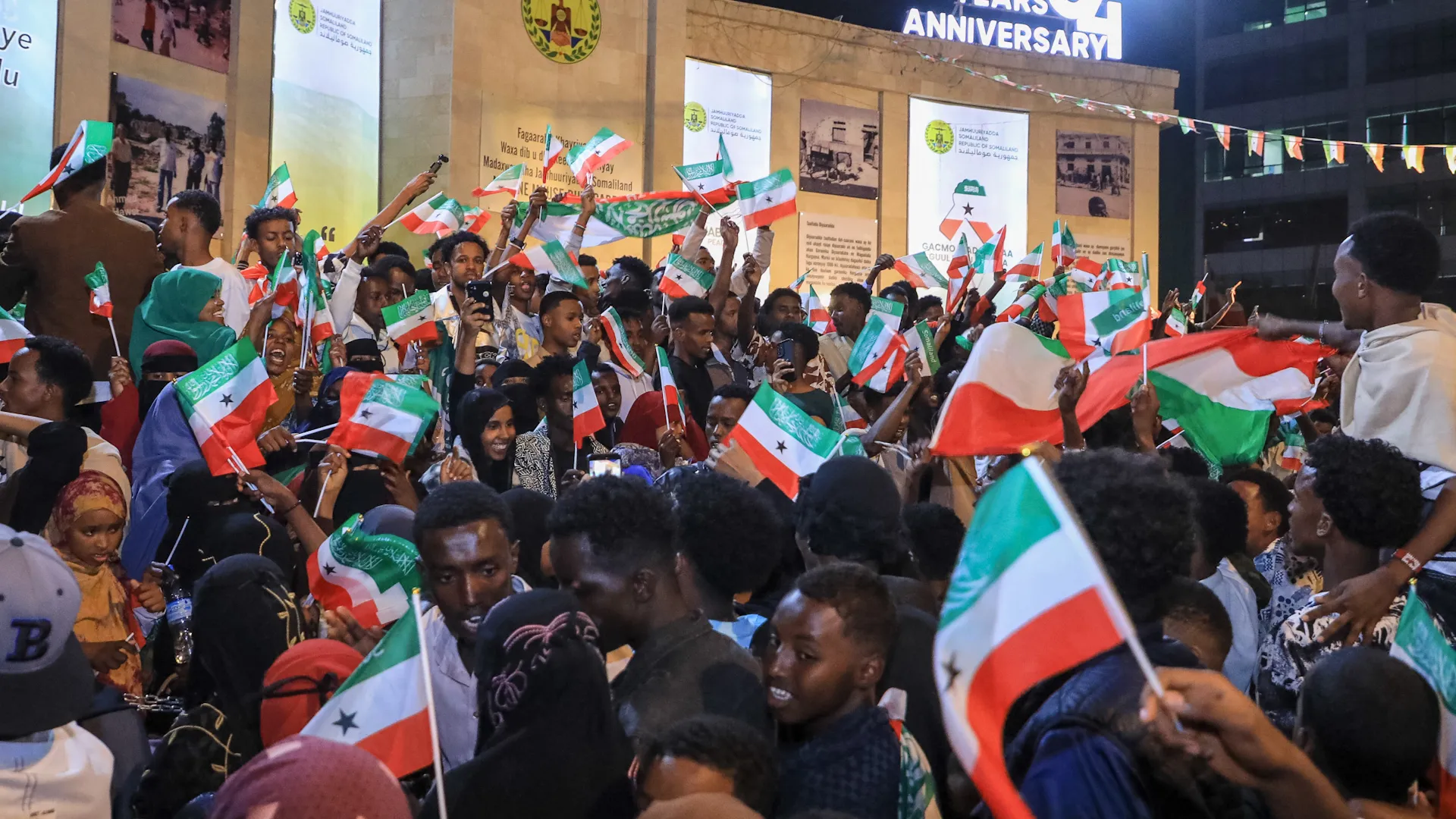
Israel on Friday announced it is officially recognising Somaliland, a first for the self-proclaimed republic since 1991.

The leader of Yemen’s Houthi rebels has warned any Israeli presence in Somaliland would be considered a “military target”, in the latest condemnation of Israel’s move to recognise the breakaway region.

“We consider any Israeli presence in Somaliland a military target for our armed forces, as it constitutes aggression against Somalia and Yemen, and a threat to the security of the region,” said the group’s chief, Abdel-Malik al-Houthi, according to a statement published by rebel media online.

Recommended Stories

list of 4 itemsend of list

Israel announced on Friday that it is officially recognising Somaliland, a first for the self-proclaimed republic that in 1991 declared it unilaterally separated from Somalia.

The Houthi chief warned that the move carried grave consequences, saying that recognition is “a hostile stance targeting Somalia and its African surroundings, as well as Yemen, the Red Sea, and the countries along both shores of the Red Sea”.

Somaliland, which has for decades pushed for international recognition, enjoys a strategic position on the Gulf of Aden and has its own money, passport and army.

Regional analysts say a rapprochement with Somaliland would provide Israel with better access to the Red Sea, enabling it to hit Houthi rebels in Yemen.

After launching its genocidal war on Gaza in October 2023, Israel repeatedly struck targets in Yemen in response to Houthi attacks on Israel, which the Yemeni rebels said were in solidarity with Palestinians in Gaza.

The Houthis have halted their attacks since a fragile truce began in Gaza in October.

Somaliland has been diplomatically isolated since its unilateral declaration of independence, even if it has generally experienced greater stability than Somalia, where al-Shabab fighters periodically mount attacks in the capital, Mogadishu.

Israel’s recognition of Somaliland was criticised by the African Union, Egypt, Turkiye, the six-nation Gulf Cooperation Council, and the Saudi-based Organisation of Islamic Cooperation.

The European Union insisted that Somalia’s sovereignty should be respected.

Source link

China industrial profits post steepest drop in 14 months

China’s national flag flies in front of the People’s Bank of China, the country’s central bank, in Beijing on Monday, January 18, 2021. The world’s second largest economy grew 2.3% in 2020, the slowest in decades but showing slow recovery even as the rest of the world was upended by the coronavirus pandemic. File Photo by Stephen Shaver/UPI | License Photo

Dec. 27 (Asia Today) — China’s industrial profits in November posted their sharpest year-on-year decline in 14 months amid weak domestic demand and deflation concerns, according to data released Friday.

Reuters and other outlets reported that China’s National Bureau of Statistics said industrial profits in November fell 13.1% from a year earlier. The decline followed an October drop of 5.5%, marking the second consecutive monthly fall and the weakest reading since September last year, when profits fell 27.1%.

Cumulative industrial profits for January through November rose 0.1% from a year earlier, slowing from 1.9% growth in the January-October period, the bureau said.

By sector, mining profits fell 27.2% in the January-November period, while profits rose in manufacturing (+5.0%) and utilities such as electricity and water (+8.4%).

Coal mining and ore processing profits fell 47.3% over the first 11 months of the year, the data showed. Profits rose in computer, communications and other electronic equipment manufacturing (+15.0%) and automobile manufacturing (+7.5%).

Reuters said industrial profits remain sluggish despite strong exports, reflecting weak domestic demand and fueling calls for additional stimulus measures.

The report said Beijing has not announced new stimulus as the government’s “around 5%” growth target for this year is seen as within reach, though expectations for further support persist as authorities have repeatedly pledged to boost domestic demand and promote employment next year.

China’s industrial profits are calculated based on enterprises with annual main business revenue exceeding 20 million yuan, about 4.1 billion won ($3.1 million).

— Reported by Asia Today; translated by UPI

© Asia Today. Unauthorized reproduction or redistribution prohibited.

Source link

Ukraine’s Zelensky meets with Trump at Mar-a-Lago

Ukrainian President Volodymyr Zelensky, pictured during a meeting at the White House with U.S. President Donald Trump in August, arrived at Mar-a-Lago on Sunday morning to work on a proposed 20-point peace plan between Russia and Ukraine. File Photo by Aaron Schwartz/UPI | License Photo

Dec. 28 (UPI) — Ukrainian President Volodymyr Zelensky on Sunday arrived at Mar-a-Lago in Palm Beach, Florida, to meet with U.S. President Donald Trump about a proposal for a cease-fire and end to Russia’s war in Ukraine.

Zelensky and his entourage arrived Sunday to discuss a 20-point plan — that may include conceding territory and shared operation of a nuclear power plant — to potentially end the war that started more than three years ago with Russia’s invasion of Ukraine.

Ahead of the meeting, Trump spoke with Russian President Vladimir Putin by phone for more than an hour, during which reportedly agreed that a long-term peace deal is preferable to a cease-fire, with Putin calling for Zelensky to make a “courageous, responsible political decision,” The New York Times reported.

Zelensky arrives for the meeting as Russia has amped up its attacks on Kyiv and other parts of Ukraine in recent days, which some have called a tactic on Russia’s part to force the Ukrainians hand in making a peace deal.

“Given the situation on the front lines, Kyiv must not delay making that decision,” Yuri Ushakov, one of Putin’s foreign policy aides, said during a press briefing on Sunday.

Trump told reporters when he welcomed Zelensky to Mar-a-Lago that he believes “we have the makings of a deal,” and that both Putin and Zelensky are both serious about making a peace deal, CNN reported.

Zelensky, Trump and representatives from both of their administrations are negotiating the 20-point peace plan that Zelensky reworked from a U.S.-proposed 28-point plan earlier this year.

Plans have also been drawn up for a three-party security guarantee between Ukraine, the U.S. and Europe, as well as a bilateral deal with the United States, in addition to economic cooperation to rebuild Ukraine, which has been brutally battered by Russia for the last three years, the Kyiv Independent reported.

According to the BBC, Putin and Trump are likely to speak later on Sunday after the meeting at Mar-a-Lago.

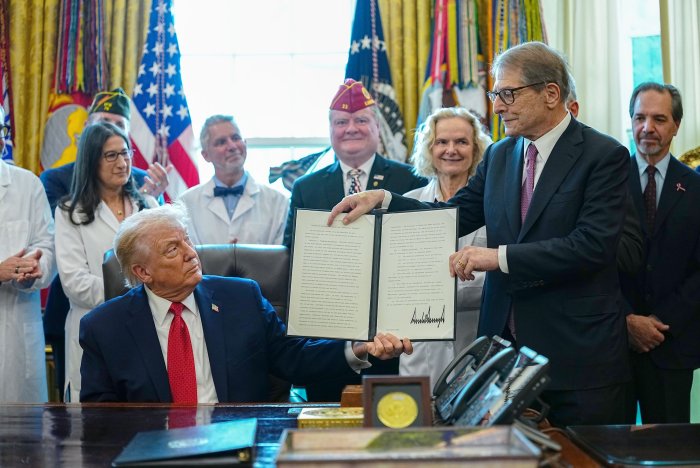
President Donald Trump holds a signed executive order reclassifying marijuana from a schedule I to a schedule III controlled substance in the Oval Office of the White House on Thursday. Photo by Aaron Schwartz/UPI | License Photo

Source link

US President Trump says Russia-Ukraine truce talks in ‘final stages’ | Russia-Ukraine war News

Diplomacy over the Russia-Ukraine war is in its “final stages”, said US President Donald Trump as he welcomed Ukraine’s leader Volodymyr Zelenskyy to his Florida estate.

The two leaders stood outside the Mar-a-Lago resort on Sunday and addressed reporters as they prepared to discuss a new proposal to end the bloody conflict.

Recommended Stories

list of 4 itemsend of list

The US president has been working hard to end the nearly four-year war in Ukraine for much of his first year back in office, showing irritation with both Zelenskyy and Russian President Vladimir Putin while publicly acknowledging the difficulty of ending the fighting.

“I think we’re … in final stages of talking and we’re going to see. Otherwise, it’s going to go on for a long time, and millions of additional people will be killed,” said Trump, adding he did not have a deadline for the process.

“I do believe that we have the makings of a deal that’s good for Ukraine, good for everybody.”

He added there would be “a strong agreement” to guarantee Ukraine’s security, one that would involve European countries.

“We have two willing parties. We have two willing countries … The people of Ukraine want [the war] to end, and the people of Russia want it to end, and the two leaders want it to end,” Trump said.

Russia intensified its attacks on Ukraine’s capital in the days before the Florida meeting.

Zelenskyy, by Trump’s side, said he and the US president would discuss issues of territorial concessions, which have so far been a red line for his country. He said his negotiators and Trump’s advisers “have discussed how to move step by step and bring peace closer” and would continue to do so in Sunday’s meeting.

During recent talks, the US agreed to offer certain security guarantees to Ukraine similar to those offered to other members of NATO.

The proposal came as Zelenskyy said he was prepared to drop his country’s bid to join the security alliance if Ukraine received NATO-like protection designed to safeguard it against future Russian attacks.

Oleksandr Kraiev, an analyst with the think-tank Ukrainian Prism, said the people of Ukraine are “quite cynical” about the talks brokered by the United States.

“We tried this in 2015, 2016, 2017, and unfortunately each time the Russians broke even the ceasefire regime, not even talking about the peace process,” he told Al Jazeera.

“So we have little faith that a proper peace process will take place. As of now we’re striving for a ceasefire as a precondition for any kind of talks… We cannot trust the Russians with a peace deal, but a ceasefire is something we’re working on.”

‘Blindsided yet again’

Trump’s upbeat tone comes despite widespread scepticism in Europe about Putin’s intentions after Russia carried out another massive bombardment of the Ukrainian capital just as Zelenskyy headed to Florida.

Before Zelenskyy arrived, Trump spoke with Putin by phone for more than an hour and said he planned to speak again after the Zelenskyy meeting – catching Ukrainian leaders off guard, reported Al Jazeera’s Shihab Rattansi.

“From what we’re hearing, the Zelenskyy delegation here have been blindsided yet again by Donald Trump. And according to the Russians, it was at the Americans’ insistence there should be a call with Vladimir Putin the hour before Zelenskyy arrived,” said Rattansi, speaking from Palm Beach, Florida.

Meanwhile, while there is talk about land concessions from Ukraine’s side, they are outside the framework Zelenskyy is hoping for.

The Kremlin gave a more pointed readout of Trump’s talks with Putin, saying the US leader agreed a mere ceasefire “would only prolong the conflict” as it demanded Ukraine compromise on territory.

Zelenskyy said last week that he would be willing to withdraw troops from Ukraine’s eastern industrial heartland as part of a plan to end the war, if Russia also pulls back and the area becomes a demilitarised zone monitored by international forces.

Putin has publicly said he wants all the areas in four key regions captured by his forces, as well as the Crimean Peninsula, illegally annexed in 2014, to be recognised as Russian territory. He also insisted that Ukraine withdraw from some areas in eastern Ukraine that Moscow’s forces have not captured.

Kyiv has publicly rejected all those demands.

Trump has been somewhat receptive to Putin’s conditions, making the case that the Russian president can be persuaded to end the war if Kyiv agrees to cede Ukrainian land in the Donbas region, and if Western powers offer economic incentives to bring Russia back into the global economy.

Source link