Office

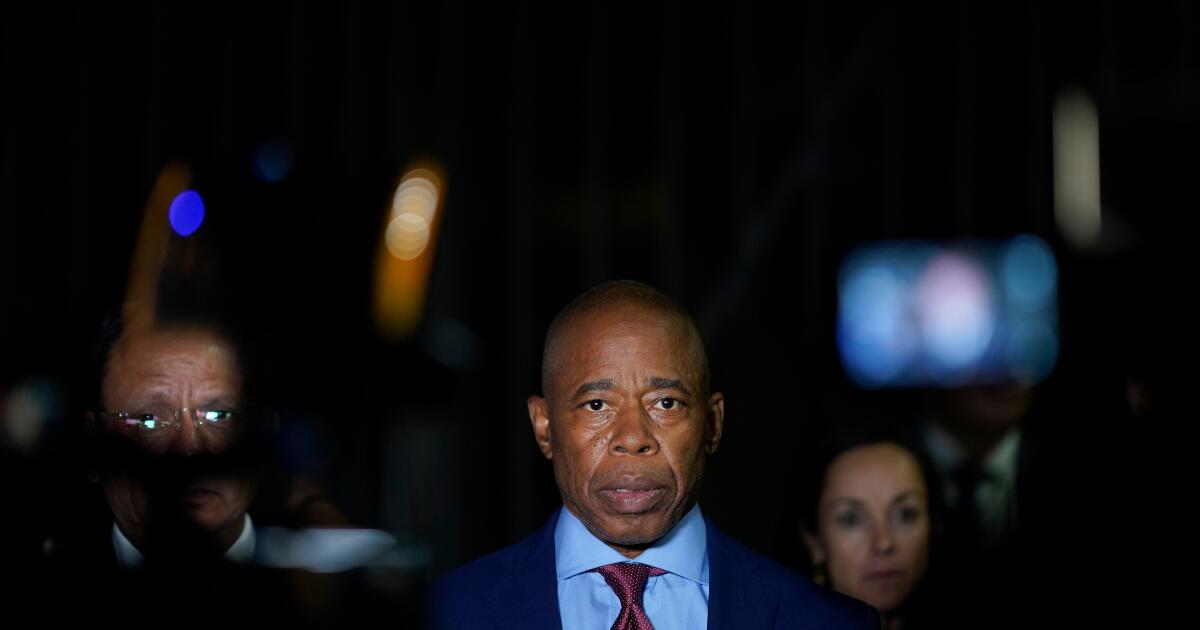
New York City Mayor Eric Adams once called himself the ‘future of the Democratic Party.’ What went wrong?

Four years ago, New York City Mayor Eric Adams swept into office with swaggering confidence, pledging to lead a government unlike any other in history and declaring himself the “future of the Democratic Party.”

On the first promise, the mayor more than delivered. But as his tumultuous term comes to an end, Adams, 65, finds himself in the political wilderness, his onetime aspirations as a party leader now a distant memory.

Instead, he has spent his final weeks in power wandering the globe, publicly mulling his next private sector job and lashing out at the “haters” and “naysayers” whom he accuses of overlooking his accomplishments.

For many of his supporters, the Adams era will be looked back on as a missed opportunity. Only the second Black mayor in city history, he helped steer New York out of the throes of the COVID-19 pandemic, often linking the city’s comeback to his own rise from humble roots in working-class Queens.

At a moment when many Democrats were struggling to address voter concerns about public safety, he drew national attention for a “radically practical” agenda focused on slashing crime and reactivating the economy.

But while most categories of crime returned to pre-pandemic levels, Adams will probably be remembered for another superlative: He is the only New York City mayor of the modern era to be indicted while in office.

“That’s a disappointment for voters, especially for Black voters, who had high expectations and aspirations,” said Basil Smikle, a political strategist who served as executive director of the state’s Democratic Party. “He entered with a lot of political capital, and that was squandered, in part because of his own hubris.”

Equally memorable, perhaps, were the strange subplots along the way: his hatred of rats and fear of ghosts; the mysteries about his home, his diet, his childhood; and his endless supply of catchphrases, gestures and head-scratching stories that could instantly transform a mundane bureaucratic event into a widely shared meme.

“So many mayors want to be filtered, they want to pretend who they are and act like they are perfect,” Adams said during a recent speech at City Hall, a freewheeling affair that ended with the mayor burying a time capsule of his achievements beneath a Manhattan sidewalk. “I am not.”

Swagger versus seriousness

Adams took over from Mayor Bill de Blasio in January 2022, amid a COVID-19 spike that was killing hundreds of New Yorkers every day, along with a worrisome uptick in both violent crime and unemployment.

Adams, a former police captain, Brooklyn borough president and state senator, increased patrols on streets and subways, brought back a controversial anti-crime unit and appointed the department’s first female police commissioner. He also raised eyebrows for installing many of his former Police Department allies, including some ex-officials with histories of alleged misconduct.

As he encouraged New Yorkers to return to their pre-pandemic lives, Adams made an effort to lead by example, frequenting private clubs and upscale restaurants in order to “test the product” and “bring swagger back” to the city, he said.

But if New Yorkers initially tolerated Adams’ passion for late-night partying, there seemed to be a growing sense that the mayor was distracted, or even slacking off, according to Hank Sheinkopf, a longtime Democratic consultant and supporter of Adams.

“There was a tension between swagger and seriousness,” Sheinkopf said. “New Yorkers wanted to see more seriousness. They didn’t want to see him out partying at some club they couldn’t afford to go into.”

It didn’t help that Adams often declined to say who was footing the bills for his meals, his entry into private clubs or his flights out of the city. When reporters staked out his nighttime activities, they found that Adams, who long professed to be a vegan, regularly ordered the branzino.

Asked about his diet, the mayor acknowledged that he ate fish and occasionally “nibbled” on chicken, describing himself, as he often would in the coming years, as “perfectly imperfect.”

City Hall in crisis

The corruption investigation into Adams’ campaign, launched quietly in the early stages of his mayoralty, first spilled into public view in the fall of 2023, as federal agents seized the mayor’s phones as he was leaving an event. It loomed for nearly a year, as Adams faced new struggles, including a surge of migrants arriving in the city by bus.

Then, on Sept. 26, 2024, federal prosecutors brought fraud and bribery charges against Adams, accusing him of allowing Turkish officials and other businesspeople to buy his influence with illegal campaign contributions and steep discounts on overseas trips.

Investigators also seized phones from the mayor’s police commissioner, schools chancellor and multiple deputy mayors. Each denied wrongdoing, but a mass exodus of leadership followed, along with questions about the mayor’s ability to govern.

Adams insisted, without evidence, that he had been politically targeted by the Biden administration for his criticism of its immigration policy. But his frequently invoked mantra — “stay focused, no distractions, and grind” — seemed to lose potency with each new scandal.

Among them: a chief adviser indicted by state prosecutors in a separate alleged bribery scheme involving a bike lane and minor TV role; another longtime adviser forced to resign after handing a chip bag filled with cash to a reporter; and a string of abuse and corruption allegations within the Police Department, many of them linked to longtime friends Adams had installed in high-ranking positions.

Looking back at what went wrong, both supporters and critics of the mayor tend to agree on at least one point: Adams could be loyal to a fault, refusing to distance himself from long-serving allies even after they appeared to cross ethical lines.

“There was one City Hall made up of dedicated and competent leaders focused on executing his priorities,” said Sheena Wright, Adams’ former first deputy mayor. “There was another City Hall made up of people who knew the mayor for a long time, and who were allowed to operate outside the norms of government.”

‘A nuclear bomb’

Facing a plummeting approval rating and the prospect of years in prison, Adams began aligning himself with President Trump, going to great lengths to avoid criticizing the Republican and even leaving open the possibility of switching parties.

That seemed to work: Weeks after Trump took office, the Justice Department dismissed the corruption case, writing in a two-page memo that it had interfered with Adams’ ability to help with the president’s immigration agenda.

But in the view of Evan Thies, one of Adams’ closest advisers at the time, that was the moment that sealed Adams’ fate as a one-term mayor.

“The memo hit like a nuclear bomb,” Thies said.

The damage worsened a few days later, when Adams appeared on “Fox & Friends” alongside Trump’s border director Tom Homan, who threatened to “be up his butt” if the mayor didn’t comply with Trump’s agenda.

“It seemed to confirm the belief that he had traded his duty to New Yorkers for his personal freedom,” Thies recalled. “It wasn’t true, but that was perception.”

Adams adamantly denied striking a deal with the Trump administration. He has continued to suggest a broad conspiracy against him, at times blaming bureaucrats in the “deep state.”

Even with his case behind him, Adams struggled to build a reelection campaign. Earlier this year, his approval rating sank to a record low. In September, he abandoned his efforts, throwing his support behind former Gov. Andrew Cuomo, a onetime rival he’d recently referred to as a “snake and a liar.”

As of late December, Adams’ plans for life after he leaves office remain uncertain.

“I did what I had to do, I left everything I had on the ice, and I’m looking forward to the next step of my journey,” he said during a farewell speech at City Hall.

Then, for the third time in as many months, Adams took off on an international trip. This time, the destination was Mexico.

Offenhartz writes for the Associated Press.

Source link

Kennedy Center Christmas Eve concert canceled after name change

A planned Christmas Eve jazz concert at the Kennedy Center, a holiday tradition dating back more than 20 years, has been canceled. The show’s host, musician Chuck Redd, says that he called off the performance in the wake of the White House announcing last week that President Trump’s name would be added to the facility.

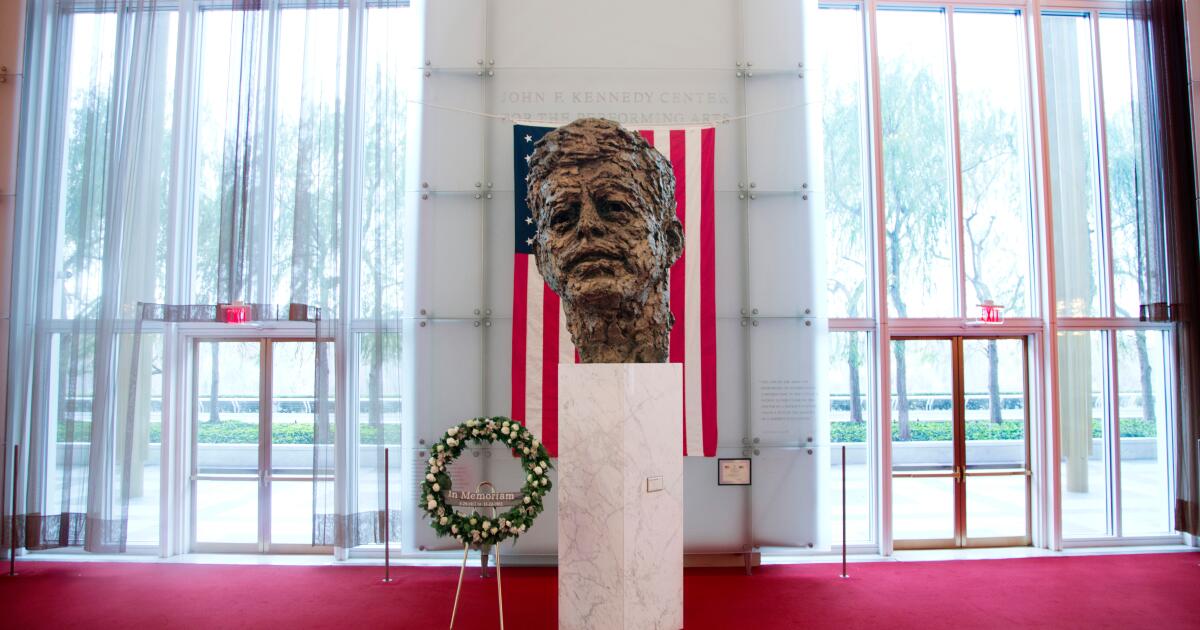
As of Friday, the building’s facade reads The Donald J. Trump and The John F. Kennedy Memorial Center for the Performing Arts. According to the White House, the president’s handpicked board approved the decision, which scholars have said violates the law. Trump had been suggesting for months he was open to changing the center’s name.

“When I saw the name change on the Kennedy Center website and then hours later on the building, I chose to cancel our concert,” Redd told the Associated Press in an email Wednesday. Redd, a drummer and vibraphone player who has toured with everyone from Dizzy Gillespie to Ray Brown, has been presiding over holiday “Jazz Jams” at the Kennedy Center since 2006, succeeding bassist William “Keter” Betts.

The Kennedy Center did not immediately respond to email seeking comment. The center’s website lists the show as canceled.

President Kennedy was assassinated in 1963, and Congress passed a law the following year naming the center as a living memorial to him. Kennedy niece Kerry Kennedy has vowed to remove Trump’s name from the building once he leaves office and former House historian Ray Smock is among those who say any changes would have to be approved by Congress.

The law explicitly prohibits the board of trustees from making the center into a memorial to anyone else, and from putting another person’s name on the building’s exterior.

Trump, a Republican, has been deeply involved with the center named for an iconic Democrat after mostly ignoring it during his first term. He has forced out its leadership, overhauled the board while arranging for himself to head it and hosted this year’s Kennedy Center honors, breaking a long tradition of presidents mostly serving as spectators. The changes at the Kennedy Center are part of the president’s larger mission to fight “woke” culture at federal cultural institutions.

Numerous artists have called off Kennedy Center performances since Trump returned to office, including Issa Rae and Peter Wolf. Lin-Manuel Miranda canceled a planned production of “Hamilton.”

Italie writes for the Associated Press.

Source link

Foreign Office says ‘don’t travel’ to these 55 countries in 2026 for UK holidaymakers

Anyone travelling to these destinations could invalidate their holiday insurance

There are certain spots around the globe that are considered quite risky, and travellers heading there receive guidance on safety precautions they should adopt to avoid mishaps.

However, only 55 locations feature on the ‘do not travel’ list, which has been flagged with a warning by the Foreign Office.

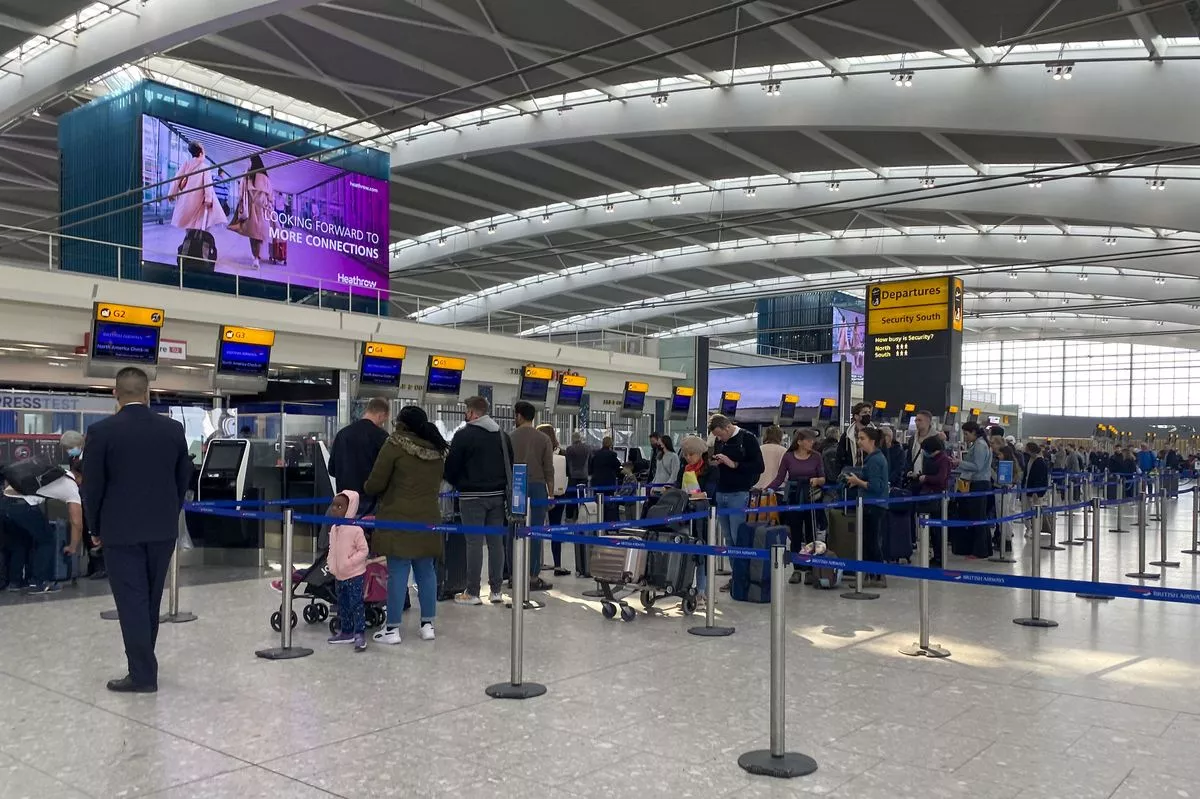
Anyone journeying to these places will be voiding their holiday insurance, meaning if things go pear-shaped, they’ll be left without support. Officials also caution that they could be jeopardising their safety. If you require consular assistance locally, it will likely be difficult to obtain.

For specific countries, the Foreign Office also advises against all but essential travel, implying you should reconsider any holiday plans The Foreign Office cautions: “Get advice and warnings about travel abroad, including entry requirements, safety and security, health risks and legal differences.”

It explained: “No foreign travel can be guaranteed safe. FCDO publishes travel advice to help you decide if it’s safe enough for you to travel to a particular destination. In some instances we also give information about how to reduce the risks you may face there. All environments contain some level of risk and you should consider what precautions you should take.

“You must take personal responsibility for your own travel. Only you can decide whether you should travel to a country or stay there, and what activities to take part in.”

People may face different risks due to their:

  • gender
  • ethnic background
  • sexuality
  • health

The Foreign Office has general guidance for specific types of traveller to help you understand some of these risks.

The FCDO sometimes formally advises British people against ‘all but essential travel’ or ‘all travel’ to a particular country. It said:

“Your travel insurance could be invalidated if you travel against advice from FCDO. We only advise against travel if we think the risk to British nationals is unacceptably high. For example, this could be due to:

  • armed conflict
  • military coups
  • civil unrest
  • disease outbreaks
  • natural disasters

“For terrorist threats, we only advise against travel:

  • in situations of extreme and imminent danger
  • where the threat is sufficiently specific, large-scale or widespread to affect British nationals severely

“We may advise against travel to:

  • a whole country
  • parts of a country

“The ‘Warnings and insurance’ section of each travel advice page lists all the areas where we advise against travel. If you want to know about changes to travel advice for a specific country, you can sign up to receive email alerts about updates.”

FCDO advises against all travel

  1. Afghanistan – “The security situation is volatile”
  2. Belarus – “You face a significant risk of arrest”
  3. Burkina Faso – “Due to the threat of terrorist attacks and terrorist kidnap”
  4. Haiti – “Due to the volatile security situation”
  5. Iran – “British nationals are at significant risk of arrest”
  6. Mali – “Due to unpredictable security conditions”
  7. Niger – “Due to the rise of reported terrorist and criminal kidnappings”
  8. Russia – “Due to the risks and threats from its continuing invasion of Ukraine”
  9. South Sudan – “Due to the risk of armed violence and criminality”
  10. Syria – “Ongoing conflict and unpredictable security conditions”
  11. Yemen – “Unpredictable security conditions”

FCDO advises against all travel to parts

  1. Algeria – all travel to within 30km of Algeria’s borders with Libya, Mauritania, Mali, Niger, Tunisia
  2. Armenia – within 5km of the full eastern border between Armenia and Azerbaijan, the M16/H26 road between the towns of Ijevan and Noyemberyan
  3. Azerbaijan – within 5km of the Azerbaijan-Armenia border
  4. Benin – northern border regions
  5. Burundi – Cibitoke and Bubanza provinces, former Kayanza province, former Bujumbura Rural province and the RN5 road north of Melchior Ndadaye airport
  6. Cambodia – within 50km from the border with Thailand
  7. Cameroon – Bakassi Peninsula, parts of the Far-North Region, North-West Region and South-West Region and within 40km of the Central African Republic, Chad and Nigeria borders
  8. Central African Republic – against all travel except to the capital, Bangui
  9. Chad – Borkou, Ennedi Ouest, Ennedi Est and Tibesti provinces, Kanem Province, including Nokou, Lake Chad region and within 30km of all Chad’s other borders
  10. Congo – within 50km of the Republic of Congo-Central African Republic border in Likouala Region
  11. Côte d’Ivoire – within 40km of borders with Burkina Faso and Mali
  12. Democratic Republic of the Congo – within 50km of the border with the Central African Republic, the province of Kasaï Oriental, the Kwamouth territory of Mai-Ndombe Province and provinces in Eastern DRC
  13. Djibouti – Djibouti-Eritrea border
  14. Egypt – within 20km of the Egypt-Libya border and the North Sinai Governorate
  15. Eritrea – within 25km of Eritrea’s land borders
  16. Ethiopia – international border areas, parts of the Tigray region, Amhara region, Afar region, Gambela region, Oromia region, Somali region, Central, Southern, Sidama and South West regions and Benishangul-Gumuz region
  17. Georgia – South Ossetia and Abkhazia
  18. India – within 10km of the India-Pakistan border and Jammu and Kashmir
  19. Indonesia – Mount Lewotobi Laki-Laki, Mount Sinabung, Mount Marapi, Mount Semeru, Mount Ruang, Mount Ibu
  20. Iraq – advises against all travel to parts of Anbar province, Basra province, Diyala province, Kirkuk province, Ninawa province, Salah al-Din province, Sadr City and within 30km of federal Iraq’s borders with Iran, Syria, Saudi Arabia and Kuwait
  21. Israel – against all travel to Gaza, parts of the West Bank and Northern Israel
  22. Jordan – within 3km of the border with Syria
  23. Kenya – Kenya-Somalia border and northern parts of the east coast
  24. Lebanon – areas in Beirut and Mount Lebanon Governorate, the South and Nabatiyeh Governorates, the Beqaa Governorate, the Baalbek-Hermel Governorate, the Akkar Governorate, the city of Tripoli and Palestinian refugee camps
  25. Libya – advises against all travel to Libya except for the cities of Benghazi and Misrata
  26. Mauritania – Eastern Mauritania and within 25km of the Malian border
  27. Moldova –Transnistria
  28. Mozambique – Cabo Delgado Province
  29. Myanmar (Burma) – Chin State, Kachin State, Kayah State, Kayin State, Mon State, Rakhine State, Sagaing and Magway regions, Tanintharyi Region, Shan State North, North Mandalay Region
  30. Nigeria – Borno State, Yobe State, Adamawa State, Gombe State, Kaduna State, Katsina State, Zamfara State and the riverine areas of Delta, Bayelsa, Rivers, Akwa Ibom and Cross River states
  31. Pakistan – within 10 miles of the border with Afghanistan, areas in Khyber Pakhtunkhwa Province and the Balochistan Province
  32. Philippines – western and central Mindanao and the Sulu archipelago
  33. Saudi Arabia – within 10km of the border with Yemen
  34. Somalia – advises against all travel except the western regions Awdal, Maroodijeh and Sahil
  35. Sudan – against all travel except to the Hala’ib Triangle and the Bir Tawil Trapezoid
  36. Palestine – against all travel to Gaza, parts of The West Bank and Northern Israel
  37. Thailand –parts of the south, near the Thailand-Malaysia border, the Hat Yai to Padang Besar train line and within 50km of the whole border with Cambodia
  38. Togo – within 30km of the border with Burkina Faso
  39. Tunisia – parts of Western Tunisia, including the Tunisia-Algeria border and Southern Tunisia, including the Tunisia-Libya border
  40. Turkey – within 10km of the Turkey-Syria border
  41. Ukraine – all regions of Ukraine with the exception of some western regions
  42. Venezuela – within 80km of the Venezuela-Colombia border, within 40km of the Venezuela-Brazil border, Zulia State
  43. Western Sahara – within 30km of ‘the Berm’ boundary line and areas south and east of the Berm boundary line

FCDO advises against all but essential travel

With regard to the definition of ‘essential travel’, the FCDO says: “Whether travel is essential or not is your own decision. You may have urgent family or business commitments which you need to attend to. Only you can make an informed decision based on your own individual circumstances and the risks.”

  1. North Korea – “The security situation can change quickly with no advance warning”
Source link

Presidential office respects parliament on Unification Church probe

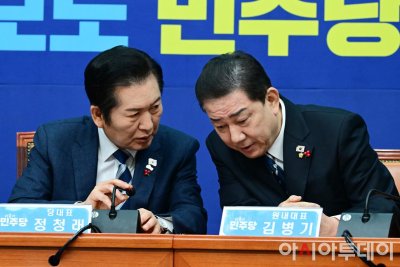
Democratic Party of Korea leader Chung Cheong-rae and floor leader Kim Byeong-gi confer during a Supreme Council meeting at the National Assembly in Seoul on Dec 22. Photo by Asia Today

Dec. 22 (Asia Today) — South Korea’s presidential office said Monday it “respects the National Assembly’s decision” after the ruling Democratic Party backed the opposition’s call for a special prosecutor to investigate matters linked to the Unification Church.

A senior presidential official said the office has consistently supported a thorough investigation regardless of party or religion and described the move as consistent with that stance.

“The presidential office has consistently advocated for a strict investigation regardless of party or religion, so a special prosecutor aligning with that stance is only natural,” the official said, adding that the party’s shift should be seen as reflecting the presidential office’s position.

Democratic Party floor leader Kim Byung-ki said during a Supreme Council meeting at the National Assembly that he supports a special probe that would include politicians from both the ruling and opposition parties.

He said the People Power Party appears to believe the Democratic Party is avoiding a special investigation and urged proceeding with a special prosecutor focused on the Unification Church.

Democratic Party leader Chung Cheong-rae also said there was no reason not to accept the proposal and called for a full accounting that includes any People Power Party figures involved.

— Reported by Asia Today; translated by UPI

© Asia Today. Unauthorized reproduction or redistribution prohibited.

Source link

Author of key report on Palisades fire was upset over changes that weakened it, sources say

The author of the Los Angeles Fire Department’s after-action report on the Palisades fire was upset about changes made to the report, without his involvement, that downplayed the failures of city and LAFD leaders in preparing for and fighting the disastrous Jan. 7 fire, according to two sources familiar with the matter.

The author’s complaints reached Mayor Karen Bass’ office in mid-November, after the LAFD had publicly released the report, said Clara Karger, a spokesperson for Bass.

“The Mayor has inquired with Chief Moore about the concerns,” Karger said last week, referring to LAFD Chief Jaime Moore.

The sources, who requested anonymity to protect their relationships with the LAFD and city officials, said the report by Battalion Chief Kenneth Cook was intended to be a final draft. Cook declined to comment.

The Times posted an article Saturday that analyzed seven drafts of the after-action report, obtained through a public records request. The most significant changes involved the LAFD’s deployment decisions before the fire, as the wind warnings became increasingly dire.

In one instance, LAFD officials removed language saying that the decision to not fully staff up and pre-deploy all available crews and engines ahead of the extreme wind forecast “did not align” with the department’s policy and procedures during red flag days.

Instead, the final report said that the number of engine companies rolled out ahead of the fire “went above and beyond the standard LAFD pre-deployment matrix.”

The deletions and revisions have drawn criticism from some who questioned the LAFD’s ability to acknowledge its mistakes before and during the blaze — and to avoid repeating them in the future.

In the months since the fire, residents who lost their homes have expressed outrage over unanswered questions and contradictory information about how top LAFD officials prepared for the dangerous weather forecast and how they handled a smaller New Year’s Day blaze, called the Lachman fire, which rekindled into the massive Palisades fire six days later.

On Saturday, after the report by The Times was published online, City Councilmember Monica Rodriguez issued a statement about the toning down of the after-action report.

“Today’s reporting makes clear that accountability is optional when after-action reports are conducted in-house with oversight by political appointees,” Rodriguez said. “If these reports are purposefully watered down to cover up failures, it leaves Angelenos, firefighters, and city officials without a full understanding of what happened and what needs to change. After-action reports must be independent to ensure honest assessments in order to avoid repeating disastrous errors and to protect our communities in the future.”

Former interim Fire Chief Ronnie Villanueva, who oversaw the completion of the report before it was made public in October, did not respond to requests for comment.

Karger, the Bass spokesperson, said this month that the report “was written and edited by the Fire Department.” Bass’ office did not demand changes to the drafts and asked the LAFD to confirm only the accuracy of items such as how the weather and the department’s budget factored into the disaster, Karger said in an email.

The LAFD has refused to answer questions about the revisions and Cook’s concerns, citing an ongoing federal court case. Federal prosecutors have charged a former Palisades resident with setting the Lachman fire.

David Loy, legal director of the First Amendment Coalition, said it’s “disingenuous” of LAFD officials to cite the investigation as a reason they can’t respond to The Times’ inquiries.

“There’s nothing about the existence of a federal investigation that prohibits them from commenting,” Loy said. “They just choose not to comment.”

Three of the seven drafts of the after-action report obtained by The Times are marked with dates: Two versions are dated Aug. 25, and there is a draft from Oct. 6, two days before the LAFD released the final report to the public.

Some drafts of the after-action report described an on-duty LAFD captain calling Fire Station 23 in the Palisades on Jan. 7 to report that “the Lachman fire started up again,” indicating the captain’s belief that the Palisades fire was caused by a reignition of the earlier blaze.

The reference was deleted in one draft, then restored in the public version, which contains only a brief mention of the Lachman fire. Some have said that the after-action report’s failure to thoroughly examine the Lachman fire reignition was designed to shield LAFD leadership and the Bass administration from criticism and accountability.

Weeks after the report’s release, The Times reported that a battalion chief ordered firefighters to roll up their hoses and leave the burn area on Jan. 2, even though they had complained that the ground was still smoldering and rocks remained hot to the touch. Another battalion chief assigned to the LAFD’s risk management section knew about the complaints for months, but the department kept that information out of the after-action report.

After The Times’ report, Bass asked Villanueva to “thoroughly investigate” the LAFD’s missteps in putting out the Lachman fire.

Moore, an LAFD veteran who became chief last month, has been tasked with commissioning the independent investigation that Bass requested.

Several key items were wholly deleted from the after-action report. The final version listed only 42 items in the section on recommendations and lessons learned, while the first version reviewed by The Times listed 74.

A section on “failures” was renamed “primary challenges,” and an item saying that crews and leaders had violated national guidelines on how to avoid firefighter deaths and injuries was scratched.

Another passage that was deleted said that some crews waited more than an hour for an assignment the day of the fire.

Two drafts contain notes typed in the margins with suggestions that seemed intended to soften the report’s effect and burnish the Fire Department’s image. One note proposed replacing the image on the cover page — which showed palm trees on fire against an orange sky — with a “positive” one, such as “firefighters on the frontline.” The final report’s cover displays the LAFD seal.

In addition to the mayor’s office, Cook’s concerns made their way to the president of the Board of Fire Commissioners, which provides civilian oversight for the LAFD. Genethia Hudley Hayes, president of the board, told The Times that she heard rumors that the author of the report was unhappy, but that she did not seriously look into the matter.

“If I had to worry about every rumor that comes out of LAFD, I would spend my entire day, Monday through Friday, chasing down rumors,” she said.

She said she raised concerns with Villanueva and the city attorney’s office over the possibility that “material findings” were or would be changed.

“I did not feel like they were lying about anything,” she said. “I didn’t feel like they were trying to cover up anything.”

Pringle is a former Times staff writer.

Source link

‘Avatar: Fire and Ash’ heats up the box office

The Na’vi won the battle of the box office this weekend, as “Avatar: Fire and Ash” hauled in a hefty $88 million in the U.S. and Canada during its opening weekend.

The third installment of the Disney-owned 20th Century Studios’ “Avatar” franchise brought in an estimated total of $345 million globally, with about $257 million of that coming from international audiences. The movie reportedly has a budget of at least $350 million.

Box office analysts had expected a big international response to the most recent film, particularly since its predecessor “Avatar: The Way of Water” had strong showings in markets like Germany, France and China.

In China, the film opened to an estimated $57.6 million, marking the second highest 2025 opening for a U.S. film in the country since Disney’s “Zootopia 2” a few weeks ago. (That film went on to gross more than $271.7 million in China on its way to a global box office total of $1.1 billion.)

The strong response in China is another sign that certain movies can still do well in the country, which was once seen as a key force multiplier for big blockbusters and animated family films but has in recent years cooled to American movies due to geopolitics and the rise of its domestic film industry.

Angel Studio’s animated biblical tale “David” came in second at the box office this weekend, with an estimated domestic gross of $22 million. Lionsgate thriller “The Housemaid,” Paramount Animation and Nickelodeon Movies’ “The Spongebob Movie: Search for Squarepants” and “Zootopia 2” rounded out the top five.

The weekend’s haul likely comes as a relief to theater owners, who have weathered a roller coaster year.

After a difficult first three months, the spring brought hits like “A Minecraft Movie” and “Sinners” before the summer ended mostly flat. A sleepy fall brought panic to the exhibition business until closer to the Thanksgiving holiday, when “Wicked: For Good” and “Zootopia 2” drew in audiences.

Source link

Stunned office workers discover colleague is former child star with role in huge festive film

A GROUP of office workers were left shocked when they learned their colleague is a former child star, and had a role in an iconic festive film.

The actor now keeps a low profile working as a Logistics Manager for the upcoming 2026 Commonwealth Games, which will take place in Glasgow. But do you recognise him?

Office workers had the highlight of their week when they realised their colleague is a former child starCredit: tiktok@commonwealthsport
Joe Lane was left mortified when his co-workers realised he was in the Nativity! movie back in 2009Credit: tiktok@commonwealthsport
Joe portrayed Edward, one of the key characters in the hit film NativityCredit: Lionsgate

Joe Lane appeared in 2009 hit Nativity!, which featured Martin Freeman, Jason Watkins and Ashley Jensen.

He portrayed schoolboy Edward in the film, which is centred around a heartbroken primary school teacher’s journey to make his class’s nativity play reach Hollywood, and win his ex-girlfriend back in the process.

In a TikTok shared by Joe’s colleagues, the former actor was left red-faced when they figured out his famous past.

The clip showed Joe, dressed in a Christmas jumper and a festive headband, as he is shaken by his colleagues.

soap slip

Emmerdale in huge blunder as Corriedale trailer ‘leaks’ character left for dead


NAME ROW

Simon Cowell’s December 10 facing new legal battle from Brit rock band

It then cuts to clips of him in the movie, before his colleagues recreate a hilarious moment by his character Edward.

Joe’s starring moment in the film saw him take to the microphone during the final Nativity performance and impersonate fart sounds with his armpit.

The former child star had his head in his hands when his co-workers cornered him at his desk and re-enacted the funny moment in the TikTok video.

“When you find out your colleague was in the nativity films,” read the video, with the caption adding: “The most exciting office development this week”.

The film was cast by producers holding open calls for local kids in Coventry, with the aim to use non-professional actors for an authentic feel.

After appearing in the first movie, Joe appears to have steered away from continuing an acting career.

He went on to become a semi-professional rugby player, before moving into logistics for sporting events.

Coventry-born Joe is now living in Glasgow after spending time in Australia and London.

It appears he has been keen to keep his famous past under wraps in the workplace.

One TikTok user commented on the video to reveal that they had previously worked with Joe, and had no clue of the connection.

“I worked with Joe at Coventry Rfc and unless I was out of the loop he kept this very well hidden!” they said.

Another commenter joked “So he didn’t become shrek??”, referencing the scene in Nativity! where character Mr. Poppy told Edward, “You could be Shrek”.

Joe as Edward, centre, in the Christmas smashCredit: Lionsgate
Joe was less than impressed when his colleagues reenacted his famous screen momentCredit: tiktok@commonwealthsport

A number of the children who appeared in Nativity! returned to their normal lives following the movie, and despite its massive success, have gone into regular jobs.

Cadi Mullane, who played Crystal – one of the main children in the film – previously detailed what filming was like in a TikTok video.

She said: “I was part of an agency called Stagecoach, they were looking for kids who were really chatty, who could dance a little bit and sing a little bit. Apparently that was me.

“There was about seven auditions. But I’m from Wales so I had to keep travelling up to London which was a bit annoying, but it was OK because I really wanted to be in a film.

“They looked at how well we could sing and how well we got on with the other kids, cause that was important, obviously.”

Cadi went on to recall how the movie filmed throughout the summer, with no scripts for the children.

She said: “It was filmed in Coventry but obviously I’m not from Coventry so we all stayed in a hotel together. It was like The Suite Life Of Zach and Cody, honestly.

“There was no scripts. Everything was improvised, except from some bits. We basically just spoke loads of rubbish, and then we were asked to say it again on camera.”

The film is centred around a Coventry school’s nativity show and their feat to take it to HollywoodCredit: Alamy
The film was fronted by award winning actor Martin FreemanCredit: Alamy
A number of local children took part in the film, with producers hiring non-professionals for an “authentic feel”Credit: Alamy

Source link

‘I work in Lapland at -32 degrees and my office is a real-life snow globe’

From walking around in -32 degrees, eating Reindeer pizza, to having just a few hours of daylight – here’s what it’s really like to work in Lapland over Christmas

Lapland is one of the most enchanting and Christmassy places in the world during this time of year, with its snow-dusted forests and roaming reindeer. Yet, imagine if the Arctic wilderness was the backdrop to your working day? And we’re not talking about being Santa Claus.

Saul Vendrig Castillo compares his office to a ‘real-life snow globe’ as he spends the most wonderful time of the year in Lapland, Finland, as a TUI representative. His job is to help create unforgettable moments for families who visit the magical winter wonderland, and it certainly comes with its perks.

“Every day I’m surrounded by snow, excitement and pure joy. Kids step off the plane with their mouths open in amazement, and you can feel the Christmas magic in the air. It’s like working inside a real-life snow globe!”, Saul said.

“Lapland is one of the only places on earth you can experience the magic of gliding through snowy forests, wrapped up warm, with a majestic reindeer leading the way. It’s peaceful, magical and gives you time to soak up the Lapland winter wonderland.”

Yet, it can come with its challenges as he revealed: “In December, we get just over two hours of daylight, which means at 4pm, it can feel like bedtime.” However, that hasn’t stopped Saul from making the most of the local delicacies, including one that some might frown upon.

“Reindeer pizza is amazing, and much better than I expected! I can also highly recommend a liquorice cake with blueberry ice cream that I ordered a few days in a row, as it was so good,” said Saul.

His job in Lapland can range from greeting families at the airport, helping them with their snowsuits and boots, to organising thrilling outdoor excursions such as husky sleigh rides, reindeer safaris or snowmobiling.

“The children get to ride in sledges pulled by a team of energetic huskies. The sound of their paws on the snow and the speed of the sledge make it an unforgettable adventure. Everyone leaves smiling and talking about it for days,” he explained.

But he confessed that the most rewarding part of his job is seeing the smiles on the children’s faces when they meet Santa. “When families visit Santa, it’s really special,” he shared.

“The children get to meet him in his cosy, twinkling cabin, tell him what they’ve been wishing for, and even receive a little gift to take home. The excitement in their eyes is priceless, and it’s magical for the parents to see too.”

Saul added: “When a child sees their first reindeer or throws their first snowball, that’s the moment you realise how special this job is. Then you take them to meet the Big Man, and their faces light up in a way you never forget. Parents often tell me this is the Christmas they always dreamed of giving their kids, so it’s really special to be a part of that experience.”

Currently in Lapland for his second season with TUI, Saul has picked up a few handy tips for those looking to visit the enchanting destination. He advised: “Make sure you bring lots of loose layers to wear under your snow suit as they trap the heat, whereas tight clothes can make you colder fast. And once you feel the chill, it’s hard to get rid of it, some days it can get to –32 degrees.”

He added that because Lapland only gets just over two hours of daylight in December, it’s best to “plan your activities with this in mind to really maximise those daylight hours”.

Additionally, Saul suggested: “For many people visiting Lapland, their bucket list goal is to see the Northern Lights, and my one piece of advice is to always be patient with them. They can be unpredictable, but they really are a sight to behold when they appear in the evening.”

During the summer season, Saul works as a TUI rep in various countries, including Greece, the Costa del Sol, and Mallorca. Yet, there’s something about Lapland, “The snow, the lights, the magic, the excited families always pull you back. There’s nowhere else like it,” he said.

If you’re interested in soaking up the festive merriment or planning a winter getaway for next year, TUI offers various packages to Lapland, departing from regional airports across the UK. The packages typically include flights, snowsuits, activities and transfers, and of course, the chance to meet Santa and witness the Northern Lights.

Do you have a travel story to share? Email webtravel@reachplc.com

Source link

Argentina creates nuclear office to become ‘Saudi Arabia of uranium’

Argentina’s nuclear plan will roll out in stages. The first phase involves building small modular reactors, or SMRs, at the Atucha Nuclear Power Plant site, already underway, to ensure nationwide energy supply and reduce power outages. Photo by CNEA/EPA

BUENOS AIRES, Dec. 19 (UPI) — Argentina has formally created the Secretariat of Nuclear Affairs, a significant structural shift in the country’s national energy strategy under President Javier Milei, aimed at positioning Argentina as a global energy leader and attracting large-scale investment.

In announcing the move, the government highlighted the country’s strengths for developing a nuclear plan, including its pool of highly trained human capital and vast, low-temperature lands in Patagonia seen as suitable for hosting artificial intelligence data centers. These advantages, officials said, allow for a combination of clean nuclear energy and cutting-edge technology.

The plan will roll out in stages. The first phase involves building small modular reactors, or SMRs, at the Atucha Nuclear Power Plant site, already underway, to ensure nationwide energy supply and reduce power outages.

SMRs produce stable and low-cost electricity, making them well-suited to power AI data centers, and would position Argentina as a regional hub for digital innovation and nuclear energy exports.

In the second phase, the government plans to develop uranium reserves to meet domestic demand and turn Argentina into an exporter of high-value nuclear fuels.

The Economy Ministry summed up the strategy in a recent statement, saying the government aims to “turn Argentina into the ‘Saudi Arabia of uranium.'”

This ambitious goal is based on the country’s uranium reserves, estimated at 36,483 tons identified and concentrated in provinces such as Mendoza, San Juan and Chubut, according to a report by the National Mining Secretariat.

Those reserves could generate significant export volumes and position Argentina as a key supplier in a growing global market driven by the energy transition.

However, physicist Alberto Baruj urged caution.

“Argentina has enough uranium for its reactors for decades. It does not have the extraordinary reserves found in other countries. Talking about being the Saudi Arabia of uranium is an exaggeration that I cannot support from a technical standpoint,” Baruj told UPI.

Baruj said Argentina could export uranium, thanks to its processing capacity. However, “it makes no sense to do so with raw ore. It would be far more convenient to process it for use in domestic reactors, including small modular reactors such as the domestically designed CAREM.”

The new nuclear institutional framework will also be tasked with leading policy on the exploitation of rare earth elements, minerals critical for batteries, cellphones and green technology, as well as nuclear minerals, in coordination with other government agencies.

It will promote collaboration among mining companies, provincial governments and private actors to increase production of these resources and drive investment, working alongside the Mining Secretariat to advance nuclear mining projects, material processing and technological applications.

“The Secretariat of Nuclear Affairs is taking on roles that previously belonged to the National Atomic Energy Commission, which blurs the agency’s place within the institutional structure,” a respected nuclear sector source who requested anonymity told UPI.

In their view, amid a budget crisis at the commission, the creation of a new body “further endangers what has historically been the center of Argentina’s nuclear activity. The inclusion of rare earth exploitation comes as a surprise within a nuclear affairs secretariat.”

Baruj also questioned the need for the new agency, saying its stated purpose, coordinating the nuclear sector, already falls by law under the National Atomic Energy Commission.

“It is possible that with the creation of the Secretariat, the government is seeking greater political control over the sector,” Baruj said. But, he added, creating a new secretariat is unnecessary if each institution fulfilled its assigned role.

“The massive loss of technical personnel with extraordinary capabilities must be reversed. But above all, the salary issue must be resolved, because the commission pays the lowest wages in the entire science and technology sector,” he said.

Baruj said the priority should be to ensure continuity of key projects such as completion of the RA-10 multipurpose reactor, its associated neutron beam laboratory, the CEARP Proton Therapy Center and the heavy water industrial plant.

“Argentina’s nuclear sector has sufficient capacity and depth to take on and carry out these projects. What is lacking, precisely, is political will,” he said.Based o

Source link

Watchdogs warn L.A. County is undermining oversight efforts

After steadily gaining power and influence for more than a decade, the watchdogs that provide civilian oversight of the Los Angeles County Sheriff’s Department face an uncertain future.

A recent leadership exodus has left behind gaps in experience and knowledge, and a succession of legal challenges and funding cuts by the county have left some concerned that long-fought gains in transparency are slipping away.

“It is beginning to look like the idea of effective oversight of the Sheriff’s Department is a pipe dream,” said Robert Bonner, former chairman of the Civilian Oversight Commission, who announced in June that he was being pushed into “involuntarily leaving” before he completed pending work.

Current and former oversight officials have argued that the office of county counsel, the Board of Supervisors and the Sheriff’s Department have repeatedly undermined efforts to rein in law enforcement misconduct.

The cumulative effect, some advocates worry, is that the public will know less about law enforcement activity, and that there will be fewer independent investigations into deputies and department leaders alike.

“The Sheriff is committed to transparency in law enforcement,” the department said via email. “As we move forward it is essential to strengthen collaboration with the [Civilian Oversight Commission] while ensuring that the rights and safety of our personnel are protected.”

In recent years, oversight bodies have uncovered information about so-called deputy gangs, published reports on inhumane jail conditions and issued subpoenas for records related to on-duty use of force incidents.

Inspector General Max Huntsman’s sudden announcement last week that he was retiring from the position he’s held since its creation more than a decade ago completed a trifecta of departures of top law enforcement oversight officials this year.

In addition to Bonner’s departure, former Civilian Oversight Commission chairman Sean Kennedy stepped down from the body in February in response to what he described as improper county interference in the commission’s activities.

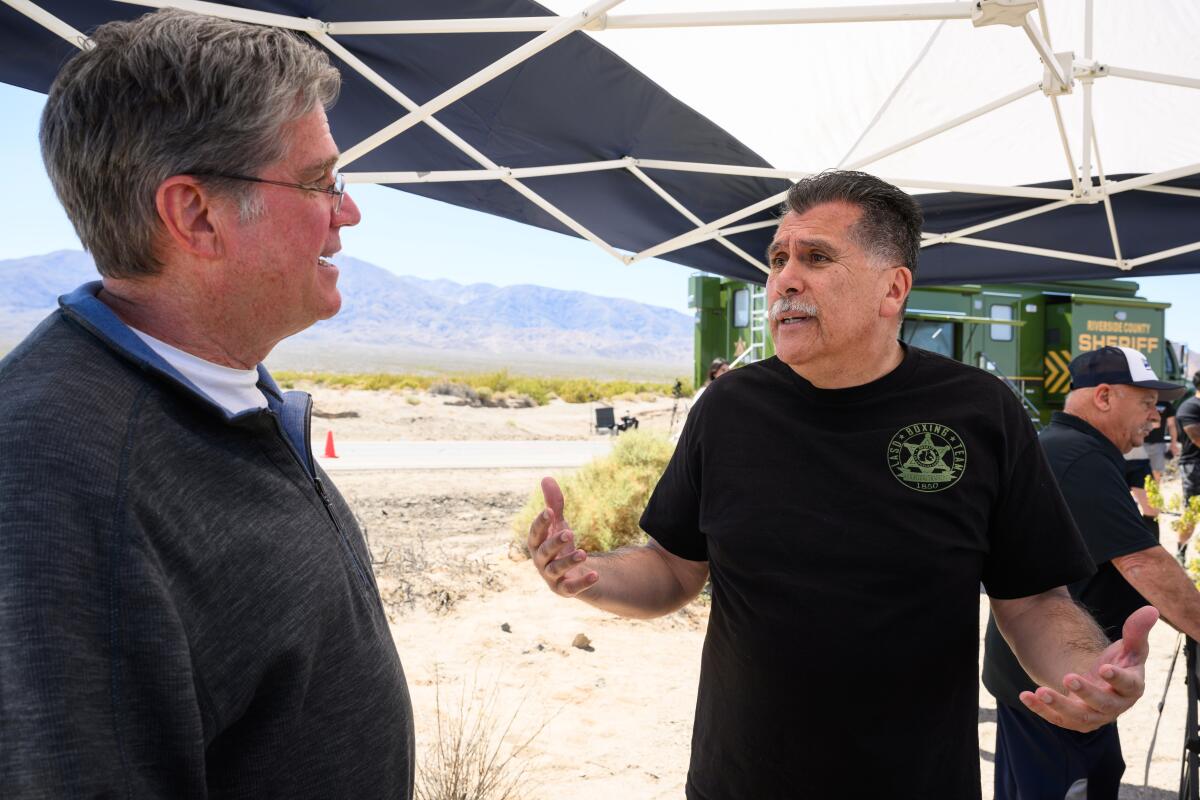
Robert Luna, right, talks with Sean Kennedy

L.A. County Sheriff Robert Luna, right, talks with Sean Kennedy during an event on April 5 in Baker. Kennedy left his position on the Civilian Oversight Commission earlier this year.

(William Liang / For The Times)

Kennedy and others have said the Sheriff’s Department has refused to comply with multiple subpoenas by the commission for personnel files and records related to deputy misconduct.

“The attack on integrity and on oversight capacity is threatening all of us in Los Angeles County,” Hans Johnson, who took over as chairman of the Civilian Oversight Commission following Bonner’s departure, said at a recent public meeting. “We look forward to making sure that oversight is preserved and protected and not muzzled and not unplugged or sabotaged.”

The Executive Office of the Board of Supervisors said in a statement that it maintains a “long-standing commitment to strong oversight.”

The Sheriff’s Department said only one request it has received from oversight officials this year remains pending.

“The Department remains committed to working cooperatively to provide all requested information as required by law,” the statement said.

On the state level, reform advocates recently scored what they described as a victory for transparency.

In October, Gov. Gavin Newsom signed a bill known as AB 847, which granted civilian oversight bodies across California the ability to view confidential law enforcement records in private sessions. L.A. County officials had previously balked at sharing certain sensitive files on sheriff’s deputies, and some reformers worry the new law may not go far enough.

Dara Williams, chief deputy of the Office of the Inspector General, said at a July public meeting that the Sheriff’s Department has a history of being “painfully slow” to respond to requests for records related to homicides by deputies. In one instance, she said, Huntsman’s office served the department with a subpoena in October 2024 “and we are still waiting for documents and answers.”

The Sheriff’s Department said it has hired an outside attorney who is “conducting an independent review” of its records to determine if “those materials actually exist and can be found.”

The department’s statement said it will abide by the law and that protecting confidential information “remains of the utmost importance.”

Some involved in oversight have also become the subject of probes themselves.

In June, the Office of the County Counsel said it was investigating Kennedy for alleged retaliation against a sergeant who had worked for a unit that had been accused of pursuing cases for political reasons during Sheriff Alex Villanueva’s tenure.

Kennedy has denied the allegations, telling The Times in June, “I was just doing my job as an oversight official.”

Budget cuts — some already instituted, others threatened — are also a concern.

Huntsman said earlier this year that the Executive Office of the Board of Supervisors was reassigning or eliminating a third of his staff.

Inspector General Max Huntsman

Former L.A. County Inspector General Max Huntsman listens during a hearing at Loyola Law School’s Advocacy Center on Jan. 12, 2024.

(Irfan Khan / Los Angeles Times)

He too left amid acrimony with county officials.

“The County has made it very clear over the past couple of years that they are not going to enforce the state oversight laws,” Huntsman told The Times. “Instead the county supports the sheriff limiting the flow of information so as to restrict meaningful oversight.”

The Executive Office of the Board of Supervisors said the changes implemented this year have had a “minimal” impact that “neither limits OIG’s responsibility nor their capacity.”

The possibility of eliminating the Sybil Brand Commission, which monitors L.A. County jails, was discussed in an August report to the Board of Supervisors. County officials said it would save about $40,000 annually.

Sybil Brand commissioner Eric Miller told The Times in September that he believes “the county is attempting to limit oversight of the Sheriff’s Department … to avoid lawsuits.” The department, he said, “is a powerful constituency within the county.”

In September, California Atty. Gen. Rob Bonta launched a state lawsuit over what he described as a “humanitarian crisis” inside L.A. County jails.

There are even concerns that the Sheriff’s Department is seeking greater control over local groups that facilitate conversations between deputies and members of the public — often some of the only opportunities for community concerns to be heard.

In the Antelope Valley, the Palmdale Sheriff’s Station Community Advisory Committee has been roiled by allegations that a local Sheriff’s Department captain appointed a new member without other members’ approval.

The chair of the committee, Georgia Halliman, resigned in October and committee member Sylvia Williams has alleged that the Sheriff’s Department captain tried to force her out.

“I was going to leave, but they need someone who’s real in there,” Williams told The Times. “You have to have an overseer.”

The department said it is reviewing the situation.

Melissa Camacho, a senior staff attorney with the ACLU of Southern California, said the county is at a crossroads.

“The main question right now is what is the county going to do?” she said. “Is this going to be a moment when the Board of Supervisors decides to actually invest in oversight?”

Source link

Obama’s former staffers hope to build upon his legacy as they run for office

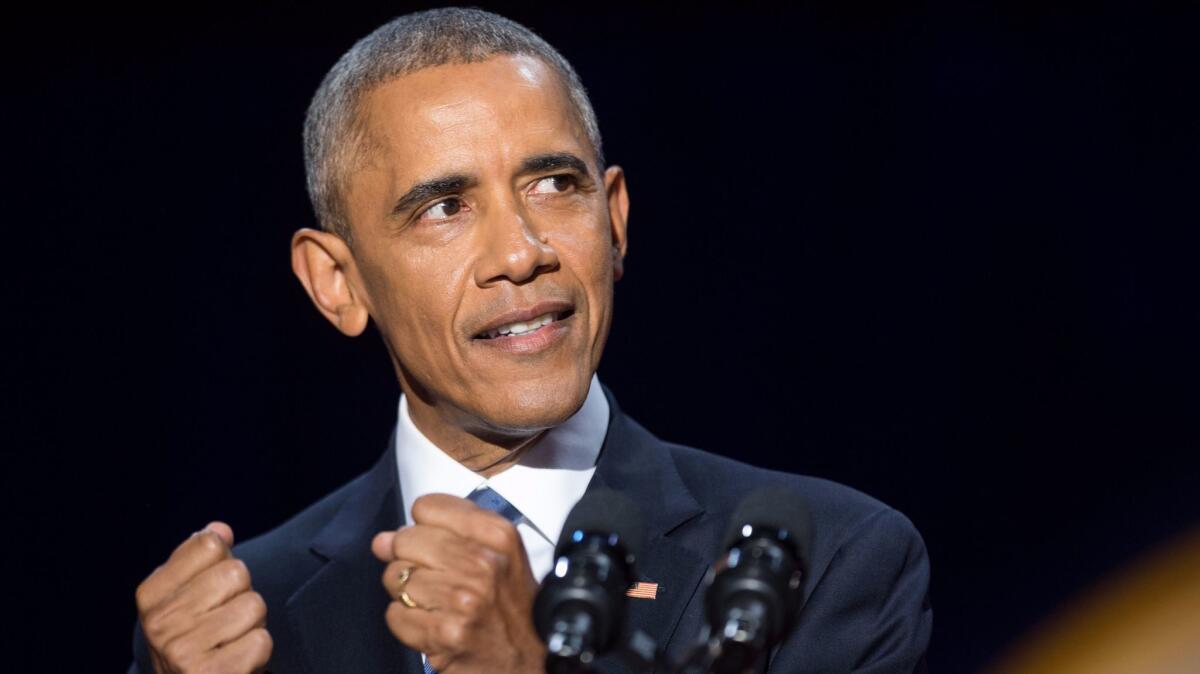
When bidding farewell to the nation in January, President Obama urged perseverance in the face of political change.

“If you’re disappointed by your elected officials, grab a clipboard, get some signatures and run for office yourself,” he said.

Dozens of people who worked in his administration or on his presidential bids have taken that call to action to heart, with several top political aides, policy staff and ambitious millennials from the Obama era mounting campaigns of their own right here in California. All are Democrats, and some of their races could be tipping points in the 2018 midterms as the party attempts to win back control in Washington.

Among the former government officials is Ammar Campa-Najjar, who is seeking to oust Republican Rep. Duncan Hunter in San Diego County.

Born in the U.S. to a Mexican mother and a Palestinian father, Campa-Najjar recalls questioning if his fellow Americans would ever truly accept him in the aftermath of the Sept. 11 terrorist attacks.

He brooded and struggled, but his faith was renewed when another biracial man with a unique name and an absent father, Barack Obama, won the presidency of the United States.

“In 2008, the country said, ‘Yes, we can,’ and elected this skinny brown kid with a funny name. It really kind of inspired me,” said Campa-Najjar, 28.

In the short term, that resulted in Campa-Najjar interning at the White House, where he was assigned the task of reading the letters Americans sent the president about their heartbreak and their victories, and helping select the 10 that were sent to Obama for him to read himself daily. He later worked in the Department of Labor and on Obama’s 2012 reelection campaign.

Today, he is among the youngest congressional candidates in the nation. And he is one of several former Obama campaign and administration officials who are running for office across the nation at all levels of government.

It’s not unusual for political staffers to seek elected office, but the number of Obama alumni who have entered the field for the 2018 election is notable. In California alone, there are at least four congressional candidates who worked for Obama, as well as several others seeking legislative and statewide posts.

President Obama in his farewell address urged listeners unhappy with their representatives to "run for office yourself.” (Zbigniew Bzdak / TNS)

President Obama in his farewell address urged listeners unhappy with their representatives to “run for office yourself.” (Zbigniew Bzdak / TNS)

(Zbigniew Bzdak / TNS)

Ammar Campa-Najjar is trying to oust Republican Rep. Duncan Hunter in San Diego County. (Hayne Palmour IV / San Diego Union-Tribune)

Ammar Campa-Najjar is trying to oust Republican Rep. Duncan Hunter in San Diego County. (Hayne Palmour IV / San Diego Union-Tribune)

(Hayne Palmour IV / San Diego Union-Tribune file)

Their campaigns are driven by the election of President Trump, fewer opportunities in Washington, D.C., with Republicans in control of the White House and Congress, and the desire to protect and build upon the former president’s legacy.

“Coming out of the Obama administration, people are particularly motivated by what Donald Trump has been trying to do to this country,” said Bill Burton, who served as a spokesman for Obama during the 2008 campaign and his first term in office and is now a Democratic operative in Southern California.

He added that early Obama supporters who signed on at a time when Hillary Clinton was perceived as the unstoppable nominee have already shown a natural willingness to take on long odds, a quality that can help them achieve their own political goals.

“When I started working for [Obama], the only person in America who thought he was going to win the Iowa caucuses was him,” Burton said.

The congressional candidates in California are all running in districts historically dominated by the GOP.

Sam Jammal is trying to defeat Rep. Ed Royce (R-Fullerton), who has represented Orange County in Congress for nearly 25 years. Jammal said his experience growing up in the district as the child of immigrants, attending law school and then working on Obama’s 2008 campaign and in the Department of Commerce proved to him that anything is possible.

Sam Jammal, a former staffer in President Obama's Commerce Department, is now a congressional candidate in Orange County.

Sam Jammal, a former staffer in President Obama’s Commerce Department, is now a congressional candidate in Orange County.

(Sam Jammal)

“Our story is the embodiment of that,” said Jammal, whose parents are from Jordan and Colombia. “The same day my dad landed here, he was working at a gas station …. For me, his youngest son, I was able to work for the president of the United States. My proudest moment in the administration was taking my parents to a White House naturalization ceremony where they were able to meet President Obama. It’s full circle.”

Others, including Eleni Tsakopoulos Kounalakis, said they expected Clinton to win the November 2016 election, giving them the opportunity to work for the first woman president. The experiences the Sacramento-area native had as Obama’s ambassador to Hungary cemented her desire to continue working in public life once he left office.

“It took me a few months after the election to recalculate how I could best serve,” said Kounalakis, who is one of two Obama alumni running for lieutenant governor. “It [became] clear: It was more important than ever that California lead the way on our values, whether it’s fighting for the climate or supporting and celebrating our immigrant community and our LGBT community.”

Trump’s actions since taking office, including trying to institute a travel ban on people from several Muslim-majority nations and withdrawing from the Paris climate accord, quickened the Obama alums’ resolve. But nearly all said Trump’s recent statements placing neo-Nazis and white supremacists who violently protested in Charlottesville on the same moral plane as those who protested against them exemplified why they decided to run.

“What has happened … with this presidency and what Donald Trump stands for and believes in is in such stark contrast to everything we worked on for eight years,” said Buffy Wicks, a grass-roots organizer who worked on Obama’s campaigns and as the White House deputy director of public engagement. She is now running for the California Assembly.

But an impressive political résumé is no guarantee of success.

Ultimately, the races will come down to how voters connect with the politicians and their policies, said Massachusetts state Sen. Eric Lesser, who went from shepherding luggage during the 2008 campaign to working steps from the Oval Office as the top aide to one of Obama’s must trusted advisors, David Axelrod.

“Show, don’t tell. You have to be elected on your own merits and your own vision, and ideas for your community,” he said.

While Lesser speaks reverently about his time working for Obama and Axelrod and the counsel he received from them during his 2014 campaign, he noted that voters want to hear how a candidate is going to address their needs, not about his time in Washington.

“Expecting people to suddenly be impressed or suddenly open doors because of a previous fancy job is not going to happen,” he said.

Expecting people to suddenly be impressed or suddenly open doors because of a previous fancy job is not going to happen.

— Eric Lesser, former Obama White House aide elected to the Massachusetts state Senate in 2014

Eleni Tsakopoulos Kounalakis, then the U.S. ambassador to Hungary, waves rainbow flags at a gay pride march in Budapest in 2012. She's now running for lieutenant governor in California.

Eleni Tsakopoulos Kounalakis, then the U.S. ambassador to Hungary, waves rainbow flags at a gay pride march in Budapest in 2012. She’s now running for lieutenant governor in California.

(Peter Kollanyi / Associated Press)

Lesser recalled that when he mounted his 2014 run, the best advice he received was from Obama, who told him to outhustle his rivals and connect with the people who would become his constituents.

“He asked, ‘How many people are in the district? How many households? How many doors?” Lesser said. “When I ran the numbers, he goes, ‘You can meet all those people.’ I haven’t quite met everyone, but I took his advice to heart.”

Reed Galen, who worked for President George W. Bush, said that while some administration posts could be particularly relevant to a race — one Obama administration official who worked on the auto industry bailout is now running for Congress in Michigan, for example — most candidates with such experience probably worked in a vast bureaucracy that few voters know or care about.

“My guess is most of these folks, the best thing they have going for them is a picture of them and the president [that shows] Barack Obama reasonably knows who I am,” said Galen, a former California GOP operative who worked on both of Bush’s campaigns and in his administration.

The greater advantages, he said, are the relationships forged with donors, leaders, strategists and the alumni network that remains tightly knit after their tenure ends.

Wicks’ fundraisingreport illustrates the political value of the connections that come from working for Obama. Axelrod, elected officials including former Rep. Gabby Giffords of Arizona, and scores of people from Washington, D.C., have donated to her campaign, names unlikely to appear on the donor list for most other California legislative candidates.

Buffy Wicks, center, who worked in the Obama White House and for the Obama and Hillary Clinton campaigns, is running for the state Assembly.

Buffy Wicks, center, who worked in the Obama White House and for the Obama and Hillary Clinton campaigns, is running for the state Assembly.

(Kirk McKoy / Los Angeles Times)

Wicks’ campaign also follows a grass-roots blueprint she helped craft for Obama when he was unknown, introducing himself to voters in diners and coffee shops and talking about their concerns.

“I’m doing house parties all over the district, really spending a lot of time in living rooms, 20 to 30 people at a time and having a really thoughtful conversation about what kind of community do we want to live in,” she said. “It’s a way to build relationships with voters, investing on the front end of that relationship and not just plying you with direct mail pieces and television ads.”

And for those who lack Wicks’ campaign experience, the connections to some of the top Democrats in the nation is invaluable.

“When you haven’t been an elected official before, you have a lot of questions .… You understand the policies, you know what your positions are, but the actual architecture of running a campaign is something that’s inherently new,” said Brian Forde, who worked on technology in the Obama administration and is now trying to topple Republican Rep. Mimi Walters in Orange County.

“What’s most helpful is being able to pick up the phone or send a text message to a friend who was a speechwriter for the president or the first lady, or someone who did work on communications who does understand all of these things because they worked on the campaign,” Forde said.

seema.mehta@latimes.com

For the latest on national and California politics, follow @LATSeema on Twitter.

ALSO

‘Art of the Deal’ writer predicts that Trump will resign by the end of the year

Defending Confederate memorials, Trump equates Gens. Lee and Jackson with Presidents Washington and Jefferson

Trump succeeds where Obama failed – spawning a new wave of liberal activism

Live coverage of California politics


Source link

Newsom trolls Trump with website of president’s ‘criminal cronies’

Gov. Gavin Newsom unveiled a new state-run website Tuesday that tracks what his office calls the “criminal cronies” around President Trump — just the latest trolling tactic by the California governor that directly mirrors Trump’s own use of public resources for political score settling.

Newsom pegged the website’s rollout to recent crime statistics, which were released in early November showing falling rates of homicide and assault in California. The governor’s website catalogs what it calls the top 10 criminal convictions that were followed by pardons offered thus far by Trump — from Jan. 6 rioters to former politicians and business figures convicted of fraud, drug trafficking and financial crimes. The website calls Trump the “criminal in chief.”

The website features AI-generated portraits of such figues as Rod Blagojevich, the only Illinois governor to be impeached and removed from office; former Honduran President Juan Orlando Hernández, who was convicted of drug trafficking; and Ross Ulbricht, the founder of a dark-web drug marketplace who had been serving a life sentence without the possibility of parole. The images show the men standing in a lineup with the word “felon” stamped in red ink.

“With crime dropping — again — California is proving what real public safety leadership looks like,” read a statement from Newsom. “Meanwhile in D.C., Trump is a felon who surrounds himself with scammers and drug traffickers. We’re providing the public with a resource putting the facts in one place so Californians, and all Americans, can see who he elevates and who he protects.”

The launch is the latest escalation in Newsom’s increasingly aggressive digital campaign against Trump.

In recent months, the governor and his press office have turned social media into a near-daily forum for mocking and trolling the president by firing off all-caps posts, meme-style graphics and sharply worded rebukes aimed at Trump’s brash rhetoric, criminal record, policy proposals and political allies.

The crime data , which was released Nov. 3 by the Major Cities Chiefs Assn., found homicides across California’s major cities fell 18% year over year, robberies dropped 18% and aggravated assaults declined 9%. The association also found that violent crime decreased in every California city reporting data, with the steepest declines in Oakland, where violent crime fell 25%, and San Francisco, where it fell 21%.

Newsom’s new website highlights Trump’s sweeping use of presidential pardons to grant clemency to roughly 1,500 people charged or convicted for their roles in the Jan. 6, 2021, attack on the U.S. Capitol. The governor’s office said some of those individuals had prior criminal records and that others went on to be convicted of new crimes after receiving pardons.

The move mirrors tactics Trump and his administration have embraced. Most recently, Trump unveiled a website of “media offenders,” naming journalists and outlets he accuses of bias. Separately, the U.S. Department of Homeland Security under Secretary Kristi Noem has maintained a website highlighting what it calls the “worst of the worst” criminal immigrants arrested by U.S. Immigration and Customs Enforcement, framing the page as evidence that the administration is carrying out Trump’s promise of mass deportations.

The state’s website launch comes as Newsom seeks to cast California as a national leader in responsible governance of artificial intelligence.

Earlier Tuesday, the governor announced a slate of initiatives aimed at promoting ethical AI use in state government, including a new advisory council, partnerships with academic and nonprofit groups, and a generative AI assistant for state employees. Among the priorities outlined are strengthening safeguards for children online, countering image-based abuse and improving government operations.

“California is at the forefront of AI technology — and is home to some of the most successful and innovative companies and academic leaders in the world,” Newsom said in a statement. “We’re not going to sit on the sidelines and let others define the future for us. But we’re going to do it responsibly — making sure we capture the benefits, mitigate the harms, and continue to lead with the values that define this state.”

Source link

Newsom taps former CDC leaders critical of Trump-era health policies

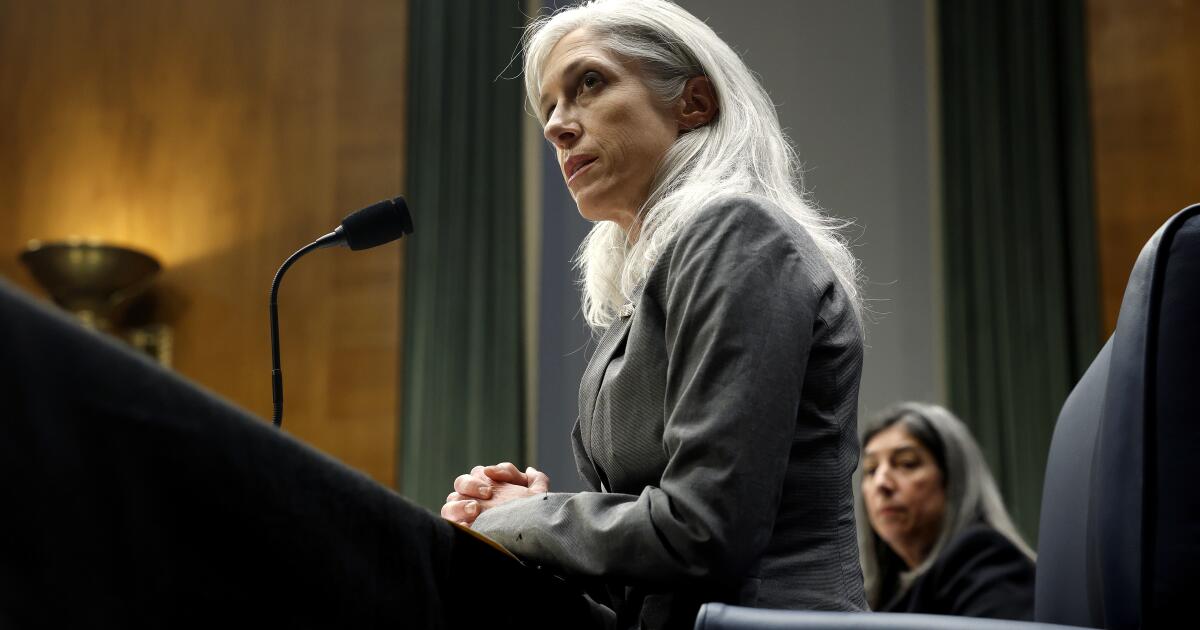
Gov. Gavin Newsom on Monday announced a new California-led public health initiative, tapping former U.S. Centers for Disease Control and Prevention officials who publicly clashed with the Trump administration, including the former agency chief who warned that the nation’s public health system was headed to “a very dangerous place.”

Newsom said the initiative will be led by Dr. Susan Monarez, the former CDC director, and Dr. Debra Houry, the CDC’s former chief medical officer. The pair will lead the Public Health Network Innovation Exchange, or PHNIX, which the governor’s office said will “modernize public health infrastructure and maintain trust in science-driven decision-making.”

The initiative was created to improve the systems that detect and investigate public health trends and build a modern public-health backbone that connects data, technology and funding across states.

“The Public Health Network Innovation Exchange is expected to bring together the best science, the best tools, and the best minds to advance public health,” Newsom said in a statement Monday. “By bringing on expert scientific leaders to partner in this launch, we’re strengthening collaboration and laying the groundwork for a modern public health infrastructure that will offer trust and stability in scientific data not just across California, but nationally and globally.”

Monarez will serve as strategic health technology and funding advisor for the initiative, helping advance private sector partnerships to better integrate healthcare data systems and enable faster disease surveillance.

“I am deeply excited to bring my experience in health technology and innovation to support PHNIX,” Monarez said in a statement shared by Newsom’s office. “California has an extraordinary concentration of talent, technology, and investment, and this effort is about putting those strengths to work for the public good — modernizing how public health operates, accelerating innovation, and building a healthier, more resilient future for all Californians.”

Houry was named senior regional and global public health medical advisor for PHNIX. Newsom’s office also announced it will work with Dr. Katelyn Jetelina, founder and chief executive of Your Local Epidemiologist. Jetelina will advise the California Department of Public Health on building trust in public health.

Monarez and Houry both described extraordinary turmoil inside the nation’s health agencies during congressional hearings, telling senators in September that Health and Human Services Secretary Robert F. Kennedy Jr. and political advisors rebuffed data supporting the safety and efficacy of vaccines. Monarez was fired after just 29 days on the job. She said Kennedy told her to resign if she did not sign off on new unsupported vaccine recommendations. Kennedy has described Monarez as admitting to him that she is “untrustworthy,” a claim Monarez has denied through her attorney.

“Dramatic and unfounded changes in federal policy, funding, and scientific practice have created uncertainty and instability in public health and health care,” Dr. Erica Pan, CDPH director and state public health officer, said in a statement. “I am thrilled to work with these advisors to catalyze our efforts to lead a sustainable future for public health. California is stepping up to coordinate and build the scaffolding we need to navigate this moment.”

The salaries of the new positions were not immediately known.

Newsom’s office said the California initiative would build on previously announced public health partnerships, such as the West Coast Health Alliance.

Source link