George Clooney, wife Amal Clooney and their 8-year-old twins are officially citizens of France, as of the day after Christmas.
The news was reported by multiple French outlets as well as the Guardian, all citing an announcement published in a French government journal.
The Clooneys bought property in France — a farm, he recently told Esquire — in August 2021, when their twins were 4. He said it was a “much better life” there for Ella and Alexander.
“Yeah, we’re very lucky. … A good portion of my life growing up was on a farm, and as a kid I hated the whole idea of it. But now, for them, it’s like — they’re not on their iPads, you know?” he said in the interview, published in the magazine’s October/November issue.
“I was worried about raising our kids in L. A., in the culture of Hollywood. I felt like they were never going to get a fair shake at life. France — they kind of don’t give a s— about fame. I don’t want them to be walking around worried about paparazzi. I don’t want them being compared to somebody else’s famous kids.”
Domaine Le Canadel in France is, according to Hello, “an enchanting and sprawling 425-acre Provence wine estate” that cost the Clooneys a reported $8.3 million. It has a pool, tennis court, gardens, a lake, an olive grove and a 25-acre vineyard, the outlet said. But, you know, it’s just a farm.
Other celebrity couples have put down roots in the area, of course, with less than charmed results over time. Then again, those folks weren’t French citizens, for the most part.
Clooney’s remarks about the French attitude toward fame echoed previous comments made by Johnny Depp, who years ago found refuge in France for himself and his children, Jack and Lily-Rose, until he split in 2012 from longtime partner Vanessa Paradis, a French singer, model and actor.
The country “afforded [Depp] the possibility of living a normal life. Really a simple life,” the “Pirates of the Caribbean” actor told SFGate in 2001.
In 2010, Depp told People, “With Vanessa and the kids, we live in a sort of little village in the south and I have the impression of being in paradise … and you know what I do there? Absolutely nothing.”
Depp, who started dating his “The Rum Diary” co-star Amber Heard the year he broke up with Paradis, listed his Provence property for sale for almost $26 million in June 2015, then reportedly put it on the market again in the years that followed for more than twice the price. However, despite containing an entire village in its 37 acres, the property appears not to have sold.
Meanwhile, Clooney’s buddy Brad Pitt and Pitt’s ex, Angelina Jolie, have been battling in court for years over the 2021 sale of her half of their Provence wine estate, Chateau Miraval, which actually produces wine. The former couple signed a long-term lease on the property in 2008 and later bought a controlling interest in the company that owned it.
Pitt and Jolie married at Chateau Miraval in 2014 after meeting in 2004 on the set of “Mr. and Mrs. Smith” when he was still married to Jennifer Aniston. (They went official as a couple the following July after Aniston filed for divorce in March 2005.) Jolie and Pitt had kids and adopted kids together over the decade leading up to the wedding, but Jolie filed for divorce after only two years as husband and wife following a fight on a private plane. That also got ugly.
The story of the Pitt-Jolie court battle over the chateau and its winery is long and complicated, but it began with Pitt alleging that he and his ex had an agreement that if either wanted to sell their half of the place, the other would have to consent. Jolie, who sold her shares to Stoli’s wine division, Tenute del Mondo, said they had no such agreement in place.
The mother of a local tennis star joined Los Angeles County prosecutors on Monday in calling for stricter DUI penalties in California after they say her son was killed by a two-time drunk driver.
Braun Levi, an 18-year-old South Bay tennis standout, was struck and killed by a car in the early-morning hours of May 4 in Manhattan Beach.
According to Los Angeles County prosecutors, 33-year-old Jenia Resha Belt was behind the wheel, speeding while driving on a suspended license and with a blood alcohol level almost twice the legal limit. Belt, prosecutors say, has a previous conviction for driving drunk.
“California’s current DUI laws are broken and weak and fail to protect families like ours, and it’s devastating,” Braun’s mother, Jennifer Levi, said at a news conference Monday. “His death haunts my every breath, every day.”
Although his parents were proud of his athletic and academic achievements, they were most proud of how he treated other people, Levi said. “He had a smile for everybody. He had a heart for everybody. I miss him so much.”
In light of her son’s death, Levi said she would work with state Sen. Bob Archuleta (D-Pico Rivera), whose granddaughter died after being hit by a drunk driver last year, to write and pass a bill that will restructure the state’s DUI penalty laws and requirements, she said.
“The feeling, the sight, the smell of identifying our son’s body will never leave my mind, body or soul, so I will not be silent,” she said.
The SoCal athlete, who died a month before his high school graduation after entering the top national ranks in boys tennis, is part of a larger trend of DUI-related deaths over the last 15 years, according to a CalMatters investigative series that L.A. Dist. Atty. Nathan J. Hochman referenced.
Roadway deaths have been steadily rising since 2010, partially due to repeat drunk drivers and people driving over the speed limit, CalMatters reported. Alcohol-related deaths have increased by 50% over the last decade, according to the investigation.
“Braun should be home right now from his first semester at UVA, spending the holidays with his family, their first as a family still displaced by the Palisades fire,” said Councilmember Traci Park, whose district includes Pacific Palisades.
“He should be planning his future, not being remembered for the way his life was taken from him.”
California’s DUI laws, although considered to be nation-leading in the 1980s, have fallen behind the curve, Hochman said.
Hochman warned drivers, especially ahead of the New Year’s Day holiday, that his office would continue to charge them — and potentially those who over-serve alcohol at bars or parties — with serious crimes.
“We are here to prevent crimes and send crystal clear messages to would-be drunk and drug drivers, to people who want to engage in excessive speed on our roads: We will come after you,” Hochman said, calling the issue a “fight for people’s lives.”
Belt is charged with second-degree murder, felony gross vehicular manslaughter while intoxicated and a misdemeanor count of driving with a suspended license after a DUI. She is being held on $2-million bail and faces life in prison if convicted.
GENEVA — The United States on Monday announced a $2-billion pledge for U.N. humanitarian aid as President Trump’s administration slashes U.S. foreign assistance and warns United Nations agencies to “adapt, shrink or die” in a time of new financial realities.
The money is a small fraction of what the U.S. has contributed in the past but reflects what the administration believes is still a generous amount that will maintain America’s status as the world’s largest humanitarian donor.
“This new model will better share the burden of U.N. humanitarian work with other developed countries and will require the U.N. to cut bloat, remove duplication, and commit to powerful new impact, accountability and oversight mechanisms,” Secretary of State Marco Rubio said on social media.
The pledge creates an umbrella fund from which money will be doled out to agencies and priorities, a key part of U.S. demands for drastic changes across the U.N. that have alarmed many humanitarian workers and led to severe reductions in programs and services.
The $2 billion is only a sliver of traditional U.S. humanitarian funding for U.N.-coordinated programs, which has run as high as $17 billion annually in recent years, according to U.N. data. U.S. officials say only $8 billion to $10 billion of that has been in voluntary contributions. The United States also pays billions in annual dues related to its U.N. membership.
“The piggy bank is not open to organizations that just want to return to the old system,” Jeremy Lewin, the State Department official in charge of foreign assistance, said at a press conference Monday in Geneva. “President Trump has made clear that the system is dead.”
The State Department said “individual U.N. agencies will need to adapt, shrink, or die.” Critics say the Western aid cutbacks have been shortsighted, driven millions toward hunger, displacement or disease, and harmed U.S. soft power around the world.
A year of crisis in aid
The move caps a crisis year for many U.N. organizations, including its refugee, migration and food aid agencies. The Trump administration has already cut billions in U.S. foreign aid, prompting the agencies to slash spending, aid projects and thousands of jobs. Other traditional Western donors have reduced outlays, too.
The U.S. pledge for aid programs of the United Nations — the world’s top provider of humanitarian assistance and biggest recipient of U.S. humanitarian aid money — takes shape in a preliminary deal with the U.N. Office for the Coordination of Humanitarian Affairs, or OCHA, run by Tom Fletcher, a former British diplomat and government official.
Fletcher, who has spent the past year lobbying U.S. officials not to abandon U.N. funding altogether, appeared optimistic at the deal’s signing in Geneva.
“It’s a very, very significant landmark contribution. And a month ago, I would have anticipated the number would have been zero,” he told reporters. “And so I think, before worrying about what we haven’t got, I’d like to look at the millions of people whose lives will be saved, whose lives will be better because of this contribution, and start there.”
Even as the U.S. pulls back its aid contributions, needs have ballooned worldwide: Famine has been recorded this year in parts of conflict-ridden Sudan and Gaza, and floods, drought and natural disasters that many scientists attribute to climate change have taken many lives or driven thousands from their homes.
The cuts will have major implications for U.N. affiliates like the International Organization for Migration, the World Food Program and refugee agency UNHCR. They have already received billions less from the U.S. this year than under annual allocations from the Biden administration — or even during Trump’s first term.
Now, the idea is that Fletcher’s office — which has aimed to improve efficiency — will become a funnel for U.S. and other aid money that can be redirected to those agencies, rather than scattered U.S. contributions to a variety of individual appeals for aid.
Asked by reporters if the U.S. language of “adapt or die” worried him, Fletcher said, “If the choices are adapt or die, I choose adapt.”
U.S. seeks aid consolidation
U.S. officials say the $2 billion is just a first outlay to help fund OCHA’s annual appeal for money. Fletcher, noting the upended aid landscape, already slashed the request this year. Other traditional U.N. donors like Britain, France, Germany and Japan have reduced aid allocations and sought reforms this year.
“This humanitarian reset at the United Nations should deliver more aid with fewer tax dollars — providing more focused, results-driven assistance aligned with U.S foreign policy,” U.S. Ambassador to the United Nations Mike Waltz said.
At its core, the changes will help establish pools of funding that can be directed either to specific crises or countries in need. A total of 17 countries will be initially targeted, including Bangladesh, the Democratic Republic of the Congo, Haiti, Syria and Ukraine.
Two of the world’s most desperate countries, Afghanistan and Yemen, are not included, with U.S. officials citing aid diversion to the Taliban and Houthi rebels as concerns over restarting contributions.
Also not mentioned on the list are the Palestinian territories, which officials say will be covered by money stemming from Trump’s as-yet-incomplete Gaza peace plan.
The U.N. project, months in the making, stems from Trump’s longtime view that the world body has great promise but has failed to live up to it and has — in his eyes — drifted too far from its original mandate to save lives while undermining American interests, promoting radical ideologies and encouraging wasteful, unaccountable spending.
“No one wants to be an aid recipient. No one wants to be living in a UNHCR camp because they’ve been displaced by conflict,” Lewin said. “So the best thing that we can do to decrease costs, and President Trump recognizes this and that’s why he’s the president of peace, is by ending armed conflict and allowing communities to get back to peace and prosperity.”
Keaten and Lee write for the Associated Press. Lee reported from Washington. AP writer Farnoush Amiri contributed to this report from New York.
IT’S rare for an X Factor star to still be around 16 years after losing what was once the biggest show on TV but Stacey Solomon played the long game – going on to become one of the busiest women in entertainment.
Stacey’s brand is in trouble after fans slammed her for being out of touchCredit: BBCAn ’embarrassing’ rant after losing out at the Baftas this year didn’t helpCredit: Getty Images for BAFTAStacey was accused of bragging when she flaunted her £30k a WEEK holidayCredit: Unknown
The Sun has been told that mum-of-five Stacey is in panic mode as the negativity increases, desperate to get people back on side.
A source revealed: “The bottom line is Stacey is no longer relatable.
“People think she flaunts her wealth and moans all the time – now Stacey’s being advised to rein it in and shut her mouth or risk ruining everything she’s worked so hard for.
“The plan is for Stacey to go back to basics and remember who her audience is. No more bragging about expensive holidays and keeping in mind not everybody is in her position”
Stace cashed in on her relatable ‘ditzy’ personality and – instead of chasing a record deal – turned her attention to social media and the fast cash that comes with being an influencer.
A Loose Women gig ensured she was always in the headlines while online posts sharing her tips and tricks for keeping a house going soon turned into something much more lucrative, releasing books and launching prime time BBC show Sort Your Life Out.
She also signed with the BBC for the fly-on-the-wall series Stacey & Joe, which gave viewers a regularly uncomfortable insight into the ups-and-downs of her marriage to Joe Swash.
It has all helped determined Stacey, 36, build up an estimated net worth of £7.3million and live a comfortable life in a £1.3million Essex mansion she calls Pickle Cottage with Joe and her children.
But nobody likes a show-off and Stacey’s girl-next-door mask has been slowly slipping for some time now, with fans turning on her for “flaunting her wealth”.
Earlier this year she was branded “smug” after bragging about her latest family holiday to Turkey, which set her back a staggering £30,000 a WEEK.
Not exactly the kind of holiday that most of Stacey’s followers – who ironically helped pay for the OTT break – can aspire to.
And even Stacey’s crafting is becoming increasingly out of budget for the average person.
Stacey shares Rex, six, Rose, four, and two-year-old Belle with Joe, 43.
She is also mum to Zachary, 17, and Leighton, 13, from previous relationships.
Someone wrote: “Looks amazing….effective and dreamy..however I think the cost of flowers would be quite high for a lot of people… x.”
And another added: “Very expensive for the lay folk x.”
In another move which drew criticism, viewers of on Stacey & Joe were quick to notice her enthusiasm for plugging her private side-hustles – including fashion, homeware and perfume brands.
The repeated appearances of Stacey’s products, some seemingly laid out for the cameras, drew accusations that the show was breaching strict BBC rules against ‘talent’ promoting products on-screen.
PANIC MODE
Stacey is someone who’s undoubtedly used to a bit of backlash here and there – a thick skin is required to survive in her industry.
Sort Your Life Out was nominated in the Entertainment category but lost out to Rob and Rylan’s Grand Tour.
Stacey was furious – and didn’t hold back when she took to Instagram to share her thoughts.
She said: “We didn’t win a Bafta. And I know I’m supposed to take it gracefully like a champ but, I’ll be honest, I’m devastated!
Even Stacey’s crafting at home is becoming unattainable for most fansCredit: InstagramThe BBC show controversially featured some of Stacey’s lucrative side-hustles including a meeting with the people behind her perfume – with the products laid out for the cameras
“I’m not handling it very well, I’m not taking it very gracefully – I’m devastated! I’m devastated for our whole team, like I’m so gutted for our team.”
She told Magic Radio: “They’ve put Sort Your Life Out and Stacey & Joe in the same blummin’ category for some reason – we’re up against each other which is absolutely ludicrous.”
Our insider said: “Stacey’s been made aware the public aren’t fans of whinging – the Baftas meltdown was embarrassing and she came off as entitled.
“And the only thing she should’ve been was grateful when both of her shows were given nods at the NTAs.”
During a tense phone call, a furious Joe branded his wife “out of order” before hanging up on her.
The backlash is causing tension at home between Stacey and JoeCredit: UnknownHe was seen branding his wife ‘out of order’ during one clash on their showCredit: BBC
He didn’t hold back, confessing: “Stacey’s like the permanent teacher and I’m the substitute teacher that the kids just take advantage of.”
We’re told something else bubbling away is Stacey – who has six million Instagram followers to Joe’s two million – often left feeling like the backlash from the public is mainly aimed at her.
A source said: “Things between her and Joe are tense at times because of the sudden unrelenting backlash.
“Stacey tells Joe she takes the brunt of the negativity and that he should be more understanding of the pressure she’s under.
“They love each other and their marriage is totally solid but when she wants to be Stacey can be cutting.
“On more than a few occasions a row has resulted in her telling him she’s sick of being the breadwinner – which is a real kick in the teeth for Joe.”
And fans should expect a much more down-to-earth approach on the family show, with Stacey desperate to be seen as a relatable, hard-working mum once again.
Stacey’s desperate to be seen as a relatable, hard-working mum once againCredit: Unknown
Piling on, stripping down, looking back, pushing ahead: Musicians found all sorts of uses for the album form this year, long after the jukebox in your pocket first threatened its existence. Here are the 25 LPs that held together the shards of my attention span in 2025.
Our picks for this year’s best in arts and entertainment.
1. Jensen McRae, “I Don’t Know How but They Found Me!” The year’s sharpest pop songwriting came from an overachieving L.A. native who understands at 28 that romantic relationships don’t live — and certainly don’t die — between just two people. In chatty yet carefully measured tunes with nearly as many hooks as words, McRae illuminates the accumulated humiliations and misunderstandings against which every couple flails. You’ll laugh, you’ll cry, you’ll wonder whether her ex’s sister had any luck with the baby.
2. SZA, “Lana” The only dishonest thing about “Lana,” which arrived just before Christmas last year as 15 new songs slipped under the wrapping of 2022’s “SOS,” is that SZA says it’s not an album.
3. Madi Diaz, “Fatal Optimist” Nothing to lose and nowhere to hide.
4. Morgan Wallen, “I’m the Problem” It’s his party, and he’ll cry if he wants to.
5. Dijon, “Baby” An album about new parenthood that feels like new parenthood.
6. Bad Bunny, “Debí Tirar Más Fotos” After the adventure, the homecoming.
7. Tobias Jesso Jr., “Shine” A pop-star whisperer takes a moment to listen to himself.
8. Parker McCollum, “Parker McCollum” Beware the Nashville authenticity play — and admit that sometimes it works.
9. Gigi Perez, “At the Beach, In Every Life” Like an emo-folk snowglobe.
10. Justin Bieber, “Swag” On which, having survived teen-pop stardom, he flicks another ash out on the old patio.
11. Geese, “Getting Killed” Rock is safe in the hands of the 25-and-unders.
12. Alemeda, “But What the Hell Do I Know” Seriously.
13. Sam Fender, “People Watching” A pint hoisted in the heartland.
14. Lady Gaga, “Mayhem” The second (third?) life of a showgirl.
15. Bon Iver, “Sable, Fable” “I could leave behind the snow / For a land of palm and gold.”
17. CMAT, “Euro-Country” Hungry for love, hungry for sex, hungry for anything not cooked by Jamie Oliver.
18. Haim, “I Quit” Lots of breakup albums seek comfort in certainty; Haim’s lives on the slippery surface of doubt.
19. Lucy Dacus, “Forever Is a Feeling” Sensual or cerebral is a false dichotomy.
20. Summer Walker, “Finally Over It” A sculpted eyebrow arched in perpetuity.
21. Lily Allen, “West End Girl” [Flush-faced emoji]
22. Bruce Springsteen, “Streets of Philadelphia Sessions” From the Boss’ “Tracks II” trove of lost albums, a more vivid depiction of Bummed-Out Bruce than director Scott Cooper’s leaden “Deliver Me From Nowhere.”
23. Zach Top, “Ain’t in It For My Health” Nashville’s friskiest traditionalist.
24. Eddie Chacon, “Lay Low” Shimmering slow-mo psychedelia.
25. Mariah Carey, “Here for It All” Crinkly ’70s soul, jumping slap-bass gospel, a faithful cover of Wings’ wonderfully gloopy “My Love”: As its title promises, Carey’s 16th studio album opens its doors to a little bit of everything.
Wow, 2025 — in the race to dismantle civilization, you certainly outdid yourself. And it took some brilliant stand-ups this year to take our problems big and small and turn them into jokes that reminded us that what we’re going through isn’t so bad or at least offer solace that things could always be worse. The best comedy specials even found a way to bring humanity together. From arena-level acts to L.A.’s favorite local comics, these were our favorite comedy specials from 2025.
Frankie Quinones at Super Chief Art Gallery in Los Angeles.
(Ethan Benavidez/For The Times)
Frankie Quiñones, “Damn, That’s Crazy” (Hulu)
In his Hulu debut “Damn That’s Crazy,” comedy sketchmaster Frankie Quiñones, who earned viral fame for his Cholofit character, does all the heavy lifting as himself. And at certain points, he definitely gets heavy. Directed by Ali Wong, the special takes viewers on a journey of relationship baggage, pandemic-related sex addictions and unresolved family trauma over sexual abuse he endured when he was a child. Yet still — there are plenty of laughs along the way. It’s the type of thing that people will certainly label as brave, but only because it succeeds without trying to be. (Nate Jackson)
It’s easy to be fooled into thinking Andrew Schulz is living his best life when he’s in the spotlight. But the stand-up comic and successful podcaster has been through his own share of problems too, like his and his wife’s efforts to have a baby. It was an ordeal that inspired a refreshingly honest core of his latest hour titled, simply, “Life,” which focused on struggles with conception, IVF and new fatherhood. Though 2025 was a year when his name was often linked to the manosphere led by Joe Rogan, Schulz’s special puts less effort into shock humor and any alt-right political agendas (though there is a touch of that here and there) as he leads with his personal story that shows a side to him as a parent that makes it not just funny, but also a compelling watch. (N.J.)
Our picks for this year’s best in arts and entertainment.
Sebastian Maniscalco, “It Ain’t Right” (Hulu)
In his seventh special, “It Ain’t Right,” Sebastian Maniscalco continues his streak as the Michael Jordan of disgruntled dad humor. As an arena-level act, the 51-year-old Chicago-bred comic still has the rubber-limbed athleticism and animated bravado that allows every one of his punchlines to be seen from space (or at least the cheap seats). But the over-the-top exaggeration he’s known for is always rooted in humility and shame — as with any good Italian. The infirmities of getting older are also a key source of laughter in this new hour, from the struggle of putting on socks, going to bed with sleep apnea or taking his family to the zoo. Like the title of the special, a lot of the stress Maniscalco continues to put up with as a superstar comic doesn’t seem right, but thankfully it’s still funny. (N.J.)
Bill Burr, “Drop Dead Years” (Hulu)
No one detonates a room with honesty and irritation quite like Bill Burr, and his latest, “Drop Dead Years,” shows the comedian in his fully evolved form. His rants remain forever epic as he talks about outlawing war, freedom of kids’ speech, social acceptance, (not) thinking positive and fake political empathy. He even turns inward, questioning his own need to be likable and empathetic. Burr may joke that he’s a broken man, but as fans would expect, he pieces it together beautifully in this special. (Ali Lerman)
Jordan Jensen, “Take Me With You” (Netflix)
Jordan Jensen’s comedy is hard to categorize, just like the rest of her. And while that’s generally how we like our funny people — layered, nuanced, tortured — it tends to wreak havoc on the actual lives of the comics themselves. Not quite fitting in a box (even though she definitely knows how to build one) has been Jensen’s shtick since birth. She grew up in upstate New York, raised in a heavy-construction family that included three lesbian moms and a dad who died when she was young. Because of that unconventional background, she says her level of hormone-fueled boy craziness mixed with her rugged ability to swing a hammer basically turned her into “a gay man.” Somewhere in her teens she entered a “fat mall goth” phase that she’s never left, even after becoming a popular comedian worthy of a Netflix special. Combining her inner Hot Topic teen with freak-flag feminism and alpha-male energy, her style makes not fitting in feel like one of the coolest things you can do — because it is. (N.J.)
Atsuko Okatsuka
(Mary Ellen Matthews / Disney)
Atsuko Okatsuka, “Father” (Hulu)
There were a lot of specials that came out this year, but only one featured a perfectly coiffed bowl haircut, because only Atsuko Okatsuka could pull it off. In her latest for Hulu, “Father,” Okatsuka makes a great case for codependency as she talks about living a tandem life with her husband Ryan, their choice not to have kids, the downside to having “a story,” and she also pulls back the pompoms on the dark side of cheerleading. Okatsuka’s movements are just as witty as her words, her energy is infectious, and “Father” is as refreshingly unpredictable as she is. (A.L.)
In the pantheon of stand-up comedy’s living legends, few names carry more weight than Fluffy‘s. In “Legend of Fluffy,” which premiered on Netflix in January, the comedian born Gabriel Iglesias takes fans through a giant retrospective of his career in comedy while zooming in on certain aspects of life: dating as a newly single man, trying to age gracefully, and a robbery that happened at his former home in Long Beach. It’s the type of special that is loud (just like his Hawaiian shirts) but also contains a positive message about refusing to give up on your dreams even in the face of obstacles, doubt or a near-death experience on a private jet. (N.J.)
Marc Maron, “Panicked” (HBO)
The L.A. comedy scene’s favorite curmudgeon is still finding the will to propel himself forward, hurtling over one existential crisis after another. Many of them come out in his latest HBO special, “Panicked,” where he zooms in on the indignities of not only growing old but finding ways to care for an aging dad whom he describes as “newly demented.” Between bits about being unlucky in love, we see flashes of pain held over from the death of his partner Lynn Shelton. But that vulnerability one might ordinarily save for therapy comes out in the form of genius, nonsensical segues to bits about rat poop under his house, Hitler’s fashion choices, the saving power of Taylor Swift and more from Maron’s endearing, hopelessly twisted psyche. (N.J.)
Nate Jackson
(Christina House/Los Angeles Times)
Nate Jackson, “Super Funny” (Netflix)
There’s a reason Nate Jackson’s debut Netflix special arrives during barbecue season. Perched on a stool under the spotlight at his shows, the comedian spends most of the evening delivering hospital-worthy third-degree burns to crowd members who want the smoke. Throughout his quick-witted hour of crowd work on “Super Funny,” Jackson finds a way to weave the stories of his random audience members together in a way that makes the whole show feel pre-planned. Meanwhile, even as Jackson is busy making fans the butt of his comedic freestyle, the person laughing the hardest in the crowd is usually the roastee. It’s the mark of good crowd work that’s not simply well done but, more important, done well. (N.J.)
Leanne Morgan, “Unspeakable Things” (Netflix)
Most comics are used to getting better with age but not necessarily bigger. Though she’s just turned 60 years old, one of comedian Leanne Morgan’s funniest jokes about herself is about just how big she’s gotten —not in terms of her career but her figure. It’s one of the first lines that escapes her mouth in her latest Netflix special, “Unspeakable Things.” But despite her jokes about not fitting into the typical Hollywood mold, it’s clear that Morgan’s life and career have certainly changed for the better since her hit 2023 Netflix debut, “I Am Every Woman.” As she grabbed the mic again for the streamer in 2025 — this time on a glitzy stage wearing a golden gown — her unvarnished style of storytelling shows us why she’s resonating with much of America. There’s just no substitute for a whip-smart Southern woman telling it like it is. (N.J.)
Iliza Shlesinger
(Marcus Ubungen / Los Angeles Times)
Iliza Shlesinger, “A Different Animal” (Prime Video)
Comedian Iliza Shlesinger takes the word “special” very seriously, and not just because she’s done a lot of them (seven). It’s because when she hits the stage, the goal is to leave a mark. In her latest, “A Different Animal,” Shlesinger dives into her evolution as a mother of two dealing with “mom brain” while proudly upholding her role as an elder millennial who can school Gen Z and Alpha newbies on what’s up with a mixture of wisdom, wit and wild animal noises. (N.J.)
Ralph Barbosa, “Planet Bosa” (Hulu)
Garnering nationwide buzz since his debut Netflix special “Cowabunga,” Ralph Barbosa has reached the top of his game in “Planet Bosa,” his latest hour on Hulu. Aside from getting more comfortable on stage, the 28-year-old exudes an energy in this new phase of his career that’s a welcome surprise from a guy whose packed schedule barely leaves time for sleep. The new special delves into his dating life, family woes as a young single dad and writing cleverly authentic jokes about the shocking ICE raids that have led to widespread detention and deportation of immigrants. (N.J.)
Jim Gaffigan, “Live From Old Forester” (YouTube)
Raise your glass to Jim Gaffigan for being THE pre-party for Thanksgiving with his latest offering, “Live From Old Forester: The Bourbon Set.” Dedicated to his love of the spirit, Gaffigan’s “passion project” is already at over 3 million views and is packed with bourbon history and facts, wacky bourbon names, and consumption stories that even someone who covets Fighting Cock over Blanton’s would connect with. And of course, between the mash bills and tasting notes, he still manages to slip in plenty of self-roasting. Gaffigan called this special “niche,” but the truth is, when he’s the symposiarch, “The Bourbon Set” is an oak barrel of straight-up laughs for the masses. (A.L.)
Steph Tolev
(Christina House/Los Angeles Times)
Steph Tolev, “Filth Queen” (Netflix)
Blunt, unapologetic, insanely funny and owning the crown of “Filth Queen,” Steph Tolev knocked it out of the smutty park with her first Netflix special. Produced by Bill Burr and filmed at the Paradise Rock Club in Boston, her show rips through bodily functions, dating gone wrong and, spoiler, the messy truths about women. Her energy is next level, her confidence is all I want for Christmas, and no matter your gender, or if you’re holding in gas or not, Tolev is giving everyone (except maybe your parents) permission to laugh at the good, the bad and the hairy. (A.L.)
Cristela Alonzo
(Allen J. Schaben / Los Angeles Times)
Cristela Alonzo, “Upper Classy”
In the third installment of the Texas comedian’s “Classy” trilogy (“Lower Classy” was in 2017, and “Middle Classy” in 2022), Alonzo definitely saved the most class for last. “Upper Classy,” her latest special, is by far her most vulnerable, which the comedian says is necessary, especially during this political moment when people like her are spoken about in the news, but not spoken to. She gives us her rags-to-riches story of growing up in an abandoned diner with her family, pairing that against her life now and enjoying the childhood she never had — and the ability to keep all her bills on autopay. After being taught to work hard in an immigrant household, Alonzo is learning how to live hard — and have fun — in her 40s (including taking swimming lessons). With her glow-up complete, Alonzo still makes it a point to rep her Mexican roots with pride. (N.J.)
Ali Siddiq, “Rugged” (YouTube)
Switching back and forth between high-energy and effortless cool, Ali Siddiq captivates as he shares (and acts out) insane family stories in “Rugged.” A master of storytelling, Siddiq talks about staying honest, teenagers and their antics, and getting mad about things that aren’t even happening, all while keeping each one of his bits hilarious to the end. Siddiq might not be the king in his own castle, but he’s certainly a king among comedians, and “Rugged” proved it this year. (Fun fact: Siddiq released two specials in 2025, the other being “My Two Sons,” which is equally as great and also on YouTube.) (A.L.)
Jim Norton, “Unconceivable” (YouTube)
Filmed at the Comedy Cellar in New York, Jim Norton’s newest hour, “Unconceivable,” explores everything from adjusting his life (and apartment) as a first-time husband to intimacy with his wife, Nikki, all while remaining brutally honest, dark and Norton to the core. Even listening to him explain the pressures and expectations that society places on strangers and their marriages — which should fully be serious — feels more like a comedy confessional rather than a set. He’s an industry veteran for good reason. His “Unconceivable” is as funny and as raw as it gets, proving once again that there’s no such thing as TMI when it’s delivered by the right comedian. (A.L.)
Jay Jurden, “Yes Ma’am” (Hulu)
In his first special, “Yes Ma’am, ”comedian and Mississippi native Jay Jurden burns verbal calories while showing the world why queer men from the South are often undefeated at being hilarious and relatable. Dependably lethal with his joke construction, Jurden’s every breath is laced with humor as he covers transphobia rules, emo rappers, traveling through blue dot cities, and fun stories with a dash of cuckoldry. His Southern background may have shaped his stories, but it’s Jurden’s hilarious and frank honesty that make “Yes Ma’am” a “hell yes, ma’am!” for 2025. And that million-dollar smile doesn’t hurt either. (A.L.)
Rosebud Baker
(Christina House/Los Angeles Times)
Rosebud Baker, “The Mother Lode” (Netflix)
Life-altering in the sincerest sense of the word, “The Mother Lode” comedically chronicles Rosebud Baker’s journey into motherhood, in real time. Skilled at mining laughs from life’s toughest situations and with her internal dumpster fire front and center, Baker goes from resisting parenthood to IVF, miscarriages, discussing parenting styles and questioning her own identity. Filmed and edited superbly with the same version of a joke, pre- and post-pregnancy, Baker truly did hit the mother lode giving birth to this special that now gets to live with its other mama, Netflix. (A.L.)
Ken Flores, “LOL Live With Ken Flores”
This year, the comedy world lost one of its biggest up-and-coming voices with the death of Ken Flores at age 28. Migrating from the Chicago stand-up scene to L.A., the loud comic made his presence known with raw, street-wise style, a diamond grill that made crowds smile before he even told a joke. Weight-related humor aside, Flores was undoubtedly one of the heavies in the local stand-up scene, and this half-hour comic assault is a time capsule of what could have been with this rising talent who left us too soon. (N.J.)
Bert Kreisher
(Robert Gauthier/Los Angeles Times)
Bert Kreischer, “Lucky” (Netflix)
Bert Kreischer resumes his shirtless razzle-dazzle and talent for hilarious, heartfelt storytelling in his special “Lucky,” inspired by his constant state of identifying the luck in his life. Most of that luck, let’s be honest, is actually the result of being married to his wife, LeAnn, who keeps him from going over the edge with his antics. If you’re into his brand of bare-chested misadventures, you will get plenty of that. But the heart of this latest hour doesn’t really show up until Kreischer’s moving tribute to his family’s dog, which will leave you laughing and crying right along with him. (N.J.)
Comedian CP, “Sunday After Six” (Veeps)
Chris Powell, a.k.a. Comedian CP, is a killer on the mic. Whether he’s hosting or headlining, comedy fans who’ve seen him perform know that his dragon-style delivery mixed with creative storytelling breathes fire onto any stage. His debut special, “Sunday After Six” puts all of his skills firmly on display in a way that will hopefully lead to our seeing more of him on the screen next year. (N.J.)
Trae Crowder, “Trash Daddy” (YouTube)
Don’t judge a comedian by his accent, especially if it’s Trae Crowder. Though the Tennessee-born comedian describes his voice as having more Southern twang than “a racist banjo,” it takes him less than two minutes onstage to show why he’s known as “the Liberal Redneck.” Whether it’s punchlines skewering white supremacists or viral video rants about the Trump era filmed from the front seat of his sun-damaged Jeep, Crowder’s brand of comedy is a mind-melting combination that never minces words about where he stands on major topics related to America. His latest special, “Trash Daddy” — released on YouTube via comedy platform 800 Pound Gorilla — swerves among jokes about politics, family and living life as a hick from the sticks while trying to raise California-bred children. (N.J.)
Phoebe Robinson, “I Don’t Want to Work Anymore” (YouTube) Phoebe Robinson’s new comedy special dismantles girl-boss culture, questioning whether financial independence and constant achievement actually lead to women’s happiness. “I Don’t Want to Work Anymore” tackles modern dating, aging and the exhausting pressure to constantly create content. The 41-year-old comedian now prioritizes rest, boundaries and authentic work over relentless productivity and the need for external validation. (N.J.)
Tim Dillon, “I’m Your Mother” (Netflix)
Taped at the Comedy Mothership in Austin, Texas, “I’m Your Mother” is Tim Dillon doing what he does best, showering us with the confidence of a man who’s absolutely done pretending things make sense. From America’s never-ending identity crisis and celebrity worship to his own royal worship and to what parenting seems like from his view, he breaks down the world’s nonsense with the energy of someone who’s seen some s— and isn’t impressed. “I’m Your Mother” isn’t guidance, it’s a verbal smackdown wrapped in laughter that’s unremorseful and so well written, Tim Dillon is now our mother. (A.L.)
Kathleen Madigan, “The Family Thread” (Prime Video)
Kathleen Madigan’s “The Family Thread” gifts us an hour built on the everyday chaos and wry Midwestern sensibility that define her comedy. From absurd family group texts to aging parents and small-town quirks that feel instantly recognizable, she never fails to turn the frustrations of life into sarcastically sharp punchlines. “The Family Thread” is a master class on why Madigan has kept people entertained for years with nothing more than honesty and outstanding storytelling. (A.L.)
Mike Vecchione, “Low Income White” (YouTube)
Making a second special funnier than the first is effortless for Mike Vecchione, and “Low Income White” serves as an even sharper follow-up to his debut special, “The Attractives,” both produced by Nate Bargatze. Vecchione’s deadpan style and constant misdirection are on full display as he talks about age gaps, magic doctors and the reality of marital vows, piling on joke after sarcastic joke. (A.L.)
Ian Edwards, “Untitled” (YouTube)
Ian Edwards fires off rapid-paced jokes throughout his latest special, “Untitled.” At the Comedy Store in La Jolla, Edwards’ comfort onstage (in a onesie, no less) is in plain view as he riffs on relationships, confusing albinos, problematic travel, rooting for the wrong side of current events, and the many layers of racism in green-bubble texts. “Untitled” is a straight shot into the mind of Ian Edwards, and if you’ve slept on this special, there’s still time to fix that. (A.L.)
Ryan Sickler, “Live & Alive” (YouTube)
Ryan Sickler turned thick blood into sweet wine this year with his new special “Live & Alive.” His trademark candor (and giggle) drives the hour as he plays tour guide through a traumatic hospital stay that nearly became his last — plenty of morbid humor to go around in this hour. His survival is his own setup and punchline as he pulls you into embarrassing bits at his own expense. And every twist and ridiculous turn leaves you grateful he’s still around to tell the story while being “Live & Alive.” (A.L.)
Chinedu Unaka, “LOL Live With Chinedu Unaka” (Hulu)
For over a decade, L.A.-bred comedian Chinedu Unaka’s passion-driven work as a special education teacher would become the day job that both funded his dream and gave him the tools to achieve it as he held the attention of kids with ADHD while making them learn while laughing. Coming at comedy from the lens of a charismatic instructor with a Nigerian American background, Unaka’s quick wit and dry humor about life, relationships and his immigrant parents are on full display in his latest special. (N.J.)
Cameron Esposito
(Christina House/Los Angeles Times)
Cameron Esposito, “4 Pills” (DropOut)
A lot of comedy specials are made for us to sit and laugh at a comedian’s funny thoughts. In her latest special, Cameron Esposito wants to take things a step further by giving you a look inside her brain. As a person diagnosed with bipolar disorder at age 40, her mind offers a lot to unpack. But the goal remains the same as any special: to laugh at something we feel like we’re not supposed to, only to realize we can relate to a person’s struggles more than we think. In her latest hour, “Four Pills,” Esposito has honed a fresh perspective on living with bipolar disorder that forced her to take her 20 years of stand-up to the next level by bringing fans into the deepest part of her world for the first time. (N.J.)
Samantha Hale, “Horror Nerd” (Apple TV/ Prime Video)
Only Samantha Hale, raised in Los Angeles on “Top Ramen and fear,” could make hair-raising terror this funny. Her long-running show, “Horror Nerd,” jumps from the Hollywood Improv stage to the screen as she nostalgically riffs on serial killers, the healing power of stabby movies, and turns genre obsessions, cult-classic fandom and online feedback into an unbroken chain of laugh-out-loud brilliance. No topic is too strange or scary as she turns her passions and life’s oddities into “Horror Nerd,” a must-watch for anyone who loves humor one (bloody) bite at a time. (A.L.)
Jiaoying Summers, “What Specie Are You?” (Hulu)
Jiaoying Summers is a single mom and a comedian, and somehow she killed it in her first stand-up hour, “What Specie Are You?” on Hulu. Summers swings from dating after divorce and discovering her identity as an immigrant, to choosing favorites between her kids and breaking down an “Asian hate system” that’s so deadpan it almost feels reasonable. Blaming her lack of a filter on her Chinese upbringing, she will have you dying laughing one minute and feeling personally attacked the next. And that works. (A.L.)
I can’t pretend that 2025 delivered a banner crop of theater productions. Many of the best shows on this list came from elsewhere. And a higher than usual percentage were seen at the Ahmanson Theatre, which had a remarkably good year — perhaps the best of any local theater.
It was so good, in fact, that I left off Michael Arden’s revival of “Parade.” My self-consciousness about the high number of touring productions persuaded me not to include “Shucked” at the Hollywood Pantages, which lightened the summer with its country bumpkin merriment. And I also omitted “Here There Are Blueberries” at the Wallis not because it wasn’t one of the best productions but because it was on my highlight reel of 2022, when this Tectonic Theatre Project play, conceived and directed by Moisés Kaufman, premiered at La Jolla Playhouse.
Our picks for this year’s best in arts and entertainment.
The highlight at the Mark Taper Forum this year was Jocelyn Bioh’s comedy “Jaja’s African Hair Braiding,” which was on its final touring stop. And one of the best musical nights I had all year was courtesy of a concert version of the National Yiddish Theatre Folksbiene’s revival of “Fiddler on the Roof” in Yiddish at the Soraya.
Of course, L.A. had the theater world’s attention this summer when Cynthia Erivo headlined the Hollywood Bowl’s revival of “Jesus Christ Superstar,” a production that seemed to take over Instagram with the clobbering force of the movie campaign for “Wicked.” But my own pick for L.A. production of the year would be Jessica Kubzansky’s revival of “The Night of the Iguana.”
Kubzansky demonstrated by example what’s required. She and Tennessee Williams were an excellent match. But it’s not just about pairing the right director with the right author. It’s also about fielding a well-synchronized artistic company.
Too many locally grown productions (from our larger theaters especially) seem to leave out one of these elements. To judge by the results, the producing process seems top-down rather than organic. A few times this year at the bigger theaters it seemed as if the principal casting was an afterthought.
Co-productions can be a smart way to pool resources while spreading the risk. But they aren’t always the answer, as proved by the lackluster revival of “Noises Off” at the Geffen Playhouse, a co-production with Chicago’s Steppenwolf Theatre Company,
The best new dramatic work I saw anywhere this year was Branden Jacobs-Jenkins’ “Purpose,” which deservedly won the Pulitzer Prize for drama and the Tony Award for best play. La Jolla Playhouse has announced that it will produce the West Coast premiere next year. I won’t hold my breath for an L.A. production. (Jackie Sibblies Drury’s “Fairview” is finally heading here next season, but I’m still waiting for countless AnnieBaker plays.) But at least Eboni Booth’s Pulitzer Prize-winning “Primary Trust” is coming to the Taper in May.
The writer who made the biggest first impression on me is a.k. payne, author of “Furlough’s Paradise,” which was the best new play I saw in town all year. Plays that I saw in New York that deserve major productions in L.A. include Bess Wohl‘s “Liberation,” Kimberly Belflower‘s “John Proctor Is the Villain,” Samuel D. Hunter’s “Little Bear Ridge Road,” and, if any company is daring enough, Jordan Tannahill’s “Prince Faggot.”
I’m still thinking about Toni Servillo’s full-throated performance in “Tre modi per non morire: Baudelaire, Dante, i Greci,” adapted from works by Giuseppe Montesano. This solo show, which I saw at Milan’s Piccolo Teatro, offered a passionate defense of how great literature can teach us to live again.
The theater can and should be a sanctuary from the technology that is encroaching on what distinguishes us as human beings — our capacity to contemplate ourselves and others feelingly.
2025 definitely had its high points. But there seems to be a weakening of institutional resolve in the face of unrelenting economic, political and cultural pressures. Let’s pray for a renewal of determination to create the theater — and society — we deserve.
Herewith, in no particular order, are my Los Angeles theater highlights of 2025.
Kasey Mahaffy and CJ Eldred in “A Man of No Importance” at A Noise Within.
(Photo by Craig Schwartz)
“A Man of No Importance,” A Noise Within. This revival of a lesser known musical by Stephen Flaherty, Lynn Ahrens and Terrence McNally (the team behind “Ragtime”) was one of the unexpected treasures of 2025. A tale of a closeted Dublin bus driver with a passion for Oscar Wilde and a yen for amateur theatricals, the show featured a star performance from Kasey Mahaffy that was sublime in both its modesty and flamboyance. Julia Rodriguez-Elliott’s production gracefully depicted a world of ordinary folks looking at the aesthetic stars from their humdrum daily realities.
Claudia Logan, from left, Bisserat Tseggai, and Mia Ellis in “Jaja’s African Hair Braiding” at the Mark Taper Forum.
(Javier Vasquez / Center Theatre Group)
“Jaja’s African Hair Braiding,” Mark Taper Forum. Jocelyn Bioh’s high-spirited ensemble comedy, vibrantly directed by Whitney White, took us inside the lives of the African immigrant women who work at a Harlem braiding salon. While working their fingers to the bone creating the most flamboyant hair designs, these characters reveal the great distances they’ve traveled, the courage that’s been required of them and the vulnerabilities they face in their increasingly hostile promised land.
Cynthia Erivo and Adam Lambert in “Jesus Christ Superstar” at the Hollywood Bowl.
(Farah Sosa)
“Jesus Christ Superstar,” Hollywood Bowl. Cynthia Erivo delivered a divinely inspired performance in this revival of Andrew Lloyd Webber and Tim Rice’s 1971 musical, directed and choreographed with concert-like brio by Sergio Trujillo. Adam Lambert was the electric Judas to Erivo’s nuclear Jesus, and the energy they emitted was more than enough to power all of social media for a few days in August. This show didn’t just go viral — it went global pandemic.
Julanne Chidi Hill, from left, Dennis Dun, Jully Lee and Riley Shanahan in “The Night of the Iguana” at Boston Court Pasadena.
(Brian Hashimoto)
“The Night of the Iguana,”Boston Court Pasadena. Artistic director Jessica Kubzansky cut to the spiritual core of one of Tennessee Williams’ lesser major plays and made it seem on par with his masterpieces, “The Glass Menagerie” and “A Streetcar Named Desire.” Jully Lee was brilliant as Hannah, the itinerant painter who turns up with her 97-year-old poet father at a Mexican seaside inn that is like a refuge for the world’s strays. Julanne Chidi Hill, who played the lusty widow hotel proprietor, Maxine, and Riley Shanahan, who played Lawrence Shannon, the disgraced reverend on the lam from his misdeeds, helped bring the play’s lonely battle for redemption to blistering life.
DeWanda Wise, left, and Kacie Rogers in “Furlough’s Paradise” at the Geffen Playhouse.
(Jeff Lorch)
“Furlough’s Paradise,” Geffen Playhouse. This shape-shifting two-character drama by a.k. payne explores the politically loaded subject of identity through the relationship of two queer Black cousins, who grew up together but whose lives have diverged. Sade (DeWanda Wise) is on a three-day furlough from prison; Mina (Kacie Rogers), adrift in California, has returned home to connect with her roots. Together, they challenge each other’s understanding of the past and sense of possibility for the future. The drama, directed by Tinashe Kajese-Bolden and choreographed by Dell Howlett, routinely escaped the confined realism of the dramatic situation to find freedom in a realm of boundless lyricism.
Wesley Guimarães, left, and Jack Lancaster and in “Bacon” at Rogue Machine.
(Jeff Lorch)
“Bacon,”Rogue Machine Theatre at the Matrix’s Henry Murray Stage. This fierce two-hander by British playwright Sophie Swithinbank, about an abusive relationship between two teenage boys awakening to their sexuality, was all the more combustible for being performed in such an inescapable intimate space. Wesley Guimarães and Jack Lancaster brought out the contrasting natures of these characters who are drawn to each in ways neither can fully work out. The production, directed by Michael Matthews, incisively balanced the traumatic push and erotic pull.
Jennifer Babiak and Steven Skybell in “Fiddler on the Roof.”
(Luis Luque / Luque Photography)
“Fiddler on the Roof,” The Soraya. This fluidly staged concert version of the National Yiddish Theatre Folksbiene’s acclaimed revival in Yiddish of this classic American musical brought a sharp-edged authenticity to the story of Tevye the milkman and his marriageable daughters navigating a treacherous world of pogroms and fraying tradition. Steven Skybell, magnificent in the role of the besieged patriarch, led a superb cast that brought a new understanding to an old chestnut through the force of Yiddish language and culture. The production, directed by Oscar- and Tony-winning actor Joel Grey, spoke as much to our own political and social turmoil as to that of the characters without ever having to press the point.
Rachel Simone Webb and the company of the North American tour of “& Juliet.”
(Matthew Murphy)
“& Juliet,”Ahmanson Theatre. This jukebox musical imagines with unstinting originality a scenario in which the doomed heroine of William Shakespeare’s “Romeo and Juliet” doesn’t die at the end of the play. Granted a theatrical second act, Juliet makes the rollicking most of it. The same could be said of this kinetically entertaining touring production. Tragedy was transformed not just into comedy but into a Max Martin dance party, replete with hits from the blockbuster Swedish producer that were made famous by such pop titans as Katy Perry, Britney Spears and the Backstreet Boys.
Pragun Bhardwaj, from left, Taha Mandviwala and the national touring company of “Life of Pi.”
(Evan Zimmerman)
“Life of Pi,” Ahmanson Theatre. The most visually entrancing production of the year was also one of the most dramatically captivating. This adventure tale of a boy trying to survive a shipwreck with the help of his imagination and a few of the surviving animals of his family’s zoo translated into purely theatrical terms the fable-like enchantment of Yann Martel’s 2002 Booker Prize-winning novel. Lolita Chakrabarti’s smart adaptation rode the magic carpet of Max Webster’s staging, which had the most enchanting menagerie of puppets since “The Lion King.”
Cher Alvarez in “Paranormal Activity.”
(Kyle Flubacker)
“Paranormal Activity,” Ahmanson Theatre. This impeccably staged horror play by Levi Holloway succeeded in injecting maximum fear without theatergoers having to hate themselves in the morning. The characters, rendered with contemporary exactness by a first-rate cast, were so recognizable that they made the mysterious events unfolding around them terrifyingly plausible. The London house, ingeniously laid out by scenic designer Fly Davis, practically stole the show.
Joe Tracini has always struggled with his mental health but feels like he can finally look to the future after starting ADHD medication
Actor Joe Tracini has always felt uncomfortable in his own skin.
Growing up in Great Yarmouth, as the son of comedian Joe Pasquale, he was self-conscious and prone to depressive thoughts.
“I told my first joke on stage at 18 months at one of my dad’s gigs,” he recalls. “But a lot of my confidence growing up was a front.”
The only way he could engage with his peers was through his skill for magic tricks. He was relentlessly bullied at school.
“I was like a little old man. I used to speak like a grown-up. I wore three-piece suits and couldn’t converse with other children,” the 37-year-old says.
Getty
Joe Tracini was born as Joe Pasquale, the same name as his father, but he changed it aged 12
At the age of 11, he changed his surname from Pasquale to Tracini, after narrowly missing out on the role of Harry Potter to Daniel Radcliffe.
“I did six auditions for it. It was a big rejection but I don’t think I would have survived making those films. The casting director sent me a letter which I’ve still got.
“I changed my name because I wanted to do things off my own back, I didn’t want to have something to live up to. I love my dad very much and we have a good relationship but I wanted people to like me for me,” he says.
Tracini went to musical theatre college and secured various acting and TV presenting roles, including as a series regular on the soap Hollyoaks.
But he turned to drink, drugs and self-harm as a way to quieten the negative voice in his head, that he calls “Mick”.
Tracini was diagnosed with borderline personality disorder (BPD) a decade ago, which came as a huge relief.
The diagnosis prompted him to kick his addictions. He has been sober for 10 years, after several trips to rehab.
“I felt less guilty because I knew the drink and drugs were a symptom of my BPD. I thought Mick would go away but the medication made me feel numb and changed my personality so I came off it,” he says.
During the pandemic, he gained tens of thousands of social media followers by posting comedy dance routines, dressed in a leotard.
He also went viral for a video about his BPD, describing symptoms including mood swings, impulsiveness, paranoia, fear of abandonment and chronic feelings of emptiness.
Tracini has filmed several videos representing his BPD as two different people – himself and the negative voice inside his head, whom he calls Mick.
But around the same time, he stopped going to auditions and working because his mental health was so bad.
“I lost so many months where I felt paralysed by fear. I started writing a one-man show called 10 Things I Hate About Me, all about my life.
“But during that period I was so low and I was having so many panic attacks, I thought I’d never be able to perform it,” he says.
The turning point came last summer, when he decided to explore the possibility that he might have ADHD.
Tracini looked through his list of followers on social media and found an ADHD psychiatrist who was able to diagnose him and prescribe medication.
“The drugs don’t help with my BPD but I feel like I get to start again. It has cleared my brain and I can function again. I can work again and I can write.
“This time last year I thought ‘this might be it. This might be who I am for the rest of my life’.
“I had no idea how life changing the diagnosis would be – people don’t take ADHD seriously enough – finding out has saved my life.”
Joe has performed his one-man show in Edinburgh and is taking it on tour after rave reviews
In the summer, Tracini performed his one-man show to rave reviews at the Edinburgh Fringe. He is now taking it on his first ever tour, starting at the Norwich Theatre Playhouse, just up the road to where he grew up.
Tracini spent so many years obsessing over the show that he felt he owed it to himself to perform it.
“Even if it had gone badly, I was doing myself a kindness to put it to rest and gain some closure,” he says.
“It covers so many years of my life and so much stuff that I held on to that destroyed me. It’s my past but it doesn’t have to be a part of me any more.”
Mick will always be there, he believes, but he has learned to live with the voice inside his head.
“It has been like getting used to a flatmate. I hope he buggers off one day but we’re doing OK.
“I was always living in the past and worrying about things I’ve done but now I’m looking to the future. I’m looking at weeks and months ahead, which is something Mick can’t argue with.”
If you have been affected by any of the issues raised in this story, information and support can be found at the BBC’s Action Line.
OLIVIA ATTWOOD has branded her personal life was ‘garbage’ after spending Christmas Day alone.
The TV presenter, 34, made the admission on the Sunday Roast podcast with close pal Pete Wicks, as the pair discussed their personal lives during the Christmas special.
Sign up for the Showbiz newsletter
Thank you!
Olivia Attwood revealed her personal life was ‘garbage’ this year during a Christmas special of her Sunday Roast radio showCredit: GettyHer admission came as she spent Christmas Day alone in a hotel as her and husband Bradley Dack move back to London to be closer to his club Gillingham FCCredit: Olivia Attwood / Instagram
The former Love Island star revealed that she wants to “really get my s*** together in 2026” as she and Pete read out new years resolutions sent in by fans.
“I want to really get my s*** together in 2026”, she said on the podcast.
Olivia continued: “I feel like I had a good work year. I think my personal life was garbage, so I’d like to have more of a balance in 2026.”
Pete, 37, responded by telling pal Olivia that he would aim to settle down in the next 12 months, but his claim was swiftly dismissed by Olivia.
They quickly became pals and have remained close ever since, and this year that friendship became a working relationship as the pair managed to bag their own The Sunday Roast podcast on KISS FM.
Olivia spoke candidly about her festive period – and told how she’ll be enjoying December 25 with her dogs instead.
After admitting Brad will be playing football or training “most of the time” she said: “I’m in London for Christmas.
“I’m staying in London but going to a hotel, we did the family already, we’re done… We can’t go skiing because of the football.’
Olivia spent much of her time this year with her former TOWIE co-star Pete Wicks, who hosts the Sunday Roast podcast with herCredit: Getty
She told Towie star Pete on their show: “I decided to do a hotel which is just 10 minutes from my house, I feel I physically, mentally needed a break from where we’re currently living, because we’ve got s**t everywhere, boxes, suitcases.
“I just need to not be there.”
It came after she previously uploaded a video to social media where she wrote over the clip: “Saying goodbye to the house I will never call home again.”
The video finished with a heartbroken Olivia seen waving goodbye to her home.
Writing over the last bit of the clip, she said: “Next chapter pending.”
Olivia has hoped that her personal life balances out with her professional life as the new year rings inCredit: Getty
Welcome to Screen Gab, the newsletter for everyone who would rather reflect on the year in pop culture than look at their current bank statement.
Santa wasn’t the only one making lists this year. As the final days of the year come to a close, we’ve gathered several of our key year-end TV and film lists for 2025 in one handy place for easy browsing while you wait in return lines, prepare to board flights or zone out on the couch.
We also threw in some other recent lists, unbound to 2025 but still useful this time of year when our brains need all the help they can get to winnow down viewing choices.
Enjoy!
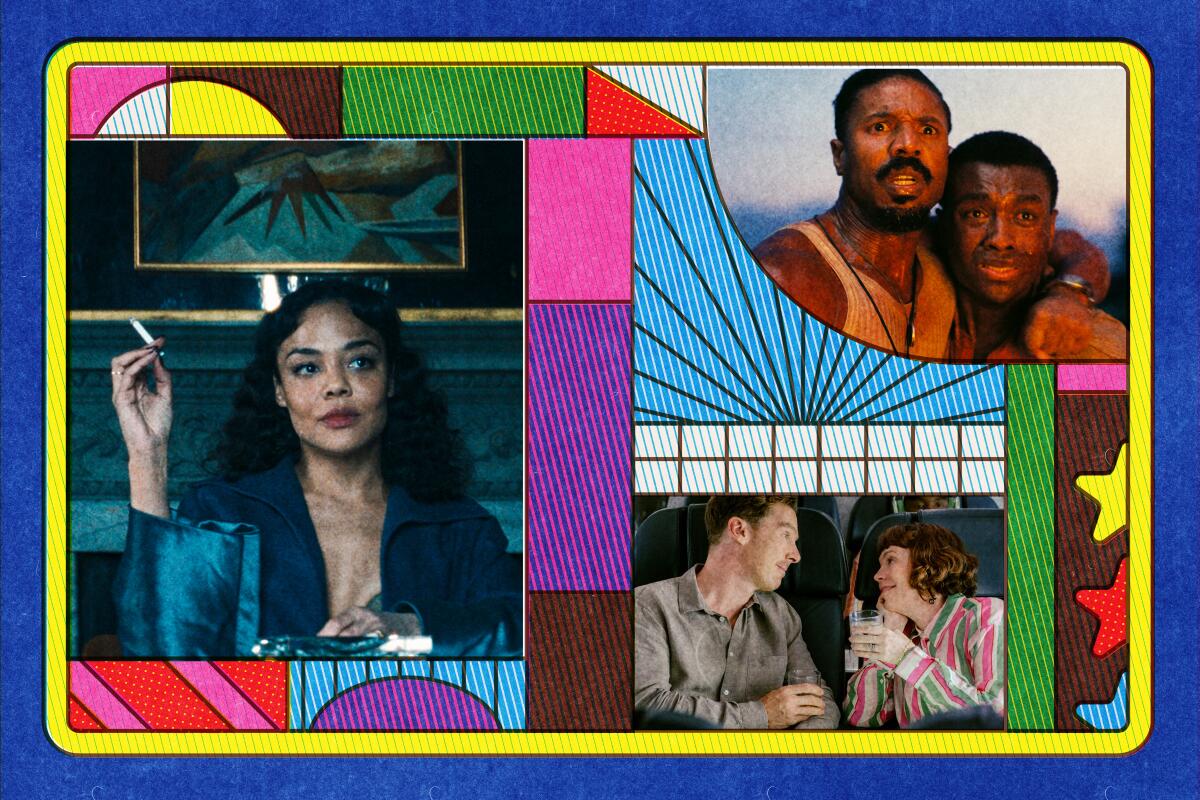
From left, Tessa Thompson in “Hedda”; Benedict Cumberbatch and Olivia Colman in “The Roses”; Michael B. Jordan and Miles Caton in “Sinners.”
(Photo illustration by Josep Prat Sorolla / For The Times; photos from Amazon Prime, Searchlight Pictures and Warner Bros. Pictures )
The 10 best movies of 2025 — and where to find them: The best movies of 2025 include “Sinners,” “Hedda,” “One Battle After Another,” “Eddington” and “The Naked Gun,” according to our critic Amy Nicholson.
The 12 best needle drops of 2025: These songs made their scenes indelible, from classic rock and dance pop to old-timey blues and thrash. There’s even a former Beatle on here.
Best of 2025: Television — from left, Anna Lambe in “North of North,” Ethan Hawke and Michael Hitchcock in “The Lowdown,” “Women Wearing Shoulder Pads.”
(Photo illustration by Josep Prat Sorolla / For The Times; photos by Netflix, FX and Warner Bros.)
The best TV shows of 2025: The TV series on this list delivered real surprises with new directions and original formats, while others just had good old-fashioned storytelling, according to our critic Robert Lloyd.
The 16 best documentaries of 2025: The documentary films and series that captured our attention this year feature famous people and ordinary people, as well as new ideas and perspectives.
The best reality TV of 2025: Scandals, competitions and breakups are par for the course on reality shows, but this year also brought some tender moments that made for must-see TV.
The 33 best comedy specials of 2025: Specials by Frankie Quiñones, Andrew Schulz, Jordan Jensen, Sebastian Maniscalco, Bill Burr, Atsuko Okatsuka and Gabriel Iglesias make our list.
15 must-watch British crime drama series: Whether with an old-fashioned one-case-per-episode or a more sprawling multistrand story, quaint or violent, historic or modern, the birthplace of Agatha Christie understands that we all need stories that make sense of seemingly senseless acts.
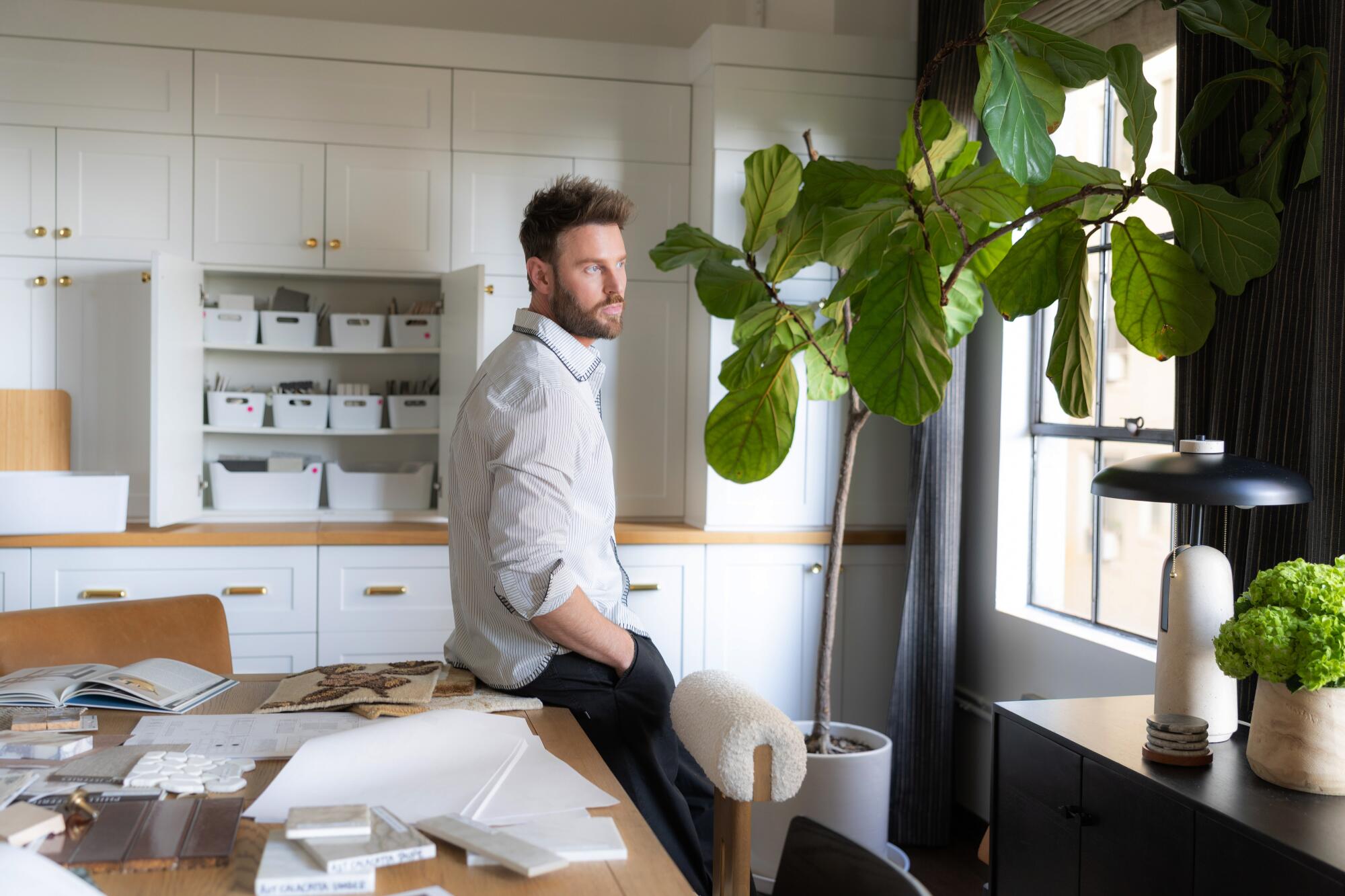
Nobody does a jaw-drop reaction like Bobby Berk. It’s only surprising when you assume he’s probably seen it all after eight seasons traveling the world as the interior design expert on Netflix’s reboot of “Queer Eye”; writing his 2023 book, “Right at Home: How Good Design is Good for the Mind”; making many TV appearances (including a Taylor Swift video) and selling pretty much anything to make your home shine on BobbyBerk.com.
But in his new HGTV series “Junk or Jackpot?”, premiering Friday at 9:30 p.m. Pacific, genuine reactions come often from Burke as he enters the homes of Los Angeles collectors and sees not only rooms jam-packed with action figures, pinball machines, puppets, marionettes and more, but also some jackpot items just sitting on a bookshelf. In one episode, for example, a collector shows Berk a trading card he has that is appraised in the $100,000 range. “I’m pretty sure I said, ‘What the f—?’ though I assume it was bleeped because it’s HGTV,” says Berk from his Los Angeles home. “I’m used to Netflix, where I could say whatever I wanted. But, yeah, that was just crazy to me.”
Reactions aside, the real marvel on “Junk or Jackpot?” is watching an enthusiastic Berk swoop into people’s homes to help them learn how to come to terms with a collecting hobby that has grown into something that’s stifling homes and putting a damaging strain on relationships. “Obviously, I’m not a therapist. I’m a designer, even though in our field, we often make the joke that we’re not just designers, we’re marriage counselors,” he says.
But Berk, born in Houston and raised in conservative Mount Vernon, Mo., is a self-taught pro at identifying what isn’t working and doing everything possible to fix it, including in his own life. Case in point: Berk, not feeling safe coming out in Mount Vernon, left home at 15 and bounced around for several years in various cities, never finishing high school. “From 15 to 22, I moved around and can’t even count the amount of places I had to move around to just due to finances and situations going on in life,” he recalls.
Eventually, he landed in New York City and worked for stores like Restoration Hardware, Bed Bath & Beyond and Portico before he opened his first online store in 2006 and first physical store in Soho in 2007. Soon thereafter, Berk was racking up appearances on networks like HGTV and Bravo before “Queer Eye” came calling in 2018 and took him to new heights, including his 2023 Emmy win for structured reality program. He also received an honorary degree from Otis College of Art and Design in 2022.
Now, with “Junk or Jackpot?” about to launch, the 44-year-old Berk spoke about how he was handpicked by pro wrestler and movie star John Cena for the show, the key to helping collectors let go of things that are weighing down their lives, and, after living many places and traveling the globe, where he considers home with husband Dewey Do and their mini Labradoodle, Bimini.
“I’m not a therapist. I’m a designer, even though in our field, we often make the joke that we’re not just designers, we’re marriage counselors,” Berk says.
(Jason Armond/Los Angeles Times)
What are the origins of “Junk or Jackpot?” and what does John Cena have to do with it all?
I’ve been toying back and forth with HGTV for years, even when I was still on “Queer Eye,” but with my exclusivity with Netflix, I couldn’t do design shows with anybody else. We always just kept that line of communication open, so then when this specific opportunity came about, Loren Ruch, the head of HGTV, who’s unfortunately since passed, reached out. He said, “Hey, John Cena’s created the show for us and you’re the top of his list of who he wants it to host it.” John was a big “Queer Eye” fan, so I said yes. It shot here in L.A., which was really important to me. We were really lacking for entertainment jobs here in the city so that was a big plus for me to be able to bring jobs here to L.A. to all of our amazing crews.
And it’s not your typical design show. Obviously, there’s nothing wrong with a typical design show and they do help people. But coming from “Queer Eye” where everyone we helped was because it was somebody deserving, somebody that was going through something and needed that extra boost in their life. That’s what this was with “Junk or Jackpot?”
Every single collector, as we’re calling them, had a story going on. With Patrick and Roger [in the premiere episode], Roger had moved out and their relationship was on the rocks because there was literally no space for Roger. With Carly and Johnny in another episode, they had a kid that they weren’t expecting to have in their early 40s, so it was a life-changing moment for them. Their priority needed to be their son, J.D.
I love the show because it was helping people at these moments in their life where they’re like, “We have this thing that we love and has brought us joy, but now this thing is actually starting to have negative things happening in our life.” I wanted to come in and really bring back the joyous part of their collection.
HGTV hasn’t given you a huge budget to revamp the homes and the collectors have to work themselves to sell off their collectibles to pay for the renovation. How did that angle come about?
It was a bit of therapy and I wanted the collectors to really realize that, yes, the collection that they have has value but this other thing that is happening in their life because of this collection has value, too. I wanted them to either be able to prove to themselves that what they were wanting to change in their life had more value than those things. Like with Patrick, Roger had a value.
I wanted them to go through the exercise of “You need to start parting with things.” And if you notice, I never pushed them to get rid of the most precious pieces of their collection. I pushed them to get rid of the things that often they had duplicates of but weren’t necessarily something like, “Oh, I got this as a child” or “somebody got this for me.” I wanted them to emotionally disconnect with those things so they could prioritize things better in life and in the future, they would have a lot easier time letting go even if I wasn’t there to push them.
Swatches and mood boards in Berk’s office. The host of “Junk or Jackpot?” says it is not your typical design show.(Jason Armond/Los Angeles Times)
How do you consider budget with the collectors? In one episode, you choose to cover a brick wall instead of tearing it down and building a new one.
The homeowners are the ones footing the bill for this, because again, a portion of this is the exercise of letting go. To your point, if we had just come in at HGTV and said, “Here’s all the money!” They’re like, “All right, I have no motivation to get rid of anything.” I wanted to make sure we made budget-conscious decisions and I think that’s also a really important thing to share with people at home that you don’t always have to go out and knock out a fireplace if you hate the material. You can do a thing like micro cement and you can completely change it for a minimal cost.
What would you say you learned from shooting the first season of “Junk or Jackpot?”
I wouldn’t say I learned anything necessarily new, but it was reaffirmed to me the emotional attachment and mental health aspect that your space and design can have on you, either in a good way or a bad way.
In the bad way, your house becomes so cluttered and overwhelmed with something that used to spark joy for you, but it’s now having an effect on not only your mental health, but your relationships with other people. On the other hand, the difference in your mental health just redoing that space, reorganizing that space, reclaiming that space can have on your mental health and your relationships not only with yourself, but with your family and your friends.
Vivian, who collects Wonder Woman memorabilia, her friends stopped coming over because there was just nowhere to sit. Her best girlfriend used to come in from Vegas all the time, where she lives, and she would spend the night and now she’s like, “I just can’t anymore because I’m surrounded literally. It’s too much and I just can’t do it anymore.” You see how just changing your space really can change your life.
“I wanted to make sure we made budget-conscious decisions and I think that’s also a really important thing to share with people at home, that you don’t always have to go out and knock out a fireplace if you hate the material,” Berk says.
(Jason Armond / Los Angeles Times)
Season 1 is set in Los Angeles but assuming you get more seasons, would you want to do other cities or countries?
I personally would always love just to keep doing L.A. I live there and with “Queer Eye” for eight years, we traveled all over America. That being said, this is a very niche show, so it might be hard to continue doing it in the same city season after season, so we probably will have to go to other cities, and I’d be fine with that. But I would at least like another season or two in L.A. After spending the last eight years filming “Queer Eye,” I like being home.
That said, you have lived in New York, you’re in L.A. now and you also have a place in Portugal. Where do you call home?
L.A. is definitely home for me. Portugal’s great, but L.A. is definitely home. Although the more time we spend in Southeast Asia, specifically Vietnam, since my husband’s originally from there, that also feels like home. I believe in reincarnation, and I was definitely from over there in my last life. Like when I landed in Vietnam, in China, anywhere in Southeast Asia — I just feel very at home.
“Queer Eye” was such a roller coaster for all you guys but what are your reflections now that it is behind you? Were you able to enjoy it at the time?
Yes and no. It was an amazing roller coaster. I enjoyed most of it, but there were times where we were just exhausted. I don’t know if you know the flight app “Flighty,” but it tracks your flights and tells you how many hours you’ve been in planes every year and how many times you’ve been on the exact same plane. I was looking the other day at how much I flew in 2019. Keep in mind in 2019, five months of the year I was filming, so I wasn’t flying anywhere. So this was just seven months, and I flew 200 flights. I flew over 500,000 miles. I don’t miss that. That was a lot. But as much as I can remember of it, I look back with fondness.
If the Shakers have a lasting cultural legacy, it is their music — most famously “Simple Gifts,” the uplifting spiritual Aaron Copland immortalized in his ballet “Appalachian Spring.” It stands to reason, then, that a film about Ann Lee, the founding “mother” of this 18th century celibate Christian sect, would be a musical. But this was no conventional woman and “The Testament of Ann Lee,” directed by Mona Fastvold and opening in L.A. on Dec. 25, is no ordinary musical.
“Ann Lee was very radical and extreme,” says composer Daniel Blumberg, “and Mona is as well.”
As conceived by Fastvold and Blumberg, the entire tapestry of this film is musicalized — from the emphatic breathing, chest thumping and floor stomping that make up the worshipers’ rituals, to the songs, inspired by Shaker traditionals and performed by star Amanda Seyfried and the cast. Even the sounds of wind, the creaking of ships and a passing cow play a part.
“This cow walks past during the song ‘I Love Mother,’” says Blumberg, 35, visiting L.A. from his native England and speaking from a hotel room over Zoom. Bald with severe features but a soft and guileless disposition, he’s fidgety about the whole Hollywood press dance — this is only his fourth feature film score. But Blumberg is eager to dissect his music-making process and brag about his collaborators. “We were tuning the cows to the song,” he says.
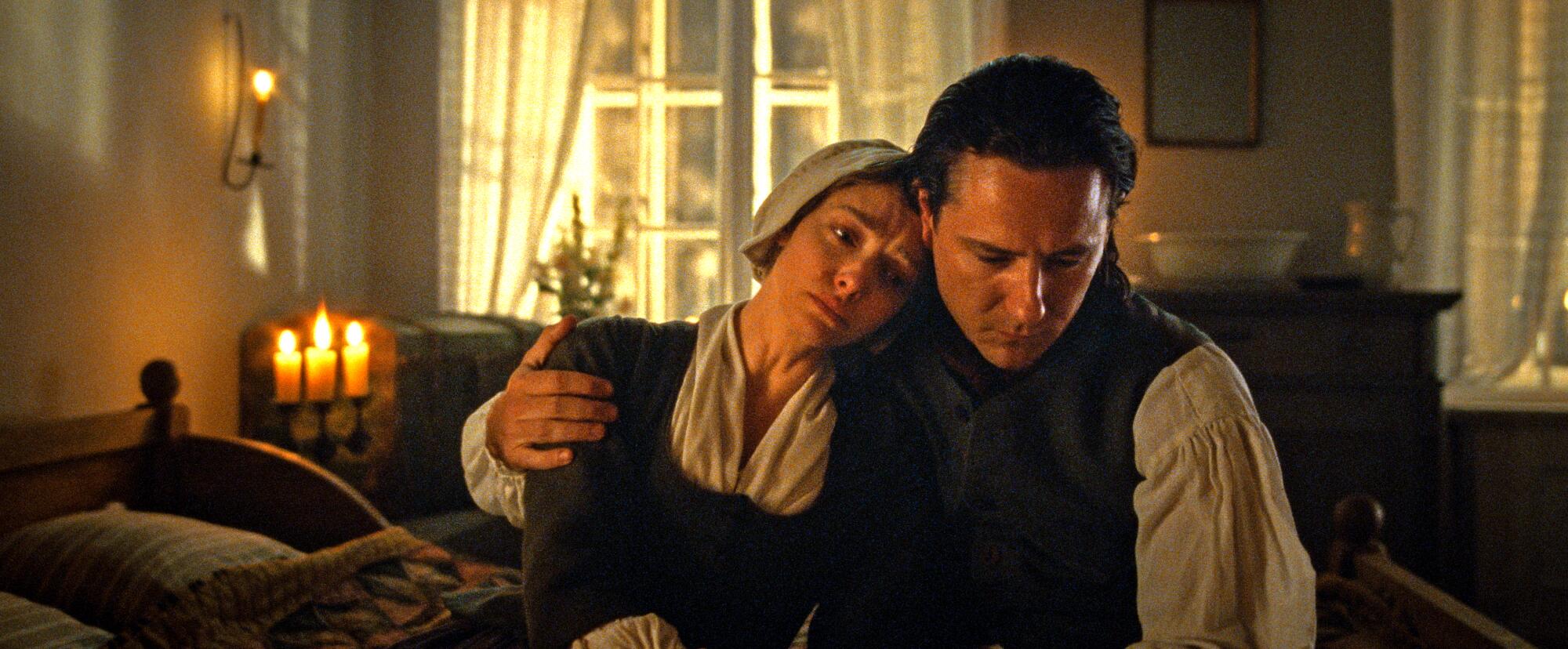
Amanda Seyfried and Lewis Pullman in the movie “The Testament of Ann Lee.”
(Searchlight Pictures)
In a prologue about Lee’s harsh childhood in Manchester, England, her mother hums a tune to her based on the traditional Shaker hymn “Beautiful Treasures.” The melody is then completed on celeste in Blumberg’s score, surrounded by a liturgical choir. The entire film is this kind of holistic musical current: score, songs and environment all in conversation with each other, every component a part of the dance.
“The whole project was very dangerous,” says Blumberg, an indie singer-songwriter with a cult following in the U.K. and now an Oscar for last year’s “The Brutalist.” “It’s always on the edge. And for me that’s a good place to be when you’re making art.”
In one stunning montage, we see a newly married Lee subjugated to religiously-tinged sex (a catalyst for her dogmatic rejection of carnal relations), give birth to several babies, mourn their deaths and express her sorrow in a fervent dance for God. Erotic noises and the cries of childbirth weave together with prayerful moaning and a mother’s keening cries, all integrated into Blumberg’s instrumental score — a guided meditation for bells and strings — with Seyfried singing “Beautiful Treasures.”
“It was very important to me to try and create this hypnotic feel to the film,” says Fastvold, speaking on Zoom from her car during the awards-season whirlwind. “You had to understand it on a sensorial level. Because I think a lot of the appeal, especially early on, were these kinds of endless dance/voice/confession sessions that would last for days.”
“If it’s just someone preaching to you,” she adds, “I certainly can’t connect to that.”
The director, 44, grew up in a secular home in Norway, but her film about this radical American sect is strikingly earnest. Fastvold doesn’t judge Lee’s convictions; there isn’t an ounce of cynicism or condescension. After having a prophetic vision in which Lee is told she is the female incarnation of Jesus Christ, Seyfried sings, “I hunger and thirst / After true righteousness / I hunger and thirst” with utter heart-bleeding sincerity. The camera and the music share her faith completely.
“I never felt like I wanted to laugh at them,” says Fastvold. “I wanted to laugh with them and sometimes their naivete is funny and endearing. But I never wanted to ridicule them. Of course, it’s a very scary thing to try and do.”
When Seyfried read the screenplay two years ago, she experienced some of that intimidation.
“It was definitely the most confused I’ve been in a while reading a script,” she says, nursing a hot tea on Zoom, “because I’m seeing these placeholders for where the hymns will be, when the music comes in, when the diegetic sound goes out or if it doesn’t at all. It was all very foreign to me — which is not necessarily a bad thing. It just leaves me with so many questions.”
Fastvold co-wrote “The Testament of Ann Lee” with her partner, Brady Corbet, who directed “The Brutalist.” They were developing it while working on his breakthrough epic. Blumberg, who has made a number of solo albums and been part of several bands including Cajun Dance Party and Yuck, became friends with Corbet a decade ago. The trio became inseparable.
Fastvold was listening to Blumberg’s records when she decided to direct “The World to Come” in 2020, a warm historical romance about two women in a chilly frontier America. She remembers being captivated by the “beautiful dissonance” in his music. “There’s this mournful, slightly atonal quality to his compositions,” she says.
Fastvold hired Blumberg to score her film — his first — and invited him to the set in Romania to experience the time-traveling feeling of the woods and the sound of passing sheep. She even gave him a small on-screen part, selling a blue dress to Katherine Waterston’s character. It was emblematic of her and Corbet’s then-burgeoning philosophy: of making lavish films on a shoestring, using stunning foreign environments to portray a bygone America and roping crew members and family into the collaboration.
For her ambitious follow-up musical about the Shakers, Fastvold knew she needed Blumberg at the ground level, along with choreographer Celia Rowlson-Hall, a collaboration that required proximity. “We kind of move in together for a while and just start figuring it out,” Fastvold says.
“The whole project was very dangerous,” says Blumberg. “It’s always on the edge. And for me that’s a good place to be when you’re making art.”
(Ian Spanier / For The Times)
They discussed how to cast a spell on the audience and how, with cinema, “you’ve got these tools to use,” says Blumberg, “with image, sound, the writing of it all and just to push those as far as possible. Obviously with the edit you can move in time very quickly, and then with sound you can bring people into the room that the characters are in, but also bring them into the heavens. It was trying to use the materials that we had to make an experience — with the story, but inside the story as well. An immersive experience.”
Fastvold and Blumberg immersed themselves in the thousands of songs the Shakers left behind, including hymns and what the group called “gift songs” and “dance songs.”
“What is our dialogue with this tradition and what is it that we’re bringing to this conversation?” Fastvold remembers them asking each other. “Because really that, to me, is what folk music is. It’s passed on, it’s transformed — it turns into something else and then passed on again.”
They found several Shaker songs that fit the needs of given scenes and moments; whenever they couldn’t, Blumberg wrote an original. The Jewish composer recalled the niguns — wordless, improvised prayers — that he grew up hearing in synagogue, and he drew on that sense memory. Many Shaker songs are mantra-like prayers addressed to God, simple rising and falling melodies based on a short repeated phrase. Blumberg got creative with the harmonies, creating demos that he sang himself.
“It was very nerve-racking,” he says, “because score is a moment where you can fix things — you do it after the edit — but this was going to define the pace of the film. There’s quite high stakes of it working.”
Seyfried was nervous too. Even though she’s a trained singer, with film credits including “Mamma Mia!” and “Les Misérables,” this peculiar religious epic required an enormous leap of faith.
“I knew Mona was going to shoot it beautifully,” Seyfried says, “and I knew that Daniel was going to be there every step of the way. And I knew that I was in good hands — but I didn’t know at that point that I could trust myself as a singer, as a musician. It was completely new territory for me. Terrifying.”
The songs were prerecorded for playback on set. The first thing Seyfried recorded in studio was an a cappella song for a scene late in the film — the lyric is “How can I but love my dear faithful children?” She says she felt miserable.
“I was just like: I sound terrible,” Seyfried says sincerely. “This song is not fun to sing. It’s beautiful, but I don’t sound beautiful. I don’t like the way I sound. And we kept doing it and my voice was dry.”
Blumberg patiently worked at finding the most comfortable key for her voice. “I had no idea how lucky I was,” she says.
Amanda Seyfried in the movie “The Testament of Ann Lee.”
(TIFF)
In the process of working with Blumberg, Seyfried says she came to a deeper appreciation of the character as well as her own singing voice. “I was so critical of it,” she remembers, but the role gave her a different kind of freedom. “I was playing somebody who didn’t necessarily have to be a beautifully trained singer,” she says. “She sang because she wanted to feel alive, and she wanted to feel free, and she wanted to feel connected to her faith — and that already just liberates the performer.”
After extensive rehearsals that continued throughout production, Fastvold shot the film in Budapest. Blumberg was always on set, accompanying the actors with a small keyboard. (Thomasin McKenzie and Lewis Pullman are among the cast members who also sing in the film.) Sometimes the actors had a simple click track in an earpiece, other times a “stomp track” from the foot choreography. They would sing live in addition to lip-syncing to playback and Fastvold amassed a huge variety of live tracks — vocals, breaths and other bodily sounds — for her final mix.
“I wanted all of that life and that natural feel to it,” she says, “to not have it feel polished at all, to just be really raw. Because they weren’t singing to entertain. It’s never performative. It’s always from this place of prayer or pain.”
With her principal cast surrounded by Hungarian extras, Fastvold roped everyone, from the dialect coach to the first assistant director’s son to Blumberg’s sister, into the dance.
“If you came to visit, you were in the movie,” she says. “The cast is the crew and the crew is the cast. It’s how I like to do it.” Once again, Daniel Blumberg appears on-screen, in scenes of Shaker worship; he also sings an original duet, “Clothed by the Sun,” with Seyfried under the end credits.
But at this point his work was only half done. Armed with a cut of the film, pillared by the songs he wrote and arranged, Blumberg crafted a score that subtly teed up song melodies and established a sense of spiritual trance. He gravitated toward the sound of bells; he and Fastvold found a handbell from Ann’s era that they used in early demos and he ended up renting some 50 church bells, in different keys, all laid out on the floor of his London flat.
He extended the bell idea with the jangly celeste, also known as a bell piano, and he augmented those bells with a small string ensemble, a choir and, at one point, even an electric guitar.
It was Blumberg’s idea to have two veteran improvising singers, Phil Menton and Maggie Nichols (who also appears in the film), to each record a track where they improvised along to the entire film. Working with mixer Steve Single, Fastvold and Blumberg would occasionally bring up one of these stems and layer it into the rest of the soundtrack for an added color.
“We’d say, ‘Let’s hear what Maggie was doing at this point,’” Blumberg says, “and then we’d bring up her stem and be like, ‘Oh, wouldn’t it be nice if she follows that character there?’ Or, ‘Wouldn’t it be nice if she’s humming outside the window?’ Or if it’s almost like the heavens speaking down on Ann?”
The final result is utterly unique to Blumberg and Fastvold, a period character study by way of trance and an experiential approximation of religious fervor. By exploring a distant and somewhat alien community through the device of music, they somehow tapped into something universal.
One of Blumberg’s favorite moments in the film is a scene where a group of sailors, transporting Lee and her disciples to the new world, shout at the Shakers to stop singing. “They really sound like this out-of-tune rabble, and you hear what maybe other people might have heard,” he says. “And then a few minutes later they’re praying on the ship and I’ve used all these reverbs and there’s all these choirs singing in the background — it’s almost like what they felt from within.”
Like the Shakers and their songs and prized furniture, “Ann Lee” was made with craft and care by a small and familial utopian community of its own.
“There were no notes from film people,” says Blumberg. “It was our bubble. So the only fear was just them trying to release it and everyone going, ‘No, that’s just mad.’ But what I was trying to do from the start was: If I got to something that seemed good, how can I push that further? Like, really trying to push everything to the extreme.”
Why this column stuck with me: I chose “I’m Fighting Parkinson’s One Punch At A Time” because it was a story that took four years to write but one that has resonated immediately and endlessly.
When I was diagnosed with Parkinson’s disease in the winter of 2021, I decided to keep the diagnosis a secret. Initially I didn’t even tell my own three children. I didn’t want people feeling sorry for me, or looking at me differently or, worse, treating me differently. I wanted to continue with my normal life while fighting the disease in private.
As part of this fight, I attended a boxing class for Parkinson’s patients. The class was filled with 80-year-old women pounding on a heavy bag, 75-year-old men dancing across the floor, elderly and trembling people working hard to stave off the effects of PD. They quickly became my heroes, and deserved to be illuminated as inspirations to others. I finally realized that I could tell their story and maybe push others to come out of the PD shadows and seek the same therapy.
And, well, if I was going to write about others with Parkinson’s disease, I would have to come clean about myself. So, with help from boxing instructor Jody Hould and sports editor Iliana Limón Romero, I did. And I’m glad I did. I’ve since heard from countless people that the story moved them to admit their illness and begin boxing therapy or other types of PD workouts. My diagnosis was a punch in the gut. But thanks in part to the encouragement that came from this story, I’m fighting back.
CASTEL GANDOLFO, Italy — Pope Leo XIV said Tuesday he was “very disappointed” that his home state of Illinois had approved a law allowing for medically assisted suicide, and he called for greater respect for life.
Leo said he had spoken “explicitly” with Gov. JB Pritzker and urged him to not sign the bill into law. Chicago Cardinal Blase Cupich did the same, Leo told reporters as he left his country house in Castel Gandolfo, south of Rome.
“We were very clear about the necessity to respect the sacredness of life from the very beginning to the very end, and unfortunately, for different reasons, he decided to sign that bill,” Leo said. “I am very disappointed about that.”
Pritzker signed the legislation Dec. 12. The measure is also known as “Deb’s Law,” honoring Deb Robertson, a resident of the state living with a rare terminal illness. She had pushed for the measure’s approval and testified to the suffering of people and their families wanting the chance to decide for themselves how and when their lives should end.
Pritzker, a Democrat, had said he had been moved by stories of patients suffering from terminal illnesses.
Leo, who grew up in Chicago, cited Catholic teaching, which calls for the defense and protection of life from conception until natural death, forbidding abortion and euthanasia.
“I would invite all people, especially in these Christmas days, to reflect upon the nature of human life, the goodness of human life,” Leo said. “God became human like us to show us what it means really to live human life, and I hope and pray that the respect for life will once again grow in all moments of human existence, from conception to natural death.”
The state’s six Catholic dioceses had criticized Pritzker’s signing, saying the law puts Illinois “on a dangerous and heartbreaking path.”
Eleven other states and the District of Columbia allow medically assisted suicide, according to the advocacy group, Death With Dignity. Delaware was the latest, and its provision takes effect Jan. 1, 2026. Seven other states are considering allowing it.
Santalucia writes for the Associated Press. AP writer Nicole Winfield contributed to this report from Rome.
KYIV, Ukraine — Before the war, Ukraine’s own “Dancing with the Stars” was a cherished and popular television show, dazzling the audiences with performances by celebrities and professional dancers. The show is now back on for one special episode — this time with Ukrainian wartime heroes as the stars, underscoring the nation’s resilience in difficult times.
Many still remember how President Volodymyr Zelensky — then an actor — won the dance competition in 2006, the year that “Tantsi z zirkamy” as the show is known in Ukrainian, first debuted.
In the new, special episode, the dancers perform with prosthetic limbs, showcasing their strength in overcoming adversity. The lineup of participants includes public figures who rose to prominence since Russia’s full-out war on Ukraine was launched in February 2022.
But like all of present-day Ukraine, the show — which is part of an international franchise — has had to deal with a multitude of wartime challenges, including frequent power outages.
All the proceeds will go to the Superhumans Center, a specialist clinic for the treatment and rehabilitation of war-wounded victims.
A new reality
During a prerecording last week, dancers spun, leapt and glided under the sparkle of lights, some seamlessly integrating their prosthetic limbs into the choreography.
For creative producer Volodymyr Zavadiuk, every segment of the show is precious, creating something special during tough times.
“It’s about our resilience and it’s about our future,” said Zavadiuk, who also heads Big Brave Events and the Big Entertainment Shows department at 1+1 Media.
Among the performers was Ruslana Danilkina, a war veteran who lost her leg in combat in 2022 and is now renowned in Ukraine for dedicating herself to helping injured troops adapt to life with prosthetics.
She delivered a passionate performance centered on reclaiming her womanhood following the traumatic injury.
Also back in the show is beloved dancer Dmytro Dikusar, this time as a competition judge. He juggled filming and serving with his platoon on the front lines.
Ukrainian rock musician Yevhen Halych sat in the makeup chair ahead of his number, reflecting on his own determination to bring back the show.
“We are filming this project in a country where there is a war. … We have power cuts, we may have an air alert, it could be bombing,” he said. “What do I feel? I feel a genuine desire to live a full life, no matter what happens.”
Wartime challenges
Producing the show’s special episode has been no easy feat in time of war. A live broadcast was impossible — a Russian attack can happen at any time. Then there were the technical obstacles: during last week’s recording, a key generator malfunctioned.
When the show airs on Sunday, audiences will vote for their favorite.
Danilkina, who was only 18 years old when she lost her leg and who today works at the Superhumans Center, enthralled everyone with her passionate performance, her prosthetic limb artfully integrated into her routine.
“Our dance number is about life. It’s about accepting love,” she told The Associated Press after her performance. “Because in reality, when your body is wounded, it’s very difficult to love yourself. And allowing someone else to love you is even harder.”
Her injury was not the end of her life, she said, and now she wants to show “thousands of wounded boys and girls who are starting their lives over again” that it’s not the end of theirs.
For veteran Ivan Voinov and his wife of three months, Solomiia, the show was more than just a dance performance: it was the second time they had danced together since his injury, the first time was at their wedding.
Solomiia Voinov smiled shyly, recounting how she had long tried to persuade Ivan that they should dance until he gave in.
“We don’t take our eyes off each other while dancing, and it’s a great connection,” she said. “I’m happy.”
Voinov said he was already planning their next dance — a bachata, a fast-paced, hip-swaying style of dance that originated in the Dominican Republic.
“We will be able to continue dancing,” he said. “It means that there is a future.”
Kullab and Stepanenko write for the Associated Press. AP videographer Alex Babenko in Kyiv, Ukraine, contributed to this report.
Celebrated actor Will Sharpe is taking the lead in a must-watch new Sky drama, so what do we know about his life away from the screen?
British actor Will Sharpe stars alongside Paul Bettany in one of Sky’s biggest new shows of the year, Amadeus.
A brand new, star-studded interpretation of the classic Peter Shaffer play, this sumptuous five-part drama reimagines the fierce rivalry of two iconic composers; Antonio Salieri (played by Bettany) and Wolfgang Amadeus Mozart (Sharpe).
Created by Joe Barton, the series is set to catapult the star to even loftier levels of fame after already landing acclaimed roles in The White Lotus, A Real Pain and Too Much.
But, did you know the actor, writer and creator already won himself a BAFTA nomination over a decade ago and is married to an equally familiar name from the world of streaming TV?
Let’s take a look at what we know about Will Sharpe’s life and career so far.
Early Life
Will Sharpe is half-Japanese on his mother’s side and, despite being born in London, was raised in Tokyo until he was eight. The family then settled in Surrey.
After schooling at Winchester College, he went on to study classics at the University of Cambridge and became the president of the Cambridge Footlights comedy troupe.
However, his first attempts at a showbiz career didn’t go as planned. Upon graduating, Sharpe moved to London and began performing at open-mic comedy nights in Whitechapel.
Speaking to GQ, he recalled: “The thing that I’d sometimes do was see how long I could act as if I wasn’t sure about the performing space, like moving chairs around and adjusting the mic, before it stopped being funny for them. And then seeing if I could do it for so long it became funny again.”
Unfortunately, he was eventually approached by a comedy agent who admitted she couldn’t represent him because it was unclear if he was actually performing comedy. He opted for a different approach instead, joining the Royal Shakespeare Company for its 2008-2009 season.
Career Success
Thankfully, it didn’t take long for Sharpe’s talents to be recognised as his 2011 film Black Pond, co-directed by Stath Lets Flats and Ghosts’ Tom Kingsley, was nominated for the BAFTA Award for Outstanding Debut by a British Writer, Director or Producer. They had previously worked together on the 2009 short film, Cockroach.
A few years later, Sharpe received more awards recognition for his Channel 4 comedy-drama series Flowers, starring Olivia Colman, Julian Barratt, Daniel Rigby and Sophia Di Martino, as well as himself. This won Sharpe his first BAFTA, for best scripted comedy.
A few years later, he won his first acting BAFTA for his critically acclaimed turn in Amadeus writer Barton’s hit crime drama Giri/Haji. He went on to have similar success in Hollywood for his Emmy-nominated turn in The White Lotus season two. Sharpe also directed the biopic film The Electrical Life of Louis Wain, starring Benedict Cumberbatch as the titular troubled artist.
Mental Health Struggles
Many of Sharpe’s projects tackle mental health issues and the actor/director has drawn from his own experiences to bring those personal stories to life.
Following the release of the second season of Flowers in 2018, the creator revealed he had been diagnosed with type two bipolar disorder.
Writing in a blog for the mental health charity mind, he shared his wish for the series was for “the audience to get a sense of how helpless you can feel in the face of mental illness, of how relentless and confusing it can be, and how painful it is to love somebody who is suffering.
“Because, for me, the only way to feel truly hopeful is to look at that stuff head on and still feel like there’s a way through.”
He added: “My experience of mental illness is that it can sell you an overpoweringly compelling – and fictional – narrative about your life, to which it can eventually start to feel like there is only one possible conclusion.
“The final episode of the second series of Flowers, I hope, challenges that and offers, if you like, a break in the narrative.”
Sky’s Essential TV and 300Mbps broadband bundle
This article contains affiliate links, we will receive a commission on any sales we generate from it. Learn more
Sky has cut the price of its Essential TV and 300Mbps fibre broadband bundle, but the deal expires on October 15.
Famous Spouse
Sharpe is married to his Flowers co-star Sophia Di Martino, with whom he has had a relationship since 2009. The pair met while filming Casualty, in which they were both main cast members. They have two children born in 2019 and 2021.
The actress is perhaps best known for portraying Sylvie, an alternate female version of Tom Hiddleston’s iconic Marvel villain Loki, in the Disney+ superhero drama based on the fan-favourite character.
She has also appeared in Sharpe’s The Electrical Life of Louis Wain and reunited with him again in an episode of Netflix’s Too Much. Di Martino will also star in her husband’s upcoming Apple TV series Prodigies, alongside Ayo Edebiri.
Amadeus is available on Sky and streaming service NOW.
What do fallen empires leave behind? Djaimilia Pereira de Almeida’s new work of fiction attempts to answer that question. “Three Stories of Forgetting” probes the inner worlds of three men scarred by their participation in Portugal’s history of rapacious colonialist intervention that ended in 1999. For nearly 600 years, the European republic was involved in a bloody land grab that at its peak controlled over 5.5 million square miles across Africa, Asia and the Americas.
Pereira de Almeida’s protagonists — Celestino, a slave trader; Boa Morte, a former soldier who had been conscripted to fight his fellow Africans in the Guinea-Bissau War of Independence; and Bruma, an elderly plantation worker — live in a liminal state between past and present, searching for some measure of solace in a world that offers none. I chatted with Pereira de Almeida, who was born in Angola but was reared in Lisbon, about her haunting triptych of stories.
You’re reading Book Club
An exclusive look at what we’re reading, book club events and our latest author interviews.
Djaimilia Pereira de Almeida is author of “Three Stories of Forgetting,” a new novel exploring the legacies of slavery, colonialism, and the Portuguese Empire.
(Humberto Brito)
Three stories of forgetting … but nothing is forgotten among these men.
All three men are tormented by what they can’t forget, although they don’t feel exactly guilty, in the case of Celestino and Boa Morte. Bruma is a different story. The “forgetting” of the title relates to the omission of the figures who do not appear in the book, or who appear only occasionally, episodically. Those who are forgotten are the victims and their story. These three stories are also chapters of a more general story of violence, that of colonialism, whose victims are largely forgotten to this day.
Boa Morte, a valet in Lisbon, carries an enormous burden of guilt; in order to expiate it, he tries to save a young street vagrant. Of course, all attempts at redemption in the book are futile — why is that?
I don’t think redemption is as common as much of today’s fiction seems to suggest. The experience of guilt or of an existence haunted by ghosts seems more common to me. Boa Morte was forgotten by Portugal, the country for which he gave his life, and his hateful behavior left him utterly alone. What would redeem his life? Boa Morte is inspired by a man I knew who became my friend and lived on the streets of Lisbon, just like the character. One day, he was found dead in an alley. Not all lives know redemption.
The three protagonists are captives of their pasts, because the past is still present. Can you speak to that?
After reading [British philosopher] Peter Geach’s sentence that opens his book “The Virtues,” I became interested in inquiring into the lives of people who may be, so to speak, “dead in the eyes of God.” The problem with this possibility, however, is that we may die in the eyes of God early in life, without knowing it, and yet live to old age and remain here.
This sentence is important to me, regardless of its religious meaning. It is important in that it opens up the possibility that we may have exhausted our share of grace in life and, as humans, need to keep going.
All three of these characters are looking for some kind of solace — whether it’s reverting to some kind of quiet life among living things that don’t talk back, or building a lean-to as a kind of sanctuary.
Perhaps these places they seek are, in very different ways, the only possible remnants of rest: and also places where questions have ceased. Among living things that don’t talk there are no witnesses, there is no guilt.
You can’t write stories like these without some degree of empathy — do you feel sorry for these men? What do you feel for them as a writer?
I agree with that. I don’t feel sorry for them, but I tried to get closer to them and understand them, without imposing my ideas and opinions on them, something I don’t like to do when I write novels. Instead, I preferred, as I usually prefer, to fly around them like an insect, to study them, to let them talk to me: It is a non-imposing approach, which lets the characters speak. In general, I tend to be interested in characters I don’t like and who wouldn’t treat me with the kindness I show them. It’s my way of seeking justice, in its contradictions, and of exploring ambiguity in human behavior: I want to create hospitality, and that means being able to extend my hospitality to characters whose deeds I condemn.
(This Q&A was edited for length and clarity.)
📰 The Week(s) in Books
Carolyn Kellogg, Bethanne Patrick and Mark Athitakis select the best books of the year for The Times.
(Photo illustration by Josep Prat Sorolla / For The Times; book jackets from Scribner, Riverhead and Penguin Press)
Jim Ruland talked to Thurston Moore about his new book that chronicles the Sonic Youth guitarist’s love of free jazz. “I go out with my band and I play typical band gigs,” says Moore, “but I prefer being in a basement with a free jazz drummer any day of the week.”
Mark Athitakis finds favor with W. David Marx’s “Blank Space,” a sharp critique that maps the decline of our present culture, as well as Adam Morgan’s biography of 20th century literary firebrand Margaret C. Anderson, a trailblazer who bucked the prevailing culture to champion challenging art, including Joyce’s “Ulysses.” “If we want more works like ‘Ulysses’ in our world (and far less cringe) … it will demand a stubbornness from creators and dedication from consumers that the current moment is designed to strip from us,” Athatakis writes.
Apollo, one of two bookstore cats, sleeping in a box at the Iliad bookstore in North Hollywood.
(Gerard Burkhart / For The Times)
The San Fernando Valley has lost many of its beloved bookshops over the last two decades, but North Hollywood’s Iliad bookshop remains. The store, which first opened its doors 28 years ago and remains the greatest purveyor of used books in all of Los Angeles, is the kind of tangled labyrinth teeming with titles that one can get lost in for hours. I spoke with Dan Weinstein about what is moving out of the doors this holiday season.
What is selling in the Christmas rush this year?
We tend to sell the same kinds of titles all year round, so it’s standard literature, science fiction and the handful of authors we can’t keep on the shelves: Octavia Butler, Charles Bukowski, Sarah J. Maas and Brandon Sanderson. Also, a lot of gift cards! Actually, January is our strongest month for sales — winter kicks in and people like to stay at home and read.
Full disclosure: I’ve been a loyal Iliad customer since the ’90s. Do you tend to see the same faces across the years?
Oh, we have very serious hardcore customers that come over and over again. Some of them even come on a daily basis. Fortunately, we are always putting good new inventory out.
What about Hollywood business? You have a tremendous inventory of art and photography books. Do set designers come in to find inspiration?
We do sell a lot to the entertainment industry. That really keeps us alive. If we were doing business in a city other than Los Angeles, I don’t think we would do nearly as well.
PLODDING down the steep cobbled ramp, I was already starting to believe that I was stepping into a fairytale.
The boat, bobbing on the water, was the start of my journey to another world.
Sign up for the Travel newsletter
Thank you!
The Scottish island of Eilean Shona was the inspiration behind Peter Pan’s NeverlandCredit: @goodcompany.group/@konrad.j.borkowskEilean Shona is a rugged tidal island in Scotland’s Inner Hebrides which is only accessible by boatCredit: @goodcompany.group/@konrad.j.borkowsk
And, as I drew closer to my destination — a small, mist-shrouded island that was the inspiration for Neverland in JM Barrie’s Peter Pan stories — the storybook setting felt even more real.
Eilean Shona is a rugged tidal island in Scotland’s Inner Hebrides.
“Hidden gem” is an apt description of the place, with visitors having to drive down a long and winding road on the mainland before they even reach the boat taxi that will ferry them to the island.
Boats aren’t on a regular schedule either — the island, and its manor house, Eilean Shona House, is privately owned by Sir Richard Branson’s sister Vanessa, who transformed the destination into a luxury eco-friendly retreat in the 1990s.
I really did feel like Wendy when I spotted Neverland for the first time, hidden beneath the clouds.
Just like JM Barrie’s mythical land, the island is covered in thick green woodland.
But this is far from your typical island retreat. Don’t expect speedy wifi, shops and roads, because Eilean Shona is completely car-free, has no shops and only nine people live here.
Instead, you can expect whimsical walks, white sand beaches and a cosy Scottish atmosphere.
The best way to get your bearings is with a refreshing walk to the summit of the island, 265 metres above sea level, which boasts spectacular views over Loch Moidart and the small isles of Rum and Eigg, as well as the Isle of Skye.
You can reward your hiking efforts with a slurp of vodka, because while whisky is the spirit more typically associated with Scotland, this island is where the premium spirits brand Sapling began.
Sat on a bench near the water’s edge in 2018, the brand’s founders, Ed Faulkner and Ivo Devereux, came up with the idea for a climate-positive spirit.
Sapling vodka and gin was formed — spirits that didn’t mess with the environment. In fact the firm gives back to it, by planting a tree each time a bottle is sold.
It was the perfect tipple to accompany me as I sat back and took in the calm of the starlit sky overhead, after retreating back to the manor house where I was staying.
Roaring fireplaces
There are a number of smaller cabins and cottages for those who are travelling solo or in a smaller group, but the manor house offers a more grand experience.
It’s a bit like a miniature version of The Traitors castle, with roaring fireplaces, ornate bathtubs, high ceilings and a grand staircase.
The 19th-century property was originally owned by Captain Swinburne, a Royal Navy seafarer, and it started out as a hunting lodge.
Swinburne went on to develop a great love for the pine trees that he saw on his travels and ended up transforming the landscape of Eilean Shona into one of the most diverse pine collections in Europe.
However these spectacular trees are only part of what makes the island’s surrounding so breathtaking.
My mornings consisted of refreshing plunges off the manor’s pontoon into chilly water, followed by dashes into the sauna afterwards.
You can follow it up with a hike or kayaking, or head to the other end of the island to see a gorgeous beach, which is like nowhere else in the UK, where soft, sugar-like sand meets serenely calm waters.
Eilean Shona House is the island’s main accommodation, sleeping up to 18 people, with a dining room that can host up to 20.
There is a library as well, with a full-sized billiards table, dartboard and a large collection of board games, while in the drawing room sits a grand piano, a cosy seated alcove and views of the loch.
The house can be booked either self-catering or fully catered, with a minimum stay of three nights.
Other options include the Shepherd’s Cottage, which sleeps two people, and the Old Schoolhouse, which sleeps four.
On Eilean Shona I could exchange the real world for Captain Hook’s imaginary version — and for a short time, I didn’t need to worry about growing up.
GO: Eilean Shona
GETTING THERE: The closest airport is Inverness, which is around three hours from the island.
Flights cost from £23.99 each way from London Gatwick. See easyjet.com.
Or the Caledonian Sleeper from London Euston Station costs from £59 each way, then it is just over an hour’s drive to Eilean Shona.
Welcome to Screen Gab, the newsletter for everyone who wants to spend some time revisiting Rob Reiner’s indelible mark on pop culture.
For many of us, it was already that time of year when we pop in our DVD of “When Harry Met Sally…” or figure out which streaming service has it in its library (or digitally rent it, if none do), and passively recite every quotable moment until Harry’s breathless declaration of love on New Year’s Eve necessitated our full performance. It was a comfort watch in the best sense because of how joyous and hopeful it left so many of us, even cynics, feeling. This year, as the tradition now becomes layered with sadness following the tragic deaths of Reiner and his wife, Michele Singer Reiner, there’s at least comfort in knowing all the Hollywood magic he brought to life (whether he was directing, or starring in a production) that was full of humanity, humor and heart, and accompanied us at different stages of our lives, can continue to do so. Members of our film team took a look at some of Reiner’s best films, many of which can be streamed. And TV critic Robert Lloyd reminded us of Reiner’s contributions to television, particularly through shows like “All in the Family” and “New Girl” (“Lettuce, tomato, lettuce, meat, meat, meat, cheese, lettuce” — iykyk).
But if it’s all too soon, we get it. Maybe our other streaming recommendations can provide an escape — one is a TV drama about a disillusioned Broadway director returning home to his amateur community theater, and the other is a mystery thriller with an unlikely duo teaming up to investigate the case of a missing girl.
Also in this week’s Screen Gab, “Emily in Paris” actor Samuel Arnold stops by Guest Spot to tell us about the behind-the-scenes adventures of the show’s Italian-set fifth season.
ICYMI
Must-read stories you might have missed
Julianne Hough near the Dolby Theatre at the 97th Academy Awards earlier this year. The Oscars are moving to YouTube, sending shock waves through Hollywood.
(Robert Gauthier / Los Angeles Times)
What the Oscars moving to YouTube means for broadcast TV: The Academy Awards will stream on YouTube beginning in 2029, ending a more than five-decade run on broadcast television and marking the show’s biggest distribution shift in its history.
Recommendations from the film and TV experts at The Times
Harry McNaughton as Charlie Summers, a disillusioned Broadway director returning home to his amateur community theatre in “Happiness.”
(Andi Crown Photography / PBS)
“Happiness” (PBS app, pbs.org)
What could be better, at this festive time of year, or any other time, than a backstage musical comedy set in an amateur theatrical company in New Zealand’s fifth-largest city? Harry McNaughton plays Charlie Summers, whose Broadway dream dies when he’s fired as the director of a “Cats” revival and, losing his work visa, returns home to New Zealand for what he hopes will be only a couple of days. Naturally, it turns out otherwise, with Charlie drawn reluctantly into the production of a new musical, “The Trojan Horse,” at the Pizazz theater, run by his mother (Rebecca Gibney) and stocked with a original twists on classic characters: a dictatorial director, the always-cast leading lady, a talented ingénue, a buff electrician with a great voice and the shy high school music teacher who wrote it, making themselves and their desires quickly felt. (There’s a feminist thrust to the plot.) The songs are tuneful and witty, the performances fun, the atmosphere charged but charming. Presented in six 20-minute episodes as part of “Masterpiece Theater.” — Robert Lloyd
Emma Thompson as private investigator Zoë Boehm and Ruth Wilson as art conservationist Sarah Trafford in “Down Cemetery Road.”
(Matt Towers / Apple TV)
“Down Cemetery Road” (Apple TV)
Nothing says the holidays like a gripping crime drama where everyone’s a suspect! Apple TV’s smart and unvarnished British series follows Zoë Boehm (Emma Thompson), a private investigator who hasn’t the time or bandwidth for social niceties, shows of emotion or combing her hair. She’s thrown together with homemaker and art restorer Sarah Tucker (Ruth Wilson), a passive suburbanite who likes 4 Non Blondes.
Their sparring personalities create the undeniable chemistry that’s at the heart of this eight-part series, while the drama’s unexpected turn of events and fast pacing make it hard to hit pause. The two women are connected when a deadly residential explosion rocks Sarah’s neighborhood. A woman was killed, but her young daughter, who made it out alive, has mysteriously disappeared. The quest to find the girl pulls the odd-couple investigators into a complex and dangerous cover up by the Ministry of Defense, and they discover the explosion was in fact an orchestrated assassination.
Morwenna Banks’ adaptation of Mick Herron’s debut novel of the same name, “Down Cemetery Road” also features the PTSD-plagued Downey (Nathan Stewart-Jarrett), the villainous Amos (Fehinti Balogun), bumbling agent Hamza Malik (Adeel Akhtar) and his sociopathic boss, C (Darren Boyd). But it’s Thompson’s gruff character who gets the best lines, such as the one she says to a potential client: “I don’t drink Prosecco and I don’t bond emotionally.” The show has already been renewed for a second season. — Lorraine Ali
Guest spot
A weekly chat with actors, writers, directors and more about what they’re working on — and what they’re watching
Samuel Arnold as Julien in Season 5 of “Emily in Paris.”
(Netflix)
Every office needs a deliciously snarky employee who is too fabulous to work, but still manages to grace the room with their presence to boost the vibe. In “Emily in Paris,” that person is Julien. The quippy, sharply dressed and gossip-loving character, played by Samuel Arnold, has been a bright spot in the series over its run. Initially the guy who liked to remind Emily she was une ringarde American, he’s softened his stance on his fish-out-of-water colleague. But as the Agence Grateau luxury marketing team ventures to Italy this season, which is now streaming, his side eye shifts focus to a new co-worker. Over email, Arnold shared what it was like shooting outside their usual setting and the animated series he returns to over and over. — Yvonne Villarreal
The Grateau team spent time in Italy this season. Some filming took place in Rome and Venice. What’s a memory or experience that stands out from filming there? Did any place there become a go-to spot for you when you weren’t shooting?
Rome was incredible, both on and off screen. One moment that really stands out is when Ashley Park and her choreographer, Carlye Tamaren, taught us one of Ashley’s dance routines. Everyone did so well — and Bruno Gouery was absolutely hilarious. When we weren’t filming, one of our favorite meeting spots was the rooftop at the Minerva Hotel. It’s stunning. In Venice, we would all gather in Bruno Gouery’s room and play a pirate dice game that Lucien Laviscount introduced us to. The city itself felt like a dream.
The series revolves around Emily and her fish-out-of-water experience of building a new life in Paris. How would this series look if it were titled “Julien in Paris”? Five seasons in, what would a slice of his life look like if you could pitch it to Darren Star?
If the show were called “Julien in Paris,” it probably wouldn’t be very exciting — Julien is a Parisian. He has Paris on lock. I like to think he sees himself as the prince of the city. Now, Julien in New York City — opening his own marketing firm there — that’s a different story. I can already feel the drama.
Julien is very discerning and could spot the games Genevieve was playing. How do you think he handled her, and the position he was in, knowing this secret could damage Emily and Mindy’s friendship?
I think Julien handled it pretty well. It’s not a great position to be in. When one friend hurts another, the right thing to do is to encourage the person at fault to do the right thing. And when someone like Genevieve — played by the absolutely lovely Thalia Besson — tries to stir up trouble, Julien definitely knows how to deal with that in the best possible way.
With all the love triangles (and squares), who would you, Samuel, pick for Emily — Gabriel or Marcello? And for Mindy — Nicolas or Alfie?
I don’t think I should be picking men for those women. What I can say is that they should follow their hearts and embrace whatever comes with that. Honestly, we should all try to do the same.
What have you watched recently that you’re recommending to everyone you know?
I recently watched “Safe House” [Netflix], with Lucien Laviscount as a badass action hero. The casting is great, the ending really catches you off guard, and Lucien does his own stunts — which makes it even more impressive.
What’s your go-to comfort watch — the movie or TV show you always come back to?
“Rick and Morty” [Hulu]. It never gets old. It’s funny, packed with pop-culture references — which I love — and the voice acting is just incredible.
It is often said that film directors are siloed off from one another, that they don’t get to watch how others work. So when you put a group of them together, as with the six participants in The Envelope’s 2025 Oscar Directors Roundtable, they are quick to share all sorts of ideas. Like where they prefer to sit in a movie theater — centered in a row or on an aisle? How far back is the best for sound, or so the screen runs up to the edges of your peripheral vision? Should you even take the worst seats in the house, since somebody will eventually be asked to pay money to sit there?
Guillermo del Toro, there with his adaptation of Mary Shelley’s classic novel “Frankenstein,” likes the top of the first quarter of the theater. Rian Johnson, who finds new twists for Benoit Blanc in his third “Knives Out” detective story, “Wake Up Dead Man,” says, “I look for wherever Guillermo’s sitting.” Nia DaCosta, who made the bold, adventurous Ibsen adaptation “Hedda,” likes the top of the first third. Mona Fastvold, who explores the life of the founder of the religious movement known as the Shakers in “The Testament of Ann Lee,” likes the center a little farther back. Jon M. Chu, who made the second part of a musical adaptation with “Wicked: For Good,” sits dead center — and has been known to talk to the theater manager if the sound isn’t loud enough. And Benny Safdie, who explores the rise and fall of mixed martial arts fighter Mark Kerr in “The Smashing Machine,” tries to find a spot where he can fidget in his seat and not bother anyone.
Read on for more excerpts of their conversation about the art of adaptation, navigating budget constraints at any scale and much more.
Jon, I’ve heard you say that with “Wicked: For Good,” you wanted the film to be deeper but not darker. And it doesn’t pull any punches as far as dealing with themes of antiauthoritarianism. What was it like to have those very serious ideas and yet still have this be a buoyant, crowd-pleasing musical?
Chu: The reason we made it was because it had that meat to it, and it was always a two-movie, yearlong experience that set up the fairy tale first. And Movie 2 is kind of where we all are, this moment of this fairy tale shattered in front of us.
I have five children now, so I’m thinking about how to present stories to my kids. Do I still believe in the possibility of dreams and the American Dream? “For Good” really gets to delve into that stuff. And because it was shorter than the first half, we get more room to do it. We added new songs to explore that idea. So it all felt really fitting. Movie 1 could be an answer. Movie 2 is much more of a challenge: Who are we gonna be now that we know the truth?
All of your films in their own way are speaking to right now. Rian, “Wake Up Dead Man” is specifically set in the year 2025 and all the “Knives Out” pictures have been dealing with our contemporary reality. What makes you want to do that?
Johnson: That kind of started for me with the first movie. This is a genre, the murder mystery genre, that I love and that I’m just seeing so much of growing up. But it’s also a genre where most of what I had seen throughout my whole life, murder mysteries are period pieces set usually in a cozy little bubble of a little “Queensfordshire” place in England.
And I guess my realization was, that’s not what Agatha Christie did. She was not writing period pieces. She wasn’t an incredibly political writer, but she was always writing to her time. It’s not trying to do anything radical in terms of making it new or updating it, but let’s set it very much unapologetically in the modern moment. … You have a group of suspects that have a hierarchy of power amongst them and the person at the top they all wanna bump off — it’s such a potent vehicle for building a little microcosm of society.
Benny, one of my favorite things in “The Smashing Machine” is that it’s funny to realize setting a story at the turn of millennium is a period piece now. What was it like crafting this very specific, recent time period?
Safdie: It’s a time period that I think everybody thinks is just yesterday. But when you actually get into the nitty-gritty, it’s a long time ago. And things were very different and everybody knows exactly what those things are too. Because it was heavily documented, there was so much footage of it, it’s so top of mind. And I think a large amount of people also want to go back there a little bit, to this time where the internet was just kind of happening. People want to go back to this simpler moment. But trying to re-create what that feels like is what I was really going after — just thinking about how you would live in that time, and then represent that in the movie. Because I did want it to kind of feel like time travel.
Guillermo, you’ve spoken so much about how “Frankenstein” has been a lifelong dream project for you. Now that it’s done, where does that leave you?
Del Toro: There’s a massive postpartum depression, No. 1, and it’s real. And it affected me more than I thought it would, to be candid. But fortunately, I’ve been very interested in two new themes that are going to be sure to produce blockbusters, which is memory and regret. The dynamic duo of past 60. And I always thought about that in the abstract, but now I try to make the movies not only about the moment I’m in, but about me.
And I’m seriously trying to express what makes me uneasy, what makes me believe in the possibilities of grace even in the most horrible circumstances. And I’m not talking only social, but personal or philosophical. Something happens when the six clicks in on the counter. And all you can do is [ask], “Do I feel I have something to say, genuinely?” And then you go to that. Cronenberg, I had dinner with him when he was turning 74, and he said you have to scare yourself into being young again.
Nia, “Hedda” is such a bold adaptation of the play “Hedda Gabler.” You switched the gender of one of the main characters. You aren’t afraid to inject issues of race and class and sexual identity into the story. Were you ever concerned that you were asking too much of this classic text?
DaCosta: I wrote it on spec, so I wasn’t thinking about anything besides letting my freak flag fly, basically. I just thought, “This character makes more sense as a woman.” OK, what does that mean now? How does that affect the rest of the story? And then I just go from there. And then it ended up being really bountiful and generative.
And then when I met Tessa [Thompson] three years later, I thought, “Oh, when I write this, eventually Tessa will play Hedda.” So now she’s Black. OK, what does that mean? And Tessa’s also mixed-race. So then you get that element of it as well. And then I chose the 1950s, and then I chose England and the country house. You just treat these things as truths, and the story has to go in a certain direction. So I never worry about those things. Maybe because I’m a Black woman, so my presence or my identity for some people will complicate the story. But for me, it just is life.
Guillermo, in adapting “Frankenstein,” did you feel like you were dealing with the Mary Shelley text and also all the Frankenstein movies that we know?
Del Toro: I put all the cinematic stuff on the side. I didn’t want to make an erudite cinematic movie or a referential movie. I have lived with the three iterations of the text for my entire life. And there’s a lot of the interstitial stuff that I took from her biography, fusing with my biography, because even if you sing a song everybody knows, you’re doing it with your lungs. And your passion and your pain and your throat. … It’s the difference between seeing a living animal and taxidermy. If you just want the text, then buy the text. You cannot be more faithful to that text than reading the text. But if you want to see how we interact and resuscitate something into being emotional again, then that’s what we try to do.
Mona, “The Testament of Ann Lee” is a story told with music, but is it a musical? Is that a question you asked yourself as you were making it?
Fastvold: I consider it a musical. I do. But it’s just a different kind of musical. No one’s singing dialogue. It’s not magic when they start to sing. I think, as I was writing the script with Brady [Corbet], we realized early on it had to be a musical because the Shakers worship through ecstatic song and dance. They would be moved by the divine spirit and then receive a song or a piece of movement, and then they would start to sing and dance. Their life was a musical, so that’s what it had to be. And that was exciting to me, to create the whole structure of that.
But it couldn’t be, “OK, here’s a story and then here’s an amazing musical number.” It had to come from this place of worship. So all the musical bits and pieces of the film, our moments of feeling moved by the spirit and having this sort of religious experience, it had to be grounded in that and it had to be really organic-sounding and -looking. So we had to ground it in live recordings and create the soundscape and the music in dialogue with my choreographers. Every body slap and stomp is part of the rhythm and the music of it, because it couldn’t just be where diegetic audio fades out and then there’s this great, wonderful piece.
Chu: In a weird way, we all make musicals. All the movies, everybody has a take on how music integrates with it.
Del Toro: I was aiming for opera.
Guillermo, Jon, both of your films have a sense of scale to them. What kind of challenges does that present? Is it wrangling all the extras? Is it having the sets built on time? Jon, just the number of florists credited at the end of “Wicked: For Good” is wild.
Chu: It’s like building Disneyland, essentially. We had the warehouses going — there’s first a recording studio, so we’re recording music while their dance rehearsals are going on. You have hundreds and hundreds of people. Then you go to the costumes department and then you have the hair, just the wigs alone. People are getting there at 2:30 in the morning. And that’s before you even start the day.
We were planning two movies at the same time. So we had 20-something musical numbers rehearsed and worked with our cinematographer and our team to understand everything and build sets around these pieces. And then you get there on the day and how do I say, “Hey, all that stuff we did, this is actually happening over here. Let’s move everything over here”? I felt the hardest thing was being OK with wasting money if it was the right thing to do at that moment. I needed to feel free and had everybody aware that if I’m moving all of a sudden, we’ve got to go and we’ve got to figure it out. And I think that’s where the magic is.
Del Toro: To me, it’s three things. The first one is tonal, meaning everything that you do, you’re not doing eye candy, you’re doing eye protein. You’re telling a story. So it’s not about looking good or looking big. It’s about, does the gesture happen at the right moment? Because you can make gestures on the wrong moment of the film, and they don’t have a dramatic impact. I say we designed the movie for the Creature to feel real, of a piece with the world. So that’s the first one.
The second one: Is it expressing something different every time we go to a bigger thing? It’s not about the scale. And the final one to me is, does it feel real in the world? So the way I go at it is, there’s no typeface, no paint, no photograph, nothing, that cannot be investigated and designed to within an inch of its life. Even great movies, I’m very fidgety. I go, “That’s not a painting from the 1930s. Somebody painted it much later.” Or a typeface or a carnival banner or something like that. So at the end of the day, if you do your job right, you have a world and people just get into it almost like a vibe. Nobody should notice, but if you do it right, they want to experience it over and over again.
Rian, you make a really bold decision in “Wake Up Dead Man,” where the signature character of the series, Daniel Craig’s Benoit Blanc, is offscreen for much of the first 45 minutes or so of the movie. Did you have to convince people that’s the way things should go?
Johnson: Not really. For this one, first of all, it is a little closer to actually a traditional detective structure. That’s kind of how most Agatha Christie books work, is you meet the suspects in the first act. You get a very good idea of who’s gonna get bumped off. And then, end of the first act, the murder happens, and then the detective shows up and starts to solve it. So there was a precedent for it. But the real reason I had done backflips in the previous two movies to get around that was so we could get Blanc in there earlier. The reason it made sense for this [is] because Father Jud, who’s played by Josh O’Connor, [is] kind of the protagonist of it because of the themes of religion, and so the whole lay of the land was more complicated and delicate in this one to set up. I felt like the audience would be best served by having that runway and getting the time before this powerhouse that is Daniel playing Benoit Blanc comes in and brings this whole new energy to it.
The other thing that I’ve landed on with them is you have to constantly resist the candy of the mystery. You have to always remind yourself [that] the mystery elements are not a load-bearing wall, that those are never going to keep an audience entertained or engaged. You need to do the same thing you do in any movie where you have an emotional, bold line going that’s thrown at the beginning, that lands at the end. And the mystery then has to support that.
Mona, with “Ann Lee,” but also with “The Brutalist,” it seems like the movies that you and Brady Corbet are collaborating on together, you’re doing so much with relatively limited resources. What is it that the two of you are doing in these films that you’re able to make them seem so grand?
Fastvold: I mean, there’s no trick. I had to prep for almost a year for this one, because I knew that no one was going to give me a lot of money to make a musical about the founders of the Shakers. It was not gonna be this sexy pitch. It was a hard pitch. So I knew that it was going to be a limited budget. But at the same time, I just desperately wanted “Ann Lee” to have a really grand story. And I wanted there to be a believable, lush world. And I wanted to tell a story about her whole life, not just a day in her life.
So I had to make it work somehow. It was so much about saying, “OK, I’m working with my [director of photography], my production designer, my costume designer every weekend and night for months and months before we started official prep. And same with my choreographer and composer and with all of the cast as well, just rehearsing. Amanda [Seyfried] was rehearsing at night while she was shooting something else. She would go and have dance rehearsals at night, on the weekends, so we could keep on adjusting.
So the only way that I could, to quote David Lynch, get dreamy on set, which was something I really wanted, was by having so much prep time, and then just really knowing what my Plan A and B was, and to sort of experiment in advance more. And because I knew there’s no way that you can try and build a world and then have the same flexibility on this budget, it’s all about knowing every line item in my budget, what everything costs in Hungary, what everything costs in Sweden. “OK, this is how much a cherry picker in Hungary costs, and therefore I’m gonna take out two shots and only build half the roof.”
The 2025 Envelope Directors Roundtable. Top row, left to right: Rian Johnson, Benny Safdie, and Mona Fastvold. Bottom row, left to right: Nia DaCosta, Jon M. Chu and Guillermo del Toro.
Chu: I think that’s one of the biggest lessons I learned being a director. You don’t have a right to make your movie, because it costs so much and you need so much help. You do have to earn the right to make your movie. That is a part of our job.
Nia, you come to “Hedda” having just made a Marvel movie. You’ve just also finished a sequel to “28 Years Later.” Is there a secret through line for you that connects all these projects?
DaCosta: Being a nerd, Marvel, horror, comic books, for me, those things that I’ve done that I haven’t written are worlds that I loved as a kid. So “Candyman” was hugely important to me when I was younger. I used to love Marvel comics as a kid. “28 Days Later” is one of my formative films that I watched. And so when the opportunities came up to be a part of those worlds, it was really exciting for me. And then “Hedda,” I’m a theater nerd too, so I just really go by my passion, and I’m really compelled by just interesting characters.
“Hedda” and “28 Years Later” are very different films, but for me, they were so similar because I learned from my experience jumping into the studio system after making a sub-million-dollar movie [“Little Woods”] what works for me and what doesn’t work for me. And what works for me is really being given authorship. And so I’m setting the tone early. We’re not here to battle. We’re here to make the vision that I have. And if you’re into it, cool and great, let’s work together. If you’re not into it, then it doesn’t have to exist or I’ll find another way for it to exist.
Del Toro: The ambition should always be beyond the budget. If they give you $130 [million], you want to make a movie that is $260 [million]. But the way to that I found by doing “Devil’s Backbone,” which is $3 million, or “Shape of Water,” which is $19.3. “Shape of Water” opened with all the different sets in the first 15 minutes. And then it’s two sets. Lab, apartment, lab, apartment, lab, apartment. I always tell the departments, let’s choose meatballs and gravy. Where do we put the real resources? You reach a plateau no matter what the budget. Never spend money on a plateau. It always needs to mean something.
Safdie: You pick and choose the moments when you’re gonna get big. We were doing the hospital scene and then we built the plane in the hallway of the hospital. Because that was the most affordable. But there was a column in the middle of the plane, and I would always joke that we should go through the column. I find those limitations exciting. Because you really have to figure it out.
Rian, “Glass Onion” had a more robust theatrical release than “Dead Man” has gotten. Do you feel like as filmmakers that all of you are being put in this position of fighting for the future of theaters and moviegoing?
Johnson: I actually feel incredibly optimistic at this moment about the future of moviemaking. I don’t feel that way because we’re all picking up signs and marching down the street and preaching to people that they need to keep this sacred. I feel optimistic about it because I go to movie theaters and I see them packed with young people who want to go to movie theaters and have that experience.
And I see them coming out for new movies. I see them at revival cinemas. I see theaters at 2 p.m. on a Tuesday showing a Melville film that are just full of young people who are excited. And then you see it with movies that have come out this year. You see it with something like Ryan [Coogler]’s movie, “Sinners,” or with so many films that have struck chords with audiences and created cultural events. You can’t wag your finger at people and say, “You should be going to the theater and having this theatrical experience,” but you feel it rising right now. And so for me, it’s less that I want to advocate for it. It’s more that I want to ride that wave of it coming up.
In a territory where 81 percent of buildings lie damaged or destroyed, a small community of young Palestinians is fighting to preserve what remains of Gaza’s digital world.
Coders, repair technicians and freelance workers are labouring under impossible conditions to keep the besieged enclave connected to the outside world.
Recommended Stories
list of 3 itemsend of list
Against all odds, Gaza’s youths continue to adapt. They work offline, code in notebooks, store solar power whenever the sun is out, and wait for rare moments of connectivity to send their work to clients around the world.
In a war that has taken nearly everything, digital skills have become a form of survival – and resilience.
Many now also rely on online work to make a living. But even that fragile lifeline is now hanging by a thread after more than two years of Israel’s genocidal war.
Palestinians work on laptops and mobile devices in Gaza despite widespread destruction of telecommunications infrastructure [Al Jazeera]
According to the Palestinian Central Bureau of Statistics, Israeli forces have “deliberately and systematically destroyed” the telecommunications infrastructure.
“We just always look for another way to get connected, always find another way,” said Shaima Abu Al Atta, a coder working from a displacement camp. “This is what actually gave us purpose because if we didn’t do this, we would just die surviving and not doing anything. We would die internally.”
Before the war erupted in October 2023, Gaza had a modest but vibrant tech scene. Innovation hubs hosted coding bootcamps, and hundreds of freelancers worked remotely for international clients. Much of that ecosystem now lies in ruins.
Shareef Naim, an engineer who led a technology hub, described what was lost. His building housed more than 12 programmers with contracts for companies outside Gaza, he said. “The team was very active,” Naim told Al Jazeera.
Today, the structure is destroyed, though some team members are still trying to work from tents and emergency shelters.
Technicians in Gaza work to repair telecommunications equipment amid severe shortages of spare parts and electricity [Al Jazeera]
Computer technician A’aed Shamaly says, “The main challenge is electricity. Today, electricity is not available all the time, and if it is available, it is unstable, and there will be a lot of cuts. Prices are also high.”
Electricity, when available at all, is unstable and prohibitively expensive, $12 per kilowatt compared with $1.50 for 10 kilowatts before the war, he said. “There are no spare parts,” he added, so technicians must scavenge components from broken equipment pulled from bombed buildings.
The scale of destruction is staggering. According to the United Nations Satellite Centre (UNOSAT), approximately 198,273 structures across Gaza have been damaged, with 123,464 completely destroyed. The telecommunications sector has been particularly hard hit.
Data from the Palestinian Central Bureau of Statistics reveals that 64 percent of mobile phone towers were out of service as of early April 2025. In Rafah, coverage has collapsed to just 27 percent, down from near-universal access before the war.
During the war, connectivity watchdog NetBlocks documented repeated disruptions, including what it called a “near-total telecoms blackout” in January 2024 that lasted for days.
Israel has long restricted Gaza to outdated 2G mobile technology while allowing 4G in the occupied West Bank.
The telecommunications sector’s value has cratered from $13m in 2023 to just $1.5m in 2024, an 89 percent collapse. Estimated losses exceed half a billion dollars, while reconstruction is projected to cost at least $90m.
Palestinians struggle to maintain internet connectivity in Gaza, where most telecommunications infrastructure has been destroyed [Al Jazeera]
The consequences ripple across Gaza’s economy and society.
Remote work was a crucial income source in a territory where unemployment exceeded 79 percent even before October 2023. Now, erratic internet access has pushed many freelancers into joblessness just as Israeli-induced famine has sent food prices soaring.
The telecommunications collapse has also paralysed the banking system, preventing money transfers and leaving families unable to access cash. Healthcare has been disrupted, with the World Health Organization documenting deaths caused by the inability to contact emergency services in time.
Even during the fragile ceasefire that took effect in October 2025, Israel has blocked essential repair equipment from entering Gaza. The restrictions form part of what analysts describe as a deliberate strategy to maintain control over Palestinian digital infrastructure and suppress the flow of information to the outside world.
The future remains deeply uncertain, as efforts to push a fragile ceasefire forward appear to stall and Israel threatens the possibility of returning to full-scale war.
In the quiet village of Kozubivka in Ukraine’s Poltava region, Nelia and her husband Oleksandr open their home to people displaced from Kharkiv, where bombing and shelling have forced thousands to flee.
But rebuilding a life in rural Ukraine is not easy. City people must learn to navigate unfamiliar routines on the farm, endure physical labour and bear the emotional weight of displacement. In the process tempers flare despite moments of tenderness.
Through these intimate encounters, Guests from Kharkiv reveals what it means to create community in the middle of a war and the courage it takes to adapt to a new way of life.
A documentary short by Halyna Lavrinets, produced by Eleron Pictures.