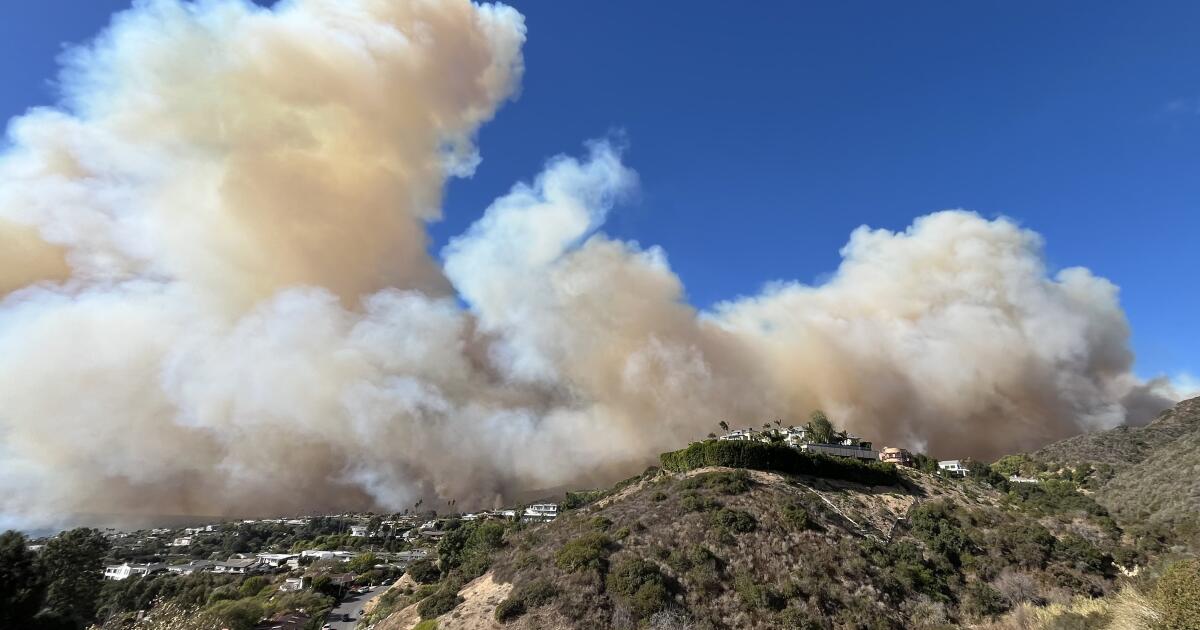
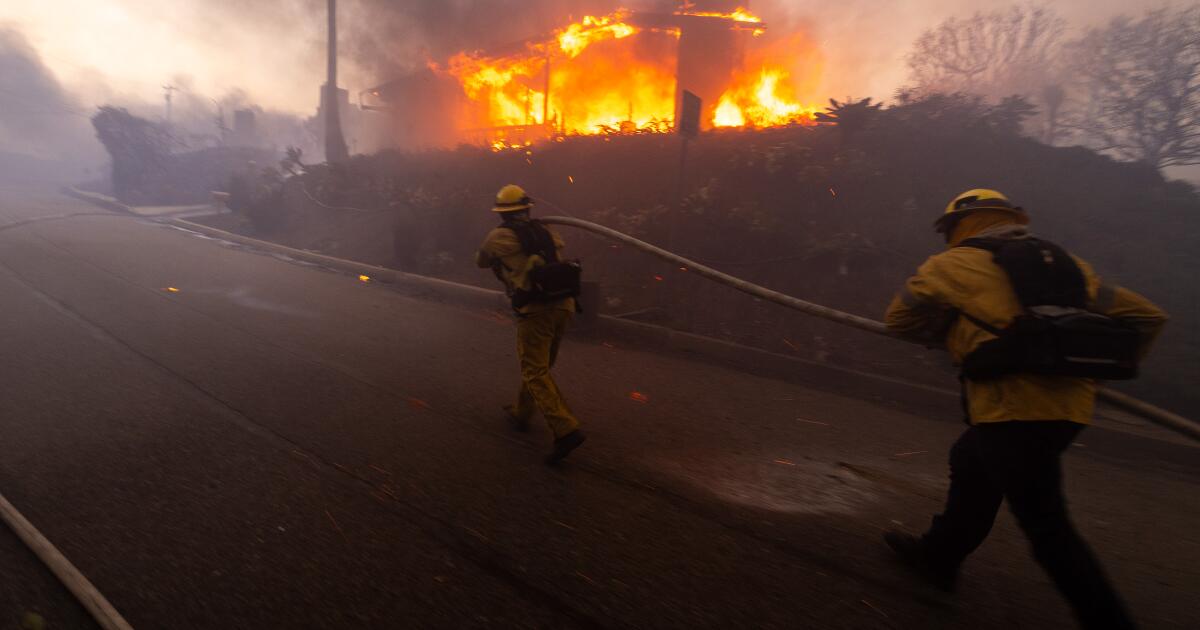
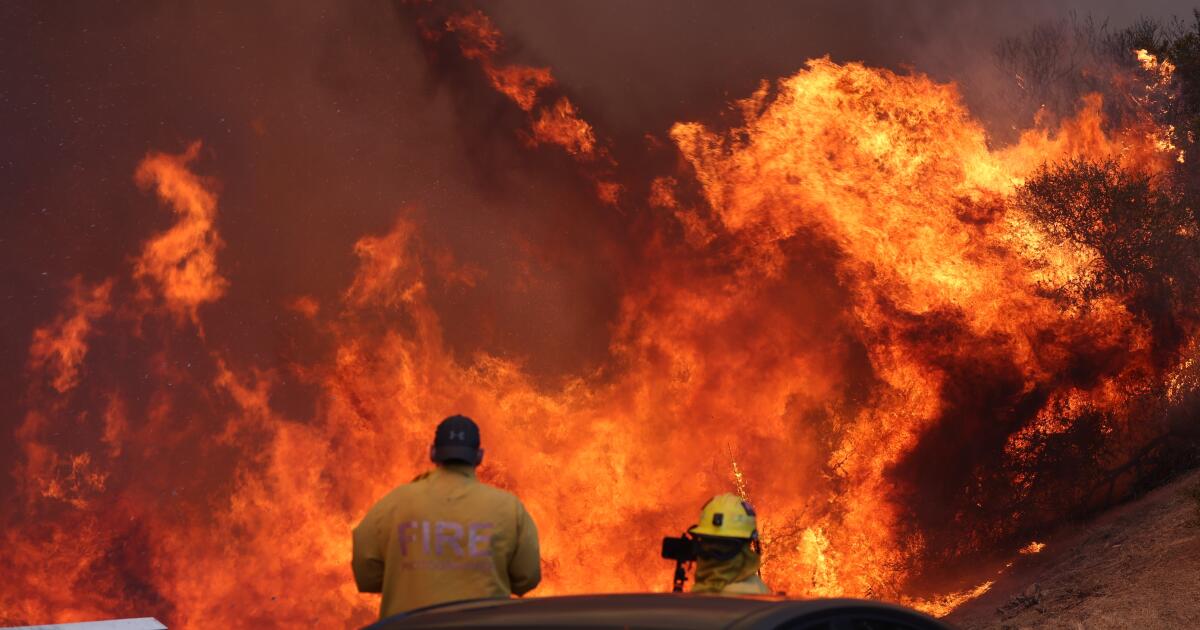
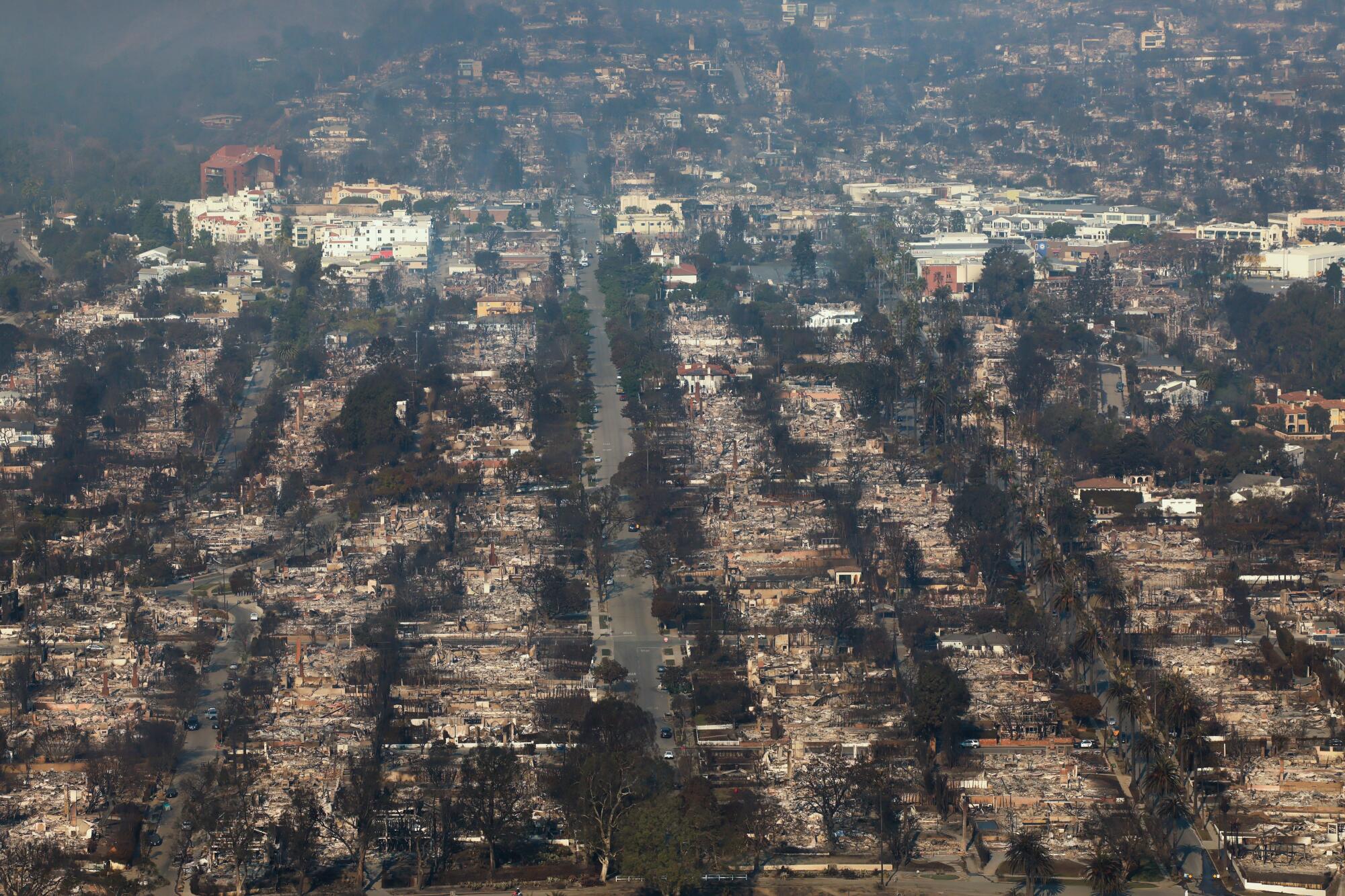
Pacific Palisades had been burning for less than two hours when word raced through the ranks of the Los Angeles Fire Department that the agency’s leaders had failed to pre-deploy any extra engines and crews to the area, despite warnings of life-threatening winds.
In the days after the fire broke out, and as thousands of homes and business continued to go up in flames, then-Fire Chief Kristin Crowley said little about the lack of pre-deployment, which was first disclosed by The Times, instead blaming those high winds, along with a shortage of working engines and money, for her agency’s failure to quickly knock down the blaze.
Crowley’s comments did not stand up to scrutiny. To several former LAFD chief officers as well as to people who lost everything in the disaster, her focus on equipment and City Hall finances marked the beginning of an ongoing campaign of secrecy and deflection by the department — all designed to avoid taking full responsibility for what went wrong in the preparations for and response to the Jan. 7 fire, which killed 12 people and leveled much of the Palisades and surrounding areas.
“I don’t think they’ve acknowledged that they’ve made mistakes yet, and that’s really a problem,” said Sue Pascoe, editor of the local publication Circling the News, who lost her home of 30 years. “They’re still trying to cover up … It’s not the regular firefighters. It’s coming from higher up.”
With the first anniversary of the fire a week away, questions about missteps in the firefight remained largely unanswered by the LAFD and Mayor Karen Bass. Among them: Why were crews ordered to leave the still-smoldering scar of an earlier blaze that would reignite into the Palisades inferno? Why did the LAFD alter its after-action report on the fire in a way that appeared intended to shield it from criticism?
The city also has yet to release the mayor’s communications about the after-action report. The Times requested the communications last month, and the report — which was meant to pinpoint failures and enumerate lessons learned, to avoid repeating mistakes — was issued in early October. Nor has the city fulfilled a records request from The Times about the whereabouts of fire engines in the Palisades when the first 911 call came in. It took the first crews about 20 minutes to reach the scene, by which time the fierce winds were driving the flames toward homes.
A Bass spokesperson has said that the mayor did not demand changes to the after-action report, noting that she pushed for its creation and that it was written and edited by the LAFD.
“This administration is only interested in the full truth about what happened before, during, and after the fire,” the spokesperson, Clara Karger, said earlier this month.
The LAFD has stopped granting interviews or answering questions from The Times about the matter, vaguely citing federal court proceedings. David Loy, legal director of the First Amendment Coalition, said that the federal prosecution of a man accused of starting the earlier blaze does not preclude the department from discussing its actions surrounding both fires.
In a December television interview, Fire Chief Jaime Moore acknowledged that some residents don’t trust his agency and said his mandate from Bass was to “help guide and rebuild the Los Angeles Fire Department to the credibility that we’ve always had.”
The Lachman fire
Shortly after midnight on New Year’s Day, a man watched flames spread in the distant hills and called 911.
“Very top of Lachman, is where we are,” he told the dispatcher. “It’s pretty small but it’s still at the very top and it’s growing.”
“Help is on the way,” the dispatcher said.
A few hours later, at 4:46 a.m., the LAFD announced that the blaze, which later became known as the Lachman fire, was fully contained at eight acres.
Top fire commanders soon made plans to finish mopping up the scene and to leave with their equipment, according to text messages obtained by The Times through a state Public Records Act request.
“I imagine it might take all day to get that hose off the hill,” LAFD Chief Deputy Phillip Fligiel said in a group chat. “Make sure that plan is coordinated.”
Firefighters who returned the next day complained to Battalion Chief Mario Garcia that the ground was still smoldering and rocks still felt hot to the touch, according to private text messages from three firefighters to a third party that were reviewed by The Times. But Garcia ordered them to roll up their hoses and leave.
At 1:35 p.m., Garcia texted Fligiel and Chief Deputy Joseph Everett: “All hose and equipment has been picked up.”
Five days after that, on the morning of Jan. 7, an LAFD captain called Fire Station 23 with an urgent message: The Lachman fire had started up again.
LAFD officials were emphatic early on that the Lachman fire was fully extinguished. But both inside and outside the department, many were certain it had rekindled.
“We won’t leave a fire that has any hot spots,” Crowley said at a community meeting in mid-January.
“That fire was dead out,” Everett said at the same meeting, adding that he was out of town but communicating with the incident commander. “If it is determined that was the cause, it would be a phenomenon.”
The department kept under wraps the complaints of the firefighters who were ordered to leave the burn site. The Times disclosed them in a story in late October. In June, LAFD Battalion Chief Nick Ferrari had told a high-ranking fire official who works for a different agency in the L.A. region that LAFD officials knew about the firefighters’ complaints, The Times also reported.
Bass has directed Moore, an LAFD veteran who took charge of the department in November, to commission an “independent” investigation of the Lachman fire mop-up. The after-action report contained only a brief mention of the earlier fire.
No pre-deployment
The afternoon before hazardous weather is expected, LAFD officials are typically briefed by the National Weather Service, using that information to decide where to position firefighters and engines the following morning.
The weather service had been sounding the alarm about critical fire weather for days. “HEADS UP!!!” NWS Los Angeles posted on X the morning of Jan. 6. “A LIFE-THREATENING, DESTRUCTIVE” windstorm was coming.
It hadn’t rained much in months, and wind gusts were expected to reach 80 mph. The so-called burning index — a measure of the wildfire threat — was off the charts. Anything beyond 162 is considered “extreme,” and the figure for that Tuesday was 268.
In the past, the LAFD readied for powerful windstorms by pre-deploying large numbers of engines and crews to the areas most at risk for wildfires and, in some cases, requiring a previous shift of hundreds of firefighters to stay for a second shift — incurring large overtime costs — to ensure there were enough personnel positioned to attack a major blaze.
None of that happened in the Palisades, with its hilly terrain covered in bone-dry brush, even though the weather service had flagged it as one of the regions at “extreme risk.”
Without pre-deployment, just 18 firefighters are typically on duty in the Palisades.
LAFD commanders decided to staff only five of the more than 40 engines available to supplement the regular firefighting force citywide. Because they didn’t hold over the outgoing shift, they staffed the extra engines with firefighters who volunteered for the job — only enough to operate three of the five engines.
On Jan. 6, officials decided to pre-deploy just nine engines to high-risk areas, adding eight more the following morning. None of them were sent to the Palisades.
The Times learned from sources of the decision to forgo a pre-deployment operation in the Palisades. LAFD officials were mum about the inadequate staffing until after The Times obtained internal records from a source in January that described the department’s pre-deployment roll-out.
The officials then defended their actions in interviews. Bass cited the LAFD’s failure to hold over the previous shift of firefighters as a reason she removed Crowley as chief less than two months after the fire.
The after-action report
In March, a working group was formed inside the LAFD to prepare the Palisades fire after-action report. A fire captain who was recommended for the group sought to make sure its members would have the freedom to follow the facts wherever they led, according to internal emails the city released in response to a records request by an unidentified party.
“I am concerned about interference from outside entities that may attempt to influence the direction our report takes,” Capt. Harold Kim wrote to Battalion Chief Kenneth Cook, who was leading the review. “I would like to ensure that the report that we painstakingly generate be published as is, to as reasonable an extent as possible.”
He worried about revisions, saying that once LAFD labor unions and others “are done with many publications, they become unrecognizable to the authors.”
Cook, who had been involved with review teams for more than a decade and written numerous reports, replied: “I can assure you that I have never allowed for any of our documents to be altered in any way by the organization.”
Other emails suggest that Kim ultimately remained in the group.
As the report got closer to completion, LAFD officials, worried about how it would be received, privately formed a second group for “crisis management” — a decision that surfaced through internal emails released through another records request by an unidentified party.
“The primary goal of this workgroup is to collaboratively manage communications for any critical public relations issue that may arise. The immediate and most pressing crisis is the Palisades After Action Report,” LAFD Asst. Chief Kairi Brown wrote in an email to eight others, including interim Fire Chief Ronnie Villanueva.
“With significant interest from media, politicians, and the community, it is crucial that we present a unified response to anticipated questions and concerns,” Brown wrote. “By doing so, we can ensure our messaging is clear and consistent, allowing us to create our own narrative rather than reactive responses.”
Cook emailed a PDF of his report to Villanueva in early August, asking the chief to select a couple of people to provide edits so he could make the changes in his Word document.
The following week, Cook emailed the chief his final draft.
“Thank you for all your hard work,” Villanueva responded. “I’ll let you know how we’re going to move forward.”
Over the next two months, the report went through a series of edits — behind closed doors and without Cook’s involvement. The revised report was released publicly on Oct. 8.
That same day, Cook emailed Villanueva, declining to endorse the public version because of changes that altered his findings and made the report “highly unprofessional and inconsistent with our established standards.”
“Having reviewed the revised version submitted by your office, I must respectfully decline to endorse it in its current form,” Cook wrote in the email obtained by The Times. “The document has undergone substantial modifications and contains significant deletions of information that, in some instances, alter the conclusions originally presented.”
Cook’s version highlighted the failure to recall the outgoing shift and fully pre-deploy as a major mistake, noting that it was an attempt to be “fiscally responsible” that went against the department’s policy and procedures.
The department’s final report stated that the pre-deployment measures for the Palisades and other fire-prone locations went “above and beyond” the LAFD’s standard practice. The Times analyzed seven drafts of the report obtained through a records request and disclosed the significant deletions and revisions.
Cook’s email withdrawing his endorsement of the report was not included in the city’s response to one of the records requests filed by an unknown party in October. Nearly 180 of Cook’s emails were posted on the city’s records portal on Dec. 9, but the one that expressed his concerns about the report was missing. That email was posted on the portal, which allows the public to view documents provided in response to records requests, after The Times asked about it.
The LAFD did not respond to a query about why the email was not released with Cook’s other emails. Karger, the Bass spokesperson, said the link to the document was broken and the city fixed it after learning the email wasn’t posted correctly. The Times has inquired about how and why the link didn’t work.
Former LAFD Asst. Chief Patrick Butler, who worked for the agency for 32 years and now heads the Redondo Beach Fire Department, said the city’s silence on such inquiries is tantamount to deceiving the public.
“When deception is normalized within a public agency,” he said, “it also normalizes operational failure and puts people at risk.”
Beyond a misty veil, dawn breaks above Shetland – sort of. The days feel as if they never quite get going here at this time of year, and it’s important, as the long nights of winter drag on, to have a hobby. Here in Lerwick, the capital of the archipelago, the locals have divined a unique way of passing the time, while honouring the deep-rooted Scandinavian influences on Shetland’s culture and history.
A rattling and murmuring begins to grow, and round a corner emerges a marching horde of lusty Vikings in homemade costumes, brandishing axes and round shields, beards flowing over leather breastplates. They carry turquoise standards bearing the flag of Haraldr Óláfsson, the 13th-century king of Mann and the Isles, and sing battle songs of raven flags flying in distant lands, of blazing torches and Vikings ruling over oceans vast.
‘A marching horde of lusty Vikings’ in Lerwick. Photograph: Daniel Stables
As the mob approaches, a shed door creaks open behind me, and a dragon-prowed, glacial blue longship emerges, pulled on ropes by a team dozens strong. This beautiful galley will be paraded through the streets of Lerwick today before being ritualistically set ablaze – the centrepiece of Up Helly Aa, Shetland’s riotous fire festival. As an act of ritual destruction it evokes the sand mandala, the Tibetan Buddhist practice of creating ornate cosmological artworks only to sweep them away as a metaphor for non-attachment and impermanence. “It’s a symbol of renewal,” says Lyall Gair, who has led the Up Helly Aa procession in years past and retains an impressive, Viking-worthy beard. A man standing next to us in the crowd has an alternative explanation. “There’s fuck all else to do around here all winter,” he says, shivering against the morning breeze.
After Christmas, the hootenannies, paper hats and midnight countdowns of 31 December can feel a little lame. Thankfully, Shetland offers a second bite of the cherry when it comes to seeing in the new year, with Up Helly Aa’s series of fire festivals setting the archipelago alight between January and March – timed to mark the end of the pre-Christian winter festival of Yule (others include Scalloway fire festival, also on Shetland, and Uyeasound on Unst). There are 11 festivals spread across the islands, but by far the largest and best-known is held in late January here in Lerwick, which sits on Mainland, the largest Shetland island (on 27 January in 2026).
Preparing the longship. Photograph: Daniel Stables
The procession, with the galley in its wake, disappears round another corner. There will now be a lull in proceedings for the watching public, though not for the Vikings in the main procession, known as the Jarl Squad, who spend the day attending to various civic duties – a boozy brunch with local luminaries, some visits to schools and hospitals, then a lush, louche luncheon, before more processions through the streets, chanting and rattling of swords and shields, and general merriment.
I take advantage of the break in the schedule to swot up on the history of the event, meeting Jolene Garriock, a tour guide with Island Vista, at Fjarå, a cafe overlooking the ocean. “The Lerwick Up Helly Aa’s been going for over 100 years, and I’ve been going for 30,” says Jolene, who grew up on the west coast of Mainland, and now lives in the Tingwall valley, a short drive from Lerwick.
The torch procession. Photograph: Roger Cracknell/Classic/Alamy
Up Helly Aa seems to have begun in the 19th century, after Shetland’s young men returned from the Napoleonic wars with frazzled minds, a low boredom threshold and a facility for pyrotechnics. They channelled their energy into tar barrelling, the practice of stuffing wooden barrels with straw and tar, setting them alight and parading them through the town. Rival “squads” of tar barrellers would often brawl in the streets, leading a wide-eyed missionary, visiting in 1824, to describe Lerwick as “in an uproar: from 12 o’clock last night until late this night blowing of horns, beating of drums, tinkling of old tin kettles, firing of guns, shouting, bawling, fiddling, fifeing, drinking, fighting”.
The chaos, Jolene says, proved too much for the authorities, who by the late 19th century had done away with the tar barrelling and replaced it with the building and burning of the galley, reshaping Up Helly Aa into a celebration of Shetland’s Nordic heritage, as well as a festival celebrating the new year and return of the light. “Hogmanay is dying in Shetland – nobody makes an effort for that any more,” she says. “Up Helly Aa is the biggest thing of the year.”
By the time I bid Jolene goodbye, it has long since gone dark; Lerwick’s streetlights have been extinguished in advance of the burning of the galley, and the streets are thronging with thousands of people. The Jarl Squad are out again, redder-eyed and sloppier than this morning after the day’s libations, but still in strong voice, and now carrying blazing torches. They’re followed by hundreds of men in fancy dress: nuns, Wombles, French maids. These are the modern incarnation of the original tar-barrelling squads, who have nowadays swapped brawling in the streets for touring venues across Lerwick on Up Helly Aa night, staging comedy skits.
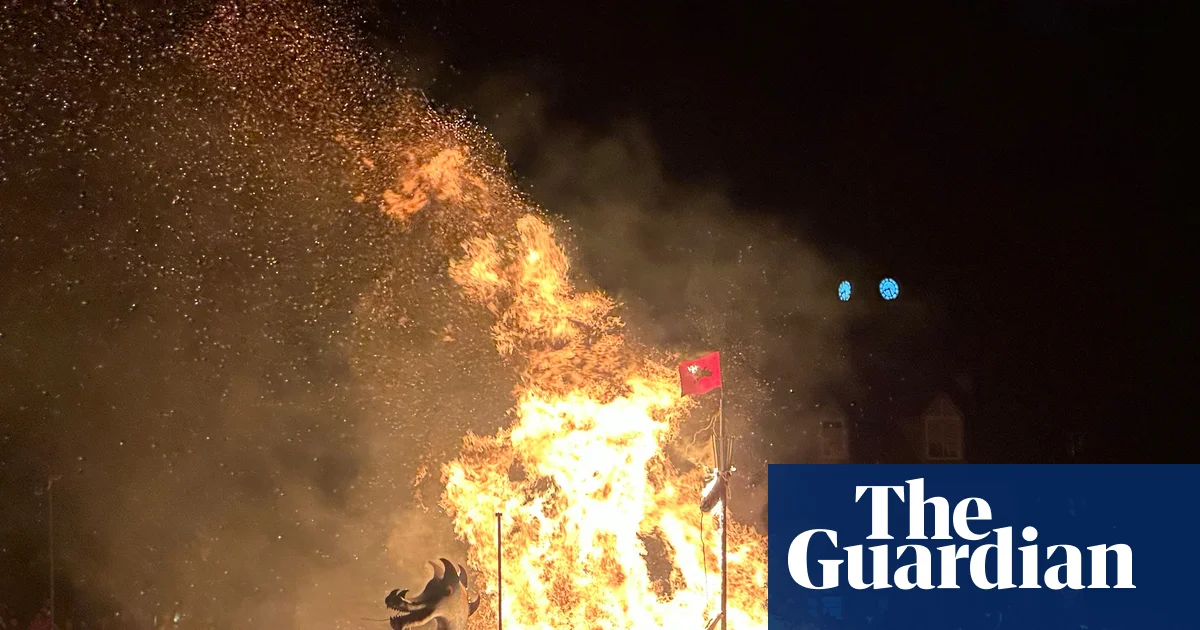
The procession files into a play park in the centre of town, where the galley lies waiting, doused in paraffin. The Jarl Squad and their entourage throw their lit torches into the belly of the boat, and before long it is engulfed in flames, warming the watching crowd. As the fire dies down and the spectators file away into the warmth of the town’s afterparty venues, for a night of comedy skits and folk dancing, soup and sandwiches, and much taking of drink, I observe the smouldering wreckage. It’s almost painful to think of the energy and care that went into the galley’s creation, only for it to go up in flames – until I remember Lyall’s words to me that morning, on Up Helly Aa’s power as a vehicle for renewal. “We just build another one next year,” he had said. “We start anew.”
State regulators ordered Southern California Edison to identify fire risks on its unused transmission lines like the century-old equipment suspected of igniting the devastating Eaton wildfire.
Edison also must tell regulators how its 355 miles of out-of-service transmission lines located in areas of high fire risk will be used in the future, according to a document issued by the Office of Energy Infrastructure Safety on Dec. 23.
State regulations require utilities to remove abandoned lines so they don’t become a public hazard. Edison executives said they did not remove the Eaton Canyon line because they believed it would be used in the future. It last carried power in 1971.
The Office of Energy Infrastructure Safety said Edison must determine which unused transmission lines are most at risk of igniting fires and create a plan to decrease that risk. In some cases that might mean removing the equipment entirely.
While the OEIS report focuses on Edison, the agency said it also will require the state’s other electric companies to take similar actions with their idle transmission lines.
Scott Johnson, an Edison spokesman, said Monday that the company already had been reviewing idle lines and planned to respond to the regulators’ requests. He said Edison often keeps idle lines in place “to support long-term system needs, such as future electrification, backup capacity or regional growth.”
“If idle lines are identified to have no future use, they are removed,” he said.
Johnson said that since 2018, Edison has removed idle lines that no longer had a purpose seven times and provided a list of those projects.
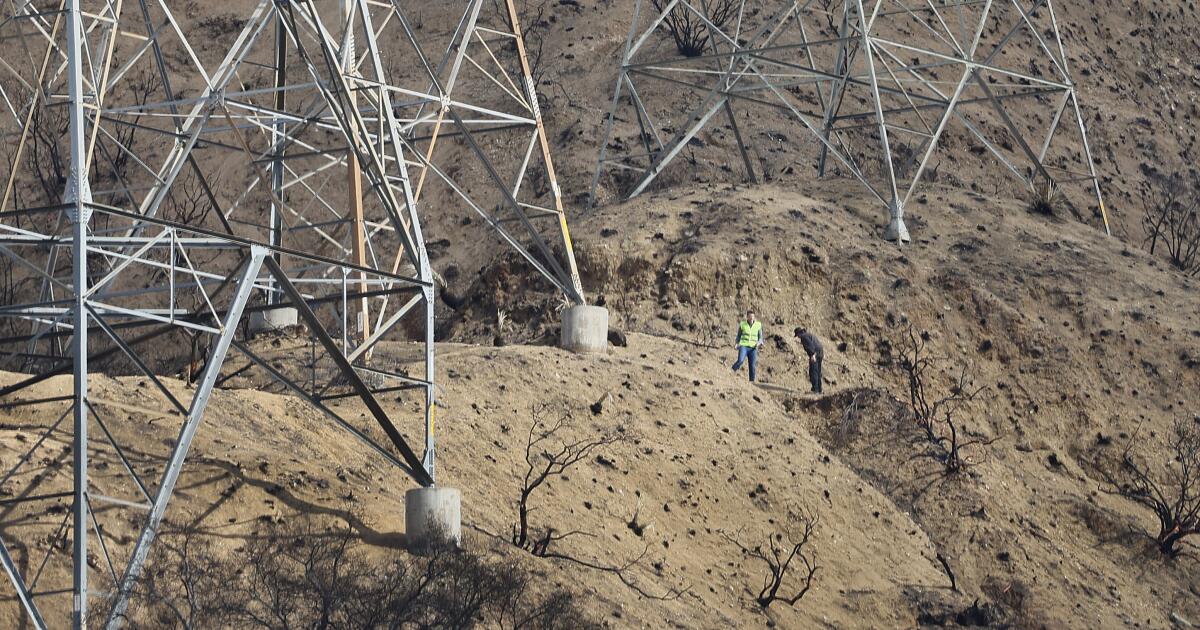
The investigation into the cause of the Eaton wildfire by state and local fire officials has not yet been released. Edison has said the leading theory is that the dormant transmission line in Eaton Canyon briefly reenergized on the night of Jan. 7, sparking the fire.
Unused lines can become energized from electrified lines running parallel to them through a process called induction.
The Eaton wildfire killed at least 19 people and destroyed more than 9,000 homes and structures in Altadena.
After the fires, Edison said it had added more grounding equipment to its old transmission lines no longer in service. The added devices give any unexpected electricity on the line more places to disperse into the ground, making them less likely to spark a fire.
The OEIS issued its latest directives after Edison executives informed the agency they had no plans to remove any out-of-service lines between now and 2028, the report said.
State regulators and the utilities have long known that old transmission lines can ignite wildfires.
The Times reported how Edison and other utilities defeated a state regulatory plan, introduced in 2001, which would’ve forced the companies to remove abandoned lines unless they could prove they would use them again.
In its report the OEIS noted it would require Edison and other electric companies to provide details of how often each idle line was inspected and how long it took to fix problems found in those inspections.
Edison has said it inspected the unused line in Eaton Canyon annually before the fire — just as often as it inspects live lines. The company declined to provide The Times with documentation of those inspections.
In the OEIS report, energy safety regulators said they expect to to approve Edison’s wildfire mitigation plan for the next three years despite the problems they found with the approach.
For example, the report noted that Edison is behind in replacing or reinforcing aging and deteriorating transmission and distribution poles. The regulators said the backlog “includes many work orders on [Edison’s] riskiest circuits.” A circuit is a line or other infrastructure that provides a pathway for electricity.
Officials said the company must work on reducing that backlog. They also criticized Edison executives for not incorporating any lessons they learned from the Jan. 7 wildfires into the company’s fire prevention plans.
Johnson, Edison’s spokesperson, said the company already improved the backlog of pole replacements. He said the company also planned to tell regulators more about the lessons it learned after the Eaton fire.
Under state law, the OEIS must approve a utility’s wildfire mitigation plan before it can issue the company a safety certificate that protects the company from liability if its equipment ignites a catastrophic fire.
The OEIS issued Edison’s last safety certificate less than a month before the Eaton fire — despite the company having had thousands of open work orders, including some on the transmission lines above Altadena, at the time.
Edison is offering to pay for damages suffered by Eaton fire victims and a handful already accepted its offers. The utility says that because it held a safety certificate at the time of the fire it expects to be reimbursed for most or all of the payments by a $21-billion state wildfire fund.
If that fund doesn’t cover the damages, a law passed this year enables Edison to raise its electric rates to make up the difference.
Gov. Gavin Newsom and state lawmakers passed laws to create the state fund and safety certificate program to protect utilities from bankruptcy if their equipment starts costly wildfires. Critics say the laws have gone too far, potentially leaving utilities financially unharmed from fires caused by their negligence.
Edison is fighting hundreds of lawsuits filed by victims of the Eaton fire. The company says it acted prudently in maintaining the safety of its system before the fire.
Pedro Pizarro, chief executive of Edison International, the utility’s parent company, told The Times this month that he believed the company had been “a reasonable operator” of its system before the fire.
“Accidents can happen,” Pizarro said. “Perfection is not something you can achieve, but prudency is a standard to which we’re held.”
THE list of living names in Billy Joel’s We Didn’t Start the Fire has shrunk to a jaw-dropping three.
Three decades after the tongue-twister song topped charts around the world, most of its human landmarks are gone.
Sign up for the Showbiz newsletter
Thank you!
Brigitte Bardot’s death was announced on SundayCredit: GettyThe iconic French actress circa 1960sCredit: GettyMusician Billy Joel performs during his 100th lifetime performance at Madison Square Garden in 2018Credit: AP
Out of the 59 people name-checked in the 1989 mega-hit, only Bob Dylan, rock n roll singer Chubby Checker, and “subway vigilante” Bernie Goetz are still alive.
The grim-but-fascinating fact has been doing the rounds on social media after Bardot’s death was announced on Sunday.
One shocked fan admitted: “This is how I find out Chubby Checker is still alive.”
Another said: “The kind of useless trivia I’ll be physically incapable of not repeating at the next dinner party.”
Billy’s catchy banger is a whirlwind history lesson.
It rattles through headlines and pop culture moments in strict chronological order starting the year Billy Joel was born in 1949, and racing toward the late 1980s.
One of the song’s most packed lines – “Bardot, Budapest, Alabama, Khrushchev” – covers 1956, the year iconic French actress Brigitte Bardot shot to global fame in And God Created Woman.
It also nods to the Hungarian Revolution in Budapest, the Montgomery Bus Boycott in Alabama, and Nikita Khrushchev’s rise to power in the Soviet Union after Stalin’s death.
Music also runs through the song like a second timeline.
Chart topper Billy, now age 79, kicks things off with Cry singer Johnnie Ray in 1949, one of the first modern pop stars signed to a major label.
He quickly follows with Bill Haley & His Comets, whose Rock Around the Clock sent rock ’n’ roll into overdrive.
Elvis Presley turns up in 1955, Buddy Holly marks 1959 and the tragedy of the Day the Music Died, Chubby Checker dances into 1960.
Bob Dylan appears in 1961 as pop music takes a sharp turn toward protest and social change.
By the time Joel hits the mid-to-late 1960s, it’s Beatlemania and Woodstock.
Bernie Goetz gets a mention after he became a household name in 1984 for shooting four black men on a train in New York after they allegedly demanded money.
One of the men was left brain damaged and paraplegic, and the shooting became a symbol of deep racial divide in the city.
Goetz handed himself in to police nine days later and was dubbed the “subway vigilante” by local media.
Billy pictured in 1989Credit: GettyThe Twist singer Chubby Checker is now 84 years oldCredit: Getty Images – GettyBoby Dylan circa 1970s, is also now aged 84Credit: GettySubway gunman Bernhard Goetz is around 78 years old todayCredit: Reuters
In an uneven year that saw two billion-dollar hits and a viral “chicken jockey” craze, but also a disastrous first quarter and a nearly 30-year-low at the October box office, the end of December was the last chance for theaters to make up ground.
But even James Cameron and the Na’vi — the latest “Avatar” film has already grossed more than $472 million globally — couldn’t save 2025 from a disappointing conclusion.
Box-office revenue in the U.S. and Canada is expected to total $8.87 billion for the year, up just 1.5% from last year’s disappointing $8.74 billion tally, according to movie data firm Comscore. More troubling is that 2025’s domestic box-office haul is projected to be down more than 20% compared with 2019, before the pandemic changed audiences’ movie-going habits and turbocharged streaming in ways that the exhibition industry is still grappling with.
The problem: Fewer people are buying movie tickets. Theatrical attendance is running below last year’s levels, with an estimated 760 million tickets sold as of Dec. 25, according to media and entertainment data firm EntTelligence. Last year, total ticket sales for 2024 exceeded 800 million.
Part of the explanation for the falloff in cinema revenue and admissions lies in the movies themselves.
Industry experts and theater owners say the quality and frequency of releases led to dips in the calendar that put extra pressure on the other movies to perform. Once-reliable genres such as comedies and dramas are facing a much tougher time in theaters, and female moviegoers — who came out in droves in 2023 for “Barbie” — were underserved in a year that largely skewed toward male-leaning blockbusters.
“It’s fair to say that 2025 didn’t quite reach the levels many of us expected at the start of the year,” Eduardo Acuna, chief executive of Regal Cineworld, said in a statement. “A big part of that comes down to a lack of depth in the release schedule, and the struggle of many smaller titles to break through.”
Even big-name stars such as Margot Robbie, Colin Farrell, Dwayne Johnson and Sydney Sweeney couldn’t prop up attendance for films such as Sony Pictures’ “A Big Bold Beautiful Journey,” A24’s “The Smashing Machine” and Black Bear Pictures’ “Christy,” all of which flopped.
And despite the critical acclaim and stacked cast list for Paul Thomas Anderson’s “One Battle After Another,” the film has stalled domestically at $71 million, with a global total of $205 million.
“One Battle After Another” had a budget of about $130 million, while “The Smashing Machine” reportedly cost $50 million and has grossed just $21 million worldwide.
“The challenge facing Hollywood is how to reconcile the budgets of these films with how much they can earn in theaters and down the road, eventually, in streaming,” said Paul Dergarabedian, head of marketplace trends at Comscore.
Universal Pictures’ “Wicked: For Good” hauled in more than $324 million, but it was one of few big blockbusters targeted to women. (Taylor Swift’s “The Official Release Party of a Showgirl,” which brought in $50 million globally, was another.)
Though the summer was marked by a number of big films, including Warner Bros.-owned DC Studios’ “Superman,” Universal’s “Jurassic World Rebirth” and Apple’s “F1 The Movie,” most were geared toward male audiences.
Female-focused films are “are few and far between,” said Jeff Bock, senior box-office analyst at Exhibitor Relations, an entertainment data and research firm. “There should be something for everyone playing most of the time, and that isn’t the case.”
To be sure, there were some bright spots for the industry, including success from young audiences.
Warner Bros. Pictures’ “A Minecraft Movie” was the highest-grossing domestic film this year, with $423.9 million. Close behind was Walt Disney Co.’s live-action adaptation “Lilo & Stitch,” which collected $423.8 million in the U.S. and Canada and a total of $1 billion worldwide.
Counting those two, five of the year’s top 10 domestic-grossing films had PG ratings, including “Wicked: For Good,” Disney’s animated “Zootopia 2” and Universal’s live-action “How to Train Your Dragon.”
“In general, the good news about the year is that most of the big hits involved young audiences,” said Tom Rothman, chair and CEO chief executive of Sony Pictures’ motion picture group. “There is a bit of a youth-quake.”
Disney capitalized on the big year for family-friendly fare.
The Burbank entertainment giant recently crossed $6 billion at the global box office for the year, powered by billion-dollar hits such as “Lilo & Stitch” and “Zootopia 2,” and marking the company’s biggest year since 2019. (Though it wasn’t all sunny for Disney this year, as Pixar’s original animated film “Elio” misfired, as did the live-action film, “Snow White,” which was mired in controversy.)
Another notable youth driver was “Demon Slayer: Kimetsu no Yaiba Infinity Castle” from Sony Pictures in partnership with its anime banner, Crunchyroll. The film had a massive opening weekend haul of $70 million in July on its way to a domestic gross of $134 million and a global total of $715 million, highlighting the increasing popularity of anime.
“The mainstreaming of anime at the theatrical box office is a really significant part of what happened this year and a really good sign,” Rothman said. “You’re bringing in young audiences.”
Not surprisingly, established intellectual property — whether video games, known franchises, novels or comic books — still topped the charts this year, with nine of the top 10 domestic films tied to an existing title.
That familiarity at the box office counts when moviegoers, particularly families, are looking for movies to watch. Viewers can be choosy about how they spend their cash and time, and may not always want to gamble on a movie they’ve never heard of.
“Meaningful IP still has an advantage in getting people to come to the theater, though it’s not the only way to do it,” said Adam Fogelson, chair of Lionsgate’s motion picture group, which saw success this year with an adaptation of Stephen King’s novel “The Long Walk,” as well as franchise film “Now You See Me: Now You Don’t.”
Horror flicks also scared up plenty of business in 2025. Warner Bros., in particular, had a string of wins in fearful films, including Ryan Coogler’s “Sinners,” “The Conjuring: Last Rites,” Zach Cregger’s “Weapons” and “Final Destination Bloodlines.”
In one notable exception, Blumhouse had a rare miss with “M3GAN 2.0,” the follow-up to the 2022 cult favorite. In an interview on “The Town” podcast, Blumhouse Productions Chief Executive Jason Blum blamed the sequel’s shortcomings on a change in genre from the original.
As 2025 draws to a close, industry insiders and theater owners are more optimistic about next year’s box office prospects.
Several big films are set to release in 2026, including Christopher Nolan’s much anticipated “The Odyssey,” Disney and Marvel Studios’ “Avengers: Doomsday,” Denis Villeneuve’s “Dune: Part Three,” as well as Disney and Pixar’s “Toy Story 5” and “The Super Mario Galaxy Movie” from Universal, Nintendo and Illumination Entertainment.
That anticipation is also clouded by the uncertainty of the impending Warner Bros. deal and what that will mean for movie releases.
Many cinema owners fear that a takeover by Netflix will limit or eliminate the theatrical exclusivity of Warner Bros. films, though Netflix executives have said they will honor the company’s current and future commitments to the big screen. And if Paramount were to buy the company, theatrical exhibitors fear that the number of films would decrease, leaving them with less content to show. (Paramount CEO David Ellison has said the company did not plan to release fewer movies.)
Any deal is expected to take at least a year to complete.
In the meantime, Hollywood will wait to see how strong the 2026 slate truly is.
“There are a lot of great titles out there, and that’s why people have been calling 2026 a return to form,” said Bock of Exhibitor Relations. “Even though 2026 is very promising, can Hollywood keep delivering year-in and year-out?”
Fire replaces water as the elemental character in James Cameron’s “Avatar: Fire and Ash.” It’s even weaponized by Varang (Oona Chaplin), the ruthless leader of the volcano-dwelling Ash People, in their war against the rest of the Na’vi tribes.
“After figuring out water in all its complexity in [‘The Way of Water’], we focused on fire,” Cameron said about his VFX Oscar front-runner. “Fire is very much the same — you have to be very observant of [this] in the world. This is where having an understanding of physics — which I do — helps, and this is where a lot of real-world photography and reference comes in handy.”
Creating more realistic-looking fire in CG required Cameron to apply his understanding of fuel and how it burns, including flow rates, the interaction of temperature gradients, the speed of an object that’s burning and the formation of carbon and soot.
In essence, fire became the centerpiece of every scene — and a character with its own escalating drama. That’s where the VFX wizards of Wētā FX in New Zealand came in. They developed Kora, a high-fidelity tool set for physics-based chemical combustion simulations. Kora increased the scale of fire while providing more artist-friendly controls. The film contains more than 1,000 digital fire FX shots, ranging from flaming arrows and flamethrowers to massive explosions and fire tornadoes.
“Physical fire is really hard to control, so we had to come up with how to bend the physics towards the direction that Jim was giving it,” said Wētā senior VFX supervisor Joe Letteri. “Because he was very specific where he wanted the fire, what kind of speed, rate, size, how much or how little energy. He very carefully crafted every component, guiding your eye across it.”
“Fire serves two roles,” added Eric Saindon, a VFX supervisor at Wētā. “There’s always a little bit of low fire going on during quiet moments, but then you get fire that becomes much more destructive whenever there’s an attack sequence.”
In the film’s best scene, where archvillain Col. Quaritch (Stephen Lang) and Varang meet for the first time in her tent, fire takes on a more subtle, mysterious quality. She gives Quaritch a trippy “truth drug” to ascertain his real agenda, seductively playing with fire with her fingers like a sorceress. The scene turns surreal with camera distortion and zoom shots to convey his hallucinatory point of view.
Then Quaritch surprises her with his superpower: the truth. He proposes a partnership to provide his military weaponry so she can spread her fire across the world and he can rule as her co-equal. “In a strange way, they become the power couple from hell,” Cameron said. “He wins her over by sharing his vision.”
The physical properties of fire drove much of the visual effects work in “Avatar: Fire and Ash.”
(20th Century Studios)
Meanwhile, the subtle flicker of fire with cool blues around the edges of the flame is like a magic trick. “She knows it’s about theater, so she presumably has some kind of a gel or makeup that’s on the tips of her fingers so that they just don’t burn away in the first few seconds,” Cameron continued. “She’s able to dip her fingers in some kind of inflammable oil and light them and have them burn like candles. Of course, in his mind, it’s all enhanced much more due to the hallucinogen.”
Cameron praised both actors in the scene, but singled out Chaplin’s performance for the force she brings to Varang’s shamanistic authority. “She understood how the character would manifest her power psychologically and how there was a flip in the scene, where the flow of power runs the other direction at a certain point.”
The director also commended Wētā’s facial capture animation team for achieving a new level of photorealism, thanks in large measure to more realistic muscle and skin movement. “The way Oona’s performance comes through so resoundingly in the character is a tribute to a lot of R&D, a lot of development in the facial pipeline. But I think it really demonstrates how the idea of CG as a kind of digital makeup really does work. What I’m proud about in that scene is that it’s a culmination of an almost 20-year journey in terms of getting exact verisimilitude in the facial representation of the characters as an extension of the actors’ work.”
“It was really fun showing Varang to Jim because he knew what he had in the performance,” added Dan Barrett, a senior animation supervisor at Wētā. “And he included Oona’s idiosyncrasies in the final animation. He was very respectful of the performance.”
In fact, Cameron argues, Chaplin’s performance as Varang is Oscar-worthy. “It may be counterintuitive, but I would argue that it’s a more pure form of acting,” he suggested. “Now, you may say that it’s cheating in terms of the cinematography in the sense that the cards are stacked in our favor because that perfect performance will always be there and will be repeatable as I do my different camera coverage. But it’s not cheating in terms of the acting.”
Cameron has recently been more proactive in demonstrating how the performance-capture process works to academy and SAG-AFTRA acting members so they can better understand it. “It was just us, working on capturing a scene, and I even wrote new scenes so it wasn’t a made-up dog-and-pony show. And they were blown away,” he added.
The apocalyptic site, dubbed a ‘doorway to hell’, exists right here on Earth and has been burning since 1971 — only one person is known to have ever descended inside.
08:00, 25 Dec 2025Updated 08:16, 25 Dec 2025
The dystopian sight seems straight out of a movie(Image: Iwanami_Photos via Getty Images)
Straight out of a dystopian thriller, a fiery ‘Gate to Hell’ exists right here on Earth.
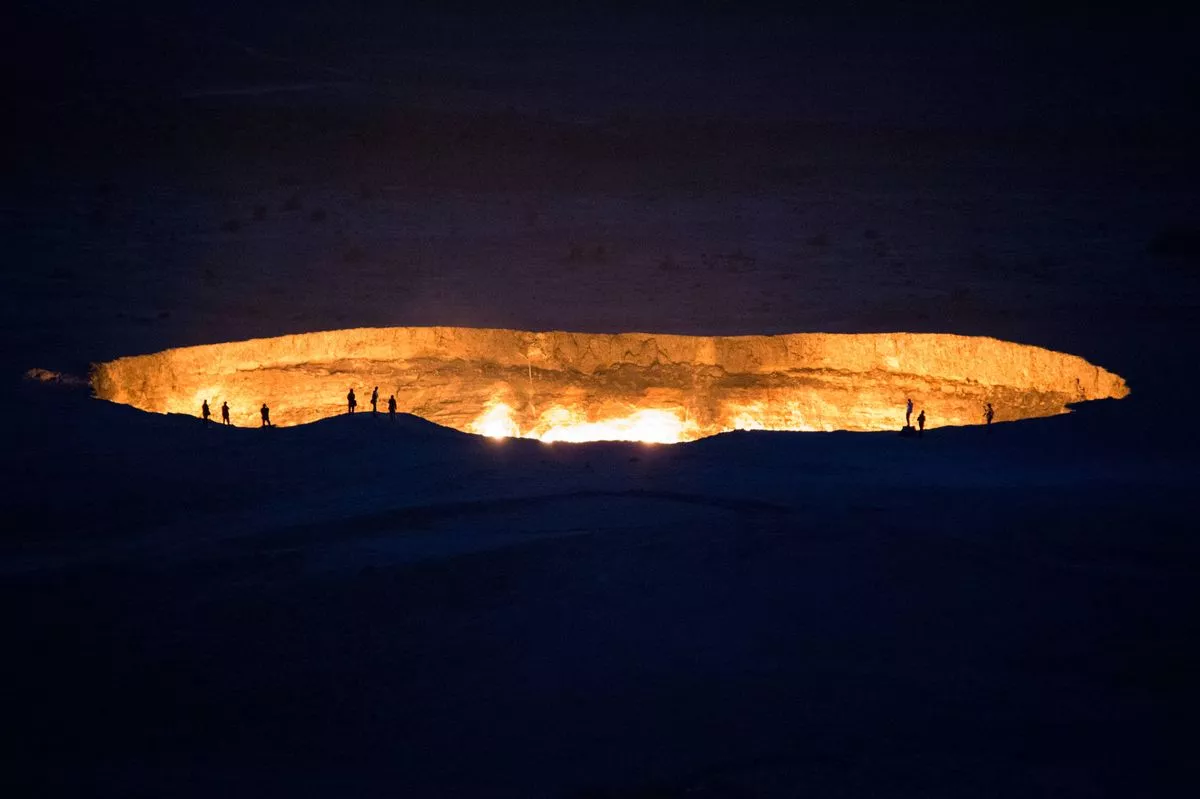
This ominous sight, located in Turkmenistan, has been aptly named the ‘Doorway to Hell’, having first been set alight back in 1971. Over half a century later, it’s still burning. The Darvaza Gas Crater, locally known as the Shining of Karakum, is a blazing sinkhole that’s been spewing out natural gas since 1971.
Legend has it that Soviet geologists accidentally collapsed a natural gas chamber while drilling and subsequently set it on fire in an attempt to contain the lethal gases and prevent them from spreading. What the engineers anticipated would be a flame extinguishing itself within a few weeks has now been burning for over 50 years (hardly surprising given that the country ranks fourth globally in natural gas reserves).
Interestingly, Turkmenistan holds no official records of the incident as relevant documentation is either classified, inaccessible, or missing from the archives – consistent with the country’s policy of secrecy. This ‘Gate to Hell’ can be found ablaze near the village of Darvaza, nestled in the heart of the Karakum Desert, and measures approximately 60-70 meters wide and 98ft deep.
The hellish pit can be seen from miles around and has become a major tourist attraction for Turkmenistan, reports the Daily Star. Despite the seemingly inhospitable conditions of this blazing chasm, visitor accounts suggest that, astonishingly, there may be some signs of life within the crater.
The only known human descent into the crater was undertaken by Canadian explorer George Kourounis. In November 2013, Kourounis ventured to the bottom of the Darvaza Gas Crater with National Geographic, aiming to gather soil samples for the Extreme Microbiome Project to investigate potential signs of life in the crater’s harsh environment. Equipped with a specialised heat-resistant suit, Kourounis managed to spend roughly 17 minutes inside the fiery abyss.
During the thrilling exploration episode, Kourounis described their mission as “looking for alien life right here on Earth”, given that the crater’s hostile, methane-rich environment mirrors that of certain planets found beyond our solar system. And indeed, they discovered signs of life. Kourounis’ expedition unearthed several types of bacteria in the soil from the crater floor.
Recounting his experience of the apocalyptic ‘Door to Hell’, Kourounis said: “It is burning with a tremendous amount of flame like there is a lot of fire down there. Day or night, it is clearly burning. You can hear the roar of the fire if you stand at the edge. The heat, if you are downwind of it, is unbearable. There are thousands of little flames all around the edges and towards the centre. It’s a very volatile place.”
Now, in a dramatic twist, after blazing fiercely for more than 50 years, it appears the flames in this ‘Gateway to Hell’ are at last dying down, though gradually. During a press briefing in June this year, Irina Luryeva, a director at Turkmenistan’s state-owned energy firm Turkmengaz, revealed to the world that the crater was finally burning out, stating: “The reduction [in fires] is nearly threefold. Whereas before a huge glow from the blaze was visible from several kilometres away, hence the name ‘Gateway to Hell’, today only a faint source of combustion remains.”
An attempted ICE arrest outside Baltimore turned violent after a man allegedly drove into law enforcement vehicles.
Published On 25 Dec 202525 Dec 2025
Share
Two people were injured in a suburb of Baltimore after Immigration and Customs Enforcement (ICE) agents fired shots at a moving vehicle whose driver was allegedly evading arrest, according to US authorities.
The Department of Homeland Security (DHS) said ICE agents had attempted to arrest two men from Portugal and El Salvador – who were allegedly living in the US illegally – as they were driving through Glen Burnie, Maryland, on Wednesday.
Recommended Stories
list of 4 itemsend of list
DHS said in a post on X that officers approached the vehicle and told the driver to turn off his engine, but the driver did not cooperate and instead drove into several ICE vehicles.
“Fearing for their lives and public safety, the ICE officers defensively fired their service weapons, striking the driver,” DHS said in a statement on X. The driver “then wrecked his van between two buildings, injuring the passenger”.
The two men later received medical attention, and no ICE agents were hurt during the incident, DHS said.
“Our brave officers are risking their lives every day to keep American communities safe by arresting and removing illegal aliens from our streets,” the DHS post also said. “Continued efforts to encourage illegal aliens and violent agitators to actively resist ICE will only lead to more violent incidents, the extremist rhetoric must stop.”
Local police confirmed to ABC News that ICE agents had approached a “white van” during an arrest on Wednesday and reported that the driver “attempted to run the agents over”.
The ICE agents then fired at the vehicle, which accelerated before coming to a rest in a wooded area of residential Glen Burnie, Maryland, ABC said.
Maryland Governor Wes Moore wrote on X that he was “aware of the ICE-involved shooting”, and his office would continue to share more information as the investigation unfolded.
The shooting follows a similar incident in Minnesota on Sunday, when ICE agents fired shots at a Cuban man who also resisted arrest and attempted to ram ICE vehicles, according to ABC News.
The man, who had entered the US on a discontinued asylum programme, was approached by ICE agents in the city of St Paul while in an SUV.
The agents threatened to break his windows if he did not speak with them, prompting the man to drive away, ABC reported, citing Assistant Homeland Security Secretary Tricia McLaughlin. During the incident, the man hit an ICE agent with his vehicle.
The situation escalated when ICE agents pursued the man to his apartment building, where he later rammed an ICE vehicle with his SUV and hit a second agent, ABC said. ICE agents fired several shots before arresting the man, the report said.
The author of the Los Angeles Fire Department’s after-action report on the Palisades fire declined to endorse it because of substantial deletions that altered his findings, calling the edited version “highly unprofessional and inconsistent with our established standards.”
Battalion Chief Kenneth Cook emailed then-interim Fire Chief Ronnie Villanueva and other LAFD officials with the subject line “Palisades AARR Non-Endorsement,” about an hour after the highly anticipated report was made public Oct. 8.
“Having reviewed the revised version submitted by your office, I must respectfully decline to endorse it in its current form,” Cook wrote in the email obtained by The Times. “The document has undergone substantial modifications and contains significant deletions of information that, in some instances, alter the conclusions originally presented.”
Battalion Chief Kenneth Cook complained to former interim Fire Chief Ronnie Villanueva about deletions and revisions in the Palisades fire after-action report.
(L.A. City Mayor’s Office)
He continued, “While I fully understand the need to address potential liability concerns and to modify certain sections in consultation with the City Attorney to mitigate litigation risks, the current version appears highly unprofessional and inconsistent with our established standards. I strongly urge you to reconsider publishing the report as it stands.”
In the email, Cook also raised concerns that the LAFD’s final report would be at odds with a report on the January wildfires commissioned by Gov. Gavin Newsom’s office, which has yet to be released.
“I am concerned that substantial disparities may exist between the two reports,” Cook wrote.
Izzy Gardon, a spokesperson for Newsom, said in a statement Tuesday, “The Governor commissioned an independent review by the world’s leading fire safety experts to ensure the public receives a complete, accurate, and unvarnished accounting of the events leading up to the Palisades fire and how responding agencies carried out their response.”
Cook — who emails show provided a final draft of the after-action report to Villanueva in August — has declined to comment. Attempts to reach Villanueva were unsuccessful.
The LAFD has refused to answer questions from The Times about the deletions and revisions. Mayor Karen Bass’ office said the LAFD wrote and edited the report, and that the mayor did not demand changes.
On Sunday, The Times reported that Cook was upset about the changes to the report. The previous day, The Times had disclosed the watering down of the after-action report after analyzing seven drafts obtained through a public records request. The most significant changes involved the LAFD’s failure to order firefighters to stay on duty for an additional shift and to fully pre-deploy engines in high-risk areas before the Jan. 7 fire, as the wind warnings became increasingly dire. It’s unclear who exactly directed the revisions.
Cook’s Oct. 8 email laying out his concerns in stark language adds to the growing evidence that city and LAFD officials attempted to burnish the LAFD’s image in a report that should have been an honest assessment of the department’s failings in preparing for and fighting the fire, which killed 12 people and destroyed thousands of homes. The goal of such a report is to prevent similar mistakes.
Cook’s email reached Bass’ office in mid-November, according to Bass spokesperson Clara Karger.
Karger said last week that “the Mayor has inquired with Chief Moore about the concerns,” referring to Jaime Moore, who became LAFD chief last month.
The Times submitted a public records request last month for all of the mayor’s emails about the after-action report, a request that the city has not yet fulfilled. Bass’ office provided Cook’s email to The Times on Tuesday.
The city had withheld Cook’s email from its response to a separate records request filed by an unknown party in October. Almost 180 of Cook’s emails were posted on the city’s records portal on Dec. 9, but the one that expressed his concerns about the report was missing. That email was only posted on the portal Tuesday, after The Times asked about it.
The LAFD did not respond to a Times query about why the email was not released with Cook’s other emails. Bass’s office also did not respond to a query about Cook’s concerns and the fact that they were withheld from the public.
Gene Cameron, who lived in the Palisades for 50 years before his home burned down in the Jan. 7 fire, was disturbed by the LAFD’s revisions, which he said amounted to a cover up.
“I appreciate his bravery to stand up against these unprofessional immoral edits,” he said of Cook, adding that the point of the report is not to assign blame, but to prevent future mistakes. “It’s just to establish a set of rules, procedures and guidelines so that this doesn’t happen again.”
City Councilmember Traci Park, whose district includes the Palisades, said in a statement Tuesday that the city can’t fix systemic failures or rebuild public trust without full transparency.
“I’ve said from the beginning that LAFD should not be investigating itself. After a disaster of this magnitude, the public deserves a full, unfiltered accounting of what went wrong and why — and my independent after-action report will provide exactly that,” she said, referring to a report she requested that the City Council approved and funded earlier this year, though it hasn’t been completed.
Genethia Hudley Hayes, president of the Board of Fire Commissioners, did not immediately respond Tuesday to a request for comment. She previously told The Times that she heard rumors that the author of the report was unhappy, but that she did not look into the matter.
A July email thread reviewed by The Times shows concern over how the after-action report would be received, with the LAFD forming a “crisis management workgroup.”
“The primary goal of this workgroup is to collaboratively manage communications for any critical public relations issue that may arise. The immediate and most pressing crisis is the Palisades After Action Report,” LAFD Asst. Chief Kairi Brown wrote in an email to eight other people.
“With significant interest from media, politicians, and the community, it is crucial that we present a unified response to anticipated questions and concerns,” Brown wrote. “By doing so, we can ensure our messaging is clear and consistent, allowing us to create our own narrative rather than reactive responses.”
Cook was not included on that email thread. It’s unclear how much of a role, if any, that group had on the revisions.
The after-action report has been widely criticized for failing to examine a New Year’s Day fire that later reignited into the Palisades fire. Bass has ordered the LAFD to commission an independent investigation into its missteps in putting out the earlier fire.
One edit to the after-action report involved language stating that the decision to not fully staff up and pre-deploy all available crews and engines ahead of the extreme wind forecast “did not align” with the department’s policy and procedures during red flag days.
The final report did not include that language, saying instead that the number of engine companies rolled out ahead of the fire “went above and beyond the standard LAFD pre-deployment matrix.”
A section on “failures” was renamed “primary challenges,” and an item saying that crews and leaders had violated national guidelines on how to avoid firefighter deaths and injuries was scratched.
Another passage that was deleted said that some crews waited more than an hour for an assignment the day of the fire.
Two drafts contain notes typed in the margins with suggestions that seemed intended to soften the report’s effect and make the Fire Department look good. One note proposed replacing the image on the cover page — which showed palm trees on fire against an orange sky — with a “positive” one, such as “firefighters on the frontline.” The final report’s cover displays the LAFD seal.
The final version listed only 42 items in the section on recommendations and lessons learned, while the first version reviewed by The Times listed 74.
This remarkable house has stayed standing through many major events, even surviving the Great Fire of London, despite huge areas of the city being destroyed, and attempts to have it demolished
The house has remained standing through many historic events(Image: In Pictures via Getty Images)
London’s most intriguing landmarks often lie hidden in plain sight, tucked away down side streets. A prime example of this lies down the street of Cloth Fair.
This narrow road near Smithfield Market in the City of London, owes its name to its medieval past as a hub for merchants. Today, instead of bustling scenes of street trading, it’s mostly residential and offers a tranquil retreat from the city’s hustle and bustle.
Yet, one building stands out due to its historical significance. 41-42 Cloth Fair, built between 1597 and 1614, holds the distinction of being London’s oldest surviving house. But what truly sets this four-bedroom townhouse apart is its resilience through various tumultuous periods in history, including its survival of the Great Fire of London.
The Great Fire of London obliterated over 70,000 homes, leaving this townhouse amidst a sea of ruined properties. However, a tall brick wall encircling the property shielded it from the devastating flames, reports the Express.
But this wasn’t the first time the house had dodged disaster. During the Second English Civil War, when many city properties were razed, the house remained unscathed. Unfortunately, its builder, Henry Rich, wasn’t as fortunate. A Royalist, Rich was apprehended, tried, and ultimately beheaded within the grounds of the Palace of Westminster.
The property’s first occupant was William Chapman, who transformed the ground floor into an ale house. Over the centuries, the building has served various purposes, from a wool drapers to a tobacconist, and then a cutlery factory until the 1920s when it was sold.
Since then, it has functioned as a private dwelling and continues to be a home today. The 1920s nearly witnessed the demolition of 41-42 Cloth Fair. In 1929, there were proposals to raze the house along with numerous other historic buildings as part of a plan to improve sanitation in city housing.
Doubts were also raised about its structural integrity, and it was marked as dangerous. But remarkably, the house was spared from demolition and even survived the Blitz unscathed, while 1.7 million buildings across London were damaged and many historical landmarks were lost forever.
In 1995, new owners acquired the property, carried out extensive renovations, and won a City Heritage Award a few years later. One particularly noteworthy historical feature is a collection of signatures etched into the lead windows using a diamond pen.
These autographs belong to several high-profile individuals who have visited the house over the years, including Winston Churchill, the Queen Mother, John Betjeman, and J. B. Priestley.
The house’s age, coupled with its location near a medieval priory, has even sparked rumours of skeletons entombed deep within its foundations.
Whether there’s any truth to these rumours or not, it seems these souls can rest undisturbed under the watchful protection of this seemingly indestructible house.
Have a story you want to share? Email us at webtravel@reachplc.com
The year was already a debacle for the Los Angeles Fire Department and Mayor Karen Bass, with multiple stumbles before and after the epic January blaze that obliterated Pacific Palisades, so it was hard to imagine that things could get worse in the closing days of 2025.
But they have.
A blistering Times investigation found that the Fire Department cleaned up its after-action report, downplaying missteps.
In other words, there was a blatant attempt to mislead the public.
And Bass representatives said they requested that her comments in the final minutes of a video interview — in which she admitted that “both sides botched it” in the Eaton and Palisades fires — be edited out because she thought the interview had ended.
Please.
Together, these developments will echo through the coming mayoral election, in which Bass will be called out repeatedly over one of the greatest disasters in L.A. history. We’re a long way from knowing whether she can survive and win a second term, but Austin Beutner and any other legitimate contenders are being handed gifts that will keep on giving.
In the case of the altered report, kudos to Times reporters Alene Tchekmedyian and Paul Pringle, who have been trying all year to keep the LAFD honest, which is no easy task.
In the latest bombshell dropped by the two reporters, they dug up seven drafts of the department’s self-analysis, or after-action report, and found that it had been altered multiple times to soften damning conclusions.
Language saying LAFD did not fully pre-deploy all crews and engines, despite the forecast of extreme conditions, was removed.
Language saying some crews waited more than an hour for their assignments during the fire was removed.
A section on “failures” became a section on “primary challenges.”
A reference to a violation of national guidelines on how to avoid firefighter injury and death was removed.
The central role of the earlier Lachman fire, allegedly started by an arsonist, was also sanitized. A reference to that unchecked brushfire, which later sparked the inferno, was deleted from one draft, then restored in the final version. But only in a brief reference.
Even before the smoke cleared on Jan. 7, I had one former LAFD official telling me he was certain the earlier fire had not been properly extinguished. Crews should have been sitting on it, but as The Times has reported, that didn’t happen.
What we now know with absolute clarity is that the LAFD cannot be trusted to honestly and thoroughly investigate itself. And yet after having fired one chief, Bass asked the current chief to do an investigation.
Sue Pascoe, who lost her home in the fire and is among the thousands who don’t yet know whether they can afford to rebuild because their insurance — if they had any — doesn’t cover the cost of new construction. Pascoe, editor of the local publication Circling the News, had this reaction to the latest expose:
“To kill 12 people, let almost 7,000 homes/businesses burn, and to destroy belongings, memorabilia and memories stored in the homes — someone needs to be held accountable.”
But who will that be?
Although the altered after-action report seems designed to have minimized blame for the LAFD, if not the mayor, the Bass administration said it wasn’t involved.
“We did not red-line, review every page or review every draft of the report,” a spokesperson told the Times. “We did not discuss the Lachman Fire because it was not part of the report.”
Genethia Hudley Hayes, president of the Board of Fire Commissioners, told The Times she noticed only small differences between the final report and an earlier report she had seen.
“I was completely OK with it,” she said, adding that the final report “did not in any way obfuscate anything.”
Well I’m not OK with it, and I suspect a lot of people who lost everything in the fire feel the same way. As I’ve said before, the conditions were horrific, and there’s little doubt that firefighters did their best. But the evidence is mounting that the department’s brass blew it, or, to borrow a phrase from Bass, “botched it.”
As The Times’ David Zahniser reported, Bass said her “botched” comment came in a casual context after the podcast had ended. She also said she has made similar comments about the emergency response on numerous occasions.
She has made some critical comments, and as I mentioned, she replaced the fire chief. But the preparation and response were indeed botched. So why did her office want that portion of the interview deleted?
Let’s not forget, while we’re on the subject of botching things, that Bass left the country in the days before the fire despite warnings of catastrophic conditions. And while there’s been some progress in the recovery, her claim that things are moving at “lightning speed” overlooks the fact that thousands of burned out properties haven’t seen a hammer or a hardhat.
On her watch, we’ve seen multiple misses.
On the blunderous hiring and quick departure of a rebuilding czar. On the bungled hiring of a management team whose role was not entirely clear. On a failed tax relief plan for fire victims. On the still-undelievered promise of some building fee waivers.
In one of the latest twists on the after-action report, Tchekmedyian and Pringle report that the LAFD author was upset about revisions made without his involvement.
What a mess, and the story is likely to smolder into the new year.
If only the Lachman fire had been as watered down as the after-action report.
The author of the Los Angeles Fire Department’s after-action report on the Palisades fire was upset about changes made to the report, without his involvement, that downplayed the failures of city and LAFD leaders in preparing for and fighting the disastrous Jan. 7 fire, according to two sources familiar with the matter.
The author’s complaints reached Mayor Karen Bass’ office in mid-November, after the LAFD had publicly released the report, said Clara Karger, a spokesperson for Bass.
“The Mayor has inquired with Chief Moore about the concerns,” Karger said last week, referring to LAFD Chief Jaime Moore.
The sources, who requested anonymity to protect their relationships with the LAFD and city officials, said the report by Battalion Chief Kenneth Cook was intended to be a final draft. Cook declined to comment.
The Times posted an article Saturday that analyzed seven drafts of the after-action report, obtained through a public records request. The most significant changes involved the LAFD’s deployment decisions before the fire, as the wind warnings became increasingly dire.
In one instance, LAFD officials removed language saying that the decision to not fully staff up and pre-deploy all available crews and engines ahead of the extreme wind forecast “did not align” with the department’s policy and procedures during red flag days.
Instead, the final report said that the number of engine companies rolled out ahead of the fire “went above and beyond the standard LAFD pre-deployment matrix.”
The deletions and revisions have drawn criticism from some who questioned the LAFD’s ability to acknowledge its mistakes before and during the blaze — and to avoid repeating them in the future.
In the months since the fire, residents who lost their homes have expressed outrage over unanswered questions and contradictory information about how top LAFD officials prepared for the dangerous weather forecast and how they handled a smaller New Year’s Day blaze, called the Lachman fire, which rekindled into the massive Palisades fire six days later.
On Saturday, after the report by The Times was published online, City Councilmember Monica Rodriguez issued a statement about the toning down of the after-action report.
“Today’s reporting makes clear that accountability is optional when after-action reports are conducted in-house with oversight by political appointees,” Rodriguez said. “If these reports are purposefully watered down to cover up failures, it leaves Angelenos, firefighters, and city officials without a full understanding of what happened and what needs to change. After-action reports must be independent to ensure honest assessments in order to avoid repeating disastrous errors and to protect our communities in the future.”
Former interim Fire Chief Ronnie Villanueva, who oversaw the completion of the report before it was made public in October, did not respond to requests for comment.
Karger, the Bass spokesperson, said this month that the report “was written and edited by the Fire Department.” Bass’ office did not demand changes to the drafts and asked the LAFD to confirm only the accuracy of items such as how the weather and the department’s budget factored into the disaster, Karger said in an email.
The LAFD has refused to answer questions about the revisions and Cook’s concerns, citing an ongoing federal court case. Federal prosecutors have charged a former Palisades resident with setting the Lachman fire.
David Loy, legal director of the First Amendment Coalition, said it’s “disingenuous” of LAFD officials to cite the investigation as a reason they can’t respond to The Times’ inquiries.
“There’s nothing about the existence of a federal investigation that prohibits them from commenting,” Loy said. “They just choose not to comment.”
Three of the seven drafts of the after-action report obtained by The Times are marked with dates: Two versions are dated Aug. 25, and there is a draft from Oct. 6, two days before the LAFD released the final report to the public.
Some drafts of the after-action report described an on-duty LAFD captain calling Fire Station 23 in the Palisades on Jan. 7 to report that “the Lachman fire started up again,” indicating the captain’s belief that the Palisades fire was caused by a reignition of the earlier blaze.
The reference was deleted in one draft, then restored in the public version, which contains only a brief mention of the Lachman fire. Some have said that the after-action report’s failure to thoroughly examine the Lachman fire reignition was designed to shield LAFD leadership and the Bass administration from criticism and accountability.
Weeks after the report’s release, The Times reported that a battalion chief ordered firefighters to roll up their hoses and leave the burn area on Jan. 2, even though they had complained that the ground was still smoldering and rocks remained hot to the touch. Another battalion chief assigned to the LAFD’s risk management section knew about the complaints for months, but the department kept that information out of the after-action report.
Moore, an LAFD veteran who became chief last month, has been tasked with commissioning the independent investigation that Bass requested.
Several key items were wholly deleted from the after-action report. The final version listed only 42 items in the section on recommendations and lessons learned, while the first version reviewed by The Times listed 74.
A section on “failures” was renamed “primary challenges,” and an item saying that crews and leaders had violated national guidelines on how to avoid firefighter deaths and injuries was scratched.
Another passage that was deleted said that some crews waited more than an hour for an assignment the day of the fire.
Two drafts contain notes typed in the margins with suggestions that seemed intended to soften the report’s effect and burnish the Fire Department’s image. One note proposed replacing the image on the cover page — which showed palm trees on fire against an orange sky — with a “positive” one, such as “firefighters on the frontline.” The final report’s cover displays the LAFD seal.
In addition to the mayor’s office, Cook’s concerns made their way to the president of the Board of Fire Commissioners, which provides civilian oversight for the LAFD. Genethia Hudley Hayes, president of the board, told The Times that she heard rumors that the author of the report was unhappy, but that she did not seriously look into the matter.
“If I had to worry about every rumor that comes out of LAFD, I would spend my entire day, Monday through Friday, chasing down rumors,” she said.
She said she raised concerns with Villanueva and the city attorney’s office over the possibility that “material findings” were or would be changed.
“I did not feel like they were lying about anything,” she said. “I didn’t feel like they were trying to cover up anything.”
The Na’vi won the battle of the box office this weekend, as “Avatar: Fire and Ash” hauled in a hefty $88 million in the U.S. and Canada during its opening weekend.
The third installment of the Disney-owned 20th Century Studios’ “Avatar” franchise brought in an estimated total of $345 million globally, with about $257 million of that coming from international audiences. The movie reportedly has a budget of at least $350 million.
Box office analysts had expected a big international response to the most recent film, particularly since its predecessor “Avatar: The Way of Water” had strong showings in markets like Germany, France and China.
In China, the film opened to an estimated $57.6 million, marking the second highest 2025 opening for a U.S. film in the country since Disney’s “Zootopia 2” a few weeks ago. (That film went on to gross more than $271.7 million in China on its way to a global box office total of $1.1 billion.)
The strong response in China is another sign that certain movies can still do well in the country, which was once seen as a key force multiplier for big blockbusters and animated family films but has in recent years cooled to American movies due to geopolitics and the rise of its domestic film industry.
Angel Studio’s animated biblical tale “David” came in second at the box office this weekend, with an estimated domestic gross of $22 million. Lionsgate thriller “The Housemaid,” Paramount Animation and Nickelodeon Movies’ “The Spongebob Movie: Search for Squarepants” and “Zootopia 2” rounded out the top five.
The weekend’s haul likely comes as a relief to theater owners, who have weathered a roller coaster year.
After a difficult first three months, the spring brought hits like “A Minecraft Movie” and “Sinners” before the summer ended mostly flat. A sleepy fall brought panic to the exhibition business until closer to the Thanksgiving holiday, when “Wicked: For Good” and “Zootopia 2” drew in audiences.
A worried mother working miles away from her family frantically tries to get her three children out of harm’s way as an out of control fire ravages their community. Firefighters do everything they can, but strong winds are working against them to make the destruction go from bad to worse.
This scenario is reminiscent of the heroics that are portrayed weekly on the CBS firefighter television drama “Fire Country,” which follows the dedicated Cal Fire station in Northern California where an abundance of wooded areas make fire a common hazard. However, this particular story is very real and comes from actor Diane Farr, who plays Cal Fire Division Chief Sharon Leone and mother to firefighter Bode Leone (Max Thieriot, also a co-creator and executive producer) on the series. Farr remembers how in January she was on the show’s set in Vancouver while the wildfires were wreaking havoc in Los Angeles.
“My house was inside the evacuation order and I had to start flying my children out as fast as I could from L.A.,” she says of her La Cañada Flintridge home, which survived. “We were evacuated for eight days and the wind just went toward Altadena as opposed to coming toward our house. It was terrifying and was very eye opening for us.”
The horrific Los Angeles fires were eventually contained after catastrophic damage to the city, with some heroic firefighters leaving with jarring stories they were able to share with the “Fire Country” cast and crew. “Two of our consultants are L.A. firefighters, Matty and Marty Mullen, who had shown me a lot of videos of real firefighting of what was going on in L.A. that we were able to infuse into our [Season 3] finale,” says executive producer Tia Napolitano. “It felt important that we could show real authenticity inspired by the L.A. fires that we all lived through. I can’t believe it’s only been a year.”
Diane Farr as Sharon Leone in “Fire Country.” The actor’s home was in the evacuation zone during the L.A. wildfires in January.
(Sergei Bachlakov / CBS)
That dedication to authenticity has helped “Fire Country” become one of the sturdiest series on CBS’ prime-time schedule since premiering October 2022. Currently in its fourth season, “Fire Country” has won its time slot every week this season except when it aired against Game 6 of the World Series. It is now the veteran drama on Friday nights sandwiched between two new successful procedurals, “Sheriff Country” starring Morena Baccarin at 8 p.m. and “Boston Blue” starring Donnie Wahlberg at 10 p.m. Pacific, both spinoffs that have quickly caught the attention of audiences since their October debuts.
Farr believes the success of these shows is akin to the huge popularity of genres like true crime and their basic storytelling structure. “There is a good guy and a bad guy that’s very clear and very binary,” she says. “If you can create a situation that feels a little bit unsafe, if you can show me how people would make me safe in it, how they would solve the problem, it’s slightly relieving on a nervous system level.”
“Fire Country” delivers on all those components with the Station 42 crew performing regular acts of heroism as they keep their community safe, a reflection of real-life firefighters, says Thieriot. “People who have to do this job day in and day out are really a special breed. For me, a big thing has always been trying to capture that and trying to portray that the best way possible,” he says. “It’s television, so obviously there are more moments when we’re trying to find the drama, but at the end of the day, it’s really important that we focus on the real and we find the real in there.”
Eve (Jules Latimer) and Bode (Max Thieriot) in “Fire Country.” “People who have to do this job day in and day out are really a special breed. For me, a big thing has always been trying to capture that and trying to portray that the best way possible,” Thieriot says.(Sergei Bachlakov/CBS)
Part of the real comes in knowing that where there are heroes, there are also villains and, as its midseason finale is set to air on Friday, “Fire Country” currently has a frightening one in the form of Landon (Josh McDermitt). Initially seen as meek and even-tempered, the layers have been pulled back to show something different.
“Landon is a threat to our people and that’ll go forward for a few episodes,” teases Napolitano. “You feel like this guy is out there and he has nothing to lose.”
That’s because Landon has already lost the trust of his girlfriend Chloe (Alona Tal) and her teenage son Tyler (Conor Sherry), who recently revealed to Bode that Landon set the tragic Zabel Ridge Fire. That’s the L.A.-inspired blaze from the third-season finale that not only destroyed homes and land but also took the life of Cal Fire battalion chief Vince Leone (Billy Burke), Sharon’s husband and Bode’s father.
In Friday’s episode, a vengeful Landon isn’t happy about being investigated or the fact that Bode and Sharon have made sure that Chloe and Tyler are staying away from him. “Landon’s a small man with a very big ego and a big victim complex and that’s going to manifest in a scary way,” Napolitano says.
It also may not help matters that Chloe and Bode were once romantically involved and a spark may still exist, especially since Bode has been mentoring the troubled Tyler. Is the single Bode’s heart open to a second chance at love? “He’s getting there,” says Thieriot. “Leading up to this season, Bode had so many obstacles and I think this journey with Tyler [as mentor] is a big part of that.”
Bode (Max Thieriot) and Chloe (Alona Tal) were once romantically involved.(Sergei Bachlakov/CBS)
Hearts are also healing on the show in the aftermath of Vince’s shocking death, an event that was never in the show’s plan to quickly sweep under the rug. “We really want to be the show that everyone knows and loves, which is a comfort to a lot of our viewers,” says Napolitano. “It’s a show of joy and levity but also honors the fact that we are missing a core character who did die a hero’s death and honoring him by keeping his memory alive.”
That memory exists for Farr in several rings she regularly wears representing Sharon’s marriage and family with Vince, but she added another piece this season based on a suggestion from director Sarah Wayne Callies.
“Vince’s bracelet is heavy and regularly bumps the smaller bones in my hand,” Farr says. “Just like my former scene partner Billy, who would debate any word or line or blocking or intention with me to get to the truest take on anything we did together. Losing him is always going to be loss.” Farr said she doesn’t want to play grief forever but upcoming episodes will continue to show Sharon “trying to figure out who she is as a ‘one’ instead of a ‘two.’”
Though everyone hopes Los Angeles won’t see more fires like the ones from nearly a year ago, “Fire Country’s” creators and cast will continue to shine a light on firefighters and all the life-and-death work they do on a daily basis and, above all else, entertain.
“It’s not always easy to continue to surprise the audience and come up with this stuff that’s just really captivating and fresh and new but I believe that we can,” Thieriot says. “I’m really eager to accomplish that.”
The Rams have lost four games this season, three resulting in part from special teams breakdowns.
In the aftermath of their defeat by the Seattle Seahawks, coach Sean McVay made a significant move.
Chase Blackburn, the Rams’ special teams coordinator for the last three seasons, has been fired, a team official said Saturday.
Assistant Ben Kotwica remains on the staff.
Earlier this month, Blackburn said, “The job of a special teams coach is to be able to adapt and overcome on all things.”
That proved a challenge for a team that features a high-powered offense, and an at-times dominating defense.
On Thursday night in Seattle, the Rams led by 16 points in the fourth quarter when they allowed Rashid Shaheed to return a punt 58 yards for a touchdown. The play sparked the Seahawks’ comeback that sent the Rams to a 38-37 overtime defeat.
The loss dropped the Rams’ record to 11-4, and knocked them out of the No. 1 seed in the NFC and first place in the NFC West.
The breakdown was the latest in a series of special teams issues that have plagued the Rams.
In September at Philadelphia, the Eagles blocked two field-goal attempts by Joshua Karty, returning the second for a winning touchdown on the final play of regulation.
Two weeks later, in a 26-23 overtime defeat by the San Francisco 49ers, Karty missed a long field-goal attempt and had an extra-point attempt blocked. Karty’s kickoff in overtime did not reach the landing zone, giving the 49ers the ball at the 40-yard line.
Before their Week 10 game against the 49ers, the Rams signed kicker Harrison Mevis to replace Karty and signed veteran snapper Jake McQuaide to replace Alex Ward.
The kicking game solidified. Mevis made all eight of his field-goal attempts, including three against the Seahawks, before he missed a 48-yard attempt with just over two minutes left in regulation.
The Rams, who clinched a playoff spot, play the Atlanta Falcons on Nov. 29 in Atlanta and then conclude the regular season at home against the Arizona Cardinals.
For months after the Palisades fire, many who had lost their homes eagerly awaited the Los Angeles Fire Department’s after-action report, which was expected to provide a frank evaluation of the agency’s handling of the disaster.
A first draft was completed by August, possibly earlier.
In one instance, LAFD officials removed language saying that the decision not to fully staff up and pre-deploy all available crews and engines ahead of the extreme wind forecast “did not align” with the department’s policy and procedures during red flag days.
Instead, the final report said that the number of engine companies rolled out ahead of the fire “went above and beyond the standard LAFD pre-deployment matrix.”
Another deleted passage in the report said that some crews waited more than an hour for an assignment the day of the fire. A section on “failures” was renamed “primary challenges,” and an item saying that crews and leaders had violated national guidelines on how to avoid firefighter deaths and injuries was scratched.
Other changes in the report, which was overseen by then-interim Fire Chief Ronnie Villanueva, seemed similarly intended to soften its impact and burnish the Fire Department’s image. Two drafts contain notes written in the margins, including a suggestion to replace the image on the cover page — which showed palm trees on fire against an orange sky — with a “positive” one, such as “firefighters on the frontline,” the note said. The final report’s cover displays the LAFD seal.
The Times obtained seven drafts of the report through the state Public Records Act. Only three of those drafts are marked with dates: Two versions are dated Aug. 25, and there is a draft from Oct. 6, two days before the LAFD released the final report to the public.
No names are attached to the edits. It is unclear if names were in the original documents and had been removed in the drafts given to The Times.
The deletions and revisions are likely to deepen concerns over the LAFD’s ability to acknowledge its mistakes before and during the blaze — and to avoid repeating them in the future. Already, Palisades fire victims have expressed outrage over unanswered questions and contradictory information about the LAFD’s preparations after the dangerous weather forecast, including how fire officials handled a smaller New Year’s Day blaze, called the Lachman fire, that rekindled into the massive Palisades fire six days later.
Some drafts described an on-duty LAFD captain calling Fire Station 23 in the Palisades on Jan. 7 to report that “the Lachman fire started up again,” indicating the captain’s belief that the Palisades fire was caused by a reignition of the earlier blaze.
The reference was deleted in one draft, then restored in the public version, which otherwise contains only a brief mention of the previous fire. Some have said that the after-action report’s failure to thoroughly examine the Lachman fire reignition was designed to shield LAFD leadership and Mayor Karen Bass’ administration from criticism and accountability.
Weeks after the report’s release, The Times reported that a battalion chief ordered firefighters to roll up their hoses and leave the burn area on Jan. 2, even though they had complained that the ground was still smoldering and rocks remained hot to the touch. Another battalion chief assigned to the LAFD’s risk management section knew about the complaints for months, but the department kept that information out of the after-action report.
“A full understanding of the Lachman fire response is essential to an accurate accounting of what occurred during the January wildfires,” Bass wrote.
Fire Chief Jaime Moore, who started in the job last month, has been tasked with commissioning the independent investigation that Bass requested.
The LAFD did not answer detailed questions from The Times about the altered drafts, including queries about why the material about the reignition was removed, then brought back. Villanueva did not respond to a request for comment.
A spokesperson for Bass said her office did not demand changes to the drafts and only asked the LAFD to confirm the accuracy of items such as how the weather and the department’s budget factored into the disaster.
“The report was written and edited by the Fire Department,” the spokesperson, Clara Karger, said in an email. “We did not red-line, review every page or review every draft of the report. We did not discuss the Lachman Fire because it was not part of the report.”
Genethia Hudley Hayes, president of the Board of Fire Commissioners, told The Times that she reviewed a paper copy of a “working document” about a week before the final report was made public. She said she raised concerns with Villanueva and the city attorney’s office over the possibility that “material findings” were or would be changed. She also said she consulted a private attorney about her “obligations” as a commissioner overseeing the LAFD’s operations, though that conversation “had nothing to do with the after-action” report.
Hudley Hayes said she noticed only small differences between the final report and the draft she reviewed. For example, she said, “mistakes” had been changed to “challenges,” and names of firefighters had been removed.
“I was completely OK with it,” she said. “All the things I read in the final report did not in any way obfuscate anything, as far as I’m concerned.”
She reiterated her position that an examination of missteps during the Lachman fire did not belong in the after-action report, a view not shared by former LAFD chief officers interviewed by The Times.
“The after-action report should have gone back all the way to Dec. 31,” said former LAFD Battalion Chief Rick Crawford, who retired from the agency last year and is now emergency and crisis management coordinator for the U.S. Capitol. “There are major gaps in this after-action report.”
Former LAFD Asst. Chief Patrick Butler, who is now chief of the Redondo Beach Fire Department, agreed that the Lachman fire should have been addressed in the report and said the deletions were “a deliberate effort to hide the truth and cover up the facts.”
He said the removal of the reference to the LAFD’s violations of the national Standard Firefighting Orders and Watchouts was a “serious issue” because they were “written in the blood” of firefighters killed in the line of duty. Without citing the national guidelines, the final report said that the Palisades fire’s extraordinary nature “occasionally caused officers and firefighters to think and operate beyond standard safety protocols.”
The final after-action report does not mention that a person called authorities to report seeing smoke in the area on Jan. 3. The LAFD has since provided conflicting information about how it responded to that call.
Villanueva told The Times in October that firefighters returned to the burn area and “cold-trailed” an additional time, meaning they used their hands to feel for heat and dug out hot spots. But records showed they cleared the call within 34 minutes.
Fire officials did not answer questions from The Times about the discrepancy. In an emailed statement this week, the LAFD said crews had used remote cameras, walked around the burn site and used a 20-foot extension ladder to access a fenced-off area but did not see any smoke or fire.
“After an extensive investigation, the incident was determined to be a false alarm,” the statement said.
The most significant changes in the various iterations of the after-action report involved the LAFD’s deployment decisions before the fire, as the wind warnings became increasingly dire.
In a series of reports earlier this year, The Times found that top LAFD officials decided not to staff dozens of available engines that could have been pre-deployed to the Palisades and other areas flagged as high risk, as it had done in the past.
One draft contained a passage in the “failures” section on what the LAFD could have done: “If the Department had adequately augmented all available resources as done in years past in preparation for the weather event, the Department would have been required to recall members for all available positions unfilled by voluntary overtime, which would have allowed for all remaining resources to be staffed and available for augmentation, pre-deployment, and pre-positioning.” The draft said the decision was an attempt to be “fiscally responsible” that went against the department’s policy and procedures.
That language was absent in the final report, which said that the LAFD “balanced fiscal responsibility with proper preparation for predicted weather and fire behavior by following the LAFD predeployment matrix.”
Even with the deletions, the published report delivered a harsh critique of the LAFD’s performance during the Palisades fire, pointing to a disorganized response, failures in communication and chiefs who didn’t understand their roles. The report found that top commanders lacked a fundamental knowledge of wildland firefighting tactics, including “basic suppression techniques.”
A paperwork error resulted in the use of only a third of the state-funded resources that were available for pre-positioning in high-risk areas, the report said. And when the fire broke out on the morning of Jan. 7, the initial dispatch called for only seven engine companies, when the weather conditions required 27.
There was confusion among firefighters over which radio channel to use. The report said that three L.A. County engines showed up within the first hour, requesting an assignment and receiving no reply. Four other LAFD engines waited 20 minutes without an assignment.
In the early afternoon, the staging area — where engines were checking in — was overrun by fire.
The report made 42 recommendations, ranging from establishing better communication channels to more training. In a television interview this month, Moore said the LAFD has adopted about three-quarters of them.
Good morning, and welcome to L.A. on the Record — our City Hall newsletter. It’s Noah Goldberg giving you the latest on city and county government.
At her official campaign launch Dec. 13, Mayor Karen Bass told Angelenos that they face a simple decision.
After speaking about the Palisades fire, federal immigration raids and the homelessness and affordability crises, she turned to the primary election next June.
“This election will be a choice between working people and the billionaire class who treat public office as their next vanity project,” Bass told a crowd of a few hundred people at Los Angeles Trade Technical-College.
Attendees take their picture against a “photo booth” wall at Mayor Karen Bass’ reelection campaign kickoff rally.
(Myung J. Chun/Los Angeles Times)
In one sentence, without uttering a single name, the mayor appeared to be taking a shot at three different men. Was she talking about President Trump? Mayoral hopeful Austin Beutner? Her previous opponent, the billionaire developer Rick Caruso?
Or how about all of the above, suggested Bass’ campaign spokesperson, Doug Herman.
The billionaire class certainly includes Caruso, who self-funded his 2022 campaign to the tune of more than $100 million. It also includes Trump, who the New York Times estimated could be worth more than $10 billion. Though the mayor is not running against Trump, she likes to cast herself in opposition him. And Beutner, a former Los Angeles schools superintendent, was once an investment banker, Herman pointed out.
Beutner confirmed to The Times that he is not a billionaire. To the contrary, Beutner said, he drives a 10-year-old Volkswagen Golf.
Herman said Angelenos don’t care if Beutner has billions or just a lot of millions.
“Whether you’re a billionaire or multimillionaire is not really important to someone having trouble getting by and playing by the rules,” Herman told The Times.
“I’m trying to find the polite words,” Beutner said when asked about Bass’ comments. “Frankly, I think it’s an attempt to distract people from her record or lack thereof.”
Caruso declined to comment.
In a speech at Bass’ campaign launch, City Councilmember Hugo Soto-Martínez hammered the same point as the mayor.
City Councilmember Hugo Soto-Martínez shows his support during Mayor Karen Bass’ reelection campaign kickoff rally at Los Angeles Trade-Technical College.
(Myung J. Chun/Los Angeles Times)
“We’re always going to have rich old white men, the millionaires and billionaires — they think they can do it better,” he said. “They didn’t get it last time, and they’re not going to get it this time.”
Then, Soto-Martínez seemed to reference Beutner.
“Do you want a healthcare worker over a hedge fund manager?” he asked the crowd, to roaring applause (Bass used to work as a physician’s assistant, while Beutner founded the investment banking advisory group Evercore Partners).
With Bass’ reelection campaign underway, Beutner challenging her as a moderate and community organizer Rae Huangrunning to her left, Caruso could be the last major domino left to fall.
The Grove and Americana at Brand developer, who has been mulling a run for either governor or mayor (or neither), still has not revealed his plans for 2026.
Karen Bass supporters created signs for her reelection campaign kickoff rally.
(Myung J. Chun/Los Angeles Times)
Stuart Waldman, president of the Valley Industry & Commerce Assn., was among the diverse array of Bass supporters gathered on stage at Trade-Tech to voice their endorsements.
Waldman told The Times that he is supporting the mayor in his personal capacity, though VICA has not yet endorsed.
In 2022, Waldman and VICA supported Caruso, and Waldman spoke at some Caruso events.
He said he switched to Bass this time partly because of his unhappiness with the $30-minimum wage for airport and hotel workers passed by the City Council earlier this year. Businesses cannot move quickly enough to raise worker wages without laying off other workers, he said.
Waldman said that Bass arranged for him to meet with Council President Marqueece Harris-Dawson, who then introduced a motion that would phase in the minimum wage increase over a longer period. The current law brings the wage up to $30 by 2028, while Harris-Dawson wants the $30 minimum to start in 2030.
“Bass was instrumental in making that happen, and we appreciate that,” Waldman said.
Harris-Dawson, a Bass ally, was at the campaign kickoff but did not make a speech.
Some were not pleased with his minimum wage proposal. Yvonne Wheeler, who is president of the Los Angeles County Federal of Labor and was at the Bass event, called it “shameful.” Soto-Martínez, who co-sponsored the minimum wage ordinance, also opposes Harris-Dawson’s proposal.
Waldman said that Soto-Martínez refused to take a meeting with him during the minimum wage fight.
“Hugo and I come from two different worlds and see the world differently,” Waldman said. “Unfortunately, I am willing to talk to everybody, and he is not.”
But at the Bass campaign launch, the two men delivered speeches one right after the other. Waldman said the diversity of opinion among the mayor’s supporters is a good sign for her.
“It’s a broad coalition,” he said.
You’re reading the L.A. on the Record newsletter
State of play
— AFTER THE FIRES: The Times posted a project called “After the Fires” online Wednesday, nearly a year after the Palisades and Eaton fires. The stories, which document mayoral missteps, changes at the LAFD, failed emergency alerts and more, will be published as a special section in Sunday’s print edition.
— VEGAS, BABY: Councilmember John Lee is facing a steep fine for his notorious 2017 trip to Las Vegas, with the city’s Ethics Commission saying he must pay $138,424 in a case involving pricey meals, casino chips and expensive nightclub “bottle service.” The commission doled out a punishment much harsher than that recommended by an administrative law judge. Lee vowed to keep fighting, calling the case “wasteful and political.”
— EX-MAYOR FOR GOVERNOR: Four Los Angeles City Council members — Harris-Dawson, Heather Hutt, Bob Blumenfield and Curren Price — threw their support behind former L.A. Mayor Antonio Villaraigosa to be the next California governor.
— POOLS OUT FOR WINTER: City swimming pools will be closed on Fridays “until further notice,” the Department of Recreation and Parks announced Monday. “These adjustments were necessary to continue operating within our available resources,” the department said on Instagram.
— HOT MIC: Bass was caught on a hot mic ripping into the city and county responses to the January wildfires. “Both sides botched it,” she said on “The Fifth Column” podcast, after she shook hands with the host and they continued chatting. The final minutes of the podcast were later deleted from YouTube, with Bass’ team confirming that her office had asked for the segment to be removed.
— HOMELESSNESS FUNDING: The Los Angeles County Affordable Housing Solutions Agency on Wednesday approved nearly $11.5 million in homeless prevention funds, the largest single allocation yet for the new agency.
— A YEAR OF JIM: After more than a year as the LAPD’s top cop, Chief Jim McDonnell is receiving mixed reviews. While violent crime is at historic lows, some say the LAPD is sliding back into its defiant culture of years past.
— “CALM AMIDST CHAOS”: LAFD spokesperson Erik Scottannounced this week that he has written a “frontline memoir” about the January wildfires. The book is set to be released on the one-year anniversary of the Palisades fire.
— “THE GIRLS ARE FIGHTING”: Mayor Karen Bass and L.A. County Supervisor Lindsey Horvath got into a tiff on X over homelessness. After Bass published an op-ed in the Daily News saying that the county’s new Department of Homelessness is a bad idea, the supervisor shot back, calling the mayor’s track record on homelessness “indefensible.” Following the spat, City Councilmember Ysabel Jurado posted on X, “I fear the girls are fighting.” And Austin Beutner, who is running against Bass, responded with a nearly six-minute video criticizing the mayor’s record on homelessness.
— OVERSIGHT OVER?: Experts worry that effective civilian oversight of the L.A. County Sheriff’s Department could be in jeopardy following a recent leadership exodus. A succession of legal challenges and funding cuts, coupled with what some say is resistance from county officials, raised concerns that long-fought gains in transparency are slipping away.
QUICK HITS
Where is Inside Safe? The mayor’s signature program did not conduct any new operations this week. The team “returned to previous Inside Safe operation locations, building relationships with unhoused Angelenos in the area to offer resources when available,” the mayor’s office said.
On the docket next week: Mayoral candidate Rae Huang will host a text bank and volunteer meetup at Lawless Brewing on Monday, Dec. 22. The City Council remains in recess until Jan. 7.
Stay in touch
That’s it for now! We’ll be dark next week for the holidays. Send your questions, comments and gossip to LAontheRecord@latimes.com. Did a friend forward you this email? Sign up here to get it in your inbox every Saturday morning.
More than two months after an explosion erupted at the Chevron oil refinery in El Segundo, neither the company nor the regulators responsible for monitoring the facility have released details on the cause and the extent of the environmental fallout.
Here’s what we do know so far: Around 9:30 p.m.on Oct. 2, a large fire broke out in the southeast corner of the refinery, where Chevron turned crude oil into jet fuel. The resulting violent blast allegedly wounded several workers on the refinery grounds and rattled homes up to one mile away.
The refinery carried out emergency flaring in an effort to burn off potentially hazardous gases, as public officials told residents in neighborhoods nearby to stay indoors. That warning held until firefighters managed to extinguish the fire the following day.
You’re reading Boiling Point
The L.A. Times climate team gets you up to speed on climate change, energy and the environment. Sign up to get it in your inbox every week.
The South Coast Air Quality Management District — the agency responsible for regulating the refinery’s emissions — said Chevron would submit reports detailing the potential cause of the fire and any unexpected equipment failures within 30 days. But the preliminary reports were handed in nearly a month late — and without any significant updates from what was said in the days immediately following the fire.
In those reports, Chevron said the fire was “unexpected and unforeseeable.” The cause is still under an investigation that probably won’t conclude until next month, an air district spokesperson told me recently.
Company officials said the fire significantly damaged power supply, utilities and gas collection systems in that section of the refinery. Repairs are underway but could take months. Meanwhile, the majority of the 1,000-acre refinery is operational, distilling crude oil into gasoline and diesel.
At an air district meeting on Dec. 2, Chevron asked for leniency from conducting equipment testing at the damaged wing of the refinery that is now offline, and the air district obliged.
One member of the agency’s hearing board, Cynthia Verdugo-Peralta, said she understood that the investigation was “quite involved” but stressed the need for “some type of response” from Chevron on the cause.
“I’m hoping that this will never happen again,” she said. “Hopefully this repair will indeed be a full repair and there won’t be another incident like this.”
Environmental regulators like the South Coast Air Quality Management District often rely on the very industries that they oversee to arrange for monitoring and investigations into disasters. For obvious reasons, that’s not ideal. Experts say this system of self-reporting is somewhat inevitable, given that many government agencies lack the staffing, budget and access to provide adequate oversight.
But it often leaves the public waiting for answers — and skeptical of the findings, when they finally arrive.
For example, there are still serious questions surrounding the air monitoring systems at Chevron’s El Segundo refinery that were supposed to act as a safety net for the public nearby during emergencies like the October fire.
Under state law, refineries are required to install, operate and maintain real-time fence line air monitors. Indeed, over four hours after the Oct. 2 fire at El Segundo, Chevron’s fence line air monitors detected elevated levels of volatile organic compounds, a category of quickly vaporizing chemicals that can be harmful if inhaled.
However, at the time of the incident, the refinery’s monitors oddly did not detect any elevated levels of some of the most common types chemicals that experts say would have been likely to be released during such a fire, such as cancer-causing benzene, a typical byproduct of burning fossil fuels.
Experts are now asking whether those monitors were fully functioning at the time.
Earlier this month, the Bay Area Air Quality Management District fined Chevron’s refinery in Richmond $900,000 after the agency found 20 of the oil company’s fence line monitors were not properly calibrated to detect the full range of emissions, potentially allowing excessive air pollution to go undetected and unreported.
As for the El Segundo facility, neither the South Coast air district nor the refinery could confirm whether the air monitors were working properly on Oct. 2. A spokesperson said the air district is scheduled to audit Chevron’s fence line air monitoring network sometime next year.
But it may already be too late to warn nearby communities. Since October’s explosion, there have been more than a dozen reported incidents of unplanned flaring at Chevron’s refinery in El Segundo, according to air district data.
Each one raises the question: What happened?
More news on air pollution
The holiday season is associated with fragrant candles, incense and gathering around the fireplace. But health experts say these traditions should be done in moderation to avoid respiratory risks, according to Associated Press reporter Cheyanne Mumphrey.
That’s especially true in Southern California, where the air district continues to issueno-burn advisories, prohibiting burning wood to limit unhealthy levels of soot, per Pasadena Now.
Almost a year after the Eaton and Palisades fires, the health effects from breathing wildfire smoke are still coming into focus. L.A. Times science and medicine reporter Corrine Purtill writes thatemergency room visits rose 46% for heart attacks at Cedars-Sinai Medical Center in the 90 days after the fires. The findings suggest the death toll could be much higher than the 31 fatalities that have been linked with the fires.
California Atty. Gen.Rob Bonta sued the Trump administration — for the 50th time — after the suspension of $3 billion in federal funding that Congress approved for building more electric vehicle chargers, according to Times climate reporter Hayley Smith. California alone stands to lose out on $179.8 million in grants that could help reduce smog and greenhouse gases.
A few last things in climate news
The Trump administration announced it will dismantle the National Center for Atmospheric Research in Colorado, one of the world’s premier Earth science research institutions, per reporting fromthe New York Times. Scientists fear this could undermine weather forecasting in an age when global warming is contributing to more intense storms and other natural disasters.
A new analysis from Woods Hole Oceanographic Institution found the rate ofsea-level rise has more than doubled along U.S. coastlines over the last 125 years, according to Washington Post environmental reporter Brady Dennis. The research rebuts a controversial federal assessment published this summer that concluded there was no acceleration in rising ocean waters.
The U.S. and Europe continue toabandon their electric vehicle aspirations, ceding the clean car market to China, Bloomberg auto reporter Linda Lew writes. The European Commission recently scrapped an effective ban on combustion engine vehicles by 2035, and Ford Motor Co. walked away from plans to significantly overhaul its EV production — including the imminent demise of its all-electric Ford 150 Lightning truck.
This is the latest edition of Boiling Point, a newsletter about climate change and the environment in the American West. Sign up here to get it in your inbox. And listen to our Boiling Point podcast here.
Southern California Edison did not spend hundreds of millions of dollars on maintenance of its aging transmission lines that it told regulators was necessary and began billing to customers in the four years before the Jan. 7 wildfires, according to a Times review of regulatory filings.
Edison told state regulators in its 2023 wildfire prevention plan that it believed its giant, high-voltage transmission lines, which carry bulk power across its territory, “generally have a lower risk of ignition” than its smaller distribution wires, which deliver power to neighborhoods.
After two of the most destructive fires in the state’s history, The Times takes a critical look at the past year and the steps taken — or not taken — to prevent this from happening again in all future fires.
While it spent heavily in recent years to reduce the risk that its smaller lines would ignite fires, Edison fell behind on work and inspections it told regulators it planned on its transmission system, where some structures were a century old, according to documents.
Edison’s transmission lines are now suspected of igniting two wildfires in Los Angeles County on the night of Jan. 7, including the devastating Eaton fire, which killed 19 people and destroyed more than 9,000 homes and other structures in Altadena.
Twenty miles away, in the San Fernando Valley, terrified Sylmar residents watched a fire that night burning under the same transmission tower where the deadly Saddleridge fire ignited six years before. Firefighters put out that Jan. 7 blaze, known as the Hurst fire, before it destroyed homes.
Roberto Delgado said the 2019 Saddleridge fire started at this powerline in the hillside behind his Sylmar house. He said the January 7 Hurst began with sparks at this and another nearby powerline. Photographed in Sylmar, CA on Wednesday, Aug. 20, 2025.
(Myung J. Chun/Los Angeles Times)
After the fires, Edison changed course, and began spending more on its transmission lines, according to executives’ recent comments and state regulatory documents.
The utility began installing more grounding devices on its old transmission lines no longer in service, like the one suspected of igniting the Eaton fire. The company says it believes the idle line, last used 50 years ago, may have momentarily reenergized from a surge in electricity on the live lines running parallel to it, sparking the blaze. The official investigation hasn’t been released.
Transmission work Edison failed to perform
Here are examples of work that Edison told regulators was needed and that it was authorized to charge to customers but did not perform. The amounts are for the four years before the Jan. 7 wildfires.
Transmission maintenance $38.5 million Transmission capital maintenance $155 million Fixing illegally sagging lines $270 million Substation transformer replacement $136 million Pole loading replacement $88 million* Transmission line patrols $9.2 million Intrusive pole inspections $1.4 million
Source: Edison’s “Risk Spending Accountability Report” filed in April 2025 *Edison said customers weren’t charged
The added devices give unexpected power on the old lines more places to dissipate into the earth.
A helicopter transports workers during the process of removing Southern California Edison’s tower 208, which is suspected of causing the Eaton Fire, on Monday, May 5, 2025, in Pasadena, Calif.
(William Liang/For The Times)
Edison also began replacing some aging equipment. Sylmar residents said they saw workers in trucks and helicopters replacing hardware on the transmission line where they had watched early flames of both the Hurst fire and the 2019 Saddleridge blaze.
“Not until this year did we see repairs,” said Roberto Delgado, a Sylmar resident who can see Edison’s transmission towers from his home. “Obviously the maintenance in the past was inadequate.”
Jill Anderson, the utility’s chief operating officer, told regulators at an August meeting that the company replaced components prone to failure on a certain transmission line after Jan. 7. Edison later confirmed she was referring to equipment on the line running through Sylmar.
In interviews, Edison executives disputed that maintenance on the company’s transmission lines suffered before Jan. 7.
A helicopter transports workers during the process of removing Southern California Edison’s tower 208, which is suspected of causing the Eaton Fire, on Monday, May 5, 2025, in Pasadena, Calif.
(William Liang/For The Times)
“I do not think that our inspections and maintenance in the years leading up to 2025 were at depressed levels,” said Russell Archer, a top Edison regulatory lawyer.
Scott Johnson, an Edison spokesman, said: “The 13,500 people at Southern California Edison show up every day committed to the safety of the communities where we live and work. There is no higher value than safety here.”
Johnson said the utility prioritized safety both before and after the fire. For example, he said, the company increased aerial and ground inspections of transmission lines in areas at high fire risk in 2022 — and kept them at that higher level in subsequent years.
Among the company’s increased spending this year was an expensive upgrade to a transmission line that the state’s grid operator said was required to more safely shut down five critical transmission lines in L.A. County including those running through Sylmar and Eaton Canyon. That work was expected to be finished by 2023 but was still in progress on Jan. 7.
Edison didn’t preventively shut down the lines in Eaton Canyon or Sylmar on Jan. 7, but said the delayed upgrade had nothing to do with that decision. The company said the wind that night combined with other factors didn’t meet its protocol at the time for the lines to be turned off.
Some proposed maintenance changes will take years.
Work crew dismantles a section of Southern California Edison’s tower 208 which will be removed for further examination on Wednesday, May 7, 2025. The idle transmission tower is suspected of sparking the Eaton fire.
(Myung J. Chun/Los Angeles Times)
For example, executives recently told regulators that next year they may begin determining whether some of its 355 miles of idle transmission lines in areas at high-risk of wildfire should be removed for safety reasons. The company said 305 miles of those dormant lines run parallel to energized lines, like the one in Eaton Canyon.
Regulators at the state Office of Energy Infrastructure Safety asked Edison this summer if any of those lines posed a risk of induction, where they become energized from nearby electrified lines. Edison told them it “has not done a line by line analysis.”
Pedro Pizarro, chief executive of Edison International, the utility’s parent company, acknowledged in a November interview that the company made changes after the fires, including by replacing a steel part called the y-clevis, which was found to have failed in the minutes before the 2019 Saddleridge fire.
“We saw some concerns with that so we accelerated a program to replace them,” he said.
Pizarro said he continued to back the company’s statements before Jan. 7 that it had decreased the risk that its lines would spark a wildfire by as much as 90% since 2018, including by spending billions of dollars for prevention work on its smaller distribution lines.
He called the Eaton fire “a black swan event” — one of “low probability, but high consequence.”
Aging equipment
About 13,000 miles of transmission lines carry bulk power through Edison’s territory. In comparison, it has nearly 70,000 miles of the smaller distribution lines, delivering power to homes.
Because the high-voltage transmission lines are interconnected, utilities must keep the system balanced, trying to prevent sudden increases or decreases in power. An abrupt jump in electricity flowing on one transmission line can cause surges and problems miles away.
In 2023, Edison said in a filing to the state Public Utilities Commission that the average age of its infrastructure was increasing as it replaced equipment less frequently than in previous times.
More than 90% of its transmission towers are at least 30 years old — the age when the first signs of corrosion appear, it said in a filing. Some transmission lines and pylons are nearing 100 years of service and have never had major overhauls, the company said.
Edison said it began looking for corroded transmission towers in 2020, but found so many that it temporarily stopped those evaluations in 2022 to focus on fixing those found unsafe.
In 2021, the commission’s Public Advocates Office warned that Edison wasn’t completing maintenance and upgrades that the utility said was “critical and necessary” and was authorized to bill to customers.
Edison had been under-spending on that work since 2018, staff at the Public Advocates Office wrote. They urged regulators to investigate, saying that “risks to the public are not addressed” and customers may be owed a refund.
That shortfall in spending continued through 2024.
According to a report Edison filed in April, the company did not spend hundreds of millions of dollars on transmission system work that regulators had authorized from 2021 to 2024.
Among the shortfalls was $270 million to fix thousands of deficiencies found more than a decade ago where its transmission lines hang too close to the ground, the report said. Also unspent was $38.5 million authorized for transmission operating maintenance and an additional $155 million for capital maintenance.
Edison planned to perform 57,440 detailed inspections of its transmission poles in those four years, the report said, but performed only 27,941, citing other priorities.
Edison said its inspection numbers still met state regulatory requirements.
A helicopter flies over the downtown Los Angeles skyline during a cloudy day on Monday, May 5, 2025, in Pasadena, Calif.
(William Liang/For The Times)
The utility also replaced 38% fewer substation transformers than it said it would. And while it was authorized to replace 14,280 transmission poles it restored just 10,031, the report stated.
Archer said some uncompleted work was for an inspection program using drones in areas at lower risk of fire. Instead the company focused those aerial inspections in high-risk areas, he said.
He said some shortfalls were for upgrade projects that were delayed for reasons beyond the company’s control.
Utilities are allowed to pass on the costs of approved maintenance projects to customers in the monthly rates they charge. State regulators also give them some flexibility to decide whether to spend the money on approved projects, or something else.
Archer said that most of the unspent money involved capital expenses like purchases of new transmission towers and upgrade projects. Once regulators authorize a capital project, he said, customers begin paying a small portion of the cost annually over the assets’ expected life, which is often decades. If the project is not completed, those annual payments stop, he said, adding that state regulations don’t allow Edison to issue refunds for most unspent funds.
Transmission lines known to spark deadly fires
Before Jan. 7, Edison told regulators in its wildfire mitigation plan that it had focused its prevention efforts on its smaller distribution system. It said transmission lines posed a lower threat because they were taller and had wires more widely spaced.
Yet the deadliest wildfire in state history was caused when equipment on a century-old Pacific Gas & Electric transmission tower failed. The 2018 Camp fire killed 85 people and destroyed most of the town of Paradise.
A year later, the Kincade fire in Sonoma County ignited when a steel part on a PG&E transmission line broke. Like Edison’s line in Eaton Canyon, that transmission cable was no longer serving customers.
Edison is now facing hundreds of lawsuits claiming it was negligent in maintaining its transmission lines in Eaton Canyon and for leaving the old unused line in place — allegations the company denies.
At 6:11 pm on Jan. 7, Edison recorded a fault — a sudden change in electricity flow — on a transmission line running from La Cañada Flintridge to Eagle Rock, according to its report to regulators.
Faults can be caused by lines slapping together, a piece of equipment breaking or other reasons. Edison said it did not know the cause.
The fault caused a momentary surge in current on the four live lines running through Eaton Canyon, the company said, which may have energized the idle line.
Investigators view the Edison electrical lines, transmission towers and surrounding area, which is a location that is being investigated as the possible origin of the Eaton fire in Eaton Canyon in Altadena Tuesday, Feb. 11, 2025.
(Allen J. Schaben/Los Angeles Times)
State regulations require utilities to remove old lines no longer in service. Edison says that even though it hasn’t used the line in decades it sees a need for it in the future.
Edison’s transmission manual dated December 20, 2024 states that it inspects idle lines every three years, while active ones are inspected annually.
Executives said they went beyond the manual’s requirements, inspecting the idle line in Eaton Canyon annually in the years before the fire.
Edison declined to provide records of those inspections.
Sylmar line suspected of two wildfires
Edison says it believes its transmission line running through the foothills above Sylmar was involved in the ignition of the Jan. 7 Hurst fire. But it denies the line ignited the 2019 Saddleridge fire.
The 2019 fire killed at least one and destroyed or damaged more than 100 homes and other structures.
This year, lawyers for victims of the 2019 fire argued in court the two fires started in the same way: steel equipment holding up the transmission lines broke, causing a sudden, massive surge in energy that triggered sparks and flames at two or more towers located miles away.
The lawyers say the line, constructed in 1970, is not properly grounded so that sudden increases in energy don’t disperse into the soil — a problem they say the company failed to fix.
Edison denies the claims, calling their description of the fire’s start an “exotic ignition theory…contrary to accepted scientific principles.”
A judge recently denied Edison’s request to dismiss the case.
As the Palisades fire raged, then-Los Angeles Fire Department Chief Kristin Crowley went on a television blitz, calling out city leadership for systematically underfunding her agency.
The LAFD, she said, didn’t have enough firefighters, based at enough fire stations, to quench the wind-driven flames that were tearing through the hills.
“We need more. This is no longer sustainable,” she said in one interview Jan. 10.
Nearly a year after the fire destroyed much of the Palisades, LAFD officials continue to highlight financial concerns, with Crowley’s successor requesting a 15% budget increase and the firefighters union proposing a sales tax that could bring in an extra $300 million per year.
A Jan. 9 aerial view of neighborhoods destroyed by the Palisades fire.
(Robert Gauthier / Los Angeles Times)
But the LAFD’s hyper-focus on money obscures its leaders’ failures in managing the resources they had, beginning with a decision to leave the scene of a New Year’s Day fire despite signs it hadn’t been fully extinguished.
Days later, that fire reignited into the Palisades fire, which killed 12 people and destroyed thousands of homes. Despite forecasts of catastrophically high winds, LAFD officials didn’t pre-deploy engines in the area or increase manpower by ordering a previous shift of firefighters to stay on duty.
As the flames spread, the firefighting response was disorganized and chaotic, with the LAFD’s own after-action reportdescribing major failures by high-ranking commanders in communication, staffing and basic wildland firefighting knowledge.
City leaders have highlighted changes they have made since the fire, including appointing 30-year LAFD veteran Jaime Moore as chief and drafting new protocols for staffing on high hazard weather days.
But the question remains: Is Los Angeles prepared for the next major wildfire? Some city officials and fire experts don’t think so, pointing to an LAFD that hasn’t evolved with the times and an incomplete review of how the Palisades fire started.
Moore, who was appointed chief last month, declined to comment.
Mayor Karen Bass said in an interview earlier this month that the city is “on the path to be completely ready” for a major wildfire, with the LAFD now taking a more proactive approach to weather warnings.
“The Fire Department has been way more aggressive, has done pre-deployment, has been very visible, alerts going out early, trying to be very, very aggressive,” she said.
But Genethia Hudley Hayes, president of the Board of Fire Commissioners, said that the LAFD is still unprepared and that there hasn’t been enough time to make the necessary changes. She cited the LAFD’s technology, which she said is about two decades behind.
“I am not confident there would be a different result” if a similar disaster strikes, she said.
City Councilmember Traci Park, whose district includes Pacific Palisades and who has advocated for more Fire Department funding, agreed with Hudley Hayes.
Some essential changes have been made, such as requiring firefighters to stay for an additional shift during red flag warnings, Park said. But she said that too many fire engines are out of service, there are not enough mechanics, and most important, questions about the origin of the Palisades fire remain unanswered.
In October, after federal prosecutors charged a former Palisades resident with deliberately setting the Jan. 1 Lachman fire, The Times reported that a battalion chief ordered firefighters to roll up their hoses and leave the burn area on Jan. 2, even though they had complained that the ground was still smoldering and rocks remained hot to the touch. The Times reviewed text messages among firefighters and a third party, sent in the weeks and months after the fire, describing the crew’s concerns.
The LAFD’s after-action report, released in October, only briefly mentioned the Lachman fire. Critics have flagged this as a crucial lapse in the report, which prevents the department from figuring out what went wrong and avoiding the same mistakes.
Mayor Karen Bass, right, and then-Fire Chief Kristin Crowley speak during a news conference in January. Bass ousted Crowley less than two months after the Palisades fire.
(Allen J. Schaben / Los Angeles Times)
Bass had ousted Crowley less than two months after the Palisades fire, citing the LAFD’s failure to properly deploy resources ahead of the winds and potentially have a chance to extinguish the fire before it exploded out of control, an issue that was exposed by a series of reports in The Times.
Bass also countered Crowley’s financial complaints, saying that the budget did not affect the department’s ability to fight the fire. The LAFD’s 2024-25 budget had actually increased 7% from the previous year, due in part to generous firefighter raises.
More money won’t solve bad decision-making by top officials, said Marc Eckstein, an emergency physician who served as LAFD’s medical director and commander of its emergency medical services bureau until he retired in 2021.
He said that without transparency and accountability, “the fallback is always going to be what it has been: We need more of everything — more people, more money, more fire trucks, more fire stations.”
A modern fire agency needs the flexibility to surge its staff during a disaster, he said, while also addressing day-to-day needs. Most 911 calls are for medical problems, he said, yet the LAFD functions more or less the same as it did decades ago, when structure fires were more common.
He said a panel of outside experts should have been given access to the LAFD’s records to offer an unbiased look at how the department performed leading up to and during the Palisades fire.
“And it’s a playbook. OK, how do we prevent this from happening again?” he said. “And the fact that didn’t happen is a disgrace.”
How much the department transforms after the Palisades disaster will depend, in large part, on its new chief. Moore, who joined the LAFD in 1995 and most recently was deputy chief of the Operations Valley Bureau, was chosen by Bass to lead the department over a fire chief from a major city outside California.
At stations around L.A., firefighters told Bass that they wanted an insider for the job, which she said factored into her decision.
“Given that the Fire Department was under such scrutiny, such a difficult time, morale is in the toilet, infighting that’s going on, the last thing in the world they needed, in my opinion, was somebody from the outside,” Bass told The Times.
Moore had signaled before his appointment was confirmed last month that he was troubled by the LAFD’s missteps with the Lachman fire and was going to bring in an outside organization to investigate.
But the following week, he appeared to change course, alleging that the media was trying to “smear” firefighters while saying he still planned to investigate the Lachman fire.
Moore will be in charge of implementing the 42 recommendations in the after-action report, which range from establishing better communication channels to how to defend homes where hidden embers could ignite.
The report drew the conclusion that top LAFD commanders had startlingly little knowledge about combating wildfires, including “basic suppression techniques.” It suggested that all LAFD members undergo training on key skills such as structure defense and how to draw water from swimming pools when hydrants don’t work.
In an interview with ABC7, Moore said that the LAFD has adopted about three-quarters of the recommendations and is considering creating a division specializing in wildland fires.
Members of Crew 4, the department’s new full-time wildland hand crew, practice cutting fire lines near Green Verdugo Fire Road in Sunland.
(Myung J. Chun / Los Angeles Times)
Since the Palisades fire, the LAFD has hired a 26-member wildland hand crew that uses chainsaws and other tools to chop paths through brush to stop a fire from spreading. When they aren’t battling fires, they do brush clearance throughout the city.
Earlier this month, as hand crew members practiced cutting fire lines through the brush in Sunland, the crew’s leader, Supt. Travis Humpherys, declined to say whether they would have changed the outcome of the Palisades fire.
Travis Humpherys is the Crew 4 superintendent.
(Myung J. Chun / Los Angeles Times)
But they have already “made a dramatic impact” with brush clearance and fighting wildfires, including a 20-acre fire in Burbank in June, Humpherys said.
Moore’s requested budget of more than $1 billion for the coming year — a 15% increase over this year’s budget — includes money for a second wildland hand crew, as well as nearly 200 additional firefighter recruits and helitanker services to attack fires from the air. That amount could be pared down during the months-long city budgeting process, as the City Council and the mayor find ways to balance the overall budget amid financial headwinds.
Meanwhile, United Firefighters of Los Angeles City Local 112 is charting an ambitious course to reduce the department’s dependency on the city budget, pushing for a ballot measure that, if approved by voters in November 2026, would raise nearly $10 billion by 2050 through a half-cent sales tax. But after the LAFD’s failures in the Palisades fire, some voters may be reluctant to entrust its leaders with more money.
“It’s hard to believe that we are fully prepared for the next major emergency,” Doug Coates, the union’s acting president, said in a statement. “We desperately need more firefighters and paramedics, more trucks, engines, and ambulances and more wildfire resources and neighborhood fire stations.”
E. Randol Schoenberg, whose family lost four homes in the fire, including his in Malibu — along with documents that belonged to his grandfather, the composer Arnold Schoenberg — said he would be happy to pay more taxes for more services.
But Schoenberg, an attorney who is representing Palisades fire victims in a lawsuit against the city and the state, said he expects the LAFD to honestly examine its mistakes.
“If they don’t really grapple with the issues of how this happened, then no matter how much money we throw at it, it’s going to happen again,” he said.
Times staff writer David Zahniser contributed to this report.
A coalition of Eaton fire survivors and community groups called on Southern California Edison on Tuesday to provide immediate housing assistance to the thousands of people who lost their homes in the Jan. 7 wildfire.
The coalition says an increasing number of Altadena residents are running out of insurance coverage that had been paying for their housing since they were displaced by the fire. Thousands of other residents had no insurance.
“When a company’s fire destroys or contaminates homes, that company has a responsibility to keep families housed until they can get back home,” said Joy Chen, executive director of the Eaton Fire Survivors Network, one of the coalition members asking Edison for emergency assistance of up to $200,000 for each family.
At the coalition’s press conference, Altadena residents spoke of trying to find a place to live after the Jan. 7 fire that killed at least 19 people and destroyed more than 9,000 homes, apartments and other structures. Thousands of other homes were damaged by smoke and ash.
Gabriel Gonzalez, center, an Eaton Fire survivor, shown with Joy Chen, Executive Director of the Eaton Fire Survivors Network (EFSN), left, and other survivors at a press conference in Altadena. They urged Southern California Edison to provide urgent housing relief to keep Eaton Fire families housed this winter.
(Gary Coronado/For The Times)
Gabriel Gonzalez said he had been living in his car for most of the last year.
Before the fire, Gonzalez had a successful plumbing company with six employees, he said. He had moved into an apartment in Altadena just a month before the fire and lost $80,000 worth of tools when the building was destroyed.
His insurance did not cover the loss, Gonzalez said, and he lost his business.
Edison is now offering to directly pay fire victims for their losses if they give up their right to file a lawsuit against the utility.
But members of the coalition say Edison’s program is forcing victims who are most desperate for financial support to give up their legal right to fair compensation.
Andrew Wessels, Strategy Director for the Eaton Fire Survivors Network, speaks about Edison’s Wildfire Recovery Compensation Plan (WRCP).
(Gary Coronado/For The Times)
“If families are pushed to give up what they are owed just to survive, the recovery will never have the funds required to rebuild homes, restore livelihoods or stabilize the community,” said Andrew Wessels. He said he and his family had lived in 12 different places since the fire left ash contaminated with lead on and in their home.
In an interview Tuesday, Pedro Pizarro, chief executive of Edison International, the utility’s parent company, said the company would not provide money to victims without them agreeing to drop any litigation against the company for the fire.
“I can’t even pretend to understand the challenges victims are going through,” Pizarro said.
He said the company created its Wildfire Recovery Compensation Program to get money to victims much faster than if they filed a lawsuit and waited for a settlement.
“We want to help the community rebuild as quickly as possible,” he said.
Pizarro said Edison made its first payment to a victim within 45 days of the compensation program launching on Oct. 29. So far, he said, the company has received more than 1,500 claims.
The company has said a leading theory is that its century-old transmission line in Eaton Canyon, which it last used in 1971, briefly became energized from the live lines running parallel to it, sparking the fire.
The program offers to reimburse victims for their losses and provides additional sums for pain and suffering. It also gives victims a bonus for agreeing to settle their claim outside of court.
Pizarro said the program is voluntary and if victims don’t like the offer they receive from Edison, they can continue their claims in court.
Edison has told its investors that it believes it will be reimbursed for all of its payments to victims and lawsuit settlements by $1 billion in customer-paid insurance and a $21 billion state wildfire fund.
Zaire Calvin, of Altadena, a survivor who has lost his home and other properties, speaks.
(Gary Coronado/For The Times)
Gov. Gavin Newsom and lawmakers created the wildfire fund in 2019 to protect utilities from bankruptcy if their electric wires cause a disastrous wildfire.
State officials say the fund could be wiped out by Eaton fire damages. While the first $21 billion was contributed half by customers of the state’s three biggest for-profit utilities and half by the companies’ shareholders, any additional damage claims from the Jan. 7 fire will be paid by Edison customers, according to legislation passed in September.
Some Altadena residents say Edison’s compensation program doesn’t pay them fully for their losses.
Damon Blount said that he and his wife had just renovated their home before it was destroyed in the fire. They don’t believe Edison’s offer would be enough to cover that work.
Blount said he “felt betrayed” by the utility.
“They literally took everything away from us,” Blount said. “Do the right thing, Edison. We want to be home.”
At the press conference, fire victims pointed out that Edison reported nearly $1.3 billion in profits last year, up from $1.2 billion in 2023.
Last week, Edison International said it was increasing the dividend it pays to its shareholders by 6% because of its strong financial performance.
“Their stock is rising,” said Zaire Calvin, one of the Altadena residents calling on Edison for emergency relief. Calvin lost his home and his sister died in the fire. “They will not pay a penny when this is over.”