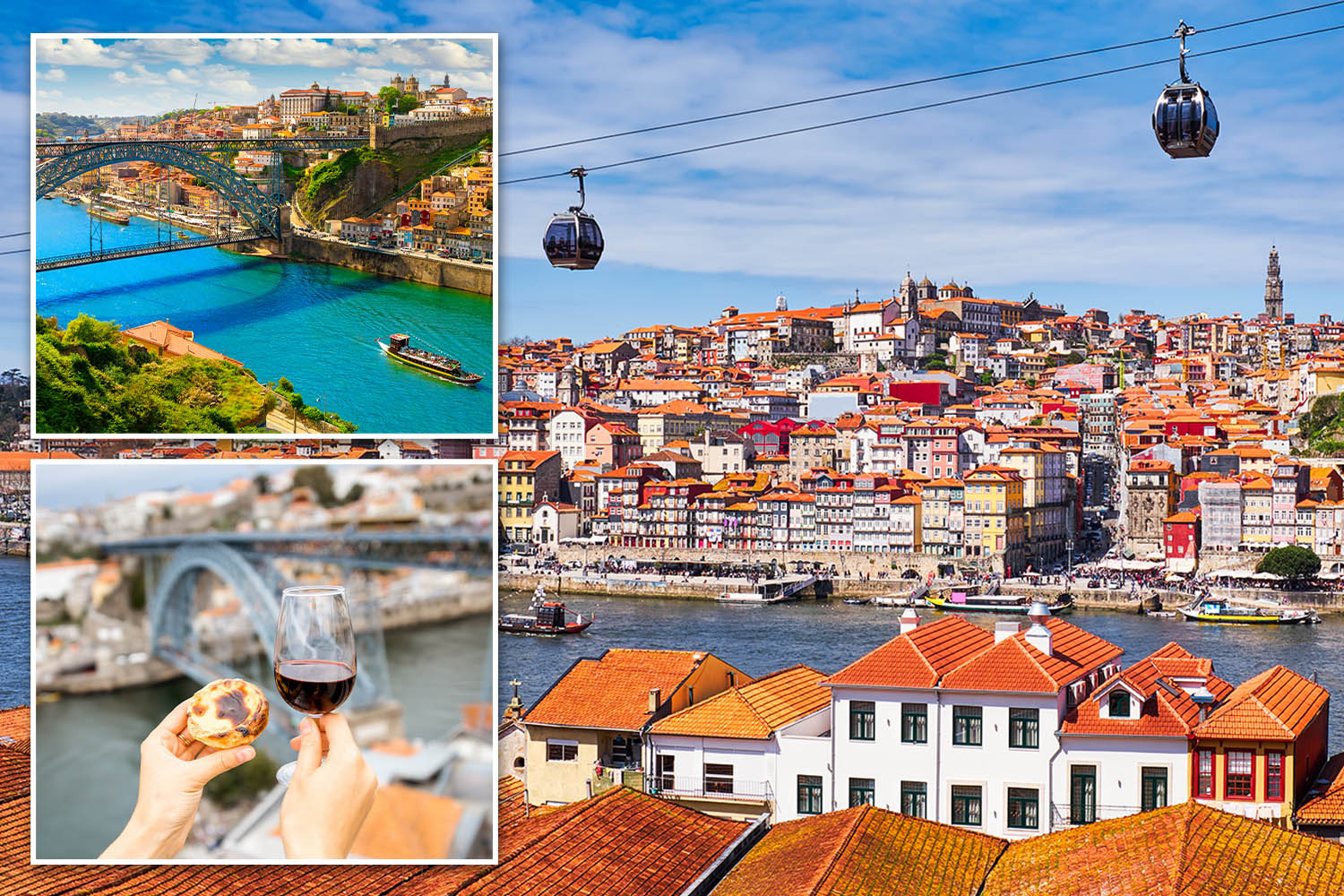
THERE is more to Portugal than its beaches – as its picturesque northern region of Douro proves.
This proudly kept secret centres around the Douro River that flows for 850km from the mountains of northern Spain to the city of Porto and serves up gastronomic, wine and cultural delights in equal measure, as well as stunning countryside.
Sign up for the Travel newsletter
Thank you!
Portugal’s picturesque northern region of Douro offers a different type of holiday to Algarve’s beachesCredit: GettyVisitors can enjoy fabulous views over the city of Porto, and there is plenty for visitors to doCredit: Getty
Its peaceful green vineyards, beneath blue skies, are a world apart from the crowded beaches of Portugal’s southern Algarve region, but just a short flight away from the UK.
Here, Lauren Clark offers a guide to what to do in Douro . . .
WHY SHOULD I GO? First and foremost, for the wine. It has been produced on the banks of the Douro River for more than 2,000 years, and this is the oldest demarcated wine region in the world after being officially established in 1756.
Its produce includes its most famous export of all — port.
But while any trip to the Douro should take in the idyllic terraced vineyards, the cobbled streets and port cellars of Porto — Portugal’s second-largest city — are not to be missed.
It is to here that barrels of wine and port have traditionally been transported down river.
STREETS ARE MADE FOR WALKING: Porto is easy to explore on foot.
Some of its medieval streets are rather steep but you can rest your legs with a ride on the Gaia cable car.
Or for yet more fabulous views, head to the train station to explore the Linha do Douro — a 99-mile rail line considered one of Europe’s most scenic, which runs close to the river for much of its route.
Hop on at Porto and disembark at Pinhao after a couple of hours.
ANYTHING FOR THE BUCKET LIST? You can take in most of compact Porto’s sites within a day or two — from its ornate tiled churches to the famous Livraria Lello bookshop.
Head across the river on the grand double-decker Dom Luis I Bridge to Vila Nova de Gaia, where historic port cellars offer tastings. At Taylor’s you can have a tour and enjoy three wines for £22.
Wine-making links are everywhere, from the 19th-century Palacio de Bolsa — a former a stockmarket built to impress potential European investors — to the merchant houses along the quaint Rua das Flores.
Visitors should try out a Francesinha, a Portuguese dish specialty from PortoCredit: Getty
WHERE SHOULD I EAT? Stop off at a no-frills local favourite, the Lado B Cafe for traditional treat francesinha — a sandwich featuring layers of bread and meats, covered in melted cheese and smothered in a spicy tomato-and-beer sauce, sometimes topped off with a fried egg.
It’s more than enough for a main meal and just £11 a go.
For more regional snacks, head to the new Time Out Market, next to the grand Porto Sao Bento train station and try traditional dessert pastel de nata — a yummy custard tart. Laid-back restaurant Adega Sao Nicolau, just off the river bank, is perfect for a more relaxed dinner.
For a special occasion, make a reservation at Le Monument, where the menu takes you on a culinary journey through Portugal.
Enjoy a drink with spectacular views over the river looking out across the cityCredit: Getty
I FANCY A DRINK: While in Porto, enjoy a sunset tipple at Restart by Vila Foz, north of the river, or Esplanada Teleferico on the south bank — both places offer stunning city views.
Or take in the sights while sipping on a glass of wine during a one-hour Six Bridges river cruise, with prices from £15.60pp.
In the Douro Valley, stop off at one of the region’s famed vineyards, Quinta da Pacheca, near the town of Peso da Regua. It offers a tour, followed by four-glass tasting, for £21 a head.
WHERE SHOULD I STAY? Five-star hotel The One Monumental Palace is handy for all of Porto’s key sites and has rooms from £169 per night in its historic, neo-classical building.
For a more value option, the Altis Porto hotel has breathtaking views of the Douro and is near the city’s Ribeiro area, featuring a riverside promenade and colourful houses. Rooms from £102 per night.
GO: Porto
GETTING THERE: EasyJet flies to Porto from Luton, Gatwick, Bristol, Liverpool and Birmingham.
An often overlooked city in the UK has been tainted with titles such as being the ‘worst’ place to stay, yet a travel writer has uncovered its allure and urges everyone to visit
Ben Aitken is an award-winning travel writer who uncovers hidden gems across the UK(Image: Handout)
A travel expert has defended the UK city that has been tainted by negative views, hailing it as one of the best and highlighting its thriving independent businesses and welcoming allure.
Earlier this year, Newport was named as the “worst” place to stay in the UK following research from Go Compare, which evaluated 55 destinations across the country for their family-friendly accommodation and visitor attractions. Elsewhere, a report by the Centre for Cities this year found that Newport has one of the highest numbers of empty shops of anyone in the UK.
Such damning reports mean that the Welsh city is often overlooked by travellers looking for a place to explore. Yet, an award-winning travel writer, who dedicates much of his time to discovering hidden gems across the UK, has labelled it as one of the best cities.
Ben Aitken, 39, loves to visit and explore British locations that are frequently dismissed by tourists, uncovering their often underappreciated charm. And Newport is one of them. “It’s punching massively below its weight in the sense that it’s got a lot going for it and people aren’t recognising that and are not taking advantage of that,” Ben exclusively told the Mirror.
“It’s peppered with these really excellent independent businesses. There are a lot of diamonds in this unfashionable place. And I can’t claim to have met all of the people that live in Newport, but I met a fair few, and each of them was friendly and welcoming.”
Having first visited in April last year, Ben said: “The first thing that struck me about Newport was its architecture. It was a boom town in the 1800s, and the legacy of its importance and significance, both industrial and civic, is still evident.
“The architecture is quite quirky; it’s not straightforwardly classic or Gothic. The high street curves and slopes in a nice way. It wasn’t buzzing, but that’s true for many towns and cities across the UK, if not the world, these days. It’s just a reality that the behaviour or habits of consumerism have changed so much.
“We no longer use high streets in the same way anymore, and when there’s no tourism in a place, that reality can appear a little unappealing, creating a quiet atmosphere. However, there are a few independent businesses that really impressed me in Newport after I wandered around for an hour.”
Ben revealed: “I had a great Italian meal at a place called Vittorio’s on the top of Stow Hill, opposite the cathedral. That’s been run by a family of third-generation Italian immigrants for about 30-40 years, as miners from Tuscany came to Newport in the 19th or early 20th century. That was a fantastic meal.
“There was also a great pub called Le Pub, which is short for Le Public space, and they do gigs and other events. It’s really relaxed, and has an inviting and quirky vibe. I chatted with the locals there and had a Trevor Nelson. It’s the local cocktail, but no one seems to know what it’s made of.
“Across the street, you’ve got a pub called Ye Olde Murenger House, and that’s about 4,000 years old. It’s the oldest and cosiest pub in Newport.” Ben added that the cafe, Rogue Fox, and fine dining restaurant at Gem 42 were other standout independent establishments in Newport.
He continued: “I also went to the Geraint Thomas National Velodrome of Wales, and there’s a brilliant velodrome just across the River Usk. Anybody can have a go. For about £20, they provided me with a bike, a helmet, and some instructions, and I whizzed around the velodrome for about an hour. It was the first time I’ve ever done that.
“Then I went to watch a rugby match at Rodney Parade. The pies were delicious. I didn’t really know what was going on, but it was atmospheric and meaningful.”
During his time in Newport, Ben stayed at the five-star Celtic Manor Resort, one of the country’s most renowned hotels. “It was really nice, it does what it does very well. I just wish it supported Newport city centre a little bit more by directing its guests there for dinner rather than to Cardiff or Bristol.
“I think I was the first visitor to have walked to the hotel from the train station, but I just wanted to demonstrate that you can do it.”
Ben added: “I’m not asking people to up sticks and move to Newport. I’m just asking them to consider visiting, staying over for the night, and I promise you can fill a weekend there. It has food, history, fun, and accommodation. Itjust goes to show that anywhere can be interesting and enjoyable if you just give it half a chance.”
You can read more about Ben’s UK travels and treasured finds in his book, Sh**y Breaks: A Celebration of Unsung Cities, which was released earlier this year. Alternatively, you can visit his Instagram page.
Do you have a travel story to share? Email webtravel@reachplc.com
Good morning, and welcome to L.A. on the Record — our City Hall newsletter. It’s David Zahniser, dishing up the latest on city and county government.
It’s not hyperbole to say that 2025 was a terrible year for Los Angeles.
Wildfires ravaged huge stretches of Pacific Palisades, Altadena, Malibu and other communities. Federal immigration raids tore families apart and disrupted the economy, prompting furious protests in downtown and elsewhere. L.A.’s political leaders, facing a brutal budget year, signed off on cuts while working to stave off layoffs of public employees.
Now, we’re heading into a year of uncertainty — one with the potential to bring fresh faces both to City Hall and the county’s Hall of Administration, while also ushering in bigger, structural changes.
You’re reading the L.A. on the Record newsletter
Here are a few of the political issues we’ll be tracking over the next twelve months, in this newsletter and elsewhere:
1) WILL HE OR WON’T HE? It’s January, and we still don’t know if real estate developer Rick Caruso will seek a rematch against Mayor Karen Bass in the June 2 primary election. A second Caruso run would deliver a jolt to the campaign, complicating Bass’ attempt to win a second four-year term in a single shot. He’s got to decide soon!
Per Mike Murphy, a political strategist and longtime Caruso friend: “He is close to a decision.”
Caruso, a fierce critic of the city’s handling of the Palisades fire, lost to Bass by 10 percentage points in 2022. If he jumps in, he would join a long list of challengers that includes former L.A. schools superintendent Austin Beutner, community organizer Rae Huang and an assortment of unknowns.
The larger the field, the tougher the road Bass will have in trying to avoid a November runoff — and winning her election overall.
2) WILL THE COUNCIL GET BIGGER? The Charter Reform Commission, which is made up of a dozen or so citizen volunteers, is heading into the home stretch as it works on a plan to update the City Charter, the governing document for L.A.
The commission’s report, due in April, is expected to say whether voters should expand the number of City Council members, scale back the duties of the elected city attorney and grant the city controller additional authority. There are also some smaller proposals, including a move to a two-year budget process.
The council will then decide which of those proposals will go on the November ballot. Raymond Meza, who chairs the commission, sounded optimistic about the prospects.
“There’s been a lot of serious public input and energy behind this process, and we think the council is going to thoroughly consider our recommendations,” Meza said.
3) WILL CITY HALL KEEP MOVING LEFT? Eight council seats are up for grabs this year, with bruising campaigns looming on the Eastside, on the Westside, in the west San Fernando Valley and in South L.A.
Councilmembers Eunisses Hernandez and Traci Park are among those battling for a second term. Voters also must find replacements for Curren Price and Bob Blumenfield, each of whom is facing term limits after a dozen years on the council.
Ground Game LA, Democratic Socialists of America and other groups inspired by the victory of New York City Mayor Zohran Mamdani are looking to keep pulling the Overton window in their direction on public safety, tenant protections and other issues.
The ballot will also feature two other citywide contests, with City Atty. Hydee Feldstein Soto and City Controller Kenneth Mejia both seeking reelection.
4) CAN L.A. AFFORD MORE COPS? Bass has been pressuring the council to free up the money to hire more officers in the new year. She’s not likely to let up, even as she begins preparing her newest citywide budget.
Still, a fight over LAPD hiring could spur the council to take a fresh look at Bass’ other major policy initiative — Inside Safe, which has been moving homeless people indoors since she took office.
Amid growing concerns about the city’s financial stability, some council members have begun exploring the idea of paying the county to deliver homeless services — an idea that Bass panned in a Daily News opinion piece last month.
That op-ed drew some icy rebuttals from County Supervisor Lindsey Horvath, who called the city’s track record on homelessness “indefensible.”
5) WHITHER THE COUNTY? Speaking of the county, officials inside the Hall of Administration will likely spend the coming year trying to figure out how to prevent Measure J — which requires public spending on alternatives to incarceration — from being struck down by Measure G, the reform measure approved by voters in 2024.
(Measure G, which was largely about expanding the number of county supervisors and establishing an elected CEO, inadvertently set the stage for a pending repeal of Measure J, in what has been billed as an enormous bureaucratic snafu.)
We’ll also be watching as the county’s new homelessness department gets up and running. And we’ll monitor Sheriff Robert Luna’s bid for reelection, as well as the campaign for two supervisorial seats.
6) COULD WE SEE A BUILDING FRENZY? L.A. County’s fire-scarred communities are hoping to see a ramp up in the pace of rebuilding in 2026. But will fire victims stay put? Or will they sell their burned-out sites to developers? The stakes are high, not just for those communities but for the elected officials who represent them.
Of course, there are plenty of other issues to track in the new year beyond the big six. For example, there’s the proposed sales tax hike to fund Fire Department operations; the push for higher taxes to pay for park facilities; the gambit to slow down wage hikes for hotel and airport workers; and the movement to hike the city or county minimum wage.
Then there are the preparations, and behind-the-scenes negotiations, over the 2028 Olympic and Paralympic Games, which have huge cost implications for the city.
Are you exhausted yet? If not, we’ll see you next week.
State of play
— ‘HIGHLY UNPROFESSIONAL’: The author of the Fire Department’s after-action report on the Palisades fire declined to endorse it because of changes that altered his findings, according to an email obtained by The Times. “Having reviewed the revised version submitted by your office, I must respectfully decline to endorse it in its current form,” wrote Battalion Chief Kenneth Cook, about an hour after the report was made public. Cook also called the final version of the report “highly unprofessional.”
— PLAYING WITH FIRE: Two groups have sued the city of L.A., alleging that agencies ignored state wildfire safety regulations while signing off on development in areas with severe fire hazards. The State Alliance for Firesafe Road Regulations and the Federation of Hillside and Canyon Assns. offered what they described as 75 examples of building permits and other plans that violate the state’s “minimum firesafe regulations.”
— DIGGING INTO DTLA: It’s been a tumultuous year for DTLA Law Group, which grew from a small firm focused on car crash victims into a litigation powerhouse with thousands of sexual abuse claims against government agencies. The firm’s activities are now the subject of an investigation by the DA’s office, amid lingering questions about how DTLA amassed so many plaintiffs so quickly. The Times spoke with dozens of former clients and employees who described aggressive tactics to bring in new clients.
— RADIO SILENCE: L.A.’s parking enforcement officers were removed from the field last weekend after copper wire thieves damaged a key communications tower in Elysian Park, leaving some workers with inoperable radios.
— LUCKY NUMBER 13: The Charter Reform Commission might finally get its 13th member, just a few months before it wraps up its work. Councilmember Bob Blumenfield recently nominatedJason Levin, a onetime spokesperson for his office, to fill the seat after his previous pick, former Councilmember Dennis Zine, flamed out. Levin is an executive vice president at the firm Edelman, focusing on crisis and risk.
— NEW YORK STATE OF MIND: City Council President Marqueece Harris-Dawson and Councilmember Eunisses Hernandez flew to New York City this week for Mamdani’s inauguration. Hernandez, on Instagram, called the event “a reminder that the movement for dignity, justice, and humanity is bigger than any one city.”
— READY FOR SIGNATURES: The City Clerk’s office recently cleared the way for the firefighters’ union to begin gathering signatures for a sales tax hike to pay for fire stations, fire equipment and other emergency resources. The proposal comes amid complaints that department brass sought to cover up findings about the Palisades fire.
— YET ANOTHER WAGE HIKE: The fire tax proposal comes a few weeks after the city clerk cleared the way for another ballot petition — this one hiking the city’s minimum wage to $25 per hour. The proposal includes provisions to ensure that hotel employees are “paid fairly for burdensome workloads” and prohibit “the exploitative practice of subcontracting housekeeping work.”
— BIG DAY FOR THE VA: The U.S. 9th Circuit Court of Appeals upheld a lower court order requiring the federal Department of Veterans Affairs to build more than 2,500 units of housing on its West L.A. campus. “Rather than use the West Los Angeles VA Grounds as President Lincoln intended, the VA has leased the land to third party commercial interests that do little to benefit the veterans,” wrote Circuit Judge Ana de Alba.
— CHANGING CHAIRS: One of Harris-Dawson’s top aides, senior advisor Rachel Brashier, is switching offices at City Hall. Brashier, who frequently sits next to the council president as he presides over meetings, has taken a job with the mayor, according to Harris-Dawson spokesperson Cerrina Tayag-Rivera. Brashier will serve as a deputy chief of staff, per Bass’ team.
QUICK HITS
Where is Inside Safe? The mayor’s signature program to combat homelessness did not launch any new operations over the holiday.
On the docket next week: L.A. marks the one-year anniversary of the Palisades and Eaton fires with a number of events. Among them is “They Let Us Burn,” a demonstration in Pacific Palisades where community leaders plan to highlight their demands to city, county and state leaders.
Stay in touch
That’s it for this week! Send your questions, comments and gossip to LAontheRecord@latimes.com. Did a friend forward you this email? Sign up here to get it in your inbox every Saturday morning.
The city is, by some counts, the hottest in the world. However, in January, the coldest time of the year, the thermometer rarely rises much higher than 20 °C, while staying in the balmy mid-teens
Waleed Alkhamees has lived his whole life in Kuwait City (Image: Waleed Alkhamees)
It’s possible to get to the hottest city in the world for £78 this month.
Kuwait City is, by all measures, ferociously hot. On July 21, the mercury reached 53.9C in Mitribah, which is near to the Capital. That temperature was verified by the World Meteorological Organization as the highest ever recorded in Asia.
Given how dangerous such high temperatures can be, it’s advisable to visit Kuwait in the winter or spring months, rather than the summer. In January, the coldest time of the year, the thermometer rarely rises much higher than 20 °C, while staying in the balmy mid-teens.
If escaping the UK’s frosty shores for a spot of Kuwaiti sunshine appeals, then you’re in luck. Flight prices are relatively low at this time of the year. Skyscanner lists flights from London for £78 return this January, with services from Bristol, Birmingham and Manchester coming in at under £100.
Waleed Alkhamees has lived his whole life in Kuwait City – a destination the tour guide describes as one that “no one ever moves away from”. Yet this Middle Eastern metropolis holds the dubious distinction of being the planet’s most scorching urban centre. During 2021, the mercury climbed above 50C (122F) for 19 consecutive days.
When we caught up with Waleed, he told us how locals deal with the weather. “Everybody is trying to keep indoors, as everywhere in Kuwait is air-conditioned. Most of the locals escape from the heat and go outside Kuwait during the summer. Businesses close down. By law you can’t work outdoors from 10am to 5pm, so the workers work from midnight until the morning.”
Waleed has observed the average temperatures inching up year on year. Each summer, he notes, it seems to get a tad hotter. While it’s always been a place where the mercury soars, residents of the largely concrete city are finding themselves making more and more adaptations just to manage.
The state heavily subsidises electricity – funded alongside healthcare and education from vast oil reserves that keep the tax rate at zero – enabling most of the 3.3 million city dwellers to run their air conditioning units non-stop.
Nearly all enclosed public spaces are filled with artificial cold air throughout the day and night, while streets are enveloped in clouds of cooling water. A government prohibition on outdoor work from 10am to 5pm during the summer months aims to prevent people from collapsing and dying in weather conditions that pose a constant threat to human health.
However, if you visit Kuwait City in the summer, you might notice that this rule isn’t strictly enforced. Workers, often recent immigrants, defy the heat and the ban to labour on the streets, their bodies fully covered from head to toe for some respite from the relentless sun.
Waleed guides tourists around the city, showcasing landmarks such as the spaceship-like Kuwait Towers, which tower over the city as a clear symbol of its wealth in a style reminiscent of the 1970s. The Grand Mosque and the old Souk are the other major attractions.
His tour groups typically comprise around 80% Americans, with the remainder being European visitors – a demographic that mirrors the significant US military presence at Camp Arifjan in the country’s south-east. Even during the scorching months of June and July, tours operate year-round, with visitors seldom stepping out of air-conditioned vehicles whilst discovering the city.
Western travellers seeking a refreshing beer in the evening will be disappointed in Kuwait, which maintains a rigorous and strictly enforced alcohol ban, even within hotels frequented by tourists. For those brave enough to trust their sun cream, the city’s coastline proves particularly attractive.
The expansive sandy shoreline ranks among the longest in the Middle East and boasts excellent diving locations.
Despite the unrelenting heat – so extreme it forces pigeons to stay grounded during parts of the day and has even killed off marine wildlife in the bays – Waleed insists his fellow citizens have no intention of leaving.
“Kuwait City has gotten hotter. For years now. It is hotter and hotter every year. I am worried about global warming. It’s half a degree every couple of years. But we won’t move away. Kuwaitis never move away. There are lots of benefits in Kuwait,” he explained.
“The currency is the highest currency in the world, we pay zero tax, everything is subsidised by the government, fuel cost is half that of Saudi Arabia. Medication and education is free. People, they don’t move away.”
Manchester City head coach Pep Guardiola has insisted he wants to “fight with his team” and see out his contract at the club, following reported interest in former Chelsea manager Enzo Maresca.
The line will predominantly be used by residents. All you need to ride the cable car is a bus ticket or travel pass that you’d also be using on the metro, and it will only cost around €2 (£1.74).
The purpose of the cable car is to connect poorly served southeastern suburbs like Créteil and Villeneuve-Saint-Georges.
The journey from Créteil to Villeneuve-Saint-Georges by road takes 40sminutes-– the cable car can do it in 18.
It will fly over four municipalities in the Paris region; Créteil, Limeil-Brévannes, Valenton, and Villeneuve-Saint-Georges.
This is the seventh urban cable car to open in France, it cost a whopping €138million (around £120.8 million) to build.
While this might seem a lot – it’s much less than a new Metro line would have cost to build.
You can experience another cable car right here in the UK
The Heights of Abraham in the Derbyshire Dales installed the UK’s first ever alpine-style cable car 40 years ago to get visitors up to its hilltop park.
You’ll find underground tours, play areas and woodland wanders for you and your family to enjoy.
The unique transport system cuts out the need to scramble up the steep hillside and has even inspired the likes of the London Eye and the cable car at Alton Towers.
The trip to the top takes you over trees, rock formations and the river, with incredible views of the town of Matlock Bath below you and rolling countryside stretching as far as the eye can see.
But the cable car voyage is only the start of a day out with a difference deep in the Derbyshire Dales.
London City Lionesses wanted a coach who could help develop and consistently deliver a unique style of football.
They have been influenced by Spanish football and its success, as well as the full-throttle style which has helped deliver eight Women’s Champions League titles at Lyon – one of the clubs also owned by wealthy businesswoman Michele Kang.
A shortlist of coaches was drawn up when they decided to replace former manager Jocelyn Precheur and they did not rule out some from the men’s game.
The main criteria was centred around the playing style, the coach’s ability to collaborate with a wider team of expertise and to have a track record of developing players and talented youth.
Maestre showed his potential with Spanish clubs CD Tenerife and Real Sociedad and London City believe he can become a future leading figure in the game
Led by chief executive officer Martin Semmens, London City have been working on a long-term project to achieve their aims of reaching European competition by 2026.
That is an ambitious target for a club only promoted to the WSL for the first time this season and their decision to replace Precheur with Maestre may have been premature but they were willing to take the risk and will be judged on that with intrigue.
A historic theater in the Russian-occupied Ukrainian city of Mariupol has opened its doors more than three years after it was pummeled in a Russian airstrike that killed hundreds of civilians sheltering inside.
Moscow-installed authorities marked the rebuilding of the Donetsk Academic Regional Drama Theater with a gala concert on the building’s new main stage Sunday night. Images shared by Russian state media outlets showed the building’s marbled pillars and staircases, and dancers wearing traditional Russian headdresses known as kokoshniks performing.
The original theater was destroyed when it was targeted by a Russian airstrike on March 16, 2022, as Moscow’s forces besieged the city in the weeks after their invasion.
An Associated Press investigation later found evidence that the attack killed about 600 people inside and outside the building — almost double an early estimate from the government.
At the time of the strike, hundreds of civilians had sought refuge in the building after weeks of relentless shelling. The word “children” had been written with paint on the street outside the building, large enough to be seen by both pilots and satellites.
Moscow said that Ukrainian forces demolished the theater, a claim that the AP’s investigation refuted.
Russian forces took control of Mariupol’s city center shortly after the strike. The ruins were bulldozed and any remains were taken to the ever-growing mass graves in and around Mariupol.
Mariupol’s Ukrainian city council, which left the city when it was occupied for Ukrainian-controlled territory, called the rebuilding and the opening of the theater “singing and dancing on bones.”
“The ‘restoration’ of the theater is a cynical attempt to conceal the traces of a war crime and part of an aggressive policy of Russification of the city. The repertoire consists largely of works by Russian writers and playwrights,” the council said in a statement on Telegram.
Guests of honor at Sunday’s opening included Denis Pushilin, the Russian-installed head of the partially occupied Donetsk region, and St. Petersburg Gov. Alexander Beglov. Workers from St. Petersburg, which was twinned with Mariupol after Russia took full control of the city in May 2022, aided in the building’s reconstruction.
The Donetsk region, where Mariupol is located, has remained a key battleground throughout the war. Russia illegally annexed it in 2022, though Moscow still doesn’t control all of it. The region’s fate is one of the major sticking points in negotiations to end the war.
Sunderland manager Regis Le Bris discusses his team’s high standards as they extend their unbeaten home record at the Stadium of Light after a 0-0 draw against Manchester City.
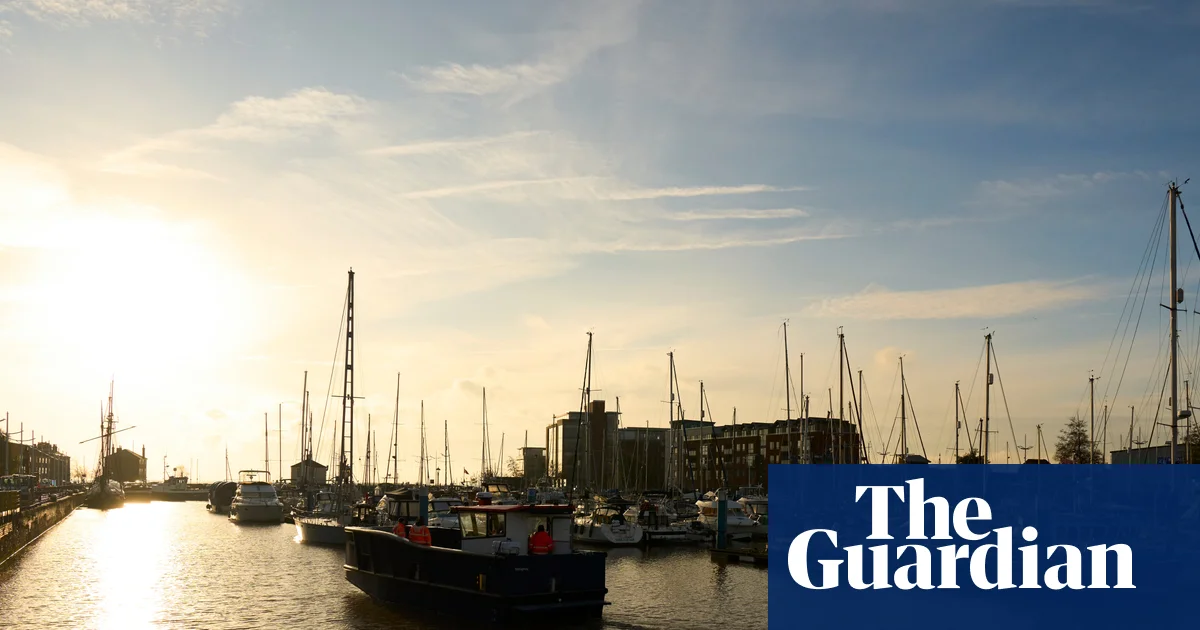
A combination of a world record-breaking trawler, a floating lighthouse and a dizzying array of maritime objects that include a stuffed polar bear called Erik are all helping to make Hull one of the top 25 places in the world to visit in 2026.
The East Yorkshire city is on the verge of completing an ambitious £70m transformation, which, supporters believe, will propel it into becoming an international tourist destination.
Eyebrows have been raised about the inclusion of Hull, a city that had a reputation problem even in the 17th century, when the poet John Taylor wrote: “From Hell, Hull and Halifax, good Lord deliver us.”
Neither eyebrow of Mike Ross, the city council’s Liberal Democrat leader, went up when he heard the news. “There was a sense of surprise for some,” he said. “But why shouldn’t Hull be one of the top 25 places? It has got so much going for it. This is a place that can do things and we want more people to see that.”
The newly restored Arctic Corsair trawler, known as Hull’s Cutty Sark, one of several projects that are part of a £70m transformation of the city. Photograph: Christopher Thomond/The Guardian
When the Guardian visited on a rainy day in December, it was clear that everything is nearly there. Finishing touches and final decisions are being made for a series of openings taking place in 2026.
A vessel called the Spurn Lightship, which for 50 years guided ships through the treacherous waters of the Humber estuary, will reopen to the public after a makeover.
Swathes of public space are being improved, including a £21m refurbishment of Queen’s Gardens, a former dock; and the city’s much-missed Maritime Museum will reopen after a five-year closure.
The ambitious project is a legacy from Hull’s UK city of culture success in 2017 and has had a number of frustrating delays, but 2026 will be the year things finally start happening.
The Spurn Lightship will reopen to the public after a makeover. Photograph: Christopher Thomond/The Guardian
The Arctic Corsair, the project’s centrepiece, is a deep-sea trawler built in 1960 that operated during the cod wars with Iceland and which once broke world records for landing the largest amount of cod and haddock in a year.
It is an emblem of Hull’s proud trawling history – still within living memory – and has been a visitor attraction since 1999. It was badly in need of restoration and closed to the public in 2018. Today, the 57-metre-long boat positively gleams.
The Arctic Corsair was restored by Dunston Ship Repairs in Hull, where it is docked, and everyone involved in the project has praised the company for going above and beyond what was expected.
For Dave Clark, the technical director at Dunston, it has clearly been a passion project but he will be happy when it makes its way to its permanent home. “People need to be on it, it needs to be seen,” he said. “People need to hear the stories, to see the working conditions … men working 16 hours a day.
“We are all from Hull and most of the people who work for us have been involved in the fishing industry their whole life and you can see the pride that has been put into it.”
Hull Maritime Museum will reopen after a five-year closure. Photograph: Christopher Thomond/The Guardian
Moving the trawler from its current berth to its dry dock home will be a huge challenge involving dredging and a possible 20-point turn.
Men who used to work on the Arctic Corsair have also volunteered their memories and knowledge. They include Cliff Gledhill, a retired maritime engineer who seems to know every working part of the boat’s machinery and huge, labyrinthine engine room.
“It’s 52 years since I first came on this ship,” he said. “If the ship broke down, it doesn’t matter where it was … Iceland or Norway or wherever, the chances were that one of us [engineers] would go.”
He said the Arctic Corsair was important to Hull. “It was a very successful ship with quite a history. It was the pride of the fleet. This is going to be a massive attraction.”
Cliff Gledhill, a retired maritime engineer, on the newly restored Arctic Corsair. Photograph: Christopher Thomond/The Guardian
At the city’s Maritime Museum, housed in former dock offices, the rooms are still largely empty but the roof has been fixed, display cabinets are being put in place and boxes are ready to be emptied.
Robin Diaper, a curator, said the museum was a place for tourists to spend time but also somewhere local people could pop in to see Erik, the popular polar bear on long-term loan from Dundee, while they were shopping.
“We wanted to make the whole project world-class,” said Diaper. “It’s of a standard you might see in New York or Paris or London. But we also want a young mother from the Orchard Park estate to be able to just walk in and for it to be hers as well.”
The Ferens Art Gallery in Hull city centre is also a draw for tourists. Photograph: Andrew Paterson/Alamy
Rooms in the museum that were previously off limits are being used to display far more objects, more boldly. The grade II*-listed former docks building was badly in need of restoration. When it rained, plastic sheeting had to be placed over whale skeletons hanging from the ceiling.
Hull also has the Ferens Art Gallery, the Wilberforce House Museum and its spectacular aquarium, The Deep. With everything happening in 2026 it is a world-class destination for visitors, say tourism officers.
For the council leader Ross, the challenge is for people not to be surprised they might have a great time in Hull, but to know in advance that they will. “If we can do that, we’ve made it,” he said.
Zohran Mamdani has been sworn in as mayor of New York City, becoming the first Muslim and the youngest person in generations to take the oath of office in the United States’ biggest city.
Mamdani, a Democrat, was sworn in at a historic, decommissioned subway station in Manhattan just after midnight on Thursday, placing his hand on a Quran as he took his oath.
“This is truly the honour and the privilege of a lifetime,” Mamdani said.
The ceremony, administered by New York Attorney General Letitia James, a political ally, took place at the old City Hall station, one of the city’s original subway stops that is known for its stunning arched ceilings.
He will be sworn in again, in grander style, in a public ceremony at City Hall at 1pm (18:00GMT) by US Senator Bernie Sanders, one of the mayor’s political heroes. That will be followed by what the new administration is billing as a public block party on a stretch of Broadway known as the “Canyon of Heroes,” famous for its ticker-tape parades.
Mamdani now begins one of the most unrelenting jobs in US politics as one of the country’s most-watched politicians.
In addition to being the city’s first Muslim mayor, Mamdani is also its first of South Asian descent and the first to be born in Africa. At 34, Mamdani is also the city’s youngest mayor in generations.
Mamdani, right, hands nine dollars to city clerk Michael McSweeney before signing a registry [Yuki Iwamura/AP]
In a campaign that helped make “affordability” a buzzword across the political spectrum, the democratic socialist promised to bring transformative change with policies intended to lower the cost of living in one of the world’s most expensive cities.
His platform included free child care, free buses, a rent freeze for about 1 million households, and a pilot of city-run grocery stores.
But he will also have to face other responsibilities: handling trash and snow and rats, while getting blamed for subway delays and potholes.
Tensions with Trump
Mamdani will also have to deal with Republican President Donald Trump.
During the mayoral race, Trump threatened to withhold federal funding from the city if Mamdani won and mused about sending National Guard troops to the city and suggested that he should be deported.
He also called Mamdani a “100% Communist Lunatic” in a social media post.
But Trump surprised supporters and foes alike by inviting the Democrat to the White House for what ended up being a cordial meeting in November.
“I want him to do a great job and will help him do a great job,” Trump said in the meeting, and the US president even came to Mamdani’s rescue as the two addressed reporters.
When a journalist asked Mamdani if he continued to view Trump as a fascist, the president stepped in.
“That’s OK. You can just say it. That’s easier,” Trump told Mamdani. “It’s easier than explaining it. I don’t mind.”
Still, tensions between the two leaders remain.
Following the meeting, Mamdani said he still believed Trump is a fascist.
“That’s something that I’ve said in the past; I say it today,” Mamdani told NBC News.
US President Donald Trump (R) shakes hands with New York Mayor-elect Zohran Mamdani as they meet in the Oval Office of the White House in Washington, DC, on November 21, 2025 [File: AFP]
Mamdani was born in Kampala, Uganda, the son of filmmaker Mira Nair and Mahmood Mamdani, an academic and author. His family moved to New York City when he was 7, with Mamdani growing up in a post-9/11 city where Muslims didn’t always feel welcome. He became an American citizen in 2018.
He worked on political campaigns for Democratic candidates in the city before he sought public office himself, winning a state Assembly seat in 2020 to represent a section of Queens.
Still, Mamdani had minimal name recognition when he launched his mayoral campaign late last year.
However, in the lead-up to the Democratic primary, he quickly rose in the polls with a message focused on lowering the cost of living.
Mamdani ultimately defeated former Governor Andrew Cuomo twice: once to clinch the Democratic nomination in June, and a second time in the November election.
Wizz Air’s new flight opens up a whole new city break destination for Brits, and not only is it less expensive than spots such as Poland, it’s full of history, walkable, and has plenty to do
The city has a blend of the historic and modern(Image: Getty Images/iStockphoto)
Budget airline Wizz Air recently announced six new routes from its London Luton Airport base, and one city in particular is an up-and-coming destination for Brits in 2026 thanks to its rich history and inexpensive pints.
From June 12, 2026, Brits will be able to fly from Luton to Yerevan, the capital of Armenia. In addition to connecting the two cities, the new route represents the first direct flights from the UK to Armenia, adding a potential new city break to many people’s lists. Flights on Wizz Air will take just over five hours, and start at just £51.99 one way.
While technically Armenia is in West Asia, it’s often considered to be part of Eastern Europe due to its culture and history. Yerevan is already a popular city break destination among Europeans, but it is rarely visited by Brits, with only 11,000 people from the UK visiting in 2025. However, the new route may see the numbers rise in 2026.
For history fans, Yerevan is a must-visit, as it’s one of the world’s oldest continuously inhabited cities. Its rich history is encapsulated in the many different types of architecture from across the eras, including a mix of newer Soviet and contemporary designs.
Etchmiadzin Cathedral is considered the oldest cathedral in the world, with the original church dating back to the early fourth century. It was built over a Pagan temple, as the country adopted Christianity as the state religion. Over the years has been rebuilt and reconstructed, with a range of different art and architecture styles.
The Kond District is the city’s oldest quarter, with narrow streets, stone houses, and even areas with unpaved roads. Large areas were destroyed during the Soviet era, with residents moved into modern apartment blocks, although there are attempts to reconstruct this historic area.
Yerevan is often called the Pink City, as many of the buildings have a light pink hue, which you’ll notice more in certain lights. This is because many of its older buildings were built in a local volcanic stone that has a pink tint to it. To really appreciate these buildings, head to Republic Square. It’s also home to the popular dancing fountains, which light up and play music in the evenings.
With prices going up in many European cities, Yerevan remains an inexpensive city break. According to Numbeo, which compares costs between cities, Yerevan is about 20% cheaper than Warsaw, with meals out and alcohol tending to be much cheaper than Poland. Pints in local pubs cost between £1.50 and £2, especially for Armenian beers, while a mid-range bottle of wine is about £7.
There are some great hotel deals to be found. The five-star Grand Hotel Yerevan, which has a central location near to tourist spots and a seasonal outdoor pool, has rooms from just £101 per night. Or if you’re looking for somewhere more budget-friendly, try the centrally located Erebuni Hotel Yerevan. Clean and modern, it has basic rooms for £47 a night including breakfast, and it’s set on a side street just off Republic Square.
The city has lots of traditional Armenian restaurants serving hearty local cuisine. Try flatbreads like lavash, or dolma, which are stuffed vine leaves. If you like barbecue, look out for restaurants offering khorovats, which is meat grilled on a skewer, usually pork, beef, or lamb.
Have a story you want to share? Email us at webtravel@reachplc.com
Dec. 31 (UPI) — A late-morning threat on Wednesday caused a temporary lockdown at Kansas City International Airport in Missouri that was lifted a little over an hour later.
Kansas City officials said the FBI and airport police were notified of a threat in a particular area within the airport, which was evacuated and searched, KCTV reported.
“Law Enforcement was able to determine no credible threat to the airport or those inside the terminal at this time. Once that determination was made, KCAD staff worked to resume normal operations and minimize disruptions,” city officials said in a statement.
Passengers were evacuated from the area of concern at 11 a.m. CST due to a “potential threat” in an unsecured area of the airport, according to WDAF TV.
They were let back in shortly before noon, and the airport was fully reopened by 12:30 p.m.
The nature of the threat was not announced, and the FBI is continuing to investigate the matter.
A separate threat also was investigated at the West Virginia International Yeager Airport in Charleston on Wednesday morning, WOWK reported.
The threat was “non-credible,” and the affected terminal was not evacuated, but a local bomb squad searched the area to ensure it was safe, local officials said.
West Ham have been touted as potential suitors for Vipotnik, although Swans boss Vitor Matos dismissed that link as “just a rumour”.
Matos, who has overseen four wins in Swansea’s past six matches, was full of praise for the forward’s performance in the 1-0 win at Oxford, with injuries to fellow frontmen Adam Idah and Liam Cullen making his contribution all the more important.
Swansea now face West Brom on New Year’s Day (15:00 GMT) with Vipotnik hoping to continue his progress this season.
Vipotnik, who has scored 12 in all competitions after just seven in his first campaign in Wales, began 2025-26 playing back-up to Cullen and then saw Idah arrive in a big-money transfer from Celtic on 1 September.
But the former Bordeaux player has made himself Swansea’s first-choice centre-forward thanks to his impressive form.
“It was tough (at the beginning of the season) but, after, I showed my character and I’m thankful for my team-mates and gaffer who helped me with this,” Vipotnik added.
“I’m really happy with my form and I’ll hope that I’ll continue in the new year.
“I have a target in my head about how many goals. I don’t like to say it, but I like to score every game.”
Sapang Kawayan, Philippines – Two hours north of the capital, Manila, on the vast grounds of a former United States military base, the Philippine government is pushing ahead with plans for a multibillion-dollar “smart city” that President Ferdinand Marcos Jr hopes to turn into a future “mecca for tourists” and a “magnet for investors”.
The New Clark City, which is being built on the former Clark Air Base, is central to the government’s effort to attract foreign investment and ease congestion in Manila, where nearly 15 million people live.
Recommended Stories
list of 4 itemsend of list
To accompany the city’s development, the government has also laid out an ambitious slate of projects at a nearby airport complex — new train lines, expanded airport runways, and a $515m stadium that officials hope will be enticing enough to draw the global pop singer Taylor Swift.
Caught between the rising new city and the site of the proposed stadium lies the Indigenous Aeta village of Sapang Kawayan. For the roughly 500 families who live there, in houses of nipa grass and rattan, the developments spell disaster.
“We were here before the Americans, even before the Spanish,” said Petronila Capiz, 60, the chieftain of the Aeta Hungey tribe in Sapang Kawayan. “And the land continues to be taken from us.”
Historians say American colonisers, who seized the Philippines from Spain in 1898, took over the 32,000-hectare (80,000-acre) tract that became Clark Air Base in the 1920s, dispossessing the Aetas, a seminomadic and dark-skinned people thought to be among the archipelago’s earliest inhabitants.
Many were displaced, though some moved deeper into the jungle inside the base and were employed as labourers.
The US turned over the base to the Philippine government in 1991, some four decades after granting the country independence. Since then, the Bases Conversion and Development Authority, or BCDA, has managed the complex. Some 20,000 Aetas are thought to remain in the Clark area today, spread across 32 villages.
But most of their claims to the land are not recognised.
In Sapang Kawayan, residents fear the government’s development boom means they could be pushed out long before they can establish such claims. The community – along with other Aeta villages in Clark – is working with researchers from the University of the Philippines to expedite a long-pending application for a Certificate of Ancestral Domain Title, or CADT — the only legal mechanism that would allow them to assert rights to their territory and its resources.
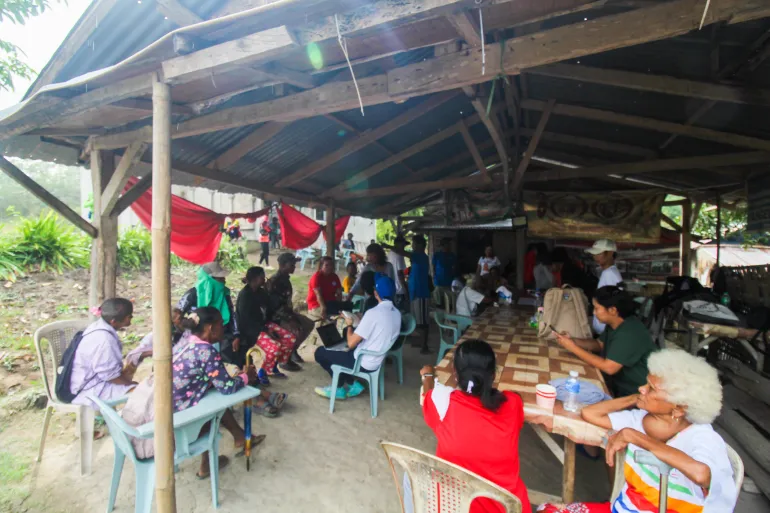
In January, July and September, Aetas young and old gathered under makeshift wooden shelters in Sapang Kawayan, assembling family trees and sharing stories and photographs. Volunteers documented each detail in hopes of demonstrating that the community there predates colonial rule.
Their 17,000-hectare claim overlaps with nearly all of the 9,450 hectares designated for New Clark City, while 14 kilometres to the south is the airport complex where the new railway line, runway and stadium are slated to rise.
Together, the new city and airport complex “will eat up the fields where we farm, the rivers where we fish and the mountains where we get our herbs”, Capiz said.
Aetas work with researchers at the University of the Philippines to expedite their application for an ancestral land title [Michael Beltran/Al Jazeera]
‘Taylor Swift-ready’
The Philippine government first announced plans for New Clark City under then-President Rodrigo Duterte, promoting it as a solution to the crippling congestion in Metro Manila. The BCDA describes the development as a “green, smart and disaster-resilient metropolis”.
Construction began in 2018 with major roads and a sports complex that hosted the Southeast Asian Games in 2019.
Designed to accommodate 1.2 million people, the city is expected to take at least 30 years to complete.
The BCDA is now building three highways linking New Clark City to the airport complex, where the “Taylor Swift–ready” stadium is planned. Officials have hyped that the stadium, to be built by 2028, will lure Swift after she skipped the Philippines during the South Asian leg of her Eras tour last year.
“One of the main elements that make Clark so attractive to investors is its unmatched connectivity,” the BCDA’s president, Joshua Bingcang, said this year, citing the airport, a nearby seaport and major expressways. “But we need to further build on this connectivity and invest more in infrastructure.”
That expansion has come at a cost for Aeta communities.
Counter-Mapping PH, a research organisation, and campaigners estimate that hundreds of Aeta families have been displaced since construction of the city began, including dozens of families who were given just a week in 2019 to “voluntarily” vacate ahead of the Southeast Asian Games.
They warn that thousands more could be uprooted as development continues.
The BCDA has offered financial compensation of $0.51 per square metre as well as resettlement for affected families. In July, it broke ground on 840 housing units, though it is unclear whether they are intended for displaced Aetas.
The agency maintains that no displacement has occurred because Aetas have no proven legal claim to the area. In a statement to Al Jazeera, the BCDA said it “upholds the welfare and rights of Indigenous peoples” and acknowledges their “long historical presence” in central Luzon, where Clark is located. However, it noted that Clark’s boundaries follow “long-established government ownership” dating to the US military base, and that the New Clark City does not encroach on any recognised ancestral domains.
The BCDA also contended that it is the National Commission on Indigenous Peoples (NCIP) that deals with the applications for a Certificate of Ancestral Domain Title, and stressed that it respected “lands awarded to Indigenous peoples”.
The Clark International Airport Corporation, which oversees the airport complex, offered similar assurances, stating that “there are no households or communities existing in the said location”. The group added that while the extended Clark area has Aeta communities, none exist within the airport complex itself.
Labourers work on buildings in the games village for the Southeast Asian Games (SEA Games) in New Clark City in Capas town, Tarlac province, north of Manila, on July 19, 2019 [Ted Jibe/AFP]
‘Since time immemorial’
Only a handful of Aeta tribes have been awarded CADTs.
Two certificates have been granted on the outskirts of Clark, while the application filed by Sapang Kawayan and other villages inside the base have languished since 1986.
Marcial Lengao, head of NCIP’s Tarlac office, told Al Jazeera that to grant Aetas in Clark a CADT they must “prove that they have been there since time immemorial”, meaning, during or before the arrival of the Spanish colonisers to the archipelago 400 years ago.
The commission, he said, specifies minimum requirements for a CADT: a genealogy of at least five clans dating back at least three generations or to the precolonial period, testimonies from elders, a map of the domain and a census of the current population.
Lengao said Sapang Kawayan’s application has yet to complete these.
But even if the application is granted, the village faces another unique hurdle. Because the BCDA owns land rights to Clark, any CADT approved by the commission in the area must then be deliberated by the executive branch or the president’s office.
“They will be responsible for finding a win-win solution,” Lengao said.
Activists, however, denounced the NCIP’s requirements as onerous and warned that the longer Aetas remain without a CADT, the more vulnerable they are to losing their lands.
“Without a CADT and without genuine recognition from the government, the Aetas will continue to be treated like squatters on their own land,” said Pia Montalban of Karapatan-Central Luzon, a local rights group.
‘Among the most abused Indigenous Filipinos’
The Aetas, who rely on small-scale subsistence farming, are among the most historically disenfranchised Indigenous peoples in the Philippines. No official data exists on the Aeta population, but the government believes them to be a small subset of the Philippines’s Indigenous peoples, numbering in the tens of thousands nationwide.
The Aeta Tribe Foundation describes them as among the “poorest and least educated” groups in the nation.
“They are among the most abused Indigenous Filipinos,” said Jeremiah Silvestre, an Indigenous psychology expert who worked closely with Aeta communities until 2022 while teaching at the Tarlac State University. “Partly because of their good-natured culture, many have taken advantage of Aetas. Worse, they live off a land that is continuously taken from them.”
Silvestre, too, described the CADT process as “unnecessarily academic”, saying it required Indigenous elders to present complete genealogies and detailed maps to government officials in what he likened to “defending your dissertation”.
Changes in government personnel can restart the entire process, he noted.
A World Bank report last year found that Indigenous peoples in the Philippines “often face insurmountable bureaucratic hurdles in their efforts to process CADTs”. The report called recognising and protecting Indigenous land rights a “crucial step in addressing poverty and conflict”.
For the families of Sapang Kawayan, experts fear the lack of formal recognition could lead to displacement and homelessness.
“There’s no safety net,” Silvestre said. “We may see more Aetas begging on the street if this continues. Systemic poverty will also mean the loss of an Indigenous culture.”
Victor Valantin, an Indigenous Peoples Mandatory Representative for Tarlac Province, which includes parts of Clark, fears that the territory for the Aetas in the former base is shrinking as the new projects accelerate.
“We’ll have to move and move,” he said. “Shopping centres won’t move for us.”
Valantin went on to lament what he sees as a familiar imbalance.
“BCDA projects happen so fast,” he said. “But anything for us will be awfully slow.”
NEW ORLEANS, La. — A National Guard deployment in New Orleans authorized by President Trump will begin Tuesday as part of a heavy security presence for New Year’s celebrations a year after an attack on revelers on Bourbon Street killed 14 people, officials said Monday.
The deployment in New Orleans follows high-profile National Guard missions the Trump administration launched in other cities this year, including in Washington and Memphis, Tennessee. But the sight of National Guard troops is not unusual in New Orleans, where troops earlier this year also helped bolster security for the Super Bowl and Mardi Gras.
“It’s no different than what we’ve seen in the past,” New Orleans police spokesperson Reese Harper said.
The Guard is not the only federal law enforcement agency in the city. Since the start of the month, federal agents have been carrying out an immigration crackdown that has led to the arrest of at least several hundred people.
Harper stressed that the National Guard will not be engaging in immigration enforcement.
“This is for visibility and just really to keep our citizens safe,” Harper said. “It’s just another tool in the toolbox and another layer of security.”
The Guard is expected be confined to the French Quarter area popular with tourists and won’t be engaging in assisting in immigration enforcement, Harper said. Guardsmen will operate similar to earlier this year when they patrolled the area around Bourbon Street following the vehicle-ramming attack on Jan. 1.
The 350 Guard members will stay through Carnival season, when residents and tourists descend on the Big Easy to partake in costumed celebrations and massive parades before ending with Mardi Gras in mid-February.
Louisiana National Guard spokesperson Lt. Col. Noel Collins said in a written statement that the Guard will support local, state, and federal law enforcement “to enhance capabilities, stabilize the environment, assist in reducing crime, and restoring public trust.”
In total, more than 800 local, state and federal law enforcement officials will be deployed in New Orleans to close off Bourbon Street to vehicular traffic, patrol the area, conduct bag searches and redirect traffic, city officials said during a news conference Monday.
The extra aid for New Orleans has received the support of some Democrats, with Mayor LaToya Cantrell saying she is “welcoming of those added resources.”
The increased law enforcement presence comes a year after Shamsud-Din Jabbar drove around a police blockade in the early hours of Jan. 1 and raced down Bourbon Street, plowing into people celebrating New Year’s Day. The attacker, a U.S. citizen and Army veteran who had proclaimed his support for the Islamic State militant group on social media, was fatally shot by police after crashing. After an expansive search, law enforcement located multiple bombs in coolers placed around the French Quarter. None of the explosive devices detonated.
In the immediate aftermath of the attack, 100 National Guard members were sent to the city.
In September, Gov. Jeff Landry asked Trump to send 1,000 troops to Louisiana cities, citing concerns about crime. Democrats pushed back, specifically leaders in New Orleans who said a deployment was unwarranted. They argued that the city has actually seen a dramatic decrease in violent crime rates in recent years.
Cline and Brook write for the Associated Press. Cline reported from Baton Rouge.
A floating community sauna on frozen Lake Oulu seemed as good a place as any to ask Finnish locals what they think of the European Capital of Culture bandwagon that will be rolling into their city in 2026. Two women sweltering on the top bench seemed to sweat more over my question than over the clouds of sauna steam – the result of a beefy Finn ladling water on the wood-fired coals with a grim determination to broil us all.
“Hmmm, yes, it will bring people to Oulu, which is good, but we don’t really know much about it,” said one of the women. “We know it’s happening, but we haven’t had many details.”
Outside, queueing for the pleasure of a dip in the frozen lake, the question elicited the sort of shrug rarely seen outside France. “We know it’s happening because the posters and signs are everywhere and people are talking about it, but we don’t know exactly what is happening,” said another woman, steaming in the sub-zero air.
Oulu can be found on the eastern edge of the Baltic Sea. Photograph: VisitOulu
There are many reasons to visit the Finnish city of Oulu, which sits on the eastern edge of the Baltic Sea: it hosts the Air Guitar world championships; is home to the world’s only Screaming Men’s Choir (20-40 suited, shouty men); and holds the annual Polar Bear Pitching event, where would-be business leaders pitch money-spinning ideas while standing in icy water. The presentations tend to be brief.
Oulu, Finland’s fifth most populous city, is 100 miles south of the Arctic Circle. It is a short drive from huskies and sled rides; it offers sea, rivers, rapids, lakes, woods, nature trails and reserves; and there is cross-country skiing as well as almost 600 miles of cycle lanes. You can see the midnight sun in summer and the northern lights in winter. It is a leading light in solar power and renewable energy – and it has saunas. Saunas on lakes and on rafts, saunas in hotels, free saunas by the roadside and in most homes. A century ago, 95% of all children were born at home, often in the sauna. Today, most parents-to-be choose a hospital but introduce their offspring to the sauna at an average age of 4.5 months.
Plus, the Oululainens have a cheery disposition, as do most Finns according to a survey that declared Finland the world’s happiest country for the eighth successive year.
These are all positives to attract visitors to this northern Nordic city that began as a settlement on Sami land in the 1600s, then became a trading site for wood tar, salmon and Nokia phones, and is now a European digital hub and a “living laboratory” (where innovations are tested in a real-world environment) for new technologies.
A floating sauna on Lake Oulu. Photograph: Jukka Lappalainen
Sadly, few of these esoteric attractions featured on a trip organised by the city’s Oulu 2026 culture committee, which chose highbrow over the shouty men and pretend guitarists.
The city’s diverse €50m Capital of Culture programme, spread across 39 sites and four counties, is aiming to attract up to 2.5 million visitors – 20% up on an average year – with the theme “Cultural Climate Change”. Highlights include a free Frozen People electronic music festival, held on the iced-over Bothnian Bay – provided it is frozen next year. Also on the calendar is the Lumo Art & Tech festival, plus the Arctic Food Lab, celebrating local cuisine (wild fish, berries, mushrooms), and a Sami opera, Ovllá, about the Indigenous people of Sápmi – the local word for Lapland – which covers northern Finland, Norway, Sweden and Russia’s Kola Peninsula.
“Its a unique opportunity for Oulu,” said Piia Rantala-Korhonen, chief executive officer of Oulu 2026, who estimates that for every euro spent, there will be a €5 return for the city. “Climate change is already happening and is a big concern here: the ice and snow are disappearing. Last year, we had to cancel the skiing marathon for only the second time in 100 years because there was no snow,” she said.
An Arctic Food Lab event, where people sample local delicacies. Photograph: oulu2026
Out on Oulu’s unseasonably slushy streets, most locals are cheerfully enthusiastic about 2026. “It will be nice to have people come here and discover our city,” said Matti, a student at one of Oulu’s two universities. “I am looking forward to it.”
Thirty meters under the city, you can find the Kivisydän (“stone heart”), a vast state-of-the-art car park that diverts vehicles away from the centre and doubles as a walkway when it rains and an emergency bomb shelter. It is a reminder of Finland’s proximity to Russia and the increasing alarm over its aggressive neighbour since Moscow’s invasion of Ukraine. Behind the Kivisydän’s steel doors, a vast red stone column stands like a beating heart. The car park could house the entire city, our guide told us.
But does it have a sauna? I asked.
“I don’t think so, but we’re Finns. If necessary, we can build one in a couple of days,” he said.
Were I a publicist for Oulu 2026, I would have hired Finland’s best air guitarist to accompany the screaming men with a few riffs while standing in an icy lake. Instead, after a traditional salmon soup dinner hosted by the city – followed by a sauna – we were treated to a cosy Norse tale. When 19th-century Oulu sailors became drunk and rowdy on merchant ships carrying tar to Liverpool, local legend has it that the Liverpudlian landlord would urge them to “keep peace”. This is now a popular toast.
As we raised glasses of local schnapps, I can think of many exclamations a scouse pub owner might make to an inebriated Finn. “Keep peace” is not one of them. Still, surrounded by the world’s happiest people, it seemed churlish to argue.
Guardiola – who takes his side to Sunderland on New Year’s Day – held several talks with his squad during the Club World Cup in America in the summer and believes the breakthrough came there.
He said: “When we went out to Al Hilal, it wasn’t the fact we didn’t win but that we were so good there. It was then holidays so I said: “OK, go on holidays” but I was annoyed because we were good there, good with the guys training, good with the competition.
“The place we were in, Boca Raton in front of the beach, everyone was happy. We made a lot of dinners, a lot of talks, [about] what we have to do next season. What we have to do. We wanted to extend it, just to live that.
“After talking with Pep [Lijnders] and James [French], Manel [Estiarte], Hugo [Viana], Txiki [Begiristain], we turned around and said something changed. Something [you can feel].
“Energy, energy, energy. We lost it last season. We started to train better, compete better.
“It doesn’t mean you are going to win but that you are able to recognise the team. Now it is eight victories in a row. It is not easy but compete in a way we do. We have to improve, absolutely, but this mindset is better.”
Dec. 28 (UPI) — More than 30 years after New York City switched from tokens to the magnetic swipe of a MetroCard to ride its subways and buses, the card’s era is about to end.
Starting on Jan. 1, 2026, transiting residents and tourists alike will be required to move into the 21st century by using a contactless form of paying fares by tapping a phone, credit card or other device as they enter stations and buses.
Although the contactless system was introduced in 2019, 94% of subway and bus trips in the city already use the OMNY system for their travel payments, ABC News reported.
“New Yorkers have embraced tap and ride and we’re proud to see that as more and more people return to the city, they are choosing mass transit,” Shanifah Rieara, chief customer officer for New York City’s Metropolitan Transit Authority (MTA), said in a press release.
“As the end of MetroCard sales nears, we are focusing on reaching the remaining 6% to make the switch and unlock the benefits and convenience of tap and ride technology,” Rieara said.
According to the MTA, the last day to purchase or reload a MetroCard will be Dec. 31, while the last day to use one of the magnetic swipe cards will be some time in mid-2026.
The OMNY system offers three ways for riders to pay: with their phone using a digital wallet or contactless bank card, as well as a physical OMNY card that works with the digital system.
MTA said that by eliminating MetroCards and move to a single method of fare collection, the agency expects to save at least $20 million, as well as gain the ability to offer customer promotions and fare discounts more easily.
From 1953 until 1994, the New York City subway system’s main method for paying were dime-sized tokens with a hole in the middle shaped like a “Y,” which the MTA at the time said made it easier to increase fares without having to accept a variety of coinage, CNN reported.
In 1983, as other large cities had started using magnetic swipe technology for their public transportation systems’ payments, the MTA started moving toward the reloadable cards that have been an essential part of life for New Yorkers for more than three decades.
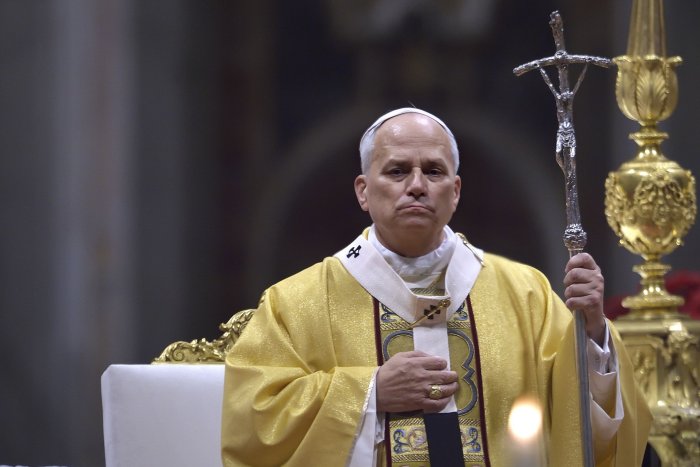
Pope Leo XIV celebrates the Christmas vigil Mass on Christmas eve on Wednesday in St. Peter’s Basilica in Vatican City, Vatican. Photo by Stefano Spaziani/UPI | License Photo
Fighting has broken out at a demonstration in the city of Latakia in Syria, killing at least three people and injuring dozens. Hundreds of people from the Alawite minority were protesting in coastal and central parts of the country, two days after a mosque was bombed in Homs.