Stay informed about the latest developments in politics with our comprehensive political news coverage. Get updates on elections, government policies, international relations, and the voices shaping the political landscape.
Folks, who was supposed to be watching grandpa last night? Because he got out, got on TV and … It. Was. Not. Good.
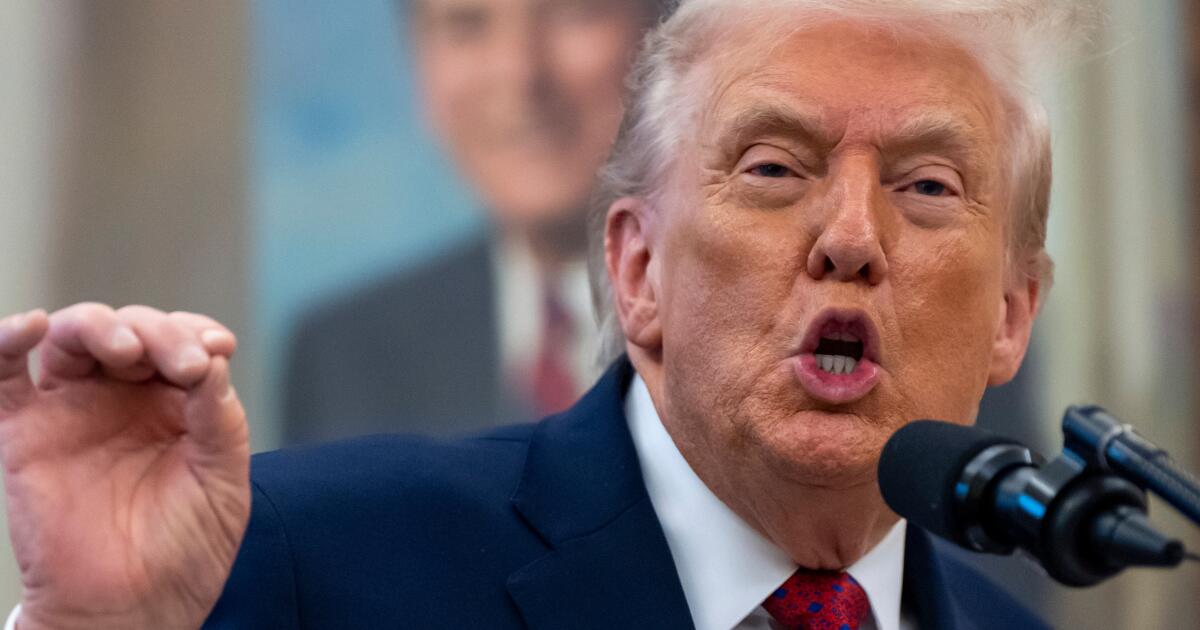
For 18 long minutes Wednesday evening, we were subjected to a rant by President Trump that predictably careened from immigrants (bad) to jobs (good), rarely slowing down for reality. But jumbled between the vitriol and venom was a vision of American healthcare that would have horror villainess M3GAN shaking in her Mary Janes — a vision that we all should be afraid of because it would take us back to a dark era when insurance couldn’t be counted on.
Trump’s remarks offered only a sketchy outline, per usual, in which the costs of health insurance premiums may be lower — but it will be because the coverage is terrible. Yes, you’ll save money. But so what? A cheap car without wheels is not a deal.
“The money should go to the people,” Trump said of his sort-of plan.
The money he vaguely was alluding to is the government subsidies that make insurance under the Affordable Care Act affordable. After antics and a mini-rebellion by four Republicans also on Wednesday, Congress basically failed to do anything meaningful on healthcare — pretty much ensuring those subsidies will disappear with the New Year.
That’s bad enough. But Trump would like to make it worse.
The Affordable Care Act is about much more than those subsidies. Before it took effect in 2014, insurance companies in many states could deny coverage for preexisting conditions. This didn’t have to be big-ticket stuff like cancer. A kid with asthma? A mom with colitis? Those were the kind of routine but chronic problems that prevented millions from obtaining insurance — and therefore care.
Obamacare required that policies sold on its exchange did not discriminate. In addition, the ACA required plans to limit out-of-pocket costs and end lifetime dollar caps, and provide a baseline of coverage that included essentials such as maternity care. Those standards put pressure on all plans to include more, even those offered through large employers.
Trump would like to undo much of that. He instead wants to fall back on the stunt he loves the most — send a check!
What he is suggesting by sending subsidy money directly to consumers also most likely would open the market to plans without the regulation of the ACA. So yes, small businesses or even groups of individuals might be able to band together to buy insurance, but there likely would be fewer rules about what — or whom — it has to cover.
Most people aren’t savvy or careful enough to understand the limitations of their insurance before it matters. So it has a $2-million lifetime cap? That sounds like a lot until your kid needs a treatment that eats through that in a couple of months. Then what?
Trump suggested people pay for it themselves, out of health savings accounts funded by that subsidy check sent directly to taxpayers. Because that definitely will work, and people won’t spend the money on groceries or rent, and what they do save certainly will cover any medical expenses.
“You’ll get much better healthcare at a much lower price,” Trump claimed Wednesday. “The only losers will be insurance companies that have gotten rich, and the Democrat Party, which is totally controlled by those same insurance companies. They will not be happy, but that’s OK with me because you, the people, are finally going to be getting great healthcare at a lower cost.”
He then bizarrely tried to blame the expiring subsidies on Democrats.
Democrats “are demanding those increases and it’s their fault,” he said. “It is not the Republicans’ fault. It’s the Democrats’ fault. It’s the Unaffordable Care Act, and everybody knew it.”
It seems like Trump just wants to lower costs at the expense of quality. Here’s where I take issue with the Democrats. I am not here to defend insurance companies or our healthcare system. Both clearly need reform.
But why are the Democrats failing to explain what “The money should go to the people” will mean?
I get that affordability is the message, and as someone who bought both a steak and a carton of milk this week, I understand just how powerful that issue is.
Still, everyone, Democrat or Republican, wants decent healthcare they can afford, and the peace of mind of knowing if something terrible happens, they will have access to help. There is no American who gladly would pay for insurance each month, no matter how low the premium, that is going to leave them without care when they or their loved ones need it most.
Grandpa Trump doesn’t have this worry, since he has the best healthcare our tax dollars can buy.
But when he promises to send a check instead of providing governance and regulation of one of the most critical purchases in our lives, the message is sickening: My victory in exchange for your well-being.
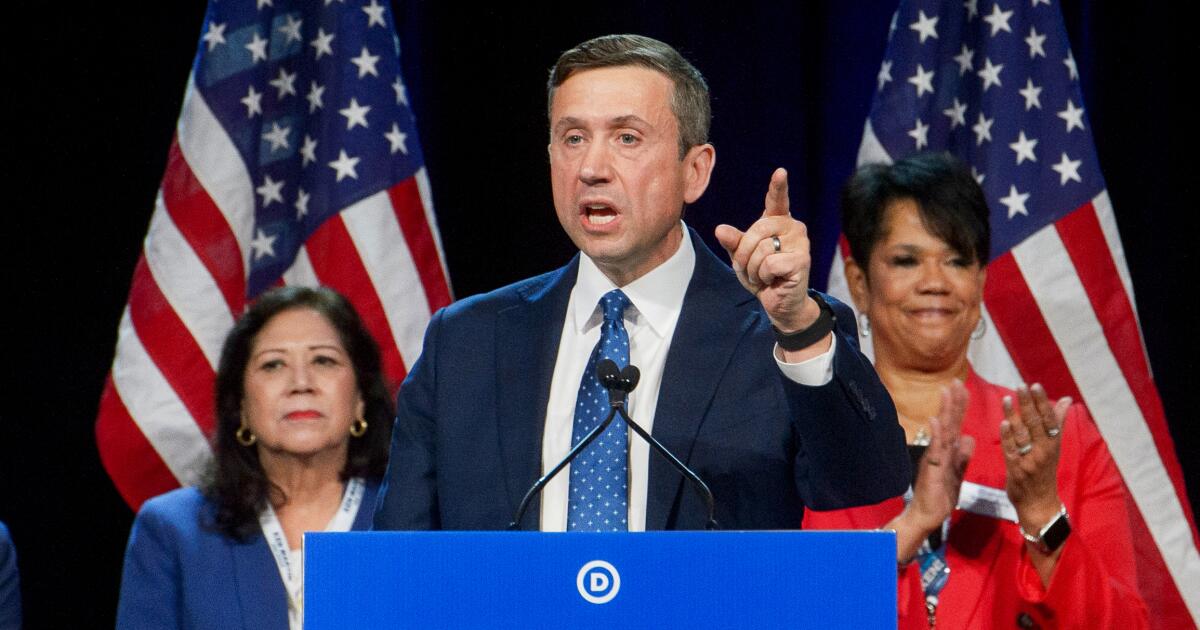
ATLANTA — Democrats will not issue a postelection report on their 2024 shellacking after all.
The Democratic National Committee head has decided not to publish a formal assessment of the party’s defeat that returned Donald Trump to power and gave Republicans complete control in Washington.
Ken Martin, a Minnesota party leader who was elected national chair after Trump’s election, ordered a thorough review of what went wrong and what could be done differently, with the intent they would circulate a report as Republicans did after their 2012 election performance. Martin now says the inquiry, which included hundreds of interviews, was complete but that there is no value in a public release of findings that he believes could lead to continued infighting and recriminations before the 2026 midterms when control of Congress will be at stake.
“Does this help us win?” Martin said in a statement Thursday. “If the answer is no, it’s a distraction from the core mission.”
Martin’s decision, first reported by the New York Times, spares top Democrats from more scrutiny about their campaigns, including former President Biden, who withdrew from the race after announcing his second-term run, and his vice president, Kamala Harris, who became the nominee and lost to Trump.
Keeping the report under wraps also means Martin does not have to take sides in the tug-of-war between moderates and progressives or make assessments about how candidates should handle issues that Trump capitalized on, such as transgender rights.
“We are winning again,” Martin said.
Martin’s announcement follows a successful string of 2025 races, both in special elections and off-year statewide votes, that suggest strong enthusiasm for Democratic candidates.
In November, Abigail Spanberger and Mikie Sherrill won races for governor in Virginia and New Jersey, respectively. In New York’s mayoral election, Zohran Mamdani, a democratic socialist, defeated establishment Democrat-turned-independent Andrew Cuomo.
In U.S. House special elections throughout 2025, Democratic nominees have consistently outperformed the party’s 2024 showing, often by double-digit percentages. Democrats have flipped state legislative districts and some statewide seats around the country, even in Republican-leaning places.
Although the DNC’s report will not be made public, a committee aide said some conclusions will be integrated into the party’s 2026 plans.
For example, the findings reflect a consensus that Democratic candidates did not adequately address voter concerns on public safety and immigration, two topics that Trump hammered in his comeback campaign. They also found that Democrats must overhaul their digital outreach, especially to younger voters, a group where Trump saw key gains over Harris compared with previous elections.
WASHINGTON — The U.S. Department of Health and Human Services on Thursday unveiled a series of regulatory actions designed to effectively ban gender-affirming care for minors, building on broader Trump administration restrictions on transgender Americans.
The sweeping proposals — the most significant moves this administration has taken so far to restrict the use of puberty blockers, hormone therapy and surgical interventions for transgender children — include cutting off federal Medicaid and Medicare funding from hospitals that provide gender-affirming care to children and prohibiting federal Medicaid dollars from being used to fund such procedures.
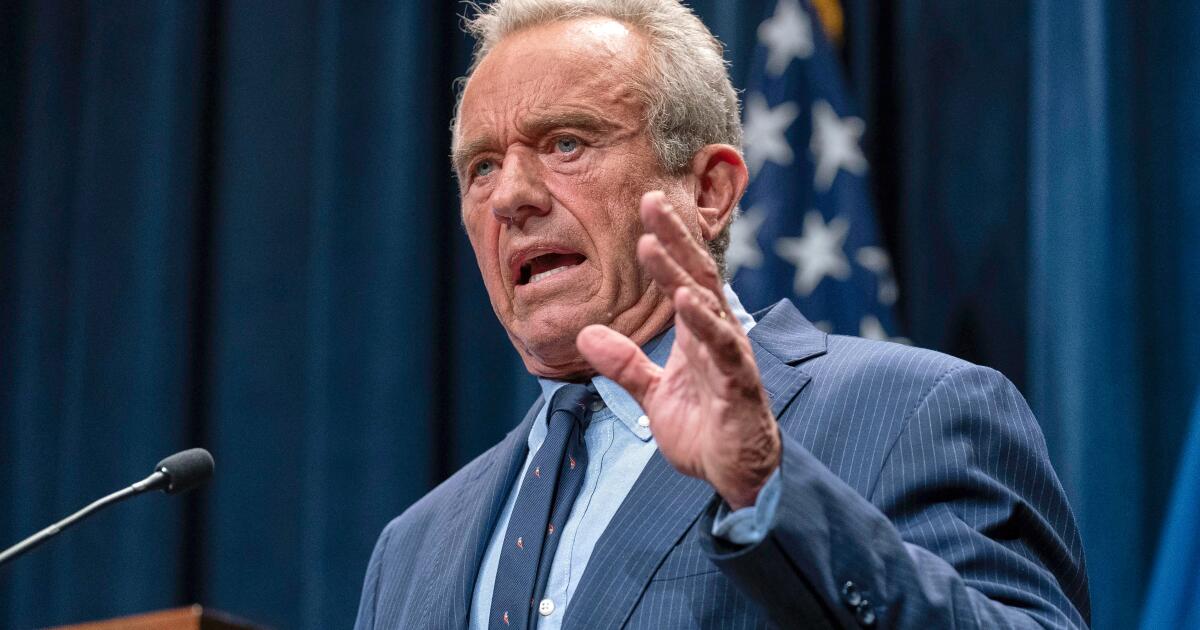
“This is not medicine, it is malpractice,” Health Secretary Robert F. Kennedy Jr. said of gender-affirming procedures on children in a news conference on Thursday. “Sex-rejecting procedures rob children of their futures.”
Kennedy also announced Thursday that the HHS Office of Civil Rights will propose a rule excluding gender dysphoria from the definition of a disability.
In a related move, the Food and Drug Administration issued warning letters to a dozen companies that market chest-binding vests and other equipment used by people with gender dysphoria. Manufacturers include GenderBender LLC of Carson, California and TomboyX of Seattle. The FDA letters state that chest binders can only be legally marketed for FDA-approved medical uses, such as recovery after mastectomy surgery.
Proposed rules would threaten youth gender-affirming care in states where it remains legal
Medicaid programs in slightly less than half of states currently cover gender-affirming care. At least 27 states have adopted laws restricting or banning the care. The Supreme Court’s recent decision upholding Tennessee’s ban means most other state laws are likely to remain in place.
Thursday’s announcements would imperil access in nearly two dozen states where drug treatments and surgical procedures remain legal and funded by Medicaid, which includes federal and state dollars.
The proposals announced by Kennedy and his deputies are not final or legally binding. The federal government must go through a lengthy rulemaking process, including periods of public comment and document rewrites, before the restrictions becoming permanent. They are also likely to face legal challenges.
But the proposed rules will likely further intimidate health care providers from offering gender-affirming care to children and many hospitals have already ceased such care in anticipation of federal action.
Nearly all U.S. hospitals participate in the Medicare and Medicaid programs, the federal government’s largest health plans that cover seniors, the disabled and low-income Americans. Losing access to those payments would imperil most U.S. hospitals and medical providers.
The same funding restrictions would apply to a smaller health program when it comes to care for people under the age of 19, the State Children’s Health Insurance Program, according to a federal notice posted Thursday morning.
Moves contradict advice from medical organizations and transgender advocates
Dr. Mehmet Oz, the administrator of the Centers for Medicare and Medicaid Services, on Thursday called transgender treatments “a Band-Aid on a much deeper pathology,” and suggested children with gender dysphoria are “confused, lost and need help.”
Polling shows many Americans agree with the administration’s view of the issue. An Associated Press-NORC Center for Public Affairs Research survey conducted earlier this year found that about half of U.S. adults approved of how Trump was handling transgender issues.
Chloe Cole, a conservative activist known for speaking about her gender-transition reversal, spoke at the news conference to express appreciation. She said cries for help from her and others in her situation, “have finally been heard.”
But the approach contradicts the recommendations of most major U.S. medical organizations, including the American Medical Association, which has urged states not to restrict care for gender dysphoria.
Advocates for transgender children strongly refuted the administration’s claims about gender-affirming care and said Thursday’s moves would put lives at risk.
“In an effort to strongarm hospitals into participating in the administration’s anti-LGBTQ agenda, the Trump Administration is forcing health care systems to choose between providing lifesaving care for LGBTQ+ young people and accepting crucial federal funding,” Dr. Jamila Perritt, a Washington-based OB/GYN and president and CEO of Physicians for Reproductive Health, said in a statement. “This is a lose-lose situation where lives are inevitably on the line. “
Rodrigo Heng-Lehtinen, senior vice president at The Trevor Project, a nonprofit suicide prevention organization for LBGTQ+ youth, called the changes a “one-size-fits-all mandate from the federal government” on a decision that should be between a doctor and patient.
“The multitude of efforts we are seeing from federal legislators to strip transgender and nonbinary youth of the health care they need is deeply troubling,” he said.
Actions build on a larger effort to restrict transgender rights
The announcements build on a wave of actions President Trump, his administration and Republicans in Congress have taken to target the rights of transgender people nationwide.
On his first day in office, Trump signed an executive order that declared the federal government would recognize only two immutable sexes: male and female. He also has signed orders aimed at cutting off federal support for gender transitions for people under age 19 and barring transgender athletes from participating in girls’ and women’s sports.
On Wednesday, a bill that would open transgender health care providers to prison time if they treat people under the age of 18 passed the U.S. House and heads to the Senate. Another bill under consideration in the House on Thursday aims to ban Medicaid coverage for gender-affirming care for children.
Young people who persistently identify as a gender that differs from their sex assigned at birth are first evaluated by a team of professionals. Some may try a social transition, involving changing a hairstyle or pronouns. Some may later also receive hormone-blocking drugs that delay puberty, followed by testosterone or estrogen to bring about the desired physical changes in patients. Surgery is rare for minors.
Swenson, Perrone and Shastri write for the Associated Press. Shastri reported from Milwaukee. AP writer Geoff Mulvihill contributed to this report.
WASHINGTON — President Trump has affixed partisan plaques to the portraits of all U.S. commanders in chief, himself included, on his Presidential Walk of Fame at the White House, describing Joe Biden as “sleepy,” Barack Obama as “divisive” and Ronald Reagan as a fan of a young Trump.
The additions, first seen publicly Wednesday, mark Trump’s latest effort to remake the White House in his own image, while flouting the protocols of how presidents treat their predecessors and doubling down on his determination to reshape how U.S. history is told.
“The plaques are eloquently written descriptions of each President and the legacy they left behind,” White House press secretary Karoline Leavitt said in a statement describing the installation in the colonnade that runs from the West Wing to the residence. “As a student of history, many were written directly by the President himself.”
Indeed, the Trumpian flourishes include the president’s typical bombastic language and haphazard capitalization. They also highlight Trump’s fraught relationships with his more recent predecessors.
An introductory plaque tells passersby that the exhibit was “conceived, built, and dedicated by President Donald J. Trump as a tribute to past Presidents, good, bad, and somewhere in the middle.”
Besides the Walk of Fame and its new plaques, Trump has adorned the Oval Office in gold and razed the East Wing in preparation for a massive ballroom. Separately, his administration has pushed for an examination of how Smithsonian exhibits present the nation’s history, and he is playing a strong hand in how the federal government will recognize the nation’s 250th anniversary in 2026.
Here’s a look at how Trump’s colonnade exhibit tells the presidential story.
Joe Biden
Joe Biden is still the only president in the display not to be recognized with a gilded portrait. Instead, Trump chose an autopen, reflecting his mockery of Biden’s age and assertions that Biden was not up to the job.
Biden, who defeated Trump in the 2020 election and dropped out of the 2024 election before their pending rematch, is introduced as “Sleepy Joe” and “by far, the worst President in American History” who “brought our Nation to the brink of destruction.”
Two plaques blast Biden for inflation and his energy and immigration policy, among other things. The text also blames Biden for Russian President Vladimir Putin’s invasion of Ukraine and asserts falsely that Biden was elected fraudulently.
Biden’s post-White House office had no comment on his plaque.
Barack Obama
The 44th president is described as “a community organizer, one term Senator from Illinois, and one of the most divisive political figures in American History.”
The plaque calls Obama’s signature domestic achievement “the highly ineffective ‘Unaffordable Care Act.”
And it notes that Trump nixed other major Obama achievements: “the terrible Iran Nuclear Deal … and ”the one-side Paris Climate Accords.”
An aide to Obama also declined comment.
George W. Bush
George W. Bush, who notably did not speak to Trump when they were last together at former President Jimmy Carter’s funeral, appears to win approval for creating the Department of Homeland Security and leading the nation after the terrorist attacks of Sept. 11, 2001.
But the plaque decries that Bush “started wars in Afghanistan and Iraq, both of which should not have happened.”
An aide to Bush didn’t return a message seeking comment.
Bill Clinton
The 42nd president, once a friend of Trump’s, gets faint praise for major crime legislation, an overhaul of the social safety net and balanced budgets.
But his plaque notes Clinton secured those achievements with a Republican Congress, the help of the 1990s “tech boom” and “despite the scandals that plagued his Presidency.”
Clinton’s recognition describes the North American Free Trade Agreement, another of his major achievements, as “bad for the United States” and something Trump would “terminate” during his first presidency. (Trump actually renegotiated some terms with Mexico and Canada but did not scrap the fundamental deal.)
His plaque ends with the line: “In 2016, President Clinton’s wife, Hillary, lost the Presidency to President Donald J. Trump!”
An aide to Clinton did not return a message seeking comment.
Other notable plaques
The broadsides dissipate the further back into history the plaques go.
Republican George H.W. Bush, who died during Trump’s first term, is recognized for his lengthy resume before becoming president, along with legislation including the Clean Air Act and Americans With Disabilities Act — despite Trump’s administration relaxing enforcement of both. The elder Bush’s plaque does not note that he, not Clinton, first pushed the major trade law that became NAFTA.
Lyndon Johnson’s plaque credits the Texas Democrat for securing the Civil Rights Act of 1964 and Voting Rights Act of 1965 (seminal laws that Trump’s administration interprets differently than previous administrations). It correctly notes that discontent over Vietnam led to LBJ not seeking reelection in 1968.
Democrat John F. Kennedy, the uncle of Trump’s health secretary, Robert F. Kennedy Jr., is credited as a World War II “war hero” who later used “stirring rhetoric” as president in opposition to communism.
Republican Richard Nixon’s plaque states plainly that the Watergate scandal led to his resignation.
While Trump spared most deceased presidents of harsh criticism, he jabbed at one of his regular targets, the media — this time across multiple centuries: Andrew Jackson’s plaque says the seventh president was “unjustifiably treated unfairly by the Press, but not as viciously and unfairly as President Abraham Lincoln and President Donald J. Trump would, in the future, be.”
Donald Trump
With two presidencies, Trump gets two displays. Each is full of praise and superlatives — “the Greatest Economy in the History of the World.” He calls his 2016 Electoral College margin of 304-227 a “landslide.”
Trump’s second-term plaque notes his popular vote victory — something he did not achieve in 2016 — and concludes with “THE BEST IS YET TO COME.”
Meanwhile, the introductory plaque presumes Trump’s addition will be a White House fixture once he is no longer president: “The Presidential Walk of Fame will long live as a testament and tribute to the Greatness of America.”
Brown and Barrow write for the Associated Press. Barrow reported from Atlanta.
WASHINGTON — Jeffrey Rosenberg is still trying to understand why President Trump would free the man who defrauded him out of a quarter of a million dollars.
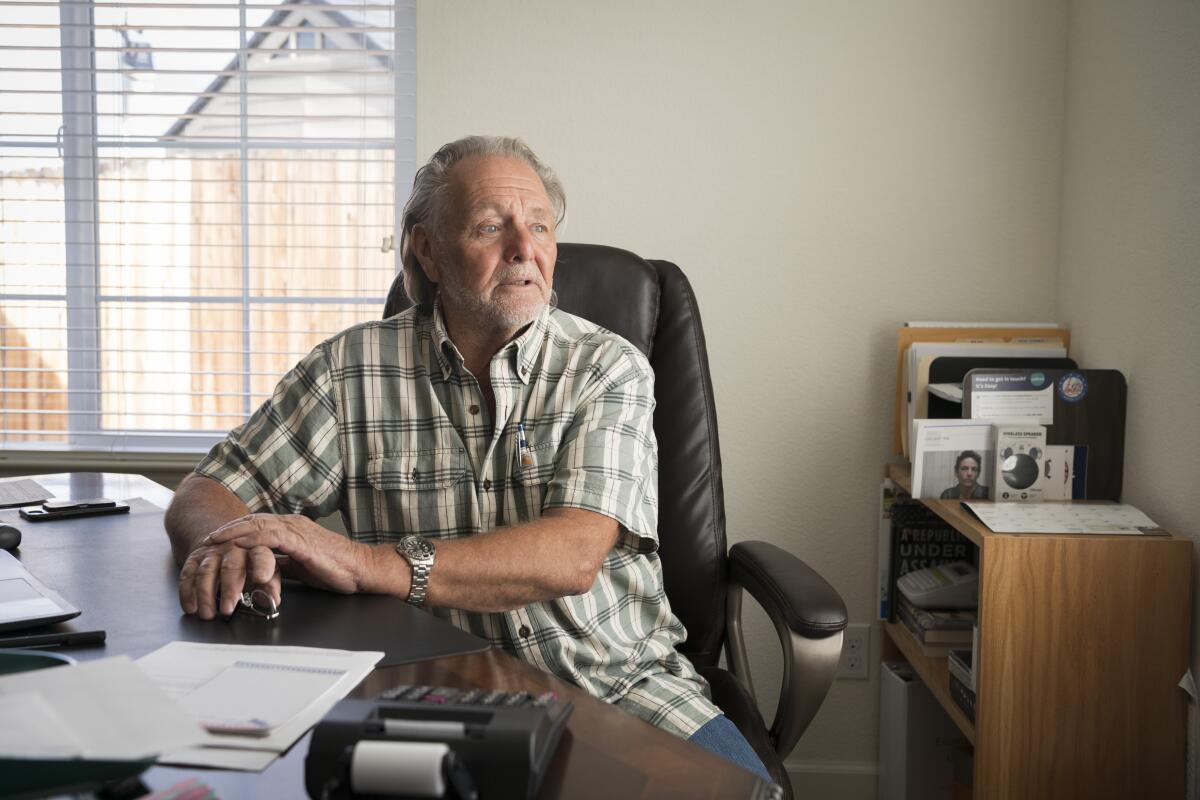
Rosenberg, a retired wholesale produce distributor living in Nevada, has supported Trump since he entered politics, but the president’s decision in November to commute the sentence of former private equity executive David Gentile has left him angry and confused.
“I just feel I’ve been betrayed,” Rosenberg, 68, said. “I don’t know why he would do this, unless there was some sort of gain somewhere, or some favor being called in. I am very disappointed. I kind of put him above this kind of thing.”
Trump’s decision to release Gentile from prison less than two weeks into his seven-year sentence has drawn scrutiny from securities attorneys and a U.S. senator — all of whom say the White House’s explanation for the act of clemency is not adding up. It’s also drawn the ire of his victims.
“I think it is disgusting,” said CarolAnn Tutera, 70, who invested more than $400,000 with Gentile’s company, GPB Capital. Gentile, she added, “basically pulled a Bernie Madoff and swindled people out of their money, and then he gets to go home to his wife and kids.”
Gentile and his business partner, Jeffry Schneider, were convicted of securities and wire fraud in August 2024 for carrying out what federal prosecutors described as a $1.6-billion Ponzi scheme to defraud more than 10,000 investors. After an eight-week trial, it took a jury five hours to return a guilty verdict.
More than 1,000 people attested to their losses after investing with GPB, according to federal prosecutors who described the victims as “hardworking, everyday people.”
When Gentile and Schneider were sentenced in May, Joseph Nocella Jr., the Trump-appointed U.S. attorney in the Eastern District of New York, and Christopher Raia, a senior official in the Justice Department, called their punishment “well deserved” and a warning to would-be fraudsters.
“May today’s sentencing deter anyone who seeks to greedily profit off their clients through deceitful practices,” Raia said in a statement.
Then, on Nov. 26 — just 12 days after Gentile reported to prison — Trump commuted his sentence with “no further fines, restitution, probation, or other conditions,” according to a grant of clemency signed by Trump. Under those terms, Gentile may not have to pay $15 million that federal prosecutors are seeking in forfeiture.
Karoline Leavitt, the White House press secretary, told reporters this month that prosecutors had failed to tie “supposedly fraudulent” representations to Gentile and that his conviction was a “weaponization of justice” led by the Biden administration — even though the sentences and convictions were lauded by Trump’s own appointees.
The White House declined to say who advised Trump in the decision or whether Trump was considering granting clemency to Schneider, Gentile’s co-defendant. Attorneys for Gentile and Schneider did not respond to a request seeking comment.
Adam Gana, a securities attorney whose firm has represented more than 250 GPB investors, called the White House’s explanation “a word salad of nonsense,” and questioned why Trump granted Gentile a commutation, which lessens a sentence, rather than a pardon, which forgives the offense itself.
“If the government wasn’t able to prove their case, why not pardon David Gentile? And why is his partner still in prison?” Gana said. “It’s left us with more questions than answers.”
‘It hurts a lot’
To Rosenberg, Tutera and two other investors interviewed by The Times, the president’s decision stripped away any sense of closure they felt after Gentile and Schneider were convicted.
Rosenberg has tried not to dwell on the $250,000 he lost in 2016, after a broker “painted a beautiful picture” of steady returns and long-term profits. The investments were supposed to generate income for him during retirement.
“A quarter of a million dollars, it hurts a lot,” Rosenberg said. “It changed a lot of things I do. Little trips that I wanted to take with my grandkids — well, they’re not quite as nice as they were planned on being.”
Jeffrey Rosenberg, a longtime Trump supporter, said he felt “betrayed” after the president granted clemency to convicted fraudster David Gentile.
(Scott Sady / For The Times)
Tutera, who runs a hormone replacement therapy office in Arizona, invested more than $400,000 with GPB at the recommendation of a financial advisor. She hoped the returns would help support her retirement after her husband had died.
“I was on grief brain at the time and just feel I was taken advantage of and really sold a bill of goods,” said Tutera, 70. Now, she says: “I have to keep working to make up for what I was owed.” She has been able to recover only about $40,000.
Tutera said her sister, Julie Ullman, and their 97-year-old mother also fell victim to the scheme. Their mother lost more than $100,000 and now finds herself spending down savings she had planned to leave to her children and not trusting people, she said.
“That’s really sad,” Tutera said. “People, unfortunately, have turned into thieves, liars and cheaters, and I don’t know what’s happened to the world, but we’ve lost our way to be kind.”
Ullman, 58, who manages a medical practice in Arizona, said the financial loss was life-changing.
“I’m going to have to work longer than I thought I would because that was my retirement fund,” Ullman said.
Mei, a 71-year-old licensed acupuncturist who asked to not use her full name out of embarrassment, said a broker introduced her to the GPB investment funds at a lunch meeting targeting divorced women. She eventually invested $500,000 and lost all of it. It was only through lawsuits that she was able to recover roughly $214,000 of her money, she said.
Mei had planned to retire in New York to be close to her children. But the loss of income has forced her to live in China, where the cost of living is much lower, six months out of the year, she said.
Mei fears Trump’s decision to commute Gentile’s sentence will allow these schemes to continue.
“Donald Trump is promoting more white-collar financial criminals, for sure,” Mei said. “How unfair.”
Bob Van De Veire, a securities attorney who has represented more than 100 GPB investors, said he has mostly handled negligence cases against the brokers who touted GPB investments.
“Based on all the red flags that were present, they should have never sold these investments at all,” Van De Veire said.
Gana, the securities attorney, added that he will continue to fight for victims in civil court, noting the clemency only addressed the criminal conviction.
The commutation caught the eye of Sen. Ruben Gallego (D-Ariz.), who sent a letter to the White House last week asking several questions: Why, for example, did Gentile receive clemency while Schneider did not? And what were the trial errors cited as a reason for the commutation? He said victims deserve answers.
“They will not forget that when they needed their government to stand with them against the man who stole their futures, their President chose to stand with the criminal instead,” Gallego wrote.
Rosenberg, the retiree from Nevada, said he still supports the president but can’t help but think Trump’s decision makes him “look like another of the swamp” that Trump says he wants to drain.
“I think Trump does a lot of good things,” he said, “but this is a bad one.”
Still, Rosenberg is hopeful Trump may do right by the victims — even if it’s just by admitting he made a mistake.
“I would like to think that he was fed some bad information somewhere along the way,” he said. “If that is the case … at least come forward and say, ‘I regret it.’ ”
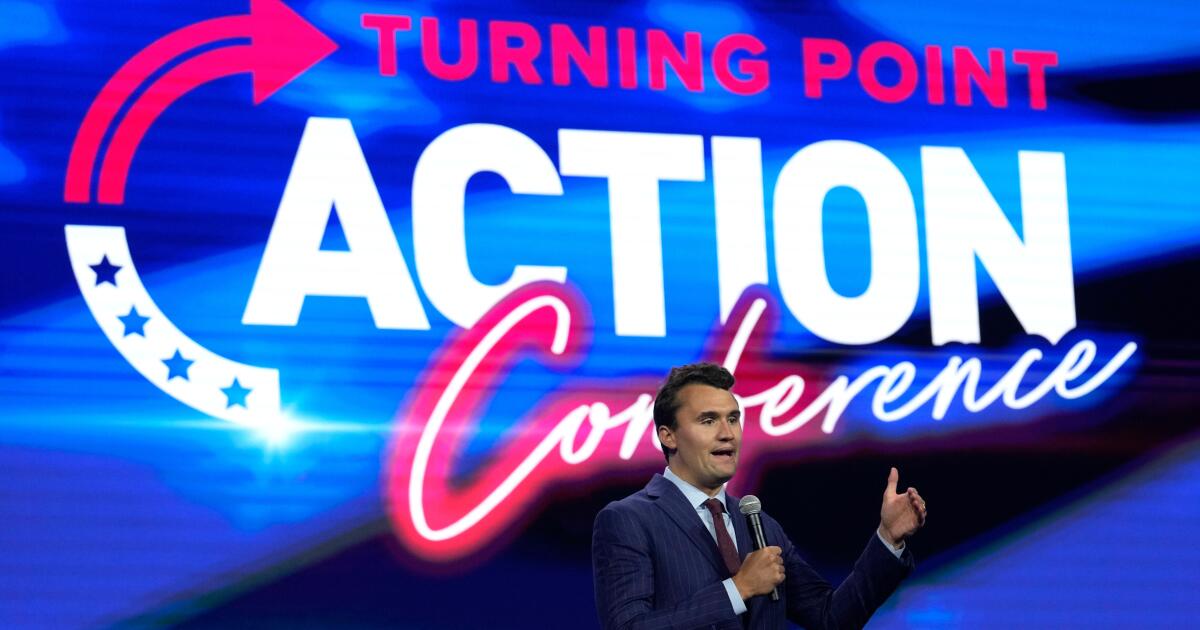
PHOENIX — Turning Point USA, the conservative youth organization that Charlie Kirk turned into a political juggernaut, will convene its flagship conference on Thursday for the first time since the assassination of its charismatic founder, testing the durability of a fractious movement that helped return President Donald Trump to the White House.
Kirk served as a unifying figure on the American right, marshaling college students, online influencers and Republican politicians. But now the party’s populist wing is skirmishing over the meaning of “America First” and the future of a decade-old movement defined more by the force of Trump’s personality than loyalty to a particular ideological project.
Thousands of people are expected to gather for the four-day meeting in Phoenix. Vice President JD Vance, media personalities and a handful of Trump administration officials are slated to appear, plus Christian rock bands and pastors. Attendees will have the chance to take selfies with popular figures and participate in discussions about political organizing, religion and conservative critiques of American culture.
Charlie Kirk’s widow, Erika Kirk, will have a prominent role as the organization’s new leader. The conference promises to be an extended tribute to her husband, who many on the right see as a martyr for conservatism and Christianity after he was slain at only 31 years old.
Tyler Robinson, the 22-year-old charged with shooting and killing Kirk while he spoke at Utah Valley University in September, appeared in court last week. Robinson has not entered a plea. Authorities say he told his romantic partner that he killed Kirk because he “had enough of his hatred.”
The last time Turning Point held its AmericaFest conference, weeks after Trump’s comeback victory one year ago, the MAGA movement was ebullient as Republicans prepared for a new era of total control in Washington.
Now the party faces challenging midterm elections, with Trump constitutionally prohibited from running again and his more ideologically motivated acolytes positioning to steer the movement after he leaves office. Meanwhile, conservatives have been roiled by conflicts over antisemitism in its ranks, which Trump has declined to mediate.
A lineup of MAGA influencers
Turning Point is known for highly produced events that feel more like rock concerts or megachurch services than political rallies, complete with pyrotechnics and floor-shaking bass.
The speaker lineup is a who’s who of conservative influencers and pastors, including some who have openly feuded with each other in recent weeks. It includes some of the biggest names in MAGA media, including Donald Trump Jr., Tucker Carlson, Megyn Kelly, Jesse Watters, Steve Bannon, Ben Shapiro and Jack Posobiec.
The jockeying for influence has accelerated since Kirk’s death, which left a void in the organization he founded and in the broader conservative movement.
“Charlie was the unifying figure for the movement,” conservative commentator Michael Knowles said at a Turning Point event just weeks after Kirk’s death.
“The biggest threat right now is that without that single figure that we were all friends with, who could really hold it together, things could spin off in different directions,” Knowles said. “We have to make sure that doesn’t happen.”
Among the fissures that has deepened since Kirk’s death is whether Republicans should continue its unflinching support for Israel and the war in Gaza. There are also concerns about whether the movement should accommodate people with anti-Jewish views.
The schism burst into the open when the head of the influential Heritage Foundation, Kevin Roberts, defended Carlson for conducting a friendly interview with podcaster Nick Fuentes, whose followers, known as “groypers,” see themselves as working to preserve a white, Christian identity in America. Roberts’ comments sparked outrage from some Heritage staffers, senators and conservative activists.
Fuentes had long feuded with Kirk, who worked to marginalize Fuentes within the conservative movement. Groypers enjoyed crashing Turning Point events to spar with Kirk.
Carlson and Shapiro, who has sharply criticized Fuentes and Carlson, are both scheduled to speak on Thursday, the first day of the conference.
Turning Point has also faced turmoil over conspiracy theories spread by Candace Owens, a former employee who hosts a top-rated podcast. Owens has alleged without evidence that Israeli spies were involved in Kirk’s death and that he was betrayed by people close to him. Authorities say Robinson acted alone.
Asked about Owens and others spreading conspiracy theories during a CBS News town hall, Erika Kirk responded with one word: “Stop.” She said Owens is making money off her family’s tragedy, adding that conspiracy peddlers risk tainting the jury pool and allowing her husband’s killer to get away with it.
Last weekend, with the Turning Point conference looming, Kirk and Owens agreed to a temporary detente until a private meeting. It didn’t last long.
After the meeting on Monday, Owens said on her show that she and Kirk spoke for 4 ½ hours but she still doubted that Robinson acted alone. Kirk wrote on X that they had “a very productive conversation” and it was “time to get back to work.”
While grieving her husband, Erika Kirk has slowly stepped up her public appearances. She spoke at the funeral, memorably forgiving her husband’s alleged killer, and at a Turning Point event in Mississippi in October.
An entrepreneur and podcaster, she often appeared with her husband at Turning Point events. The former 2012 Miss Arizona USA has also worked as a model, actress and casting director, and she founded a Christian clothing line, Proclaim, and a ministry that teaches about the Bible.
Before her husband’s death, she talked openly about prioritizing her family ahead of her career and described a marriage with traditional gender roles. Now she’s taking on the demanding job leading Turning Point, an organization that resonated in particular with young men.
At a memorial for her husband, Erika said “Charlie and I were united in purpose.”
“His passion was my passion, and now his mission is my mission,” she said. “Everything that Turning Point USA built through Charlie’s vision and hard work, we will make 10 times greater through the power of his memory.”
More than two months after an explosion erupted at the Chevron oil refinery in El Segundo, neither the company nor the regulators responsible for monitoring the facility have released details on the cause and the extent of the environmental fallout.
Here’s what we do know so far: Around 9:30 p.m.on Oct. 2, a large fire broke out in the southeast corner of the refinery, where Chevron turned crude oil into jet fuel. The resulting violent blast allegedly wounded several workers on the refinery grounds and rattled homes up to one mile away.
The refinery carried out emergency flaring in an effort to burn off potentially hazardous gases, as public officials told residents in neighborhoods nearby to stay indoors. That warning held until firefighters managed to extinguish the fire the following day.
You’re reading Boiling Point
The L.A. Times climate team gets you up to speed on climate change, energy and the environment. Sign up to get it in your inbox every week.
The South Coast Air Quality Management District — the agency responsible for regulating the refinery’s emissions — said Chevron would submit reports detailing the potential cause of the fire and any unexpected equipment failures within 30 days. But the preliminary reports were handed in nearly a month late — and without any significant updates from what was said in the days immediately following the fire.
In those reports, Chevron said the fire was “unexpected and unforeseeable.” The cause is still under an investigation that probably won’t conclude until next month, an air district spokesperson told me recently.
Company officials said the fire significantly damaged power supply, utilities and gas collection systems in that section of the refinery. Repairs are underway but could take months. Meanwhile, the majority of the 1,000-acre refinery is operational, distilling crude oil into gasoline and diesel.
At an air district meeting on Dec. 2, Chevron asked for leniency from conducting equipment testing at the damaged wing of the refinery that is now offline, and the air district obliged.
One member of the agency’s hearing board, Cynthia Verdugo-Peralta, said she understood that the investigation was “quite involved” but stressed the need for “some type of response” from Chevron on the cause.
“I’m hoping that this will never happen again,” she said. “Hopefully this repair will indeed be a full repair and there won’t be another incident like this.”
Environmental regulators like the South Coast Air Quality Management District often rely on the very industries that they oversee to arrange for monitoring and investigations into disasters. For obvious reasons, that’s not ideal. Experts say this system of self-reporting is somewhat inevitable, given that many government agencies lack the staffing, budget and access to provide adequate oversight.
But it often leaves the public waiting for answers — and skeptical of the findings, when they finally arrive.
For example, there are still serious questions surrounding the air monitoring systems at Chevron’s El Segundo refinery that were supposed to act as a safety net for the public nearby during emergencies like the October fire.
Under state law, refineries are required to install, operate and maintain real-time fence line air monitors. Indeed, over four hours after the Oct. 2 fire at El Segundo, Chevron’s fence line air monitors detected elevated levels of volatile organic compounds, a category of quickly vaporizing chemicals that can be harmful if inhaled.
However, at the time of the incident, the refinery’s monitors oddly did not detect any elevated levels of some of the most common types chemicals that experts say would have been likely to be released during such a fire, such as cancer-causing benzene, a typical byproduct of burning fossil fuels.
Experts are now asking whether those monitors were fully functioning at the time.
Earlier this month, the Bay Area Air Quality Management District fined Chevron’s refinery in Richmond $900,000 after the agency found 20 of the oil company’s fence line monitors were not properly calibrated to detect the full range of emissions, potentially allowing excessive air pollution to go undetected and unreported.
As for the El Segundo facility, neither the South Coast air district nor the refinery could confirm whether the air monitors were working properly on Oct. 2. A spokesperson said the air district is scheduled to audit Chevron’s fence line air monitoring network sometime next year.
But it may already be too late to warn nearby communities. Since October’s explosion, there have been more than a dozen reported incidents of unplanned flaring at Chevron’s refinery in El Segundo, according to air district data.
Each one raises the question: What happened?
More news on air pollution
The holiday season is associated with fragrant candles, incense and gathering around the fireplace. But health experts say these traditions should be done in moderation to avoid respiratory risks, according to Associated Press reporter Cheyanne Mumphrey.
That’s especially true in Southern California, where the air district continues to issueno-burn advisories, prohibiting burning wood to limit unhealthy levels of soot, per Pasadena Now.
Almost a year after the Eaton and Palisades fires, the health effects from breathing wildfire smoke are still coming into focus. L.A. Times science and medicine reporter Corrine Purtill writes thatemergency room visits rose 46% for heart attacks at Cedars-Sinai Medical Center in the 90 days after the fires. The findings suggest the death toll could be much higher than the 31 fatalities that have been linked with the fires.
California Atty. Gen.Rob Bonta sued the Trump administration — for the 50th time — after the suspension of $3 billion in federal funding that Congress approved for building more electric vehicle chargers, according to Times climate reporter Hayley Smith. California alone stands to lose out on $179.8 million in grants that could help reduce smog and greenhouse gases.
A few last things in climate news
The Trump administration announced it will dismantle the National Center for Atmospheric Research in Colorado, one of the world’s premier Earth science research institutions, per reporting fromthe New York Times. Scientists fear this could undermine weather forecasting in an age when global warming is contributing to more intense storms and other natural disasters.
A new analysis from Woods Hole Oceanographic Institution found the rate ofsea-level rise has more than doubled along U.S. coastlines over the last 125 years, according to Washington Post environmental reporter Brady Dennis. The research rebuts a controversial federal assessment published this summer that concluded there was no acceleration in rising ocean waters.
The U.S. and Europe continue toabandon their electric vehicle aspirations, ceding the clean car market to China, Bloomberg auto reporter Linda Lew writes. The European Commission recently scrapped an effective ban on combustion engine vehicles by 2035, and Ford Motor Co. walked away from plans to significantly overhaul its EV production — including the imminent demise of its all-electric Ford 150 Lightning truck.
This is the latest edition of Boiling Point, a newsletter about climate change and the environment in the American West. Sign up here to get it in your inbox. And listen to our Boiling Point podcast here.
WASHINGTON — Today’s political consensus crosses all ages, demographics and party lines: Three out of four Americans think the economy is in a slump. It is not just in their heads. Economic growth this year has been practically stagnant, save for one exception, economists say.
You’re reading the L.A. Times Politics newsletter
George Skelton and Michael Wilner cover the insights, legislation, players and politics you need to know in 2024. In your inbox Monday and Thursday mornings.
Hundreds of billions of dollars invested by California-based tech giants in artificial intelligence infrastructure accounted for 92% of the nation’s GDP growth this year, according to a Harvard analysis, supported by other independent economic studies.
It is a remarkable boon for a handful of companies that could lay the groundwork for future U.S. economic leadership. But, so far, little evidence exists that their ventures are expanding opportunities for everyday Americans.
“You have to watch out for AI investments — they may continue to carry the economy or they may slow down or crash, bringing the rest of the economy together with them,” said Daron Acemoglu, an economics professor at MIT. “We are not seeing much broad-based productivity improvements from AI or other innovations in the economy, because if we were, we would see productivity growth and investment picking up the rest of the economy as well.”
Even in California itself, where four of the top five AI companies are based, the AI boom has yet to translate into tangible pocketbook benefits. On the contrary, California shed 158,734 jobs through October, reflecting rising unemployment throughout the country, with layoffs rippling through the tech and entertainment sectors. Consumer confidence in the state has reached a five-year low. And AI fueled a wave of cuts, cited in 48,000 job losses nationwide this year.
“It is evident that the U.S. economy would have been almost stagnant, absent the capital expenditures by the AI industry,” said Servaas Storm, an economist at the Institute for New Economic Thinking, whose own analysis found that half of U.S. economic growth from the second quarter of 2024 through the second quarter of 2025 was due to spending on AI data centers.
The scale of investments by AI companies, coupled with lagging productivity gains expected from AI tools, is spawning widespread fears of a new bubble on Wall Street, where Big Tech has driven index gains throughout the year.
The top 10 stocks listed in the Standard & Poor’s 500 index, most of which are in the tech sector, were responsible for 60% of the yearlong rally, far outperforming the rest of the market. And the few who benefited from dividends fueled much of the rest of this year’s economic growth, with the vast majority of U.S. consumption spending attributed to the richest 10% to 20% of American households.
“There were ripple effects into high-end travel, luxury spending, high-end real estate and other sectors of the economy driven by the financial elite,” said Peter Atwater, an economics professor at William & Mary and president of Financial Insyghts, a consulting firm. “It tells the average consumer that while things are good at the top, they haven’t benefited.”
Stan Veuger, a senior fellow in economic policy studies at the American Enterprise Institute and a frequent visiting lecturer at Harvard, said that slowing growth and persistently high inflation were diminishing the effects of the AI boom.
“Obviously, that’s not a recipe for sustainable growth,” he said.
U.S. growth today is based on “the hope, optimism, belief or hype that the massive investments in AI will pay off — in terms of higher productivity, perhaps lower prices, more innovation,” Storm added. “It should tell everyday Americans that the economy is not in good shape and that the AI industry and government are betting the farm — and more — on a very risky and unproven strategy involving the scaling of AI.”
Trump’s AI bet
The Trump administration has fully embraced AI as a cornerstone of its economic policy, supporting more than $1 trillion in investments over the course of the year, including a $500-billion project to build out massive data centers with private partners.
Trump recently took executive action attempting to limit state regulations on AI designed to protect consumers. And House Republicans passed legislation this week that would significantly cut red tape for data center construction.
Administration officials say the United States has little choice but to invest aggressively in the technology, or else risk losing the race for AI superiority to China — a binary outcome that AI experts warn will result in irreversible, exponential growth for the winner.
But there is little expectation that their investments will bear fruit in the short term. Data centers under construction under the Stargate program, in partnership with OpenAI and Oracle, will begin coming online in 2026, with the largest centers expected to become operative in 2028.
“AI can only fulfill its promise if we build the compute to power it,” OpenAI Chief Executive Sam Altman said at the launch of the Stargate project. “That compute is the key to ensuring everyone can benefit from AI and to unlocking future breakthroughs.”
In the meantime, the Americans expected to benefit are those who can join in the investment boom — for as long as it lasts.
“2025 has been a very good year for people who already have significant wealth, a mediocre year for everyone else,” said Kenneth Rogoff, a prominent economist and professor at Harvard. “While the stock market has exploded, wage growth has been barely above inflation.”
“Whether the rest of the economy will catch fire from AI investment remains to be seen, but near term it is likely that AI will take away far more good jobs than it will create,” Rogoff added. “The Trump team is nevertheless optimistic that this will all go their way, but the team is largely built to carry out the president’s vision rather than to question it.”
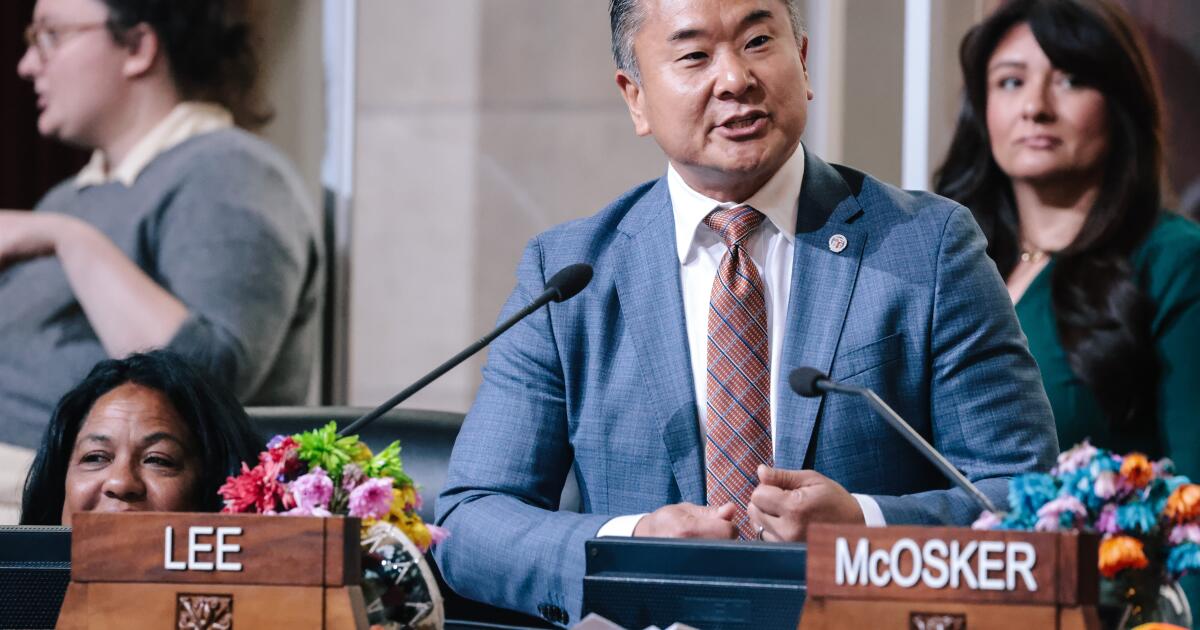
L.os Angeles City Councilmember John Lee is facing a steep fine for his notorious 2017 trip to Las Vegas, with the city’s Ethics Commission saying he must pay $138,424 in a case involving pricey meals and expensive nightclub “bottle service.”
On Wednesday, the commission decided 4 to 0 that Lee, who represents the northwest San Fernando Valley, committed two counts of violating the city’s gift law and three counts of violating a law requiring that such gifts be disclosed to the public.
By a 3-1 vote, the panel found that Lee violated five additional counts of misusing his city position or helping his boss at the time — Councilmember Mitchell Englander — misuse his position. After that, the commission voted unanimously to levy the maximum financial penalty, as recommended by city ethics investigators.
The commission went much further than an administrative law judge, who, after a multiday hearing, concluded that Lee violated five of 10 counts and recommended a fine of nearly $44,000.
Commission President Manjusha Kulkarni argued for the maximum fine, saying it would discourage others from violating ethics laws. She said Lee directly benefited from his decision not to report the gifts — which came from three men who sought business with City Hall — on his economic disclosure forms.
Lee, by failing to report those gifts, gained an unfair advantage during his 2019 and 2020 election campaigns, both of which he won by small margins, Kulkarni said.
“There was a concealment effort made there in order to win those two elections,” she said.
Commissioner Aryeh Cohen voted against the five additional ethics counts, saying he wasn’t convinced that the gift information would have made a difference. Last year, after city investigators accused Lee of violating gift laws, he won reelection handily.
“Voters knew, and he won by a larger margin” than in 2019 or 2020, Cohen said. “So I don’t think that that was a misuse of a position or gaining benefit from it.”
Brian Hildreth, an attorney representing Lee, had argued for a maximum fine of $10,000. Appearing before the commission, he said city investigators incorrectly calculated the value of the gifts and failed to take into account how much Lee had actually consumed at the food and drink venues.
Lee, in a statement, vowed to keep fighting the charges, calling the case “wasteful and political.” An appeal would need to be filed in Los Angeles County Superior Court.
“Today is but one step in the process of fighting these baseless charges,” he said. “I look forward to finally having an opportunity to have this matter adjudicated in a fair and impartial setting.”
The Lee case revolves around gifts — mostly meals and alcohol but also hotel stays, transportation and $1,000 in gambling chips — provided by the three businessmen: Andy Wang, who peddled Italian cabinets, “smart home” technology and facial recognition software; architect and developer Chris Pak; and lobbyist Michael Bai.
Lee, while working as Englander’s chief of staff, flew with his boss and several others — including Wang and Bai — to Las Vegas in 2017. Englander resigned from office the following year, after being contacted by FBI agents about the trip.
In 2020, federal prosecutors accused Englander of accepting $15,000 in cash from Wang, lying to FBI agents and obstructing their investigation. He eventually pleaded guilty to a single count of providing false information to the FBI and was sentenced to 14 months in prison.
In 2023, Englander agreed to pay $79,830 to settle an Ethics Commission case focused on his own gift law violations. That same year, the commission filed a case against Lee, saying he violated the gift law not just in Vegas but also at restaurants in downtown L.A. and Koreatown.
Lee repeatedly denied the allegations and argued that the statute of limitations had run out. The commission responded by scheduling a multiday hearing, held in June before Administrative Law Judge Ji-Lan Zang.
During those proceedings, Lee said he made a good faith effort to pay his own way and, in some cases, declined to eat during meals. For example, he testified that he did not remember eating during the meetings at Yxta Cocina Mexicana and Water Grill, both in downtown L.A.
Zang, in her written report to the commission, called those denials “not credible,” saying it “strains credulity” to believe that he would join the group at those restaurants without eating any food.
During the Las Vegas trip, Lee stayed at the Aria hotel, went to Blossom restaurant and spent an evening with the group at Hakkasan Nightclub.
At Blossom, Wang ordered a dinner worth nearly $2,500 that included shark fin soup, Peking duck and Kobe beef. Lee testified over the summer that he arrived at the restaurant in time for a dessert of bird’s nest soup, tasting it and deciding he did not like it.
At Hakkasan Nightclub later that night, Wang purchased three rounds of bottle service for the group for around $8,000 apiece, while Pak purchased a fourth round for $8,418.75.
Lee said he gave Wang $300 in cash as reimbursement for his drinks, withdrawing money from an ATM. Hildreth, his attorney, told the commission that drinks were served to a large number of nightclubgoers.
“The testimony and the evidence suggests that dozens and dozens of people were joining Councilmember Lee and others,” he said.
Kulkarni, before the vote, said she was especially troubled that Lee, after being contacted by FBI agents in 2017, sent Wang a backdated check for $442 to reimburse him for some of the Vegas trip. That act on its own, she said, constituted “a very serious offense.”
“That is not a mistake that one does. That is an affirmative act,” she said.
Hildreth said his client wrote a reimbursement check right away but that it was lost, necessitating a second, backdated check. He also noted that Lee cooperated with federal law enforcement and city ethics investigators.
“He sat for two interviews with the FBI,” Hildreth said. “That’s not something that deserves a punitive penalty.”
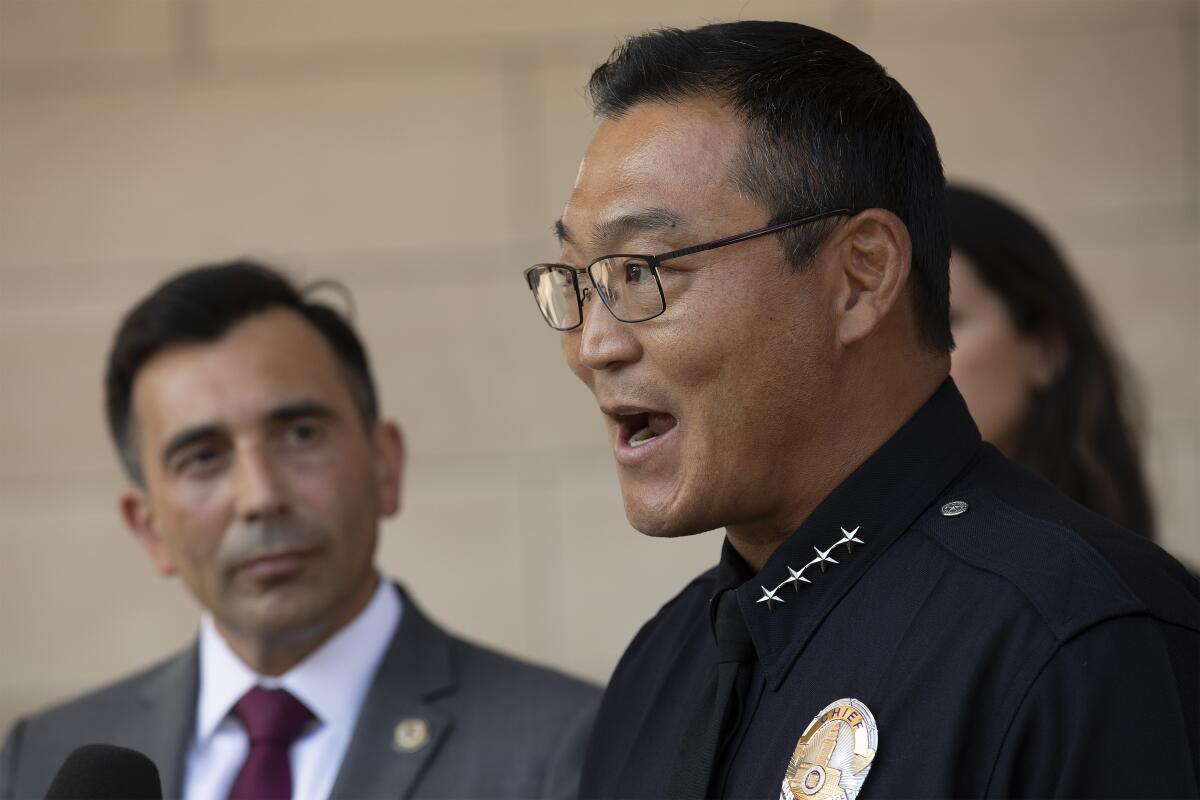
When an LAPD captain stood up during a meeting this fall and asked Chief Jim McDonnell to explain the role of his most trusted deputy, Dominic Choi, other top brass in attendance waited with anticipation for the reply.
Multiple department sources, who requested anonymity to discuss the private meeting and speak candidly about their boss, said McDonnell’s answer drew confused looks.
Some officials had began to wonder how closely the 66-year-old McDonnell, who stepped into the job in November 2024 after recent work in consulting and academia, was involved in day-to-day operations. Choi is often attached to his hip, and McDonnell has privately advised other senior staff to go through the assistant chief for key matters, leaving some uncertainty about how shots are called, the sources said.
At the senior staff meeting, McDonnell joked about not wanting to talk about Choi — who was not present in the room — behind his back, and told the captain that Choi was simply his “eyes and ears,” without offering more clarity, according to the sources.
The awkward exchange reflected the uncertainty that some LAPD officials feel about McDonnell’s leadership style.
Over the last year, The Times spoke with numerous sources, from high-ranking commanders to beat cops on the street, along with recently retired LAPD officials and longtime department observers, to gather insights on McDonnell’s first 12 months as the city’s top cop.
By some measures, McDonnell has been a success. Violent crime citywide has continued to decline. Despite the LAPD’s hiring struggles, officials say that applications by new recruits have been increasing. And support for the chief remains strong in some political circles, where backers lauded his ability to navigate so many challenges, most not of his own making — from the city’s financial crisis and civil unrest to the devastating wildfires that hit just two months after he was sworn in.
At the same time, shootings by police officers have increased to their highest levels in nearly a decade and the LAPD’s tactics at protests this summer drew both public outrage and lawsuits. Some longtime observers worry the department is sliding back into a defiant culture of past eras.
“You’ve got a department that’s going to bankrupt the city but doesn’t want to answer for what it is going to be doing,” said Connie Rice, a civil rights attorney.
In an interview with The Times, McDonnell said he is proud of how his department has performed. He said his bigger plans for the LAPD are slowly coming together.
McDonnell rose through the LAPD’s ranks early in his career, and acknowledged much has changed in the 14 years that he was away from the department. That’s why he has leaned “heavily” on the expertise of Choi, who served as interim chief before he took over, he said.
“He’s been a tremendous partner for me coming back,” McDonnell said.
Dominic Choi, who served as interim LAPD chief before Jim McDonnell was hired, speaks at a 2024 news conference with federal law enforcement officials.
(Al Seib / For The Times)
McDonnell added that he has relied just as much on his other command staff, encouraging them to think and act for themselves “to get the job done.”
Retired LAPD commander Lillian Carranza is among those saying the new chief has failed to shake things up after Michel Moore stepped down abruptly in January 2024.
Instead, she said, McDonnell has lacked the decisiveness required to make real changes in the face of resistance from the police union and others.
“It appears that the chief thought he was coming back to the LAPD from 15 years ago,” she said of McDonnell. “It’s been a disappointment because of the individuals that he’s promoted — it just seems like Michel Moore 2.0 again.”
There are notable contrasts in style and strategy between McDonnell and his predecessor.
Moore, who did not respond to a call seeking comment, often used his pulpit to try to get out ahead of potential crises. McDonnell has kept a lower profile. He has largely halted the regular press briefings that Moore once used to answer questions about critical incidents and occasionally opine on national issues.
Unlike Moore, who developed a reputation as a demanding manager who insisted on approving even minor decisions, McDonnell has seemingly embraced delegation. Still, his perceived deference to Choi, who also served as a top advisor to Moore, has led to questions about just how much has really changed. Choi has represented the department at nearly a fourth of all Police Commission meetings this year, a task usually performed by the chief.
Former LAPD Chief Michel Moore attends an event at the Police Academy on Dec. 7, 2023.
(Irfan Khan / Los Angeles Times)
It’s telling of their closeness, LAPD insiders said, that Choi occupies the only other suite on the 10th floor of LAPD headquarters with direct access, via a balcony, to McDonnell’s own office.
Choi did not respond to a request for comment.
Mayor Karen Bass chose McDonnell as chief after a lengthy nationwide search, picking him over candidates who would have been the first Black woman or first Latino to lead the department. He offered experience, having also served as police chief in Long Beach and as L.A. County sheriff.
McDonnell has mostly avoided the type of headline-grabbing scandals that plagued the department under Moore. Meanwhile, homicides citywide were on pace to reach a 60-year low — a fact that the mayor has repeatedly touted as her reelection campaign kicks into gear.
In a brief statement, the mayor commended McDonnell and said she looked forward to working with him to make the city safer “while addressing concerns about police interaction with the public and press.”
Jim McDonnell shakes hands with Mayor Karen Bass after being introduced as LAPD chief during a news conference at City Hall on Oct. 4, 2024.
(Ringo Chiu / For The Times)
McDonnell has taken steps to streamline the LAPD’s operations, including folding the department’s four homicide bureaus into the Robbery-Homicide Division and updating the department’s patrol plan to account for the department being down fewer officers.
John Lee, who chairs the City Council’s public safety committee, said the chief is the kind of experienced and steady leader the city needs as it gets ready to host the World Cup and Olympics. McDonnell, he said, deserves credit for guiding the LAPD through “unprecedented situations,” while largely delivering on promises to reduce crime and lift officer morale.
But among the rank and file, there is continued frustration with the department’s disciplinary system. The process, which critics outside the LAPD say rarely holds officers accountable, is seen internally as having a double standard that leads to harsh punishments for regular cops and slaps on the wrist for higher-ranking officials. Efforts at reform have repeatedly stalled in recent years.
McDonnell told The Times that officers have for years felt that the system was stacked against them. One of his priorities is “making the disciplinary system more fair in the eyes of those involved in it,” he said, and speeding up internal affairs investigations that can drag on for a year or more without “jeopardizing accountability or transparency.”
He said he’d like to give supervisors greater authority to quickly weed out complaints that “are demonstrably false on their face” based on body camera footage and other evidence.”
But the lack of progress on the issue has started to rankle the Los Angeles Police Protective League, the union for officers below the rank of lieutenant. The League urged McDonnell to take action in a statement to The Times.
“The way we see it, the Chief is either going to leverage his mandate and implement change, much to the chagrin of some in his command staff that staunchly support the status quo, or he will circle the wagons around the current system and continue to run out the clock,” the statement read. ”There’s no need to keep booking conference rooms to meet and talk about ‘fixing discipline,’ it’s time to fish or cut bait.”
Perhaps more than anything, the ongoing federal immigration crackdown has shaped McDonnell’s first year as chief.
Although McDonnell is limited in what he can do in the face of raids by Immigration and Customs Enforcement and other federal agencies, some of the chief’s detractors say he is missing a moment to improve relations between police and citizens of a majority-Latino city.
The son of Irish immigrants from Boston, McDonnell drew criticism during President Trump’s first term when, as L.A. County sheriff, he allowed ICE agents access to the nation’s largest jail. As LAPD chief, McDonnell has often voiced his support for long-standing policies that restrict cooperation on civil immigration enforcement and limit what officers can ask members of the public about their status in the country.
“I get hate mail from two extremes: those that are saying we’re not doing enough to work with ICE and those that are saying we’re working with ICE too much,” McDonnell said.
U.S. Border Patrol Cmdr. Gregory Bovino marches with federal agents to the Edward R. Roybal Federal Building on Aug. 14.
(Carlin Stiehl / Los Angeles Times)
Deputy Chief Alan Hamilton, who runs the department’s detective bureau, said McDonnell has to tread lightly politically and can’t follow the suggestion of some people that “we should use our law enforcement agencies to fight back against the feds.”
“He can’t come out and say, ‘We oppose ICE, get out of our city,’ like some of these other clowns are doing,” Hamilton said. “I mean, what, are you just trying to bring the wrath?”
But the LAPD’s response to the protests against Trump’s agenda has repeatedly led to bad optics. Officers have stepped in to keep the peace when angry crowds form at the scene of ICE arrests, which some said created the appearance of defending the federal actions.
During large demonstrations — which have occasionally turned unruly, with bricks and Molotov cocktails hurled by some in the crowds — LAPD officers on foot or horseback have not held back in swinging batons, firing less-lethal munitions and even launching tear gas, a measure that hadn’t been deployed on the streets of L.A. in decades.
Press rights organizations and a growing list of people who say they were injured by police have filed lawsuits, potentially adding to the tens of millions in the legal bills the department already faces for protest-related litigation from years that predated McDonnell.
Attorney Susan Seager, who is suing the department over its recent protest tactics, said that McDonnell has seemed unwilling to second-guess officers, even when confronted with clear video evidence of them violating court-imposed restrictions.
“I’ve never seen LAPD so unhinged at a protest shooting people,” she said.
An LAPD officer pushes back an anti-ICE protester during a rally on “No Kings Day” in downtown Los Angeles on June 14.
What goes unmentioned by the LAPD’s detractors, he said, is how volatile and “kinetic,” protests have been, requiring officers to use all means available to them to avoid being overwhelmed by hostile crowds.
Reporters and others on the front lines should know the risks of being there, he said.
“If the journalists are in that environment, they sometimes get hit with less-lethal projectiles — as do our police officers who are in that same environment,” he said.
DOVER AIR FORCE BASE, Del. — President Trump on Wednesday paid his respects to two Iowa National Guard members and a U.S. civilian interpreter who were killed in an attack in the Syrian desert, joining their grieving families as their remains were brought back to the country they served.
Trump met privately with the families at Dover Air Force Base in Delaware before the dignified transfer, a solemn ritual conducted in honor of U.S. service members killed in action. The civilian was also included in the transfer.
Trump, who traveled to Dover several times in his first term, once described it as “the toughest thing I have to do” as president.
The two Iowa troops killed in Syria on Saturday were Sgt. Edgar Brian Torres-Tovar, 25, of Des Moines, and Sgt. William Nathaniel Howard, 29, of Marshalltown, according to the U.S. Army. Both were members of the 1st Squadron, 113th Cavalry Regiment, and have been hailed as heroes by the Iowa National Guard.
Torres-Tovar’s and Howard’s families were at Dover for the return of their remains, alongside Iowa Gov. Kim Reynolds, members of Iowa’s congressional delegation and leaders of the Iowa National Guard. Their remains will be taken to Iowa after the transfer.
A U.S. civilian working as an interpreter, identified Tuesday as Ayad Mansoor Sakat, of Macomb, Mich., was also killed. Three other members of the Iowa National Guard were injured in the attack. The Pentagon has not identified them.
They were among hundreds of U.S. troops deployed in eastern Syria as part of a coalition fighting the Islamic State group.
The process of returning service member remains
There is no formal role for a president at a dignified transfer other than to watch in silence, with all thoughts about what happened in the past and what is happening at Dover kept to himself for the moment. There is no speaking by any of the dignitaries who attend, with the only words coming from the military officials who direct the highly choreographed transfers.
Trump arrived without First Lady Melania Trump, who had been scheduled to accompany him, according to the president’s public schedule. Her office declined to elaborate, with spokesperson Nick Clemens saying the first lady “was not able to attend today.”
During the process at Dover, transfer cases draped with the American flag that hold the soldiers’ remains are carried from the belly of a hulking C-17 military aircraft to a waiting vehicle under the watchful eyes of grieving family members. The vehicle then transports the remains to the mortuary facility at the base, where the fallen are prepared for burial.
Iowa National Guard members hailed as heroes
Howard’s stepfather, Jeffrey Bunn, has said Howard “loved what he was doing and would be the first in and last out.” He said Howard had wanted to be a soldier since he was a boy.
In a social media post, Bunn, who is chief of the Tama, Iowa, police department, said Howard was a loving husband and an “amazing man of faith.” He said Howard’s brother, a staff sergeant in the Iowa National Guard, would escort “Nate” back to Iowa.
Torres-Tovar was remembered as a “very positive” family-oriented person who always put others first, according to fellow Guard members who were deployed with him and issued a statement to the local TV broadcast station WOI.
Dina Qiryaqoz, the daughter of the civilian interpreter who was killed, said Wednesday in a statement that her father worked for the U.S. Army during the invasion of Iraq from 2003 to 2007. Sakat is survived by his wife and four adult children.
The interpreter was from Bakhdida, Iraq, a small Catholic village southeast of Mosul, and the family immigrated to the U.S. in 2007 on a special visa, Qiryaqoz said. At the time of his death, Sakat was employed as an independent contractor for Virginia-based Valiant Integrated Services.
Sakat’s family was still struggling to believe that he is gone. “He was a devoted father and husband, a courageous interpreter and a man who believed deeply in the mission he served,” Qiryaqoz said.
Trump’s reaction to the attack in Syria
Trump told reporters over the weekend that he was mourning the deaths. He vowed retaliation. The most recent instance of U.S. service members killed in action was in January 2024, when three American troops died in a drone attack in Jordan.
Saturday’s deadly attack followed a rapprochement between the U.S. and Syria, bringing the former pariah state into a U.S.-led coalition fighting the Islamic State group.
Trump, who met with al-Sharaa last month at the White House, said Monday that the attack had nothing to do with the Syrian leader, who Trump said was “devastated by what happened.”
Price writes for the Associated Press. AP writers Konstantin Toropin and Darlene Superville in Washington, Isabella Volmert in Lansing, Mich., and Hannah Fingerhut in Des Moines, Iowa, contributed to this report.
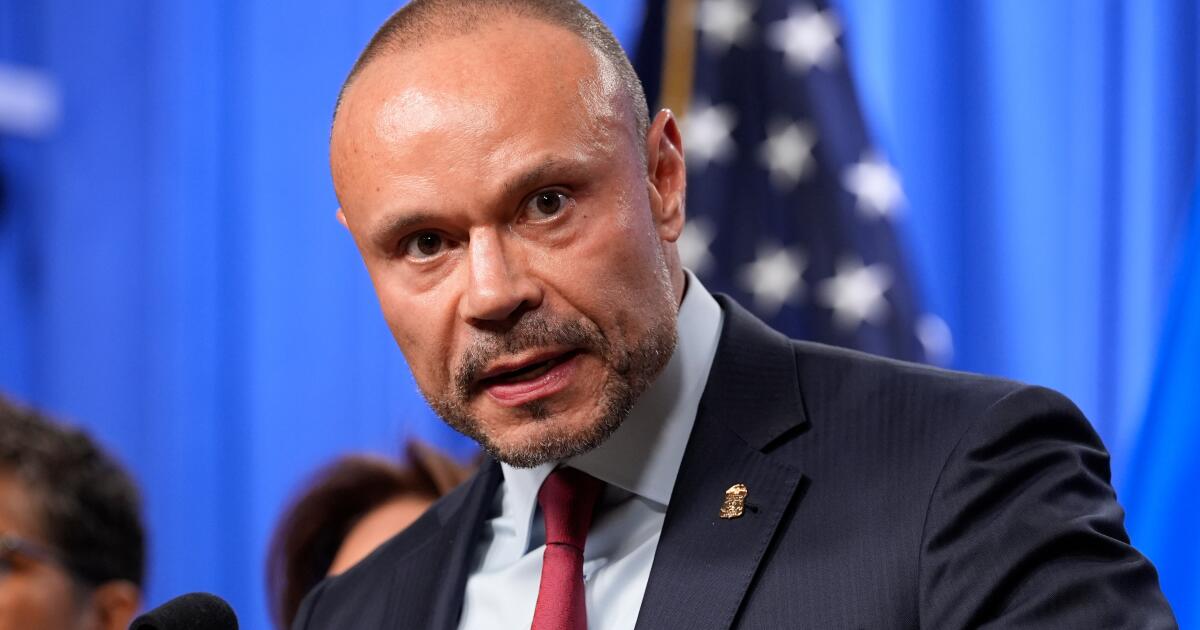
WASHINGTON — FBI Deputy Director Dan Bongino said Wednesday that he will resign from the bureau next month, ending a brief and tumultuous tenure in which he clashed with the Justice Department over the handling of the Jeffrey Epstein files and was forced to reconcile the realities of his law enforcement job with provocative claims he made in his prior role as a popular podcast host.
The departure, which had been expected, would be among the highest-profile resignations of the Trump administration. It comes as FBI leadership has been buffeted by criticism over Director Kash Patel’s use of a government plane for personal purposes and social media posts about active investigations.
Bongino announced his planned departure in a post on X in which he said he was grateful for the “opportunity to serve with purpose.” He did not say precisely when in January he would leave or detail his future plans.
President Trump said earlier Wednesday, in response to a question about Bongino’s fate: “Dan did a great job. I think he wants to go back to his show.”
Bongino was always an unconventional pick for the No. 2 job at the FBI, a position that historically has entailed oversight of the bureau’s day-to-day operations and typically has been held by a career agent. Though he had previously worked as a New York City police officer and Secret Service agent, neither he nor Patel had any experience at the FBI before being picked for their jobs.
Nonetheless, Bongino was installed in the role in March by Trump after years as a conservative podcast host, where he used his platform to repeatedly rail against FBI leadership and to encourage conspiracy theories related to the Epstein sex-trafficking case and pipe bombs discovered in Washington on Jan. 6, 2021.
Once in the position, Bongino struggled to placate elements of Trump’s base who expected him to quickly deliver the reform he had claimed was needed at the FBI and to uncover the truths he had said had been hidden by the federal government.
On the Epstein case, for instance, he had previously challenged the official ruling that the wealthy financier had taken his own life in a New York jail soon after his 2019 arrest. But once in the FBI, he said in a Fox News interview: “I’ve seen the whole file. He killed himself.”
Bongino had separately speculated as recently as last year that the pipe bombs placed on the eve of the Jan. 6 Capitol riot were an “inside job” and part of a “massive cover-up.” But after the FBI earlier this month arrested a 30-year-old Virginia man with no evident connection to the federal government, Bongino was pressed about his prior comments.
“I was paid in the past for my opinions,” Bongino said in a Fox News interview. “One day I will be back in that space, but that’s not what I’m paid for now. I’m paid to be your deputy director, and we base investigations on facts.”
A pair of blue and yellow earplugs dangle on Jose’s neck while waiting for work as a day laborer out of the Home Depot in Cypress Park.
They’ve been a necessity for laborers in the area since late November, when Home Depot installed three machines in the parking lot that emit a high-pitched tone. The noise, typically kept on all day, is a piercing sound that “penetrates your bones,” he said.
The Instituto de Educacion Popular del Sur de California (IDEPSCA), a nonprofit that supports day laborers, held a press conference at Home Depot Wednesday, calling for the company remove the machines and vocalize opposition to the ICE raids taking place in its parking lots, part of a growing number of protests targeting corporate cooperation with immigration enforcement.
Home Depot locations nationwide have been a prime target for ICE raids under President Donald Trump’s immigration crackdown. In early November, ICE agents detained a man at the Cypress Park location and then drove off with his toddler in the back of the vehicle.
Around 50 people have been detained at the Cypress Park location this year, said Maegan Ortiz, IDEPSCA’s executive director. The machines are an attempt to push day laborers off its lots, she said.
The machines were turned off by the company during the press conference, but were turned back on about an hour after it ended, according to workers. The noise is in earshot of the IDEPSCA’s day laborer center, one of five operated by the organization that have supported workers for over two decades.
“We have been here and remain open through global pandemics, providing services and creating community,” Ortiz said. “We’re not going to let sound machines, gates and intimidation get rid of us. Day laborers are here to stay. IDEPSCA is here to stay. The immigrant community is here to stay.”
Evelyn Fornes, a spokesperson for Home Depot, wrote to The Times that the company “has several initiatives we use to keep our stores safe, including human and technology resources.” The company did not address questions on why or when the machines were installed.
George Lane, a company spokesperson, previously told The Times that the company doesn’t coordinate with ICE or Border Patrol.
“We’re not involved in the operations. We aren’t notified that immigration enforcement activities are going to happen, and often, we don’t know operations have taken place until they’re over,” Lane wrote.
Jose’s earplugs, which IDEPSCA provided to workers, help muffle the sound, but aren’t enough to completely mask it, he said. The noise causes workers headaches, nausea and dizziness, said Jose and Andres Salazar, the center’s site coordinator.
Salazar said the noise often follows him home, still ringing in his ears long after he’s left the parking lot.
The machines were installed only days after the latest raid at the location in late November, during which day laborers were taken and IDEPSCA staff members were harmed, Ortiz said.
The machines were installed on light posts in the parking lot situated directly under the 5 freeway overpass. Hernandez and Ortiz said that portion of the parking lot is Caltrans property and not owned by Home Depot. They urged the city to look into the machine’s installations.
Home Depot also installed yellow barriers that close off access to the parking lot near IDEPSCA’s day labor center, located at the corner of the Cypress Park location.
The machines are “a deliberate choice by a multi billion dollar corporation that absolutely knew what it was doing and chose to weaponize sound literally,” said Councilwoman Eunisses Hernandez, who represents the city’s first district. “Devices like these are used as torture against our people.”
Home Depot relies on immigrant and Latino communities, Hernandez said, including customers who shop inside and day laborers, who seek work outside their storefronts.
The day laborer center is more than just a workplace, said Jose, who asked to withhold his last name for fear of retaliation by immigration agents. For many day laborers, it’s a second home, and for some, their only one. The center is bursting with greenery – plants that are cared for by the workers themselves.
“This space is something truly beautiful,” Jose said. “But, everything they’re doing with the noise and the barriers, it is affecting us…We’re here to help serve the community, not steal from the company.”
The noise is an added another layer of stress to day laborers, who are already struggling with less work opportunities and navigating lingering trauma from ICE raids. Jose was at the Home Depot when the last raid took place, only days before the company implemented the noise machines.
He watched in horror as coworkers were taken and volunteers were beaten.
“It made me angry, but I felt so impotent because, well, what do I do?” Jose said. “If I start fighting them, they’re going to knock me down, they’re going to take me.”
A trio of federal judges questioned attorneys for Gov. Gavin Newsom and the California Republican Party on Wednesday in a legal case that will decide the fate of California’s new voter-approved congressional districts for the 2026 midterm elections.
Attorneys for the California Republican Party and the Trump administration’s Department of Justice during the hearing recapped the argument they made in their legal complaint, accusing Democratic legislators and redistricting experts of racial gerrymandering that illegally favored Latinos.
The state’s legal representatives, meanwhile, argued their primary goal was not racial but political — they worked to weaken Republicans’ voting power in California to offset similar gerrymandering in Texas and other GOP-led states.
But Wednesday was the first time the public got to hear the three federal judges of the Central District of California challenge those narratives as they weigh whether to grant the GOP’s request for a temporary injunction blocking the reconfigured congressional districts approved by voters in November under Proposition 50.
The GOP has repeatedly seized on public comments from Paul Mitchell, a redistricting expert for California’s Democratic-led Legislature who designed the Proposition 50 congressional districts, that “the No. 1 thing” he started thinking about was “drawing a replacement Latino majority/minority district in the middle of Los Angeles.”
On Wednesday, District Court Judge Josephine Staton suggested that GOP attorneys focused too much on the intent of Mitchell and Democratic legislators and not enough on the voters who ultimately approved Proposition 50.
“Why would we not be looking at their intent?” Staton asked Michael Columbo, an attorney for California Republicans. “If the relative intent is the voters, you have nothing.”
Nearly two-thirds of California voters approved the new Proposition 50 congressional district map in a Nov. 4 special election after Newsom pitched the idea as a way to counter partisan gerrymandering after President Trump pressed Texas to redraw maps to shore up the GOP’s narrow House majority.
The stakes for California and the nation are high.
If the new map is used for the 2026 midterms, it could give California Democrats up to five additional U.S. House seats. That could allow them to push back against the gains Republicans make due to redistricting in staunchly GOP states and increase Democrats’ chance of seizing the House and shifting the balance of power in Congress.
A win for Democrats could also boost Newsom’s national clout and help him pitch himself as the nation’s strongest and most effective Trump critic as he enters his final year as California governor and weighs a White House bid.
During closing arguments Wednesday, an attorney for the U.S. Department of Justice argued that the race-based aspect of the redrawn districts started with the drafting of the Assembly bill that led to Proposition 50 being placed on the ballot.
Staton, however, seemed unconvinced.
“These maps have no effect,” she said, “until the voters give them effect.”
The GOP cannot challenge the map on grounds of political gerrymandering: The Supreme Court decided in 2019 that such complaints have no path in federal court. That leaves them focusing on race.
But proving that race predominated over partisanship is a challenge, legal scholars say, and paying attention to race is not, in itself, prohibited under current law. To prove that race was the key motivation, plaintiffs have to show there is another way for map makers to achieve their desired political result without a racial impact.
During the hearing, Staton stressed that the burden was on the challengers of Proposition 50 to prove racial intent.
To that end, the GOP brought to the stand RealClearPolitics elections analyst Sean Trende, who said the new 13th Congressional District in the San Joaquin Valley had an “appendage” that snaked northward into Stockton. Such contorted offshoots, he said, are “usually indicative of racial gerrymandering.” Trende produced an alternative map of the district that he said retained Democratic representation without being driven by race.
But Staton questioned whether Trende’s map was substantially different from Mitchell’s, noting they both seemed to fall within a similar range of Latino representation.
U.S. District Judge Wesley Hsu lambasted Columbo over what he called the “strawman” attempt to pick out one district, the 13th Congressional District, to make the case that there was a race-conscious effort in the attempt to flip five seats in the Democrats’ favor.
Jennifer Rosenberg, an attorney for the state, also argued that Trende’s analysis was too narrow.
“Dr. Trende failed to conduct a district by district analysis,” Rosenberg said. “And as we can see, he only addressed two tiny portions of District 13 and really only focused on one of the subparts.”
U.S. District Judge Kenneth Lee questioned Rosenberg on how much she believed Mitchell’s public statements about wanting to create a Latino district in Los Angeles influenced his redrawing.
“He was talking to interested groups,” Rosenberg said. “He did not communicate that intent to legislators.”
However, Lee said that Mitchell’s closeness to Democratic interest groups was an important factor. Mitchell “delivered on” the “wants” of the Latino interest groups he interacted with, Lee said, based on his public statements and lack of testimony.
Lee also took issue with Mitchell not testifying at the hearing and the dozens of times he invoked legislative privilege during a deposition ahead of the hearing.
Abha Khanna, who represented the Democratic Congressional Campaign Committee, argued there was no racial predominance in Mitchell’s statements.
She showed judges the text of Proposition 50, an official voter guide and statements from Newsom, arguing they were overt declarations of partisan intent. She also pointed out instances in which Republican plaintiffs discussed Proposition 50 in exclusively partisan terms.
If the federal judges grant a preliminary injunction, California would be temporarily blocked from using the newly drawn map in the 2026 election. Attorneys for the state would probably appeal to the U.S. Supreme Court.
Just two weeks ago, the nation’s highest court allowed Texas to temporarily keep its newly drawn congressional districts — which also faced complaints of racial gerrymandering — after a federal court blocked the Texas map, finding racial considerations probably made it unconstitutional.
The U.S. Supreme Court indicated it viewed the Texas redistricting as motivated primarily by partisan politics. In its ruling, it explicitly drew a connection between Texas and California, noting that several states, including California, have redrawn their congressional map “in ways that are predicted to favor the State’s dominant political party.”
MEXICO CITY — President Trump has ordered a partial blockade on oil tankers going to and from Venezuela, potentially crippling the nation’s already battered economy, and accused Caracas of stealing “oil, land other assets” from the United States — a significant escalation of Washington’s unrelenting campaign against the government of President Nicolás Maduro.
Asked about Venezuela on Wednesday, Trump said the United States will be “getting land, oil rights and whatever we had.”
“We want it back,” Trump said without further elaboration. It was unclear if Trump planned to say more about Venezuela in a televised address to the nation late Wednesday night.
The blockade, which aims to cripple the key component of Venezuela’s faltering, oil-dependent economy, comes as the Trump administration has bolstered military forces in the Caribbean, blown up more than two dozen boats allegedly ferrying illicit drugs in both the Caribbean and the Pacific, and threatened military strikes on Venezuela and neighboring Colombia.
“Venezuela is completely surrounded by the largest Armada ever assembled in the History of South America,” Trump said in a rambling post Tuesday night on his Truth Social site. “It will only get bigger, and the shock to them will be like nothing they have ever seen before.”
Not long after Trump announced the blockade Tuesday night, the government of Venezuela denounced the move and other Trump efforts as an attempt to “rob the riches that belong to our people.”
Leaders of other Latin American nations called for calm and United Nations Secretary-General Antonio Guterres, after a phone call with Maduro, called on U.N. members to “exert restraint and de-escalate tensions to preserve regional stability.”
Also Wednesday, Trump received rare pushback from the Republican-dominated Congress, where some lawmakers are pressuring the administration to disclose more information about its deadly attacks on alleged drug boats.
The Senate gave final approval to a $900-billion defense policy package that, among other things, would require the administration to disclose to lawmakers specific orders behind the boat strikes along with unedited videos of the deadly attacks. If the administration does not comply, the bill would withhold a quarter of Defense Secretary Pete Hegseth’s travel budget.
The bill’s passage came a day after Hegseth and Secretary Marco Rubio came to Capitol Hill to brief lawmakers on the U.S. military campaign. The briefings left lawmakers with mixed reaction, largely with Republicans backing the campaign and Democrats expressing concern about it.
The White House has said its military campaign in Venezuela is meant to curb drug trafficking, but the U.S. Drug Enforcement Administration data shows that Venezuela is a relatively minor player in the U.S.-bound drug trade.
Trump also declared that the South American country had been designated a “foreign terrorist organization.” That would apparently make Venezuela the first nation ever slapped with a classification normally reserved for armed groups deemed hostile to the United States or its allies. The consequences remain unclear for Venezuela.
Regional responses to the Trump threats highlight the new ideological fault lines in Latin America, where right-wing governments in recent years have won elections in Chile, Argentina and Ecuador.
The leftist leaders of the region’s two most populous nations — Brazil and Mexico — have called for restraint in Venezuela.
“Whatever one thinks about the Venezuelan government or the presidency of Maduro, the position of Mexico should always be: No to intervention, no to foreign meddling,” Mexican President Claudia Sheinbaum said Wednesday, calling on the United Nations to look for a peaceful solution and avoid any bloodshed.
Brazilian President Luiz Inácio Lula da Silva has also urged Trump to pull back from confrontation. “The power of the word can outweigh the power of the gun,” Lula said he told Trump recently, offering to facilitate talks with the Maduro government.
But Chile’s right-wing president-elect, José Antonio Kast, said he supports regime-change in Venezuela, asserting that it would reduce migration from Venezuela to other nations in the region.
“If someone is going to do it, let’s be clear that it solves a gigantic problem for us and all of Latin America, all of South America, and even for countries in Europe,” Kast said, referring to Venezuelan immigration.
In his Tuesday post, Trump said he had ordered a “complete blockade of all sanctioned oil tankers going into, and out of, Venezuela.” While potentially devastating to Venezuela’s economy, the fact that the blockade will only affect tankers already sanctioned by U.S. authorities does give Venezuela some breathing room, at least for now.
Experts estimated that only between one-third and one-half of tankers transporting crude to and from Venezuela are likely part of the so-called “dark fleet” of sanctioned tankers. The ships typically ferry crude from Venezuela and Iran, two nations under heavy U.S. trade and economic bans.
However, experts said that even a partial blockade will be a major hit for Venezuela’s feeble economy, reeling under more than a decade of of U.S. penalties. And Washington can continue adding to the list of sanctioned tankers.
“The United States can keep sanctioning more tankers, and that would leave Venezuela with almost no income,” said David A. Smilde, a Venezuela expert at Tulane University. “That would probably cause a famine in the country.”
The growing pressure, analysts said, will likely mean the diminishing number of firms willing to take the risk of transporting Venezuelan crude will up their prices, putting more pressure on Caracas. Purchasers in China and elsewhere will also likely demand price cuts to buy Venezuelan oil.
Trump has said that Maduro must go because he is a “narco-terrorist” and heads the “Cartel de los Soles,” which the While House calls is a drug-trafficking syndicate. Trump has put a $50 million bounty on Maduro’s head. Experts say that Cartel de los Soles is not a functioning cartel, but a short-hand term for Venezuelan military officers who have been involved in the drug trade for decades, long before Maduro or his predecessor and mentor, the late Hugo Chávez, took office.
In his comments on Tuesday, Trump denounced the nationalization of the Venezuelan oil industry, a process that began in the 1970s, when Caracas was a strong ally of Washington.
Echoing Trump’s point that Venezuela “stole” U.S. assets was Stephen Miller, Trump’s homeland security advisor, who declared on X: “American sweat, ingenuity and toil created the oil industry in Venezuela. Its tyrannical expropriation was the largest recorded theft of American wealth and property.”
Among those believed to be driving Trump’s efforts to oust Maduro is Secretary of State Maro Rubio, the son of Cuban immigrants to Florida. Rubio has long been an outspoken opponent of the communist governments in Havana and Caracas. Venezuelan oil has helped the economies of left-wing governments in both Cuba and Nicaragua.
Christopher Sabatini, a senior fellow for Latin America at Chatham House, said Rubio has been on a long-time campaign to remove Maduro.”He has his own political project,” Sabatini said. “He wants to get rid of the dictators in Venezuela and Cuba.”
Staff writers McDonnell and Linthicum reported from Mexico City and Ceballos from Washington. Contributing was special correspondent Mery Mogollón in Caracas.
U.S. senators peppered Federal Communications Commission Chairman Brendan Carr with questions during a wide-ranging hearing exploring media censorship, the FCC’s oversight and Carr’s alleged intimidation tactics during the firestorm over ABC comedian Jimmy Kimmel’s comments earlier this fall.
Sen. Ted Cruz (R-Texas) called Wednesday’s hearing of the Senate Commerce, Science and Transportation Committee following the furor over ABC’s brief suspension of “Jimmy Kimmel Live!” amid social media backlash over Kimmel’s remarks in the wake of conservative activist Charlie Kirk’s killing.
Walt Disney Co. leaders yanked Kimmel off the air Sept. 17, hours after Carr suggested that Disney-owned ABC should punish the late-night comedian for his remarks — or face FCC scrutiny. Soon, two major TV station groups announced that they were pulling Kimmel’s show, although both reinstated the program several days after ABC resumed production.
Progressives were riled by the President Trump-appointed chairman’s seeming willingness to go after broadcasters in an alleged violation of their First Amendment rights. At the time, a few fellow Republicans, including Cruz, blasted Carr for suggesting to ABC: “We can do this the easy way or hard way.”
Cruz, in September, said that Carr’s comments belonged in the mob movie “Goodfellas.”
On Wednesday, Carr said his comments about Kimmel were not intended as threats against Disney or the two ABC-affiliated station groups that preempted Kimmel’s show.
The chairman argued the FCC had statutory authority to make sure that TV stations acted in the public interest, although Carr did not clarify how one jumbled sentence in Kimmel’s Sept. 15 monologue violated the broadcasters’ obligation to serve its communities.
Cruz was conciliatory Wednesday, praising Carr’s work in his first year as FCC chairman. However, Democrats on the panel attempted to pivot much of the three-hour session into a public airing of the Trump administration’s desire to punish broadcasters whom the president doesn’t like — and Carr’s seeming willingness to go along.
Sen. Ted Cruz (R-Texas) called Wednesday’s Senate committee hearing.
(Associated Press)
Carr was challenged by numerous Democrats who suggested he was demonstrating fealty to the president rather than running the FCC as an independent licensing body.
Despite the landmark Communications Act of 1934, which created the FCC, the agency isn’t exactly independent, Carr and fellow Republican Commissioner Olivia Trusty testified.
The two Republicans said because Trump has the power to hire and fire commissioners, the FCC was more akin to other agencies within the federal government.
“Then is President Trump your boss?” asked Sen. Andy Kim (D-N.J.). The senator then asked Carr whether he remembered his oath of office. Federal officials, including Carr, have sworn to protect the Constitution.
“The American people are your boss,” Kim said. “Have you ever had a conversation with the president or senior administration officials about using the FCC to go after critics?”
Carr declined to answer.
Protesters flocked to Hollywood to protest the preemption of “Jimmy Kimmel Live!” after ABC briefly pulled the late-night host off air indefinitely over comments he made about the fatal shooting of conservative activist Charlie Kirk.
(Genaro Molina / Los Angeles Times)
The lone Democrat on the FCC, Anna M. Gomez, was frequently at odds with her fellow commissioners, including during an exploration of whether she felt the FCC was doing Trump’s bidding in its approach to merger approvals.
Trump separately continued his rant on media organizations he doesn’t like, writing in a Truth Social post that NBC News “should be ashamed of themselves in allowing garbage ‘interviews’” of his political rivals, in this case Sen. Raphael Warnock (D-Ga.).
Trump wrote that NBC and other broadcasters should pay “significant amounts of money for using the very valuable” public airwaves.
“Without a doubt, the FCC is leveraging its authority over mergers and enforcement proceedings in order to influence content,” Gomez said.
Parts of the hearing devolved into partisan bickering over whether Democrats or Republicans had a worse track record of trampling on the 1st Amendment. Cruz and other Republicans referenced a 2018 letter, signed by three Democrats on the committee, which asked the FCC to investigate conservative TV station owner Sinclair Broadcast Group.
“Suddenly Democrats have discovered the 1st Amendment,” Cruz said. “Maybe remember it when Democrats are in power. The 1st Amendment is not a one-way license for one team to abuse the power.
“We should respect the free speech of all Americans, regardless of party,” Cruz said.
WASHINGTON — The Senate gave final passage Wednesday to an annual military policy bill that will authorize $901 billion in defense programs while pressuring Defense Secretary Pete Hegseth to provide lawmakers with video of strikes on alleged drug boats in international waters near Venezuela.
The annual National Defense Authorization Act, which raises troop pay by 3.8%, gained bipartisan backing as it moved through Congress. It passed the Senate on a 77-20 vote before lawmakers planned to leave Washington for a holiday break. Two Republicans — Sens. Rand Paul and Mike Lee — and 18 Democrats voted against the bill.
The White House has indicated that it is in line with President Trump’s national security priorities. However, the legislation, which ran more than 3,000 pages, revealed some points of friction between Congress and the Pentagon as the Trump administration reorients its focus away from security in Europe and toward Central and South America.
The bill pushes back on recent moves by the Pentagon. It demands more information on boat strikes in the Caribbean, requires that the U.S. maintain its troop levels in Europe and sends some military aid to Ukraine.
But overall, the bill represents a compromise between the parties. It implements many of Trump’s executive orders and proposals on eliminating diversity and inclusion efforts in the military and grants emergency military powers at the U.S. border with Mexico. It also enhances congressional oversight of the Department of Defense, repeals several years-old war authorizations and seeks to overhaul how the Pentagon purchases weapons as the U.S. tries to outpace China in developing the next generation of military technology.
“We’re about to pass, and the president will enthusiastically sign, the most sweeping upgrades to DOD’s business practices in 60 years,” said Sen. Roger Wicker (R-Miss.), the chair of the Senate Armed Services Committee.
Still, the sprawling bill faced objections from both Democratic and Republican leadership on the Senate Commerce Committee. That’s because the legislation allows military aircraft to obtain a waiver to operate without broadcasting their precise location, as an Army helicopter had done before a midair collision with an airliner in Washington, D.C., in January that killed 67 people.
“The special carve-out was exactly what caused the January 29 crash that claimed 67 lives,” Sen. Ted Cruz (R-Texas), the chair of the Senate Commerce Committee, said at a news conference this week.
Cruz said he was seeking a vote on bipartisan legislation in the next month that would require military aircraft to use a precise location sharing tool and improve coordination between commercial and military aircraft in busy areas.
Boat strike videos
Republicans and Democrats agreed to language in the defense bill that threatened to withhold a quarter of Hegseth’s travel budget until he provided unedited video of the strikes, as well as the orders authorizing them, to the House and Senate Committees on Armed Services.
Hegseth was on Capitol Hill on Tuesday ahead of the bill’s passage to brief lawmakers on the U.S. military campaign in international waters near Venezuela. The briefing elicited contrasting responses from many lawmakers, with Republicans largely backing the campaign and Democrats expressing concern about it and saying they had not received enough information.
The committees are investigating a Sept. 2 strike — the first of the campaign — that killed two people who had survived an initial attack on their boat. The Navy admiral who ordered the “double-tap” strike, Adm. Frank “Mitch” Bradley, also appeared before the committees shortly before the vote Wednesday in a classified briefing that also included video of the strike in question.
Several Republican senators emerged from the meeting backing Hegseth and his decision not to release the video publicly, but other GOP lawmakers stayed silent on their opinion of the strike.
Democrats are calling for part of the video to be released publicly and for every member of Congress to have access to the full footage.
“The American people absolutely need to see this video,” said Sen. Richard Blumenthal (D-Conn.). “I think they would be shocked.”
Congressional oversight
Lawmakers have been caught by surprise by the Trump administration several times in the last year, including by a move to pause intelligence sharing with Ukraine and a decision to reduce U.S. troop presence in NATO countries in eastern Europe. The defense legislation requires that Congress be kept in the loop on decisions like those going forward, as well as when top military brass are removed.
The Pentagon is also required, under the legislation, to keep at least 76,000 troops and major equipment stationed in Europe unless NATO allies are consulted and there is a determination that such a withdrawal is in U.S. interests. Roughly 80,000 to 100,000 U.S. troops are usually present on European soil. A similar requirement keeps the number of U.S. troops stationed in South Korea at 28,500.
Lawmakers are also pushing back on some Pentagon decisions by authorizing $400 million for each of the next two years to manufacture weapons to be sent to Ukraine.
Cuts to diversity and climate initiatives
Trump and Hegseth have made it a priority to purge the military of material and programs that address diversity, anti-racism or gender issues, and the defense bill codifies many of those changes. It would repeal diversity, equity and inclusion offices and trainings, including the position of chief diversity officer. Those cuts would save the Pentagon about $40 million, according to the Republican-controlled House Armed Services Committee.
The U.S. military has long found that climate change is a threat to how it provides national security because weather-related disasters can destroy military bases and equipment. But the bill makes $1.6 billion in cuts by eliminating climate change-related programs at the Pentagon.
Repeal of war authorizations and Syria sanctions
Congress is writing a closing chapter to the war in Iraq by repealing the authorization for the 2003 invasion. Now that Iraq is a strategic partner of the U.S., lawmakers in support of the provision say the repeal is crucial to prevent future abuses. The bill also repeals the 1991 authorization that sanctioned the U.S.-led Gulf War.
The rare, bipartisan moves to repeal the legal justifications for the conflicts signal a potential appetite among lawmakers to reclaim some of Congress’ war powers.
WASHINGTON — Four centrist Republicans broke with Speaker Mike Johnson on Wednesday and signed onto a Democratic-led petition that will force a House vote on extending for three years an enhanced pandemic-era subsidy that lowers health insurance costs for millions of Americans.
The stunning move comes after House Republican leaders pushed ahead with a health care bill that does not address the soaring monthly premiums that millions of people will soon endure when the tax credits for those who buy insurance through the Affordable Care Act expire at year’s end.
Democrats led by Minority Leader Hakeem Jeffries of New York needed 218 signatures to force a floor vote on their bill, which would extend the subsides for three years.
Republican Reps. Brian Fitzpatrick, Robert Bresnahan and Ryan Mackenzie, all from Pennsylvania, and Mike Lawler of New York signed on Wednesday morning, pushing it to the magic number of 218. A vote on the subsidy bill could come as soon as January under House rules.
“Unfortunately, it is House leadership themselves that have forced this outcome.” Fitzpatrick said in a statement.
Origins of a Republican revolt
The revolt against GOP leadership came after days of talks centered on the health care subsidies.
Johnson, R-La., had discussed allowing more politically vulnerable GOP lawmakers a chance to vote on bills that would temporarily extend the subsidies while also adding changes such as income caps for beneficiaries. But after days of discussions, the leadership sided with the more conservative wing of the party’s conference, which has assailed the subsidies as propping up a failed marketplace through the ACA, which is widely known as “Obamacare.”
House Republicans pushed ahead Wednesday a 100-plus-page health care package without the subsidies, instead focusing on long-sought GOP proposals designed to expand insurance coverage options for small businesses and the self-employed.
Fitzpatrick and Lawler tried to add a temporary extension of the subsidies to the bill, but were denied.
“Our only request was a floor vote on this compromise, so that the American People’s voice could be heard on this issue. That request was rejected. Then, at the request of House leadership I, along with my colleagues, filed multiple amendments, and testified at length to those amendments,” Fitzpatrick said. “House leadership then decided to reject every single one of these amendments.
“As I’ve stated many times before, the only policy that is worse than a clean three-year extension without any reforms, is a policy of complete expiration without any bridge,” Fitzpatrick said.
Lawler, in a social media post, similarly said that “the failure of leadership” to permit a vote had left him with “no choice” but to sign the petition. He urged Johnson to bring the plan up for an immediate floor vote.
Path ahead is uncertain
Even if the subsidy bill were to pass the House, which is far from assured, it would face an arduous climb in the Republican-led Senate.
Republicans last week voted down a three-year extension of the subsidies and proposed an alternative that also failed. But in an encouraging sign for Democrats, four Republican senators crossed party lines to support their proposal.
Senate Majority Leader John Thune, R-S.D., argued against the Democratic extension as “an attempt to disguise the real impact of Obamacare’s spiraling health care costs.”
WASHINGTON — President Trump intends to preview his agenda for next year and beyond in a live speech from the White House on Wednesday night. His remarks are coming at a crucial time as he tries to rebuild his steadily eroding popularity.
The White House offered few details about what the Republican president intends to emphasize in the 6 p.m. PST speech. Public polling shows most U.S. adults are frustrated with his handling of the economy as inflation picked up after his tariffs raised prices and hiring slowed.
Trump’s mass deportations of immigrants have also proved unpopular even as he is viewed favorably for halting crossings along the U.S. border with Mexico. The public has generally been nonplussed by his income tax cuts and globe-trotting efforts to end conflicts, attack suspected drug boats near Venezuela and attract investment dollars into the United States.
In 2026, Trump and his party face a referendum on their leadership as the nation heads into the midterm elections that will decide control of the House and the Senate.
Trump has said that he thinks more Americans would back him if they simply heard him describe his track record. Administration officials say investment commitments for new factories will reverse the recent decline in manufacturing jobs and that consumer activity will improve dramatically as people receive increased tax refunds next year.
“It has been a great year for our Country, and THE BEST IS YET TO COME!” Trump said in a Tuesday social media post announcing the speech.
White House press secretary Karoline Leavitt said that Trump would discuss his achievements this year and his plans for the remainder of his second term.
Trump has been omnipresent on social media and television this year with his impromptu news conferences and speeches. But addresses to the nation often can be relatively sober affairs, as was Trump’s June address describing the U.S. bombing of nuclear facilities in Iran.
The president has eschewed the messaging discipline that’s common among most politicians, an authenticity that appeals to some voters and repels others.
In a speech in Pennsylvania last week, he said his tariffs might mean that American children should have fewer dolls and pencils, while confirming a previously denied story from his first term in 2018 that he did not want immigrants from “shithole” countries.
On Monday, Trump on his social media site blamed Rob Reiner’s vocal objections to the president for the killing of the actor-director and his wife, Michele Singer Reiner.
A report released on Tuesday showed a jobs market that looks increasingly fragile, even if the overall economy still appears to be stable.
Employers were adding on average 122,750 jobs a month during the first four months of this year. But since Trump announced his broad tariffs in April, monthly job gains have averaged a paltry 17,000 as the unemployment rate has climbed from 4% in January to 4.6%.
Trump’s team has blamed Democratic lawmakers for shutting down the government for the job losses reported Tuesday during October. The president continues to blame his predecessor, Democrat Joe Biden, for any challenges the nation might face over inflation or ending Russia’s war in Ukraine.
WASHINGTON — Former Justice Department special counsel Jack Smith told lawmakers in a closed-door interview on Wednesday that his team of investigators “developed proof beyond a reasonable doubt” that President Donald Trump had criminally conspired to overturn the results of the 2020 election, according to portions of his opening statement obtained by The Associated Press.
He also said investigators had accrued “powerful evidence” that Trump broke the law by hoarding classified documents from his first term as president at his Mar-a-Lago estate in Palm Beach, Florida, and by obstructing government efforts to recover the records.
“I made my decisions in the investigation without regard to President Trump’s political association, activities, beliefs, or candidacy in the 2024 election,” Smith said. “We took actions based on what the facts and the law required — the very lesson I learned early in my career as a prosecutor.”
He said that if asked whether he would “prosecute a former president based on the same facts today, I would do so regardless of whether the president was a Republican or Democrat.”
The private deposition before the House Judiciary Committee gives Smith his first chance to face questions, albeit behind closed doors, about a pair of investigations into Trump that resulted in since-abandoned criminal charges between the Republican president’s first and second terms in office. Smith was subpoenaed earlier this month to provide both testimony and documents as part of a Republican investigation into the Trump probes during the Biden administration.
The former special counsel cooperated with the congressional demand despite having volunteered more than a month earlier to answer questions publicly before the committee, an overture his lawyers say was rebuffed by Republicans.
“Testifying before this committee, Jack is showing tremendous courage in light of the remarkable and unprecedented retribution campaign against him by this administration and this White House,” one of Smith’s lawyers, Lanny Breuer, told reporters Wednesday. “Let’s be clear: Jack Smith is a career prosecutor, who conducted this investigation based on the facts and based on the law and nothing more.”
Trump told reporters at the White House that he supported the idea of an open hearing, saying: “I’d rather see him testify publicly. There’s no way he can answer the questions.”
Smith is expected to discuss both of his investigations of Trump but will not answer questions that call for grand jury materials, which are restricted by law, according to a person familiar with the investigation who insisted on anonymity to discuss the interview. He is also expected to correct what he regards as mischaracterizations from Republicans about his work, including about his team’s use of cellphone records belonging to certain GOP lawmakers, the person said.
Smith was appointed in 2022 to oversee the Justice Department investigations into Trump’s efforts to overturn his 2020 presidential election loss to Democrat Joe Biden and his hoarding of classified documents at Mar-a-Lago. Smith’s team filed charges in both investigations.
Smith abandoned the cases after Trump was elected to the White House again last year, citing Justice Department legal opinions that say a sitting president cannot be indicted.
Republicans who control Congress have sought interviews with at least some individual members of Smith’s team.
In recent weeks they have seized on revelations that the team, as part of its investigation, had analyzed the phone records of select GOP lawmakers from on and around Jan. 6, 2021, when pro-Trump rioters stormed the U.S. Capitol to try to halt the certification of Trump’s election loss to Biden. The phone records reviewed by prosecutors included details only about the incoming and outgoing phone numbers and the length of the call but not the contents of the conversation.
Tucker and Mascaro write for the Associated Press.
Southern California Edison did not spend hundreds of millions of dollars on maintenance of its aging transmission lines that it told regulators was necessary and began billing to customers in the four years before the Jan. 7 wildfires, according to a Times review of regulatory filings.
Edison told state regulators in its 2023 wildfire prevention plan that it believed its giant, high-voltage transmission lines, which carry bulk power across its territory, “generally have a lower risk of ignition” than its smaller distribution wires, which deliver power to neighborhoods.
After two of the most destructive fires in the state’s history, The Times takes a critical look at the past year and the steps taken — or not taken — to prevent this from happening again in all future fires.
While it spent heavily in recent years to reduce the risk that its smaller lines would ignite fires, Edison fell behind on work and inspections it told regulators it planned on its transmission system, where some structures were a century old, according to documents.
Edison’s transmission lines are now suspected of igniting two wildfires in Los Angeles County on the night of Jan. 7, including the devastating Eaton fire, which killed 19 people and destroyed more than 9,000 homes and other structures in Altadena.
Twenty miles away, in the San Fernando Valley, terrified Sylmar residents watched a fire that night burning under the same transmission tower where the deadly Saddleridge fire ignited six years before. Firefighters put out that Jan. 7 blaze, known as the Hurst fire, before it destroyed homes.
Roberto Delgado said the 2019 Saddleridge fire started at this powerline in the hillside behind his Sylmar house. He said the January 7 Hurst began with sparks at this and another nearby powerline. Photographed in Sylmar, CA on Wednesday, Aug. 20, 2025.
(Myung J. Chun/Los Angeles Times)
After the fires, Edison changed course, and began spending more on its transmission lines, according to executives’ recent comments and state regulatory documents.
The utility began installing more grounding devices on its old transmission lines no longer in service, like the one suspected of igniting the Eaton fire. The company says it believes the idle line, last used 50 years ago, may have momentarily reenergized from a surge in electricity on the live lines running parallel to it, sparking the blaze. The official investigation hasn’t been released.
Transmission work Edison failed to perform
Here are examples of work that Edison told regulators was needed and that it was authorized to charge to customers but did not perform. The amounts are for the four years before the Jan. 7 wildfires.
Transmission maintenance $38.5 million Transmission capital maintenance $155 million Fixing illegally sagging lines $270 million Substation transformer replacement $136 million Pole loading replacement $88 million* Transmission line patrols $9.2 million Intrusive pole inspections $1.4 million
Source: Edison’s “Risk Spending Accountability Report” filed in April 2025 *Edison said customers weren’t charged
The added devices give unexpected power on the old lines more places to dissipate into the earth.
A helicopter transports workers during the process of removing Southern California Edison’s tower 208, which is suspected of causing the Eaton Fire, on Monday, May 5, 2025, in Pasadena, Calif.
(William Liang/For The Times)
Edison also began replacing some aging equipment. Sylmar residents said they saw workers in trucks and helicopters replacing hardware on the transmission line where they had watched early flames of both the Hurst fire and the 2019 Saddleridge blaze.
“Not until this year did we see repairs,” said Roberto Delgado, a Sylmar resident who can see Edison’s transmission towers from his home. “Obviously the maintenance in the past was inadequate.”
Jill Anderson, the utility’s chief operating officer, told regulators at an August meeting that the company replaced components prone to failure on a certain transmission line after Jan. 7. Edison later confirmed she was referring to equipment on the line running through Sylmar.
In interviews, Edison executives disputed that maintenance on the company’s transmission lines suffered before Jan. 7.
A helicopter transports workers during the process of removing Southern California Edison’s tower 208, which is suspected of causing the Eaton Fire, on Monday, May 5, 2025, in Pasadena, Calif.
(William Liang/For The Times)
“I do not think that our inspections and maintenance in the years leading up to 2025 were at depressed levels,” said Russell Archer, a top Edison regulatory lawyer.
Scott Johnson, an Edison spokesman, said: “The 13,500 people at Southern California Edison show up every day committed to the safety of the communities where we live and work. There is no higher value than safety here.”
Johnson said the utility prioritized safety both before and after the fire. For example, he said, the company increased aerial and ground inspections of transmission lines in areas at high fire risk in 2022 — and kept them at that higher level in subsequent years.
Among the company’s increased spending this year was an expensive upgrade to a transmission line that the state’s grid operator said was required to more safely shut down five critical transmission lines in L.A. County including those running through Sylmar and Eaton Canyon. That work was expected to be finished by 2023 but was still in progress on Jan. 7.
Edison didn’t preventively shut down the lines in Eaton Canyon or Sylmar on Jan. 7, but said the delayed upgrade had nothing to do with that decision. The company said the wind that night combined with other factors didn’t meet its protocol at the time for the lines to be turned off.
Some proposed maintenance changes will take years.
Work crew dismantles a section of Southern California Edison’s tower 208 which will be removed for further examination on Wednesday, May 7, 2025. The idle transmission tower is suspected of sparking the Eaton fire.
(Myung J. Chun/Los Angeles Times)
For example, executives recently told regulators that next year they may begin determining whether some of its 355 miles of idle transmission lines in areas at high-risk of wildfire should be removed for safety reasons. The company said 305 miles of those dormant lines run parallel to energized lines, like the one in Eaton Canyon.
Regulators at the state Office of Energy Infrastructure Safety asked Edison this summer if any of those lines posed a risk of induction, where they become energized from nearby electrified lines. Edison told them it “has not done a line by line analysis.”
Pedro Pizarro, chief executive of Edison International, the utility’s parent company, acknowledged in a November interview that the company made changes after the fires, including by replacing a steel part called the y-clevis, which was found to have failed in the minutes before the 2019 Saddleridge fire.
“We saw some concerns with that so we accelerated a program to replace them,” he said.
Pizarro said he continued to back the company’s statements before Jan. 7 that it had decreased the risk that its lines would spark a wildfire by as much as 90% since 2018, including by spending billions of dollars for prevention work on its smaller distribution lines.
He called the Eaton fire “a black swan event” — one of “low probability, but high consequence.”
Aging equipment
About 13,000 miles of transmission lines carry bulk power through Edison’s territory. In comparison, it has nearly 70,000 miles of the smaller distribution lines, delivering power to homes.
Because the high-voltage transmission lines are interconnected, utilities must keep the system balanced, trying to prevent sudden increases or decreases in power. An abrupt jump in electricity flowing on one transmission line can cause surges and problems miles away.
In 2023, Edison said in a filing to the state Public Utilities Commission that the average age of its infrastructure was increasing as it replaced equipment less frequently than in previous times.
More than 90% of its transmission towers are at least 30 years old — the age when the first signs of corrosion appear, it said in a filing. Some transmission lines and pylons are nearing 100 years of service and have never had major overhauls, the company said.
Edison said it began looking for corroded transmission towers in 2020, but found so many that it temporarily stopped those evaluations in 2022 to focus on fixing those found unsafe.
In 2021, the commission’s Public Advocates Office warned that Edison wasn’t completing maintenance and upgrades that the utility said was “critical and necessary” and was authorized to bill to customers.
Edison had been under-spending on that work since 2018, staff at the Public Advocates Office wrote. They urged regulators to investigate, saying that “risks to the public are not addressed” and customers may be owed a refund.
That shortfall in spending continued through 2024.
According to a report Edison filed in April, the company did not spend hundreds of millions of dollars on transmission system work that regulators had authorized from 2021 to 2024.
Among the shortfalls was $270 million to fix thousands of deficiencies found more than a decade ago where its transmission lines hang too close to the ground, the report said. Also unspent was $38.5 million authorized for transmission operating maintenance and an additional $155 million for capital maintenance.
Edison planned to perform 57,440 detailed inspections of its transmission poles in those four years, the report said, but performed only 27,941, citing other priorities.
Edison said its inspection numbers still met state regulatory requirements.
A helicopter flies over the downtown Los Angeles skyline during a cloudy day on Monday, May 5, 2025, in Pasadena, Calif.
(William Liang/For The Times)
The utility also replaced 38% fewer substation transformers than it said it would. And while it was authorized to replace 14,280 transmission poles it restored just 10,031, the report stated.
Archer said some uncompleted work was for an inspection program using drones in areas at lower risk of fire. Instead the company focused those aerial inspections in high-risk areas, he said.
He said some shortfalls were for upgrade projects that were delayed for reasons beyond the company’s control.
Utilities are allowed to pass on the costs of approved maintenance projects to customers in the monthly rates they charge. State regulators also give them some flexibility to decide whether to spend the money on approved projects, or something else.
Archer said that most of the unspent money involved capital expenses like purchases of new transmission towers and upgrade projects. Once regulators authorize a capital project, he said, customers begin paying a small portion of the cost annually over the assets’ expected life, which is often decades. If the project is not completed, those annual payments stop, he said, adding that state regulations don’t allow Edison to issue refunds for most unspent funds.
Transmission lines known to spark deadly fires
Before Jan. 7, Edison told regulators in its wildfire mitigation plan that it had focused its prevention efforts on its smaller distribution system. It said transmission lines posed a lower threat because they were taller and had wires more widely spaced.
Yet the deadliest wildfire in state history was caused when equipment on a century-old Pacific Gas & Electric transmission tower failed. The 2018 Camp fire killed 85 people and destroyed most of the town of Paradise.
A year later, the Kincade fire in Sonoma County ignited when a steel part on a PG&E transmission line broke. Like Edison’s line in Eaton Canyon, that transmission cable was no longer serving customers.
Edison is now facing hundreds of lawsuits claiming it was negligent in maintaining its transmission lines in Eaton Canyon and for leaving the old unused line in place — allegations the company denies.
At 6:11 pm on Jan. 7, Edison recorded a fault — a sudden change in electricity flow — on a transmission line running from La Cañada Flintridge to Eagle Rock, according to its report to regulators.
Faults can be caused by lines slapping together, a piece of equipment breaking or other reasons. Edison said it did not know the cause.
The fault caused a momentary surge in current on the four live lines running through Eaton Canyon, the company said, which may have energized the idle line.
Investigators view the Edison electrical lines, transmission towers and surrounding area, which is a location that is being investigated as the possible origin of the Eaton fire in Eaton Canyon in Altadena Tuesday, Feb. 11, 2025.
(Allen J. Schaben/Los Angeles Times)
State regulations require utilities to remove old lines no longer in service. Edison says that even though it hasn’t used the line in decades it sees a need for it in the future.
Edison’s transmission manual dated December 20, 2024 states that it inspects idle lines every three years, while active ones are inspected annually.
Executives said they went beyond the manual’s requirements, inspecting the idle line in Eaton Canyon annually in the years before the fire.
Edison declined to provide records of those inspections.
Sylmar line suspected of two wildfires
Edison says it believes its transmission line running through the foothills above Sylmar was involved in the ignition of the Jan. 7 Hurst fire. But it denies the line ignited the 2019 Saddleridge fire.
The 2019 fire killed at least one and destroyed or damaged more than 100 homes and other structures.
This year, lawyers for victims of the 2019 fire argued in court the two fires started in the same way: steel equipment holding up the transmission lines broke, causing a sudden, massive surge in energy that triggered sparks and flames at two or more towers located miles away.
The lawyers say the line, constructed in 1970, is not properly grounded so that sudden increases in energy don’t disperse into the soil — a problem they say the company failed to fix.
Edison denies the claims, calling their description of the fire’s start an “exotic ignition theory…contrary to accepted scientific principles.”
A judge recently denied Edison’s request to dismiss the case.
It was supposed to be a speech with a clear message of hope for survivors of the Palisades fire.
In her State of the City address in April, Los Angeles Mayor Karen Bass called for a law exempting fire victims from construction permit fees — potentially saving them tens of thousands of dollars as they rebuild their homes.
Eight months later, the City Council is still debating how much permit relief the city can afford. Palisades residents have been left hanging, with some blaming Bass for failing to finalize a deal.
“This should have been pushed, and it wasn’t pushed,” said electrician Tom Doran, who has submitted plans to rebuild his three-bedroom home. “There was no motor on that boat. It was allowed to drift downstream.”
Since the Jan. 7 fire destroyed thousands of homes, Bass has been announcing recovery strategies with great fanfare, only for them to get bogged down in the details or abandoned altogether.
After two of the most destructive fires in the state’s history, The Times takes a critical look at the past year and the steps taken — or not taken — to prevent this from happening again in all future fires.
At one point, she called for the removal of traffic checkpoints around Pacific Palisades, only to reverse course after an outcry over public safety. She pushed tax relief for wildfire victims in Sacramento, only to abruptly pull the plug on her bill. Her relationship with Steve Soboroff, her first and only chief recovery officer, quickly unraveled over pay and other issues. He left after a 90-day stint.
Critics in and outside the Palisades say the mayor’s missteps have undermined public confidence in the rebuilding process. They have also made her more politically vulnerable as she ramps up her campaign for a second term.
1
2
3
1.Tom Doran poses for a portrait in the remains of his home in the Pacific Palisades. Doran, who has submitted plans to rebuild the home he lived in for decades, has said that Los Angeles Mayor Karen Bass should have done more to secure passage of a law giving residents relief from city rebuilding permits after the wildfires.(Kayla Bartkowski / Los Angeles Times)2.Statues are seen in an aerial of the remnants of Doran’s home.(Kayla Bartkowski / Los Angeles Times)3.An aerial of the remains of Doran’s home.(Kayla Bartkowski / Los Angeles Times)
Bass, seated in her spacious City Hall office earlier this month, said the recovery is happening at “lightning speed” compared to other devastating wildfires, in part because of her emergency orders dramatically cutting the time it takes to obtain building permits.
By mid-December, more than 2,600 permit applications had been filed for more than 1,200 addresses — about a fifth of the properties damaged or destroyed in the fire. Permits had been issued at about 600 addresses, with construction underway at nearly 400, according to city figures.
Still, Bass acknowledged that fire victims are feeling angry and frustrated as they enter the holiday season.
“I think people have a right to all of those emotions, and I wouldn’t argue with any of them,” she said.
Rebuilding a community after a natural disaster is a monumental task, one with no clear playbook. Many of the obstacles — insurance claims, mortgage relief — reach beyond the purview of a mayor.
Still, Bass has plenty of power. City agencies crucial to the rebuilding effort report to her. She works closely with the council, whose members have sharply questioned some of her recovery initiatives.
Perhaps the most disastrous narrative revolved around Soboroff, a longtime civic leader known for his blunt, outspoken style.
Mayor Karen Bass, right, and her disaster recovery chief, Steve Soboroff, during a news conference at Palisades Recreation Center on Jan. 27.
(Brian van der Brug / Los Angeles Times)
To many, the assignment made sense on paper. Soboroff had a background in home building, roots in the Palisades and extensive knowledge of City Hall.
Soboroff initially expected to receive a salary of $500,000 for three months of work as chief recovery officer, with the funds coming from philanthropy. After that figure triggered an outcry, Bass changed course, persuading him to work for free. Soon afterward, Soboroff told an audience that he had been “lied to” about whether he would be compensated. (He later apologized.)
Soboroff also voiced frustration with the job itself, saying he had been excluded from key decisions. At one point, Bass appeared to narrow his duties, telling reporters he would focus primarily on rebuilding the community’s historic business district and nearby public areas.
Bass told The Times that she does not view her selection of Soboroff as a mistake. But she acknowledged there were “challenges along the way” — and decisions where Soboroff was not included.
“In those first few months when everything was happening, I’m sure there were decisions he wanted to be in that he wasn’t in,” she said.
In April, amid Soboroff’s departure, Bass said she was searching for a new chief recovery officer. She repeated that assertion in July. Yet she never publicly announced a replacement for Soboroff, baffling some in the Palisades and providing fresh ammunition to her critics.
Real estate developer Rick Caruso, who ran against Bass in 2022 and founded the nonprofit SteadfastLA to speed the rebuilding process, said the recovery czar position is still desperately needed, given the size of the task ahead.
“You’ve got infrastructure that has to be rebuilt, undergrounding of power lines, upgrading of water mains. At the same time, you want to get people back in their homes,” said Caruso, who is weighing another run for mayor.
A Samara XL modular house is lowered into place at a project site in Culver City on March 21. Developer and former mayoral candidate Rick Caruso’s Steadfast L.A. nonprofit wants to raise $30 million in the hopes of providing between 80 and 100 Samara XL homes for fire victims.
(Myung J. Chun / Los Angeles Times)
Behind the scenes, Bass opted not to select a single person to replace Soboroff, going instead with a trio of consultants. By then, she had confronted a spate of other crises — federal immigration raids, a $1-billion budget shortfall, a split with county officials over the region’s approach to homelessness.
Soboroff declined to comment on Bass’ handling of the recovery. Early on, he pushed the mayor’s team to hire the global engineering giant AECOM to oversee the recovery. Bass went initially with Hagerty, an Illinois-based consulting firm that specializes in emergency management.
At the time, the mayor pointed out that Hagerty was already working with county officials on the Eaton fire recovery in Altadena and Palisades fire recovery in other unincorporated areas.
The city gave Hagerty a one-year contract worth up to $10 million to provide “full project management” of the recovery, Bass said at the time.
Hagerty quickly ran into trouble. At community events, the firm’s consultants struggled to explain their role in the rebuilding.
Two months after Soboroff stepped down, Bass announced she was hiring AECOM after all to develop a plan for rebuilding city infrastructure. Hagerty ended up focusing heavily on the logistics around debris removal, helping the city coordinate with the federal Army Corps of Engineers, which spearheaded the cleanup.
Hagerty quietly finished its work earlier this month, billing the city $3.5 million — far less than the maximum spelled out in the firm’s contract.
The confusion over Hagerty’s role created a major opening for Bass’ best-known challenger in the June 2 primary election: former L.A. schools Supt. Austin Beutner, a onetime high-level deputy mayor.
Beutner, whose home was severely damaged in the Palisades fire, called the selection of Hagerty a “fiasco,” saying it’s still not clear what the firm delivered.
“The hiring of Hagerty proved to be a waste of time and money while creating a false sense of hope in a community that’s dealing with a terrible tragedy,” he said.
Executives with Hagerty did not respond to multiple inquiries from The Times.
An aerial image of some homes being reconstructed and lots that remain empty in Pacific Palisades.
(Allen J. Schaben / Los Angeles Times)
AECOM joined the city in June, working to prepare reports on the rebuilding effort that dealt with infrastructure repairs, fire protection and traffic management. Those reports are now expected by the one-year anniversary of the fire.
Matt Talley, who spent part of the year as AECOM’s point person in the Palisades, praised Bass for her focus on the recovery, saying he watched as she took lengthy meetings with Palisades community members, then made sure her staff worked to address their concerns.
“I think the mayor gets a bad rap,” said Talley, who left AECOM in mid-November. “She takes a lot of incoming, but in her heart, she really does want to drive the recovery and do the right thing, and that’s evidenced by the meetings she’s having with the community.”
Bass, in an interview, said she eventually decided to have three AECOM staffers form a “recovery team,” instead of a single replacement for Soboroff.
“It didn’t make sense to go in the other direction,” she said. “We evaluated that for quite a while, met with a number of people, consulted many experts.”
By the time Bass announced AECOM’s hiring, she had also begun pursuing another initiative: relief from Measure ULA, the city’s so-called mansion tax, which applies to most property sales above $5.3 million.
Proponents argued that Palisades residents should not have to pay the tax if they sell their burned-out properties. For those who can’t afford to rebuild — either because they are on fixed incomes or have little insurance — selling may be the only option, they argued.
In June, Caruso sent Bass a proposal showing how Measure ULA could be legally suspended. By then, Bass had tapped former state Assembly Speaker Bob Hertzberg to work on a bill overhauling Measure ULA, not only to aid fire victims but to spur housing construction citywide.
Three months later, near the end of the legislative session in Sacramento, Bass persuaded some L.A.-based lawmakers to carry the bill, infuriating affordable housing advocates who accused her of attempting an end run around voters.
But right before a key hearing, Bass announced she was withdrawing the bill, which had been submitted so late that it missed the deadline for lawmakers to make changes.
Bass said city leaders are now working to identify other pathways for suspending ULA in the Palisades.
Meanwhile, her push for permit relief is also a work in progress.
Alice Gould, who lost her home in the Palisades fire, is rebuilding her home on Akron Street in Pacific Palisades. Gould, who has lived on the property for 28 years, is upset that Mayor Karen Bass has not yet secured passage of a law to exempt fire victims from city permit fees for rebuilding.
(Genaro Molina / Los Angeles Times)
In April, a few days after her State of the City speech, Bass issued an emergency order suspending the collection of permit fees while the council drafted the law she requested. If the law isn’t enacted, fire victims will have to pay the fees that are currently suspended.
Councilmember Bob Blumenfield, who sits on the council’s powerful budget committee, said Bass’ team did not contact him before she issued her order.
“When I read that, my first thought was: ‘That’s great. How are we gonna pay for that?’” he said.
Bass issued a second emergency order in May, expanding the fee waivers to include every structure that burned. By October, some council members were voicing alarms over the cost, warning it could reach hundreds of millions of dollars, depending on the details.
Palisades residents called that estimate grossly inflated. On Dec. 2, dozens of them showed up at City Hall to urge the council to pass legislation covering every residential building that burned — not just single-family homes and duplexes, a concept favored by some on the council.
Council members, still struggling to identify the cost, sent the proposal back to the budget committee for more deliberations, which will spill into next year because of the holiday break.
Bass defended her handling of the issue, saying she used her “political heft” to move it forward. At the same time, she declined to say how far-reaching the relief should be.
Asked whether the Palisades should be spared from permit fees for grading, pools or retaining walls, she responded: “I can’t say that,” calling such details “minutiae.”
“What I wanted to see happen was, all fees that were possible to be waived should be waived,” she said.
Hank Wright, against a backdrop of his neighbor’s home being built, walks on the property where he lost his four-bedroom home in the Palisades fire.
(Genaro Molina / Los Angeles Times)
Hank Wright, whose four-bedroom home on Lachman Lane burned to the ground, remains frustrated with the city, saying he doesn’t understand why Bass was unable to lock down the votes.
“She has not been the point person that I wanted her to be,” he said. “I don’t think she has been able to corral that bureaucracy.”