Stay informed and up-to-date with the latest news from around the world. Our comprehensive news coverage brings you the most relevant and impactful stories in politics, business, technology, entertainment, and more.
How do we talk about antisemitism after the Bondi shooting?
Na’amod co-founder Em Hilton, raised in Bondi, says Jews must resist retreat, find moral courage, and build bonds with Muslims, Palestinians, and other threatened communities.
Former heavyweight champion beats social-media-star-turned fighter with a sixth-round knockout in Miami.
Published On 20 Dec 202520 Dec 2025
Share
Former world heavyweight champion Anthony Joshua knocked out YouTuber-turned-boxer Jake Paul in their controversial Netflix-backed bout in Miami.
Two-time world champion Joshua made hard work of defeating his vastly less experienced opponent on Friday night, but finally made his superior size and power count in the later stages of the eight-round fight.
Recommended Stories
list of 4 itemsend of list
A mediocre contest at the Kaseya Center – with the two men reportedly splitting a mammoth purse of $184m – descended into farce at times, with Paul repeatedly dropping to the canvas and grappling at Joshua’s legs.
At one stage even referee Christopher Young appeared to be losing patience, warning the fighters in the fourth round: “The fans did not pay to see this crap.”
As Paul tired, Joshua finally began to land punches with more regularity and after knocking down the American twice in the fifth round the end came swiftly in the sixth.
Joshua backed the 28-year-old into a corner and after teeing up Paul with a crunching left, delivered the knockout blow with a right to the chin that sent his opponent crashing to the canvas.
“It wasn’t the best performance,” Joshua, 36, admitted afterwards. “But the end goal was to get Jake Paul, pin him down and hurt him.
“That was the request leading up, and that was on my mind. It took a bit longer than expected but the right hand finally found its destination.”
Joshua meanwhile praised Paul for lasting into the later rounds.
“I want to give him his props – he got up time and time again,” Joshua said. “It was difficult in there for him, but he kept on trying to find a way. It takes a real man to do that.”
Paul, meanwhile, his mouth bloodied from Joshua’s final assault, said he believed his jaw had been broken – but was satisfied with his performance.
“That was fun. I gave it my all,” Paul said. “I had a blast. I think my jaw is broken by the way. But Anthony’s one of the best to ever do it so. I’m gonna come back and get a world championship.
“I just got tired to be honest – like it was so much handling his weight. I think with better cardio I could have kept it up and kept on fighting. But he hits really hard.”
The bout was carried live to Netflix’s approximately 300 million subscribers.
Friday’s made-for-streaming contest, which came just over a year after Paul had fought a 58-year-old Mike Tyson in a much-derided Netflix fight, had triggered alarm across boxing given the disparity in size and experience between the two men.
Yet the devastating first or second round knockout by Joshua that most had predicted failed to materialise as Paul scrambled desperately to stay outside of the 2012 Olympic champion’s range.
Joshua, fighting for the first time in 15 months, always looked the more threatening fighter though, landing 48 of 146 punches thrown compared to Paul’s meagre total of 16 punches landed.
Watch: Former US President Bill Clinton featured in new Epstein photos
The US justice department has released an initial tranche of documents related to Jeffrey Epstein.
The documents, which include photos, videos and investigative documents, were highly anticipated after Congress passed a law mandating the files be released in their entirety by Friday. The Department of Justice (DOJ), however, acknowledged it would not be able to release all of the documents by the deadline.
A number of famous faces are included in the first batch of files – including former US President Bill Clinton, Andrew Mountbatten-Windsor, and musicians Mick Jagger and Michael Jackson.
Being named or pictured in the files is not an indication of wrongdoing. Many of those identified in the files or in previous releases related to Epstein have denied any wrongdoing.
Several hundred thousand pages still have not been released
Among the documents released on Friday are many that are redacted, including police statements, investigative reports and photos.
More than 100 pages in one file related to a grand jury investigation are entirely blacked out.
Officials, as outlined in the law, were allowed to redact materials to protect the identity of victims, or anything related to an active criminal investigation, but they were required by law to explain such redactions, which has not yet been done.
The thousands of pages released on Friday are only a share of what is to come, according to the justice department.
Deputy Attorney General Todd Blanche said the department was releasing “several hundred thousand pages” on Friday and that he expected “several hundred thousand more” to be released over the coming weeks.
He told Fox & Friends that the department was heavily vetting each page of material to ensure “every victim – their name, their identity, their story, to the extent that it needs to be protected – is completely protected”. That is a process, he argued, that takes time.
The timing of when additional materials will be released is unclear, and lawmakers on both sides of the aisle have expressed frustration.
Democrats including Congressman Ro Khanna have threatened action against members of the justice department, including impeachment or possible prosecution over the delay.
Khanna led with Republican Congressman Thomas Massie to force a vote on the Epstein Files Transparency Act, defying US President Donald Trump who at first urged his party to vote against the measure.
“The DOJ’s document dump of hundreds of thousands of pages failed to comply with the law,” he said on social media, saying in a video that all options were on the table and being mulled over by him and Massie.
Bill Clinton pictured in pool and hot tub
US Department of Justice
Several of the images released include former US President Bill Clinton.
One picture shows him swimming in a pool, and another shows him lying on his back with his hands behind his head in what appears to be a hot tub.
Clinton was photographed with Epstein several times over the 1990s and early 2000s, before the disgraced financier was first arrested. He has never been accused of wrongdoing by survivors of Epstein’s abuse, and has denied knowledge of his sex offending.
A spokesperson for Clinton commented on the new photos, saying they were decades old.
“They can release as many grainy 20-plus-year-old photos as they want, but this isn’t about Bill Clinton. Never has, never will be,” Angel Ureña wrote on social media.
“There are two types of people here. The first group knew nothing and cut Epstein off before his crimes came to light. The second group continued relationships with him after. We’re in the first. No amount of stalling by people in the second group will change that,” he continued.
“Everyone, especially MAGA, expects answers, not scapegoats.”
US Department of Justice
Epstein allegedly introduced Trump to 14-year-old girl
In the tranche of files released by the justice department are court documents that mention the US president.
The court documents detail that Epstein allegedly introduced a 14-year-old girl to Trump at his Mar-a-Lago resort in Florida.
During the alleged encounter in the 1990s, Epstein elbowed Trump and “playfully asked him”, in reference to the girl, “This is a good one, right?”, the document says.
Trump smiled and nodded in agreement, according to the lawsuit filed against Epstein’s estate and Ghislaine Maxwell in 2020.
The document says that “they both chuckled” and she felt uncomfortable, but “at the time, was too young to understand why”.
The victim alleges she was groomed and abused by Epstein over many years.
In the court filing she makes no accusations against Trump, and Epstein’s victims have not made any allegations against him.
The BBC has contacted the White House for comment.
The alleged episode is one of very few mentions of the president in the thousands of files released on Friday. He can be seen in several photos but his inclusion is minimal at best.
The Trump War Room, the official X account for the president’s political operation, instead was posting photographs of Clinton. Trump’s press secretary, too, re-posted images of Clinton, saying “Oh my!”
However, there are still pages to be released.
Deputy Attorney General Todd Blanche has said that “several hundred thousand” pages of documents are still being reviewed and have yet to be made public.
The US president has previously said he was a friend of Epstein’s for years, but said they fell out in about 2004, years before Epstein was first arrested. Trump has consistently denied any wrongdoing in relation to Epstein.
Photo appears to show Andrew laying across laps
US Department of Justice
A photo in the released files appears to show Andrew Mountbatten-Windsor laying across five people, whose faces are redacted. Epstein’s convicted co-conspirator Ghislaine Maxwell is seen in the image standing behind them.
Andrew has faced years of scrutiny over his past friendship with Epstein, who does not appear in the photo.
He has repeatedly denied all wrongdoing in relation to Epstein, and said he did not “see, witness or suspect any behaviour of the sort that subsequently led to his arrest and conviction”.
Michael Jackson, Diana Ross, Chris Tucker and Mick Jagger
US Department of Justice
Epstein poses with Michael Jackson
The newly released documents include the widest assortment of celebrities we’ve seen in an Epstein file release so far.
The former financer was known for having connections across entertainment, politics and business. Some images released by the DOJ show him with stars that include Michael Jackson, Mick Jagger and Diana Ross.
It’s unclear where or when any of the photos were taken or in what context. It’s also unclear if Epstein was associated with all of these figures or whether he attended these events. Previously released photos from Epstein’s estate have included photos that he did not take from events where he was not in attendence.
In one of the newly released photos, Epstein is photographed with Michael Jackson. The pop idol is wearing a suit and Epstein is seen in a zip-up hoodie.
US Department of Justice
Rolling Stones legend Mick Jagger is seen here posing with Clinton
Another image of Jackson shows him with former US President Bill Clinton and Diana Ross. They are posing together in a small area and multiple other faces are redacted from the image.
Another photo in the thousands of files shows Rolling Stones legend Jagger posing for a photo with Clinton and a woman whose face is redacted. They are all in cocktail attire.
Several photos include the actor Chris Tucker. One shows him posing and seated next to Clinton at a dining table. Another shows him on an airplane tarmac with Ghislaine Maxwell, the convicted associate of Epstein.
The BBC has contacted Jagger, Tucker and Ross for comment. Clinton has previously denied knowledge of Epstein’s sex offending and a spokesperson on Friday said they were decades-old photos.
“This isn’t about Bill Clinton. Never has, never will be,” the spokesperson said.
US Department of Justice
Michael Jackson and Diana Ross are photographed with Clinton
US Department of Justice
Actor Chris Tucker seen posing with convicted Epstein associate Ghislaine Maxwell
Epstein threatened to burn down house, accuser says
One of the first people to report Epstein is included in the files. Maria Farmer, an artist who had been working for Epstein, told the FBI in a 1996 report that he had stolen personal photos she took of her 12-year-old and 16-year-old sisters.
She said in a complaint that she believed he sold the photos to potential buyers, and said he threatened to burn her house down if she told anyone about it. Her name is redacted in the files but Farmer confirmed the account was hers.
She notes in the report that Epstein had allegedly asked her to take pictures for him of young girls at swimming pools.
“Epstein is now threatening [redacted] that if she tells anyone about the photos he will burn her house down”, the report states.
Farmer said she feels vindicated after nearly 30 years.
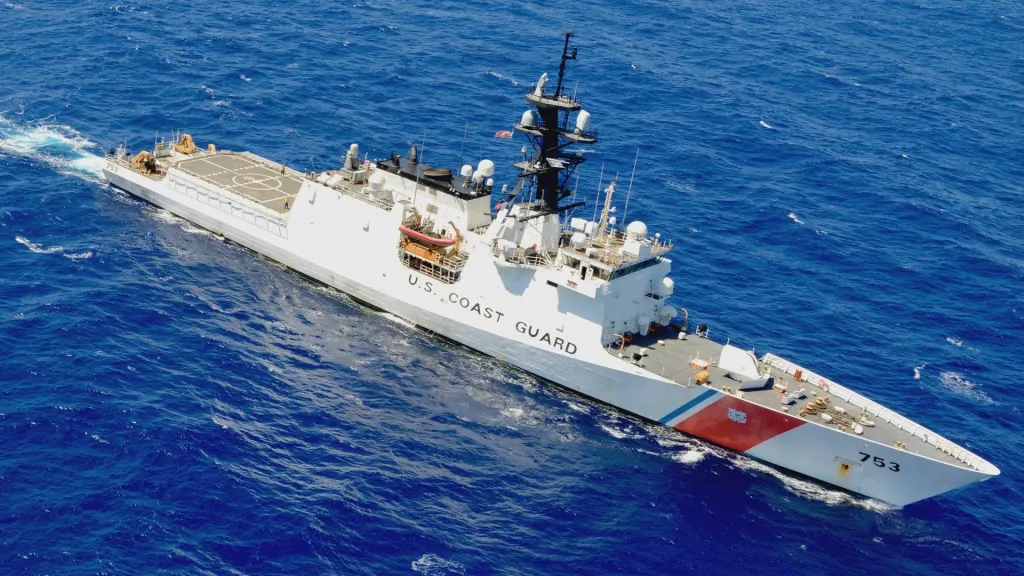
The Navy had previously announced its intention to acquire a new class of frigates, but had only said they would be based on an unspecified American design. Breaking Defensehad reported last week that the Legend class National Security Cutter, developed by Huntington Ingalls Industries (HII), was the design in question, citing anonymous sources.
The USGCS Hamilton, one of the US Coast Guard’s Legend class National Security Cutters. USCG
Secretary of the Navy John Phelan announced the decision to cancel the Constellation class program at the end of November. The Navy had awarded the first contract for what had been expected to be a fleet of at least 10 of those frigates, based on the existing Franco-Italian FREMM design, in 2020. With the idea that only relatively minor changes would be necessary in the Americanized version, and that this would help keep the program on track, the original goal was to see the future USS Constellation delivered in 2026. However, extensive Navy-directed design changes resulted in an almost completely different vessel with only 15 percent commonality with its European ‘parent,’ and the delivery schedule had slipped to 2029 at the earliest.
A previously released rendering of a Constellation class frigate. USN
Now, “to deliver at speed and scale, I have directed the acquisition of a new frigate class based on HII’s Legend class National Security Cutter design, a proven American-built ship that has been protecting U.S. interests at home and abroad,” Secretary Phelan said in a video announcement today. “The President [Donald Trump] and SECWAR [Secretary of War Pete Hegseth] have signed off on this as part of the Golden fleet. Our goal is clear: launch the first hull in the water in 2028.”
I have directed a new Frigate class as part of @POTUS Golden Fleet. Built on a proven American design, in American shipyards, with an American supply chain, this effort is focused on one outcome: delivering combat power to the Fleet fast. pic.twitter.com/ovnASiHYaF
“We look forward to supporting the Navy on this critical program,” Chris Kastner, President and CEO of HII, also said in a statement in a company press release. “Speed matters, and the NSC ship design is stable and producible and will lead to predictable schedules. I have great confidence in the Ingalls team to execute this program, and in our ongoing efforts with our partners to successfully expand the U.S. shipbuilding industrial base to meet the Navy’s needs.”
In terms of the future frigates themselves, “the FF(X) is a highly adaptable vessel. While its primary mission will be surface warfare, its ability to carry modular payloads and command unmanned systems enables it to execute a broad spectrum of operations, making it ready for the challenges of the modern maritime environment,” according to a Navy release. “Small surface combatants have always been essential to the fleet, handling a wide range of missions where a large warship isn’t required. The FF(X) will continue this vital role, and will take on more routine operations, enhancing the fleet’s operational flexibility, adaptability, and mission readiness.”
The Navy has not yet released more specific details about FF(X)’s expected capabilities, but has shown renders of the design. USNI News has also published an additional Navy rendering of the design, seen at the top of this story. What is seen is notably distinct in various ways from Patrol Frigate concepts derived from the National Security Cutter that HII has previously proposed to the Navy, including in the FFG(X) competition that led to the Constellation class. In particular, a very prominent ‘shelf’ has been added to the bottom of the front end of the main superstructure.
A rendering of the FF(X) design as seen from the side. The shelf in front of the main superstructure is clearly visible. USN captureA comparative rendering of a previous Patrol Frigate concept, called the FF4923, that HII has presented in the past. HII capture
Where a Vertical Launch System (VLS) array might be found is an immediate question. This is something that one would expect to be a key feature on any future Navy frigate. Past HII Patrol Frigate concepts have included VLS arrays of varying sizes between the main superstructure and the turreted gun on the bow, as can be seen in the video below.
Patrol Frigate Variants – Information Video
However, the FF(X) design, as it has been shown so far, does not have a VLS clearly installed in its bow, and the new shelf cuts into the space used in previous Patrol Frigate concepts for this purpose. With this in mind, it is possible that a VLS array will be, or at least could be, installed directly in the expanded forward superstructure. This design change would presumably make it easier to fit a larger VLS array into the existing Legend class hull configuration, as below deck alterations to accommodate it would be reduced, especially if longer strike-length cells are not planned.
A rendering of the FF(X) design as seen from the top down, which underscores how much the new shelf extends past the rest of the forward superstructure. USN capture
The VLS requirement was a particularly hot topic of discussion around the FFG(X) effort that led to the Constellation class. After work began on those ships, there continued to be questions about whether their 32-cell VLSs were sufficient for meeting their expected mission requirements, as you can read more about in this past TWZ feature.
The FF(X) renderings do clearly show angled deck launchers for missiles at the stern end of the ship, but what they are intended to be filled with is unknown. What is depicted does align with launchers for 16 Naval Strike Missiles (NSM), an anti-ship cruise missile with secondary land-attack capability that the Navy has already been integrating onto some of LCSs, and has been exploring as an option for arming other ships. The U.S. Marine Corps is also fielding a ground-based NSM system.
The ship’s only other clearly visible weapon systems are a Mk 49 launcher for RIM-116 Rolling Airframe Missile (RAM), for close-in defense, and what appears to be the same 57mm gun in a turret on the bow that is found on the Coast Guard’s Legend class configuration. Whether this has anything to do with the FF(X) nomenclature for the new frigate effort, which notably lacks the “G” reflecting naval vessel designs explicitly intended to carry guided missiles, is unknown.
A wider look at the stern end of the FF(X) rendering showing the Mk 49 RAM launcher, at right, and additional angled missile launchers, at left. USN via USNI News
The FF(X)’s main mast configuration, as depicted in the rendering, also looks largely unchanged from the existing Legend class design. It does appear to feature a Saab AN/SPS-77 Sea Giraffe medium-range multi-mode surveillance radar that is not found on the Coast Guard’s cutters. A much larger AN/SPY-6(V)3 Enterprise Air Surveillance Radar (EASR), coupled with a derivative of the Aegis combat system, had been set to be a key feature on the Constellation class frigates. More significantly expanded sensor suites were also a feature in past HII Patrol Frigate concepts.
The explicit mention of modular payloads in the Navy’s release raises additional questions. One of the most significant areas where the LCS program has failed to deliver has been in the promise of its modular mission modules. These were supposed to allow the ships to rapidly shift from one mission set to another. As it stands now, the Navy’s Independence and Freedom class LCSs are deployed with largely fixed configurations. It is also worth noting that modular payloads for the FF(X) could refer to containerized systems, such as the Mk 70 Payload Delivery System, which contained a four-cell missile launcher derived from the Mk 41 VLS. There is space on the fantail of the FF(X) design, behind the box launchers, that could be used for a containerized payload.
An SM-6 missile seen being fired from a Mk 70 containerized launcher mounted on the stern flight deck of a US Navy Independence class LCS. USN
The Navy has otherwise made clear that it expects the new frigate design to allow for the integration of new and improved capabilities and functionality down the line.
“The frigate will follow the same proven approach we’ve used with the Arleigh Burke destroyers, building it smart from the start, then upgrading it in steps over time, as the threat and technology evolve,” Chief of Naval Operations Adm. Daryl Caudle also said in today’s video announcement.
Arleigh Burke class destroyers, also sometimes referred to as DDG-51 class ships, are the primary workhorse of the Navy’s current surface fleets, something that looks unlikely to change for decades to come. The service has now begun fielding the Flight III subvariant, which features significantly improved capabilities. There are a number of major upgrade programs underway for existing versions, as well. At the same time, it is worth noting that Navy officials have been warning for years that the underlying design is ‘maxed out’ from a structural perspective, as well as when it comes to meeting the needs of increasingly power-hungry mission systems.
The USS Jack H. Lucas, the US Navy’s first Flight III Arleigh Burke class destroyer. USN
Any major physical modifications to the initial FF(X) design, such as the installation of a larger VLS or a new mast for a larger and/or more capable radar array, could be complex and costly. The Navy has its own history with large-scale upgrade programs becoming expensive boondoggles, with previous work on its Ticonderoga class cruisers having become a particular case study in what not to do.
The Navy has shared details about its acquisition strategy for the new frigates, which it clearly hopes will help avoid some of the issues that befell the Constellation program. The service also plans to eventually competitively award contracts for additional hulls to multiple shipyards. This is in line with broader trends across the Navy and the rest of the U.S. military to be better about obtaining and retaining key intellectual property rights for major weapon system programs to prevent being locked into a particular vendor.
“We will acquire these ships using a lead yard and competitive follow-on strategy for multi-yard construction,” according to Secretary Phelan in today’s video. “Shipyards will be measured against one outcome, delivering combat power to the fleet as fast as possible.”
A 2023 Navy briefing slide showing work on the future USS Constellation. USN
“Leveraging a complete design and production baseline approach will allow the Navy and shipbuilders to reduce costs, schedule, and technical risk,” Adm. Caudle added. “We know this frigate design works. We know it operates with the fleet, and most importantly, we know how to build it now.”
The new frigate program is also being presented as a way to help bolster domestic U.S. shipbuilding capacity. America’s shipbuilding industry has contracted to a very worrying degree over the past few decades, especially in contrast to China’s heavy investment in the opposite direction, as you can read more about here.
“We will deliver on a wartime footing, and we will unleash the American industrial base to do it, competition, accountability, and real output, steel in the water,” per Secretary Phelan.
Comments from Navy officials today also seem clearly intended to head off questions about why the service is not considering any of the wide array of capable frigate designs that allies and partners have in active production now. This is something TWZ explicitly touched on in our recent piece on the Navy’s future frigate outlook.
“We’ve also been clear-eyed about what happens in conflict. Other countries will always prioritize their own fleets, not us, ships that depend on foreign industry,” Adm. Caudle said in the video released today. “That’s why this is an American design backed by American workers, American suppliers, and an established logistics and maintenance network. So wherever the ship sails, when the American flag goes into port, it does so with American industry firmly behind it.”
National Security Cutter – Ingalls Shipbuilding
What is not in question is the Navy’s need for more capable small surface combatants, and more of them overall, especially given the underperformance of the LCS program. In particular, the new frigates will offer a way to free up Arleigh Burke destroyers for more pressing taskings, as well as reduce operational strain on the destroyers overall.
“Recent operations from the Red Sea to the Caribbean make the requirement undeniable,” Adm. Caudle stressed in the video today. “Our small surface combatant inventory is a third of what we need. We need more capable blue water, small combatants to close the gap and keep our DDGs focused on the high-end fight.”
With what happened to the Constellation class program, one can expect the new FF(X) effort to be subjected to a particular significant degree of scrutiny, including from Congress. With the official plan now declared to be to leverage the Legend class National Security Cutter design already in Coast Guard service, more specific details may begin to emerge.
The recent decision by the United States Navy (USN) to cancel the Constellation-class frigate program after eight years of development and billions of dollars in investment represents a significant setback in US naval modernization drive. The Constellation-class was meant to become a modern, multi-mission combat vessel capable of relieving operational pressure from Arleigh Burke-class destroyers and narrowing the growing numerical advantage of the China’s People’s Liberation Army Navy (PLAN). Instead, continuous design changes, and subsequent delays changed what was supposed to be an easy-to-construct warship platform into a costly and significantly delayed project. After failure of several major projects like Zumwalt destroyer and Littoral Combat Ships (LCS), the cancellation of the Constellation-class frigate project has degraded Washington’s efforts to sustain the naval balance of power against rapidly expanding naval fleet of PLAN.
The Constellation-class project was a product of USN’s urgent need to fill the gap left behind Oliver Hazard Perry-class (OHP) frigates which were phased out from USN services in 2015. The OHPs, despite lack of built-in vertical launch system (VLS), were regarded for their reliability, and versatility in missions ranging from open-ocean escorting to anti-submarine warfare (ASW) and anti-surface warfare (ASuW). The retired hulls of OHPs were purchased by navies of several US allies including Australia, Bahrain, Chile, Egypt, Pakistan, Spain, Taiwan, and Turkiye. Their withdrawal from USN created a capability void that the Littoral LCS program – comprising of Freedom class and Independent class vessels – was expected to fill. However the LCS encountered numerous mechanical failures in hulls and propulsion system, cost overruns, and capability gaps that rendered it unsuitable for missions in contested naval environments.
As USN halted further procurement and early retirement of LCS, it attempted to follow a new approach, i.e., opt for a proven design tailored to meet USN requirements. Franco-Italian FREMM frigate design was chosen as the baseline for a modern, affordable American Constellation-class frigate. At initial stage, it appeared a sound idea. The FREMM platform had already proven itself in European naval forces, and the USN specific variant was modified to carry 32 Mk-41 VLS cells capable of firing SM-series interceptors and even Tomahawk cruise missiles, alongside Naval Strike Missiles. This program committed to be a potent yet affordable and rapid addition in USN fleet while retaining 85 percent commonality with original design. But as USN continued to impose new requirements, complications in construction, and alteration in designing began to inhibit the efficiency of the program. Constellation-class frigate undertook major size increment than parent FREMM design, stretching from 466 feet to nearly 500 and increasing to over 7,200 tons. Instead of leveraging a proven design, USN trapped itself with a pseudo-original design which now shared mere 15 percent commonality with the original design. By 2024, the first frigate was already three years behind schedule, and the program’s cost enlarged well beyond initial estimations. Faced with increasing costs, long delays, and design complications, the USN eventually axed the Constellation-class frigate program too, leaving behind a significant gap in USN surface fleet which this frigate was supposed to fill.
USN now wants a new frigate class structured on proven American design by 2028. Reportedly, the design of US Coast Guard (USCG) Legend Class cutter will be used as baseline to develop a USN specific variant. These 4,600 tons class ships are capable of conducting blue water operations and support 57mm deck gun, Phalanx CIWS, and flight deck with hanger to support rotary wing operations. Its USN specific frigate version can accommodate a 16-cell Mk-41 VLS module, 8x Harpoon/NSM cruise missiles in canisters, RIM-116 Sea RAM, and torpedo tubes. Using an American proven design for mass producing USN specific frigate of relatively smaller size and low tonnage will allow USN to produce and commission larger number of hulls in relatively less time. But on flip side, this new frigate class will be far less capable than recently cancelled Constellation-class as they are unlikely to carry Aegis CMS, and will have significantly less range, endurance, and weapon load-out.
Nowhere is this challenge more evident than in the rapid growth of China’s naval power. PLAN is now commissioning highly capable naval combatants including flat-deck aircraft carrier (Fujian), next generation destroyers (Type-055 and Type-52DL) and frigates (Type-54B), and new class of conventional as well as nuclear submarines. Chinese coast guard, and maritime militia collectively operate more than 750 vessels – more than twice the number of hulls under US control. While the US Navy still retains qualitative advantages, especially in nuclear submarines and carrier aviation, trends in shipbuilding capacity significantly favor Beijing. China commands more than half of global commercial ship production, while the US share barely registers at a tenth of a percent. This allows China to mass produce modern warships for PLAN at a pace the United States cannot simply match.
Although USN plans to expand its fleet from 296 manned warships to 381 manned warships and 134 unmanned vessels by 2045, but so far trends of decline hull strengths have been observed. Ticonderoga class cruisers are gradually retiring, next-generation DDG(X) destroyers are still in far future, Ford class nuclear aircraft-carriers and Columbia-class ballistic missile submarines (SSBNs) are facing delays, and Arleigh Burke Flight-III destroyers are not producing at rate faster enough to accommodate these growing gaps. Unmanned vessels are sometimes perceived as a viable solution to fill-up the gaps but these vessels cannot replace manned warships on one-on-one basis. In sum, aforementioned projects expose the persistent limitations of ship production capacity of US shipyards. The Congressional Budget Office estimates that reviving the shipbuilding sector to meet the USN long-term needs would require annual investments of more than $40 billion for three consecutive decades—a staggering commitment that would require political consensus and sustained strategic vision.
The cancellation of the Constellation-class frigate, just like past projects of Zumwalt and LCS- thus represents a persistent crisis in US naval build-up. As China accelerates its naval production and expands power projection into the Indo-Pacific, the United States finds itself struggling to revive its own shipbuilding capacity. Whether Washington can reverse this trajectory will depend on its ability to reform procurement processes, invest in industrial capacity, and adopt realistic designs aligned with strategic needs. Without such changes USN risks entering the next decade with too few ships to meet global demands.
Who: Villareal vs Barcelona What: Spain’s La Liga Where: Estadio de la Ceramica in Villareal, Spain When: Sunday, December 21, at 4:15pm (15:15 GMT) How to follow: We’ll have all the build-up on Al Jazeera Sport from 1215 GMT in advance of our text commentary stream. Click here to follow our live coverage.
Villarreal has quietly mounted a potential dark horse title campaign through most of the first half of La Liga.
Recommended Stories
list of 4 itemsend of list
Now it has a chance to make it official when the “Yellow Submarine” host Barcelona on Sunday.
Al Jazeera Sport takes a look at a game that could blow the Spanish top flight wide open.
How have Villareal fared in La Liga this season?
The team coached by Marcelino Garcia Toral is in third place, eight points behind leader Barcelona and four behind second-placed Real Madrid. But it has played two fewer games than the powerhouses, so it could easily be in an even stronger position.
Villarreal has disappointed in the Champions League and was eliminated from the Copa del Rey by a lower-division side this week. But La Liga is a different story. Villarreal is on a six-game winning run, and its only two losses have come at Madrid and Atletico Madrid.
Marcelino’s men have also turned their La Ceramica stadium into a fortress, conceding a miserly four goals in eight home matches while remaining unbeaten and winning all but one of those league encounters.
How have Barcelona fared in La Liga this season?
The game will pit the league’s top defence in Villarreal, with 13 goals allowed in 17 games, against the league’s top attack. Barcelona has poured in 49 goals in that time – 15 more than closest challengers Real – and more than made up for a sometimes shaky defence by outscoring its opponents.
Barcelona will look to both quash thoughts of a challenge by Villarreal and close 2025 on a high note this weekend.
An eighth consecutive league victory for Lamine Yamal and company would also keep the pressure on a Madrid side which is struggling.
Madrid hosts Sevilla on Saturday, with coach Xabi Alonso in need of a convincing victory before they have the two-week winter break to ponder the team’s future.
What happened in Villareal’s last match?
Adding insult to the injury of Villareal’s difficulties outside of La Liga this season, they suffered a shock 2-1 Copa del Rey defeat to second-tier Racing de Santander on Wednesday.
Their last La Liga match was on December 6, and was a 2-0 home win against Girona. In between those two matches, Villareal also suffered a 3-2 home defeat at the hands of Copenhagen in the Champions League.
What happened in Barcelona’s last match?
Andreas Christensen and Marcus Rashford struck late in the game to hand Barcelona a hard-fought 2-0 victory against third-tier side Guadalajara in the Copa del Rey on Tuesday.
Their last La Liga match also saw the Catalans pushed to the limit by Osasuna with Raphinha netting twice late in the game to secure a 2-0 win.
What is the secret of Villareal’s La Liga form?
Villarreal has based its success on a team effort with several goal-scorers and playmakers. But left winger Alberto Moleiro stands out. He is having a breakout first season with the team and leads Villarreal with six league goals. Tajon Buchanan has added five goals, and midfielder Santi Comesana helps a solid midfield.
What are Barcelona’s challenges in their La Liga defence?
Barcelona coach Hansi Flick has so far succeeded in making a left-side centre-back of Gerard Martin, who struggled to fill in at left back when Alejandro Balde was injured late last season.
Martin has five consecutive starts in the centre of the defensive line as Flick tries to find a replacement for Inigo Martínez, who left earlier in the year for Saudi Arabia. Martin may be tested by Villarreal’s attack.
What happened to La Liga’s plan to play Villareal-Barcelona in Miami?
The Sunday showdown was originally earmarked for Miami until La Liga’s international expansion plans collapsed under heavy criticism, forcing the cancellation of what would have been the first European league match played abroad.
What happened the last time Villareal played Barcelona?
Villareal were 3-2 winners in the La Liga clash in May at Barcelona in the side’s last encounter, although the home side had already secured the league title five days previous to the match.
The away side took the lead through Ayoze Perez after only four minutes, but Yamal and Fermin Lopez turned the game in Barca’s favour before the break. Villareal were not done, however, with Santi Comesana levelling in the 50th minute before Tajon Buchanan scored the winner 10 minutes from time.
What happened in the corresponding fixture between Villareal and Barcelona last season?
The first meeting between the sides last season resulted in a 5-1 drubbing as Barcelona ran amok at in Villareal.
Robert Lewandowski and Raphinha both netted braces either side of Pedro Torre’s strike. Perez was also on the scoresheet in this match for the home side, but it proved only to be a consolation.
Head-to-head
This is the 55th meeting between the sides, with Barcelona winning 33 of the matches and Villarreal emerging victorious on 11 occasions.
Villareal have won their last two trips to Barcelona, but the Catalan club have the same record from their last two games at La Ceramica.
Villareal team news
Villarreal received a timely boost as veterans Gerard Moreno and Dani Parejo returned to training on Tuesday and should be available to face Barcelona.
Pape Gueye and Ilias Akhomach, however, are away with Senegal at the Africa Cup of Nations.
Pau Cabanes is a definite injury absentee, while Thomas Partey, Gerard Moreno, Willy Kambwala and Santiago Mourino must prove their fitness before the match.
Barcelona team news
Dani Olmo and Gavi are both absent due to injuries, while Ronald Araujo is set to miss the game due to personal reasons.
Pedri missed training on Friday due to a calf strain, making him a major doubt for the match.
The administration of President Donald Trump has announced it will halt the visa lottery programme that allowed the suspect in the Brown University shooting to enter the United States.
The lottery awards approximately 50,000 immigrant visas each year, according to the US government.
Recommended Stories
list of 3 itemsend of list
But Trump has long opposed the Diversity Immigrant Visa Programme, sometimes known as the DV Programme. On Friday, his Secretary of Homeland Security Kristi Noem revealed that he had directed her to end the lottery immediately.
She also identified the suspect as Portuguese national Claudio Manuel Neves Valente, who received his green card — a certificate for permanent residency — through the lottery in 2017.
“This heinous individual should never have been allowed in our country,” Noem wrote in her social media statement.
“At President Trump’s direction, I am immediately directing USCIS [US Citizenship and Immigration Services] to pause the DV1 program to ensure no more Americans are harmed by this disastrous program.”
Campaign to end visa lottery
Friday’s announcement is not the first time Trump has sought to wind down the diversity visa lottery.
Trump has long sought to narrow the country’s pathways to legal immigration, and he has used crime as a pretext for doing so.
Noem herself pointed out that, in 2017, Trump “fought” to shut down the diversity visa lottery in the wake of an attack in New York City that saw a truck ram into a crowd of people, killing eight.
Speaking at a graduation ceremony for the Federal Bureau of Investigation (FBI) in December 2017, Trump — then in his first term as president — called on Congress to “end the visa lottery system”.
“They have a lottery. You pick people. Do you think the country is giving us their best people? No,” Trump said.
“What kind of a system is that? They come in by lottery. They give us their worst people.”
The Diversity Immigrant Visa Programme was established in 1990 to ensure applicants from underrepresented countries had access to the US immigration system.
Immigration rights advocates have long argued that pathways to permanent residency are narrow for those who do not already have a spouse, relatives or some other kind of sponsor in the country.
The visa lottery helps to answer that need, by creating an alternative route to residency.
The lottery system selects visa recipients randomly, but critics argue it remains a long-shot avenue to gain US residency, and even successful applicants must still pass a rigorous screening process after the lottery.
While the Diversity Immigrant Visa Programme used to accept 55,000 applicants each year, in 2000 that number was lowered to its current level, according to the American Immigration Council.
Surveillance images released by police show Claudio Neves Valente, the suspect in the mass shooting at Brown University [Providence Police Dept via AP Photo]
A suspect identified
Friday’s decision to immediately suspend the lottery comes as new details emerge about Neves Valente, a physics scholar found dead in a storage unit in New Hampshire after a nationwide manhunt.
The search began on December 13, when gunfire erupted on the campus of Brown University, a prestigious Ivy League school in Providence, Rhode Island.
The school’s fall semester was at its conclusion, and the exam period had begun. Students in the Barus and Holley physics laboratory were taking their end-of-course exams when a suspect, clad in black, entered the building and opened fire, killing two students and injuring nine others.
The physics lab was close to the edge of campus, and the suspect was able to escape on foot undetected.
The manhunt included several false starts, as authorities said they quickly detained a person of interest, only to release the individual without charges.
Then, on November 15, law enforcement officials announced that a plasma physics scholar named Nuno Loureiro had been found dead at his home, after suffering multiple gunshot wounds.
Loureiro was also a Portuguese immigrant, and he served as a professor at the Massachusetts Institute of Technology (MIT), a highly regarded science institution.
It was not immediately clear that the two shooting incidents were related, and authorities faced pressure to bring the Brown University shooter to justice, as the manhunt dragged on.
But on Thursday night, officials announced they had discovered Neves Valente dead from a self-inflicted gunshot wound, and that they believed him to be responsible for both attacks.
Neves Valente had previously studied in a PhD programme at Brown, though he did not complete his degree, and he had been Loureiro’s classmate in Portugal.
Visa revocations
The administration of President Trump has a track record of revoking visas and terminating immigration programmes after high-profile attacks.
On November 26, for example, two National Guard members from West Virginia were shot while on patrol in Washington, DC, as part of Trump’s crime crackdown in the capital.
The suspect in that case was identified as Rahmanullah Lakanwal, an Afghan national who had previously worked with allied forces during the US-led war in Afghanistan.
One of the National Guard soldiers, 20-year-old Sarah Beckstrom, ultimately died from her wounds.
Trump responded to the incident by announcing he was halting all visa applications and asylum requests from Afghan nationals, despite outcry from human rights and veterans groups.
The Republican leader also said he would pursue a “permanent pause” on entry for immigrants from “all third-world countries”.
In the aftermath of the shooting, the Trump White House tightened entry for 19 countries it had identified in June as “high risk” and expanded the list of restrictions to include 20 more countries.
Trump has also taken targeted actions to strip individuals of their immigration status following shootings.
After the assassination of conservative commentator Charlie Kirk in September, the Trump administration announced it was yanking visas from six foreign nationals who posted disrespectful comments or memes online about the attack. They hailed from countries ranging from Argentina to Brazil, Germany to Paraguay.
Free-speech advocates said the decision was a clear violation of the First Amendment of the US Constitution, which protects the freedom of expression.
But the Trump administration has repeatedly threatened to boot foreign nationals that do not align with its policy priorities.
“Aliens who take advantage of America’s hospitality while celebrating the assassination of our citizens will be removed,” the US State Department wrote in response.
The suspect in the Kirk shooting is a 22-year-old US citizen named Tyler James Robinson from Utah.
Studies have repeatedly shown that US-born citizens are more likely to commit violent crimes than immigrants.
A shell company with Israeli ties exploited Palestinians desperate to flee the ongoing war in Gaza, charging them large sums of money to covertly exit the country in what may be an official plan to ethnically cleanse the territory.
In an exclusive digital investigation, Al Jazeera probed last month’s mystery flight that spirited 153 passengers from Gaza to South Africa, unearthing figures working for Al-Majd Europe, an unregistered front organisation that falsely claimed to be working for humanitarian aims.
Recommended Stories
list of 3 itemsend of list
The Palestinians arrived at OR Tambo International Airport, which serves the cities of Johannesburg and Pretoria, on November 13. Refused entry by border police as they did not have departure stamps from Israel on their passports, they were stuck on the aircraft for 12 hours before being allowed to disembark.
South African President Cyril Ramaphosa admitted the passengers “out of compassion”, but said at the time that his government, which has long been a strong supporter of the Palestinian cause, would investigate as it seemed that they had been “flushed out” of the Gaza Strip.
Forced evacuations
Israeli officials have previously openly stated that they support what they have termed the “voluntary emigration” of Palestinians from Gaza, in what effectively would be their forced evacuation.
In March 2025, Israel’s security cabinet set up a controversial bureau to get Palestinians to leave Gaza voluntarily, which was headed by former deputy director of the Ministry of Defence, Yaakov Blitstein. Israeli Defence Minister Israel Katz said at the time that 40 percent of Gaza residents were “interested in emigrating”.
The previous month, Al-Majd Europe set up its online presence with a new website stating that it focused on relief efforts in Muslim countries, specifically “for Gazans wishing to exit Gaza”, with claims that it had organised mobile health clinics in the enclave and trips for Palestinian doctors abroad that Al Jazeera later discovered to be false.
A passenger from the November flight to South Africa, whose identity was kept hidden for his own protection, said he contacted the organisation after finding the link online, which promised not only a way out of Gaza, but safety and medical treatment for injuries. “Initially, it said it was free. Then they asked for $1,400 [per person]. Then the price went up to $2,500,” he said.
Testimonies gathered by Al Jazeera showed that payments requested varied from $1,000-2,000 per person, with strict criteria for signing up. Only families would be accepted on condition that they kept their departure secret, with details on flight departures only released a few hours before takeoff.
Passengers say they were told to arrive at the Karem Abu Salem crossing (called Kerem Shalom in Israel) in southern Gaza. When they arrived, their personal belongings were confiscated, and they were put on buses to Ramon Airport, near the Israeli city of Eilat, apparently by Israeli authorities.
Nigel Branken, a South African social worker who helped tho Palestinians on the plane, previously told Al Jazeera that there were “very clearly … marks of Israel involved in this operation to take people … to displace them”.
Evacuees told Al Jazeera they were not informed of their final destination until moments before boarding. They were then escorted onto a flight registered to a brand new airline called FLYYO without exit stamps in their travel documents.
Al Jazeera discovered that FLYYO has organised a number of similar flights, all taking off from Israeli airports, headed to Romania, Indonesia, South Africa, Kenya and other destinations.
False identity
Further scrutiny of Al-Majd Europe, which said it was a “humanitarian foundation established in 2010 in Germany”, with a head office located in Sheikh Jarrah, a neighbourhood in occupied East Jerusalem, later revealed its identity to be a sham.
Al Jazeera found no company registered by that name on any German or European database. The supposed address does not appear in official Jerusalem records, with the location on Google Maps corresponding to a hospital and a cafe.
While digging into the flights, Al Jazeera found two faces linked to the organisation – both Palestinians. The first was Muayad Hisham Saidam, which the organisation lists as its humanitarian projects manager in Gaza.
A search of Saidam’s name reveals that in May 2024, his wife created a public page to ask for donations to help her family leave Gaza. A year later, Saidam posted an image of himself boarding a plane chartered by Fly Lili, another Romanian airline, announcing that he was departing Gaza.
Using the angle of his shadow, time of the flight and the location of the plane on the Ramon Airport runway, Al Jazeera discovered Saidam was likely on a flight on May 27, 2025, which left Israel for Budapest, with 57 Palestinian passengers from Gaza.
It appears that Saidam’s identity is real, and that his family was likely evacuated to Indonesia. But his connection to Al-Majd Europe is unclear.
The second public face of the organisation belongs to a man named only as Adnan, though he appears to have no digital footprint.
On November 13, the day of the Johannesburg flight, a page containing a number of partner companies was deleted from Al-Majd’s website. Using open-source intelligence techniques, Al Jazeera recovered the page, which showed a number of well-known groups that Al-Majd claimed to have been working with, including the International Red Cross.
One name stood out: Talent Globus – a recruitment company established in Estonia in 2024, with a fund containing only $350. Its website lists four employees, including Director Tom Lind, a businessman with Israeli and Estonian citizenship.
Lind’s name has been linked to a number of other companies where he’s listed either as a founder or director – all without official registration or physical addresses.
Lind’s name appeared in reports by Israeli newspaper Haaretz as one of the coordinators of the flights of Palestinians leaving Ramon Airport.
In May 2025, Lind posted on his LinkedIn page that he had left Talent Globus, and was instead focused on “humanitarian efforts to support Palestinians”. He said that, alongside a network of individuals and groups, he had assisted with the evacuation of a “substantial number” of people from Gaza.
Photos of the other three employees of Talent Globus from its website – James Thompson, Maria Rodriguez, David Chen – all turned out to be stock images.
And much like those employees, it appears as though Al-Majd itself is a fake humanitarian group, leading to the question of what those behind the organisation are trying to hide.
Publicly, Israel has seemed to back down from its plan to encourage “voluntary emigration”. But Al Jazeera’s investigation poses more questions – is Al-Majd part of a bigger plan, a way to quietly empty Gaza of its inhabitants, one secret flight at a time?
Weekly insights and analysis on the latest developments in military technology, strategy, and foreign policy.
Welcome to Bunker Talk. This is a weekend open discussion post for the best commenting crew on the net, in which we can chat about all the stuff that went on this week that we didn’t cover. We can also talk about the stuff we did or whatever else grabs your interest. In other words, it’s an off-topic thread.
This week’s second caption reads:
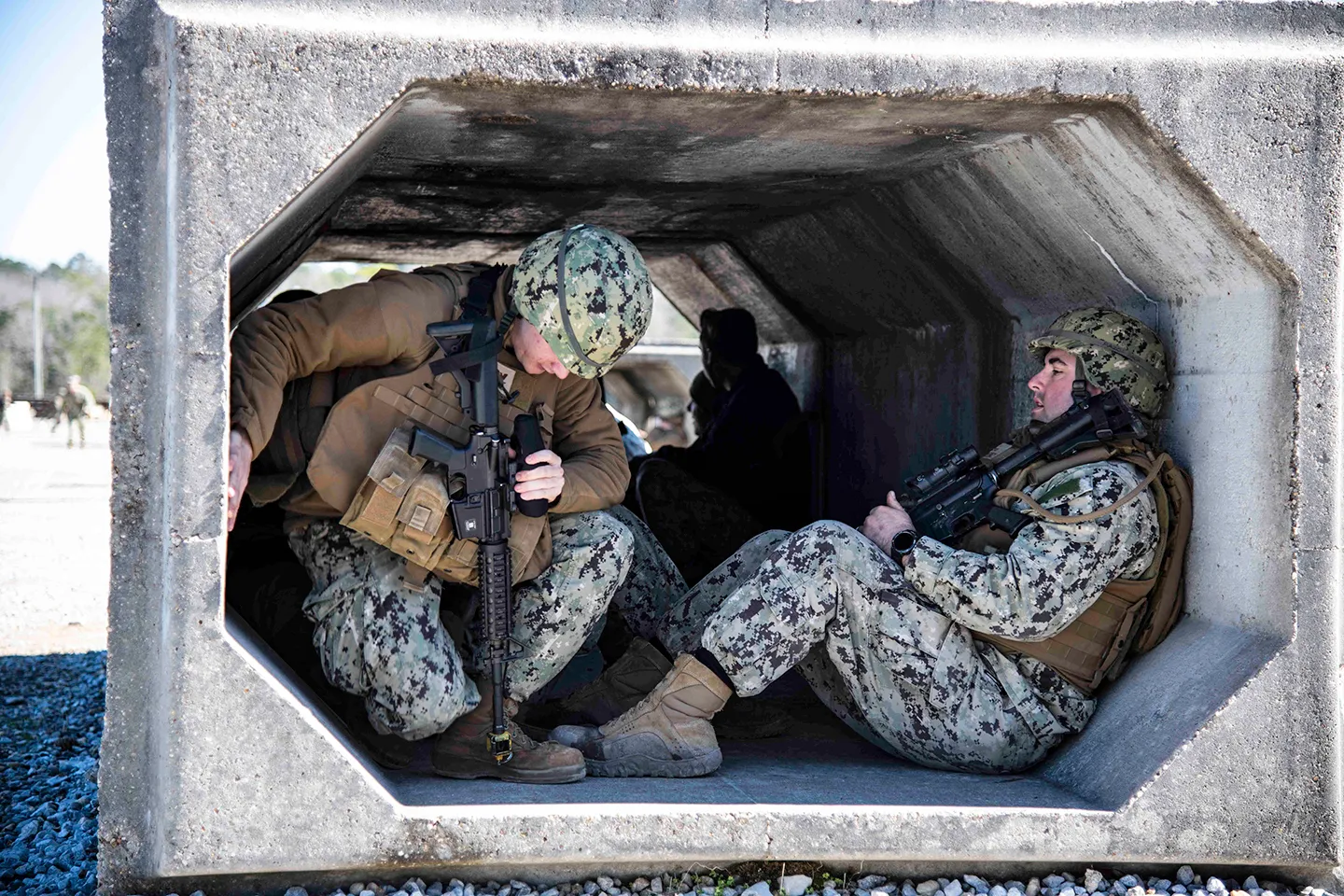
Camp Shelby, Mississippi (February 3, 2023) Seabees, assigned to Naval Mobile Construction Battalion 133 (NMCB 133), go to bunkers during a simulated missile strike on Camp Shelby, Mississippi, February 3, 2023. NMCB 133 is at Camp Shelby, Mississippi conducting a field training exercise operating as part of Navy Expeditionary Combat Command conducting the advanced phase of the force readiness training plan (FRTP). (U.S. Navy photo by Mass Communication Specialist 2nd Class Andrew Waters/Released)
Also, a reminder:
Prime Directives!
If you want to talk politics, do so respectfully and know that there’s always somebody that isn’t going to agree with you.
If you have political differences, hash it out respectfully, stick to the facts, and no childish name-calling or personal attacks of any kind. If you can’t handle yourself in that manner, then please, discuss virtually anything else.
No drive-by garbage political memes. No conspiracy theory rants. Links to crackpot sites will be axed, too. Trolling and shitposting will not be tolerated. No obsessive behavior about other users. Just don’t interact with folks you don’t like.
Do not be a sucker and feed trolls! That’s as much on you as on them. Use the mute button if you don’t like what you see.
So unless you have something of quality to say, know how to treat people with respect, understand that everyone isn’t going to subscribe to your exact same worldview, and have come to terms with the reality that there is no perfect solution when it comes to moderation of a community like this, it’s probably best to just move on.
Finally, as always, report offenders, please. This doesn’t mean reporting people who don’t share your political views, but we really need your help in this regard.
European Union leaders have agreed to borrow 90 billion euros ($105 billion) to help fund Ukraine’s defense against Russia over the next two years. This decision marks a shift from an earlier plan to finance Ukraine using frozen Russian assets.
The EU will provide interest-free loans for 2026-2027, supported by EU borrowing in capital markets and backed by the EU budget’s excess capacity. This amount is expected to cover about two-thirds of Ukraine’s needs during this period. Initially, Britain was to contribute to filling the funding gap with its frozen Russian assets.
Despite initial resistance to the EU borrowing plan, particularly from Hungary, a compromise was reached. Hungary, Slovakia, and the Czech Republic allowed the scheme to proceed after being reassured it would not financially impact them.
The proposal to use frozen Russian assets faced challenges, especially from Belgium, which holds a significant portion of these assets. Other countries like Italy, Malta, and Bulgaria also expressed concerns. The plan would have involved investing the frozen funds in zero-interest bonds, helping meet Ukraine’s needs without outright confiscation, which is against international law. However, the need for Belgium to have guarantees against potential risks stalled this approach.
As for repayment, EU leaders stated that the Russian assets will remain frozen until Russia pays reparations to Ukraine. If this occurs, Ukraine could use those funds to repay the loan, though this scenario seems unlikely. Borrowing 90 billion euros is considered manageable to support Ukraine and maintain investor interest, with expectations of sufficient appetite for this new loan.
A spokesperson for Antonio Guterres calls for UN staffers’ immediate release, as 69 now detained in the country.
United Nations Secretary-General Antonio Guterres has condemned the detention of 10 more UN staff members by the Houthis in Yemen.
Stephane Dujarric, a spokesperson for Guterres, confirmed on Friday that the previous day’s arrests had brought the total of detained local staffers to 69, calling for their immediate release.
Recommended Stories
list of 3 itemsend of list
“These detentions render the delivery of UN humanitarian assistance in Houthi-controlled areas untenable. This directly affects millions of people in need and limits their access to life-saving assistance,” Dujarric said.
The Houthis, who control most of northwestern Yemen, including the capital Sanaa, have stepped up their arrests of UN staff since the start of Israel’s genocidal war on Gaza in October 2023, accusing them of spying for the United States and Israel.
The UN has repeatedly rejected Houthi accusations that its staff or operations in Yemen are involved in spying, a charge that carries the death penalty in the country.
On Thursday, the organisation confirmed that the detainees were all Yemeni nationals.
The latest arrests came days after Guterres discussed detained UN, diplomatic and NGO staff with Sultan Haitham bin Tariq of Oman, which has served as a mediator in the conflict in Yemen.
Guterres also commented this week on the Houthis’ recent referral of three detained UN staffers to a criminal court, saying they had been charged in relation to “their performance of United Nations official duties” and calling for charges to be dropped.
Shift in balance of power
A decade of civil war has plunged Yemen into one of the world’s worst humanitarian crises, according to the UN.
Guterres said this week that 19.5 million people in the country – nearly two-thirds of the population – need humanitarian assistance.
The conflict has recently entered a new phase, as separatists with the Southern Transitional Council (STC) extended their presence in southeastern Yemen – marking one of the largest shifts in power since the war began.
They now claim to control areas including the eastern governorates of oil-rich Hadramout and al-Mahra and the port city of Aden.
The STC, which wants to establish an independent state in the south of Yemen, has fought in the past alongside the internationally recognised, Saudi-backed government, which is based in Aden, against the Houthis.
However, the STC’s advance in the south brings it into direct confrontation with the government in Aden, known as the Presidential Leadership Council (PLC), which condemned the seizure of territory as “unilateral and a blatant violation”.
The STC’s leader, Aidarous al-Zubaidi, has a seat on the PLC, officially as one of its vice chairmen.
But relations have often been shaky between the group and the internationally recognised government, which came under major pressure in areas under its control over power outages and a currency crisis this year.
The two entities have previously fought, most notably in 2018 and 2019, in Aden and its surrounding governorates.
This week, Guterres urged all parties to exercise “maximum restraint, de-escalate tensions, and resolve differences through dialogue”.
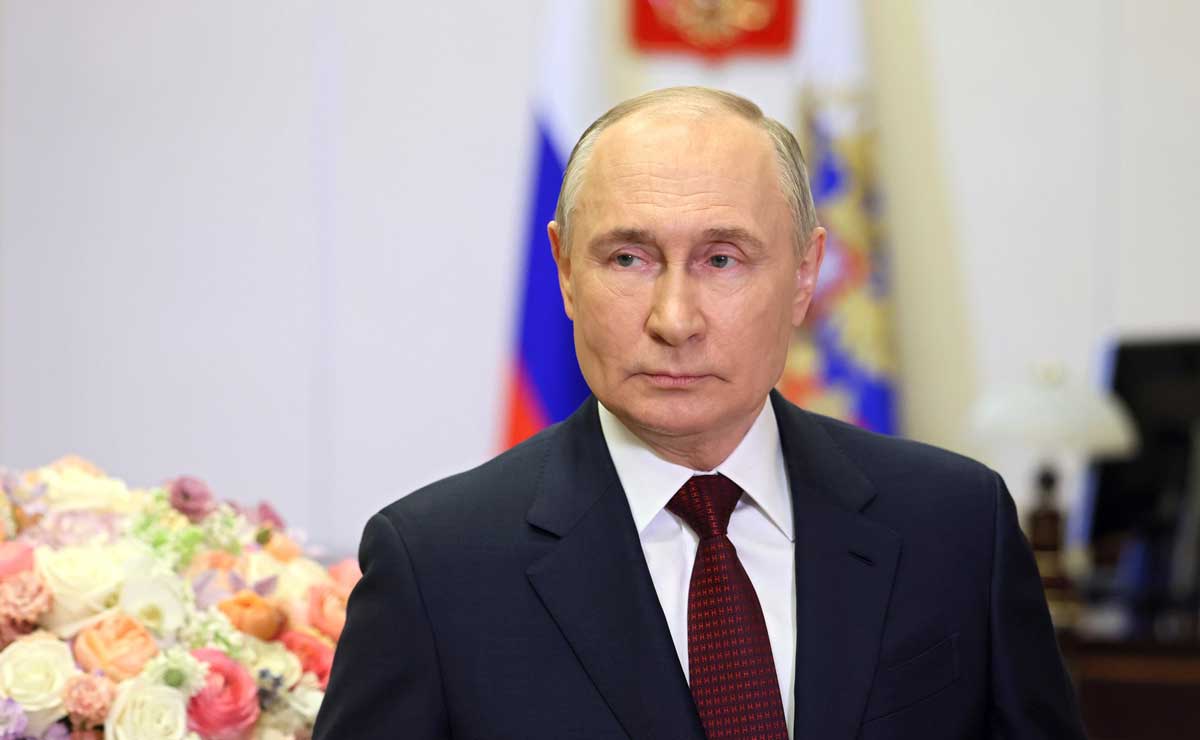
The war on Ukraine was a big topic at Vladimir Putin’s annual televised question and answer session, but the Russian president wouldn’t say if the war is coming to an end.
Responding to reports that Hamas may be willing to partially disarm, handing over heavy weaponry but keeping its small arms, US Secretary of State Marco Rubio said peace will never happen if the group has the capability to “threaten or attack Israel.”
Weekly insights and analysis on the latest developments in military technology, strategy, and foreign policy.
In a significant escalation of the ‘tanker war’ between Russia and Ukraine, which has so far played out mainly in the Black Sea, Ukrainian aerial drones have struck a tanker belonging to Russia’s so-called ‘shadow fleet’ in the Mediterranean. The latest incident comes after a tit-for-tat series of attacks, and a warning earlier this month from Russian President Vladimir Putin that he would “cut Ukraine off from the sea” in response to Kyiv stepping up its campaign against Russian commercial shipping.
A source from within the Security Service of Ukraine (SBU), the government’s main internal security agency, told TWZ that “a new, unprecedented special operation” was carried out “more than 2,000 kilometers” (1,243 miles) from Ukrainian territory.
A video appeared online allegedly showing a drone attack on a Russian shadow fleet tanker in the Mediterranean sea.
Reportedly, it was a QENDIL tanker that transports Russian oil that was empty at the moment of the strike. There are reports that the vessel was critically… pic.twitter.com/G50Sf579If
The target was the Oman-flagged crude oil tanker Qendil, empty at the time of the attack and sailing from the Indian port of Jamnagar, where it had been unloaded on December 1.
“Accordingly, this attack did not pose any threat to the ecological situation in the region,” the SBU said.
Before unloading, the tanker had left Russia’s Black Sea port of Novorossiysk on November 4, sailing through the Bosphorus and Mediterranean, then passing the Suez Canal en route to India. The vessel was built in 2006 and has a capacity of 115,338 deadweight tonnes.
Russian tanker hit in Ukrainian drone strike
A Russian oil tanker tied to Moscow’s so-called shadow fleet has sustained critical damage after being struck by Ukrainian aerial drones in the Mediterranean Sea, according to reports. #MarineTraffic data shows the tanker Qendil… pic.twitter.com/jb82QT40S7
According to Lloyd’s List Intelligence vessel tracking, the attack likely occurred when the tanker was heading west in the Mediterranean between Malta and Crete, which would put it around 930 miles from Ukraine. According to AIS data, the vessel made a U-turn immediately before midnight and then turned toward the east, for unknown reasons, changing its destination to Port Said in Egypt.
The SBU explained that aerial drones were used as part of a “multi-stage” operation that was conducted by forces from its Special Group “Alpha.” The same group was responsible for yesterday’s aerial drone attack on Belbek Air Base in Crimea, which you can read more about here.
The SBU shared a video with us that purports to show the attack on the tanker. Here, munitions can be seen dropped onto the deck from a hexacopter-type aerial drone, indicating a short-range attack, with ‘bomber drones’ likely having been launched from a nearby vessel. The launch of these drones from a neighboring country would only be possible if the target was half a dozen or so miles off the coast.
The SBU claims that the tanker “suffered critical damage and cannot be used for its intended purpose.” The video evidence suggests that damage was inflicted on the tanker’s topside infrastructure, although it’s unclear how severe this was.
“Russia used this tanker to circumvent sanctions and earn money that went to the war against Ukraine,” the agency added in a statement. “Therefore, from the point of view of international law and the laws and customs of war, this is an absolutely legitimate target for the SBU. The enemy must understand that Ukraine will not stop and will strike it anywhere in the world, wherever it may be.”
In a statement, the security firm Vanguard said that the attack reflected “a stark expansion of Ukraine’s use of uncrewed aerial systems against maritime assets associated with Russia’s sanctioned oil export network.”
The EU and the United Kingdom sanction Qendil, since it is considered part of the shadow fleet, a term for vessels used by Russia (as well as by Iran and Venezuela) to evade sanctions with deceptive practices. These include changing flags and complex chains of ownership, often using shell companies.
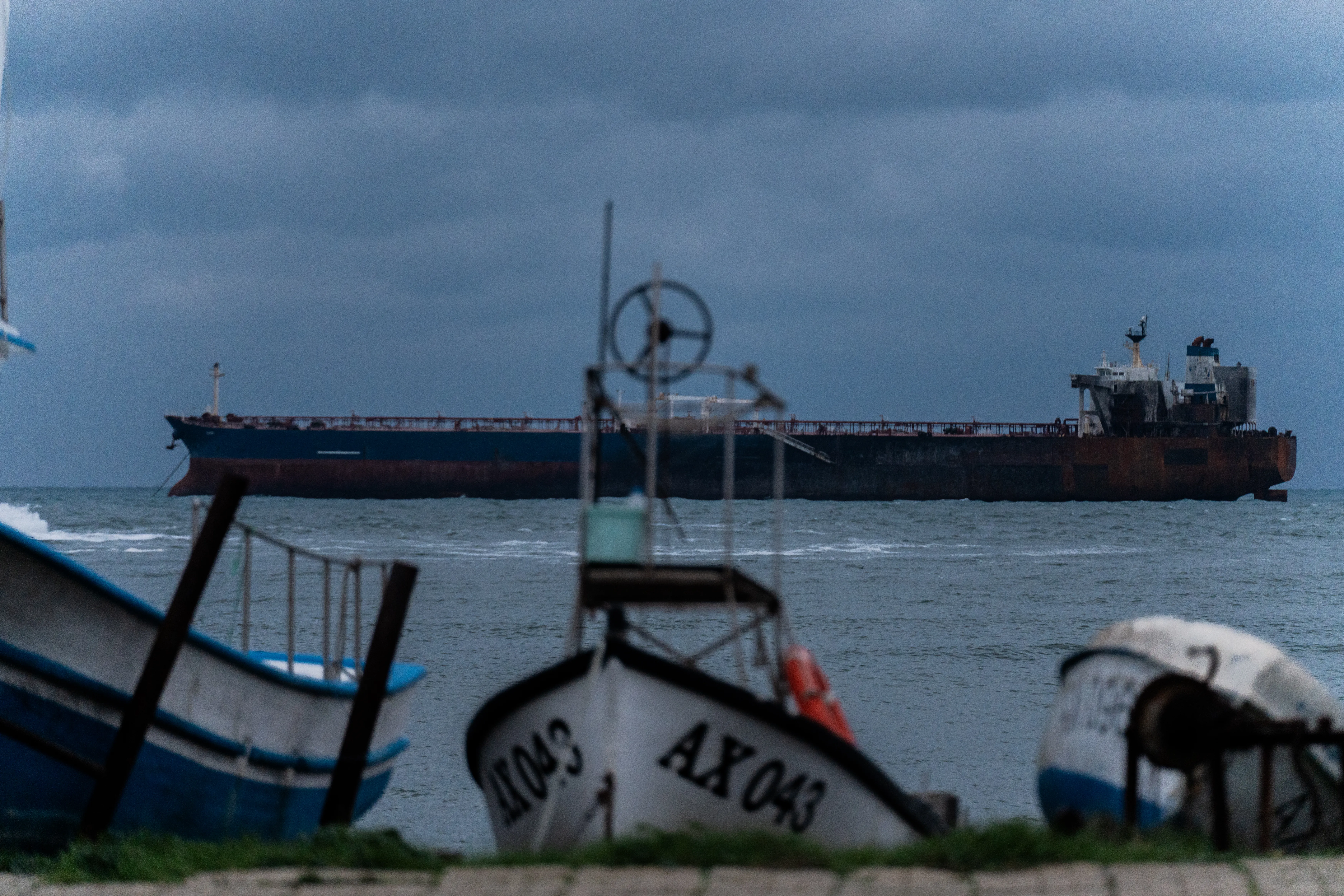
The oil tanker Kairos, a Gambian-flagged vessel believed to be part of the Russian shadow fleet, remains anchored on December 8, 2025, in Ahtopol, Bulgaria. The ship was sailing from Egypt toward the Russian port of Novorossiysk when it caught fire after an alleged attack by Ukrainian naval drones. Photo by Hristo Rusev/Getty Images Hristo Rusev
It might not be a coincidence that the attack took place on the day of Russian President Vladimir Putin’s annual end-of-year press conference. During this, Putin said that Russia would respond to recent Ukrainian attacks on shadow fleet tankers.
Since the start of the full-scale invasion of Ukraine, Russia has relied heavily on the shadow fleet, estimated to number more than 1,000 ships, to circumvent sanctions and export crude oil, bringing much-needed revenue.
Putin said today that Russia would “definitely respond” to Ukraine’s campaign against its shadow fleet. “Ultimately, this will not lead to the expected result,” he said. “It will not disrupt any supplies, but will only create additional threats,” Putin added.
Ukraine has previously used drone strikes to target Russian shadow tankers in the Black Sea.
As we have previously reported, Ukraine carried out three attacks on Russian-connected oil tankers in the Black Sea in late November and early December. This campaign has drawn a response in kind from Russia, using a Shahed-type drone, as you can read about here.
Ukraine’s SBU security service says its Sea Baby naval drones today struck another Russian “shadow fleet” tanker in the Black Sea.
Video from an SBU source purports to show the oil tanker “Dashan” being hit by the attack drone and explosions in the stern area. “The vessel,… pic.twitter.com/mtfBqYe1gQ
However, the first confirmed Ukrainian strike on a Russian-linked vessel this far from the Black Sea theater is a significant development. It is highly likely that the clandestine anti-ship war waged between Iran and Israel — something we have reported on for years now —likely provided a template for this.
The ability to use short-range drones to prosecute attacks in the Mediterranean indicates that vessels could be under threat elsewhere in European waters or even beyond. Beyond that, we could see Ukraine start to use longer-range systems, including one-way attack drones equipped with Starlink terminals, in the future.
Regardless, this development not only makes it potentially harder for Russia to export oil but also means that other commercial shipping will have to be aware of the increasing risks and potentially take measures to enhance their protection.
While the attack on Qendil appears to be the first of its kind in the Mediterranean, a further geographical expansion of Kyiv’s campaign against the Russian shadow fleet should not be ruled out.
French President Emmanuel Macron indicated that Europe may need to directly engage with Russian President Vladimir Putin if U.S.-led efforts toward a Ukraine peace deal fail. European leaders have been dissatisfied with their exclusion from peace talks led by the Trump administration and have been focused on supporting Ukraine’s negotiating position from afar. During remarks in Brussels, Macron emphasized the necessity for a solid peace agreement with security guarantees, suggesting that without this, Europe should prepare to re-establish direct dialogue with Russia. This comes after EU leaders decided to provide Ukraine with a 90 billion euro loan, utilizing the EU’s budget rather than frozen Russian assets, amid internal divisions.
Macron argued that the EU cannot afford to lose its communication channels with Moscow, particularly as U.S. officials prepare for talks with Russian negotiators. Most EU nations, except Hungary and Slovakia, have halted communication with Putin since the invasion of Ukraine. Macron highlighted the need for a strategic approach to facilitate renewed discussions with Russia, warning that continued inaction might leave EU leaders isolated and marginalized in negotiations.
Moreover, some EU leaders expressed concerns about diminishing public support for sustaining Ukrainian resistance to the ongoing war. The summit’s outcome aims to support Ukraine financially, reflecting a recognition of the war’s broader implications for European security, despite worries about increasing political pressure and potential public fatigue regarding the conflict. Danish Prime Minister Frederiksen noted that Putin is likely counting on a combination of war fatigue and societal uncertainty to undermine European resolve.
Singapore has reported a growing number of “rogue” or “shadow fleet” tankers operating off its shores in and around one of the world’s busiest maritime corridors.
According to Lloyd’s List Intelligence data cited by international maritime authorities, at least 27 such ships transited the Singapore Strait in early December, with another 130 clustered nearby around Indonesia’s Riau Archipelago.
Recommended Stories
list of 4 itemsend of list
While traffic through the strait remains dense and appears outwardly routine – more than 80,000 vessels pass through it each year – ship-spotters and analysts say the profile of some of the ships using these waters has recently changed.
Why are so many ‘rogue’ tankers appearing near Singapore?
Conflict in Ukraine and the Middle East has sparked a surge in Western sanctions on oil exports from countries such as Russia and Iran. The European Commission and the United States Trump administration have both recently renewed or extended sanctions against Venezuelan oil, as well.
As a result, a parallel, unofficial maritime network has emerged to keep sanctioned oil moving.
The Singapore Strait is a vital artery for global maritime trade, carrying about one-third of the world’s traded goods at some point along their journeys. For tankers at sea, it is almost unavoidable – the strait is a natural gateway between the Indian Ocean and the South China Sea, also a busy trade artery.
The Maritime and Port Authority monitors vessel movements within Singaporean waters. But international law limits what action it can take once ships move into the high seas – in effect, international waters – allowing shadow fleets to thrive in regulatory grey zones.
In recent weeks, suspect shipping activity has been noted just beyond Singapore’s territorial waters – roughly 22.2 kilometres from its coast – in international waters, just outside of the city state’s law enforcement reach.
What are ‘shadow fleets’ and how do they avoid sanctions?
As a result of record sanctions by Western governments in recent years over Russia’s war in Ukraine, Iran’s nuclear programme and, most recently, United States President Donald Trump’s campaign against Venezuela, the number of falsely flagged ships globally has more than doubled this year to more than 450, most of them tankers, according to the International Maritime Organization database.
All vessels at sea are required to fly a flag showing the legal jurisdiction governing their operations in international waters. The body which grants ship nationalities is the UN Convention on the Law of the Sea (UNCLOS).
A shadow ship, or “ghost” ship, is typically an ageing vessel with obscure ownership. These vessels frequently change flags – for instance, when the US seized the tanker, Skipper, off the coast of Venezuela earlier this month, the government of Guyana, Venezuela’s neighbour, said it was “falsely flying the Guyana flag”, and clarified that it was not registered in the country.
Operators of shadow ships also falsify registration details, broadcast false geo-location codes, or even switch off tracking systems altogether to evade detection and skirt UNCLOS laws.
These vessels typically carry sanctioned oil and other restricted goods such as military equipment. They often conduct risky ship-to-ship transfers of cargo under the cover of night to avoid detection. This can create serious safety and environmental risks.
Additionally, most of the tankers are owned by shell companies in jurisdictions such as Dubai, where rapid buying and selling by anonymous or newly formed firms can take place, making it even harder to trace their origins.
Jennifer Parker, a specialist in maritime law at Australia’s University of New South Wales, said the increasing number of shadow fleets presents a “real challenge”.
Parker told Al Jazeera that “finding out who owns them and who insures them has been incredibly difficult because of the [murky] paper trail around them”.
She added that “often they would do what is called bunkering, which is the process of transferring fuel at sea between ships. So that makes it hard to track where that ship has actually come from and where that oil has come from.”
She added: “Sometimes, what they do is actually mix oil, so you will have a legitimate ship that will do a ship-to-ship transfer at sea with a shadow fleet and they will mix the oil so it becomes hard to really trace where that oil has come from … to avoid sanctions.”
What sort of problems do these tankers cause?
When ageing, uninsured vessels are involved in accidents, it can lead to environmental disasters like oil spills.
According to Bunkerspot, a specialist maritime publication, a shadow tanker spill, which can cause enormous damage to water, wildlife and local coastlines, can cost up to $1.6bn in response and cleanup alone.
Last December, Russian authorities scrambled to contain an oil spill in the Kerch Strait caused by two 50-year-old tankers which had been damaged during a heavy weekend storm. The scale of the environmental damage and the associated cleanup costs remain unclear.
In addition to vessel collisions, they can cause environmental damage through chemical leaks and illegal waste dumping.
A volunteer cleans up a bird covered in oil following an oil spill by two tankers damaged in a storm in the Kerch Strait, at a veterinary clinic in the Black Sea resort city of Saky, Crimea, on January 8, 2025 [Alexey Pavlishak/Reuters]
Who uses shadow fleets the most?
Russia is the primary beneficiary of ghost fleet trading. Moscow has largely maintained its oil exports despite Western sanctions, ensuring steady revenue for its war in Ukraine. Though not to the same extent, Iran and Venezuela also sell fossil fuels using ghost fleets.
China and India, currently the largest buyers of Russian crude, benefit from steep discounts, often purchasing oil well below the Western-imposed $60 per barrel price cap, which was imposed in December 2022 following Russia’s invasion of Ukraine.
Tracking by S&P Global and Ukrainian intelligence shows that Russia relied heavily on its shadow tanker fleet in 2025. India has been the main destination, importing about 5.4 million tonnes (or 55 percent of Russian crude oil sales via shadow tankers) between January and September.
China has taken a smaller but still significant share of about 15 percent. Overall, most Russian seaborne crude now moves outside Group of Seven (G7)-compliant shipping, underscoring the shadow fleet’s central role in this trade.
What actions have governments taken against shadow fleets?
To avoid enforcement of sanctions, many shadow tankers have moved out of major shipping lanes. In part, this is down to European authorities now requiring physical inspections during ship-to-ship transfers, making it riskier for these vessels to operate on conventional routes.
For instance, Denmark, Sweden, Poland, Finland and Estonia recently began carrying out insurance checks on tankers transiting the Gulf of Finland and the waters between Sweden and Denmark. This is aimed at ensuring compliance with 2022 sanctions on Russian oil.
Meanwhile, in July 2025, the United Kingdom imposed measures – such as restrictions on access to UK ports, insurance and financial services – on 135 shadow fleet vessels and two linked firms, aiming to reduce Russia’s shipping capacity and cut its energy earnings.
In the US, President Donald Trump has warned that comparable measures will follow if Russia refuses to agree to a ceasefire in Ukraine, raising the prospect of closer transatlantic coordination with the UK and Europe against shadow fleets.
Ukrainian military successes and Russian narratives clashed this week, as Moscow’s assertion of inevitable victory flew in the face of facts on the ground.
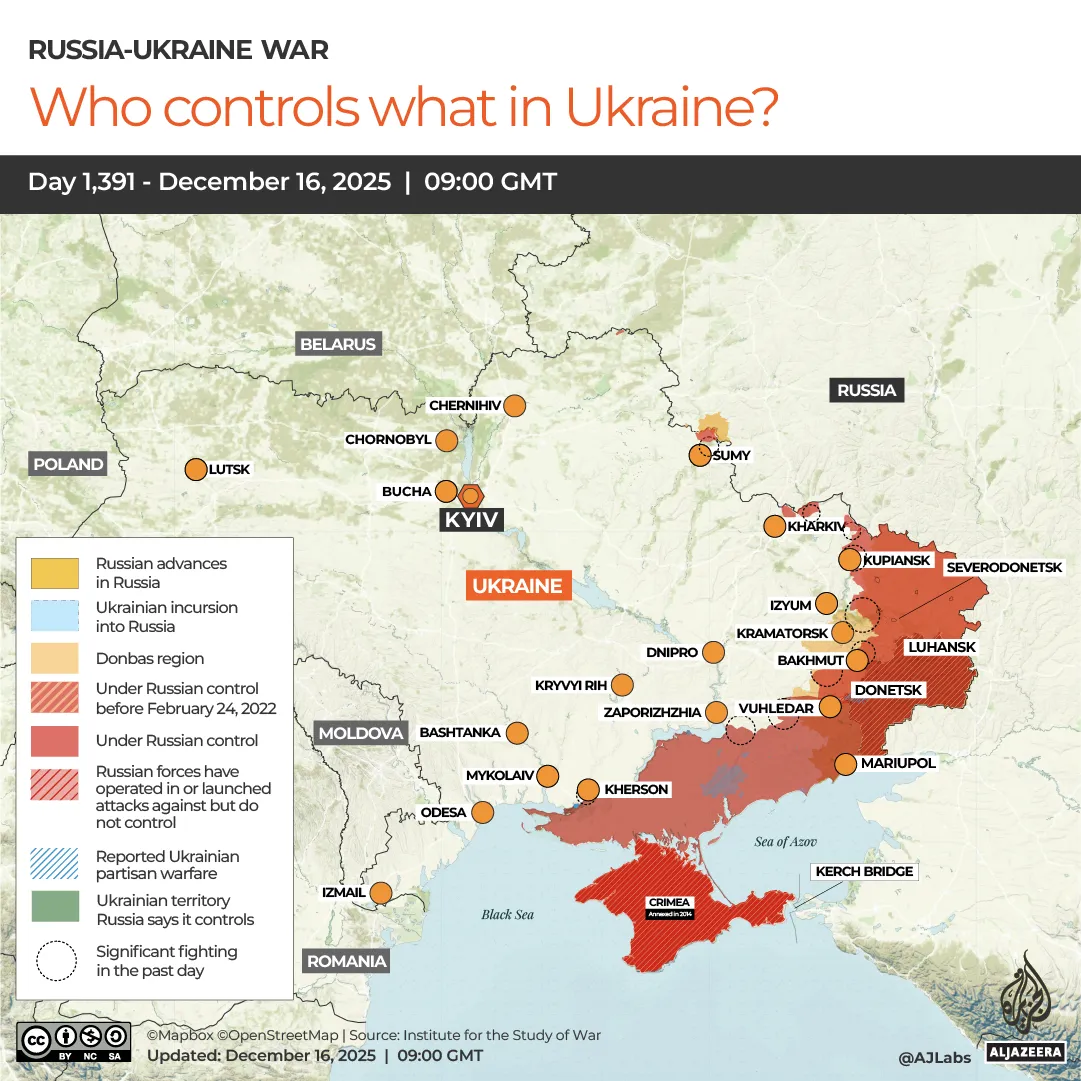
Ukraine steadily took back control of almost all of its northern city of Kupiansk after isolating Russian forces within it, belying Russian claims to have seized it.
Russian forces were also unable to dislodge Ukrainian defenders from the eastern city of Pokrovsk to back up Moscow’s claims of total control.
And Moscow attempted to deny Ukraine’s successful use of an underwater unmanned vehicle to severely damage a Kilo-class submarine, despite visual evidence.
Ukrainian forces operating in the northern Kharkiv region said they had cut Russian logistics to Kupiansk, surrounded a vanguard of 200 Russians inside it, and cleared Russian forces out of forests north of the city on December 12.
Geolocated footage showed Ukrainian forces advancing in the city the following day and taking back the southern suburb of Yuvileynyi, pushing Russian troops to the northern and western suburbs.
The Russian position had become more precarious by Monday. Ukrainian forces said they prevented reinforcements from entering the city through a gas pipeline, a tactic Russia had used in the siege of Chasiv Yar, and the isolated Russian troops were being supplied solely by drone. Ukraine’s General Staff said its forces were still repelling Russian attacks on Friday.
Russia’s Ministry of Defence insisted it had control of the situation. “Units of the Zapad Group of Forces exercise reliable control over all districts of liberated Kupiansk,” it said on Monday, claiming that Ukraine’s efforts to enter the city from the south were being suppressed.
“The only thing that can be said for sure is that the Russian Armed Forces are still holding part of the centre and north of Kupiansk, but most of it is already either in the grey zone or under the control of the Armed Forces of Ukraine,” wrote a Russian military reporter on the Telegram messaging app.
On Wednesday this week, Colonel General Oleksandr Syrskii, Ukraine’s Army commander-in-chief, told a Ramstein-format of Ukraine’s allies that his forces had taken back 90 percent of Kupiansk. At the same time in Moscow, Russian Defence Minister Andrei Belousov was telling Russian President Vladimir Putin that “the enemy is unsuccessfully trying to regain” the city.
“The Russian Defense Minister, Belousov, continues to lie that Russia controls Kupiansk,” wrote Andrii Kovalenko, head of Ukraine’s Center for Countering Disinformation, on Telegram. “In reality, most of the city is controlled by the Ukrainian Defense Forces, which are continuing to clear it of Russians. However, all of Putin’s officials, from [commander-in-chief Valery] Gerasimov, who was the first to lie about controlling the city, to Belousov, continue to lie in the presence of Putin himself.”
Contrary to the available evidence, Belousov also insisted that Russia had seized Pokrovsk, which Russia calls Krasnoarmeysk, and was on the cusp of vanquishing neighbouring Myrnohrad, which Russia calls Dimitrov. Both towns are in the eastern Donetsk region, and are almost surrounded by Russian forces to the north, south and east.
“Russian soldiers continue to inflict fire damage on Ukrainian troops in Dimitrov, the last stronghold of the Armed Forces of Ukraine in Krasnoarmeysk agglomeration,” Belousov told Putin.
But Syrskii told allies that Ukrainian forces had regained about 16 square kilometres (6 square miles) in the northern part of Pokrovsk and 56sq km (22sq miles) west of the city. “Logistics in Myrnograd are complex, but the operations continue,” he wrote.
Russia had claimed complete control over Pokrovsk on December 2 and was sticking to its story.
(Al Jazeera)
Submarine and oil refinery explosions
A third point of contention was Ukraine’s successful use of an underwater unmanned vehicle (UUV) to strike a Russian Kilo-class submarine on Monday (December 15), in what is considered the first such attack in military history.
Video of the Russian fleet at anchor in the port of Novorossiysk on the Black Sea shows a huge explosion in the stern section of the submarine.
Ukraine’s State Security Service later claimed credit for the attack.
However, Russia’s Defence Ministry said: “Not a single ship or submarine as well as the crews of the Black Sea Fleet stationed in the bay of the Novorossiysk naval base were damaged as a result of the sabotage.”
The ministry published footage of what it said was the attacked submarine, in which it appeared undamaged above the surface, but the video did not show the stern section.
Ukraine’s long-range strikes against Russia scored other successes, on which Russia did not comment.
Ukraine struck the oil refinery in Yaroslavl, northeast of Moscow, on December 12. On Sunday, Ukrainian drones struck the Afipsky refinery in Krasnodar Krai and the Uryupinsk oil depot in Volgograd, causing explosions in both locations. They also struck the Dorogobuzhskaya power plant in Smolensk.
A Ukrainian Presidential Press Service photo shows President Volodymyr Zelenskyy as he awards a serviceman of the 14th Separate Mechanized Brigade of the Armed Forces of Ukraine during his visit to the front-line town of Kupiansk on December 12, 2025 [Ukrainian Presidential Press Service/Handout via Reuters]
United States and Ukrainian negotiating teams met for two days in Berlin on Sunday and Monday. Russian officials said they would be briefed next week on the results of those talks.
But even as it claimed to be interested in ongoing peace negotiations, Russia clearly signalled that it plans to continue aggressive operations next year.
“The key task for the next year is to maintain and increase the pace of the offensive,” said Belousov in Putin’s presence on Wednesday, at an expanded meeting of the Defence Ministry Board.
“It wasn’t us who started the war in 2022; it was the destructive forces in Ukraine, with the support of the West – essentially, the West itself that unleashed this war,” Putin said. “We are only trying to finish it, to put an end to it.”
Putin said “the goals of the special military operation will certainly be achieved,” and “Russia will achieve the liberation of its historical lands by military means,” suggesting there was little room for compromise on Moscow’s side.
Putin’s Deputy Foreign Minister Sergey Ryabkov signalled the same thing in an interview with ABC on Tuesday. He said Europe and Ukraine expected a “deep and very wrong” revision of Russian peace proposals, and ruled out conceding seized Ukrainian land.
“We are not able in any form to compromise on this, because it would be, in our view, a revision of a very fundamental element of our statehood, set forth through our constitution,” Naryshkin said.
(Al Jazeera)
Russian losses outpace recruitments
Russia has attempted to give the impression that it has inexhaustible manpower with which to prosecute the war it started in Ukraine.
Belousov said almost 410,000 Russians volunteered for military service, exceeding expectations for 2025.
That translates to 32,800 per month. “Data from the Ukrainian General Staff on Russian losses indicate that Russian forces suffered an average of 34,600 casualties per month between January and November 2025 – suggesting that Belousov’s recruitment numbers are not quite replacing Russian losses,” wrote the Institute for the Study of War, a Washington-based think tank.
Ukrainian President Volodymyr Zelenskyy suggested most of these casualties were deaths. “[Putin] spends around 30,000 soldiers’ lives on the front every month. Not wounded – 30,000 killed each month… We have drone footage confirming these deaths,” he told Dutch parliamentarians.
Syrski also doubted Russian recruitment quotas were sufficient.
“The number of Russian troops has long been around 710,000,” he wrote on Telegram. “However, the enemy has not been able to increase this figure, despite active recruitment in Russia, because our soldiers are ‘reducing’ the number of occupiers by a thousand every day through deaths and injuries.”
UN-backed food security experts have found improvements in nutrition and food supplies in Gaza since the ceasefire but say 100,000 people were still experiencing “catastrophic conditions” last month.
In August, the Integrated Food Security Phase Classification (IPC) found that half a million people – about a quarter of Gaza’s population – were living in areas suffering from famine.
Since a fragile ceasefire came into force in October, the UN and other humanitarian agencies have been able to increase food getting into Gaza.
Israel’s foreign ministry said the report was “deliberately distorted” and “doesn’t reflect the reality in the Gaza Strip”.
The latest IPC analysis suggests that a month ago, half a million Gazans were still facing emergency conditions and more than 100,000 were still under the highest level of food insecurity – IPC Phase 5 – experiencing “catastrophic conditions”.
It projects that number will continue to decrease but stressed the situation remains “highly fragile”.
IPC Phase 5 signifies the most extreme level of food insecurity , labelled “Famine” for an area or “Catastrophe” when referring to households. The report said no areas in Gaza were now classified as “in Famine”.
Israel rejected the original findings of famine by the IPC – which monitors and classifies global hunger crises – and has continued to criticise its methodology.
Cogat, the Israeli military body which controls Gaza’s crossings, said the number of trucks with food aid entering each week went beyond what the UN had determined it needed.
“The report relies on severe gaps in data collection and on sources that do not reflect the full scope of humanitarian assistance,” the body said in a statement.
The IPC said acute malnutrition was at critical levels in Gaza City and serious in Deir al-Balah and Khan Younis.
In the coming months the situation is expected to remain severe but the number of people facing the most severe conditions is predicted to fall to 1,900 by April, according to the report.
But it added that if there were renewed hostilities the entire Strip would be at risk of famine.
Israel’s Prime Minister Benjamin Netanyahu said earlier this month that the second phase of the US-brokered peace plan – which would see Israel withdraw troops further from Gaza and Hamas disarm – was close but key issues still needed to be resolved.
The IPC said key drivers of food insecurity included restricted humanitarian access, displacement of more than 730,000 people and the destruction of livelihoods – including more than 96% of crop land in Gaza being destroyed or inaccessible.
Israel imposed a total blockade on aid deliveries to Gaza at the start of March this year, which was eased in May, saying it wanted to put pressure on the armed group Hamas to release hostages remaining in Gaza at the time.
Ahead of this IPC report Cogat said the body had not engaged with the US or Israel and its methodology, “reinforcing a false narrative, driven in part by Hamas-sourced claims, while ignoring the actual humanitarian conditions on the ground”.
It also denied Israel was preventing winter and medical supplies from entering the territory and that there was a shortage of drinking water.
Unwra, the UN agency for Palestinian refugees, said while the report stated Gaza was no longer in famine, the situation remained “critical”.
“Overall living conditions in the Gaza Strip are still catastrophic, made worse by the winter weather,” it said in a statement, adding there must be “sustained, expanded, and consistent humanitarian and commercial access”.
When Wura Hope paints her nails, she paints her prosthesis too. Pink glows on her dark skin like fine art. But her right foot is pale, yellowish-tan, the generic colour of many imported prosthetics. It contrasts with her melanin-rich skin and does not offer the aesthetics she desires.
Wura is a model, fashion designer, and vendor of Ankara fabrics. She also interns at a bank. Sometimes, she doesn’t want the spotlight that comes with being an amputee. But with a prosthetic foot so different from the rest of her body, curious eyes are unavoidable. As a result, she fully covers up her leg.
The unease Wura feels today traces back to when she was 11. One of her daily chores was filling the water tank of the large generator her parents used at their home in Abuja, in Nigeria’s North Central. One day, the propeller caught her long dress and badly injured her right leg. An infection followed, and the leg was eventually amputated.
The 28-year-old barely remembers life with two legs. She has lived with one for so long that she even forgets she has a physical challenge.
“Like, I literally forget,” said Wura.
Every word she says seems to arrive with a smile. And when her lips spread, they show her teeth like fresh corn peeking through a half-opened husk. She’s grateful to be walking again after many years on crutches.
Her current prosthesis is her third. The first, donated by an Indian charity in 2014, was heavy and rigid. The second caused blisters around her stump that took days to heal. The one she uses now is lighter and has a knee joint that makes walking easier. But it is far from perfect. In hot weather, the liner squeaks against her sweaty stump and sometimes threatens to slip off. When that happens, she has to find a restroom, take it off, clean it, let it dry for a few minutes, and put it back on.
“Sometimes in the market, I’ll be looking for somewhere private to clean my liner,” she told HumAngle.
Moments like this remind Wura of her disability, turning long-distance walking into a nightmare.
The struggle is not just Wura’s; it is a shared reality for many who wear devices designed for colder climates. Thirty-year-old Eva Chukwunelo knows it well. She finds her stump in a pool of sweat after walking just a few metres. But in March this year, she walked seamlessly from Washington Park to the Brooklyn Bridge in New York, a distance of more than two kilometres. Back home in Abuja, she would have stopped multiple times to pull off her prosthesis, drain the sweat from its liner, and wait for her stump to dry.
In Abuja, March is one of the hottest months, but it is cold in New York, giving chills rather than sweat. Most advanced prosthetic devices come from temperate countries, where they may be designed with little consideration for Africa’s heat and humidity.
Silicon liners, the technology used by both Wura and Eva, were invented in Iceland and initially called the Icelandic Roll-On Silicone Socket. Made from medical-grade silicone RTVs, they do not absorb sweat. As moisture gathers inside, it simply coats the stump, making every step increasingly uncomfortable. The material is soft and generally reliable, but it does not match Africa’s weather realities.
“So I felt like if you’re wearing a silicone liner, you cannot do so well in a hot environment,” Eva said.
As for the skin covers, they are either too black or not black at all, wrote Eva in the Nov. 5 dispatch of The Amputee LifeStyle, the newsletter where she documents the lived experiences of amputees.
“Somewhere between ‘too white’ and ‘too black’, African amputees are left underrepresented,” she noted. “So yes, we walk again. But sometimes, we walk in discomfort.”
The more money you have, the lighter it becomes. Photo: Eva Chukwunelo
Eva was also born with two legs. As a child, she was always running, climbing trees, playing football, or dancing. Even after she was diagnosed with osteomyelitis, a severe bone infection, she stayed active in school and continued playing with friends. But her left foot soon developed ulcers, prompting concerns about activities that could expose her to germs. The leg began to decay right from between the big toe and the second. When gangrene—the death of body tissue due to lack of blood flow or severe bacterial infection—set in, the only option was amputation.
Eva was just 16. She imagined a future spent on crutches, or confined to a wheelchair, or, even worse, reduced to begging like the lepers who often took shelter under the flamboyant trees outside her parents’ house. She had never heard of prosthetics, a life-changing technology that dates as far back as ancient Egypt. But everything shifted the day her doctor invited a prosthetist into the room.
“The first time I walked again, it felt like a miracle,” she wrote in her newsletter.
Her first two prosthetic devices were heavy, rigid, and, in her words, ugly. They helped her walk, but she was never comfortable enough to let her live freely. Until she got her third device, which came with a silicon liner, she never felt confident leaving her left leg uncovered in public. The fourth was lighter. The fifth, lighter still and more advanced, each upgrade was a small step toward ease, though never quite the perfect match she longed for.
“I think the more money you have, the lighter it becomes,” Eva told HumAngle.
Africa’s difference is not just in climate and skin tones. Like Nigeria, most African countries trail far behind Europe in minimum wage and purchasing power. And for many amputees across the continent, this means the most advanced and most comfortable prosthetic devices are far beyond reach.
On the day 18-year-old Adeola Olailo lost one of her legs in an accident in Ekiti State, South West Nigeria, she had hoped to hawk groundnuts after school. Selling groundnuts and fried pork was how she supported her parents, who struggled to make ends meet. And she was good at it. But when a car veered off the road and ploughed into the students walking home, Adeola lost a limb on the spot, and her family lost a vital source of income. It took repeated media reports and the state government’s intervention for her to receive a locally made prosthesis, one she has now outgrown.
For amputees like Adeola, a matching device must be affordable, too. She dreams of a waterproof leg that aligns with her height, matches her complexion, and lets her jump, walk without pain, run, and dance again, especially now that she is preparing for university. But a prosthesis that can do even a fraction of these may cost up to ₦5 million, an amount far beyond the reach of her household. And like most imports, when the naira slips, the price soars.
Taiwo Akinsanya, founder of Dynalimb, a Nigerian company working to expand access to quality prosthetics, said there are still many barriers to creating truly Nigerian or African-centred devices. One of the biggest, he explained, is the education system that does not encourage home-grown innovation, often producing graduates who take pride in their ability to apply foreign products rather than pioneer new ones for local realities.
“We were taught in medical school to take the approach of what is currently being done in the current market and keep applying it to a number of patients,” he said.
Access and affordability, he added, are also limited by Nigeria’s heavy reliance on foreign manufacturers for key prosthetic components.
“We were trying to develop a locally made prosthetic device here in Nigeria. We did it, and it worked. The major constraint we had was that the raw materials, such as steel, used to produce the metallic part of the prosthetic device, were imported, which made European products more affordable than we wanted to achieve here.”
Every imported part raises the overall cost, making locally assembled devices expensive and out of reach for many amputees. Meanwhile, Dynalimb’s mission was to make prosthetic devices accessible and affordable. They had to scrap the innovation.
Of the estimated 65 million amputees in the world, about five million live in Africa. Many are victims of diabetes, road traffic accidents, industrial mishaps, congenital conditions, and conflict-related injuries. Yet most struggle with prosthetic devices never designed with their bodies, climates, or lifestyles in mind. An even larger number have no access to prosthetics at all.
Amid numerous infrastructural constraints and inadequate government support, African innovators are working hard to adapt foreign inventions to local realities and, in some cases, to build African-centred devices from scratch. Earlier this year, South Africa’s Prosthetic Engineering Technologies launched silicone liners “engineered for the unique challenges of African terrain and climate”. The liners, according to the company, are locally manufactured to reduce costs and improve access. In Nigeria, Immortal Cosmetic Art is creating hyper-realistic prosthetic skin covers for people of colour, an innovation that has already been celebrated both locally and abroad. But the effects of these breakthroughs are yet to be felt at scale. And African amputees, tired of struggling in devices not made for them, want even more.
“My leg is black, but the prosthesis is not,” Adeola said about why she always wears knee-high socks.
“I think it’s time we start designing prosthetics that understand Africa. Products that consider the climate, materials that can breathe, and sweat and heat. Products that match our tones, so people stop asking why your leg looks ‘imported’,” Eva wrote in her International Prosthetic and Orthotics Day newsletter.
Once, Wura received a dark prosthetic foot from a company that imported devices from China. When she painted the nails, it looked “very, very pretty.” It felt like it truly belonged to her. But the joy didn’t last.
“I don’t know what they sell to us here,” she told HumAngle. “I don’t think that foot lasted six months. I like it when the colour of my socket is dark. Because I’m a dark person, my foot should also be dark.”
When she painted the nails, it looked “very, very pretty”. Photo: Hope Wura
Taiwo said there are no perfect prosthetics. An artificial limb, he said, will always be an artificial limb. But for amputees like Wura, Eva, and Adeola, progress begins with a limb that matches their skin and survives their weather.
Russian President Vladimir Putin is expected to address the future of the war in Ukraine when he speaks at his marathon end-of-year news conference on Friday. Russia’s invasion of Ukraine in February 2022 triggered the most severe confrontation between Moscow and the West since the Cold War, following years of conflict in eastern Ukraine. The annual “Results of the Year” event, held in various formats since 2001, allows Putin to field wide-ranging questions from journalists and citizens, covering domestic pressures such as inflation as well as foreign policy, nuclear weapons and the war that the Kremlin still calls a “special military operation”.
Why it matters Putin’s remarks are likely to be closely parsed in Washington and European capitals for clues about whether Moscow is open to negotiations or prepared for a prolonged conflict. U.S. President Donald Trump has said he wants to be remembered as a peacemaker but has struggled to bring the war to an end, fuelling concern in Kyiv and Europe that any U.S.-brokered deal could sideline European interests or weaken Ukraine. With millions of casualties reported by U.S. officials and continued territorial gains by Russian forces, the stakes include not only the future of Ukraine but also the stability of Europe’s security order.
Russia is seeking to consolidate gains and redefine its relationship with the West, while Ukraine and its European allies remain wary of concessions that could reward aggression. The United States plays a central role as a potential broker, with Trump’s approach diverging from that of his predecessor, Joe Biden. The European Union, which has just agreed to jointly borrow funds to support Ukraine’s defence, faces long-term financial and security implications depending on how the war evolves. China is an indirect but important actor, given Moscow’s growing alignment with Beijing.
What’s next Putin’s statements could clarify whether Russia is willing to engage in serious peace talks or intends to press ahead militarily, despite the economic and human costs. Any hint of compromise may open the door to renewed diplomatic efforts led by Washington, while a hardline stance would point to a longer, bloodier conflict with rising risks of escalation. Markets, governments and militaries will be watching closely for signals that could shape the next phase of the war.
In a territory where 81 percent of buildings lie damaged or destroyed, a small community of young Palestinians is fighting to preserve what remains of Gaza’s digital world.
Coders, repair technicians and freelance workers are labouring under impossible conditions to keep the besieged enclave connected to the outside world.
Recommended Stories
list of 3 itemsend of list
Against all odds, Gaza’s youths continue to adapt. They work offline, code in notebooks, store solar power whenever the sun is out, and wait for rare moments of connectivity to send their work to clients around the world.
In a war that has taken nearly everything, digital skills have become a form of survival – and resilience.
Many now also rely on online work to make a living. But even that fragile lifeline is now hanging by a thread after more than two years of Israel’s genocidal war.
Palestinians work on laptops and mobile devices in Gaza despite widespread destruction of telecommunications infrastructure [Al Jazeera]
According to the Palestinian Central Bureau of Statistics, Israeli forces have “deliberately and systematically destroyed” the telecommunications infrastructure.
“We just always look for another way to get connected, always find another way,” said Shaima Abu Al Atta, a coder working from a displacement camp. “This is what actually gave us purpose because if we didn’t do this, we would just die surviving and not doing anything. We would die internally.”
Before the war erupted in October 2023, Gaza had a modest but vibrant tech scene. Innovation hubs hosted coding bootcamps, and hundreds of freelancers worked remotely for international clients. Much of that ecosystem now lies in ruins.
Shareef Naim, an engineer who led a technology hub, described what was lost. His building housed more than 12 programmers with contracts for companies outside Gaza, he said. “The team was very active,” Naim told Al Jazeera.
Today, the structure is destroyed, though some team members are still trying to work from tents and emergency shelters.
Technicians in Gaza work to repair telecommunications equipment amid severe shortages of spare parts and electricity [Al Jazeera]
Computer technician A’aed Shamaly says, “The main challenge is electricity. Today, electricity is not available all the time, and if it is available, it is unstable, and there will be a lot of cuts. Prices are also high.”
Electricity, when available at all, is unstable and prohibitively expensive, $12 per kilowatt compared with $1.50 for 10 kilowatts before the war, he said. “There are no spare parts,” he added, so technicians must scavenge components from broken equipment pulled from bombed buildings.
The scale of destruction is staggering. According to the United Nations Satellite Centre (UNOSAT), approximately 198,273 structures across Gaza have been damaged, with 123,464 completely destroyed. The telecommunications sector has been particularly hard hit.
Data from the Palestinian Central Bureau of Statistics reveals that 64 percent of mobile phone towers were out of service as of early April 2025. In Rafah, coverage has collapsed to just 27 percent, down from near-universal access before the war.
During the war, connectivity watchdog NetBlocks documented repeated disruptions, including what it called a “near-total telecoms blackout” in January 2024 that lasted for days.
Israel has long restricted Gaza to outdated 2G mobile technology while allowing 4G in the occupied West Bank.
The telecommunications sector’s value has cratered from $13m in 2023 to just $1.5m in 2024, an 89 percent collapse. Estimated losses exceed half a billion dollars, while reconstruction is projected to cost at least $90m.
Palestinians struggle to maintain internet connectivity in Gaza, where most telecommunications infrastructure has been destroyed [Al Jazeera]
The consequences ripple across Gaza’s economy and society.
Remote work was a crucial income source in a territory where unemployment exceeded 79 percent even before October 2023. Now, erratic internet access has pushed many freelancers into joblessness just as Israeli-induced famine has sent food prices soaring.
The telecommunications collapse has also paralysed the banking system, preventing money transfers and leaving families unable to access cash. Healthcare has been disrupted, with the World Health Organization documenting deaths caused by the inability to contact emergency services in time.
Even during the fragile ceasefire that took effect in October 2025, Israel has blocked essential repair equipment from entering Gaza. The restrictions form part of what analysts describe as a deliberate strategy to maintain control over Palestinian digital infrastructure and suppress the flow of information to the outside world.
The future remains deeply uncertain, as efforts to push a fragile ceasefire forward appear to stall and Israel threatens the possibility of returning to full-scale war.
The United States Middle East envoy, Steve Witkoff, will hold talks in Miami, Florida, with senior officials from Qatar, Egypt and Turkiye as efforts continue to advance the next phase of the Gaza ceasefire, even as Israel repeatedly violates the truce on the ground.
A White House official told Al Jazeera Arabic on Friday that Witkoff is set to meet representatives from the three countries to discuss the future of the agreement aimed at halting Israel’s genocidal war on Gaza.
Recommended Stories
list of 3 itemsend of list
Axios separately reported that the meeting, scheduled for later on Friday, will include Qatari Prime Minister and Foreign Minister Sheikh Mohammed bin Abdulrahman bin Jassim Al Thani, Turkish Foreign Minister Hakan Fidan and Egyptian Foreign Minister Badr Abdelatty.
At the same time, Israel’s public broadcaster, quoting an Israeli official, said Prime Minister Benjamin Netanyahu is holding a restricted security consultation to examine the second phase of the ceasefire and potential scenarios.
That official warned that Israel could launch a new military campaign to disarm Hamas if US President Donald Trump were to disengage from the Gaza process, while acknowledging that such a move was unlikely because Trump wants to preserve calm in the enclave.
Despite Washington’s insistence that the ceasefire remains intact, Israeli attacks have continued almost uninterrupted, as it continues to renege on the terms of the first phase, as it blocks the free flow of desperately needed humanitarian aid into the besieged Palestinian territory.
According to an Al Jazeera analysis, Israeli forces carried out attacks on Gaza on 58 of the past 69 days of the truce, leaving only 11 days without reported deaths, injuries or violence.
In Washington, Trump said on Thursday that Netanyahu is likely to visit him in Florida during the Christmas holidays, as the US president presses for the launch of the agreement’s second phase.
“Yes, he will probably visit me in Florida. He wants to meet me. We haven’t formally arranged it yet, but he wants to meet me,” Trump told reporters.
Qatar and Egypt, who are mediating and guaranteeing the truce after a devastating two-year genocide in Gaza, have urged a transition to the second phase of the agreement. The plan includes a full Israeli military withdrawal and the deployment of an international stabilisation force (ISF).
Fragile truce, entrenched occupation
Qatar’s prime minister warned on Wednesday that daily Israeli breaches of the Gaza ceasefire are threatening the entire agreement, as he called for urgent progress towards the next phase of the deal to end Israel’s genocidal war on the besieged Palestinian enclave.
Sheikh Mohammed made the appeal following talks with United States Secretary of State Marco Rubio in Washington, where he stressed that “delays and ceasefire violations endanger the entire process and place mediators in a difficult position”.
The ceasefire remains deeply unstable, and Palestinians and rights groups say it is a ceasefire only in name, amid Israeli violations and a rapidly deteriorating humanitarian situation in Gaza.
Since the truce took effect on October 10, 2025, Israel has repeatedly breached the agreement, killing hundreds of Palestinians.
Gaza’s Government Media Office says Israel committed at least 738 violations between October 10 and December 12, including air strikes, artillery fire and direct shootings.
Israeli forces shot at civilians 205 times, carried out 37 incursions beyond the so-called “yellow line”, bombed or shelled Gaza 358 times, demolished property on 138 occasions and detained 43 Palestinians, the office said.
Israel has also continued to block critical humanitarian aid while systematically destroying homes and infrastructure.
Against this backdrop, Israel Hayom quoted an Israeli security official as saying the so-called “yellow line” now marks Israel’s new border inside Gaza, adding that Israeli forces will not withdraw unless Hamas is disarmed. The official said the army is preparing to remain there indefinitely.
The newspaper also reported that Israeli military leaders are proposing continued control over half of Gaza, underscoring Israel’s apparent intent to entrench its occupation rather than implement a genuine ceasefire.
Compounding the misery in Gaza, a huge storm that recently hit the Strip has killed at least 13 people as torrential rains and fierce winds flooded tents and caused damaged buildings to collapse.
Israel’s two-year war has decimated more than 80 percent of the structures across Gaza, forcing hundreds of thousands of families to take refuge in flimsy tents or overcrowded makeshift shelters.