Stay informed and up-to-date with the latest news from around the world. Our comprehensive news coverage brings you the most relevant and impactful stories in politics, business, technology, entertainment, and more.
China has marked the anniversary of the 1937 massacre by Japanese soldiers, as tensions soar over Taiwan.
China has held a low-key memorial ceremony for the Nanjing Massacre, as a diplomatic crisis between Beijing and Tokyo over Taiwan continues to simmer.
President Xi Jinping did not attend the ceremony on Saturday commemorating the 1937 attack, in which China says Imperial Japan’s troops slaughtered 300,000 people in the eastern city of Nanjing.
Recommended Stories
list of 3 itemsend of list
A post-World War II Allied tribunal put the death toll at 142,000, but some conservative Japanese politicians and scholars have denied that a massacre took place at all. China and Japan have long sparred over their painful history.
Japanese Prime Minister Sanae Takaichi has infuriated Beijing after her remarks last month in which she projected that a hypothetical Chinese attack on the self-governed island of Taiwan could trigger a military response from Japan.
Doves flew over the national memorial centre in Nanjing after the ceremony, which was completed in less than half an hour, in front of an audience that included police officers and schoolchildren.
Shi Taifeng, head of the ruling Communist Party’s powerful organisation department, made far less combative remarks than recent rhetoric from Chinese government officials.
“History has proven and will continue to prove that any attempt to revive militarism, challenge the post-war international order, or undermine world peace and stability will never be tolerated by all peace-loving and justice-seeking peoples around the world and is doomed to fail.”
He did not mention Takaichi but alluded to China’s previous assertions that the Japanese leader seeks to revive the country’s history of militarism.
On Saturday, the Eastern Theatre Command of China’s People’s Liberation Army put out a picture on its social media accounts of a large bloody sword, of the type used by many Chinese soldiers during the war, chopping off the head of a skeleton wearing a Japanese army cap.
“For nearly 1,000 years, the eastern dwarves have brought calamity; the sea of blood and deep hatred are still before our very eyes,” it said, using an old expression for Japan.
Dispute over Taiwan
Last month, Japan’s Defence Minister Shinjiro Koizumi announced that Tokyo was moving forward with plans to deploy a missile system on Yonaguni, the country’s westernmost island located 110km (68 miles) off Taiwan’s east coast, which has hosted a Japanese military base since 2016.
China’s Ministry of Foreign Affairs blasted the announcement, describing Japan’s plan as a “deliberate attempt to create regional tension and provoke military confrontation”. Koizumi pushed back, saying the Type 03 guided missile system was purely defensive and “intended to counter aircraft and missiles invading our nation”.
Beijing views Taiwan as its own territory and has promised to unite the island with the Chinese mainland, an aspiration that Taipei says infringes on its sovereignty and that only Taiwan’s citizens can decide their future.
Both countries have since traded quarrelsome accusations, with Japan summoning China’s ambassador earlier this month over an incident in which Chinese military aircraft allegedly twice locked fire-control radar onto Japanese fighter jets.
Illuminating aircraft with radar signals a potential attack that could force targeted planes to take evasive measures, making it among the most threatening actions a military aircraft can take.
For its part, the Chinese embassy denied Tokyo’s claims, saying in a statement that “China solemnly demands that Japan stop smearing and slandering, strictly restrain its frontline actions, and prevent similar incidents from happening again”.
US President Donald Trump’s overseas envoy will travel to Germany this weekend to meet Ukrainian President Volodymyr Zelensky and European leaders for the latest round of high-level talks on ending the war.
Steve Witkoff, who has been leading White House attempts to mediate between Ukraine and Russia, will discuss the latest version of the proposed peace agreement in Berlin.
The Trump administration is pushing for a deal to be in place by Christmas and has held several rounds of talks with Ukrainian and Russian representatives in recent weeks, though there has been little sign a breakthrough is imminent.
It has not yet been confirmed which European leaders will attend the Berlin talks.
The Wall Street Journal, which first reported details of the meeting, said UK Prime Minister Sir Keir Starmer, French President Emmanuel Macron and German Chancellor Friedrich Merz would all take part.
Confirmation of the Witkoff-Zelensky meeting comes days after Ukraine gave the US its revised version of a 20-point peace plan, the latest iteration of a proposal which first emerged in late November and has triggered a flurry of diplomatic activity.
The fate of territory in eastern Ukraine remains one of the most intractable topics in the negotiations, with Kyiv refusing to cede land which has been illegally occupied, and Moscow repeating its intention to take the Donbas region in full by force unless Ukraine withdraws.
The Ukrainian president told reporters that under the US-proposed terms, the Kremlin would undertake not to advance into the areas vacated by Ukraine’s forces, with the land between Russian-controlled parts of the Donbas and Ukraine’s defensive lines effectively turned into a demilitarised zone.
The proposal, seemingly an attempt to resolve the question of legal ownership by creating a new status for the land, has been publicly questioned by Zelensky, who said: “What will restrain [Russia] from advancing? Or from infiltrating disguised as civilians?”
Ukraine and allies in Europe have said publicly that the US-led talks have been fruitful, and have hailed progress on securing amendments to a plan which was widely viewed as favouring Russia when it first emerged.
But there have been signs in recent weeks that Trump is losing patience with Zelensky and his backers on the continent.
Zelensky said elections could be held within 90 days if the US and Europe provided the necessary security. Elections have been suspended since martial law was declared when Russia launched its full-scale invasion in February 2022.
As the White House’s diplomatic push continues, attention in Europe is focused on how to support Ukraine in the event of a peace deal, with talks ongoing over security guarantees and funding.
The Ukrainian government faces a stark financial situation: it needs to find an extra €135.7bn (£119bn; $159bn) over the next two years.
It is hoped that agreement paves the way for the funds to be loaned back to Ukraine if a deal can be reached at an EU summit next week, providing Kyiv with financial help for its military and efforts to rebuild parts of the country left devastated after nearly four years of all-out war.
That move has been condemned as theft by the Kremlin, and Russia’s central bank has said it will sue Euroclear, a Belgian bank where the vast majority of Russian assets frozen after the invasion are held.
Officials were still negotiating the exact structure of a deal to repurpose the Russian assets on behalf of Ukraine, with the Belgian government being particularly sceptical due to its particular legal exposure as the main holder.
Elsewhere, it was reported that the latest version of the peace plan being circulated envisions Ukraine rapidly joining the European Union.
The Financial Times said Brussels backed Ukraine’s swift accession to the bloc, an idea proposed by Ukraine in the latest draft it has given to Washington.
Ukraine formally applied to join the EU days after the 2022 invasion but despite promises of an accelerated process is still several years away from becoming a member.
Under the plan, Ukraine would become a member as soon as January 2027, AFP reported, citing an unnamed senior official. It was unclear whether Washington had approved that element of the draft.
Weekly insights and analysis on the latest developments in military technology, strategy, and foreign policy.
Welcome to Bunker Talk. This is a weekend open discussion post for the best commenting crew on the net, in which we can chat about all the stuff that went on this week that we didn’t cover. We can also talk about the stuff we did or whatever else grabs your interest. In other words, it’s an off-topic thread.
This week’s second caption reads:
25 July 2022, Hamburg: In front of an entrance to the Steintor underground bunker, yellow and black pressure doors can be seen. The inscription “Stand back from the door” can be read on the doors. The 140-meter-long and 17-meter-wide facility near the main train station had been built from 1941 to 1943. During the Cold War, it had been converted into a nuclear bunker and would have provided shelter for 2700 people in an emergency. Since 2007, the Hamburg Underworlds association has organized guided tours and cultural events in the underground bunker so that the history of this place is not forgotten. Photo: Julian Weber/dpa (Photo by Julian Weber/picture alliance via Getty Images)
Also, a reminder:
Prime Directives!
If you want to talk politics, do so respectfully and know that there’s always somebody that isn’t going to agree with you.
If you have political differences, hash it out respectfully, stick to the facts, and no childish name-calling or personal attacks of any kind. If you can’t handle yourself in that manner, then please, discuss virtually anything else.
No drive-by garbage political memes. No conspiracy theory rants. Links to crackpot sites will be axed, too. Trolling and shitposting will not be tolerated. No obsessive behavior about other users. Just don’t interact with folks you don’t like.
Do not be a sucker and feed trolls! That’s as much on you as on them. Use the mute button if you don’t like what you see.
So unless you have something of quality to say, know how to treat people with respect, understand that everyone isn’t going to subscribe to your exact same worldview, and have come to terms with the reality that there is no perfect solution when it comes to moderation of a community like this, it’s probably best to just move on.
Finally, as always, report offenders, please. This doesn’t mean reporting people who don’t share your political views, but we really need your help in this regard.
China has successfully achieved economic development in recent years by shifting towards a model that relies on stimulating domestic demand. This not only ensures economic stability but also addresses crucial considerations related to China’s national security and international competitiveness. China has indeed succeeded in this by focusing on four key factors that are the main determinants of its remarkable economic growth: economic reform policies, the government’s commitment to Chinese-style reform, the government’s dedication to integrating into the global economy, and industrial upgrading and technological innovation. The Chinese government has also unveiled measures to boost service consumption and pledged to open up more sectors, such as the internet, culture, and the promotion of hosting international sporting events, in an effort to bolster the Chinese economy and connect it globally.
China’s Fifteenth Five-Year Plan further spurred this shift from high-speed growth to high-quality growth, placing science and technology at the forefront of national priorities. Over the past five years, China has strengthened its comprehensive opening-up policy, implementing practical measures to improve the business environment and fostering continued cooperation with all countries, especially developing nations of the Global South, through its Belt and Road Initiative. The Belt and Road Initiative has become a model for a new type of international cooperation and has been recognized as such by international organizations, including the United Nations. During this same period, China has also made concerted efforts to improve the ecological environment and fulfill its international commitments through its “green economy” policy. This policy emphasizes the Chinese government’s commitment to environmentally friendly economic projects worldwide, particularly in African, developing, and Globally Southern countries. China is rapidly advancing a cleaner and greener economy, with strong commitments to environmental protection, clean energy, ecological protection, and the development of green industries.
China’s economic development has achieved remarkable success in recent years through a long-term plan focused on economic reforms. This plan involved transitioning from a centrally planned economy to a market-oriented one, adopting a policy of openness to foreign investment, establishing special economic zones to attract foreign investment, and investing heavily in infrastructure development, particularly in transportation, energy, communications, information technology, and artificial intelligence. China has also become the world’s largest exporter of advanced technology, with the Chinese government allocating approximately 2.6% of its GDP to research and development across various economic sectors. Furthermore, China boasts the world’s fastest-growing consumer market and is the second-largest importer of goods. China’s industrial output is double that of the United States. The Chinese government has addressed poverty through development, guided by market principles, economic restructuring, the utilization of domestic resources, peaceful production development, and the strengthening of self-reliance and development capabilities. It has employed various methods and approaches to reduce poverty through self-reliance and hard work, building infrastructure in agriculture, industry, roads, and irrigation, providing the necessary funds for development and training, and allocating all necessary resources for technological advancements in each sector. Simultaneously, efforts have been made to protect the environment by conserving soil and water, promoting ecological construction, and implementing the sustainable development strategy set by the central government. China has not only eradicated poverty but has also raised the standard of living in all areas, enabling it to compete with developed nations in many fields.
One of the most prominent strengths of the Chinese economy in recent years is its success in achieving high levels in education and scientific research. China spends 2.5% of its GDP on research and development. The number of people employed in research and development sectors is approximately 1,687 per million inhabitants, enabling China to remain a leading exporter of high-tech goods globally. This has been achieved while the Chinese government has encouraged the formation of rural and private enterprises, liberalized foreign trade and investment, eased state control over certain prices, and invested in industrial production and workforce education.
A New York Times reporter told Jeffrey Epstein that he could write an article that would define the financier on his own terms as he faced allegations of sexually abusing minors in the months leading up to his 2008 conviction, newly uncovered emails reveal.
After a negative article about Epstein was published in September 2007, then-New York Times journalist Landon Thomas Jr advised Epstein to “get ahead” of more bad publicity by doing an interview that would define the story “on your terms”.
Recommended Stories
list of 4 itemsend of list
“I Just read the Post. Now the floodgates will open — you can expect Vanity Fair and NYMag to pile on,” Thomas wrote to Epstein in an email dated September 20, 2007, referring to the magazines Vanity Fair and New York Magazine.
“My view is that the quicker you get out ahead of this and define the story and who you are on your terms in the NYT, the better it will be for you.”
Thomas, who left the Times in 2019, urged Epstein to quickly do an interview to prevent the “popular tabloid perception” about him from hardening, and expressed sympathy over his legal troubles.
“I know this is tough and hard for you, but remember jail may [be] bad, but it is not forever,” Thomas wrote.
As part of his pitch to Epstein, Thomas recalled a 2002 profile he wrote about the financier for New York Magazine, titled Jeffrey Epstein: International Moneyman of Mystery.
Written before Epstein’s first arrest in 2006, the profile portrayed the financier as an enigmatic but highly successful businessman with the appearance of a “taller, younger Ralph Lauren” and a “relentless brain that challenges Nobel Prize-winning scientists”.
The piece contained glowing appraisals from Epstein’s many high-profile associates, whose praise-filled descriptions included that he was “very smart”, “amazing”, “extraordinary”, and “talented”.
“Remember how for a while my NY Mag piece was the defining piece on you? That is no longer the case after all this,” Thomas wrote to Epstein.
“But I think if we did a piece for the Times, with the documents and evidence that you mention, plus you speaking for the record, we can again have a story that becomes the last public word on Jeffrey Epstein.”
Jeffrey Epstein is pictured for the New York State Sex Offender Registry on March 28, 2017 [File: New York State Sex Offender Registry via AP]
A little more than a week later, on September 28, Thomas sent Epstein an email reiterating the importance of “getting out ahead” of other publications.
Thomas suggested that he begin reaching out to associates of Epstein who could talk about the financier’s business activities and scientific and philanthropic work, including former Harvard President Larry Summers and Israeli Prime Minister Ehud Barak.
“Before I get a glimpse of the legal material, I was thinking that I should at least start calling around to people who know you. Again to focus on the business and scientific/philanthropic aspect of the piece,” Thomas wrote.
“Could I start to do that — call people like Larry Summers, Jess Staley, George Mitchell, Ehud Barak, Bill Richardson and others?” Thomas finished the email expressing his hope that Epstein was “holding up okay” and stating his view that “we need to move on this.”
It is not clear how Epstein responded to Thomas’s emails, which were included in a trove of emails from Epstein’s personal accounts that were made available to Al Jazeera by the whistleblower website Distributed Denial of Secrets.
Thomas did not respond to a request for comment.
Following Thomas’s correspondence with Epstein, the Times went on to publish an article by the journalist detailing the financier’s downfall the following year.
The article, published a day after Epstein’s guilty plea on June 30, 2008, drew from in-person and phone interviews that Thomas had conducted with the financier, including during a visit to Epstein’s island of Little St James several months earlier.
In the article, Thomas described the financier sitting on the patio of his island mansion as he likened himself to the eponymous character of the satirical novel Gulliver’s Travels.
“Gulliver’s playfulness had unintended consequences,” Epstein was quoted as saying.
“That is what happens with wealth. There are unexpected burdens as well as benefits.”
Little St James, a small private island formerly owned by the late financier Jeffrey Epstein, is pictured in the US Virgin Islands on November 29, 2025 [File: Marco Bello/Reuters]
A 2019 report by NPR said colleagues of Thomas at the Times had been “appalled” by the article when they reviewed it years later, following the journalist’s admission that he had solicited a $30,000 donation from Epstein for a cultural centre.
The emails obtained by Al Jazeera also show that Epstein emailed an error-strewn Word document to himself in which Thomas is described discussing the legal case against Epstein with then-Florida prosecutor David Weinstein.
The purpose and origin of the document, which describes Thomas and Weinstein discussing technical aspects of the charges facing Epstein, is unclear. Weinstein said he spoke to Thomas in January 2008, but that the document did not contain an accurate description of their conversation.
Weinstein said they had spoken about the “criminal justice process and general state and federal statutes”, but not Epstein’s case specifically.
He said he did not know where the information in the document came from or who provided it to Epstein.
“I never spoke with him about the specific facts of the late Mr Epstein’s case, nor did I offer any opinion about that matter,” Weinstein told Al Jazeera.
The emergence of the emails between Thomas and Epstein comes after correspondence the two men shared from 2015 to 2018 came to light last month in a batch of documents released by US lawmakers.
Among other revelations, those emails showed that Thomas let Epstein know that the late investigative journalist John Connolly had contacted him for information for Connolly’s 2016 book Filthy Rich: The Jeffrey Epstein Story.
“He seems very interested in your relationship with the news media,” Thomas wrote to Epstein in an email dated June 1, 2016. “I told him you were a hell of a guy :)”.
A spokesperson for the Times said Thomas had not worked for the newspaper since early 2019 “after editors discovered his failure to abide by our ethical standards”.
Cambodia’s Ministry of Defence said Thai F-16 fighter jets continued to bomb targets inside country.
Published On 13 Dec 202513 Dec 2025
Share
Cambodia has accused Thailand of continuing to drop bombs in its territory hours after United States President Donald Trump said Bangkok and Phnom Penh had agreed to stop fighting.
“On December 13, 2025, the Thai military used two F-16 fighter jets to drop seven bombs” on a number of targets, the Cambodian Defence Ministry said in a post on social media on Saturday.
Recommended Stories
list of 4 itemsend of list
“Thai forces have not stopped the bombing yet and are still continuing the bombing,” the ministry said, listing aerial attacks on hotel buildings and bridges earlier in the morning.
The reports of continued bombing follow after President Trump said that Thailand and Cambodia had agreed “to cease all shooting” on Friday.
“I had a very good conversation this morning with the Prime Minister of Thailand, Anutin Charnvirakul, and the Prime Minister of Cambodia, Hun Manet, concerning the very unfortunate reawakening of their long-running War,” Trump said on his Truth Social platform.
“They have agreed to CEASE all shooting effective this evening, and go back to the original Peace Accord made with me, and them, with the help of the Great Prime Minister of Malaysia, Anwar Ibrahim,” he said.
This is a breaking news story. More to follow soon.
Dili, East Timor – On the 50th anniversary of Indonesia’s invasion of East Timor, longtime independence advocate and now the country’s President Jose Ramos-Horta reflected on the last half-century of politics and diplomacy in his country.
Ramos-Horta was serving as the foreign minister of the newly declared Democratic Republic of East Timor in the days leading up to Indonesia’s invasion in December 1975.
Recommended Stories
list of 4 itemsend of list
Formed by the independence party Fretilin after colonial Portugal’s withdrawal from the country, the new government in East Timor’s capital Dili was under pressure from Indonesia and its threat of invasion.
As the danger intensified, Ramos-Horta flew to the United Nations in New York to plead for international recognition and protection for East Timor’s fragile independence. Despite unanimous support at the UN for Timorese self-determination, Indonesian troops launched their invasion on December 7, 1975.
Ramos-Horta’s colleagues, including Prime Minister Nicolau Lobato and other Fretilin leaders, either went into hiding or were killed in the ensuing attack. Unable to return home, Ramos-Horta became East Timor’s voice in exile for the next 24 years.
During his exile, Ramos-Horta lobbied governments, human rights organisations, and the UN to condemn Indonesia’s occupation, which resulted in the deaths of an estimated 200,000 Timorese through conflict, famine, and repression.
Silenced by a military-imposed media blackout for much of the 1980s, it was only in the 1990s that reports of Indonesian atrocities – including the 1991 Santa Cruz massacre – began to filter out and East Timor’s struggle for independence gained international attention.
Ramos-Horta’s tireless advocacy earned him a Nobel Peace Prize, along with Bishop Carlos Belo, in 1996.
A UN-sponsored referendum delivered an overwhelming vote for independence in 1999, leading to a fully independent East Timor in 2002. However, the country continues to face economic challenges and remains one of Southeast Asia’s poorest nations.
In the years overseeing his country’s transition from conflict to reconciliation, Ramos-Horta has held the roles of foreign minister, prime minister and now president.
Al Jazeera’s Ali MC sat down with Ramos-Horta on a recent trip to East Timor, where the president spoke about his country’s long road to peace and hopes for it to prosper from membership of the Association of Southeast Asian Nations (ASEAN), increased trade with China, and development of the offshore Greater Sunrise gas field.
Al Jazeera: Reflecting on your role as an ambassador for East Timor after Indonesia’s 1975 invasion, what were some of the key challenges that you faced while advocating for your country on the international stage?
Ramos-Horta: First, we were in the midst of the Cold War with that catastrophic US engagement in the wars against North Vietnam, Cambodia and Laos.
Then, you can say – the US defeat, if not military defeat, it was a total political defeat at the hands of the Vietnamese. So, it was in the midst of all of this that Indonesia invaded Timor-Leste [the official Portuguese-language name for East Timor], on December 7, 1975. The day before, US President Gerald Ford and Secretary of State Kissinger were in Jakarta, and they officially gave the green light to President Soeharto to invade – immorally – with the use of American weapons.
So, it was within this context that it was very challenging for us to mobilise sympathy, support and the media. The invasion merited only one small, short column in The New York Times.
In Australia, there was more coverage. But the coverage didn’t last long, because Indonesia did a very good job, with Australian complicity, in blocking any news out of East Timor. At that time, not a single journalist came – the first foreign journalist to come here was in 1987.
The absence of [proof of] death is the worst enemy of any struggle. There were terrible massacres on the day of the invasion, hundreds of people shot and dumped into the sea, including an Australian, Roger East [a journalist killed by Indonesian forces on the day of the invasion].
Many, many countless people shot on the spot. Many were alive and dragged to the port of Dili, shot and fell into the sea. Many more killed randomly around town. And zero media coverage, not a single camera.
East Timorese President Jose Ramos-Horta addresses the 78th Session of the UN General Assembly in New York City, US, in 2023 [File: Brendan McDermid/Reuters]
AJ: How did that lack of media coverage make it difficult for you, as an ambassador overseas, to describe to the international community exactly what was happening in East Timor?
Ramos-Horta: Terribly difficult.
To mobilise people who are potentially sympathetic, you can do so effectively if you have a backup for what you say, what you allege, what you report. This must be backed up with visuals.
But people were sympathetic and listened to me. I was persuasive enough for them to believe what might be going on.
AJ: Given your own personal experience in the struggle for independence in East Timor, does that influence the way that you advocate? Does that bring a more personal response to your diplomacy?
Ramos-Horta: My personal instinct as a person is not shaped by anyone, by any school, any religion. It is me, always, against injustice and abuse.
Then came our experience and the fight for independence. When we fought for independence and for freedom, I went around the world begging for support, begging for sympathy. Then, we became independent.
Well, how can I not show sympathy in a real way towards the Palestinians? Why would I not show sympathy in a real way towards the people of Myanmar? Just showing sympathy, because we cannot do much more.
What can we do? We are not even a mid-sized country. But speaking out – a voice – is very important.
AJ: What are your reflections on what has occurred in Gaza?
Ramos-Horta: It is one of the most abominable humanitarian catastrophes in modern times, in the 21st century, next to the killing fields in Cambodia during Pol Pot’s regime.
The amount of bombs dropped on Gaza is more than the combined amount of the bombs dropped on London and Dresden during World War II, and more than the bombs dropped on Cambodia by the Americans during the Vietnam War.
The suffering inflicted on civilians, women and children is just unbelievable.
How we, human beings in this 21st century, can descend so low and how Israel, a country that I always admired, first out of sympathy for what Jewish people went through, through their lives, through their history – always persecuted, always having to flee, and then culminating in the horrendous Holocaust. When you survive a Holocaust experience, like the Jews, I would think that you are a person that is the most sympathetic to anyone yearning for freedom, for peace, for dignity. Because you understand.
They [Israelis] are doing the opposite.
And you have to understand, also, the people who are on the other side. You know the Palestinians, who had 70 years of occupation and brutality, they are not going to show any sympathy to the Jews or Israelis. So, this whole situation has generated hatred and polarisation as never before.
Palestinian President Mahmoud Abbas, right, meets East Timor’s President Jose Ramos Horta in the occupied West Bank city of Ramallah in 2011 [File: Mohamad Torokman/Reuters]
AJ: What can the international community learn from the experience of East Timor and people such as yourself?
Ramos-Horta: I am thoroughly disillusioned with the so-called international community, particularly the West, that enjoy entertaining themselves lecturing Third World countries on democracy, human rights, transparency, anticorruption, etc, etc.
They could never find the case to help poorer countries getting out of extreme poverty. But they found billions of dollars for the last three years to pump into the war in Ukraine.
I don’t condemn that. It is white people supporting white people being attacked. But then they are silent on Israel as it bulldozes the whole of Palestine; carpet bombing, killing tens of thousands of civilians.
And yet, with incredible, nauseating hypocrisy, when they are asked to comment on this, they say Israel has the right to defend itself!
Defend itself against children, against women, against students, against academics, against universities, that they bulldoze completely. Defend themselves against doctors and nurses in hospitals that they bulldoze.
And in an incredible contortion, you have the secretary-general of NATO say Iran presents a threat to the whole world. I know the whole world, literally, and I don’t know of anyone in the whole world that I know that considers Iran a threat to them.
I feel nauseated with such dishonesty, such inhumanity. So, I’m thoroughly disappointed. And I was always an admirer of the West.
AJ: Reflecting on many decades in politics in East Timor, is there anything that stands out to you as a personal success or something that you feel most proud about?
Ramos-Horta: I feel proud that we have been able to keep the country at peace. We have zero political violence. We have zero ethnic-based or religious-based tensions or violence. We don’t have even organised crime. We have never had a bank robbery or armed robbery in someone’s home. We don’t have that. And we are ranked among having the freest media in the world and the freest democracy in the world. I’m proud of my contribution in that.
A Pride Parade from East Timor’s capital, Dili, to the famed Cristo Rei statue of Christ, which was built by the Indonesians during the occupation. While East Timor has a large Catholic population, LGBT rights have become more accepted, with even President Ramos-Horta expressing support [Ali MC/Al Jazeera]
AJ: East Timor is set to join the Association of Southeast Asian Nations (ASEAN). What will be the benefits of being a part of that?
Ramos-Horta: We’ll be part of a community of 700 million people, a community whose combined GDP is at least $4 trillion.
And that means the possibility of Timor-Leste benefitting from our neighbours is greater. There will be more free movement of capital. There’ll be more people attracted to visit Timor-Leste and more embassies opening.
These are the benefits of being associated with an organisation like ASEAN. There are concrete, material benefits besides the importance of the strategic alliance, the strategic partnership, with our neighbours.
AJ: China is really emerging in the Southeast Asia and Pacific regions. Are there any tensions over East Timor’s relationship with China?
Ramos-Horta: We don’t view China as an enemy of anyone, unlike some in America.
The US is not able to digest the fact that China today is a global superpower, that China today is a major global financial and economic power. That it is no longer the US that rules this unipolar world, that it has a competitor.
But the Chinese are very modest, and they say they are not competing to be number one with the US.
Any rational, intelligent person who is informed about China – even if a leader emerged in China that would view Australia and the US with hostility – would, in his right mind, think that you can overpower the US economically and militarily.
AJ: What is the projected benefit economically for East Timor from the Greater Sunrise Gas Field?
Ramos-Horta: The existing studies point to it taking seven years for the whole project to be completed and deliver gas and revenue to Timor-Leste.
But long before that, the day we sign the agreement, within the following few months, two years, a lot of investments already start to happen. Because we have to build all the infrastructure on the south coast that will run into the tens of millions of dollars, hundreds of millions of dollars.
The pipeline will take its time to reach Timor, but the pipeline will be served by all the infrastructure built on the south coast, plus housing. Hundreds, maybe thousands of houses for workers, for people and so on. Then improvement in the agriculture sector. Farmers in the community benefitting because they will sell produce to the company, to the workers and so on.
Despite more than two decades of independence, East Timor remains one of the poorest countries in the region [Ali MC/Al Jazeera]
European champion Gian van Veen has booked his place in the second round of the PDC World Championship but 12th seed Ross Smith suffered a shock first-round exit.
Expectations are high for Van Veen after a successful 2025 and, after falling at the first hurdle in his two previous visits to Alexandra Palace, there will have been an element of relief following his 3-1 win over Spain’s Cristo Reyes.
The Dutch 10th seed, a two-time world youth champion, battled to victory in the first set despite being short of his best before stepping it up in the second, averaging 107, to go 2-0 up.
Reyes hit back in the third after taking out 167 to win the first leg and earned a break in the fourth, only for Van Veen to show his grit and come back to secure his first win at the tournament.
“Finally across that line,” the 23-year-old, who averaged 98.91, told Sky Sports.
“Today, walking on this stage, you feel like a 16-year-old again – I was so nervous! But as soon as the first darts went in, I was like ‘OK, you belong here’.”
But while Van Veen can prepare for round two, Smith is heading home after a 3-2 loss to 50-year-old debutant Andreas Harrysson of Sweden.
Smith missed six match darts in the fourth set and was made to pay as Harryson pressed on to win the deciding set by three legs to one.
Also in the evening session, England’s Ricky Evans beat Hong Kong’s Man Lok Leung 3-0 and Australian 16th seed Damon Heta earned a 3-1 win over Ireland’s Steve Lennon.
Weekly insights and analysis on the latest developments in military technology, strategy, and foreign policy.
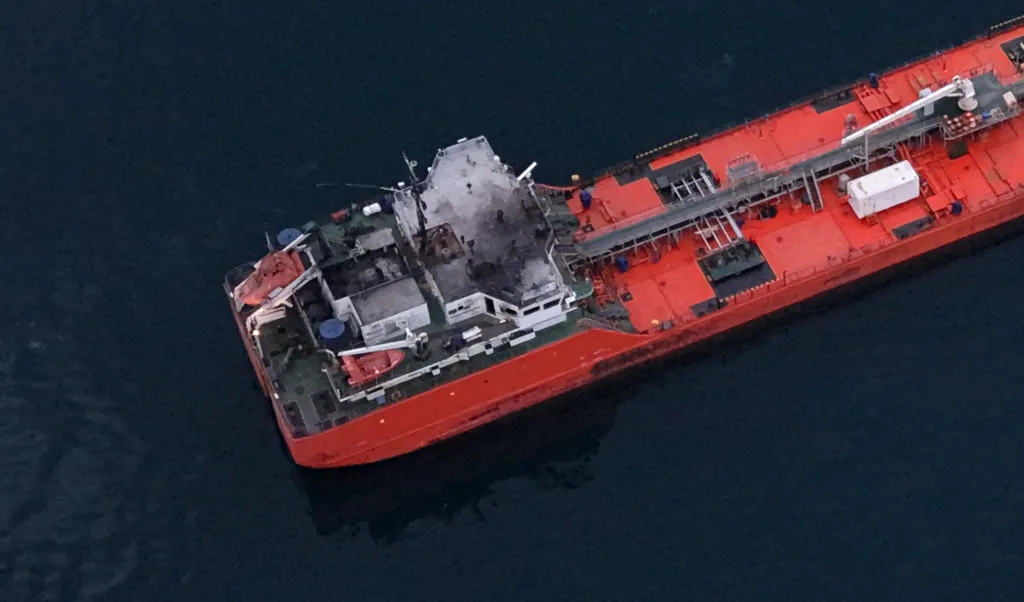
A Russian Shahed kamikaze drone strike on a ship in the port of Chornomorsk was in retaliation for a recent spate of Ukrainian attacks on Russian oil tankers in the Black Sea, the Ambrey maritime security firm tells us. The attack on the Turkish-owned CENK-T roll-on, roll-off cargo ship comes after Russian President Vladimir Putin warned he would “cut Ukraine off from the sea” in response to Ukraine’s stepped-up campaign against Russian commercial shipping.
As we have previously reported, Ukraine carried out three attacks on Russian-connected oil tankers in the Black Sea in late November and early December. Reports emerged on Wednesday that they carried out a fourth one, which you can read more about later in this story.
“This attack was the first retaliation,” Joshua Hutchinson, a former Royal Marine commando now serving as the company’s Managing Director of Risk and Intelligence, told us Friday afternoon.
Video emerging on social media showed several angles of the attack. One showed theShahed flying over the port of Chornomorsk before the CENK-T‘s bow became engulfed in flames.
Early reports on this incident from both Ambrey and Russian media claimed Russia used an Iskander-M ballistic missile to carry out the attack, but the video clearly shows otherwise. While it’s possible another strike occurred using a ballistic missile, we have seen no evidence of it at this time.
SON DAKİKA | Türk gemisinin vurulma anı Türk gemiciler tarafından kaydedildi.
🔴 Türk kargo gemisi CENK-T Rus füzesiyle vuruldu.
🔴Sakarya-Karasu’dan kalkan gemi, Romanya üzerinden Ukrayna Odesa Limanı’na giderken saldırıya uğradı. pic.twitter.com/9U1TlI2BTg
A separate video showed different views of the 606-foot-long Panamanian-flagged vessel in flames following the strike. One view appeared to be across the harbor, while another was a closer view, dockside, with the ship burning and people running from the scene. The strike injured at least one person, according to Ambrey.
Kargo gemisi CENK-T, Rus füzesiyle vuruldu.
▪️Sakarya-Karasu’dan Romanya’ya, oradan Ukrayna’nın Odesa Limanı’na giden jeneratör taşıyan Panama bayraklı yolcu ve konteyner gemisi CENK-T, Rus İskender füzesinin hedefi oldu.
In addition to the CENK-T being hit, Ukrainian President Volodymyr Zelensky said several other targets in the Odesa region were attacked in a volley of missile and drone strikes. Though Russia has frequently attacked Ukrainian ports, this incident marks an escalation to the Black Sea shipping wars, increasing the danger to commercial vessels regardless of nation of origin, Hutchinson told us.
“We are heading to an uncharted time,” he explained. “We are now seeing two state actors attacking commercial shipping.”
While Russia has hit Ukrainian ports before, strikes on ships have been largely incidental. A concerted campaign against vessels would make shipping companies think twice before sending vessels into this area due to the risks to ships and crews. We saw that play out when the Houthis were attacking Red Sea shipping and a large percentage of companies opted to avoid the region. This would be very problematic for Ukraine.
Zelensky decried the attack, saying it was another sign Russians aren’t interested in peace.
“Today’s Russian strike, like many other similar attacks, had, and could not have, any military sense,” the Ukrainian leader stated on X. “A civilian ship in the Chornomorsk port was damaged. This once again proves that the Russians not only do not take the current chance for diplomacy seriously enough, but also continue the war aimed at destroying normal life in Ukraine.”
Today, the Russian army carried out a missile strike on our Odesa region, and last night there was also a Russian attack on Odesa’s energy infrastructure. At one point we talked about the situation in this city and the people of Odesa with President Trump.
— Volodymyr Zelenskyy / Володимир Зеленський (@ZelenskyyUa) December 12, 2025
The Russians have not officially commented on the CENK-T strike; however, Russian media acknowledged that it was in response to the attacks that damaged the four Russian ships and that the tempo could increase.
“Earlier, Vladimir Putin directly stated that the strikes by the Russian Armed Forces on Ukrainian ports are a completely justified response to Kyiv’s actions,” the Russian Readovka media outlet suggested. “At the same time, the sinking of just 10-15 ships in one port could paralyze its operations.”
The most recent of those took place on Wednesday when Sea Baby drones from Ukraine’s state security service (SBU) attacked the Serbian-flagged crude oil tankerDashan in the Black Sea. Video of that attack showed the drones approaching the ship, which erupted in flames.
Ukraine’s SBU security service says its Sea Baby naval drones today struck another Russian “shadow fleet” tanker in the Black Sea.
Video from an SBU source purports to show the oil tanker “Dashan” being hit by the attack drone and explosions in the stern area. “The vessel,… pic.twitter.com/mtfBqYe1gQ
The Dashan attack, as we noted in our previous coverage, was preceded by others. On Dec. 2, a Ukrainian aerial drone struck the Russian-owned oil tanker Midvolga-2 about 80 miles north of the Turkish city of Sinop. A few days earlier, oil tankers, Kairos and Virat, were struck in quick succession off Turkey’s Black Sea coast by Ukrainian Sea Baby drones. These vessels are reportedly part of Russia’s “shadow fleet” that evades sanctions.
An aerial view of the Midvolga-2, a vessel sailing from Russia to Georgia, as it arrived off the coast of Sinop, a northern province of Turkiye following an attack in international waters in the Black Sea on December 2, 2025. (Photo by Ramazan Ozcan/Anadolu via Getty Images) Anadolu
Ukraine, as we have frequently reported, is waging a campaign against Russia’s energy infrastructure involving numerous attacks on refineries, ports and other supply hubs inside Russia. The attack on the Dashan is a further indication that Ukraine is taking this fight to Russian vessels at sea.
Meanwhile, the Trump administration has reportedly signaled its support for the Ukrainian attacks on Russian vessels
The Atlantic suggested that while the Biden administration feared escalation and opposed attacks on Russian vessels in international waters, Trump has taken the opposite tack. The publication reported that not only did the Trump administration not object to strikes, but in a number of cases, approved the transfer of intelligence to Kyiv, which was used to hit oil infrastructure facilities in Russia. The War Zone cannot independently verify that claim.
In the wake of today’s attack, Ambrey issued a warning to all ships making Black Sea port calls. These vessels “are advised to conduct comprehensive voyage threat assessments,” the company stated. “The crew is advised to remain within the designated Safe Muster Point (SMP) during missile attacks on infrastructure. The SMP should be located above the waterline, amidships and low-down in the superstructure.”
The coming days will tell if both parties continue to prosecute commercial shipping targets and what that could mean for maritime access to Ukraine.
Netflix has announced a proposed $72 billion acquisition of Warner Bros Discovery, aiming to absorb HBO Max and consolidate a subscriber base of 428 million. To justify the massive scale, Netflix argues it needs this merger to compete effectively with YouTube, which Nielsen ranks as America’s most-watched TV platform. However, antitrust experts and former regulators are deeply skeptical, noting that YouTube’s model built on user-generated content, influencers, and advertising, differs fundamentally from Netflix’s premium, scripted, subscription-based ecosystem. The Department of Justice and global regulators are expected to scrutinize the deal closely, particularly Netflix’s claim that it competes in the same market as YouTube.
Why It Matters
This isn’t just another media merger, it’s a defining test for how regulators view competition in the digital entertainment era. If accepted, Netflix’s “YouTube as rival” argument could set a precedent allowing giant streaming platforms to consolidate further by defining their market extremely broadly. The deal would give Netflix unprecedented control over both premium original content and major legacy film/TV libraries, potentially allowing it to dominate pricing and distribution in the paid streaming sector. How regulators respond will signal whether antitrust enforcement can keep pace with the evolving, platform-driven media landscape.
Critical Analysis
Netflix’s YouTube argument faces several critical weaknesses. First, content and business models are fundamentally different: Netflix invests billions in exclusive, scripted originals and operates on a subscription-first model, while YouTube monetizes user-generated videos through ads and creator partnerships. Second, historical precedent works against Netflix: regulators have repeatedly rejected broad market definitions in favor of specific “sub-markets” (e.g., “premium natural supermarkets” in the Whole Foods case), and internal company documents often reveal how firms really view their competition.
Third, new merger review rules will force Netflix to turn over internal strategic documents early, which could undermine its public claims if those materials don’t mention YouTube as a primary competitor. Finally, Netflix’s claim that bundling will lower prices for consumers is viewed with extreme skepticism by regulators, who often see such promises as unenforceable and worry more about price hikes for non-bundled users.
Conclusion
Netflix faces an uphill battle to convince regulators that swallowing Warner Bros Discovery is necessary to compete with YouTube. The DOJ is likely to define the relevant market narrowly, around premium, subscription-based streaming, where the combined entity would hold overwhelming share and pricing power. Unless Netflix can produce compelling internal evidence that it genuinely views YouTube as a direct competitor for the same viewer time and dollars, this deal is at high risk of being challenged or blocked. The outcome will not only shape the future of streaming consolidation but also test the boundaries of modern antitrust logic in a platform-dominated world.
This briefing is based on information from Reuters.
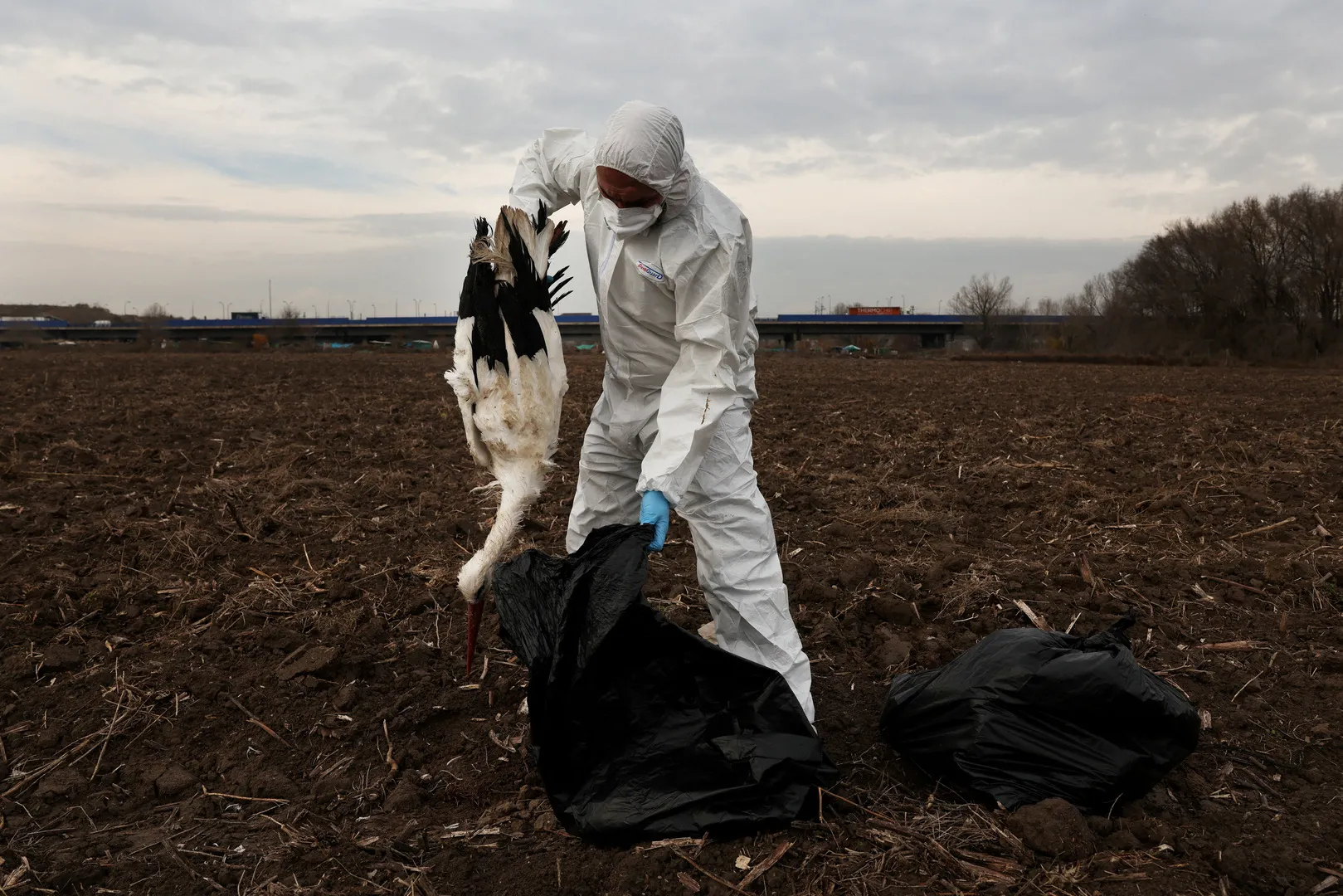
Spanish authorities have detected four bird flu outbreaks among wild birds in the Madrid region after discovering hundreds of dead storks. Officials say no poultry farms are affected and there is no serious risk to humans amid a wider surge across Europe.
Kilmar Abrego Garcia walked out of a US courthouse without being arrested by immigration authorities, relieving fears ICE may attempt to take him back into custody the day after he was released.
Singer’s statement follows walkout by five countries after organisers cleared Israel to participate in next year’s contest.
Published On 12 Dec 202512 Dec 2025
Share
Swiss Eurovision winner Nemo said they will return their 2024 victory trophy because Israel is being allowed to compete in the pop music competition.
The singer, who won the 2024 edition with operatic pop track, The Code, posted a video on Instagram showing them placing the trophy in a box to be sent back to the Geneva headquarters of the European Broadcasting Union (EBU).
Recommended Stories
list of 3 itemsend of list
“Eurovision says it stands for unity, for inclusion and dignity for all people,” Nemo said, adding that Israel’s participation amid its ongoing genocidal war on Gaza showed those ideals were at odds with organisers’ decisions.
The EBU, which organises Eurovision, cleared Israel last week to take part in next year’s event in Austria, prompting Spain, the Netherlands, Ireland, Slovenia and Iceland to announce they would be boycotting the contest.
“When entire countries withdraw, it should be clear that something is deeply wrong,” Nemo said on Thursday.
On Friday, contest director Martin Green said in a statement sent to The Associated Press that organisers were “saddened that Nemo wishes to return their trophy which they deservedly won in 2024”.
“We respect the deeply held views Nemo has expressed and they will always remain a valued part of the Eurovision Song Contest family,” he added.
Next year’s Eurovision is scheduled to take place in Austria’s capital, Vienna, after Austrian singer JJ won the 2025 contest in Basel, Switzerland. Traditionally, the winning country hosts the following year.
“This is not about individuals or artists. It’s about the fact that the contest was repeatedly used to soften the image of a state accused of severe wrongdoing, all while the EBU insists that this contest is non-political,” said Nemo.
“Live what you claim. If the values we celebrate on stage aren’t lived off stage, then even the most beautiful songs become meaningless,” they added.
Israel’s genocidal war on Gaza has killed at least 70,369 Palestinians, according to the territory’s health authorities.
The country’s military has continued to attack the enclave despite a ceasefire with Palestinian group Hamas reached back in October.
“It’s a chance to qualify. It is a chance to participate in a big event,” Fifa president Gianni Infantino declared in January 2017.
The Fifa Council had just unanimously voted to expand the World Cup to 48 teams. Nations who had never or rarely reached the finals were being given hope.
Infantino added: “Football is more than Europe and South America. Football is global.
“The football fever you have in a country that qualifies for the World Cup is the most powerful tool you can have, in those nine months before qualifying and the finals.”
Yet that “football fever” is falling a little flat after the ticket prices were released.
While the players will be there, the price of tickets could outstrip wages.
Take Haiti, one of the poorest countries in the world. The average wage in the Caribbean nation is around $147 (£110) a month.
The cheapest tickets for Haiti’s first game at the World Cup in 42 years, against Scotland, cost $180 (£135).
To attend all three matches – they also play Brazil and Morocco – would cost $625 (£467). That’s more than four months’ salary for the average Haitian, just to get into the ground.
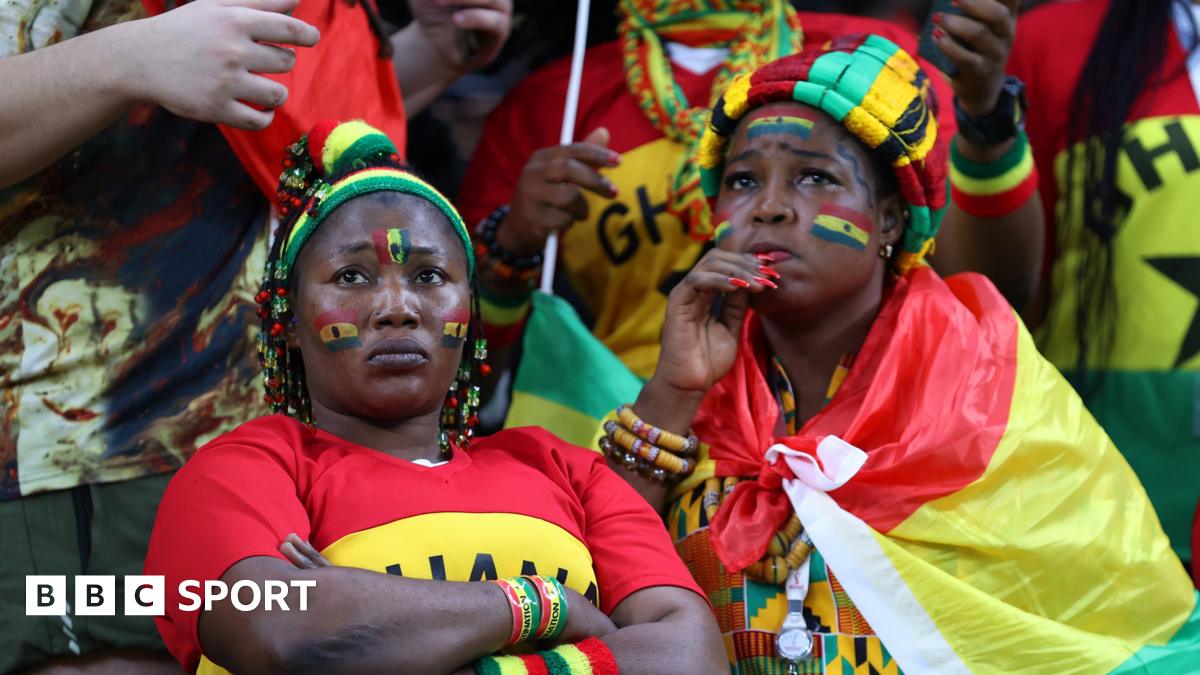
It’s a similar story for Ghana, where the average monthly salary is around $254 (£190).
Ghana supporter Jojo Quansah told BBC World Service that fans would have to cancel their plans.
“It’s a bit of a disappointment for those who, for the last three-and-a-half years, have been trying to put some money away in the hope that they can have their first World Cup experience,” he said.
“Fifa themselves have gone ahead to increase the number of teams so a lot more smaller football nations will get a chance to have themselves and their fans represented.
“It’s been overshadowed by pricing those same fans out of a chance to watch their country play at the World Cup.
“I have a feeling that quite a number of people within the next couple of months, are going to drop out of that desire to be at the next World Cup. Sadly. So sadly.”
Weekly insights and analysis on the latest developments in military technology, strategy, and foreign policy.
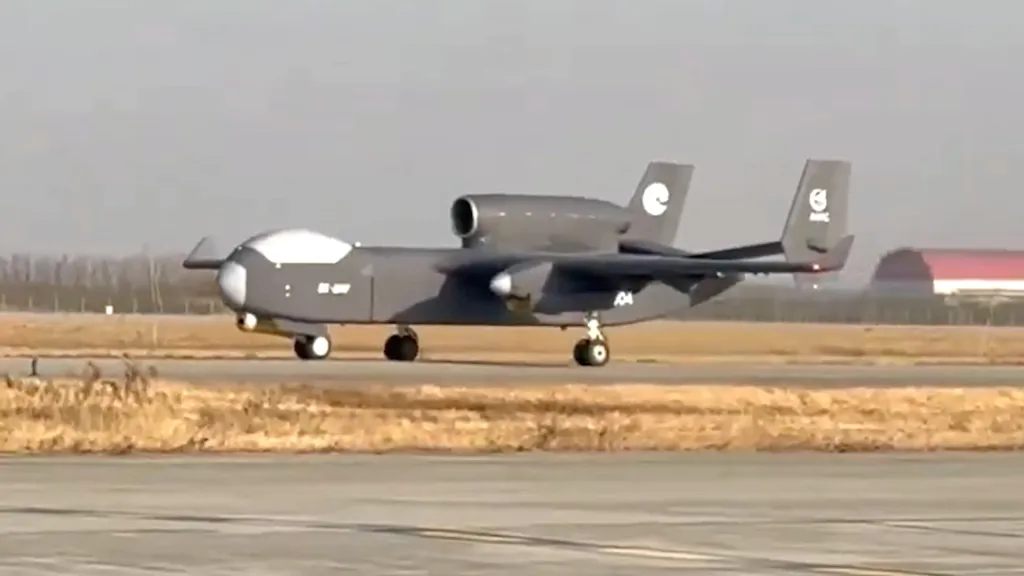
China’s heavyweight jet-powered Jiutian drone, said to have a maximum takeoff weight of around 17.6 tons (16 metric tons), has flown. A key mission for the design is expected to be acting as a mothership for swarms of smaller uncrewed aerial systems, as TWZ has explored in the past. It has also been shown previously armed with various air-to-surface and air-to-air munitions, and could perform a variety of other missions, including airborne signal relay and logistics.
The Jiutian’s manufacturer, the state-run Aviation Industry Corporation of China (AVIC), announced the drone’s first flight, which took place earlier today in Pucheng County in China’s central Shaanxi Province. The drone was first shown publicly at the 2024 Zhuhai Airshow, and it has also been referred to as the SS-UAV. What the “SS” stands for in that acronym remains unclear. The name Jiutian (also sometimes written Jiu Tian), or “The Ninth Heaven,” refers to the highest level of the heavens in traditional Chinese mythology, but is also commonly translated simply as “High Sky.”
A view of the Jiutian drone on the ground before taking off for its first flight. capture via Chinese internet/X
Jiutian is some 53.6 feet (16.35 meters) long and has a wingspan of around 82 feet (25 meters), per AVIC. In addition to its maximum takeoff weight, the company says it has a maximum payload capacity of nearly 13,228 pounds (6,000 kilograms), a ferry range of approximately 4,349.5 miles (7,000 kilometers), and can stay aloft for up to 12 hours. The drone’s stated maximum operational ceiling is 49,212.5 feet (15,000 meters), and it can fly at speeds up to 378 knots and as low as 108 knots.
In terms of its general configuration, Jiutian has a high-mounted wing with a very minimal sweep and small winglets at the tips, as well as an H-shaped tail. It has a single jet engine mounted in a nacelle on top of the rear fuselage. Its tricycle landing gear includes main units that retract into sponsons under the wings. As TWZ has noted in the past, these features together give the drone the outward appearance of something of a mashup of the A-10 Warthog and OV-10 Bronco attack aircraft. There is also a resemblance to rugged De Havilland aircraft, with its landing gear looking especially tough, which could point to being able to operate out of rougher fields.
A top-down look at the Jiutian offering a good general view of the design. Chinese internet via X
Jiutian is notably large compared to many other armed uncrewed aircraft designs currently on the market globally. For instance, the jet-powered Wing Loong-10 drone (also known as the WZ-10) in Chinese service now, produced by AVIC’s Chengdu Aircraft Industry Group (CAIG) subsidiary, has a maximum takeoff weight of around 3.5 tons (3,200 kilograms). CAIG’s Wing Loong 3 pusher-propeller-driven armed drone, the largest member of that design family to date, has a maximum takeoff weight of around six tons. As another point of comparison, the stated maximum takeoff weight of newer extended-range versions of the U.S. MQ-9 Reaper, which are also notably smaller overall, is just under six tons.
AVIC has described the Jiutian as a “general purpose” design capable of performing a wide range of missions, and its modular payload section has drawn particular attention since it was first unveiled. At the 2024 Zhuhai Airshow, that section had a Chinese phrase printed on the side reading “ascension of the beehive mission module,” according to a machine translation. It also said “Isomerism Hive Module” in English, which appeared to be a mistranslation. A term typically used in chemistry, isomerism refers to the potential existence of isomers, which are molecules or ions with identical molecular formula, but that differ in the physical and chemical arrangements of their atoms. AVIC subsequently confirmed that the intent was to communicate a drone swarm launch capability, according to Chinese state media.
A rendering shown on Chinese state television depicting the launch of a swarm of smaller uncrewed aerial systems from a Jiutian drone. CCTV capture
“China’s interest in swarming capabilities and the ability to launch them from various platforms, including high-altitude balloons, is not new. For military purposes, swarms have a number of inherent benefits, including the ability to rapidly fan out across a broad area to carry out various missions depending on how they are configured, including intelligence, surveillance, and reconnaissance (ISR), electronic warfare, and kinetic strike. Individual drones in a swarm can also be equipped with different payloads to give the entire grouping a multi-mission capability. Large numbers of uncrewed aerial systems operating closely together also present significant challenges for defenders who could easily find themselves overwhelmed or otherwise confused about how to best respond to the incoming threats.”
“The War Zone previously laid out a case for giving exactly this kind of drone swarm launch capability to reconfigured P-8 Poseidon maritime patrol planes, which you can read more about here. Drones launching other drones offers a way to push these capabilities further forward while reducing the risk to crewed platforms.”
Having a platform capable of delivering a swarm of drones within hundreds of miles of a particular area would offer huge advantages, especially for attacking ships at sea, island outposts, and other distributed or dispersed target sets. Even the most modern warships in service in the United States and elsewhere today notably lack any real ability to defend against a high-volume attack of this kind. This is something TWZ previously highlighted in a detailed case for arming U.S. Navy warships with their own swarms of drones to bolster their defensive and offensive capabilities, which you can find here.
As mentioned, Jiutian has been displayed in the past with four pylons under each wing loaded with various munitions, as well. This has included PL-12 radar-guided air-to-air missiles, TL-17 land-attack cruise missiles (an export variant of the KD-88), and precision-guided bombs.
Jiutian has a sensor turret under its nose of the kind typically fitted with a mix of electro-optical and infrared cameras. It could also contain a laser designator for employing munitions using that type of guidance.
The drone also has a dome on top of the nose in line with a beyond-line-of-sight communications array and a nose radome. The latter has pointed to at least provisions for the installation of a radar. That could be used to help spot and target aerial threats using weapons like the PL-12, as well as for other targeting purposes, and just to assist with navigation and provide additional situational awareness. Jiutian could use air-to-air weapons for self-defense or to actively hunt flying targets.
The modular payload section is large enough to serve a host of other potential purposes, as well. It could accommodate additional sensors, such as a side-looking airborne radar (SLAR), as well as electronic warfare suites and communication arrays. Jiutian’s ability to fly high and for extended periods at relatively low speeds could make it a particularly ideal platform for more general surveillance and reconnaissance, as well as acting as an airborne communications node. China’s People’s Liberation Army (PLA) had already been expanding its fleet of high-altitude, long-endurance drones and increasingly employing them on routine surveillance and reconnaissance missions, over land or water, around its borders. Many of those existing designs can also carry air-to-surface munitions, but with nowhere near the same capacity as the Jiutian.
A Chinese WZ-7 drone seen flying over or around the East China Sea. This picture was taken from a Japanese aircraft sent to intercept it. Japanese Ministry of Defense
AVIC itself has highlighted how Jiutian’s internal space could be utilized for carrying cargo, and it could be a relevant addition for providing logistics support to far-flung locales. The PLA has pronounced needs in this regard with an ever-growing array of remote and austere operating locations, such as its highly strategic island outposts in the South China Sea and its bases spread across the Himalayan Plateau along its disputed border with India. As mentioned earlier, the Jiutian’s landing gear could point to its ability to perform any of its missions while forward-deployed at sites with more limited infrastructure to perform.
Uncrewed platforms could also offer cost benefits compared to traditional crewed cargo aircraft for conducting routine resupply operations to those areas, where the latter may not even be able to operate at all. At the same time, this all seems likely to be at most a secondary mission set for the Jiutian. AVIC and other Chinese aviation firms have already been developing a growing array of larger drones expressly designed primarily for logistics roles.
AVIC and the PLA have also been heavily touting Jiutian’s potential to perform various non-military missions. “Its modular payload system enables roles ranging from precise deliveries of heavy cargo to remote regions, to emergency communication and disaster relief, to geographic surveying and resource mapping,” according to a post today from the China Military Bugle account on X, an official mouthpiece for China’s armed forces.
A large unmanned aerial vehicle (#UAV), named “Jiutian,” completed its maiden flight on December 11, 2025, according to the Aviation Industry Corporation of China (#AVIC).
The domestically developed general-purpose drone, measuring 16.35 meters in length and 25 meters in… pic.twitter.com/LwUHyNaEp6
It’s worth pointing out that AVIC’s heavy focus on non-military missions for Jiutian underscores the significant overlap between the military and commercial ends of China’s aerospace industry, as well as the role that ostensibly civilian research institutions often play. This is something TWZ routinely highlights. These kinds of dual-purpose relationships are also prevalent in the country outside of the aviation realm.
When it comes to the Jiutian design, specifically, more insights into its capabilities and expected roles may now begin to emerge as the drone is now in flight testing.
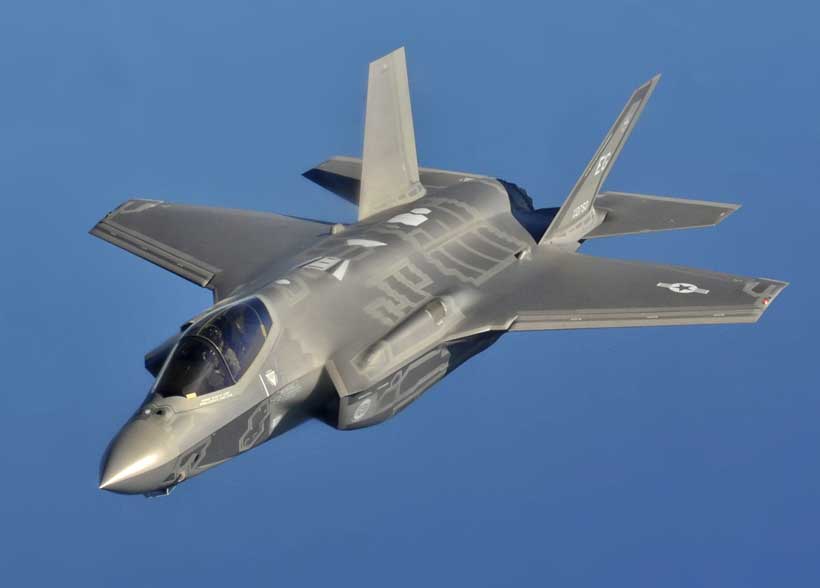
NEWS BRIEF Finland has announced it will procure Advanced Medium Range Air-to-Air Missiles (AMRAAM) from the United States, a key step in arming its fleet of 64 F-35 fighter jets as Helsinki continues to bolster its air defenses against Russia. The missiles, described as the latest and most advanced variant, are scheduled to be delivered […]
Congolese refugees have recounted harrowing scenes of death and family separation as they fled intensified fighting in the eastern Democratic Republic of the Congo (DRC), where Rwanda-backed M23 rebels captured a strategic city despite a recent United States-brokered peace agreement.
M23 has cemented control over Uvira, a key lakeside city in DRC’s South Kivu province that it seized on Wednesday, despite a peace accord that President Donald Trump had called “historic” when signed in Washington just one week earlier.
Recommended Stories
list of 3 itemsend of list
Al Jazeera, which is the first international broadcaster to gain access to the city since M23’s takeover, saw residents tentatively returning home after days of violence, amid a heavy presence of rebel fighters on Friday.
The day before, M23 fighters combed the streets to flush out remaining Congolese forces and allied militias – known as “Wazalendo” – after taking over key parts of the city.
Meanwhile, at Nyarushishi refugee camp in Rwanda’s Rusizi district, Akilimali Mirindi told the AFP news agency she fled South Kivu with just three of her 10 children after bombs destroyed her home near the border.
“I don’t know what happened to the other seven, or their father,” the 40-year-old said, describing corpses scattered along escape routes as about 1,000 people reached the camp following renewed clashes this month.
Regional officials said more than 413 civilians have been killed since fighting escalated in early December, with women and children among the dead.
The offensive has displaced about 200,000 people, and threatens to drag neighbouring Burundi deeper into a conflict that has already uprooted more than seven million across eastern DRC, according to United Nations figures.
Uvira sits on Lake Tanganyika’s northern shore, directly across from Burundi’s largest city, and serves as South Kivu’s interim government headquarters after M23 seized the provincial capital, Bukavu, in February.
Al Jazeera correspondent Alain Uaykani, who gained access to the city on Friday, reported a tenuous calm and the heavy presence of M23 soldiers but described harrowing scenes on the journey there.
“Here in Uvira, we have seen different groups of the Red Cross with their equipment, collecting bodies, and conducting burials across the road,” Uaykani said.
He added that the Al Jazeera crew saw abandoned military trucks destroyed along the road to Uvira, and the remains of people who were killed.
Residents who fled Uvira told AFP of bombardment from multiple directions as M23 fighters battled Congolese forces and their Burundian allies around the port city.
“Bombs were raining down on us from different directions,” Thomas Mutabazi, 67, told AFP at the refugee camp. “We had to leave our families and our fields.”
‘Even children were dying’
Refugee Jeanette Bendereza had already escaped to Burundi once this year during an earlier M23 push in February, only to return to DRC when authorities said peace had been restored. “We found M23 in charge,” she said.
When violence erupted again, she ran with four children as “bombs started falling from Burundian fighters”, losing her phone and contact with her husband in the chaos.
Another refugee, Olinabangi Kayibanda, witnessed a pregnant neighbour killed alongside her two children when their house was bombed. “Even children were dying, so we decided to flee,” the 56-year-old told an AFP reporter.
M23 spokesperson Lawrence Kanyuka announced on Wednesday that Uvira had been “fully liberated” and urged residents to return home.
Fighting had already resumed even as Trump last week hosted Congolese President Felix Tshisekedi and his Rwandan counterpart Paul Kagame at a widely attended signing ceremony.
The December 4 Washington agreement obliged Rwanda to cease supporting armed groups, though the M23 was not party to those negotiations and is instead involved in separate Qatar-mediated talks with Kinshasa.
DRC’s government accused Rwanda of deploying special forces and foreign mercenaries to Uvira “in clear violation” of both the Washington and earlier Doha agreements.
The US embassy in Kinshasa urged Rwandan forces to withdraw, while Congolese Foreign Minister Therese Kayikwamba Wagner called for Washington to impose sanctions, saying condemnation alone was insufficient.
Rwanda denies backing M23 and blames Congolese and Burundian forces for ceasefire violations.
In a statement on Thursday, President Kagame claimed that more than 20,000 Burundian soldiers were operating across multiple Congolese locations and accused them of shelling civilians in Minembwe.
UN Secretary-General Antonio Guterres warned the escalation “increases the risk of a broader regional conflagration” and called for an immediate cessation of hostilities.
Chile has nearly 15.8 million registered voters, and this year, for the first time since 2012, all of them are required by law to vote in the presidential race.
Kast is believed to have the upper hand in Sunday’s run-off.
Though he came in second place during the first round of voting in November, he is expected to sweep up additional support from conservative candidates who did not make the cut-off for the second vote.
But some voters expressed scepticism about the emphasis on crime in this year’s race.
Daniela Ocaranza, a mother who lives in a low-income neighbourhood in Santiago, considers the heightened focus on crime to be a ploy.
She volunteers at an organisation that fights for affordable housing, and she thinks politicians are leveraging the uptick in crime to convince the voters to put more resources into security.
“Crime has increased,” Ocaranza acknowledged. “But this happens in all countries.”
She said the media is partly to blame in raising fears. It shows “you the same crime 30 times a day — morning, noon and night — so the perception is that there is more”.
“But there are many other things that are more important,” Ocaranza stressed, pointing to issues like education, healthcare and pensions. They are areas that she sees best addressed by Jara, whom she will be voting for on Sunday.
For his part, Johnson said politicians draw up hardline policies to appease residents who want urgent action taken.
But he noted that research has shown punitive measures don’t typically produce results. In the meantime, he warned that the outsized fears about crime can have real-world ramifications.
“Today, there are fewer people consuming art, going out to see theatre, going out to restaurants. So it doesn’t just limit someone’s quality of life but also economic development,” Johnson said.
“Fear is extremely harmful. It might even be more hurtful than the actual crime.”
Nationwide has been fined £44m for not having the right processes in place for detecting financial crime between 2016 and 2021.
The building society had “ineffective systems” for assessing risk and monitoring the transactions of its customers, the Financial Conduct Authority (FCA) said.
In one instance, Nationwide missed opportunities to identify a customer who had £26m of fraudulent Covid furlough payments paid into a personal account in the space of just eight days.
Nationwide said it had fully co-operated with the regulator’s investigation and since 2021 had invested in its crime control systems to ensure they were “robust”.
During the period in question Nationwide did not offer business accounts.
The FCA said that even though the building society was aware that some customers were using personal accounts for business activity, it did not have an accurate picture of who presented a higher risk of financial crime.
As a result money laundering risks were not effectively monitored, it said.
The customer who banked the illegitimate furlough payments received £27.3m over 13 months. Most, but not all of it, has since been recovered by the tax authority.
“Nationwide failed to get a proper grip of the financial crime risks lurking within its customer base,” said Therese Chambers, joint executive director of enforcement and market oversight at the FCA.
“It took too long to address its flawed systems and weak controls, meaning red flags were missed with serious consequences,” she said.
The Nationwide said it had identified the shortcomings through its own reviews and had brought them to the attention of the FCA.
“We are sorry that our controls during the period fell below the high standards we expect,” a spokesperson said.
“Since 2021, Nationwide has invested significantly in all aspects of its economic crime control framework in order to ensure our systems are robust.
“We do not believe that these controls issues caused financial loss to any of our customers and remain committed to preventing economic crime and protecting our customers and the wider UK economy from fraud,” they added.
Fatima Alhassan is twenty years old now, but her voice still carries the weight of a ten-year-old girl who watched her world collapse a decade ago. Her father, Shahid Alhassan, was killed on Dec. 12, 2015, during the infamous ‘Zaria Massacre’.
“Despite our little time with him, we were always happy around him,” she said. “We were very close. Since we lost him, that vacuum has not been filled in our hearts.”
It was a Saturday morning, and Shahid had just returned home from a funeral. He lay on the sofa, with dust still on his palms. After some moments, he rubbed it across his face and said, “I am next”. His wife, Hauwa Muhammad, found those words unsettling.
Hauwa speaks about her last moments with her husband. Photo: Isah Ismaila/HumAngle
Immediately, Hauwa dismissed it, insisting it was not yet time and that they still had years to spend together, but he replied quietly that “my grave would not be dug in Kano, but in Gyallesu [a suburb in Zaria, Kaduna State, in North West, Nigeria].”
Shahid rose from the sofa, bathed, and had breakfast, and together they walked to the door, exchanging pleasantries before he left.
Around noon, news broke that officers of the Nigerian Army opened fire on some members of the Islamic Movement of Nigeria (IMN) in Zaria town.
That Saturday was the first day of Maulud, the birth month of Islam’s Holy Prophet Muhammad. Shahid and other IMN faithful had gone out for the celebrations.
Founded in the early 1980s, the IMN grew under the leadership of Ibrahim Zakzaky, then a student activist at Ahmadu Bello University in Zaria. Inspired by the 1979 Iranian Revolution, Zakzaky advocated for an Islamic state governed by Sharia law. What began as a campus-based movement quickly expanded nationwide, attracting millions of followers who aligned with Shi’a Islam.
What really led to the Zaria Massacre?
The military claimed that the convoy of the then Chief of Army Staff, Lt Gen. Tukur Yusuf Buratai, was denied access through the road where the members of IMN were preparing for the Maulud celebration.
However, Mukhtar Bashir, an IMN representative in Kano State, told HumAngle that the group were hoisting a flag when they sighted the convoy and some soldiers stationed near a filling station. Immediately, they felt something was off, and then some members confronted the convoy to enquire what was happening.
Over the decades, IMN’s growing influence and its confrontations with state authority led to heightened tensions with Nigerian security forces. One of the most significant clashes occurred in July 2014, when soldiers killed three of Zakzaky’s sons and 30 IMN members during a Quds Day procession.
The incident deepened mistrust and left many IMN members expecting hostility whenever the military appeared. As Mukhtar recalled: “We thought it was another attack.”
What began as a “simple confrontation” quickly escalated into a full-scale assault, which continued through the weekend. Mukhtar told HumAngle that the soldiers opened fire indiscriminately on unarmed civilians, including women and children, killing hundreds as the violence stretched across three days.
By Tuesday and Wednesday, the focus had shifted from gunshots to the evacuation of dead bodies that were buried in mass graves. Mukhtar said the burials were held without religious rites, or “any form of dignity”. Amnesty International confirmed this claim in a report on the incident.
Based on IMN records, “a thousand members of the organisation” were killed in the massacre. Muktar noted that when the numbers of passersby who were caught in the violence and also lost their lives are added, the death toll will be significantly higher. “We can show the houses of each person killed or missing,” he added.
The aftermath
When the news got to Hauwa, she was at home, anxiously waiting for her husband’s return. During those tense moments, she remembered the words Shahid had said while on the sofa. “What if his prayers had been answered?” She thought.
Hauwa cries when she talks about her husband. Photo: Isah Ismaila/HumAngle
Hauwa kept dialling her husband’s phone number, but every call went unanswered. Later in the evening, she began receiving different accounts about Shahid’s whereabouts; some said he was injured, others said he was dead.
“Initially, I never believed he was killed,” she recounted. “We heard that it was our neighbour who died. Even my husband’s uncle said he was alive. Until Shahid’s friend, Malam Abdulkadir, drove to Zaria and confirmed that he was dead.”
Hauwa still didn’t believe that testimony until a local newspaper published images of the deceased Shi’a Muslims. That was when she accepted his death.
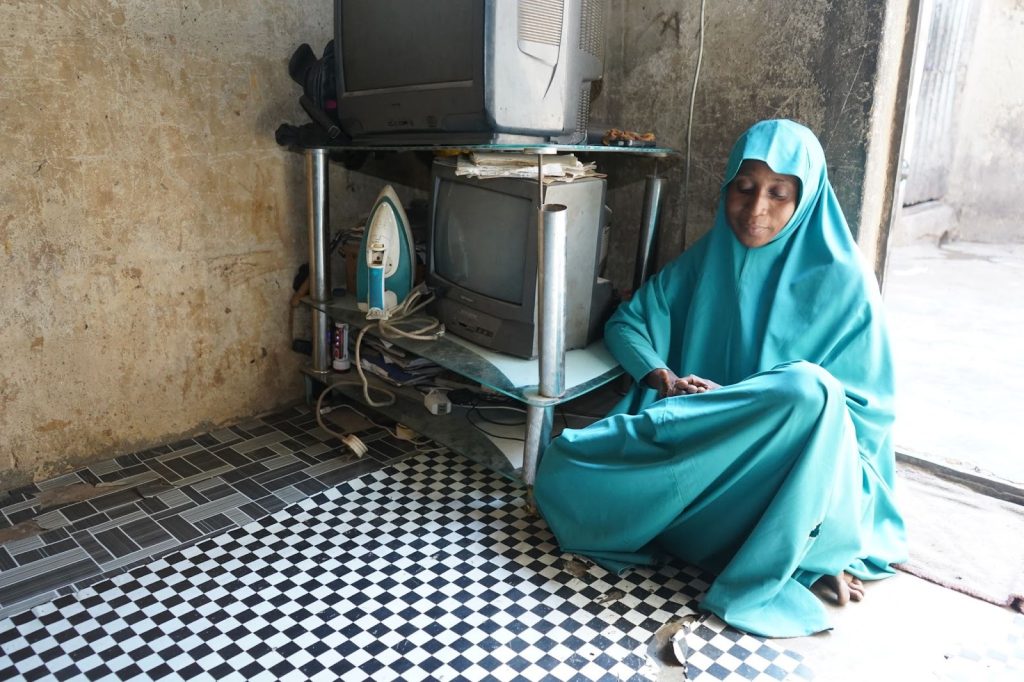
A portrait of Shahid Alhassan held by his wife, Hauwa. Photo: Isah Ismaila/HumAngle.Hauwa and her children are left with many portraits of Shahid Photo: Isah Ismaila/HumAngle.
What followed was silence, Hauwa said it was unbearable. “Every day, in every aspect of my life, I felt the absence of my husband, the only pillar of our household. He had been a devoted father to our seven children and a loving companion to me,” she said.
His loss left the family adrift. Twenty-one months after the incident, Hauwa’s youngest son also died. It deepened the tragedy for the family.
“I miss my husband,” she said. “It was through him that I fell in love with the path I am on as a Muslim. I have nothing to say, only to ask Allah to bless him for all he has done for us, and may his soul continue to rest in peace.” Hauwa believes that Shahid died a martyr—a gift he had long prayed for.
However, the challenges of raising their children alone, the weight of grief, and the absence of justice have defined the family’s life for the past decade.
“Some days are filled with happiness, while others are filled with pain and hunger. The sad days are more than the happy ones,” said Fatima, staring away from the camera. She attends a secondary school in Kano, where she also lives with her mother and six siblings in a modest three-room apartment.
Fatima carried a gloomy face when she spoke of her father. Photo: Isah Ismaila/HumAngle.
Each morning, as she prepares for school, she asks her mother for transport fare. Too often, her mother has nothing to give. Fatima does not feel anger; it is the ache of knowing her father is not there to shoulder the burden.
While in school, Fatima says she is often silent when conversations come up with friends about their fathers and their life plans. “Living without a father is emotionally disturbing,” she told HumAngle. “We just have to do everything with our mother, and it saddens me.”
The loss has reshaped her dreams. Once, she imagined herself studying commerce, perhaps medicine or journalism. But after her father’s death, affordability dictated her path. She now studies Arabic, hoping to become a teacher—a future she never planned for, but one forced upon her by circumstance.
It is ten years since the massacre, but families, like Shahid’s, said they have not gotten justice. “They even painted it to look like we are the ones who committed an offence,” Fatima said. “The government has not done anything tangible. To them, it might have passed, but to us, it is as fresh as it was ten years ago.”
After the massacre, the former Kaduna State governor, Nasir El-Rufai, set up a judicial commission of inquiry, whose report found evidence of human rights violations by the Nigerian Army and also noted that 347 IMN members were killed in the incident.
“The commission recommended prosecution of the soldiers who participated in the killings, but that has not been done,” said Haruna Magashi, legal practitioner and human rights activist.
IMN also accused the soldiers of demolishing their buildings, including the residence of their founding leader, Ibrahim Zakzaky. In November, when HumAngle visited Zakzaky’s house and some of the IMN centres, some had been turned into a refuse dump site, while others were still not in shape.
Some survivors who spoke to HumAngle three years ago recalled scenes of chaos as homes were raided, people shot at close range, and corpses left scattered on the streets.
Zakzaky was arrested by Nigerian authorities after the incident, but he was discharged and acquitted by the court in July 2021. “All the concluded cases against the IMN were in their favour,” said Haruna.
A Nigerian court has since ruled that the activities of IMN are “acts of terrorism and illegality”, an allegation that it has persistently denied. IMN was banned in July 2019.
Echoes of grief
While some of the survivors were teenagers and are now young adults, others can’t even remember because they were babies, but they have formed memories through stories.
Fatima Alhassan was four when her father died in the massacre. The 14-year-old said she only tries to picture her father through the good things her mother has said about him. Through the stories, she knows that his father was a good cook, and he always bathed his children and cared for the household whenever illness struck.
Fatima Shahid Alhassan couldn’t hold back her tears as she remembered the challenges she faced without their father. Photo: Isah Ismaila/HumAngle.
“Honestly, we have all been cheated in our family,” she said. “This is because whenever my mother falls sick and my elder siblings aren’t home, she has to do all the chores by herself. But if my father were around, I am sure he wouldn’t leave her like that. Even if she insists he go to work, he would still stay behind to assist her. Such moments break my heart, and I wish he were still alive.”
Those recollections make her long for the father she never really met. At her former school, she and her siblings were bullied by classmates who mocked them for not having a father, flaunting gifts they received, while they reminded them of what they had lost.
Fatima says her uncles and other close relatives have been supportive, especially during festive seasons, but the longing for her father never fades.
“It hurts me a lot. If I were to see him now, I would tell him that we have missed him a lot and we have suffered without him,” she said as tears rolled down her cheek.
‘To live my father’s dreams’
Amidst an unending grief that aches now and then, Al’haidar Alhassan said he wants to live his father’s dream. He is studying at Basita Darwish Chami Academy, a boarding school in Kano State built for orphans whose parents were killed in the massacre, and he hopes to be a scientist and a researcher someday.
“Glory be to God Almighty that we have gotten the support we need, and I believe we will achieve what we intend. Nevertheless, I still feel heartbroken. The thought of losing my father and pillar still affects me because I feel demotivated sometimes,” he said.
Al’haidar sits quietly in a classroom at the Basita Darwish Chami Academy in Kano. Photo: Isah Ismaila/HumAngle.
After his father’s death, the 19-year-old and his siblings dropped out of school for two years. Al’haidar said that his father’s greatest wish was for his children to be educated.
“I miss the father-and-son bond we shared. Whenever he was leaving for work, I never wanted to let him go. Whenever I see a child and his father, the more I miss him, and in some cases, I have no choice but to cry,” Al’haidar added.
A father’s loss
While Al’haidar misses the bond with his father, Bashir Muktar sits on the floor in his living room, in between the portraits of his two sons who were killed in the massacre. The bond with his children was one of deep affection and shared ambition.
Bashir Muktar sits between the portraits of his sons who were killed in the massacre. Photo: Isah Ismaila/HumAngle.
Shahid Abba, his eldest son, had just completed his remedial studies at the College of Arts and Islamic Studies a few days before the incident. The 20-year-old was brimming with plans to pursue chemical engineering at the university. Meanwhile, Bashir’s younger son, Hujjatullahi, was still in secondary school at Fudiya Science in Kano. The 18-year-old has dreams of becoming a doctor.
“A child is a flesh of yours,” Bashir said, “and you live your life trying to ensure that you build them up. You have certain ambitions towards your children. In every household, every father tries to build his children to greatness because they are your successors.”
Even though he kept a smiling face, it broke his heart as he recounted some of his sons’ youthful curiosity. He speaks about a day in 2014 when he found the younger son under the staircase, carving something for a school experiment.
He teased him for “still behaving childishly”, but Hujjatullahi replied that: “It is an assignment. I am going to conduct an experiment on meiosis and mitosis.” That was the day his son revealed to him his dream of becoming a doctor. These memories, Bashir said, are etched in his heart.
He was on a trip in Abuja, North Central Nigeria, when his children called to ask if they could attend the Maulud programme in Zaria. He suggested they meet there at the event, but he was caught up in a late meeting, and his sons kept reaching out to confirm what was happening.
Shahid Abba and Shahid Hujjatullahi’s portraits hang high on their father’s house in Kano. Photo: Isah Ismaila/HumAngle.
“They sent a text message enquiring what was happening in Zaria. I replied with, ‘Nothing is happening.’ They asked if they could proceed, and I said yes, not knowing soldiers had attacked and opened fire at the venue earlier that day,” Bashir recounted.
By the time he tried reaching them again, their phones were no longer connecting. Bashir attempted to travel to Zaria the following day, but the roads were sealed off as news spread quickly that soldiers had blocked the entrance to the city.
Two days later, while having breakfast, he got a call: “I extended salutations, then I heard, ‘Father! Father!!’ It was the voice of Hujjatullahi. I confirmed by calling his name, then I started recording and put the call on speaker. I asked, ‘What’s happening, Hujjatullahi?’ He said, ‘Please forgive us, Father.’ I asked again, ‘What is happening?’ He responded, ‘Forgive us for whatever we have done to you until we meet at Darul Salam [referring to the final abode of the deceased righteous in Islam].’”
The words that followed were devastating.
“My elder brother has been shot in the stomach, and I have been shot in the stomach and my arm,” Hujjatullahi told him.
Bashir said that how his sons were buried worsened his grief.
“If they had travelled or fallen sick and died, it would have been different. But the manner in which they lost their lives is painful,” he said. “After killing them, they took their corpses, both men, women, children, pregnant mothers, and the elderly, then dug a massive hole and buried them all together like animals. No religious ritual was performed. With these, there are a lot of things to remember, and we can’t forget them.”
When asked what justice looks like for him and other grieving families, Bashir said that the fight for justice is not only about acknowledging the massacre but also about reclaiming the dignity of those who were killed.
“The most important thing for us in this fight for justice is the corpse of our loved ones,” he told HumAngle. “Where are the dead bodies of the people they killed and buried without prayer, spiritual bath, no shroud, no graves, nothing at all?”
“I believe even if someone is sentenced to death, after the life is taken, the body belongs to the family. So, where are the bodies? Despite killing them without any valid reason, they are still depriving us of their dead bodies.”
The last witness
In the same incident, Zainab Isa lost nearly everything.
Zainab Isa lost six children and her husband in the Zaria massacre. Photo: Isah Ismaila/HumAngle.
Her husband, Abdullahi Abbas, and six of their children—Abdulrazaq, Muhammad, Abbas, Ahmad, Ibrahim, and Jawwad—were all killed in the Zaria massacre.
A decade later, at her home in the Rimin Danza community in Zaria, she imagines what her youngest son, Jawwad, who was only 18 when he died, might have become at 28. “I wouldn’t be surprised if he were a doctor by now,” she said.
She said Jawwad was quiet, intelligent, and reserved and carried the kind of promise that only time could have revealed. Instead, his life ended before it even began.
Her eldest, Abdulrazaq, was over thirty when he was killed, four years after graduating from Ahmadu Bello University, Zaria.
The last memory of the family that brings all of them together in one place. Photo: Isah Ismaila/HumAngle.
He had plans to further his education once he secured a job. She remembers his brilliance in school, his demur anytime he was announced first in class, and his humility in admitting that his younger brother Jawwad was even smarter.
Jawwad contributed to scholarship by writing an Islamic book, the Forty Hadiths, which was published and shared at his graduation, before his death.
Zainab can go over and over again about the stories of each of them. She told HumAngle that even other people in her community remember her children not only for their achievements but also for their kindness.
Neighbours told her of small acts of generosity—paying transport fares for strangers, helping to fetch water for a neighbour, and offering support without being asked. “Wherever they went, they were loved,” she said. “I am not saying it to prove anything. It was God Almighty that blessed me and made them upright.”
Since that incident happened, her husband’s words about the frailty of life have stayed with her: “Only God knows who would be the first to leave this world between us. I just pray God accepts my worship before He takes my life.”
“The scar will never heal,” she said. “Even if they would bring a truckload of dollars to my house, with the intention of making me happy, honestly, it won’t make me happy. If times could change, I would ask them to stay behind and go there myself to die instead, because they were still young and had dreams and were loved by everyone.”
Zainab is one of the few surviving witnesses to her family’s tragedy.
Between grief and discrimination
Sadiya Muhammad, another widow of Abdullahi Abbas, was left between the pain of losing her husband and the discrimination her daughter endured in its aftermath.
Sadiya Muhammad has been confronted with grief and sectarian prejudice. Photo: Isah Ismaila/HumAngle.
Sadiya’s daughter, Radiya, was only two years old in 2015. Too young to remember her father, she grew up knowing his face only through photographs. “Whenever you hand her a picture, she would be able to point out her father,” Sadiya said.
But at school, where students and teachers came from different Islamic sects, her daughter faced painful words that deepened her grief. One day, a teacher openly told the class, “Do not be carried away by the prayers and fasting of any person who is a member of the Shi’a sect; they are worse than unbelievers, and they are all going to hell.”
The little girl returned home troubled, asking her mother, “Since my teacher said those who are Shi’a are all going to hellfire, is my father also going to hellfire?”
Sadiya’s response was firm yet tender: “I told her that her father is not going to hell; rather, he was martyred, and by Allah’s mercy, he is going to paradise.”
A cemetery at Darul Rahama, a worship centre in Zaria, which was demolished by the Nigerian Army in 2015. Photo: Isah Ismaila/HumAngle.
In the years after the massacre, her family’s mourning was made heavier by the sectarian prejudice of others, forcing her to constantly remind her children of their father’s honour and the value of their faith.
Human rights activists like Magashi believe the massacre carries a broader warning about minority rights in Nigeria. “You are in danger of extinction once you are a minority in the country,” he said. “This is dangerous as far as human rights are concerned. The Shi’ites are the minority Muslims in Nigeria, but they share the same human rights as the majority.”
The official could not say how many, when they will arrive or where they will go, but suggested they will most likely fly to the former Roosevelt Roads U.S. Navy base in Puerto Rico which has served as a staging ground for aviation assets and troops gathered in the region.
An F-35A Lightning II assigned to the 158th Fighter Wing, Vermont Air National Guard. (U.S. Air National Guard photo by Staff Sgt. Jana Somero)
As we previously reported, F-35s from the U.S. Marine Corps began arriving at Roosevelt Road in the middle of September. E/A-18G Growler electronic attack jets just arrived there yesterday as well, which is possibly the most glaring sign that the U.S. is preparing for airstrikes as any over the last few months. You can read more about that deployment and its significance here.
F-35 fighters have arrived at the former Roosevelt Roads Naval Station in Ceiba, Puerto Rico, now operating as the primary staging base for the aircraft and their support teams.
On Wednesday, Vermont media outlets reported that wing assets were being prepared for a deployment but didn’t say where.
“Lt. Col. Meghan Smith confirmed to Vermont Public on Wednesday that the 158th Fighter Wing ‘has received a federal mobilization order,” the Vermont Public news outlet reported. “While we can’t discuss specific timelines or locations, our Airmen train continuously to ensure they are fully prepared to support federal and state missions whenever and wherever they are needed,” Smith said in an email.
Republican Gov. Phil Scott told Vermont Public on Wednesday that he did not know where the jets are going.
“Scott said during his weekly media briefing Wednesday that the Pentagon issued the mobilization orders under Title 10, the federal statute that allows the president to place National Guard troops under federal command,” according to the news outlet. “There isn’t much I can share because I don’t know a lot about any of the mission,” Scott said. “Everything from my understanding is coming out of either the National Guard or the Pentagon at this point.”
F-35A deployed to the Caribbean — the first USAF tactical jets to do so — would offer the ability to drop 2,000lb-class guided bombs on targets deep inside Venezuelan airspace. The F-35Bs currently deployed to Puerto Rico are limited to 1,000lb-class weapons. They also have significantly less range and reduced agility. No F-35s are deployed aboard the USS Gerald R. Ford, it only carries Super Hornets and the USS Iwo Jima is currently carrying a small contingent of AV-8B+ Harriers.
Taking all this into account, the F-35A deployment is a major signal of what type of operations could be on the horizon.
This is a developing story.
Update: 8:29 PM Eastern –
In addition to the F-35As, more aviation assets are being deployed for Operation Southern Spear, including combat search and rescue (CSAR) aircraft and refueling tankers. You can read about that in our story here.
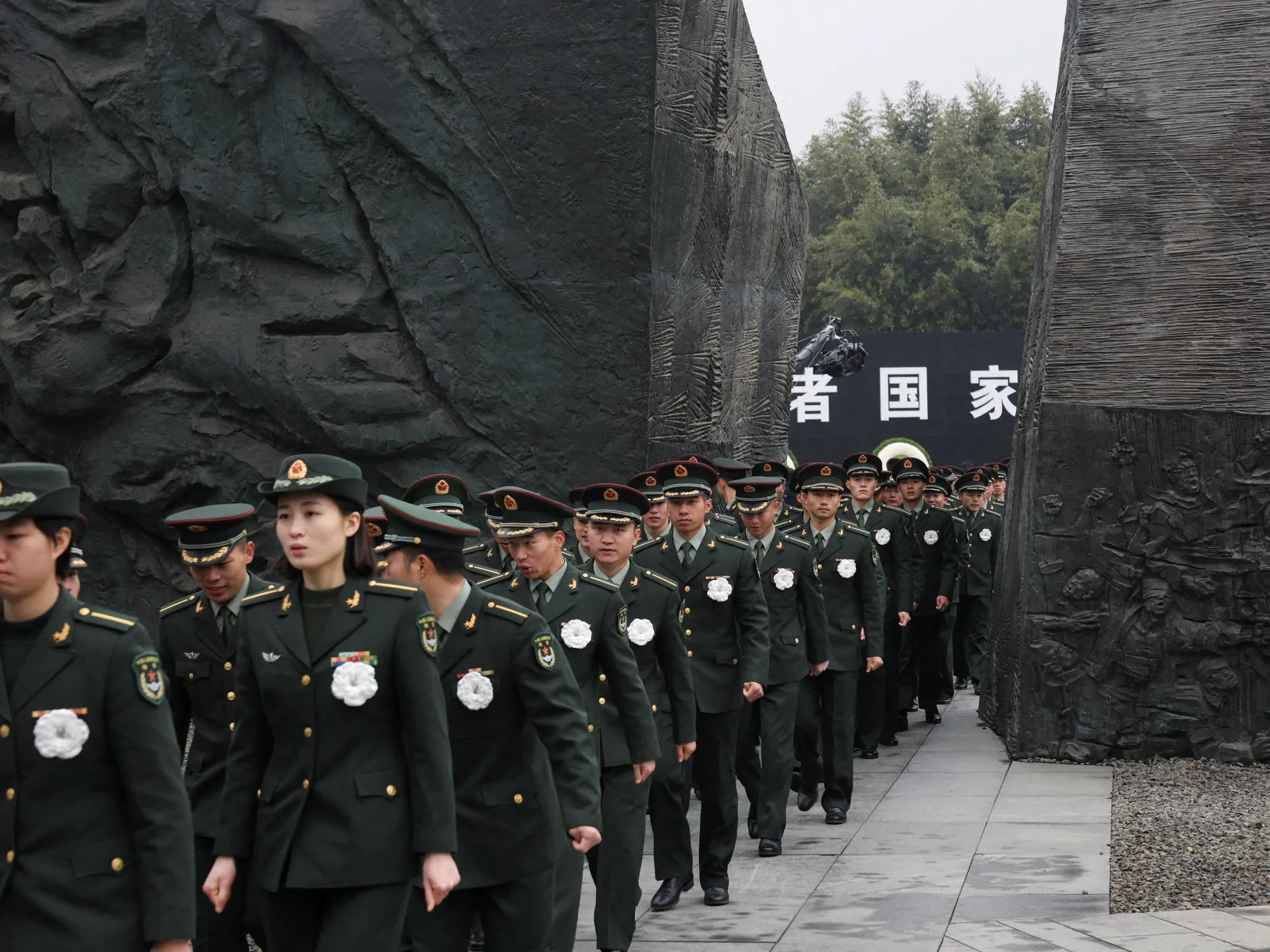
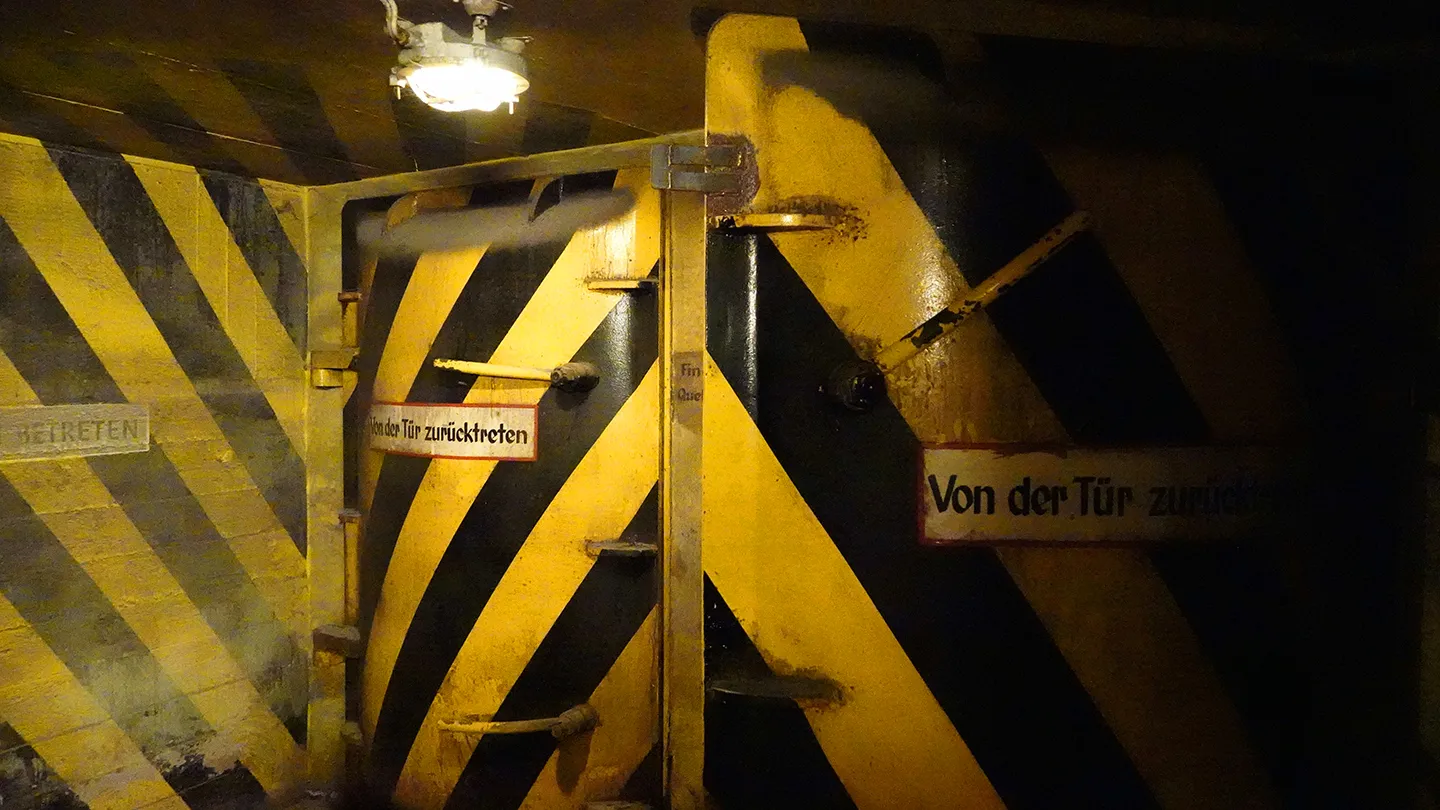


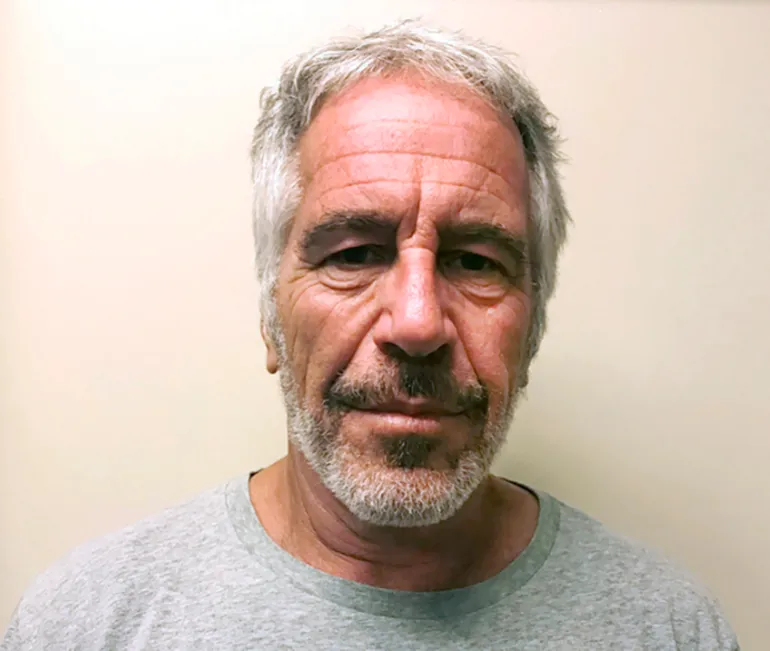



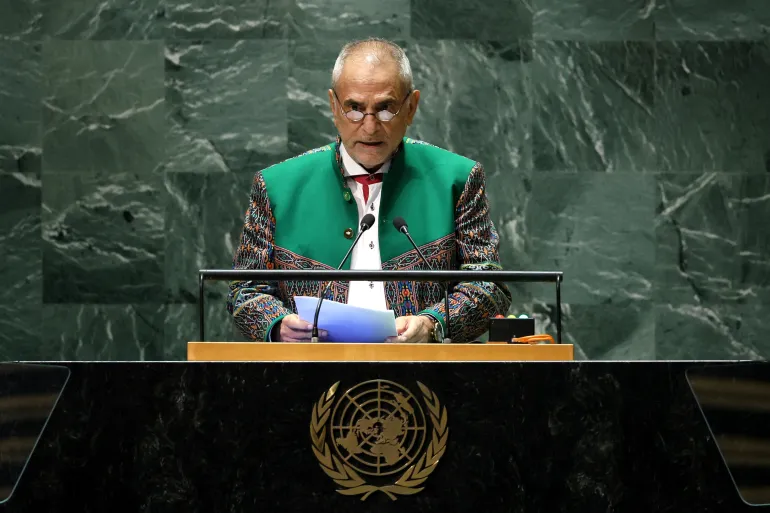


![While East Timor has one of the highest Catholic populations worldwide, LGBT rights have become more accepted, with even President Ramos - Horta a supporter. 2. Pride Parade from East Timor ’ s capital, Dili, to the famed Cristo Rei statue of Christ, built by the Indonesians during the occupation [Ali MC/Al Jazeera]](https://i0.wp.com/www.aljazeera.com/wp-content/uploads/2025/12/East-Timor-Additional-2-2-1765528720.jpg?w=640&ssl=1)
![Despite more than two decades of independence, Timor - Leste remains one of the poorest countries in the region (Ali MC/Al Jazeera]](https://i0.wp.com/www.aljazeera.com/wp-content/uploads/2025/11/Ramos-Horta-Article-6-1764315950.jpg?w=640&ssl=1)