Politics Desk

Conservative political analyst joins NewsNation for a new prime-time show

Katie Pavlich, a longtime contributor to Fox News, is leaving the network to join NewsNation.

Pavlich, a conservative political analyst, will have a nightly 10 p.m ET program starting early next year, the Nexstar-owned cable news channel announced Monday.

Pavlich, 37, will replace Ashleigh Banfield, who held down the time period since 2021. Banfield will partner with the network to create digital true crime content, including a podcast.

Pavlich has spent the last 16 years as news editor of the conservative website Townhall.com. She appeared regularly on cable ratings leader Fox News since 2013, appearing as a guest co-host on “The Five” and a fill-in host on its prime-time programs.

Pavlich becomes the latest Fox News alum to join NewsNation. Leland Vittert, a former correspondent for the network, is NewsNation’s 9 p.m. Eastern host. Chris Stirewalt, who was fired from Fox after the 2020 presidential election, is politics editor for the network.

Veteran cable news host Ashleigh Banfield will work on digital true crime content for NewsNation

Veteran cable news host Ashleigh Banfield joined NewsNation in March.

(NewsNation)

NewsNation was launched in 2020 as an alternative to the three major cable news networks at a time when all leaned heavily into opinion programming in prime time. But the network has moved toward political debate since Chris Cuomo became its highest rated host in prime time.

An Arizona native who grew up as an avid hunter, Pavlich is a strong advocate of the 2nd Amendment. She poses with firearms in a number of photos on her Instagram.

Pavlich is the author of several books, including New York Times bestsellers “Fast and Furious: Barack Obama’s Bloodiest Scandal” and “Assault and Flattery: The Truth About the Left and Their War on Women.”

Source link

Court battle begins over Republican challenge to California’s Prop. 50

Republicans and Democrats squared off in court Monday in a high-stakes battle over the fate of California’s Proposition 50, which reconfigures the state’s congressional districts and could ultimately help determine which party controls the U.S. House in the 2026 midterms.

Dozens of California politicians and Sacramento insiders — from GOP Assembly members to Democratic redistricting expert Paul Mitchell — have been called to testify in a Los Angeles federal courtroom over the next few days.

The GOP wants the three-judge panel to temporarily block California’s new district map, claiming it is unconstitutional and illegally favors Latino voters.

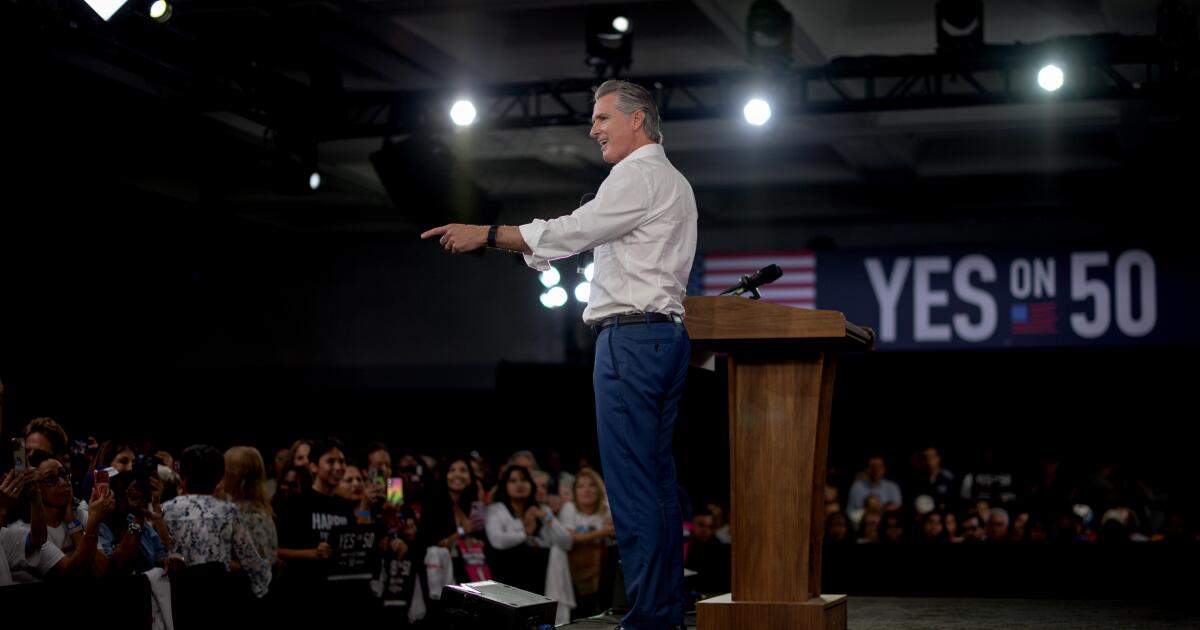
An overwhelming majority of California voters approved Prop. 50 on Nov. 4 after Gov. Gavin Newsom pitched the redistricting plan as a way to counter partisan gerrymandering in Texas and other GOP-led states. Democrats admitted the new map would weaken Republicans’ voting power in California, but argued it would just be a temporary measure to try to restore national political balance.

Attorneys for the GOP cannot challenge the new redistricting map on the grounds that it disenfranchises swaths of California Republicans. In 2019, the U.S. Supreme Court decided that complaints of partisan gerrymandering have no path in federal court.

But the GOP can bring claims of racial discrimination. They argue California legislators drew the new congressional maps based on race, in violation of the Equal Protection Clause of the 14th Amendment and the 15th Amendment, which prohibits governments from denying citizens the right to vote based on race or color.

On Monday, attorneys for the GOP began by homing in on the new map’s Congressional District 13, which currently encompasses Merced, Stanislaus, and parts of San Joaquin and Fresno counties, along with parts of Stockton.

When Mitchell drew up the map, they argued, he over-represented Latino voters as a “predominant consideration” over political leanings.

They called to the stand RealClearPolitics elections analyst Sean Trende, who said he observed an “appendage” in the new District 13, which extended partially into the San Joaquin Valley and put a crack in the new rendition of District 9.

“From my experience [appendages] are usually indicative of racial gerrymandering,” Trende said. “When the choice came between politics and race, it was race that won out.”

Republicans face an uphill struggle in blocking the new map before the 2026 midterms. The hearing comes just a few weeks after the U.S. Supreme Court allowed Texas to temporarily keep its new congressional map — a move that Newsom’s office says bodes poorly for Republicans trying to block California’s map.

“In letting Texas use its gerrymandered maps, the Supreme Court noted that California’s maps, like Texas’s, were drawn for lawful reasons,” Brandon Richards, a spokesperson for Newsom, said in a statement. “That should be the beginning and the end of this Republican effort to silence the voters of California.”

In Texas, GOP leaders drew up new congressional district lines after President Trump openly pressed them to give Republicans five more seats in the U.S. House of Representatives. A federal court blocked the map, finding racial considerations likely made the Texas map unconstitutional. But a few days later the Supreme Court granted Texas’ request to pause that ruling, signaling they view the Texas case, and this one in California, as part of a national politically-motivated redistricting battle.

“The impetus for the adoption of the Texas map (like the map subsequently adopted in California),” Justice Samuel A. Alito Jr. argued, “was partisan advantage pure and simple.”

The fact that the Supreme Court order and Alito’s concurrence in the Texas case went out of their way to mention California is not a good sign for California Republicans, said Richard L. Hasen, professor of law and director of the Safeguarding Democracy Project at UCLA School of Law.

“It’s hard to prove racial predominance in drawing a map — that race predominated over partisanship or other traditional districting principles,” Hasen said. “Trying to get a preliminary injunction, there’s a higher burden now, because it would be changing things closer to the election, and the Supreme Court signaled in that Texas ruling that courts should be wary of making changes.”

Many legal scholars argue that the Supreme Court’s ruling on the Texas case means California will likely keep its new map.

“It was really hard before the Texas case to make a racial gerrymandering claim like the plaintiffs were stating, and it’s only gotten harder in the last two weeks,” said Justin Levitt, a professor of law at Loyola Marymount University.

Hours after Californians voted in favor of Prop. 50 on Nov. 4, Assemblymember David J. Tangipa (R-Fresno) and the California Republican Party filed a lawsuit alleging that the map enacted in Prop. 50 for California’s congressional districts is designed to favor Latino voters over others.

The Department of Justice also filed a complaint in the case, arguing the new congressional map uses race as a proxy for politics and manipulated district lines “in the name of bolstering the voting power of Hispanic Californians because of their race.”

Mitchell, the redistricting expert who drew up the maps, is likely to be a key figure in this week’s battle. In the days leading up to the hearing, attorneys sparred over whether Mitchell would testify and whether he should turn over his email correspondence with legislators. Mitchell’s attorneys argued he had legislative privilege.

Attorneys for the GOP have seized on public comments made by Mitchell that the “number one thing” he started thinking about” was “drawing a replacement Latino majority/minority district in the middle of Los Angeles” and the “first thing” he and his team did was “reverse” the California Citizens Redistricting Commission’s earlier decision to eliminate a Latino district from L.A.

Some legal experts, however, say that is not, in itself, a problem.

“What [Mitchell] said was, essentially, ‘I paid attention to race,’” Levitt said. “But there’s nothing under existing law that’s wrong with that. The problem comes when you pay too much attention to race at the exclusion of all of the other redistricting factors.”

Other legal experts argue that what matters is not the intent of Mitchell or California legislators, but the California voters who passed Prop. 50.

“Regardless of what Paul Mitchell or legislative leaders thought, they were just making a proposal to the voters,” said Hasen, who filed an amicus brief in support of the state. “So it’s really the voters’ intent that matters. And if you look at what was actually presented to the voters in the ballot pamphlet, there was virtually nothing about race there.”

Source link

Newsom taps former CDC leaders critical of Trump-era health policies

Gov. Gavin Newsom on Monday announced a new California-led public health initiative, tapping former U.S. Centers for Disease Control and Prevention officials who publicly clashed with the Trump administration, including the former agency chief who warned that the nation’s public health system was headed to “a very dangerous place.”

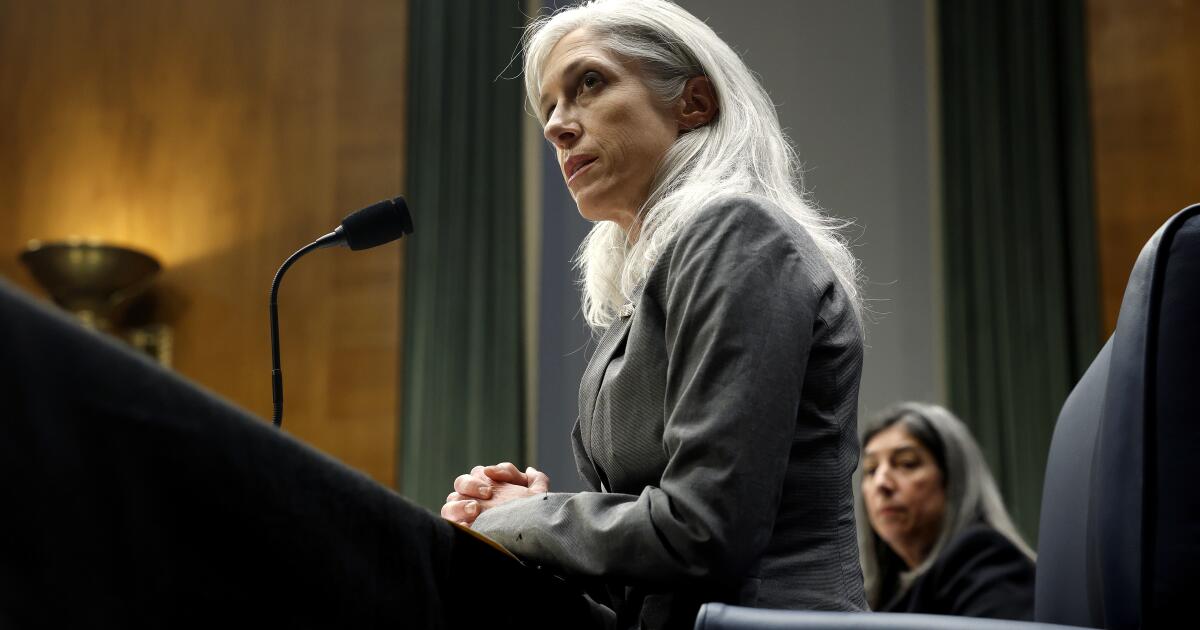
Newsom said the initiative will be led by Dr. Susan Monarez, the former CDC director, and Dr. Debra Houry, the CDC’s former chief medical officer. The pair will lead the Public Health Network Innovation Exchange, or PHNIX, which the governor’s office said will “modernize public health infrastructure and maintain trust in science-driven decision-making.”

The initiative was created to improve the systems that detect and investigate public health trends and build a modern public-health backbone that connects data, technology and funding across states.

“The Public Health Network Innovation Exchange is expected to bring together the best science, the best tools, and the best minds to advance public health,” Newsom said in a statement Monday. “By bringing on expert scientific leaders to partner in this launch, we’re strengthening collaboration and laying the groundwork for a modern public health infrastructure that will offer trust and stability in scientific data not just across California, but nationally and globally.”

Monarez will serve as strategic health technology and funding advisor for the initiative, helping advance private sector partnerships to better integrate healthcare data systems and enable faster disease surveillance.

“I am deeply excited to bring my experience in health technology and innovation to support PHNIX,” Monarez said in a statement shared by Newsom’s office. “California has an extraordinary concentration of talent, technology, and investment, and this effort is about putting those strengths to work for the public good — modernizing how public health operates, accelerating innovation, and building a healthier, more resilient future for all Californians.”

Houry was named senior regional and global public health medical advisor for PHNIX. Newsom’s office also announced it will work with Dr. Katelyn Jetelina, founder and chief executive of Your Local Epidemiologist. Jetelina will advise the California Department of Public Health on building trust in public health.

Monarez and Houry both described extraordinary turmoil inside the nation’s health agencies during congressional hearings, telling senators in September that Health and Human Services Secretary Robert F. Kennedy Jr. and political advisors rebuffed data supporting the safety and efficacy of vaccines. Monarez was fired after just 29 days on the job. She said Kennedy told her to resign if she did not sign off on new unsupported vaccine recommendations. Kennedy has described Monarez as admitting to him that she is “untrustworthy,” a claim Monarez has denied through her attorney.

“Dramatic and unfounded changes in federal policy, funding, and scientific practice have created uncertainty and instability in public health and health care,” Dr. Erica Pan, CDPH director and state public health officer, said in a statement. “I am thrilled to work with these advisors to catalyze our efforts to lead a sustainable future for public health. California is stepping up to coordinate and build the scaffolding we need to navigate this moment.”

The salaries of the new positions were not immediately known.

Newsom’s office said the California initiative would build on previously announced public health partnerships, such as the West Coast Health Alliance.

Source link

Column: California Democrats have momentum, Republicans have problems

You’re reading the L.A. Times Politics newsletter

Anita Chabria and David Lauter bring insights into legislation, politics and policy from California and beyond. In your inbox three times per week.

By continuing, you agree to our Terms of Service and our Privacy Policy.

It turns out Proposition 50 smacked California Republicans with a double blow heading into the 2026 congressional elections.

First, there was the reshaping of House districts aimed at flipping five Republican-held seats to Democrats.

Now, we learn that the proposition itself juiced up Democratic voter enthusiasm for the elections.

Voter enthusiasm normally results in a higher casting of ballots.

It’s all about the national battle for control of the U.S. House of Representatives — and Congress potentially exercising its constitutional duty to provide some checks and balance against the president. Democrats need a net pickup of only three seats in November’s elections to dethrone Republicans.

President Trump is desperate to keep his GOP toadies in power. So, he has coerced — bullied and threatened — some red-state governors and legislatures into rejiggering Democratic-held House seats to make them more Republican-friendly.

When Texas quickly obliged, Gov. Gavin Newsom retaliated with a California Democratic gerrymander aimed at neutralizing the Lone Star State’s partisan mid-decade redistricting.

California’s counterpunch became Proposition 50, which was approved by a whopping 64.4% of the state’s voters.

Not only did Proposition 50 redraw some GOP-held House seats to tinge them blue, it stirred up excitement about the 2026 elections among Democratic voters.

That’s the view of Mark Baldassare, polling director for the nonpartisan Public Policy Institute of California. And it makes sense. Umpteen millions of dollars were spent by Newsom and Proposition 50 backers advertising the evils of Trump and the need for Democrats to take over the House.

A PPIC poll released last week showed a significant “enthusiasm gap” between Democratic and Republican voters regarding the House contests.

“One of the outcomes of Proposition 50 is that it focused voters on the midterm elections and made them really excited about voting next year,” Baldassare says.

At least, Democrats are showing excitement. Republicans, not so much.

In the poll, likely voters were asked whether they were more enthusiastic than usual about voting in the congressional elections or less enthusiastic.

Overall, 56% were more enthusiastic and 41% less enthusiastic. But that’s not the real story.

The eye-opener is that among Democrats, an overwhelming 72% were more enthusiastic. And 60% of Republicans were less enthusiastic.

“For Democrats, that’s unusually high,” Baldassare says.

To put this in perspective, I looked back at responses to the same question asked in a PPIC poll exactly two years ago before the 2024 elections. At that time, Democrats were virtually evenly split over their enthusiasm or lack of it concerning the congressional races. In fact, Republicans expressed more enthusiasm.

Still, Democrats gained three congressional seats in California in 2024. So currently they outnumber Republicans in the state’s House delegation by a lopsided 43 to 9.

If Democrats could pick up three seats when their voters weren’t even lukewarm about the election, huge party gains seem likely in California next year. Democratic voters presumably will be buoyed by enthusiasm and the party’s candidates will be boosted by gerrymandering.

“Enthusiasm is contagious,” says Dan Schnur, a former Republican operative who teaches political communication at USC and UC Berkeley. “If the party’s concentric circle of committed activists is enthusiastic, that excitement tends to spread outward to other voters.”

Schnur adds: “Two years ago, Democrats were not motivated about Joe Biden or Kamala Harris. Now they’re definitely motivated about Donald Trump. And in order to win midterm elections, you need to have a motivated base.”

Democratic strategist David Townsend says that “enthusiasm is the whole ballgame. It’s the ultimate barometer of whether my message is working and the other side’s is not working.”

The veteran consultant recalls that Democrats “used to go door to door handing out potholders, potted plants, refrigerator magnets and doughnuts trying to motivate voters.

“But the best turnout motivator Democrats have ever had in California is Donald J. Trump.”

In the poll, 71% of voters disapproved of the way Trump is handling his job; just 29% approved. It was even worse for Congress, with 80% disapproving.

Among Democratic voters alone, disapproval of Trump was practically off the chart at 97%.

But 81% of Republicans approved of the president.

Among voters of all political persuasions who expressed higher than usual enthusiasm about the House elections, 77% said they‘d support the Democratic candidate. Also: 79% said Congress should be controlled by Democrats, 84% disapproved of how Congress is handling its job and 79% disapproved of Trump.

And those enthused about the congressional elections believe that, by far, the most important problem facing the nation is “political extremism [and] threats to democracy.” A Democratic shorthand for Trump.

The unseemly nationwide redistricting battle started by Trump is likely to continue well into the election year as some states wrestle with whether to oblige the power-hungry president and others debate retaliating against him.

Sane politicians on both sides should have negotiated a ceasefire immediately after combat erupted. But there wasn’t enough sanity to even begin talks.

Newsom was wise politically to wade into the brawl — wise for California Democrats and also for himself as a presidential hopeful trying to become a national hero to party activists.

“Eleven months before an election, nothing is guaranteed,” Schnur says. “But these poll numbers suggest that Democrats are going to start the year with a big motivational advantage.”

Trump is the Democrats’ proverbial Santa who keeps on giving.

What else you should be reading

The must-read: Kristi Noem grilled over L.A. Purple Heart Army vet who self-deported
The TK: Newsom expresses unease about his new, candid autobiography: ‘It’s all out there’
The L.A. Times Special: A Times investigation finds fraud and theft are rife at California’s county fairs

Until next week,
George Skelton


Was this newsletter forwarded to you? Sign up here to get it in your inbox.

Source link

Scott Brown: ‘Thank God’ Elizabeth Warren didn’t pose nude

With two words, Massachusetts Sen. Scott Brown launched himself into controversy Thursday morning when he joked about being glad that Elizabeth Warren, his likely Democratic opponent in 2012, had never posed in the nude.

Brown was responding to a quip Warren made at a Democratic debate Tuesday. Asked how she had paid for college – compared with Brown, who once posed partially nude for Cosmopolitan – Warren said: “I kept my clothes on.”

Brown fired back during an interview onBoston radio station WZLX: “Thank God!”

The jab went over well with the host, who laughed, then tried to stoke the flames.

“That’s what I said,” the host responded. “I said, look, can you blame a good looking guy for, you know, for wanting to…”

Brown swept into office last year on a tea party wave that helped him take a seat that had been held by Edward M. Kennedy for nearly 50 years. Democrats will fight hard to win it back in 2012.

Warren has a strong following and is known for her consumer advocacy. Obama tapped her last year to set up a new consumer protection agency, but Republicans opposed letting her head the agency.

She entered the Senate race in mid-September after being heavily courted, but her nomination is not guaranteed – the Democratic primary field is packed with other contenders. Brown’s comment made him an easy target at a time when he’d be better off laying low and letting the Democrats fight it out.

Brown cut in with an attempt to soften the jab: “You know what, listen, bottom line is I didn’t go to Harvard. You know, I went to the school of hard knocks and I did whatever I had to do to pay for school.”

(Warren also did not go to Harvard, though she is a Harvard law professor.)

Brown went on to describe how he faced “real challenges growing up.”

“You know, whatever,” he said. “You know, let them throw stones. I did what I had to do. And but not for having that opportunity, I never would have been able to pay for school and never would have gone to school and I wouldn’t probably be talking to you, so, whatever.”

The host didn’t want to let Brown’s initial comment go, and Brown wasn’t going to take all the blame.

“That’s funny you throw that jab, because –“ the host began. But Brown again cut him off.

“You said it too!” Brown replied.

The Massachusetts Democratic Party was quick to respond, scolding Brown for the comment.

“Sen. Brown’s comments are the kind of thing you would expect to hear in a frat house, not a race for U.S. Senate,” executive director Clare Kelly said in a statement. “Scott Brown’s comments send a terrible message that even accomplished women who are held in the highest esteem can be laughingly dismissed based on their looks.”

kim.geiger@latimes.com

Source link

Wilson Expands on Plan for ID Card : Immigration: Governor wants the state to be a testing ground for the tamper-proof documents. But he admits that it would probably be impossible to come up with a foolproof system.

Gov. Pete Wilson challenged President Clinton on Thursday to make California a test market for a tamper-proof federal identification card designed to keep illegal immigrants from receiving public benefits or getting jobs in the United States.

Later, a Wilson aide said one option might be a national identification card that would be carried by every legal resident of the United States, including U.S. citizens.

Wilson’s news conference at U.S. Immigration and Naturalization Service offices at Los Angeles International Airport was billed as the forum for a “major announcement regarding immigration.” In fact, Wilson’s statement expanded on his Aug. 9 program by only a small step–the proposed California test–while raising even more questions about his plan for the proposed identification card.

The governor acknowledged to a reporter that it probably is impossible to come up with a foolproof card because counterfeiters could fake birth certificates, passports or other documents that would be needed to get the card.

Wilson left unclear just who might have to possess the card: just foreign nationals living in the country legally or all U.S. citizens?

Asked who would have to carry the card, Wilson said: “Those who are applicants for employment and those who are applicants for benefits.”

Later, Wilson aide Dan Schnur said one possibility that arose during policy discussions in the governor’s office was a national identification card issued to all U.S. citizens and legal residents.

“A universal card is one option, but we’re not looking at it as an absolute condition,” Schnur said in telephone calls to reporters.

The form and scope of any card would be worked out in negotiations with the Clinton Administration, he said.

There have been periodic proposals for a national ID card, but they have always run up against strong opposition on civil liberties grounds.

Wilson was quoted by the Santa Monica Outlook while running for the U.S. Senate in 1982 that a proposed national identification card was “a lousy idea” because it would create a massive new bureaucracy. He also said he had some philosophical objections to the concept.

Schnur had no comment on that report, but he said conditions have changed greatly since the passage of immigration reform in the late 1980s and the heavy influx of illegal immigrants into California in recent years.

Thursday’s billing of a major new initiative drew a dozen television cameras and perhaps a score of reporters, a big turnout for any political event in Los Angeles. Although it turned out that Wilson’s statement was more of an expansion on a previous proposal than a major new initiative, the session did give the governor a platform for responding to critics of his Aug. 9 announcement.

Wilson said an identification card is the key to the enforcement of any of the sanctions written into federal law against employers who hire illegal immigrants for jobs in the United States. Without it, such sanctions are unenforceable, he said.

“Until we deal with the problem of document fraud, anyone proposing additional employer sanctions is simply blowing hot air,” Wilson said after examining stacks of phony passports, Social Security cards and other false documents confiscated by the INS.

Critics, including potential Democratic gubernatorial challenger Kathleen Brown, have said Wilson’s plan cracks down on illegal immigrants but not on the employers who also violate the law by hiring them.

Last week, Brown, the state treasurer, endorsed a national tamper-proof Social Security card that would have to be presented to a prospective employer before the cardholder could be hired.

In his lengthy Aug. 9 letter to Clinton, Wilson called on the federal government to compensate California for the cost of services to illegal immigrants, called for stricter enforcement of the California-Mexico border, and said children born on U.S. soil to undocumented immigrants should not automatically become U.S. citizens or be eligible to attend public schools in California.

Wilson made no mention of stronger enforcement against employers. He proposed an identification card as something that foreign nationals in the country legally would present to qualify for state services.

Wilson said California’s modern holographic drivers licenses could be the model for a federal card, but a reporter wondered if even they could be forged, since a photographic blowup of one was among the fake IDs on display.

“You know, I don’t dispute the ingenuity of counterfeiters. . . . I think it is possible to stay technologically ahead of even expert counterfeiters,” Wilson said.

“The question really is not whether you’re going to have an entirely foolproof system, but whether you have one that works to achieve its major goal, which is to screen out the vast majority of counterfeit documents.”

Later in the day, Democratic state Chairman Bill Press chided Wilson for intervening with the INS in 1989 on behalf of a San Diego supporter, Anne Evans, whose hotels were under investigation for hiring illegal immigrants. At the time, Wilson was a U.S. senator.

Evans ultimately was accused of 362 violations of employer sanctions provisions and fined $70,000.

Schnur described Wilson’s letter, which sought a conciliation between the INS and Evans, as a routine constituent service.

Source link

La Follette to Challenge Wright for State Senate : Politics: The former legislator would pose significant opposition to the Republican assemblywoman from Simi Valley in the new 19th District.

Marian La Follette, who spent 10 years as a Republican Assemblywoman from Northridge before retiring in 1990, plans to enter the state Senate race in the new district that stretches from Oxnard to the San Fernando Valley, Republican sources said Tuesday.

“I just spoke to her a little while ago, and she has made up her mind that she will be running,” said Charles H. Jelloian, a Republican from Northridge. Jelloian said he has decided to withdraw from the state Senate race, partly to make way for La Follette’s return to politics.

“Marian’s jumping into the race is a very big factor,” said Jelloian, who became acquainted with La Follette when he was an aide to state Sen. Newton R. Russell (R-Glendale). “I worked very, very well with her for a long time,” he said. “I have a lot of respect for her.”

La Follette has lived in Orange County since her retirement. She could not be reached for comment Tuesday.

If she enters the race, she could pose a formidable challenge to Assemblywoman Cathie Wright (R-Simi Valley) in the new 19th state Senate District. So far, Wright is the leading candidate in the district that encompasses Oxnard, Camarillo, Thousand Oaks, Moorpark, Fillmore, Simi Valley and Northridge.

“Both are new to this district,” said one Republican source. “I think they would start out about equal.”

Roger Campbell, a Republican city councilman in Fillmore, also has declared his candidacy in the heavily Republican district. No Democratic candidate has come forward in the district that has roughly 28,000 more registered Republican voters than Democrats.

La Follette, a conservative legislator, was best known for her persistent efforts to divide the massive Los Angeles Unified School District into smaller districts.

She decided to retire two years ago when her late husband, Jack, a Los Angeles lawyer, fell seriously ill with cancer.

When she was in the Legislature, she aligned herself with Sen. Ed Davis (R-Santa Clarita), who is vacating the Senate seat. Republican sources said they anticipate that Davis will support her candidacy against Wright, a longtime political foe.

La Follette’s candidacy is another indication that Assemblyman Tom McClintock (R-Thousand Oaks) will run for Congress. She and McClintock are strong political allies.

McClintock has toyed with the notion of running for state Senate, GOP sources said. The long-anticipated announcement of his plans has been postponed until later this week.

Source link

Geraldine Ferraro dies at 75; shattered political barrier for women as vice presidential nominee in 1984

Geraldine A. Ferraro, the savvy New York Democrat who was embraced as a symbol of women’s equality in 1984 when she became the first woman nominated for vice president by a major party, died Saturday at Massachusetts General Hospital in Boston. She was 75.

The cause was complications from multiple myeloma, her family said.

Ferraro was diagnosed with multiple myeloma, an incurable form of blood cancer, in 1998. She did not disclose her illness publicly until 2001, when she went on NBC’s “Today” show and said she had beaten the cancer into remission with thalidomide, the once-banned drug that had proven effective with some end-stage cancers. The cancer recurred, but she again went into remission after therapy with a new drug.

Initially told that she had three to five years to live, she survived for more than 12 years, long enough to witness the historic candidacies of two other women in 2008: Hillary Rodham Clinton, the former first lady and current secretary of State who ran against Barack Obama for the Democratic presidential nomination, and Sarah Palin, the former Alaska governor who was Republican Sen. John McCain’s running mate.

Ferraro was “a pioneer in our country for justice and a more open society,” former Vice President Walter Mondale told the Associated Press of his former running mate. “She broke a lot of molds, and it’s a better country for what she did.”

Palin also praised Ferraro, writing in a Facebook message that she “broke one huge barrier and then went on to break many more.”

Ferraro’s 1984 candidacy was seen as a potentially powerful weapon to turn the emerging “gender gap” of the 1980s to the advantage of the Democratic Party, which sought to regain the White House after Ronald Reagan’s first term.

But her four-month campaign almost immediately hit rough waters. She was bashed by critics who questioned the finances of her husband, John Zaccaro, a Manhattan real estate developer. A devout Roman Catholic, she was repeatedly assailed by New York’s archbishop, the late John J. O’Connor, for her views supporting abortion rights. She also endured insinuations of mob connections as the first Italian American on a national ticket.

“I was constantly being asked, ‘Was it worth it?’ Of course it was worth it!” she wrote in “Framing a Life, A Family Memoir,” published in 1998. “My candidacy was a benchmark moment for women. No matter what anyone thought of me personally, or of the Mondale-Ferraro ticket, my candidacy had flung open the last door barring equality — and that door led straight to the Oval Office.”

Her nomination astonished some of the most stalwart feminists. Among them was Ms. magazine founder Gloria Steinem, who had predicted that 1984 would be the year that politicians talked seriously about putting a woman on the national ticket, not “the year they actually did it.”

Over the next two decades, other women achieved milestones in national politics. Janet Reno became U.S. attorney general, Madeleine Albright was named secretary of State, and Nancy Pelosi became speaker of the House.

Their path was eased by Ferraro, who believed that a childhood tragedy set up her moment in history.

“I’ve often said that if my father hadn’t died, I might not have done anything,” Ferraro once told Steinem in an interview. “I saw my mother left suddenly with kids and no money…. I wanted to be able to take care of myself and not miss a beat.”

Born Aug. 26, 1935, in Newburgh, N.Y., she was the pampered daughter of Antonetta and Dominick Ferraro, Italian immigrants who had lost a son, Gerard, in a car crash and were so overjoyed at her birth a few years later that they named her Geraldine, in memory of him.

Dominick Ferraro ran a successful restaurant in Newburgh. When business fell on hard times, he turned to running a numbers game and was arrested. On the morning he was to appear in court, he died of an apparent heart attack. Ferraro was 8.

She became seriously anemic — doctors told her she had internalized her grief — and was unable to attend school for months. Strapped for money, her mother moved the family to a cramped Bronx apartment and took a job as a crochet beader. By scrimping on meat and other luxuries, she managed to send Ferraro to Marymount, an exclusive parochial school in Tarrytown, N.Y., and later to Marymount Manhattan College.

Ferraro graduated and became an elementary school teacher in Queens. At night she put herself through Fordham Law School, one of two women in a class of 179 whose professors resented her for “taking a man’s rightful place.”

Years later, when she was raising three children of her own and finally had begun to practice law, Ferraro split her legal fees with her mother and kept her maiden name in tribute.

She took the bar exam two days before her wedding in 1961 and passed, but Zaccaro did not want his wife to work, so she spent the next 13 years as a homemaker in upper-middle-class Forest Hills, N.Y. Their first child, Donna, was born in 1961, followed by John Jr. in 1964 and Laura in 1966.

She balanced her domestic responsibilities with pro bono work for women in family court and became the first woman on the board of the Forest Hills Gardens Corp. She also was elected president of a women’s bar association.

In 1974, when her youngest child was in second grade, she went to see her cousin, Queens Dist. Atty. Nicholas Ferraro, who hired her as a prosecutor. Within three years she was promoted to chief of the special victims bureau, in charge of sex crimes, child abuse, rape and domestic violence cases. It was emotionally draining work, but she won six jury trials, aided, according to a review by American Lawyer magazine, by her “straightforward eloquent approach” and “meticulous courtroom preparation.”

Her years as a prosecutor transformed her from a “small-c conservative to a liberal,” she later said. And it would lead her to adopt a supportive view of abortion that would put her in conflict with her church.

“You can force a person to have a child, but you can’t make the person love that child,” Ferraro wrote, reflecting on the child abuse cases she prosecuted. “I don’t know what pain a fetus experiences, but I can well imagine the suffering of a four-year-old girl being dipped in boiling water until her skin came off and then lying in bed unattended for two days until she died. And that was only one of the cases seared in my memory.”

In 1978, Ferraro formally entered politics. Running for Congress on the slogan “Finally, a tough Democrat,” she won by a 10% margin despite being snubbed by local party leaders.

She was reelected twice by even larger margins — 58% in 1980 and 73% in 1982.

She studiously strove to avoid the pitfalls of being a rookie and one of the few women in Congress. After overhearing a male colleague’s putdown of a new female member who “couldn’t find her way to the ladies’ room,” Ferraro mentally mapped out her exact route whenever she headed out the door. “Silly, right? And totally inconsequential,” she said. “But nothing is worse than looking as if you don’t know where you’re going.”

A quick learner, she soon caught the attention of House Speaker Tip O’Neill, who called her “a regular since the day she arrived.” She was in many ways an old-fashioned politician who could schmooze and glad-hand with the most wizened colleagues. O’Neill rewarded her with seats on the Democratic Steering and Policy Committee and the House Budget Committee, as well as the position of secretary to the House Democratic Caucus. Male colleagues found her effective but, as then-Rep. Leon E. Panetta described her, “not a Bella Abzug type,” a reference to the late New York congresswoman and feminist leader known for her confrontational style.

Ferraro supported a nuclear freeze, opposed Reagan’s tax-cut proposal, upheld support for social programs for the poor, elderly and children, and was a strong supporter of Israel. She was passionate about abortion rights and championed the Equal Rights Amendment. She also voted against mandatory busing for integration and for tuition tax credits for parochial schools, positions that won favor in her conservative, largely blue-collar district. Her record earned a description in Time as “a New Deal Democrat with a good seasoning of traditional family values,” an appealing balance that eventually would help her leap onto the national stage.

While she was building her career in Washington, interest in the gender gap began to intensify. Proportionally more men than women had voted Reagan into office in 1980. Many partisans began to take note of the fact that he had won by 8.4 million votes, a margin that they hoped could be overturned the next time by some 30 million unregistered women of voting age.

In late 1983, the drumbeat for a female vice president began at a conference of the National Organization for Women, the nation’s largest feminist group. Polls began to ask whether a woman on the ticket would make a difference, and the answer was coming back as yes.

In Washington, a group of politically connected Democratic women began a stealth campaign. Calling themselves Team A, they prodded prominent Democrats to publicly endorse the concept of a female vice president. Eventually, Mondale, Gary Hart and Edward M. Kennedy spoke favorably of the idea. The ad-hoc group floated names of potential candidates, including women then in Congress such as Barbara Mikulski of Maryland and Pat Schroeder of Colorado, and then-San Francisco Mayor Dianne Feinstein. They encouraged women in the national media to write about putting a woman on the ticket.

Early in 1984, after vetting the possibilities, the group decided that the woman with the most voter appeal was Ferraro. Over a Chinese takeout dinner, Team A broached the subject with her. Would she “stay open to the idea of becoming the actual nominee” if the concept caught on? Ferraro recalled her reaction: “I was flabbergasted and flattered.” The possibility of her nomination struck her as extremely remote, but she agreed to become the focus of the team’s efforts.

To raise her national profile, she went after a prominent role in the upcoming Democratic National Convention and became the first woman to be platform chair. She earned high marks for averting a potential convention revolt by delegates pledged to Hart and Jesse Jackson, who ultimately were satisfied that the platform reflected their views.

While she labored over the platform, prominent figures, including House Speaker O’Neill, began to drop her name as a contender for the No. 2 spot on the ticket.

By early July, she was regularly mentioned as a finalist on Mondale’s list, along with San Antonio Mayor Henry Cisneros, Los Angeles Mayor Tom Bradley, Philadelphia Mayor Wilson Goode, Kentucky Gov. Martha Layne Collins, Texas Sen. Lloyd Bentsen, and Feinstein. The party front-runner summoned her to Minnesota for an interview, but she nearly pulled herself out of contention after leaks from a high-ranking Mondale staffer resulted in stories deriding her prospects.

The waiting ended July 11 when Mondale popped the question: Would she be his running mate?

“I didn’t pause for a minute,” Ferraro wrote in “Ferraro: My Story,” published in 1985.

At a news conference that day, an unusually effervescent Mondale said — twice — “This is an exciting choice.”

Among the pundits who agreed was New Yorker political analyst Elizabeth Drew. Ferraro’s selection, she wrote, was “a lightning bolt across the political landscape.” It not only would help Mondale energize female voters, Hart supporters and independents, but would bolster the staid image of the Minnesota Democrat who, in a stroke, had “reduced ? the assumption that he is incapable of bold action.” Dragging by double digits in the polls, Mondale had grasped his “best, and perhaps only, hope” for victory in November.

On July 19, Ferraro strode onto the stage at San Francisco’s Moscone Center to accept her party’s nomination. She was greeted by roars of “Gerr-reee! Gerr-reee!” from what looked like a sea of jubilant women, many of them non-delegates who had finagled floor passes to witness this stirring moment in the nation’s history.

“My name is Geraldine Ferraro,” the then-48-year-old declared, for once slowing her usual staccato style of speech. “I stand before you to proclaim tonight, America is the land where dreams can come true for all of us.”

The mood “was so electric that just being female felt terrific,” Maureen Dowd wrote in the New York Times.

But none of Ferraro’s years in Congress prepared her for the hurricane that was coming.

The media clamored for interviews, amassing in such numbers that Capitol Hill police roped off her office to keep them at bay. More than 50,000 letters and gifts — ranging from books to a boxing glove — poured in by election day.

Within two weeks of her nomination, the flak began to hit.

Critics blasted her for taking the statutory exemption to withhold information about her husband’s finances on disclosure statements required of members of Congress. And John Zaccaro was attacked for improperly borrowing money from the estate of an 84-year-old widow. He later was removed as conservator. In subsequent weeks the public would learn that Ferraro had improperly loaned money to her first House campaign in 1978, and that Zaccaro and Ferraro had underpaid their taxes that year.

In the blur of campaigning, Ferraro approved a news release that mistakenly said she would release her husband’s tax returns. When she subsequently refused to release the returns, the candidate with a dangerous tendency toward flippancy told a reporter: “You people who are married to Italian men, you know what it’s like.”

Immediately she knew she had made a terrible gaffe. She had meant that Italian men tended to be private about their personal affairs, but her remark was interpreted as an ethnic slur. It also fueled debate about Ferraro’s toughness, with critics contending if she wasn’t strong enough to oppose her husband, she couldn’t stand up to the Soviets.

Media scrutiny of her husband was so intense that reporters even began to investigate allegations that his father had once rented space to a member of the Gambino crime family.

(Washington Post editor Benjamin Bradlee later observed that the charges, which never amounted to much, would not have been made if she had been “somebody named Jenkins. You’d have to be from another planet not to think that,” he told The Times in a post-election analysis.)

In late August, she released a detailed financial disclosure statement and faced the national media. She earned favorable reviews for her responses to 90 minutes of often hostile questioning (“Ferraro passes a vital test,” went a cover line in Time) but her candidacy never recovered.

In September, Ferraro began fending off attacks on a new front. New York’s Archbishop O’Connor lashed out at her stand on abortion rights and said she had misrepresented church teachings on abortion. He even held open the possibility of excommunication. Anti-abortion and abortion-rights groups clashed at her rallies.

The Italian American community did not rise to her defense, even when other critics attempted to smear her with allegations of underworld dealings. Some commentators decried the sexism they said was fueling the attacks. Noting the silence of the Italian American community, syndicated columnist Richard Reeves observed: “The stoning of Geraldine Ferraro in the public square goes on and on, and no one steps forward to help or protest — not even one of her kind?. The sons of Italy and fathers of the Roman Catholic Church are silent or are too busy reaching for bigger rocks?. Heresy! Mafia! Men are putting women in their place.”

Ferraro did well when she faced then-Vice President George H.W. Bush in debate. He ignored her request that she be addressed as “Congresswoman,” however, and called her “Mrs. Ferraro” instead. Shortly before the debate, she was insulted by Barbara Bush who called her “that four-million-dollar — I can’t say it, but it rhymes with ‘rich.’ ” (Ferraro and Zaccaro’s net worth had been reported at $3.8 million.)

She was discouraged by news coverage that she felt rarely reflected the enthusiasm and massive crowds she encountered on the campaign trail. “They were far less interested in what I had to say about the life-and-death issues facing the nation than they were about what I was wearing, how I looked that day, whether or not I cried, and what was happening in my marriage,” she recalled in her memoir.

Reagan, one of the most popular presidents in history, wound up with an 18-point victory, aided in part by women, who supported him in greater numbers than they had the Mondale-Ferraro ticket. Post-election analyses found that Ferraro had neither greatly helped nor hindered the Democrats’ chances.

What later became clear to Ferraro was how ambivalent the electorate — particularly women — had been about her candidacy.

Those attitudes led Ferraro to make a controversial appearance in a 1991 commercial for Pepsi-Cola, in which she endorsed being a mother over being in politics. Feminists shouted betrayal.

The commercial apparently did little to bolster her chances the following year when she ran for the Democratic nomination for Senate. She lost the 1992 Democratic primary and again in the 1998 primary, her last bid for elected office.

Fatigued after the primary, she went for a medical checkup and was diagnosed with multiple myeloma.

She was determined to remain active despite the ups and down of her health. At President Clinton’s request, she served as U.S. ambassador to the United Nations Human Rights Commission. She found a forum for her views on television as the liberal co-host of CNN’s “Crossfire” and as a Fox political analyst. In 2004, she helped found grannyvoter.org with other female activists in their 60s to encourage grandparents to become politically involved. She also worked for a number of lobbying firms.

Later, Ferraro was a feisty advocate for Hillary Clinton’s bid for the Democratic presidential nomination, garnering criticism for remarking during the heated 2008 primary season that Obama had an advantage because he is black. The remark was perceived as racist, and in the ensuing controversy, Ferraro resigned from her voluntary position on Clinton’s campaign finance committee, but she did not back away from her view of how race and gender were playing out in the campaign.

“Sexism is a bigger problem” than racism in the United States, Ferraro told the Daily Breeze in the March 2008 story that made her a liability for the Clinton campaign. “It’s OK to be sexist in some people’s minds. It’s not OK to be racist.”

She harbored no regrets at having tried to become the first female vice president, despite how grueling the struggle was. What women needed to remember, she told an interviewer in 2004, was a simple fact of politics: “If you don’t run, you can’t win.”

In addition to her husband and three children, Ferraro, who lived in New York City, is survived by eight grandchildren. Funeral arrangements are pending.

elaine.woo@latimes.com

Source link

Rob Reiner used his fame to advocate for progressive causes. ‘Just a really special man. A terrible day’

Rob Reiner was known to millions as a TV actor and film director.

But the Brentwood resident, known for the classic films “Stand by Me” and “When Harry Met Sally,” was also a political force, an outspoken supporter of progressive causes and a Democratic Party activist who went beyond the typical role of celebrities who host glitzy fundraisers.

Reiner was deeply involved in issues that he cared about, such as early childhood education and the legalization of gay marriage.

Reiner, 78, and his wife, Michelle Singer Reiner, were found dead inside his home Sunday, sparking an outpouring of grief from those who worked with him on a variety of causes.

Ace Smith — a veteran Democratic strategist to former Vice President Kamala Harris, Gov. Gavin Newsom, former Gov. Jerry Brown and presidential candidate Hillary Clinton — had known Reiner for decades. Reiner, he said, approached politics differently than most celebrities.

“Here’s this unique human being who really did make the leap between entertainment and politics,” Smith said. “And he really spent the time to understand policy, really, in its true depth, and to make a huge impact in California.”

Reiner was a co-founder of the American Foundation for Equal Rights, the organization that successfully led the fight to overturn Proposition 8, the 2008 ballot measure that banned same-sex marriage. He was active in children’s issues through the years, having led the campaign to pass Proposition 10, the California Children and Families Initiative, which created an ambitious program of early childhood development services.

Proposition 10 was considered landmark policy. Reiner enlisted help in that effort from Steven Spielberg, Robin Williams, and his own father, comedy legend Carl Reiner.

“He wanted to make a difference. And he did, and he did profoundly,” Smith said.

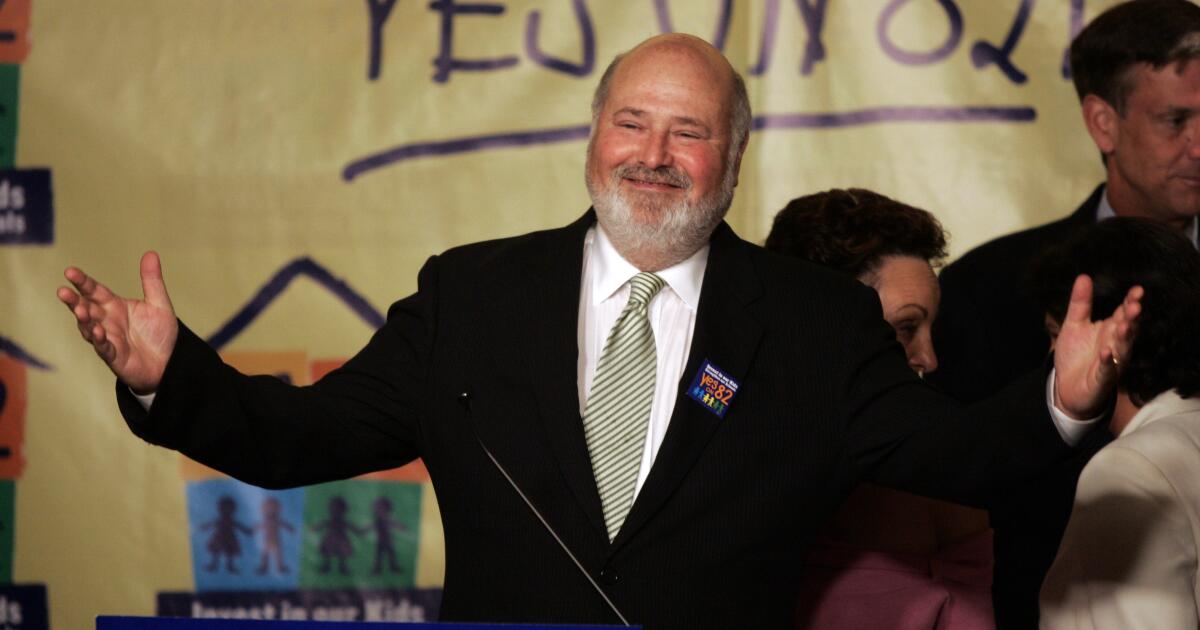
Reiner was also a leading backer of Proposition 82, an unsuccessful measure that would have taxed the wealthy to create universal preschool in California.

Former Los Angeles Mayor Antonio Villaraigosa, who had known Reiner since he was a state lawmaker in the 1990s, worked with him on Proposition 10 and was impressed with how Reiner embraced the cause.

“He was a man with a good answer. It wasn’t politics as much as he was always focused on the humanity among us,” Villaraigosa said. ‘When he got behind an issue, he knew everything about it.”

“Just a really special man. A terrible day,” the former mayor said.

Mayor Karen Bass said in a statement that she was “heartbroken” by the day’s events, saying Reiner “always used his gifts in service of others.”

“Rob Reiner’s contributions reverberate throughout American culture and society, and he has improved countless lives through his creative work and advocacy fighting for social and economic justice,” the mayor said.

“I’m holding all who loved Rob and Michele in my heart,” Bass said.

Newsom added, “Rob was a passionate advocate for children and for civil rights — from taking on Big Tobacco, fighting for marriage equality, to serving as a powerful voice in early education. He made California a better place through his good works.”

“Rob will be remembered for his remarkable filmography and for his extraordinary contribution to humanity,” the governor said.

Source link

As gerrymandering battles sweep country, supporters say partisan dominance is ‘fair’

When Indiana adopted new U.S. House districts four years ago, Republican legislative leaders lauded them as “fair maps” that reflected the state’s communities.

But when Gov. Mike Braun recently tried to redraw the lines to help his fellow Republicans gain more power, he implored lawmakers to “vote for fair maps.”

What changed? The definition of “fair.”

As states undertake mid-decade redistricting instigated by President Trump, Republicans and Democrats are using a tit-for-tat definition of fairness to justify districts that split communities in an attempt to send politically lopsided delegations to Congress. It is fair, they argue, because other states have done the same. And it is necessary, they say, to maintain a partisan balance in the House of Representatives that resembles the national political divide.

This new vision for drawing congressional maps is creating a winner-take-all scenario that treats the House, traditionally a more diverse patchwork of politicians, like the Senate, where members reflect a state’s majority party. The result could be reduced power for minority communities, less attention to certain issues and fewer distinct voices heard in Washington.

Republican Sen. Rand Paul of Kentucky fears that unconstrained gerrymandering would put the United States on a perilous path, if Democrats in states such as Texas and Republicans in states like California feel shut out of electoral politics. “I think that it’s going to lead to more civil tension and possibly more violence in our country,” he said Sunday on NBC’s “Meet the Press.”

Although Indiana state senators rejected a new map backed by Trump and Braun that could have helped Republicans win all nine of the state’s congressional seats, districts have already been redrawn in Texas, California, Missouri, North Carolina and Ohio. Other states could consider changes before the 2026 midterms that will determine control of Congress.

“It’s a fundamental undermining of a key democratic condition,” said Wayne Fields, a retired English professor from Washington University in St. Louis who is an expert on political rhetoric.

“The House is supposed to represent the people,” Fields added. “We gain an awful lot by having particular parts of the population heard.”

Under the Constitution, the Senate has two members from each state. The House has 435 seats divided among states based on population, with each state guaranteed at least one representative. In the current Congress, California has the most at 52, followed by Texas with 38. The District of Columbia and U.S. territories such as Puerto Rico have no voting representation in either chamber of Congress.

Because senators are elected statewide, they are almost always political pairs of one party or another. Pennsylvania and Wisconsin are the only states with a Democrat and Republican in the Senate. Maine and Vermont each have one independent — who caucuses with Democrats — and one senator affiliated with a political party.

By contrast, most states elect a mixture of Democrats and Republicans to the House. That is because House districts, with an average of 761,000 residents, based on the 2020 census, are more likely to reflect the varying partisan preferences of urban or rural voters, as well as different racial, ethnic and economic groups.

This year’s redistricting is diminishing those locally unique districts.

In California, voters in several rural counties that backed Trump were separated from similar rural areas and attached to a reshaped congressional district containing liberal coastal communities. In Missouri, Democratic-leaning voters in Kansas City were split from one main congressional district into three, with each revised district stretching deep into rural Republican areas.

Some residents complained their voices are getting drowned out.

Democratic Gov. Gavin Newsom has defended California’s gerrymandering effort — approved by voters last month — as necessary to fight what he calls a power grab launched by Trump. Republican Gov. Mike Kehoe of Missouri has defended his state’s redistricting — approved by GOP lawmakers and signed into law by him — as a means of countering Democratic states and amplifying the voices of those aligned with the state’s majority.

All’s ‘fair’ in redistricting?

Indiana’s delegation in the U.S. House consists of seven Republicans and two Democrats — one representing Indianapolis and the other a suburban Chicago district in the state’s northwestern corner.

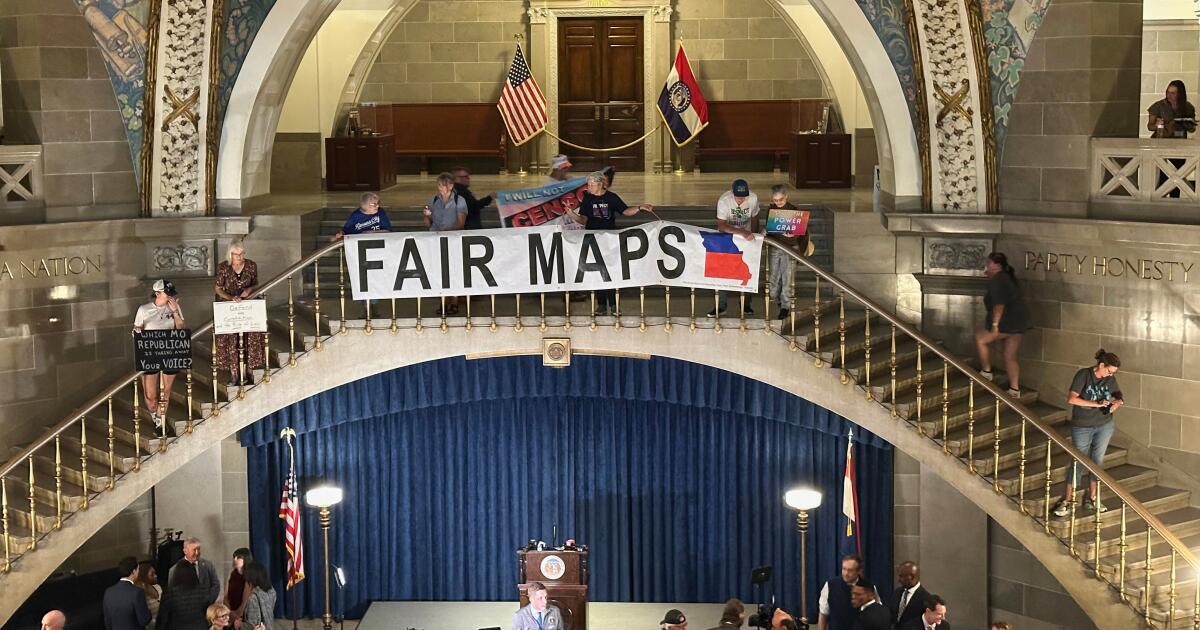
Dueling definitions of fairness were on display at the Indiana Capitol as lawmakers considered a Trump-backed redistricting plan that would have split Indianapolis among four Republican-leaning districts and merged the Chicago suburbs with rural Republican areas. Opponents walked the halls in protest, carrying signs such as “I stand for fair maps!”

Ethan Hatcher, a talk radio host who said he votes for Republicans and libertarians, denounced the redistricting plan as “a blatant power grab” that “compromises the principles of our Founding Fathers” by fracturing Democratic strongholds to dilute the voices of urban voters.

“It’s a calculated assault on fair representation,” Hatcher told a state Senate committee.

But others asserted it would be fair for Indiana Republicans to hold all of those House seats, because Trump won the “solidly Republican state” by nearly three-fifths of the vote.

“Our current 7-2 congressional delegation doesn’t fully capture that strength,” resident Tracy Kissel said at a committee hearing. “We can create fairer, more competitive districts that align with how Hoosiers vote.”

When senators defeated a map designed to deliver a 9-0 congressional delegation for Republicans, Braun bemoaned that they had missed an “opportunity to protect Hoosiers with fair maps.”

Disrupting an equilibrium

By some national measurements, the U.S. House already is politically fair. The 220-215 majority that Republicans won over Democrats in the 2024 elections almost perfectly aligns with the share of the vote the two parties received in districts across the country, according to an Associated Press analysis. It was made possible, however, in part by a gerrymander of North Carolina districts in the GOP’s favor prior to the 2024 election.

But that overall balance belies an imbalance that exists in many states. Even before this year’s redistricting, the number of states with congressional districts tilted toward one party or another was higher than at any point in at least a decade, the AP analysis found.

The partisan divisions have contributed to a “cutthroat political environment” that “drives the parties to extreme measures,” said Kent Syler, a political science professor at Middle Tennessee State University. He noted that Republicans hold 88% of congressional seats in Tennessee, and Democrats have an equivalent in Maryland.

“Fairer redistricting would give people more of a feeling that they have a voice,” Syler said.

Rebekah Caruthers, who leads the Fair Elections Center, a nonprofit voting rights group, said there should be compact districts that allow communities of interest to elect the representatives of their choice, regardless of how that affects the national political balance. Gerrymandering districts to be dominated by a single party results in “an unfair disenfranchisement” of some voters, she said.

“Ultimately, this isn’t going to be good for democracy,” Caruthers said. “We need some type of détente.”

Lieb writes for the Associated Press.

Source link

A letdown for state’s same-sex couples

New Jersey’s Supreme Court ruling on same-sex unions is likely to make California’s top court less receptive to authorizing gay marriage, legal experts said Thursday.

On a 4-3 vote, the New Jersey high court refused Wednesday to declare that same-sex couples should be permitted to wed. The jurists instead said the Legislature must provide same-sex couples with the same rights as spouses, possibly under a civil union law.

Santa Clara University professor Gerald Uelmen, an expert on California’s Supreme Court, said New Jersey’s ruling would incline the California court to be more “restrained” on same-sex marriage.

“I don’t think this will push them in the direction” of approving same-sex marriage, Uelmen said.

New Jersey’s Supreme Court is one of the most liberal in the country, while California’s top court is considered cautious and moderately conservative. Although a split ruling like New Jersey’s has less weight than a unanimous decision, “the impact it has seems more likely to be negative than favorable toward a right of gay marriage,” said Stephen Barnett, professor emeritus of law at UC Berkeley.

Unlike New Jersey’s, California’s top court will not be able to issue a compromise ruling, law professors said.

In New Jersey, the jurists ruled that same-sex couples must be given the rights and privileges of marriage, but left it to the Legislature to say whether the resulting unions should be labeled “marriages.” Same-sex couples in California already have most of those rights under a strong domestic-partners law.

“New Jersey was able to split the baby in half,” Barnett said. “In California, that has already been done.”

UCLA law professor Brad Sears agreed.

“Unlike in New Jersey, the California Supreme Court is not going to be able to avoid the marriage question,” Sears said.

The California Legislature passed a bill in favor of same-sex marriage, but Gov. Arnold Schwarzenegger vetoed it. A state appeals court earlier this month rejected same-sex marriage, and the California Supreme Court will decide whether to review the ruling by the end of the year.

“The hot potato is now in the hands of the California Supreme Court, and they don’t have anywhere to toss it, “ Sears said.

The New Jersey decision is not binding on California, but it could be cited in arguments to the court and thus sway deliberations by indicating a legal trend.

Sears and gay-rights lawyers insisted the New Jersey ruling would be more helpful than harmful to the campaign for same-sex marriage. New Jersey’s ruling was sympathetic to the demands of gays to marry, whereas the high courts in Washington and New York flatly rejected same-sex marriage in rulings this year.

“So this reverses a trend of a number of losses we had earlier this summer,” said Jon Davidson, legal director of Lambda Legal, a gay-rights group that represented the couples in the New Jersey case.

The New Jersey ruling is “a little bit tepid but way better than a loss,” said San Francisco Chief Deputy City Atty. Therese Stewart, who is on the pro-gay marriage legal team.

Even though gays did not win the right to marry in Washington, New York and New Jersey, dissenting opinions in those cases could be influential, Sears said. The New Jersey and New York courts each had three justices in favor of same-sex marriage.

“That a growing number of justices are writing dissenting opinions is helpful at this stage,” said Sears, director of the Williams Institute on Sexual Orientation Law and Public Policy at UCLA.

University of Richmond law professor Carl Tobias said the California court could find many legal arguments in the New Jersey ruling to support same-sex marriage.

Gay couples got “90% of what they were asking for in New Jersey — but not marriage,” Tobias said.

Opponents of same-sex marriage, though unhappy with the New Jersey ruling, said it made them more confident that California’s Supreme Court will rule in their favor.

If gay-rights lawyers “can’t win in New Jersey, they can’t win anywhere,” said Glen Lavy, senior counsel of the Alliance Defense Fund, which promotes traditional Christian values through litigation.

The issue of same-sex marriage reached the California courts in 2004 after San Francisco Mayor Gavin Newsom permitted nearly 4,000 same-sex couples to marry. Until then, the strategy of most gay-rights lawyers was to work with legislatures to change marriage laws. The lawyers believed it was too early to make legal challenges.

But Massachusetts’ high court had already ruled that same sex-marriage should be permitted, and the marriages in San Francisco gave the issue stronger impetus.

Davidson said it was too soon to know whether activists should have limited their campaign to legislatures instead of courts.

“The history of this is now being written and is unfolding,” he said.

*

maura.dolan@latimes.com

Source link

Gangs: The New Political Force in Los Angeles : Governance: Bloods-Crips unity is about who will rule South-Central. Those in authority now have abdicated any claim to leadership.

Luis J. Rodriguez, a former gang member, is author of “Always Running: A Memoir of La Vida Loca, Gang Days in Los Angeles (Curbstone). Cle (Bone) Sloan is a member of the Bloods, Kershaun (Little Monster) Scott of the Crips

The political terrain of the country has dramatically changed since the presidential nominating process began in February. The most significant development was the outbreak of violence in Los Angeles following the acquittal of four police officers accused of illegally beating Rodney G. King. New forces are arising in the land. They must be addressed.

A segment of the so-called marginalized and disenfranchised are stirring. In the past, they were written off as the “underclass,” the disadvantaged, even as “illegal.” They have been criminalized and dismissed. You could either feel sorry for them or hate them. The point was not to get near them.

They must now be reckoned with as a political force.

From the homeless to welfare mothers, from people with AIDS to the physically handicapped, thousands are flexing their organizational muscle, and using it on the streets, in pursuit of their economic and political interests. The unity in Los Angeles between the city’s two largest gangs, the Crips and Bloods, is expressive of this development.

The stirrings of “the bottom” of society aim toward certain goals: the end of scarcity in the midst of plenty; complete literacy; the ability to function competently at any chosen level of society; productive and livable employment; access to the most advanced health care in the world and a real voice in the policy decisions that affect their lives.

It is in this context that the Bloods and the Crips have come together to demand their place in the changing social fabric.

How is this possible when police and most of the media portray them as drug-dealing, inner-city terrorists?

It’s possible because these gangs are not monolithic. There is no single leadership. To be sure, there are gang members who care nothing about unity. For years, their violent acts dictated the lives and determined the deaths of thousands of young people in South-Central. Communities were pulled into the warfare.

Another group, less publicized, became politicized with every police beating, every inequity, every injustice. Years ago, these gang members, along with others in the community, began work on uniting the gangs. Until the April uprising, most of these efforts involved individuals. Since then, unity efforts have been carried out on a larger scale, with neighborhoods participating.

At the same time, gang members grew tired of the senseless killings. Many of these killings touched everyone, particularly when children were hit. This is why, in the aftermath of the uprising, graffiti appeared expressing such sentiments as “Mexicans & Crips & Bloods Together.” Police later erased most of the unity-related scrawl.

The gangs became political through observation and participation. Although many of the youth don’t read, they witness politics playing itself out every day. What the King beating did, what the uprising did, was help them cross the line of understanding what’s really going on.

The Bloods-Crips unity is about who will rule South-Central. A Los Angeles radio announcer recently estimated that there were some 640 liquor stores within a three-mile radius of South-Central, compared with no movie houses or community centers. Elsewhere, schools and streets are in disrepair. Manufacturing industries have been shuttered forever. Under these circumstances, you have to ask: Who really controls this community?

Not the community.

Although the people of South-Central share responsibility for their conditions–proportionately, more of them are in jail than any other community in the city–they don’t have any decisive control over their lives. This is a breakdown in the integration of responsibility and authority, a component of any democratic process. Those with the authority, including the police and city, county and state officials, fail to take any responsibility, thus abdicating any claim to leadership.

Yet it was precisely when the gangs came together that the police tried to break up as many “unity” rallies as they could, arresting gang leaders and inflaming the ire of residents of housing projects, where many of the rallies were held. The Los Angeles Police Department told the media that the gangs were going to turn on police officers, even ambush them. Yet no police officer in South-Central has been killed or severely hurt since April 29, the day the King-beating verdict came down.

Soon after the rebellion, local law enforcement circulated a flyer among themselves–and the media–that proclaimed the Crips and Bloods would “kill two cops for every gang member killed.” It was incendiary and a forgery. For example, most African-American gang leaders would never use the words “little black girl” to describe Latasha Harlins, who was slain by a Korean grocer last year. They know the flyer’s writing style was not even crudely close to the current street style. The flyer appeared to be yet another example of cartoon propaganda that has characterized previous allegations by police.

Meanwhile, the federal government has launched the largest investigation of its kind to destroy the gangs. Government officials are using the Racketeer Influenced Corrupt Organizations Act, the one used to put reputed crime boss John Gotti in jail, to go after every person associated with the Crips and the Bloods. It appears the FBI is targeting the L.A. gangs for political, not criminal, activity, since its efforts are directly related to the events beginning April 29.

This is not new, or surprising. After the 1965 Watts rebellion, several gangs united, some of them becoming the L.A. chapter of the Black Panthers. The federal government intervened, orchestrating the friction between the Black Panther Party and the United Slaves organization.

Last year, nearly 600 L.A. youth were killed in gang- or drug-related incidents. Yet only now has Washington decided to come in, when the rate of shootings and deaths has dramatically fallen.

Despite the array of local, state and federal forces currently poised against L.A. gangs, gang unity is going to last. The Bloods and Crips have undergone a 22-year-old war without declared terms. To think that in five or six months there will be total unity is unrealistic. There are still some individual disputes. But the attacks have diminished in scale and number. The war is essentially over. The government–and police–should stop undermining the truce, stop fanning the emotional flames that will only bring on more death and destruction.

The Bloods and Crips are not asking for anything from anybody. This is what they have to do for themselves. They have even bypassed certain so-called leaders, including Jesse Jackson. They are not asking for outsiders to step in and dictate the terms of peace.

Recently, a plan to rebuild L.A., presumed to be from the Bloods and Crips, was floated around. Regardless of its origin, the plan was in clear contrast to the “official” rebuilding group, whose members are mostly from outside South-Central. The plan does not call for re-establishing the taco stands, the liquor stores or exploitative markets that previously dotted South-Central. Instead, it calls for improved housing, infrastructure and sanitation, for more parks, community centers and health-care facilities. It includes a proposal for upgrading all schools. It ends with the statement: “Give us the hammers and the nails, we will rebuild the city.”

This embodies a vision, something many police and some government officials would like the public to believe the gangs are incapable of possessing. This is taking responsibility. And it is a demand for the authority to carry it out.

Despite great odds, the Bloods and Crips have found common ground, a unified aim, to end the violence. Whether society is ready for this or not, it is the only path not littered with hypocrisy and blame. Indeed, it is one of the few for peace and justice still viable in Los Angeles.

Source link

Bush Wins, Vows to Seek Unity : Democrats Keep Grip on Congress; Wilson Reelected : Republican Has at Least 37 States to Dukakis’ 10

Republican nominee George Bush won an overwhelming victory over Democrat Michael S. Dukakis in Tuesday’s presidential election despite a late surge of support for the Massachusetts governor among previously undecided voters and wayward Democrats.

Late returns showed Bush winning a solid majority of the popular vote nationwide and chalking up substantially more than the 270 electoral votes needed for victory. The Vice President swept the South, won all the Border states but West Virginia, took the Rocky Mountain West and gathered in the lion’s share of the electoral votes in the Midwest and Mid-Atlantic states.

“The people have spoken,” Bush told a cheering victory celebration in Houston, then immediately sounded a chord of unity. “A campaign is a disagreement and disagreements divide. But an election is a decision and decisions clear the way for harmony and peace,” Bush said, “and I mean to be the President of all the people.”

For his part, Dukakis–in a concession statement delivered earlier to loyal supporters in Boston’s World Trade Center–set the generous-spirited post-election tone, saying of Bush: “He will be our President and we will work with him.”

All told, according to late returns reported by the Associated Press, Bush had won 37 states to 10 for Dukakis, including the District of Columbia. Among the four undecided states late Tuesday night, Bush maintained narrow leads in California, Alaska and Illinois while Dukakis remained ahead in Washington state.

Thanks Reagan

Bush, recognizing the enormous political advantages of campaigning as the designated heir of one of the most popular chief executives of modern times, thanked President Reagan “for going the extra mile on the hustings” for the GOP ticket.

Bush also made a point of praising his controversial running mate, Sen. Dan Quayle of Indiana, for showing what Bush called “great strength under fire” during the campaign.

Despite the divisiveness of the bitter campaign, Bush said he was sure the country would unite in the aftermath of the election. “I know that we’ll come together as we always have, 200 years of harmony in the oldest, greatest democracy in man’s time on earth,” Bush said.

Will Do ‘Level Best’

In particular, the President-elect pledged to “do my level best to reach out and work constructively with the United States Congress.”

That may well be among the most serious challenges facing the President-elect. Despite Bush’s sweeping victory, Democrats apparently added to their already substantial domination of both the Senate and the House–assuring continuation of a pattern of divided government that has generally paralleled the GOP domination of the White House during the last 30 years.

In the Senate, where Democrats already outnumbered Republicans by 54 to 46, they gained seats in Connecticut, Virginia and Nebraska while losing seats in Mississippi and Montana, according to actual votes and television network projections. They seemed likely to increase their number in the Senate to 55.

Democrats ousted Republican Sens. Lowell P. Weicker Jr. in Connecticut and David K. Karnes in Nebraska, and former Gov. Charles S. Robb of Virginia took the seat being vacated by retiring Republican Paul S. Trible Jr.

Republicans defeated Democratic Sen. John Melcher of Montana, and in Mississippi, Rep. Trent Lott

won the seat now occupied by retiring Democratic Sen. John C. Stennis.

Sen. Lloyd Bentsen of Texas, the Democratic vice presidential nominee, retained his Senate seat thanks to a Texas law that allowed him to seek reelection there even as he ran on the national ticket.

With all but a few incumbents in both parties coasting to easy victories, the Democrats appeared certain to retain their comfortable majority in the House. NBC News projected that the Democrats will outnumber Republicans by 259 to 176 in the House next year, compared to the present lineup of 255 to 177 with three vacancies.

The most stunning congressional upset was the defeat of Rep. Fernand J. St Germain (D-R.I.), chairman of the House Banking Committee, at the hands of a Republican political novice, Ronald K. Machtley.

If the presidential balloting produced an overwhelming electoral victory for Bush, Dukakis nonetheless ran stronger than any Democratic presidential candidate in this decade. He appeared to have carried New York, Rhode Island, Minnesota, Wisconsin, Iowa, Oregon and Washington, as well as the District of Columbia and his native Massachusetts.

He also mounted powerful challenges in such heavily populated states as Pennsylvania, Illinois and California.

Concession Statement

Still, with both CBS and ABC projecting Bush as the winner as early as 6:17 p.m. PST, Dukakis made his concession statement in Boston at 8:20 p.m. PST–just 20 minutes after the California polls closed.

About 30 minutes later Bush, who had run a slashingly negative campaign against the man he labeled “a liberal out of the mainstream,” told a cheering crowd in Houston that in defeat Dukakis had been “most gracious . . . and genuinely friendly in the great tradition of American politics.”

Bush, 64, is the first sitting vice president to win the Oval Office since Martin Van Buren in 1836. And his election to succeed President Reagan means that, for the first time since the Democratic era of Franklin D. Roosevelt and Harry S. Truman 40 years ago, the same party will control the White House for more than two consecutive terms.

Overall, the presidential balloting appeared to reflect the fact that voters feel fairly satisfied with the way things are going in the country–as confirmed by Los Angeles Times/ Cable News Network exit polls. Most voters interviewed in that survey said they wanted to stay the course charted by the Reagan Administration in domestic and foreign policy.

Reaganesque Note

The vice president, who had patiently plotted his run for the presidency ever since losing the GOP presidential nomination to Reagan in 1980, repeatedly promised voters he would continue those policies and sounded a Reaganesque note in victory Tuesday night, saying: “Now we will move again, for an America that is strong, and resolute in the world, strong and big-hearted at home.”

Reagan himself, who retained an extraordinary approval rating in the 55%-60% range as his second term drew to a close, pulled out all stops in campaigning for the election of his vice president.

Exit polls indicated that even though Quayle continued to have unusually high unfavorable ratings among voters, he was not a significant factor in Tuesday’s vote. The selection of Quayle, which had stunned and even dismayed some of Bush’s aides, was criticized repeatedly by Dukakis in speeches and in television commercials during the campaign. And Bush strategists were so concerned that Quayle would be a drag on the ticket that they limited his campaign schedule to smaller cities and towns outside the national limelight.

Late Dukakis Surge

Exit polls indicated a surge of Dukakis support over the weekend, especially among Democrats who had voted for Reagan in 1980 and 1984 and among voters who made up their minds only in the last few days. Dukakis, attempting to squeeze the last drop of help from that trend, used satellite links to beam last-minute television appeals into states where the polls were still open Tuesday night.

But in the end the shift fell considerably short for Dukakis as Bush drew heavy support among men, non-union voters and white voters–especially Southern whites and “born-again” Christian whites, according to the surveys of voters as they left polling places. Early poll figures even showed Bush winning about one-eighth of the black vote, which is more support than Reagan won among blacks.

The Times survey of voters indicated that Dukakis–for all his problems during the campaign–did as well or better than Walter F. Mondale did four years ago when it came to holding the core of the nation’s Democrats, but in today’s political arithmetic that alone is not enough to carry the White House. Among the independents who hold the balance of power, Bush outscored his Democratic rival.

Aggressive Campaign

Bush surged into the lead in his heated campaign with Dukakis by bouncing back from a 17-point deficit in the polls in mid-July with an aggressive, hard-hitting campaign in which he portrayed himself as the new leader of the Reagan revolution and Dukakis as a free-spending liberal who opposed such traditional values as the Pledge of Allegiance and favored such soft-on-crime measures as prison furloughs for convicted murderers.

The effectiveness of the Republican tactics was enhanced by the fact that Dukakis let valuable time slip away after his own nomination in July, was slow to meet the Bush attacks and failed until the final weeks of the campaign to develop a compelling message of his own.

It was apparently too late by the time Dukakis began to respond aggressively to Bush’s attacks and to drive home a populist message that the governor was “on your side.” The vice president, Dukakis declared in the closing days of the campaign, was partial to upper-income voters and his support for a reduction in the capital gains tax from 20% to 15% showed concern not for the average citizen but for the wealthy.

Negative Perceptions

Bush strategists, by contrast, began at the Republican convention last August to press a well-coordinated effort to drive up voters’ negative perceptions of Dukakis, who polls showed was fairly well liked but not very well known by the voters. That the Bush strategy succeeded to an extraordinary degree is indicated by exit polls Tuesday that showed Dukakis with an extraordinarily high unfavorable rating of 46% compared to 47% favorable.

The same polls showed Bush with a relatively high unfavorable rating of 39% himself, compared to a favorable rating of 55%.

Voting experts indicated that fewer than 100 million voters, or a little more than half the voting-age public, were turning out to vote Tuesday. They blamed the low turnout on the negative nature of the campaign, which included harsh attacks by Bush and counterattacks by Dukakis, as well as on a lack of enthusiasm for either candidate.

Moreover, the country is enjoying peace and relative prosperity and there were no overriding issues of the kind that can stimulate a high voter turnout.

Both Exhausted

Both candidates were exhausted as they campaigned right up to the end. Bush, returning to his official residence at a Houston hotel, said he was nervous but felt good about the election and Dukakis declared he felt “terrific” but was glad to be back in Boston.

ABC exit polls showed Bush scored heavily among the following groups: Veterans, people with children, people earning more than $40,000 a year, those with college degrees or some college education, Protestants, residents of farm areas and small towns, and voters who were self-employed or earned salaries instead of working for hourly wages.

Among Dukakis voters, almost 60% said they were voting against Bush rather than for the Democratic nominee. Although the vice president highlighted environmental issues and repeatedly accused Dukakis of failing to clean up the pollution of Boston Harbor, voters who gave high priority to environmental issues apparently favored the governor.

Strong GOP Support

While Bush was falling short of Reagan’s 1980 and 1984 landslides, polls indicated he was drawing about 92% of the vote among those who consider themselves Republicans. He was carrying independents by a margin of 54% to 44% for Dukakis, whereas Reagan won 61% of the independent vote in 1984.

Bush, like Reagan, cut into the Democratic ranks, but the vice president was getting only 17% of that vote, compared to the 24% Reagan got in 1984.

Bush voters said they were looking for strong leadership, experience, a strong national defense and a strong economy. They also favored Bush’s stance opposing legalized abortions and his stand on curbing illegal drugs.

The vice president was relaxed and in good spirits as he and his wife, Barbara, along with 22 members of their family and dozens of friends and advisers, awaited the election’s final outcome at the Houstonian Hotel.

At Bush’s side was former Treasury Secretary James A. Baker III, his longtime confidant and director of his almost flawlessly managed election campaign. Baker is widely expected to be named secretary of state in the Bush Administration, although Bush repeatedly refused to discuss potential Cabinet appointments during the campaign.

Quayle Decision

Baker has made it clear he had no part in the selection of Quayle as Bush’s running mate, the one major decision that Republican strategists considered a negative for the Bush campaign. Baker has said Bush informed him of the selection after he had already told others.

The 41-year-old, boyish-looking Quayle went home to Huntington, Ind., to vote and shake hands with supporters along the town’s main street before settling down to wait for the final outcome in Washington.

“I’m looking forward to being the next vice president of the United States,” he told reporters.

Looks Exhausted

Dukakis, accompanied by his wife, Kitty, and three children, cast his ballot at a housing project in his hometown of Brookline, Mass. He look exhausted and made no statement to about 200 shouting supporters before returning home.

For 50 hours without a break, he had sped by plane across the country, stumping in 11 cities in nine key battleground states in his last-ditch effort to turn things around.

Bentsen, who polls showed was the most popular figure on either ticket, spent Election Day in Austin. Although he was unable to help carry his state for Dukakis, Bentsen is expected to remain a powerful voice in Washington, however. He will retain his chairmanship of the Senate Finance Committee and Democratic sources say his performance on the campaign trail is likely to enhance his influence in party affairs.

Rallied Faithful

Dukakis’ finest hour in the campaign came at the Democratic convention in July, when he rallied the party faithful with a stirring speech that promised a more honest and caring government and attacked Bush for his role in the Iran-Contra affair and other scandals and tied him to Reagan Administration slashes in social programs.

But the Massachusetts governor never came close to stirring such excitement again, even though in the closing days of his campaign he drew large, enthusiastic crowds as he crisscrossed the country in a desperate final effort.

Shortly after the Democratic convention, polls showed Dukakis briefly with a 17-point lead over Bush. But that lead quickly disappeared as the governor appeared to coast in the opening weeks of his campaign, spending at least two days a week at the Statehouse in Boston while Bush was campaigning vigorously and painting his opponent as a liberal far removed from the American mainstream.

Democratic strategists criticized Dukakis for failing to respond early to Bush’s attacks and for assembling a campaign team that included relatively few people experienced in running a presidential campaign.

Source link

Anniversary Draws Bush to Gulf Coast

As next week’s anniversary of Hurricane Katrina triggers recollections of rooftop refugees and massive devastation along the Gulf Coast, the White House has begun a public relations blitz to counteract Democrats’ plans to use the government’s tardy response and the region’s slow recovery in the coming congressional elections.

President Bush will visit the area Monday and Tuesday, including an overnight stay in New Orleans. He probably will visit the city’s Lower 9th Ward, the heavily black area that remains mired in debris, and is expected to meet with storm victims.

The trip will force Bush to revisit sensitive racial issues that arose with the flooding of New Orleans; at that time, civil rights leaders charged that the White House was slow to respond because so many victims were black. GOP strategists acknowledged that the administration’s failure to act quickly was a significant setback in their efforts to court traditionally Democratic African American voters.

The White House announced Bush’s visit Tuesday as a phalanx of administration officials stood before reporters to argue that billions of dollars had flowed to the region and millions more was on the way. The plans for the trip were disclosed one day after Atty. Gen. Alberto R. Gonzales announced that he was sending additional lawyers and resources to the city to fight fraud and abuse.

At Tuesday’s briefing, White House aides passed out folders and fact sheets that painted a picture of aggressive recovery efforts. A packet from the Army Corps of Engineers, responsible for the levees that were breached after the storm, carried the slogan: “One Team: Relevant, Ready, Responsible, Reliable.”

Donald E. Powell, the White House official in charge of recovery plans, declared that Bush was “fulfilling his commitment to rebuild the Gulf Coast better and stronger.”

The administration’s coordinated response is the latest example of White House officials maneuvering to cast a positive light on a campaign issue expected to hurt Republicans. Just this week, Bush acknowledged public anxiety over Katrina, along with concern about the war in Iraq and rising gasoline prices. But he defended his record and accused the Democrats of weakness, particularly on national security issues.

The White House effort comes as the Democrats, who plan to challenge Republicans on national security in this year’s midterm election campaign, are portraying the government’s response to Katrina as evidence that Bush failed to fix inadequacies exposed by the Sept. 11 attacks.

A report being released today by top Democrats, titled “Broken Promises: The Republican Response to Katrina,” features a picture of Bush during his Sept. 15, 2005, speech in New Orleans’ Jackson Square, in which he promised to oversee “one of the largest reconstruction efforts the world has ever seen.”

The report argues that every aspect of recovery — including housing, business loans, healthcare, education and preparedness — “suffers from a failed Republican response marked by unfulfilled promises, cronyism, waste, fraud, and abuse.”

Senate Minority Leader Harry Reid of Nevada is scheduled to spend Thursday in New Orleans with fellow Democratic Sen. Mary L. Landrieu of Louisiana to kick off what they call the “Hope and Recovery Tour.” House Minority Leader Nancy Pelosi of San Francisco plans to arrive this weekend with about 20 other Democrats for additional events.

White House officials declined Tuesday to offer many details of Bush’s trip. Spokeswoman Dana Perino said Bush would travel Monday to two Mississippi towns devastated by the storm, Gulfport and Biloxi, before arriving in New Orleans. He is expected to attend an ecumenical worship service at New Orleans’ St. Louis Cathedral, the backdrop to his Jackson Square address.

Leaders of the recovery effort said Tuesday that although progress had been slow in some areas, Bush would be able to point to successes in some New Orleans neighborhoods, including the famed French Quarter and the Garden District. However, neither area was damaged as severely as the Lower 9th Ward. The question for White House schedulers is how much to accentuate the positives while acknowledging the negatives.

“If you go to most of the city you see enormous progress,” said Walter Isaacson, president of the Aspen Institute and vice chairman of the Louisiana Recovery Authority. “They are probably going to go to the Lower 9th Ward, which is very honest of them, because that’s the place you see the least progress.”

Isaacson, a New Orleans native, said he considered many of the Democrats’ critiques to be unfair. He credited the White House with safeguarding millions of dollars in grants for housing and levee reconstruction, some of which was only approved this summer amid a contentious budget debate.

“They protected that housing money and the levee money in the appropriation process when every congressman was looking at it greedily,” he said.

On Monday, Bush offered a preview of his anniversary message, contending at a news conference that despite frustrations about the slow arrival of housing funds and delays in debris removal, “the money has been appropriated, the formula is in place, and now it’s time to move forward.”

He suggested that $110 billion in federal funds had been “committed” to help the region rebuild, but confusion persisted Tuesday over what portion of that money had actually been spent.

During the White House briefing, Powell said that about $44 billion, about 40% of the total, had been distributed to hurricane victims, but suggested that state and local governments were mostly to blame for the gap.

The director of the Federal Emergency Management Agency, R. David Paulison, was contrite about mistakes made during the disaster aftermath. Paulison, who won Senate confirmation in May, a week before the 2006 hurricane season began, was named acting director in September after Michael D. Brown was forced to resign as FEMA director amid criticism of the federal response.

“Our communications system was broken — it was broken between the local community and the state, it was broken between the state and the federal government, and it was broken within the federal government,” Paulison said. “That was the first thing we had to fix.”

*

Times staff writer Janet Hook contributed to this report.

Source link

Strategist Garry South and Mark Z. Barabak debate Newsom 2028

Gavin Newsom is off and running, eyeing the White House as he enters the far turn and his final year as California governor.

The track record for California Democrats and the presidency is not a good one. In the nearly 250 years of these United States, not one Left Coast Democrat has ever been elected president. Kamala Harris is just the latest to fail. (Twice.)

Can Newsom break that losing streak and make history in 2028?

Faithful readers of this column — both of you — certainly know how I feel.

Garry South disagrees.

The veteran Democratic campaign strategist, who has been described as possessing “a pile-driving personality and blast furnace of a mouth” — by me, actually — has never lacked for strong and colorful opinions. Here, in an email exchange, we hash out our differences.

Barabak: You once worked for Newsom, did you not?

South: Indeed I did. I was a senior strategist in his first campaign for governor. It lasted 15 months in 2008 and 2009. He exited the race when we couldn’t figure out how to beat Jerry Brown in a closed Democratic primary.

I happen to be the one who wrote the catchy punch line for Newsom’s speech to the state Democratic convention in 2009, that the race was a choice between “a stroll down memory lane vs. a sprint into the future.”

We ended up on memory lane.

Barabak: Do you still advise Newsom, or members of his political team?

South: No, though he and I are in regular contact and have been since his days as lieutenant governor. I know many of his staff and consultants, but don’t work with them in any paid capacity. Also, the governor’s sister and I are friends.

Barabak: You observed Newsom up close in that 2010 race. What are his strengths as a campaigner?

South: Newsom is a masterful communicator, has great stage presence, cuts a commanding figure and can hold an audience in the palm of his hand when he’s really on. He has a mind like a steel trap and never forgets anything he is told or reads.

I’ve always attributed his amazing recall to the struggle he has reading, due to his lifelong struggle with severe dyslexia. Because it’s such an arduous effort for Newsom to read, what he does read is emblazoned on his mind in seeming perpetuity.

Barabak: Demerits, or weaknesses?

South: Given his remarkable command of facts and data and mastery of the English language, he can sometimes run on too long. During that first gubernatorial campaign, when he was still mayor of San Francisco, he once gave a seven-hour State of the City address.

Barabak: Fidel Castro must have been impressed!

South: It wasn’t as bad as sounds: It was broken into 10 “Webisodes” on his YouTube channel. But still …

Barabak: So let’s get to it. I think Newsom’s chances of being elected president are somewhere between slim and none — and slim was last seen alongside I-5, in San Ysidro, thumbing a ride to Mexico.

You don’t agree.

South: I don’t agree at all. I think you’re underestimating the Trumpian changes wrought (rot?) upon our political system over the past 10 years.

The election of Trump, a convicted felon, not once but twice, has really blown to hell the conventional paradigms we’ve had for decades in terms of how we assess the viability of presidential candidates — what state they’re from, their age, if they have glitches in their personal or professional life.

Not to mention, oh, their criminal record, if they have one.

The American people actually elected for a second term a guy who fomented a rebellion against his own country when he was president the first time, including an armed assault on our own national capitol in which a woman was killed and for which he was rightly impeached. It’s foolish not to conclude that the old rules, the old conventional wisdom about what voters will accept and what they will not, are out the window for good.

It also doesn’t surprise me that you pooh-pooh Newsom’s prospects. It’s typical of the home-state reporting corps to guffaw when their own governor is touted as a presidential candidate.

One, familiarity breeds contempt. Two, a prophet is without honor in his own country.

Barabak: I’ll grant you a couple of points.

I’m old enough to remember when friends in the Arkansas political press corps scoffed at the notion their governor, the phenomenally gifted but wildly undisciplined Bill Clinton, could ever be elected president.

I also remember those old Clairol hair-color ads: “The closer he gets … the better you look!” (Google it, kids). It’s precisely the opposite when it comes to presidential hopefuls and the reporters who cover them day-in, day-out.

And you’re certainly correct, the nature of what constitutes scandal, or disqualifies a presidential candidate, has drastically changed in the Trump era.

All of that said, certain fundamentals remain the same. Harking back to that 1992 Clinton campaign, it’s still the economy, stupid. Or, put another way, it’s about folks’ lived experience, their economic security, or lack thereof, and personal well-being.

Newsom is, for the moment, a favorite among the chattering political class and online activists because a) those are the folks who are already engaged in the 2028 race and b) many of them thrill to his Trumpian takedowns of the president on social media.

When the focus turns to matters affecting voters’ ability to pay for housing, healthcare, groceries, utility bills and to just get by, Newsom’s opponents will have a heyday trashing him and California’s steep prices, homelessness and shrinking middle class.

Vice President Kamala Harris walks past rows for furled American flags ahead of her 2024 concession speech

Kamala Harris twice bid unsuccessfully for the White House. Her losses kept alive an unbroken string of losses by Left Coast Democrats.

(Kent Nishimura / Getty Images)

South: It’s not just the chattering class.

Newsom’s now the leading candidate among rank-and-file Democrats. They had been pleading — begging — for years that some Democratic leader step out of the box, step up to the plate, and fight back, giving Trump a dose of his own medicine. Newsom has been meeting that demand with wit, skill and doggedness — not just on social media, but through passage of Proposition 50, the Democratic gerrymandering measure.

And Democrats recognize and appreciate it

Barabak: Hmmm. Perhaps I’m somewhat lacking in imagination, but I just can’t picture a world where Democrats say, “Hey, the solution to our soul-crushing defeat in 2024 is to nominate another well-coiffed, left-leaning product of that bastion of homespun Americana, San Francisco.”

South: Uh, Americans twice now have elected a president not just from New York City, but who lived in an ivory tower in Manhattan, in a penthouse with a 24-carat-gold front door (and, allegedly, gold-plated toilet seats). You think Manhattan is a soupçon more representative of middle America than San Francisco?

Like I said, state of origin is less important now after the Trump precedent.

Barabak: Trump was a larger-than-life — or at least larger-than-Manhattan — celebrity. Geography wasn’t an impediment because he had — and has — a remarkable ability, far beyond my reckoning, to present himself as a tribune of the working class, the downtrodden and economically struggling Americans, even as he spreads gold leaf around himself like a kid with a can of Silly String.

Speaking of Kamala Harris, she hasn’t ruled out a third try at the White House in 2028. Where would you place your money in a Newsom-Harris throwdown for the Democratic nomination? How about Harris in the general election, against whomever Republicans choose?

South: Harris running again in 2028 would be like Michael Dukakis making a second try for president in 1992. My God, she not only lost every swing state, and the electoral college by nearly 100 votes, Harris also lost the popular vote — the first Democrat to do so in 20 years.

If she doesn’t want to embarrass herself, she should listen to her home-state voters, who in the latest CBS News/YouGov poll said she shouldn’t run again — by a margin of 69-31. (Even 52% of Democrats said no). She’s yesterday’s news.

Barabak: Seems as though you feel one walk down memory lane was quite enough. We’ll see if Harris — and, more pertinently, Democratic primary voters — agree.

Source link

California’s role in shaping the fate of the Democratic Party on display

California’s potential to lead a national Democratic comeback was on full display as party leaders from across the country recently gathered in downtown Los Angeles.

But is the party ready to bet on the Golden State?

Appearances at the Democratic National Committee meeting by the state’s most prominent Democrats, former Vice President Kamala Harris and Gov. Gavin Newsom, crystallized the peril and promise of California’s appeal. Harris failed to beat a politically wounded Donald Trump in the 2024 presidential race and Newsom, now among President Trump’s most celebrated critics, is considered a top Democratic contender to replace the Republican president in the White House in 2028.

California policies on divisive issues such as providing expanded access to government-sponsored healthcare, aiding undocumented immigrants and supporting LGBTQ+ rights continually serve as a Rorschach test for the nation’s polarized electorate, providing comfort to progressives and ammunition for Republican attack ads.

“California is like your cool cousin that comes for the holidays who is intriguing and glamorous, but who might not fit in with the family year-round,” said Elizabeth Ashford, a veteran Democratic strategist who worked for former Govs. Jerry Brown and Arnold Schwarzenegger and Harris when she was the state’s attorney general.

Newsom, in particular, is quick to boast about California being home to the world’s fourth-largest economy, a billion-dollar agricultural industry and economic and cultural powerhouses in Hollywood and the Silicon Valley. Critics, Trump chief among them, paint the state as a dystopian hellhole — littered with homeless encampments and lawlessness, and plagued by high taxes and an even higher cost of living.

Only two Californians have been elected president, Republicans Ronald Reagan and Richard Nixon. But that was generations ago, and Harris and Newsom are considering bids to end the decades-long drought in 2028. Both seized the moment by courting party leaders and activists during the three-day winter meeting of the Democratic National Committee that ended Saturday.

Harris, speaking to committee members and guests Friday, said the party’s victories in state elections across the nation in November reflect voters’ agitation about the impacts of Trump’s policies, notably affordability and healthcare costs. But she argued that “both parties have failed to hold the public’s trust.”

“So as we plan for what comes after this administration, we cannot afford to be nostalgic for what was, in fact, a flawed status quo, and a system that failed so many of you,” said Harris, who was criticized after her presidential campaign for not focusing enough on kitchen table issues, including the increasing financial strains faced by Americans.

While Harris, who ruled out running for governor earlier this year, did not address whether she would make another bid for the White House in 2028, she argued that the party needed to be introspective about its future.

“We need to answer the question, what comes next for our party and our democracy, and in so doing, we must be honest that for so many, the American dream has become more of a myth than a reality,” she said.

Many of the party leaders who spoke at the gathering focused on California’s possible role in determining control of Congress after voters in November approved Proposition 50, a rare mid-decade redrawing of congressional districts in an effort to boost the number of Democrats in the state’s congressional delegation in the 2026 election.

Los Angeles Mayor Karen Bass rallied the crowd by reminding them that Democrats took back the U.S. House of Representatives during Trump’s first term and predicted the state would be critical in next year’s midterm elections.

Mayor Karen Bass speaks at a mic

Mayor Karen Bass speaks at the Democratic National Committee Winter Meeting at the InterContinental Hotel in downtown Los Angeles on Friday.

(Genaro Molina/Los Angeles Times)

Newsom, who championed Proposition 50, basked in that victory when he strode through the hotel’s corridors at the DNC meeting the day before, stopping every few feet to talk to committee members, shake their hands and take selfies.

“There’s just a sense of optimism here,” Newsom said.

Democratic candidates in New Jersey and Virginia also won races by a significant margin last month which, party leaders say, were all telltale signs of growing voter dissatisfaction with Trump and Washington’s Republican leadership.

“The party, more broadly, got their sea legs back, and they’re winning,” Newsom said. “And winning solves a lot of problems.”

Louisiana committee member Katie Darling teared up as she watched fellow Democrats flock to Newsom.

“He really is trying to bring people together during a very difficult time,” said Darling, who grew up in Sacramento in a Republican household. “He gets a lot of pushback for talking to and working with Republicans, but when he does that, I see him talking to my mom and dad who I love, who I vehemently disagree with politically. … I do think that we need to talk to each other to move the country forward.”

Gov. Gavin Newsom speaks as his wife Jennifer Siebel Newsom looks on

Gov. Gavin Newsom speaks as his wife Jennifer Siebel Newsom looks on during an election night gathering at the California Democratic Party headquarters on November 04, 2025 in Sacramento.

(Justin Sullivan / Getty Images)

Darling said she listens to Newsom’s podcast, where his choice of guests, including the late Charlie Kirk, and his comments on the show that transgender athletes taking part in women’s sports is “deeply unfair” have drawn outrage from some on the left.

Illinois Gov. J.B. Pritzker, another potential 2028 presidential candidate whose family has historically supported Newsom, was also reportedly on site Thursday, holding closed-door meetings. And former Transportation secretary Pete Buttigieg, also a possible White House contender, was in Los Angeles on Thursday, appearing on Jimmy Kimmel’s late-night show and holding meetings.

Corrin Rankin, chair of the California Republican Party, cast the DNC meetings in L.A. as “anti-Trump sessions” and pointed to the homeless encampments on Skid Row, just blocks from where committee members gathered.

“We need accountability and solutions that actually get people off the streets, make communities safer and life more affordable,” Rankin said.

Elected officials from across the nation are drawn to California because of its wellspring of wealthy political donors. The state was the largest source of contributions to the campaign committees of Trump and Harris during the 2024 presidential contest, contributing nearly a quarter of a billion dollars, according to the nonpartisan, nonprofit organization Open Secrets, which tracks electoral finances.

While the DNC gathering focused mostly on mundane internal business, the gathering of party leaders attracted liberal groups seeking to raise money and draw attention to their causes.

Actor Jane Fonda and comedian Nikki Glaser headlined an event aimed at increasing the minimum wage at the Three Clubs cocktail bar in Hollywood. California already has among the highest minimum wages in the nation; one of the organizers of the event is campaigning to increase the rate to $30 per hour in some California counties.

“The affordability crisis is pushing millions of Americans to the edge, and no democracy can survive when people who work full time cannot afford basic necessities,” Fonda said prior to the event. “Raising wages is one of the most powerful ways to give families stability and hope.”

But California’s liberal policies have been viewed as a liability for Democrats elsewhere, where issues such as transgender rights and providing healthcare for undocumented immigrants have not been warmly received by some blue-collar workers who once formed the party’s base.

Trump capitalized on that disconnect in the closing months of the 2024 presidential contest, when his campaign aired ads that highlighted Harris’ support of transgender rights, including taxpayer-funded gender-affirming surgery for inmates.

“Kamala is for they/them, President Trump is for you,” the commercial stated. The ad aired more than 30,000 times in swing states in the fall, notably during football games and NASCAR races.

“Kamala had 99 problems. California wasn’t one of them,” said John Podesta, a veteran Democratic strategist who served a senior advisor to former President Biden, counselor to former President Obama and White House chief of staff for former President Clinton.

He disputed the argument that California, whether through its policies or candidates, will impact Democrats’ chances, arguing there’s a broader disconnect between the party and its voters.

“This sense that Democrats lost touch with the middle class and the poor in favor of the cultural elite is a real problem,” said Podesta. “My shorthand is, we used to be the party of the factory floor, and now we’re the party of the faculty lounge. That’s not a California problem. It’s an elitist problem.”

While Podesta isn’t backing anyone yet in the 2028 presidential contest, he praised Newsom for his efforts to not only buck Trump but the “leftist extremists” in the Democratic party.

The narrative of Californians being out of touch with many Americans has been exacerbated this year during the state’s battles with the Trump administration over immigration, climate change, water and artificial intelligence policy. But Newsom and committee members argued that the state has been at the vanguard of where the nation will eventually head.

“I am very proud of California. It’s a state that’s not just about growth, it’s about inclusion,” the governor said, before ticking off a list of California initiatives, including low-priced insulin and higher minimum wages. “So much of the policy that’s coming out of the state of California promotes not just promise, but policy direction that I think is really important for the party.”

Source link

Higher cost, worse coverage: Affordable Care Act enrollees say expiring subsidies will hit them hard

For one Wisconsin couple, the loss of government-sponsored health subsidies next year means choosing a lower-quality insurance plan with a higher deductible. For a Michigan family, it means going without insurance altogether.

For a single mom in Nevada, the spiking costs mean fewer Christmas gifts this year. She is stretching her budget already while she waits to see if the Republican-led Congress will act.

Less than three weeks remain until the expiration of COVID-era enhanced tax credits that have helped millions of Americans pay their monthly fees for Affordable Care Act coverage for the last four years.

The Senate on Thursday rejected two proposals to address the problem, and an emerging healthcare package from House Republicans does not include an extension, all but guaranteeing that many Americans will see much higher insurance costs in 2026.

Here are a few of their stories.

Spending more for less

Chad Bruns comes from a family of savers. That came in handy when the 58-year-old military veteran had to leave his firefighting career early because of arm and back injuries incurred on the job.

He and his wife, Kelley, 60, both retirees, cut their own firewood to reduce their electricity costs in their home in Sawyer County, Wis. They rarely eat out and say they buy groceries only when they are on sale.

But to the extent that they have always been frugal, they will be forced to be even more so now, Bruns said. That is because their coverage under the health law enacted under former President Obama is, because of congressional inaction, getting more expensive — and for worse coverage.

This year, the Brunses were paying $2 per month for a top-tier gold-level plan with less than a $4,000 deductible. Their income was low enough to help them qualify for a lot of financial assistance.

But in 2026, that same plan is rising to an unattainable $1,600 per month, forcing them to downgrade to a bronze plan with a $15,000 deductible.

Kelley Bruns said she is concerned that if something happens to their health in the next year, they could go bankrupt. While their monthly fees are low at about $25, their new out-of-pocket maximum at $21,000 amounts to nearly half their joint income.

“We have to pray that we don’t have to have surgery or don’t have to have some medical procedure done that we’re not aware of,” she said. “It would be very devastating.”

Forgoing insurance

Dave Roof’s family of four has been on ACA insurance since the program started in 2014. Back then, the accessibility of insurance on the marketplace helped him feel comfortable taking the leap to start a small music production and performance company in his hometown of Grand Blanc, Mich. His wife, Kristin, is also self-employed as a top seller on Etsy.

Their coverage has worked for them so far, even when emergencies come up, such as an ATV accident their 21-year-old daughter had last year.

But now, with the expiration of Obamacare subsidies that kept their premiums down, the 53-year-old Roof said their $500-per-month insurance plan is jumping to at least $700 a month, along with spiking deductibles and out-of-pocket costs.

With their joint income of about $75,000 a year, that increase is not manageable, he said. So, they are planning to go without health insurance next year, paying cash for prescriptions, checkups and anything else that arises.

Roof said his family is already living cheaply and has not taken a vacation together since 2021. As it is, they do not save money or add it to their retirement accounts. So even though forgoing insurance is stressful, it is what they must do.

“The fear and anxiety that it’s going to put on my wife and I is really hard to measure,” Roof said. “But we can’t pay for what we can’t pay for.”

Single mom’s straining budget

If you ask Katelin Provost, the American middle class has gone from experiencing a squeeze to a “full suffocation.”

The 37-year-old social worker in Henderson, Nev., counts herself in that category. As a single mom, she already keeps a tight budget to cover housing, groceries and daycare for her 4-year-old daughter.

Next year, that is going to be even tougher.

The monthly fee on her plan is going up from $85 to nearly $750. She decided she is going to pay that higher cost for January and reevaluate afterward, depending on whether lawmakers extend the subsidies, which as of now appears unlikely. She hopes they will.

If Congress does not act, she will drop herself off the health insurance and keep it only for her daughter because she cannot afford the higher fee for the two of them over the long term.

The strain of one month alone is enough to have an impact.

“I’m going to have to reprioritize the next couple of months to rebalance that budget,” Provost said. “Christmas will be much smaller.”

Swenson writes for the Associated Press.

Source link

Welcome to the Clint Bolick Revolution

Nina J. Easton, the magazine’s staff writer, is working on a book chronicling the history of baby-boomer conservatives

It is Sunday night on the north side of San Diego. The wine is California and the talk is tinged with grievance. Inside a law professor’s mission-style home, two dozen Prop. 209 volunteers, all white, swap stories of Asian and white friends shut out of state and university programs because they weren’t part of an “underrepresented” ethnic group. As the evening winds down, they settle into a cozy living room to hear from their honored guest, Washington lawyer Clint Bolick, a legal advisor to the sponsors of Prop. 209, which will ban state-sponsored racial and gender preferences if it survives a heated court test. * The 39-year-old Bolick, wine glass in hand, takes his place at the front of the room. He describes a court ruling temporarily blocking enforcement of the law, also known as the California Civil Rights Initiative, as “manipulation.” He adds he is confident that, on appeal, the “great U.S. judicial system” will uphold the initiative, which California voters approved last November. Then Bolick sweeps his arms across the room, telling the CCRI volunteers gathered before him: “This party is really about you. I never thought this day would come. It’s hard to realize the consequences of what you’ve accomplished . . . . Let me quote my favorite revolutionary, Tom Paine, who said, ‘We have the power to begin the world over again.”’

*

It is Monday night in downtown San Diego. The food is Russian, the talk is again tinged with grievance. At The Kabob House restaurant, five African American entrepreneurs swap stories about how a white-controlled state regulatory system has turned thousands of hair-braiders into outlaws. The law requires that they take 1,600 hours of classes, costing $5,000 to $7,000, and qualify for a cosmetology license–even though this training doesn’t teach African hair-braiding and emphasizes chemical use shunned by the braiders. (The braiders argue that cosmetology schools teach hairstylists to use chemical straighteners to “correct” black hair.) Unable to afford this fee to launch a business, braiders often hide their operations at home, facing stiff fines or closure if they open a public salon.

As caviar and blintzes, cups of borscht and plates of kabobs are piled onto the table, a voice rises above the din and proposes a toast. Clint Bolick speaks up to tell the group that the restaurant they are enjoying is owned by Russian immigrants who began by selling their kabobs as street vendors and have faced the same kinds of regulatory obstacles. Then he raises his glass to honor the entrepreneurs seated next to him–the next “heroes,” he says, in the battle for economic liberty. The next day, Jan. 28, the braiders seated at this table will become plaintiffs in a federal lawsuit against the California Board of Barbering and Cosmetology. And Bolick, a balding white guy who jokes that he knows more about African hair-braiding than anyone who needs it less, will serve as their lead attorney.

*

This is a civil rights story, but one of a different stripe, for Bolick draws his politics from the Far Right reaches of the political spectrum. As chief litigator for a Washington conservative public-interest law firm, the Institute for Justice, he has spent much of the last six years taking regulators to court on behalf of urban entrepreneurs, most of them struggling financially. Arguing that America’s inner cities would look a lot different if regulators would get off the backs of street vendors, unlicensed cabbies, hair salons and a host of other tiny businesses that enable people to stake out an honest living, the institute has gone to court in New York City, Washington, Denver, Houston and now San Diego. On April 28, a federal judge will hear the first round of arguments in the hair-braiders’ suit against California’s cosmetology board.

Most of Bolick’s clients are black. Yet most of his politics are scorned by traditional African American leaders. After all, this is the same Bolick whose legislative proposals inspired a federal version of CCRI in Congress, who supports stringent welfare reform, who sank President Clinton’s nomination of Lani Guinier as the nation’s chief civil rights enforcer by inspiring the tag “the quota queen,” and whose younger son considers as his godfather Supreme Court Justice Clarence Thomas, a nemesis of civil rights and feminist groups.

Bolick, a self-described libertarian who supports “individual initiative and opportunity” over “government-mandated solutions,” sees his legal efforts as a kind of put-your-money-where-your-mouth-is element too often missing on the Right. If programs such as racial preferences and welfare don’t ease racial disparities, he reasons, then conservatives need to offer something else that does. In Bolick’s mind, that answer comes from vigorous support of entrepreneurism and new educational opportunities in inner cities. He is a prominent defender of school vouchers in the Cleveland and Milwaukee programs, where he represents low-income parents using state dollars to send their children to private schools.

“The battle to curb racial preferences and promote economic liberty and school choice are all different sides of the same coin,” he says. “It’s all about curbing the perverse powers of the welfare state. The state should not have the power to classify people on the basis of race, or erect barriers to entrepreneurs, or consign kids to educational cesspools.” He also argues that “the racial-preference regime has hurt low-income people. By taking cosmetic action to ensure proportional representation in certain institutions, it makes us think we are solving racial disparities, when, in fact, they are growing larger.”

Bolick’s critics on the Left, however, see in his urban-guerrilla litigation a cynical attempt to dismantle government protections under the guise of helping the poor. Elliot Mincberg, general counsel to the liberal People for the American Way, says “Clint does a nice job of getting attention by doing things the press regards as counterintuitive.” Minc- berg says “economic liberty” should not be defined as a civil right alongside legal protections against “invidious discrimination” based on race, sex and religion.

Criticism of Bolick’s anti-government agenda extends to at least one of his clients–JoAnne Cornwell, chairwoman of the Africana Studies program at San Diego State University and a plaintiff in the San Diego hair-braiders case. Bolick’s agenda of “extreme capitalism requires an underclass,” she says, “and that underclass is going to look a lot like me.” When asked if she opposed Bolick’s cause celebre, CCRI, Cornwell says, “Of course. I opposed it as an educator. It makes it extremely difficult to outreach to underrepresented groups when you can’t call them what they are . . . . Being black is the reason they are underrepresented.”

Some critics say Bolick has stumbled onto–and, in their minds, is exploiting–a potential divide between middle-class ethnic minorities, who benefit from race-based affirmative action programs, and the poor, who are less likely apply to a University of California, send a resume to a Fortune 500 company or secure a construction contract from the county.

Typical of Bolick’s clients is Taalib-Din Uqdah, owner of a Washington hair-braiding salon and founder of the American Hairbraiders and Natural Haircare Assn. “If you tell me affirmative action is trying to right some wrong, it hasn’t helped me,” says Uqdah, a largely self-educated man who says he’s a “radical conservative.” “Affirmative action has weakened an entire race of people. It’s welfare for the educated. [Eliminating racial preferences] will force people to find creative ways to make a living.”

Bolick is part of a small but growing group of activists and thinkers on the Right who claim to represent the interests of America’s disadvantaged. More than two dozen Republicans in Congress have formed a new coalition called the Renewal Alliance to push conservative ideas to rebuild cities. Conservative activist David Kuo, who has collaborated with such high-profile figures as Ralph Reed and William J. Bennett, recently launched a group called The American Compass to help faith-based charities working with the poor. Longtime conservative donor and investor Foster Friess of Delaware is also funneling big bucks to faith-based charities, particularly those serving the homeless and drug addicts. Despite doubts about their sincerity, these conservatives appear to take to heart the late theorist Russell Kirk’s admonition: “Conservatism has its vice, and that vice is selfishness.” (The other half of that observation was: “Radicalism, too, has its vice, and that vice is envy.”)

“A lot of conservatives don’t have any dealing with low-income people–they are seen as clients of the welfare state,” says Michael Joyce, president of Milwaukee’s conservative Bradley Foundation and a donor to Bolick’s Institute for Justice. “I’d put Clint in the forefront of conservatives who meet with, strategize with, socialize with mostly low-income people. But it’s not out of some liberal guilt, that’s the key.”

Instead, Joyce contends, Bolick understands that low-income people, particularly inner-city residents, are more burdened by the welfare state than “the rest of us”: Welfare rules restrict how they spend their money, taxes hurt more, public school systems don’t offer decent educations and consumer-protection rules restrict grass-roots entrepreneurism.

*

Bolick used to joke that he was a “bleeding-heart conservative.” Now he prefers the oxymoron “big-government libertarian” as a way to demonstrate that he values pragmatism over ideological purity.

He began his journey as one of the nation’s earliest angry white males. The son of a welder with an eighth-grade education who died when Clint was 12, he contributed to the family’s meager finances with a paper route and work in the local grocery store in Hillside, N.J.

When he left home to attend college at Drew University in Madison, N.J., in the mid-’70s, affirmative action efforts were beginning to gain steam. “No sooner did I arrive in college than I heard that I and everyone else who was white and male were privileged, and that others should be given preferential treatment regardless of what their socioeconomic status was. Knowing how much I was working and sacrificing, and how much my parents had worked and sacrificed, it seemed patently unfair.”

Bolick’s sense of injury deepened when he attended UC Davis law school just as the high-profile “reverse discrimination” lawsuit brought by medical student Alan Bakke was unfolding. (The 1978 Supreme Court Bakke decision set the basic parameters of the affirmative action world: It barred quotas but allowed race to be used as a preferential “plus factor” in admissions.) Inspired by the potential of constitutional law to “change the world,” Bolick moved through conservative law groups and into the Reagan administration. At the U.S. Equal Employment Opportunity Commission, he fell under the spell of the chairman (and now Supreme Court Justice), Clarence Thomas, who convinced Bolick that addressing the plight of inner-city residents with no access to affirmative action programs should be higher in priority than fighting “reverse discrimination.”

Those conversations with Thomas launched Bolick’s career in a different direction. In 1991, Bolick and former Energy Department counsel William Mellor founded the Institute for Justice in an attempt to mimic public-interest legal groups on the Left. Funded primarily by conservative and libertarian foundations, the institute continued the kind of litigation Bolick had taken up two years before, when he served as counsel to Ego Brown, a Washington shoeshine-stand owner whose livelihood was threatened by a Jim Crow-era law banning sidewalk bootblacks. Like many such laws adopted after Reconstruction, the bootblack ban, originally designed to keep blacks from prospering, was still being enforced in the 1980s. Bolick took the law to court, and a federal judge ruled it unconstitutional.

The institute’s clients since have included Taalib-Din Uqdah, the Washington salon owner whose legal case prompted the District of Columbia’s City Council to exempt braiders from cosmetology regulations; Alfredo Santos, who operated a van service for the poor in Houston and successfully challenged that city’s anti-jitney law, and Leroy Jones and several other Denver cabdrivers cut out of the market by a World War II-era law virtually mandating a limit of three cab firms in the city. So-called economic liberty cases can be difficult to win, so Bolick says he also presses his cases in “the court of public opinion.” In the Jones case, for example, the cab law went by the wayside after meeting opposition in the Colorado General Assembly. In March, Bolick’s partner, William Mellor, filed suit against New York City on behalf of jitney drivers.

The Institute for Justice is also fighting the use of racial categories for adoptions, particularly of foster-care children. Two such clients, Scott and Lou Ann Mullen, a Texas mixed-race couple, had been prevented from adopting two black foster children they were raising. The Mullens received the go-ahead to adopt the boys after their lawsuit against the regulators was settled. Bolick, the divorced father of two boys, ages 8 and 13, both in Virginia public schools, says his greatest inspiration comes from representing low-income parents who–through state-financed vouchers–are now sending their children to private schools.

Critics of school choice worry that such programs will drain scarce resources from public schools. They are particularly nervous about the constitutional issues raised by state funding of religious schools included in voucher programs. “As a taxpayer, I don’t think spending tax dollars for religion is a good,” says Jeffrey Kassel, a Wisconsin attorney and part of the legal team challenging the Wisconsin program. “It’s a threat to religious liberty to get the government involved in religion.”

*

On his plane ride from Washington to San Diego this week in mid-January, Bolick puts aside his brief in the CCRI legal battle to work on his latest novel; writing yet-unpublished fiction is his favorite pastime. But, facing a fast-approaching court deadline, he spends his first day in San Diego holed up in a hotel room, writing his latest legal defense of the law. Meanwhile, I arrange a visit with Bolick’s lead client in his other legal battle–Cornwell vs. California Board of Barbering and Cosmetology.

At a modest home northeast of downtown San Diego, the front door swings open after a few short knocks and the petite figure of JoAnne Cornwell lunges into a hug. Raised in Detroit, where she and her two sisters once sang together as The Emeralds, Cornwell combines an actor’s stylishness with the cool, confident demeanor of an academic. She obtained a doctorate in French from UC Irvine, and her specialty is African literature written in French. In addition to chairing San Diego State’s Africana studies program, she teaches French.

Hair brought Cornwell and Bolick together; Cornwell’s locks flow in lush waves down past her shoulders. Over the past two years, she developed a system of locking hair, a process in which she loops together tiny chunks of hair, starting with the ends and moving toward the scalp. She trademarked the system under the name “Sisterlocks” and has big ambitions for it. She has already produced teaching videos and trained dozens of stylists around the country. She wants to open up a salon, but if she did, she’d have to get a cosmetology license or face fines and prosecution.

For Cornwell, the issue is more than paying thousands of dollars for a license that has nothing to do with her business. It is a matter of cultural and feminine identity. “African American women have a unique relationship with our hair,” she says. “Whatever we end up being, hair remains our central focus. We’re judged by whether our hair is straight or straight-looking. We have a lot of anxiety. The damage has been done and is rooted deeply in our cultural psyche.”

Hair-locking, or braiding, is an ancient art–and a natural alternative to chemicals that straighten hair, often leaving it severely damaged. Cornwell, whose mother and grandmother both owned hair salons, began experimenting on her own hair five years ago and developed her own technique. “It’s not just about business and money, she says. “It’s about our empowerment.” A favored catchword on both the Left and Right, it gives Bolick and Cornwell a common language. “I like the fact that his ultimate goal is to see people empowered,” Cornwell says of her new attorney.

But the trust, at least on Cornwell’s part, doesn’t extend much further than this lawsuit. She recalls a long history of outsiders using the issues central to the black community to make a political point.

A firm believer in government intervention to level the playing field, Cornwell not only opposes CCRI, she also expresses deep reservations about the private market that Bolick so readily celebrates. One has only to look back to slavery to see the impact of “the profit motive,” she notes. “If the government pulls out, who comes in?”

But what if government protections are in fact designed to protect the interests of those in power? That is what Cornwell argues about the California Board of Barbering and Cosmetology, whose policies, she says, prevent competition with established salons, expensive beauty schools and a profitable chemical industry. The board’s policies, which she and other braiders characterize as white-oriented, require training that emphasizes making the hair of blacks look more like the hair of whites through the use of potentially dangerous chemicals. (California law, the board argues, requires the training and regulation of any kind of hairstylists in the interest of consumer protection.)

This uneven impact of government power is where Bolick finds fertile ground for litigating against state and municipal regulators on behalf of ethnic entrepreneurs shut out of the system. His study of barriers to entrepreneurship in San Diego, part of a seven-city survey, concluded that others turned into “outlaws” by local regulations include Mexican immigrants selling products from pushcarts, home-based businesses and cheap but unlicensed jitneys that serve low-income areas.

But in his lawsuit against the state of California, Bolick also forwards Cornwell’s cultural argument, creating a merger between the identity politics of the Left and the anti-regulatory rhetoric of the Right.

*

When I meet with Bolick later that afternoon, he is not surprised to hear about Cornwell’s concern with his politics. In searching for potential pro bono clients to challenge California’s cosmetology laws, Bolick quickly settled on Cornwell but made it clear to her that he had actively supported CCRI.

In reality, Bolick thrives on alliances with liberals like Cornwell. In his mind, they prove his motives are sincere. During his campaign against Clinton nominee Lani Guinier, he was labeled a racist–a charge that still stings him deeply, even though the allegations came from his political opponents. In an April 1993 Wall Street Journal opinion piece headlined “Clinton’s Quota Queens,” Bolick attacked Guinier, who, instead of requiring minorities to build majority support for legislation or elections affecting their communities, favored a cumulative voting system that would guarantee equal outcomes. Bolick said that required “abandonment not only of the ‘one person, one vote’ principle but majority rule itself.” The “quota queen” tag caught on and helped sink her nomination.

Since then, Bolick seeks out alliances with the Left. One effort teamed his own lawyers with a handful of prominent liberal Harvard professors seeking an end to adoption policies nationwide that often prevented the placement of black foster children in white adoptive homes.

In our discussion this afternoon, Bolick focuses on what he considers the dangers of classifying people by race, even if it’s purportedly in their interests. He talks of black children trapped in foster care because of their skin color; in his 1993 book “Grass Roots Tyranny,” he cites a 1986 directive by California Superintendent of Public Instruction Bill Honig that prohibited the administration of IQ tests to black students, even if their parents requested it. (A federal court has since overturned that directive.)

Bolick says he is careful to distinguish between “affirmative action” and “racial classifications.” He opposes classifying people by race but says he supports affirmative action consisting of outreach efforts to underprivileged individuals based on their socioeconomic status, not race or sex.

In a confidential memo to CCRI sponsors last summer, Bolick argued that “we should not allow CCRI to be characterized as anti-affirmative action.” He supports the 1964 U.S. Civil Rights Act, which bars discrimination based on race and gender, and favors vigorous enforcement of nondiscrimination laws.

Bolick’s 1996 book, “The Affirmative Action Fraud: Can We Restore the American Civil Rights Vision?” was influential in building support for CCRI, according to the initiative’s sponsors. As Prop. 209 sponsors began drafting the language of the initiative, they contacted Bolick, who offered free legal counsel. Now Bolick is one of three Washington advisors to Ward Connerly, UC regent and a sponsor of Prop. 209, as he attempts to take the initiative national. With those credentials, Bolick is treated as a legal sage by the CCRI volunteers who gather at the party in his honor. But his opening comments focus not on CCRI, but on his other reason for being in San Diego this week in January–the hair-braiders and, in particular, JoAnne Cornwell, whom he calls a “third-generation entrepreneur.”

“It shows that there are a few [liberals] who are a bit more thoughtful,” he says. “We need to look at what we can do, apart from racial preferences, to heal the racial divisions.”

*

The next morning, Clint Bolick and his colleague, Donna Matias, set out for a meeting with their other San Diego clients in the hair-braiding suit–Ali Rasheed, his wife, Assiyah, and their business partner, Marguerite Sylva, all owners of a salon called The Braiderie. These grass-roots sessions, rather than inside-the-beltway strategizing, are what give Bolick a sense of purpose. He has an almost instinctual ability to fit in with his clients. This morning he wears a tweed jacket and no tie, in sharp contrast to the two blue suits who arrive from the law firm of Pillsbury, Madison & Sutro to serve as local counsel. Inside The Braiderie, Bolick opens the conversation but then recedes into the background, letting his clients do most of the talking.

Rasheed, 55, a longtime San Diego entrepreneur who moved here from Norfolk, Va., is far more in sync with Bolick’s politics than Cornwell. Although he voted against CCRI, saying he was concerned about preserving limited government protections for blacks, he doesn’t consider affirmative action very effective. “Everybody who is honest knows the playing field is not level,” he says. “It’s not going to be, and it can never be. Affirmative action has helped some blacks and women, but the masses who need it have never been helped.”

That said, however, he sounds more like Bolick when he repeatedly states this prescription for life: “Why keep knocking at someone else’s house? Go build your own.” The respect people give depends on achievement. If African Americans and Mexican Americans are economically viable and improve our own communities, we’ll be respected and recognized.”

Rasheed’s wife, Assiyah, and their partner, Sylva, were born in Senegal. Rasheed stresses that though his wife is an immigrant, she’s never been on welfare. An elegant presence, her hair wrapped in a scarf, Assiyah describes coming to San Diego at age 29 after hearing that “this is the greatest country.” Some women employed in their braiding shop might otherwise have collected welfare checks, she says proudly.

Sylva, recognized as a master braider, learned the art in Senegal and came to the United States when she was 20. She started a business and brought the Rasheeds in as partners nearly three years ago. Sylva earned her cosmetology license, but the braiders they employ have not. In October, the state cited the salon and issued a $200 fine. Then Bolick stepped in.

As we sit on barber chairs in the simply styled salon, the three express their outrage over local rules that keep bootstrap entrepreneurs from operating. They frequently bring up Mexican immigrants trying to make a living selling products–from pillows to oranges and shaved ice–on the San Diego streets. “Then, if they get on welfare” because of rules against street vending, people say, ‘You don’t want to work,’ ” complains Assiyah Rasheed. Her husband, who is steeped in the history of San Diego’s small-business life, describes one African American’s efforts to obtain a cab license so he could serve black neighborhoods the regulars shunned.

Rasheed says the current regulatory structure was “never made to benefit me . . . . I’d rather have the government leave me alone.”

*

Bolick is primarily a constitutional lawyer, but he sees lost political opportunity in urban entrepreneurism. He calls the Republican Party “the worst possible vehicle” to bridge the racial divide, pointing to a recent poll showing a slim plurality of blacks–33%–calling themselves conservative, but only 8% saying they vote Republican. He is right about the political potential for conservatives, but the Right’s rote-like portrayal of government as the evil empire makes it hard to broaden that base.

While less enamored of government intervention than the urban-oriented conservative, Jack Kemp, Bolick does support tax credits to encourage investment and doesn’t oppose federally backed small-business loans based on socioeconomic status as opposed to race. He says he can envision a “limited” role for government in rebuilding urban areas, “especially where it has contributed to the problem of inner-city chaos.”

Bolick picks his battles against the regulatory welfare state with care, peering into its recesses to locate the rusty hinges. His zoom lens focuses on the kind of regulatory oversteps and missteps that feed a public perception of bureaucratic zealotry.

For now, Bolick’s best arguments may be drawn from the lives of his clients, each of whom he hopes will turn these seemingly minor legal cases into the next Brown vs. Board of Education on behalf of economic liberty. He wants the San Diego case to go to trial so that the hair-braiders have a chance to tell their own story.

Taalib-Din Uqdah, the Washington salon owner who runs the hair-braiders’ trade group, says that when he brought his case to Bolick, the lawyer gave definition to his decade-long struggle with regulators. “He told me it was a violation of the Constitution,” Uqdah recalls, “and I thought, ‘Here, finally, I don’t have to pay an attorney to convince him I’m right.’ ”

Ask Uqdah if Bolick’s scenario suffers from a heavy dollop of wishful thinking, and the entrepreneur responds like this: “Write down these names–Marriott and Hewlett-Packard. Marriott got started as a root beer stand. Hewlett-Packard started in an East Palo Alto garage. Today, you couldn’t sell root beer by the side of the road, and you’d have to get government approval to start a business in the garage.”

The point, Uqdah forcefully concludes, is that unfettered entrepreneurism has a long history in America of building lives and economies.

Source link

Capitol Journal: In Newsom’s apology to Native Americans, California finally acknowledges the bigotry of its past

In a Time Life book titled “The Indians of California,” there’s a passage that probably isn’t taught to schoolchildren studying our not-so-golden state’s checkered history.

It reads:

“One old Pomo woman looked on in horror as two whites impaled a little girl on the bayonets of their guns and tossed the body in the water. [She] saw a little boy and a mother and baby put to death in similar fashion. One man was strung up by a noose and a large fire built under him….”

That happened on what soon became known as Bloody Island at Clear Lake, 90 miles north of San Francisco.

There’s a historical marker that reads: “On this island in 1850, U.S. soldiers nearly annihilated all its inhabitants for the murder of two white men. Doubt exists of these Indians’ guilt.”

There’s no doubt two white ranchers were killed by a handful of Indians. The ranchers had enslaved, tortured and starved the Indians. They were planning to force-march the “surplus” — those unfit or unneeded for ranch labor — to Sutter’s Fort in the Sacramento Valley 100 miles away. A final straw was when the ranchers captured the chief’s young wife and forced her to live with them.

After the chief and some buddies killed the two ranchers, the U.S. Army retaliated by massacring much of the Pomo tribe. The commander wrote his general: “The number killed I confidently report at not less than 60, and doubt little that it extended to 100 and upwards.”

On Tuesday, 169 years later, California’s governor finally apologized for the likes of Bloody Island.

Technically, state government wasn’t the assassin at Clear Lake. The U.S. Cavalry was. California was still four months short of official statehood. But the carnage unquestionably reflected the prevailing California political sentiment.

The 2020 census is coming.Will Native Americans be counted? »

The next January, California’s first elected governor, Peter Burnett, declared in his State of the State address: “That a war of extermination will continue to be waged between the two races until the Indian race becomes extinct must be expected.”

In the 1850s, the Legislature appropriated $1.29 million to wage militia war against California’s Native Americans. Some of that money was used to pay bounties for body parts — 25 cents per scalp, up to $5 for a whole head.

California’s indigenous population exceeded 200,000 in 1800, but plummeted to around 15,000 by 1900.

“It’s called a genocide,” Gavin Newsom said at a ceremony with Native American leaders along the Sacramento River in 103-degree heat. “That’s what it was. A genocide. No other way to describe it and that’s the way it needs to be described in the history books….

“You have to call things what they are…. We allowed vigilantes. We organized militias. We funded them. We reimbursed them and we got the federal government to make us whole. That was genocide….

“And so,” he concluded, “I’m here to say the following: I’m sorry on behalf of the state of California.”

OK, but so what? Why now? And what good does it do?

For starters, why not?

It does mean that California’s government finally acknowledges that a significant number of the state’s early elected officials and pioneer citizens were a bunch of greedy, bigoted thugs. It’s healthy to admit that.

We’ve never been reluctant to demand that Southern whites face up to their shameful history of enslaving, segregating and lynching African Americans.

“It’s definitely overdue,” Newsom senior advisor Daniel Zingale replied when I asked what prompted the governor’s apology. “It’s the kind of thing he wanted to address early on. It’s on his list of core values.”

‘This is our land’: Native Americans see Trump’s move to reduce Bears Ears monument as an assault on their culture »

Another thing it does: It makes the Democratic governor lots of wealthy friends who run tribal casinos and have vaults full of potential campaign donations when he eventually runs for president.

Actually, I figure, most California voters partially apologized in 1998 and 2000 by allowing tribes to build Vegas-style casinos on their rural reservations. There are now 64 casinos operated by 62 tribes.

No one seems to know — at least publicly — how much in winnings they pull in each year. But it’s in the many billions of dollars.

The governor’s apology apparently means a lot personally to Native American leaders.

“It’s instrumental,” says Assemblyman James Ramos (D-Highland), the first California Indian elected to the Legislature. “Sometimes local elected officials don’t really believe what happened to us. It’s just ‘our story.’ So having the leader of the state of California come out and give an apology, it’s instrumental.”

Ramos, who grew up on the San Manuel Indian Reservation, talks about the “Battle of 1866.” White militia forces swarmed into the San Bernardino Mountains to clear out the Indians. His great-great-grandfather, Ramos says, saved the last 30 tribal members and founded the San Manuel reservation in the valley.

“There’s the same story of genocide over gold and logging throughout the state,” he says. “Tribes were pretty much annihilated.”

Now California has the largest American Indian population in the country — around 723,000.

This state, of course, also has a bigoted, greedy history toward Asians. For generations, Japanese immigrants were barred from owning property. The Chinese couldn’t legally migrate here at all.

But California Indians were the only ones systematically killed with Sacramento’s financial support.

If Newsom is ever elected president, he can offer the nation’s apology for all the atrocities inflicted on Native Americans by European invaders — including at the Trail of Tears, Wounded Knee and Bloody Island.

More from George Skelton »

george.skelton@latimes.com

Follow @LATimesSkelton on Twitter


Source link

Hillary May Have Saved Party and Husband

If you must put a name and a face on 1998, don’t look in the Senate or even the governor’s mansions. Look in the White House. The dominant female image, the single most impressive political performance, came from Hillary Rodham Clinton. The woman of this year was the first lady.

In the August doldrums, it was common wisdom that Monica Lewinsky would cast a shadow over the election. In the November exit polls, it was Monica who? In between, it was all Hillary.

Hillary Clinton was here, there, everywhere. The true Democratic National Campaign was the HRC Road Show. The candidates who regarded Bill Clinton as the third rail of this election embraced her. She hit 20 states, did 100 radio and TV ads, raised millions of dollars–and millions of spirits.

Instead of hiding in the wings, the woman straightened her spine, ran a comb through her hair and went back out: show time. Whether she was sulking or spitting nickels in private, she was unstoppable in public.

Why did Hillary’s popularity soar in the wake of the scandal? Maybe we prefer a wronged woman to an uppity woman. Surely at the beginning of the HRC Road Show, many came to gawk, as if they were passing an accident on the highway. There were others who came like girlfriends in a crisis with a box of Kleenex and chocolates.

But eventually, both those who think she should dump the guy’s clothes on Pennsylvania Avenue and those who want her to stand by her man stayed to admire her strength, including the strength of her convictions.

Ruth Mandel, the political scientist, calls Hillary the defining figure of the election. “We’ve all got troubles. The message is how she’s handling it. The unstated message of Hillary Clinton, the one that mothers tell their kids, is that you stand up and you carry on.”

Carrying on, she may have saved her husband’s political future. Carrying on, she was shield as well as surrogate against the most lethal attacks on his personal behavior. But she was also the clearest Democratic voice on the national trail.

Source link

Viewpoints – Los Angeles Times

Independent Counsel Kenneth W. Starr

“Any suggestion that the men and women of our Office enjoyed or relished this investigation is wrong. It is nonsense. . . . The Lewinsky investigation caused all of us considerable dismay–and continues to do so. . . . This investigation has proved difficult for us because it centered on legal wrongdoing by the president of the United States. The presidency is an office that we, like all Americans, revere and respect. No prosecutor is comfortable when he or she reports wrongdoing by the president. All of us want to believe that our president has at all times acted with integrity, and certainly that he has not violated the law. . . . Mr. chairman, my office and I revere the law. I am proud of what we have accomplished. We were assigned a difficult job. We have done it to the very best of our abilities. We have tried to be both fair and thorough.”

Rep. Henry J. Hyde (R-Ill.), Judiciary Committee chairman

“Do we have one set of laws for the officers and another for the enlisted? Should we? These are but a few questions these hearings are intended to explore. And just perhaps, when the debate is over, the rationalizations and the distinctions and the semantic gymnastics are put to rest, we may be closer to answering for our generation the haunting question, asked 139 years ago in a small military cemetery in Pennsylvania, “whether a nation conceived in liberty and dedicated to the proposition that all men are created equal can long endure.”

Rep. John Conyers Jr. (D-Mich.)

“Today’s witness, Kenneth W. Starr, wrote the tawdry, salacious and unnecessarily graphic referral that he delivered to us in September with so much drama and fanfare. And now the majority members of this committee have called that same prosecutor forward to testify in an unprecedented desperation effort to breathe new life into a dying inquiry. It is fundamental to the integrity of this inquiry to examine whether the independent counsel’s evidence is tainted, whether conclusions are colored by improper motive; in short, it is relevant to examine the conduct of the independent counsel and his staff where their behavior impacts directly on the credibility of the evidence in the referral.”

Rep. Ed Bryant (R-Tenn.)

“Judge Starr . . . I want to commend you for setting forth a clear, documented, compelling case against the president. You have provided a road map for us to see how and when the president chose deception rather than truth at many important crossroads in our judicial system’s search for the truth.”

Rep. Stephen E. Buyer (R-Ind.)

“It boggles my mind to hear some people who claim that they are true advocates of civil rights, now somehow claim that it’s OK to lie in a civil rights case. That just boggles my mind. What message do we want to send unto our society? So what do we have? We have the president; he took an oath to faithfully execute the laws of the land. The president has a constitutional duty to do just that. It is alleged that the president, as a defendant in a sexual harassment civil rights case in federal court committed perjury in his deposition before a federal judge.”

Rep. Charles T. Canaday (R-Fla.):

” . . . I think what we are seeing here is a desperate attempt to get away from the facts of the case against the president. Now, I understand that because I find that the facts are particularly compelling. I think your referral sets forth in great detail a pattern of calculated and sustained misconduct by the president of the United States. And I understand why the president’s friends would instinctively react to defend him. But what is going on in attacking your investigation is not right. It is not consistent with respect for the rule of law. And I believe that the attacks that have been launched against you are without substance.”

Rep. William D. Delahunt (D-Mass.)

“The committee has given the independent counsel a full two hours to present his version of the facts . . . At the same time, the majority has seen fit to give the president’s counsel all of 30 minutes to question Mr. Starr . . . I submit this is a grave disservice . . . “

Rep. Jerrold Nadler (D-N.Y.)

“I would point that with respect to Monica Lewinsky, her attorney was Frank Carter, who is a criminal, as well as a civil, attorney; . . . regulations are intended to ensure that a person’s right to counsel is respected. Under this policy, your office never should have contacted Monica Lewinsky directly on Jan. 16 without the consent of her attorney Frank Carter.”

Rep. Zoe Lofgren (D-San Jose)

“Mr. chairman, there is no doubt that this is one of the most embarrassing chapters in American history. . . . But also embarrassing has been the reaction of Congress to the referral made by Mr. Starr in September. What we should have done was this: Ask how these allegations, if true, could destroy our American constitutional system of government.”

Source link