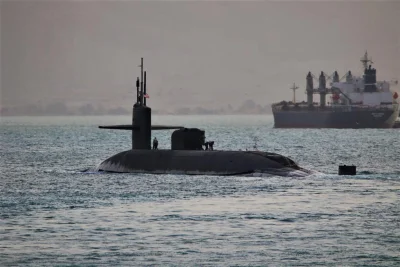
The guided-missile submarine USS Florida transits the Suez Canal en route to the Red Sea on Friday amid heightened tensions between the United States and Iran. File U.S. Navy photo by Mass Communication Specialist 2nd Class Elliot Schaudt
Dec. 22 (Asia Today) — China has voiced strong opposition to potential cooperation between South Korea and the United States on nuclear-powered submarines, warning it could undermine the global nuclear nonproliferation regime, Chinese state media reported.
Song Zhongping, a Chinese military analyst, said in an interview published Monday by the Global Times that consultations between Seoul and Washington on nuclear submarine-related cooperation could pose a “serious threat” to nuclear nonproliferation.
The Global Times cited South Korean media reports saying the two countries plan to begin sector-by-sector consultations next year related to leader-level understandings that include nuclear submarine construction, uranium enrichment and spent nuclear fuel reprocessing.
Song said the AUKUS nuclear submarine effort with Australia set a negative precedent and suggested a similar case could emerge with South Korea. He argued that U.S. support for allies’ access to nuclear technology and nuclear fuel would weaken the Nuclear Non-Proliferation Treaty.
Song also said Japan has raised the idea of acquiring nuclear-powered submarines and warned the trend could fuel an arms race. He said more countries operating nuclear-powered submarines would increase the risk of technology leakage and accidents.
He further argued South Korea has limited practical need for nuclear-powered submarines because of its restricted coastline, the report said.
In October, Chinese Foreign Ministry spokesperson Guo Jiakun said at a regular briefing that Beijing hopes South Korea and the United States will fulfill nonproliferation obligations and avoid actions that run counter to regional peace and stability, according to the report.
As Washington intensifies its political, economic, and military attacks against Venezuela, opposition to imperialism is also growing inside the United States—particularly among working-class and immigrant communities who experience the costs of imperialism directly. From cuts to social programs and housing insecurity to mass deportations and ICE raids, many are drawing connections between repression at home and US intervention abroad.
Elizabeth Blaney is a key figure in the Los Angeles tenant movement, a co-founder and co-director of Unión de Vecinos and part of the broader Los Angeles Tenants Union (LATU). With decades of experience organizing in Boyle Heights against displacement and gentrification, Blaney has also been deeply involved in international solidarity with Venezuela.
This conversation took place in the context of her participation in the recent People’s Assembly for Peace and Sovereignty held in Caracas. In it, she reflects on grassroots opposition to war and how the Bolivarian Revolution has helped radicalize housing struggles in the Los Angeles tenant movement.
How are organized working-class communities reacting to the latest imperialist military escalation against Venezuela?
Among the working-class base we organize with, there is absolutely no support for the war against Venezuela. In East Los Angeles, where I’m from—and in Los Angeles more broadly—the population is majority Latino, African American, and Asian. Most people in our communities are immigrants. Many come from countries that have experienced violence as a direct result of US intervention. Because of that, they understand the situation and recognize the real motivations behind what the US government is doing here in Venezuela. There is strong opposition to war and a clear demand for the United States to get out of the Caribbean.
People also understand that war funding comes directly at their expense. We’ve lost school programs, social services, and benefits. Starting in January, many people will lose Medicaid support. There is a widespread understanding that public resources are being redirected to fund wars. So, beyond solidarity or morality, there is also a concrete economic reason that people oppose war…. They know that they are already paying the price.
This has translated into organization. People want to learn more and get involved in the growing anti-war movement, and our leadership has participated in solidarity protests across Los Angeles. The ongoing ICE raids have also deepened understanding of what is happening to Venezuela: witnessing family members, friends, and neighbors abducted by ICE has generated fear, but also a growing disposition to resist.
Many people now understand that retreating into fear only strengthens the state. They also recognize that the same violence the US government deploys against them is being used against the people of Venezuela and Palestine. This has led to a broad rejection of imperialist aggression—people overwhelmingly oppose the imperialist military buildup in the Caribbean and the Israeli genocide, which is funded and enabled by the United States.
You participated in the recent “People’s Assembly for Peace and Sovereignty” [December 9-11] in Caracas. Getting to it was not easy, since most airlines stopped flying to Venezuela after Trump closed the airspace. Despite these obstacles, the Assembly took place and was a huge success. What can you tell us about it?
Hundreds of people were stranded in airports or had their flights canceled at the last minute because of Trump’s illegal attempt to control Venezuelan airspace. As a result, many delegates who were scheduled to attend didn’t make it.
Despite this, the conference went forward, with between 600 and 800 delegates from around the world present. In that sense, it was a success. Some people traveled through five or six countries just to get here. That level of commitment shows how deeply people oppose US aggression and support the call for peace!
Politically, what stood out most was how clearly delegates connected US aggression against Venezuela to its global impact. People discussed how sanctions and seizures—such as the illegal confiscation of oil tankers bound for Cuba and other countries—directly affect energy access and economic stability elsewhere. This makes it clear that what’s happening in Venezuela is an international issue.
There were also discussions about how war funding drains resources from working people in the United States and promotes speculation in financial and housing markets globally. One session focused specifically on housing, examining how imperialist war drives up rents and housing prices, worsening conditions for tenants worldwide.
Beyond peace, the Assembly’s debates emphasized people’s sovereignty and who has the right to control resources. The conclusion was clear—those resources belong to the Venezuelan people. If they are stolen from Venezuela, nothing prevents similar theft elsewhere.
The Peace Assembly helped develop a shared understanding of how to defend Venezuela’s sovereignty while preparing for what comes next globally. Now the analysis has to go back to our communities.
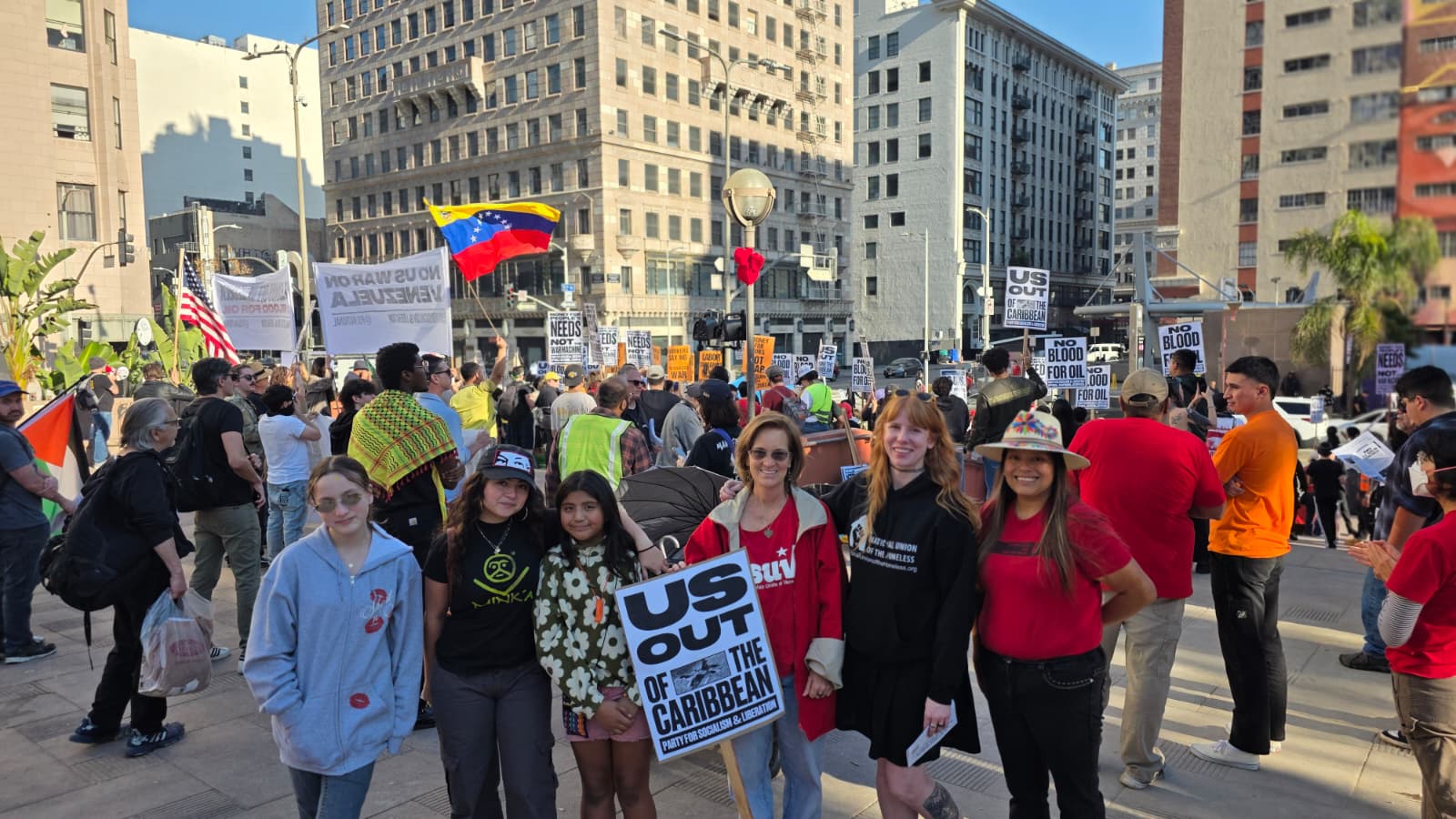
Members of the Unión de Vecinos in an LA concentration against the US military deployment in the Caribbean. (Unión de Vecinos)
You’ve said on other occasions that the Bolivarian Process, despite being demonized by the media establishment, has helped radicalize housing struggles in Los Angeles. How has that experience shaped your organization?
I’m part of the Unión de Vecinos, the East Side chapter of the Los Angeles Tenants Union. We’ve been engaged in internationalist solidarity work for many years. We first came to Venezuela in 2019 and have returned several times since, not only to oppose sanctions but to strengthen the tenant movement in Los Angeles and to be fellow travelers in the march toward socialism.
In July 2023, we organized a brigade of about 25 tenant organizers from across California. For many participants, it was a transformative experience. What people in the United States often don’t grasp is that in Venezuela, there is a real socialist project. Of course, it is not perfect and has contradictions, but it is a true emancipatory project with tangible advances. Housing rights, free university education, and free healthcare already exist here in ways they do not in the US.
Seeing this reality firsthand shifted how our organizers think. It made it clear that socialism is not just an abstract demand but something that can be built in practice. Over the past two years and across our 15 chapters, this experience has fueled profound debates about what it means to build a socialist project in Los Angeles.
We don’t see ourselves as just a housing movement. It is about tenants’ ability to survive, remain in their neighborhoods, and collectively shape their communities. This broader vision was strongly influenced by what we learned in Venezuela. Following a process of internal debates, the LA Tenants Union collectively declared itself a socialist organization in August. That decision would not have been possible without the internationalist exchange with Venezuela.
Another crucial lesson has been learning about participatory democracy. In the United States, democracy is reduced to voting every few years or speaking at meetings with no real power. In Venezuela, democracy is practiced as an ongoing process through communal assemblies and popular consultations. For our organizers, seeing Venezuela’s communal assemblies, which are the communes’ highest decision-making body—with “voceros” [spokespeople] accountable to them—has been especially influential. We are strengthening that model across our chapters.
This work goes beyond visits. We’ve built ongoing relationships with Venezuelan movements like the Movimiento de Pobladores, the Movimiento de Inquilinos, and the Simón Bolívar Institute through regular exchanges and political education initiatives. Reciprocal solidarity is central to our political formation and our ability to challenge dominant narratives in the United States.
At a recent event in El Panal Commune, the Simón Bolívar Institute launched the “Solidarity Committee with the Peoples of the US.” What does this initiative represent for grassroots movements in your context?
Solidarity requires sustained commitment and concrete action. This initiative creates a space where analysis and action converge in a spirit of reciprocal solidarity. At the launch, around ten or eleven organizations from the United States were present, all rooted in working-class communities, in addition to El Panal communards and spokespeople from the Instituto Simón Bolívar. That matters, because this isn’t just about organizations—it’s about the people they represent and organize.
The initiative strengthens our responsibility as organizers and working-class people in the US to fight fascism at home, while opposing imperialism abroad. It also demonstrates that we are not fighting alone. Through this work, we will also be deepening ties with movements in Mexico, Honduras, and Argentina, where people are facing similar crises, particularly around housing. Bringing these struggles together strengthens all of us.
Finally, how have the current ICE raids reshaped the political landscape inside the United States, and how do people connect this repression to US imperialist aggression abroad?
The raids and kidnappings being carried out by the US government against immigrants are a turning point. In practice, the Supreme Court has legalized racism, allowing federal agents to detain people based on skin color, language, or where they gather for work, without due process.
This has sparked resistance well beyond traditional activist circles. While working-class communities have always resisted, many people who were never politically active before are now organizing. Neighborhoods are forming patrols, blocking streets, warning residents, and physically slowing ICE operations.
This has opened space for deeper political conversations. People are increasingly connecting what is happening in their neighborhoods to US aggression abroad. They are asking: if the government can do this here—deporting people, including Venezuelans, or sending migrants to third countries—what stops it from escalating further against countries like Venezuela?
As a result, international solidarity no longer feels distant or abstract. More people are recognizing the shared enemy and taking action in solidarity with Venezuela. That political awakening is one of the most significant developments of the present moment.
Bob Mortimer is leading the tributes for Chris Rea following the Driving Home For Christmas star’s tragic deathCredit: youtubeBob was good friends with the late star the pair even making the song Lets Dance together in 1997 for Middlesbrough’s Football Club’s FA Cup FinalCredit: YouTube/Gone FishingOn his tribute post bob added a sweet picture of Chris in a bubble bath holding an eggCredit: X/RealBobMortimer
He made a huge impact in the entertainment industry and following his passing a host of celebrities have shared their tributes to the late singer.
Comedian Bob Mortimer branded the star a ‘brilliant bloke’, taking to X to pen a heartfelt message, he wrote: “So so sad. A lovely brilliant funny giant of a bloke. Oh Man….RIP Chris .. Boro legend forever. Love to family and friends”.
On the post the comedian added a sweet picture of Chris in a bubble bath holding an egg, which features in Bob’s memoir recalling a time on Would I Lie To You ? where Chris had ‘supposedly’ put an egg in his bath, after the episode Rea sent him the pic.
Bob was good friends with the late star, the pair even making the song Lets Dance together in 1997 for Middlesbrough’s Football Club’s FA Cup Final.
The football team also wrote a tribute on their own page for Chris, who hails from Middlesborough, they wrote: We’re deeply saddened to learn of the passing of Chris Rea. A Teesside icon. Rest in peace, Chris.”
TV star Lizzie Cundy also took to X to express her own condolences, she said: “I’m so sad to hear Chris Rea has died. I was lucky enough to star in his music video Driving home for Christmas.
“I loved every minute and was an honour to work with him and be in his iconic music video . He will always be an inspiration and legend to me. Rest in peace Chris.”
Lizzie appeared in the smash festive hit’s music video back in 2009, alongside a host of celebs including Gail Porter and Martin Shaw.
TV presenter Timmy Mallet wrote in his tribute: “ #RIP Chris Rea I bought his house 1991 on garage wall is happy Christmas message his daughters sprayed it’s still there.
“Chris is driving home For Christmas now singing for our nearest & dearest. Grateful for his wonderful gravely voice. God bless you Chris #RIP”
During Rea’s last TV appearance, on BBC’s Mortimer and Whitehouse Gone Fishing in 2020, the singer revealed a special gift he gave childhood sweetheart Joan.
He guest starred on the show for a special Christmas episode where he talked about his battle with serious health issues over the years.
Mortimer also spoke about how his health battles had strengthened the bond between him and his family.
Rea was quick to agree and beamed as he said he shared a similar experience with Joan.
The singer replied: “It was exactly the same for me. I was in hospital and the pancreatic cancer nurse comes in and tells me ‘it’s not grade three cancer phone your wife!’
“So I phone my wife and she pulled the car over and burst into tears.”
Themusicianhad his pancreas removed after he was diagnosed with pancreatic cancer in 2001 and suffered a stroke in 2016.
The singer went on to make a light-hearted joke about leaving his wife the royalties to his famous hit.
“I gave her all the money, all the rights to all the songs, and now she won’t give them back,” he laughed.
Rea’s wife of 57 years played a key role in writing his Christmas smash hit.
Rea’s wife of 57 years Joan played a key role in writing his Christmas smash hitCredit: Shutterstock EditorialFollowing a short illness Chris sadly passed away in hospital just three days before ChristmasCredit: EPARea’s last TV appearance was on the BBC’s Mortimer and Whitehouse Gone Fishing in 2020Credit: WARNING: Use of this image is subject to the terms of use of BBC Pictures’ Digital Picture
Colorado Gov. Jared Polis (R) talks with President Donald Trump in the Cabinet Room of the White House in Washington, D.C., on May 13, 2020. On Monday, Polis called on Trump to reverse his recent decision to deny the state disaster relief for recent flooding and fire damage. File Pool Photo by Doug Mills/UPI | License Photo
Dec. 22 (UPI) — Colorado lawmakers have called on President Donald Trump to reverse a recent decision denying state disaster aid requests in the wake of “life-threatening flooding and historic wildfires.”
In a statement Sunday, Colorado Gov. Jared Polis announced Trump had rejected the state’s requests for help and accused the president of playing “political games.” He said the state would be appealing the decision.
“Coloradans impacted by the Elk and Lee fires and the flooding in Southwestern Colorado deserve better than the political games President Trump is playing,” Polis said.
“I call on the president’s better angels, and urge him to reconsider these requests. This is about the Coloradans who need this support, and we won’t stop fighting for them to get what they deserve,” the Democratic governor added.
Polis declared a disaster emergency on Aug. 3, for the Elk Fire and added the Lee Fire three days later. He filed an executive order by the end of August as the state revealed initial damage estimates from the fires and mudslides totaled more than $27 million.
In October, Polis declared a disaster emergency to unlock $6 million in state funding for flood response and recovery in Western Colorado.
Democratic Sen. Michael Bennet said, “Trump’s decision to deny Colorado’s request for critical federal assistance is unacceptable.”
“Communities in Western Colorado are in serious need of help after the life-threatening flooding and historic wildfires earlier this year,” Bennet added. “Trump continues to use Coloradans for political games; it is malicious and obscene.”
While a president can tap additional federal assistance with a major disaster under the Stafford Act, the Trump administration has recently denied some states’ requests for aid as it works to downsize the Federal Emergency Management Agency.
The White House said Monday, “there is no politicization to the president’s decisions on disaster relief.” White House spokeswoman Abigail Jackson explained Trump’s decision, adding that the administration sent two firefighting planes to Colorado to help fight the fires.
“The president responds to each request for federal assistance under the Stafford Act with great care and consideration,” Jackson said, “ensuring American tax dollars are used appropriately and efficiently by the states to supplement — not substitute, their obligation to respond to and recover from disasters.”
United States President Donald Trump has issued a new warning to Nicolas Maduro, saying “it would be smart” for the Venezuelan leader to leave power, as Washington escalates a pressure campaign against Caracas.
The warning on Monday came as Russia pledged “full support” for Maduro’s government, and China condemned the US’s seizure of two oil tankers off the coast of Venezuela.
Recommended Stories
list of 4 itemsend of list
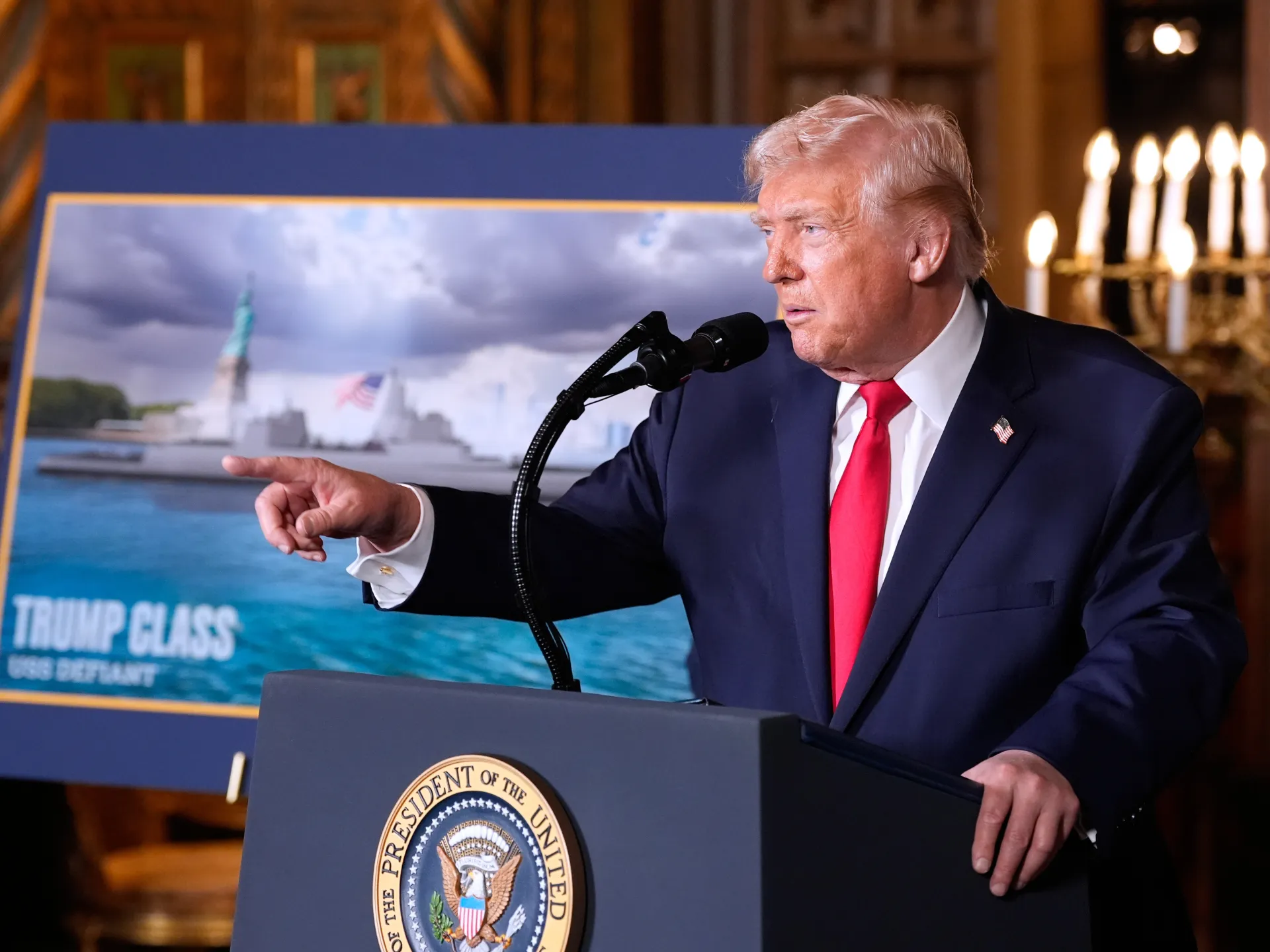
Trump, speaking at his Mar-a-Lago resort in Florida alongside his top national security aides, Secretary of State Marco Rubio and Secretary of Defense Pete Hegseth, suggested that he remains ready to further escalate his four-month pressure campaign.
When asked if the goal was to force Maduro from power, Trump told reporters: “Well, I think it probably would… That’s up to him what he wants to do. I think it’d be smart for him to do that. But again, we’re gonna find out.”
“If he wants to do something, if he plays tough, it’ll be the last time he’s ever able to play tough,” he added.
Trump levied his latest threat as the US coastguard continued for a second day to chase a third oil tanker that it described as part of a “dark fleet” that Venezuela uses to evade US sanctions.
“It’s moving along, and we’ll end up getting it,” Trump said.
The US president also promised to keep the ships and the nearly 4 million barrels of Venezuelan oil the coastguard has seized so far.
“Maybe we’ll sell it. Maybe we’ll keep it. Maybe we will use it in the strategic reserves,” he said. “We’re keeping it. We’re keeping the ships also.”
Maduro fires back
Trump’s campaign against Venezuela’s vital oil sector comes amid a large US military buildup in the region with a stated mission of combating drug trafficking, as well as more than two dozen strikes on alleged drug trafficking vessels in the Pacific Ocean and Caribbean Sea near the South American nation.
Critics have questioned the legality of the attacks, which have killed more than 100 people.
Venezuela denies any involvement in drug trafficking and insists that Washington is seeking to overthrow Maduro to seize the country’s oil reserves, which are the world’s largest.
It has condemned the US’s vessel seizures as acts of “international piracy”.
Maduro fired back at Trump hours after the latest warning, saying the US president would be “better off” if he focused on his own country’s problems rather than threatening Caracas.
“He would be better off in his own country on economic and social issues, and he would be better off in the world if he took care of his country’s affairs,” Maduro said in a speech broadcast on public television.
The exchange of words came on the eve of a United Nations Security Council meeting on Tuesday to discuss the growing crisis.
Russia’s Minister of Foreign Affairs Sergey Lavrov, in a phone call with his Venezuelan counterpart, Yvan Gil, slammed the US’s actions and expressed support for Caracas.
“The ministers expressed their deep concern over the escalation of Washington’s actions in the Caribbean Sea, which could have serious consequences for the region and threaten international shipping,” the Russian Ministry of Foreign Affairs said in a statement.
“The Russian side reaffirmed its full support for and solidarity with the Venezuelan leadership and people in the current context,” it added.
US blockade
China also condemned the US’s latest moves as a “serious violation of international law”.
“China opposes any actions that violate the purposes and principles of the United Nations Charter and infringe upon the sovereignty and security of other countries,” said Lin Jian, a spokesperson for the Chinese Foreign Ministry.
“Venezuela has the right to develop independently and engage in a mutually beneficial cooperation with other nations. China understands and supports Venezuela’s stance in safeguarding its legitimate rights and interests,” he added.
Last week, Rubio brushed aside Moscow’s stated support for Caracas.
Washington, he said, was “not concerned about an escalation with Russia with regards to Venezuela” as “they have their hands full in Ukraine”.
US-Russia relations have soured in recent weeks as Trump has voiced frustration with Moscow over the lack of a resolution on the war in Ukraine
Gil, on Monday, also read a letter on state television, signed by Maduro and addressed to UN member nations, warning that the US blockade “will affect the supply of oil and energy” globally.
“Venezuela reaffirms its vocation for peace, but also declares with absolute clarity that it is prepared to defend its sovereignty, its territorial integrity and its resources in accordance with international law,” he said.
“However, we responsibly warn that these aggressions will not only impact Venezuela. The blockade and piracy against Venezuelan energy trade will affect oil and energy supply, increase instability in international markets, and hit the economies of Latin America, the Caribbean, and the world, especially in the most vulnerable countries.”
PARIS Hilton has been spotted wearing a disguise while on rides at Disneyland with her family, and she almost went completely unnoticed.
The Simple Life alum swapped her signature platinum blonde hairstyle for a brunette wig to keep her identity under wraps.
Sign up for the Showbiz newsletter
Thank you!
Paris Hilton attempted to disguise herself in a brunette wig during a trip to DisneylandCredit: The Mega AgencyThe DJ was photographed on rides with her two kids: Pheonix and LondonCredit: The Mega Agency
However, Paris, 44, didn’t have everybody fooled, as photos circulated of the DJ donning the getup on Sunday at the Anaheim, California, theme park.
They captured the socialite snapping photos of herself on the carousel and on other kiddie rides with her two kids: a son, Pheonix, who turns three in January, and her 2-year-old daughter, London.
She paired her new hairdo with dark blue jeans, a long-sleeved black Mickey Mouse sweater, a black hat, and thick, black-framed glasses.
Paris’s sister, Nicky Hilton, 42, joined them for the outing, along with her little ones, although she didn’t attempt to hide from the crowd, even sporting Minnie Mouse ears while taking pictures on the rides.
Hours earlier, Paris shared a sweet video of her two kids, whom she shares with her husband, Carter Reum, smiling in front of a massive Christmas tree, decorated with silver and pink ornaments.
The youngsters wore matching light gray pajamas with Santa’s face for the photoshoot, during which Phoenix adorably sat on his little sister’s lap.
Paris gushed over the duo’s adorable bond and called them “besties for life,” while recalling her close relationship with her siblings.
“Watching Phoenix and London grow up side by side is the greatest gift. Best friends from the very beginning. There’s nothing like having a sibling to laugh with, learn with, and always feel understood by,” her caption began.
“Growing up with siblings shaped my whole heart, and I’m so grateful they get to have that same bond. I love my forever built-in bestie@NickyHiltonfor showing me just how special that kind of love can be,” the This Is Paris author added.
Paris also has two brothers, Barron Hilton II, 36, and Conrad Hilton, 31.
Despite the TV star’s tight bond with her family, which includes Real Housewives of Beverly Hills star Kathy Hilton, she kept them all in the dark about the birth of her eldest child until a week after he was born.
Paris welcomed her son via surrogate in 2023 but kept the news private out of concern it would leak.
“Not even my mom, my sisters, my best friend knew until he was over a week old,” the reality star confessed on her This Is Paris podcast.
“It was really nice to have that with Carter, be our own journey together. I just feel like my life has been so public, and I’ve never really had anything be just mine,” Paris continued.
“So, when we were talking about it, I really felt that I wanted this journey to be for us only.”
She also said she and Carter “made a pact” to keep the pregnancy a secret, and they followed through on it.
Paris and Carter began dating in November 2019 after reconnecting at a Thanksgiving dinner with mutual friends.
They had known each other for 15 years before that, but it wasn’t until their first date that their romance blossomed.
Paris paired the look with blue jeans, a long-sleeved Mickey Mouse shirt, a hat, and glassesCredit: The Mega AgencyShe snapped pictures of herself on the carousel, seemingly trying to go under-the-radarCredit: The Mega AgencyParis’s sister, Nicky Hilton, joined her for the outing, along with her kidsCredit: Getty
Kilmar Abrego Garcia delivers remarks during a rally before his check in at the ICE Baltimore Field Office in Baltimore Maryland, on August 25. On Monday, a federal judge allowed the Salvadoran native to remain free through Christmas, after he was released earlier this month, as he awaits trial on human smuggling charges in Tennessee. File Photo by Shawn Thew/EPA
Dec. 22 (UPI) — A federal judge on Monday allowed Kilmar Abrego Garcia to remain free through Christmas as she barred Immigration and Customs Enforcement from re-detaining the Salvadoran native.
U.S. District Judge Paula Xinis in Maryland extended a temporary restraining order to keep federal officials from deporting Abrego Garcia, after the U.S. Supreme Court ruled he was deported and imprisoned in March without legal authority to El Salvador.
“This is an extremely irregular and extraordinary situation,” Xinnis told attorneys Monday, as she pressed the government on whether it would detain Abrego Garcia if there were no restraining order.
“Show your work, that’s all,” Xinis said. “Give it to me and we don’t have to speculate.”
Abrego Garcia was released from ICE detention on Dec. 11, following efforts to deport him to an African nation where he has no connection.
“Because Abrego Garcia has been held in ICE detention to effectuate third-country removal absent a lawful removal order, his requested relief is proper,” according to Xinis.
The U.S. Department of Homeland Security called Xinis’ rulings “naked judicial activism by an Obama-appointed judge.”
Abrego Garcia, who illegally entered the United States nearly 15 years ago, has accused the White House of vindictive prosecution. The administration has called him an MS-13 gang member, which he denies.
Abrego Garcia had been living in Maryland with his wife and children before being deported to El Salvador’s CECOT mega-prison in March. He was returned to the United States in June and is awaiting trial on human smuggling charges in Tennessee. He has pleaded not guilty.
On Monday, Abrego Garcia’s attorneys said he is prepared to go to Costa Rica, which the judge said the government refuses to consider.
The “persistent refusal to acknowledge Costa Rica as a viable removal option, their threats to send Abrego to African countries that never agreed to take him and their misrepresentation to the court that Liberia is now the only country available to Abrego, all reflect that whatever purpose was behind his detention, it was not for the ‘basic purpose’ of timely third-country removal,” Xinis wrote.
The Trump administration has shifted from a “narcoterrorism” campaign to economic coercive measures. (Countercurrents)
In our Donald-in-Wonderland world, the US is at war with Venezuela while still grasping for a public rationale. The horrific human toll is real – over a 100,000 fatalities from illegal sanctions and over a hundred from more recent “kinetic strikes.” Yet the officially stated justification for the US empire’s escalating offensive remains elusive.
The empire once spun its domination as “democracy promotion.” Accordingly, State Department stenographers such as The Washington Post framed the US-backed coup in Venezuela – which temporarily overthrew President Hugo Chávez – as an attempt to “restore a legitimate democracy.” The ink had barely dried on The New York Timeseditorial of April 13, 2002 – which legitimized that imperial “democratic” restoration – before the Venezuelan people spontaneously rose up and reinstated their elected president.
When the America Firsters captured the White House, Washington’s worn-out excuse of the “responsibility to protect,” so beloved by the Democrats, was banished from the realm along with any pretense of altruism. Not that the hegemon’s actions were ever driven by anything other than self-interest. The differences between the two wings of the imperial bird have always been more rhetorical than substantive.
Confronted by Venezuela’s continued resistance, the new Trump administration retained the policy of regime change but switched the pretext to narcotics interdiction. The Caribbean was cast as a battlefield in a renewed “war on drugs.” Yet with Trump’s pardon of convicted narco-trafficker and former Honduran President Juan Orlando Hernández – among many other contradictions – the alibi was wearing thin.
Venezuelan oil tankers blockaded
The ever-mercurial US president flipped the narrative on December 16, announcing on Truth Social that the US would blockade Venezuelan oil tankers. He justified this straight-up act of war with the striking claim that Venezuela had stolen “our oil, our land, and other assets.”
For the record, Venezuela had nationalized its petroleum industry half a century ago. Foreign companies were compensated.
This presidential social media post followed an earlier one, issued two weeks prior, ordering the airspace above and surrounding Venezuela “closed in its entirety.” The US had also seized an oil tanker departing Venezuela, struck several alleged drug boats, and continued to build up naval forces in the region.
In response to the maritime threat, President Nicolás Maduro ordered the Venezuelan Navy to escort the tankers. The Pentagon was reportedly caught by surprise. China, Mexico, Brazil, BRICS, Turkey, along with international civil society, condemned the escalation. Russia warned the US not to make a “fatal mistake.”
The New York Times reported a “backfire” of nationalist resistance to US aggression among the opposition in Venezuela. Popular demonstrations in support of Venezuela erupted throughout the Americas in Argentina, Panama, Ecuador, Peru, Mexico, Brazil, Colombia, Honduras, and the US.
Trump’s phrasing about Venezuela’s resources is not incidental. It reveals an assumption that precedes and structures the policy itself: that Venezuelan sovereignty is conditional, subordinate to US claims, and revocable whenever it conflicts with Yankee economic or strategic interests. This marks a shift in emphasis, not in substance; drugs have receded from center stage, replaced by oil as the explicit casus belli.
The change is revealing. When Trump speaks of “our” oil and land, he collapses the distinction between corporate access, geopolitical leverage, and national entitlement. Venezuelan resources are no longer considered merely mismanaged or criminally exploited; they are portrayed as property wrongfully withheld from its rightful owner.
The day after his Truth Social post, Trump’s “most pointless prime-time presidential address ever delivered in American history” (in the words of rightwing blogger Matt Walsh) did not even mention the war on Venezuela. Earlier that same day, however, two House resolutions narrowly failed that would have restrained Trump from continuing strikes on small boats and from exercising war powers without congressional approval.
Speaking against the restraining resolutions, Rep. María Elvira Salazar – the equivalent of Lewis Carroll’s Red Queen and one of the far-right self-described “Crazy Cubans” in Congress – hailed the 1983 Grenada and 1989 Panama invasions as models. She approvingly noted both were perpetrated without congressional authorization and suggested Venezuela should be treated in the same way.
The votes showed that nearly half of Congress is critical – compared to 70% of the general public – but their failure also allows Trump to claim that Congress reviewed his warlike actions and effectively granted him a mandate to continue.
Non-international armed conflict
In this Trumpian Wonderland, a naval blockade with combat troops rappelling from helicopters to seize ships becomes merely a “non-international armed conflict” not involving an actual country. The enemy is not even an actual flesh and blood entity but a tactic – narco-terrorism.
Trump posted: “Venezuelan Regime has been designated a FOREIGN TERRORIST ORGANIZATION.” Yet FTOs are non-state actors lacking sovereign immunities conferred by either treaties or UN membership. Such terrorist labels are not descriptive instruments but strategic ones, designed to foreclose alternatives short of war.
In a feat of rhetorical alchemy, the White House designated fentanyl a “weapon of mass destruction.” Trump accused Venezuela of flooding the US with the deadly synthetic narcotic, when his own Drug Enforcement Administration says the source is Mexico. This recalls a previous disastrous regime-change operation in Iraq, also predicated on lies about WMDs.
Like the Cheshire Cat, presidential chief of staff Susie Wiles emerges as the closest to a reliable narrator in a “we’re all mad here” regime. She reportedly said Trump “wants to keep on blowing boats up until Maduro cries uncle,” openly acknowledging that US policy has always been about imperial domination.
The oil is a bonus for the hegemon. But even if Venezuela were resource-poor like Cuba and Nicaragua, it still would be targeted for exercising independent sovereignty.
Seen in that light, Trump’s claim that Venezuela stole “our” oil and land is less an error than a confession. It articulates a worldview in which US power defines legitimacy and resources located elsewhere are treated as imperial property by default. The blockade is not an aberration; it is the logical extension of a twisted belief that sovereignty belongs to whoever is strong enough to seize it. Trump is, in effect, demanding reparations for imperialists for the hardship of living in a world where other countries insist their resources belong to them.
The drama has landed on Netflix and is currently on the streaming giant’s Top 10 chart.
The actor is best known for starring in Downton Abbey(Image: ITV)
A recent drama featuring one of Downton Abbey‘s most familiar faces has made its way to Netflix, and it’s certainly stirred up mixed feelings.
The suspenseful thriller, Captivated, also known as Too Good To Be True, hails from 2024 and currently holds a middling 5.6/10 rating on IMDb.
The plot centres around Rachel, a single mum and cleaner, who is offered an improved job by a wealthy businessman. However, as she becomes more entangled in his affairs, her suspicions about his intentions grow.
Despite its initial airing on Channel 5 last year, the series has gained renewed interest after being added to Netflix UK, where it now ranks third on the streaming behemoth’s Top 10 chart.
While some viewers have clearly enjoyed the show, others have taken to IMDb to caution potential watchers “not to waste their time” on the thriller, reports the Express.
“An utter waste of time,” ane disgruntled viewer lamented, adding: “Just finished this series, of which all 4 episodes can be seen on My5. It gets steadily worse with each episode with a paper thin and entirely predictable plot.”
Another echoed the sentiment, advising: “Don’t waste your time like I did. I kept thinking it would get better. It absolutely does not.”
A third chimed in with their critique, branding it “predictable and unconvincing,” and describing it as “a disappointing crime miniseries”.
Another viewer chimed in: “As usual with this type of drama, this started off OK and went downhill rapidly. It is very predictable and some of it makes no sense at all.”
Get Netflix free with Sky
This article contains affiliate links, we will receive a commission on any sales we generate from it. Learn more
Sky is giving away a free Netflix subscription with its new Sky Stream TV bundles, including the £15 Essential TV plan.
This lets members watch live and on-demand TV content without a satellite dish or aerial and includes hit shows like Stranger Things and The Last of Us.
Yet not everyone shared such a dim view, with some fans finding merit in the programme, one describing it as “strangely entertaining”.
“I’ve read some scathing reviews about this show, and whilst I don’t think it’s great, I still think it’s watchable,” reasoned another viewer.
A third defended it as “not as bad as ratings suggest”, adding: “This is a little predictable but is easy to watch and does have a storyline.”
Another supporter urged: “Despite the low rating and some negative reviews it’s surprisingly good. So don’t be fooled.”
One enthusiastic fan encouraged patience: “The first episode was good just persevere with it as the series does get better. It’s little predictable but a good watch ! Too Good To Be true is intense and thrilling to watch!!”
Those curious to form their own opinion can stream Captivated on Netflix and Channel 5 in the UK, or BritBox in the US.
**For the latest showbiz, TV, movie and streaming news, go to the new **Everything Gossip** website**
Planned talks come as Southeast Asian leaders urge both countries to show ‘maximum restraint’ and return to dialogue.
Published On 22 Dec 202522 Dec 2025
Share
Thailand and Cambodia have agreed to hold a meeting of defence officials later this week as regional leaders push for an end to deadly violence along the two countries’ shared border.
Thailand’s Foreign Minister Sihasak Phuangketkeow announced the planned talks on Monday after a special meeting in Kuala Lumpur of Southeast Asian foreign ministers, who were trying to salvage a ceasefire.
Recommended Stories
list of 3 itemsend of list
That truce was first brokered by Association of Southeast Asian Nations (ASEAN) chair Malaysia and United States President Donald Trump after cross-border fighting broke out in July.
Sihasak told reporters that this week’s discussions would be held on Wednesday in Thailand’s Chanthaburi, within the framework of an existing bilateral border committee.
But just hours after the regional crisis talks were held in Malaysia, Cambodia’s Ministry of Defence said the Thai military deployed fighter jets to bomb areas of Siem Reap and Preah Vihear provinces.
The Thai army said Cambodia had fired dozens of rockets into Thailand, with Bangkok’s air force responding with air strikes on two Cambodian military targets.
Thailand and Cambodia have engaged in daily exchanges of rocket and artillery fire along their 817km (508-mile) land border following the collapse of the truce, with fighting at multiple points stretching from forested regions near Laos to the coastal provinces of the Gulf of Thailand.
Despite the cross-border fire, Cambodia’s Ministry of Interior said it remains “optimistic that the Thai side will demonstrate sincerity” in implementing a ceasefire.
Thailand’s Sihasak, however, cautioned that the upcoming meeting may not immediately produce a truce. “Our position is a ceasefire does not come with an announcement, but must come from actions,” he said.
His ministry said the two nations’ militaries would “discuss implementation, related steps and verification of the ceasefire in detail”.
The planned meeting comes as ASEAN on Monday urged both countries to show “maximum restraint and take immediate steps towards the cessation of all forms of hostilities”.
In a statement after the talks in Kuala Lumpur, ASEAN also called on both Thailand and Cambodia to “restore mutual trust and confidence, and to return to dialogue”.
ASEAN members also reiterated their concerns over the ongoing conflict and “called upon both parties to ensure that civilians residing in the affected border areas are able to return, without obstruction and in safety and dignity, to their homes”.
Weekly insights and analysis on the latest developments in military technology, strategy, and foreign policy.
The U.S. Navy has confirmed to TWZ that the armament package for its first “flight” of its new FF(X) frigates will not include a built-in Vertical Launch System (VLS). There had been widespread questions about whether the ships would include a VLS array after renderings were released with no such feature readily apparent.
A lack of any type of VLS on the FF(X) design is a glaring omission that can only raise questions about the operational utility and flexibility of the ships. At the same time, the new frigates will be able to carry modular payloads, including containerized missile launchers, on their sterns. The Navy also has an explicit plan to employ the FF(X)s as “motherships” for uncrewed surface vessels (USV), likely offering a distributed arsenal, as well as additional sensors, for the frigates to leverage during operations.
One of the renderings the Navy released last week of the FF(X) design. USN via USNI News
I have directed a new Frigate class as part of @POTUS Golden Fleet. Built on a proven American design, in American shipyards, with an American supply chain, this effort is focused on one outcome: delivering combat power to the Fleet fast. pic.twitter.com/ovnASiHYaF
“The initial flight of FF(X) will have a 57mm gun, 2 x 30mm guns, a Mk 49 Rolling Airframe Missile [launcher], various countermeasures, and a flight deck from which to launch helicopters and unmanned systems. Aft of the flight deck, there will be a flexible weapons system, which can accommodate containerized payloads (Counter-UAS, other missiles),” a Navy spokesperson told TWZ today. “Much like the successful DDG-51 [Arleigh Burke class destroyer] program, we are building this in flights. The frigate will be upgraded over successive flights to evolve and has the space reservations needed to improve capability over time.”
“The goal is to get [FF(X)] hulls in the water ASAP,” another Navy official told TWZ. “Minimal design changes will be incorporated into the first flight so that we can get hulls into the water as soon as possible.”
“The [FF(X)] design changes are in the process of being finalized and we are confident that our extensive experience and collaboration with the U.S. Navy will lead to a successful approval process,” a HII spokesperson also told us. “Specific and targeted changes will be implemented to meet unique mission requirements. The process will be similar to a baseline upgrade on the DDG program, which has been successfully used to introduce new capabilities multiple times over the class’ history. Design work is ongoing and we understand the Navy’s intent is to minimize changes in order to expedite procurement.”
One of the US Coast Guard’s existing Legend class National Security Cutters. USCG
As we mentioned in our initial reporting on FF(X), the size of the Mk 41 VLS array on the previously planned Constellation class frigates was a hot topic of debate. Questions had been raised whether the 32-cell VLSs on those ships would be sufficient to meet their expected operational taskings, as you can read about more in this past TWZ feature.
A rendering of a Constellation class frigate. USN
Overall, the Mk 41 VLS requirement was central to the FFG(X) program that led to the Constellation class design. This was viewed as a key element of righting the wrongs of the Navy’s chronically underperforming Littoral Combat Ship (LCS) program. The Independence class and Freedom class LCSs both lack a VLS array. In addition, it’s worth remembering here that HII’s losing FFG(X) bid was notably a Patrol Frigate concept derived from the National Security Cutter that featured a VLS. The company had also pitched other VLS-equipped Patrol Frigate variations to the Navy before then, as seen in the video below.
Patrol Frigate Variants – Information Video
Integrating a VLS into future flights of FF(X) frigates is certainly an option, but one that could be complex and costly if the design is not configured to accommodate one to begin with. AsTWZ previously highlighted, the FF(X) configuration, as it has been seen so far, has a significantly redesigned main superstructure compared to the Coast Guard’s Legend class and previous Patrol Frigate concepts. This includes a prominent ‘shelf’ that extends forward into the space on the bow utilized for VLSs on previously seen Patriot Frigate configurations. With what we know now, that extension seems more likely to be utilized in the future as a mounting place for some type of point defense system, possibly even a laser directed energy weapon. It’s possible it could be adapted to accommodate a small VLS array in the future, as well. The lack of an integrated VLS could explain the lack of a more advanced radar in the renderings of the FF(X) that have been shown so far.
A rendering showing the FF(X) design from the top down with the ‘shelf’ extending forward of the main superstructure clearly visible. USN capture
Installing missile launchers on the FF(X)’s fantail would give the ships a boost in firepower in the absence of an integrated VLS array. Renderings so far have shown what look to be launchers for up to 16 Naval Strike Missiles (NSM) installed in that position. NSM is an anti-ship cruise missile with secondary land-attack capability that the Navy has already integrated onto a portion of its LCSs and at least one Arleigh Burke class destroyer, and that the Marine Corps is fielding now in a ground-based configuration. There also looks to be space there for a least one containerized Mk 70 Payload Delivery Systems (PDS), another capability the Navy is already acquiring. Each Mk 70 contains a four-cell launcher derived from the Mk 41 VLS, and similarly capable of firing a variety of weapons, including SM-6 multi-purpose missiles and Tomahawk land-attack cruise missiles. FF(X)s could also leverage sensors on larger crewed warships for targeting purposes when operating as part of a surface action group.
An SM-6 missile seen being fired from a Mk 70 containerized launcher mounted on the stern flight deck of a US Navy Independence class LCS. USN
“The FF(X) will be designed to command groups of unmanned vessels, acting as a sort of ‘mothership,’ providing the commander tailored force packages based upon the weapons and sensors fielded on those unmanned craft,” a Navy spokesperson also told TWZ today.
In this way, an FF(X) could still call upon a deeper and more flexible array of weapon options without having to have a VLS integrated directly onto the ship. The uncrewed platforms would also be able to operate across a much broader area than any single crewed frigate and present a different risk calculus for operating in higher-risk environments. All of this would expand the overall reach of the combined force and present targeting challenges for opponents. But there are also substantial development and operational risks with this kind of arrangement. As it sits, this kind of autonomous vessel and manned vessel teaming is still in development. Operationally, leaving the ship without, or with very limited, area defense capability is at odds with many future threat scenarios.
The Navy is already separately pursuing a family of larger uncrewed surface vessels (USV) able to carry an array of containerized payloads to bolster the capability and operational capacity of its crewed surface fleets as part of a program called Modular Surface Attack Craft (MASC), which you can read more about here.
Even with all this in mind, the lack of a VLS still raises significant questions about the FF(X) plans, especially about the ability of the ships to operate more independently. This has been a key issue for the Navy’s existing LCS fleets, and one that the Constellation class was supposed to help address.
The USS Freedom, seen at the rear, sails alongside the USS Independence. USN The USS Freedom, at rear, sails alongside the USS Independence, in the foreground. The lead ships in both of their classes of Littoral Combat Ships (LCS), these vessels were both been decommissioned in 2021. USN
Omitting a VLS capable of at least employing Evolved Sea Sparrow Missiles (ESSM) imposes particular limitations on the ship’s ability to defend itself against aerial threats. Navy experiences during recent operations in and around the Red Sea have served to put a notable spotlight on the ever-growing dangers posed by anti-ship missiles and drones, which would be far more severe in any future high-end fight in the Pacific. All of this also means FF(X)s will not be able to provide area defense for convoy operations without a modular containerized payload, and that would only offer a very limited supply of munitions compared to a highly efficient VLS array.
The Navy is also clearly focused on just trying to get more hulls into service as quickly as it reasonably can. The service has major operational demands for more surface warships, in general, and now has an additional gap to fill following the collapse of the Constellation class program. The goal is for the FF(X) to be launched in 2028.
“We will start as soon as a funding contract and material are available,” the HII spokesperson told TWZ today. “We are confident in our ability to launch the first ship into the water in 2028, then conduct final outfitting, systems activation, and testing before delivering to the Fleet.”
HII also plans to leverage materials already acquired under the Coast Guard’s Legend class National Security Cutter program to help accelerate work on the first FF(X) hull. The current timeline for that ship to enter operational service remains unknown.
Overall, just how aggressively the Navy is moving to get these new frigates into the fleet as fast and cheaply as possible is now clear with today’s news. While expanded variants in the future with VLS arrays and more exquisite combat systems seem like a real possibility, when it comes to installed armament, America’s next frigate is set to be just as lightly armed as the LCS that came before it.
A new celebrity is rumoured to be replacing Daniel Craig as the next James BondCredit: AlamyAfter impressing fans in Netflix show House Of Guinness, Anthony Boyle’s odds have shot to 4-1 to take on the roleCredit: Getty
The actor has been cut to 4-1, from 12-1, by bookmaker Coral to become the next James Bond, after attracting support in the firm’s betting over the last 24 hours.
Coral’s John Hill said: “We have seen significant support for Anthony Boyle in our next James Bond betting over the last 24 hours.
“As we approach the end of 2025, many punters are convinced he could be leading the race to replace Daniel Craig.”
The British actor and Hollywood star posted a playful reel on TikTok as he posed with James Bond wax figures at Madame Tussauds.
As the iconic Bond theme played over the top and the camera panned along the line of 007s, the shot finally stopped to show Idris, 53, standing at the end.
Viewers of the video rushed to the comments section to share their excitement, feeling Idris would be a prime pick for replacing Daniel Craig.
“You would be an AMAZING Bond,” said one user. A second exclaimed in all caps: “Do not get me excited for this.”
Although Jacob is Australian, is does not rule him out – especially as Aussie actor George Lazenby having previously played Bond in On Her Majesty’s Secret Service in 1969.
Aaron Taylor-Johnson and Henry Cavill have also been heavily rumoured to take on the gig.
Anthony is known for portraying Arthur GuinnessCredit: PADaniel took on the role two decades ago and has now stepped downCredit: AlamyHenry Cavill is one of the other stars who is heavily rumoured to take on the job, alongside Idris Elba and Callum TurnerCredit: Getty
People light candles in the Church of Nativity, believed to be built on the site where Jesus was born, in Bethlehem, West Bank, on Friday. A poll of Americans found that while the percent of people who observe the religious aspects of Christmas has declined over the past several years, the secular traditions have largely stayed steady. Photo by Debbie Hill/ UPI | License Photo
Dec. 22 (UPI) — While the number of Americans who enjoy the secular traditions of Christmas has remained largely unchanged over recent years, a Gallup analysis released Monday showed that fewer people are observing the religious aspects of the holiday.
The poll found that 88% of Americans say they celebrate Christmas, down from 90% in 2024 and 96% in 2005. Of the more secular aspects of Christmas, 96% of people exchange gifts (down from 97% in 2010); 95% get together with friends or family (97% in 2010); 90% put up a Christmas tree (92% in 2010); 89% put up other decorations (91% in 2010); and 43% attend a holiday concert or play (58% in 2010).
The more religious aspects of Christmas saw a greater decline over the same period of time, with 54% of people using religious decorations such as nativities (down from 68% in 2010) and 47% attending a religious service (64% in 2010).
All religious activities saw a notable drop in participation, while one secular event — attending a holiday concert or play — did as well.
“Although fewer people, including fewer Christians, appear to be incorporating religious aspects, Christmas is thriving as a social occasion focused on gatherings, festivities and gifts,” Gallup said in an analysis of the data.
“Its popularity among young adults and non-Christians in general suggests that even as the U.S. continues to change demographically, a less religiously focused Christmas will endure.”
Gallup asked a few new questions about people’s traditions this year, finding that 86% of people watch holiday-themed movies, 81% make holiday desserts and 52% send holiday cards.
Gallup said that of the adults who celebrated Christmas, 69% identified as a Christian denomination, down from 83%, mirroring the overall drop in American adults who identify with a particular religion.
The poll found that there’s little difference in the percentage of Christians and non-Christians who celebrate secular Christmas traditions, and, in fact, a marginally higher percentage of non-Christians participate in some activities, including gathering together with friends and family and exchanging gifts. In each category, 97% of non-Christians participate while 95% of Christians gather with friends and family and 96% exchange gifts.
Meanwhile, Christians are far more likely to observe religious traditions such as using religious decorates (69% compared to 22%) and attending a Christmas service (61% to 11%).
New Yorkers gather for near Times Square at SantaCon NYC on Saturday as part of the annual worldwide event where thousands dress as Santa or other festive characters for a day of drinking, parading through city streets and celebrating the holidays. Photo by John Angelillo/UPI | License Photo
Rea said he was on the dole at the time, his manager had just left him and he had been banned from driving.
His then-girlfriend Joan (who he met when they were both 16 and went on to marry) had to pick him up in London in her mini and drive him home.
That’s what inspired the song, which was written in 1978, 10 years before it was released as a single in 1988.
Asked about what he thinks of when he hears the song, the singer joked about how it bought him “that lovely little holiday in the Maldives”.
The song has since been covered by artists including Engelbert Humperdinck and Stacey Solomon.
Rea was good friends with Mortimer and in 1997 they recorded Let’s Dance for Middlesbrough Football Club’s FA Cup Final.
On Monday evening, Mortimer posted on X: “So so sad. A lovely brilliant funny giant of a bloke. Oh Man… RIP Chris… Boro legend forever. Love to family and friends.”
But alongside the singer-songwriter’s success, he had suffered with various bouts of ill-health over the years.
He had his pancreas removed a few years after being diagnosed with pancreatic cancer at the age of just 33 in 1994, which meant he developed type 1 diabetes. He later had a stroke in 2016.
Rea (centre) appeared on Mortimer & Whitehouse: Gone Christmas Fishing in 2020
“None of my heroes were rock stars. I arrived in Hollywood for the Grammy Awards once and thought I was going to bump in to people who mattered, like Ry Cooder or Randy Newman. But I was surrounded by pop stars.”
He added: “The celeb thing has gone totally wrong in the sense that everyone has tried to top each other. They don’t put the work in.”
Speaking of his wife in the same interview, he said: “Our golden moment is each morning when there is an elbow fight over whose turn it is to make the coffee.
“Then there are the large mugs of fresh coffee, BBC Breakfast news or Sky and we gaze out of the window over the countryside for an hour and we are still 16. We are lucky to still have that feeling.”
Rea was born in 1951 in Middlesbrough to an Italian father and Irish mother, and had six siblings. He began his working life helping out with his family’s ice-cream business.
“To be Irish Italian in a coffee bar in Middlesbrough – I started my life as an outsider,” he later said.
Getty Images
Once he found the guitar, he soon began playing in various bands and released his debut album Whatever Happened To Benny Santini? in 1978.
His commercial breakthrough came in the 1980s, as two of his studio albums – The Road To Hell (1989) and Auberge (1991) – went to number one in the UK.
He returned to his blues roots in his later years while facing his health challenges.
After his stroke nine years ago, he recovered to launch a new album, Road Songs For Lovers, in 2017.
He took the album on the road at the end of that year but had to cancel a number of shows after he collapsed mid-song while performing at the New Theatre in Oxford.
Rea released a new album in October 2025, titled The Christmas Album, featuring a remaster of Driving Home For Christmas as well as other festive tracks.
Paying tribute to Rea following his death, journalist Tony Parsons described him as a “top man” and “hugely underrated songwriter”.
TV personality Lizzie Cundy, who appeared in the music video for a 2009 version of Driving Home For Christmas, said that she was “so sad” to hear the musician had died.
“I loved every minute and was an honour to work with him and be in his iconic music video,” she said. “He will always be an inspiration and legend to me.”
Andy McDonald, Labour MP for Middlesbrough and Thornaby East, said he was “very saddened” to hear the news of Rea’s death.
In a post on X, he said: “Chris, a most cherished son of Middlesbrough, will live on through his wonderful music. My sincere condolences to his family.”
Rea and his wife Joan shared two daughters, Josephine and Julia. He credited his family with helping him to cope after his ill health.
“It’s music and family with me. I’m only one of four, that’s how I am,” Rea once said. “I’m 25% of a unit. It’s always been that way and we like it that way. In between that there’s music.”
Claudia Schiffer plays Carol, a single mother and the love interest for Liam Neeson’s character, widower Daniel, after he mentions she is his dream woman throughout the film
22:53, 22 Dec 2025Updated 22:53, 22 Dec 2025
Claudia appeared in the iconic Christmas film(Image: PA)
She might only have appeared on screen for 60 seconds but Claudia Schiffer was reportedly paid a truly blockbuster sum of money for her brief cameo in Love Actually. The supermodel plays the role of Carol who is a single mother and the love interest for Liam Neeson’s character, widower Daniel.
This comes after he mentions her as his dream woman throughout the entirety of the film is Claudia Schiffer. It has been reported that the star received quite the pay cheque despite only appearing for about a minute in total. Her appearance came back in 2003 and she is said have been paid around £275,000, or £4,500 ($6,100) per second for the job.
Vogue reported that Andrew Holmes’s book How Much?!: The $1000 Omelette… and 1100 Other Astonishing Money Moments revealed the impressive amount. Now, 22 years on from when the movie was filmed, the pay cheque would be the equivalent of £458,000 ($616,000) or £7,633 ($10,274) per second.
Claudia’s short scene in the film comes after Daniel’s son, Sam (played by Thomas Brodie-Sangster), finishes playing the drums in his school play in a bid to impress his classmate Joanna.
Daniel then meets Sam backstage to congratulate him on her performance when Sam says that his plan to win his classmate over hasn’t worked and she was on her way to the airport to go back to the US.
However, this doesn’t stop them as they then make their way to the car to drive to the airport. But as Daniel turns around, he bumps into a school mum, Carol, who is played by Claudia.
Carol apologises as Daniel explained that it was his fault. Carol then goes on to ask if Daniel was Sam’s dad as he then confirms and the pair shake hands.
Daniel confessed that he hopes that they will meet again as Carol replies “I’ll make sure we do”. Claudia recently opened up about her personal life as she said her focus changed after she married Matthew Vaughn and they had their three children, Casper, now 22, Clementine, 21, and Cosima, 15.
She said she found that she became less “competitive” and that she is content with what she has achieved in her life despite knowing she could book more jobs if she wished.
The supermodel recently spoke to HELLO! magazine where she opened up about her career as well as her family life. She said: “When I was in my 20s, travelling around the world, my focus was on my career – working hard, being competitive and getting to the top.
“That changed when I had kids, and now, I feel lucky to have such a wonderful family. I’m proud of my children, they’re very down to earth and their well-being is mine and my husband’s priority.”
The Mirror has contacted Claudia’s reps for comment
Dec. 22 (UPI) — The former CEO of a healthcare software company in Arizona was sentenced to 15 years in prison and ordered to pay more than $452 million in restitution for conspiring to defraud Medicare for $1 billion, the U.S. Department of Justice said Monday.
Gary Cox, 79, of Maricopa County, was found guilty in June of healthcare fraud in which he generated false doctors’ orders to support fraudulent claims for various medical items.
“This just sentence is the result of one of the largest telemarketing Medicare fraud cases ever tried to verdict,” Acting Assistant Attorney General Matthew R. Galeotti of the Justice Department’s Criminal Division said in a statement. “Telemedicine scammers who use junk mailers, spam calls and the internet to target senior citizens steal taxpayer money and harm vulnerable populations. The Criminal Division will continue dedicating substantial resources to the fight against telemedicine and medical equipment frauds that drain our health care benefit programs.”
Cox was convicted of conspiracy to commit healthcare fraud and wire fraud, three counts of healthcare fraud, conspiracy to pay and receive healthcare kickbacks, and conspiracy to defraud the United States and make false statements in connection with healthcare matters.
Cox was the CEO of Power Mobility Doctor Rx, LLC.
Prosecutors say Cox and his co-conspirators targeted several hundred thousand Medicare beneficiaries who provided personally identifiable information and agreed to accept medically unnecessary orthotic braces, pain creams and other items through misleading mailers, television advertisements and calls from offshore call centers, the Justice Department said.
Cox connected pharmacies, durable medical equipment suppliers and marketers with telemedicine companies to accept illegal kickbacks and bribes in exchange for signed doctors’ orders transmitted using the DMERx platform.
Prosecutors said DMERx falsely said that a doctor had examined and treated the Medicare beneficiaries when, in fact, purported telemedicine companies paid doctors to sign the orders without regard to medical necessity. It was based on a brief telephone call with the beneficiary or no interaction with the beneficiary, the Justice Department said.
These doctors’ orders billed Medicare and other insurers more than $1 billion with Medicare and the insurers paying more than $360 million based on these claims.
The scheme was concealed through sham contracts and elimination from doctors’ orders in which one co-conspirator described as “dangerous words” that might cause Medicare to audit the scheme’s DME suppliers.
“This sentence sends a clear message: Those who exploit telemedicine to prey on seniors and steal from taxpayer-funded health care programs will be held accountable,” said Christian J. Schrank, deputy inspector general for investigations of the U.S. Department of Health and Human Services.
“This scheme was a massive betrayal of trust, built on deception and greed. Our investigators, working with law enforcement partners, dismantled this billion-dollar fraud operation that targeted vulnerable patients and undermined the integrity of Medicare. We will not relent in our mission to protect the public and safeguard Medicare and other federal health care programs from fraud, waste, and abuse.”
Before his sentencing, friends of the defendant submitted letters to the judge vouching for Cox’s good character.
“It is my belief, based on all my life experiences both good and bad that Gary is not a person that would take advantage of or cheat another,” one letter said.
Since March 2007, the Justice Department’s Fraud Section, operating nine strike forces in 27 federal districts, has charged more than 5,800 defendants, who collectively have billed federal healthcare programs and private insurers more than $30 billion.
“Together with our partners, the FBI will aggressively pursue those who defraud taxpayer-funded health care programs,” Rebecca Day, acting assistant director of the FBI’s Criminal Investigative Division, said. “Programs like Medicare are intended to help the most vulnerable among us, and fraud schemes like the one orchestrated by the defendant can jeopardize the delivery of critical care to those who need it the most.”
Approximately 69.4 million Americans are enrolled in the federal health insurance, which is primarily for people aged 65 and older. It also covers younger people with long-term disability, end-stage renal disease or ALS.
Medicare fraud, mistakes and abuse cost the program an estimated $60 billion annually.
“Medicare numbers are more valuable than Social Security numbers because if they have all the right documentation, the Medicare claim has to go through, there are rules and regulations around that,” Nancy Moore, director of Indiana Senior Medicare Patrol, told WRTV-TV in June.
“One of the best ways to look out for fraud is to read your summary notices, your EOB if you’re on Medicare Advantage, or your Medicare summary notice. If you notice a charge for something you never received or didn’t need. That’s when you should call us to report it.”
Consumers can also report suspected medical identity theft to the Health & Human Services fraud hotline at 800-447-8477 (800-HHS-TIPS) or the National Insurance Crime Bureau at 800-835-6422.
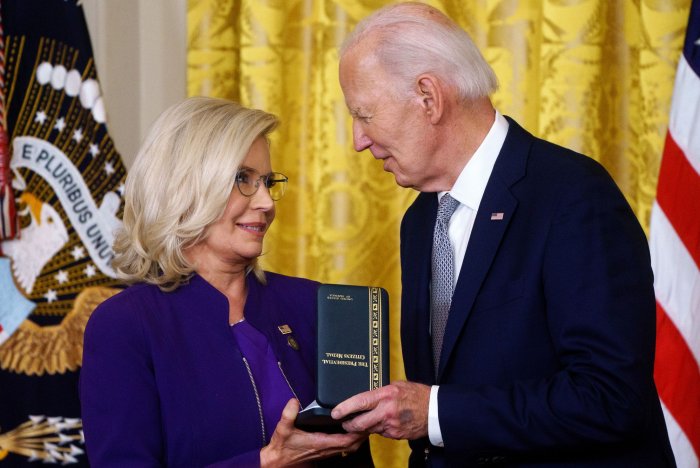
Former President Joe Biden presents the Presidential Citizens Medal to Liz Cheney during a ceremony in the East Room of the White House in Washington, on January 2, 2025. The Presidential Citizens Medal is bestowed to individuals who have performed exemplary deeds or services. Photo by Will Oliver/UPI | License Photo
Deadly attack comes as Gaza government media office says Israel violated ceasefire 875 times since it began in October.
Israeli forces have killed at least two Palestinians in the Gaza Strip as Israel continues to violate a ceasefire agreement and block desperately needed humanitarian aid to the war-ravaged coastal enclave.
The Palestinian news agency Wafa reported on Monday that two people were killed after Israeli troops opened fire in the Shujayea neighbourhood of eastern Gaza City.
Recommended Stories
list of 3 itemsend of list
Their deaths bring the total number of Palestinians reported killed in Gaza over the past 24 hours to at least 12, including eight whose bodies were recovered from the rubble in the territory.
The Gaza City attack is the latest in hundreds of Israeli violations of a United States-brokered ceasefire between Israel and Hamas, which came into effect on October 10.
Gaza’s Government Media Office on Monday condemned Israel’s “serious and systematic violations” of the truce, noting that the Israeli authorities had breached the ceasefire 875 times since it came into force.
That includes continued Israeli air and artillery attacks, unlawful demolitions of Palestinian homes and other civilian infrastructure, and at least 265 incidents of Israeli troops shooting Palestinian civilians, the office said in a statement.
At least 411 Palestinians have been killed and 1,112 others wounded in Israeli attacks on Gaza since the ceasefire began, it added.
Worsening shelter conditions
Meanwhile, hundreds of thousands of Palestinian families displaced by Israel’s genocidal war on Gaza continue to grapple with a lack of humanitarian supplies, including adequate food, medicine and shelter.
As the occupying power in Gaza, Israel has an obligation under international law to provide for the needs of Palestinians there.
But the United Nations and other humanitarian groups say it has systematically failed to allow unimpeded deliveries of aid into Gaza.
The situation has been worsened by a series of winter storms that have pummelled the Strip in recent weeks, with rights groups saying Israel’s refusal to allow tents, blankets and other supplies into Gaza is part of its genocidal policy and threatening Palestinian lives.
On Monday, the Gaza Government Media Office said that only 17,819 trucks entered the territory out of the 43,800 that were supposed to be allowed in since the ceasefire came into effect in October.
That amounts to an average of just 244 trucks per day – far below the 600 trucks that Israel agreed to allow into Gaza daily under the ceasefire agreement, the office said.
On Monday, a spokesperson for UN chief Antonio Guterres reiterated the call “for the lifting of all restrictions of the entry of aid into Gaza, including shelter material”.
“Over the past 24 hours, and despite the ceasefire, we have continued to receive reports of air strikes, shelling and gunfire in all five governorates of Gaza. This has resulted in reported casualties and disruptions to humanitarian operations,” Stephane Dujarric said.
He said that the UN’s humanitarian partners are working to address the significant shelter needs, particularly for displaced families living in unsafe conditions.
“Our partners continue to work to improve access to dignified shelter for approximately 1.3 million people in Gaza in the past week, about 3,500 families affected by storms are living in flood prone areas,” he said.
Dujarric said that aid deliveries have included tents, bedding sets, mattresses and blankets, as well as winter clothing for children, but the needs remain overwhelming.
Palestinians struggle with flooding after heavy rain hits the Bureij refugee camp in Gaza City [File: Moiz Salhi/Anadolu]
The appeals come a day after the Palestinian Ministry of Health in Gaza said that a lack of drugs and other healthcare supplies was making it difficult to provide care to patients.
Nearly all of Gaza’s hospitals and healthcare facilities were attacked during Israel’s two-year bombardment of the territory, damaging at least 125 facilities, including 34 hospitals.
The Israeli army has killed at least 70,937 Palestinians in Gaza, mostly women and children, and injured 171,192 others since its genocidal war began in October 2023.
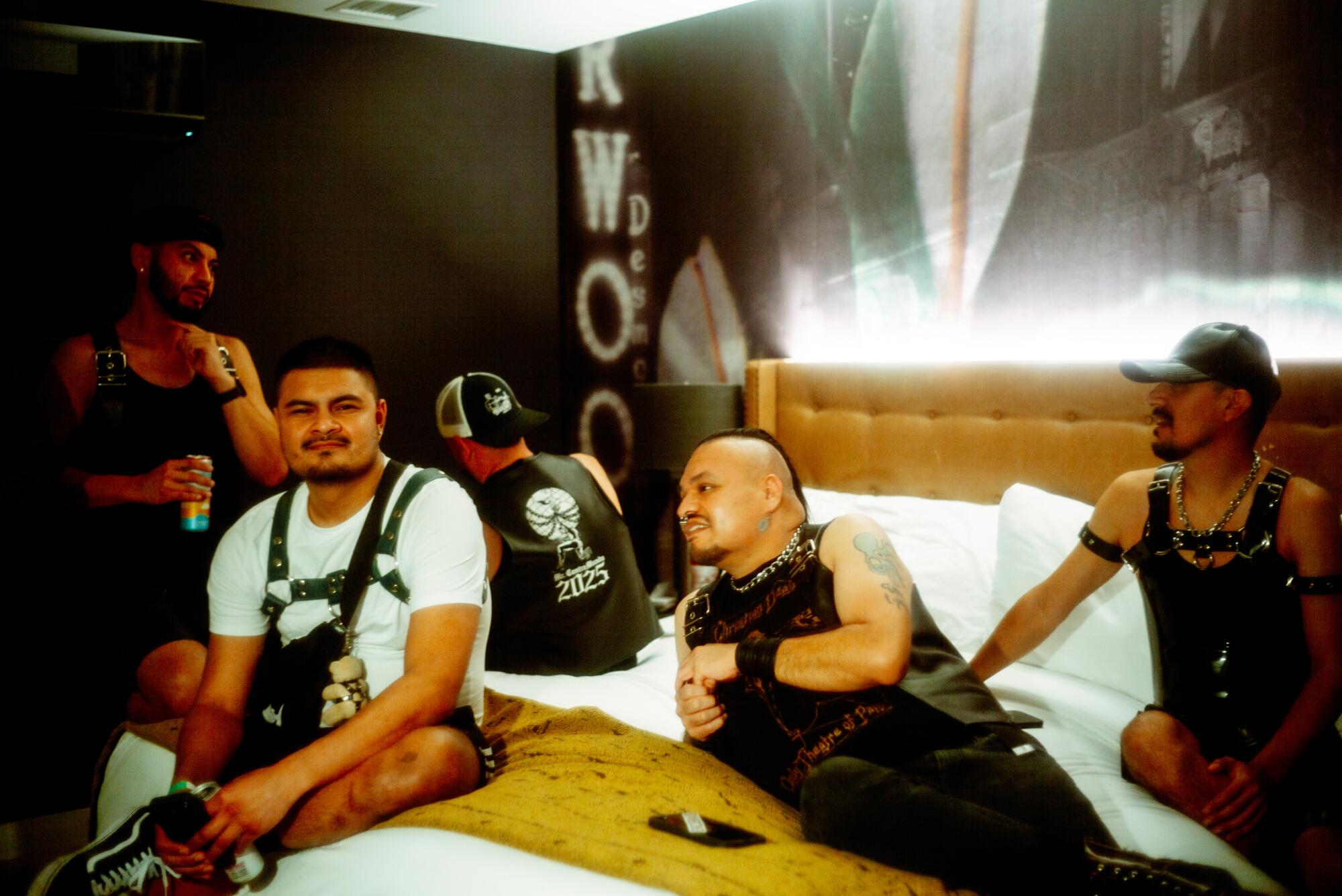
On the Friday night after Thanksgiving, a hotel room on the 17th floor of the Hotel Indigo in Downtown Los Angeles was transformed into a leather dressing room. About a dozen friends crowded around a king-size bed, cracking open Tecates, vibing to techno house music from a portable speaker, and adjusting each other’s harnesses.
The flash of a digital camera went off like a strobe as Yair Lopez documented his friends before their night at an afterparty. They were all there as part of the L.A. iteration of CLAW: a national leather and kink convention that offers workshops, parties and community spaces for people interested in BDSM culture. Founded in 2002, the convention started out in Cleveland, but has also held events in in L.A. since 2021.
As others spent their Thanksgiving holiday with blood relatives at the dinner table, this particular gathering was dubbed “Leather Thanksgiving” — a celebration of chosen family, cobbled together from various corners of L.A.’s queer nightlife. For Lopez and his friends, that sense of belonging is only growing.
“This chain was gifted to me from a friend,” Lopez said as he adjusted the silver around his neck. “Chains with a lock represent that you have a dom and the other person has the key. I’m still waiting for the lock,” he added jokingly, glancing at his boyfriend.
Leather enthusiasts pre-game ahead of the release party for the film, “Encuerados,” on November 28th at the Hotel Indigo in Downtown Los Angeles.
(Yair Lopez / For De Los)
It was a big day for Lopez. Earlier he showcased three of his photos as part of a leather art gallery and attended a screening of “Encuerados,” a short documentary he appeared in, which shadowed a group of Latino men carving out space in L.A.’s leather community. An “Encuerados” afterparty would soon follow.
For Lopez and his friends, leather is less about fetish and more about kinship, safety and visibility, in a city where queer Latino spaces remain scarce.
Lopez has become a visible force in L.A.’s leather underground scene, building community through both his art and the spaces he helps create. He has self-published his work through photos and zines; he also founded Contramundo, a Latino leather night at the Bullet Bar in North Hollywood. His community work even led to a third-place finish in the 2023 Mr. L.A. Leather competition.
He started shooting a decade ago, moving from street scenes and hikes to L.A.’s queer nightlife. That work eventually led him to the Eagle, where he found a muse and a community he didn’t know he needed.
“I grew up in a pretty religious Mexican household in the San Fernando Valley. I was made to feel ashamed of who I was, even my own body, so finding this felt so needed,” he recalled.
Located in Silver Lake, the Eagle is a legacy leather bar that has anchored L.A.’s kink scene for decades. It is also one of the few remaining spaces for this corner of queer nightlife. And while Lopez did feel seen through the leather community, there was still a piece missing.
“It is no surprise that a lot of gay spaces are predominantly white, so finding gay brown community is hard. But that changed when I started meeting other like-minded Latinos in leather,” Lopez said.
The group of friends ran into Iriarte as they made their way to the 18th floor, where he was DJing for the night in a large, dimly lit conference room.
Dressed in black leather pants and boots, Iriarte had “Mr. L.A. Leather 2011” embroidered across the back of his vest. The Michoacán native also happened to be the protagonist of the “Encuerados” documentary and host of the “” afterparty.
“When I moved to the United States in 2001, I didn’t move for the classic American dream of looking for a better life financially,” said Iriarte. “My purpose of moving here was to be free as a gay person.”
Latinos in leather pose ahead of the “Encuerados” screening during the CLAW L.A. convention on November 28th at the Hotel Indigo in Downtown Los Angeles.
(Yair Lopez / For De Los)
And while Iriarte did find that freedom he hoped for, he was not prepared for the racism he would encounter in the leather scene — especially after winning his title.
“I remember a hate campaign and even death threats after I won,” he said. “It was scary, but it opened a door for other Latinos, and this space has grown so much since.”
As it gets closer to midnight, the dark conference room swells with bodies moving to Iriarte’s pulsing techno. Partygoers poured in sporting leather chaps, chest-hugging harnesses, and even tejana hats for a vaquero-leather twist.
Lopez put down his camera to circulate and greet friends from over the years. He bumped into Orlando Bedolla, director of “Encuerados,” who first met Lopez four years ago while filming the documentary.
“I learned about his photography, the zine he was making, all of it,” Bedolla said. “I found him interesting because he is literally a Latino increasing Latino representation in the leather community.”
Bedolla recalled attending CLAW L.A. in 2021 and going to his first Latino party there after getting an invite from Payasos L.A. Inside, he found a room full of mostly Latino men in jockstraps, harnesses and leather. He was struck by the energy of an underground community he didn’t realize existed. That night would become the seed for the film.
On the dance floor, colored lights flashed across Lopez’s visage as he tried to keep track of his room key. His friends borrowed it to run upstairs to their shared room for more drinks — and he wondered aloud about how messy it would be after their two-night stay.
These spaces, low-lit yet overflowing with camaraderie, offer the community something harder to find anywhere else, especially during the holidays: the freedom to be fully themselves.
“When I step into spaces like this, I don’t just see leather,” Lopez said, taking a sip of his vodka soda. “I see people reaching for some kind of joy and connection we’re constantly told is wrong. But we all want to feel touched and seen — and there’s nothing wrong with that.”
Lyle Foster’s match-winning 79th-minute strike allowed South Africa to win first opening match at AFCON since 2004.
Published On 22 Dec 202522 Dec 2025
Share
Lyle Foster scored a superb winner from outside the box as South Africa defeated Angola 2-1 in Africa Cup of Nations Group B in Marrakesh on Monday, the first time they have won their opening match at the continental finals in 21 years.
South Africa also had a goal disallowed and struck the crossbar, just about deserving the nervy victory. Angola also had chances and will be disappointed not to have gotten something from the game.
Recommended Stories
list of 2 itemsend of list
South Africa took the lead on 21 minutes when Oswin Appollis showed neat footwork in the box to work a shooting chance and put the ball in the bottom corner. But Angola equalised before the break as Show got a touch to Fredy’s free kick to steer the ball into the net.
The winning moment came after 79 minutes, when Foster was teed up 20 yards out and curled his shot into the top corner to give the bronze medallists from two years ago a positive start to their campaign.
It was a workmanlike performance from South Africa, who do not have the plethora of players in top European leagues that their tournament rivals enjoy, with Foster their only one at Premier League Burnley.
But they are a well-oiled machine under Belgian coach Hugo Broos and did enough for a victory that set them well on course for the knockout rounds. Egypt and Zimbabwe will meet later on Monday in the same pool.
South Africa’s Oswin Appollis, centre, scores the opening goal of the match in the 21st minute [Themba Hadebe/AP]
Even first half
South Africa took the lead after a period of sustained possession that led to Khuliso Mudau’s cross, which was touched by both Sipho Mbule and Foster before Appollis beat two defenders and side-footed into the bottom corner of the net.
Angola equalised on 35 minutes when Fredy’s low free kick was touched into the bottom corner by Show, his second goal in his 50th cap for his country, to make it 1-1 at the break.
South Africa thought they had retaken the lead when halftime substitute Tshepang Moremi turned his defender and fired low into the bottom corner of the net, but a VAR review showed that Foster was offside in the buildup.
South Africa’s Mbekezeli Mbokazi crashed the ball against the crossbar with a rasping shot from 35 yards, before Foster’s clinical strike secured all three points.
Zambia rally to draw with Mali
In an earlier Group A match on Monday, Zambia’s Patson Daka scored with a spectacular diving header in stoppage time to see his side come from behind and force a 1-1 draw with Mali in Casablanca.
Mali looked in control for most of the encounter, but paid the price for sitting back in the closing stages as Zambia staged a late recovery, with Daka leaping through the air to force home Mathews Banda’s curling cross two minutes into stoppage time at the end of the game.
Lassine Sinayoko had taken advantage of sloppy defending to give Mali a 62nd-minute lead after his strike partner, El Bilal Toure, had a first-half penalty saved.
Zambia’s forward Patson Daka celebrates scoring his team’s equalising goal in the 90th minute against Mali at Mohammed V Stadium in Casablanca, Morocco on December 22, 2025 [Abdel Majid Bziouat/AFP]
At least two people have been killed in clashes in Aleppo between Syrian government forces and the Kurdish-led Syrian Democratic Forces (SDF) that control the country’s northeast. Syrian President Ahmed al-Sharaa signed a deal in March with the SDF to integrate the group into the country’s state institutions by the end of this year.
Coronation Street revealed surprise death news in Monday’s episode of the ITV soap and Debbie Webster has implied that all is not what it seems after the surprise passing
Debbie was there to support her brother Carl when he learned that his mum had died – but something seemed a little bit off (Image: ITV)
Coronation Street aired scenes of a shock death on Monday evening. Earlier this year, Carl Webster (Jonathan Howard) arrived as the long-lost half brother of Kevin Webster, and whilst things were going well to begin with, their reunion quickly soured when it was revealed that Carl had been having an affair with his brother’s wife Abi.
Little is known about Carl’s past, but what has been established is that he grew up in Germany with his parents Bill and Elaine Webster. Bill was the father of Kevin (Michael Le Vell) and Debbie Webster (Sue Devaney), and their mother Alison never appeared on the programme, having died in 1980. Carl was then born to Bill and Elaine off-screen in 1986.
On Monday’s episode of the world’s longest-running TV soap, Abi was at Debbie’s hen-do when she got a panicked phone call and rushed straight home. Once there, Carl revealed to her that his mother had died, and he had been completely unaware that she had been fighting cancer.
For the first time, Carl began to open up about his mother to Abi and hinted at a mystery that was never solved between the pair. He said: “She was… formidable. Not the most loving of mothers, that’s for sure. Our relationship was tricky. I knew she wanted me to settle down, get married and have kids and all then.
“I was immature back then – late developer. She did bail me out a few times, though, let me stay at hers, when I hit the skids. I remember my 30th, I had to come home, tail between my legs, after my latest job and relationship had gone pear-shaped.
“She was back in Southampton then. I must’ve been there a week and I hadn’t really got out of bed. She came in my room one morning, dragged me out of bed and said we were going to the beach. I hadn’t been to the beach with my mum since I was a little boy.
“And I said I was sorry for being a mess. 30 and still kipping in my mum’s spare room. She was quiet for a long time and then said I deserved more from my growing up. But if I knew what had happened, then I would understand why.”
Abi then asked if she ever explained herself to him, and Carl replied: “No. I’m sorry Abi, for being the kind of person that not even a mother can love.” It was then that Abi pulled Carl in close, her eyes wide, clearly worried about what her partner had just said to her. She later reminded him that just because Elaine rarely called, that didn’t make him a bad son, and Debbie then burst in, having heard that something terrible had happened.
Through tears, Carl told his half-sister: “Apparently she’d been in the hospice for months. I didn’t even know that she was ill,” and when he and Abi voiced their dismay that Elaine had never been in touch, Debbie began to justify it. She said: “Well, we don’t know what’s gone on, do we?
“She might not have been well enough.” Carl then asked Debbie when she last spoke to Elaine, and the hotel owner quickly claimed that they hadn’t spoken since Bill died, which would have been in 2023.
But there was a further twist in store when Debbie, who was diagnosed with vascular dementia earlier this year, went home to her fiancé Ronnie. When he said it was odd that Elaine had not got in touch with the family, Debbie revealed: “She tried to. Recently. I just… I just forgot to tell him. With everything going on, it just… it just went out of my head.
“I haven’t told Carl – I can’t. He’d never forgive me. Ronnie, don’t tell him, will you? I feel terrible Really terrible.” When Ronnie reassured Debbie that it wasn’t her fault and she didn’t do it on purpose, she didn’t respond and simply gave a weird look.
Footage shows security forces dispersing crowds with tear gas at rallies for Ugandan presidential candidate Robert Kyagulanyi, also known as Bobi Wine, in Kampala. The pop star-turned-politician is campaigning ahead of Uganda’s January 2026 elections, as officials warn against interference.