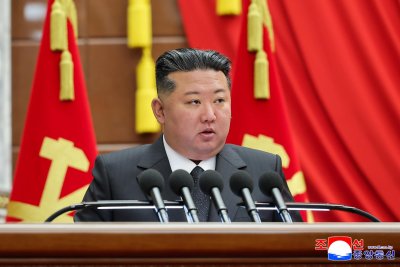
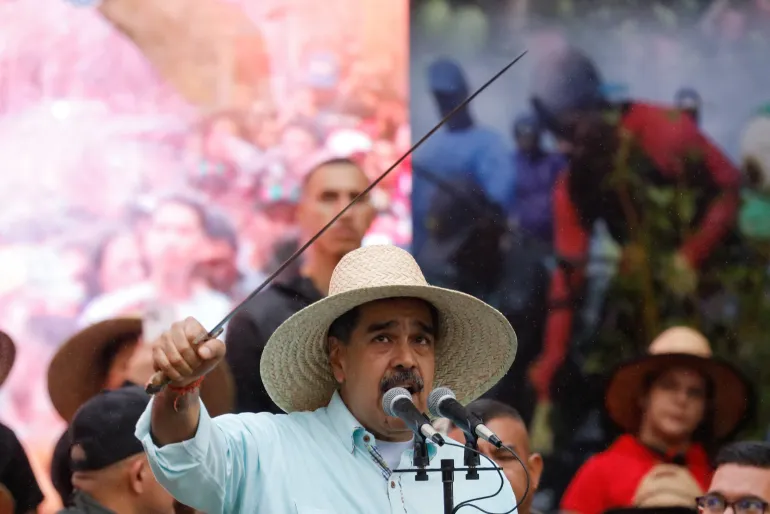
North Korean leader Kim Jong Un praised his country’s military modernization efforts at a key ruling party meeting, state-run media reported Friday. In this photo, Kim is seen speaking Tuesday during the second day of the plenary meeting of the Workers’ Party Central Committee. Photo by KCNA/EPA
SEOUL, Dec. 12 (UPI) — North Korean leader Kim Jong Un praised his country’s military modernization efforts as addressing security challenges “effectively and correctly” at a key ruling party meeting, state-run media reported Friday.
Kim said the regime’s push to strengthen defense capabilities was the “exact” direction to ensure North Korea’s security amid shifting geopolitical dynamics, according to the official Korean Central News Agency.
The comments came as the three-day enlarged plenary meeting of the Workers’ Party of Korea’s Central Committee wrapped up on Thursday. The session reviewed this year’s policy implementation results and laid groundwork for a key party congress set for early next year.
During his remarks, the North Korean leader also highlighted the deployment of troops to Russia as a major achievement of the country’s defense strategy.
“The signal military gains made by … the Korean People’s Army in the overseas military operations over the past nearly one year demonstrated to the world the prestige of our army and state,” Kim said.
Pyongyang has provided significant support for Moscow’s war effort in Ukraine, sending thousands of shipping containers of munitions and deploying 15,000 troops to assist Russian forces in the Kursk region, according to Seoul’s National Intelligence Service.
In exchange, experts assess that Russia is transferring advanced military technology to Pyongyang, including assistance with space launch vehicles, reconnaissance satellites and air defense systems.
On Friday, the commander of U.S. Forces Korea warned of the expanding threat posed by North Korea as it deepens military cooperation with Russia.
“Russian-DPRK collaboration is real — it is not a quid pro quo relationship,” Gen. Xavier Brunson said during a webinar.
The Democratic People’s Republic of Korea is the official name of North Korea.
“There are things we know are happening right now that give me pause as I look at what might face us down the road, whether that be training, or techniques and procedures they’re learning from the front,” Brunson said.
The ruling party’s Ninth Congress, expected in early 2026, is widely expected to outline a new five-year economic plan and recalibrate Pyongyang’s military and foreign policy priorities.
Analysts say that the event may also cement a hard-line posture toward South Korea. In 2024, North Korea officially designated the South as a “hostile state,” according to state media, while Kim publicly rejected the long-held goal of reunification.
Fatima Alhassan is twenty years old now, but her voice still carries the weight of a ten-year-old girl who watched her world collapse a decade ago. Her father, Shahid Alhassan, was killed on Dec. 12, 2015, during the infamous ‘Zaria Massacre’.
“Despite our little time with him, we were always happy around him,” she said. “We were very close. Since we lost him, that vacuum has not been filled in our hearts.”
It was a Saturday morning, and Shahid had just returned home from a funeral. He lay on the sofa, with dust still on his palms. After some moments, he rubbed it across his face and said, “I am next”. His wife, Hauwa Muhammad, found those words unsettling.
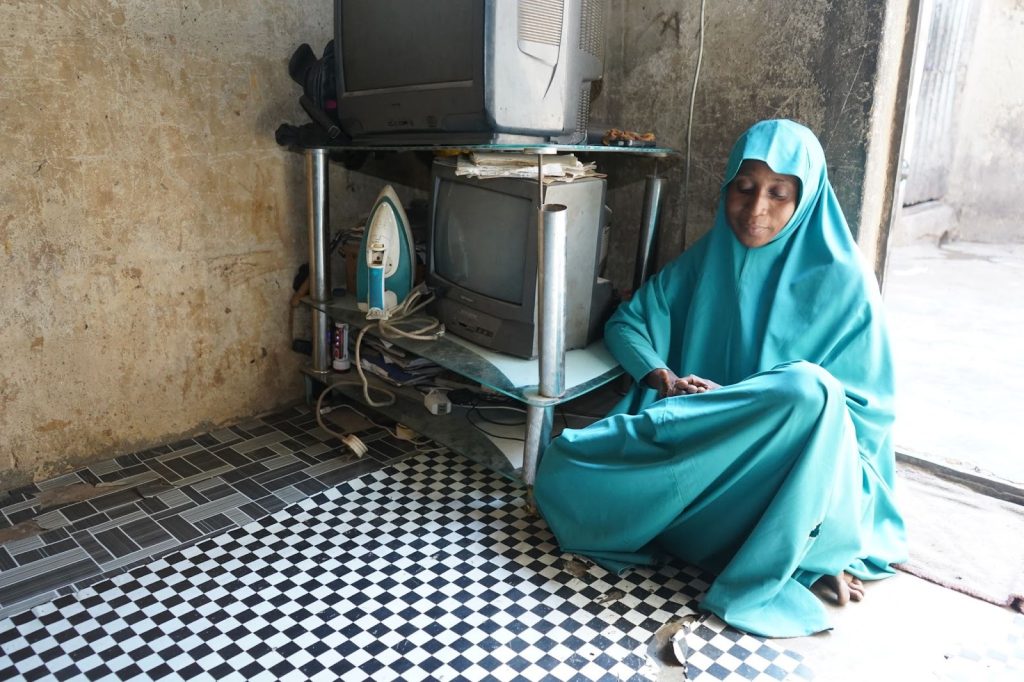
Hauwa speaks about her last moments with her husband. Photo: Isah Ismaila/HumAngle
Immediately, Hauwa dismissed it, insisting it was not yet time and that they still had years to spend together, but he replied quietly that “my grave would not be dug in Kano, but in Gyallesu [a suburb in Zaria, Kaduna State, in North West, Nigeria].”
Shahid rose from the sofa, bathed, and had breakfast, and together they walked to the door, exchanging pleasantries before he left.
Around noon, news broke that officers of the Nigerian Army opened fire on some members of the Islamic Movement of Nigeria (IMN) in Zaria town.
That Saturday was the first day of Maulud, the birth month of Islam’s Holy Prophet Muhammad. Shahid and other IMN faithful had gone out for the celebrations.
Founded in the early 1980s, the IMN grew under the leadership of Ibrahim Zakzaky, then a student activist at Ahmadu Bello University in Zaria. Inspired by the 1979 Iranian Revolution, Zakzaky advocated for an Islamic state governed by Sharia law. What began as a campus-based movement quickly expanded nationwide, attracting millions of followers who aligned with Shi’a Islam.
What really led to the Zaria Massacre?
The military claimed that the convoy of the then Chief of Army Staff, Lt Gen. Tukur Yusuf Buratai, was denied access through the road where the members of IMN were preparing for the Maulud celebration.
However, Mukhtar Bashir, an IMN representative in Kano State, told HumAngle that the group were hoisting a flag when they sighted the convoy and some soldiers stationed near a filling station. Immediately, they felt something was off, and then some members confronted the convoy to enquire what was happening.
Over the decades, IMN’s growing influence and its confrontations with state authority led to heightened tensions with Nigerian security forces. One of the most significant clashes occurred in July 2014, when soldiers killed three of Zakzaky’s sons and 30 IMN members during a Quds Day procession.
The incident deepened mistrust and left many IMN members expecting hostility whenever the military appeared. As Mukhtar recalled: “We thought it was another attack.”
What began as a “simple confrontation” quickly escalated into a full-scale assault, which continued through the weekend. Mukhtar told HumAngle that the soldiers opened fire indiscriminately on unarmed civilians, including women and children, killing hundreds as the violence stretched across three days.
By Tuesday and Wednesday, the focus had shifted from gunshots to the evacuation of dead bodies that were buried in mass graves. Mukhtar said the burials were held without religious rites, or “any form of dignity”. Amnesty International confirmed this claim in a report on the incident.
Based on IMN records, “a thousand members of the organisation” were killed in the massacre. Muktar noted that when the numbers of passersby who were caught in the violence and also lost their lives are added, the death toll will be significantly higher. “We can show the houses of each person killed or missing,” he added.
The aftermath
When the news got to Hauwa, she was at home, anxiously waiting for her husband’s return. During those tense moments, she remembered the words Shahid had said while on the sofa. “What if his prayers had been answered?” She thought.
Hauwa cries when she talks about her husband. Photo: Isah Ismaila/HumAngle
Hauwa kept dialling her husband’s phone number, but every call went unanswered. Later in the evening, she began receiving different accounts about Shahid’s whereabouts; some said he was injured, others said he was dead.
“Initially, I never believed he was killed,” she recounted. “We heard that it was our neighbour who died. Even my husband’s uncle said he was alive. Until Shahid’s friend, Malam Abdulkadir, drove to Zaria and confirmed that he was dead.”
Hauwa still didn’t believe that testimony until a local newspaper published images of the deceased Shi’a Muslims. That was when she accepted his death.
A portrait of Shahid Alhassan held by his wife, Hauwa. Photo: Isah Ismaila/HumAngle.Hauwa and her children are left with many portraits of Shahid Photo: Isah Ismaila/HumAngle.
What followed was silence, Hauwa said it was unbearable. “Every day, in every aspect of my life, I felt the absence of my husband, the only pillar of our household. He had been a devoted father to our seven children and a loving companion to me,” she said.
His loss left the family adrift. Twenty-one months after the incident, Hauwa’s youngest son also died. It deepened the tragedy for the family.
“I miss my husband,” she said. “It was through him that I fell in love with the path I am on as a Muslim. I have nothing to say, only to ask Allah to bless him for all he has done for us, and may his soul continue to rest in peace.” Hauwa believes that Shahid died a martyr—a gift he had long prayed for.
However, the challenges of raising their children alone, the weight of grief, and the absence of justice have defined the family’s life for the past decade.
“Some days are filled with happiness, while others are filled with pain and hunger. The sad days are more than the happy ones,” said Fatima, staring away from the camera. She attends a secondary school in Kano, where she also lives with her mother and six siblings in a modest three-room apartment.
Fatima carried a gloomy face when she spoke of her father. Photo: Isah Ismaila/HumAngle.
Each morning, as she prepares for school, she asks her mother for transport fare. Too often, her mother has nothing to give. Fatima does not feel anger; it is the ache of knowing her father is not there to shoulder the burden.
While in school, Fatima says she is often silent when conversations come up with friends about their fathers and their life plans. “Living without a father is emotionally disturbing,” she told HumAngle. “We just have to do everything with our mother, and it saddens me.”
The loss has reshaped her dreams. Once, she imagined herself studying commerce, perhaps medicine or journalism. But after her father’s death, affordability dictated her path. She now studies Arabic, hoping to become a teacher—a future she never planned for, but one forced upon her by circumstance.
It is ten years since the massacre, but families, like Shahid’s, said they have not gotten justice. “They even painted it to look like we are the ones who committed an offence,” Fatima said. “The government has not done anything tangible. To them, it might have passed, but to us, it is as fresh as it was ten years ago.”
After the massacre, the former Kaduna State governor, Nasir El-Rufai, set up a judicial commission of inquiry, whose report found evidence of human rights violations by the Nigerian Army and also noted that 347 IMN members were killed in the incident.
“The commission recommended prosecution of the soldiers who participated in the killings, but that has not been done,” said Haruna Magashi, legal practitioner and human rights activist.
IMN also accused the soldiers of demolishing their buildings, including the residence of their founding leader, Ibrahim Zakzaky. In November, when HumAngle visited Zakzaky’s house and some of the IMN centres, some had been turned into a refuse dump site, while others were still not in shape.
Some survivors who spoke to HumAngle three years ago recalled scenes of chaos as homes were raided, people shot at close range, and corpses left scattered on the streets.
Zakzaky was arrested by Nigerian authorities after the incident, but he was discharged and acquitted by the court in July 2021. “All the concluded cases against the IMN were in their favour,” said Haruna.
A Nigerian court has since ruled that the activities of IMN are “acts of terrorism and illegality”, an allegation that it has persistently denied. IMN was banned in July 2019.
Echoes of grief
While some of the survivors were teenagers and are now young adults, others can’t even remember because they were babies, but they have formed memories through stories.
Fatima Alhassan was four when her father died in the massacre. The 14-year-old said she only tries to picture her father through the good things her mother has said about him. Through the stories, she knows that his father was a good cook, and he always bathed his children and cared for the household whenever illness struck.
Fatima Shahid Alhassan couldn’t hold back her tears as she remembered the challenges she faced without their father. Photo: Isah Ismaila/HumAngle.
“Honestly, we have all been cheated in our family,” she said. “This is because whenever my mother falls sick and my elder siblings aren’t home, she has to do all the chores by herself. But if my father were around, I am sure he wouldn’t leave her like that. Even if she insists he go to work, he would still stay behind to assist her. Such moments break my heart, and I wish he were still alive.”
Those recollections make her long for the father she never really met. At her former school, she and her siblings were bullied by classmates who mocked them for not having a father, flaunting gifts they received, while they reminded them of what they had lost.
Fatima says her uncles and other close relatives have been supportive, especially during festive seasons, but the longing for her father never fades.
“It hurts me a lot. If I were to see him now, I would tell him that we have missed him a lot and we have suffered without him,” she said as tears rolled down her cheek.
‘To live my father’s dreams’
Amidst an unending grief that aches now and then, Al’haidar Alhassan said he wants to live his father’s dream. He is studying at Basita Darwish Chami Academy, a boarding school in Kano State built for orphans whose parents were killed in the massacre, and he hopes to be a scientist and a researcher someday.
“Glory be to God Almighty that we have gotten the support we need, and I believe we will achieve what we intend. Nevertheless, I still feel heartbroken. The thought of losing my father and pillar still affects me because I feel demotivated sometimes,” he said.
Al’haidar sits quietly in a classroom at the Basita Darwish Chami Academy in Kano. Photo: Isah Ismaila/HumAngle.
After his father’s death, the 19-year-old and his siblings dropped out of school for two years. Al’haidar said that his father’s greatest wish was for his children to be educated.
“I miss the father-and-son bond we shared. Whenever he was leaving for work, I never wanted to let him go. Whenever I see a child and his father, the more I miss him, and in some cases, I have no choice but to cry,” Al’haidar added.
A father’s loss
While Al’haidar misses the bond with his father, Bashir Muktar sits on the floor in his living room, in between the portraits of his two sons who were killed in the massacre. The bond with his children was one of deep affection and shared ambition.
Bashir Muktar sits between the portraits of his sons who were killed in the massacre. Photo: Isah Ismaila/HumAngle.
Shahid Abba, his eldest son, had just completed his remedial studies at the College of Arts and Islamic Studies a few days before the incident. The 20-year-old was brimming with plans to pursue chemical engineering at the university. Meanwhile, Bashir’s younger son, Hujjatullahi, was still in secondary school at Fudiya Science in Kano. The 18-year-old has dreams of becoming a doctor.
“A child is a flesh of yours,” Bashir said, “and you live your life trying to ensure that you build them up. You have certain ambitions towards your children. In every household, every father tries to build his children to greatness because they are your successors.”
Even though he kept a smiling face, it broke his heart as he recounted some of his sons’ youthful curiosity. He speaks about a day in 2014 when he found the younger son under the staircase, carving something for a school experiment.
He teased him for “still behaving childishly”, but Hujjatullahi replied that: “It is an assignment. I am going to conduct an experiment on meiosis and mitosis.” That was the day his son revealed to him his dream of becoming a doctor. These memories, Bashir said, are etched in his heart.
He was on a trip in Abuja, North Central Nigeria, when his children called to ask if they could attend the Maulud programme in Zaria. He suggested they meet there at the event, but he was caught up in a late meeting, and his sons kept reaching out to confirm what was happening.
Shahid Abba and Shahid Hujjatullahi’s portraits hang high on their father’s house in Kano. Photo: Isah Ismaila/HumAngle.
“They sent a text message enquiring what was happening in Zaria. I replied with, ‘Nothing is happening.’ They asked if they could proceed, and I said yes, not knowing soldiers had attacked and opened fire at the venue earlier that day,” Bashir recounted.
By the time he tried reaching them again, their phones were no longer connecting. Bashir attempted to travel to Zaria the following day, but the roads were sealed off as news spread quickly that soldiers had blocked the entrance to the city.
Two days later, while having breakfast, he got a call: “I extended salutations, then I heard, ‘Father! Father!!’ It was the voice of Hujjatullahi. I confirmed by calling his name, then I started recording and put the call on speaker. I asked, ‘What’s happening, Hujjatullahi?’ He said, ‘Please forgive us, Father.’ I asked again, ‘What is happening?’ He responded, ‘Forgive us for whatever we have done to you until we meet at Darul Salam [referring to the final abode of the deceased righteous in Islam].’”
The words that followed were devastating.
“My elder brother has been shot in the stomach, and I have been shot in the stomach and my arm,” Hujjatullahi told him.
Bashir said that how his sons were buried worsened his grief.
“If they had travelled or fallen sick and died, it would have been different. But the manner in which they lost their lives is painful,” he said. “After killing them, they took their corpses, both men, women, children, pregnant mothers, and the elderly, then dug a massive hole and buried them all together like animals. No religious ritual was performed. With these, there are a lot of things to remember, and we can’t forget them.”
When asked what justice looks like for him and other grieving families, Bashir said that the fight for justice is not only about acknowledging the massacre but also about reclaiming the dignity of those who were killed.
“The most important thing for us in this fight for justice is the corpse of our loved ones,” he told HumAngle. “Where are the dead bodies of the people they killed and buried without prayer, spiritual bath, no shroud, no graves, nothing at all?”
“I believe even if someone is sentenced to death, after the life is taken, the body belongs to the family. So, where are the bodies? Despite killing them without any valid reason, they are still depriving us of their dead bodies.”
The last witness
In the same incident, Zainab Isa lost nearly everything.
Zainab Isa lost six children and her husband in the Zaria massacre. Photo: Isah Ismaila/HumAngle.
Her husband, Abdullahi Abbas, and six of their children—Abdulrazaq, Muhammad, Abbas, Ahmad, Ibrahim, and Jawwad—were all killed in the Zaria massacre.
A decade later, at her home in the Rimin Danza community in Zaria, she imagines what her youngest son, Jawwad, who was only 18 when he died, might have become at 28. “I wouldn’t be surprised if he were a doctor by now,” she said.
She said Jawwad was quiet, intelligent, and reserved and carried the kind of promise that only time could have revealed. Instead, his life ended before it even began.
Her eldest, Abdulrazaq, was over thirty when he was killed, four years after graduating from Ahmadu Bello University, Zaria.
The last memory of the family that brings all of them together in one place. Photo: Isah Ismaila/HumAngle.
He had plans to further his education once he secured a job. She remembers his brilliance in school, his demur anytime he was announced first in class, and his humility in admitting that his younger brother Jawwad was even smarter.
Jawwad contributed to scholarship by writing an Islamic book, the Forty Hadiths, which was published and shared at his graduation, before his death.
Zainab can go over and over again about the stories of each of them. She told HumAngle that even other people in her community remember her children not only for their achievements but also for their kindness.
Neighbours told her of small acts of generosity—paying transport fares for strangers, helping to fetch water for a neighbour, and offering support without being asked. “Wherever they went, they were loved,” she said. “I am not saying it to prove anything. It was God Almighty that blessed me and made them upright.”
Since that incident happened, her husband’s words about the frailty of life have stayed with her: “Only God knows who would be the first to leave this world between us. I just pray God accepts my worship before He takes my life.”
“The scar will never heal,” she said. “Even if they would bring a truckload of dollars to my house, with the intention of making me happy, honestly, it won’t make me happy. If times could change, I would ask them to stay behind and go there myself to die instead, because they were still young and had dreams and were loved by everyone.”
Zainab is one of the few surviving witnesses to her family’s tragedy.
Between grief and discrimination
Sadiya Muhammad, another widow of Abdullahi Abbas, was left between the pain of losing her husband and the discrimination her daughter endured in its aftermath.
Sadiya Muhammad has been confronted with grief and sectarian prejudice. Photo: Isah Ismaila/HumAngle.
Sadiya’s daughter, Radiya, was only two years old in 2015. Too young to remember her father, she grew up knowing his face only through photographs. “Whenever you hand her a picture, she would be able to point out her father,” Sadiya said.
But at school, where students and teachers came from different Islamic sects, her daughter faced painful words that deepened her grief. One day, a teacher openly told the class, “Do not be carried away by the prayers and fasting of any person who is a member of the Shi’a sect; they are worse than unbelievers, and they are all going to hell.”
The little girl returned home troubled, asking her mother, “Since my teacher said those who are Shi’a are all going to hellfire, is my father also going to hellfire?”
Sadiya’s response was firm yet tender: “I told her that her father is not going to hell; rather, he was martyred, and by Allah’s mercy, he is going to paradise.”
A cemetery at Darul Rahama, a worship centre in Zaria, which was demolished by the Nigerian Army in 2015. Photo: Isah Ismaila/HumAngle.
In the years after the massacre, her family’s mourning was made heavier by the sectarian prejudice of others, forcing her to constantly remind her children of their father’s honour and the value of their faith.
Human rights activists like Magashi believe the massacre carries a broader warning about minority rights in Nigeria. “You are in danger of extinction once you are a minority in the country,” he said. “This is dangerous as far as human rights are concerned. The Shi’ites are the minority Muslims in Nigeria, but they share the same human rights as the majority.”
Kelvin Washington: Hello, everyone, welcome to another episode of The Envelope. Kelvin Washington here. You know who I’m with: Yvonne Villarreal, Mark Olsen, glad to be here with you. Thanks for watching and listening.
All right, let’s get it started. Mark, you had a chance to talk to Tonatiuh. And of course, this is a big moment for him. This is something he worked hard for and now getting a lot of recognition for — “Kiss of the Spider Woman.” Tell me a little bit more about your chat.
Mark Olsen: That’s right. So earlier this year at the Sundance Film Festival, there just was this great moment at the premiere of Bill Condon’s adaptation of the musical version of “Kiss of the Spider Woman,” where just to see a showcase like this for someone is so exciting. Tonatiuh, he’s acting, he’s singing, he’s dancing. There’s like so much in this performance. It’s wonderful to to see. He has a lot of poise and charisma just simply in conversation. So it made for a really exciting talk.
Washington: And also the difficulty playing multiple roles, right? I mean, I would imagine that would have been challenging.
Olsen: That’s right, in the structure of the film, he plays a political prisoner in a South American jail and he’s explaining a favorite movie of his to his cellmate, played by Diego Luna, and then he also becomes the dashing leading man of that movie [within] the movie.
Washington: Right. Diego, also Jennifer Lopez, so obviously around some big stars. I swing over to you — speaking of big stars, Kate Hudson has been one for for a long time.
Villarreal: I thought you were talking about me!
Washington: You thought I was talking about Kate? You and then Kate, of course.
Villarreal: Obviously.
Washington: Kate Hudson, a big star for for some years now, half of a tribute band for Neil Diamond, “Song Sung Blue.” Tell me a little bit about this.
Villarreal: I feel like it’s the perfect pairing to have both these guests in this episode. This one also showcases, you know, her singing abilities and her performing abilities as an actor — two of her passions. She recently released an album, and with this movie, we really get to see Kate onstage and embodying what that’s like. We see this couple who find success as this Neil Diamond tribute band, but in the middle of the height of that, her character Claire suffers a big tragedy and it really derails everything, and she has to find her way back to that. And it was a really touching conversation to hear Kate sort of embody that and her own thoughts on, you know, when you come from a world like this, it’s not a guarantee, and you have to really have passion for that. Hearing her talking about spending time with Neil Diamond at his cabin. And she sang for us a little bit. When you leave that film, I feel like there’s an instinct to go home and just listen to Neil Diamond. I know I did. Hopefully we can go karaoke at some point.
Washington: “Sweet Caroline…”
Villarreal: Do you have a Neil Diamond go-to, Mark?
Olsen: Well, I love the “Hot August Night” album recorded live at the Greek Theatre here in Los Angeles, so I’ll go with any of the tunes from that one.
Washington: I’m still upset with the both of you that I there was no “Bah, bah bah…” [to continue his “Sweet Caroline”].
Villarreal: Hugh Jackman’s character would not go for that. I’m just saying.
Washington: Would have joined me? Or not going for it, like you two leaving me hanging?
Villareal: He doesn’t want us to start with “Sweet Caroline.” You gotta go further than that. But I’ll allow it now.
Washington: Deep cuts?
Villarreal: Deep cuts.
Washington: All right, we’ll talk some more about it while you enjoy Mark and Tonatiuh.
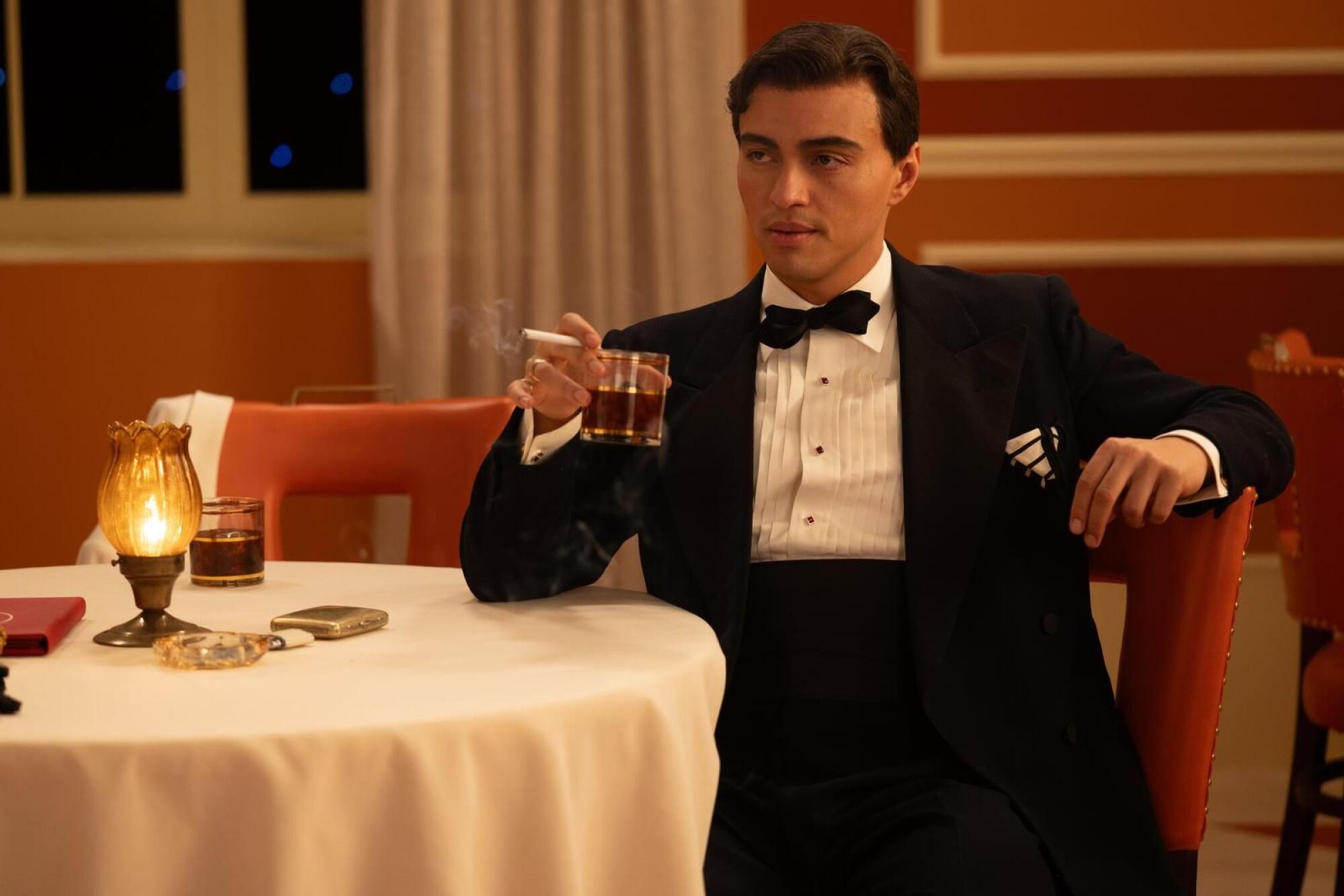
Tonatiuh in “Kiss of the Spider Woman.”
(Roadside Attractions)
Mark Olsen: It seems like you’ve been approaching your career with such a sense of intentionality and purpose. And I would imagine, especially as a young actor starting out, you’re not necessarily in control of the roles that you get, what you could do. What have you done or how do you feel like you are trying to take that control and have that sort of intentionality in the roles that you take and what you’re doing with your career in this industry?
Tonatiuh: Well, I think I’ll pivot a little bit and say I’ve been working for 12 years as a working-class actor. I’ve been on an ABC show [“Promised Land”] as a series regular. I was in “Carry-On,” which at the time it was the No. 2 most-watched movie on Netflix, but I think we’re now at No. 5. “KPop Demon Hunters” slayed. But the only control that I really have is saying yes or no to auditions. I’m not necessarily getting offered roles. I’ve had an entire career where if I sit around and wait for someone to come knocking on my door, I will starve. And I didn’t get into this for the celebrity. I got into this because of the social impact that it had on my own life. Art to me is a mirror as to who we are as a country and who we are as people. And so it gives us an opportunity to really reflect on that, but it also gives us a destination to where we want to be. A lot of my sense of humor came from the TV shows and films that I watched growing up. And I was introduced to cultures that were different than mine. …
I think with this specific project, with “Kiss of the Spider Woman,” it was a role of a lifetime. Bill Condon wrote a fantastic script where we not only got to tell one movie but we get to tell two. We time travel and go back into a 1950s-style musical, and I get to live my Gene Kelly, Errol Flynn, Montgomery Clift fantasy with the character of Kendall Nesbitt. But then with the character of Molina, I get to be this almost genderless expression. In the totality of the film I get to play the gender spectrum. Hypermasculinity, classic masculinity, very Hollywood masculinity with Kendall, a genderless expression with Molina. And then at the very end you get a little surprise of a full female fantasy.
Olsen: Whether intended or not, this film is being released to a specific cultural and political moment. In particular, as someone who identifies as nonbinary and is the American-born child of an immigrant family, how are you processing the moment the movie is coming out to?
Tonatiuh: It comes in waves. It’s different waves. At first it was “Wow, how crazy relevant our film is,” and that’s powerful. And when I accepted the role, we’re giving the Hollywood treatment to a bunch of marginalized communities and we’re telling truly with our film, “Latinos are Hollywood.” In that era, in the 1950s, there weren’t very many, if at all, Latin stars, especially those who were allowed to be the leads in those films. And so with this we’re almost kind of rewriting history and subversively saying, “No, no, we’ve always been here” and reminding people of the dignity and the beauty of that. But, comma, we also are doing that for the queer experience. So Molina, in my view, is what we would consider in 2025 genderqueer. And we’re putting Molina right at the center, at the heart of the film. And my mission statement, and the whole reason I lost 45 pounds in 50 days, was to ensure that we can focus on their heart and their eyes and not even consider thinking about what their gender possibly could be. You’re just falling in love with a form, a person.
Olsen: This role, of course, in the original film was played by William Hurt. Do you feel it was important to have a queer performer in the part of Molina? What does that do for the story?
Tonatiuh: There’s a lot of lived experience that can go into the DNA of a character, right? But there’s also a sense of responsibility. I have met so many incredible, beautiful, gender-diverse individuals in my life. And so being able to center someone like that and to tell it with as much love, it’s just a little bit more icing on the cake. And there’s creative conversations as things are being built where you have to add and pitch perspectives that maybe someone missed because they don’t necessarily have that exact experience. I don’t necessarily subscribe to, “You always have to cast the person for the thing.” Although I relate and understand Molina, I’m an artist and my job is to bring that humanity to them. I don’t have to be identical to that person. That’s where my artistry comes from. But I think that the reverence and the respect and that sense of responsibility is what makes this unique.
Olsen: Your final number in the movie you begin in a tuxedo and you end in a dress.
Tonatiuh: With a 26-inch waist, mind you. Clock the waist.
Olsen: And there’s just something extremely powerful about that.
Tonatiuh: I mean, there’s something really cool about it. People weren’t expecting the flip with Kendall. So all of a sudden it’s like, “Wait, that’s the same guy. Now he’s looking dapper with a mid-Atlantic accent.” And then at the very end it’s a quite shocking revelation when we look down the barrel of the camera and she’s gorgeous. But that was the beauty of it. Molina dreams of being a Hollywood starlet. And I think, for me as an artist, this will probably be the only time in my life where I get to play a leading lady and a leading man at the same time. It was really special.
Olsen: Molina doesn’t really see themselves as a political person in the beginning of the film —
Tonatiuh: No, not at all.
Olsen: And part of the the journey of the film is Molina coming to realize that they are part of this fight whether they want to be or not.
Tonatiuh: Well, I think Molina falls in love. I think Molina felt like a loser in their own life who wasn’t capable of even defending themselves, right? They were just trying to survive. And there’s this twisted internalized messaging that children of marginalized groups or people who have been bullied, they start doing it to themselves as a way of protecting themselves from the world. Like, “I’ll punch myself first before you can, and I’ll make it funnier. Actually, it’ll be my whole personality.” And I think that there’s something healing in that. Valentin’s character says, “I’m disgusted when you’d make fun of yourself like that. Where’s your self-respect?” And I don’t think that they understood self-respect because I don’t think they experienced it before. And so it took living in a prison cell to find dignity again. And these two men who are diametrically opposed were able to drop all facades. They were stripped of their comforts, they were stripped of the very masks that they used to protect themselves and were forced to see each other in order to connect. And I think that’s a larger theme that’s happening in the world. I think we’re constantly being told that we’re divided and we’re not similar. But I think at the end of the day, we all want similar things. We want to feed our children. If something, God forbid, happens to us, we don’t want to go into medical debt over it. We want joy, we want community, we want connection, and I think that vulnerability is the price we pay for that connection.
Olsen: I was at the premiere of the movie at the Sundance Film Festival —
Tonatiuh: Were you really? Oh man, I wasn’t. I was fully disassociated that day.
Olsen: And something happened in that room. I think the entire audience felt they had seen someone arrive. What have the past few months been like since then?
Tonatiuh: I don’t know if I’ve arrived with this role. I’ve been preparing for this moment my entire life. I am an artist and I love what I do. And one of the biggest gifts that I got was I got to meet people, yes, at the top of their game like Jennifer Lopez and Diego Luna. But every dancer in our film was a person of color, a Latin dancer, people from the Black community, and they are also at the top of their game on Broadway. And that’s the beautiful part. I’ve met so many artists who were just dying for the opportunity. I feel like all of us are in waiting. And so it’s not for lack of talent, it’s for lack of opportunity. And with this, I am very proud of the work that I’ve done. I don’t know if I’ve arrived. People still have to see the movie, you know? And I have to get the next job. So we’ll see when that comes. But as an artist, I am feeling more emboldened to continue telling the stories that I want to tell and to continue sharing this 15 seconds of limelight with the things that I value. I think that’s what my mission statement is as an artist.
Olsen: What was it about this role that made you realize from the start that you were going to really grab it with both hands?
Tonatiuh: Well, I have no choice. No, no, no. After the strikes, after COVID. And I don’t wanna make this sound like a pity party, but the roles tend to go to the same 15 people. And I don’t come from nepotism. My mom was an immigrant in this country. She worked at a Jack in the Box drive-thru when she first got here. But I had a dream, and she and I and a bunch of my friends and community along the way just kept pushing and trying to make it happen. And so when you get three-dimensional characters, two, when you get three-dimensional characters and a really dynamic script. You gotta take it and fight. And I wanted to give it all. And it also was so important. We’re centering people who are currently being called terrorists for simply existing in this world. How can I not give them honor? This is our love letter to them. This is our way of saying we love you, we see you, and you’re not alone.
Olsen: Tell me about some of the outreach you’ve been doing to get the film in front of people and communities Hollywood may not always reach.
Tonatiuh: So I partnered with a couple of great individuals. It started off with my friend Ruben Garcia, who owns this incredible company called Mosaico. And we wanted to activate the Latin community and get people excited to come and see it. But then I kept thinking, “Man, our community has been going through a lot recently. And the country as a whole is experiencing some financial difficulties.” So I kept asking myself, “How do we give a little love and entertainment to folks?” So I reached out. I started calling friends. I started calling nonprofits. I started calling corporations and just saying, “Here’s what the mission is. We’d love to just gift things to people.” And so we created a small impact fund where we received some donations and we handed out QR codes. We just wanted to treat people for opening weekend, and we gifted tickets to the L.A. LGBT center because they have a youth services program. Los Angeles [has] one of the country’s biggest populations of unhoused queer youth. And it was important for me that they see themselves onscreen, that this is possible for them, that they get the Hollywood treatment. We gifted it to organizations that are helping with immigrant defense funds. We gifted it to their staff because they also need a little joy in their life.
And then another personal favorite was the very high school where I started acting, West Covina High School, is a public school. Their Teacher, Kim Battersby, was always going above and beyond, spending countless hours after school, over the weekend, and then she even had kids along the process. It is the performing arts programs that helped me see more of who I was. I felt like a weird little queer kid, I call it queer-do, in high school. And it was the on the stage where I felt I could practice being other people and seeing what worked and what didn’t and to learn more of who I was. I brought them out to the Grove and we filled it up with them and they dressed to the nines. They all got dressed up as if they were going to a premiere of their own. It was so sweet. And after the film, I thanked them and we took pictures and they were crying. Because they saw themselves. I taught some of them. And it was so sweet. And some of them shared their hearts with me and said that they’ve been scared of leaving the house because of what’s happening. That they’re walking around with their passports. That some of them feel like they’re invisible and that with this movie they felt seen. It was really touching.
Olsen: What does that mean to you? What do you hope those audiences receive from the film?
Tonatiuh: I mean, I think watch it. And be pleasantly surprised as to what the movie’s about. I don’t want to give too much away, naturally, because of course it’s fun to be surprised at a film. But I think our film does two wonderful things. It does hold up a mirror and it also reminds us of what we’re really about. And it creates so much joy. I mean, Jennifer, Diego, Bill, Colleen [Atwood], the incredible costumes; you get to see something that feels out of this time. And I think we could use a little Hollywood glamour right now.
Olsen: Can you talk about the challenge of this being essentially two performances — Molina in prison and then Kendall in the fantasy sequences?
Tonatiuh: Completely different performances. There are two different films with two different acting styles. And two different worlds to build. So let’s look at the movie. The first one, we were transported back into the 1950s, classic Hollywood. And so the first thing that I did as soon as I got the script is I called Bill and I said, “All right, give me every movie you want to reference, and I’ll watch as many of them as I could while preparing for it.” And I thought to myself, “Who is a wonderful tortured soul” — because Kendall’s really tortured — “that I could emulate?” And I instantly thought of Montgomery Clift, in “The Heiress” specifically. And I was just like, “Man, I want his energy, but I want to dance like Fred Astaire and Gene Kelly. And so preparing before set, I would just watch as many of these films as I was getting ready in the hair and makeup trailer. But there, you know, it’s down to the mannerisms, the small microexpressions, really trying to nail that acting style because it’s proscenium. But the crazy part is we’re a shoestring budget movie. I mean, it’s a musical, so it’s a little bit bigger than other independent films, but we only had about 20 days to shoot 12 musical numbers. And Bill wanted to shoot it in that style, which means if he could get away with a single take, he was gonna try to get away with a single take. And it took a powerhouse like Jennifer Lopez, but also Diego and myself, to really focus and nail those moments. And there’s one moment in particular, “Give Me Love,” [with] Jennifer in the Cyd Charisse green dress, making a nod to “Les Girls” and also “Singin’ in the Rain,” where I wasn’t even called to set and I was just there watching nonstop because I was like, “My God, this feels like I’m watching Marilyn or Rita or Cyd herself doing it.”
But then the second part was a naturalistic drama — well, a little bit of a fantasy, but inside of an Argentinian prison. And like I said, my mission statement was to make Molina as genderless as possible. I had just come off of “Carry-On,” so I had to lose 45 pounds in about 50 days. And this is not a commercial for Ozempic. I wish GLP-1 was sponsoring this because that would have been helpful. But no, I did it the old-fashioned way. I starved. But it was worth it. I really wanted to get that look and find his voice and the accent and transport us back into Argentina in the 1980s.
Olsen: But at the same time, is there some point of connection? Are the things that you’re doing in the two halves of the movie meant to bring them together?
Tonatiuh: Well, the two films are intrinsically connected. It’s Molina’s favorite film, but it’s also their diary. It’s their confession. Oftentimes it’s easier for us to say I love you through someone else’s song, or to say I’m scared. We look to films and music to transport us, to heal us. And so it starts off with Molina just sharing a little bit about who they are through their favorite film, but then it ends up becoming their confessions and their soul.
Olsen: Can you talk about the audition process and what it took to get this role?
Tonatiuh: I never feel really qualified to talk about the audition process because for me, this is how it went. They had been looking for months. I didn’t know about the project. I didn’t hear about it until Dec. 18 or 19, something like that. At that point, Hollywood’s completely shut down. I’m confident I was like the last person to hear about this audition. And then I locked myself up in a room after reading the material and just working it over and over and over again, until I found that throughline. ‘Cause there’s so many ways of telling a musical. Dec. 22, literally days before Christmas, I got a call saying, “You’re gonna come to New York. Jan. 2nd, 9 a.m.” Next thing you know, I’m doing a tango and a Bob Fosse number and singing in front of Bill Condon and [producer] Bernie Telsey. And then a little table read with Diego Luna and I get a text message from Bill saying, “Call me.” And I was like, “Oh man, it’s either ‘Call me, I’m sorry’ or ‘Call me, you got it’ and it was ‘You got it.’
Olsen: And then what was your audition number? What song did you do?
Tonatiuh: “She’s a Woman.” And with that number, it was so interesting because there were so many ways of telling that as well. My audition actually was from more so the point of view of Molina singing it, but within the context of the film, Kendall sings it. And so there becomes this almost “Victor/Victoria” moment where it’s Molina’s “I Want” song through Kendall Nesbitt. but played by Molina because he hated the original actor who was Kendall Nesbitt. And so it was really a thought process to think, “OK, well, how would the original Kendall do it and pay nods to him? But if Molina was able to take over his body and tell it, how would then he say it?”
Olsen: Jennifer Lopez’s performances in the musical numbers is a great reminder of why she is who she is. What was it like to see that up close?
Tonatiuh: What’s the quote? I feel it was like watching lightning strike. It was powerful and awe-inspiring. I mean, it was just incredible. But it was one of those moments, as soon as they say, “You’re gonna be singing and dancing with Jennifer Lopez,” it was like, “Oh, OK. Time to level up.” It felt like I was getting an invitation to the Olympics. I mean, these are some of the greats. Jennifer’s fantastic. Diego Luna is a phenomenal actor. Bill Condon is a master at this craft, specifically with musicals. And then even Colleen Atwood, who did all of our costumes, and Christine Cantella. They transported us with those fabrics, you know. And so it was really one of those moments like, “Oh wow, I’m I’m finally getting the invitation to go into the ring,” and it was either level up or die.
Olsen: And I know that in some ways they were almost two production units.
Tonatiuh: There were completely two different different productions.
Olsen: What was it like having to shift gears between the musical fantasia of the story within the story and the prison scenes that are, as you said, these very naturalistic, very dramatic scenes with Diego. How did you manage that?
Tonatiuh: I always joke around because people are like, “How did you start acting?” And I’m usually like, “My acting was a trauma response,” you know, just to survive and code-switch in the world. But jokes aside, I think that being able to shift quickly allows me to go from culture to culture, set to set, and just adapt quickly to that. We had a wonderful crew in Uruguay, which was amazing. But Bill Condon is an actor’s director. Once we went to Uruguay, he sat us down and we did traditional theater table reads. We sat at the table for a week and a half and we just talked about the script, beat by beat, moment by moment, really carving out what our thoughts were and his thoughts were. Sometimes we disagreed. Things in the script changed. He was so open to our perspectives — like we [were] the heads of the department for our individualized perspective, essentially. And the beauty of what we did was we shot this in order. It’s a two-man play. And so the first time that you see Molina entering the cell, meeting Valentin, was the first time that Diego and I ever saw each other in full character. These two people are discovering who they are with every passing scene and dropping the facades. But we as actors were learning to depend on one another. I always joke around that this is like the Stanford prison experiment, because we were in the cell before the sun went up, and we were out of the cell after the sun went down, straight to the hotel and back. And we were shooting in the dead of winter in Uruguay, so there was very little sunlight to begin with. So it was one of those moments where it was like we needed each other, and we created amongst ourselves a deep and and very personal bond.
Olsen: And tell me more about working with Bill, especially on the musical numbers. There are some extremely long and extended pieces of onscreen dancing.
Tonatiuh: He’s incredibly meticulous. In a good way. He has already thought about exactly what vision he wants. Down to the very film that plays in the theater at the end was a deliberate choice. And so it was really exciting because he invites you to his world and because he prioritizes the table reads, we’re able to fully understand what he’s trying to sell. So then we already know, we’re finely tuned to it. But everybody on the set, and those sets alone were just glorious. I felt like I was walking into the Titanic. It was incredible. And our choreographers, Chris Scott, Sergio Trujillo, Brandon Bieber, they also worked with Bill to basically do a dance between the camera and the dancers themselves. Because if you look back at old movies with Fred Astaire or with Gene Kelly, specifically Fred Astaire, they would zoom out just to show you from head to toe, we are dancing. This isn’t edited. It’s not done in the cut. Which was really, really cool.
Olsen: With everything that you’ve put into this project, how do you move forward from here? What is it that you see for yourself moving forward?
Tonatiuh: Well, with this project specifically, I think what I want is to get it into the hands of the people who I know will absolutely love it because I think that there’s a healing process in watching this, especially watching it in cinemas. It’s communal. The energy shifts and the technicolor washes over you in a way that a cellphone could never. But moving after that, I’m excited. My favorite thing is to transform. I’ve literally sat in theaters this weekend where people had no idea I was sitting next to them and that was me onscreen, and then I wait in the lobby to take pictures. Some people come up and they’re shocked that I’m there, A, but B that I look so different. And I didn’t get fat. I’m back to my normal weight, OK? I lost weight for Molina. But I love to transform. And up until this point in my career, I’ve only I’ve had a limited amount of ability to transform. I hope to be completely unrecognizable in my next role. And I don’t know what that’s gonna be. If I want to be a hero, if I want to play a villain, do something in the sci-fi world, an action world. I don’t know exactly what that is. And of course, I’d love to also go to Broadway. There’s one play in particular that I’ve been circling now for the last eight months, and I’m inches from putting it up. I’m inches from getting the rights. But I’m saying it on here because I am going to do that one way or another.
Hugh Jackman and Kate Hudson in “Song Sung Blue.”
(Focus Features)
Villarreal: Do you like doing podcasts as a fellow podcast host?
Hudson: I like talking to people. I like connecting, so I’m always down for for this. [With] podcasts you get to have more time to really unpack.
Villarreal: Has it made you appreciate the art of the interview?
Hudson: I’ve learned a lot. I was so used to being on the other side, being the person that’s being asked all the questions and having to navigate the right way to answer something and not get yourself into trouble. So when it flipped and we [she co-hosts “Sibling Reverie” with her brother, actor Oliver Hudson] started to interview, when I would listen to our podcast, I’d cut everything out. I’d be like, “Jesus, shut up, Kate.” I’d cut out so much. I’ve also learned that sometimes, you gotta get to the point. You gotta keep everybody on track. Oliver, my brother, is a great podcast host. He’s so funny. I feel so lucky to have him to be my partner.
Villarreal: Well, we’re very glad to have you here to talk about “Song Sung Blue.” This is a film that’s about love of self, love of others, love of music and finding your way back to all that after tragedy. Tell me about why this was the right movie for you at this point in your life and career.
Hudson: It’s a great question. These things aren’t calculated. You have these opportunities, you read something, you hope you get to play the part because you believe in the story and you believe in the filmmaker and you believe in your co-star. And then you just hope that it comes together. And with this, the story was there. [Writer-director] Craig [Brewer] wrote a great script. For me, as an actor, it gave me all the colors, all of the things that I love and have been doing for so long [and allowed me] to be able to do in one movie. And the thing that was weighing on me was that if the love story doesn’t work, if we don’t believe these two people are madly in love with each other and needing each other — they’re quite codependent — the movie’s not going to work. It didn’t matter how great the script was. And I said [to co-star Hugh Jackman], “Look, how comfortable are you with getting to know me? Because I really feel like this movie’s not gonna work if we don’t work. And we kind of have to, like, be really intimate with each other and get to know each other really well … and let me know if I ever make you uncomfortable.” I’m incredibly tactile. He felt the same way. And that actually became the easiest part, was our connection and how much we trusted each other and how connected we felt. Something happened on the set. We kind of knew that it was a special, what was starting to unfold was something really special. Then you just cross your fingers and hope that the movie, that it became what we felt like we were making. I remember seeing the movie and just going, “Oh, my God, this movie makes me miss movies.” I just feel so happy and humbled to be a part of it because you never know.
Villarreal: Tell me more about building that foundation with Hugh, because the film is based on a true story of these two Milwaukeeans who fall in love, start this tribute band of Neil Diamond music. How did the bond with Hugh take form? Were you sharing playlists?
Hudson: We do share a love of of music. The first thing we did was record music. In the last two years, I’ve been very immersed in music and writing and just saying, “I have to make music” because if I don’t, I’m not fulfilling my creative output, input — all of it. I have to be making music. So I’ve been spending a lot of time in the recording studio. So I was very excited that that was where we were starting. Hugh has a different side of the story, which is it appears to him [that] it came much easier to me than it did to him. I disagree with that, but I’m sure that’s what he would say. But it was great because we got to sing together. When you can sing with someone and you sound good together and you start to connect through music, it’s a very different kind of language. And that was the beginning of us being like, “Oh, this is gonna feel really good.” Energetically, we’re both very spirited people and we had a blast in the studio. It was a great initial connection. But the movie itself is about people who love music, and who don’t necessarily get the opportunities to make that this huge success that maybe once when they were younger they dreamed of. One of the things I love about Craig and what he understands, and what I understand about music as someone who’s lived it my whole life, whether it be through partnership or myself, is that you along the way meet all these incredible, incredible musicians — way more talented than you are or I am — that don’t have the opportunities that maybe have been put in front of others or myself. And when you see that and you live it and you know it and you love it — I have a profound respect for that musician, the one that is the session player or the one that is the tip-drawer musician, the one who ends up being an interpreter because they didn’t make it as their own artist. And I think that’s what Claire and Mike Sardina really are in their hearts. They’re musicians. And Hugh has that in him. He loves being onstage. He loves performing. He loves giving his art out. And I think musicians, some musicians, love that. So we connected there and we connected to the characters very much so, with that essence of believing and loving something so much that you just have to do it, no matter what.
Villarreal: Do you remember the first song you guys did together in those recording sessions?
Hudson: I think it might have been “Forever in Blue Jeans” or maybe it was “Cherry Cherry.” We did so many songs, but I think it was one of those.
Villarreal: Are you ready to ask him to be on your next album?
Hudson: We’re already like, “We’re taking this on the road. We’re going to go sing all kinds of songs.” You don’t have to twist our arms to get in front of a mic and start singing. And a good music movie is really hard to do.
Villarreal: Why?
Hudson: You have to understand the language. Craig is, in his heart, a musician, even though he’s not a musician. He lives and breathes music. He’s a Memphis, Tenn., boy. Most of his world is around music. That’s how I fell in love and met Craig. I was young when I met him. We’ve been trying to work together for 20 years. I was married to Chris [Robinson, of the Black Crowes] at the time. We’re music people in our blood. Some people don’t have any real connection to music. Music isn’t something that they can relate to. But there’s two types of music lovers: There’s the fan, you feel music in your bones that you can’t explain and it moves you to places that you couldn’t live without it; then there’s people who have music in them and it has to come out of them. That is another language that you can’t explain to someone unless they were born with that or have that in them. Craig has it in him. And so it translates onto the screen. It’s like Cameron Crowe. It’s like PTA [Paul Thomas Anderson]. He has music in him. You can tell by the way he directs and his use of music. There’s certain directors that really understand musicality. Craig has that, so he was able to access that for this movie.
Villarreal: What was that like connecting on that front with Claire when you met with her? At what point in the process did that come?
Hudson: I really did not want to get too close with Claire because I don’t want things to feel like [I’m] mimicking. It’s not a Bruce Springsteen or Bob Dylan or that kind of biopic. And it was important to Craig too, to make Mike and Claire their own characters. I got to know her while we were shooting, and then she’d come to set, and I’ve got this footage of us sitting and laughing with each other. And it’s so funny because there’s an energy there where you’re like, “Oh, my God, I am playing her.” You can see it sitting in the director’s chairs. It was good to get her essence, but then to create another version of Claire, the movie version.
Villarreal: Did you ever get to sing with her?
Hudson: No. I had to miss the wrap party, which really was upsetting. And apparently there was a lot of karaoke singing at the wrap party. We’ll do a redo. But Claire’s had a really interesting life. Her life has been hard. Their life is and was hard. And they somehow found a way to believe in each other and have this beautiful love and life together. Claire, when she comes and she talks about Mike, he still really lives in her every day. It’s like he’s almost still here. It’s an amazing thing to see.
Villarreal: What was your relationship to Neil Diamond‘s music coming into this?
Hudson: Like most people that aren’t hardcore Neil Diamond fans, I obviously knew his biggest songs. When I read the script, I did like a big deep dive into [him] and I was like, “Whoa, what a catalog.” So many great songs and what a great songwriter. And when you hear some of — like the last song of the movie [“I’ve Been This Way Before”], I’d never heard that song before. Neil loves that we use that song because it’s very rare. People don’t usually talk about that song. And even “Forever in Blue Jeans,” I forgot about that song. I forgot about, “Girl, You’ll Be a Woman Soon.” There’s so many songs.
Villarreal: I wanted to ask if “Soolaimon” is still playing in your head? Because it’s like an earworm for me now.
Hudson: Oh, my God. [Singing] Soooooo. Soolaimon. Oh, yeah. That song is fantastic. It’s such a great live song. And I didn’t know that song until we started the movie. Getting to know Neil’s catalog was really honestly an honor. And for him to give us the opportunity to sing all of it and to use it, so wonderful.
Villarreal: You also spent time with him … on your porch? His porch? I saw the Instagram post.
Hudson: I grew up in Colorado and he is my neighbor. But I’ve never met him. My whole life. And then I was talking with his son the other day who was at the premiere, and I was like, “It’s so weird we’ve never met.” He lives like 15 minutes from where I grew up. So we just sat on his porch and had lemonade, and we held hands and talked for hours.
Villarreal: What do you talk about with Neil Diamond?
Hudson: He was very open, and he’s in a place in his life where he did a lot of listening, and then he told me great stories about his childhood that I feel very honored that he shared with me, about where he grew up and how he grew up. And the one thing he did say, which I love — I asked him what his favorite song was to perform, then I asked if he missed performing. He said that he’s done so much and he feels good about what he’s done, but the song that he loves is “I Am … I Said.” He said that it’s like God wrote that song. It just came through him, and he was having a very hard time when he wrote that song and he was conflicted, he was having a hard time writing it, then all of a sudden it just poured through him. I loved the privilege of hearing that story from him. He said that his life has gifted him with these different eras where his music got new life. And he was just incredibly grateful to us, say[ing], like, “I know that this is gonna give my music another chapter.” Then Hugh went. I said to Hugh, “You have to go see Neil.” And so he went and flew to Colorado and sat with him. I feel so happy that he got to see the movie and he loves it and that we did good by him.
Villarreal: You asked him what his favorite song was to perform. What was yours? There’s the moment where Mike and Claire are playing alongside Eddie Vedder that really stands out in the film. And what do you feel when you perform?
Hudson: It’s been really great to exercise a new muscle, performing muscle. For the last two years, from the first time I had my first show to now, it feels very different. I get really excited. When something goes horribly wrong is actually kind of fun because that’s what live shows are, you get to not be perfect even though you’re striving for something great and to give something out that’s great. It’s not always going to be what you hope it’s going to be. Something’s gonna go wrong, it’s gonna sound weird, you’re not gonna hear this, the guitar’s not gonna [do that], and there’s something about that live experience when you’re performing that just feels so alive. One of the greatest feelings for me is when you see people singing your words back to you. I couldn’t believe the first time I saw people that I’d never seen know my music. I don’t care how many people that is. Even one person that you can see that actually is feeling something that you put out into the world is such a wonderful feeling. Performing is a blast. Singing with Hugh at Radio City, and you get to play all these cool venues and places that, as a music lover, you look around and what a bucket-list moment to sing in this historic venue. I’m so happy that I, like, had the courage to do it because I wouldn’t have had all of these experiences that I’ve had. I don’t think I would have been cast in this movie if I didn’t make music, if I didn’t go out on a limb and make an album.
Villarreal: We see in the film that, at the height of their stardom, Claire suffers a tragic accident and it upends their world. She’s in a state of depression and she’s being confronted with, “Who am I? And does this change everything about who I am because I’m not up there? And how do I get back there?” What was that like for you to delve into that headspace as a performer? For you, either as an actor or a singer, can you relate to that feeling of it being intrinsically a part of who you are and the fear of never doing it again?
Hudson: Like any role, there’s a lot of things that you can relate to or substitute. I sometimes substitute, you know, something that I can’t relate to with other things, as my own process. Meryl Streep always says you have to honor the character as much as you would honor your own life. That’s how you create a character. But then when you’re telling someone else’s life story, it’s almost like a double whammy because of the pressure that you’re sort of holding someone’s life. They’re giving you an opportunity to portray something that you don’t want to know let them down, especially with something as intimate and as vulnerable as what Claire went through.
I felt a responsibility to her struggles and how we looked at them — to have a family, to constantly be struggling to keep food on the table, to have the ups and downs of mental health. What I love about this movie is Craig doesn’t really hit you crazy over the head with Claire’s mental health struggles, but it is implied that she is up and down and is on medication and has been, and so when Claire’s up, she’s up; and when she falls it’s pretty dark. Everybody experiences trauma differently. Some people are better at pushing through or being optimistic in the face of tragedy. Claire is faced with that [idea that] nothing will ever be the same … Claire always said — we don’t say this in the movie — “Mike was a leg guy.” He would talk about them. And when that accident happened, she felt so unattractive to him. It’s like something was lost that she knew that he loved of her. Then it just hit everything from her inability to move, to be the partner she wanted to be for him, to the kids, to the drugs, to the the pain. It just was an awful spiral. I just wanted to do that as much justice [while] holding on to Claire’s inevitable optimism. She’s a very optimistic person.
Villarreal: Have you ever felt that fear of it being taken away from you? It’s one thing to decide to leave something that you love.
Hudson: I’m very stoic. I have a amazing family. I have a big support system and entered this industry knowing that if I don’t really love what I’m doing, if I’m not happy singing in that Thai restaurant, then this is not the right industry for me. If I’m not happy doing community theater or doing sketches with my friends at the local theater, I’m not in the right business. If you love it like that, then you are in the right business, because you know that it’s always gonna let you down. There’s the other side, the spiritual side, which is that I really live my life like we are all gonna die. It is inevitable. If there’s anything that’s inevitable, it is tragedy. We will meet it at some point, whether it be parents dying, whatever that is, we all will experience it at some point. So the harder thing is where the joy sits. How do we live now with joy and happiness and intention and positive intention? It’s something that I really live, authentically. So no, I don’t think about it because the reality is, if I did, then I’d be living in fear and anxiety and I choose to not do that.
Villarreal: Give me tips, Kate. I’m a worrywart.
Hudson: I worry about my kids. But life is too short. Time is so short. Lightning can strike twice. It’s the Claire line. You can’t live in that.
Villarreal: It really does feel like you are living in that sort of joy. Between this film, the album, you recently recorded a Christmas song, you’ve got the new season of “Running Point,” the podcast with your brother. I’m still waiting for “Something Blue” [the follow-up to “Something Borrowed.”]
Hudson: Oh, my God, me too. You know what? Ginny [Goodwin, her co-star in the film] and I — she was just on the podcast and we were talking about it and we were like, “We need Emily to write us in our 40s now.”
Villarreal: Who’s the villain? In “Something Borrowed.”
Hudson: Great question. Aren’t we all the hero and villain of our own story? Isn’t that how this works?
Villarreal: But you seem really happy.
Hudson: I am very happy. Age does that. You start to grow up and you realize you can go one of two ways: You can enjoy your life and your life experience. I’m on the back half — almost the back half. But you get to a certain point in your life where you have choices to make of either, you lean into enjoying everything, every blessing, or you’re miserable and you get more miserable. I want to enjoy my life and my kids. I love watching my kids grow up. And honestly, I love the decision that I made for me to make art differently than I was in my early 20s and 30s. Life presents itself the way it’s supposed to present itself. Opportunities as an actor come as they do. It’s a hard thing as an actor to wait for things to come to you because, as any actor knows, you’re at the mercy.
Villarreal: You could be waiting forever.
Hudson: Creatively, you have to, at some point, make the moves and take the risks to do things your way. Whether they’re liked or not liked, you have to do it. I think something happened in my 40s where I’m like, “I’m just gonna take the risks and make art and do things the way, tell stories the way, I’d like to do them.” And really enjoy what it is. It’s magic. Making movies is magic. And you can tell when people love doing them. You can tell when someone’s in it for something other than the art form of it. And sometimes we get them really right, sometimes we get them horribly wrong. But we gotta keep telling stories.
The official could not say how many, when they will arrive or where they will go, but suggested they will most likely fly to the former Roosevelt Roads U.S. Navy base in Puerto Rico which has served as a staging ground for aviation assets and troops gathered in the region.
An F-35A Lightning II assigned to the 158th Fighter Wing, Vermont Air National Guard. (U.S. Air National Guard photo by Staff Sgt. Jana Somero)
As we previously reported, F-35s from the U.S. Marine Corps began arriving at Roosevelt Road in the middle of September. E/A-18G Growler electronic attack jets just arrived there yesterday as well, which is possibly the most glaring sign that the U.S. is preparing for airstrikes as any over the last few months. You can read more about that deployment and its significance here.
F-35 fighters have arrived at the former Roosevelt Roads Naval Station in Ceiba, Puerto Rico, now operating as the primary staging base for the aircraft and their support teams.
On Wednesday, Vermont media outlets reported that wing assets were being prepared for a deployment but didn’t say where.
“Lt. Col. Meghan Smith confirmed to Vermont Public on Wednesday that the 158th Fighter Wing ‘has received a federal mobilization order,” the Vermont Public news outlet reported. “While we can’t discuss specific timelines or locations, our Airmen train continuously to ensure they are fully prepared to support federal and state missions whenever and wherever they are needed,” Smith said in an email.
Republican Gov. Phil Scott told Vermont Public on Wednesday that he did not know where the jets are going.
“Scott said during his weekly media briefing Wednesday that the Pentagon issued the mobilization orders under Title 10, the federal statute that allows the president to place National Guard troops under federal command,” according to the news outlet. “There isn’t much I can share because I don’t know a lot about any of the mission,” Scott said. “Everything from my understanding is coming out of either the National Guard or the Pentagon at this point.”
F-35A deployed to the Caribbean — the first USAF tactical jets to do so — would offer the ability to drop 2,000lb-class guided bombs on targets deep inside Venezuelan airspace. The F-35Bs currently deployed to Puerto Rico are limited to 1,000lb-class weapons. They also have significantly less range and reduced agility. No F-35s are deployed aboard the USS Gerald R. Ford, it only carries Super Hornets and the USS Iwo Jima is currently carrying a small contingent of AV-8B+ Harriers.
Taking all this into account, the F-35A deployment is a major signal of what type of operations could be on the horizon.
This is a developing story.
Update: 8:29 PM Eastern –
In addition to the F-35As, more aviation assets are being deployed for Operation Southern Spear, including combat search and rescue (CSAR) aircraft and refueling tankers. You can read about that in our story here.
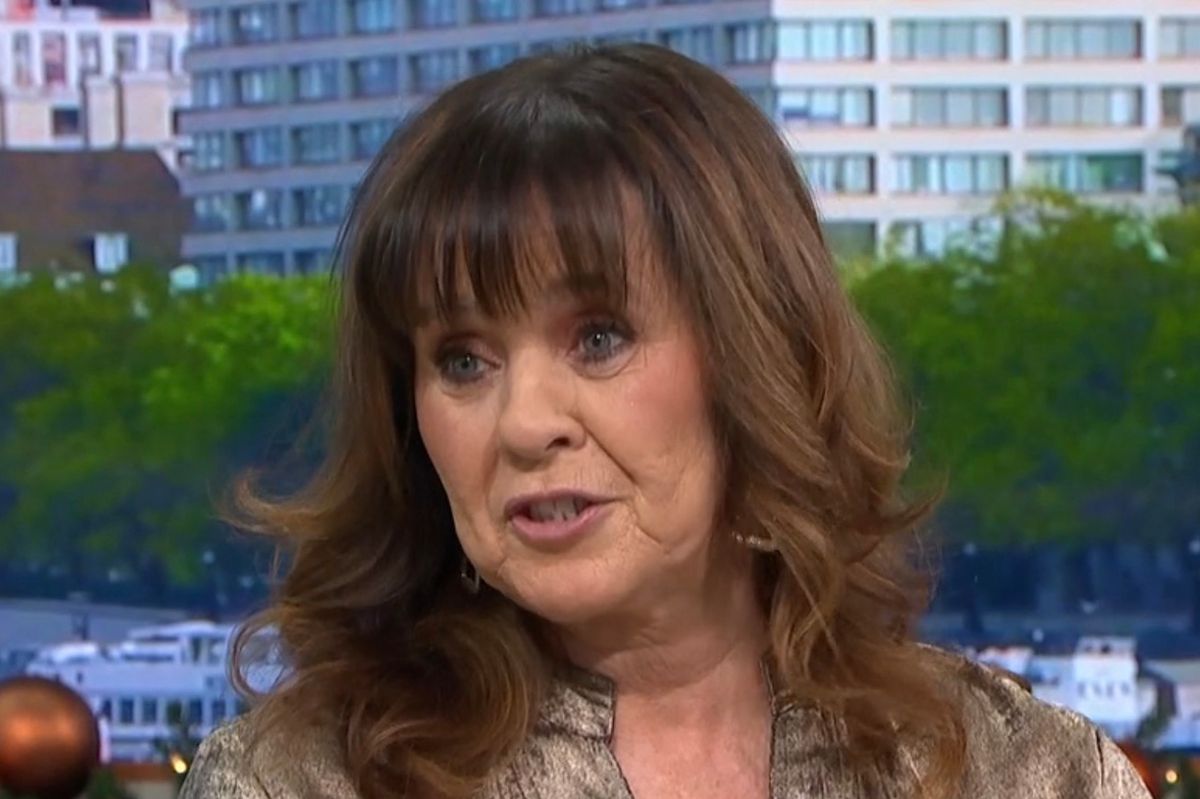
Coleen Nolan has opened up about a hidden family struggle on Friday’s Good Morning Britain
Coleen Nolan has opened up about a hidden family struggle on Friday’s Good Morning Britain (Image: ITV)
Coleen Nolan has revealed she spent ‘years crying’ and feeling like a ‘terrible mother’ over a hidden family struggle.
Over the summer, Coleen, 60, disclosed that her son, Shane, 37, had been fighting a secret battle with drugs which saw him ‘hit rock bottom’ and wreck his marriage to his beauty queen ex-wife, Maddie Wahdan.
Coleen’s son, Shane, whom she shares with ex-husband Shane Richie, separated from his beauty queen wife in December 2023 amid claims he had been unfaithful – just a year after they had tied the knot.
Over the summer, Shane, alongside his mother Coleen, spoke candidly about his struggle with drug addiction, which resulted in him being admitted to rehab as his family feared for his life.
Shane is now in a new relationship with girlfriend Kimberly Sallis, whom he has credited for helping him through the drug addiction, and in November they welcomed their first child together, a baby boy called Cruz-Carter, reports Wales Online.
Speaking about her son’s past struggle on Friday’s Good Morning Britain, Coleen confessed: “I felt like a terrible mother. I thought it was my fault.”
Coleen said of her son speaking out: “It was totally Shane’s decision. It would never have been me forcing him in to talk about it. He thought it was important to talk about and especially when it was during Men’s Mental Health month and all of that.
“When he did it, we were both nervous. I was quite emotional because it’s really hard as a parent or a relative to watch an addict. I mean, it was years of me crying because I couldn’t do anything. I’m his mum and I couldn’t do anything.”
Coleen went on: “People were like, ‘Well, you know, you’re going to have to kick him out. You’re going to have to do that.’ and I went ‘He’s my child!’
“I kept making excuses for him, ‘well, I think he did this… no, no, it’s just because he’s tired, you know.’ And then something major happened where he ended up with stitches in his head and all of that. I think that was a massive wake up call.
“Talking about it afterwards, he said to me, ‘Mum, I feel like a whole weight has been lifted off my shoulders.'” Coleen revealed it was equally beneficial for Shane to understand the impact his struggle had on her.
The Loose Women panellist emotionally shared: “I felt like a terrible mother. I thought it was my fault. I’d done things wrong. I couldn’t help him and it was nothing to do with me. As an addict, the only person that could have helped him was himself, which he did.”
Good Morning Britain continues on weekdays at 6am on ITV and ITV X.
Dec. 12 (UPI) — The State Department is offering a $5 million reward for information leading to the arrest or conviction of Francisco Manuel Bermudez Cagua, an alleged leader of the Ecuadorian Los Choneros cartel who is wanted in the United States on drug trafficking charges.
The reward, announced Thursday, is being offered under the Narcotics Rewards Program of the State Department’s Bureau of International Narcotics and Law Enforcement Affairs.
Bermudez Cagua, also known as Churron, is the alleged leader of Los Choneros, which was designated a Foreign Terrorist Organization and a Specially Designated Global Terrorists by the Trump administration in September amid President Donald Trump‘s crackdown on illegal drugs and immigration.
Federal prosecutors in the Eastern District of New York indicted Bermudez Cagua, along with Jose Adolfo Macias Villamar, the principal leader of the Los Choneros, in a superseding indictment unsealed June 27, 2025, charging him with international cocaine distribution conspiracy, international cocaine distribution and use of firearms in furtherance of drug trafficking offenses.
“As alleged, Bermudez Cagua is a top lieutenant within the leadership of Los Choneros, an extremely violent foreign terrorist organization responsible for pumping drugs into the United States, causing harm to our communities, and wreaking havoc in his homeland of Ecuador,” U.S. Attorney Joseph Nocella Jr. said in a statement.
According to the State Department, the 29-year-old Bermudez Cagua reports to Macias Villamar and became his right-hand man while in prison. Once they both escaped, Bermudez Cagua became Macias Villamar’s spokesperson.
“Bermudez Cagua regularly participated in the decisions Macias Villamar made related to the organization’s drug and weapons trafficking and served as an intermediary, relaying critical information between Macias Villamar and their associates,” according to the State Department website.
Los Choneros is considered one of Ecuador’s most violent criminal organizations and is linked to the infamous Sinaloa Cartel of Mexico. Ecuador designated the group as a terrorist organization in 2024, and the U.S.’ Treasury imposed sanctions against it that same year.
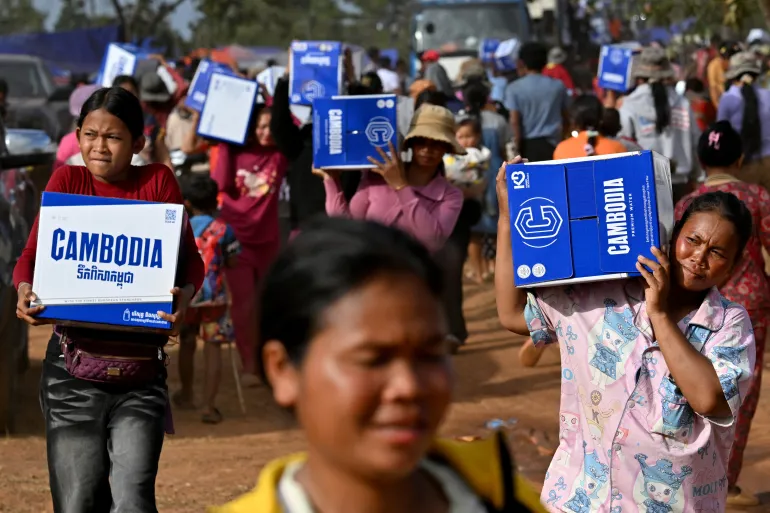
Border fighting between Thailand and Cambodia has entered its fifth day, marking one of the most violent flare-ups since July. Heavy artillery and rocket exchanges along the 817-km frontier have killed at least 20 people, wounded over 200, and displaced hundreds of thousands. The clashes come despite a ceasefire earlier this year that U.S. President Donald Trump personally brokered. With the violence worsening, Thailand’s caretaker Prime Minister Anutin Charnvirakul confirmed he will speak with Trump late Friday in an effort to restore calm.
WHY IT MATTERS
The renewed fighting threatens regional stability in mainland Southeast Asia and risks escalating into a broader conflict if not contained. Trump is positioning himself once again as a mediator, eager to revive a fragile ceasefire he sees as a diplomatic accomplishment. For Thailand and Cambodia both navigating domestic political turbulence U.S. involvement may be one of the few external pressures capable of stopping the conflict quickly.
Trump is doubling down on his role as peace-broker, publicly highlighting past successes and pledging to get the ceasefire “back on track.” Thailand and Cambodia’s militaries are locked in multi-point battles along the border, with commanders facing pressure to halt the humanitarian crisis unfolding. Civilians on both sides remain the most vulnerable, with tens of thousands displaced and local communities facing days of bombardment.
WHAT’S NEXT
The scheduled call between Trump and Prime Minister Anutin will be the latest attempt to restart diplomacy. Trump also plans separate calls with Cambodian leadership. Whether these interventions can end the fighting as they did in July remains uncertain. Much will depend on whether both sides are willing to recommit to a ceasefire and allow international monitoring to stabilise the border.
OLIVIA Attwood has revealed she was cruelly shamed for the cosmetic procedures she has undergone by a presenter.
The former Love Island star, 34, described it as “one of the worst experiences” she has ever had.
Sign up for the Showbiz newsletter
Thank you!
Olivia Attwood has revealed she was cruelly shamed over her cosmetic surgeries by a female presenterCredit: youtube/@thisisoliviashouseOlivia has been open about the various procedures she has had doneCredit: GettyShe even fronted an ITV documentary about surgery, dubbed The Price Of PerfectionCredit: Refer to source
Olivia has been open about her aesthetic preferences; often talking to her fans about which surgical enhancements she has undergone and even making a documentary about cosmetic surgery.
But the star says that she was put in an uncomfortable position during an interview, where the presenter told her she looked older due to having procedures.
Talking on her new podcast, Olivia’s House, the star said: “I had an experience with a female host and one of the worst experiences that I’ve probably had in an interview because I felt like she didn’t want me there…
“I was meant to be promoting the documentary and everything I’d learned about the industry and she very much wanted to make it about me and what I looked like.”
Olivia continued: “She said in her second question, she said, ‘So you, what have you had done?’ And I was a bit like, whoa… I’m talking about the cosmetic industry as a whole.”
“She goes, ‘I don’t know what you were trying to achieve, but you look a lot older ‘cause of what you’ve done to yourself’.”
“It was really one of the worst experiences that I’ve probably had in an interview because I felt like… I felt like she didn’t want me there.”
“When I left that studio… I remember for 20 minutes I just sat in silence and I was like, ‘What? What just actually happened?’.”
While Olivia hasn’t named the presenter, she added that the situation felt “wrong”.
“It just felt just very like tonally wrong for a show that is meant to be about a safe space for women and uplifting women… it was just a really horrible experience and it stayed with me for a little while,” the star concluded.
At the time, Olivia didn’t acknowledge what was going on between them, but was pictured letting loose during a trip to Ibiza, where she cosied up to pal Pete Wicks.
Addressing the situation on her new show, the star admitted that she and Bradley have had a tough year – with issues from both sides.
And teasing that there is more to come, she told fans that Bradley would tell his side of the story “in his own words” when he comes onto the podcast.
Olivia didn’t name the presenter who shamed her, but said it made her feel “uncomfortable”Credit: youtube/@thisisoliviashouseTalking on her podcast, Olivia also detailed her relationship with Bradley DackCredit: Getty
The Department of Homeland Security has pledged to appeal the latest ruling, slamming it as ‘naked judicial activism’.
Kilmar Abrego Garcia, whose case has become a flashpoint in the Trump administration’s immigration crackdown in the United States, has been freed from detention on a judge’s order and returned to his home, according to reports.
Abrego Garcia was due to check in with US immigration officials on Friday, The Associated Press news agency reported, a day after returning to his home following his release from an immigration processing centre in the latest twist in a convoluted case of deportation and detention targeting the Maryland man.
Recommended Stories
list of 4 itemsend of list
In a ruling on Thursday, US District Judge Paula Xinis in Maryland ordered Immigration and Customs Enforcement to let Abrego Garcia go immediately, writing that federal authorities had detained him again after his return to the US without any legal basis.
The face of Trump’s hardline immigration policies
Abrego Garcia has an American wife and children and has lived in Maryland for years, under protected legal status since 2019, when a judge ruled he should not be deported because he could be harmed in his home country by a gang that targeted his family. He originally moved to the US without documentation as a teenager.
He then became the highest-profile case among more than 200 people sent to the notorious El Salvador’s CECOT mega-prison as part of President Donald Trump’s crackdown on refugees, migrants and asylum seekers in the US.
He was wrongfully deported by the Trump administration to El Salvador in March. A court later ordered his return to the US, where he was detained again, as immigration officials sought to deport him to a series of African countries instead of El Salvador.
‘Judicial activism’
The Department of Homeland Security slammed Thursday’s ruling and said it would appeal, labelling the decision as “naked judicial activism” by a judge appointed during President Barack Obama’s administration.
“This order lacks any valid legal basis, and we will continue to fight this tooth and nail in the courts,” said Tricia McLaughlin, the department’s assistant secretary.
Abrego Garcia’s lawyer, Simon Sandoval-Moshenberg, said he expected his client’s ordeal was far from over, and he was preparing to defend him against further deportation efforts.
“The government still has plenty of tools in their toolbox,” Sandoval-Moshenberg said.
“We’re going to be there to fight to make sure there is a fair trial.”
The lawyer said the judge’s ruling had made it clear that the government could not detain a person indefinitely without legal authority, adding that Abrego Garcia had already “endured more than anyone should ever have to”.
Legal battles ongoing
Abrego Garcia has filed a federal lawsuit claiming the Trump administration is illegally using the deportation process to punish him due to the attention his case received.
Since his return, federal authorities have also filed charges against Abrego Garcia for alleged human smuggling related to a 2022 traffic stop.
He has pleaded not guilty and filed a motion to dismiss the charges, claiming the prosecution is vindictive.
In her ruling on Thursday, Judge Xinis said Trump lawyers “affirmatively misled” the court, including falsely claiming that Costa Rica had rescinded an offer to accept Abrego Garcia.
Abrego Garcia has said he was willing to resettle there in the event he was deported from the US.
In a separate proceeding, Abrego Garcia has also petitioned to reopen his immigration case to seek asylum in the US.
The 156-day trial, the most high-profile use of Beijing’s draconian national security law, is set to come to a close.
Hong Kong’s High Court is set to hand down a verdict in the case of pro-democracy campaigner and media mogul Jimmy Lai next week, bringing an end to his lengthy national security trial.
Lai’s verdict will be delivered by a three-judge panel in a hearing that begins at 10am local time (02:00 GMT) on Monday, according to a court diary notice seen on Friday.
Recommended Stories
list of 3 itemsend of list
Founder of the now-shuttered pro-democracy Apple Daily newspaper, Lai, 78, is charged with foreign collusion under Hong Kong’s national security law, which Beijing imposed following huge and sometimes violent pro-democracy protests in 2019.
He previously pleaded not guilty to two counts of conspiring to collude with foreign forces, as well as a third count of sedition under a colonial-era law.
Authorities accuse Lai, who has been detained since December 2020, of using the Apple Daily to conspire with six former executives and others to produce seditious publications between April 2019 and June 2021.
He is accused of using his publication to conspire with paralegal Chan Tsz-wah, activist Andy Li, and others to invite foreign countries – including the United States, Britain and Japan – to impose sanctions, blockades and other hostile measures against Hong Kong and China.
Prosecutors also accuse Lai of stoking hatred against authorities in Beijing and Hong Kong through writing and publishing more than 150 critical op-eds in the outlet.
He faces life imprisonment if convicted.
Lai has been held in solitary confinement for more than 1,800 days, with his family saying they fear for his wellbeing and his health is deteriorating as he suffers from diabetes, high blood pressure, as well as heart palpitations that require medication.
In August, the court postponed closing arguments in his 156-day trial – which began in December 2023 – citing a “medical issue” involving the 78-year-old’s heart.
Authorities say Lai has received proper treatment and medical care during his detention.
Trump to do ‘everything I can to save him’
Hong Kong was handed back to China in 1997 after more than 150 years under British colonial rule.
As part of the “one country, two systems” approach, Hong Kong officially operates a separate judicial system based on Common Law traditions, meaning Lai has greater legal protections than he would in mainland China.
But Hong Kong has experienced significant democratic backsliding in recent years, which accelerated following mass pro-democracy protests in 2019-20, which resulted in a harsh crackdown on dissent in the territory by Beijing.
In 2020, Chinese authorities introduced a draconian national security law to crush the protest movement, establishing secession, subversion, terrorism, and collusion with foreign organisations as crimes carrying hefty punishments.
Lai’s trial represents the most high-profile use of that law, with critics condemning his trial as politically motivated.
The Chinese and Hong Kong governments insist Lai is being given a fair trial and have said the legal process must be allowed to reach its conclusion.
But his case has drawn international scrutiny, including from US President Donald Trump, who has repeatedly promised to “save” Lai. In August, Trump promised to do “everything I can to save him”.
“His name has already entered the circle of things that we’re talking about, and we’ll see what we can do,” Trump told Fox News Radio.
Trump also reportedly raised Lai’s case during a meeting with Chinese leader Xi Jinping when the pair met in South Korea in October.
Have you ever wondered what movie might draw praise from Jacob Elordi and Benicio Del Toro for its cinematic reverie?
When you gather six actors from some of this year’s most acclaimed films, a thoughtful discussion about their roles and the craft is to be expected. But in kicking off The Envelope’s 2025 Oscar Actors Roundtable, the talent reminded us that they’re movie fans like the rest of us, picking the films they wish they could experience again for the first time.
“I’d like to watch ‘The Dark Knight’ again in the exact same circumstance that I watched it,” Elordi said, referring to Christopher Nolan’s dark retelling of Batman’s battle with the Joker. “I was 11 and I was with my dad. I’d been told by my mother that I wasn’t allowed to see it because there’s a horrific sequence with a pencil and a magic trick. My dad — when my mum was away — took me to the cinema to see it. I remember the first time I saw Heath [Ledger, as the Joker] onscreen and really feeling just totally moved by something.”
Then Del Toro chimed in with his pick, “Papillon,” Franklin Schaffner’s 1973 prison film starring Dustin Hoffman and Steve McQueen: “I saw it when I was a kid. We got in late in the movie, and it was a scene where they’re trying to get a gator. And they’re running around the crocodile. I’ve always really enjoyed that film.”
“And you really see Steve McQueen do more in that movie than ever before,” Elordi says. “When he starts going mad in that cell.”
Jesse Plemons is more sheepish when coughing up his selection.
“Everyone’s listing serious movies. The movie that popped into my head was ‘Nacho Libre.’ In life, some things just give you simple pleasures that aren’t necessarily elevated or high art. But that movie makes me very happy, guys.”
There was no judgment. An atmosphere of friendly sharing and mutual understanding was felt throughout the conversation, which brought together Elordi, who portrays the misunderstood and abused Creature in Guillermo del Toro’s “Frankenstein”; Plemons, in his turn as Teddy, a conspiracy theorist who is convinced that aliens live among us in “Bugonia”; Benicio Del Toro, who plays Sergio St. Carlos, a karate sensei and revolutionary immigration activist in “One Battle After Another”; Will Arnett, who stars as Alex Novak, a middle-age suburbanite whose crumbling marriage inspires him to try stand-up comedy in “Is This Thing On?”; Wagner Moura, who portrays Marcelo Alves, a teacher trying to escape the Brazilian dictatorship in “The Secret Agent”; and Stellan Skarsgård, who plays Gustav Borg, a veteran film director and absentee father who decides to make a movie about his family in “Sentimental Value.” Read on for excerpts from our discussion.
These roles take you to intense places — emotionally, physically, mentally. But what’s the furthest you’ve gone to book a role because you really felt like it was something you were meant to play?
Moura: “Narcos” was a crazy adventure for me because I was cast to play that part that had nothing to do with me. I was a skinny Brazilian guy who didn’t speak Spanish at all. So I had to go through a very intense thing. I had to learn a language in order to play a character. That was crazy. That was the the furthest I’ve [gone] to play a part.
Plemons: Those early weeks are a lot of fun, right? The beginning. It’s like Christmas every day.
Moura: The beginning is always like, “What am I doing?” And you go to bed and go like, “Jesus Christ, this is … There’s no way I can pull this off.” At the same time, I remember going to bed and thinking, “Have I done everything I could?” And then I was like, “Yeah, go to bed. Sleep.”
Arnett: Did you ever think about quitting, about not doing it?
Moura: No. I had to go ahead and do it. That director trusted me, and he was like, “You can do it.” I didn’t want to disappoint him.
Have you gotten to that point, Will? Wanting to quit something because it felt like too much?
Arnett: All the time. Doing [“Is This Thing On?”], I felt like I was at the bottom of a mountain. Every day, I thought, “There’s no way I can do it.” I would come home and just think, “That was probably the worst day that anybody’s ever filmed a scene,” then just have to let it go.
With “Is This Thing On?,” you did a stand-up act in front of people, and they were tourists. Some of them didn’t know who you were. And you bombed a few times, right? Place me in that moment, and what does that do for your performance.
Arnett: I had them introduce me by my character name. So the people who did know who I was, we were saying that [they] thought I was probably having a midlife crisis or something, which I was, but for different reasons. I’d never done stand-up before, so going up and doing this in front of people and bombing was super vulnerable. There’s nowhere to hide, and you can’t just walk off. There was one time where I’d done a set at the Comedy Cellar, in the main room, and it was great. And went around the corner, like five minutes later, onto a different stage, with the same material, and it was dead silent. And the only person laughing was Bradley. I could see him laughing, and [I was] thinking, “Can I just walk off stage right now?” That was ego-stripping. It becomes kind of absurd. You end up kind of laughing at yourself, at the absurdity of it. It’s not out-of-body, but you separate yourself from the words as they’re coming out.
Stellan, “Sentimental Value” is, in some ways, about how the choices a parent makes in the service of their job or their art shape the lives of your children. How did it make you reflect on the choices you’ve made in your career and the impact it had on your family?
Skarsgård: I thought it had nothing to do with me. This was a good escape. But my second son, he called me and said, “You recognize yourself?” And I went, “Uh, no.” And of course I don’t recognize myself because he’s a different kind of man. He’s an old-fashioned man in a sense, a 20th century man. And I’m a 21st. [Laughs.] But it reminded me — since I stopped at the Royal Dramatic Theatre [in] 1989, I spent four months a year in front of the camera and eight months a year changing diapers and wiping asses. I don’t think I’ve been away a lot, but it made me think about, “Have you been present?” Not really. I have eight kids, which means there are eight different personalities, and some kids need a lot of attention and some don’t. You’re imperfect, but I’m sort of settled with that. My kids have to settle with it too. They’re not perfect either.
We often hear from the women who are mothers, how they balance their work with their careers. Many of you are fathers. How have you learned to navigate it?
Moura: For me, it’s the most difficult thing ever. I was thinking the other day, “What are the things that really define me as a human being?” Being a father is the strongest one, but being an artist is almost there. It’s hard because with our job, we have to travel a lot, and you’re not always able to bring your kids with you. They have school, and they have their own lives and their own things. I kind of think this is sort of an impossible perfect balance. But like Stellan said, it is what it is. And when I’m with them, I try to be with them. But being aware that, of course, there will be parts of their lives that I won’t be able to be there for them and sort of accept that.
Arnett: It’s funny, I’ve been traveling a lot doing this stuff. I’ve been back for a couple of days, but I’ve been busy. I’ve been going out all day, doing work and doing these things, and my 15-year-old said to me — I checked in on him. He’s doing his homework. I said, “How are you doing?” He said, “Good,” and he said, “I miss you.” And I was in the same place with him. I don’t even know if this is appropriate for this forum, but it really struck me. Him saying that stayed with me all day. And I woke up thinking about [that] this morning, and even this [round table], and saying, “Hey, we’re gonna have dinner tonight.” I had those moments of thinking, “Am I that guy?” Now I’m saying, “Let’s have dinner after … I gotta go do this thing.” It weighs on you. It is the most difficult balance.
Del Toro: I’ve tried to include my daughter in the process sometimes, you know? Sit her down, bounce lines with her, go see the movie when I’m done with the movie. Make her part of it too.
Jacob, so often when you’re talking to an actor, at least on my end, there’s curiosity about the research process and what you’ve had to learn to prepare for a role. But in playing the Creature in “Frankenstein,” this amalgamation of parts, your character’s really in a process of discovery. Did you have to unlearn things? How did you approach that?
Elordi: The nature of the character actually gives you an excuse to be absolutely free because he’s sort of the first man, in a lot of ways. You can really draw from everything and anything, like a smell or light, because he hasn’t felt the sun on his face. But there’s so many things that you can go back on and reconsider. A lot of the process was just closing the world off for the time of filming — not eating a cheeseburger when I wanted to eat a cheeseburger or just little stuff that made me feel Other. But strangely enough, because he’s made of so many different parts, and you get to go from being born to finding consciousness to the death of consciousness at the end, it’s like shooting fish in a barrel. You can’t really miss because everything is happening to him all the time. It’s interesting because you say you want to ask someone about the process, but the process is so f— boring.
Plemons: You studied some form of Japanese dance or movement?
Elordi: Guillermo had this idea to study Butoh. It’s a movement thing, like you’re in drama school again where [the instructor]’s like, “Imagine fire in your fingertips and a hurricane in your lungs, and your foot is a steam train.” And then you walk around the room for 40 minutes … I remember being in drama school, and I had to carry a stick that was called my Intellikey for two hours. It was a piece of bamboo. And move around the room as if that stick was a part of my soul or something. Something completely f— absurd. It was a similar process to that, but it was actually helpful because I had something to apply it to that was sort of physically not so human.
Do any of you have a thing that really helped you find your way into a character? Jesse, I feel like you have gone to some dark places.
Plemons: I guess the most curious is I do dream work. There are symbols and whatnot that you are gifted with that may not make sense on a conscious level, or they may. That’s something that’s hard to talk about. Anything that makes me feel like I’m just following my curiosity and I’m not working; I’m just following some trail that I don’t necessarily know where it’s leading — it’s hard to describe because the way I like to work is where anything goes.
Elordi: You kind of know when you get onto that thing too. When a dot does connect. Something happens, then, all of a sudden, you’re six hours down this little road on this sound that you heard in a song or something like that. You also know when it’s not working. But to be conscious about it can mess it up as well, if you’re like, “I’m gonna do this kind of thing and this. And this is gonna go to this voice.”
Does the work need to feel hard in order for you to feel like you’re challenging yourself?
Skarsgård: No. [I need] to not be afraid and not to be blocked; I need to feel safe. And I need [for] everybody on the set, they want me to be good, and I feel it. Then I can be free. I’m with you [Jesse], you have to be in a state where anything is possible. I don’t do backstories for my characters, ever, because it reduces the possibilities. Then you have to follow the backstory — so he couldn’t do that. You, as an actor, say to the director, “No, my character wouldn’t do that.” “How do you know?” Your character might be more interesting than you are.
Plemons: And this thing doesn’t exist yet, this moment —
Moura: There’s no better thing than being in a scene with another actor, and you look at the other guy or the other actors, and you go, like, “This can go anywhere.” Because these other guys, or this other actor, she’s ready to do whatever, to take this wherever. This is the thing that really moves me in a scene. It’s really hard when you work with an actor or with a director that sticks with the thing that they want the scene to be, that thing they thought at home, that they prepared for, and you can’t really move into that space.
Benicio, you really know how to make a character memorable and leave a lasting impression. With Sensei Sergio and what we see onscreen, what were you working with on the page and how much came from you in collaboration with Paul [Thomas Anderson, the film’s director]?
Del Toro: I just asked questions. Paul wants to hear what the actors have to say. I just bombard him with questions. Paul was very flexible … He’s very quick, and if he likes something, he would jump on it. My character was introduced by killing someone in my dojo. So, I asked him, “OK, so I killed this guy in the dojo … I’m not gonna drive Leo anywhere. I have to get rid of the body. And we’re gonna have to clean the dojo or set it on fire. And why am I doing that?” So, from there, it evolved into, like, “We’re not killing anybody.” I approach it a little bit like that — common sense. Logic. But every character is different and every story is different, and every director is different. I’ve been in movies where you just have to find yourself in there. And those are challenging, and they make you better.
“The Secret Agent” really explores how brutal a dictatorship can be on regular people. Wagner, your character Marcelo is not trying to overthrow the government. He’s just a man who’s trying to stick with his values. Tell me about portraying a person in that situation.
Moura: The dictatorship in Brazil was from ’64 to ’85. I was born in ’76, so the echoes of the dictatorship were still there. I remember my parents speaking like [mimics whispering] because they didn’t want people to hear what were they talking about. It’s important that Brazilian cinema is going back there to look at that big scar in our country. I directed a film [2019’s “Marighella”] about a freedom fighter, a guy who wanted to overthrow the government. But this one is different. Like you said, it’s just someone who’s trying to stick with the values that he has. And I think that this is a reality in many different parts of the world, where just the fact that you are who you are makes your life difficult or puts your life in danger, just by the color of your skin or your sexual orientation. You see the dictatorship and and what a dictatorship can do, but not in a obvious way.
Do any of you read reviews?
Skarsgård: Yes, sometimes. I prefer to read the good ones.
Has there been a bad review that propelled you or motivated you or helped you?
Skarsgård: Once I read a theater review that was really bad and that pointed out a grave mistake I made in the show, so I corrected it afterwards. But otherwise —
Elordi: You took the advice?
Skarsgård: Yeah.
Arnett: I did this show for Netflix like 10 years ago, and this guy wrote this review, and I’m embarrassed to say I wrote a point-for-point rebuttal email. I sent it as a draft to Mark Chappell, my partner, and he said, “Oh, hold on. Don’t send it. I’m gonna come over. Let’s talk for a minute.” And I didn’t send it.
Plemons: I’ve got one journalist — I am not gonna say their name — but …
Arnett: Who’s got it out for you?
Plemons: In a way that wasn’t even that intense, but said it [a performance of mine] was “misguided” — which, is just like, “What?” And then I started reading more of his reviews, and everything’s “misguided” to this guy. It’s like, “What do you mean?” So, I’m trying to be less misguided.
Can I jump in with a question for anyone? Talking about that balance between preparation — in certain cases, it’s necessary — then your experience where you rethink all of that. Given the fact that we’re not machines, that on any given day there are a number of variables that influence your mood and influence your mind and influence your ability to relax and do the scene, I’ve thought a lot about that ideal baseline place of being fully relaxed and in your [element]. I wish acting teachers had told me that when I was younger, that that’s like over half of the battle. I’m curious if you have any —
Top row, from left to right: Will Arnett, Wagner Moura and Jesse Plemons. Bottom row, from left to right: Benicio Del Toro, Jacob Elordi and Stellan Skarsgård.
Skarsgård: Tips?
Plemons: No, routines or [an] approach, anything you do to get yourself into a place where you feel like you can leave the preparation and [just be].
Skarsgård: The preparation can serve that purpose. You feel that you’re doing something because it’s a f— strange business, what we’re doing. You don’t know what it is, really, but you feel that, “OK, I’ve done this preparation. I’ve done three months of baking because I’m [playing] a baker.” You feel that you’re prepared, so you feel safer. But, personally, I make sure that the set is safe. I’m first on set. I come in early and, while they’re setting up, I’m gonna see what they’re doing. I’m making sure that I know what all the sound guys, the prop guys, what they’re doing at the same time. So, I feel a part of the unit. That’s my way of feeling safe.
Plemons: Yeah, I find that too. Any time you try and block anything out, you’re missing it. I know that’s sort of a cliche, but the times when I’ve felt maybe the best, I wasn’t blacked out. I was aware of everything.
Elordi: Key to the whole thing is you practice.
Plemons: Yeah, I was looking at the DP I had.
Elordi: That’s when I feel, like, the most comfortable, is when you feel like you are in a dialogue with the operator and the lighting guard and your director, and you’re all in the scene working towards [the same thing]. It’s not like, “Everyone, shut the f— up now. I need complete silence.” Complete silences are unnerving to me on a set. It’s like you’re all trying to reach this point for cut, and then you’ve got that piece of the thing. That makes me feel comfortable when it’s technical and not actually getting lost in this thing of like, “I need complete silence. My body needs to be supple and ready.”
Dec. 12 (UPI) — European Union member states have approved nearly $2.7 billion in funding for Ukraine as part of a plan to bolster the war-besieged nation’s recovery, reconstruction and modernization.
The disbursement of the funds was approved Thursday by the European Council, the 27-member block’s top political steering body, to boost Ukraine’s macro-financial stability and support the functioning of its public administration, the council said in a statement.
“I am grateful to the EU for the steadfast support,” Sergii Marchenko, Ukraine’s minister of finance, said in a statement.
“The [Ukraine-EU] partnership ensures our financial stability today and lays the foundation for Ukraine’s shared future in the EU.”
According to Ukraine’s Ministry of Finance, $2.4 billion of the funds will be provided as loans, with the remainder in grants.
It is the sixth regular disbursement of funds from the Ukraine Facility, the EU’s main framework for sustaining Ukraine’s economy, governance and reconstruction amid its defense against Russia’s invasion.
Ukrainian Prime Minister Yulia Svyrydenko said in a statement that this disbursement is “essential” for Ukraine to maintain its “financial resilience” during the war, which began with Russia’s invasion on Feb. 24, 2022.
“We are grateful to our European partners for their consistent support and for continuing the program,” she said.
The council agreed to release the funds as Ukraine successfully completed the eight steps required for the disbursement as well as an outstanding step from the fourth disbursement, according to the council.
The reforms were implemented before the end of the third quarter in the areas of public finance management, the judiciary, the business environment, the banking sector, environmental protection and others, according to the finance ministry.
“The government of Ukraine is working to further improve compliance with Ukraine Facility conditions in the upcoming reporting period,” Svyrydenko added.
The announcement comes a little over a month after the EU approved the fifth disbursement in early November.
“This quick consecutive provision of funds mirrors Ukraine’s speed and commitment to implement reforms aligned with the country’s EU accession goals,” the council said.
The Ukraine Facility entered into force March 1, 2024, to provide Ukraine with up to more than $58 billion in grants and loans through 2027.
To date, Ukraine has received more than $28.6 billion under the program, with $9.7 billion having been received this year alone, according to the Ministry of Finance.
“This is stable and predictable financial support that enables us to maintain budget liquidity and ensure social payments,” Marchenko added in a separate statement.
“Thanks to this support, Ukraine remains on the path of reforms and is moving closer to EU membership.”
The Ukraine Facility is closely linked to advancing the so-called Ukraine Plan that outlines Kyiv’s strategy not only for recovery, reconstruction and modernization but also for implementing reforms to achieve its goal of becoming the 28th member of the EU.
The announcement coincided with the EU and Ukraine agreeing on a 10-point plan on implementing reforms to ensure Kyiv aligns with the bloc and eventually becoming a member.
The EU is Ukraine’s largest backer during its war against Russia, giving it about $80.2 billion since the war began, of which $30.9 billion was given this year.
The Trump administration has imposed new sanctions on Venezuela, targeting three nephews of President Nicolas Maduro’s wife, Cilia Flores, as well as six crude oil tankers and shipping companies linked to them, as Washington steps up pressure on Caracas.
Two of the sanctioned nephews were previously convicted in the United States on drug trafficking charges before being released as part of a prisoner exchange.
Recommended Stories
list of 3 itemsend of list
The US is also targeting Venezuela’s oil sector by sanctioning a Panamanian businessman, Ramon Carretero Napolitano, whom it says facilitates the shipment of petroleum products on behalf of the Venezuelan government, along with several shipping companies.
The US Treasury Department said on Thursday that the measures include sanctions on six crude oil tankers it said have “engaged in deceptive and unsafe shipping practices and continue to provide financial resources that fuel Maduro’s corrupt narco-terrorist regime”.
Four of the tankers, including the 2002-built H Constance and the 2003-built Lattafa, are Panama-flagged, with the other two flagged by the Cook Islands and Hong Kong.
The vessels are supertankers that recently loaded crude in Venezuela, according to internal shipping documents from state oil company PDVSA.
‘An act of piracy’
In comments on Thursday night, Trump also repeated his threat to soon begin strikes on suspected narcotics shipments making their way via land from Venezuela to the US.
White House Press Secretary Karoline Leavitt said the US would take the tanker to a US port.
“The vessel will go to a US port, and the United States does intend to seize the oil,” Leavitt said during a news briefing. “However, there is a legal process for the seizure of that oil, and that legal process will be followed.”
Maduro condemned the seizure, calling it “an act of piracy against a merchant, commercial, civil and private vessel,” adding that “the ship was private, civilian and was carrying 1.9 million barrels of oil that they bought from Venezuela”.
He said the incident had “unmasked” Washington, arguing that the true motive behind the action was the seizure of Venezuelan oil.
“It is the oil they want to steal, and Venezuela will protect its oil,” Maduro added.
Maduro’s condemnation came as US officials emphasised that the latest sanctions also targeted figures close to the Venezuelan leader.
Venezuela’s President Nicolas Maduro holds a sword which belonged to Ezequiel Zamora, a Venezuelan soldier [FILE: Leonardo Fernandez Viloria/Reuters]
Maduro’s relatives targeted
Franqui Flores and Efrain Antonio Campo Flores, nephews of Venezuelan first lady Cilia Flores, were also sanctioned. The two became known as the “narco nephews” after their arrest in Haiti in 2015 during a US Drug Enforcement Administration sting.
They were convicted in 2016 on charges of attempting to carry out a multimillion-dollar cocaine deal and sentenced to 18 years in prison, before being released in a 2022 prisoner swap with Venezuela.
A third nephew, Carlos Erik Malpica Flores, was also targeted. US authorities allege he was involved in a corruption scheme at the state oil company.
Maduro and his government have denied links to criminal activity, saying the US is seeking regime change to gain control of Venezuela’s vast oil reserves.
Beyond the individuals targeted, the US is also preparing to intercept additional ships transporting Venezuelan oil, the Reuters news agency reported, citing sources.
Asked whether the Trump administration planned further ship seizures, White House spokesperson Leavitt told reporters she would not speak about future actions but said the US would continue executing the president’s sanctions policies.
“We’re not going to stand by and watch sanctioned vessels sail the seas with black market oil, the proceeds of which will fuel narcoterrorism of rogue and illegitimate regimes around the world,” she said on Thursday.
Wednesday’s seizure was the first of a Venezuelan oil cargo amid US sanctions that have been in force since 2019. The move sent oil prices higher and sharply escalated tensions between Washington and Caracas.
White House Press Secretary Karoline Leavitt holds a news briefing [Jonathan Ernst/Reuters]
Real Housewives of Cheshire star Debbie Davies has urged people to get checked out after discovering she has tonsil cancer caused by the HPV virus
22:38, 11 Dec 2025Updated 22:38, 11 Dec 2025
Real Housewives of Cheshire star Debbie Davies shared she has cancer(Image: Instagram)
Real Housewives of Cheshire star Debbie Davies has shared the sad news she has cancer. The 58-year-old reality star, who is also a psychic, ghost hunter and medium, took to Instagram to reveal she had been diagnosed with tonsil cancer at the end of November.
Posting a video, she told her followers how she had been experiencing a constantly sore mouth for a while and had “so many sore throats over the years”. But she said that “never for a moment” did she think it could be something so serious.
Doctors only discovered it was cancer after she had three teeth out and a nurse advised Debbie to get checked out. She said: “Thank God a nurse at Wythenshawe Hospital mentioned the possibility of it being cancer to me! Thanks to her I got checked out and now I’m getting treatment.”
Since her initial diagnosis, Debbie has been giving fans regular updates – and warning people what to look out for so it doesn’t happen to them, or they at least have the best chance of catching it early.
Sharing a photo of herself wearing a special mask covering her whole head apart from her nose that’s meant for radiotherapy treatment, Debbie said: “Constant sore throat? Get checked. Tonsil cancer caused by the HPV virus is no joke.”
In the caption she wrote: “The advice is simple, get checked. The mask looks grim but it’s doable and if you want to survive you’ve got no choice.
“Today someone messaged to say they’ve got diagnosed because they got seen after my first post, to me that makes baring my soul worth it, no woman wants to be seen at her worst, but if it saves lives I’ll do it.
“So apologies for banging on about this, it is what it is, please share and get this out there. Cancer – you are the devil’s work and I’m one of God’s women, so heaven help you picking a war with me.”
In her latest post, Debbie shared that she is having a mix of chemotherapy and radiotherapy over the next few weeks to hopefully be rid of the cancer for good.
She told fans: “I’m OK, and hopefully I’m going to be OK.
“So, finally, after a ton of appointments, I don’t go back until Monday and that’s for radiation and chemotherapy for six weeks.
“Although that’s not going to be easy and simple because the cancer is in my mouth, it’s on my tonsils and in my glands. So, I’m going to be very burnt from the radiotherapy. I’ve got that ordeal to get through.
“But six weeks of treatment and then, please God, I’ll be cancer free. So, keeping everything crossed. Six weeks, I’ll have to recover, but please God, I’ll go back to normal and be cancer free.”
Debbie first appeared on The Real Housewives of Cheshire in 2021, taking over from Dawn Ward, and quit after just one series. But she returned to the ITV2 show earlier this year for the 10th anniversary series.
Fighting between Cambodia and Thailand has entered its fifth day, with Cambodia accusing the Thai military of continued shelling and Thailand’s caretaker Prime Minister Anutin Charnvirakul confirming that he is scheduled to speak with United States President Donald Trump.
Thai forces allegedly carried out new attacks in three Cambodian provinces in the early hours of Friday morning, according to Cambodian news outlet The Khmer Times.
Recommended Stories
list of 3 itemsend of list
The newspaper reported that Thai forces opened fire in the Ta Moan, Ta Kra Bei and Thmar Daun areas of Cambodia’s Oddar Meanchey province.
It also reported Thai shelling in the Phnom Khaing and An Ses areas of the country’s Preah Vihear province, as well as the areas of Prey Chan Village and Boeung Trakuan in nearby Banteay Meanchey province.
No new casualties were reported following the renewed fighting.
At least 20 people have been killed across both countries, with nearly 200 more wounded, since fighting resumed on Monday.
An estimated 600,000 people have also been displaced on both sides of the Thai-Cambodia border since the breakdown of a peace agreement brokered by Trump in October.
Displaced people carry boxes with drinking water distributed at a temporary camp in Cambodia’s Oddar Meanchey province on December 11, 2025 [Tang Chhin Sothy/AFP]
In a Facebook post, Cambodia’s Ministry of Defence also rejected as “fake news” a claim from the Thai military that it was using foreign mercenaries to operate suicide drones in its attacks on targets in Thailand.
“The Ministry of National Defence of Cambodia would like to reject propaganda disseminated on the Thai 2nd Army Area Facebook page, which accused Cambodia of using foreigners to help launch FPV [first person view] drones in the Cambodian-Thai border conflict,” the ministry said.
Separately, the ministry also rejected accusations from Thai media outlets alleging that it was preparing to launch Chinese-made PHL-03 missiles in the border dispute.
The PHL-03 is a truck-mounted multiple rocket launcher that can fire guided and unguided rockets with a range of 70km to 130km (43.5 miles to 81 miles), according to a US military database, while Cambodia’s BM-21 Soviet-designed multi-rocket launchers have a range of just 15km to 40km (9.3 miles to 25 miles).
“Cambodia demands the Thai side to deliberately stop spreading false news in order to divert attention to its violations of international law by painting Cambodia as a pretext to use more violent weapons on Cambodia,” the Defence Ministry said.
The Southeast Asian neighbours accuse one another of reigniting the conflict that centres around a centuries-old border dispute along their 800-kilometre (500-mile) frontier, where both sides claim ownership over a smattering of historic temples.
The continued fighting involving artillery, fighter jets, tanks and drones comes as Thailand’s caretaker Prime Minister Anutin confirmed he was scheduled to speak with President Trump at 21:20 local time (14:20 GMT) on Friday.
Trump promised on Wednesday to reach out to the leaders of both countries, saying he thinks he “can get them to stop fighting”.
White House Press Secretary Karoline Leavitt said on Thursday that Trump had yet to call the Thai and Cambodian leadership, but added that “the administration is obviously tracking this at the highest levels and is very much engaged”.
Thailand’s top diplomat Sihasak Phuangketkeow spoke with US counterpart Marco Rubio on Friday ahead of the planned call between Trump and Anutin, Thailand’s foreign ministry said.
Sihasak told Rubio that Thailand was committed to a peaceful resolution, but said sustainable peace must be backed up by actions and genuine commitment, the ministry said in a statement, adding that Rubio confirmed US readiness to constructively promote peace.
Anutin also said his decision to dissolve parliament on Thursday – earlier than expected – would not affect the management of the ongoing border conflict.
The move comes following a breakdown in relations between Anutin’s Thai Pride Party and the opposition People’s Party, the largest bloc in the Thai legislature.
Government spokesperson Siripong Angkasakulkiat said a legislative impasse had paralysed the government’s agenda, meaning Anutin’s party “can’t go forward in parliament”.
Thailand’s King Maha Vajiralongkorn endorsed the dissolution, the country’s official Royal Gazette announced on Friday, making way for early elections.
The national polls must now be held within 45 to 60 days in Thailand.
In the large displacement camps of Gaza, rows upon rows of makeshift tents blanket debris, empty lots and what remains of flattened neighbourhoods. With Storm Byron descending upon the enclave, a sense of terror has seized a population already exhausted from two years of Israel’s genocidal war with its unrelenting bombardment, starvation and chaos.
For the 1.5 million Palestinians living under plastic sheets and tattered tarps, the storm means something more than just bad weather. It’s another danger piled on top of the current battle for survival.
Recommended Stories
list of 4 itemsend of list
For several days, meteorologists have warned that heavy rainfall and strong winds could hit the strip today, tomorrow and over the weekend, risking flash flooding and significant wind damage. What is certain, though, is that Gaza is not facing this storm with ready infrastructure, stocked shelters or functioning drainage systems.
It faces it with tents propped up with pieces of scrap metal, paths that become mud rivers after only one night of rain and families who have nothing left to protect.
Solidarity a survival strategy
In the camps of Gaza City, the scenes of vulnerability are everywhere. Most tents are constructed from aid tarpaulins, pieces of plastic salvaged from rubble and blankets tied to recycled wooden poles. Many sag visibly in the middle; others are erected inadequately, so much so that they quiver and flap violently under the slightest breeze.
“When the wind starts, we all hold the poles to keep the tent from falling,” said Hani Ziara, a father sheltering in western Gaza City after his home was destroyed months ago.
His tent was flooded last night in the heavy rain, and his children had to stay outside in the cold. Hani wonders painfully what else he can do to protect his children from the rain and strong winds.
Hani Zaira, a Palestinian father taking shelter in a destroyed building in Gaza City [Hani Mahmoud/Al Jazeera]
In many camps, the ground was already soft from previous rainfall. Wet sand and mud stick to shoes, blankets and cooking pots as people shuffle through. Trenches dug by volunteers to divert water often collapse within hours. With nowhere else to go, families who live in low-lying areas are preparing for the worst: that floodwaters will be pushed directly into their tents.
Stocking up on food, storing clean water and securing shelter are the most basic steps when people prepare for a storm, but that is considered a luxury for the displaced of Gaza.
Most families receive scant water deliveries, going sometimes days without enough to cook or wash. Food supplies are equally strained, and while irregular aid distributions provide basics like rice or canned beans, the quantities seldom last more than a few days. Preparing for a storm by cooking ahead, gathering dry goods or storing fuel is simply not possible.
Mervit, a mother of five children displaced near the Gaza port [Hani Mahmoud/Al Jazeera]
“We could not sleep last night. Our tent was flooded with rainwater. Everything we had was flushed out by water. We want to prepare, but how?” asked Mervit, a mother of five children displaced near the Gaza port. She added, “We barely have enough food for tonight. We can’t save what we don’t have.”
Despite poverty, solidarity has become Gaza’s strongest survival strategy. Neighbours, with whatever they have, help secure the tents. Young men go through the rubble and scavenge for metal and wood remains to serve as temporary posts. The women organise collective cooking so that hot meals can be distributed to families in need, particularly those with young children or elderly family members, whenever possible.
These unofficial networks become more active the closer a storm gets. Volunteers trudge from tent to tent, helping families raise sleeping areas off the ground, patch holes in canopies with plastic sheets, and dig drainage channels. Crowds try to move those who are in precarious, extremely exposed areas to other locations, sharing information about safer places.
‘We are exhausted’
Beyond physical danger, the psychological impact is deep. After months of displacement, loss and deprivation, another crisis – this time, not war, but forces of nature – feels overwhelming.
“Our tents were destroyed. We are exhausted,” said Wissam Naser. “We have no strength left. Every day there is a new fear: hunger, cold, disease, now the storm.”
Wissam Naser, a displaced Palestinian sheltering in a tent in Gaza City [Hani Mahmoud/Al Jazeera]
Many residents describe the feeling of being sandwiched between the sky and the ground, exposed on both ends and unable to protect their families from either.
As clouds mass along Gaza’s shore, families prepare to take a hit. Some weigh down tent walls against the wind with rocks and sandbags. Others push children’s blankets to the driest corner, hoping a roof will last. Most don’t have a plan. They just wait.
The storm will not be another single-night affair for the displaced in Gaza. It would be a further reminder of how fragile life has become, how survival depends not on preparedness but rather on endurance.
They wait because they have no alternative. They prepare with what little they have. They pray that this time, the winds will be merciful.
IN one of my encounters with Pink Floyd’s Nick Mason, he cast his mind back to his first dealings with the “crazy diamond”.
This would have been late 1964, early ’65, when the band still called themselves The Tea Set because they rehearsed in a basement tearoom at Regent Street Polytechnic in London.
Sign up for the Showbiz newsletter
Thank you!
In 1975, a dishevelled Syd Barrett appeared at Abbey Road Studios, above, leaving Pink Floyd members stunned as they realised their frontman had changed beyond recognitionCredit: SuppliedPink Floyd’s Richard Wright, David Gilmour, Nick Mason and Roger WatersCredit: Storm Thorgerson, Sony Music EntertainmentSyd Barrett during his time in the band, pictured here in 1967Credit: Getty
Mason, Roger Waters and Richard Wright had found themselves not just a singer and a guitarist but a charismatic frontman, all set to “shine on”.
“Syd was the most delightful man, absolutely charming,” Mason told me. “He wrote wonderful, whimsical, pastoral English music.”
Barrett, a childhood friend of Waters in Cambridge, came up with Floyd’s first single, the eyebrow-raising Arnold Layne, about a pervert whose hobby was stealing women’s underwear from washing lines.
Before the second album, A Saucerful Of Secrets, was even completed, the troubled star had no choice but to leave and guitarist David Gilmour was already in place.
“It’s still not entirely clear what happened with Syd,” Mason continued. “There is a belief that maybe he didn’t want to be a pop star. You have to know that, in 1967, the rest of us DID want to be on Top Of The Pops.
“Maybe Syd realised it wasn’t what he wanted, but didn’t know how to get out of it.”
As students of Pink Floyd know, the band crossed paths with Barrett several years later in haunting, uncomfortable circumstances.
On June 5, 1975, a shambling figure — shaven-headed, overweight, largely incoherent and clutching a plastic shopping bag — pitched up at EMI Studios (Abbey Road), stomping ground not just of The Beatles but also Floyd.
Years later, keyboard player Wright described the scene: “I remember going in and Roger was already in the studio working.
“I came in and sat next to Roger. After ten minutes, Roger said to me, ‘Do you know who that guy is?’
“I said: ‘I have no idea. I assumed it was a friend of yours.’ Suddenly I realised it was Syd!”
Art director Storm Thorgerson, responsible with Aubrey “Po” Powell for the band’s iconic album covers, also witnessed the scene.
“Two or three people cried,” he said. “Syd sat around and talked for a bit, but he wasn’t really there.”
On that very day, the band were mixing their nine-part, 26-minute homage to Barrett, Shine On You Crazy Diamond.
To many, it ranks as the band’s greatest single composition, matching Gilmour’s elegant, fluid guitar, Wright’s serene keyboards and Mason’s perfectly weighted drumming to some of Waters’ most touching lyrics.
“You were caught in the crossfire of childhood and stardom. Blown on the steel breeze.”
The song would be split into two sections, Parts 1-5 and Parts 6-9, to bookend Wish You Were Here, the follow-up to a cultural phenomenon, The Dark Side Of The Moon.
Now, to mark its 50th anniversary, the album is appearing in expanded formats, adding alternate takes to the original release.
Poet Laureate and Floyd superfan Simon Armitage has written a stream-of-consciousness love letter to the band and, in particular, Wish You Were Here.
I’m very sad about Syd. I wasn’t for years. For years, I suppose he was a threat because of all that was written about him and us
Roger Waters
It has no capital letters or punctuation, but these lines give you the drift: “it’s the forty four minute five second guide to eternity — it’s infinity measured in five songs.”
And for the first time, Shine On You Crazy Diamond is also presented as one continuous piece thanks to a new remix by James Guthrie.
It stands as an emotional remembrance of Barrett, who died a recluse in 2006, aged 60, at his home in Cambridge.
Poignantly, as the track fades to nothing, you hear strains of the See Emily Play keyboard melody.
Waters once reflected: “I’m very sad about Syd. I wasn’t for years. For years, I suppose he was a threat because of all that was written about him and us.
“Of course, he was very important and the band would never have started without him but, on the other hand, it couldn’t go on with him.”
As for Shine On, he added: “It is not really about Syd. He’s just a symbol for the extremes of absence some people have to indulge in because the only way they can cope with how sad it is — modern life — is to withdraw completely.”
On the song’s scale in musical terms, Mason likened it to another lengthy set piece, Echoes, from 1971’s Meddle album. “Echoes,” he said, “was Shine On’s grandfather.”
Now let’s rewind to 1974 when Pink Floyd set about devising an album in the wake of the juggernaut that The Dark Side Of The Moon had already become.
Their initial attempt, using everyday objects as instruments, was not very encouraging, to say the least.
When I reminded Mason of it, he replied: “Some things I’ve been trying to obliterate from my brain — and I’m afraid you just brought that one up!
The legendary Wish You Were Here album cover shotCredit: Aubrey PowellDavid Gilmour (left) on stage with singer-songwriter Roy Harper at a free concert in Hyde Park, London, in 1974Credit: GettyPink Floyd’s Nick Mason on the drumsCredit: JD Mahn/Sony Music EntertainmentRichard Wright and David GilmourCredit: JD Mahn/Sony Music Entertainment
“The problem was that we ended up spending an awful lot of time grinding away, developing the sounds.
“We hadn’t even got any real music. Things like plucking rubber bands slowed down to quarter-speed.”
He added: “It was a fantastically fruitless exercise, really a way of putting off the ghastly business of what the hell were we going to do next.”
So, did the whole band buy into the daft idea? I ventured.
“We did,” Mason sighed. “If only two people at least had had the gumption to go, ‘F*** this! Let’s work on a record’.”
One of the extra Wish You Were Here tracks, Wine Glasses, offers listeners a taste of the project that became known as Household Objects.
And, as Mason reported, “The wine glasses did make it on to the beginning of Shine On.” (Listen carefully and you’ll hear the tinkling sound.)
So what about the three tracks, further exploring themes of absence and alienation, which were sandwiched between Shine On’s lengthy sections?
Synthesiser-heavy Welcome To The Machine was a product of Floyd’s infatuation with latest technology, and the others came with fascinating back stories.
If Barrett had been a surprise visitor to the Abbey Road sessions, so were two virtuoso violinists just as Floyd were recording the album’s title track, Wish You Were Here.
Mason picked up the story: “If someone was down the hall recording at Abbey Road, it was OK to pop in and say, ‘Hello’.
“Suddenly the door opened and Yehudi Menuhin and Stephane Grappelli were standing there, going, ‘Hello boys’.”
Menuhin, an American-born Brit, was widely regarded as one of the greatest 20th Century classical violinists. Grappelli, a French jazz violinist, was noted for an intuitive, more improvisational approach.
Mason added with English understatement: “By ’75, we were reasonably well known and Grappelli being French would have heard about us because we always had a standing in France.
“I think we invited them both to play with us. Menuhin wanted to but wasn’t comfortable improvising, whereas Grappelli could do it like stepping off a log.”
So the Frenchman went up to one of Pink Floyd’s mics and added gorgeous violin flourishes to a take of the acoustic guitar-led Wish You Were Here.
Ultimately, his contribution didn’t make the finished album, but it can be heard on the expanded editions.
Mason said: “I’m really astonished by it. We thought it had been recorded over, that we’d lost it for ever. I don’t know why we didn’t use it — it would have enhanced the record, but maybe it sounded too folky.
“Or maybe, in a pre-Euro world, we thought, ‘It’s a bloody Frenchman and he shouldn’t have anything to do with it!’”
Grappelli was paid £300 (a princely sum in those days), but went to his death in 1997 oblivious to this unlikely footnote to the Wish You Were Here story.
People did say to us: ‘Which one’s Pink?’ They thought Pink Floyd was the lead singer!
David Gilmour
Another outsider at the sessions — Floyd’s friend, folk-rock troubadour Roy Harper — felt “hard done by” when it came to payment for his lead vocals on Have A Cigar.
After numerous failed attempts by Waters to nail his withering put-down of music industry executives “on the gravy train”, he turned to a singer who loaded his delivery with the perfect sneering tone.
“Roy was recording in the studio anyway,” remembered Waters, “and was in and out all the time. I can’t remember who suggested it, maybe I did, probably hoping everybody would go, ‘Oh no Rog, you do it’, but they didn’t!
“They all went, ‘Oh yeah that’s a good idea’. And he did it and everybody went, ‘Oh, terrific!’ So that was that.”
We know how single-minded Waters can be and he still gave it one final go — but to no avail.
Tape engineer John Leckie recalled Waters saying to Harper that they should reward him for his efforts.
“And Roy said: ‘Just get me a season ticket for life at Lord’s.’ He kept prompting Roger, but it never came.”
Many years later in 2013, when Harper released his comeback album Man & Myth, I met him for coffee near Lord’s, just before the avid cricket fan watched England play Australia for The Ashes.
Best known for When An Old Cricketer Leaves The Crease, he bemoaned his lack of payment for Have A Cigar but talked about his close ties to three of Britain’s biggest rock bands.
“I was an interloper really,” he said. “I was the one who didn’t have a band. I drifted between Led Zeppelin, Pink Floyd and The Who basically.
“At the time, they were big and here was this strange interloper moving between all three.
“One thing I never did, for which I deserve credit, was to transfer what one said about the other. Keep it discreet!”
Violinists Yehudi Menuhin and Stephane Grappelli were surprise visitors at Abbey RoadCredit: Allan WarrenWright and Roger WatersCredit: Storm Thorgerson/Sony Music Entertainment
On the recording Have A Cigar, he said: “I listened to the song at home for a night. I came back the following day and didn’t quite nail it. But then, on the day after that, I did — and they had a song.”
The track’s most memorable line is, “Oh by the way, which one’s Pink?”
Gilmour once admitted: “People did say to us: ‘Which one’s Pink?’ They thought Pink Floyd was the lead singer!”
As you may have gathered, Wish You Were Here comes with a rich history and timeless, captivating music.
Emerging as it did from the mighty shadow cast by The Dark Side Of The Moon, it still shines on 50 years later.
PINK FLOYD Wish You Were Here 50th Anniversary
★★★★☆
Wish You Were Here 50th Anniversary is out December 12Credit: Supplied
An illustration picture shows the introduction page of ChatGPT, an interactive AI chatbot model trained and developed by OpenAI, on its website in Beijing, China, in 2023. President Donald Trump signed an executive order Thursday limiting the ability of American states to regulate AI. File Photo ChatGPT. EPA-EFE/WU HAO
Dec. 11 (UPI) — President Donald Trump signed an executive order Thursday night that limits states’ ability to regulate artificial intelligence companies.
The order is designed “to sustain and enhance the United States’ global AI dominance through a minimally burdensome national policy framework for AI,” according to a release on the White House website.
“To win, United States AI companies must be free to innovate without cumbersome regulation,” the order says. “But excessive State regulation thwarts this imperative.”
Trump has been a strong proponent of U.S. leadership in AI development, and said at the executive order signing ceremony Thursday night that AI companies “want to be in the United States, and they want to do it here, and we have big investment coming. But if they had to get 50 different approvals from 50 different states, you could forget it.”
The order instructs Attorney General Pam Bondi to establish an “AI Litigation Task Force” within 30 days whose “sole responsibility shall be to challenge State AI laws” that don’t align with the Trump administration’s minimal approach to regulation.
It could also revise existing state laws, and directs Commerce Secretary Howard Lutnick to identify state laws that “require AI models to alter their truthful outputs,” which aligns with Trump’s efforts to prevent what he describes as “woke AI.”
Trump has also used federal funding as an incentive to encourage states with such laws not to enforce them. Under terms of the executive order, federal AI law would preempt state regulations. State AI laws designed to protect children would not be affected.
The executive order comes after congress voted in July and November against creating a similar policy.
Critics of the plan created by the executive order call it an attempt to block meaningful regulation on AI and say congress is not equipped to replace state-specific laws with a single, nationwide standard.
Tech companies have been supportive of efforts to limit the power of states to regulate AI. The executive order marks a victory for tech companies like Google and OpenAI, which have launched campaigns through a super PAC, and have as much as $100 million to spend in an effort to shape the outcome of next year’s midterm elections.
The order is also seen as a move to thwart Democrat-led states such as California and New York from exerting state laws over AI development
A British backpacker who struck and killed a man while riding an e-scooter drunk has been jailed for four years in Australia.
Alicia Kemp, 25 – from Redditch, Worcestershire – was driving at speeds of 20 to 25km/h (12 to 15mph) when she hit 51-year-old Thanh Phan from behind on a Perth sidewalk in May.
She had been drinking with a friend all afternoon, the court heard, and had an alcohol level more than three times the legal limit.
Phan, a father-of-two, hit his head on the pavement and died in hospital from a brain bleed two days later.
A friend of Kemp, who was a passenger on the scooter, was also hurt in the crash – sustaining a fractured skull and broken nose – but her injuries were not life-threatening.
Kemp, who was in Australia on a working holiday visa, pleaded guilty to dangerous driving causing death in the Perth Magistrates Court in August.
Her sentence will be backdated to 1 June, and she’ll be eligible for parole after serving two years of her sentence. Her driver’s licence was also disqualified for two years.
For all those in search of pop star-infused festive cheer, Mariah Carey’s Holiday Bar opened earlier this month at the Mondrian Hotel’s Skybar.
The pop-up’s Los Angeles debut is steeped with the signature seasonal touch from the Queen of Christmas — neon signs of her lyrics light up the room, massive portraits of the star fill the space and every single song that plays — holiday-themed or not — is from Carey’s discography. (Disclaimer: “All I Want For Christmas Is You” does play every 30 minutes.)
“For as long as I’ve known Christmas, Mariah has always been there. It signals to me that childlike wonder and excitement of Christmas time that kind of harkens back to when I was a kid,” said Cathy Kwon, who was posing for a photo on the decorative sleigh. “The fact that the song itself [‘All I Want For Christmas Is You’] has stayed this popular for this long is remarkable.”
Ever since releasing her holiday album, “Merry Christmas,” in 1994, Carey has established herself as a permanent fixture in the holiday season. Every year, the 56-year-old singer has gift-wrapped a new festivity for her fans.
Last year, she embarked on Mariah Carey’s Christmas Time tour to celebrate the album’s 30th anniversary and this year, she’s doing a Vegas residency called “Christmastime in Las Vegas.” She’s also previously hosted several holiday specials for Apple TV and CBS. And nearly every year, her modern holiday classic, “All I Want For Christmas Is You,” climbs to the top of the charts.
Mariah Carey’s Holiday Bar will be open until Dec. 28.
(Eric Thayer / Los Angeles Times)
For her holiday bars, she partnered with the event company Bucket Listers to open four locations across the country, in Los Angeles, New York City, Miami and Las Vegas. The WeHo bar is complete with endless photo ops, including life-size cutouts and large-scale holiday-themed portraiture of the “Obsessed” singer, as well as cocktails featuring her own liqueur company, Black Irish. The bar’s pool is filled with candy cane floaties, twinkling Christmas trees decadently line every walkway and bursts of soapy snow fly through the air (occasionally landing in a cocktail or two).
Bucket Listers founder Andy Lederman says the demand for this experience has “surpassed every expectation” that the company had.
“She’s the queen of Christmas. Outside of Santa Claus and the Grinch, I don’t know if there’s anything more iconic,” Lederman said. “There’s really nothing like her during this time of year. It gives you such a great feeling to be able to celebrate her and to be a part of her wonderland with the people you love.”
Though Carey has since built out her holiday world far beyond its original soundtrack, many of the bar’s patrons came to indulge in the nostalgia provided by the 1994 holiday album. The record is a 10-track collection of reworked classic holiday covers and a handful of originals, offering a diverse selection of love songs, traditional festive tunes and modernized religious hymns.
Shannon Armah was sitting in the bar, catching up with a group of friends. The Miracle Mile resident grew up with the Mariah Carey Christmas album on repeat and describes early memories of listening to its songs in a car seat. To her, it’s the perfect balance of “fun and playful music” and music that is rooted in the religious “reason for the season.”
“We went to a Baptist church growing up, so hearing the gospel influence in the album is reminiscent of our usual Sunday experience,” Armah said. “It was very relatable. It also taps into the ‘90s nostalgia and brings back that feeling of simpler times.”
Maria Castillo takes a picture of Amanda Rico at the pop-up Mariah Carey Holiday Bar at the Mondrian Hotel.
Anthony Escalante, a real estate agent and manager of a luxury retail store, came to the Christmas bar dressed in his holiday best — a well-fitted, all-white vest and matching pants. He says he admires Carey’s holiday music for its ability to tell a story beyond the typical seasonal festivities.
“She’s the pioneer of reinventing modern Christmas songs,” said Escalante. “She speaks beyond a generic Christmas. [‘All I Want For Christmas Is You’] is about experiencing a holiday without the love of your life. She sets a tone for something that is more than just another Christmas song.”
People attend the pop-up Mariah Carey Holiday Bar at the Mondrian Hotel.
(Eric Thayer / Los Angeles Times)
The track’s ability to amass popularity year after year is what makes it one of the few contemporary holiday classics. Decked out in their Carey holiday apparel, Sara Rushton and Benji Flowers credit the singer as being one of the few pop stars to successfully put a modern twist on Christmas.
“Growing up, everything Christmas was old-fashioned. Christmas movies were really old, and there wasn’t really a new version of Christmas for millennials, or postmillennials,” said Rushton, who received her first Carey record in her stocking as kid. “But Mariah was someone who celebrates Christmas in a different festive way.”
Flowers, who works as a yoga instructor, looks to the pop star as one of the last exciting elements of the season. He proposes that the Mariah Carey bars should stay open all year, as Carey’s discography can lend itself to more than just the holiday season.
“I do think that it could be like a year-round thing, and they could have seasonal changes to it. She has a song for every moment in life. She’s got slow romantic songs and heartbreak. She’s got hip-hop and old disco. I mean, I can go on and on,” Flowers said. “It’s not a bad idea. At night, it could be all about the EDM remixes of her songs.”
Mariah Carey’s Holiday Bar will be open until Dec. 28.
A tsunami warning has been issued following a strong quake off northeast coast of Japan.
Published On 12 Dec 202512 Dec 2025
Share
An earthquake with a preliminary magnitude of 6.7 has hit Japan’s northeastern region, prompting a tsunami advisory from the Japan Meteorological Agency (JMA).
The earthquake struck on Friday off the coast of Aomori Prefecture at 11:44am local time (02:44 GMT) at a depth of 20km (12.4 miles), according to the JMA.
Recommended Stories
list of 4 itemsend of list
The United States Geological Survey (USGS) also said that the quake measured 6.7.
Japan’s Nuclear Regulation Authority said there were no immediate signs of abnormalities at the region’s nuclear facilities.
National broadcaster NHK said that the level of shaking from the quake was less than a bigger magnitude 7.5 earthquake that hit in the same region on Monday and tore apart roads, smashed windows and triggered tsunami waves of up to 70 centimetres (2.3ft).
Following Monday’s quake, which injured at least 50 people, the JMA issued a rare special advisory warning to residents across a wide area, from Hokkaido in the north to Chiba, east of Tokyo, to be on alert for an increased possibility of a powerful earthquake hitting again within a week.
The northeast region is haunted by the memory of a massive magnitude 9.0 undersea quake in 2011, which triggered a tsunami that left about 18,500 people dead or missing.
The JMA issued its first special advisory in 2024 for the southern half of Japan’s Pacific coast warning of a possible “megaquake” along the Nankai Trough.
The government has said that a quake in the Nankai Trough and subsequent tsunami could kill as many as 298,000 people and cause up to $2 trillion in damages.
Amid fears of a “megaquake”, NHK reported on Thursday that people in the northeast of Japan were stocking up on disaster-related goods such as torches, water storage tanks and support poles to prevent furniture toppling over due to tremors.
One shop in Hokkaido’s Hakodate City reported sales of bottled water and disaster kits tripling following Monday’s quake.
“We decided to prepare, so I bought disaster kits for everyone,” a male customer in his 30s told NHK while visiting a shop with his family.
Japan sits on top of four major tectonic plates along the western edge of the Pacific “Ring of Fire” and is one of the world’s most seismically active countries.
A vehicle rests on the edge of a collapsed road in the town of Tohoku in Aomori Prefecture, on December 9, 2025, following a magnitude 7.5 earthquake off the coast of northern Japan [JIJI Press/AFP]