The new short documentary has proven a tough watch for Netflix viewers
All The Empty Rooms follows Steve Hartman on a journey to memorialise the bedrooms of children killed in school shootings(Image: Netflix)
Netflix fans have been left in tears over the “saddest” true crime documentary that they are forced to “take a break” from.
Just this month, the streaming giant quietly added a short, but “poignant”, true crime documentary which aims to highlight the need for action against the “rising epidemic of gun violence” in America.
All The Empty Rooms on Netflix is around 35 minutes long but is a powerful story following reporter Steve Hartman and photographer Lou Bopp who embark on a journey to memorialise the bedrooms of children who were killed in school shootings.
Netflix states about the documentary: “The untouched bedrooms of American children killed in school shootings tell a story of memory, loss and enduring love in this poignant short documentary.”
The documentary was released on December 1 with true crime fans urged to give it a watch. But for some, it is a struggle to watch in one go as they are left “sobbing”.
Taking to X, formerly Twitter, one Netflix fan said: “I just watched All the Empty Rooms documentary on Netflix and wow 30 minutes of sadness. Everyone should watch it.”
Another wrote: “All the Empty Rooms documentary on Netflix … the saddest 30 min documentary I’ve ever seen. Cried my eyes out!”
Over on TikTok, may videos have been made as one user warned: “When I tel lyou this one is going to have you stopping to catch your breath, I’m not being dramatic, please heed this warning.”
One fan replied: “Every gun owner should be made to watch this before getting a gun. I’m sobbing.”
Another penned: “I just started this in the UK. It’s crazy. I can’t believe it’s normalised. The dirty clothes in the laundry basket [crying emoji] poor souls [broken heart].”
A third echoed: “Ohhhh!!! I started it tonight and I had to stop… had to take a break. I may try later tonight but may have to wait until tomorrow. I feel guilty for stopping it but I just can’t make it in one sitting.”
In another video, one true crime fanatic said: “This is the most powerful and heartbreaking 33 minutes of anything I’ve ever watched.”
As one person replied: “I bawled so hard I actually couldn’t finish it, it’s just… haunting…”
The short film, by Oscar-nominated Joshua Seftel, follows the after effects of school shootings and the heartbreak families are continuing to endure several years after the tragedies. Reporter Steve speaks to families involved as they share of their heartache and what the rooms now mean to them.
In an emotional trailer, the clip starts with a video of a young girl speaking to the camera as she says “Hi”. This is then followed by an emotional Steve who can be heard saying: “I’ve been typecast as, you know, the feel good happy news kind of guy… What I’ve been doing is just whitewashing the whole thing.”
Writing in another clip, it reads: “For seven years, journalist Steve Hartman has documented the empty bedrooms of children lost to school shootings.”
Heartbreaking clips are then shows of some of the children who were killed as fans were quick to comment on the heartbreaking watch. One person posted on the YouTube trailer: “The feeling this trailer gave me was just a visceral punch to the stomach that I think is really needed right now. The empty rooms become memorials in place of their child and I can’t even fathom the weight of that.”
All The Empty Rooms can be streamed on Netflix now
Argentina football icon Lionel Messi is on a three-day GOAT tour of India ahead of the 2026 defence of FIFA World Cup.
Published On 13 Dec 202513 Dec 2025
Share
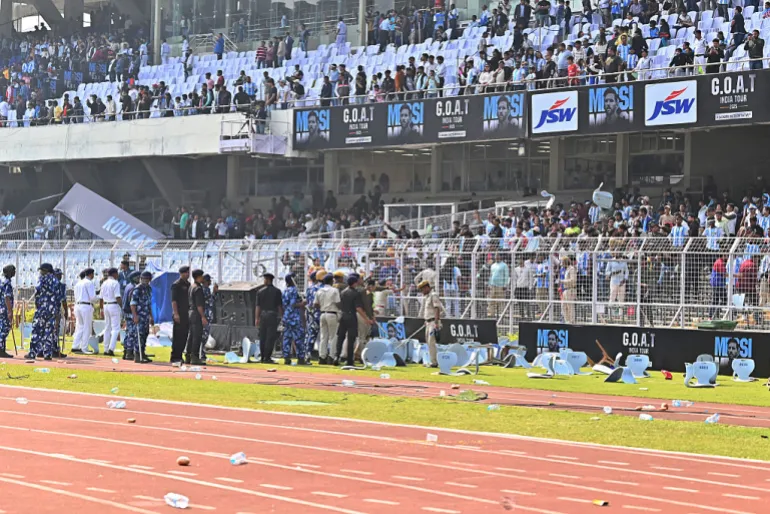
Lionel Messi’s much-hyped tour of India got off to a rocky start on Saturday with angry fans throwing bottles and attempting to vandalise a stadium after many of them failed to get more than just a glimpse of their hero.
The Times of India reported that many ticket holders said that they failed to see Messi at all – either in person or on the stadium’s big screens – despite waiting for hours.
Recommended Stories
list of 4 itemsend of list
West Bengal Chief Minister Mamata Banerjee apologised to the Argentinian football star for the “mismanagement” of the event.
“I am deeply disturbed and shocked by the mismanagement witnessed today at Salt Lake Stadium,” Banerjee wrote on social media, where she also apologised to fans who had expected more after paying for tickets.
Police officials speak to spectators as they throw debris onto the field at Vivekananda Yuva Bharati Krirangan (VYBK) during the Lionel Messi GOAT tour [Ayush Kumar/Getty Images]
Banerjee said a committee would be constituted to “conduct a detailed enquiry into the incident, fix responsibility, and recommend measures to prevent such occurrences in the future”.
Messi’s three-day “GOAT (Greatest of All Time) India Tour” was to bring the World Cup winner from Kolkata to Hyderabad and then Mumbai before concluding in New Delhi on Monday.
He was joined by longtime teammates Luis Suarez and Rodrigo De Paul.
Earlier on Saturday, Messi remotely “unveiled” a 21-metre (70-foot) statue of himself in Kolkata.
A fan hits a sound system with a pole during the Lionel Messi GOAT tour [Ayush Kumar/Getty Images]
Former FIFA President Sepp Blatter once described India as a “sleeping giant” in the football arena, but the sport in the country has run into many problems in recent years.
The Indian Super League (ISL) – India’s top football competition – has been in danger of collapse over a dispute between the federation and its commercial partner.
ISL side Bengaluru FC stopped paying the salaries of its first team’s players and staff as a result of the turmoil.
In a statement in August, the 2018-19 ISL champions said they had taken the decision “in view of the uncertainty surrounding the future of the Indian Super League season”.
A 21-metre statue of international footballer Lionel Messi of Argentina was built in Lake Town for the Lionel Messi GOAT tour [Ayush Kumar/Getty Images]
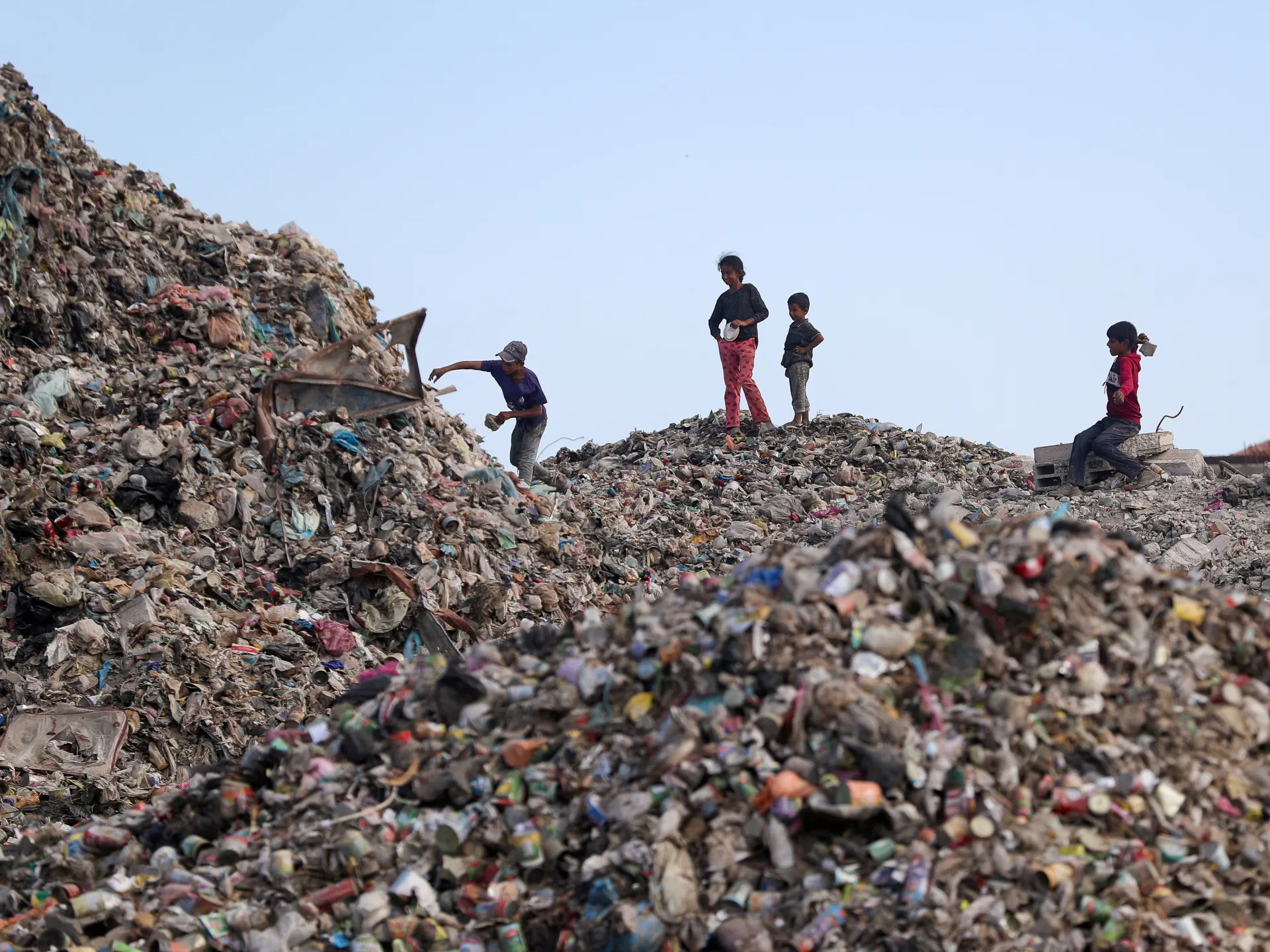
Last month, I was waiting for a shared taxi at the Nuseirat roundabout when I witnessed a heartbreaking scene. As I stood by the side of the road, I felt a small hand tugging at my clothes.
I looked down and saw a little girl, no older than eight. She was barefoot, her shirt was torn, and her hair was messy and unwashed. Her eyes were beautiful, and her face showed innocence, yet exhaustion and despair clouded it.
She pleaded: “Please, please, give me just one shekel, God bless you.”
Before I gave her the money, I decided to speak with her. I knelt down and asked, “What is your name, my dear?”
She replied in a frightened voice, “My name is Nour, and I am from the north.” Her name, which means “light” in Arabic, stood in stark contrast to the darkness surrounding her.
I asked her, “Why are you asking for money, Nour?”
She looked at me hesitantly, then whispered, “I want to buy an apple… I crave one.”
In Gaza, a single apple now costs $7; before the war, a kilogramme of apples was less than a dollar.
I tried to ignore the pain rising in my chest. I thought about the circumstances we now face, where young children are forced to beg in the street just to buy an apple.
I gave Nour one shekel ($0.30), but as soon as I did, the situation worsened. A large group of children, all Nour’s age or younger, gathered around me, repeating the same request. I felt immense distress.
For more than two years, we have faced genocide. We have witnessed countless tragedies and horrors. But for me, the sight of children begging in the streets is particularly unbearable.
Before the war, Gaza was still a poor place. We used to see child beggars, but they were few, mostly roaming in a few areas. Now, they are everywhere, from the north to the south.
The genocidal war has destroyed families and livelihoods across Gaza. The carnage has orphaned more than 39,000 children, and the enormous destruction has deprived more than 80 percent of the workforce of their jobs, driving countless children into extreme poverty and forcing them to beg for survival.
But child begging is not just a result of poverty; it is a sign of a deep disintegration affecting the family, the education system, and the community. No parent sends their child to beg because they want to. The war has left many families in Gaza without options, and in many cases, there are no surviving parents to keep the children away from the streets.
Child beggars do not just lose their childhood; they also face exploitation, harsh labour, illiteracy and psychological trauma that leaves a lasting effect.
The more begging children increase in number, the more the hope for this generation diminishes. Houses can be rebuilt, infrastructure can be restored, but a young generation that is deprived of education and hope for the future cannot be rehabilitated.
The strength Gaza possessed before the war was not just about military power; it was about human power, the main pillar of which was education. We had one of the highest levels of literacy in the world. The enrolment rate for primary education stood at 95 percent; for higher education, it reached 44 percent.
Education stood as a counterforce to the debilitating siege that dispossessed the people of Gaza and crippled the economy. It nourished skills and ingenuity within the young generations to help them cope with an increasingly harsh economic reality. More importantly, education gave children a sense of direction, security and pride.
The systematic attack on Gaza’s education system – the destruction of schools, universities, libraries and the killing of teachers and professors – has pushed what used to be a remarkably resilient and effective educational system to the brink. The pillar that protected children and guaranteed them a clear future is now falling apart.
After I left the Nuseirat roundabout, Nour’s eyes stayed with me. It was not just because of the pain of seeing an innocent child being forced to beg. It was also because of the realisation that this encounter brought about: That the capacity of the next generation to rebuild Gaza one day is being taken away.
The world allowed Israel to carry out genocide in Gaza for two years. It knew what was going on, and yet it chose complicity and silence. Today, it cannot erase its guilt, but it can choose to redeem itself. It can take all necessary action to save the children of Gaza and to grant them the rights they are inherently given by the Convention on the Rights of Children: The right to food, water, healthcare, a safe environment, education, and protection from violence and abuse.
Anything short of that would mean continuing support for the slow genocide of Gaza.
The views expressed in this article are the author’s own and do not necessarily reflect Al Jazeera’s editorial stance.
LADY Gaga was forced to stop her Sydney gig mid-show after one of her dancers fell off the stage.
The Poker Face hitmaker, 39, halted the action during her Mayhem Ball concert following heavy rain at the Accor Stadium.
Sign up for the Showbiz newsletter
Thank you!
Lady Gaga was forced to stop her Australian tour mid-gig at the Mayhem BallCredit: GettyThe American called a halt to proceedings after a dancer fell off stage in SydneyCredit: GettyHer dancer Michael tumbled over mid way through the track, Garden of EdenCredit: XShe was performing at the open-air Accor Stadium, where the stage was soaked with rainCredit: X
The Sydney venue is open-air and, two hours after the show kicked off, the painful mishap brought a temporary stop to proceedings.
Lady Gaga kick-started her 31-song setlist with tracks Bloody Mary and Abracadabra.
She belted out the likes of Judas, Poker Face and Aura before the issue struck mid-way through Garden of Eden.
The track is from her 2025 album Mayhem on which the tour is named.
With a soaking wet floor, the dancers charged to the front of the stage.
One, named Michael Dameski, fell down during the choreography and A Star Is Born actress Gaga was quick to wave her arms and call a stop to the show at around 9pm.
The singer and her dancers then retreated inside during a temporary pause, to try to find more suitable footwear.
They then resumed the show, with further tracks including Rain On Me, How Bad Do You Want Me and Always Remember Us This Way playing out.
FAN PRAISE
Fans were quick to praise Gaga’s actions in what was her last Aussie show of the tour.
One took to X to write: “Sending love and well wishes to Gaga’s dancer, Michael, who fell off stage during Garden Of Eden.
“So grateful that Gaga paused the show to check on him. True professionalism and compassion.”
Another put: “She’s so special the way she ran straight over, climbed down and made sure he was okay.”
Singles Abracadabra and Disease broke into the Top Ten, while herBruno Marscollaboration Die With A Smile became one of the biggest hits of the year worldwide.
Speaking toBizarreas Mayhem was released, a source explained that Gaga has finally found inner peace after years of struggling with her pop star persona and the real person behind it, Stefani Germanotta.
The insider explained: “Gaga has never hidden her real self from the world.
“But she’s more comfortable now in her ability to associate herself as the creator instead of the product.
“The person she wakes up as is the same person who hits the stage.”
The singer’s energetic routines showed that she has fully recovered from a hip injury and fibromyalgia, a condition which caused musculoskeletal pain, extreme fatigue and deep anxiety — and resulted in the cancellation of part of her Joanne world tour in 2018.
The chart star continued her show after the mishap, with tracks including Rain On Me and How Bad Do You Want MeCredit: GettyShe kicked off the Mayhem Ball extravaganza in Las Vegas back in JulyCredit: GettyIt was her final Aussie show of the tourCredit: Alamy
Pope Leo XIV pictured in May addressing Catholic faithful from the Vatican balcony in Vatican City, Vatican. On Friday, the American-born Catholic Church head urged Italy’s intelligence officials to ground national security in ethical principles and cautioned that efforts to preserve peace must not trump human dignity or truth. File Photo by Stefano Spaziani/UPI | License Photo
Dec. 12 (UPI) — Pope Leo XIV urged Italy’s intelligence officials on Friday to ground national security in ethical principles and cautioned that efforts to preserve peace must not trump human dignity or truth.
The U.S.-born pope marked the centenary of Italy’s Security Intelligence System and noted the nation’s first coordinated intelligence service launched in 1925 established the “foundations for building a more effective and coordinated system, aimed at safeguarding the security of the state.”
He added in remarks that, about a century later, tools and capabilities may have advanced dramatically, but responsibilities and moral risks of such intelligence work have grown.
On Friday, Leo told assembled intelligence professionals visiting the Vatican they bear a “serious responsibility” of “constantly monitoring the dangers that may threaten the life of the nation, in order above all to contribute to the protection of peace.”
He praised sometimes ignored efforts to foresee a crisis before it arises but cautioned that discretion risks misuse without ethics.
The pope stressed that professionalism required “respect for the dignity of the human person.”
“Security activity must never lose sight of this foundational dimension and must never fail to respect the dignity and rights of each individual,” he said.
He urged ethical restraint in gathering intelligence and warned that a sense of urgent common good cannot justify ignoring limits on individual rights.
National security, he added, must never arrive at the expense of individual rights, including “private and family life, freedom of conscience and information and the right to a fair trial.”
The Catholic Church leader underscored the need for strong ethical standards in modern day communication, and cautioned in an era run by constant and instant connection that misinformation, manipulation and exploitation of vulnerable people was a growing threat.
He further warned that confidential information must never be deployed to intimidate, manipulate, blackmail or discredit public officials, journalists or other groups.
In addition, Leo urged attendees to pursue their profession with balance and discernment that prioritizes the common good while staying “firmly anchored to those legal and ethical principles that place the dignity of the human person above all else.”
Pope Leo XIV leads a holy mass for the beginning of his pontificate in St Peter’s square in the Vatican on May 18, 2025. Photo by Stefano Spaziani/UPI | License Photo
Australian TV network Seven has accused a member of the England staff of a physical confrontation at Brisbane Airport.
England were travelling from Brisbane to Adelaide on Saturday afternoon before the third Test.
While the team moved through the airport, a member of the England security staff attempted to place himself between a cameraman and the squad.
The back-and-forth continued through the airport and the footage was broadcast by Seven.
Throughout the series Cricket Australia has issued instructions to media that teams will not be available for interview in transit through airports and all images should be captured from a respectful distance.
In the Seven report, journalist Tom Wilson said cameraman Nick Carrigan was “well within his rights to be filming” and “respects the unwritten rules of not getting too close”.
A spokesperson from Seven said: “There was an incident at Brisbane Airport involving a 7NEWS camera operator and a member of the England cricket team’s travelling party.
“While conducting routine filming in a public space, the camera operator was physically confronted despite acting respectfully and professionally.
“The safety and wellbeing of our staff is paramount. This matter is being taken seriously and is now being managed through the appropriate channels.”
England have not commented, but it is understood Seven has raised the incident with the touring team.
Cricket Australia has also declined to comment.
The episode comes as England ended their break in Noosa and prepare to return to training on Sunday before the crucial third Test.
England, 2-0 down after defeats in the opening two Tests, must win at the Adelaide Oval to keep their hopes of regaining the Ashes alive.
The sale of Warner Bros. — whether in pieces to Netflix or in its entirety to Paramount — is stirring mounting worries among Hollywood union leaders about the possible fallout for their members.
Unions representing writers, directors, actors and crew workers have voiced growing concerns that further consolidation in the media industry will reduce competition, potentially causing studios to pay less for content, and make it more difficult for people to find work.
“We’ve seen this movie before, and we know how it ends,” said Michele Mulroney, president of the Writers Guild of America West. “There are lots of promises made that one plus one is going to equal three. But it’s very hard to envision how two behemoths, for example, Warner Bros. and Netflix … can keep up the level of output they currently have.”
Last week, Netflix announced it agreed to buy Warner Bros. Discovery’s film and TV studio, Burbank lot, HBO and HBO Max for $27.75 a share, or $72 billion. It also agreed to take on more than $10 billion of Warner Bros.’ debt. But Paramount, whose previous offers were rebuffed by Warner Bros., has appealed directly to shareholders with an alternative bid to buy all of the company for about $78 billion.
Paramount said it will have more than $6 billion in cuts over three years, while also saying the combined companies will release at least 30 movies a year. Netflix said it expects its deal will have $2 billion to $3 billion in cost cuts.
Those cuts are expected to trigger thousands of layoffs across Hollywood, which has already been squeezed by the flight of production overseas and a contraction in the once booming TV business.
Mulroney said that employment for WGA writers in episodic television is down as much as 40% when comparing the 2023-2024 writing season to 2022-2023.
Executives from both companies have said their deals would benefit creative talent and consumers.
But Hollywood union leaders are skeptical.
“We can hear the generalizations all day long, but it doesn’t really mean anything unless it’s on paper, and we just don’t know if these companies are even prepared to make promises in writing,” said Lindsay Dougherty, Teamsters at-large vice president and principal officer for Local 399, which represents drivers, location managers and casting directors.
Dougherty said the Teamsters have been engaged with both Netflix and Paramount, seeking commitments to keep filming in Los Angeles.
“We have a lot of members that are struggling to find work, or haven’t really worked in the last year or so,” Dougherty said.
Mulroney said her union has concerns about both bids, either by Netflix or Paramount.
“We don’t think the merger is inevitable,” Mulroney said. “We think there’s an opportunity to push back here.”
If Netflix were to buy Warner Bros.’ TV and film businesses, Mulroney said that could further undermine the theatrical business.
“It’s hard to imagine them fully embracing theatrical exhibition,” Mulroney said. “The exhibition business has been struggling to get back on its feet ever since the pandemic, so a move like this could really be existential.”
But the Writers Guild also has issues with Paramount’s bid, Mulroney said, noting that it would put Paramount-owned CBS News and CNN under the same parent company.
“We have censorship concerns,” Mulroney said. “We saw issues around [Stephen] Colbert and [Jimmy] Kimmel. We’re concerned about what the news would look like under single ownership here.”
That question was made more salient this week after President Trump, who has for years harshly criticized CNN’s hosts and news coverage, said he believes CNN should be sold.
The worries come as some unions’ major studio contracts, including the DGA, WGA and performers guild SAG-AFTRA, are set to expire next year. Two years ago, writers and actors went on a prolonged strike to push for more AI protections and better wages and benefits.
The Directors Guild of America and performers union SAG-AFTRA have voiced similar objections to the pending media consolidation.
“A deal that is in the interest of SAG-AFTRA members and all other workers in the entertainment industry must result in more creation and more production, not less,” the union said.
SAG-AFTRA National Executive Director Duncan Crabtree-Ireland said the union has been in discussions with both Paramount and Netflix.
“It is as yet unclear what path forward is going to best protect the legacy that Warner Brothers presents, and that’s something that we’re very actively investigating right now,” he said.
It’s not clear, however, how much influence the unions will have in the outcome.
“They just don’t have a seat at the ultimate decision making table,” said David Smith, a professor of economics at the Pepperdine Graziadio Business School. “I expect their primary involvement could be through creating more awareness of potential challenges with a merger and potentially more regulatory scrutiny … I think that’s what they’re attempting to do.”
A cautious calm has settled over the eastern Democratic Republic of the Congo (DRC) city of Uvira in South Kivu province, as residents begin emerging from their homes following its capture by M23 rebels.
The capture earlier this week threatens to derail a United States-brokered peace agreement, signed with much fanfare and overseen by President Donald Trump a week ago, between Congolese and Rwandan leaders, with Washington accusing Rwanda on Friday of igniting the offensive.
Recommended Stories
list of 2 itemsend of list
Regional authorities say at least 400 civilians, including women and children, have been killed in the violence between the cities of Bukavu and Uvira, both now under M23 control.
Al Jazeera is the only international broadcaster in Uvira, where correspondent Alain Uaykani on Saturday described an uneasy calm in the port city on the northern tip of Lake Tanganyika, which sits directly across from Burundi’s largest city, Bujumbura.
Uaykani said government and allied militias, known as “Wazalendo”, which had been using the city as a headquarters, began fleeing even before M23 fighters entered.
Residents who fled as the Rwanda-backed group advanced have begun returning to their homes, though most shops and businesses remain shuttered.
“People are coming out, they feel the fear is behind them,” Uaykani said, though he noted the situation remains fragile with signs of intense combat visible throughout the city.
Bienvenue Mwatumabire, a resident of Uvira, told Al Jazeera he was at work when fighting between rebels and government forces broke out, and he heard gunshots from a neighbouring village and decided to stop, but said that “today we have noticed things are getting back to normal.”
Baoleze Beinfait, another Uvira resident, said people in the city were not being harassed by the rebels, but added, “We will see how things are in the coming days.”
M23’s spokesperson defended the offensive, claiming the group had “liberated” Uvira from what he called “terrorist forces”. The rebels say they are protecting ethnic Tutsi communities in eastern DRC, a region that has seen fighting intensify since earlier this year.
The offensive, which began on December 2, has displaced more than 200,000 people across South Kivu province, according to local United Nations partners.
Rwanda accused of backing rebels
South Kivu officials said Rwandan special forces and foreign mercenaries were operating in Uvira “in clear violation” of both the recent Washington accords and earlier ceasefire agreements reached in Doha, Qatar.
At the UN Security Council on Friday, US ambassador Mike Waltz accused Rwanda of leading the region “towards increased instability and war,” warning that Washington would hold spoilers to peace accountable.
Waltz said Rwanda has maintained strategic control of M23 since the group re-emerged in 2021, with between 5,000 and 7,000 Rwandan troops fighting alongside the rebels in Congo as of early December.
“Kigali has been intimately involved in planning and executing the war in eastern DRC,” Waltz told the UNSC, referring to Rwanda’s capital.
Rwanda’s UN ambassador denied the allegations, accusing the DRC of violating the ceasefire. Rwanda acknowledges having troops in eastern DRC but says they are there to safeguard its security, particularly against Hutu militia groups that fled across the border to Congo after Rwanda’s 1994 genocide.
The fall of Uvira has raised the alarm in neighbouring Burundi, which has deployed forces to the region. Burundi’s UN ambassador warned that “restraint has its limits,” saying continued attacks would make it difficult to avoid direct confrontation between the two countries.
More than 30,000 refugees have fled into Burundi in recent days.
The DRC’s foreign minister urged the UNSC to hold Rwanda accountable, saying “impunity has gone on for far too long”.
A report by the American Enterprise Institute’s Critical Threats project said Rwanda provided significant support to M23’s Uvira offensive, calling it the group’s most consequential operation since March.
Al Jazeera’s UN correspondent Kristen Saloomey said UNSC members were briefed by experts who noted that civilians in DRC are not benefitting from the recent agreements negotiated between Kinshasa and Kigali.
More than 100 armed groups are fighting for control of mineral-rich eastern DRC near the Rwandan border. The conflict has created one of the world’s largest humanitarian crises, with more than seven million people displaced across the region.
The M23 group is not party to the Washington-mediated negotiations between DRC and Rwanda, participating instead in separate talks with the Congolese government hosted by Qatar.
Weekly insights and analysis on the latest developments in military technology, strategy, and foreign policy.
The U.S. Navy says it is aiming to have the first of a new class of frigates based on an existing American design “in the water” by 2028. The U.S. Coast Guard’s Legend class National Security Cutter is reportedly the basis for the design in question. This all follows a decision to cancel the Constellation class frigate, a program marred by major delays and cost growth, which has now further exposed a highly concerning gap in the service’s future force structure plans. Constellation, meant to right the wrongs of the disastrous Littoral Combat Ship (LCS) program by buying a largely off-the-shelf frigate, had turned into a boondoggle of its own.
Navy Secretary John Phelan had announced the cancellation of Constellation just over two weeks ago. The Navy had awarded the first contract for a fleet of at least 10 of those warships in 2020. The service picked a design based on the existing Franco-Italian FREMM frigate, with the expectation that only relatively minor changes would be needed, and that this would help keep the program on track. However, over the past five years, the Constellation design morphed into almost a completely different vessel with only 15 percent commonality with its ‘parent.’ As of April, construction of the future USS Constellation was only around 10 percent complete, and the delivery timeline had slipped to 2029.
Navy Secretary John Phelan seen here speaking at a Marine Corps 250th anniversary event in October 2025. DoW
“We believe the future frigate can be in the water in 2028,” Jason Potter, the official currently performing the duties of the Assistant Secretary of the Navy for Research, Development, and Acquisition, told attendees at the U.S. Naval Institute’s annual Defense Forum Washington on Wednesday, according to Breaking Defense.
“We will be building a frigate. It will be based on an American design,” Phelan had said last weekend at the Reagan National Defense Forum, according to Defense One. “It is something we can build that we think, actually, will be done before the old Constellation.”
Phelan also said the follow-on frigate effort was part of a larger naval force structure and shipbuilding plan the Navy has been crafting under the current Trump administration, referred to as the “Golden Fleet.”
In addition, Breaking Defensereported that Phelan recently told individuals at a private dinner that the Legend class National Security Cutter, developed by U.S. shipbuilder Huntington Ingalls Industries (HII), would be the basis of the new frigate, citing two unnamed sources. That outlet said the Navy and HII declined to confirm or deny any connection between the National Security Cutter design and the post-Constellation frigate plans.
The Coast Guard’s Legend class cutter USCGC Hamilton. USCG
TWZ has also reached out for more information. In response to our queries, HII declined to speak to the Navy’s current frigate plans.
Starting with the National Security Cutter, 10 of which were built for the Coast Guard between 2005 and 2024, would not necessarily be a surprising choice. HII notably entered a variation of its Patrol Frigate concept, derived from the National Security Cutter, into the Navy’s FFG(X) competition that led to the Constellation class, something we will come back to later on.
A US Navy MH-60R Seahawk helicopter seen embarked on the Coast Guard’s Legend class cutter USCGC Midgett for an exercise in 2022. USCG
At the same time, the National Security Cutter design would have been modified significantly to meet Navy mission requirements for a frigate. The primary armament of each one of the Coast Guard’s Legend class cutters consists of a single 57mm gun in a turret on the bow. They also have a Phalanx Close-In Weapon System (CIWS) with a 20mm Vulcan cannon, and mounts for crew-operated machine guns at various points around the ship. The possibility of arming them with Harpoon anti-ship cruise missiles has come up in the past, but there has been no actual movement to integrate that capability.
In comparison, the Constellation class frigate design, with a displacement approaching 7,300 tons (at least per the original target), included a 32-cell Vertical Launch System (VLS) intended to fire SM-2 Block IIICs and Evolved Sea Sparrow Missiles (ESSM). These are both surface-to-air missiles. Some of those VLS cells were also expected to be loaded with a vertically-launched anti-submarine warfare weapon, likely a member of the RUM-139 Vertical Launch Anti-Submarine Rocket (VL-ARSOC) family or a follow-on design. All variants of the VL-ARSOC carry lightweight anti-submarine torpedoes as their payloads. There had been talk of integrating SM-6 multi-purpose missiles and Tomahawk land attack cruise missiles onto Constellation in the future.
There had been much discussion in the past about whether even the 32-cell VLS was sufficient for the Constellation‘s expected combination of anti-air, anti-surface warfare, and anti-submarine mission profiles, as you can read more about in detail in this past TWZ feature.
A rendering of a Constellation class frigate. The design’s 32-cell VLS array is seen right in front of the main superstructure. USN
Beyond the VLS, each Constellation class frigate was set to be armed with launchers for 16 RGM-184 Naval Strike Missile (NSM) cruise missiles (which have anti-ship and land-attack capabilities), a single launcher loaded with RIM-116 Rolling Airframe Missiles (RAM) for close-in defense, a 57mm main gun, and mounts for multiple crew-operated machine guns.
Navy requirements for sensors and other systems missions, as well as other design features, would also differ from what the Coast Guard has laid out for the Legend class, which would require significant changes to the existing design. As one example, the Constellation class frigates were expected to feature a version of the Aegis Combat System, a key capability not found on the Coast Guard’s cutters.
There is also the matter of the Navy’s distinct shipbuilding and survivability standards for surface warships. Power generation, cooling, and even tweaks to propulsion could be needed.
It is important to remember, as mentioned, that a central factor in the collapse of the Constellation class program was the excessive changes between that design and the Franco-Italian FREMM (which stands for Fregata Europea Multi-Missione, meaning European Multi-Mission Frigate in English), from which it was derived. The Navy had expressly intended to reduce risks for that program by starting with a proven, in-production warship.
An infographic from circa 2021 with details about how significantly the Constellation class design differed from its ‘parent’ design, the Franco-Italian Fregata Europea Multi-Missione (FREMM). USN via CRS
As mentioned, HII has already done significant design work on the Patrol Frigate concept over the past decade or so. HII has put forward multiple variations of that design, including ones with 12 and 16-cell VLS arrays, as well as various other weapons and mission systems beyond what are found on the Legend class configuration.
Patrol Frigate Variants – Information Video
“Regarding the original frigate competition, we did bid a variation of the NSC [National Security Cutter] that was lethal, low risk, and affordable,” an HII spokesperson had told Breaking Defense when asked about Phelan’s reported comments. “We look forward to partnering with the Navy on designs for the ships they need.”
There is also a question of whether the Navy might be able to more directly leverage the Coast Guard’s National Security Cutter program in its new frigate plans. In June of this year, HII confirmed to USNI News that it had stopped work on what was expected to be the 11th member of the Legend class, set to be named the USCGC Friedman, following the settlement of a contract dispute with the Coast Guard. How far along work on that ship was at the time, and whether it would be feasible to complete it in a new Navy-specific configuration, is unclear. Fabrication of the future Friedmanhad started in 2021. In addition, Congress previously approved funding for the Coast Guard to purchase long lead time materials in relation to an option to buy a 12th Legend class cutter, which has never been executed.
A picture HII release in 2021 showing workers cutting steel for the future USCGC Friedman. HII
The National Security Cutter’s career with the Coast Guard to date has not been entirely smooth sailing, either. The service has been open about the challenges it has been facing in operating and sustaining its Legend class ships.
“When a National Security Cutter pulls into port, we do a controlled parts exchange, which is a fancy term for cannibalizing our readiness,” Acting Coast Guard Commandant Adm. Kevin Lunday had said at the Navy League’s annual Sea Air Space conference earlier this year. “You can only cannibalize your readiness and eat your own readiness for so long in that downward death spiral, and that’s where we’re at.”
Lunday made clear that this was reflective of broader readiness issues facing his service, compounded by budgetary challenges. The Navy fielding a fleet of National Security Cutter-derived frigates might help here by spreading cost burdens differently across a shared supply chain. The Navy already has a history of cooperating with the Coast Guard on major shipbuilding efforts.
Though the Navy’s plan to use the National Security Cutter as a starting place for a new frigate does remain unconfirmed, it’s unclear what other options there might even be for a new warship in this category that is “based on an American design.” The U.S. subsidiary of Australian shipbuilder Austal and Lockheed Martin did compete for FFG(X) with expanded versions of their respective Independence and Freedom class Littoral Combat Ships (LCS). Lockheed Martin dropped out of the running early, reportedly because it could not rework the Freedom design enough to meet the Navy’s requirements. Austal USA had continued on, but the Navy passed on its offer, as well. Variations of the Freedom class LCS are still being built, including four Multi-Mission Surface Combatant (MMSC) derivatives for Saudi Arabia. The last Independence class LCS was delivered to the Navy earlier this year.
A Navy briefing slide highlighting the FFG(X) competitors. In addition to the FREMM, Independence class, Freedom class, and Patrol Frigate-based designs, General Dynamics’ Bath Iron Works (BIW) had submitted an offer in partnership with Spanish shipbuilder Navantia. USN
It should also be noted that there are several modern frigate designs available on the open market elsewhere in the world. Japan’s futuristic Mogami class stands out particularly in this regard, with examples of an expanded version with a larger 32-cell VLS array now being built and a historic export deal for additional hulls for Australia secured earlier this year. This means two U.S. allies in the Pacific are now set to have fleets of these ships, which could offer operational and sustainment benefits, especially in the context of a major conflict or other contingency that both nations might find themselves involved in. Finding ways to maximize that kind of commonality would also be advantageous for the U.S. Navy when selecting a new frigate.
A rendering of a Type 26 frigate. BAE SystemsThe South Korean Batch II Daegu class frigate ROKS Chuncheon. South Korean Defense Acquisition Program AdministrationThe first F110 frigate for the Spanish Navy seen being launched earlier this year. Navantia
A version of the Type 26 now in development for Canada, called the River class, as well as the F110, both notably feature the Aegis Combat system, as well as versions of Lockheed Martin’s still very new AN/SPY-7 radar. It’s also worth pointing out that the Canadian armed forces also refer to the future River class warships as destroyers rather than frigates, reflecting a particular view of their expected capabilities and mission sets. In the context of the U.S. Navy’s new frigate plans, being able to leverage an existing design that already has key desired systems baked in, at least in certain subvariants, could be highly beneficial. Integrating Aegis, and the radar arrays that go along with it, in particular, is a major design driver for any warship, and having to modify an existing type to incorporate those features would come along with costs and complexities.
This all can only prompt questions about whether the Navy may be hamstringing itself now by centering its new frigate plans on an existing American design. The U.S. shipbuilding sector, overall, faces significant challenges at present, especially around workforce retention, after decades of contracting in size. This contributed to delays with Constellation, and continues to impact other Navy shipbuilding programs. These issues have become increasingly concerning from a broad national security perspective, especially given the huge gap now that exists in shipbuilding capacity compared to that of China, and the U.S. government has been trying to take steps to reverse the worrisome trends. The prospect of leveraging foreign yards to help build future Navy warships, as well as sustain existing fleets, has been raised. American authorities have also been courting foreign investment in the shipbuilding industry in the United States. A U.S.-South Korean trade agreement announced in November notably included a pledge by the latter country to pump $150 billion into America’s shipbuilding sector.
Given what happened with the Constellation class, any future Navy frigate program is likely to face significant scrutiny, including from Congress, in general, and be seen as a major test of the service’s ability to avoid past pitfalls. Since he was confirmed to the post in March, Navy Secretary Phelan has been consistently pledging to shake up how the service buys ships and submarines, especially when it comes to accelerating delivery timelines and cutting costs.
From day one I made it clear: I won’t spend a dollar if it doesn’t strengthen readiness or our ability to win.
To keep that promise, we’re reshaping how we build and field the Fleet—working with industry to deliver warfighting advantage, beginning with a strategic shift away… pic.twitter.com/pbTpIPDfR8
“The requirements are going to be put in and done before we start building the first one,” Phelan also said about the new frigate plans at the Reagan National Defense Forum this past weekend, according to The Washington Times. “When we start building the first one, any change order will have to be put through me.”
“The Constellation class frigate was canceled because, candidly, it didn’t make sense anymore to build it,” Phelan also said. “It was 80 percent of the cost of a destroyer and 60 percent of the capability. You might as well build destroyers.”
Locking in the design of any future class of frigates for the Navy, and doing so relatively quickly, will be absolutely key to avoiding what happened with Constellation. This, in turn, will require the service to accept the fact that frigates are not destroyers, and the tradeoffs and risks that come with that, especially when it comes to potentially employing the ships more independently in a higher threat environment.
Plenty of good frigate designs to put directly into production with MINOR subsystem tweaks to meet U.S. Navy’s basic needs. Rapid design lock prior to construction.
They could have spiraled in new capabilities and done an expanded variant down the line. They just couldn’t keep their hands out of the cookie jar. Even after LCS and DDG-1000 disasters, they couldn’t help themselves and went totally against the programs core objective.
How the Navy proceeds in its push now to right the wrongs of the Constellation class program, and have the first example of a still sorely needed class of new frigates launched by 2028, will be an area of keen interest going forward.
Scott was the first person eliminated from the jungle and immediately headed back to the UK. The former Arsenal star reunited with popstar beau Jess Glynne under difficult circumstances, after her mum suffered a major stroke and needed brain surgery.
Sharing on social media after fans noticed her missing from the famous bridge walk, Glynne said: “Over the last few weeks, my mum suffered a major stroke and needed urgent brain surgery. It’s been a really life-altering time for my family, and I’ve had to stay close to home.
“Alex would always want me to be where I’m needed most. I can’t wait to have her back by my side.”
Scott was initially grateful for the I’m a Celeb experience, as she said: “It’s been such an incredible experience. I didn’t think that… mentally it is so tough, and I did struggle at times, missing home and everything.
“But I’m so glad I got to do this series with such a great bunch of campmates. We really connected, and I never expected that coming into the jungle, to make the bonds that we all did.”
However, she is yet to reunite with any of her campmates after the show and also called out the broadcaster for not showing her true self. During an appearance on Lorraine, Scott said: “It’s me actually being out and learning what’s been aired and what’s been shown.
“I had so much fun, and that bit wasn’t shown. I had so much fun. I was called the Games Master in there, the stuff that I was doing with everyone.
“It’s only an hour show so only so much can go into the edit but when I reflect, I wish more of the fun stuff, people had seen that side of me. I wanted them to see the more fun Alex Scott that they didn’t see.”
She added: “Ginge and Aitch have had all the airtime and everyone has seen them, but my special bond with Shona, I don’t think the public have seen the real journey she’s been, she’s spoken so much about her anxiety and her fun side but I don’t think anyone has seen it.”
After missing the final episode and wrap party, Scott is likely not to appear on Saturday’s reunion show. Speaking to the Daily Mail, she added: “It’s been a hard couple of months, but Jess was like I want you to go on the show and do it for my mum.
“It’s been tough because I want to be here for the wrap party and I have to get home straight away. She’s my Jessica, and I’m going home to be her rock. My campmates knew what I was going through and I just want to thank everyone at ITV and my camp mates because they’ve all shown me so much support.”
The I’m a Celebrity Coming Out show will air on ITV1 and ITVX on Saturday, December 13 at 9:05pm.
On Dec. 3, the group released a cache of images from Epstein’s private island in the U.S. Virgin Islands, Little St. James.
Rep. Robert Garcia, D-Calif., said in a statement that the latest release from the estate included “over 95,000 photos, including images of the wealthy and powerful men who spent time with Jeffrey Epstein” and “thousands of photographs of women and Epstein properties.”
“It is time to end this White House cover-up and bring justice to the survivors of Jeffrey Epstein and his powerful friends,” Garcia said in a statement. “These disturbing photos raise even more questions about Epstein and his relationships with some of the most powerful men in the world. We will not rest until the American people get the truth. The Department of Justice must release all the files, NOW.”
The committee spokesperson accused Democrats of “cherry-picking photos and making targeted redactions to create a false narrative about President Trump.”
“We received over 95,000 photos and Democrats released just a handful. Democrats’ hoax against President Trump has been completely debunked. Nothing in the documents we’ve received shows any wrongdoing. It is shameful Rep. Garcia and Democrats continue to put politics above justice for the survivors,” the spokesperson said.
Gates has previously told CNN’s Anderson Cooper that “It was a huge mistake to spend time with [Epstein], to give him the credibility of being there.”
Speaker of the House Mike Johnson, R-La., departs a closed-door meeting with Republican leadership about health care negotiations at the US Capitol on Friday. Johnson and House Republicans hope to hold a vote next week on their own health care program. Photo by Jim Lo Scalzo/UPI | License Photo
I recall how, when I was still teaching EU law at ULB, I used to point to Article 122 TFEU with a certain pride bordering on mischief. “Students,” I would say, “we always complain that the treaties leave us powerless in a crisis—but look, quietly hidden in plain sight, there is this little Swiss-army-knife provision that lets the Council act fast, by qualified majority, in a spirit of solidarity, when severe economic difficulties arise.” I presented it as one of the smartest pieces of constitutional engineering in the entire treaty. Today, I am no longer so proud.
The European Commission is now invoking that very Article 122(1) TFEU in December 2025 to make the immobilization of €210 billion of Russian central bank assets permanent and to transform them into collateral for massive loans to Ukraine. Yet Article 122 is an economic-policy tool—not a foreign-policy or sanctions instrument. Freezing a third country’s sovereign reserves is, by definition, a restrictive measure governed by Article 215 TFEU, which requires unanimity under the CFSP.
The objective behind this legal switch is transparent: to bypass the vetoes of Hungary and possibly Slovakia. But this is a textbook evasion of the unanimity rule, the very type of maneuver the Court of Justice has repeatedly condemned—most famously in its 2012 ruling on sanctions against Zimbabwe.
Nor are the textual prerequisites of Article 122(1) even remotely satisfied. Its triggers—“severe difficulties in the supply of certain products, notably energy” or threats to the balance of payments—simply do not correspond to political inconvenience in renewing sanctions. And the Court has never equated a geopolitical stalemate with an “economic emergency.”
The Commission’s approach also stretches the Union’s powers far beyond their constitutional limits. The EU does not possess a general emergency competence and has no authority to adopt quasi-confiscatory measures against the central bank of a third state. Under customary international law, central-bank assets enjoy near-absolute immunity; using them as loan collateral without judicial process or a peace treaty amounts, in many experts’ view, to unlawful expropriation.
Such a precedent would be economically reckless. The ECB has repeatedly warned—if mostly behind closed doors—of the catastrophic effects this could have on the euro’s status as a reserve currency. The “without prejudice” clause in Article 122 does not grant it supremacy over more specific legal bases that deliberately require unanimity.
And even if one were to ignore these structural limits, the litigation risk is enormous. Should the Court annul the regulation—a highly probable outcome once Belgium files—the assets will need to be released, the loans will become illegal, and both the Union and Euroclear could face joint liability in the hundreds of billions.
For all these reasons, the overwhelming majority of independent EU and international-law scholars view the attempt to rely on Article 122(1) as legally indefensible. The political majority may still force the measure through in December 2025, but litigation is inevitable. When the action for annulment reaches Luxembourg, the court is likely to strike it down within one or two years. And in the process, my once-beloved Article 122—the provision I used to celebrate as a masterpiece of flexible, solidarity-driven drafting—may emerge severely damaged, perhaps permanently.
I never thought I would live to see the day when this provision would be twisted into what the Belgian Prime Minister has openly called “theft.” One further doctrinal point makes the misuse even clearer: Article 122(1) defines its object and purpose with remarkable precision. It authorizes Council action “in a spirit of solidarity between Member States” when Member States face severe economic difficulties. This solidarity clause is not decorative; the Court has repeatedly affirmed its binding nature.
A systemic reading reinforces this conclusion. Article 122(1) cannot be used to grant financial assistance—a power explicitly reserved for Article 122(2), which functions as a lex specialis. Measures under paragraph 1 therefore cannot include loans or any other form of financial aid, let alone the conversion of a third country’s frozen sovereign assets into collateral for a €100–200 billion lending operation to another third country. The Commission’s proposal is not merely constitutionally illegitimate for hijacking a CFSP sanction; it is textually impossible.
Recent developments only underscore the trend toward abusing Article 122 as a general crisis-financing mechanism. On 19 March 2025, the Commission proposed a Council regulation establishing the “SAFE instrument” (Security Action for Europe) to rapidly expand Europe’s arms industry. Although the proposal generically cites “Article 122 TFEU,” it is clear from its substance—providing financial assistance to Member States to support urgent, large-scale defense investments—that it relies on Article 122(2).
The SAFE regulation would mobilize €150 billion from the EU budget in the form of subsidies and subsidized loans for national defense projects. Since Member States may receive financial aid from the Union budget on account of severe difficulties only under Article 122(2), the proposal cannot be grounded in Article 122(1). Its explanatory memorandum invokes the “exceptional security context” and the need for “massive investments” in defense manufacturing—but these are political arguments, not legal ones.
Taken together, the Russian-assets plan and the SAFE proposal amount to a systematic attempt to transform Article 122 into a universal crisis and security financing clause—a purpose it was never designed to fulfill.
The European Parliament, while strongly supportive of assisting Ukraine, has raised alarm over this distortion of a 1957 economic-emergency provision, adopted in secret, by a qualified majority, without parliamentary scrutiny. When the case reaches Luxembourg, the Parliament will argue—rightly—that the Emperor has no clothes. And on current jurisprudence, the Court is likely to agree.
Article 122 allows the Council to legislate alone. That was grudgingly tolerated for €3 billion of extraordinary own resources during COVID. For €210 billion of another state’s sovereign assets in peacetime, it is constitutionally explosive.
The real motive remains the neutralization of Hungary’s veto in the CFSP. But the Court has annulled every previous attempt to launder a CFSP measure through a non-CFSP legal basis (see Case C-130/10). And while the war undeniably harms Europe’s economy, the Court has never accepted “we need to bypass a veto” as equivalent to an energy-supply crisis or a balance-of-payments emergency.
If the General Court or the ECJ strikes down the €150 billion defense fund for exceeding the scope of Article 122, then the Russian assets regulation—which is even further removed from classic economic policy grounds—has virtually no chance of surviving judicial review.
Greene built a reputation in the 1990s as one of Hollywood’s most memorable screen villains.
He played Zed, the sadistic security guard in Quentin Tarantino’s 1994 hit Pulp Fiction, and ruthless mobster Dorian Tyrell opposite Jim Carrey and Cameron Diaz in The Mask the same year.
Edwards said: “Nobody played a bad guy better than Peter.
“But he also had, you know, a gentle side that most people never saw, and a heart as big as gold.”
With nearly 95 screen credits, Greene appeared in The Usual Suspects, Training Day, Blue Streak, and Laws of Gravity.
He also starred in Clean, Shaven – a 1993 indie film that earned critical acclaim for his portrayal of a man with schizophrenia.
A New York Times review said his performance turned the role “into a compellingly anguished, volatile character.”
Edwards revealed Greene was preparing to begin production in January on an independent thriller titled Mascots alongside Mickey Rourke.
After notifying the film’s writer-director Kerry Mondragón of the death, Edwards said “they were very upset.”
While Greene had a reputation for being difficult on set, his manager said it stemmed from high standards.
The actor was known for his role in The Mask, 1994Credit: AlamyGreene also starred in Clean, Shaven – a 1993 indie film where he portrays a man with schizophreniaCredit: Alamy
He was “a perfectionist who gave every job his all and wanted his performance to be just ‘right’,” according to Edwards.
“He worked with so many amazing actors and directors,” the manager said, adding that his role in The Mask was “arguably his best role.”
Peter Greene was born on October 8, 1965, in Montclair, New Jersey.
At 15, Greene ran away from home and lived on the streets of New York City, where he struggled with drug addiction.
Greene is survived by a sister and a brother.
This is breaking news. More to follow…please refresh for more updates and followthe-sun.comfor the biggest stories of the day…
Greene pictured in The Rich Man’s Wife, with Halle BerryCredit: Alamy
VR headsets are offering injured, traumatised Palestinian children some respite from hardship in war-torn Gaza.
Published On 13 Dec 202513 Dec 2025
Share
Inside a makeshift tent in the heart of the besieged Gaza Strip, Israel’s genocidal war, which has destroyed neighbourhoods, schools and hospitals, decimated families and shattered lives for more than two years, no longer exists.
Virtual reality technology is taking Palestinian children struggling with physical and psychological wounds to a world away, where they can feel safe again.
Recommended Stories
list of 3 itemsend of list
“After I was injured in the head, I try to forget the pain,” Salah Abu Rukba, a Palestinian child taking part in the sessions, told Al Jazeera at the VR Tent in az-Zawayda, central Gaza.
“When I put on the headset, I forget the injury. I feel comfort as I forget the destruction, the war, and even the sound of the drones disappears.”
Salah Abu Rukba sustained an injury to his head during Israel’s genocidal war on Gaza [Screen grab/ Al Jazeera]
Lama Abu Dalal, communication officer at Gaza MedTech – the technology initiative spearheading the project – said Abu Rukba and the others have constant reminders of the war etched in their bodies.
But the VR headset makes them forget their life-changing wounds and simply be children again, if only for a few moments.
Gaza MedTech was launched by Palestinian innovator Mosab Ali, who used VR to comfort his injured son. Ali was later killed in an Israeli attack.
Studies have confirmed that VR can have beneficial effects in the treatment of mental disorders, including post-traumatic stress disorder (PTSD). Offering this service in Gaza is hard to sustain, as spare parts of the equipment are barred from entry into Gaza by Israel’s ongoing punishing blockade.
Gaza MedTech was launched by Palestinian innovator Mosab Ali, who used VR to comfort his injured son [Screen grab/Al Jazeera]
Since a ceasefire formally went into effect on October 10, Israel has allowed slightly more aid in, although far less than Gaza’s needs and what the agreement clearly stipulated. Israel continues to restrict the free flow of humanitarian aid and medical supplies.
Authorities in Gaza say the truce has been violated by Israel at least 738 times since taking effect.
The United Nations estimates that more than 90 percent of children in Gaza are showing signs of severe stress driven by the loss of safety and stability, and will require long-term support to heal from the psychological effect of the conflict.
Multiple UN bodies, including the World Health Organization (WHO), the UN humanitarian office OCHA, and independent UN experts, have called for immediate and unimpeded access to Gaza for essential medical equipment and psychological support.
ELN conducts military drills, orders civilians indoors, as Trump warns drug-producing nations face potential attack.
Colombia’s largest remaining rebel force has told civilians living under its authority to stay at home for three days while it stages military drills in response to burgeoning United States threats.
The National Liberation Army (ELN), a left-wing rebel group, ordered the lockdown on Friday, instructing residents to keep off major routes and rivers from Sunday morning as fighters conduct what the group describes as preparations to defend the country against “imperialist intervention”.
Recommended Stories
list of 3 itemsend of list
The announcement follows warnings from President Donald Trump that nations manufacturing and exporting cocaine to the US could face military strikes or even land attacks.
“It is necessary for civilians not to mix with fighters to avoid accidents,” the ELN said.
Colombia’s Defence Minister Pedro Sanchez rejected the rebel directive as “nothing more than criminal coercion”, pledging that government troops would maintain presence “in every mountain, every jungle, every river”.
The move underscores a deepening confrontation between Washington and Bogota as Trump escalates rhetoric against Colombian President Gustavo Petro.
Earlier this week, Trump told business executives that Petro had “better wise up, or he’ll be next”, citing cocaine production as justification for potential action, and alluding to the US military build-up near Venezuela amid threats to remove its President Nicolas Maduro.
In recent days, the Trump administration has imposed new sanctions on Venezuela, targeting three nephews of President Nicolas Maduro’s wife, Cilia Flores, as well as six crude oil tankers and shipping companies linked to them, as Washington steps up pressure on Caracas, following the US seizure of a Venezuelan oil tanker.
Petro has responded to Trump’s actions, including sanctioning the Colombian president, with equal defiance, warning Trump earlier this month against “waking the jaguar” and insisting any assault on Colombian territory would amount to a declaration of war.
The left-wing president has invited his US counterpart to witness laboratory demolitions firsthand, claiming his administration destroys drug facilities every 40 minutes. In late November, the government hailed what it said was its largest cocaine bust in a decade.
The rebel group, ELN, which fields roughly 5,800 fighters, maintains control over significant drug-producing areas, including the Catatumbo region along the Venezuelan frontier.
Al Jazeera correspondent Teresa Bo, who visited ELN-held territory in November, found the group exercising unchallenged authority, with fighters openly displaying banners declaring “Total peace is a failure” and no government soldiers visible.
Commander Ricardo, a senior figure interviewed during that visit, suggested the rebels might join wider resistance should Trump attack Venezuela. Such an intervention could provoke an armed response across Latin America, he warned, describing US actions as violations of regional self-determination.
The organisation has attempted peace negotiations with Colombia’s last five governments without success.
Discussions with Petro’s administration collapsed after the ELN launched a January assault in Catatumbo that killed more than 100 people and forced thousands from their homes.
Despite claiming ideological motivation, the group derives substantial income from narcotics trafficking, competing with former FARC fighters who refused to disarm under a 2016 peace settlement for control of coca cultivation zones and smuggling corridors.
Relations between Colombia and the US have deteriorated sharply since Trump returned to office.
Washington has imposed personal sanctions on Petro, cancelled his visa after he joined a pro-Palestinian demonstration in New York, and removed Colombia from its list of reliable counter-narcotics partners.
Meanwhile, Trump has deployed the nation’s largest aircraft carrier and nearly 15,000 troops to the Caribbean and has ordered more than 20 military strikes in recent months against alleged drug trafficking vessels in the Caribbean and off Latin America’s Pacific coast, killing more than 80 people.
Human rights groups, some US Democrats, and several Latin American countries have condemned the attacks as unlawful extrajudicial killings of civilians.
The true story behind the family drama “Rosemead” may not be the saddest tale ever brought to the screen. But boy, it’s up there.
Inspired by a shattering 2017 Times article by then-staff writer Frank Shyong (and now the first narrative feature film from LA Times Studios), “Rosemead” has long been a passion project for its star, Lucy Liu, also a producer. It’s not hard to see why.
This powerful account of humble, terminally ill Taiwanese American widow Irene Chao (based on real-life Rosemead resident Lai Hang), who takes the fate of her schizophrenic teen son into her own hands, offers the transformational role of a lifetime for Liu. Best known for stylish, commanding turns in the “Charlie’s Angels” and “Kill Bill” movies and in TV series such as “Ally McBeal” and “Elementary,” she’s a revelation here.
But the narrative also shines a crucial spotlight on L.A.’s Asian American community and its sometimes insular approach to handling emotional trauma, particularly mental illness. Shame over the condition’s perceived stigma, language barriers and a general fear of expressing oneself add to this cultural dilemma, one that hasn’t been widely explored on the big screen.
Liu is tender and heartbreaking as Irene, who runs the local print shop that her husband (Orion Lee, seen in flashbacks) left behind several years ago. She also helps out in the herbal pharmacy run by childhood best friend Kai-Li (Jennifer Lim). Given that Irene displays a troubling cough from the start, it’s no surprise where her health is heading.
Of more immediate worry to Irene, though, is her only child, Joe (an excellent Lawrence Shou), a high school senior diagnosed with schizophrenia after his beloved dad’s untimely death — and it’s gotten worse. This downturn has impacted his grades, competitive swimming status and overall focus; he obsessively doodles eerie clusters of spiders and draws a disturbing map of his school’s floor plan.
Joe maintains a supportive circle of friends, but they, like Irene and other observers, are ever more alarmed by his bouts of extreme behavior. The boy’s abrupt, inexplicable disappearances are increasingly commonplace, as is a destructive streak.
If that wasn’t enough, Joe has secretly stopped taking his meds. He’s also seemingly become fixated on guns and the endless string of school shootings that make the news.
His deeply concerned therapist, Dr. Hsu (James Chen), assures Irene, who has kept herself at arm’s length, “Most people with schizophrenia don’t engage in violence.” But it’s cold comfort to a mother whose days are numbered by a dire diagnosis. She’s convinced that when she is no longer there to monitor and protect her son, he will hurt himself and others.
Something must be done. The result is an act so unthinkable that, if it hadn’t happened in real life, Marilyn Fu’s otherwise sensitively constructed screenplay might seem beyond repair. But, as they say, truth is stranger than fiction and viewers won’t soon forget the film’s devastating conclusion.
Eric Lin, who has served as cinematographer on such disparate indie films as “The Exploding Girl,” “My Blind Brother” and “Hearts Beat Loud,” makes a worthy feature directing debut here, even if the picture tends to unfold a bit more prosaically than its singular story might demand. Yet when Lin attempts to break out using strobe effects to reflect Joe’s schizophrenic episodes, it comes off more jarring than immersive.
Still, with an able assist from cinematographer Lyle Vincent (“A Girl Walks Home Alone at Night”), Lin vividly captures the look and feel of life in and around Rosemead. This is a special achievement since only about a quarter of the movie was shot in L.A. The rest was filmed in Queens, Brooklyn and Long Island to take advantage of New York’s tax incentives. No matter: The final product, featuring an effective array of SoCal exteriors to tie things together, looks seamless.
Enough can’t be said about Liu’s astonishing, naturalistic turn. She’s a physical marvel here, making herself as small and inconspicuous — yet also as quietly resolute — as her complex character requires. Liu, who was raised in a Chinese-speaking New York household, proves a verbal wonder as well, impeccably toggling between Irene’s halting English and her fluent native Mandarin. Prizes may elude Liu this awards season, but she should be in the conversation.
Despite the film’s downbeat subject matter and its grim finale, watching “Rosemead” isn’t as wholly depressing as it may sound. Like many films and TV shows that have dealt with life’s most unimaginable trials, there are profound human and societal lessons to be gleaned. Moreover, at this moment in time, any truthful, heartfelt story about America’s immigrant experience deserves our attention. That the film contains one of the year’s finest performances may seal the deal for more serious viewers.
Kim Jong Un participates in latest public event to honour North Korean troops who served with Russian forces in war against Ukraine.
Published On 13 Dec 202513 Dec 2025
Share
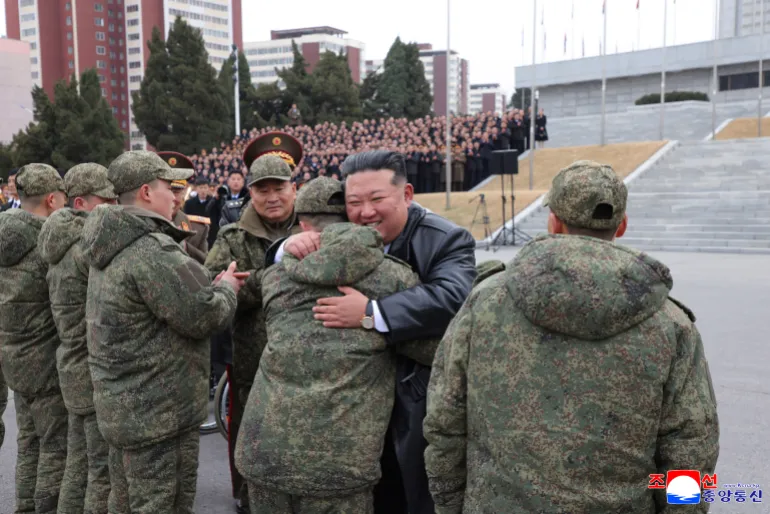
North Korea’s leader Kim Jong Un has hugged injured soldiers in wheelchairs at a ceremony in the capital, Pyongyang, to welcome home troops who served with Russian forces in the war against Ukraine.
State-run Korean Central News Agency said on Saturday that Kim praised the “mass heroism” of the returning 528th Regiment of Engineers of the Korean People’s Army, which had served in Russia’s Kursk region.
Recommended Stories
list of 4 itemsend of list
Kim hailed the regiment’s conduct during its 120-day overseas deployment, which commenced in early August and involved combat and engineering duties, including mine clearing in the Kursk region of Russia, where Ukrainian forces had infiltrated and occupied for months before withdrawing.
“You could work a miracle of turning a vast area of danger zone into a safe and secure one in a matter of less than three months, the task which was believed to be impossible to be carried out even in several years,” Kim said, according to South Korea’s Yonhap news agency.
“The armed villains of the West, armed with whatever latest military hardware they are, cannot match this revolutionary army with an unfathomable spiritual depth,” Kim added at the ceremony on Friday.
North Korean leader Kim Jong Un on Friday welcomed soldiers from the Korean People’s Army’s 528th Regiment of Engineers, who returned from an overseas deployment in Russia’s Kursk region [KCNA via AFP]
The North’s leader also spoke of the “heartrending loss” of nine members of the regiment and announced that the unit would be conferred with the Order of Freedom and Independence. The deceased troops would also be honoured with the title Hero of the Democratic People’s Republic of Korea, KCNA said, referring to North Korea’s official name.
Video footage of the ceremony released by North Korea showed uniformed soldiers disembarking from an aircraft and Kim embracing soldiers seated in wheelchairs, as other soldiers and officials gathered to welcome the troops.
The Russian Ministry of Defence confirmed last month that North Korean troops, who had helped Russia repel Ukraine’s incursion into Kursk, were now involved in clearing the area of mines.
Concluding a key meeting of his ruling Workers’ Party of Korea on Thursday, Kim also praised the deployment of North Korean troops in support of Russia’s war on Ukraine, saying it “demonstrated to the world the prestige of our army”.
North Korea’s “ever-victorious army” was the “genuine protector of international justice”, Kim said.
Under a mutual defence pact between Moscow and Pyongyang, an estimated 14,000 North Korean soldiers were deployed to fight for Russia, with the number of those killed or wounded ranging between 3,000 and 4,000.
The welcoming ceremony held on Friday marks the latest event to publicly honour North Korean soldiers who served in Russia’s war on Ukraine.
In October, Kim was featured embracing weeping soldiers at a ground-breaking ceremony for a planned memorial to those who fought for Russia, and in June, state media showed Kim draping coffins with the national flag in what appeared to be the repatriation of soldiers’ remains from Russia.
The welcoming home ceremony on Friday in Pyongyang, North Korea, for the Korean People’s Army’s 528th Regiment of Engineers [KCNA via AFP]
Witnesses at the hospital and the UN say the attack killed medics, patients and may ‘amount to a war crime’.
Published On 13 Dec 202513 Dec 2025
Share
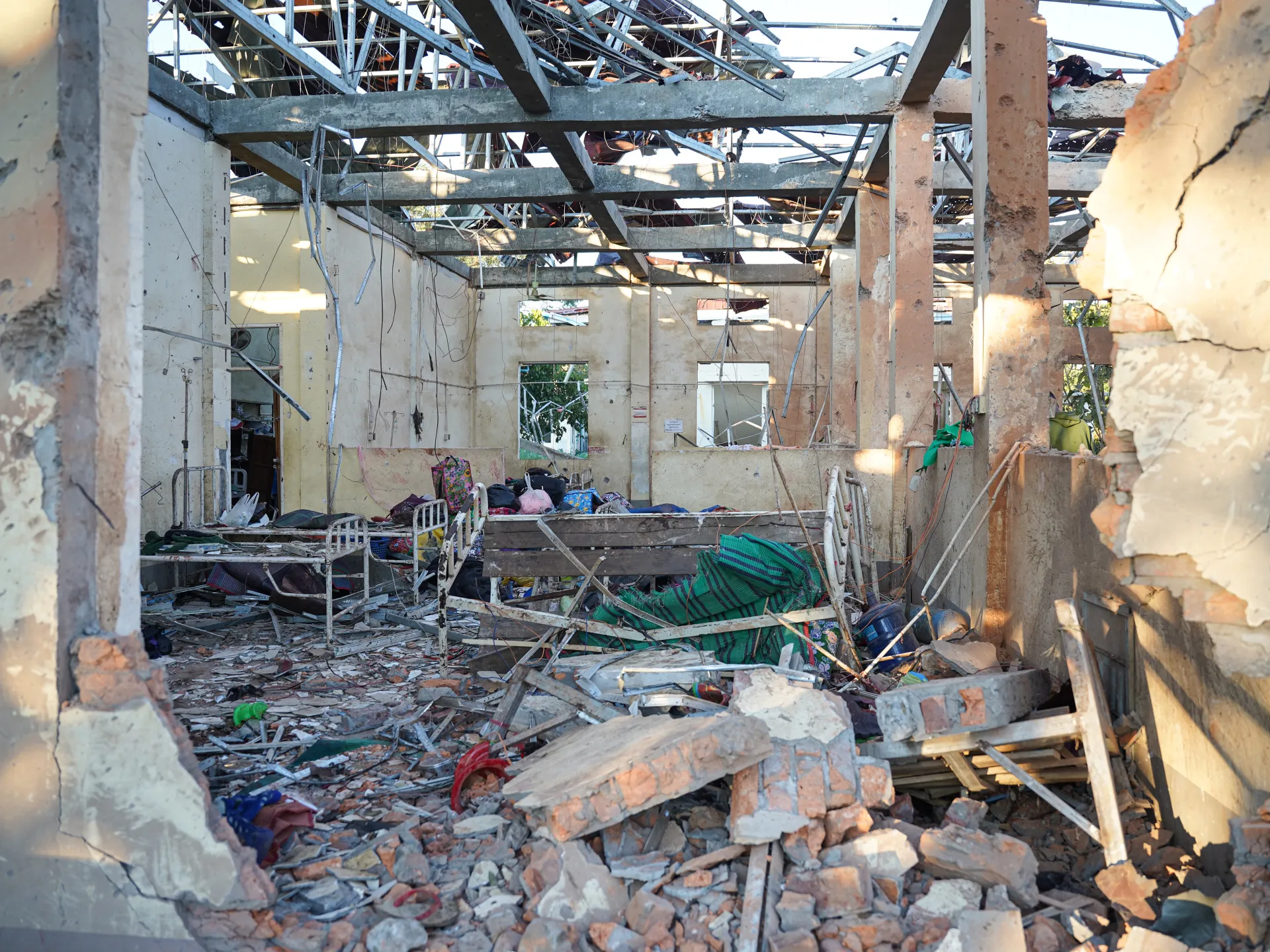
Myanmar’s military has acknowledged it conducted an air strike on a hospital in the western state of Rakhine that killed 33 people, whom it accused of being armed members of opposition groups and their supporters, but not civilians.
Witnesses, aid workers, rebel groups and the United Nations have said the victims were civilians at the hospital.
Recommended Stories
list of 3 itemsend of list
In a statement published by the state-run Global New Light of Myanmar newspaper on Saturday, the military’s information office said armed groups, including the ethnic Arakan Army and the People’s Defence Force, used the hospital as their base.
It said the military carried out necessary security measures and launched a counterterrorism operation against the general hospital in Mrauk-U township on Wednesday.
However, the United Nations on Thursday condemned the attack on the facility providing emergency care, obstetrics and surgical services in the area, saying that it was part of a broader pattern of strikes causing harm to civilians and civilian objects that are devastating communities across the country.
UN rights chief Volker Turk condemned the attacks “in [the] strongest possible terms” and demanded an investigation. “Such attacks may amount to a war crime. I call for investigations and those responsible to be held to account. The fighting must stop now,” he wrote on X.
World Health Organization chief Tedros Adhanom Ghebreyesus said he was “appalled”. “At least 33 people have been killed … including health workers, patients and family members. Hospital infrastructure was severely damaged, with operating rooms and the main inpatient ward completely destroyed,” he wrote on X.
Myanmar has been gripped by attritional fighting in a raging civil war.
Mrauk-U, located 530km (326 miles) northwest of Yangon, the country’s largest city, was captured by the Arakan Army in February 2024.
The Arakan Army is the well-trained and well-armed military wing of the Rakhine ethnic minority movement, which seeks autonomy from Myanmar’s central government. It began its offensive in Rakhine in November 2023 and has seized a strategically important regional army headquarters and 14 of Rakhine’s 17 townships.
Rakhine, formerly known as Arakan, was the site of a brutal army counterinsurgency operation in 2017 that drove about 740,000 Muslim-majority Rohingya to seek safety across the border in Bangladesh. There is still ethnic tension between the Buddhist Rakhine and the Rohingya.
The Arakan Army pledged in a statement on Thursday to pursue accountability for the air strike in cooperation with global organisations to ensure justice and take “strong and decisive action” against the military.
The military government has stepped up air strikes ahead of planned December 28 elections. Opponents of military rule charge that the polls will be neither free nor fair and are mainly an effort to legitimise the army retaining power.
Myanmar has been in turmoil since the army took power in 2021, triggering widespread popular opposition. Many opponents of military rule have since taken up arms, and large parts of the country are now embroiled in conflict.
Man Vs Baby has just been released on Netflix with subscribers more curious than ever to find out about Rowan Atkinson’s life.
Rowan Atkinson is a British treasure, so it’s no surprise devotees are keen to learn everything about the 70-year-old performer.
Man Vs Baby landed on Thursday, December 11, on Netflix, a four-episode comedy following Trevor Bingley (portrayed by Rowan Atkinson) as he unexpectedly becomes guardian to an abandoned infant in London.
The sitcom may have only just arrived on the platform but has already soared to Netflix’s top spot, demonstrating that audiences remain captivated by the Mr Bean icon.
As fans carry on devouring Man Vs Baby this weekend, here’s everything worth knowing about the legendary Rowan Atkinson.
Unexpected career
Whilst everyone recognises Atkinson primarily for his comedic work, breaking into acting wasn’t his original plan.
He first pursued electrical engineering at Newcastle University and embarked on a PhD at Oxford University when he uncovered his love for performing.
During his Oxford years, he encountered the writer of Four Weddings And A Funeral, in which Atkinson made a brief appearance, and also co-penned the beloved Blackadder.
Stutter
The Man Vs Baby performer has lived with a speech impediment throughout much of his life but has apparently discovered it troubles him less whilst he’s on stage.
Atkinson generally avoids the limelight regardless, but he also steers clear of numerous interviews due to his stammer.
He told Time magazine: “It comes and goes. It depends on my nerves, but it can be a problem.
“I find that when I play a character other than myself, the stammering disappears. That may have been some of my inspiration for pursuing the career that I did.”
Mr Bean
Beyond his memorable role in the Blackadder series, Atkinson’s early work centred on the wordlessly chaotic persona of Mr Bean.
It’s thought that Mr Bean draws from nine year old Atkinson’s experiences after being bullied at school by youngsters who thought he resembled an alien, earning him cruel nicknames such as Doople and Greenman.
Speaking to The Independent, he said: “There’s a lot of Mr Bean in me. He’s socially inept, selfish and has no manners – yet he can be sweet, innocent and well-meaning.”
Personal life
Atkinson was married to makeup artist Sunetra Sastry who he first met in the 1980s during filming of Blackadder’s second season.
Sastry worked as makeup artist for his co-star Stephen Fry, but it wasn’t long before Atkinson formed a connection with her, and they married in 1990.
The couple remained together for 24 years and welcomed children Benjamin and Lily before divorcing in November 2015.
During the divorce proceedings, the pair were midway through building an £11 million property in Oxfordshire.
The star met his current girlfriend Louise Ford in 2013 – who was then dating comedian James Acaster – whilst working on the West End production Quartermaine’s Terms.
Ford, who is roughly 30 years younger, has appeared in Horrible Histories, The Windsors and Crashing. The couple, who became parents to their darling daughter Isla in December 2017, have chosen to keep her away from the public gaze.
Dec. 12 (UPI) — President Donald Trump has voiced support for reclassifying cannabis and making it a legally obtainable drug — possibly as soon as next week.
The president might sign an executive order to reclassify cannabis as a Schedule III drug as soon as Monday, accordingto CNBC, but no later than early next year, Axios reported.
Trump has a team examining the matter, but no decision has been made as of Friday morning.
The president also met with House Speaker Mike Johnson, R-La., earlier this week to discuss the matter and is considering signing an executive order compelling federal agencies to reclassify cannabis as a Schedule III drug.
The federal government currently has cannabis classified as a Schedule I drug with no known medical uses and a strong potential for abuse and dependency, as defined by the Controlled Substances Act.
Other drugs similarly classified include LSD, heroin and MDMA.
A Schedule III drug is one with recognized medicinal use and a low potential for abuse and dependency. Examples include ketamine, opioids and anabolic steroids, all of which require prescriptions to obtain legally.
Food and Drug Administration and the Drug Enforcement Agency, with assistance from the Health and Human Services Department, mostly determine how various drugs are scheduled by the federal government.
The push for reclassification of cannabis comes as more U.S. adults are using cannabis, while moving away from alcohol and tobacco products.
Reclassifying cannabis would not make marijuana legal for recreational use, but it would become legal for medicinal purposes and require a prescription.
Reclassification also would make it legal for cannabis producers to transport their products between states and enable federally chartered banks to process financial transactions related to legal cannabis sales.
Cannabis producers and retailers also could benefit from federal tax breaks.
News of a potential change in federal cannabis laws and enforcement boosted related stocks on Friday.
Cannabis stocks surged upward upon the prospect of cannabis becoming a legally obtainable substance at the federal level, in addition to respective states that have enacted recreational or medical marijuana laws, and many times both.
Several cannabis stocks posted respective gains ranging from more than 10% to about 35% during trading on Friday, CNBC reported.
Two dozen states, three U.S. territories and the District ofColumbia have legalized the medicinal and recreational use of cannabis, and a recent Gallup poll showed 64% or respondents support legalization, according to Axios.
At the federal level, the House of Representatives briefly considered decriminalizing cannabis during President Trump’s first term in office but delayed the matter until after the 2020 general election.
Legalization also could lessen the profit potential for drug cartels, which spurred Colombian President GustavoPetro in March to urge the Colombian Congress to legalize cannabis.
He said the nation’s continued prohibition against cannabis “only brings violence” among its drug cartels.
Speaker of the House Mike Johnson, R-La., departs a closed-door meeting with Republican leadership about health care negotiations at the US Capitol on Friday. Johnson and House Republicans hope to hold a vote next week on their own health care program. Photo by Jim Lo Scalzo/UPI | License Photo
China has marked the anniversary of the 1937 massacre by Japanese soldiers, as tensions soar over Taiwan.
China has held a low-key memorial ceremony for the Nanjing Massacre, as a diplomatic crisis between Beijing and Tokyo over Taiwan continues to simmer.
President Xi Jinping did not attend the ceremony on Saturday commemorating the 1937 attack, in which China says Imperial Japan’s troops slaughtered 300,000 people in the eastern city of Nanjing.
Recommended Stories
list of 3 itemsend of list
A post-World War II Allied tribunal put the death toll at 142,000, but some conservative Japanese politicians and scholars have denied that a massacre took place at all. China and Japan have long sparred over their painful history.
Japanese Prime Minister Sanae Takaichi has infuriated Beijing after her remarks last month in which she projected that a hypothetical Chinese attack on the self-governed island of Taiwan could trigger a military response from Japan.
Doves flew over the national memorial centre in Nanjing after the ceremony, which was completed in less than half an hour, in front of an audience that included police officers and schoolchildren.
Shi Taifeng, head of the ruling Communist Party’s powerful organisation department, made far less combative remarks than recent rhetoric from Chinese government officials.
“History has proven and will continue to prove that any attempt to revive militarism, challenge the post-war international order, or undermine world peace and stability will never be tolerated by all peace-loving and justice-seeking peoples around the world and is doomed to fail.”
He did not mention Takaichi but alluded to China’s previous assertions that the Japanese leader seeks to revive the country’s history of militarism.
On Saturday, the Eastern Theatre Command of China’s People’s Liberation Army put out a picture on its social media accounts of a large bloody sword, of the type used by many Chinese soldiers during the war, chopping off the head of a skeleton wearing a Japanese army cap.
“For nearly 1,000 years, the eastern dwarves have brought calamity; the sea of blood and deep hatred are still before our very eyes,” it said, using an old expression for Japan.
Dispute over Taiwan
Last month, Japan’s Defence Minister Shinjiro Koizumi announced that Tokyo was moving forward with plans to deploy a missile system on Yonaguni, the country’s westernmost island located 110km (68 miles) off Taiwan’s east coast, which has hosted a Japanese military base since 2016.
China’s Ministry of Foreign Affairs blasted the announcement, describing Japan’s plan as a “deliberate attempt to create regional tension and provoke military confrontation”. Koizumi pushed back, saying the Type 03 guided missile system was purely defensive and “intended to counter aircraft and missiles invading our nation”.
Beijing views Taiwan as its own territory and has promised to unite the island with the Chinese mainland, an aspiration that Taipei says infringes on its sovereignty and that only Taiwan’s citizens can decide their future.
Both countries have since traded quarrelsome accusations, with Japan summoning China’s ambassador earlier this month over an incident in which Chinese military aircraft allegedly twice locked fire-control radar onto Japanese fighter jets.
Illuminating aircraft with radar signals a potential attack that could force targeted planes to take evasive measures, making it among the most threatening actions a military aircraft can take.
For its part, the Chinese embassy denied Tokyo’s claims, saying in a statement that “China solemnly demands that Japan stop smearing and slandering, strictly restrain its frontline actions, and prevent similar incidents from happening again”.
Adam Peaty’s estranged family are demanding Netflix remove them from Gordon Ramsay’s upcoming docuseries amid their ongoing wedding feud, pictured with Holly RamsayCredit: Instagram/@hollyramsayyMum Caroline has written to the streamer to say they did not consent to being filmed at Adam and Holly Ramsay’s engagement doCredit: UnknownAdam alongside Gordon and wife TanaCredit: Getty
His family want a prompt response, a source said, as the series, Being Gordon Ramsay, is due for release early next year.
A source said they expected Netflix to answer within 14 days from when it was sent the letter.
James was arrested at home in Uttoxeter, Staffs, on suspicion of harassment before being bailed.
A source said: “Caroline has written to Netflix to say the family were not asked for their consent to be filmed for Gordon’s documentary at last year’s engagement do.
“She was very clear that, after everything that’s happened, they do not want to be featured.
“She was filmed giving a speech as were the family during arrivals and while mingling at the party.
“They’re expecting a response from Netflix within 14 days of the letter’s arrival.”
A source close to Gordon Ramsay said filming notices were displayed at the lavish party which took place in London.
They said: “They stated that by attending you were giving your consent to appear in the show.
“Everyone had a brilliant time and the Peaty family members were not interviewed so no additional consent would have been needed. It’s possible they may not even make the final edit.”
Since the falling out, sister Bethany is the only member of Adam’s family still invited to the wedding.
She was very clear that, after everything that’s happened, they do not want to be featured