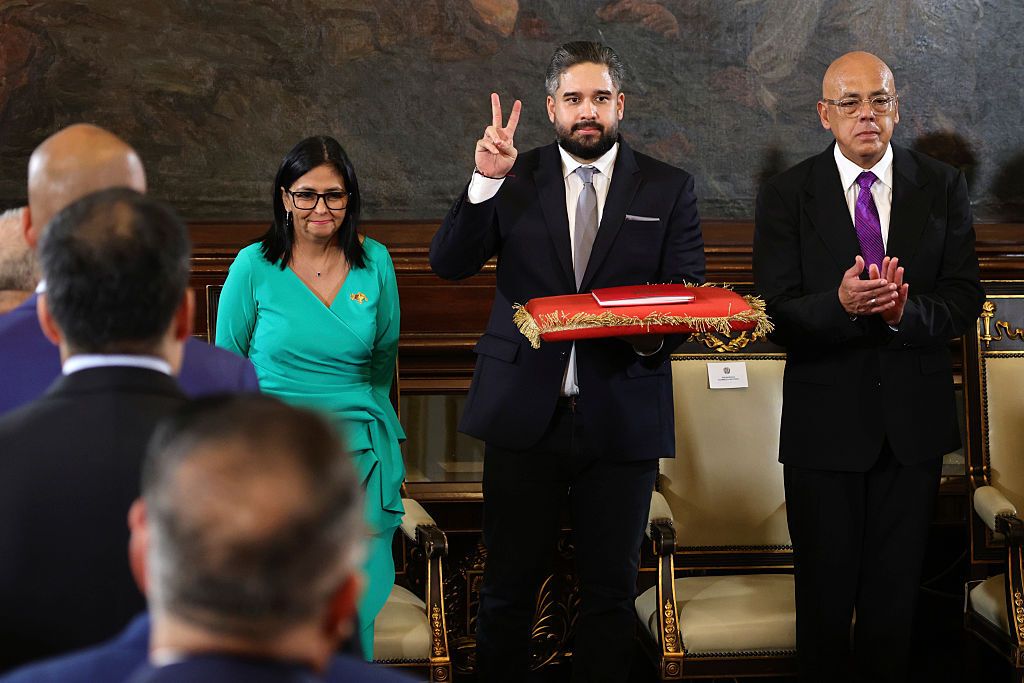
The unprecedented January 3rd US attack and the capture of Nicolás Maduro has shaken Venezuela’s political board. Today, after the new chavista legislature was sworn in and Jorge Rodríguez was ratified as its president, we saw the latter taking the oath of his sister, Delcy, as Nicolás Maduro’s acting president. As this was happening, Maduro and his wife, Cilia Flores, were being arraigned in a New York court. It’s Monday, January 5th, all of this could change in months, weeks, or even days. This is where the different players stand.
Delcy and Jorge Rodríguez
It’s widely being reported that Delcy Rodríguez backstabbed Maduro and Flores, giving away their coordinates for a Delta Force unit to take them out on January 3rd. While it’s easy to imagine the Rodríguez siblings lobbying hard for a chavismo-without-Maduro outcome that sought to end months of US hostilities in the Caribbean, it can’t be ruled out that the White House just grew tired of Maduro calling Trump’s bluff and decided to snatch him and his wife while unilaterally handing the reins of the country to the beleaguered siblings, the two chavistas that US diplomats know best at this point (a mixture between the Rubio and Grenell approaches, leave the “moderates” but get Maduro). Those two are far from being in a comfortable position. On one hand, they must deal with a US government that, according to Politico, is asking Rodríguez to stop the flow of drugs, expel Iranian and Cuban agents, and block US adversaries from Venezuelan oil. Por ahora, other more complicated asks may come later.
Apart from this, the Rodríguez house must keep itself safe from the most predatory clan within the ruling coalition, embodied by Diosdado Cabello and the web of security agencies he leads. It’s fair to say that chavismo is quite good at maintaining cohesiveness in the toughest circumstances. However, the ease at which the US entered Venezuela and captured its dictator makes the current equilibrium quite fragile. Delcy and Jorge may have an insurmountable challenge ahead of them: keeping the US satisfied in whatever appears in Trump and Runio’s (or Stephen Miller’s!) agenda, while making themselves unexpendable for the safety of Cabello et al until who knows when. At some point, something’s gotta give.
The Venezuelan business elite
For this actor, Plan A for unlocking the country’s near-permanent, multidimensional crisis has always been a transitional government led by reformist and pragmatic figures who, in their view, would prioritize preserving the economic order built over the past five years. The Rodríguez siblings served as the bridge between the ruling elite and organizations such as Fedecámaras and Conapri—leaders of the domestic private sector who, in recent years, benefited from de facto dollarization, price deregulation, tariff exemptions for certain products, and informal privatizations driven by the drastic shrinking of the Venezuelan state.
If the new chavista setup was to last without Maduro and Cilia at the helm, the business elite would be betting on a continuation of what Venezuela was between 2019 and 2023, when the logic of the so-called Pax Bodegónica prevailed, before political instability surged again in 2024. Beyond enjoying a fairly exclusive relationship with what The New York Times calls “Venezuela’s industry captains,” the Rodríguez siblings embody the socioeconomic architecture that has been wobbling since Maduro’s electoral fraud: a spiraling exchange rate, the revocation of licenses granted to oil companies that had returned to the country, and more recently, the US naval blockade of Venezuelan crude in the Caribbean.
In the coming weeks and months, this actor is likely to push for what it has sought since 2019: the lifting of sanctions on PDVSA (and, of course, the oil blockade); the expansion of oil licenses to companies that benefited from the 2023-2024 Barbados Agreement; further deregulation of private-sector activity; and continued access to the ruling elite still that remains running the country.
The Trump administration
The United States bypassed Venezuela’s defenses with little resistance, bombed the capital’s main military installations (possibly destroying weapons and air-defense systems), and penetrated the country’s most important military complex to capture what it considers the two kingpins of an international drug-trafficking network threatening US national security. All of this without suffering a single combat casualty.
In line with its newly unveiled foreign policy doctrine, the US showed the world it is willing to remove its enemies in its old backyard, as it did a century ago, and to carry out spectacular interventions in its own hemisphere—not only in distant places like Iran or Syria. Collateral damage from the so-called Operation Absolute Resolve appears low compared to previous US interventions such as Libya (2011) or Iraq (2003), though the true human toll of January 3 is still unknown.
The operation also exposed Cuban presence within Venezuela’s security apparatus that has long been questioned by some foreign analysts. On Monday, Cuban President Miguel Díaz-Canel admitted that 32 Cubans who were “on mission” in Venezuela died as a result of the January 3 attacks. This revelation may give Washington leverage to demand that Delcy Rodríguez purge Cuban networks from the Venezuelan state in the near future.
A big win for Trump in general terms, but the question is how impactful it may be back home—where it actually matters to him. How much do Americans care about Trump ending a dictator’s run and dangling him for people to see in a New York court? How much do they care about the business that may come from Bolivar’s homeland? Also, while it’s great to see Maduro dragged out of his home and delivered to a court of justice, some of the actions and decisions of T2 during this whole process may come back to judicially haunt him in the future—unless he’s able to go full Chávez and stay on forever.
International intermediaries close to the Rodríguez siblings
One of the great ironies of this episode is that some of the figures who downplayed the events of July 28 and advocated for a “negotiated solution with chavismo” amid the conflict with the United States (which, according to Trump, could have meant a safe exile for Maduro) are now seeing their desired outcome materialize through military intervention.
Delcy Rodríguez—the “Deng Xiaoping” of chavismo, who has cultivated influence and contacts in Western countries—is, for now, in charge of steering the transition. Figures such as special envoy Ric Grenell and former Spanish Prime Minister José Luis Rodríguez Zapatero may play a role in maintaining cooperation between the US administration, the European Union, and the teams of Delcy and Jorge Rodríguez, with whom they have long-standing ties.
Diosdado Cabello
The interior minister survived the US attack. Washington prioritized capturing the presidential couple over going after the regime’s chief enforcer—arguably its most dangerous figure. Cabello responded by appearing publicly with a group of armed men that included DGCIM Colonel Alexander Granko Arteaga and CICPC Director Douglas Rico.
Simply surviving the incursion is a victory for the Cabello clan, which now has the opportunity to regroup, reassess its options, and consider off-ramps that seemed unnecessary just a month ago. Still, Cabello’s medium-term options may be limited. Too much rapprochement and cooperation between Delcy Rodríguez and Trump could lead to another “anti-corruption” episode that takes down the Cabello clan, as happened to El Aissami in 2022. On the other hand, a refusal by Delcy Rodríguez to advance Washington’s agenda risks triggering a second wave of US aircraft, with Cabello as a potential primary target.
Faux opposition lawmakers in the 2025 National Assembly
With an interim government supposedly under pressure to enact reforms to “re-steer” Venezuela after Maduro’s capture, figures such as Henrique Capriles, Stalin González, Antonio Ecarri, and Bernabé Gutiérrez—recently sworn in—gain renewed relevance. More than 20 supposedly opposition politicians, many of whom failed to secure enough votes to legislate, have just taken office.
The 2025 National Assembly is likely to present itself as a venue for approving new agreements and “national unity pacts” in response to US aggression. This group—often referred to as the faux opposition or systemic opposition—can act as a proxy for real power centers, backing initiatives and extracting favors that may empower them. In the coming months, this could yield:
- More releases of political prisoners;
- The lifting of political bans for specific opposition politicians (or a combination of 1 and 2); and
- New political appointments for faux opposition figures as part of a prospective “national unity government.”
María Corina Machado and the opposition
The US attack doesn’t seem to have been carried out with prior consultation with Team Machado, which had no time to craft an immediate response and watched as President Gustavo Petro became the first international leader to react. More troubling for them is that both Donald Trump and Marco Rubio have made clear, for now, that Machado or her allies are not being considered to lead the transition. The preference seems to be to run the country in the coming months through de facto power holders, including the ruling elite and the existing security apparatus.
Machado can celebrate the fall of chavismo’s top boss, but it doesn’t look like she can claim to have access to “the room where it happens.” Por ahora. At this moment, it seems unlikely that the military option will allow Edmundo González Urrutia to take the presidential oath right now. Or ever. However, this doesn’t mean that she’s done. Machado has yet to do her next move, and if she waits for the right moment, and plays her cards correctly, it may pay off.
This hiccup may be a blessing and not a curse. While at this moment we see highly unlikely that we will see the enforcement of the result of the 2024 presidential elections, if the Trump administration tried to impose the proclamation of the rightful winner, it could easily backfire. The coming months are going to be highly unstable. Machado could take her time to put that Nobel to good use and strengthen international alliances (in the US and the EU) that could back her up if and when she decides to return to the country. Then, she would have a chance to go back to the ground to lead the political movement that she built and perhaps run in an election without a stand in dummy. Is it unlikely that she will be allowed to run? Absolutely! But this is the transition path that we’re on. If Trump and Rubio follow through, eventually we could get to a place where she can get there. Hindsight is 20/20, but it is what it is. Trump wasn’t going to force Edmundo. It would’ve required a scorched earth campaign, with the US assuming much more responsibility—NOT GONNA HAPPEN.
The Bolivarian National Armed Forces (FANB)
Without repeating what has already been said, Venezuela’s military forces stood out for their complete inability to resist the US attacks. They failed to shoot down a single helicopter that roamed the Caracas valley in the early hours of January 3. The humiliation is nearly total for a force that has spent 20 years chanting anti-imperialist slogans while claiming readiness to withstand a Yankee onslaught in perfect “civic-military-police unity,” or even to reclaim the Essequibo.
The myth of Russian, Chinese, and Iranian defense systems—sold by Chávez until his death—has also evaporated. The FANB’s response to the “imperialist aggression” (without naming Trump or the United States) made no reference to soldiers killed in combat, for whom there is still no official figure. Nor was there an accounting of the cities and facilities attacked.
Within both the FANB and the PSUV, the discourse insists on Maduro’s release while refusing to acknowledge how defenseless the territory proved to be during a limited bombing campaign. Internally, this should:
- significantly demoralize mid- and lower-ranking officers in the Army and National Guard, who may now see themselves as cannon fodder; and
- generate greater mistrust among generals and military regions that may well consider cooperating with the US to save themselves in the event of a second wave of attacks.
Luiz Inácio Lula da Silva and Gustavo Petro
The United States upended the scenarios of both leaders. Nicolás Maduro and his wife were forcibly removed from power, yet the country did not collapse nor descend into the kind of bloody Libyan-style civil war that Brazil and Colombia had predicted. January 3 sets a troubling precedent for Venezuela’s neighbors: Washington did not consult Lula, who had repeatedly offered to mediate with Trump during the conflict.
The possibility of a golden exile for Maduro—facilitated by allies in the old regional left—has been buried, or at least reduced to very low odds. Both Lula and Petro are now watching, in real time, as Venezuela—whether under chavismo or another political force—may be drifting into the US sphere of influence, without Washington incurring significant reputational damage during the operation.
Maduro’s capture could also provide Washington with compromising information about three decades of alliances between chavismo and figures of the regional left, including Petro and Lula—valuable ammunition ahead of elections in both South American countries and as the US seeks to reassert its hemispheric dominance.
Venezuelan society
There have been celebrations in the diaspora over the imprisonment of Maduro and Cilia Flores. It is also possible that many inside Venezuela harbor cautious, if private, optimism about what has happened and what may come. But Venezuela remains far from the political changes people are waiting for—let alone those demanded by the more than seven million voters of July 28, 2024.
Even though the U.S. managed to decapitate the regime’s leadership, chavismo remains standing. Meanwhile, confusion reigns. The uncertainty Venezuelans already felt in their daily lives continues to grow, reflected in long lines at grocery stores and supermarkets in the hours following Absolute Resolve.
History will judge whether this truly marks the beginning of a democratic transition. For now, colectivos and security agents will keep rounding up activists, journalists and ordinary Venezuelans. The official dollar exchange rate has just surpassed Bs. 300—five times its value in February 2024. The material precarity of Venezuelans will not change unless the country shows real signs of deep transformation in the months ahead.
Yet, never underestimate the indomitable Venezuelan spirit.
The Maduros
Well, not much to say about this. While Nicolás Jr. (aka Nicolasito) has to submit himself to the rule of the Rodríguez siblings, Maduro and Cilia are in for a ride and will be paraded as trophies as they dive into a complicated trial. Will they rot in jail? Probably, beyond the drug charges, there’s a couple of jurisdictions that want them for human rights violations. And besides, who would pardon a drug trafficker? Right?