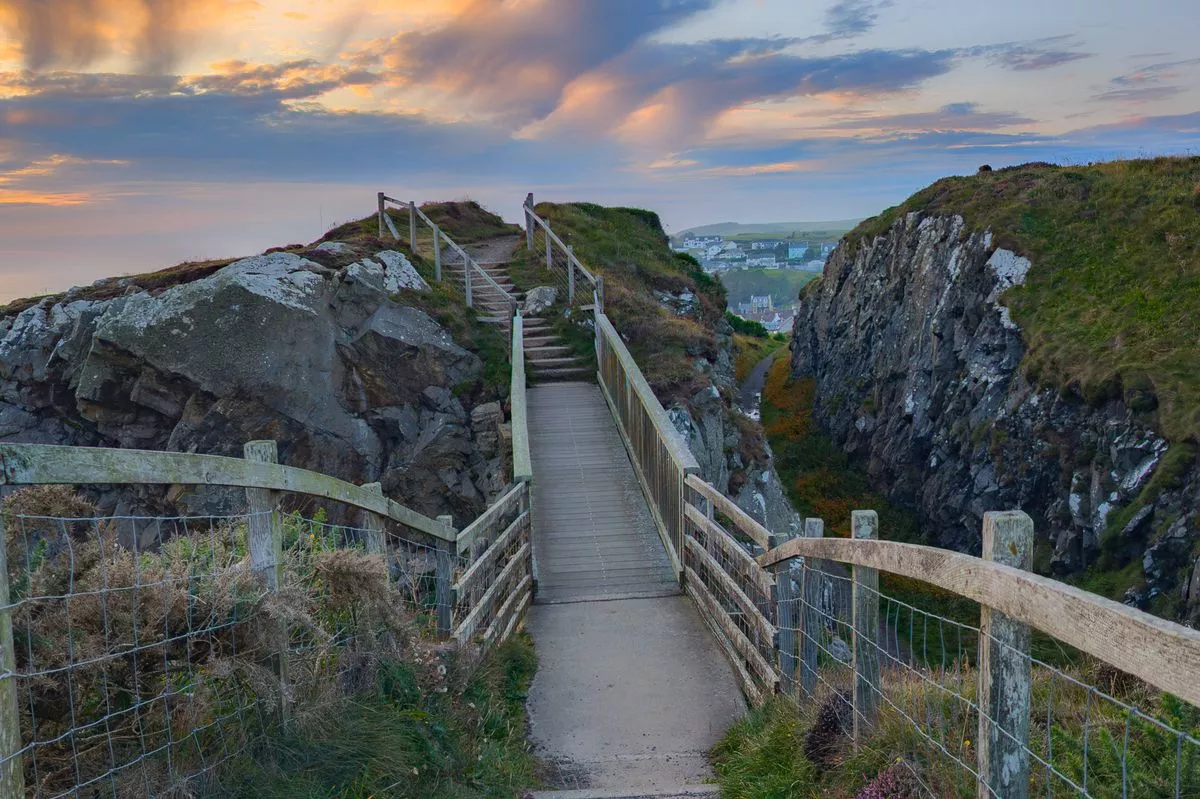
The cliff path has been named the cleanest hiking trail in the UK by Independent Cottages – though the route is impacted by rockfall and has some impressive drops along the way

The Gobbins route has been named the cleanest in the UK(Image: Frank Günther via Getty Images)
A dizzying cliff path overlooking a churning sea has been crowned the UK’s cleanest hiking trail.
The Gobbins, an extraordinary and awe-inspiring route that stretches for three miles along the treacherous cliffs of County Antrim in Northern Ireland, has clinched the top spot in Independent Cottages’ ranking of the UK’s cleanest walking trails. Remarkably, there were no mentions of uncleanliness across more than 1,300 reviews.
The Gobbins presents a surreal landscape, born from colossal geological forces and subsequently shaped by the elements. Today, it teems with life and has been captivating courageous visitors for over a hundred years.
The tale of The Gobbins begins some 200 million years ago when the Earth’s continents were united in the supercontinent, Pangaea. The land that would eventually become northeast Ireland was submerged beneath a warm, shallow sea.
Algae and single-celled organisms thrived in these waters, their calcium carbonate shells slowly accumulating layers of calcium on the seafloor after they died, which solidified into a limestone layer, reports the Express.


READ MORE: Beautiful seaside town now ‘dying a death’ and ‘depressing’ as 1 in 4 shops lie empty
This is what gave rise to the coastlines and caves that are dotted across Ireland today. This stone forms the bedrock of The Gobbins’ spectacular rock formations.
Atop this lies basalt, a product of eruptions from now long-extinct volcanoes, which has been fractured and moulded by the shifting bedrock of tectonic plates as Pangaea separated, and later, vast ice sheets during ice ages.
The outcome is one of the most spectacular stretches of coastline found anywhere across the British Isles, which happens to offer countless habitats for diverse birds and marine creatures. For instance, the Gobbins hosts Northern Ireland’s sole mainland colony of puffins, which nest in the cliff-face earth disturbed by ancient glaciers.
“Guillemots, razorbills, cormorants, and kittiwakes make their homes high in the rocks and scan the waters from perches on the sea stacks. The depths teem with fish, feeding in the plankton-rich waters of the North Channel. Lion’s Mane jellyfish, one of the largest such species, migrate through here, providing prey for seals, porpoises and other marine mammals,” the official Gobbins Cliff Path website writes.
“Low tide exposes the rockpools under the path, a home for molluscs, sponges and weird nodules of red seaweed. Spleenwort ferns, kidney vetch, and sea campion cling to cracks in the rocks or hold down patches of volcanic soil.”
The stunning natural landscape has transformed this location into an essential walking destination, first attracting masses of nature enthusiasts and day visitors during the Victorian era. Berkeley Deane Wise played a crucial role in shaping the Gobbins into what it is today.
This civil engineer, who had climbed to the position of Chief Engineer of the Belfast and County Down Railway and had created a groundbreaking signalling system that cut accidents on his routes, possessed a dedication to safety and fascinating design. Amongst his creations are the mock Tudor structure and clock tower in Portrush, plus walkways and a tearoom in Glenariff Forest that offer a superb view of its woodland and waterfalls.
The Gobbins Cliff Path is widely regarded as his most significant achievement and perfectly captures his brilliance as an engineer dedicated to helping ordinary folk enjoy remarkable experiences.
Construction commenced in 1901 and spanned several years, given the challenge of transporting steel girder bridges manufactured in Belfast via barges and rafts. These were subsequently hoisted into position using lines lowered from the clifftop.
The pathway became enormously popular and drew vast numbers of tourists from throughout the British Isles. “There is, in short, nothing like The Gobbins anywhere else in the world,” noted a correspondent in the Proceedings of the British Association in 1902.
A writer for The Sketch observed: “Surely there is something in the influence of the Irish climate which acts upon the rocks. The tints are softer and deeper. The very air is laden with poetry.”
Regrettably, the Gobbins route is currently shut due to rockfall. If you’re considering a trip, ensure you verify the official website for the latest information on its availability.