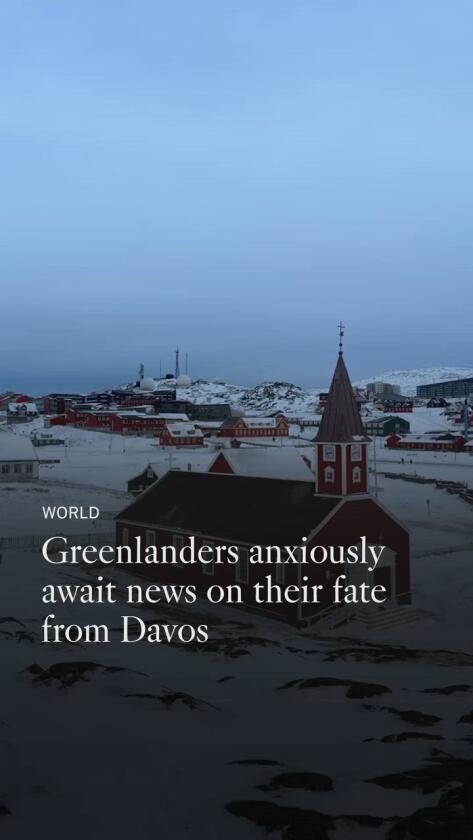
NUUK, Greenland — So far north in the middle of winter, the sun had barely crept above Greenland’s ice sheet midday when President Trump began his remarks. But Jinny Holm was not going to miss them.
She turns on the television every morning these days, keeping it on in the background, monitoring the developments of a foreign leader who otherwise would matter little in her life if not for his fixation on conquering her ancient homeland.
“My son, he has been a little bit worried about this military, so I have been talking to him — ‘Don’t worry. He cannot buy us,’” said Holm, a caregiver, describing her 9-year-old. “So that’s really good, that he said he will not use military force.”
In his remarks at Davos, Switzerland, Trump walked back threats to use military force to annex the semiautonomous Danish territory — news that was received with overwhelming relief here. Yet few trust Trump enough to take him at his word on any given day.
“I don’t want to be American, because I am Inuit,” she continued. “I am born here. In my future, I have grandson, and he will be Greenlandic.”
In remarks to the annual economic forum in Switzerland, which were focused largely on the fate of Greenland, Trump made no mention of the people here, whose lives have been consumed by confusion and concern over his designs.

-
Share via
It has become such an overbearing topic around town that locals have grown weary discussing it. Journalists are making their presence known in Greenland’s largest city, posting tripods at the few major intersections that make up Nuuk. Flying to the regional capital — which, by law and practice, means flying into the European Union — even a border agent in Reykjavik, Iceland, couldn’t help but comment on the news.
“You’re flying into that storm?” she asked.
Many locals let signage speak for themselves: “We Are Not For Sale” posters are common, alongside the occasional silhouette of Greenland, donning an orange toupee, crossed out in red. Several locals said they are flying Greenland’s red-and-white flag for the first time.
“He talks so much s—,” said Silas, a student from Nuuk, who dismissed the idea of joining the United States due to its healthcare system.
Finn Meinel, a lawyer born and raised in Nuuk, said there is “universal” disapproval of Trump’s territorial approach toward the island.
“Of course it’s nice to see that the wording has been softened, and that increases the odds of a nonviolent solution to this conflict,” Meinel said. But he took a moment before answering whether he viewed the United States as a force for good in the world.
“A lot of people are disappointed,” he said, “and for trust to be rebuilt with the Greenlandic people, that will take quite some time.”
Cal Egedeboggild, also born and raised in Greenland, said he had lost trust in Trump after precipitating an unnecessary crisis.
“He’s threatening, he’s threatening and he’s threatening. He gets his way by threatening. But does he create trust? No,” said Cal Egede Boggild, a former university professor working at the Ministry of Education. “There’s no such thing as a friendly annexation.”

A pedestrian at sunset in Nuuk, Greenland, on Jan. 21, 2026.
(Evgeniy Maloletka / Associated Press)
Like so many others, he has closely followed developments out of Washington. After conveying frustration with the U.S. government, he paused to apologize for being so direct.
“There are Americans, and there is Trump. They are two things,” Egede Boggild said. “I don’t distrust Americans. I distrust the Trump government. It’s only power — that’s all it is. The argument they are making don’t hold.”
Those arguments are coming solely from the White House, where Trump himself, with no meaningful assistance from policy wonks, has run the United States headlong into a diplomatic rupture with its closest allies, Defense and State Department sources tell The Times.
Trump’s remarks Wednesday, suddenly retreating from his threat of military force, could mitigate some of the damage inflicted on Washington’s most cherished relationships. But there is a risk his pivot has come too late. Major transatlantic partners, from France and the United Kingdom to Canada, expressed this week a rare sense of resignation, as if they have had enough with Trump’s foreign policy tactics, viewed across Europe as increasingly boorish and unrestrained.
The president’s moves may ultimately result in a new defense agreement over Greenland. But it may also be remembered as the moment where Europe broke away from the United States, exasperated by a world run solely by hard American power at the whims of an ever imperial presidency.
In Greenland, for its part, it may be remembered as a moment that rallied its small, remote population to its value and purpose.
“I think people are coming together, and are more socially aware — taking care of those who need to be supported, caring for one another,” Meinel said.
“People are more friendly,” he continued, “putting ourselves together as a group against an external foe.”
What else you should be reading
The must-read: https://www.latimes.com/sports/newsletter/2026-01-20/rams-seahawks-super-bowl-title
The deep dive: Celebrity PR firm helped LAFD shape messaging after Palisades fire
The L.A. Times Special: 2026 Oscar nominations: Our expert’s predictions in 11 key categories
More to come,
Michael Wilner
—
Was this newsletter forwarded to you? Sign up here to get it in your inbox.