


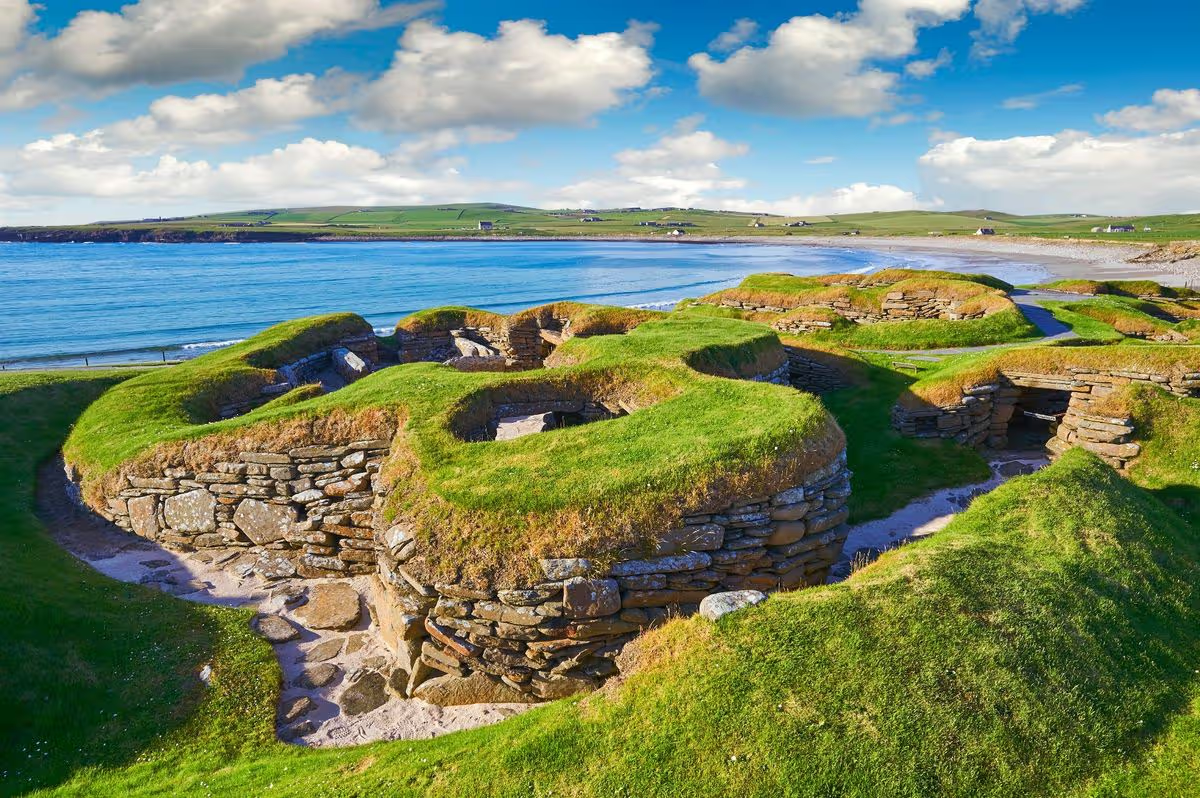
At one of the most popular tourist destinations, which dates back more than 5,000 years, visitors throw coins into a toilet in what they believe is a wishing well


The stone-built Neolithic settlement is located in the Orkney archipelago of Scotland(Image: Getty Images)
The UK’s ‘lost city’ has been attracting tourists from around the world – but most of them want to toss pennies into a toilet.
Skara Brae, on the Orkney archipelago in Scotland, is a preserved Neolithic village that was inhabited by a farming community around 5,000 years ago. It stands as one of the finest-preserved farming settlements across the British Isles and is known as the “Scottish Pompeii”.
The village was inhabited between 3100 and 2500 BC, and its close proximity to the sea allowed its residents to easily hunt for fish while also growing crops and tending to their various animals. It isn’t exactly clear why Skara Brae was abandoned, but it’s thought to have become uninhabitable due to climate change and severe weather.
READ MORE: Abandoned UK village left a ‘ghost town’ with 33 unfinished new build homes boarded upREAD MORE: I booked a mystery holiday for £79 and thought things couldn’t get worse — they did
It was left largely untouched until a storm in 1850 uncovered the site, revealing its fascinating past and prehistoric dwellings. Following a dig at Skara Brae, remnants of the community were further uncovered, including stone dressers and box beds, along with artefacts such as tools, gaming dice, pots and jewellery.
Together with a substantial chambered tomb (Maes Howe) and two ceremonial stone circles (the Stones of Stenness and the Ring of Brodgar), the settlement now forms part of the “Heart of Neolithic Orkney” collection of monuments, designated a UNESCO World Heritage Site in 1999.
Dating back thousands of years, the site remains one of the island’s most popular tourist attractions, drawing crowds near and far. In a long-standing tradition, superstitious visitors have frequently thrown pennies into an ancient hole in the ground of the preserved Neolithic village, believing it to be a wishing well.
However, it’s actually a toilet – and not everyone realises. Experts have outlined that the hole in the ground is merely an “old sewer” and a network of well-constructed drains and substantial cisterns.
Local tour guide from Orkney Uncovered, Kinlay Francis, previously shared on Facebook: “For years, people have been throwing money down a subterranean hole in the Skara Brae ground, thinking they are throwing money down a well to make a wish.
“I have great delight in telling my clients and anybody who throws their money down there that they are, in fact, throwing money down a toilet.
“This is the old drain/sewer from the Skara Brae site. It is not, and I repeat, not a wishing well. So don’t go there to spend a penny.”
The post quickly amassed over 2,000 reactions and nearly 150 comments, as people couldn’t believe the hilarious mix-up. One person remarked: “Oh! So! Priceless!”, while a second said: “Really a p*****g well not a wishing well then”.
A third commented: “It’s not a wishing well…it’s a s******g well.” Yet, not everyone was prepared to ditch their beliefs, as one noted: “Still…maybe brings good luck”, and another stated: “Where there is muck, there is brass!”
The confusion hasn’t stopped visitors from marvelling at the Neolithic village, and it’s received outstanding praise on TripAdvisor. One traveller shared: “Skara Brae Prehistoric Village is a must-see if you are in the Orkney Islands. Such an interesting place. You will be blown away by how well-preserved this 5000-year-old site is.”
A second commented: “This was my second time to Skara Brae and it was just as wonderful as the first. The setting of this village is spectacular, and on this visit, the weather was outstanding. On my first visit, the rain was blowing sideways. It is fantastic to view the site and then visit the reconstructed house to see how these people lived. Not so different from us – pretty pots, stone dressers and reasonably comfortable beds with skins as duvets!”
One more noted: “A must-see bucket list experience older than the Giza pyramids. Although the museum is small, the recreated room really brings alive the site. They even had plumbing. Once you are at the site, you can tour the homes from the walkway, which shows the genius of the ancient culture. Plentiful parking with a good gift shop/cafe.”
Do you have a travel story to share? Email webtravel@reachplc.com