ALAN Carr’s ex-husband has told his side of their story in an explosive new memoir — lifting the lid on boozy nights with Adele and his own battles with drink and drugs.
Paul Drayton describes life inside a high-profile relationship and devotes an entire chapter to superstar singer Adele, who lived near the former couple.
Alan Carr’s ex-husband Paul Drayton has told his side of their 13-year relationshipAdele officiated Alan and Paul’s Los Angeles wedding in 2018Credit: instagram
Paul, 54, and Alan, 50, met in 2008 and tied the knot ten years later in a lavish Los Angeles ceremony officiated by Adele.
Recalling their nights together, Paul writes: “Most evenings we’d just get a Thai takeaway. Adele would turn up with a cheap bottle of wine, which we sank in a second, and moved on to our supplies.”
Sign up for the Showbiz newsletter
Thank you!
Paul also claims he helped introduce Adele to her first husband Simon Konecki, the father of her son Angelo, 13.
He writes: “She was always very honest and open with me and Alan because she knew she could trust us.”
Alan and Paul met in 2008 and were together for 13 yearsCredit: GettyPaul has shared candid memories of the former couple’s friendship with AdeleCredit: Instagram
Paul also reveals Adele played them her chart-topping album 30 before its release.
And he fondly recalls “the time I took her to TK Maxx for the first time”, adding: “She couldn’t believe it as we combed through the rails hunting for bargains.”
Elsewhere in the memoir, Paul speaks candidly about his struggles with alcohol and drugs.
He writes: “Alcohol and drugs became my crutch. They slowed my brain down, quietened the constant noise in my head, and evened me out so I felt like I was on the same level as everyone else.”
Paul also lays bare how his relationship with Alan began, and how it developed.
He recalls: “Sexy? Sure. Marriage material? Possibly. Did I know at that moment I’d marry him one day? Of course not. But something clicked. He was unlike anyone I’d ever met.”
The pair later ended up in a nightclub — leaving Paul to wake the following morning thinking: “Oh my God, I’d been snogging Alan Carr.”
Paul went on: “There were moments when I genuinely thought we could’ve been the next Morecambe and Wise.”
But he says life with Alan soon “took over”, adding: “My dream of acting — well, it would have to wait.”
Opening up about living in the comedian’s shadow, Paul writes: “From the outside, it looked like I had it all. Alan in the spotlight, me in the wings. The ‘plus one’. The ‘kept man’… in designer sunglasses, holding the dogs and carrying the bags.
“But I wasn’t just standing there. I was driving the car, clearing the path, fixing the messes. Planning our exits like we were royalty.
“I’d like to think I was his ride or die — as he was mine, or at least, I bloody tried.
“I’ve been the clown, the cleaner, the carer and the chaos. I’ve fallen apart, pulled myself back together, and ended up in a police cell drinking toilet water out of a kid’s party cup.”
Umm al-Khair, occupied West Bank – The Palestinian villagers of Masafer Yatta, a collection of hamlets in the southern West Bank, feel Israel’s military and settlers closing in on them on a daily basis.
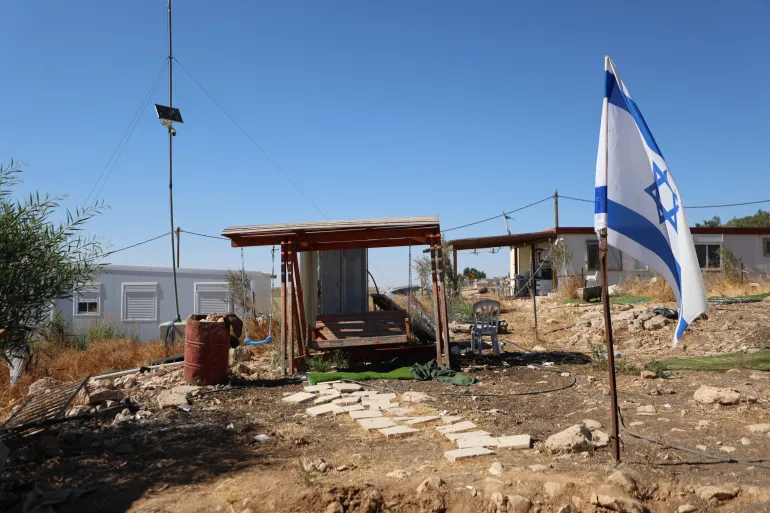
In one of those villages, Umm al-Khair, the presence of a newly established illegal settlement outpost nearby is the latest evidence that they are being replaced in their own land.
Recommended Stories
list of 3 itemsend of list
Salem and Ikhlas al-Hathaleen live with their eight children in a modest home covered with sheet metal. The land around their home had been somewhere the family could use for agriculture and grazing. But the illegal outpost, an extension of the nearby settlement of Carmel established last September, was set up on that land, roughly 20 metres (66 feet) away from their house.
Ikhlas explains that her old morning routine used to involve taking the family’s sheep out of their enclosure, providing them with food and water, milking them, and allowing them to graze.
The tasks were simple – but that is no longer the case.
Now, thanks to the new Israeli outpost, reaching the enclosure – which lies just behind the house – has become difficult, and at times, impossible.
According to Ikhlas, the family was initially prevented for four consecutive days from reaching the livestock enclosure and then was only allowed to access it once, while accompanied by Israeli soldiers, in order to provide food and water for the animals. They were then prevented from accessing the enclosure for two days. This pattern of occasional visits interspersed with days of not being allowed to access the animals has continued, and Ikhlas says they have only been able to check on the animals three times in July.
“I look every morning to see whether the sheep are still alive,” Ikhlas says. “I only wish I could reach them and take care of them like I used to.”
Struggle for a bathroom
It is not just sheep enclosure that is a struggle to get to for the al-Hathaleen family.
Even the family’s bathroom, which is a freestanding structure a few metres away from their home, has become difficult to reach.
Ikhlas explains that settlers in early July placed obstacles near the bathroom, including barbed wire and children’s playground equipment, all in an effort to make access harder, particularly for children and the elderly.
She adds that the situation has become more complicated since the Israeli army declared the area around the bathroom a closed military zone. As a result, the family – including the children, the youngest of whom is a year old – have been forced to use a neighbour’s toilet, despite the risks involved in reaching it.
The route requires crossing a road used by settler vehicles, Ikhlas says, adding that her five-year-old daughter Swar was injured after being hit on the road last August.
For Ikhlas, it is not just an issue of reaching a toilet or the family’s livestock, but about a family’s ability to live with dignity and have a normal life inside their own home.
“We will not leave our land,” she says. “Even if we have to live in a tent or under a tree, we will stay here.”
Settlers have attempted to block access to the al-Hathaleen’s outdoor bathroom [Mosab Shawer/Al Jazeera]
Growing settlements
Umm al-Khair has faced an increasing tide of settler attacks since October 2023, when Israel’s genocidal war on Gaza began, as well as a simultaneous escalation in Israeli attacks in the occupied West Bank.
Jewish settlers, seeking to capture more land from Palestinians in the West Bank, have become a particular menace, with little pushback from the Israeli state – and often encouragement, particularly in light of the presence of far-right settler leaders, such as Itamar Ben-Gvir and Bezalel Smotrich, in the highest ranks of government.
Settlements continue to expand rapidly across the occupied West Bank and occupied East Jerusalem, making any hope for a Palestinian state on these lands increasingly remote.
An Israeli court issued an order last October that the new illegal outpost next to Umm al-Khair be evacuated, but after the Israeli army did nothing to implement the order, it was cancelled.
The local Palestinians have little ability to push back against the Israeli settlers – if they do, they are at risk of being attacked more forcefully by the settlers, who have weapons, or arrested by soldiers.
Khalil al-Hathaleen, the head of Umm al-Khair’s village council, says that settlement expansion in the area has accelerated in recent years, including the establishment of the new illegal outpost, as well as the opening of roads for settlers, and expanding the areas under the control of existing settlements – all of which rely on expropriating Palestinian land.
The extension of the illegal Israeli settlement of Carmel lies right next to Umm al-Khair [Mosab Shawer/Al Jazeera]
Khalil explains that as a result, the number of livestock owned by Umm al-Khair’s residents has dropped from 3,000 to about 700, as a result of the difficult conditions facing herders and the growing challenges in accessing grazing areas.
He adds that more than 1,000 olive trees have been cut in the area, 50,000 square metres (538,000sq feet) of agricultural land taken over, and demolition orders issued against 14 homes and structures.
“For the people of Umm al-Khair, losing access to their land does not only mean losing property,” Khalil says. “It means losing an entire way of life that has existed for generations.”
Hisham al-Sharbati, a researcher at the Jerusalem Legal Aid and Human Rights Center, says the organisation has been monitoring the situation in Umm al-Khair for years, and that challenges facing residents have intensified alongside settlement expansion in the area.
“The humanitarian impact is visible in every detail of daily life – from difficulties accessing sources of income to restrictions affecting homes and basic facilities,” he says, adding that the actions of Israel and its settlers directly contravene international law.
Ahmed al-Hathaleen tracks the impact of the illegal settlement on Umm al-Khair [Mosab Shawer/Al Jazeera]
Children in fear
Ahmed al-Hathaleen, another resident of Umm al-Khair, works to track Israeli abuses in the village.
“I have a special folder on my phone called ‘Umm al-Khair File’,” he says, adding that it contains about 1,500 video clips and 1,200 photographs that he has collected since April 2025.
“Photography and video have become a way to tell our story and show people what is happening here,” he says.
Ahmed, who is 31 years old, says that it is the children – and he has three of them – who are most affected by the situation, with some experiencing nightmares as a result of the surrounding environment.
Sahm Khalil al-Hathaleen is one of those children. He says children in the community have lost much of their normal childhood, especially their right to education and safe spaces to play.
The Palestinian children in Umm al-Khair say they’re fearful of the Israeli settlers [Mosab Shawer/Al Jazeera]
The 12-year-old boy says that he just wants to go to school and play without fear, but that is impossible in the current situation they face.
“The children here just want to live like other children,” he says.
Sahm sees some of those other children living normal lives – the children from the nearby Israeli settlements. While they play, he describes being woken up in the middle of the night scared whenever he hears a sound outside.
“Fear,” Sahm says, “has become part of our daily lives.”
The overcrowding one of the most popular tourist islands in Europe has sparked comparisons to a ‘long toilet line’ – with large crowds gathering as early as 7am
Tourists taking pictures and selfies during sunset in the town of Oia with its limewashed houses and windmills(Image: Marcos del Mazo/LightRocket via Getty Images)
Holidaymakers have been warned a beautiful Greek island and one of the most popular sunshine resorts in Europe has descended into “one long toilet line”.
Travel content creator Mambo Italiano took to X to share footage of the scene recorded at 7am – with dozens of men, women and children tourists queuing into the streets at a photo spot. “Social media trends have turned the world’s most beautiful places into endless bathroom lines at a concert, where everyone waits for hours just to take the same photo to show to people who couldn’t care less,” she ranted in a caption.
“Nothing captures the shallow decay of our time better than this.”
Content cannot be displayed without consent
The clip in question was recorded in Oia on the island of Santorini, which is located in the southern Aegean Sea – around 120 miles from the Greek mainland.
Mambo Italiano’s video followed the queue around several corners to reach its end – a lookout point over the crystal-blue sea overlooking Santorini’s famous blue-domed Greek Orthodox churches from an excellent vantage point.
“Oia is an over touristed,” one X user exclaimed in response. “One of the worst places I’ve been. Other parts of Santorini are lovely.”
A second person concurred: “I have to agree – there are much better areas on the island. Oia is good for photos and that’s about it.”
While a third explained: “People are no longer visiting places to see and enjoy. They want to visit and photograph themselves on those places, so then they can post them social media for likes and attention, with the only intent of saying, ‘oh look at me, I was here and you not’ and ‘look how special I am’ etc etc etc.
“That’s the only reason for those long queues, it is not to see and enjoy, it’s only to show off.”
And a fourth X user agreed: “Everything has turned into an influencers Instagram photo shoot. Beautiful places are ruined by main character syndrome narcissists.
“Every new eatery has a grass wall outside the entrance, loud music and serves high priced s*** on a plate.”
According to Greek Trip Planner figures from INSETE and municipal data show approximately 3.4 million visitors reach Santorini through a combination of air arrivals, cruise ship tenders, and inter-island ferries each year.
“The 3.4 million annual visitors produce a ratio of approximately 220 tourists for every resident per year – or, expressed differently, 107.8 tourists per 100 inhabitants at any given time during peak season,” they added.
“This density figure, documented in a 2018 European Commission study, placed Santorini beyond the measurable limits of standard overtourism indicators.”
Madonna has landed a host of A-listers to feature in cameos on her new music filmCredit: YouTubeKate Moss in the 13-minute Confessions IICredit: YouTube
The film features six songs from her upcoming album.
During the one unreleased track, Danceteria, the singer slinks through a bathroom where Chelsea football aces Cole Palmer and Joao Pedro are at the urinal, while Richard E. Grant, Gwendoline Christie, Shygirl, Kate and Benedict rave in the toilet disco.
Sabrina Carpenter, who teamed up with Madge on the record’s lead single, the recently released Bring Your Love, also has a starring role.
The superstar’s daughter, Lourdes Leon, is in there too.
Other new tracks in the film are I Feel So Free, Good For The Soul, One Step Away and Read My Lips.
I first told in March how the superstar had enlisted her showbiz pals to be part of a four-day shoot at a West London studio for the video — and now she has proved it was worth the wait.
Her Confessions II collection is set to be released on July 3 — 21 years after her original Confessions On A Dancefloor album came out.
Madonna and Benedict Cumberbatch rave in the toilet discoCredit: YouTubeSabrina Carpenter, who teamed up with Madge on the record’s lead single, the recently released Bring Your Love, also has a starring roleCredit: YouTubeFootballers Cole Palmer and Joao Pedro are in the videoCredit: YouTubeCole and Joao at the urinalsCredit: YouTube
I revealed at the weekend that she is now eyeing up plans for potential concerts to celebrate the record’s release — but you are unlikely to see her follow in other stars’ footsteps with a Las Vegas residency.
Name-checking a state-of-the-art 20,000-capacity arena in Paradise,
Nevada, she said, during a Q&A: “Sphere seems cool, but I don’t want to wake up and look at Vegas every day.”
And she’s ready for fans to ditch their phones at any future gigs. She added: “Put your phones down, go out, and connect with people.
Gwendoline Christie taking a peak in the toiletsCredit: YouTubeJulia Garner, who was cast as Madonna in a yet-to-be-filmed biopic, appears in a scene where Madge flies over the crowdCredit: YouTubeRichard E. Grant makes an appearanceCredit: YouTubeThe superstar’s daughter, Lourdes Leon, is in there tooCredit: YouTube
ABBA have hatched a scheme to take Mamma Mia! The Party to Manchester after it proved a hit in Stockholm and London.
Plans for a new entertainment venue next to the city’s Etihad Stadium have been recommended for approval by council planners.
The three-storey venue, set to be built beside Man City’s new North Stand and close to the Co-op Live, would offer a theatrical dining experience for up to 600 guests.
City have teamed up with entertainment giant Pophouse – founded by Abba’s Bjorn Ulvaeus – for the project, with bosses saying the city’s rich music heritage made it the perfect home for the production.
Pophouse chief executive Jessica Koravos said: “Manchester is known for its innovation in music and entertainment and we cannot think of anywhere better to bring one of the world’s most popular and ground breaking theatrical productions.”
TRAITOR STEPHEN’S MUSICAL
Stephen Libby has penned a musical that he hopes to bring to the West End in the not-too-distant futureCredit: Getty
TRAITORS winner Stephen Libby fancies himself as the next Andrew Lloyd Webber.
I can reveal the Scottish fashionista has penned a musical that he hopes to bring to the West End in the not-too-distant future.
A source said: “Stephen has the musical all written and ready to go.
“He has always dreamed of his work making it to the West End.
“With The Traitors opening so many doors – both financially and in terms of connections – he feels like the time could be now.
“He’s been having various meetings and things are looking promising.”
Stephen and fellow Traitors winner Rachel Duffy split the hit BBC show’s £95,750 prize money earlier this year.
Since then he has been a regular on the showbiz circuit in London and even landed an ad hoc hosting job on ITV’s This Morning.
The Irish singer released Dinner Party on Friday and it is currently in the lead to top the charts, after Sir Paul McCartney claimed pole position last week with The Boys Of Dungeon Lane.
ACE THEO TACKLES TOXICITY
Theo Walcott is getting into the World Cup spirit despite hanging up his footie bootsCredit: PA
FORMER England ace Theo Walcott is getting into the World Cup spirit despite hanging up his footie boots.
The Arsenal legend has teamed up with EE to front its new Yes Boys campaign.
The initiative aims to shine a light on the negative online influences shaping boys’ attitudes both on and off the pitch.
It comes as new data reveals 42 per cent of boys aged 11 to 16 encounter outdated phrases like “men shouldn’t show emotion” and “boys need to toughen up” every week.
Progress has been made over the years, but clearly there is still a long way to go.
DOLLS ASH: MY DANCE TRAUMA
Ashley Roberts has admitted she was so burned out when the group split in 2010 that even seeing people dance would make her cryCredit: Instagram
PUSSYCAT DOLLS star Ashley Roberts has admitted she was so burned out when the group split in 2010 that even seeing people dance would make her cry.
The girls were known for their intense, choreographed routines but Ashley couldn’t bear to bust any moves after the break-up because of the trauma wrapped up in the group’s original run.
She said: “It was absolutely heartbreaking. I couldn’t even actually watch dancing because I would just be bursting into tears.
“When it first became my job, I was like, ‘Well, this is epic’.
“But then it got wrapped up in this bubble of a major pop group that was a global success.
“I got a bit on the other side and I was like, ‘Well, who am I actually outside of this, right?’
“I just felt very lost, very disconnected to the one thing that actually made me feel like it was like the essence of life to me.
“I just didn’t really recognise myself.
“And it was a really, really tough time.”
Thankfully Ashley has since healed herself, as well as her relationship with performing, and has reunited with Nicole Scherzinger and Kimberly Wyatt for a tour here this autumn.
On how she feels to be back, she told Fearne Cotton on her Happy Place podcast: “Everybody’s like, ‘No, you’re in shape – you got this’.
“I’m like, ‘No, this is a whole other beast’.
“It’s like running a marathon in heels.
“We’re like, ‘Screw it’. You never know when we’re going to be able to do this again.
“We’ve got to just do it – we’ve got to say yes and just go for it.”
SAM SMITH mixed business with glamour by pairing a shirt and tie with an eye-catching gold corset.
The Stay With Me singer’s snap has been released for the first time as part of a book called The Elegance Of Time, celebrating the 60th edition of Switzerland’s Montreux Jazz Festival.
Sam played at the event – held annually near Lake Geneva – in 2023, and this photo, along with 150 other intimate portraits of artists including Raye, Lionel Richie, Benson Boone and Pulp, will be included in the book, which is out tomorrow.
BBC bosses splashed out on therapy for UK Eurovision act Look Mum No Computer after he came last in the contest and was ridiculed online.
The performer, whose real name is Sam Battle, said the fallout from his quirky entry Eins, Zwei, Drei is ongoing, so he is still seeing a counsellor.
Sam told The Euro Trip podcast: “There was some sort of therapy stuff. The BBC got me a therapist, which is amazing.
“I’ve never really had one before. They were very accommodating. In fact, I’ve still got the therapist because obviously the fallout is another thing. They don’t just leave you.”
Now Sam reckons the only way forward for the UK at Eurovision is to send a hard rock band.
He said: “We went for ‘very good sensible pop songs’ and then for something ‘a little bit left field’. Still didn’t quite work.