The AA Hotel of the Year in Scotland was named as Crossbasket Castle in High Blantyre, while in Wales it was Porth Tocyn Hotel in Abersoch, Gwynedd.
In Northern Ireland, Culloden Estate & Spa in Holywood, County Down nabbed the top spot.
There is also an AA Hotel of the Year for London, which was The Emory.
Old Course Hotel, Golf Resort & Spa was named the AA Spa Hotel of the YearCredit: Trip Advisor/Old Course Hotel, Golf Resort & Spa Management
When it came to the AA B&B of the Year, Lys-Na-Greyne, Aboyne, Aberdeenshire secured the award.
The B&B features six rooms with en-suites and there is also a lounge, conservatory and gardens for guests to explore.
The B&B also sits in the Cairngorms National Park making it the perfect spot for those who want to explore Royal Deeside by hiking, fishing and biking,
And for a slightly further afield day trip, Balmoral Castle is only a 20-minute drive away.
If you want to pamper yourself, visit Old Course Hotel, Golf Resort & Spa, St Andrews in Fife, which won AA Spa Hotel of the Year.
The spa at the hotel is one of Europe’s top spa facilities, with a number of hydrotherapy treatments and a 20-metre indoor swimmingpool.
The Penny Bun, Otley, West Yorkshire took the award for AA Inn of the Year.
Coming out on top as the AA Hotel of the Year in England is the Calcot & Spa, Tetbury, GloucestershireCredit: Trip Advisor/Calcot & Spa ManagementIt dates back to the 14th century and is surrounded by wildflower meadowsCredit: Trip Advisor/Calcot & Spa Management
And last but not least, the AA Restaurant with Rooms of the Year award was given to House of George W. Davies, Broadway, Worcestershire.
Simon Numphud, Managing Director of AA Hotel & Hospitality Services said: “Every year, the AA Hospitality Awards shines a light on hotels, restaurants, B&Bs, Inns and Chefs going above and beyond to deliver memorable experiences for guests and diners.
“This year’s winners showcase the breadth and quality of hospitality across the UK, giving consumers a host of trusted recommendations and inspiration for their next meal or stay.
“Behind every award is a commitment to quality and service, which is what helps sets British hospitality apart, underpinning its world-renowned reputation.”
AA Hospitality Awards
AA Chefs’ Chef of the Year
Adam Byatt of Trinity Restaurant, London
AA Restaurants of the Year
England – The Star Inn, Harome, North Yorkshire
London – AngloThai, London
Wales – The Walnut Tree Inn, Abergavenny, Monmouthshire
Scotland – Swadish by Ajay Kumar, Glasgow, Glasgow City
AA Group of the Year
The Celtic Collection, Newport, South Wales
AA Hotels of the Year
London – The Emory, London
England – Calcot & Spa, Tetbury, Gloucestershire
Scotland – Crossbasket Castle, High Blantyre, South Lanarkshire
Wales – Porth Tocyn Hotel, Abersoch, Gwynedd
Northern Ireland – Culloden Estate & Spa, Holywood, County Down
AA Small Hotel Group of the Year
AA Wine Award
England and Overall – etch. by Steven Edwards, Brighton, East Sussex
Wales – The Jackdaw, Conwy, Conwy County Borough
Scotland – Knockinaam Lodge, Portpatrick, Dumfries and Galloway
AA Sustainable Restaurant of the Year
The Black Swan at Oldstead, Oldstead, North Yorkshire
AA Inn of the Year
The Penny Bun, Otley, West Yorkshire
AA B&B of the Year
Lys-Na-Greyne, Aboyne, Aberdeenshire
AA Restaurant with Rooms of the Year
House of George W. Davies, Broadway, Worcestershire
AA Spa Hotel of the Year
Old Course Hotel, Golf Resort & Spa, St Andrews, Fife
AA Sustainable Award
Malmaison & Hotel du Vin, Nationwide
AA College Restaurant of the Year
The Classroom, Cardiff & Vale College, Cardiff
New 4 Rosettes
Frog by Adam Handling, London
Hide and Fox, Hythe, Kent
Ikoyi, London
Inver, Strathlachlan, Argyll and Bute
LI~LY by Aiden Byrne, Knutsford, Cheshire
The Cocochine, London
New 3 Rosettes
AngloThai, London
Daise by Tony Parkin, Wirral, Merseyside
FERN, Nanstallon, Cornwall
Flavour, Tarbert, Western Isles
KYND at Hampton Manor, Solihull, West Midlands
Langar Hall Hotel, Langar, Nottinghamshire
Lofft, Cardiff
Luna Omakase, London
Orrery by Pierre Minotti, London
Restaurant Elm, Sheffield, South Yorkshire
Sō-lō Restaurant, Aughton, Lancashire
St Barts, London
The Bath Priory Hotel, Restaurant & Spa, Bath, Somerset
WHEN the unpredictable British weather strikes, a tropical indoor waterpark is the ideal escape for families.
We’ve hunted down the UK’s absolute best indoor waterparks, packed with terrifying near-vertical drops for adrenaline junkies and giant interactive pirate ships to entertain the little ones.
Alton Towers has its own on-site waterpark at the Splash Landings hotelCredit: Not known clear with picture desk
Parents haven’t been forgotten either, as plenty of these indoor resorts have luxurious adults-only spas, bubbling spa pools, and peaceful lazy rivers to help you escape the chaos.
Best of all, these waterparks won’t break the bank, with tickets from £5.31 for adults and £2.50 for kids.
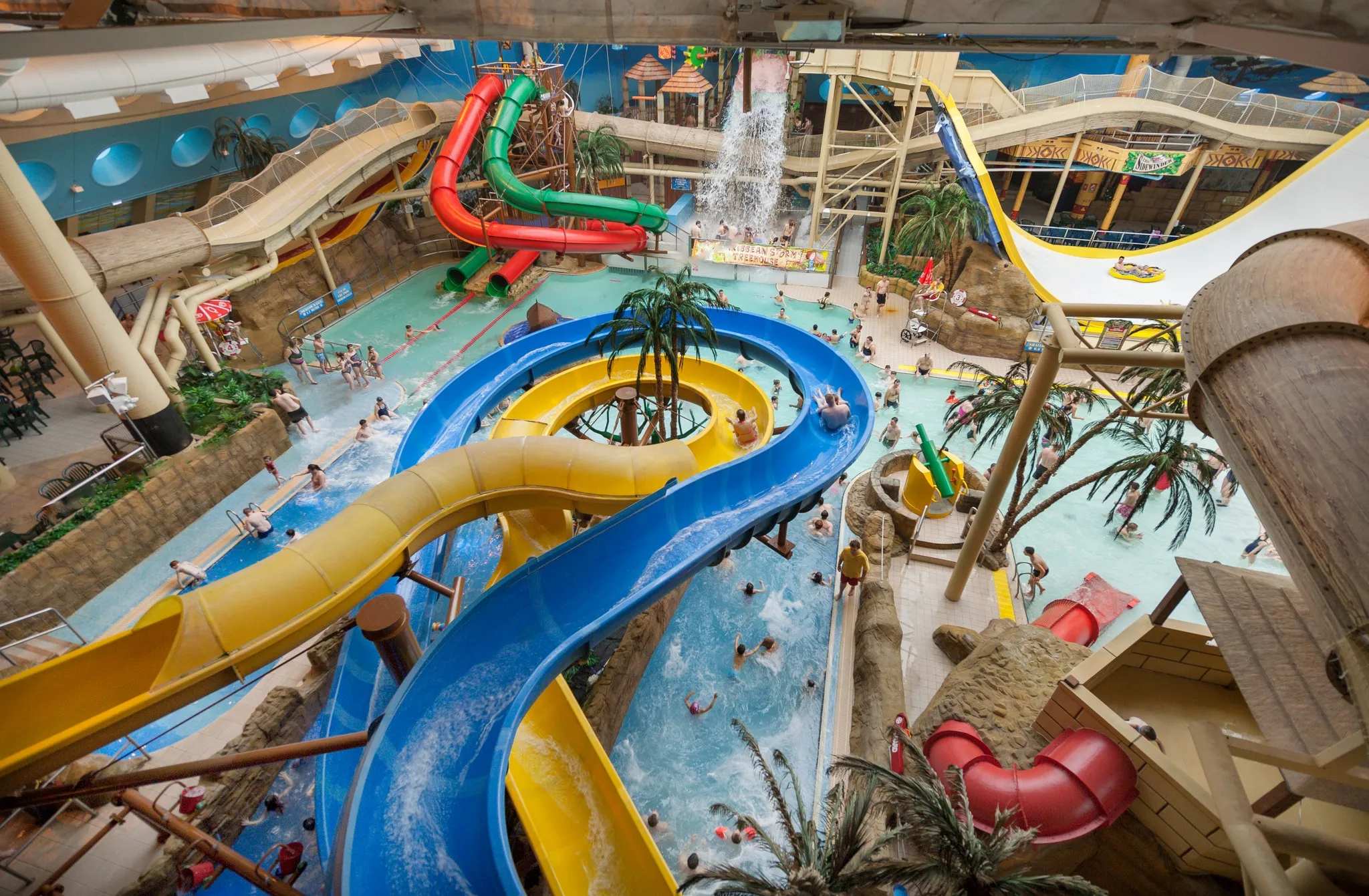
Sandcastle Waterpark, Blackpool
Sandcastle Waterpark in Blackpool is the UK’s largestCredit: Sandcastle Waterpark Blackpool / Facebook
As the UK’s largest waterpark, it’s safe to say there’s absolutely loads of indoor fun to be had at Sandcastle Waterpark in Blackpool.
The attraction boasts 18 slides, ranging from the toddler-friendly treetops water chutes to a climbing frame where a giant coconut dumps 600 gallons of water onto unsuspecting swimmers.
Older thrill-seekers can tackle five record-breaking white-knuckle rides, including the Sidewinder, the world-first indoor half-pipe, and the Masterblaster, the UK’s longest indoor water rollercoaster.
While the kids run wild, adults can escape to the Sea Breeze Spa for an extra £7 to unwind in the sauna, steam room, and aromatherapy lounge.
For the ultimate VIP day out, the £60 Tiki Cabana package gets you park entry, lunch and unlimited drinks, spa access, and a private retreat complete with a TV and hot tub.
Standard tickets start at £24.95 for those aged 12 and over, £15.95 for kids aged three to seven, and under-threes get to splash around for free.
Waterworld, Stoke-on-Trent
Waterworld Aqua Park in Stoke on Trent has over 30 different rides and attractionsCredit: Waterworld Leisure Resort
This waterpark with tropical temperatures packs in over 30 different rides and attractions under one roof.
Test your nerves on the lightning-themed Hurricane ride that descends at 17mph, or brave the Thunderbolt – the UK’s first trap-door flume that plummets you downwards at a terrifying 25mph.
If you want something a bit gentler, toddlers will love the gentle twists of the newly refurbished Python slide, while the whole family can enjoy the swirling rapids and wave pool.
When you need a breather, you can chill in the calming bubble pools and fuel up on pizza, bubble waffles, and milkshakes at the on-site restaurant.
Outside of the waterpark, the wider leisure resort contains the M Club Spa and fitness centre as well as a tiki-themed adventure mini-golf course.
General admission tickets start at £24pp.
Blue Lagoon Water Park, Wales
Zip down a rubber ring ride at Blue Lagoon WaterparkCredit: bluestonewales
Beneath its giant, curved glass dome, the Blue Lagoon Water Park hides a massive wave pool, four high-speed flumes, a lazy river, bubbling spa pools and more.
Here the kids can make a splash on mini slides and water cannons at Nippers Cove, or even join in on magical mermaid schools and pirate-themed events.
While the pool complex is normally reserved for holiday park guests, you can still visit without booking an overnight stay by grabbing tickets to a public open day.
The next public open day takes place on October 28 between 6.30pm and 9pm, with entry costing a budget-friendly £11.55 per person.
The complex is completely free however for guests staying on-site at Bluestone National Park Resort, making it the perfect excuse to book in a staycation.
You can bag a three-night break in a stylish wooden lodge sleeping four from £420, working out to £35pp per night.
Alton Towers Waterpark, Staffordshire
Alton Towers Waterpark at Splash Landings Hotel has tropical temperaturesCredit: Alamy
You don’t need to brave the theme park’s giant rollercoasters for an action-packed day out at Alton Towers.
The attraction boasts its own massive tropical waterpark with toasty temperatures right in the Staffordshire countryside.
Adrenaline junkies can tackle the epic Master Blaster water rollercoaster, twist down the indoor Rush ‘N’ Rampage slides, or brave the outdoor Flash Floods flume before splashing into the giant pool.
Meanwhile, little ones can run wild in the Wacky Waterworks Treehouse, a sprawling play zone packed with over 70 interactive features including water cannons and tipping buckets.
If you prefer a more relaxing pace, you can drift peacefully along the lazy river or simply kick back on a lounger with a drink while the kids wear themselves out.
When hunger strikes, you can grab burgers and chicken strips at the Calypso Cave, or treat the family to ice cream sundaes and floats from the Ice Cream Shack.
Standard tickets start at £18 when booked online, with kids under 90cm going completely free.
There are also parent-and-toddler passes available from £23.
Coral Reef Waterworld, Bracknell
Kids can play in the pirate ship at Coral Reef Bracknell
Bracknell’s Coral Reef Waterworld is one of England’s largest indoor water parks. With 30C temperatures and a giant pirate ship to play in, it makes for the ideal rainy-day family escape.
Little ones can run wild in the pirate ship and battle against each other with water cannons, or even dodge the ‘eruptions’ of the giant water volcano.
Older kids can tackle five high-tech waterslides, including the 67-metre high-speed Cannon chute and Poseidon’s Peril, a neon-lit, colour-changing raft ride built for two.
If you need to catch your breath, the main swimming pool has plenty of calmer spots to float around, featuring a swirling rapid river and relaxing bubble pools.
There’s even an adults-only Coral Spa where you can completely unwind on heated sun loungers, chill in a Japanese steam room, or sweat it out across three saunas.
Tickets from £18.60 for adults and £13.20 for kids.
Alpamare, Scarborough
Alpamare has four intense water rides themed around ski runsCredit: TripAdvisor
Scarborough‘s Alpamare is a totally unique waterpark that truly lives up to its claim of being “unlike any waterpark you’ve seen before”.
Here you’ll find four massive, ski-themed waterslides: the Cresta Run, Olympic Run, Black Run, and Snowstorm.
Each will send you flying through high-speed twists, turns, and giant spinning funnel bowls.
There’s also a huge main indoor pool, which ripples with waves every 30 minutes. You can also brave the outdoor chill and take a dip in a heated outdoor infinity pool.
Alpamare also has its own spa, which might just be the most unique of the bunch.
The spa offers a hammam, LED ice showers, foot baths and even a Sauna World complex with plenty of room for sitting down and heating up.
Plus there’s a totally bizarre Hay Bath aromatherapy experience, where you relax on a lounger surrounded by fresh local Yorkshire hay – where the natural scent is designed to soothe the senses.
Tickets start at £10 for adults, £7.50 for kids, and £2.50 for toddlers when you book ahead online.
The Wave, Coventry
There are six water rides to choose from at The Wave in CoventryCredit: TripAdvisor
The Wave is a giant indoor waterworld containing the UK’s largest wave pool, which churns over 20 million litres of water every single day.
Zip down your choice of six high-octane flumes, including the stomach-churning Riptide – a massive half-pipe slide that blasts rubber ring riders down a terrifying near-90-degree drop.
You can also take on the dizzying Cyclone ride that spins swimmers around a giant open bowl, while younger children can safely splash away from the big drops in The Reef, a vibrant play area packed with mini slides and fountains.
If the parents need some well-deserved peace and quiet, they can escape the chaos and head over to the luxurious on-site Mana Spa.
Here you can swim gentle lengths in a quieter pool, sweat it out in the sauna and steam room, or switch off in the soothing aromatherapy suite.
Adult tickets cost £15, kids aged 11 and under £13, and babies under one go for free.
Time Capsule Water Park, Scotland
Time Capsule waterpark in Scotland is one of the most affordable on our listCredit: Active NL
Time Capsule Water Park in Coatbridge, Scotland is a brilliant budget-friendly option that even comes attached to an indoor ice rink for the ultimate action-packed day out.
Inside the massive water complex, you’ll find a lazy river, twisting waterslides, and kids splash zones lined with water cannons.
Thrill-seekers will want to make a beeline for Tornado Tantrum, a tall flume packed with twisting drops alongside dramatic thunder and lightning effects.
Younger kids can safely splash around the toddler-friendly Cove Island, or dry off and run wild in the Tiny Tots indoor soft play area.
When it’s time to refuel the family, grab a cold drink and a poolside burger at the on-site Tsunami Cafe.
This waterpark is one of the cheapest on our list, with adult tickets costing £6.50 and kids £4.50, plus the bonus of completely free parking.
LC Swansea Waterpark, Wales
Learn to surf on the Boardrider simulator at LC Swansea, WalesCredit: LC Swansea
Taking the crown as Wales‘ biggest waterpark, LC Swansea goes way beyond your standard indoor pool and slide.
Here you can learn to surf on the Boardrider simulator, or hop on a rubber ring ride that blasts you uphill before gravity sends you plummeting back into the pool.
The Volcano Bay zone is the perfect place for the kids to burn off energy with interactive fountains, toys and tipping buckets.
But you can always escape the madness by floating down the peaceful lazy river or sinking into the bubbling whirlpool.
The fun doesn’t stop once you dry off, thanks to a massive underwater-themed indoor play area spanning four storeys of obstacles just next door, as well as a 30ft climbing wall.
Plus there’s a Costa Coffee for well-deserved snacks and drinks and a handy shop for forgotten swim gear.
You won’t have to empty your wallet to enjoy it all either, with tickets starting at £5.31 for adults and older kids.
Toddler tickets (ages one to three) cost £2.97, and babies go free.
British monarch highlights AI’s potential darker capacities, urging safety and humanity-focused development.
Published On 17 Sep 202617 Sep 2026
The United Kingdom’s King Charles has warned Artificial Intelligence (AI) industry leaders of the “existential dangers” posed by the technology if it falls into the wrong hands.
The monarch’s comments on Thursday add to a global debate over whether, and how to regulate the industry.
Recommended Stories
list of 3 itemsend of list
Charles hosted AI giants, including the cofounders of Nvidia and Google DeepMind, along with leaders from OpenAI and Anthropic at a summit at his Dumfries House estate in Scotland, to address safety concerns before it was “too late” to rein it in.
“There seems urgency in adequately considering the existential dangers of such technologies falling into the wrong hands, and being used in potentially catastrophic ways,” Charles told guests at the opening of the conference.
“Those in our world who value our humanity and its vital moral component are anxiously seeking your reassurance that we will not lose control of our destiny,” he told the industry leaders.
“Those who have created these technologies are now increasingly warning that AI risks developing darker capacities, perhaps even to take life,” or be used in “potentially catastrophic ways”, the king also said.
In recent weeks, global figures have weighed in on whether the industry should regulate itself or allow governments to produce guidelines on how the rapidly evolving technology develops.
In May, Pope Leo XIV said ”the world does not need an artificial intelligence that diminishes humanity” and must be “disarmed”.
Meanwhile, US President Donald Trump has dismissed concerns about the technology as a “hoax”.
Slow the pace of AI development
Last week, two Anthropic researchers warned that the rapidly advancing technology could lead to human extinction in the not-too-distant future.
Anthropic Chief Executive Dario Amodei has also called for companies to slow the pace of AI development.
However, that has prompted an international debate about whether some executives were trying to get ahead of a possible government backlash and set the rules to keep the lead of particular companies.
“The development of AI – its substance and its pace – are both intriguing and deeply concerning in equal measure,” the British monarch said.
He urged industry leaders to harness it “with safety at its heart” and “to ensure that it remains firmly in the service of humanity, community and the natural world”.
The summit in Scotland is not expected to produce any binding agreements.
WITH autumn here and the 2026 never-ending heatwave in the rearview mirror, it’s time to brush up on our knowledge of rainproof attractions.
So, there’s no better time to discover some fun indoor attractions to keep the family occupied as the weather turns – and we have quite a few to share.
There are a number of great indoor attractions across the UKCredit: Flip Out
Whether you prefer adrenaline-filled rides or obstacle filled challenges – there are loads of great indoor attractions across the UK.
From older kid favourites to the ideal toddler spots, here are the top indoor UK theme parks and attractions:
Sign up for the Travel newsletter
Thank you!
Win one of five incredible holidays to Turkey, the Norwegian fjords and Spain by voting in The Sun’s Travel Awards – enter here to win.
Babylon Park, London
Babylon Amusement Park, London, is one of the only fully indoor theme parks in the countryCredit: Supplied
Found in Camden, London, Babylon Park is one of the only fully indoor theme parks in the UK.
The entire attraction is outer space-themed and boasts different rides and attractions such as a rollercoaster, a drop tower, bumper cars and an arcade.
The park is free to visit but to go on the different rides and attractions you’ll need to buy Game Coins, Bonus Coins and Ride Coins.
Packages for these cost between £14 to £100.
The Playhive, North Yorkshire
The Playhive, North Yorkshire, has four themed areas for kids to exploreCredit: The Playhive
Stockeld Park in North Yorkshire is home to The Playhive, which calls itself one of Europe‘s largest indoor playgrounds.
Inside, there are four themed worlds including space, air, jungle and sea.
The different areas feature giant slides, games, tunnels and climbing trails.
Tickets cost from £11 per person, which includes entry to the entire Stockeld Park attraction as well as The Playhive.
Woodlands, Devon
Woodlands in Devon claims to be home to the biggest indoor soft play in the countryCredit: Alamy
In Devon, Woodlands family theme park has loads of outdoor attractions to explore, but when the weather gets ba, d head inside and you will find what the park claims to be the biggest indoor soft play in the country.
There are multiple different areas for kids to explore across five floors, with net towers, drop slides and ball pits.
There are even specific areas for little ones too.
Big kids – or daredevils – have more thrilling attractions such as a 15.2-metre drop ride too.
And parents can feel at ease by keeping an eye on the kids from one of the many tables around the play area.
Tickets cost £16.50 for adults and kids over 92 cm, which includes access to the theme park and indoor adventure park.
Older kids will love Gravity Max which has two venues – one in Wandsworth and the other in Westfield Stratford.
The attractions feature a huge e-karting track that looks like a real-life Mario Kart game.
There’s also immersive bowling, AR darts, and VR arenas.
Individual activities cost from £16 per person.
Ninja Warrior UK Adventure Parks, multiple locations
You can even try out your Ninja Warrior skills in several UK destinationsCredit: Ninja Warrior UK
Who hasn’t wanted to try out the Ninja Warrior course? Well, you can in a number of places across the country.
With 15 venues across the UK including in Sheffield, Milton Keynes, Cardiff, Bristol and Leicester, the indoor Ninja Warrior UK Adventure Park obstacle courses are the perfect way to have fun indoors.
The obstacle courses have balance beams, monkey bars and the famous TV show obstacle, The Warped Wall.
Tickets cost from £9.50 per person.
Zip World, Llechwedd
There’s an underground cave attraction in WalesCredit: Not known, clear with picture desk
Head underground at Zip World Llechwedd in Wales, where there are caves and huge trampolines in a disused slate mine.
There are a number of different activities to choose from including Underground Golf with neon lights from £29 per person.
Or for the same price, there’s a cave tour.
For kids needing to let off steam, there are Bounce Below with a number of giant trampolines across six chambers.
Bounce Below sessions cost from £29 per person.
For the ultimate adventure, head to Caverns at the attraction, where you can zip line through the caves for £79 per person.
Play Factore, Manchester
Play Factore in Manchester has a giant play frame with spider netsCredit: Play Factore
Play Factore in Manchester claims to be the biggest indoor entertainment attraction in the UK.
Inside, there’s a giant play frame with spider nets, rollers and even the UK’s tallest indoor standing slide.
For younger guests, it has the biggest toddler area in the country too.
Tickets cost from £2.95 to £12.95 depending on the kids’ age, while adults pay £4.75.
Adventure Inside, Essex
Adventure Island in Essex has a six-storey soft play areaCredit: Adventure Island
Over in Essex, Adventure Inside has a six-storey soft play area with monkey bars and ball pits, ideal for young children.
There’s also a carousel, drop tower ride,swinging pirate ship and a racing spin ride.
An Adventure Island Day Band costs from £30 per person.
And currently, when you buy one you’ll get an annual pass as well for free.
Riverside Hub, Northampton
Riverside Hub in Northampton has imaginary worlds for kids to play inCredit: facbook
In Northampton, Riverside Hub is home to several different zones which include Role Play Villages where kids can explore an imaginary world with its own cafe, shop, witch’s house and tooth fairy dentist.
Older kids aren’t left out though as they can try out different climbing activities, including a 10-metre beanstalk.
There’s a giant play frame with slides, games and even a football pitch too.
Travel writer Catherine Lofthouse said: “There’s so much to do here that it’s a struggle to fit it into the two and a half hours that each session is allocated.
“We could have happily spent the whole day and still have gone back for more.
“With three boys aged between five and 12, it can sometimes be difficult to find somewhere that has enough to keep all ages happy as the older two are getting a bit big for soft play, but that certainly wasn’t a problem here.”
Tickets cost £8.50 per adult, £14.50 per child aged one to three-ears-od and £17.50 for kids between four and 17-yers-old.
Flip Out, various locations
Flip Out has venues across the UK with inflatable obstacle coursesCredit: Flip Out
Another great indoor attraction with venues across the UK including Bradford, Doncaster, Chichester and Coventry, is Flip Out.
Inside each venue there is a trampoline park with foam pits and stunt walls.
Some venues have additional attractions such as Flip Out Canary Wharf, where there is also laser quest and bumper cars.
Prices vary depending on destination and session length.
The city has been highlighted by Tripadvisor Travelers’ Choice Awards: Best of the Best Restaurants for 2026, which is based on first-hand reviews from millions of travellers over the last year
One UK city is.a standout when it comes to food(Image: Getty Images)
A charming UK city with medieval streets and a towering minster is also home to the country’s best restaurants.
While the silver-spoon-holding residents of foodie capitals London, Manchester, and Edinburgh may consider themselves to live in the UK’s culinary epicentre, they’re wrong.
The newly released Tripadvisor Travelers’ Choice Awards: Best of the Best Restaurants for 2026, which is based on first-hand reviews from millions of travellers over the last year, shows there is one UK city with a far higher concentration of great eateries than anywhere else, despite having a population almost 50 times smaller than London.
The city of 200,000 had the highest-ranked restaurants of anywhere in the UK, with Brazilian joint Casa Brazilian Rodizio ranking eighth worldwide. The family-run, authentic Brazilian rodizio-style restaurant aims to “provide an unforgettable authentic taste, service and experience for an unbeatable set price!” By all accounts, it has succeeded.
“Went out for a family meal yesterday, the food was absolutely amazing, the place was astonishing. The meat tasted rich, and the buffet had so many amazing options,” wrote one of Casa Brazilian Rodizio’s reviewers among the thousands awarding it 4.9/5 stars.
Other York restaurants performed really well in the UK rankings, with Buongiorno, Enoteca By L’uva and Damastique making the top 25 in the ‘best casual dining’ list. Legacy At The Grand also found itself at number seven in a rundown of the UK’s best date-night restaurants, and Melton’s reached the same spot on the ‘best fine dining’ rundown. And finally, the family-run Turkish outfit Kapadokya 50 was named one of the UK’s best hidden gems.
York’s rise to become the country’s premier gastronomy spot is an interesting one. The medieval city has always tempted in history buffs with its minster, Jorvik Centre and Quilt Museum, and it’s long boasted of having more pubs than days of the year to drink in them, a fact that seemed suspect when I lived there a decade ago and is almost certainly not true now. But the foodie revolution that’s taken place there is a more recent and quiet phenomenon.
A new crop of young chefs has been putting the city’s food in the spotlight, in backstreets from Micklegate to The Shambles. Among the gang is Tommy Banks, one of the youngest chefs in the UK to win a Michelin star, who leads Roots York in the city centre. His cooking relies heavily on homegrown produce, farm-to-table tasting menus, and unique preservation techniques.
Another is Ahmed Abdalla, head chef at Legacy inside The Grand hotel, who creates modern British tasting menus with classic Yorkshire ingredients. And Joshua and Victoria Overington run Restaurant Mýse, a place that specialises in local Anglo-Saxon culinary heritage.
The Michelin Guide lists 16 restaurants in York and its surroundings, three with stars and a Michelin Green Star, including Roots and Mýse.
Eduardo Caetano, owner of Casa Brazilian Rodizio, opened the restaurant 11 years ago. “The philosophy of the restaurant is casa, which means home. When you come in, you come into our home. You are my guest. If the food is not good enough for me, it’s not good enough for me,” he told the Mirror.
“The offering in York is an extremely competitive market, there are loads of places to eat. I love that there are so many family businesses here. For me, York is the only place in the world that feels like home.”
In terms of places in York he loves to eat, Eduardo recommended Delrio’s Italian Restaurant. “I love going there,” he added.
It’s not just in high-end restaurants that York is excelling; its casual dining scene is also strong. Recent additions doing well locally include authentic Neapolitan pizzeria Cresci Pizzeria, which has become a citywide favourite, while the gut-busting sandwiches of Browns in Heslington remain a cheap, filling option.
This all sits against a backdrop of the Shambles Market, York’s main daily open-air market, located at Silver Street in the heart of the city. Come early November, it is joined by the Christmas Market, with Alpine chalets filling up Parliament Street and St Sampson’s Square. Whether you find festive fare charming or a logistical impediment, stallholders not only bring a real buzz to the city, but plenty of gastro-delights.
You can get loaded on artisanal hot cocoa, locally made gin, scratchings, high-end crumble and much more.
Similarly, the long-term culinary heritage of York is evident in its fantastic pubs, many of which also serve up delicious food. The House of Trembling Madness is a wonderfully wonky pub that pairs cheese boards and yards of ale, while Valhalla York on Patrick Pool is a Viking-themed ale house serving hearty meat and cheese boards alongside local mead and ales.
The success of York as a food city is no accident. The city has actively invested in growing this reputation through events such as York Restaurant Week, now one of the UK’s biggest events of its kind since its 2019 launch, with the most recent edition doubling to two weeks and featuring over 100 participating venues. The previous October’s event saw over 22,000 vouchers downloaded, bringing in nearly £400,000 for local businesses, a 70% jump from the year before.
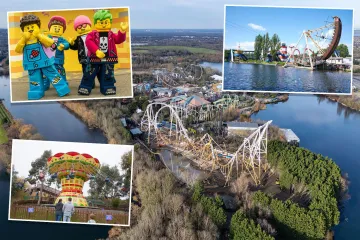
A family theme park near a seaside town with more than 30 attractions and tickets starting from £16, has been named the UK’s best for this year, but not everyone has heard of it
This coastal theme park was named the UK’s best for under 1 million visitors (Image: Facebook/Pleasurewood Hills)
With the warm summer days a distant memory, thoughts are turning to how we can spend our time when the weather isn’t dependent. Theme parks are a great option, with any worries about the weather quickly vanishing as you whizz around an exhilarating ride or venture around the colourful site packed with attractions.
The UK is brimming with entertaining and family-friendly theme parks, whether you’re an adrenaline junkie or want a day out that’s suitable for all ages. While we’ve all heard of Alton Towers, Thorpe Park and Legoland, they’ve been pipped to the post by a lesser-known attraction for the title of the UK’s best theme park.
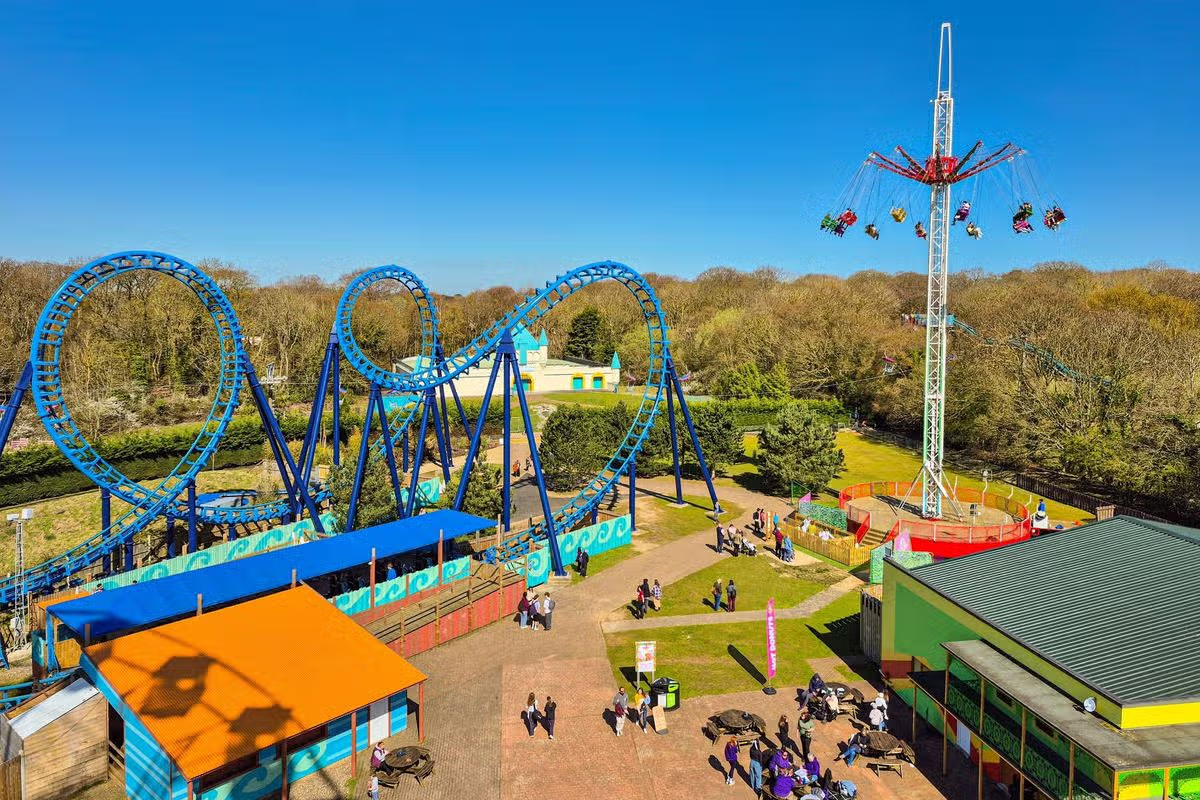
Pleasurewood Hills near Lowestoft in Suffolk was crowned ‘Theme Park of the Year’ for under 1 million visitors, in this year’s UK Theme Park Awards, presented by AttractionTickets.com. Located near the Suffolk coast between Corton and Gunton, the biggest theme park in East Anglia has 30 fun-packed rides and attractions across its 59-acre site, from family favourites to thrill-seeking ventures.
Some highlights include the park’s wild mouse roller coaster, Marble Madness, the Jolly Roger, a stomach-churning drop tower, and the water flume ride, Water Fun Factory. But that’s just the start of their offerings, with plenty more rides that are suitable for all ages.
There’s Woody’s Wheel to savour the coastal vistas, the Flying Elephants, the pirate ship, Shiver me Timbers, the small coast, the Egg-Spress and Wavebreaker, and an exciting waterslide down a winding course. In addition, visitors can watch a sealion or colourful bird show, before visiting the indoor soft play area, Woody’s Cub House, take a drive in a safari car, and ride the carousel or Woodland Express.
Elsewhere, Pleasurewood Hills’ flagship roller coaster is the towering Wipeout, which stands more than 130ft high and whizzes guests around its twisting, turning, looping, and rolling track, before reversing on itself for the “ultimate backwards thrill”. However, it’s currently closed after it broke down over the summer, leaving riders stuck on board for up to three hours, with it expected to reopen by the end of October.
Following this, one of the theme park owners, Freddy Stokes, said their ‘Theme Park of the Year’ award had not been something “we were expecting to win”. The UK Theme Park Awards were based on public votes held prior to the issues with the Wipeout ride.
Pleasurewood Hills is open from 10am until 4pm on Saturday and Sunday during off-peak seasons, and additionally opens Monday to Friday during the October half-term, with opening times varying. However, you don’t have long to visit as the theme park will close for the season on Sunday, 1 November, with an opening date for 2027 yet to be confirmed.
Online tickets for the Suffolk theme park start from £16 per person, while they can also be purchased on the door from £29 per person. For more information, visit the Pleasurewood Hills website.
Do you have a travel story to share? Email webtravel@reachplc.com
I CAN’T say my weekends are usually spent dressed as a fox in the middle of a forest, springing about in an aerial bungee or learning Bollywood dance routines.
But I certainly wish more of them were.
A bit like an American summer camp but for grown-ups, Camp Wildfire incorporates outdoorsy activities like tree-climbing and paddleboarding with campfire singalongs – and, importantly, cocktailsCredit: SuppliedYou’ll fill your entire festival with your pick of 100 activities, from beekeeping to rifle shootingCredit: Supplied
I was at Camp Wildfire in Kent – a three-day festival that’s far from your average Reading or Glastonbury experience.
A bit like an American summer camp but for grown-ups, Camp Wildfire incorporates outdoorsy activities like tree-climbing and paddleboarding with campfire singalongs – and, importantly, cocktails.
Sign up for the Travel newsletter
Thank you!
Upon arrival, festivalgoers are asked to join one of four teams: Foxes, Badgers, Hawks or Squirrels.
One pair of fluffy ears and face-paint whiskers later, I had made myself part of the Fox patrol.
Forget scouring a lanyard for your favourite bands’ set times – a weekend here begins by charging into a games arena with your new animal teammates to take on a series of Sports Day-style games like tug-of-war that will earn your team “Patrol Points”.
You’ll fill your entire festival with your pick of 100 activities, from beekeeping to rifle shooting, all while collecting points for a grand finale at the end.
I chose to begin with quad biking – I truly can’t think of a better wake-up call than riding into the breeze through the Kentish countryside, taking in whiffs of wild mint.
Next came flower headdress-crafting, followed by a potion-making class that left me smelling of lavender and clutching some homemade skincare.
Jenna chose to begin with quad biking – riding into the breeze through the Kentish countryside,Credit: SuppliedThere was also a climbing wall on site to try outCredit: Supplied
By this point I was feeling like a total wilderness goddess, which gave me the confidence boost I needed to channel my inner acrobat for my final activity of the day: twirling on the aerial silks. All of this before 5pm left me in serious need of a drink.
Thankfully, there are regular cocktail masterclasses, where visitors can learn to pour favourites like the perfect Pornstar Martini ahead of the nighttime acts.
Evening entertainment at Camp Wildfire is some of the best I’ve experienced.
Yes, there’s great music, with everything from Disney singalongs to reggae and techno dance tents.
But there are also fabulous comedy acts, a board games bar and even an astronomy tent for stargazing.
The music continues well into the early hours but with laser clay shooting first thing in the morning, I made sure to rest up.
Precision was equally as important for pyrography, where I decorated a wooden coaster with a heated metal pen, although it was less critical for aerial bungee.
If you’ve never jumped around in a giant harness, pulling Superman shapes and Spider-Man jumps, I highly recommend it – you’ll split your sides laughing and become more flexible, too.
Jenna enjoys the fireworksCredit: Supplied
My final activity was a Burlesque class, where I managed to bag a Patrol Point, but sadly, it wasn’t enough for us Foxes to take the lead.
That didn’t stop me cheering on the winning Hawk team at the dramatic closing ceremony, though, where all visitors are invited to enjoy an impressive drone show.
We’ll get ’em next year, Foxes!
ULTRA-earlybird tickets for Camp Wildfire 2027 are live now and cost from £259pp for the weekend. Super-earlybird tickets go on sale from October 2 and start at £269pp.
All tickets include general camping. For details or to book, see campwildfire.co.uk.
WHAT’S better than an annual trip to the theme park? Several trips, of course.
If your family is a big fan of rollercoasters, there are some brilliant value annual passes for parks across the UK that offer HUGE savings for repeat trips.
The UK is home to loads of theme parks and family attractions – most of which have great annual pass offersCredit: Alamy
But which one should you go for? Instead of having to research them all yourself, we have gathered the annual pass prices for the most popular theme parks in the UK.
So here’s all the attraction passes you could get, and how many times you’d need to return to your favourite attractions to get your money’s worth.
Merlin Annual Pass
Starting off with probably the most famous annual pass in the UK, the Merlin Annual Pass gets you access to more than 20 attractions.
These include Alton Towers, Thorpe Park and Legoland Windsor, Cadbury World, Windsor Castle, Legoland Discovery Centres and much more.
An essential pass costs from £139 per year and allows members 339 days of access to Merlin’s top attractions.
For £239, you can get a Gold pass which also gets you free parking and 20 per cent off shopping and dining.
The Platinum Pass is then £299 per year, giving you all that plus four free bring a friend passes each year, one free fast track per visit and free Coke Freestyle cup & refills.
Tickets for Alton Towers alone start from £32 per person when booked in advance online, while Warwick Castle tickets cost from £25.38 online, so if you’re planning on doing several Merlin attractions each year there are big savings to be had.
To make the most of the £139 annual pass, you’d need to go to just four or five attractions across the entire year.
For example, if you booked Alton Towers (£32), Warwick Castle (£25.38), Thorpe Park (£32), Cadbury World (£18) and Legoland Windsor (£32) once each across the year, you’d make up the price of the pass.
Alton Towers
Alton Towers is the UK’s largest theme park and offers a whole host of exciting rides
You can stay onsite at the main Alton Towers Hotel, the CBeebies Land Hotel, Splash Landings Hotel, themed Woodland Lodges or at Stargazing Pods.
An annual pass costs £64, while day tickets start from £32 per person when booked in advance online,
You’d need to visit just twice across the year to get your money’s worth.
Thorpe Park
At Thorpe Park, you can head on the UK’s tallest and fastest rollercoasterCredit: Alamy
Surrey’s Thorpe Park is often considered the UK’s main thrill-seeker theme park.
The theme park itself sits on an island and has a number of record-breaking rides.
For example, you can head on Hyperia, which is the UK’s tallest and fastest rollercoaster, and in the autumn, the theme park is well-known for its Fright Nights.
The Thorpe Park Annual Pass costs £64 per person and allows you access to the park across 189 days over 12 months, as well as access to the Fright Nights.
Thorpe Park one-day tickets start at £32 per person when booked in advance online
Passes are only required for guests over 1.2metres tall.
Again, you’d need to visit just twice across the year to make the pass worthwhile.
Legoland
Legoland is the perfect family day out with younger kidsCredit: Supplied
Legoland Windsor is aimed at families with kids aged between two and 12 years old.
You’ll find miniature worlds made out of bricks and family-friendly coasters, plus plenty of Lego building opportunities.
The Legoland Annual Pass costs £64 per person and allows you access to the park across 236 days, over 12 months. Day tickets start from around £34 when booked online.
Passes are only required for guests 90cm and over, and after two visits you’d have made your money back.
Crealy
At Crealy, you can go on more than 60 rides and attractionsCredit: Alamy
Crealy theme park in Devon has a number of different annual passes.
The theme park is the largest in Devon with more than 60 rides and attractions including rollercoasters.
The cheapest is £99 per person, per year – which you can pay in one go or you can pay a £30 deposit, then £6.90 a month on direct debit for an annual pass (costing £112.80 total).
This annual pass gets you unlimited entry to the theme park, a 10 per cent discount across food and drink as well as in the shops and exclusive viewings of Crealy events.
The next level up is the Gold Pass at £120, which gets the same perks but you will get 15 per cent off food and drink, 30 per cent of entry for family or friends and 20 per cent off glamping and camping breaks at the park.
Get a Platinum Pass for £170 and you’ll get 20 per cent off food and drink, 50 per cent off entry for family and friends, 50 per cent off glamping and camping stay and even a free two-night camping break.
One-day tickets for Crealy Theme Park & Resort cost around £24 per person when you book online.
You’d therefore need to visit five times at least across the year to make the pass worthwhile.
Woodlands
Woodlands in Devon has a giant soft plat insideCredit: Alamy
Woodlands Theme Park, also in Devon, is home to massive indoor play areas including soft play, water coasters and a toboggan run.
There’s also a number of barns with farm animals in.
The annual pass, costing £110 per person over 1.1 metres and £86 for those under that height, includes unlimited free access to Woodlands Family Theme Park with outdoor rides, indoor soft play, an eight-acre zoo farm, and falconry.
You’ll also get 15 per cent off at the gift shop, 10 per cent off food and drink and 20 per cent off camping stays.
One-day tickets cost £29.75 for adults and kids over 110cm, and £21.95 for kids.
As an adult, you’d need to visit four times across the year to make the pass worthwhile, and the same amount of visits to make the kids pass worthwhile.
Drayton Manor
At Drayton Manor, you can head to a Viking-themed areaCredit: Alamy
Drayton Manor in Staffordshire is ideal for families with kids aged four to 12.
The rides are tamer, with a Thomas Land including Thomas the Tank Engine himself and a Viking-themed area with spinning and rocking rides like the Thor Zampa Disco.
Drayton Manor has three different passes.
The cheapest is the Silver Annual Pass, which costs £75 per person (£45 per child aged two to three-years old) or you can pay for annual pass monthly, costing £35 for the first month then £5 a month for 11 months (£90 total).
This pass gets you unlimited visits to the park, 10 per cent off food and drink as well as the shop, freemini golf, 10 per cent off hotel bed and breakfast, 20 tickets for £20 for family and friends and discounts on photos.
The £99 annual pass (£65 per child aged two to three-years old) gets you all of the above, but discounts are 20 per cent on food and drink and the shop.
And last but not least is the ultimate pass costing £249 per person over the age of three (under this age no pass is needed).
With this pass you get all of the above, but also unlimited visits to West Midlands Safari Park and Waterworld, as well as discounts at each of those attractions.
Drayton Manor one-day tickets start at £25.80 for visitors aged 12 and over, and £14 for children aged 2 to 12 when booked online.
You’d need to visit three times across the year to make the annual pass worthwhile (four times for under three-year-olds).
The Big Sheep
The Big Sheep in North Devon is home to farm experiences as well as ridesCredit: Alamy
The Big Sheep in North Devon has farm experiences as well as rides and live shows.
Season tickets for The Big Sheep cost £50 per person.
You then pay £1 each time you visit if you book online, or £2 at the door.
The pass includes a member’s day where you can bring a guest for free, discounts on events, a 10 per cent discount on food and drink, as well as a 10 per cent discount in the shop.
One-day tickets for the Big Sheep in North Devon start from £14.95 for adults and children over three feet tall when booked online.
You’d need to visit at least four times to make the annual pass worth it.
Gulliver’s World
Gulliver’s World has four sites across the UKCredit: Alamy
There are a number of Gulliver’s World theme parks across the UK including Warrington, Matlock Bath, Milton Keynes and near Sheffield.
Each park is slightly different, with themed zones and attractions aimed at kids under the age of 13.
The parks often host events too such as Fright Fiesta for Halloween and the winter Land of Lights lantern festival.
For £99, you can get a 12 month pass allowing unlimited entry to all Gulliver’s Theme Parks (Warrington, Matlock Bath, Milton Keynes & Rother Valley).
You’ll also get entry to Gulliver’s Dinosaur & Farm Park in Milton Keynes, plus discounts on short breaks.
One-day tickets for Gulliver’s World Theme Park Resort cost £28 when booked as an online advance ticket.
You’d need to visit four times across the year to make your money back on the pass.
Flamingo Land
Flamingo Land has a Peter Rabbit Adventure areaCredit: Alamy
Flamingo Land Resort in North Yorkshire spans across 375 acres and features a zoo as well as rides.
For example, there’s Velocity, the UK’s first motorbike launch coaster.
You can also head to a Peter Rabbit Adventure area, ideal for younger kids.
An annual pass costs £199 to Flamingo Land and gets you unlimited access year round to the theme park and zoo.
Flamingo Land one-day tickets start from £46 per person when booked in advance.
You’d need to visit five times to make your money back on the annual pass.
Pleasure Beach Resort
An annual pass to Pleasure Beach Resort in Blackpool gets you access to other destinations in EuropeCredit: Alamy
Pleasure Beach Resort in Blackpool sits right by the seafront and is more than 125 years old.
Inside the park, there are a range of attractions including thrill rollercoasters.
There’s also a Nickelodeon Land, which has themed rides including Wallace and Gromit Thrill-o-matic.
The Platinum Annual Pass at Blackpool Pleasure Beach costs £125 per person and gives you unlimited entry for a full year.
But what makes it even better is that, included in the price, you get free entry to seven theme parks across Europe, including Efteling, Europa Park, Liseberg, PortAventura World, Emerald Park, Tripsdrill and Isla Magica.
All you need to do is show the Pleasure Beach Resort Platinum Pass Card when you arrive.
You are allowed one free entry to each attraction per pass holder, per year.
Blackpool Pleasure Beach one-day tickets start from around £30 to £34 when booked in advance online.
You’d need to visit between four and five times to make your money back on the annual pass.
Paultons
Paultons Park is the official home of Peppa PigCredit: Alamy
Paultons Park in Hampshire is spread across 140 acres and is home to more than 70 rides and attractions, including the official home of Peppa Pig.
The theme park has a number of different annual passes, but the cheapest is the Essential Pass which costs £172.
With this pass you get unlimited off-peak visits over 12 months.
And at the end of the year, if you renew, it will set you back £153.
The Star Pass costs £225 and gets you unlimited off-peak visits including some weekends (renewal would cost £203.50).
The Premium Pass costs £290 and gets you unlimited access to the park at any time, as well as discounts on food and drink and in the shop (renewal would cost £262).
Paultons Park one-day tickets start from £46.75 per person when booked in advance, and kids under 1m are free, so paying visitors would need to go at least four times to make the annual pass worthwhile.
Pleasurewood Hills
Pleasurewood Hills in Suffolk boasts over 35 ridesCredit: Alamy
Pleasurewood Hills in Lowestoft, Suffolk, is home to more than 35 rides and attractions, as well as live shows.
The park’s main thrill ride is Wipeout, which boasts six inversions.
A Standard Season Pass for unlimited access all season, but with some blackout dates (dates where you cannot attend the park – usually during peak season) costs £79.
Alternatively, you can get a Premium Season Pass, which gets you unlimited visits all season as well as exclusive perks and discounts such as 50 per cent off entry for family and friends and free parking for £99.
One-day tickets for Pleasurewood Hills start from £16.41 per person when booked online.
You’d need to visit at least five times across the year to make the most of the £79 annual pass.
Chessington World of Adventures
Chessington World Of Adventures is only 12 miles from central LondonCredit: Alamy
Chessington World of Adventures, about 12 miles from central London, is home to more than 40 rides across a number of themed lands.
And next year, the park is set to open a new Minecraft World, which will be the world’s first Minecraft-themed land.
A Chessington Annual Pass allows visitors access to the park across 339 days, costing £64.
Passes are only needed for guests 90cm and over.
Chessington one-day tickets start from £32 online in advance.
Visit the park twice to make your money back on the annual pass.
Lightwater Valley
In North Yorkshire, Lightwater Valley Family Adventure Park is ideal for younger childrenCredit: Alamy
Lightwater Valley Family Adventure Park in North Yorkshire is ideal for families with younger children, with safari-styled areas, pirate-themed rides and classic fairground favourites.
A seasonal pass costs £89 and includes unlimited entry throughout the park’s open days, including special events and Bank Holidays.
One-day tickets for Lightwater Valley Family Adventure Park cost between £22.00 and £27.00 when booked online.
You’d need to visit between four and five times across the year to make the pass worth it.
M&D’s
M&D’s is Scotland’s largest theme parkCredit: Alamy
The park has more than 40 rides and attractions to explore, including rollercoasters and children’s adventures such as a sky trail and Scotland’s only indoor tropical rainforest.
A season pass to the theme park costs £75 and allows you unlimited access to the park when it is open.
You will also get other offers like discounts on food and drink and a day where you can bring a friend for free.
M&D’s Scotland’s Theme Park offers free entry with ride all day wristbands costing from £20.13.
THE UK’s most famous observatory will soon close for two years for a massive renovation project.
Royal Greenwich Observatory in London dates back 350 years and will close for two years on November 2 to undergo a £77million upgrade.
Royal Greenwich Observatory in London dates back 350 yearsCredit: Jamie Fobert ArchitectsAnd soon it will get a £77million makeoverCredit: Jamie Fobert Architects
The project, dubbed ‘First Light’, “will bring the story of this historic site to life”, according to the Observatory, as well as “give everyone the chance to experience the wonders of space and time for themselves”.
The Observatory will be home to new galleries, refreshed displays, innovative architecture, as well as improved access for visitors.
Sign up for the Travel newsletter
Thank you!
As part of the project, there will be a new visitor centre which will be “the jewel in the crown of Greenwich’s UNESCO World Heritage Site”.
Inside the pavilion, there will be a gateway to the rest of the site, which will also have improved access overall, including full accessibility to the Great Equatorial Telescope for the first time.
There will be new galleries too, in which visitors can explore observation and scientific work that took place at the Observatory.
And there will be new, interactive astronomer galleries, ideal for kids who want to become scientists themselves.
They will explore the fundamentals of astronomy: Light, Matter and Motion.
Many of the existing displays at the attraction will get a refresh including John Harrison’s timekeepers and instruments used for the Prime Meridian line itself.
The Observatory will close for works in NovemberCredit: GettyWorks are then expected to be complete by 2028Credit: Jamie Fobert ArchitectsThe upgraded Observatory will feature new galleries and live science showsCredit: Jamie Fobert Architects
Visitors can meet astronomers and scientists as well, in the ‘Astronomers’ Court’, with events including live science shows.
Outside the Observatory, Greenwich Park will get new landscaping as well as plants.
The First Light project already began in autumn last year and it is set to be complete by spring 2028
The Royal Observatory will close on November 2, 2026 but parts of the attraction such as the Meridian Courtyard, are expected to reopen in summer 2027.
Held at Abingdon Airfield, the firework display is the biggest in the country and will take place on November 14.
It’s an incredible wraparound display with 270 degrees of fireworks across the airfield’s horizon with flashing lasers and lights all to music.
Sign up for the Travel newsletter
Thank you!
There’s also an earlier kids singalong fireworks show especially for youngsters – both fireworks displays are followed by the lighting of roaring bonfire.
Throughout the event, families can enjoy the rides at the largest fairground in the south of England.
There are over 100 rides and attractions like the waltzers, ghost houses, mirror houses and bouncy castles – each ride costs £2.
There will also be enormous monster truck rides doing donuts and epic fireball explosions too.
Music and live entertainment will be held throughout the evening including Kerin & Perry which are an act where ‘comedy meets dance nostalgia’.
When it comes to food and drink, there’s a food village with plenty of snacks to pick up, sweet treats, drinks and craft bars.
One visitor who went last year said: “It was an absolutely amazing event! Fireworks were out of this world, the fairground had a huge choice of rides and prizes for all games, food – delicious and not overpriced.”
Another added: “The fireworks are on another level! Each year tops the last; bigger, brighter, and more breathtaking every time. Easily the best we’ve ever seen.”
Another simply said they were “The best fireworks we have seen to date!”
One change for this year is there is less capacity in order to make the event more exclusive and comfortable – but it does mean fewer tickets are on offer.
So if you want to get yourself some, head to their website, here.
Adult tickets start from £20, tickets for children (3-15) start from £15 – those under three go free.
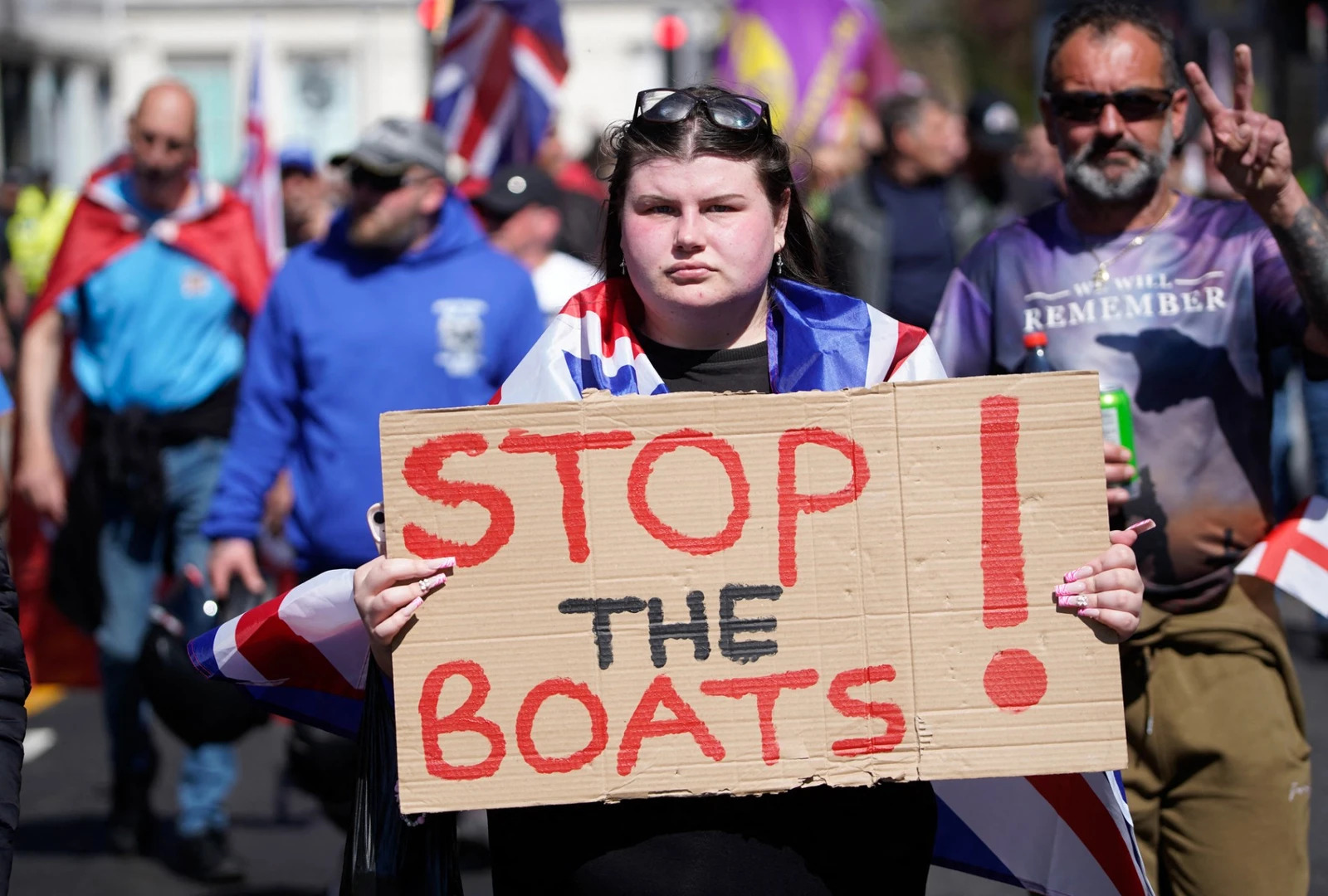
The number of migrants arriving on British shores in small boats so far this year has fallen by more than 40 percent compared to the same period last year, with the people smugglers being forced into a change of tactics due to the French and British police’s closures of many gaps. However, the last week has seen alarming incidents of “intimidating and thuggish behavior” — as described by a government spokesperson — by far-right activists.
On Sunday, roads in Portsmouth were blocked after a boat carrying 140 migrants was brought ashore there. This came the day after similar scenes of direct action had blocked roads and disrupted travel in and out of the Port of Dover. In both incidents, organized men in black, with some wearing balaclavas, blocked traffic and even smashed the windscreens of police cars.
Though largely peaceful, the protests reflect a change in tactics, raising questions about policing, intelligence gathering and the lack of robust measures taken against them. The threat posed by these groups should not be belittled. There is the potential not just for a climate of fear among immigrants but also a threat to law and order and the standing and reputation of the UK as a tolerant country.
The police, the government and officials from all parties condemned the protests. Many rightly questioned the scale of Kent police’s failure after it emerged a tipoff was received the day before the far-right agitators blocked Dover’s roads. Details were apparently passed to police after residents of a nearby village heard individuals boasting in a pub about going to Dover to “attack Muslims.” That information fell on deaf ears and Kent police even later described the protest as “spontaneous.”
Far-right groups are of the opinion that no action taken or policy adopted by the government is good enough
Mohamed Chebaro
Nick Lowles, the chief executive of Hope Not Hate, an organization that charts far-right activity, told the BBC: “To have 300, 400 people with balaclavas marching down the streets, stopping traffic. You know, it’s not just good enough. We need to call these people out for their politics and for the type of Britain that they want to see.” He added: “We’ve got different ways to register our protest. We do not go on the street. We do not burn people out of their houses. We do not cause trouble and threaten to fight the police.”
We should be careful about the repercussions of these images and videos being widely shared and the normalization of those scenes and the messages they convey. They are not viewed only by people in the UK but are also disseminated around the world.
Hope Not Hate was quicker than the police to inform the public that the Dover disturbances were organized by a far-right group called Patriot Platform. This new network was launched in June, uniting smaller, localized antimigrant groups. It claims to represent a Christian “army of patriots,” rallying around a vision of reclaiming the country’s borders and a message that Britain belongs to the British. It seems its adherents are ready to adopt vigilante methods to combat immigration in an effort to revive the country’s Christian values, as the group claims.
After winning power in July 2024, the Labour governments of first Keir Starmer and now Prime Minister Andy Burnham have fought to curb the arrival of small boats across the Channel, using a variety of laws and tactics to deter people from making the dangerous journey. But the past two years have also shown that far-right groups are of the opinion that no action taken or policy adopted by the government is good enough, as if antimigrant agitation could be a conduit to replacing Labour with Reform UK, the party led by colorful euroskeptic politician Nigel Farage.
Surely those that marched in Dover and Portsmouth are not like the Blackshirts just yet. But the resemblance is there
Mohamed Chebaro
After two nights of vigilante, militant-style action against migrants, people have begun to question whether the UK is witnessing the rise of fascism. What we saw at the weekend was a reminder of Italy’s Blackshirts, the violent private army and paramilitary wing of Benito Mussolini’s National Fascist Party, which was founded in 1919. Not long after them came the Hitler Youth of the 1930s, which transitioned from a fringe, violent paramilitary wing into a powerful, mandatory state apparatus.
Surely those that marched in Dover and Portsmouth are not like the Blackshirts of Oswald Mosley’s British Union of Fascists just yet. But the resemblance is there to be seen. This time, the “enemy” is not the Jews of the 1930s but migrants, who are seemingly considered to all be of the Muslim faith.
How the government can act against this clear and present danger is not obvious, as it could end up with more ugly scenes. Already, citizens have taken it upon themselves to “defend the realm” through encircling hotels and government facilities housing migrants or wearing black uniforms and balaclavas and blocking roads and ports. Surely the obvious thing to ask is who is behind them? Who is financing and organizing these acts, which we are told are only the beginning?
It is going to be very difficult for the British government to undo the damage caused by the men in black at Dover and Portsmouth. Launching an investigation to find any lapses of intelligence or policing should be the first step.
Governments across Europe seem to be increasingly at the mercy of far-right forces that are riding high in a changing world. This emerging threat rests on three aspects: the far-right nativist ideology; a warped digital realm that magnifies and spreads toxic, hate-filled content; and an unexplained financial lifeline.
The task ahead is daunting. The so-called patriotic drive of the far right is not aimed at migrants alone — its real enemies are democracy, liberties and the rule of law. Its methods are not peaceful protests but organized activism bordering on vigilantism and militancy.
Mohamed Chebaro is a British-Lebanese journalist with more than 25 years of experience covering war, terrorism, defense, current affairs, and diplomacy.
Mohamed Chebaro is a British-Lebanese journalist with more than 25 years’ experience covering war, terrorism, defense, current affairs and diplomacy. He is also a media consultant and trainer.
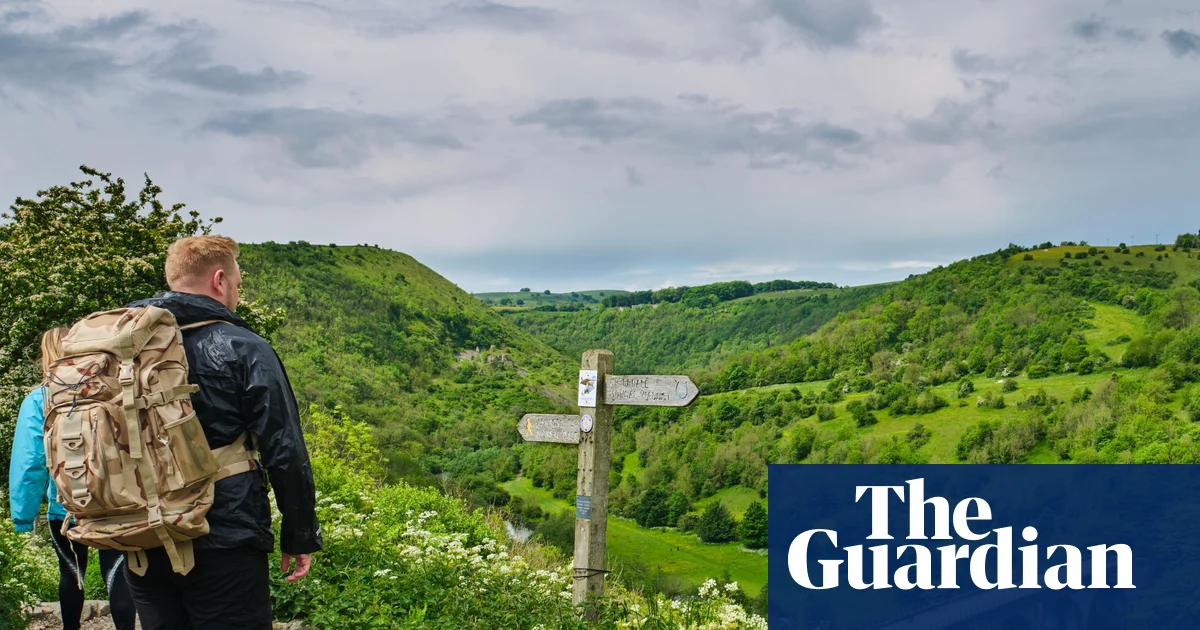
Start/finishCoombs Road in Bakewell to Blackwell Mill in Chee Dale, but there are lots of access points along the way Distance8.5 miles Cycle, hike or ride a horse along the Monsal Trail to explore a swathe of Derbyshire’s industrial history. This former stretch of the Midland Railway line winds past the imposing structures of two 18th-century cotton mills, through illuminated railway tunnels and over the Headstone Viaduct, which gives glorious views of the River Wye and Monsal Dale below. Interpretation and listening panels along the route explain the area’s history, geology and wildlife, while a short detour on to Monsal Head offers a panoramic view of the viaduct itself. Pause here for lunch or a pint at the Monsal, or stop in at Hassop Station Cafe, which offers bike rental alongside hefty sandwiches, homemade cakes and wood-fired pizza at weekends. monsaltrail.org.uk
The Strawberry Line, Somerset
Cycling on the Strawberry Line at Shute Shelve railway tunnel. Photograph: Joe Dunckley/Alamy
Start/finishYatton railway station to the old (unused) Cheddar railway station Distance10.7 miles Named for the fruity cargo that trains once carried from the strawberry fields up to London, this flat, accessible route – shared by walkers, cyclists and wheelchair users – knits together former railway stations, cider orchards and small, historic towns. Direct trains run from Bristol to Yatton, where the not-for-profit, community-run Strawberry Line Cafe serves hearty breakfasts and homemade cakes, while next door the Strawberry Line Cycle Project offers bike hire and accessories such as child seats. The route runs through wildlife-rich wetlands, open grazing land and lush valleys, while the medieval square at Axbridge gives an insight into the region’s rich history, dating back to the 10th century, when it was a busy commercial centre. Settle in at the Almshouse Teashop, in a building almost 600 years old, for freshly made soup and sweet treats, before setting off again. thestrawberryline.org.uk
The Mawddach Trail, Gwynedd, Wales
The toll bridge at Penmaenpool, over the Mawddach. Photograph: Henry Ciechanowicz/Alamy
Start/finishMarian Mawr car park in Dolgellau to Barmouthviaduct Distance9.5 miles Mostly running alongside the Mawddach estuary, this tranquil trail is a great choice for birders, with peregrine falcons and buzzards whirling above, and curlews and oystercatchers in the salt marshes. The wide, even surface also makes it ideal for wheelchairs and mobility scooters, and there are several joining points along the trail, meaning you can walk or bike as little or as far as you like. Just next to the 150-year-old Penmaenpool wooden toll bridge, the George III hotel and pub offers sweeping estuary views and classic pub food (including particularly fine pies), or pick up picnic supplies from Fork, Cork and Feathers in Dolgellau, which has a cold counter crammed with cured meats, cheeses and other local produce. There are seats and picnic tables dotted all the way along the trail. mawddachtrail.co.uk
The Cuckoo Trail, East Sussex
The Cuckoo Trail. Photograph: Johan Siebke/Alamy
Start/finishStation Road in Heathfield to Hampden Park in Eastbourne Distance14 miles A great choice for a family adventure, this mostly flat trail has five augmented reality “story stops” along the way – where, with just a quick scan of the QR code, children can interact with animated wildlife characters, solve puzzles and take a selfie with a grumpy badger. There are sculptures too, including carved wooden seats made from oak trees that fell during the great storm of 1987 and steel sculptures that act as mileposts. Cuckoo Shack Cafe, part of Priory Court Farm in Polegate, is set right on the trail and offers homemade-cakes, sandwiches and excellent coffee, but it is only open at weekends and during school holidays. Otherwise, a quick diversion into Hailsham offers a clutch of places to eat, including Neapolitan street food and wood-fired pizza at Rustico. wealden.gov.uk
The Flitch Way, Essex
The former Rayne railway station, near Braintree. Photograph: PA Images/Alamy
Start/finishBraintree station to Start Hill, near Bishop’s Stortford Distance15 miles Discover a tranquil side of Essex by following this rural trail along the edge of the former royal hunting ground of Hatfield Forest – where fallow deer roam between the ancient oak trees – and Great Notley Country Park, where families can take advantage of the 1.2km play trail, with slides, forts and swings. The main refreshment stop is 2 miles along the trail from Braintree at the Rayne Station centre, which combines the Booking Hall Cafe with the free-to-enter Railway Carriage Museum, a visitor centre and toilets. For something more sustaining (and a pint or two), the Lion and Lamb pub is just a short detour off the trail, in the pretty village of Little Canfield. Keep an eye out for kestrels and buzzards, plus brown hares dashing out of the hedgerows. explore-essex.com
The Wirral Way, Merseyside and Cheshire
Thurstaston beach. Photograph: David Chapman/Alamy
Start/finishWest Kirby railway station to Hooton railway station Distance12.2 miles One of the first converted railway lines in England, the Wirral Way is now a dramatically beautiful coastal path running along the Wirral Peninsula. It takes in the Wirral Country Park, where Wirral Way Bikes offers cycle hire for adults and kids (including ebikes), and clifftop picnic spots have gorgeous views over the Dee estuary. Take a detour down the cliffs to Thurstaston beach for a spot of fossil hunting or a quick paddle, and pause at Hadlow Road station, which has been preserved in all its 1950s glory (when the passenger service stopped) as an open museum; it also operates as an information point for the trail. Time your walk or ride for sunset, when the mudflats glow rose-pink and gold as the sun drops below the Clwydian Hills, and take the short connecting path down to the Harp Inn, Little Neston, set directly on the estuary, for a sundowner to go with the view. visitcheshire.com
The Crab and Winkle Way, Kent
Rewilded bison on the Blean. Photograph: Donovan Wright/PA
Start/finishCanterbury West station to Whitstable Harbour Distance7.5 miles Following the route of one of the earliest railway lines, built in 1830, this hiking and cycling trail passes through the Blean, a large swathe of ancient woodland, home to the 13th-century church of St Cosmus and St Damian, and an RSPB reserve. It’s also home to Europe’s first free-roaming bison, introduced as part of a rewilding initiative in 2022 by the Kent Wildlife Trust and Wildwood Trust. There’s not really anywhere en route to stop and eat, so either pick up treats for a picnic at the Goods Shed in Canterbury (an indoor farmers market, closed mondays) or save yourself for oysters and a glass of fizz at the Whitstable Oyster Company, right on the beach. explorekent.org
The Dava Way, Moray and Highland, Scotland
The collie dog memorial on the Dava Way. Photograph: John Bracegirdle/Alamy
Start/finishMannachie Avenue in Forres to Dulicht Bridge in Grantown-on-Spey Distance24 miles Unusually for a rail trail, the Dava Way includes a stiff climb from the Moray Firth up over Dava Moor to the Dava Summit, at 320 metres (1,050ft), before heading back down to Grantown-on-Spey, following the Highland Railway line that operated for over a century, from 1863 to 1965. The ascent is well worth it for the spectacular views across the Moray Firth to Sutherland in the north, and south to the Cromdale Hills and the Cairngorms, while the ride back down is a breeze. The Divie Viaduct, built in 1863, is the most famous landmark along the way, while the Halfway Hut is a restored shelter that makes a perfect spot for a picnic, with old photographs and route info on the walls (not for overnight stays). davaway.org.uk
The holiday park chain is one of the most popular in the UK, offering a vast array of activities and family fun, but there’s one common issue in reviews that has seen it criticised, especially by parents
12:29, 09 Sep 2026Updated 08:46, 10 Sep 2026
Its six holiday parks have serene lake and forest settings(Image: Center Parcs)
One of the UK’s most popular holiday park chains has been hit by a low score in a national ranking, with visitors particularly irked about one thing in particular.
Center Parcs has six holiday villages across the UK, and in a recent Which? survey, it was the most-visited holiday park on the list, especially popular for short breaks in its car-free forest locations.
Which? said: “You like that you know what you’re getting, from the acres of forest trails to the swimming pool in a heated glass dome – a subtropical paradise even in the soggiest of British summers. It also earned praise for appealing to all ages, whether that’s with the treetop aerial adventure or the thermal spa (with a volcanic steam room and an igloo-inspired ice cave).”
Have a story you want to share? Email us at webtravel@reachplc.com
The parks were also praised for their accommodation, with higher grades including facilities such as hot tubs, saunas, and games rooms, making it a solid “family favourite” according to Which?. But customers were particularly unhappy with one thing.
“However, it’s extraordinarily expensive, at more than twice the price of budget rival Haven. Activities cost even more on top, and you need to secure your preferred slots weeks in advance. The two-star rating for value for money is the joint lowest in our survey. You could save a fortune by choosing a better-rated rival,” the Which? survey noted.
In most aspects, Center Parcs performed well. It was awarded four stars for activities, entertainment and facilities, as well as quality of accommodation and cleanliness. It achieved three stars for customer service and food and drink. But its place in the rankings, fifth from the bottom, came due to its value for money score at just two stars. It was the third most expensive of all the holiday parks surveyed.
It’s not the first time the chain has been criticised for its high prices. In a viral social media post, one fed-up mum showed the difference in prices between a school holiday and September dates at the parks, commenting: “If anyone’s unsure when their kids return to school after the holidays, Center Parcs have this handy tool.” A four-night break in August was priced at £1,049, while the same holiday a week later, post-school holidays, was £529.
Even positive reviews of the parks often mention the price. One recent review of Center Parcs Woburn Forest said: “Amazing place to holiday. Personally, I felt the prices of things on-site were a little high, and that was even going outside of term-time; however, you cannot fault the fun and wonder of being at these parks.”
Another was more blunt: “Badly overpriced, we only paid £799 for a family of 4 and it still felt like a rip off. You get a good room, yes, but it’s nothing you can’t get at a hotel in the countryside for half the price. Every single other activity charged extra (except swimming which is decent but you can get a similar quality just slightly more warm out at Butlin’s for 1/10th of the price).”
Center Parcs has been contacted for comment.
The UK’s best and worst holiday parks
(Name of resort, overall customer score)
Potters Resorts – 83%
Hoburne Holidays – 81%
Darwin Escapes – 80%
Landal Parks – 80%
Waterside Holiday Group – 80%
Shorefield Holidays – 76%
Away Resorts – 75%
Bluestone Wales – 75%
Park Leisure UK – 75%
Highland Holidays – 74%
Lyons Holiday Parks – 74%
Largo Leisure – 73%
Park Holidays UK – 73%
Warner Coastal Villages – 73%
Forest Holidays – 72%
John Fowler Holidays – 72%
Center Parcs – 69%
Haven Holidays – 68%
Parkdean Resorts – 68%
Butlin’s – 63%
Pontins – 61%
Based on a survey of 2,221 Which? Connect panel members and general public conducted in February and March 2026.
THE UK’s second biggest airport may face even more delays this month as workers are set to strike over pay.
This comes as thousands of planes were grounded yesterday following a nationwide technical glitch.
More than two hundred workers could strike later this month if pay conditions are not metCredit: Getty
Around 220 staff members at London Gatwick Airport are set to strike later this month, following a dispute between Unite members and employer Wilson James.
The workers, who provide assisted travel, have been engaged in pay talks since May and previously rejected a two-year offer of a 3.4 per cent salary increase.
Sign up for the Travel newsletter
Thank you!
The union said it was “not enough to address years of low pay at the firm”.
As a result, Unite regional officer Ben Davis, said that “industrial action will inevitably disrupt services throughout Gatwick” as negotions continue.
Strikes are expected to take place from September 17 to September 21.
Just two days later, another set of strikes will occur from September 23 to September 26.
This will mean passengers who rely on assistened travel will take longer to board and disembark, leading to flight delays across both short-haul and long-haul services to and from Gatwick.
Davis added: “Strikes can be avoided but that requires the company making a significantly improved offer.”
This comes as travellers have already faced extensive delays and cancellations following a major technical issue with the UK’s air traffic control provider yesterday.
The National Air Traffic Services (NATS) suffered an issue with its “flights processing system”, resulting in tens of thousands of passengers stranded in terminals and over 1,000 journeys cancelled.
Although the issue preventing departures was fixed yesterday evening, knock-on delays and cancellations – mainly affecting Heathrow Airport – continue to disrupt passengers today.
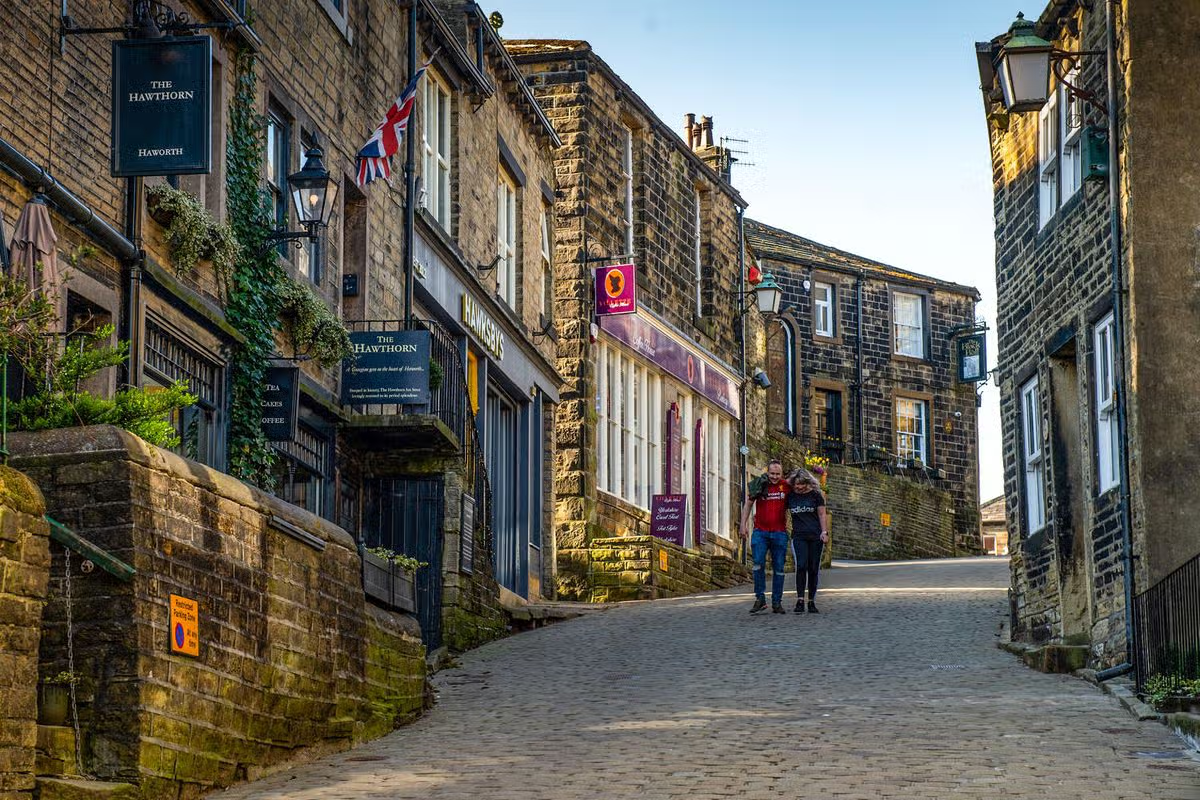
If you’re on your annual Gilmore Girls re-watch and dreaming of an escape to Stars Hollow, without the long-haul flight, then this UK village gives seriously cosy vibes for a day out
The village has been compared to Stars Hollow by British fans of the show(Image: SWNS)
Gilmore Girls may just be the perfect autumn show, and when the weather starts cooling off, many fans find themselves binge-watching the comedy-drama about a quirky mother and daughter duo.
And anyone who has watched the show will no doubt have dreamed about visiting Stars Hollow, the cosy Connecticut town where the Gilmores live, full of unique characters, friendly local shops, and of course, great coffee. Sadly, Stars Hollow isn’t a real location – the pilot was filmed in Canada before a set was built on a studio backlot in Burbank, California – but many fans have been looking out for locations that give the same vibes.
If you don’t fancy the flight to New England, British Gilmore Girls fans have been debating where the UK’s answer to Stars Hollow can be found, and one village with long literary associations is often named as the best local dupe.
Content cannot be displayed without consent
Taking to TikTok, travel creator @lilyjbet posted a video captioned: “pov: you just found the real-life Stars Hollow in England” showing footage of the quaint village of Haworth in Yorkshire. Her video shows a variety of eclectic shops, cafés, and bookstores that would thrill any Gilmore Girls fan.
Haworth has literary associations that Rory Gilmore would find fascinating. The Brontë sisters lived and wrote most of their novels here, and their former home is now the Brontë Parsonage Museum. Sitting atop a hill, it overlooks miles of countryside, and the view no doubt inspired the rugged backdrops of many of their famous works. Fans of gothic literature can walk to Top Withins, a remote farmhouse surrounded by moorland, which many believe helped inspire the gloomy setting of Wuthering Heights.
The museum is an incredible memorial to the literary sisters, many rooms still holding the original furniture and personal items, as if waiting for the family to return.
Many of the colourful independent shops in Haworth look like they belong in Stars Hollow. Wave Of Nostalgia, a vintage bookshop that also sells unique gifts, would certainly be a place the Gilmores would visit. Cabinet of Curiosities is a kind of old-school apothecary which could easily be from the Victorian era, while Spooks of Haworth, a ‘spiritual emporium,’ is the perfect stop for lovers of autumn and Halloween.
And of course, there are plenty of cafés where you can enjoy cosy mother-daughter chats or simply sit and read your book. Café Verde has a great location with outdoor tables on the cobbled streets, while Villette Coffee House and Bakery offers a range of freshly-baked pastries and Yorkshire specialities.
The perfect way to arrive in Haworth is by train. Not only because riding the vintage steam trains to your location feels like stepping back in time, but also because you can avoid needing to navigate the extremely narrow, steep roads that were built for a horse and carriage. The village is on the Keighley & Worth Valley Railway, a five-mile heritage railway that runs through the Yorkshire countryside, giving you stunning views on the way to your destination.
Fans of classic movies may also recognise the train line as being the setting of the 1970s adaptation of The Railway Children. In addition to standing in for the Edwardian railway hub, filming was completed around the village in locations including St Mary’s Churchyard.
Have a story you want to share? Email us at webtravel@reachplc.com
BOURNEMOUTH is one of the most popular seaside towns in the UK, pulling in millions of visitors every year to its pretty beaches.
But there’s so much more to it than just its coastline, as Michael Regenhard, who manages the Bournemouth Highcliff Hotel, reveals.
Michael Regenhardt is the Multi Property General Manager of the Bournemouth HighcliffCredit: SuppliedThere’s lots more to do in Bournemouth as well as enjoy its beautiful beachesCredit: Alamy
Michael Regenhardt left Germany for Bournemouth 20 years ago and he’s lived there ever since – what did he make of it when he first arrived?
He told us: “I’m German, so you look at the English and think they do all these weird and wonderful things. Then when you live here – I eat my lamb with mint sauce now – my mother will never forgive me for that.”
Sign up for the Travel newsletter
Thank you!
Michael continued: “I wear brown suede shoes now too. And when I came to Bournemouth – it was the first time I went to an amusement arcade I was given a bundle of coins and I thought ‘what do I do with this?’
“But now, when I have friends come to visit, I take them on the lift down to the beach – then we go there and their eyes light up.
“I see it with Brits too because it’s nostalgic – it takes them back to their childhood. It’s a lovely experience – then we go for fish and chips afterwards.
“You can’t get more English than that.”
Here are his top Bournemouth recommendations.
Hotels
Bournemouth Highcliff Marriott Hotel sits high above the beachCredit: Supplied
Being the Multi Property General Manager of the beautiful Bournemouth Highcliff (and the Portsmouth Marriott) – Michael has to recommend it to visitors.
“The Highcliff is 150-years-old and was initially just four townhouses then it was converted into a hotel. Next to us we have the original coastguard cottages that Bournemouth had when the smugglers still came across the sea.
“They go back to around 1830 – and they’re part of the hotel as well. Now they’re rooms, with a little garden in front of them.”
The coastal cottages are now beautiful rooms that guests can stay inCredit: Mike Caldwell
“Winston Churchill stayed here at the beginning of World War Two – he was actually declared wartime leader at the hotel.”
Michael continued: “We have 160 bedrooms and the hotel sits on top of the cliff, so we get the best views out of most of the hotels I would say.
“We have Brasserie Blanc, it’s our restaurant partner, and we have an outdoor swimmingpool.”
Restaurants
“I have one in the summer which is called El Murrino – it’s right on the beach. But it’s only open from April until September.
“It has good vibes, it has good food – it’s very simple, pizzas, burgers, salads, cocktails and beers. But it’s one of the only restaurants right on the beach.
“We have a place for Tiien Thai, which I have to say, is in my hotel. It’s not part of the hotel, but it is inside. It’s been around for almost 12 years and I think it’s the best Thai restaurant in the south.
El Murrino is a seasonal beach bar right on the sandCredit: UnknownAruba has a tropical feel and an outdoor terrace looking over the pierCredit: TripAdvisor
“I’m a Panang man – it’s what I have every time I go. And they have the best crispy squid, or calamari.”
Bars
When it comes to beach bars, he said there aren’t many, but praises Aruba which overlooks the pier, saying there is “always a good vibe in there during the evening”.
He added: “We have a place called The Botanist now in the square in the old Debenhams building – it’s very beautiful and it’s on the rooftop.
“You take an old staircase up, and it is a restaurant too but they have a lovely outside bar – you overlook the square and the Lower Gardens.
“Our hotel has a bar as well, it’s part of Brasserie Blanc, they have a fantastic terrace – but that would be biased from me!”
Pubs
“One in the town centre is called The Sun which has recently been refurbished, it used to be called 60 Million Postcards.
“It has a good look to it with a big terrace.
“Then there’s a couple up in The Triangle, they’re a bit older; The Branksome is one of those.
“There’s two pubs in the main square too – like the Wetherspoons. It depends what you want.”
Date night spots
“Go back to the Urban Garden as a restaurant because you can go on a romantic walk there too through the gardens, take the staircase, it’s half in the jungle.
“Afterwards, if you’re a bit younger, I’d say go down to 1812 which is next to the BIC.
“It’s a huge building and there’s a cocktail bar inside there – it gets busy on Fridays and Saturdays.
“But it’s a nice setting, especially if you sit outside.”
Best beaches
Sandbanks has pretty sandy beaches and is much quieter during the weekCredit: AlamyBournemouth has miles and miles of coastlineCredit: Getty
“One really nice beach is if you go towards Sandbanks, the beach is beautiful, there aren’t any stones – but it is busy.
“During the week, it’s much quieter.
“Branksome is a lovely beach with two lovely restaurants there and it’s a nice, family-friendly spot. It’s not too busy – and you can only park in the Chines.
“I don’t think there’s a bad spot in Bournemouth though.”
Hidden gems
“One of those is Sobo Beach, which is in Southbourne. It’s very much a neighbourhood beach and is usually quiet, but busy enough that it has a good vibe.
“SOBO Beach Bar and Restaurant is great too – it’s very quirky, a bit Miami, very colourful with good music on the weekend.
“During the week it’s part of the neighbourhood where people go for coffees in the morning and so on. That’s a great beach and it’s not busy.
“If I give one tip – if you ever go to the beach, avoid the piers. Go 200 metres one way or the other, it’s just too packed.
“There are miles and miles of beach.”
Local experiences
These are some of England’s most expensive beach hutsCredit: AlamyWestbourne is the place to visit for unique shopsCredit: Alamy
“Past Southbourne is a little place called Tuckton, and when you speak to all the English tourists they talk about Tuckton Tea Garden – but that’s not the experience I’m talking about.
“They have a mini marina there and from there you take boat trips up to Mudeford Spit. It’s like little boats for eight or nine people, then you drive up the river a bit, go part Christchurch and come out on Christchurch Bay.
“It’s a beautiful little trip. Then when you get there you have England’s most expensive beach huts, which go for around £250,000 and over.
“They are the only beach huts where you can stay overnight and some of them have dual aspect so you can see the Isle of Wight and Christchurch Bay.
“It’s a beautiful trip. There’s a little train as well which goes to Hengistbury Head and from there you can take a bus or a cab back.
“Not many people know about that.”
Family attractions
“There’s the Oceanarium – it’s something for the whole family. It’s right on the pier, they have penguins there.
“It’s nicely done with lots of activities, quite educational – it’s a nice thing to do as a family.
“The pier has a zipwire, and a climbing centre now too. Overall, the pier has lots of little activities for families.
“As for attractions – it’s really all about the beach.”
Shopping
“I’d say Westbourne which from the hotel is a five-minute drive away.
“It’s a very nice, older kind of neighbourhood; it has an arcade with shops inside and the high street isn’t one long road, it’s more of a loop.
“They’re all very individual shops, with nice cafes, lovely restaurants – it’s all a bit quirky.
“It takes you away from the classic shopping centre – which we do have.”
Cheap food spots
At the Pier View Kitchen you can pick up breakfast for £5Credit: TripAdvisor The Russell Cotes Museum sits on Eastcliff and is full of art workCredit: Alamy
“Where the pier is, there’s the Pier View Kitchen and it’s got a huge terrace, it’s half self-service and half service.
“But they have everything you need and you can pick up a bacon butty and a coffee for £5.
“It does what it says on the tin and you can look over the whole pier approach.”
Sweet treats and coffee
“There are two places that aren’t far from each other – there’s a place called Fika on Westover Road.
“It’s where the Pavilion is, and they’re really individual coffee shop, it’s a lovely place to eat, they do ice creams too – it’s very cute.
“Then there’s another coffee spot I recommend called BigWigs – it’s a family bakery that have a few places dotted through Bournemouth.
“Great pastries, cakes and great coffee – they serve Bad Hand coffee which is a local coffee roastery.
“Then you have Bad Hands itself which is up towards the Triangle, that’s where their roastery is, and they have a coffee shop now too.”
Cheap activities
“We had a group recently that hired some bikes and went all along the promenade from one end to the other. And the best time to do that? 8 o’clock in the morning – it’s stunning.
“That’s a nice way of doing some sightseeing while in Bournemouth. If you’re looking for something free to do, head to the beach.”
Cultural activities
“There’s the Russell Cotes Museum on Eastcliff in a beautiful old building which goes back over 100 years.
“It used to be family owned and the people in there loved collecting art and sculptures and it was slowly turned into a museum.
“It’s very beautiful and inside, it’s fantastic and it’s Bournemouth-centric.
“That’s from the pier, five minutes up the hill – there are also some art galleries on Westover Road if that takes your fancy.”
Best views
Explore nearby Swanage on a Breezer BusCredit: AlamyMudeford Spit is a place most tourists heading to Bournemouth won’t visitCredit: Alamy
“So if you go over to Mudeford Spit, that is attached to Hengistbury Head – and you want to go to the oppositesidee of Sandbanks.
“It’s not a mountain, it’s a hill and it’s beautiful to walk, you can go along the beach and around it – or up and over.
“Once you’re on top of it, you see the Isle of Wight and The Needles, Swanage and Christchurch – it’s absolutely beautiful.
“When the regatta is on over on the Isle of Wight you can see all the ships too.
“The best time to do it in the early morning when it’s clearer – you can see for miles.”
Michael has some final tips as a local…
“I just say prepare for the weather! It’s one of the main things that people do wrong.
“It could be sunny and then it gets cold – which it always does in the evenings.
“As I said before there’s never the wrong weather, just the wrong clothes – and I’d say Bournemouth is just as lovely in the autumn and winter.
“It’s lovely in the summer months but it can be a bit too much – if you come out of season, October, November – it doesn’t matter, it’s still lovely. Just put your jacket on.”
The anti-immigration Reform UK party said two of its senior officials had stepped down on Friday, following allegations that they were secretly filmed appearing to discuss ways to circumvent UK electoral laws on foreign donations.
The far-right party, whose popularity has soared in the past two years, is already embroiled in several other funding scandals involving its leader Nigel Farage. On Friday, it announced an internal probe into the latest case, which was brought to light by a Channel 4 investigation.
Recommended Stories
list of 3 itemsend of list
Reform is currently holding its annual party conference in Birmingham, central England.
Here’s what we know about the foreign funding claims and how they could affect British politics.
What did the Channel 4 investigation show?
Channel 4, an independent broadcaster, aired footage of senior Reform officials Dan Jukes and James Orr meeting with undercover reporters who were posing as prospective Reform backers from the United States.
In one instance during the programme, which was broadcast on Thursday night, footage was shown of Jukes appearing to talk about a proposal for Reform to receive a 500,000-pound ($675,000) donation from one of the men, who was presenting himself as an American financier, through his son, who he said lives in the UK.
The “son” was actually another journalist from investigative group Verbatim, which recorded the exchange.
In separate footage, Orr appeared to discuss a plan for the US donor to fund opinion polls for Reform UK rather than donating the money directly.
He told the undercover reporter that “we just don’t have British-resident donors, British entities, that would support us”.
During the investigation, Verbatim reported that Reform officials arranged for the US donor to pay more than 30,000 pounds ($40,500) to fund three opinion polls, without disclosing the source of the funds.
Channel 4 said it had verified the findings from Verbatim, an offshoot of the Centre for Climate Reporting.
What are the UK’s rules against foreign funding for political parties?
Under UK electoral law, political parties may only accept donations from British voters or UK-registered businesses. Donations from individuals or organisations based overseas are strictly forbidden.
In a statement on Friday, a UK Electoral Commission spokesperson said political parties must report all “permissible donations” they accept exceeding 11,180 pounds ($15,120) and all “impermissible donations” exceeding 500 pounds ($676).
“Parties are responsible for ensuring their internal processes and controls are fit for purpose,” the spokesperson said. “Information about any potential attempt to evade the controls on donations is for the police to consider.”
How has Reform responded to the allegations?
Following the programme’s broadcast, Reform initially issued a statement denying any wrongdoing and claiming the allegations were a hoax.
In a later statement, however, the party said it was conducting an internal probe and that Orr and Jukes had stepped down pending its outcome.
Orr, the party’s policy head, said he had agreed to step down temporarily and would “cooperate fully” with the investigation.
Jukes, Farage’s long-term aide, denied any wrongdoing but said he had “stepped back from politics in order to clear my name”.
Advisor Dan Jukes speaks to UK Reform party leader Nigel Farage [File: Hollie Adams/Reuters]
Farage accused the undercover journalists of “entrapment” and told broadcaster LBC, “they got a couple of our contractors to say things that perhaps should not have been said”.
“And as a result of that, you know, they have been removed this morning. And yeah, you know, I’m not happy about it,” Farage said.
“The party has broken no laws, the party has not taken any dodgy money or anything like that whatsoever,” Farage insisted.
Will Reform face legal consequences?
It remains to be seen. The UK’s ruling Labour Party has written to the police asking them to investigate possible criminal offences.
The Metropolitan Police said it was aware of the allegations in the broadcast and would assess any information provided to them.
This does not amount to the formal launch of an investigation.
Why does this matter?
The latest donation scandal is another blow for Reform, which has seen its place as the UK’s most popular party slip in opinion polls in recent months.
Last year, polling by YouGov suggested that Reform had become the most popular political party, and would likely win a UK general election if one had been held then. At that point, Labour was trailing far behind in the polls – projected to win just 27.3 percent of parliamentary seats, compared with Reform’s 41.7 percent. The former ruling Conservative Party stood at just 7 percent.
But a poll this week by YouGov showed Reform now tied with the UK’s left-wing Labour Party with 23 percent support each. The Conservatives have caught up with 20 percent.
This is not the first funding scandal Reform has grappled with, either. In July, Farage dramatically stepped down as Member of Parliament for Clacton amid allegations, also revealed in the UK media, that convicted fraudster George Cottrell, 32, recruited and paid three staff to work on Farage’s social media before the 2024 general election and has continued to allow Farage to use a five-storey Georgian townhouse he rented near Buckingham Palace.
Farage ultimately re-won his seat in Clacton at a by-election but still faces the prospect of a parliamentary inquiry into undeclared funding of 5 million pounds ($6.7m) from Thailand-based billionaire and crypto investor Christopher Harborne, who paid for Farage’s personal security before he announced his candidacy in the 2024 general election. So far, Farage denies all wrongdoing.
This week, Farage told the BBC that the parliamentary inquiry was unfair. He said there was a “wilful attempt, and it’s gone on now for months, to say that everything to do with Reform, that every individual involved with Reform is somehow a crook”.
This is evidence of “the establishment in a very coordinated way fighting back”, he claimed.
However, Justin Fisher, professor of political science at Brunel University of London, told Al Jazeera Reform’s latest donation scandal would further hurt Farage’s standing both within and outside his party, and could cost Reform votes in the next elections.
“If this was an isolated incident, then Reform would probably be able to brush it off,” said Fisher. “But it comes on top of serious questions about a donation to Nigel Farage, and a donation to Reform which allegedly had overseas links. This all contributes to a narrative which Reform is having great difficulty avoiding.”
DODGING the crowds on Oxford Street could become a thing of the past ahead of new plans to ban all traffic.
The busy London street is taking its first steps to becoming pedestrianised and will partially close to cars in October.
The plan is for Oxford Street is to become a ‘pedestrian plaza’Credit: Mayor of LondonCars and buses will be rerouted through part of Oxford Street from next monthCredit: Alamy
It’s not the first time that Oxford Street has been closed to vehicles – but this will be a move for a permanent change.
London Mayor Sadiq Khan‘s vision is for it to be transformed into a ‘pedestrian plaza’ at the cost of £150million.
Sign up for the Travel newsletter
Thank you!
At first, not all of Oxford Street will be closed to cars – the plan is for 1km to be traffic free by the second half of October.
Buses won’t be allowed to drive down the pedestrianised area either and will be diverted to other roads.
The section closed to traffic will be Orchard Street near Selfridges and Great Portland Street.
This area includes the Oxford Circus junction where Oxford Street and Regent Street cross.
Not only will the road be shut, but there will be new seating and planters installed too.
This is a test followed by a review of the scheme which will take place in spring 2027 – work will then start on making it permanent later on in the year.
The end aim is for Oxford Street to undergo an enormous £150million to be completely pedestrianised between Oxford Circus and Marble Arch.
There will be more space for its 500,000 daily visitorsto walk around by replacing the roads with paths.
There are 500,000 daily visitors on Oxford StreetCredit: Alamy
There are concerns though – some locals are worried that the pedestrianisation will push the traffic out into the surrounding areas such as Soho and Mayfair.
Council leader Paul Swaddle has raised further issues including safety.
He said: “At the moment, if you go to Oxford Street at midnight, there are buses, there are people getting night buses – you would feel relatively safe.
“If you were crossing that on your own – if one of my kids was crossing it on their own in the evening, I’d be concerned.”
Other concerns are about emergency services, however unlike private vehicles, they will have access to the street at any time in the new plan.
Crime rates, long-term unemployment and poor health outcomes have long plagued a town that is now under threat from rising sea levels and has attracted “dark tourists”
A long golden beach runs along Jaywick(Image: Getty Images)
“On a sunny afternoon, it feels like a ghost town. I feel like I am in a film about a lost time,” explains Christopher Moss, having visited what is probably the UK’s most maligned seaside town.
Among the two dozen towns featured in the book is Jaywick, a seaside spot in Essex that regularly comes in for a real kicking. It has been officially ranked as England’s most deprived neighbourhood four times running (2010, 2015, 2019, and again in 2025) by the Ministry of Housing, Communities and Local Government.
Crime rates, long-term unemployment and poor health outcomes have long plagued a town that is now under threat from rising sea levels. The town has become something of a punching bag, with YouTube “dark tourists” regularly turning their cameras on Jaywick and even a US Republican congressional candidate using a photo of neglected housing and potholed roads in an election ad warning American voters about economic decline.
In his 1983 classic travelogue, The Kingdom by the Sea, Paul Theroux dismissed Jaywick as being like an “Argentinian shanty town”. The Channel 5 documentary series Benefits by the Sea was filmed here in 2015.
Chris does not sugarcoat what he found on his trip to Jaywick, but instead lifts up the intriguing, unique and beautiful parts of the town that are easy to miss amidst the damning headlines.
“I was taken by how beautiful it is to be on the waterside there,” Chris told the Mirror. “It has this golden beach and this feeling of being in a foreign country. It was very calm and warm. Sedate even.”
The feeling of being somewhere other than England is added to by the chalets that make up most of the housing stock in Jaywick. The town was founded about 100 years ago when property developer Frank Stedman bought 24 acres of flood-prone marshland near the popular resort of Clacton, and flogged it in small parcels to Londoners looking to escape the city for the weekend. They were encouraged to build their own homes from kits, with suggested models costing just £52, although these were made of “rough cast asbestos” bricks.
The promise of a lake and sports centre never materialised, but what did was a curious housing estate in the shape of a car radiator grille with roads named after old vehicle manufacturers.
The destruction of East London during WW2 led many to move into their Jaywick homes full-time, not just for the holidays. “Eighty years later, materials and decor and fixtures have changed, but they are still weekend-sized and vulnerable to floods, time and family budgets,” writes Chris. While some of the homes are “stoved in”, others are well looked after and kept looking fresh.
As well as the strong Essex/London hybrid accent, what remains in Jaywick are the Martello Towers. The squat structures were built in large numbers along the coasts of Britain and other parts of the former British Empire, mostly during the early 19th century, primarily to provide a defensive base should Napoleon launch a land invasion.
The design was inspired by a round fortification at Mortella Point in Corsica, which British forces attacked in 1794. A small garrison there put up unexpectedly stiff resistance against Royal Navy ships, inspiring the Brits to steal the idea.
Jaywick’s tower is still intact and now plays host to an arts, heritage and community centre. It was saved earlier this year when an Essex County Council plan to cut £90,000 of funding prompted a local backlash. Part of it is given over to residents’ poems that both sing Jaywick’s praises and reckon with its challenges.
One from Anna Mae reads: “Sirens blazing, blue lights flashing, drunkards fighting, eau de weed pervading, boom boxes blaring, foxes screaming way into the night. Seagulls screeching their morning calling, school kids running, mums beckoning, voices straining, muted threatening, coaches arriving, mobility scooters racing, cars parking, buckets and spades unloading, excited cries, tired of eye spying, children clamouring eager to see the sea, new land dredged from marshes keep on sinking, sea will continue claiming what is hers.”
It is this constant and growing risk of inundation that adds to the place’s strange atmosphere, as does the feeling of a community bonded by a world that is against them.
“Put-downs can spread the shame, but not here; people defend the right to be proud of their homes,” Chris concludes.
“All I’m saying to readers is it’s okay to accept the headlines, but go and see and say hello. Most of these places are not as bad as the press presents.”
Where Tourists Seldom Tread is available in hardback for £19 and ebook for £12.99 on bookshop.org.
A NEW area of one of the world’s most visited tourist attractions is being opened to the public.
The Natural History Museum in London is officially the UK’s most popular attraction, with seven million tourists visiting each year and soon a new area in the museum will open.
A gallery closed at the Natural History Museum will reopen after 80 yearsCredit: Natural History MuseumInside are 50 objects linked to humans’ relationship with the natural worldCredit: Alamy
Closed since World War II, the Nature and Us gallery will open to the public next month.
Opening on September 16, the gallery will be free to visit and will be home to 50 objects linked to humans’ relationship with the natural world.
Sign up for the Travel newsletter
Thank you!
The space has been closed to the public since 1943 and includes a miniature model of a Crystal Palace dinosaur and Jenny, a Victorian skeleton of a monk seal.
Visitors will also be able to touch a replica jaw of one of Britain’s earliest known domesticated dogs, which dates to around 14,300 years ago.
All visitors can then have their say on their favourite stories from the gallery, which will then be moved into the permanent collection in 2029.
The gallery is located on the second floor of the museum.
It used to be a skeleton gallery and mammal gallery.
When the museum’s original herbarium was damaged during the Second World War, it was then turned into the botanicals new home.
The gallery will reopen onCredit: NHM London
Today, the original wooden herbarium cabinets remain.
Dr Doug Gurr, Director of the Museum, said: “Reopening this remarkable gallery is an exciting moment for the Museum.
“For the first time in over 80 years, visitors will be able to step into this beautiful historic space and explore our changing relationship with the natural world.
“It’s another important step in our NHM150 transformation as we create new spaces that inspire people to become advocates for the planet.”
The reopening of the gallery is part of the NHM150 campaign which includes opening a new or revitalised gallery each year until 2031.
Sammy and Jonathan were one of a number of couples whose romantic journeys were never shown on the Netflix show
18:45, 29 Aug 2026Updated 18:47, 29 Aug 2026
Sammy’s Love Is Blind UK love story never made it to air(Image: Tom Dymond/Netflix)
Love Is Blind UK’s third season saw a record number of engagements – but only a handful were shown.
The Netflix reality dating show sees 30 singles sent on a string of blind dates in the show’s pods which are designed to prevent the contestants from ever seeing each other. The only way they can meet a potential partner face to face is if they accept a marriage proposal from them.
An unprecedented number of contestants became engaged during the latest season – 14 to be precise – though just six of those love stories were shown to viewers at home.
The show’s executive producer, Nazleen Karim, previously addressed why they cut some couples on the programme but kept following others. She explained: “When there are more engagements than we can physically follow, we have to make difficult editorial choices. We’re looking for a range of different relationship journeys and stories that together capture the full experience of the experiment.
“Not being selected isn’t a reflection of the strength of a relationship – many couples continue exploring their connection once they leave the pods.”
Now, one couple who were cut from the show revealed what happened to them afterwards, and the remarkable journey they have been on since.
Tech recruiter Jonathan, 32, and wellbeing coach and entrepreneur Sammy, 31, found a connection in the pods and became engaged, but their dates, nor that all-important proposal, were ever shown.
In a tell-all Instagram post, Sammy recounted that she asked a producer to give Jonathan her number after they were told they would not be continuing on the programme, and the pair continued to date in the real world.
Content cannot be displayed without consent
Since leaving the show in August last year, they have jetted off on holiday together, met each other’s families, got a dog together named Poddy in homage to the show, and remain engaged to this day. Sammy also revealed the devastating news that the pair had suffered a silent miscarriage in June.
“We lost our baby to a silent miscarriage and honestly, we really struggled,” she shared. “Grieving whilst still living on opposite sides of the country was one of the hardest things we’ve had to face together.”
While she admitted the pair were still navigating the loss, Sammy revealed their love story still endured. She added: “We didn’t get picked to continue on Love Is Blind. At the time, that felt like the end of our story. Turns out, it was the beginning of the best bit.
“No cameras. No experiment. No guarantees. We just kept choosing each other, and now you’re finally in on the secret.”
Love Is Blind UK series three is now streaming on Netflix. A reunion special will air tomorrow night (August 30) at 9pm.
ONE tiny village in the North of England has been dubbed one of the best places to visit.
It’s surrounded by ‘Little Switzerland’s‘ rolling hills, not to mention it has a wild swimming spot that’s is considered England‘s highest beach.
Todmorden in West Yorkshire has been named one for the best places to visit this summerCredit: AlamyHardcastle Crags is considered the UK’s very own ‘Little Switzerland’Credit: Alamy
The Independent put the village of Todmorden in top spot when ranking its ‘best places to visit in summer‘.
It said: “Hebden Bridge, up the road, is a tourist magnet.Happy Valleyput Calderdale on the TV pilgrims’ map. But Todmorden at the eastern end of the valley has retained a down-to-earth, organic quality.“
Sign up for the Travel newsletter
Thank you!
It continued: “With the historicLancashire-Yorkshire border running through the town – even cutting the Town Hall in half – it’s a mix of rural and urban, Mancunian and West Riding, poshed-up and proletarian.“
It has a few pubs like the Golden Lion, Hare & Hounds and The Polished Knob as well as cafes, an indoor market.
Some of the houses sit on the waterfront as the River Calder runs directly through Todmorden.
The village is also very close to Hardcastle Crags, a wooded valley managed by the National Trust.
It’s often referred to as ‘Little Switzerland‘ thanks to its steep Alpine-style hills, valley, streams and rock ravines.
It also has a 19th-century mill that is open to visitors.
One of its most popular attractions in Todmorden is Gaddings Dam which is a Victorian reservoir high up on the moors.
Gaddings Dam in Todmorden is considered England’s highest beachCredit: Alamy
At 1,150 feet above sea level, it’s actually considered the highest beach in England and is a wild swim spot managed by the local communities.
One visitors said: “Wow! Went here one sunny, but windy day in July. Took about half an hour to walk to the top but well worth it when we got there!
“Make sure you take water and refreshments as there is nothing at the top apart from beautiful scenery! Only a small beach and only a handful of people there but was really peaceful.”
Another added: “Gaddings Dam is a fab place to go for a walk, swim, and picnic.”
Another popular site near Todmorden is Stoodley Pike, a landmark along the Pennine Way.
It overlooks both Todmorden and the neighbouring town of Hebden Bridge.
Lots of hikers say the spot ‘gets windier every single time you visit’ but is worth the walk for the ‘unreal’ views.
Meanwhile, Hebden Bridge is Todmorden’s more well-known neighbour considered ‘quirky’ and ‘bohemian’ thanks to its many artists, crafters, brewers and beekeepers.
Here’s the full list of the best places to visit in the North of England…
Todmorden, Lancashire
Ouseburn, Newcastle
Stockton-on-Tees, County Durham
AND festival, Barnsley, South Yorkshire
The GM Ringway, Manchester and surroundings
Yorkshire Sculpture Park, Wakefield, West Yorkshire