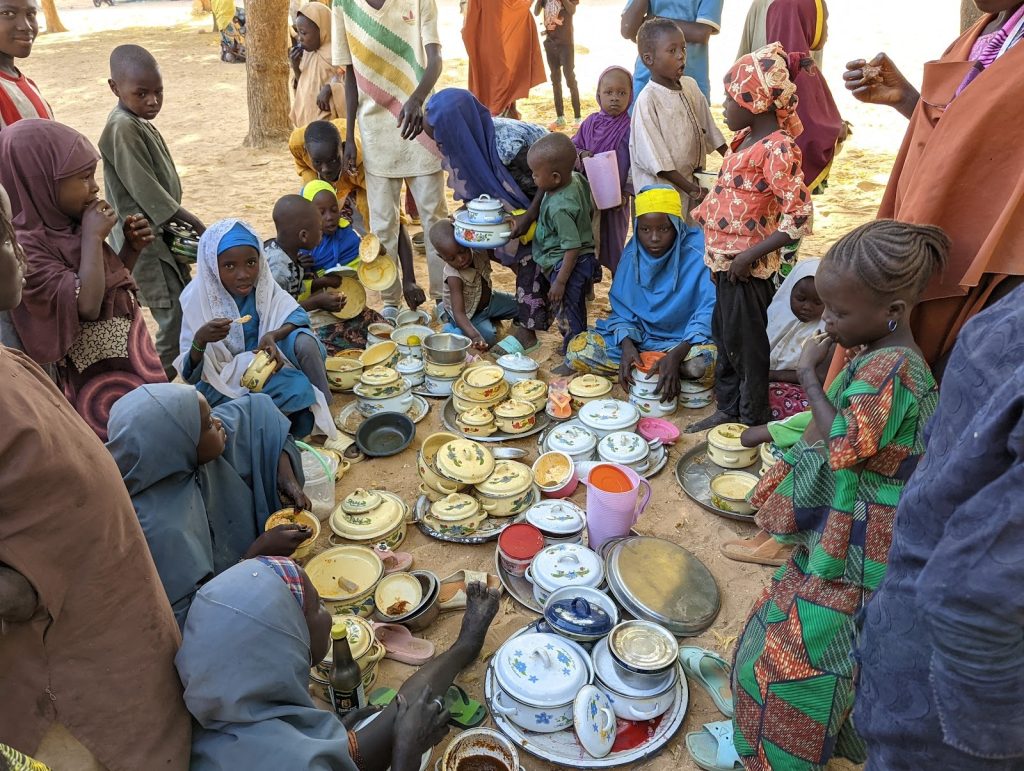
The harvest season is a moment of festivity in Medu, a Hausa farming community in the Gagarawa Local Government Area of Jigawa State, North West Nigeria. After residents gather crops and fill their granaries, women set aside a special day to celebrate Asure, an age-old traditional feast whose name means “enjoyment”.
Ramma Hassan, a mother of five—two boys and three girls—believes Asure is both a source of joy and a challenge. From her farming proceeds, she saved diligently for months in preparation for the annual celebration, ensuring her children were not left out.
“We sew clothes for our children, we buy new hijabs and shoes, and we cook rice and stew with chicken,” she told HumAngle. “If we don’t do this, our children will look different when every other child is looking good and feasting.”

Unlike other communal events in the village, where men often take centre stage, Asure is distinctly women-led. It is held after the hibiscus harvest, locally known as zobo—the last crop to leave the farms each season. Women are often invited by farmers to harvest the hibiscus, either for cash payment or in exchange for a share of the produce. They sell it and use the proceeds to prepare for the feast. Once the harvest is complete, brides-to-be and other young women agree on a date for the celebration, which is then announced across the community by a town crier.
Ramma spent over ₦100,000 preparing three of her daughters for Asure last year. Those with more financial capacity spent more, while others spent less, depending on their savings.
“I didn’t save much, as the produce I got was not highly priced; that is why I spent so little,” she said. “The more we save, the more we spend, especially when the prices of foodstuffs soar in the market.”
However, Ramma told HumAngle that in a world that often forgets to look their way, the hibiscus harvest allows them to step into the light and take responsibilities often reserved for men.
“Asure to us is not just about cooking; it is about giving our best and showing that our labour can sustain the rhythm of our village life. In those moments, despite the financial burden it comes with, every mother like myself is usually excited that we are not left behind by tradition; we are the tradition itself,” she emphasised.
Food and fellowship
The recent feast was held on December 29, 2025, and HumAngle attended. On the eve of Asure, the village hummed with excitement. Women moved from house to house, laying out fabrics and showing other women the new clothes they had bought, while others prepared ingredients for delicacies. Children chattered endlessly, eager to wear their new hijabs, shoes, and shirts.
“I am very excited to enjoy my portion of rice and chicken and to put on my new clothes,” said Aisha Arma, a nine-year-old.

The spirit of festivity abounded, reflected in the beams in the women’s eyes as they watched their sons and daughters rejoice over their new clothes and flip-flops. For many children, sleep came slowly that night, as their minds were already in celebration.
At dawn, the village stirred to life. Smoke rose from kitchens lit by sorghum canes, as women set up their cooking spaces, pots clanging and local spices filling the air.

Men joined in, assisting their wives or mothers with slaughtering chickens or goats, after which women and children defeathered them before turning them over for the stew. The pounding of the mortar and pestle resounded across the village, mingling with laughter and the chatter of children running through the dusty streets.
By noon, the anticipation reached its peak. Children were served food on metal plates with colourful designs and, balancing their meals on their heads, they headed to open fields and school grounds, where friends sat together under trees to feast.

The sight was striking, with boys and girls in colourful attire, plates balanced on the ground, sharing bites and stories. The feast was marked by an abundance of dishes which were rarely on their daily menu.
What is Asure?
The significance of Asure lies in its emphasis on women’s agency.
In a society where economic decisions are often dominated by men, this festival allows women to showcase their financial resilience and generosity.
Asure dates back over 150 years, according to Malam Dauda Muhammad Medu, the 59-year-old leader of Matarama, a group that supports cultural decisions in the community. Despite its age, little is known about Asure’s origin. Every older person HumAngle spoke with said they simply grew up experiencing the festival, with no clear account of how or why it started. This makes Asure a tradition preserved largely through practice rather than written or oral history.

“This festival has been here before us,” Dauda told HumAngle. “We met our grandparents and parents, celebrating it.” The festival is held in Medu and other neighbouring communities.
“Traditionally, Asure is celebrated after harvest, when farmers have brought food home. Women fix the date, and the day is marked by meals reserved for special occasions. Goats are slaughtered in some households, but at the very least, a chicken must be prepared for every child. Even households without children must slaughter one,” he added.

Dauda revealed that on the day of the feast, eating tuwo or similar staple food is prohibited. Instead, rice, macaroni, spaghetti, or other festive meals are prepared for children and adults alike, who change into colourful clothes to gather in open spaces, sharing food and joy.
“This is purely cultural; that is why women take charge. It is our own way of celebrating International Women’s Day,” he said. “Aside from Asure, however, men are responsible for providing everything, including during other festive seasons like Eid.”
The local leader recalled that Asure was once solely about feasting, but innovations have emerged. During the festivity, fiancés in the community compete to impress their future wives by purchasing expensive clothes, hijabs, wrappers, and other valuables. The culturally-rooted feast transformed into a display of love and wealth.

“As of two years ago, a man could spend nothing less than ₦150,000 for his bride-to-be outside the wedding expenses,” Dauda said. “Such spending sometimes strained relationships, even leading to breakups when expectations were not met.”
To address this concern amid the country’s economic hardship, the men came together and consulted the Matarama group and the village head. A collective decision was made to return the feast to its roots.

The new stipulation for the Asure feast was that grooms would provide groceries, two measures of rice, two or three chickens, two bottles of cooking oil, and stew ingredients. Dauda reiterated that clothing and accessories would remain the responsibility of mothers.
“Anyone who went beyond these stipulations would face punishment,” he noted.
Resilience despite hardship
Despite these adjustments, the current economic reality has added another layer of struggle to the Asure feast, which is not optional, especially for mothers like Fatima Arma, who fear being subjected to gossip for failing to provide for their children.
Fatima told HumAngle the joy of preparing for the celebration is often overshadowed by worry about how much money must be spent, as prices of rice, chicken, and even simple items like cooking oil have risen, forcing women like her to stretch their savings further than before.

After the feast, hardship often follows as the savings of an entire year vanish in a single day of celebration. Fatima laughed as she responded to the question of what comes after Asure, saying, “Poverty and hardship”.
“Despite the hardship, the feast cannot be abandoned, especially in a community like ours where traditions are deeply rooted; failing to provide for children during Asure is seen as neglect. We fear the whispers and judgments of others. That is why the pressure to keep up with expectations weighs heavily, even when resources are scarce,” she lamented.
Dauda added that since women are at the forefront of sustaining the tradition, the local cultural group will ensure subsequent adjustments to sustain inclusivity in the community while bearing in mind economic realities.
“Asure carries deep cultural meaning to us even though it is modest in scale compared to urban festivals. More importantly, it underscores the resilience of our women in rural communities who, despite limited resources, create abundance through sacrifice and planning,” he said.