Lisandro Brusco: ‘We Must Fight the Imperialist and Zionist Bloc in Latin America’
Lisandro Brusco. (Venezuelanalysis)
Lisandro Brusco is an Argentine political scientist and Palestine solidarity activist with a track record in geopolitical analysis and journalism focused on Global South struggles. He has contributed as a columnist to international media outlets such as Hispan TV, El Salto, Alma Plus TV, and Huellas del Sur, and is a prominent organizer at Masar Badil. In this exclusive interview, Brusco shares his perspective on the genocide in Palestine, analyzes the expansion of Zionism in Latin America, and outlines the challenges facing anti-imperialist internationalism.
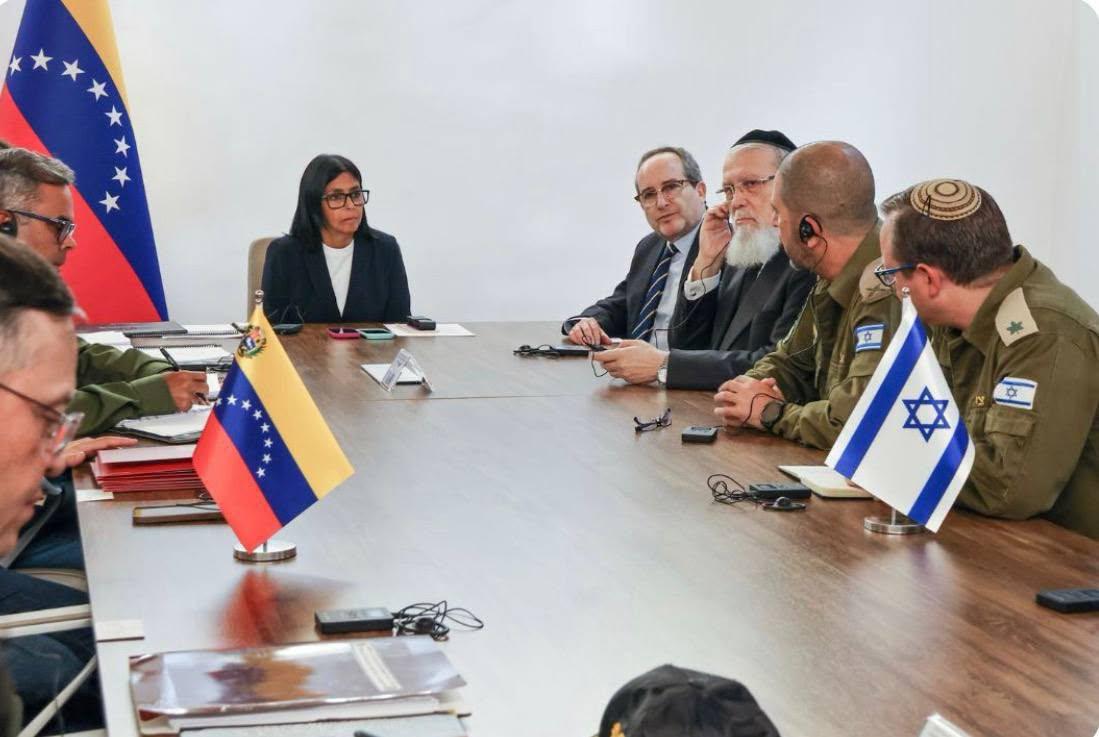
Venezuela recently announced the establishment of consular relations and “technical cooperation” with Israel. The rapprochement began with the arrival of a military-humanitarian contingent days after the June 24 earthquake. How can we explain that an army that destroys hospitals and schools and murders people in Gaza would travel to other countries to portray itself as a lifesaver?
What we saw in Venezuela after the double earthquakes, and in Colombia as well, is part of the Israeli colonial regime’s “humanitarian washing” policy. This involves sending humanitarian contingents to aid the civilian population following a natural disaster. The genocidal state of Israel seeks to restore the image it has lost, especially since October 7. On a global scale, its mask has slipped. People began to see, especially in the West, what the State of Israel was doing to the Palestinian people, even before October 7. After October 7, what we call a “televised genocide” became even more evident. Much credit goes to the press and grassroots journalists, many of whom have been killed, especially in the Gaza Strip.
Israel has lost the legitimacy it once enjoyed in global Western opinion as a democratic state, as a state constantly under attack by neighboring nations, by Arab countries. All those myths are crumbling.
“Humanitarian washing” is an attempt to say, “Here are the good guys coming to show solidarity with this population.”
How is it possible that a regime – which has destroyed more than 70% of the infrastructure in the Gaza Strip, which blows up hospitals, schools, and mosques, which has destroyed the agricultural production capacity, the very little the Gaza Strip had, which blocks the entry of humanitarian aid, could turn around and send so-called humanitarian contingents to other regions?
Some of these contingents include soldiers who have even been accused of genocide and are wanted for arrest.
How can this happen? Because governments complicit in this genocide allow these troops to enter their territories. Unfortunately, this is happening in Latin America.
This entire whitewashing mechanism is also applied on social media. In 2025, Israel invested $1 billion in PR firms, influencers, digital diplomacy, artificial intelligence, and so on. The settler-colonial regime needs to control search engines to steer information in its favor and create a permanent stranglehold on social media, so that the public consumes fake news it produces.

Israel’s influence in Latin America has been linked to the sale of surveillance technology and “combat-tested” weaponry used against the Palestinian people and on other fronts. As Venezuela normalizes its relationship with Israel, what are the main risks you see?
The Zionist lobby in Latin America operates in tandem with imperialist interests in the region. It is very important to highlight this premise in order to analyze the situation correctly and implement sound political strategies.
This is not a recent development: that organic link already existed between the Israeli colonial entity and the ecclesiastical-civil-military dictatorships that were imposed by blood and fire across Latin America in the 1960s and 1970s.
They were not individual Zionist links with each dictatorship, but with the imperial project being imposed on the region: Operation Condor, the US policy toward Latin America and the Caribbean aimed at quelling the revolutionary movements that were taking shape. Israel sold weapons and provided military training to those dictatorships.
The process continued with the so-called democratic transitions of the 1980s and gained new momentum following the US “War on Terror” offensive beginning in 2001. Today we also see this expressed in a clear strengthening of the ties between the Zionist movement, the State of Israel, and US imperialism.
This is not about particular interests, nor is there any intention to create a situation in Latin America similar to that in Palestine. Israel has no plan to build settlements in the region. Here, Zionism continues to support the capitalist imperialist interests of the United States.
We see this in the trade agreements that various governments have signed with Israeli surveillance, arms, and extractive companies.
For example, the Israeli state-owned water company Mekorot advises various provincial governments in Argentina on water management. Similarly, the Israeli company XtraLit is involved in the extraction of lithium, a strategic mineral for contemporary capitalism. Another example is Navitas Petroleum, an oil company that also extracts resources in Argentina.
The focus of these Israeli companies is the same as that of global capitalism: resources. And to ensure the extraction of resources, they need repression; that is why they have military companies, surveillance software, and so on.
Because what Israel has historically sold to the world is repressive technology tested on the ground. Who can better vouch for military tools than the genocidal regime par excellence?
Obviously, there is a political landscape in the region that facilitates all of this: governments like we have in Argentina, Colombia, Chile, and Ecuador. These are governments subservient to imperialist interests, which even create regional and global political structures such as the Isaac Agreements – signed by the Milei administration – that are set to expand to other nations. All of this goes hand in hand with military initiatives such as the Shield of the Americas.
The presence of Zionism in Latin America is a political concern for anti-imperialist activists: there is a hegemonic bloc that is coming for our resources, our territories, to plunder, pollute, and destroy our land. We must fight this bloc.
Having been on the ground in the West Bank, you describe how the machinery of home demolitions, checkpoints, and the violent expansion of settlements operates on a daily basis. How is the settler-colonial project sustained economically and militarily, and what role does the complicity of the international community play?
Israel is sustained, to a great extent, by the United States, international banks, and European powers such as Germany. Without US support, Israel would not have lasted a week in the recent war against Iran. The US Congress, driven by the Zionist lobby, had to approve emergency funds to support Israel’s military defense.
On the other hand, the settlements in the West Bank are sustained economically by state support from the Israeli regime, through subsidies – largely contributions from multinational corporations, ranging from investment funds to Zionist foundations such as the Jewish National Fund.
And the international community, such as the United Nations, has historically legitimized and normalized this occupation, not only through the resolution that allowed for the establishment of the State of Israel, but also by failing to take action against Jewish settlements in the West Bank, despite declaring them illegal.
It is worth noting that when the Oslo Accords were signed in 1993, there were just over 150,000 settlers in the West Bank. Today there are approximately 700,000. There are entire cities that are illegal settlements, with industries, schools, police stations, and so on.
The UN member states are also doing nothing. They could sever trade and diplomatic ties with this genocidal entity, but even the powers that proclaim themselves anti-hegemonic fail to do so.
The only sovereign state that has no ties to the Israeli regime and whose political goal is the destruction of this colonial entity is the Islamic Republic of Iran. It is the only country that has advocated for the destruction of the Israeli occupation of Palestine since 1948.
In short, there is no political initiative by the international community to at least halt the advance of illegal settlements in Palestine. Recently, although the systematic aggression against Gaza continues, the Zionist entity is making much greater inroads in the West Bank through its settlers.
Settler civilians – the vast majority of whom are armed – set fire to Palestinian homes and fields, kill grazing animals, and prevent Palestinian children from going to school. All of this takes place under the protection of the Israeli occupation army. The situation is desperate, and often – with a few honorable exceptions – Palestinians feel that they are on their own.

In the West Bank, you spent time alongside local families. In the face of Israeli violence, how do the Palestinian people sustain their daily lives, their culture, and their resistance in the face of this ongoing occupation?
It is a question as important as it is difficult to answer, because from our perspective it is hard to understand how the Palestinian people sustain their daily lives, their culture, and their resistance in the face of such genocide and ongoing occupation.
As with all anti-colonial struggles, there is a fundamental factor that the colonizers fail to consider as a variable: the Palestinian people’s deep connection with their land. This goes far beyond a purely utilitarian view; it is an ancestral, cultural, social, and historical bond. That is why, despite the brutal attacks of the Zionist occupation, the Palestinian people have no intention of leaving their territory.
Getting them to leave is the primary objective of the Zionist movement: a project of ethnic cleansing that has failed to do so for over 100 years, despite Western support. As time goes on, the Israeli regime faces increasingly severe crises, while the Palestinian population remains steadfast on its land.
We must bear in mind that there is also a deliberate effort to destroy written historical records, civil registries, libraries, and universities. All of this is part of a very clear mission to erase the written history of the Palestinian people. In the face of this, memory is preserved and expressed through oral history – the stories that refugees pass down to new generations.
Therein lies the idea of return and liberation, symbolized by the key. This goes far beyond the material property that families once owned in what is now the State of Israel. The key embodies the history of a people, of a family, their tradition of struggle, their connection to the land, and their origins. It is not conceived in terms of private property, but rather from a social and historical perspective.
That is why, in every refugee camp – whether in the West Bank, Gaza, Lebanon, Jordan, or Syria – each family preserves not only the key but also its customs and identity. If we ask a third- or fourth-generation Palestinian refugee, born in Beirut, where they are from, they will immediately name the Palestinian village razed in 1948 from which their family hails. That identity remains extremely strong even several generations later. That is why there is such brutal repression against the refugee camps, because that is where the revolutionary spirit is preserved.
This tradition is sustained in large part by the daily efforts of families and, in a very special way, by the educational role of women. They are the ones who pass down oral history to children and take charge of their education, especially in contexts where children are prevented from attending school due to Israeli checkpoints or settler attacks.
Alongside this collective memory, Palestinian society draws on solidarity and community resilience. Facing daily policies of apartheid, displacement, torture, home demolitions, and mass incarceration, the community responds collectively. Committees of prisoners’ family members are organized, and when a home is slated for demolition, the community mobilizes to ensure that the family is not left homeless.
In the face of apartheid and ethnic cleansing, resistance is practiced in daily life.
In your writings, you address the essence of the Zionist colonial project and the imposition of permanent control structures in Gaza. What plans does the Israeli government have in store, together with Trump’s Board of Peace, for Gaza?
The Board of Peace is yet another of the many tools of the Israeli colonial regime. In this case, it was proposed by the United States, just as others came from the British Empire, just as the UN hatched a plan to create the State of Israel on Palestinian territory.
These are proposals imposed by the West to ensure the expansion of the State of Israel – as a Zionist project – across all Palestinian territory and beyond.
Thus, the Board of Peace is a strategic policy of the Zionist movement, a tool for administering this occupation, denying the genocide, and imposing a supposed stability built upon the total massacre of the Palestinian people.
We’ve seen this story before, even in Oslo in 1993. At that time, there was talk of building a Palestinian state, of economic growth, of foreign investment, of an economy integrated into the region, and of the creation of a so-called Palestinian Authority.
Far from that, the result was a territory that became even more controlled, more occupied, more fragmented, and more bombed. The Palestinian Authority, it is now undeniable, serves the occupation, collaborating in the repression of those who oppose normalization and the recognition of the State of Israel.
So, I’ll say it again: Trump’s Board of Peace has nothing to do with peace. It serves to uphold the policy of exterminating the Palestinian population and destroying homes, farmland, water supply systems, roads, hospitals, schools, markets, refugee camps, and so on. All the infrastructure that supported daily Palestinian life in the Gaza Strip has now been destroyed.
And this Board of Peace proposes the reconstruction of this territory. Reconstruction for what purpose and for whose benefit? Who will manage this reconstruction? Who will control food supplies and productive land? This Board of Peace goes hand in hand with a plan for the total colonization of the Gaza Strip and total control over its territory, with the possible establishment of a Palestinian governing body in the future.
But in reality, just like the Palestinian Authority in the West Bank, what it will guarantee is the occupying power’s control over that territory, along with a supply of cheap labor.

For years, progressive governments in Latin America firmly condemned Israel, and in some cases even severed ties. In the current climate, where realpolitik prevails and the normalization of the Zionist regime is advancing, what challenges do solidarity movements face in sustaining support for the Palestinian cause?
From a communications perspective, the role of grassroots solidarity movements with Palestine is central. We saw this beginning on October 7, 2023, when Palestinian journalists and media workers in Gaza and Lebanon became military targets of the Israeli colonial regime, in response to the threat that was beginning to emerge in the battle of ideas, in the battle for the hearts and minds of the people.
Communication work is strategic when it comes to fostering critical thinking and a revolutionary, solidarity-based practice that breaks with the commodified conception of news to uphold the basic principles of informing the public.
On the other hand, the role of international movements – both in the West and in West Asia, as well as in the countries of the Global South – is fundamental. What the Al-Aqsa Flood operation did was precisely to mobilize and awaken many peoples who were dormant and to show that the enemy is not invincible.
We can launch our own political initiatives, including military ones, to create crises in these genocidal, criminal, and occupation projects that exist today in West Asia and throughout the world.
One key question to address from a solidarity perspective is: How do we bring these national liberation resistance movements together? We must approach this from an internationalist perspective. For example, any victory for the movements organized around the Axis of Resistance that directly confront imperialism – the United States and Israel – is a victory for the peoples of Latin America who face the same enemy. This is the Guevarist conception that any defeat of imperialism anywhere in the world is a victory for the peoples.
It seems to me that this solidarity bond must be organic and strategic when considering the building of international fronts that break the capitalist domination that prevails in much of the world.
If revolutionary governments came to power in Latin America and truly severed ties with the Israeli entity, that would weaken all those fronts involved in the sale of arms, technology, etc,. and set a precedent for other peoples around the world.
And that is the way to support the Palestinian cause, which is the cause of liberation and return. We, too, must instill in public opinion and in our discussions with all organizations the conviction that Palestine will be free from the river to the sea. Today, we cannot reconcile the liberation of the Palestinian people and their return with the existence of the State of Israel.
We need to build political, organic, and genuine solidarity that focuses on projects of national liberation and collective emancipation. And it seems to me that the Al-Aqsa Flood has, in a way, established precisely that: that the best way to change the status quo is by dealing real and tangible blows to colonialism and imperialism.
