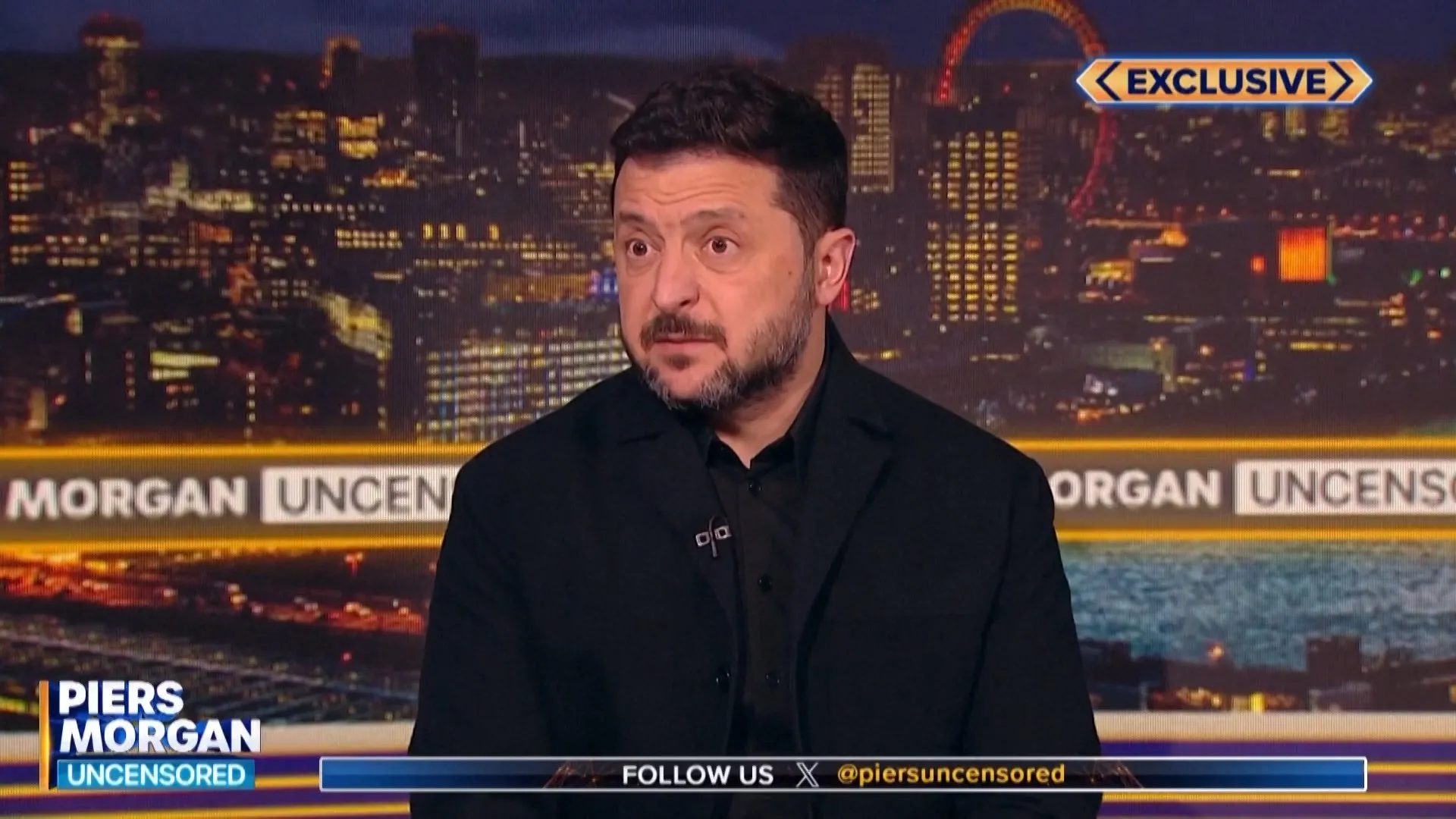
Zelenskyy

Zelenskyy speaks to Al Jazeera at site of major Russian attacks in Kyiv | Russia-Ukraine war

NewsFeed

Russia has launched one of its largest attacks on Kyiv since the war began, firing hundreds of drones and missiles across Ukraine overnight.

Speaking to Al Jazeera after visiting damaged sites, President Volodymyr Zelenskyy condemned the strikes and the targeting of civilian infrastructure, as Ukraine vowed retaliation.

Source link

Key Zelenskyy aides under corruption cloud: What are they accused of? | Corruption News

Andriy Yermak, Ukrainian President Volodymyr Zelenskyy’s former chief of staff and close aide, is now at the centre of the country’s biggest corruption investigation since Russia’s full-scale invasion in 2022.

Anticorruption authorities named him an official suspect on Monday in an alleged multimillion-dollar money laundering scheme linked to a luxury housing project outside the capital, Kyiv.

Recommended Stories

list of 3 itemsend of list

Yermak appeared at a Kyiv court on Tuesday for a hearing related to the charges, which are part of a widening probe drawing in other senior figures associated with the president, including his national security chief.

While Zelenskyy is not accused of any wrongdoing, the scandal could potentially threaten Ukraine’s aspirations for European Union membership as it seeks to convince the bloc that its anticorruption drive is on track.

So, what are the charges against Yermak? Are other allies of Zelenskyy also under a cloud of suspicion? And what does this mean for Ukraine’s standing with its Western allies?

What are the charges against Yermak?

Ukraine’s National Anti-Corruption Bureau (NABU) and the Specialized Anti-Corruption Prosecutor’s Office (SAPO) say Yermak is suspected of involvement in an organised criminal group that allegedly laundered about 460 million hryvnias ($10.5m) through a luxury real estate project near Kyiv.

Prosecutors are seeking to impose bail of about $5.4m on the 54-year-old while they continue their investigation.

Yermak, who resigned in November, has firmly rejected the claims. In a post on Telegram after a court hearing on Tuesday, he described the accusations as “unfounded”.

“As a lawyer with more than 30 years’ experience, I have always been guided by the law. And now, in the same way, I will defend my rights, my name and my reputation,” he said.

Ukraine's former Presidential Office Chief of staff Andriy Yermak (R), stands in court before a hearing in a money laundering case, to determine a preventive measure, in Kyiv on May 12, 2026, amid the Russian invasion of Ukraine.
Ukraine’s former Presidential Office Chief of Staff Andriy Yermak stands in court before a hearing in a money laundering case in Kyiv on May 12, 2026 [AFP]

At one point during the hearing, Yermak told reporters that he “owns only one apartment and one car”.

His lawyer, Ihor Fomin, labelled the allegations against his client “groundless” and denied any role by Yermak in laundering funds through the high-end development. Fomin told Ukraine’s public broadcaster Suspilne that “this entire situation has been provoked by public pressure.”

NABU director Semen Kryvonos defended the proceedings, stating that authorities move to issue formal notices only when they believe they possess enough evidence to sustain charges in court. He clarified that Zelenskyy was not subject to any investigation.

But the case has dragged the shadow of corruption closer to the Ukrainian president than ever before. That’s because it isn’t just Yermak who has been caught up in the accusations of fraud.

Have other Zelenskyy allies been implicated, too?

Timur Mindich, a wealthy businessman who was Zelenskyy’s former partner from the entertainment world – the Ukrainian president is a former comedian – has emerged as another leading figure in the scandal. He left for Israel after corruption allegations surfaced last year.

The probe has also brought Rustem Umerov, the head of Ukraine’s National Security and Defence Council, into the crosshairs of the authorities. Umerov, who until last year was Ukraine’s defence minister, is Zelenskyy’s main representative in United States-backed diplomatic efforts to end Russia’s war on Ukraine.

Prosecutors say Umerov has been interviewed as a witness in the luxury real estate development case.

The case is part of a broader anticorruption operation, dubbed “Midas” and led by NABU and SAPO. The operation was first made public in November, when prosecutors accused Mindich of engineering a $100m kickback scheme at Energoatom, charges the businessman has refuted.

Zelenskyy has yet to publicly respond to the allegations involving Yermak. On Monday, a communications aide said it was premature to comment on the case.

Ukraine’s government in July passed a law in an effort to strip the independence of NABU and SAPO, which were established in 2014 after a pro-democracy uprising against the then-government of President Viktor Yanukovych.

Within days, protests broke out against the move, forcing Zelenskyy to reverse course and sign a new law to restore the anticorruption institutions’ independence.

Why does this matter?

The scandal has emerged at a particularly sensitive moment for Ukraine, as Kyiv continues to make the case for military and financial support from its allies in Western Europe and North America.

Last July, US senators Jeanne Shaheen and Lindsey Graham released a strongly worded statement denouncing the attempt by the government to, at the time, curb the anticorruption work of NABU and SAPO.

“One of the most widely used talking points for ending support for Ukraine is that it was awash with corruption,” they said. “We acknowledge that Ukraine continues to make progress on this front and we urge the government to refrain from any actions that undermine that progress.”

Moreover, Ukraine’s bid to join the EU has increased pressure on Zelenskyy’s administration to demonstrate institutional independence and accountability.

German Chancellor Friedrich Merz last month cautioned against a quick accession of Ukraine to the EU, saying Ukraine cannot join the bloc due to several key concerns, including ending the war and fighting corruption.

Ukrainian opposition politician Oleksiy Goncharenko said the allegations had now reached a point that Zelenskyy “personally cannot ignore”.

However, Olena Halushka, a board member at the Anti-Corruption Action Centre in Kyiv, said the case against Yermak and others was a “clear example that the checks and balances system really works”.

Speaking to Al Jazeera, Halushka said it proved that in Ukraine there are “law enforcement institutions functioning independently and professionally, exercising their powers in defence of democracy”.

“These institutions were protected by the Ukrainian society and European partners from the political attack last summer, and now we see the tangible results of their activities,” she added.

In a survey conducted on May 6 by the Kyiv International Institute of Sociology, 54 percent of Ukrainians said corruption was a bigger threat to the country than the war with Russia.

Source link

Zelenskyy says Russia fired over 200 drones at Ukraine as truce expires | Russia-Ukraine war News

One killed and four others wounded in attacks on Ukraine’s Dnipropetrovsk region, local administration chief says.

Russia and Ukraine have resumed air attacks after a United States-brokered three-day truce expired, with President Volodymyr Zelenskyy saying more than 200 drones were used to attack Ukraine overnight.

Russian aerial attacks across Ukraine’s Dnipropetrovsk region on Tuesday morning killed at least one person and injured four others, according to regional administration chief Oleksandr Ganzha.

Recommended Stories

list of 3 itemsend of list

Russian drones also hit energy infrastructure in Ukraine’s Mykolaiv region, causing outages, and struck residential buildings and a kindergarten in the Kyiv region, according to local authorities. Russia also carried out attacks on the regions of Kharkiv, Zhytomyr, Sumy and Chernihiv, according to authorities.

More than 200 long-range drones were used in the wave of attacks, Zelenskyy said. “Russia itself chose to end the partial silence that had lasted for several days,” he said in a post on X.

Russia’s military, meanwhile, said its defences downed 27 Ukrainian drones over the regions of Belgorod, Voronezh and Rostov.

The exchange of aerial attacks came after the expiry of a 72-hour truce announced by US President Donald Trump on Friday, which he said he hoped would mark “the beginning of the end” of Russia’s four-year war on Ukraine.

The May 9-11 truce overlapped with Russia’s Victory Day, which celebrates the defeat of Nazi Germany in the second world war.

But even before it expired, both sides accused each other of violating the truce by attacking civilians.

Zelenskyy said Russia was neither observing the truce nor “even particularly trying to”, adding there had been no calm in front-line areas despite a lull in large-scale attacks.

Meanwhile, Russia’s Ministry of Defence accused Ukraine of committing more than 1,000 ceasefire violations. It said Ukrainian forces attacked civilian targets in several Russian regions and carried out strikes against Russian military positions on the front line.

Russia’s military had “responded in kind” to the ceasefire violations, according to the Defence Ministry.

US-backed negotiations on ending the Russia-Ukraine war have made little headway and have been largely sidelined by the crisis in the Middle East amid the US-Israel war on Iran. Trump’s ceasefire announcement had raised some hope that US-led talks to end Russia’s invasion could be resumed.

On Saturday, Russian President Vladimir Putin suggested for the first time that the Ukraine war may be “coming to an end” and expressed a willingness to meet Zelenskyy in Moscow or a neutral country once an agreement to end the war is finalised. He also accused the “arrogant” West of risking a global conflict, warning that Russia’s “strategic forces” are combat-ready.

Source link

Zelenskyy has no cards to play against Russia or the West | Russia-Ukraine war

Ukrainian President Volodymyr Zelenskyy’s artistic skills have earned him the reputation of a public relations genius acknowledged by both friends and foes. United States President Donald Trump, who has openly attacked him in public, famously called the Ukrainian leader “the greatest salesman on Earth”. A much more sympathetic voice, New York Times columnist David French, has recently portrayed Zelenskyy as “the new leader of free world”.

But Zelenskyy’s PR genius can do very little when it comes to changing the dynamics of the battlefield in the Russia-Ukraine war. In recent weeks, his administration and allies have tried hard to create the impression that the war might be approaching a turning point. But realities on the ground tell a different story.

For example, there were official claims that in February, Ukraine made more territorial gains than Russia did. Some pro-Ukrainian war monitoring platforms have supported these claims while others have not. It is important to note  these calculations can be tricky given that along the frontline there is an extensive grey zone in which control is unclear. The advances themselves are measured in 150-200 square kilometres per month. In other words, methodology can be manipulated in order to produce the desired conclusion: that Ukraine is gaining ground.

In reality, there is nothing at all that suggests a significant change in the battlefield dynamics that have been in place for at least two years now.

More importantly, Russian troops are currently besieging a number of industrial cities in the north of the Donetsk region. Their advances all along the northern border, in particular, are extending the active front line by hundreds of kilometres, which is making Ukraine’s personnel shortages even more acute.

Four years into the war, the Ukrainian army has had to resort to brutal campaigns to enforce mandatory conscription, pulling young men off the streets of towns and villages. Meanwhile, Russia is still able to lure volunteers by offering lavish compensation.

Ukrainian officials have also claimed that Russia is losing more troops than it is able to recruit based on dubious casualty data. Zelenskyy, in particular, has stated the Russians suffered the highest number of monthly casualties in March this year – 35,000. But his statement contradicted his own Ministry of Defence, which claimed that the highest Russian monthly losses crossed 48,000 in January 2025, with an average monthly rate of roughly 35,000 throughout 2025.

Zelenskyy’s chief of staff, former military intelligence chief Kyrylo Budanov, also contradicted this narrative that Russia is having major difficulty with deploying personnel. He acknowledged in a recent interview that the collapse of the Russian mobilisation effort was not forthcoming.

It should be noted that Ukraine is waging a successful drone campaign to damage Russian oil facilities. But it is doubtful that it could change anything beyond providing dramatic footage of oil tanks on fire for TV networks to broadcast.

In April, Russian oil revenues surged to $9bn, thanks to the US-Israel war on Iran. The windfall Russia got in a month is equivalent to 10 percent of the loan Ukraine is to receive from the European Union over the next two years to help fund its war effort.

It cannot be denied that Russia has sustained major economic losses due to the war, and Russian President Vladimir Putin has acknowledged as much. But the Russian economy displays much the same downturn as other European economies, also affected by wars in Ukraine and Iran.

Russia’s gross domestic product (GDP) per capita adjusted for purchasing power parity (an indicator reflecting living standards) currently exceeds that of less affluent EU countries, such as Romania and Greece, according to the IMF charts. The same indicator for Ukraine is on par with Mongolia and Egypt, while the country’s critical infrastructure lies in ruins and millions of Ukrainians have fled the country, most of them for good.

With Ukraine’s prospects bleaker than ever, pro-Ukrainian audiences jump on every news from Russia, which they hope may signify “cracks in the regime”. Last month, an Instagram video by Russian influencer Victoria Bonya made Western headlines for its daring criticism of government policies. There may be frustration in Russia, but the regime is far from approaching a downfall.

This narrative, however, serves to distract Ukrainian and EU citizens from the painful truth that the war is heading towards a deadlock at best and Ukraine’s collapse at worst. Zelenskyy may have received a lifeline with the $90bn euro loan, but his and his allies’ lack of vision and winning strategy is staggering.

The reality has already begun to kick in. German Chancellor Friedrich Merz recently suggested that Ukraine would have to concede some of its territory to Russia to end the war but get a faster track to EU membership in exchange. The EU’s defence chief, Andrius Kubilius, has gone further by claiming that NATO membership for Ukraine was out of the question and EU membership was going to be a “complicated process”. Instead, he proposed a military union of Ukraine and other European countries – an idea that Moscow will reject, interpreting it as NATO through the back door.

What these contradictory statements manifest is that the main bargain over the contours of peace is currently going not so much between Zelenskyy and Putin, but between Zelenskyy and his Western, primarily European, allies.

As Budanov recently claimed, the positions of Kyiv and Moscow can be moved closer to what is realistically attainable in peace talks. But Zelenskyy needs to show at least some kind of gain for Ukraine when a very unpalatable version of a peace treaty is finally signed. Ideally, that gain would be EU membership or real security guarantees, but as Merz and Kubilius’s statements suggest, the chances of attaining either are slim.

The frustration among Ukrainians is already palpable. The head of the Ukrainian parliament’s fiscal committee, Danylo Hetmantsev, said European officials should stop seeing Ukrainians as “a tool for solving someone’s geopolitical tasks” or as a “human shield”. They have no right to define Ukraine’s destiny, he insisted.

But Zelenskyy, who is dogged by a large-scale investigation into corruption involving his immediate entourage, seems to hold no cards to play against Russia or his Western allies. The status quo in which he retains the position of a war leader serves him well, but it is increasingly becoming untenable.

The views expressed in this article are the author’s own and do not necessarily reflect Al Jazeera’s editorial stance.

Source link