Zelensky

Zelensky says ‘significant progress’ made in finalizing peace plan

Ukrainian President Volodymyr Zelensky countenanced giving up territory in exchange for peace for the first time, via a free economic zone mechanism, as he laid out the detail of a plan fleshed out in talks in Florida at the weekend. File photo by Nadja Wohlleben/EPA

Dec. 24 (UPI) — Ukrainian President Volodymyr Zelensky unveiled a 20-point peace plan hammered out in negotiations in Miami over the weekend that provides strong NATO-style security guarantees in exchange for land concessions. He said the plan was now being reviewed by Moscow.

Detailing the plan on Tuesday, Zelensky said “the main framework” included affirmation of Kyiv’s sovereignty, a non-aggression pact, a means to monitor the final border, Ukraine‘s non-nuclear status and limits on its military to 800,000 troops, The Kyiv Independent and RBC-Ukraine reported.

The plan also contains Ukraine-U.S.-Europe security guarantees, U.S.-Ukraine security guarantees, and a 15-year plan for Ukraine’s recovery and economic development involving raising as much as $800 billion.

European Union membership for Ukraine will form part of the security guarantees.

The document, which emerged from a 28-point-plan drafted by the White House and the Kremlin and first floated by President Donald Trump in mid-November, was expected to be delivered to the Kremlin by U.S. officials later Wednesday.

An immediate cease-fire comes into force as soon as Ukraine, the United States, Europe, and Russia sign — with Ukraine commiting to hold elections as soon as possible afterward. Who would sign on behalf of Europe was yet to be decided.

“We have made significant progress toward finalizing the documents,” Zelensky said.

However, Kyiv wants to put the plan to the people of Ukraine in a referendum which would take at least two months.

The main sticking point of territory remains with the plan calling for the frontlines in Donetsk, Luhansk, Zaporizhzhia and Kherson regions to form the de facto border, while Russia will pull out of Ukraine’s Dnipropetrovsk, Mykolaiv, Sumy, and Kharkiv regions.

The United States has proposed a compromise acceptable to both sides under which Ukrainian forces pull out of areas of its Donetsk region that Kyiv still controls in favor of a demilitarized “free economic zone” that Russian forces would not advance into.

“We are in a situation where the Russians want us to withdraw from Donetsk Oblast, while the Americans are trying to find a way for us not to withdraw because we are against withdrawal,” Zelensky said.

“We consider a free economic zone a potential option for a sovereign state to choose such a path. We fought for a single word — ‘potential.’ We believe that such potential economic zones can exist,” he added.

“If all regions are included and if we remain where we are, then we will reach an agreement. That is why it says ‘potential zones’ here. But if we do not agree to ‘remain where we are,’ there are two options: either the war continues, or something will have to be decided regarding all potential economic zones.”

Zelensky’s mention of other potential economic zones refers to his preferred solution to the other big outstanding issue of the Zaporizhzhia Nuclear Power Plant, which has been occupied by Russian forces since shortly after their full-scale invasion in 2022.

Ukraine opposes a U.S. plan under which Ukraine, Russia and the United States share equal control with Washington having overall jurisdiction, with Kyiv instead pushing for a U.S.-Ukraine partnership under which they would split the electricity generated 50-50.

Clouds turn shades of red and orange when the sun sets behind One World Trade Center and the Manhattan skyline in New York City on November 5, 2025. Photo by John Angelillo/UPI | License Photo

Source link

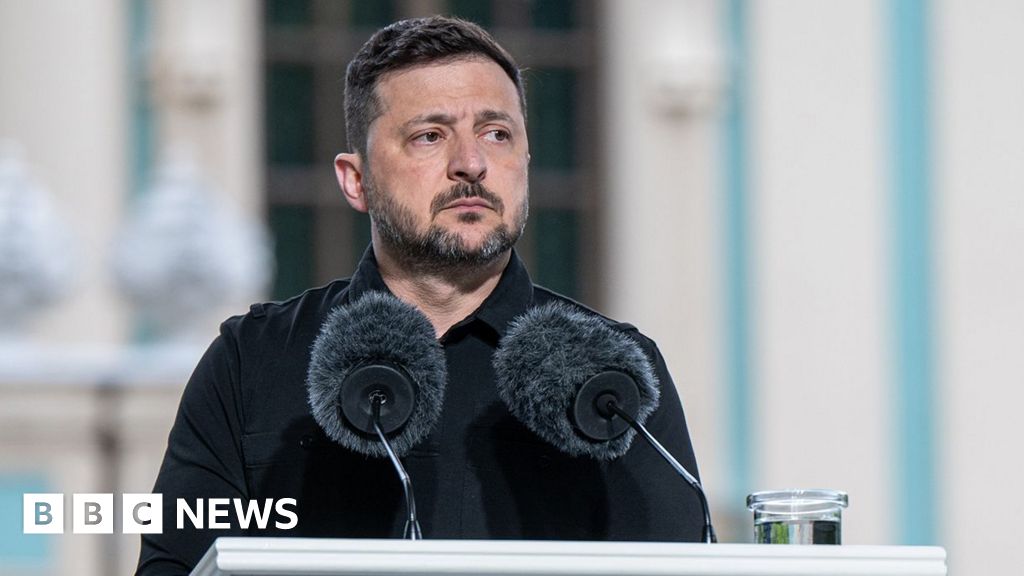
Zelensky moves towards demilitarised zones in latest peace plan for Ukraine

Ukraine’s President Volodymyr Zelensky has given details of an updated peace plan that offers Russia the potential withdrawal of Ukrainian troops from the east that Moscow has demanded.

Giving details of the 20-point plan agreed by US and Ukrainian negotiators in Florida at the weekend, Zelensky said the Russians would respond on Wednesday once the Americans had spoken to them.

Describing the plan as “the main framework for ending the war” Zelensky said it proposed security guarantees from the US, Nato and Europeans for a co-ordinated military response if Russia invaded Ukraine again.

On the key question of Ukraine’s eastern Donbas, Zelensky said a “free economic zone” was a potential option.

He told journalists that as Ukraine was against withdrawal, US negotiators were looking to establish a demilitarised zone or a free economic zone. Any area that Ukrainian troops pulled out of would have to be policed by Ukraine, he stressed.

“There are two options,” Zelensky said, “either the war continues, or something will have to be decided regarding all potential economic zones.”

The 20-point plan is seen as an update of an original 28-point document, agreed by US envoy Steve Witkoff with the Russians several weeks ago, which was widely seen as heavily geared towards the Kremlin’s demands.

The Russians have insisted that Ukraine pulls out of almost a quarter of its own territory in the eastern Donetsk region in return for a peace deal. The rest is already under Russian occupation.

Sensitive issues including questions over territory would have to be resolved “at the leaders’ level”, but the new draft would provide Ukraine with strong security guarantees and a military strength of 800,000, Zelensky explained.

Much of the updated plan resembles what came out of recent talks in Berlin involving US negotiators Witkoff and Jared Kushner with Ukrainian and European leaders. The setting then moved to Miami last weekend where US President Donald Trump’s team spoke separately to Russian envoy Kirill Dmitriev and then Ukrainian and European officials.

There now appears to be far more detail on the territorial issue, although it is clear the Ukrainian side was unable to reach a consensus with the Americans.

Zelensky explained that if Ukraine was prepared to pull its heavy forces back by five, 10 or 40km in the 25% of Donetsk it still held to create an economic zone, making it virtually demilitarised, then Russia would have to do the same “accordingly by five, 10, or 40km”.

Russian troops are currently about 40km (25 miles) east of Ukraine’s “fortress belt” cities of Sloviansk and Kramatorsk, having captured the town of Siversk.

Russian President Vladimir Putin is unlikely to be impressed by the kind of compromise being proposed for Donetsk. He said this month that Russia would take control of the entire east of Ukraine by force if Ukrainian troops did not pull out.

Zelensky made clear that such a free economic zone would have to be under Ukrainian administration and police – “definitely not the so-called Russian police”. The current front line would then become the boundary of the economic zone with international forces on the ground along the contact line to ensure no Russian infiltration.

Russia has so far rejected a European proposal to police any peace deal through a Coalition of the Willing as a “brazen threat”.

A referendum would need to be held on the whole peace plan, Zelensky said, ad only a referendum could decide on the idea of a potential free economic zone in Donbas.

He emphasised that an economic zone would also have to be set up around the Zaporizhzhia nuclear power plant currently occupied by Russia, and that Russian troops would have to pull out of four other Ukrainian regions – Dnipropetrovsk, Mykolaiv, Sumy, and Kharkiv.

The main points of the plan reaffirm Ukraine’s sovereignty and propose a non-aggression pact between Russia and its neighbour with a monitoring mechanism.

As well as strong security guarantees mirroring Nato’s Article Five, which requires members to aid an ally under attack, Ukraine is to be allowed a maximum military strength of 800,000 in peacetime.

Discussions are still going on over a US plan to receive compensation in return for security guarantees, so Zelensky says it is not currently part of the document.

There is no reference barring Ukraine from joining Nato, which was in the original 28-point plan and something Russia has consistently demanded.

And the latest framework proposes that Ukraine joins the European Union with a defined date of accession. It is currently a candidate, but a number of other candidate countries are seen as first in line, such as Albania.

There are plans for a Ukraine investment fund of about $200bn involving both the US and Europe.

Among the other points is a requirement for Ukraine to hold elections as soon as possible after the deal is signed. Russia and the US have both pushed for a vote, even though Ukraine is under martial law because of the full-scale invasion.

Source link

Ukraine: European leaders meet Zelensky, Witkoff, Kushner in Berlin

German President Frank-Walter Steinmeier (R) welcomes Ukrainian President Volodymyr Zelensky (L) at Bellevue Palace in Berlin on Monday ahead of three way talks between European, American and Ukrainian delegations on efforts to hammer out a peace deal that is acceptable to all sides. Photo by Hannibal Hanschke/EPA

Dec. 15 (UPI) — British Prime Minister Keir Starmer and German Chancellor Friedrich Merz were set to meet with Ukrainian President Volodymyr Zelensky and U.S. officials in Berlin on Monday in an effort to reach a consensus on what any peace deal with Russia should look like.

The European leaders, along with French President Emmanuel Macron, who has yet to confirm his attendance, will seek to negotiate an alternative to the U.S.-Russia plan currently on the table with a stronger deal for Ukraine with better protections for its security.

The talks will also attempt to keep afloat an EU-brokered agreement to loan Ukraine some of the $246.7 billion of Russia’s assets frozen in European banks and other institutions to help it defend itself and take “forward peace talks from a position of strength,” amid mounting opposition to the plan.

The meeting follows five hours of talks on Sunday between Zelensky and U.S. Special Envoy Steve Witkoff and President Donald Trump‘s son-in-law, Jared Kushner, at the Federal Chancellery that Witkoff said were productive and would resume on Monday.

“Representatives held in-depth discussions regarding the 20-point plan for peace, economic agendas, and more. A lot of progress was made, and they will meet again tomorrow morning,” Witkoff posted on X on Sunday evening.

Zelensky was reported to have dropped demands for NATO membership, if it was what was required to end the war, in exchange for a bilateral defense agreement with the United States similar to an Article 5-like guarantee, along with other guarantees from Ukraine’s European partners.

Article 5 is a cast-iron guarantee, a collective defense principle enshrined in NATO’s constitution under which an armed attack on one member is considered an attack on all members and triggers an obligation for each member to come to its defense.

Following the initial discussions on Monday, Merz’s spokesman confirmed the group would be widened to include “numerous European heads of state and government, as well as the leaders of the EU and NATO.”

The diplomatic focus will shift to Brussels on Thursday when the leaders of all 27 EU nations converge on the Belgian capital for a meeting of the European Council with Ukraine and European security topping the agenda.

Council President Antonio Costa said the summit would address how best to continue defending Europe’s interests and how to “strengthen Ukraine’s negotiating position,” a key element of which necessitated “increased pressure on Russia.”

Costa said that having already committed to providing for Ukraine’s urgent financial needs for 2026-2027, including funding for its military and defense, it was now time to decide how to implement it and that leaders must keep talking on Thursday until an agreement was reached.

Earlier this month, European Commission President Ursula von der Leyen unveiled two options — both controversial — to provide Ukraine with $105.8 billion of the $158.6 it is estimated it will need in the two years through 2027 to keep the country running and being able to continue fighting Russia.

The so-called “reparations loan” option involving using frozen Russian assets only requires a two-thirds majority of EU states to vote for it. The second option under which the EU would use its budget to go borrow on the international capital markets is more problematic because it could be blocked by a single state.

Hungary and Slovakia have indicated they are opposed to either route, while Belgium, home to Euroclear, the clearing house where the majority of Russia’s frozen assets are held, has expressed strong worries that it could be taken to court by Russia were the frozen assets tapped or that it may scare off foreign investors.

Russia has protested that appropriating its assets amounts to theft but the EU says that is not the case because there was nothing to preclude Russia from reclaiming the funds in future — after it has paid war reparations to Ukraine.

Ukraine is set to run out of money early in the New Year.

South Africans honor Nelson Mandela

Large crowds gather outside Nelson Mandela’s former home in the Johannesburg suburb of Houghton to pay their respects on December 7, 2013. Mandela, former South African president and a global icon of the anti-apartheid movement, died on December 5 at age 95 after complications from a recurring lung infection. Photo by Charlie Shoemaker/UPI | License Photo

Source link

Ukraine may give up NATO dreams for end of war, Zelensky says

Dec. 14 (UPI) — Ukrainian President Volodymyr Zelensky said Sunday that his country may give up its dreams of NATO ascension, at least temporarily, for an end to the war and security guarantees from the United States and Europe, reports said.

Zelensky, who has said that NATO ascension is unlikely because of Russian opposition, held that Ukraine would still seek security guarantees similar to the bloc’s Article 5 clause for mutual protection for members under attack.

His comments were made to journalists in a private WhatsApp chat and were reported by The New York Times and Financial Times.

“This is already a compromise on our part,” Zelensky said.

German Chancellor Friedrich Merz will host talks Sunday between Zelensky, as well as Steve Witkoff and President Donald Trump‘s son-in-law, Jared Kushner, at the Federal Chancellery.

Zelensky added that he has not yet received a response from the Trump administration on revised peace proposals sent last week, the reports said.

Under that peace plan, The New York Times reported, Ukraine said any decision to give up Ukrainian territory would need to be put to a vote and it removed a measure put in place by American negotiators preventing it from ever joining NATO, indicating that Zelensky holds on to hope Ukraine could join the defense alliance in the future.

Yuri Ushakov, the foreign policy adviser to President Vladimir Putin, said on state television Sunday that Russia would have “sharp objections” if the United States adopted any Ukrainian or European suggestions for the plan.

Both Ukraine and Russia have seemingly rejected a proposal from the Trump administration that would create a sort-of demilitarized zone in parts of eastern Ukraine that it still holds, requiring only Ukrainian troops to withdraw from the buffer area.

Zelensky said Sunday he did not consider it fair that Russian troops were not also asked to withdraw deeper into the occupied territories.

“We stand where we stand,” he said. “That is precisely a ceasefire.”

Source link

Steve Witkoff to meet Volodymyr Zelensky for latest Ukraine war talks

US President Donald Trump’s overseas envoy will travel to Germany this weekend to meet Ukrainian President Volodymyr Zelensky and European leaders for the latest round of high-level talks on ending the war.

Steve Witkoff, who has been leading White House attempts to mediate between Ukraine and Russia, will discuss the latest version of the proposed peace agreement in Berlin.

The Trump administration is pushing for a deal to be in place by Christmas and has held several rounds of talks with Ukrainian and Russian representatives in recent weeks, though there has been little sign a breakthrough is imminent.

It has not yet been confirmed which European leaders will attend the Berlin talks.

The Wall Street Journal, which first reported details of the meeting, said UK Prime Minister Sir Keir Starmer, French President Emmanuel Macron and German Chancellor Friedrich Merz would all take part.

Confirmation of the Witkoff-Zelensky meeting comes days after Ukraine gave the US its revised version of a 20-point peace plan, the latest iteration of a proposal which first emerged in late November and has triggered a flurry of diplomatic activity.

The fate of territory in eastern Ukraine remains one of the most intractable topics in the negotiations, with Kyiv refusing to cede land which has been illegally occupied, and Moscow repeating its intention to take the Donbas region in full by force unless Ukraine withdraws.

Zelensky has reacted sceptically to the White House’s latest proposal on resolving the territorial question, which is for Ukraine’s army to pull out of the region and for it to be turned into a “special economic zone”.

The Ukrainian president told reporters that under the US-proposed terms, the Kremlin would undertake not to advance into the areas vacated by Ukraine’s forces, with the land between Russian-controlled parts of the Donbas and Ukraine’s defensive lines effectively turned into a demilitarised zone.

The proposal, seemingly an attempt to resolve the question of legal ownership by creating a new status for the land, has been publicly questioned by Zelensky, who said: “What will restrain [Russia] from advancing? Or from infiltrating disguised as civilians?”

Ukraine and allies in Europe have said publicly that the US-led talks have been fruitful, and have hailed progress on securing amendments to a plan which was widely viewed as favouring Russia when it first emerged.

But there have been signs in recent weeks that Trump is losing patience with Zelensky and his backers on the continent.

In a scathing interview with Politico earlier this week, the US president labelled European leaders “weak” and renewed his calls for Ukraine to hold elections.

Zelensky said elections could be held within 90 days if the US and Europe provided the necessary security. Elections have been suspended since martial law was declared when Russia launched its full-scale invasion in February 2022.

As the White House’s diplomatic push continues, attention in Europe is focused on how to support Ukraine in the event of a peace deal, with talks ongoing over security guarantees and funding.

The Ukrainian government faces a stark financial situation: it needs to find an extra €135.7bn (£119bn; $159bn) over the next two years.

On Friday, European Union governments agreed to indefinitely freeze around €210bn (£185bn; $247) worth of Russian assets held in Europe.

It is hoped that agreement paves the way for the funds to be loaned back to Ukraine if a deal can be reached at an EU summit next week, providing Kyiv with financial help for its military and efforts to rebuild parts of the country left devastated after nearly four years of all-out war.

That move has been condemned as theft by the Kremlin, and Russia’s central bank has said it will sue Euroclear, a Belgian bank where the vast majority of Russian assets frozen after the invasion are held.

Officials were still negotiating the exact structure of a deal to repurpose the Russian assets on behalf of Ukraine, with the Belgian government being particularly sceptical due to its particular legal exposure as the main holder.

Elsewhere, it was reported that the latest version of the peace plan being circulated envisions Ukraine rapidly joining the European Union.

The Financial Times said Brussels backed Ukraine’s swift accession to the bloc, an idea proposed by Ukraine in the latest draft it has given to Washington.

Ukraine formally applied to join the EU days after the 2022 invasion but despite promises of an accelerated process is still several years away from becoming a member.

Under the plan, Ukraine would become a member as soon as January 2027, AFP reported, citing an unnamed senior official. It was unclear whether Washington had approved that element of the draft.

Source link