yamamoto

Soundgarden reflect on Rock Hall induction and Chris Cornell’s legacy

Soundgarden, the seminal Seattle grunge rock group, were inducted into the Rock and Roll Hall of Fame at a star-studded ceremony at the Peacock Theater on Saturday night. Before they accepted their awards from comedian Jim Carrey and ripped into “Black Hole Sun,” and “Rusty Cage,” the band reflected together backstage on their topsy turvy journey into the ranks of rock’s immortals and the lasting impact of their departed frontman Chris Cornell.

“I like the honor of it and I’m really happy for our fans,” bassist Ben Shepherd said. “I can’t wait to play.”

For guitarist Kim Thayil, there’s a measure of validation in their induction which he recalled from conversations with Cornell. “Chris would say, ‘Remember how you and I, and [bassist] Hiro [Yamamato] would sit around in a room and talk about the bands we really liked…and that influenced us to play together?” It’s like, ‘Well, that’s the kind of band we should be. The band that makes us want to get together and play music.’”

Soundgarden members Kim Thayil, Matt Cameron, Chris Cornell and Ben Shepherd standing in a line, posing for photo

Soundgarden members (from left) Kim Thayil, Matt Cameron, Chris Cornell and Ben Shepherd in 2014.

(Jack Plunkett / Jack Plunkett/invision/ap)

The induction was a long-time coming for Soundgarden. They originally formed in 1984 and steadily moved to the forefront of underground indie rock scene on labels like Sub Pop and SST while touring the country in a red Chevy van. “It was almost like a camping trip with sleeping bags,” Cameron recalled. “I remember I brought this one blue blanket to sleep on.”

“I’d bring my own breakfast. I’d bring a cooler, and I’d put cereal and yogurt in there,” Yamamoto said. “These guys would go to Denny’s every day. I can’t do that!”

After moving to A&M Records, Soundgarden spent the 1990s crafting some of the most innovative, heavy and dynamic albums of their generation. Groundbreaking records like “Badmotorfinger,” “Superunknown” and “Down on the Upside.” Soundgarden disbanded in 1997 but got back together 13 years later in 2010 and resumed working on music and touring.

As rewarding as the Rock Hall honor is, the absence of Cornell –- who took his own life after a concert in Detroit in 2017 – carried a bit of somber note into the festivities. “It’s nice to hear the power of the music that we created, but it’s extremely bittersweet as well that we don’t have [Chris] with us,” drummer Matt Cameron said. “In the few instances where we have performed this music since his passing — it’s only been a few occasions — it’s empowering, but it’s also really, really bittersweet.”

In the meantime, Cornell’s bandmates are continuing to work on a collection of tunes they were recording with him just before his passing. “Once we were able to work on the music again, it all just kind of came back to just how powerful the music still is and how meaningful it still is to us,” Cameron said. “I think we’re going into it with just those types of intentions of trying to make it natural and real, which at this stage of the game, there’s a few things that sound amazing.”

The reunion with Yamamoto – who left Soundgarden around 1989 — for the Rock Hall show went a long way to livening the festivities. As soon as the band kicked into one of their early cuts, “Entering,” during rehearsals in Seattle, Shepherd recalled with a hint of awe that, “It instantly sounded like Soundgarden.”

“That was one of those things where I might have gone to YouTube and had somebody else teach me how to play it again,” Yamamoto said with a laugh. Nevertheless, Shepherd snapped a picture of the moment and gleefully sent it around to friends.

“We weren’t sure how it would work, but Hiro’s so adaptable and he’s such an amazing musician that it sounded great from the get-go,” Cameron said. “A lot of low end, but the band has always had a pretty sizable bass presence in our sound. It was just nice.”

Soundgarden and Taylor Momsen perform on stage at Rock Hall induction

Inductee Kim Thayil of Soundgarden, Taylor Momsen and inductee Matt Cameron of Soundgarden perform onstage during the 2025 Rock & Roll Hall of Fame Induction Ceremony at Peacock Theater on November 08, 2025 in Los Angeles, California.

(Amy Sussman/WireImage)

To bring Cornell’s vocals to life at the Peacock Theater, Soundgarden turned to a pair of younger powerhouses. Brandi Carlile and the Pretty Reckless frontwoman Taylor Momsen. Both are tried and true Soundgarden fans and represent the group’s impact on the next generation of musicians that followed in their wake. It’s something they are particularly proud about.

“It’s still surprising, but it is something that was probably on our wishlist as something we would hope to expect,” Thayil said. “If we’re honest with ourselves and we’re honest with what we’re creating and honest in how we communicate together, then this should happen. But it’s still a surprise and still heartwarming.”

“It is sort of nice to be able to contribute to that continuum of music and have younger generations hopefully be inspired by what we were grooving on with the band, which was you know, self-expression and collaboration and trusting your own instincts and things like that,” Cameron said. “I think is a nice thing to impart on other young musicians.”

As for who they think should follow Soundgarden into the Hall next, Thayil has some thoughts. “Alice in Chains is the first thing that comes to mind, of course,” he said. “I’m surprised to learn that these six people aren’t in the Hall of Fame: Sonic Youth, Motorhead, Iron Maiden, the Pixies, the New York Dolls and the Black Crows.”

“And the Melvins!” Cameron added.

Source link

How Yoshinobu Yamamoto made the 2025 World Series his greatest moment

Shortly after the Dodgers won Game 6 of the World Series, Yoshinobu Yamamoto approached his longtime personal trainer.

Lowering his head, Yamamoto said to Osamu Yada, “Thank you for everything this year.”

Yamamoto figured his season was over. He’d thrown 96 pitches over six innings, and he half-joked in the postgame news conference that he wanted to cheer on his team rather than pitch again the next day. Manager Dave Roberts had the same thought, saying Yamamoto would be the only pitcher unavailable in Game 7.

The trainer had other ideas.

“Let’s see if you can throw in the bullpen tomorrow,” Yada said.

By just being in the bullpen, Yada said, Yamamoto could provide the Dodgers a psychological edge over the Toronto Blue Jays.

“That’s how I got tricked,” Yamamoto said in Japanese with a laugh.

Yada’s guiding hand transformed Yamamoto into a legend on Saturday night.

Pitching the final 2 ⅔ innings of an 11-inning, championship-clinching 5-4 victory over the Toronto Blue Jays, Yamamoto won his third game of the World Series.

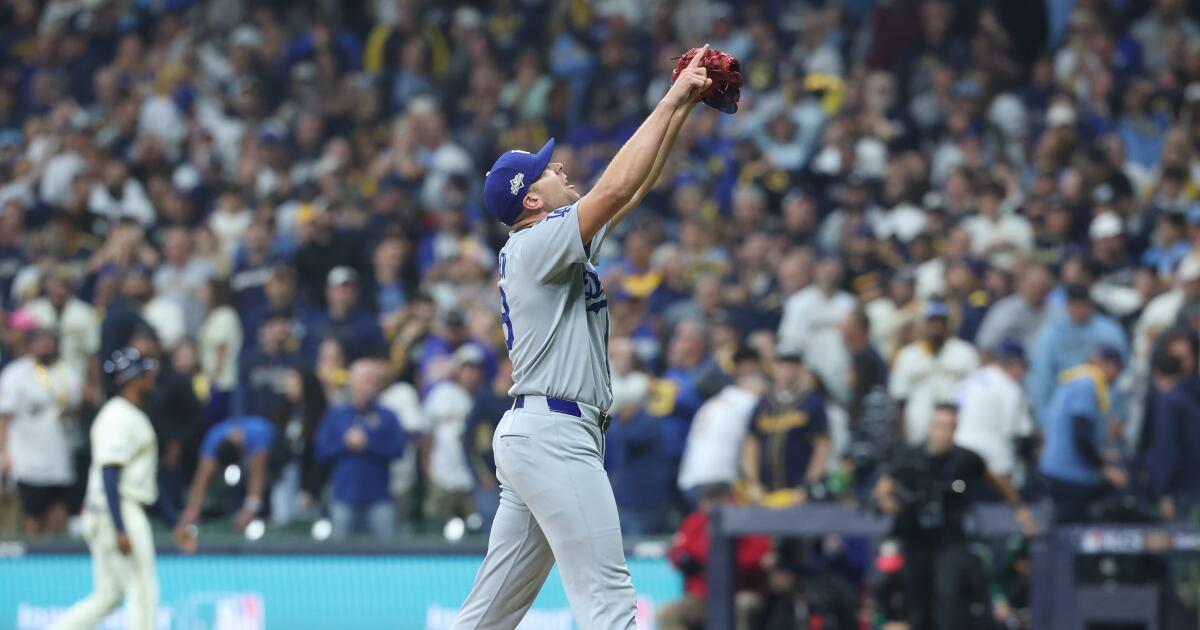
When he forced Alejando Kirk to ground into a game-ending double play, Yamamoto removed his cap and raised his arms toward the heavens. Catcher Will Smith rushed the mound and picked him up from the waist.

“I felt a joy I never felt before,” Yamamoto said.

Dodgers catcher Will Smith picks up Dodgers pitcher Yoshinobu Yamamoto after the final out.

Dodgers catcher Will Smith picks up Dodgers pitcher Yoshinobu Yamamoto after the final out of a 5-4 win in 11 innings over the Toronto Blue Jays in Game 7 of the World Series on Saturday.

(Gina Ferazzi / Los Angeles Times)

Yamamoto pitched a complete game in Game 2. He pitched six more in Game 6. His contributions in Game 7 increased his series total to 17 ⅔ innings, over which he allowed only two runs.

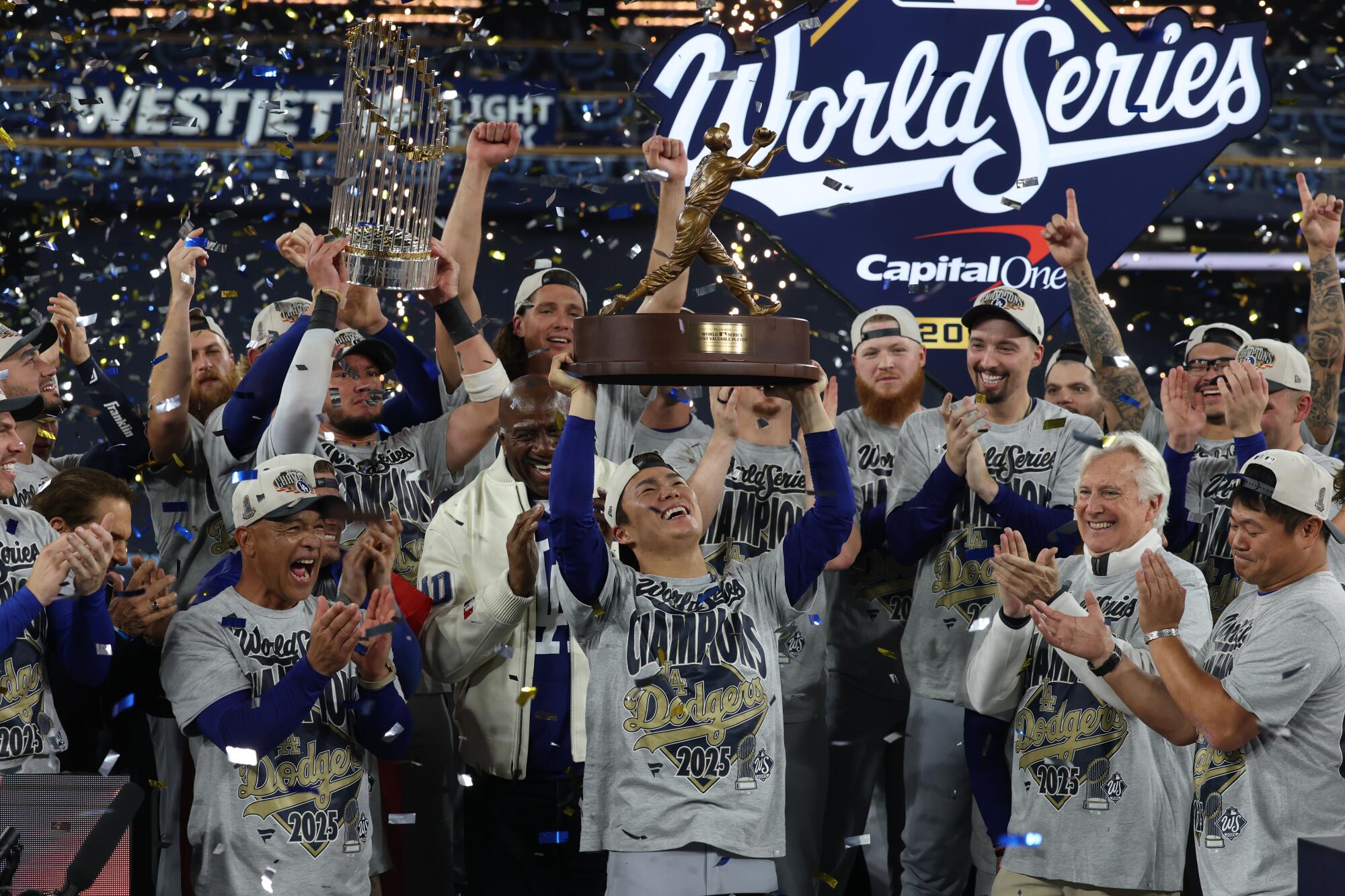
The throwback performance earned him the series’ most valuable player award, as well as universal admiration.

“I really think he’s the No. 1 pitcher in the world,” Shohei Ohtani said in Japanese. “Everyone on the team thinks that, too.”

Freddie Freeman marveled at the workload shouldered by the 5-foot-10 Yamamoto, who was sidelined for three months last year with shoulder problems.

“I mean, he pitched last night, started,” Freeman said. “He threw the most innings out of our pitchers tonight.”

Freeman pointed out that in addition to pitching in three games, Yamamoto also warmed up to pitch in a fourth. Two days after his complete game in Game 2, he prepared in the bullpen to pitch a potential 19th inning in Game 3. The Dodgers won that game in the 18th inning.

“I’ve never seen anything like that,” Freeman said.

President of baseball operations Andrew Friedman said of Yamamoto’s Game 7 performance, “For him to have the same stuff that he had the night before is really the greatest accomplishment I’ve ever seen on a major league baseball field.”

Did Friedman think any other pitcher could have done what Yamamoto did in this series?

“No, I don’t,” Friedman said. “In fact, yesterday morning I didn’t necessarily think Yama could either.”

Friedman said he didn’t think much of it when he was notified after Game 6 that Yamamoto was receiving treatment from Yada at the team hotel with the intention of perhaps pitching in Game 7. Friedman was told the next morning that Yamamoto received another round of treatment.

The possibility of Yamamoto pitching in Game 7 became real to Friedman after he performed his trademark javelin-throwing routine and played catch at Rogers Centre. Yamamoto still wasn’t convinced.

Dodgers pitcher Yoshinobu Yamamoto, left, celebrates with Shohei Ohtani and teammates.

Dodgers pitcher Yoshinobu Yamamoto, left, celebrates with Shohei Ohtani and teammates after a 5-4 win over the Toronto Blue Jays in Game 7 of the World Series at Rogers Centre on Saturday.

(Robert Gauthier / Los Angeles Times)

“I didn’t think I would pitch,” Yamamoto said. “But I felt good when I practiced, and the next thing I knew, I was on the mound (in the game).”

Yamamoto’s interpreter, Yoshihiro Sonoda, was prepared.

The superstitious Sonoda wears the same pair of lucky underwear on days Yamamoto pitches. He wore the rabbit-themed boxers for Game 6. Sensing Yamamoto might pitch again, Sonoda wore the same boxers for Game 7.

“Just in case,” Sonoda admitted, “I didn’t wash them.”

Yamamoto had never pitched on consecutive days as a professional, in either the United States or Japan. When was called on to relieve Blake Snell in the ninth inning, he was uncertain of how he would perform.

Inheriting two baserunners from Snell with one out, Yamamoto loaded the bases by plunking Kirk. He forced Dalton Varsho to ground into a force out at home, only to throw a curveball to Ernie Clement that was driven to the wall in left field. Defensive replacement Andy Pages crashed into Kiké Hernández on the warning track but held on to the ball, preventing the Blue Jays from scoring the walk-off run.

Yamamoto pitched a 1-2-3 10th inning and went into the bottom of the 11th with a 5-4 lead, courtesy of a homer by Smith in the top of the inning.

Vladimir Guerrero Jr. started the inning by pulling a 96.9-mph fastball for a double and advanced to third base on a sacrifice bunt by Isiah Kiner-Falefa. Yamamoto walked Addison Barger to place runners on the corners, setting up the game-ending double play by Kirk.

“I really couldn’t believe it,” Yamamoto said. “I was so excited I couldn’t even recall what kind of pitch I threw at the end. When my teammates ran to me, I felt the greatest joy I’ve felt up to this point.”

Clayton Kershaw, whom Yamamoto wanted to send into retirement with another championship, embraced him harder than he’d ever embraced him. Roberts swallowed him an embrace.

Yamamoto was moved to tears.

Overwhelmed by the moment, Yamamoto didn’t sound as if he grasped the magnitude of what he’d just done. In time, he will.

On the night the Dodgers solidified their dynasty, Yamamoto made this World Series his.

Source link