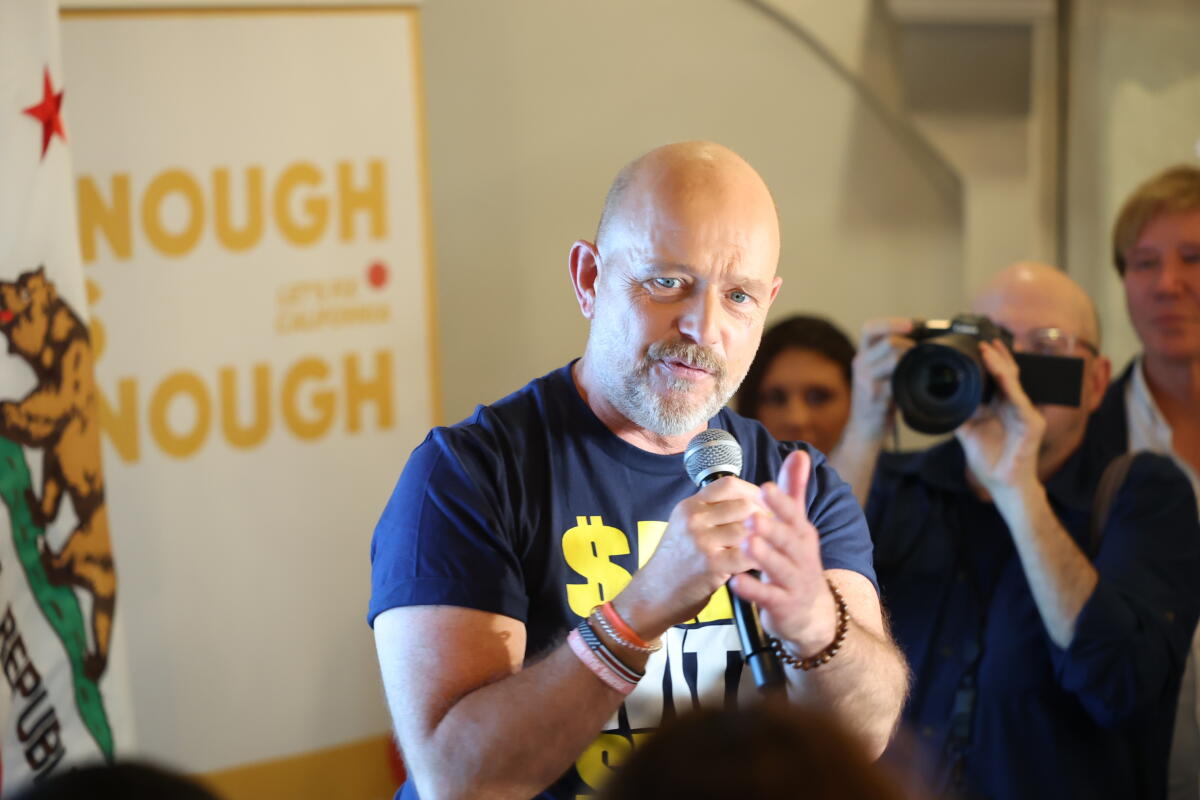
Xavier

Los Angeles Rep. Xavier Becerra poised to become California’s first Latino attorney general

In a move that suggests a sharp battle to come with the administration of President-elect Donald Trump and upends conventional wisdom about who will emerge as the next generation of statewide elected officials, Gov. Jerry Brown picked House Democratic Caucus Chairman Xavier Becerra (D-Los Angeles) on Thursday to be California’s next attorney general.

If confirmed by both houses of the Legislature, he will succeed Kamala Harris, who was elected to the U.S. Senate in November.

Becerra, 58, has served 12 terms in Congress. Just days before the appointment, he had announced a bid to become the ranking Democrat on the powerful House Ways and Means Committee.

“It’s a phenomenal opportunity,” Becerra said. “It means I get to be home a lot more.”

Few statewide offices are as powerful, or prominent, as that of attorney general. The role has often been referred to as the state’s top lawyer and its top law enforcement officer, a nod to the breadth of responsibilities vested in the office and its leadership of the California Department of Justice.

Attorneys general not only must pursue cases of criminal and civil wrongdoing, they oversee criminal forensic work for most counties and make the final choice about defending state laws — even crafting the language that summarizes ballot measures for voters.

Becerra was beaming during an interview in his House office Thursday morning shortly after Brown offered him the job.

“I’m still processing,” Becerra said with a laugh. “I didn’t expect it.”

Becerra would be the state’s first Latino attorney general. The son of Mexican immigrants, he was the first member of his family to attend college, earning a law degree from Stanford Law School and a bachelor’s degree in economics from Stanford University. Elected to a two-year term in the state Assembly and then to the House in 1992, he rose through the ranks to become the highest-ranking Latino in Congress.

Becerra worked in the civil division of the state attorney general’s office, writing advisory opinions for former Gov. George Deukmejian, a Republican, and defending the state’s constitutional officers from 1987 to 1990 before entering the Assembly. He said he had always wanted to return to the office.

“It was a great place to be,” he said.

Brown’s pick was so sudden that Becerra has not yet had time to reactivate his state law license, though he would not be the first attorney general to have to do so. Inactive status allows attorneys to hold on to their licenses when they are not actively practicing law.

Becerra would also be the first attorney general appointed by a governor since Thomas Lynch, who was chosen by former Gov. Pat Brown in 1964. Few political appointments are likely to be as personal to the current governor as this one, given his own four-year stint as attorney general starting in 2006 and the fact that his father used the office as a steppingstone to governor more than five decades ago.

“Xavier has been an outstanding public servant — in the state Legislature, the U.S. Congress and as a deputy attorney general,” Brown said in a statement. “I’m confident he will be a champion for all Californians and help our state aggressively combat climate change.”

The choice sent political shock waves through California, in large part because Becerra was not on any of the widely circulated lists of potential picks. Brown had offered no details on whom he would pick or when.

Many suspected that he might choose a caretaker, perhaps even a career staffer who would simply carry out the office’s functions through the 2018 election. Virtually no Democrats who heard the news on Thursday believed that Becerra would be that kind of officeholder.

“He has the smarts, political experience and ambitions to run and win reelection,” said state Sen. Steve Glazer (D-Orinda), a former top political adviser to Brown.

If Becerra serves less than two years of Harris’ existing term, he could be eligible to run for up to two additional terms — eight years — as attorney general. Harris has said she plans to hold the position until she is sworn in to the Senate on Jan. 3, and at that point Brown could officially nominate Becerra.

Becerra said Thursday he’s thinking about the confirmation process at this point and not whether he’ll run for a full term as attorney general or another office in 2018. He must be confirmed by the state Senate and Assembly, both controlled by Democrats. Becerra said he hasn’t been told when a confirmation vote might happen.

Earlier, Becerra had flirted with a bid for U.S. Senate when Sen. Barbara Boxer (D-Calif.) announced plans to retire, but Harris’ quick entry into the race kept him and other California Democrats from running.

Holding such a prominent statewide post would raise Becerra’s profile as the Golden State’s foil to Trump, potentially setting him up to run for governor or U.S. Senate in the future. The attorney general, by virtue of the office’s broad power, will likely be a key player alongside Brown in pushing back against Trump’s proposed efforts on issues important to California, including immigration and climate change. In Texas, a state that has its own experience fighting the federal government, attorneys general have been a major force in the battle over states’ rights.

“He has great tenacity and he respects the rights of all Californians — much-needed qualities for an attorney general given the troubling times ahead,” Assembly Speaker Anthony Rendon (D-Paramount) said Thursday.

Several congressional colleagues echoed that sentiment.

“Many of the values that we stand by in California will be under attack in the next few years, and Chairman Becerra is the fighter I want in our corner,” Rep. Tony Cardenas (D-Los Angeles) said in a statement.

Becerra said that with Trump headed to the White House, he’s prepared to protect California’s progressive policies on immigration, the Affordable Care Act, energy and criminal justice. As California politicians embrace their roles in guarding the state against Trump’s policies, Becerra threw down his own gauntlet Thursday.

“If you want to take on a forward-leaning state that is prepared to defend its rights and interests, then come at us,” Becerra said.

A vocal advocate for Hillary Clinton’s presidential bid, Becerra was briefly floated as a potential pick for vice president or a Cabinet position. With Clinton’s loss Nov. 8 and no upward mobility available in House leadership, Becerra’s future political career was unclear.

He’d reached the time limit on serving as caucus chairman, the fourth highest-ranking House Democratic leadership position, and with House Minority Leader Nancy Pelosi (D-San Francisco) and the other two Democrats above him in leadership staying put, there was no path up the ladder headed into the next Congress.

Becerra serves on the powerful House Ways and Means Committee, and made a play as recently as Tuesday to be the committee’s ranking Democrat. He was quickly endorsed by the current ranking member, Rep. Sandy Levin (D-Mich.), who said in a statement Thursday that he respects that Becerra “feels a special responsibility during these difficult times to look after vital legal interests in his home state.”

Democrats across California reacted Thursday with effusive praise for Becerra. Lt. Gov. Gavin Newsom called him “a thoughtful and effective leader, with a keen legal mind and a passion for giving a voice to the voiceless.”

In particular, some pointed out the importance of elevating a Latino politician to statewide office, alongside both Latino leaders of the Legislature and Secretary of State Alex Padilla.

“It’s good for the state’s future,” said Bill Lockyer, who served as attorney general from 1999 to 2007.

The announcement also meant early guessing as to who would replace Becerra in representing downtown Los Angeles and communities to the west and north in Congress. Becerra won reelection in November in the solidly Democratic district. A special election to fill the seat would probably take place in late spring of 2017, though the law gives Brown wide discretion on the precise schedule.

John A. Pérez, the former Assembly speaker and current University of California regent, announced his bid less than an hour after Brown’s announcement, and more contenders may follow.

sarah.wire@latimes.com; john.myers@latimes.com

Follow @sarahdwire and @johnmyers on Twitter

Read more about the 55 members of California’s delegation at latimes.com/politics

ALSO

After beating back rival for House leadership post, Nancy Pelosi says Democrats are ready for Trump

Trump seems ready to fight the world on climate change. But he’s likely to meet resistance

Updates on California politics


Source link

Before governor’s race, Xavier Becerra was depicted in kids novels

For years, Kitty Felde was a familiar voice on public radio in Southern California. Reporting from Capitol Hill, it was her job, she felt, to explain government to the grown-ups living thousands of miles away.

It could be frustrating, given how little many listeners seemed to know or understand about even the basics of Washington and how the place works. (Or, at least, how it’s supposed to work.)

“They don’t remember this stuff from fifth grade,” Felde said.

Worse, a lot of people didn’t seem to care.

So Felde wondered: What if her insights and expertise were aimed at a younger audience?

You’re reading the L.A. Times Politics newsletter

George Skelton and other political analysts cover the insights, legislation, players and politics you need to know. In your inbox Monday and Thursday mornings.

With her career in radio winding down, Felde set off in a new direction, writing a novel for young adults that combined sleuthing with civics; a blend of “Nancy Drew” and “The West Wing,” as Felde’s website described the result.

Set in Washington, the book’s main character was Fina Mendoza, a 10-year-old girl modeled after someone whom Felde, a Southern California native, mentored years ago while living and reporting in Los Angeles.

“She was fierce, smart, quiet, driven, even persuading her non-English-speaking mother to help her transfer to a better high school where she graduated with honors,” Felde told an interviewer when the book was published in 2019. In creating Fina Mendoza, “I imagined what [Felde’s mentee] must have been like when she was younger.”

For Mendoza’s father, or “Papa,” Felde envisioned someone she had gotten to know over the years covering California’s congressional delegation. Someone genial and soft-spoken who, lately, has been in the news quite a bit.

Xavier Becerra.

“He’s a widower,” Felde said of the fictional Arturo Mendoza, a Democratic congressman representing Los Angeles, as Becerra did for nearly a quarter of a century. “Xavier, obviously, is not. But I met his daughters, I met his wife. And so that image … I could see him being the father.”

She did not, Felde confessed, see Becerra as a California governor-in-waiting.

When she conceived Arturo Mendoza, Felde said, “nobody knew who [Becerra] was” — which is only a slight exaggeration. Even now, many Californians are just becoming familiar with the Democrat, who is heavily favored to beat Republican Steve Hilton in November, given the state’s strong Democratic tilt.

A five-part series

That first novel about Fina and her exploits on Capitol Hill has expanded into a multi-volume series, published in English and Spanish, featuring the young detective and her roman à clef Papa. The fourth installment comes out next month. Felde is currently working on the fifth and, she expects, final volume.

Collectively, the works do not purport to offer “The Xavier Becerra Story.” Rather, each centers on a mystery — a bird that poops on the president during his State of the Union speech; a culprit placing snakes in the gym bags of lawmakers; a series of break-ins, fires and vandalism in the Montecito Heights neighborhood of Los Angeles, where Fina is home for the summer. The protagonist unravels each knot and, along the way, delivers readers a goodly dose of Government 101.

A shelf-load of books written by Kitty Felde

Felde has written four books in the Fina Mendoza Mystery Series and is working on the fifth and, she believes, final volume.

(Gina Ferazzi/Los Angeles Times)

Unlike Becerra, Papa continues serving in the House. His real-life model left Congress in January 2017 after Gov. Jerry Brown appointed him California attorney general, replacing Kamala Harris upon her departure for the U.S. Senate. Becerra was elected to the job the following year, served in the Biden administration as Health and Human Services secretary and finished atop the field in California’s crowded June 2 gubernatorial primary.

Speaking via Zoom from her home office in Baldwin Hills, Felde ventured a few thoughts on how Becerra would do as governor. (Which, of course, is also a mystery; at this point one can only guess.)

“We’re a big state with a lot of problems,” Felde said with a small shake of her head. “I think he’ll have a good time fighting the current administration. And I think, because he does have contacts both in Sacramento and in Washington … that can help because that’s where money’s coming from.”

The great divide

Returning to Fina Mendoza, Felde said part of her intent in writing the series was closing the yawning physical and psychic gaps that exists between California and Washington.

“We think we are the center of the universe because we are isolated in a lot of ways from the rest of the country,” Felde said of her fellow Californians. In Washington, “they think the same thing, but they’re the ones with the money and the power…. There is a dependency there.”

For that reason alone, she suggested, people should pay closer attention to what’s happening back East, notwithstanding the distance and the sometimes confounding, oftentimes arcane ways and means of the nation’s capital.

“It’s our government,” she said. “If you want to change the world, it’s not just City Hall. It’s not just whoever is making the HOA rules. It’s on Capitol Hill. It’s the White House. It’s the Supreme Court.”

Apart from the Fina Mendoza novels, Felde has written several other books and plays related to government and history, set in and around Washington. She also hosts several podcasts, including a book club for kids.

What does Becerra think of his artistic rendering?

Felde’s husband caught up with the gubernatorial hopeful a few months ago outside a candidates forum in Santa Monica. He presented Becerra with a copy of the first book in the series, “Welcome to Washington Fina Mendoza.” Becerra’s eyes brightened at the mention of Felde and he sent his warm regards.

Otherwise, she has yet to hear back.

What else you should be reading:

The must-read: Politician behind ‘top two’ primary has second thoughts
The deep dive: ‘I got crushed’: AI giants are funding ad wars in races across the country
The L.A. Times Special: Federal probe of Newsom creates lots of smoke. Is there any fire?

Until next time,
-mzb

Was this newsletter forwarded to you? Sign up here to get it in your inbox.

Source link

Former Fox News host Steve Hilton clinches a top spot in governor’s race, will challenge Xavier Becerra

Republican Steve Hilton, a former Fox News commentator, clinched one of the top spots in California’s gubernatorial primary on Tuesday, earning him the right to challenge veteran Democratic politician Xavier Becerra in the November election to determine the state’s next governor.

The contest offers voters two starkly different politicians. Hilton was endorsed by President Trump and has wooed his MAGA supporters, blaming Democratic policies for California’s homelessness crisis, high cost of living and other entrenched ills. Becerra campaigned as a battle-tested warrior against the Republican president and a champion of affordable healthcare. He could make history as the state’s first elected Latino governor.

Hilton’s victory was declared by the Associated Press on Tuesday, days after Becerra secured one of the top spots and a week after the June 2 election. Under California’s primary system, the two candidates who receive the most votes in the primary advance to the November general election, regardless of their party affiliation. According to the latest vote count, which is ongoing, Becerra has a slight edge over Hilton.

California Republican gubernatorial candidate Steve Hilton, center, flanked by others hold a press conference

California Republican gubernatorial candidate Steve Hilton, center, flanked by lieutenant governor candidate Gloria Romero, left, and California Republican Party Chairwoman Corrin Rankin, right, hold a press conference to discuss election and voting reforms at the Los Angeles County Registrar-Recorder/County Clerk headquarters on Tuesday in Norwalk.

(Gary Coronado / For The Times)

Democrat Tom Steyer finished in third place. The hedge fund founder and environmental activist spent $216 million of his own money on his campaign, and now joins the legion of other high-profile, self-funding candidates rejected by California voters.

Becerra heads into the Nov. 3 election with a distinct advantage — Democratic voters in California outnumber Republicans by an almost 2-to-1 margin, a telltale reason why no GOP candidate has won a statewide race since 2006.

The contrast between Becerra and Hilton, both on policy and political personas, couldn’t be more pronounced.

A British immigrant and former political advisor to U.K. Prime Minister David Cameron, Hilton, 56, embraces traditional conservative ideals that have echoed across the country since the days of President Reagan — cutting taxes, weeding out government fraud and waste and promising to unbridle entrepreneurs and homebuilders from stifling state regulation.

But he’s also ventured into MAGA territory, declining to acknowledge that Trump lost the 2020 presidential election and promising to extradite California doctors who provide abortion pills to other states for prosecution.

Becerra, 68, came up in Los Angeles politics in the 1980s and has long supported policies to expand protections and resources for immigrants with or without legal status. Married to Harvard-educated OB-GYN Carolina Reyes, Becerra has also staunchly opposed abortion restrictions throughout his career.

In Congress and other positions, Becerra earned a reputation as a cerebral, analytical politician who would fully commit to his positions after taking time to mull them through.

A straight-laced family man with a Catholic upbringing, Becerra was more reserved during the debates — a quiet confidence that drew some voters to support him. He also faced criticism from his rivals for failing to offer detailed housing and healthcare policies.

Hilton, who cuts an unmistakable image with his bald crown and clipped English accent, proved himself as a polished communicator during the debates, skills honed by his years as a Fox News analyst.

Television hosts must translate complex issues into easily digestible sound bites, said Republican strategist Matt Klink. “Most voters want a CliffsNotes version of the issues,” Klink said.

Republican strategist Kevin Spillane credits Hilton’s TV show, “The Next Revolution,” which ran for six years, with boosting his profile, calling Fox News the most important media vehicle within the conservative and Republican framework.

Hilton “understands how politics and how communications work,” Spillane said.

He often appeared relaxed during the gubernatorial debates, at points even complimenting or joking with his rivals as they parried on stage.

At a CBS debate earlier this year, Becerra referred to President Trump, who endorsed Hilton, as the Republican candidate’s “daddy.” Hilton responded with a quip that quickly deflated the attack.

“It would be rather amazing,” said Hilton, at the possibility of being Trump’s son. “My daddy was the goalie for the Hungarian national ice hockey team.”

In an interview last week, before the election, Hilton said he enjoyed the debates. “In a weird way, I was sad when we had the last one,” he said. “I’m looking forward to debating whoever it is.”

As a former political advisor to Britain’s Conservative Party, Hilton helped usher in a green, socially liberal strain of conservatism.

He also infuriated colleagues in the coalition government, the British press reported, proposing a stream of unconventional ideas: scrapping maternity leave, abolishing job centers, even buying cloud-bursting technology so Britain would have more sunshine. In 2012, he moved full time to the Bay Area.

Hilton, who founded a nonprofit on California policies, was known for his frequent visits in the last couple of years to the state Capitol for discussions with legislators.

Rival Republican candidate Riverside County Sheriff Chad Bianco, who was trailing Steyer in fourth place in the latest vote count, ultimately didn’t seek to appeal to those beyond his rural, MAGA base, Klink said.

By contrast, Hilton presented himself as the “more cosmopolitan” candidate who “can talk to the hedge fund manager or the small-business owner or the Sacramento lobbyist,” said Klink said.

“Hilton was more energized at the end, when it mattered,” said Spillane, contrasting the two Republicans.

Past Republican candidates, including businessman John Cox in 2018 and former eBay CEO Meg Whitman in 2010, have self-financed their campaigns with their vast fortunes.

By contrast, Hilton spent just a few million dollars on media advertising, he said in an interview last week.

He said he ignored advice from consultants who told him to do a launch announcement and then unleash a wave of ads in the last month of the campaign.

“I just said, ‘I want to do it the old-fashioned way,’ and that’s what we’ve been doing,” said Hilton in the interview before the election. “We’ve been to nearly every single county…. stepped it up with our town halls.”

Nina Royal, 83, who lives in Los Angeles and is a community advocate for her Tujunga neighborhood, voted for Hilton, saying that he understands California’s problems.

“He’s a realist,” said Royal. “He has a clear view of what needs to be done.”

Times staff writer Jenny Jarvie contributed to this report.

Source link

Column: The secret to Xavier Becerra’s success

Winning elections — or achieving any success — often is about being in the right spot at the right moment. Getting lucky and capitalizing. Xavier Becerra is a textbook example.

Becerra’s moribund campaign for California governor was flatlining in early April when he got a shocking break. Five women publicly accused the Democratic front-runner, Rep. Eric Swalwell, of sexual misconduct, including rape. He denied the allegations but quickly quit the race and Congress.

And Becerra surged, leaping from his political deathbed to Democratic front-runner in the contest to replace Gov. Gavin Newsom, ultimately earning one of two gubernatorial slots on the November ballot.

That’s assuming the agonizingly slow vote count in last week’s primary election holds up, and it’s virtually inconceivable that it won’t.

But Becerra didn’t suddenly just get lucky with Swalwell’s demise. He has capitalized on life-altering sudden good fortune much of his life.

There was a fortuitous incident in high school that substantially upgraded Becerra’s higher education and undoubtedly his career.

You’re reading the L.A. Times Politics newsletter

George Skelton and Michael Wilner cover the insights, legislation, players and politics you need to know. In your inbox Monday and Thursday mornings.

Becerra, the son of Mexican immigrants whose construction worker father didn’t go past the sixth grade, was pulling down good grades at McClatchy High in Sacramento when he was invited to a summer program at UC Davis for promising students of color.

One day he saw a classmate toss some wadded paper into a waste basket.

“What’s that?” Becerra asked.

“I was going to apply to this college, but now I’m not,” the kid replied. He had screwed up on a final exam.

“Give it to me,” Becerra said.

It was an application form for Stanford University. Becerra filled it out and “got it in the mail at the last moment,” he recalled to me years later.

He was accepted. His working-class family was able to send him to the pricey, private university thanks to scholarships, federal aid and after-school work.

“I didn’t know where Stanford was until I rode there with my mom,” Becerra told me.

Becerra got a B.A. in economics at Stanford, then earned a law degree there. That ultimately landed him a job as a deputy state attorney general.

He eventually was elected to Congress, filling a vacant central Los Angeles seat when longtime Rep. Edward Roybal retired. He served 12 terms, rising to the No. 4 Democratic leadership position as party caucus chairman.

A big career break came just before the 2016 election. Becerra was back in Sacramento campaigning for two congressional candidates and was invited to a nonpolitical reception. Also attending by chance was Gov. Jerry Brown’s top aide, Nancy McFadden.

McFadden was impressed. They wound up having a long private talk in a corner. Atty. Gen. Kamala Harris was about to win a U.S. Senate seat and Brown would be appointing her replacement as AG.

“What about Xavier?” McFadden thought to herself, she later told me.

McFadden suggested Becerra to Brown, who didn’t really know the guy. But Becerra’s resume stood out and Brown phoned him. There was an instant liking.

“It wasn’t a hard decision,” McFadden recalled. “It just made sense.”

So, Becerra became California’s so-called top cop, a post he really hadn’t been seeking.

But it was the perfect job for Becerra because goofy Donald Trump became president at the same time. Becerra — often with other Democratic state attorneys general — filed 123 lawsuits against the Trump administration and won the vast majority.

The suits ran the gamut of issues, and one was particularly highlighted: Trump’s efforts to kill the Affordable Care Act, or Obamacare.

Fast-forward to Joe Biden’s ouster of Trump in 2020 and the newly elected president’s search for Cabinet members.

Biden needed a health secretary and was drawn to Becerra partly because he had helped jockey Obamacare through the U.S. House as a congressional leader and had staunchly defended it in court as California attorney general.

Without being appointed AG, Becerra might be running for House reelection in November instead of now seemingly having an easy shot at becoming California’s first elected Latino governor.

Becerra got a huge break in the gubernatorial race when two potential heavyweight contenders concluded the job wasn’t worth running for. Either person would have been heavily favored to win.

Former Vice President Harris decided to retain the option of seeking the presidency for a third time in 2028.

Sen. Alex Padilla opted to keep his comfy job, which opens lots of doors to national cable news sets and doesn’t require running vast, nerdy state bureaucracies.

But “if it hadn’t been for Swalwell’s demise, Becerra never would have made the top two” list of vote-getters in the primary, veteran Democratic strategist Garry South says.

Why did Swalwell’s collapse benefit the mild-mannered, low-key Becerra much more than any other Democrat?

“People are looking for something stable,” he told me several weeks ago. “Everybody likes pizzazz and glitter. Then all of a sudden their hero falls from grace. And they look for who they can trust.”

That trust is built on an impressive resume and likability.

Billionaire hedge fund founder Tom Steyer, who has never held public office, spent tens of millions of dollars attacking rival Becerra in TV ads. But it apparently didn’t work because he lacked credibility. Steyer came across to many voters, I suspect, as a wild-eyed meanie.

He would have been better off spending his negative ad money on positive spots promoting himself and becoming more likable.

Likability is a candidate’s No. 1 asset. We learn that as grammar schoolers in class president elections. It beats a billion dollars every time — at least in California.

Now Becerra is on the verge of another break — facing Republican former Fox news commentator Steve Hilton in a lopsided fall contest. Californians haven’t elected a Republican to statewide office in 20 years.

Becerra merely needs to remind voters that Hilton is endorsed by Trump — a nice break gifted by the president.

What else you should be reading

The must-read: Becerra advances to November, moves closer to becoming California’s first elected Latino governor
This just in: 2026 live primary election results
The L.A. Times Special: How a simple mix-up fueled false conspiracies about L.A. vote count

Until next week,
George Skelton


Was this newsletter forwarded to you? Sign up here to get it in your inbox.

Source link

Xavier Becerra faces attack, some unwarranted, from Washington

Xavier Becerra has spent nearly four decades in elected office. To some that speaks of extensive experience and a deep grounding in policy. To others, it smacks of political careerism and a long-term investment in the failed status quo.

Wired or tired?

It all depends on your perspective.

Becerra, a California native, emerged from the hothouse of Latino politics on Los Angeles’ Eastside. He was elected to the state Assembly in 1990, served 12 terms in Congress, was California attorney general and then, for nearly four years, ran the Department of Health and Human Services under President Biden.

It’s that latter stint that’s become a particular focus in the final days of California’s long and winding gubernatorial primary.

As Becerra surged from inconsequence to front-runner, opponents — led by chief Democratic rival Tom Steyer — have hammered Becerra’s performance in the Biden administration, suggesting he was AWOL during the COVID-19 pandemic and inept in his handling of unaccompanied migrant children, 85,000 of whom were supposedly “lost” on Becerra’s watch.

Politics is about persuasion and emotion, not rocket telemetry, so it’s not hard to figure out what’s going on.

“You look at Xavier and he seems to be perceived as a thoughtful, credible, trustworthy choice. That’s what I hear when I talk to regular people who aren’t political insiders,” said Darry Sragow, a Democrat strategist who’s spent decades running California campaigns. “So you see the people who want to take him out going after one of the words I just used here, which is ‘trustworthy’ and, to some extent, ‘credible.’”

A recent Steyer mail piece — which, naturally, features a grim-faced portrait of Becerra — accuses him of “mismanagement,” “scandal” and “incompetence,” and cites a 2024 quote from Susan Rice, a former Biden domestic policy advisor, describing the ex-Cabinet member as an “idiot.” (Apparently “bitch-a—,” another Rice epithet from the same Axios news report, was deemed unsuitable.)

The mail piece also quotes Xochitl Hinojosa, a Justice Department spokesperson in the Biden administration, saying Becerra “was not effective in government,” though several people who worked in the White House could not think of any occasion, or any reason, Hinojosa would have meaningfully interacted with Becerra.

Pretty weak sauce. But at least Hinojosa, who delivered her gibe on one of CNN’s talking-head shows, was willing to publicly attach herself to the criticism.

Six former Biden administration officials were quoted by Politico “reacting with a mix of incredulity, mockery and resignation” to Becerra’s sudden ascendance in the governor’s race. Critics also unloaded to NBC News and other outlets. All of them spoke anonymously.

Therefore, it’s impossible to discern their motivations. Jealousy? Ego? An attempt to stay politically relevant?

Or maybe Becerra was, indeed, a feckless, flailing and thoroughly awful Cabinet member, deserving of scorn and shame.

Ron Klain, who was Biden’s chief of staff during the first two years of his presidency, doesn’t believe so.

I think he did an excellent job as HHS secretary and I think the record shows that,” Klain said, citing, among other accomplishments, Becerra’s work helping negotiate a drop in the price of prescription drugs and expanding healthcare coverage under the Affordable Care Act.

On COVID-19, Becerra wasn’t confirmed until several months into the Biden administration. Dr. [Anthony] Fauci had been on the job and was quite a well-known figure to Americans. So, of course, he became more the face of the COVID response.”

“On immigration,” Klain went on. “Xavier’s part was small and discreet. He wasn’t the secretary of Homeland Security. He didn’t run the border. He oversaw an office called the Office of Refugee Resettlement” responsible for processing children who crossed the border alone. “I was in meetings where he was a passionate and forceful advocate for these minors,” Klain said.

Still, there are legitimate questions, notwithstanding Becerra’s deflections — Trump! MAGA! Trump! — about his handling of the migrant children, some of whom died, suffered horrible abuse or were catastrophically injured, according to revelatory reporting by the New York Times. It’s worth noting, however, that Becerra inherited a plan to deal with unaccompanied minors that was drafted and phased in by Rice and her Domestic Policy Council.

There is an unhappy history between the two; apparently Becerra was not alone in drawing Rice’s ire. In 2022, an article in the American Prospect accused her of creating an “abusive and dehumanizing workplace,” in which Rice routinely berated others, including the Health and Human Services secretary.

On social media, Rice has made no secret of her continued contempt for Becerra, a display that carries no small whiff of ax-grinding and score-settling. She highlighted the refusal of Biden’s Homeland Security chief, Alejandro Mayorkas, to endorse Becerra in the governor’s race, though it would be surprising if Mayorkas, Biden, Kamala Harris or any high-level Democrat picked a favorite in such a fiercely contested primary.

Becerra “had big things to do and he got them done,” said Neera Tanden, who succeeded Rice as head of Biden’s Domestic Policy Council and has vigorously defended Becerra against attacks on social media.

“I am not on or coordinating with the Becerra campaign,” Tanden said. “I just know these attacks are ridiculous.”

If Becerra makes it past Tuesday’s primary to the November runoff, his career merits careful scrutiny — and not just those years spent in the Biden Cabinet. Many voters are still getting to know Becerra, who is the likeliest candidate to be California’s next governor. Anonymous quotes, drive-by commentary and incendiary mailers may be standard campaign fare. But voters deserve better.

Source link

Xavier Simons: ‘Dangerous’ Bolton Wanderers can win League One play-off final

In 2019 Bolton were not just relegated out of the Championship, but their very existence looked in doubt.

A takeover went through later that summer but the damage of an interrupted season had already taken hold and a second successive relegation in a Covid-interrupted campaign followed.

And then came the rebuild.

Ian Evatt led them back to the third tier and a pathway to the second could have followed in 2024, having narrowly missed out on automatic promotion to the Championship.

The League One play-off final beckoned and, off the back of an impressive campaign, perhaps they were destined to return to the second tier just five years after it had all gone wrong.

Bolton were, after all, a prolific play-off side, having twice won promotion to the Premier League via the nail biting end-of-season competition.

That day at Wembley two years ago felt like a step too far, however with a jaded Bolton looking off the pace. Opponents Oxford might not have been fancied before kick-off, but they controlled the game, scored twice, and earned their place in the Championship.

Fast forward two years and Oxford are down and face a return to League One, but could Bolton pull off a reverse in fortunes and take their place? Simons’ finish at Valley Parade means that dream moves a step closer.

“I couldn’t think of anyone better to score the goal to take us to Wembley. It’s been tough in the second half of the season for Xav,” Schumacher added.

“He’s found himself sometimes out of starting XIs or matchday squads but he’s a model pro, he’s done absolutely everything properly all the time, every single day.

“For him to come on and score the goal and take us to Wembley, I’m delighted for him.”

Source link

Contributor: Xavier Becerra shows that his loyalty lies with fossil fuels

In June 2017, with President Trump newly installed in office for the first time, one of the biggest battles with the administration was about oil. He’d just named the chief executive of Exxon Mobil, Rex Tillerson, as his secretary of State, even though great reporting — in this newspaper among others — had recently shown that the company knew all about, and lied all about, climate change as far back as the 1980s.

Back east, the attorneys general of New York and Massachusetts were trying to take the oil giant on, initiating investigations of the company to try to hold it accountable. Environmental advocates and consumer groups were pressing hard for California Atty. Gen. Kamala Harris to join in, and she seemed to be considering it. Then she left the office to assume her new U.S. Senate seat, and the decision fell to her replacement, Xavier Becerra — now a leading candidate for California governor.

As I wrote in these pages at the time, it was a great test for him, and a great curiosity that he was staying silent, “since the rest of Sacramento is hard at work dealing with climate change.” I was not the only one who noticed. Seventy thousand Californians signed petitions demanding action. Eight California representatives in Congress — including Jared Huffman and Ted Lieu — sent him a letter demanding a “vigorous” inquiry and pointing out that it was particularly important because the newly elected Trump administration was clearly favoring the oil industry. “California has led the world in responding to the dangers of climate change, and we know that it will continue to do so,” they wrote. “You now have a leading role in that effort.” But ultimately Becerra did not have a leading role, or indeed any role at all: He punted, as this editorial page pointed out. What Sen. Ted Cruz (R-Texas) is now trying to do by statuteimmunize the big oil companies from prosecution for climate liability — Becerra accomplished by sheer silence.

In the years since, of course, California has paid a huge price for our inaction on climate. Just looking at wildfire, there were of course the great blazes that Los Angeles County will never forget in 2025, but also the 2020 August Complex fire in Humboldt and Mendocino counties, the 2021 Dixie fire up north, the 2017 conflagration across Napa and Sonoma counties, the 2017 Thomas fire in Ventura and Santa Barbara counties, the 2018 Camp fire that devastated Paradise — the list goes sadly on and on and on.

Meanwhile, Big Oil and its friends at Big Utility have racked up huge profits, and Californians have faced ever higher bills. An unhobbled oil industry played a huge role in reelecting Trump in 2024 and in taking us to war with Iran.

And through it all, during his years as attorney general, Becerra did little or nothing to help. As I said all those years ago, it’s a mystery why, though I fear the mystery gets clearer with each campaign funding filing over his long career. As California’s top prosecutor, he took big donations from oil industry giants such as Chevron, and also from energy companies Sempra and Southern California Edison. As a member of Congress, he took larger checks from Pacific Gas and Electric and Edison International.

This time around, as he seeks the governor’s office, Chevron has maxed out its contributions to his campaign, the first time they’ve found a gubernatorial candidate to back in a decade. Meanwhile, across the country, leading progressives have signed a pledge refusing fossil fuel donations. Another gubernatorial contender, Katie Porter, is among them. Needless to say, Becerra is not.

The California chapters of Third Act — a group of Americans over 60 that I helped found — canvassed their members last month and issued an endorsement of Tom Steyer, on the grounds that he had worked hard over the years to address energy and climate issues. Instead of taking money from Big Oil, he’s given money, time and counsel to those of us volunteering in the fight against the industry. In fact, I think that whether one is most concerned about lowering utility bills with clean energy or protecting California’s forests, beaches and insurance rates from the global warming threat, he’d be the most climate-conscious elected official in America.

But Third Act was also founded to help protect our democracy. And that means disconnecting public policy from campaign donations. We need leaders who will do the right thing for us, not for their donors. Steyer has called on Becerra to return his donations from Big Oil. That would be a start, but it doesn’t really make up for the wasted decade we’ll never get back.

Bill McKibben is the founder of Third Act and the author, most recently, of “Here Comes the Sun: A Last Chance for the Climate, a Fresh Chance for Our Civilization.”

Source link

Stop being so chill, Xavier Becerra. Fight for California’s future

Xavier Becerra needed to land a knockout punch, even more so than the five other candidates for California governor he was facing at Wednesday night’s debate.

Instead, he fired off some slaps.

He needed to roar about his many accomplishments in his 35-year career in Sacramento and Washington, to distinguish himself from the relative political neophytes around him.

Instead, Becerra recited his resume with the vigor of someone rattling off his LinkedIn page.

He needed to uplift Californians with a vision of hope, when many feel the state is going in the wrong direction.

Instead, he offered the oratory equivalent of a pat on the shoulder.

No candidate had more at stake that night than Becerra, who went from an afterthought to a contender after Eric Swalwell dropped out and resigned his congressional seat over sexual assault allegations.

Five weeks ago, Becerra and other candidates of color were protesting their exclusion from a USC debate because they were all polling so low. Now, the 68-year-old has a chance to become California’s first Latino governor.

This possibility seems to have uncorked California’s silent majority — the rancho libertarians turned off by hard-right politics but also the wokoso politics they feel have left them behind. The people who yearn for an unglamorous, competent leader after eight years of all-about-me Gavin Newsom and a decade of Donald Trump.

Becerra’s campaign, once as rudderless as a leaf in a river in a race so chaotic for Democrats that many feared two Republicans would win on June 2 and face each other in the general election, suddenly latched onto a palpable wave.

At the Los Angeles Times Festival of Books last weekend, I saw people sporting Becerra campaign buttons who had just come from a rally that was expected to draw a few hundred but instead had over 2,000 RSVPs. On social media, friends who had never especially cared for state politics suddenly declared they were for Becerra and fought off their more lefty pals who think he’s a Latino Ned Flanders not up for this fraught moment.

Unglamorous and competent are Becerra’s middle names, and they were on display at the debate — for better and mostly worse. This was his chance to show both his new followers and undecided voters that they could trust him as California’s next governor.

But where he needed to be limber like a prizefighter, the former California attorney general was as tightly wound as a Rolex.

While the other candidates pressed their palms against the podiums, ready to pounce on every question, Becerra clasped his hands like an altar boy. When he did gesture, his movements never went further than the span of his shoulders.

As the others grinned and grimaced at their rivals’ responses, Becerra was as stone-faced as Buster Keaton. He stumbled more than he should have — how could someone in his position mistake Iraq for Iran when criticizing Trump’s Middle East quagmire? — and rarely seemed at ease, as if the weight of the moment and the good luck of his surge had suddenly hit him at the worst possible time.

Candidates in California's gubernatorial race

Candidates in California’s gubernatorial race, from left, Matt Mahan, Xavier Becerra, Chad Bianco, and Steve Hilton look on during a debate Wednesday, April 22, 2026, in San Francisco.

(Jason Henry / Associated Press)

Becerra’s supporters say a level-headed leader is what California needs. But voters almost never go for what they need — they pick what they want. And California wants someone who’s loud, or at least louder than Becerra. There’s a reason why strident partisans like Republicans Chad Bianco and Steve Hilton and progressives Tom Steyer and Katie Porter have consistently placed high in the polls, while moderates like Becerra, his frenemy Antonio Villaraigosa and San Jose mayor Matt Mahan have lagged.

The weird thing is that Becerra does know how to brawl. Wallflowers don’t go from a working class Mexican immigrant family to Stanford Law School. Wimps don’t survive the ruthlessness of Eastside politics as an outsider to become a congressmember at just 34. Cowards don’t file over 100 lawsuits against the Trump administration as California’s top prosecutor or tackle the coronavirus pandemic as President Biden’s health secretary.

I’ve only encountered the Sacramento native a few times but always came away impressed. In small crowds, he makes people laugh and tear up. He’s quick with ripostes, righteous in off-the-cuff remarks and has a do-gooder aura that never comes off as sanctimonious.

We saw hints of that Becerra at the debate. To Hilton, he quipped, “You can be a talking head and not worry about the consequences of what you do” after the former Fox News host babbled on about how one-party ruled had failed California.

After Porter accused him of not offering hard numbers for his economic plans, Becerra responded that he has balanced federal budgets larger than California’s. “It’s easy to say you haven’t done this; it’s easier to prove that you actually have,” he concluded.

But after Becerra described the evils of racial profiling by law enforcement and Bianco, the sheriff of Riverside County, ranted that California politicians need to stop thinking so much about race, it was Porter who responded with a verbal haymaker as Becerra silently looked on.

You don’t fight as a choirboy in a battle royale. Becerra wasn’t bad at the debate but he also wasn’t great — and that won’t win this race.

Voters want someone who’ll do the job, yes — especially if it comes with no drama. They also want to elect someone they think is a human, not a joyless bureaucrat. So how did Becerra respond to the debate’s last question about what was the last series you’ve streamed?

Becerra flashed his biggest smile of the night. It was such a softball query that even a kindergartener could have slammed it à la Shohei Ohtani.

“I wish I could tell you I had time to watch streaming shows,” he replied.

Dude. We’re all overworked, but everyone I know unwinds by watching mindless drivel (my current obsession is “Vanderpump Villa”). We all need to relax, even for a moment. As my dad says when he sees me filing one columna after another and urges me to take a break, “El trabajo nunca se acaba pero uno sí se acaba.

Work never ends, but people do.

Xavier, you know you’re on the wrong side of California when the only other candidate with a similar answer was Bianco, who said he doesn’t watch television at all.

Being careful has served you well, but this is the greatest opportunity of your life. You don’t have to suddenly become a flamethrower, but some sparks would help. It’s six weeks until the primary, so time to throw down — channel your inner cholo and go get what should be yours.

Source link