xavier becerra

Here’s what to watch for in Tuesday’s California governor debate

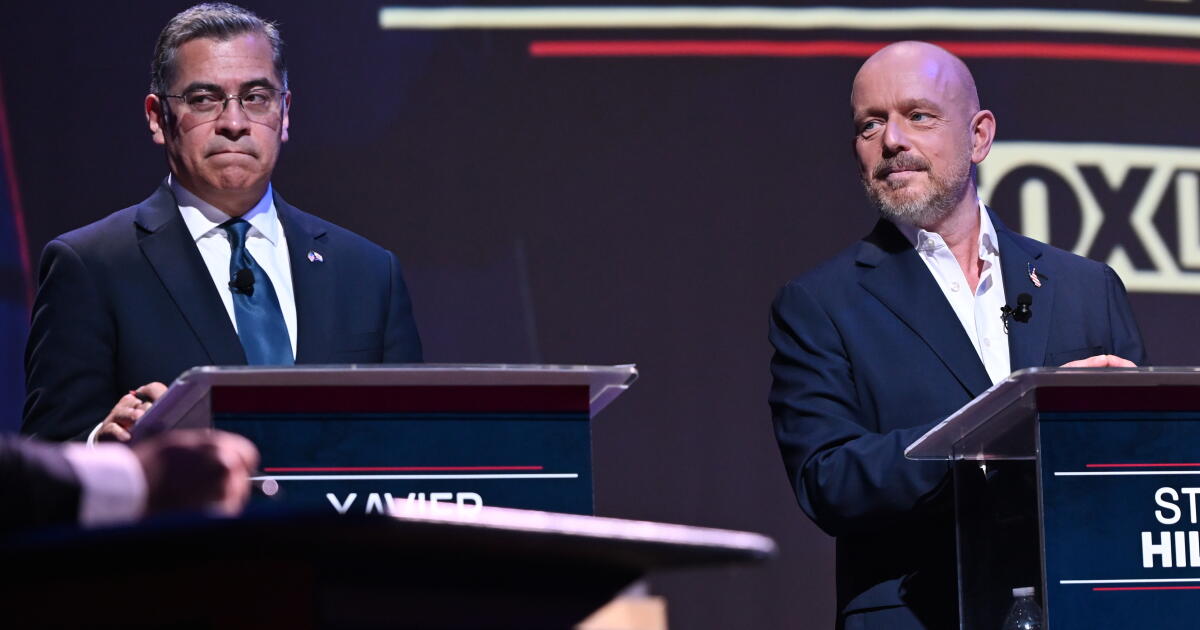
Contenders in the race to be California’s next governor will meet on stage Tuesday night for the second of three planned debates before the June 2 primary.

Last week’s meet-up in San Francisco didn’t provide the fireworks or memorable moments the candidates, and many voters, were hoping for — but it did manage to remind us all that ballots will hit mailboxes in coming days and decisions must be made.

Ahead of the forum at Pomona College in Claremont, a trio of our Times columnists — Gustavo Arellano, Mark Z. Barabak and Anita Chabria — weigh in with a cheat sheet on what to look for, what to expect and why it matters.

Chabria: I’ll start us off with the obvious — let’s hope Tuesday gives us at least one breakout candidate who comes with some fire and vision.

After last week’s debate, there was lots of social media posturing about who won and who trolled whom the best. But as one of the six people who actually watched, I can tell you it was mostly bland with no clear winner.

That’s in large part because many of the Democrats have only slivers of daylight between their policies, and ditto for the two Republicans.

So my hope is that at least a single candidate ups their game and comes to voters with not just attacks, but something that inspires, something that sets them apart. This far into the race, that hope is slim, but I’m keeping it alive.

What are your hopes and dreams — and maybe fears — going into this?

Barabak: I know I sound like a broken record. (Google it, kids.) Anita, you and I, in particular, have gone round and round on this one. But I don’t feel a particular need for inspiration from the guys and gal that are running for governor. If I want inspiration, I’ll go back and reread the Rev. Martin Luther King Jr.’s “Letter From Birmingham Jail.” Or listen to a Grateful Dead show from May of ’77.

Give me someone who can work with the Legislature, and as difficult as it may be, President Trump, to get stuff done.

Pursue a “California First” agenda, to borrow a phrase. Put voters and their interests ahead of ego, careerism and personal ambition. Start by pledging, if elected, to serve a full four-year term and not run for president so long as they’re serving as governor.

Of course, that kind of promise can be broken. (See then-Gov. Pete Wilson, who made that vow when he sought reelection in 1994, then turned around and — unsuccessfully — sought the White House in 1995.)

At least we’d have them on the record.

Arellano: I’m all for this morass of democracy. A small part of me wants two Republicans to make it into the general election because the California Democratic Party deserves a meteor-like extinction event. No GOP statewide elected official since Schwarzenegger. Supermajority in Sacramento for most of a decade.

And what do they have to show for their one-party rule? This.

But then I hear Chad Bianco and Steve Hilton mewl, and I’m suddenly hoping alongside Anita that someone vanquishes their foes with an unassailable vision. Problem is, I think all the candidates have reached their ceiling. The only one who has any chance of showing us something new is Xavier Becerra, who needs to drop his Dudley Do-Right shtick for a second and channel the inner cholo we all know is in him.

Instead, he was at a fundraiser in Fullerton over the weekend with professional Latinos — you should’ve been kicking it with my cousins in Anaheim who were watching their Dodgers slaughter the Cubs, loco, because they’re the ones who’ll make or break you.

Chabria: How the first potential Latino governor is failing to excite Latino voters is exactly what I’m talking about. If you don’t give voters something to be excited about, they don’t vote, and our fragile democracy needs every voter it can get.

But if we are forced to vote on nuance, let’s do it informed. Here are some questions I hope these candidates have to answer:

For San José Mayor Matt Mahan, funded in the mega-millions by tech bros, it’s not enough to promise to regulate artificial intelligence, or billionaire influence, for that matter. Tell us what those regulations look like and tell us how you reconcile your own politics with those of big donors such as Joe Lonsdale, co-founder of Palantir, who has called Gen Z the “loser generation.”

For billionaire investor Tom Steyer, who has said he will reform Proposition 13 (which limits property taxes) for corporate land owners: What assurances do homeowners have that they won’t be next?

For former Rep. Katie Porter, polling third among Democrats, the clock is ticking — is there a point where you will drop out and endorse a fellow candidate if you can’t break through? Same-ies for state schools superintendent Tony Thurmond and former L.A. Mayor Antonio Villaraigosa, who are included in this debate but polling in the single digits.

And I agree with you, Gustavo, Becerra is coming across as resolutely bland, but to Mark’s point, he’s using that to position himself as drama-free and experienced. So in an era when fraud and abuse are the words of the day, how does Becerra explain not catching fraud in his own office?

Mark and Gustavo, what are the topics you hope candidates will be grilled on?

Arellano: Slight correction, Anita — California already had a Latino governor: Romualdo Pacheco, the lieutenant governor who replaced Newton Booth in 1875 when the latter became a U.S. senator. Pacheco — a Latino Republican! — served all of 10 months before becoming a Congress member.

See, Californians? Political musical chairs is as much a part of our state as free-spending oligarchs — but enough about Steyer.

Issues? Immigration, of course. I want each one to address the state’s undocumented immigrants for 90 seconds in whatever matter they choose. Water: Believe in climate change or not, but our supply is shrinking faster than the gubernatorial chances of Thurmond. And since I believe that the more random the question, the more you learn about who a candidate truly is: What’s the best song about California, and why? Anyone who says “California Girls” or “California Gurls” deserves disqualification, even if both songs rock.

Barabak: Not an issue, per se. What I’d like to see is a bit of backbone.

The next governor is going to have to make some tough decisions, especially around spending priorities and/or cuts to the state budget. Inevitably, the next governor is going to make some people unhappy. And I’m not talking about just those members of the opposite party, or folks who didn’t vote for them.

So I’d like each of them to name an issue where, for the good of the state, they’re willing to take on their friends and allies, knowing they’ll be displeased. If you’re a Democrat, name something you would do that would, say, tick off organized labor. And for Republicans Bianco and Hilton, what’s an area where you’re willing to say to Trump, “Sir” — the president imagines everyone bowing and calling him sir — “you’re dead wrong about this and California needs to go its own way, whether you like it or not.”

Arellano: Good luck seeing any candidate buck their masters. I think we need to lower our expectations way, way, well, lower. So a simple question to conclude: Who needs to do the most tonight besides Mahan’s beard? I think it’s my fellow Orange Countian, Katie Porter. She’s now to the right of Steyer and left of Becerra, which means she needs to peel off supporters from both of them and grab undecideds if she wants to advance. Not sure how she can pull that off — but if anyone can bring necessary fire, it’s her.

Chabria: Porter definitely has a lot on the line.

One standout moment for her, Steyer or Becerra — good or bad — could tilt this very-much-undecided race — not so much because people will be watching, but because it will fuel the social media and advertising sure to follow. These next two debates are high-stakes, not just to avoid a Biden performance, but to do something, anything, that fires up momentum.

Politics ain’t beanbag, as the old saying goes, and it’s time to bring the heat. So in the spirit of Gustavo’s song request, I’ll leave it with these lyrics from the Rivieras (or the Ramones, if you prefer): We’re out there having fun, in the warm California sun.

Barabak: Not to be the pooper at the party but I think we shouldn’t overstate the import of tonight’s debate. For one thing, as Anita suggested, the audience will be exceedingly small — minuscule, even, relative to the state’s 23 million registered voters.

We know, from experience, that most folks will take away what they do based not on the debate itself but rather the coverage of it and whatever soundbites, memes, chatter and advertising it produces — and that’s only to the extent people are paying attention.

So, yes, what’s said and done in Pomona, will matter some. But we’re still five weeks away from election day, and I suspect many folks will be waiting at least another week or three to start focusing on the race and finally make up their minds.

I’ll end with something that Jerry Garcia sang: All good things in all good time.

Source link

Commentary: 90 minutes, 6 gubernatorial candidates, zero big moments — but some differences that matter

Two of our esteemed gubernatorial candidates, the cowboy and the dilettante, apparently could not find ties for the first debate Wednesday night, showing up with dress shirts casually unbuttoned.

Mr. Middleground sported a scruffy sorta-beard, apparently unable to pay for a razor in the midst of California’s affordability crisis. It’s a trademark look that always makes me think if this doesn’t work out, he’ll opt to live on a boat in some not-too-expensive slip by the Bay.

The billionaire wore Nikes instead of dress shoes, a sartorial nod perhaps to his bid to be the outsider-fighter. Or maybe his feet just hurt.

The last two contenders were remarkably unremarkable.

Why start with fashion? Honestly, it might be the most interesting, and telling, bit of insight that came from this first (of three) chances for our next governor to let us know who they are and what they’re made of. If the debate showed us anything, it’s that none of these candidates are hiding follow-me charisma or an excitement-inducing political vision for our collective future.

Yes, there were a few decent jabs here and there about Tom Steyer’s money, Katie Porter’s temper, Matt Mahan’s tech ties and Chad Bianco’s far-right world view. But even those were predictable.

Still, in between the yawns, there were a couple of answers worth noting, ones that might actually give us insight into how the Democratic candidates differ (Despite all the hype, it seems increasingly unlikely that two Republicans will come out of the primary, and even more unlikely that in a Democratic vs. Republican race, the Democrat would lose in blue California.)

I’ll start with a surprising place where I agreed with Steve Hilton, the Republican endorsed by President Trump.

The candidates were asked if they would support a ban on social media for kids under age 16. This is a quickly accelerating idea not beloved by tech companies. Australia and Indonesia already have bans in place. Other countries, including France and Portugal, have them in the works. Florida banned children under 14 from opening social media accounts on their own last year.

And a Los Angeles jury last month dealt a blow to Meta and YouTube when it found the platforms had damaged the mental health of a young woman with their addictive features.

Hilton took the ban question a step further, saying it “misses the point.” He has long argued that it isn’t just social media that is the problem, but having kids staring at a digital device for hours a day instead of interacting in the real world. It was one of the most genuine answers of the night.

“We’ve got to get to the heart of the problem, and that’s the devices and the screens,” he said. “I think that every parent in their heart knows that it’s wrong.”

While Steyer and Xavier Becerra, the former California attorney general, both said they would support such a ban, the remaining three candidates hedged or said they would not. Porter said no to a ban under age 16, but said she “might consider a different ban,” without being specific.

Mahan, who is backed by significant tech money, and Bianco both said they believed requiring parental consent was the way to go (though Mahan said he would ban devices in schools).

As Becerra pointed out, “kids have died as a result of their use of social media,” so it’s a place where policy matters. And if a candidate doesn’t see government’s role in controlling the dangers of social media, what will happen with artificial intelligence?

The candidates also had differences in how they would handle homelessness and the related crisis of housing affordability, though the devil was often buried in the details.

At least for Democrats. For Bianco, the difference was stark.

“We are not dealing with homeless. So stop calling it homeless,” he snapped at the moderators. “It has nothing to do with homes. This is drug- and alcohol-induced psychosis, mental illness.”

Of course, this is wrong. Last year, the UC San Francisco Benioff Homelessness and Housing Initiative released the results of the state’s most comprehensive survey of homeless people. It found that for most people living on our streets, “the cost of housing had simply become unsustainable.” It also found an increasing percentage of those folks were older — almost half were over the age of 50 — and had become homeless after a hardship such as an illness or a job loss.

“It’s also families who are fleeing intimate partner and domestic violence,” Porter said. “It’s people who are double and tripled up. It’s people who are living in their cars on our college campuses. Homelessness comes in a lot of different forms.”

Most of the Democratic candidates seemed to understand this and embraced the increasingly popular idea of putting more money into helping people stay housed after a hardship, instead of trying to get them housed after they lose their place.

“How can I help you keep your home?” Becerra said. “Because it costs me so much more money to pick you off the streets, provide you with the assistance in the shelter, than it does to keep you in the home.”

But the issue of homelessness is also where daylight emerged between the candidates. Steyer said he and his wife had helped finance low-barrier homes, not just shelter spaces, where people do not need to be addiction-free and where they can bring pets — two issues that are common hindrances for moving folks off sidewalks voluntarily.

Mahan, the mayor of San José, who often touts his city’s success at moving people indoors, agreed that emergency and interim housing was critical, but also voiced support for forcing folks to accept help. Last year, San José passed an ordinance he backed that some say criminalizes homelessness — a person can be cited twice for refusing shelter, and a third refusal within 18 months can lead to an arrest.

“When shelter was available, we required that people come indoors,” Mahan said, adding, “We have to be able to mandate treatment.”

It’s a controversial position, but also one that is increasingly popular. Gov. Gavin Newsom has backed mandated treatment, in a lighter form, with his CARE Court (which is technically voluntarily). And the movement to require people to accept a shelter space or face arrest is growing on the right and even the Democratic-middle.

But there is a fine and dangerous line with mandated treatment and shelter requirements that is often pushed further and further to the side in favor of the clean, safe streets argument. Whenever we start locking folks up — whether it’s in mental wards or immigration detention centers or jails — we should be careful that expediency isn’t trumping ethics.

Of course, the debate would not be complete without the Democratic candidates’ position on our president, speaking of ethics.

Steyer was gleeful that Trump has come after him on social media, a point of pride that he is a relevant figure in the fight against MAGA. He also said he would abolish Immigration and Customs Enforcement if he could, which he can’t.

Becerra highlighted his many lawsuits as California’s attorney general during Trump’s first term, and pledged to keep fighting. Porter leaned into her time in Congress and her efforts to help Democrats in other races win.

Mahan took a different route, pledging to fight when necessary, but adding, “We need a partnership, and we need to find common ground with this administration on certain issues.”

Newsom learned the hard way that common ground is what Trump says it is, and shifts without warning or reason.

So what’s the takeaway from all this?

Boring dad; feisty mom; rich do-gooder; striving newcomer; MAGA one; MAGA two.

None of them hit it out of the park, but no one struck out. Maybe next time.

Source link

Stop being so chill, Xavier Becerra. Fight for California’s future

Xavier Becerra needed to land a knockout punch, even more so than the five other candidates for California governor he was facing at Wednesday night’s debate.

Instead, he fired off some slaps.

He needed to roar about his many accomplishments in his 35-year career in Sacramento and Washington, to distinguish himself from the relative political neophytes around him.

Instead, Becerra recited his resume with the vigor of someone rattling off his LinkedIn page.

He needed to uplift Californians with a vision of hope, when many feel the state is going in the wrong direction.

Instead, he offered the oratory equivalent of a pat on the shoulder.

No candidate had more at stake that night than Becerra, who went from an afterthought to a contender after Eric Swalwell dropped out and resigned his congressional seat over sexual assault allegations.

Five weeks ago, Becerra and other candidates of color were protesting their exclusion from a USC debate because they were all polling so low. Now, the 68-year-old has a chance to become California’s first Latino governor.

This possibility seems to have uncorked California’s silent majority — the rancho libertarians turned off by hard-right politics but also the wokoso politics they feel have left them behind. The people who yearn for an unglamorous, competent leader after eight years of all-about-me Gavin Newsom and a decade of Donald Trump.

Becerra’s campaign, once as rudderless as a leaf in a river in a race so chaotic for Democrats that many feared two Republicans would win on June 2 and face each other in the general election, suddenly latched onto a palpable wave.

At the Los Angeles Times Festival of Books last weekend, I saw people sporting Becerra campaign buttons who had just come from a rally that was expected to draw a few hundred but instead had over 2,000 RSVPs. On social media, friends who had never especially cared for state politics suddenly declared they were for Becerra and fought off their more lefty pals who think he’s a Latino Ned Flanders not up for this fraught moment.

Unglamorous and competent are Becerra’s middle names, and they were on display at the debate — for better and mostly worse. This was his chance to show both his new followers and undecided voters that they could trust him as California’s next governor.

But where he needed to be limber like a prizefighter, the former California attorney general was as tightly wound as a Rolex.

While the other candidates pressed their palms against the podiums, ready to pounce on every question, Becerra clasped his hands like an altar boy. When he did gesture, his movements never went further than the span of his shoulders.

As the others grinned and grimaced at their rivals’ responses, Becerra was as stone-faced as Buster Keaton. He stumbled more than he should have — how could someone in his position mistake Iraq for Iran when criticizing Trump’s Middle East quagmire? — and rarely seemed at ease, as if the weight of the moment and the good luck of his surge had suddenly hit him at the worst possible time.

Candidates in California's gubernatorial race

Candidates in California’s gubernatorial race, from left, Matt Mahan, Xavier Becerra, Chad Bianco, and Steve Hilton look on during a debate Wednesday, April 22, 2026, in San Francisco.

(Jason Henry / Associated Press)

Becerra’s supporters say a level-headed leader is what California needs. But voters almost never go for what they need — they pick what they want. And California wants someone who’s loud, or at least louder than Becerra. There’s a reason why strident partisans like Republicans Chad Bianco and Steve Hilton and progressives Tom Steyer and Katie Porter have consistently placed high in the polls, while moderates like Becerra, his frenemy Antonio Villaraigosa and San Jose mayor Matt Mahan have lagged.

The weird thing is that Becerra does know how to brawl. Wallflowers don’t go from a working class Mexican immigrant family to Stanford Law School. Wimps don’t survive the ruthlessness of Eastside politics as an outsider to become a congressmember at just 34. Cowards don’t file over 100 lawsuits against the Trump administration as California’s top prosecutor or tackle the coronavirus pandemic as President Biden’s health secretary.

I’ve only encountered the Sacramento native a few times but always came away impressed. In small crowds, he makes people laugh and tear up. He’s quick with ripostes, righteous in off-the-cuff remarks and has a do-gooder aura that never comes off as sanctimonious.

We saw hints of that Becerra at the debate. To Hilton, he quipped, “You can be a talking head and not worry about the consequences of what you do” after the former Fox News host babbled on about how one-party ruled had failed California.

After Porter accused him of not offering hard numbers for his economic plans, Becerra responded that he has balanced federal budgets larger than California’s. “It’s easy to say you haven’t done this; it’s easier to prove that you actually have,” he concluded.

But after Becerra described the evils of racial profiling by law enforcement and Bianco, the sheriff of Riverside County, ranted that California politicians need to stop thinking so much about race, it was Porter who responded with a verbal haymaker as Becerra silently looked on.

You don’t fight as a choirboy in a battle royale. Becerra wasn’t bad at the debate but he also wasn’t great — and that won’t win this race.

Voters want someone who’ll do the job, yes — especially if it comes with no drama. They also want to elect someone they think is a human, not a joyless bureaucrat. So how did Becerra respond to the debate’s last question about what was the last series you’ve streamed?

Becerra flashed his biggest smile of the night. It was such a softball query that even a kindergartener could have slammed it à la Shohei Ohtani.

“I wish I could tell you I had time to watch streaming shows,” he replied.

Dude. We’re all overworked, but everyone I know unwinds by watching mindless drivel (my current obsession is “Vanderpump Villa”). We all need to relax, even for a moment. As my dad says when he sees me filing one columna after another and urges me to take a break, “El trabajo nunca se acaba pero uno sí se acaba.

Work never ends, but people do.

Xavier, you know you’re on the wrong side of California when the only other candidate with a similar answer was Bianco, who said he doesn’t watch television at all.

Being careful has served you well, but this is the greatest opportunity of your life. You don’t have to suddenly become a flamethrower, but some sparks would help. It’s six weeks until the primary, so time to throw down — channel your inner cholo and go get what should be yours.

Source link

Will California elect a GOP governor? Democrats are panicked

Today we discuss probability, self-destruction and political bossism.

Wow. California, which is as blue as Lake Tahoe, is about to elect a Republican governor! How crazy is that?

Whoa. Hold up, pony. Let’s not get too far ahead of ourselves.

Well, there’s certainly a lot of Democratic angst out there.

That’s for sure. It’s reminiscent of the panic that followed Joe Biden’s wretched debate performance in Atlanta, the biggest disaster to hit the city since a 2009 flood caused more than half a billion dollars in damage.

In California, the high anxiety is a result of the state’s “jungle” primary, in which all candidates appear on the same ballot, regardless of party, with the top two finishers advancing to a November runoff. With so many Democrats running, there’s the genuine prospect of them splintering partisan support, resulting in the leading GOP candidates — Chad Bianco and Steve Hilton — grabbing both slots and moving past June 2.

How likely is that to happen?

I can’t say. And Nostradamus is away on spring break.

But one of California’s leading political savants, Paul Mitchell, has developed a helpful online tool to suss out the possibilities. Visitors to his site have run tens of thousands of simulations, which right now put the odds of a Democratic freeze-out at about 17% to 20%.

Which suggests it’s unlikely. But it’s also not impossible.

Why don’t some Democrats step aside, for the good of the party?

That’s easy for you to say.

Anyone putting themselves out there by seeking public office has to have a certain amount of faith, in both their capabilities and the prospect of good fortune smiling upon them. (Luck being a greatly undervalued factor in political success.)

To be clear, no one is running away with the gubernatorial contest. For all the talk of Republicans “leading” in the polls, it’s more like a four- or five-way tie for first place, when you factor in the margin of error. And 20% support — which is roughly what the top candidate receives in surveys — is hardly a number to strike fear in the heart of rivals.

There’s also the YOLO factor.

You mean the county just outside Sacramento?

No, that’s Yolo.

I mean, YOLO — as in You Only Live Once

Several of the candidates mired near the bottom of polls — Antonio Villaraigosa, Xavier Becerra, Betty Yee — are probably looking at the end of the line if they lose this race. So you can understand, if not necessarily agree with, their reluctance to drop out and call it a day, in the hope that, just maybe, that proverbial bolt of lightning will strike.

So why doesn’t someone force some candidates to drop out?

Like who? There is no Tammany Hall. This isn’t Chicago under Boss Daley. Modern-day California has never had that kind of all-powerful political machine.

The closest approximations were in San Francisco, where brothers Phil and John Burton held great sway, and Los Angeles, where another pair of siblings, Howard and Michael Berman, exercised enormous clout with their compatriot, Henry Waxman. But their influence was mainly limited to Congress, the Legislature and local politics. They weren’t kingmakers when it came to electing California governors.

And the two major political parties, which never wielded the power they enjoy in other states, have become even less influential in this entrepreneurial age of politics, when candidates raise their money online and boost their profile by going on the political chat shows on TV.

What about Gavin Newsom?

The governor could certainly try to pare the Democratic field. But he’d risk humiliating himself and hurting his presidential prospects in the process.

How so?

It would be embarrassing if Republicans were to seize the governorship on Newsom’s watch. (At least among those political insiders who pay attention to that kind of stuff.) It would also be embarrassing if the governor tried to muscle candidates aside and failed.

It’s not at all clear Newsom would have much clout. He isn’t particularly close to any of the candidates running. No one needed his blessing to enter the race, or his backing to sustain their candidacy. And there isn’t very much the term-limited governor, playing out his final months in office, can offer as incentive to quit.

Newsom also has to consider how it would look if he tried to ease out the laggards — whose ranks happen to include all the prominent candidates of color: Becerra, Villaraigosa, Yee and state Supt. of Public Instruction Tony Thurmond.

We saw how that worked out for USC, which abruptly canceled a scheduled debate after a storm of criticism over its selection process and the exclusion of those four candidates.

Would Newsom care to veto Thurmond et al., then defend his actions in, say, South Carolina, where Black voters typically constitute more than half the Democratic primary electorate?

Sounds like Newsom doesn’t have many good options.

No.

Speaking of options, is there anything Democrats could do if they’re frozen out of the runoff?

Such as?

Waging a write-in campaign in the fall?

Nope. Under California law, write-in candidates are allowed only in the primary.

Hmm. How about a Democrat running as an independent?

Nope. Same rule applies. Only the two candidates getting the most votes in June will be on the November ballot.

So what can Democrats do?

Hope their voters consolidate around a single candidate, or either Bianco or Hilton pull far enough ahead with GOP voters that there’s room for a Democrat to make the top two.

Failing that, get ready for a Democratic-led recall campaign, beginning early in 2027.

Source link

Democrats excluded from USC governor debate urge rivals to boycott

Four Democrats running for governor called on their fellow candidates to boycott an upcoming debate at USC, reiterating concerns that the criteria used to determine who was invited to participate resulted in every prominent candidate of color being excluded from the forum.

“We ask each and every candidate who is in this race to recognize that if we can’t have a fair process for a debate, then we should all not participate,” said Xavier Becerra, the former U.S. Health and Human Services secretary. “We call on them to withdraw from this biased forum.”

Becerra’s call was echoed by former Los Angeles Mayor Antonio Villaraigosa, state Supt. of Public Instruction Tony Thurmond and former state Controller Betty Yee during a Friday afternoon news conference.

The candidate’s request comes a week after some of them raised concerns about the criteria for Tuesday’s debate, arguing that it was engineered to allow the inclusion of San José Mayor Matt Mahan, who entered the race in late January and quickly raised millions of dollars from Silicon Valley executives.

“The rules initially were polling and money. Matt Mahan is [polling] lower than some of us, period,” Villaraigosa said, adding that the debate organizers “then added time in the race,” which resulted in Mahan’s invitation.

Mahan’s campaign did not respond to a request for comment on Friday, but when Becerra raised such concerns last week, Mahan said the former Biden administration official ought to be included in the debate.

The matter is further complicated by Mahan supporters who have notable ties to the university.

Mike Murphy, a co-director of the USC center hosting the debate, has been voluntarily advising an independent expenditure committee backing Mahan. The veteran GOP strategist said last week that he had nothing to do with organizing the debate and that he has asked for unpaid leave at the university through the June 2 primary if he takes a paid role in the campaign.

USC has also received tens of millions of dollars in donations from billionaire real estate developer Rick Caruso and his wife. Caruso, a USC alumnus who served as a trustee for years, is also a Mahan supporter.

A representative for Caruso did not respond to a request for comment.

The debate, hosted by the USC Dornsife Center for the Political Future, KABC-TV Los Angeles and Univision, is scheduled to take place on campus at 5 p.m. Tuesday — less than two months before ballots begin arriving in voters’ mailboxes. The forum will be streamed and broadcast on ABC and Univision affiliates across the state.

USC and the television stations put out a joint statement Friday morning, prior to the candidates’ news conference, justifying the criteria used to determine who was invited to participate and saying none of the debate partners had any influence on the methodology.

“We want to be clear that we categorically, unequivocally deny any allegations that the debate criteria was in any way biased in favor or against any candidate and want to clarify the facts,” they said in a statement, adding that Christian Grose, a USC political science professor, was asked to develop “data-driven” benchmarks to determine which candidates were invited.

“The methodology was based on well-established metrics consistent with formulas widely used to set debate participation nationwide — a combination of polling and fundraising — and developed without regard to any particular candidate.”

After the Democratic candidates called for their competitors to not participate, USC and KABC declined to comment further. Univision did not respond to a request for comment.

Grose defended the methodology he crafted as “objective” in an interview Friday, and said he met with Becerra as well as the staff of other candidates to explain it.

“The idea that it was biased or designed to create some sort of outcome to disfavor the candidates who spoke at the press conference is just not correct,” Grose said, adding that attacks on the methodology have a “chilling effect” on universities and media outlets who sponsor debates.

“I’m not worried about the optics,” he said. “The optics are we are having a debate at USC to inform voters and educate students.”

Jarred Cuellar, a political science assistant professor at Cal Poly Pomona, described Grose’s methodology as “thoughtful” and “empirically grounded,” and characterized the concerns raised by candidates not included in the debate as unfounded and not credible.

“The formula is methodologically sound and represents a clear improvement over how debate participation has often been determined,” he said. “Rather than relying on a single metric such as polling, it takes a multidimensional approach to evaluating candidate viability. That approach better reflects how political scientists measure complex phenomena like electoral competitiveness.”

But the controversy has caused consternation among USC professors past and present.

“It seems like an unforced error that is casting the entire event in a bad light,” said a current USC professor who closely follows politics but is not involved in the debate, and who asked for anonymity to speak candidly. “It’s super important that if the debate happens, it happens correctly.”

Darry Sragow, a veteran Democratic strategist who taught election and environmental law at USC for 19 years, said that while he believes the large field of Democratic candidates needs to be winnowed, that’s not the job of a university or media outlets.

“Every one of these eight [Democratic candidates] is capable of running the state of California,” he said. “ It would certainly be my advice to USC and to Univision and to ABC to allow all the candidates to take part, or to cancel the debate.”

The four Democratic candidates not invited to the debate argued that voters are just starting to pay attention to the thus-far sleepy race and that diverse candidates should be represented.

“We are a minority-majority state, and the idea that the four candidates of color are not going to be on the stage to bring those perspectives, to really speak to those communities, is really not doing right by the voters,” Yee said.

Becerra said some of the candidates had requested to speak with top university leadership, including President Beong-Soo Kim. In other conversations, he said university officials raised the possibility of “either canceling this debate or incorporating more of the candidates in it. Evidently they could not agree to do that. … I think they recognize that there were problems with the way this debate had been organized.”

Becerra said he reviewed the formula and has “never seen” debate criteria like it before during his decades of serving in elected office.

“Your fundraising numbers are divided by the number of days you’ve been out there campaigning in front of voters,” he said. “So you could have raised millions of dollars, but if you’ve been in longer than someone else who just raised millions of dollars very quickly, you get penalized.”

Campaigns for the invited candidates — Democrats Rep. Eric Swalwell of Dublin, former Orange County Rep. Katie Porter, climate activist Tom Steyer and Mahan; as well as Republicans Chad Bianco, the sheriff of Riverside County, and former Fox News host Steve Hilton — did not respond to requests for comment on the call to boycott the debate.

Source link