Actor Tom Arnold unleashed on Chuck Lorre on X in response to the former “Roseanne” writer-producer’s claims in his new memoir, “Sitcom.”
“He thinks he’s brilliant & beloved like Norman Lear but Chuck ‘Chuckles’ Lorre’s a terrible human, an angry dry drunk who lies every time he opens his mouth,” Arnold wrote Tuesday.
Arnold and the ’90s sitcom’s co-creator and titular star, Roseanne Barr, were married Jan. 20, 1990, four months after he first appeared on the show as a poker pal of Barr’s TV husband and four days after Barr’s real-life divorce from her husband of 14 years, William Pentland, was finalized.
Barr and Arnold were hostile to their writing and producing colleagues on the show and the network, Lorre told the Los Angeles Times’ culture critic Mary McNamara in an interview published Tuesday, the day of the book’s release.
“We were punished, the writers,” Lorre told The Times. “The word ‘cruelty’ comes to mind. And I still don’t know why, why so much cruelty. It wasn’t like we didn’t want to make a great show. We were proud to be on that show.”
Hired in 1990 after Barr fired all of the show’s writers, Lorre recalls in the book that he had a rude awakening when he took the job.
“I was now the co–executive producer on the number one show on television. I swaggered into the office assigned to me and met Danny Jacobson (a world-class comedy writer who would go on to cocreate ‘Mad About You’ with, sorry, Paul — ‘My Two Dads’ — Reiser),” Lorre writes in “Sitcom.”
Chuck Lorre, pictured in 2024, related several anecdotes in his book “Sitcom” that didn’t sit well with Tom Arnold.
(Willy Sanjuan / Invision / Associated Press)
“Danny, having been fired by Roseanne for being talented, was packing up his stuff when I walked in. He showed me a sloppy, hand-scribbled couple of pages and explained this was a ‘script’ by the show’s new executive producer, Tom Arnold. It had been part of Danny’s job to write real scripts and put Tom’s name on the front page — as if Tom had written them,” Lorre continues. “Bob, myself, and several other staff writers would be ordered to do this on many occasions…. Was it a portent of bad things to come? You tell me.”
For her part, Barr admitted after the 1990 firings, “Yeah, I probably was difficult to work with, now looking back.”
“I don’t think I was as especially clear as I could have been,” Barr told former Times television writer Rick Du Brow in a November 1990 article. “It’s like being a woman and an administrator — I never had any background like that. I didn’t know how, like I do now, to go in and say, ‘This is what I want you to do.’ I think that’s common with women in business. I would go in there and try to get them to agree with me rather than tell them what I want to do.”
Arnold’s social media screed doesn’t directly address any of Lorre’s claims in the book but resorts to name-calling and his own claims against the producer, who went on to create or co-create sitcom hits including “Cybill,” “Dharma & Greg,” the Charlie Sheen-starring “Two and a Half Men” and “The Big Bang Theory” and its offshoots.
“He trashes Trump but he is Trump & he’s a bitter hack who actually believes his lame vanity cards at the end of his lame shows are Paddy Chayefsky worthy,” Arnold wrote, invoking the three-time Oscar-winning writer of “Network.” “Chuckle’s made $800,000,000 off the backs of very talented women & a naive cracked up Charlie Sheen (clean & sober since he’s not under Lorre’s strange, abusive tutelage) then trashes them all to make him feel cool but don’t worry, Chuck hates himself more than we ever could.”
Some thoughts on uber producer Chuck Lorre’s new book… https://t.co/KaUN4fen9h
Lorre’s accounts of Arnold in “Sitcom” included several other anecdotes, including one seemingly questioning the “True Lies” and “The Stupids” star’s trustworthiness.
“Executive Producer Tom was angrily explaining to Bob [Myer] and me that some bastard had stolen Roseanne’s love letters to him and sold them to the National Enquirer. His plan was to hire a private detective and get to the bottom of this treachery. And he did. It took one day. The detective found a cashed check for twenty-five grand from the National Enquirer made out to Tom Arnold. Mystery solved.”
Lorre was famously fired after two years on the show, which Arnold recalled in concluding his X post: “I wish everyone could’ve seen his arrogant, sad clown face the day Roseanne made me fire him.”
Barr later fired Arnold from “Roseanne” in 1994 amid their divorce. In 2018, after posting a racist tweet, Barr was fired from the “Roseanne” reboot, which was resurrected as spinoff “The Conners.”
NEIGHBOURS and Home and Away legend Ray Kolle has died aged 85.
The Australian soap star and script writer passed away in Sydney, it was confirmed today.
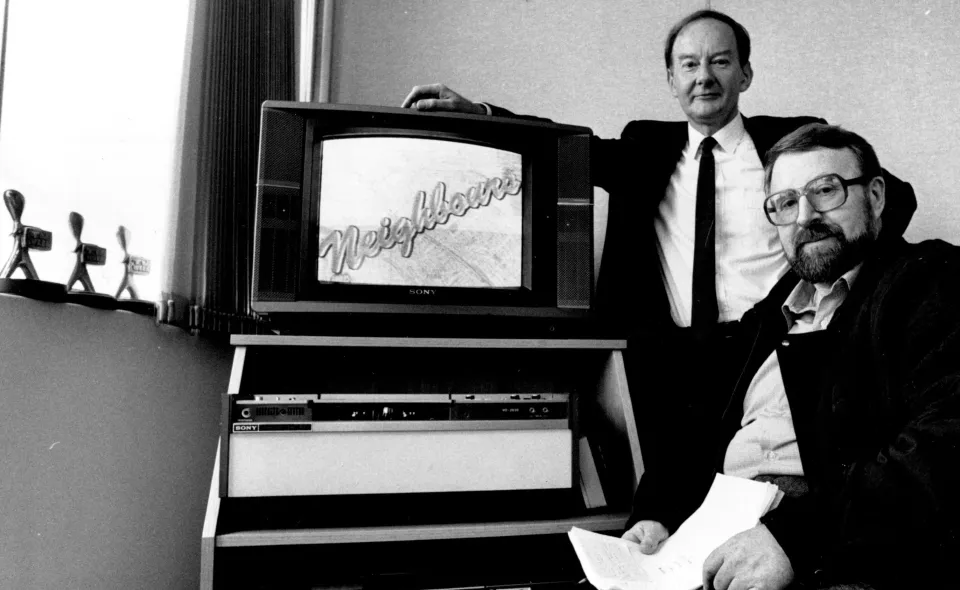
Don Battye, Executive Producer of Neighbours with Script Supervisor Ray Kolle in 1989Credit: GettyRay Kolle has passed away aged 85Credit: Facebook
Tributes have flooded in from heartbroken fans and friends who remembered Ray as an “important part of Australian television history”.
Australian entertainment and production company, TV City wrote in a statement: “Very sad news to hear of the passing of veteran Australian television writer and story editor Ray Kolle.
Sign up for the Showbiz newsletter
Thank you!
“Ray was one of those incredibly talented people working behind the scenes who helped shape some of Australia’s most iconic television dramas.
“Another important part of Australian television history has left us.
“Thank you, Ray, for the stories and memories you helped create for generations of television viewers.”
Ray served as head writer on Neighbours from 1986 until 1992, introducing iconic characters like Scott and Charlene Robinson.
His 46-year career began with a big break writing comedy sketches for In Melbourne Tonight.
More to follow… For the latest news on this story keep checking back at The Sun Online
Thesun.co.uk is your go-to destination for the best celebrity news, real-life stories, jaw-dropping pictures and must-see video.
The unpredictable crime drama follows the puzzling deaths of four guests at a dinner party
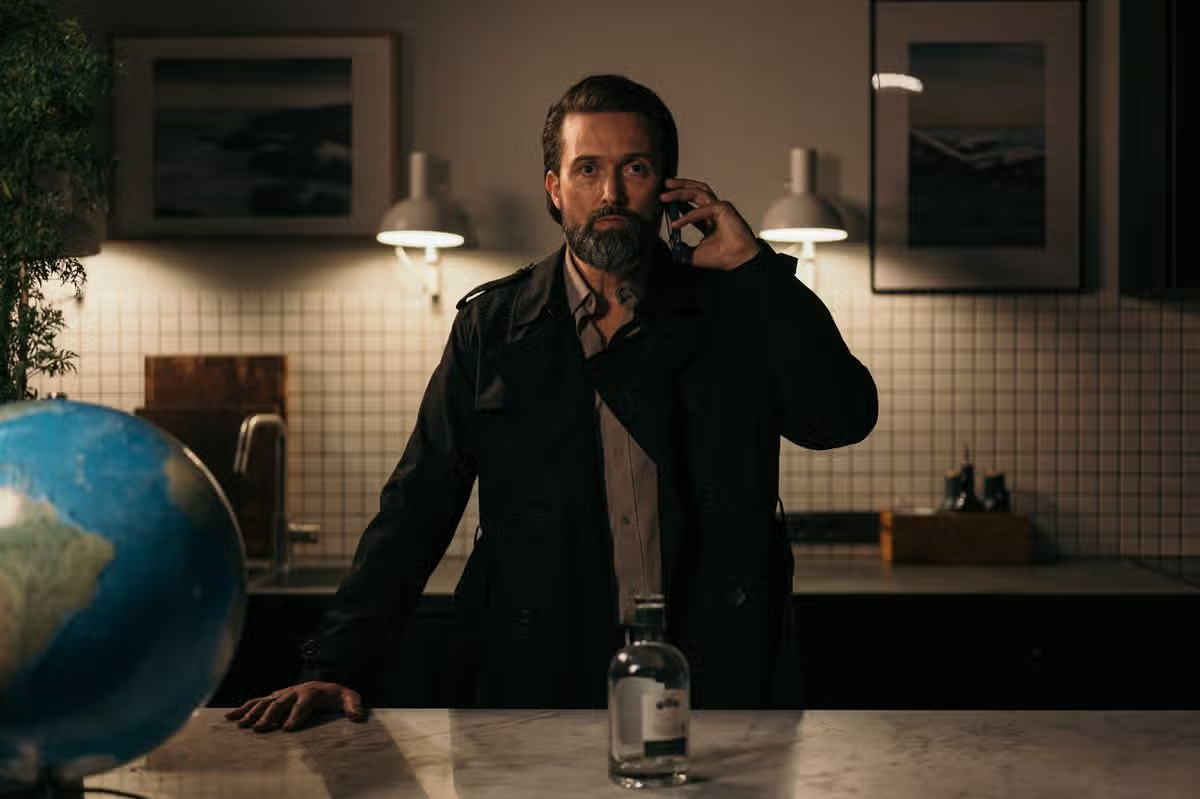
Emmett J Scanlan transforms into Niall Conway for the Channel 5 drama(Image: 5)
MobLand star Emmett J. Scanlan is starring in a new murder mystery alongside Celebrity Traitors’ Sharon Rooney.
Channel 5 has released a first look at their upcoming thriller, An Impossible Way to Die, which follows two detectives who are tasked with uncovering the mysterious deaths of four guests at a dinner party.
The six-part series has been described as “gripping” by the broadcaster, and follows Sharon Rooney’s character, DS Katie Salter, whose quiet local policing life is upended when she is thrust into a high-pressure murder investigation with DI Niall Conway, played by Emmett J Scanlon.
Described as a character-driven, unpredictable drama exploring identity, protection, power, and corruption, the story will see DS Katie Salter “happily solving everyday crimes until fate drags her into an impossible murder mystery”.
The synopsis continues: “Four people sat around a table seemingly set for a dinner party – except they are all dead. The only clue is a scorpion crawling out of one of the victim’s mouths.”
It continues: “Salter is not your stereotypical damaged and tormented TV detective. Smart, diligent, and committed to her family, tensions quickly surface when Salter is partnered with DI Niall Conway, lead investigator on the case. Salter’s measured, grounded approach clashes with Conway’s all-consuming dedication to the job.
“At first, the two detectives appear fundamentally incompatible. Yet, as the investigation deepens and the pressure intensifies, Conway begins to recognise the value of Salter’s empathy, optimism, and instinctive understanding of people.”
The synopsis adds: “As the case grows increasingly impossible, secrets are unearthed and conspiracies emerge, lives are put at risk as the detectives race against time to connect seemingly disparate cases and unmask a killer before it’s too late.”
DS Katie Salter actress Sharon Rooney is best known for playing Rae Earl in My Mad Fat Diary and was recently seen competing in the latest series of The Celebrity Traitors. While Emmett J. Scanlan is famed for portraying Paul O’Donnell in Paramount+ crime series MobLand, his other recent roles include A Working Man, Gangs of London, and How to Get to Heaven from Belfast.
Coldwater and Vigil star Lois Chimimba will star alongside Rooney and Scanlan, and will be joined by Black Mirror’s Jonny Lavelle and This Country’s Ashley McGuire.
The crime seriesis scheduled to air in 2027 and has been penned by Death is Paradise’s Jillian Mannion, alongside Ciara Conway, David Persiva, Robin Ganderton, and Rowena Johnson.
Adam Wimpenny serves as director for the thriller, which is executive produced by Clapperboard’s Mike Benson and Myf Hopkins. Amber Howorth also serves as producer
An Impossible Way to Die will air on Channel 5 in 2027
Every so often, an aspiring screenwriter wanders into the dim red glow of Jumbo’s Clown Room hoping to interview one of the dancers. “They’re like: ‘I’m writing a screenplay. Can I interview you?” says Cecilia Fairchild, one of the longtime dancers at the renowned East Hollywood bikini bar.
Her response is usually some version of this: “I’m like, ‘Why are you writing about that? Don’t you know we are all writing that too? Leave us alone,’” Fairchild says with a mischievous laugh. What bothers Fairchild is the assumption behind it — that the dancers are voiceless and helpless. Worst of all, they’re presumed to have stories worth mining but not the ability to produce literature themselves.
Jumbo’s has a longstanding reputation of being part of L.A.’s literary lore.
In the 1970s and 1980s, Charles Bukowski — L.A. nightlife’s debaucherous poet laureate — was rumored to haunt the bikini bar in its early days. David Lynch wrote his classic screenplay “Blue Velvet” at the bar. (According to local legends, the iconic opening shot of “Blue Velvet” came to Lynch when he spotted a dancer with only one ear.) Writer and director Quentin Tarantino reputedly wrote at the bar. But while Jumbo’s has garnered a mythology as a magnet for filmmakers, writers and musicians who collect impressions, the dive’s dancers have shifted from being the subject to the artists.
Many of Jumbo’s dancers write fiction and memoir, host literary salons across Los Angeles and find ways to tell their own stories rather than serve as muses. “It’s funny because I wish that male auteurs would tell the story of customers. I want a sniffer’s memoir. I think that’s a real point of view,” Fairchild says. (Speaking of alienation and horniness, the dancer has been meaning to crack the Marcel Proust canon.)
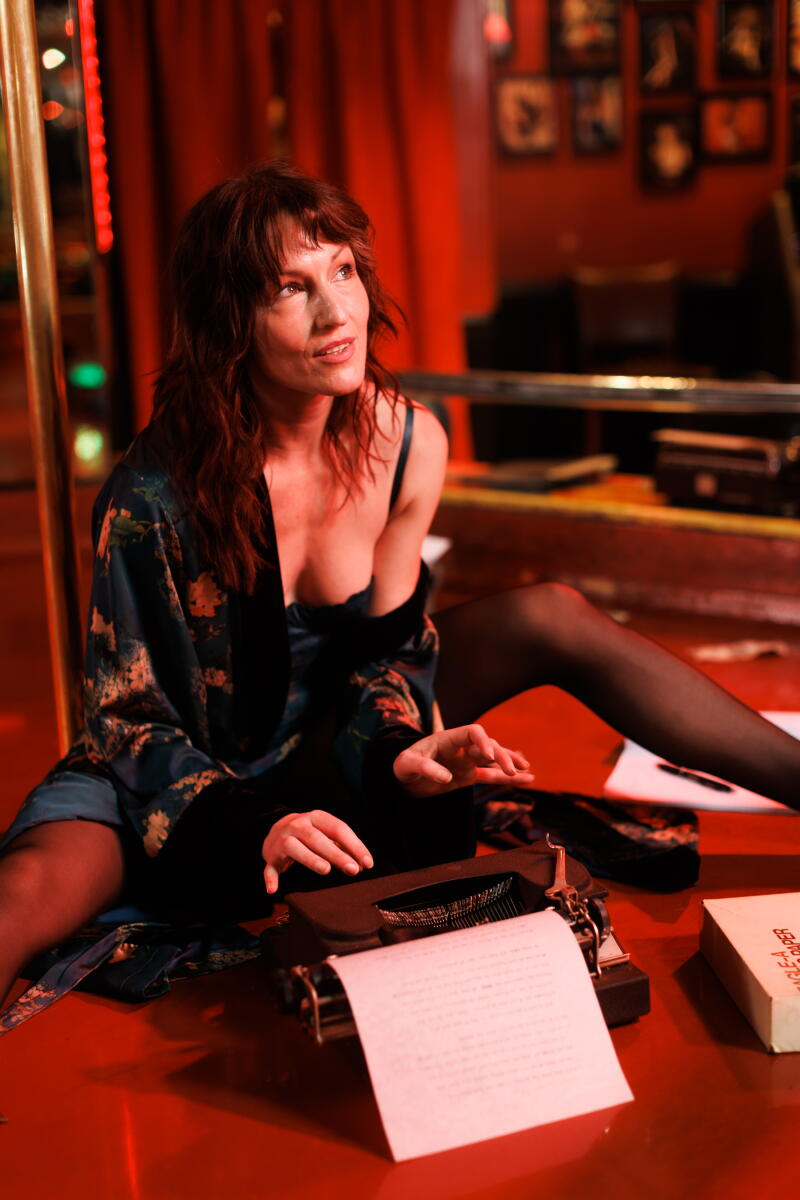
Honey Ryder (Claudia Musikul) types on the bar inside Jumbo’s Clown Room.(Carlin Stiehl / For The Times)
Fairchild is a playwright, poet and memoirist. Her recently completed memoir, “The Poison + The Spit,” traces a life of tumultuous love affairs and a stint dancing in New Orleans, rendered in prose that is whimsical, surreal and deeply emotional. The dancer also hosts the Downpour, a popular monthly literary salon at Bar Covell, and recently directed “Fool in the Pool,” a play that premiered at El Condor in Silver Lake this summer.
Her writing style mirrors her dancing: kinetic, wild and unpredictable. She sometimes takes the stage in roller skates, dancing to David Bowie. Her memoir achieves that same sense of hypnotic motion. “The memoir is so heavy,” she says. “Everything was so sad that I needed some lens to look at it that was fun, zippy and crazy.”
For Fairchild, dancing and writing possess the same need to expose oneself. “Vulnerability is one of the most interesting things about dancing,” she says. “There really is the potential to look into people, and they look into you, and you wordlessly share something with them that is half sexual and half this other thing.”
Meanwhile, Danielle Henderson — another dancer and aspiring novelist at Jumbo’s who writes under the pen name D.M. Faulk — has been working on a science-fiction novel titled “Meridian.” The book imagines a dystopian American wasteland where pregnant women are surveilled and controlled. She has been a longtime science-fiction fan since she and her father watched “Jurassic Park” and “Planet of the Apes” when she was a child.
Long treated as passive muses by visiting writers, Jumbo’s dancers — from left, Caroline Blaike (Caroline Moyer), Honey Ryder (Claudia Musikul), and Cecilia Fairchild — are reclaiming the narrative as active poets, memoirists and screenwriters.
(Carlin Stiehl / For The Times)
Unexpectedly, the Jumbo’s comically tiny dressing room became the inspiration for her novel. In 2022, when Roe v. Wade was overturned, conversations between dancers about reproductive rights ignited in the dressing room, which in turn informed her novel.
“A lot of those conversations happen in the dressing room. I’m incredibly inspired by the women I’m with who are incredibly sex positive and strong.” That ethos informed Henderson’s protagonist, Zayla.
In recent years, the bar has become a local author hangout. Allie Rowbottom, the author of the recent buzzy adult film novel “Lovers XXX,” discovered the bar in 2011 on the occasion of writer Elizabeth Hall’s birthday party. “I recall sitting front row on novelist Jon Lindsey’s lap, raining dollar bills on dancers performing intricate, beautiful athletic feats,” Rowbottom says. “I spent more than I could afford that night and have been back often since.”
Increasingly, Jumbo’s has cemented itself as a watering hole to the local writing scene. “Two years ago, I rented out a few tables for Jon Lindsey’s birthday, attended by Los Angeles literati like Tea Hacic-Vlahovic, Sammy Loren, Morgan Krantz, Tex Gresham and Nada Alic,” she adds.
According to Rowbottom, Jumbo’s is rife for literary inspiration. “To me, Jumbo’s feels uniquely dedicated, as a venue, to intersecting sex and art, despite the obvious dissonance of selling either,” she says. “I suspect such is what has historically made it a rich spot for writers, dissonance and tension being of utmost importance to good literary work.”
From left, Caroline Blaike (Caroline Moyer), Honey Ryder (Claudia Musikul), Cecilia Fairchild and Stephen (Aaron Laughton) inside Jumbo’s Clown Room.
(Carlin Stiehl / For The Times)
A charged scene in L.A. writer Aiden Arata’s critically-acclaimed 2025 essay collection, “You Have a New Memory,” features a night out at Jumbo’s Clown Room. “The dancers are starlets, athletes, artists; the theme is clown, and also longing — longing is a high form of physical comedy,” says Arata. “It possesses that heady mix of scuzz and glamour that can trick you into thinking your life is about to change.”
Jumbo’s burgeoning literary interest revives a hotly debated question: Who gets to tell the stories of sex work? For decades, the club has inspired celebrated writers and filmmakers, but Claudia Musikul — a dancer at Jumbo’s and a screenwriter herself — hopes its literary legacy will increasingly belong to the people at its core: the dancers.
“I hope that everybody can actually get their work out there because I feel it’s much deserved,” says Musikul. “You’ve probably heard about Bukowski, David Lynch doing ‘Blue Velvet’, or Anthony Bourdain. That’s all really cool, but in a way, it’s the actual dancers’ turn to have that kind of recognition.”
Musikul primarily writes screenplays about strippers, a subject she believes is seldom represented authentically. She has been in writing partnerships and workshops while developing scripts centered on dancers. In a sea of films depicting sex work, she cites Paul Verhoeven’s “Showgirls” as a film that resonates with her experience.
“‘Showgirls’ is my very favorite movie,” she says. “It’s my very special place in my heart movie.”
For Caroline Blaike, a poet and dancer at Jumbo’s, the connection between dancing and writing lies in observation. Years of performing have made her acutely attentive to the people who pass through the club, a voyeuristic habit that carries over into her poetry.
“When you’re a dancer, you’re very observant. You watch every person that walks in,” she says. “I feel like the way dancing makes you observe people helps you write from a perspective that other people can then relate to.”
Blaike has been working on a poetry collection that explores love, queerness, desire and personhood. “It’s gotten a little sexier over time, which is kind of fun,” she says. “I also just write about love, being gay, just existing. It can be a little aggressive, but people seem to like it, so that’s good.” She writes these poems from her prized typewriter — a “1951 Olympia typewriter that is my child.”
Among Blaike’s earliest literary touchstones was Maya Angelou. She still remembers encountering Angelou’s line in her poem “Still I Rise,” “I dance like I have diamonds at the meeting of my thighs,” and being stunned by it.
“I was like, ‘Oh, you can write that? That’s amazing,’” she says.
The literary ambitions at Jumbo’s extend well beyond the stage. Stephen Laughton, one of the club’s security guards, jokes that he leads a double life. By night, he keeps watch at the door; by day, he is an award-winning playwright. He’s recently been named the new associate artistic director of the Echo Theater in Atwater Village, and Laughton’s served as the writer-in-residence in the astrophysics department at the Natural History Museum in New York. Last November, his latest play became the first in the world to be staged in a planetarium.
“It’s this crazy, beautiful science play about two guys who meet in a club that explores mental health in the LGBT community, human interaction, time and astrophysics,” Laughton says.
Like many of his co-workers, Laughton has found himself turning Jumbo’s into copy. The club, he suggests, has a way of compelling everyone who works there to write about it.
“I think that probably what we’re all going to realize is that we’re all writing a version of the exact same story,” Laughton jokes.
Blaike argues that the dancers’ diverse talents are a key reason why Jumbo’s Clown Room has become such a beloved institution in the city. “It attracts confident, creative women who work there,” says Blaike. “Our community of women is supportive of each other and each other’s endeavors. … It really does facilitate that.”