Borno IDPs Caught Between Terrorists’ and Troops’ Wrath
It was midnight on April 12 when Modu Baluye woke to the sound of gunfire.
He was asleep with his family inside a classroom at Government Girls’ Secondary School (GGSS), in Monguno, Borno’s north, in northeastern Nigeria, which now serves as a temporary displacement camp, when the first shots rang out. Then came another burst, and another, cutting through the night in rapid succession.
“These people are attacking again,” he remembered saying.
He whispered a prayer and stayed awake. Around him, other displaced families were stirring as well. In the darkness, people listened without speaking, measuring the distance of the violence by the sound of the guns. The attack went on for hours.
By Modu’s account, the gunshots lasted about four hours. He later learned it was a gun battle between terrorists and military officers at the nearby Sector 3 base. As the troops pursued the terrorists along the exit route between Gana Ali, another displacement shelter, and the GGSS, they drove over buried explosives, which detonated and killed the commanding officer and six other soldiers.
By morning, fear had settled over the communities.
The military, residents said, became suspicious of the settlements around the base. The attackers had entered on foot under the cover of darkness, and the communities were not far from the military formation.
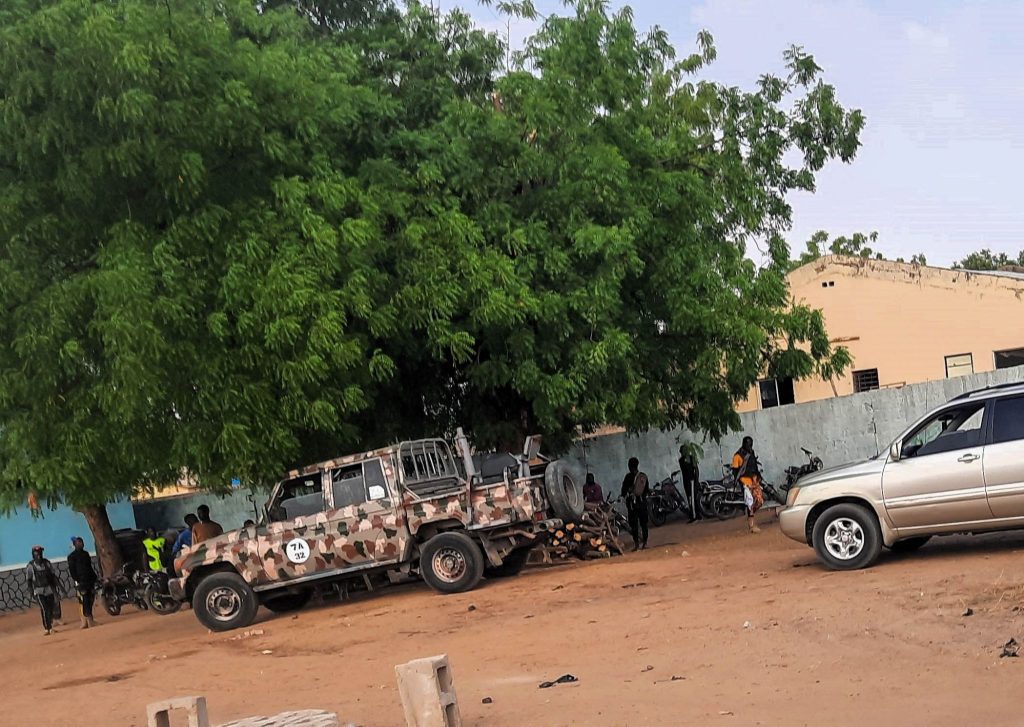
“They suspected we were hiding some of them,” Modu said. In the days that followed, soldiers raided Gana Ali and the GGSS camp. Residents told HumAngle that five suspected informants in the communities were arrested, and weapons were recovered. Then came an order for the communities to leave.
“They told us: leave or we will kill you all and burn down your houses,” Modu recounted. Within two days, families began dismantling their makeshift shelters. They packed what they could carry and left. Some were moved to a government settlement on the outskirts of Monguno, along the Monguno-Gajiram road, which is about a 30-minute walk from town.
“It is two weeks today,” Modu said when he spoke to HumAngle on May 10. “The place was torched after we left. I am not sure who torched the buildings.”
For Modu, displacement is not new. He fled Ala, his village in the Marte Local Government Area (LGA) of the state, in 2016 as insurgent violence spread across northern Borno. At the time, he was unmarried and found refuge with his parents at the ‘Water Board’ displacement camp in Monguno, where they lived for about six months. He later moved to the GGSS settlement after securing his own shelter and spent nearly a decade there. In 2024, he got married. By the time soldiers ordered residents to leave the community in April, he had begun building a mud house on a piece of land he purchased the previous year. It was there, in the unfinished house, that he and his family began rebuilding their lives after years of displacement.
A war returning to the bases
The Monguno attack came during a renewed wave of terror assaults on military formations and rural settlements across Borno.

In recent months, terrorists from Jama’atu Ahlis Sunna Lidda’awati wal-Jihad (JAS), commonly known as Boko Haram, and the Islamic State West Africa (ISWAP) have repeatedly targeted troops, bases, weapons, and supply routes. The attacks have killed soldiers, including senior military officers, and Civilian Joint Task Force (CJTF) members.
In Nov. 2025, terrorists ambushed a military convoy along the Damboa-Biu road. Two soldiers and two CJTF members were killed. Brigadier-General M. Uba, commander of the 25 Task Force Brigade, was abducted and later killed.
On Jan. 26, terrorists attacked a military base in Damasak, killing seven soldiers and capturing 13 others, including the commanding officer. Eleven later escaped. Five days later, on Jan. 31, another terror attack on an army base in Sabon Gari killed nine soldiers and two CJTF members; about 16 injured security personnel were evacuated for treatment.
On March 10, a military base in Kukawa came under attack; the commanding officer, Lt. Col. Umar Farouq, and several of his soldiers were killed.
On April 9, three days before the Monguno attack, terrorists launched a joint assault on the headquarters of the 29 Task Force Brigade in Benisheikh, killing its brigade commander, Brigadier-General Oseni Braimah.
The attacks have already weakened the military formations in rural areas. In some places, troops have withdrawn or consolidated around larger garrison towns, leaving smaller settlements more exposed. But when soldiers are killed, residents say the anger does not end on the battlefield. It returns with the troops.

The trails of suspicion
In rural Borno, civilians are often trapped between two armed powers. Terrorists demand information about troop movements, military positions, and security operations. Soldiers, in turn, demand information about insurgent hideouts, movements, and informants. Refusing either side can be deadly.
Those suspected of helping the military may be abducted or killed by the terrorists. Those suspected of helping terrorists may be arrested, detained, displaced, or punished by security forces. As a result, civilians often face impossible choices, with serious consequences regardless of whom they cooperate with.
Despite these risks, communities have at times provided intelligence to the military. In March, for example, residents of Doro, a rural community in Kukawa LGA on the shores of Lake Chad, reportedly alerted troops after observing suspicious insurgent movements, helping security forces prepare for an attack.
The consequences of such actions can be severe. In March 2022, ISWAP executed four civilians in communities within the same local government area after accusing them of spying for government troops. Residents said the killings were intended to deter others from sharing information with security forces. For many civilians, the message was clear: speaking to the military could carry a death sentence.
The Chief of Defence Staff (CDS), Gen. Olufemi Oluyede, recently argued that residents in Borno and Yobe knew some of those behind the attacks during an operational visit to Maiduguri in March, reflecting a long-held security assumption that residents in affected communities often know more than they admit. The CDS said communities must take ownership of the crisis, citing Kukawa, where he claimed two of the attackers were from within the village.
But for many civilians, knowing does not mean consenting. They say in places where terrorists move freely, buy food, collect supplies, and threaten residents, silence is often a currency for survival.
Professor Abubakar Mu’azu, former director of the Centre for Peace, Development, and Diplomatic Studies at the University of Maiduguri, said this suspicion has existed since the early years of the insurgency.
“Right from the start, there was suspicion by the security agencies that the people who are living in areas where these terrorist activities were happening are also supporting the terrorists,” he said. “They never considered the fact that there is a majority of people who disagree with these terrorists’ activities.”
Mu’azu said the reactionary nature of security operations has prevented the military from building a reliable system of trust with local communities.
“They assume that the locals are giving information to the terrorists willingly,” he said. “But they keep saying they want the people to give them information about the terrorists.”
For him, this contradiction is at the heart of the crisis.
The military needs civilian intelligence to fight terrorism, but if civilians fear that any contact with terrorists, even under duress, will be treated as collaboration, they may stop speaking altogether.

Life under duress
In Monguno, residents say terrorists still move in and out of town despite the presence of security forces.
Koso Abubakar, a displaced farmer, said the terrorists often enter on motorcycles, buy food items, and leave.
“They come and leave at will,” he said. “Sometimes, they come to kidnap people. They don’t attack the military, and the military does not confront them. But on other days, they attack the military. That is when the military retaliates.”
According to Koso, most residents live with the knowledge that they can be accused by either side at any time.
“People are living in fear because everyone is a potential target,” he said.
In many rural communities, even work has become dangerous. A farmer going to his field, a fisher heading towards the water, or a trader moving goods through bush paths may first have to pay those who control the routes. The payments are called taxes, levies, or sometimes simply “settlement”, but residents understand what they are: money paid under fear. To refuse is to risk punishment, in lighter cases, or killing and abduction, in extreme cases, from terrorists. To pay is to risk being seen by soldiers as someone sustaining the insurgency. In this way, even the small acts people perform to feed their families can become evidence against them.

Professor Mu’azu said this fear terrorists use violence to discipline communities.
“They are very good at setting a very deadly example by killing or eliminating people, with or without evidence,” he said. “If they are attacked by security agencies and they did not hear anything from people living in these settlements, they would assume the people gave information about their positions.”
This was what many residents believe happened in Ngoshe in March, when terrorists attacked the community, killed many residents, and abducted others, including women and children. The attack was suspected to be retaliation for a previous military operation in the Mandara Mountains that killed some terrorist commanders. The terrorists reportedly believed residents had given up their location.
For civilians, the lesson is brutal: giving information can kill you. Not giving information can also kill you.
When protection becomes punishment
The military has long accused some civilians of aiding terrorists. In the early years of the war, many young men were arbitrarily detained. Some disappeared. Some were killed. In April 2014, soldiers arrested 42 adult men from Gallari, a village in the Konduga LGA of Borno, on suspicion of links to the insurgency. They were taken to the Giwa Barracks detention facility in Maiduguri. Twelve years later, only three have regained their freedom after years in detention and alleged torture. Through months of on-the-ground investigation and analysis of satellite imagery, HumAngle has also previously reported on disappearances and mass graves linked to military operations, while the wives of detained and disappeared men later formed the Knifar Women movement to demand justice.

For communities already carrying the memory of those years, new raids and forced evacuations reopen old wounds.
Mu’azu said security forces should approach communities with more care, especially when allegations of collaboration arise.
“One would assume that when security forces are dealing with situations like this, they would not come with the mindset that the people are sympathetic to the terrorists, or that all the people are giving information to the terrorists,” he said.
He added that soldiers have a difficult job and deserve sympathy for the burden they carry. But he argued that this does not justify indiscriminate punishment.
“They are the ones who are supposed to protect the civilians,” he said. “If there are people they suspect, they should arrest them and hand them over to the police for proper investigation, without compromising the little support they have in the community.”
When communities are burned or displaced after attacks, the consequences go beyond the immediate loss of shelter. Food stocks disappear. Children are pulled out of school. Families scatter. People who had already fled violence once are forced to flee again.
In resettled or displaced communities, where people have spent years coping, another displacement can mean the collapse of everything they had slowly rebuilt.
A dangerous silence
After the Monguno raid, Koso said some residents became so afraid of the military that they fled into the bush.
“Many people, about 30, also left for the bush,” he said. “Most of them fear the military. The military does not trust them.”
Mu’azu warned that this kind of fear can damage counterterrorism efforts.
“They will lose trust, respect, and block chances of receiving information,” he said. “This could also push them to be recruited by the terrorists.”
For Mu’azu, the solution is not to abandon intelligence work, but to make it safer and more systematic. He said the military should cultivate trusted informants within communities, create secure channels of communication, and protect residents when terrorists retaliate.
“This is the gap,” he said. “Oftentimes, communities are attacked after successful military operations. The patterns should be studied. They should do a statistical analysis. They should be mindful of the time and be prepared against such actions.”
He also called for stronger collaboration among the military, DSS, police, civil defence, and intelligence agencies in neighbouring countries such as Cameroon, Chad, and Niger, because terrorists move across borders.
But for Modu and others displaced from Gana Ali and the GGSS, these policy questions remain distant. What they know is simpler: they fled one danger and met another. They were told to leave the place they had made into a home. Then they watched, or heard, that what remained had been burned.
In Borno’s war, civilians are often asked to prove their loyalty to the state while surviving under the shadow of terrorists, and in that narrow space between fear and suspicion, many are losing everything.