Times of Troy: What’s the worst-case scenario in a make-or-break 2026 for USC football?
Welcome back to the Times of Troy newsletter, where we’re dedicating the next two editions of Times of Troy to determining a range of outcomes for this make-or-break season of USC football. We’ll save the rose-colored takes for next week, when the Trojans will be on the doorstep of their season opener against San José State. But for today, as we did at this time last year, let’s consider the other, darker side of that same coin — and talk about how it could all go wrong.
Because, rest assured, there will be plenty of landmines to navigate through a gauntlet schedule that includes all three of the top three teams in opponent adjusted efficiency (FEI) from last season (Indiana, Oregon, Ohio State), plus the 14th-ranked team in the same category (Washington). Then there’s a trip to one of the hardest places to play in America (Penn State) to boot.
USC will need to win at least three of those five games to make the Playoff. Which is borderline cruel to ask.
For the purposes of this exercise, let’s assume that USC opens its season 3-0, with wins over San José State, Fresno State and Louisiana. Anything less, it’s fair to say, would be an unmitigated disaster.
How those three weeks go, though, will be important for the progress of USC’s young players, who need to find their bearings fast in order for USC to fulfill its potential.
It would be an especially unfortunate twist of fate for that process to be interrupted or for the team’s depth to take a hit through that easy, early stretch. But barring injury, those first three weeks should give USC time to get some of its young stars — such as receivers Kayden Dixon-Wyatt and Boobie Feaster, tight end Mark Bowman, cornerback Rock Hill and defensive end Luke Wafle, especially — up to speed.
The slate really begins Sept. 19, when USC opens conference play with its furthest possible trip east, at Rutgers. With Oregon awaiting the next week and the added dynamic of cross-country travel, you could certainly convince me the Trojans could be caught flat-footed in this game, leaving things a bit too close for comfort. But if USC somehow loses to Rutgers in its Big Ten opener, coach Lincoln Riley might not make it much past Halloween.
So let’s say the Trojans are 4-0 when Oregon comes to the Coliseum in late September. Really, it’s this game that will tell us where USC is actually headed this season.
Because the stage will have never been bigger for quarterback Jayden Maiava, who had his worst game of 2025 in Eugene last fall. That performance, according to Pro Football Focus, featured double the turnover-worthy throws (six) of any other game Maiava has started at USC. Any worst-case for USC probably includes some form of unraveling from the quarterback.
But even with Maiava at his best, Oregon is still the deeper and more well-rounded team. The front seven should be as formidable as it’s ever been under coach Dan Lanning. The quarterback might be the NFL’s No. 1 overall pick next spring, and his weapons on offense are as good as any in college football. That firepower proves too much for USC, which gets beat at home for the first time since November 2024.
Losing to Oregon would be a bitter pill for a young team to swallow. And it would also be a particularly bad time to start spiraling. Because the next three weeks are all losable games. Washington has a mobile quarterback (Demond Williams) capable of wreaking havoc on USC’s defense if its front seven can’t keep him contained. And while we don’t know what to expect from new coach Matt Campbell and Penn State, the White Out at Beaver Stadium a week later will be no joke. Even Wisconsin shouldn’t be overlooked two weeks after that. Especially at Camp Randall.
There’s a world in which USC has lost three of four, we’ll spot them a win at Wisconsin, after starting the season 3-0. That slump could be an absolute back-breaker. Because guess who looms after that?
Oh, just Ohio State and Indiana.
Pretty bleak, right?
Suddenly, in this most demoralizing scenario, USC is out of the Playoff picture at the halfway point of the season. The positive vibes around Gary Patterson’s hire are gone, and a significant segment of the fanbase will have resigned themselves to never seeing a good USC defense again in their lifetimes.
The conversation around Riley’s future will have reached a fevered pitch. The seat will have gotten scorching hot. The Trojans would now be playing for their coach’s job. The pressure, on a particularly young team, would be immense.
And then, Ohio State comes to town. The Buckeyes have lost three times on the road in the last two seasons, compared to just once at home. But those three road losses were either in the postseason to a top-two team, at Oregon or the inexplicable 2024 loss to a far inferior Michigan team in The Game. Chalk this up to a loss, as Ohio State tramples over both of USC’s fronts.
Indiana, meanwhile, has yet to lose a home game in two years under Curt Cignetti. I don’t expect that to change this year, either.
So with losses to Ohio State and Indiana — and a presumably smooth win at Maryland — USC would be 6-5 heading into the crosstown rivalry. And I think we can all agree that no scenario would be more of a worse case for USC than UCLA emerging from its first season under Bob Chesney as the better-trending program between the two.
I don’t think that’s where this season is headed. This is an absolute worst-case scenario, after all. The schedule does give USC serious spiral potential. And stranger things have happened in the crosstown rivalry.
But if USC were to end this season at 6-6, with a baffling loss to the Bruins, I think I can say pretty confidently that the whole program will be headed in a new direction after that.

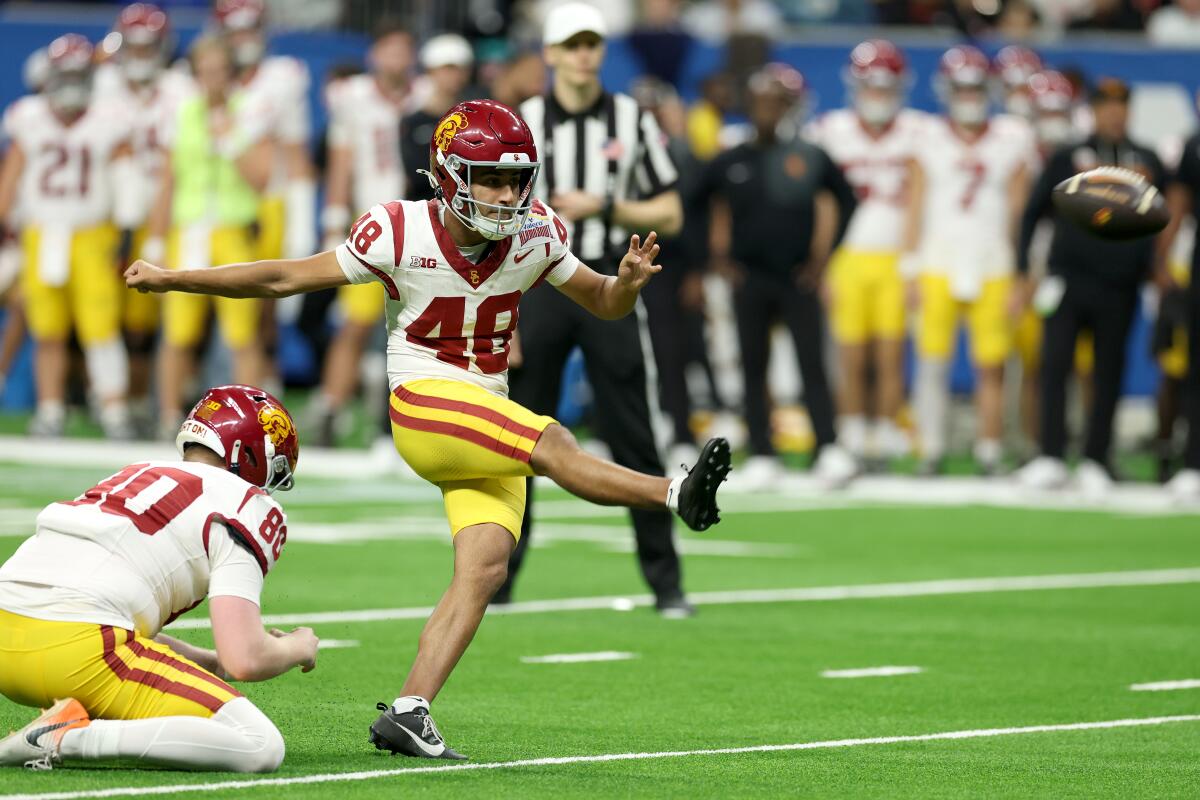
Will Ryon Sayeri remain USC’s kicker this season?
(Kenneth Richmond / Getty Images)
—Is USC’s starting offensive line already set? It’s starting to feel that way. The season-ending injury to center Kilian O’Connor limited USC’s options, with Tobias Raymond now almost assuredly set to step in there. But from what we’ve seen in open periods, there hasn’t been much movement elsewhere. Hayden Treter has been the preferred option at left guard, while Alani Noa has primarily been at right guard. Elijah Paige and Justin Tauanuu have once again been the bookends at tackle. Whether that’ll be the case by the midway point of the season, we’ll see, but USC seems confident with Treter and Noa flanking Raymond on the interior.
—Could USC make a change at kicker? Riley would like us to believe that it’s definitely a possibility, despite the fact that last season’s All-Big Ten third-team kicker Ryon Sayeri has returned. Sayeri wasn’t going to get the job last year until former Nevada Las Vegas kicker and freshman All-American Caden Chittenden got injured and relinquished it with Sayeri’s strong play. “I don’t know that I’ve ever been in a situation as a coach where you have like two guys that you believe in as much as I believe in them,” Riley said. Still, it would be bold to replace a guy who was as consistent as Sayeri was for most of last season.
—USC football got its Class of 2028 quarterback. Trey Wright is currently just the 25th-ranked passer in the class, according to 247 Sports. But Riley, who prefers to offer just one quarterback in each class, clearly sees something in the Frisco, Texas, signal-caller. Wright certainly piled up stats as a sophomore, throwing for over 4,000 yards and 38 touchdowns while rushing for nearly 1,800 yards and 16 touchdowns. The comparisons with Kyler Murray were natural even before the Vikings quarterback, who won a Heisman with Riley, sent Wright a video that he posted on social media. Wright is just 5 feet 10 and 175 pounds. But he looks like a heck of an athlete.
—Most of USC’s starting lineup for next hoops season is injured right now. Which is not exactly … ideal. But only center Eric Reibe is expected to miss real time into the season. Georgetown transfer KJ Lewis’ ankle should be healed by the start of the season in November. He’s expected to start playing live five-on-five in October. Rodney Rice (shoulder) should be good to go before that, while other key contributors have battled through bumps and bruises this summer. Reibe’s situation is especially odd. He sought a second opinion on his foot injury, according to a person familiar with the decision, and was told to sit out the summer to try to avoid surgery. Well, he ended up getting the surgery anyway, losing seven weeks of potential recovery time.
Polling the people
This is obviously a critical season for Riley’s future, and everyone seems to have a number in mind of what it’ll take for Riley to keep his job.
So, what is the fewest number of wins you’d accept from Riley and USC without calling for a change?
6 wins
7 wins
8 wins
9 wins
10 wins/Playoff appearance
Click here to vote in our survey
What I’m watching this week

Emmy Rossum in “Furious.”
(Sarah Shatz / Disney)
You don’t see many female serial killers — estimates historically range around just 8% to 12% — but that premise is a thrilling starting point for Hulu’s new cat-and-mouse crime thriller, “Furious.” Emmy Rossum stars as Alice Black, a female FBI agent who’s tasked with tracking down a sex trafficking survivor who has taken to murdering the men who abused her.
But the show gets much deeper than that, as lines start to blur between what’s right and wrong and who’s the actual villain in the story. Only a few episodes are out so far, but what I’ve seen so far suggests we might be looking back on this show as one of the best of 2026.
In case you missed it
USC quarterback Jayden Maiava pushes to use his voice as he enters his third season
Until next time …
That concludes today’s newsletter. If you have any feedback, ideas for improvement or things you’d like to see, email me at ryan.kartje@latimes.com, and follow me on X at @Ryan_Kartje. To get this newsletter in your inbox, click here.