1 of 2 | Iranians stand inside their damaged residential building in southern Tehran, Iran, on Sunday. Photo by Abedin Taherkenareh/EPA
March 15 (UPI) — Israel said it launched a wave of airstrikes on Iran on Sunday as Iran carried out its own attacks on U.S. military sites and against U.S. allies in the Gulf region at large.
The Israeli military said its airstrike hit the Hamedan area of western Iran, hitting multiple military headquarters, The Times of Israel reported. The Israeli military said it plans to expand its attacks on western and central Iran “with the aim of broadly and systematically damaging the regime’s command and control capabilities.”
Israeli officials, meanwhile, said at least five people in the country were injured Sunday by Iranian missiles. Iran’s state-run Mehr news agency reported that the Iranian military has pledged to “pursue and kill” Israeli Prime Minister Benjamin Netanyahu “with force.”
The United Arab Emirates said it has seen a drop in Iranian attacks within its borders. The defense ministry said it intercepted four ballistic missiles and six drones Sunday.
Since the start of the war, it has faced more than 1,900 attacks by Iran.
Bloomberg reported that a key oil port on the UAE’s east coast — Fujairah — was back in operation Sunday after it was targeted by an Iranian drone Saturday. The port is about 70 nautical miles away from the Strait of Hormuz, which Iran closed earlier in the month to put pressure on its enemies’ abilities to transport oil. About one-fifth of the world’s oil passes through the strait.
Fujairah is situated at one end of a pipeline that allows the UAE to bypass use of the Strait of Hormuz entirely. The site exported an average of more than 1.7 million barrels of crude and refined fuels per day in 2025, about 1.7% of the world’s demand, The Guardian reported.
Officials said they intercepted a drone attack near the site, causing a fire there briefly.
British Energy Secretary Ed Miliband said his country was examining ways to reopen the Strait of Hormuz and keep oil flowing. In an appearance on Sky News’ Sunday Morning with Trevor Phillips, Miliband said Britain was in talks with allies.
“There’s different ways in which we can make maritime shipping possible. We are intensively looking with our allies at what can be done, because it’s so important that we get the strait reopened.”
Japanese football legend says his opinion prompts a US company to cancel an advertising campaign before the FIFA World Cup.
Published On 15 Mar 202615 Mar 2026
Share
Former Japanese footballer Keisuke Honda says he has lost an advertising deal in the United States after voicing support for the Iranian national team’s participation in the upcoming FIFA World Cup.
Without naming the sponsor, Honda revealed on Saturday that an advertisement from a US-based company had been “put on hold” after he posted on X that he wants Iran to compete in the tournament cohosted by the US, Mexico and Canada.
Recommended Stories
list of 3 itemsend of list
“I know it’s a very sensitive thing, but I personally want them to participate in the World Cup,” the 39-year-old wrote in a tweet on Thursday, a day after Iran’s sports minister said the country cannot take part in the World Cup after the US and Israel launched a war on it and killed its supreme leader.
Honda, who represented Japan from 2008 to 2018 and scored 38 international goals for his country, posted a follow-up tweet in which he indicated that the advertisement, which had been expected to be finalised in time for the World Cup, had been shelved due to his earlier post.
“Apparently, this statement caused a US company to cancel an advertisement that was about to be finalised to coincide with the World Cup,” he wrote.
“We don’t want anything to do with companies that ignore the essence of things and make decisions based on rotten thinking.”
Iran’s place at the 48-team tournament is in doubt even after they qualified because of the US-Israeli attacks that began on February 28, following which Tehran responded by launching waves of missiles and drones at Israel, several military bases in the Middle East where US forces operate and infrastructure in the region.
The 23rd edition of the FIFA World Cup will be held in the three host nations from June 11 to July 19, and all of Iran’s group games have been scheduled at venues on the US West Coast.
The former Samurai Blue represented his country at the 2010, 2014 and 2018 World Cups and is among the top 10 most capped players and top five goal scorers for the Asian giants.
Honda was named the most valuable player in Japan’s title-winning run at the Asian Cup in 2011. After representing 11 clubs across five continents, the attacking midfielder hung up his boots in 2024 and switched to coaching.
The golden-haired player enjoys a hero-like status in his home country and is one of Japan’s most recognised international footballers.
He expressed his opinion on Team Melli’s participation amid heightened tensions between the host nation US and Iran.
Honda played club football in South America, North America, Europe, Australia and Asia [File: Pilar Olivares/Reuters]
US President Donald Trump said on Thursday that it would not be appropriate for Iran to participate in the World Cup.
“The Iran National Soccer Team is welcome to The World Cup, but I really don’t believe it is appropriate that they be there, for their own life and safety,” Trump wrote in a social media post without elaborating.
The Instagram account for the Iranian national team quickly responded to Trump’s remarks, questioning whether the US president should be commenting on team participation.
“The World Cup is a historic and international event, and its governing body is FIFA – not any individual country,” it wrote.
The account also criticised Trump for failing to provide adequate security for Iran’s national football players.
“Certainly, no one can exclude Iran’s national team from the World Cup,” the message continued. “The only country that could be excluded is one that merely carries the title of ‘host’ yet lacks the ability to provide security for the teams participating in this global event.”
Trump later posted another message on his social media platform to emphasise that the event would be safe for players and spectators from around the world.
The decision by United States President Donald Trump to launch a war on Iran has left many international law experts questioning if the world order established after World War II is actually working.
In his second presidential term, Trump seems to be wielding total power without restraint, and the system of checks and balances enshrined in the US Constitution appears to be failing to limit his power.
Recommended Stories
list of 4 itemsend of list
Since Trump was sworn in in January 2025, he has ordered two unprovoked attacks on independent states, Venezuela and Iran; threatened to annex Greenland; strained traditional alliances with Europe; undermined the United Nations; and rattled international trade with his sweeping tariffs.
Previous constraints set by the UN system and international law appear supplanted by what Trump told reporters in January was a vision of power limited only by his “own morality”.
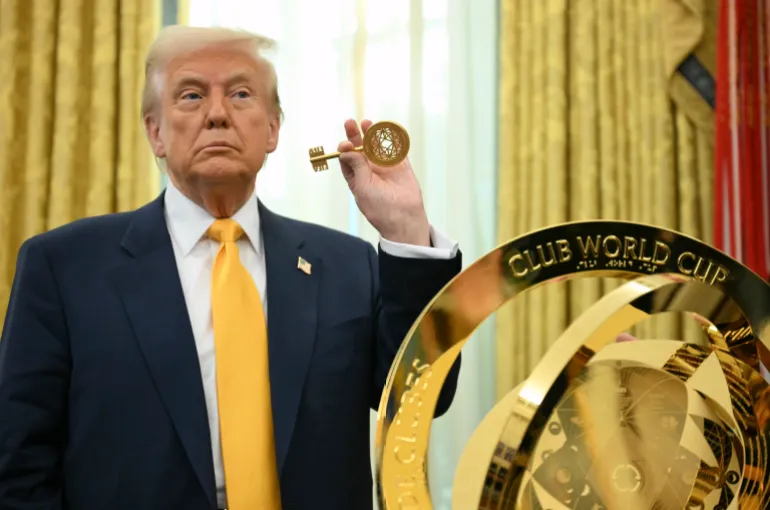
President Donald Trump holds the key to unlock the FIFA Club World Cup trophy, which he said is staying at the White House, requiring a replica to be presented to the tournament’s winners, Chelsea, in July 2025 [File: Pool via AP]
So what checks are there on Trump? Is he really free to attack states, set tariffs at will and, as leader of the world’s most powerful state, essentially dictate global policy? And if so, why are so many observers now saying his war on Iran is faltering?
Has international law put any checks on Trump?
Not so far.
According to analysts, both his attacks on Venezuela and Iran were in clear breach of international law and the UN Charter, principally the prohibition on the use of force under Article 2(4).
Debates about international law, how it has been geared over the decades to underpin the interests of the West and the US specifically, are hardly new. However, experts said, the Trump presidency has seen even the notional restraints of international law trampled underfoot.
Trump himself has brushed aside international law, saying in January that it would be up to him to decide when and how much international law applied to the US and his actions.
“In many respects, international law has historically served US interests, and self-interest should continue to generate US support for a rules-based order organised around the core principles enshrined in the UN Charter,” Michael Becker, a professor of international human rights law at Trinity College in Dublin who previously worked at the International Court of Justice in The Hague, told Al Jazeera, “But finding value in international law often requires adopting a long-term outlook that does not sit easily with short-term political agendas.”
“In the current geopolitical climate, the capacity of international law to provide a meaningful constraint on US action under Donald Trump has proven negligible,” Becker added. “That seems unlikely to change, especially given the failure by other states to strike a united front against Trump’s gangsterism.”
What about the UN?
Not so much.
From its founding, the role of the UN has been to promote dialogue instead of conflict and provide a global response to international challenges. However, Trump’s relationship with the body, like so many of the president’s associations, has rarely been so straightforward. On the one hand, while appearing to try to supplant the body with his members-only Board of Peace as well as sidelining UN aid efforts in Gaza, he has on occasion sought the legitimacy of the UN for a number of his projects, such as his calls in August for the UN to establish a Support Office in Haiti, to help limit migration to the US.
However, while the support of the UN may be helpful, it is clear that Trump has no intention of abiding by its charter, Richard Gowan, the Crisis Group’s UN director from 2019 to 2025, said.
“While other UN members see the US is breaking international law on a regular basis, they often hold back from criticising Washington too loudly in forums like the Security Council because they fear blowback from Trump,” Gowan said. “So Trump is learning he can sidestep the UN when he wants to and get away with it while occasionally using it for instrumental purposes.”
What about other powers?
Up to a point.
Many countries known as “middle powers”, such as Canada, the United Kingdom, France, and other Western and European states, have proven successful so far in pushing back against Trump’s efforts to unilaterally annex Greenland. But European powers have failed to condemn Trump’s unprovoked war on Venezuela and Iran, exposing their double standards in conflicts in the Middle East and the Global South.
Many analysts expect that a withdrawal of investments in the US by Gulf states, which are bearing the brunt of Iran’s retaliation to US and Israeli attacks, may also hasten the war’s end.
“Middle powers can generate friction but not a veto,” HA Hellyer of the Royal United Services Institute for Defence and Security Studies in London said. “Collective action – European governments, Gulf states – can raise costs and extract tactical adjustments. The structural imbalance remains: The US retains decisive military, financial and institutional primacy.”
Smaller states often hedge their bets, follow Washington or look to regional alliances for protection, Hellyer added, continuing that while pressure was strongest in Europe, where the US is no longer seen as a reliable security guarantor, the idea of establishing an alternative continues to be a hurdle. “The logic of an alternative model is accepted; the capacity to execute it quickly is not. A prolonged interregnum follows. The Gulf Arab states are in an analogous position,” he said.
In the meantime, Trump and the US are free to act as they choose. “These are exposure-management strategies, pursued until structural dependence on the US security umbrella can be reduced,” he said.
China and Russia have so far criticised the breaches of international law while avoiding clear escalation, and India and other members of the BRICS bloc have largely stayed silent, suggesting a preference for strategic ambiguity over confronting Washington directly.
Canadian Prime Minister Mark Carney warned Trump of a ‘rupture’ in the Western alliance at the World Economic Forum in Davos, Switzerland, in January 2026 [File: Denis Balibouse/Reuters]
What about domestic restraints?
Not really.
The US Supreme Court was able to block Trump’s use of tariffs to manage large parts of his foreign policy by rewarding allies with lower tariffs and punishing critics with punitive import duties.
But none of the other traditional guardrails – such as Congress; the Department of Justice, which has provided unwavering support to the president; and even the news media – has contained the president’s ambitions. This isn’t entirely new. Previous presidents have ordered wars without congressional approval. However, with Trump, analysts suggested, it has been systematic.
Powerful US institutions have largely failed to hold the Trump administration accountable, analysts, such as Kim Lane Scheppele, a professor of international affairs at Princeton University, said.
“His base of strong supporters are saying that they are willing to experience short-term increases in gasoline prices if it leads to a friendly government in Iran in the long term. His opponents have been his opponents on everything, so he simply ignores and threatens them,” Scheppele told Al Jazeera.
“Trump pays more attention to market performance than to public opinion, so he started saying that he was minimising costs and saying that the Iran war is short term to boost markets again.”
“What the US is spectacularly missing is leadership to oppose Trump. Congress is not doing its constitutional job to constrain him. The Supreme Court is in his pocket because he packed the court in his first term. Lower court judges are heroic and have done amazing work under serious pressures, but they don’t get foreign policy questions, given the difficulty of anyone getting ‘standing’ … in the area of international matters,” she said, referring to the requirement that parties to a lawsuit must show actual or future direct harm to themselves to bring a case to court.
She noted that lower federal courts, although limited on foreign policy, have repeatedly checked executive overreach on immigration, sanctions designations and emergency powers, often under intense political pressure.
A bulk carrier and tanker at anchor in Muscat, Oman, as Iran has essentially closed the Strait of Hormuz by threatening to attack vessels transiting the waterway [File: Benoit Tessier/Reuters]
So why are so many people saying Trump’s war is faltering?
In the eyes of many observers, Trump, with no clear war aims or a defined resolution, is in danger of losing control of a conflict that appears to be both growing and reaching into economic areas apparently unforeseen by his administration, so while traditional restraints don’t apply, market forces, like gravity, always do.
Trump has repeatedly said the war would be over soon despite none of his claimed war aims being achieved.
Oil prices have surged due to his attacks on Iran, Tehran’s counterstrikes and threats to shipping in the Strait of Hormuz, through which about 20 percent of the world’s oil and liquefied natural gas passes.
The International Energy Agency’s decision on Wednesday to release 400 million barrels of oil from international petroleum reserves has failed to tame the prices. Iran has warned that oil could hit $200 a barrel as it continues its stranglehold of the waterway.
“Ultimately, the factors that might be most likely to constrain Donald Trump’s neoimperialist impulses – or his willingness to pursue the policy goals of those who have his ear – are the economic fallout from disrupting global energy markets and a broader disenchantment among US voters with his globe-trotting militarism, his rampant self-dealing and his callous disregard for the human costs of war,” Becker said.
Ohtani began the World Baseball Classic in Tokyo for Team Japan with a double on the first pitch he saw and then, one inning later, a grand slam … of course he did.
It continued with an espresso shot …
The hitters of lovable Team Italy celebrated home runs with shots of Italian espresso in a dugout dripping with cheek kisses and caffeine.
After hitting three homers against Mexico, Italy’s Vinnie Pasquantino told Fox that he was, “beaned up.”
Truly, this blip of a tournament has been beaned up, a glorious 10 days of deafening cheers and eye-blacked tears, fans dressed like discount popes and bald eagles, TV ratings through the roof, baseball at its October best … in the middle of spring training?
Italy’s Jac Caglianone takes a shot of espresso as he celebrates with teammate Vinnie Pasquantino after hitting a solo home run against the U.S. during the World Baseball Classic on Tuesday in Houston.
(Kenneth Richmond / Getty Images)
What a thing! What a treat!
All hail the WBC, 20 years old and all grown up, its sixth incarnation stealing the stage in a sweet spot during NBA doldrums and before March Madness.
Have you watched any of it? Have you been energized by all of it? It’s been like two weeks of All-Star games, only the players are serious. It’s been like when baseball was part of the Olympics, only the players are all truly the best in the world.
In the middle of the most boring part of the Cactus and Grapefruit Leagues, it’s like a Superhero League. Two weeks before opening day, it’s like the final week of a pennant race.
It’s competitive, and it’s crazy, and Friday’s quarterfinals were filled with both.
There was giant Vladimir Guerrero Jr. going airborne to score a run for the Dominican Republic against Korea, and then leaping up and pumping his fist as if he had just won the World Series.
There was Juan Soto flying home to score an inning later, his head-first dive celebrated by Soto doing a swim move in the dugout.
Then there was Team USA’s David Bednar, screaming along with the chanting crowd as he worked out of a seventh-inning jam in a win over Canada.
In a tournament filled with equal parts emotion and edginess, Team USA now plays the Dominican Republic Sunday in Miami in a semifinal that could be the most-watched game of this season before the season starts.
Paul Skenes versus a lineup so deep Julio Rodriguez bats seventh? A team led by Aaron Judge and Bryce Harper versus a team featuring Manny Machado and Fernando Tatis Jr?
Dominican Republic’s Vladimir Guerrero Jr. dives past South Korea catcher Park Dong-won to score on a double by Junior Caminero during the World Baseball Classic on Friday in Miami.
(Lynne Sladky / Associated Press)
“I expect it to be one of the best games of all time,” said Team USA Manager Mark DeRosa.
No, the WBC isn’t as big as the World Series. One notable player said it’s even bigger.
“The Classic kind of feels above the World Series,” Kiké Hernández told reporters earlier this spring. “Maybe it’s because of what we have on the chest,”
Hernández, who didn’t play for his home country Puerto Rico because he is recovering from elbow surgery, nonetheless showed up in San Juan for the pool-play games.
He was so excited when Puerto Rico beat Panama on a walk-off home run, he texted Dodgers baseball president Andrew Friedman and asked if he could accompany the team to Houston for the knockout round. Friedman of course said yes.
Yes, yes, yes, more, more, more.
Before this spring, I had watched exactly one WBC at-bat. The entire deal felt cheesy and contrived. American players didn’t appear to care. American players would rather lounge through the final days of spring training in occasional games and on countless golf courses
Other countries loved it. Other countries caused a ruckus. The fan experience was highlighted by a memorable and deafening 2009 final at Dodger Stadium featured a Japan victory over South Korea in a game that many observers said was the loudest they ever attended.
Not me. Didn’t care. I pretty much ignored the whole thing until stumbling upon that one at-bat, the final out in the 2023 title game, that stunning dramatic strikeout of Mike Trout by then-Angel teammate Ohtani to give Japan the title.
Ohtani threw his cap and glove in a rare show of emotion, setting off a wild and sincere celebration as my ignorant self finally realized, “Hey, this is a thing.”
Three years later, the American players have agreed, stacking the roster with stars like Judge and Harper, kids like Pete Crow-Armstrong, vets like Kyle Schwarber and Big Dumpers named Cal Raleigh, all transforming this occasional baseball oddity into must-see TV.
You know how one can tell it’s real American baseball? The team spent its first week mired in social media drama and a second-guessing controversy.
American right fielder Aaron Judge celebrates his team’s win over Canada during a World Baseball Classic quarterfinal game on Friday in Houston.
(David J. Phillip / Associated Press)
Tarik Skubal, the game’s best pitcher, found himself defending his patriotism after leaving the tournament early to better prepare for his opening day start with the Detroit Tigers.
First, he admitted he was surprised at how bad he felt about abandoning Team USA. That seemed to be a theme in a clubhouse that has been stunned at how much this matters.
“I totally misread how I would feel,” he said.
Then, he seemed genuinely hurt that people think he is turning his back on the flag.
“It’s just not fair,” he told the Athletic, later adding, “If they know me, though, and they know me on a personal level and they know what my peers think of me, I don’t think it’s fair to say those things.”
Also finding himself in hot water was USA manager Mark DeRosa, who nearly allowed his team to be eliminated in pool play because he didn’t know the rules.
When Team USA played Italy on Tuesday night, DeRosa rested most of his starters, nearly used retired Clayton Kershaw and basically managed the game as if he thought they didn’t need to win to guarantee advancement to the next round.
Guess what? They needed to win. But they didn’t win, losing 8-6 in a shocking upset. So they were forced to sweat out the Italy-Mexico game on Wednesday, where another Italian upset allowed them to back into the quarterfinals.
DeRosa claimed he knew the rules all along, which he clearly did not.
Before the game against Italy, in an interview on the MLB Network, he said, “Our ticket’s punched to the quarterfinals.”
After the game, DeRosa claimed he just, “misspoke”
And then Thursday he told the media, “I was well aware that we had to win the game.”
The 16-year journeyman clearly messed up, and then tried to cover up, and here’s guessing even if Team USA wins this tournament, he won’t be managing them in the 2028 Olympics or in any future WBC events.
Meanwhile, one American player had a dissenting view about the status of this tournament, Harper offering a tired argument.
“Obviously, the WBC has been great, but it’s not the Olympics, right?” he told reporters. “That’s no disrespect to the WBC or anything, but everybody knows that when the Olympics are on, everybody’s watching. It doesn’t matter what sport it is; it could be the most random sport, and it’s got all the fans watching it.”
Wrong. Here’s guessing more fans will be watching Sunday night in a matchup for the ages. Then, imagine if Team USA wins and plays Japan on Tuesday night for the championship?
With the sport headed toward a seemingly inevitable work stoppage this winter, this could be the sweet beginnings of a long farewell. Soak it in. Enjoy the buzz. Get all beaned up. March madness indeed.
The son of former Brazilian President Jair Bolsonaro, Sen. Flavio Bolsonaro, reacts outside the hospital where his father was taken in Brasilia, Brazil, on Friday. Jair Bolsonaro, has been imprisoned in a Brasilia penitentiary after being sentenced to 27 years in prison for his role in a coup attempt. Photo by Andre Borges/EPA
March 13 (UPI) — Former Brazilian President Jair Bolsonaro was hospitalized Friday in Brasilia after doctors diagnosed a bacterial lung infection, authorities said, marking the latest health episode for the 70-year-old who is currently serving a prison sentence.
Bolsonaro was admitted to the DF Star hospital with fever, vomiting and low oxygen levels. Doctors later confirmed a case of bacterial pneumonia and began treatment with intravenous antibiotics while keeping him under medical observation.
The former president was transferred to the hospital from detention. Since January, he has been held in the officers’ wing of the 19th Military Police Battalion, known as “Papudinha,” in Brasilia, where he is serving a sentence of 27 years, three months in prison for an attempted coup.
Health issues have been a recurring concern for Bolsonaro since a 2018 assassination attempt during a campaign rally in the southeastern city of Juiz de Fora, where he was stabbed in the abdomen.
The attack caused severe internal injuries and required emergency surgery, forcing him to spend weeks recovering in hospital while continuing his presidential campaign.
Since then, Bolsonaro has undergone several abdominal procedures and has been hospitalized numerous times for intestinal obstructions, infections, hernia repairs and other chronic health problems. Doctors said Friday his condition is stable and that doctors continue to monitor the infection.
March 13 (UPI) — An Australian businessman was found guilty Friday of selling information to two people believed to be Chinese spies.
Alexander Csergo, 59, was convicted of reckless foreign interference in a Sydney court after compiling reports for two people he knew as Ken and Evelyn in Shanghai between 2021 and 2023. He faces up to 15 years in prison.
The prosecution alleged that Csergo believed they worked for Chinese intelligence agency the Ministry of State Security and acted recklessly about knowing if it would support Chinese intelligence.
His defense team argued he had only given them information that was publicly available and he included made-up quotes from people he pretended to have interviewed, including former Australian Prime Minister Kevin Rudd.
Csergo ran a business in Shanghai and was first approached by a woman on LinkedIn who said she was working for a think tank. She introduced him to Ken and Evelyn and said they had businesses in Australia, New Zealand and Canada.
Their meetings, in which he exchanged reports for cash, happened in empty cafes and restaurants, prosecutors said.
Ken and Evelyn gave Csergo a “shopping list” of subjects they wanted reports on. After he returned to Australia in 2023, officials searched his Bondi home and found the list, but Csergo said he never used that list.
Ken and Evelyn asked for reports about lithium mining, the German government, the Quadrilateral Security Dialogue and AUKUS, a trilateral security partnership between Australia, Britain and the United States. The Quad alliance is a non-military partnership between the United States, India, Japan and Australia.
Csergo’s defense attorney, Iain Todd, argued that there is no evidence he provided anyone with any national secrets.
The prosecution said the biggest value to Ken and Evelyn were Csergo’s contacts, but Todd said Csergo had no real contacts.
“He never spoke to interviewees. He lied about that,” Todd said. “He never gave access to anyone because there was no one to give access to.”
Some of the information in the report on lithium mining was labeled “gibberish” by experts.
Prosecutors said he exchanged about 2,800 WeChat messages with Ken and developed a collegial relationship with him.
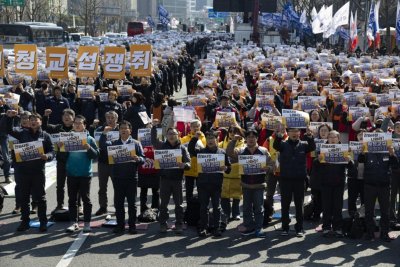
Members of the South Korean Confederation of Trade Unions (KCTU) shout slogans and hold up banners reading ‘Let’s fight for the basic rights of the Workers’ at a rally against the government’s labor policy in Seoul, South Korea, 10 March 2026. Photo by JEON HEON-KYUN / EPA
March 13 (Asia Today) —This commentary is the Asia Today Editor’s Op-Ed.
The atmosphere across industrial workplaces following the implementation of the so-called Yellow Envelope law is far from normal, with growing uncertainty emerging across the labor market.
Within two days of the law taking effect, 453 subcontractor unions representing nearly 98,500 workers filed collective bargaining requests against 248 prime contractor workplaces. With many unions closely watching the situation, the number of bargaining demands is expected to increase sharply once the first successful negotiations occur.
Most companies are struggling to respond effectively to the demands from subcontractor unions. Many firms believe the best course of action is to wait for decisions by the Central Labor Relations Commission and for court precedents to emerge through litigation.
Amid this uncertainty, attention is focusing on the activities of South Korea’s two major labor federations – the Federation of Korean Trade Unions and the Korean Confederation of Trade Unions – which have launched campaigns to expand their influence.
Both organizations view the new law as a major opportunity to increase union membership. With the national unionization rate hovering just above 10%, labor leaders believe the law could help reverse the trend.
The Federation of Korean Trade Unions, which had about 1.2 million members as of 2024, has launched an organizing task force with the goal of expanding its membership to 2 million.
The Korean Confederation of Trade Unions has also set an internal target of reaching 2 million members.
As the two federations compete for leadership within the labor movement, the revised labor law is emerging as a catalyst for organizational expansion. Subcontractor unions with limited bargaining power are increasingly turning to these larger labor groups for support.
The shift is already visible. The labor union at auto parts manufacturer Mando recently voted to rejoin the Korean Confederation of Trade Unions’ Metal Workers’ Union after 14 years.
Union leaders reportedly concluded that joining an industrywide union could help reduce job insecurity, particularly as corporate restructuring has become a potential subject of collective bargaining under the new law.
If even the union at a primary contractor such as Mando has decided to rejoin the federation, the choice for subcontractors, special employment workers and platform laborers with weaker bargaining power appears increasingly clear.
The public sector is also experiencing confusion.
While the government has stated that recognizing employer status in the public sector is generally difficult, President Lee Jae-myung offered a different message, saying the government should serve as a model employer.
As a result, collective bargaining demands are pouring in from outsourced workers and subsidiary employees affiliated with central and local governments as well as public institutions. Many of these public-sector unions are also expected to seek membership in the two major labor federations.
Subcontractor unions backed by the organizational strength and strike guidance of higher-level labor groups are likely to adopt a more aggressive stance in labor disputes.
In particular, the expansion of the Korean Confederation of Trade Unions – often criticized by companies for confrontational labor tactics – could undermine the stability of labor-management relations.
For companies operating in a rapidly changing business environment that demands specialization and efficiency, the situation presents growing challenges.
The competitiveness of government agencies and public institutions could also be affected.
If the government truly seeks to protect the livelihoods of citizens, it must prioritize the competitiveness of businesses and the national economy while taking steps to minimize disruption across industrial workplaces.
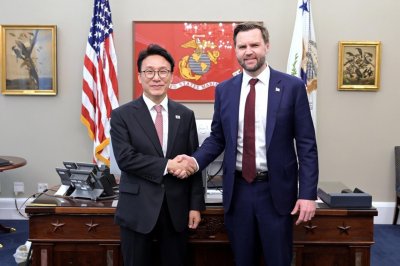
South Korea Prime Minister Kim Min-seok (L) with US Vice President JD Vance ahead of their talks at the White House in Washington DC, USA, 12 March 2026. Courtesy of the Embassy of the Republic of Korea in the United States
March 13 (Asia Today) — South Korean Prime Minister Kim Min-seok met U.S. Vice President J.D. Vance at the White House in Washington on Wednesday to discuss bilateral investment, trade issues and developments on the Korean Peninsula.
The meeting came about 50 days after the two leaders first met during Kim’s visit to Washington in January.
Kim highlighted the passage of a special law supporting South Korean investment in the United States, which cleared the National Assembly earlier this week.
He said the legislation demonstrates Seoul’s commitment to implementing bilateral investment agreements and could contribute to revitalizing U.S. manufacturing and job creation.
Kim added that the measure could also accelerate implementation of agreements outlined in a joint fact sheet between the two countries, including cooperation in areas such as nuclear-powered submarines, nuclear energy and shipbuilding.
Vance welcomed the legislation, saying it provides a legal foundation for implementing investment agreements between the two countries, according to South Korea’s Prime Minister’s Office.
The two sides also discussed cooperation in critical minerals and issues related to non-tariff trade barriers.
Kim explained Seoul’s recent decision to allow U.S. companies to export mapping data from South Korea, describing it as a forward-looking step aimed at strengthening cooperation.
Vance praised the move and said the two countries should continue consultations on non-tariff trade barriers.
Kim also said issues previously raised by Vance during their January meeting – including concerns related to the e-commerce company Coupang and certain religious matters – are now being handled in a stable manner.
Vance said the United States respects South Korea’s domestic legal framework and thanked Seoul for continuing to communicate with Washington on issues of interest to the United States.
The leaders also exchanged views on the Korean Peninsula and reaffirmed that the door remains open for dialogue with North Korea.
They agreed to maintain close coordination on developments related to the peninsula.
South Korea’s Prime Minister’s Office said the meeting helped deepen personal trust between Kim and Vance and is expected to strengthen communication on key bilateral issues.
The office’s statement did not mention whether the two discussed the Section 301 trade investigation launched this week by the Office of the United States Trade Representative targeting several major trading partners, including South Korea.
However, the issue of non-tariff barriers raised during the meeting could be related to that investigation.
Five teams will compete in the new series of the BBC travel show, racing from Europe to Mongolia
Race Across the World is returning with a new series
(Image: BBC screengrab)
The upcoming Race Across the World contestants are shown battling through thick snow in an early look at the new series.
The much-loved BBC programme – which features teams racing vast distances on limited budgets, without phones and banned from flying – is back for a sixth series, and the broadcaster has released a short preview in a teaser trailer, reports Wales Online.
Whilst the departure point hasn’t been revealed yet, this season the participants will face the challenge of travelling from Europe “to the uncharted edges of Mongolia”. Footage in the trailer captures the racers riding horses, navigating major cities, leaping from boats and attempting to hitch lifts.
“The further they go, the closer they’ll get,” flashes across the screen, as one of this year’s participants is heard saying: “This race, it’s a lifetime of exploring in such a short amount of time.
“It’s going to open up a lot of doors not many people have the privilege to unlock.”
Another contestant is then heard exclaiming: “This is an adventure.”
The BBC teased: “In this vast east-to-west journey, five pairs race from the familiarities of Europe all the way to the uncharted edges of Mongolia in Race Across the World series six.
“These teams must forge their own path… But on this journey of extremes, who will finish first? No flights. No phones. No safety net… Let the race begin!”
Fans have declared they “can’t wait” following the series preview, with one posting on Instagram: “So excited for this.”
“OMG…. Can’t wait for this one!!!” gushed one person, whilst another fan declared: “My favourite programme.”
“Yippee!” enthused another viewer, as somebody else wrote: “Yesssssss!! Cannot wait – best programme!!”
Last year’s series of Race Across the World saw the teams departing from The Great Wall of China before journeying across China, Nepal and India to reach the finishing point of Kanniyakumari, the southernmost tip of India.
It was claimed by mother and son pairing Caroline and Tom, who secured the £20,000 prize after becoming the first duo to arrive at the final checkpoint.
For the latest showbiz, TV, movie and streaming news, go to the new **Everything Gossip** website.
North Korea on Saturday staged another of its show-of-force ballistic missile launches — pictured is one launch during a test in December — that sent 10 missiles off its west coast, which traveled more than 200 miles and landed just outside the Japanese exclusive economic zone in the Sea of Japan. Photo by KCNA/EPA
March 14 (UPI) — North Korea launched 10 ballistic missiles into the sea on Saturday — which landed just outside Japan’s economic zone in the East Sea — in a show of force amid a U.S.-South Korea military exercise.
The launch, confirmed by the Japanese and South Korean defense ministries, is one of the largest North Korea shows of force that it has ever launched, The Japan Times and The Independent reported.
The missiles were launched from the west coast of North Korea, flying roughly 211 miles before falling just outside the Sea of Japan.
The Japanese Ministry of Defense in a statement called the launch a continued effort to “threaten the peace and security of Japan, the region and the international community.”
Shinjiro Koizumi, the Japanese defense minister, added that the ministry would remain in close contact with the United States and other allies “to remain fully vigilant and maintain surveillance in preparation for any unforeseen contingencies.”
The launch is the largest since at least November 2022, when Kim Jong Un’s regime launched a volley of 23 missiles that included short-range ballistic missiles and surface-to-air missiles, among others.
Analysts have said that it is unlikely that North Korea would attack U.S. or other nation’s assets in the region while the United States has diverted missile defense systems, among other things, to the Middle East amid the war in Iran.
They say, rather, that the show of force is meant to show that it can defend itself if it is invaded.
North Korea’s launch also comes as the United States and South Korea are about halfway through the annual 11-day Freedom Shield combined joint exercise that includes land, air and sea training events to allow the two nation’s armed forces to integrate seamlessly in combat.
One warship that was involved with the exercise, the USS Tripoli, an amphibious assault ship carrying 2,500 Marines and 2,500 sailors, has been redeployed to the Middle East to bolster U.S. military power there amid the war in Iran.
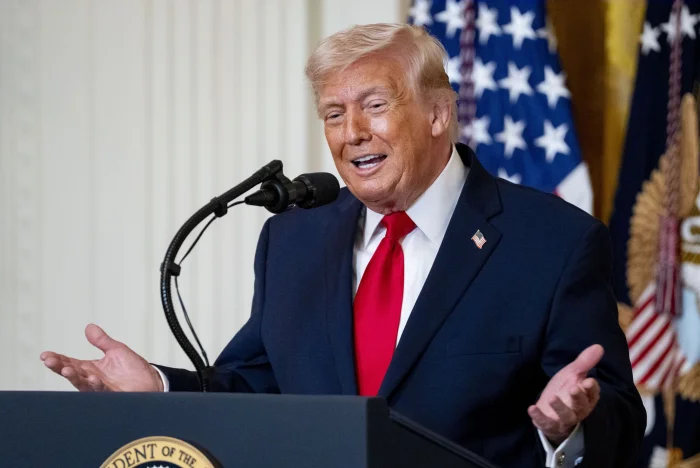
President Donald Trump speaks during an event celebrating Women’s History Month in the East Room of the White House on Thursday. Photo by Bonnie Cash/UPI | License Photo
March 14 (UPI) — President Donald Trump on Saturday said that a coalition of nations affected by Iran choking off the Strait of Hormuz will send warships to open it back up.
Trump said that although the United States and Israel have “destroyed 100% of Iran’s military capability” in its war in Iran, its attempt to close the strait — by attacking ships and possibly laying mines along the shipping route — is affecting global trade.
Iran started to limit traffic in the strait since the war started two weeks ago and on Thursday, Iran’s new supreme leader, Mojaba Khamenei, said it would remain closed as a tactic to pressure the United States and Israel to end their attacks on the country.
The Strait of Hormuz is a significant global trading route, and sees roughly 20% of the global oil and fuel supply pass through it every day.
“Many countries, especially those who are affected by Iran’s attempted closure of the Hormuz Strait, will be sending War Ships, in conjunction with the United States of America, to keep the Strait open and safe,” Trump said in a post on Truth Social, Axios and The Guardian reported.
“Hopefully China, France, Japan, South Korea, the UK, and others, that are affected by this artificial constraint, will send Ships to the area so that the Hormuz Strait will no longer be a threat by a Nation that has been totally decapitated,” Trump said.
On Friday, several news organizations confirmed with the Department of Defense that the USS Tripoli, an amphibious assault ship that was operating in the Philippine Sea, is headed to the Middle East.
The Tripoli brings with it 2,500 Marines of the 31st Marine Expeditionary Group, along with 2,500 more sailors, after U.S. Central Command requested additional military options for the conflict.
The 31st MEU can conduct ground operations, which the Trump administration has not ruled out in Iran, but Joint Chiefs of Staff Chair Gen. Dan Caines told reporters at a press conference that the Pentagon plans to go after Iran’s mine-laying capability and its ability to attack commercial vessels.
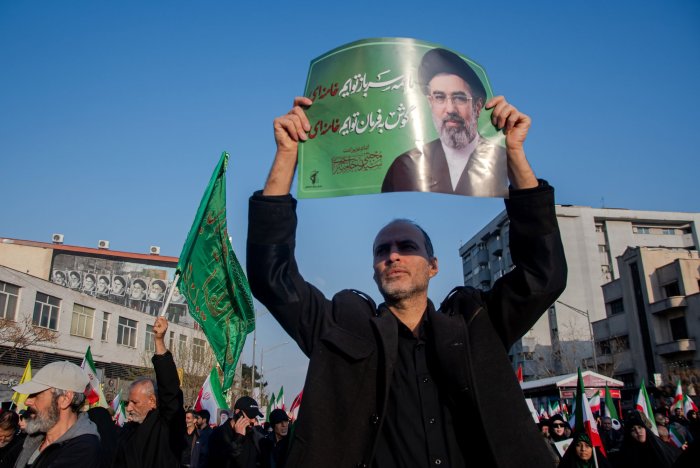
An Iranian man raises a portrait of new supreme leader Mojtaba Khamenei during a rally on Revolution Street in Tehran on March 9, 2026. Photo by Hossein Esmaeili/UPI | License Photo
Ukrainian experts inspect a shell crater at the site of a Russian strike in Brovary near Kyiv, Ukraine, on Saturday amid the Russian invasion. Photo by Sergey Dolzhenko/EPA
March 14 (UPI) — Russian attacks on Kyiv overnight left at least four people dead and 15 injured, Ukrainian President Volodymyr Zelensky announced Saturday.
The missile and drone attacks hit four districts in the capital, bringing damage to schools, residential buildings and critical infrastructure, regional officials said, as reported by EuroNews. Zelensky said the attacks caused damage in Kyiv, Sumy, Kharkiv, Dnipro and Mykolaiv.
“The main target for the Russians was the energy infrastructure of the Kyiv region, but unfortunately, there were also direct hits on and damage to ordinary residential buildings, schools and civilian businesses,” Zelensky said in a post on X.
Zelensky said Russia used 430 drones and about 68 missiles to carry out the attacks, 58 of which were intercepted by Ukraine’s air defense system.
The president said the number of weapons used in the attack is a reminder to Ukraine’s partners that air defenses and missiles are a “daily necessity.”
“Every agreement on missile supplies cannot wait — everything must be implemented as quickly as possible,” Zelensky said. “Our agreements to increase the production of air defense missiles are a critical direction, and this direction requires one hundred percent attention.”
NBC News reported that Ukraine is waiting for the Trump administration to approve a major drone production deal.
He said Russia will attempt to take advantage of the new war in Iran and will benefit a surge in oil prices and from the United States easing sanctions on Russian oil to balance supply drops through the Hormuz Strait.
Russian officials said, meanwhile, that Ukrainian drones hit an oil refinery in the southern Krasnodar region.
WE ARE just a couple of weeks away from the new Disneyland Paris World of Frozen opening and fans are in for a real treat.
Officially opening on March 29, the World of Frozen at Disneyland Paris was first announced back in 2018 – and Sun Travel has been lucky enough to see it today, before the gates officially open.
Sign up for the Travel newsletter
Thank you!
Sun Travel Reporter Cyann Fielding got a sneak peek at the new World of Frozen opening at Disneyland Paris on March 29There’s a family-friendly boat ride called Frozen Ever After, where you travel on a journey through ArendelleCredit: DisneylandParis NewsIn addition to the ride, visitors can head to a new Nordic-themed restaurantCredit: DisneylandParis News
The land features a life-sized 36-metre North Mountain with Elsa’s Ice Palace, a Frozen Ever After boat ride and A Celebration in Arendelle show on the water.
There is also a Nordic-themed restaurant, as well as themed shopping experiences and character meet and greets.
This weekend I got a sneak peek at the new land and let me tell you, there’s a lot to share.
The Frozen Ever After ride
The main attraction of the new land is the musical Frozen Ever After boat ride.
With no height restrictions,the family-friendly ride heads on a journey through well-known scenes from the Frozen franchise.
Starting at the Royal Docks, you head through the village and forest meeting Sven and Olaf on the way, then you glide past Troll Valley and up The North Mountain (and then down the other side!).
But don’t worry, the drop isn’t dramatic…yet.
The boat journey continues on past a magical moment with Anna and Kristoff, before being halted at the doors of Elsa’s Ice Palace.
Swiftly, the doors open to reveal Elsa singing from her balcony.
This is where the ride gets really special as you are propelled backwards through her glistening palace.
The air turns cold as fog emerges and the ice monster Marshmallow appears, with a blast of his icy breath you’re spun back around and plummet down the remainder of the mountain.
But don’t forget to smile, as this is the photo moment before parking back up at the Royal Docks.
Meeting Olaf
A few months back during the first peek at World of Frozen, videos circulated on social media of the interactive Olaf, quickly gaining millions of views.
Olaf is powered by AI but you wouldn’t know as he walks and talks just as you would expect him to if he had stepped out of the film.
He makes an appearance on the new boat show, but it’s not yet been confirmed where else he will appear around Arendelle.
A Celebration in Arendelle
Of course, World of Frozen wouldn’t be complete without its own show.
The land is set during the Snowflower Festival and as a result, the daily show features your favourite characters as they sing and dance and celebrate the festival together.
It’s a magical moment to sing your heart out to Let It Go.
You can expect a water display, snow and fireworks.
And you can meet characters from the film including an interactive Olaf powered by AICredit: Cyann FieldingThe new land includes an exclusive show set for the Snowflower Festival as wellCredit: Cyann FieldingMeet Anna and Elsa inside the Royal Palace
Royal Encounters
Head to the Royal Palace to meet Anna and Elsa who are welcoming guests for a private experience.
In a waiting area, there are several paintings that feature in the film including a reimagined version of Jean-Honoré Fragonard’s famous painting The Swing.
Then there is the room where you get your Royal Encounter, which features the royal orb and sceptre as well as the clock young Anna leans against in the song ‘Do You Want to Build a Snowman?’
You won’t get a moment where you are closer to the two sisters and can take a photo to remember your time in Arendelle.
You can meet other characters too of course, back in the Kingdom including Mossie the troll and Oaken (from the trading post and sauna).
The Arendelle Boutique and the Fjord View shop sell Frozen merchandise that is exclusive to Disneyland ParisCredit: Cyann Fielding
Arendelle Boutique
Inside Arendelle Boutique, which is next to the Clock Tower, guests will discover the world of Bjorn and Thea who are a couple of toymakers whose wooden creations are loved by Elsa and Anna.
There’s even a wooden Arendelle Castle with Anna, Elsa and Olaf.
And for visitors who really want to feel as if they are one of the people who live in the Kingdom, they can grab Nordic-inspired dresses with floral patterns.
A great activity for little ones is sending a postcard from the village mailbox, which is next to the shop.
Fjord View Shop
Similar to the Arendelle Boutique, the Fjord View Shop sells exclusive merch, but one particularly special thing is the troll toys.
Inside this shop there is a real hidden gem too, you can adopt your very own Runa troll, who is interactive.
When you leave the shop with Runa, she also interacts with different parts of the World of Frozen.
The outside of the Nordic Crowns Tavern is inspired by the UNESCO-listed Bryggen district in Bergen, NorwayCredit: DisneylandParis NewsAt the Nordic Crowns Tavern, the menu is inspired by Norwegian and more widely, Scandinavian cuisineCredit: Cyann FieldingThe tavern also serves a swirl of tutti frutti ice cream in Frozen’s famous blue or vanilla ice cream sprinkled with snowflakes and edible flowers.Credit: Cyann Fielding
Nordic Crowns Tavern
When it comes to having a bite to eat and a tipple, you can head to the Nordic Crowns Tavern, which is set just steps away from Arendelle’s harbour.
The outside of the Tavern is inspired by the UNESCO-listed Bryggen district in Bergen, Norway, which is known for its wooden buildings.
Two buildings meet at the entrance to the Tavern, one painted green for Anna and one painted blue and purple for Elsa.
Inside, visitors are greeted by cosy wooden paneling with nautical touches such as maritime charts and paintings of the rolling fjords.
And of course, there are two portraits of the princesses in the main hall.
The menu is inspired by Norwegian and more widely, Scandinavian cuisine with dishes featuring salmon and meatballs.
For dessert, I enjoyed my very own white chocolate and berry snowflake, but you can also opt for a swirl of tutti frutti ice cream in Frozen’s famous blue or vanilla ice cream sprinkled with snowflakes and edible flowers.
There’s also a new light and drone show at the park that takes place in the eveningCredit: Cyann Fielding
Disney Cascade of Lights
While not exclusive to just Frozen, the new Disney Cascade of Lights is Disneyland Paris‘ second night-time show.
Set over Adventure Bay, the show features fountains, lights, projections, pyrotechnics and drones.
The show features firm Disney favourites including Mulan, Moana, Hercules and the Zootopia police force.
Police investigate the scene following an overnight explosion at a Jewish school in the Buitenveldert district of Amsterdam, the Netherlands, on Saturday. Photo by Michel Van Bergen/EPA
March 14 (UPI) — An explosion early Saturday at a Jewish school in Amsterdam was a “targeted attack” fueled by anti-Semitism, the city’s mayor said.
It was the second attack on Jewish institutions in the Netherlands in as many days.
A statement from Amsterdam Mayor Femke Halsema said a suspect detonated an explosive device along the outer wall of a school in the neighborhood of Buitenveldert. She said there was limited damage to the facility and no injuries reported.
“This is a cowardly act of aggression towards the Jewish community,” she said. “I understand the fear and anger of Jewish Amsterdammers. They are increasingly confronted with anti-Semitism, and that is unacceptable.
“A school must be a place where children can receive lessons safely. Amsterdam must be a place where Jews can live safely.”
Halsema said police were investigating the explosion using camera images of the suspect who detonated the device.
The attack in Amsterdam came one day after an explosion and fire at a synagogue early Friday in Rotterdam. Police said the fire went out on its own and no one was injured.
A statement from the police department said officers later arrested four teenage men outside another synagogue in the city believing them t be involved in the earlier attack. The driver of the vehicle allegedly had been driving erratically and matched the description of one of the perpetrators at the first synagogue.
The arrested suspects were from Tilburg and aged between 17 and 19.
I SKULK swiftly through the labyrinth of shrubs. The grass is so tall it strokes my shoulders with each stride.
Fresh dung and paw prints in the sandy pastures point to South Africa’s most famous mammals lurking nearby — but they stay hidden.
Sign up for the Travel newsletter
Thank you!
Spot the ‘big five’ of lions, leopards, buffalo, rhino and elephantsCredit: SuppliedWe had to pull to a halt for a lion sleeping in the roadCredit: Supplied
Suddenly, among the chorus of bird call, a rustle and a huff from the nearby shrubs sends adrenaline surging through me.
My feet spring into action before my brain, as I pelt in the opposite direction, following the urgent calls of my rifle-carrying guide.
We had found ourselves mere metres from two wild buffalo, part of the elusive Big Five and one of Kruger National Park’s deadliest animals.
In the east of South Africa and arguably the most famous park for safari in the world, Kruger is celebrating its 100th anniversary this year.
That’s in part thanks to the committed rangers, who are continually working on the park’s infrastructure and a fierce anti-poaching programme.
And their work meant my chances of spotting wildlife hadn’t been diminished.
In fact, within 24 hours of checking into Rhino Walking Safaris’ Plains camp, I ticked off the Big Five — lions, leopards, buffalo, rhino and elephants — almost twice over.
Lounge area at Rhino Walking Safaris’ Plains CampCredit: Photo: Roger de la Harpe/Africa ImageryMdluli Safari Lodge tents have aircon and wifiCredit: mdlulisafarilodge.co.za
Full credit goes to the guides accompanying me, James and Orance, who know precisely how to spot clues, including claw marks on trees, with their hawk-like eyes.
Earlier that day, we had pulled to a halt for a lion sleeping in the road.
He was within touching distance.
Not that you’d risk extending an arm beyond the truck.
You have a greater chance of a lion fleeing than attacking, though.
Out in the bush with guidesCredit: Photo: Roger de la Harpe/AfricaThe Sun’s Sophie on safariCredit: Supplied
Guide James tells me the Kruger lions are used to seeing trucks of humans.
They’re still very much wild, but they generally feel safe in our presence, which makes for spectacular observing — that’s if you manage to spot one (more tips on that).
Next it was hippos braving dry land after the blistering heat had subsided, an agile leopard creeping through the long grass, then elephants shaking the last of the green fruit from the branches of a Marula tree.
Smiling broadly, I returned to my luxury safari tent, which featured wooden twin beds, a private bathroom with a shower head that dangles from a tree branch and a large decking area from which you can lazily watch wildlife, beyond the small electric fence.
Rhino Walking Safaris owns a 12,000 hectare private concession within Kruger and its Plains camp is near a popular watering hole, so the chances of spotting creatures even during downtime is high.
Buffalos, a wildebeest named Steve, baboons, and even a duo of young rhinos called by.
With only four tents and no wifi, strangers become friends and you’re wholly immersed in the experience.
The real highlight for me, however, was the morning walks.
A 4.45am alarm may sting, but observing the misty pink sunrise from beyond a buffalo’s resting place makes it all worthwhile.
There’s something magical about safaris on foot, treading the same path as the animal you’re tracking, away from all things man-made and with the exhilaration of imminent danger.
Guides carry rifles, although they’re so knowledgeable about the creatures around us, they’ve never had to fire them.
Morning walks come with snacks and coffee, followed by a brunch feast at camp, a few hours of downtime and high tea.
Then it’s the afternoon game drive with sundowners (in my case a healthy pouring of gin), an 8.30pm three-course dinner back at camp and 10pm stargazing — or bedtime for those whose eyes are too weary.
A leopard spotted in Kruger National ParkCredit: GettyGiraffes take a stroll in the parkCredit: Getty
Exhaustion is combatted by sheer adrenaline, but there are also plenty of less rural camps offering more laid-back itineraries where lazy mornings can be enhanced by spa treatments or dips in the pool.
Mdluli Safari Lodge, on the western periphery of Kruger, has a spectacular infinity pool overlooking a watering hole.
The very large safari tents, of which there are 50, are raised on stilts and come with greater levels of creature comforts such as aircon, plugs in rooms, internet access and a swinging egg chair on the decking.
Choice of game drives is plentiful. You can head out at pretty much any time of day, on short sunset safaris or day-long drives.
We even managed to squeeze in a final early sunrise ride before our transfer to the airport, admiring a mob of dwarf mongoose rustling at the edge of the road.
Before heading home or ahead of your safari, a day in Johannesburg is worthwhile.
Holidaymakers travelling from the UK will fly into this city and it’s a poignant area for delving into South Africa’s troubled past.
June 2026 marks 50 years since the brutal killing of Hector Pieterson, a 12-year-old schoolboy, who was shot by police during the Soweto student uprising.
You can learn all about this tale, and the apartheid regime, on a tuktuk tour with Lebo’s Soweto Backpackers (£35pp, sowetobackpackers.com).
We rolled through modern-day communities and old hostels, before passing Nelson Mandela’s former home, now a museum.
It’s a humbling experience.
Top it with a ride through untrodden pastures with the Big Five for an adventure of a lifetime.
Watching a David Attenborough documentary back in the UK, I feel a little smug.
A TV screen can’t quite capture that magic.
GO: KRUGER, S AFRICA
GETTING THERE: British Airways flies from Heathrow to Johannesburg from £598pp return.
STAYING THERE: Two-person tents at Rhino Walking Safaris Plains Camp start from about £422pp per night, with a minimum stay of two nights, including all meals, walking safaris and game drives.
1. BRING LOTS OF CLOTHES: You’ll sweat a lot and clothes get grubby on both walks and game drives because of the dust. I often changed outfits twice a day.
2. EARTHY COLOURS: When you’re in the truck, it really doesn’t matter what you wear – although bring a fleece or jacket, even in summer, as it gets chilly. On walks you should wear neutral, earthy tones like beige, green or brown – no whites or brights. And don’t worry about buying chic or stylish garments for walks; comfort is key.
3. WAKE UP FOR THE EARLY SAFARIS: Even if you’re knackered and desperate to stay in bed, those early-morning game drives or walks are some of the most spectacular. This is when a lot of animals come out and some of the sunrises were even more impressive than the sunsets.
4. IGNORE THE WEATHER FORECAST: The Met Office and BBC Weather forecast rain for every day I was in Kruger. Yet it didn’t rain once. It’s best to come prepared for all eventualities – rain jacket, shorts, trousers and binoculars.
5. CASH FOR TIPS: Bring more than you think you’ll need. If you run out of money, it’ll be a struggle to get more and gratuities, although not always expected, are very common. We tipped our guides 200-250 rand per day. You’ll likely want to tip other staff too, such as cooks, cleaners and waiters.
6. BRING THE RIGHT EQUIPMENT: Worldwide adaptors rarely work in South Africa – the sockets aren’t common. So order one online before you go and make sure to pack a battery pack if you plan to use your phone to take pictures and videos.
7. DON’T SELF-DRIVE: Self-drives are popular in Kruger and do give you a greater level of independence, but if you’re going for the first time, you’ll see heaps more with the help of a guide. These guides are experts and are connected with all the other guides in the area so will be first to hear of a sighting. They live on site so know exactly where certain herds rest.
8. BRING EARPLUGS: Remember, you’re in the wild, so if you’re a light sleeper, ear plugs are a must. I thought it would be sleep-inducing listening to the hum of animals at night. They were much louder than expected and I was woken up several times by a relentless owl.
9. DON’T JUST CHASE THE BIG FIVE: Everyone likes to say they’ve seen them, but some of my most magical experiences were with creatures I’d never heard of. Even the trees and flora we spotted were fascinating, as were the birds.
10. CHOOSE YOUR STAY WISELY: Camps have their own guides – and each guide or ranger varies in skill and expertise. Do your research and try to book a camp where two guides accompany you on safari as opposed to one – double the people means double your chances of spotting wildlife. We’d met people who were yet to spot a single one of the Big Five in a week, but we’d seen them all in a day and that’s thanks to our guides.
Singapore Airlines holds the record for the world’s longest flight
Millie Bull Deputy Editor, Spare Time and Luke Chillingsworth
12:29, 14 Mar 2026Updated 12:29, 14 Mar 2026
Business class seats transform into fully flat beds.(Image: Singapore Airlines)
The world’s longest flight connects America to Asia, with travellers spending nearly 19 hours in the air. Singapore Airlines currently holds the record for the longest long-haul route, operating between New York’s JFK Airport and Singapore Changi.
Covering an impressive 9,537 miles, the mammoth journey takes 18 hours and 50 minutes and has been running since the airline launched it in 2018. Singapore Airlines deploys its latest Airbus A350-900ULR on the route, an aircraft engineered to remain airborne for more than 20 hours without needing to refuel.
The aircraft achieves these remarkable flight times thanks to an enhanced fuel system, which increases the plane’s total fuel capacity to an extraordinary 24,000 litres.
However, the service isn’t available to all travellers, as Singapore Airlines has removed economy class from this particular route. Instead, the airline offers 67 Business Class seats and 94 Premium Economy Class seats.
Premium Economy travellers can enjoy extra legroom, a footrest, and an adjustable headrest. They’re also given noise-cancelling headphones and WiFi throughout their flight, reports the Express.
Those flying in Business class enjoy maximum privacy, with their seats converting into fully flat beds for a proper sleep whilst airborne. The aircraft features a host of premium amenities including higher ceilings, larger windows and bespoke lighting designed to reduce jetlag.
The carrier maintains that the aircraft’s cutting-edge carbon composite airframe also delivers exceptional air quality.
Those hoping to book a seat will require substantial funds, as fares routinely reach well into five figures. Singapore Airlines’ Chief Executive, Mr Goh Choon Phong, has previously described the new route as the “fastest way” to journey between the two major cities.
He stated: “Singapore Airlines has always taken pride in pushing the boundaries to provide the best possible travel convenience for our customers, and we are pleased to be leading the way with these new non-stop flights using the latest technology, ultra-long-range Airbus A350-900ULR.
“The flights will offer our customers the fastest way to travel between the two cities – in great comfort, together with Singapore Airlines’ legendary service – and will help boost connectivity to and through the Singapore hub.”
Whilst Singapore Airlines’ aircraft is undoubtedly remarkable, the world’s largest plane remains the Antonov An-225 Mriya, capable of transporting “52 mature elephants”.
March 13 (UPI) — A State Department official was barred Friday from going to Brazil because of a proposed visit to jailed former Brazilian President Jair Bolsonaro, who is in prison for plotting a coup four years ago.
The official, Darren Beattie, was approved for a visa to attend a critical minerals summit next week, but his visa was pulled because the meeting with Bolsonaro was determined to be outside his diplomatic authorization, Brazil’s Supreme Court ruled Thursday, Bloomberg and The Guardian reported.
After the ruling, current Brazilian President Luiz Inacio Lula da Silva ordered his government to revoke Beattie’s visa entirely, at least partially because U.S. President Donald Trump denied Brazilian health minister Alexandre Padilha a visa and revoked visas held by his wife and daughter.
“That American guy who said he was coming here to visit Bolsonaro, he’s been barred from visiting and I have forbidden him from to Brazil so long as they don’t free up the visa of my health minister, which has been blocked,” Lula said Friday.
Bolsonaro is serving a 27-year prison sentence after he was convicted for plotting a coup after losing the 2022 election to Lula.
The charges were based on Bolsonaro’s supporters storming government buildings in January 2023 — a plan that had started in 2021, before the 2022 election — in an effort to prevent Lula from taking office.
Brazilian Foreign Minister Mauro Vieira said that although Beattie’s visa application included the minerals summit and meetings with other Brazilian officials, he only asked for the other meetings after asking for the Bolsonaro visit.
Trump and many within his administration, including Beattie, have been critical of the Brazilian Supreme Court and the country’s officials for jailing Bolsonaro on the coup charges.
“It should be noted that a visit by a foreign state official to a former president in an election year may constitute undue interference in the internal affairs of the Brazilian state, Vieira told the Supreme Court.
Lula and Flavio Bolsonaro, who is the son of the former president, are currently locked in a close race for Brazil’s presidency after a poll found them tied for the first time with 41% of participants, which would lead to a runoff election.
The Brazilian presidential election is scheduled for Oct. 4, and a runoff would be Oct. 25.
President Donald Trump speaks during an event celebrating Women’s History Month in the East Room of the White House on Thursday. Photo by Bonnie Cash/UPI | License Photo
A screenshot from South Korean President Lee Jae-myung’s social media post showing gasoline prices at gas stations in the Siheung area. Graphic by Asia Today
March 13 (Asia Today) — South Korean President Lee Jae-myung on Thursday urged citizens to report gas stations that violate the government’s newly introduced fuel price cap, saying public monitoring is necessary to prevent price gouging.
Lee posted a message on the social media platform X on the first day of the petroleum price cap system, asking citizens to report any gas stations charging excessive prices.
“Fuel prices are stabilizing, right? If you see price gouging, please report it,” Lee wrote.
The president also shared a map showing gasoline prices at gas stations in the Siheung area of Gyeonggi Province. The prices ranged from the 1,700 won to 1,900 won range per liter.
The government began enforcing the price cap at midnight Thursday.
Under the measure, refiners’ supply price for regular gasoline is capped at 1,724 won per liter, or about $1.29. The cap for automotive diesel is 1,713 won, about $1.28, and for kerosene 1,320 won, about $0.99.
Lee’s public posting of gas station prices was widely interpreted as a signal that the presidential office is closely monitoring fuel prices.
About 90 minutes before sharing the map, Lee posted another message warning companies against violating the policy.
“Starting today we are fully implementing the petroleum price cap system,” he wrote.
“To stabilize domestic fuel prices amid volatile international conditions, we have set clear upper limits on supply prices.”
Lee also called for citizen participation in monitoring the market.
“If you discover any gas station violating the price cap, please report it immediately,” he wrote. “Public vigilance is necessary to prevent businesses from taking advantage of the situation to earn excessive profits.”
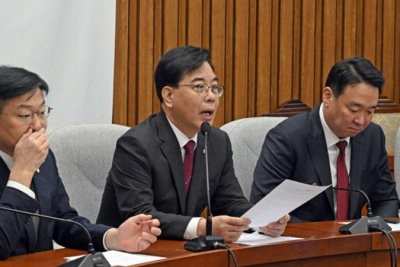
Song Eon-seok, floor leader of South Korea’s People Power Party, speaks during a party strategy meeting at the National Assembly in Seoul on Friday. Photo by Asia Today
March 13 (Asia Today) — A senior opposition leader said Friday that allegations of pressure to drop criminal charges linked to aides of President Lee Jae-myung could amount to grounds for impeachment if proven true.
Song Eon-seok, floor leader of the conservative People Power Party, made the remarks during a party strategy meeting at the National Assembly.
Song cited claims made by journalist Jang In-soo during a YouTube broadcast hosted by political commentator Kim Eo-jun.
According to Song, the journalist alleged that a senior government official close to the president conveyed messages to several prosecutors asking them to drop charges in a case related to Lee.
“If such allegations are true, it would constitute grounds for impeachment of the president,” Song said.
Song also accused Justice Minister Jeong Seong-ho of acknowledging remarks that could be interpreted as pressure on prosecutors.
He argued that any attempt by a sitting minister to influence decisions about dropping charges would represent an abuse of authority and could justify impeachment proceedings against the minister.
The People Power Party is considering introducing an impeachment motion against Jeong as early as next week, according to party officials.
Opposition lawmakers also criticized recent judicial reform legislation passed by the National Assembly under the ruling party’s leadership.
Kim Eun-hye, a senior policy deputy floor leader of the People Power Party, said the justice minister should serve as a guardian of the rule of law rather than “a shield for a single individual.”
She argued that the allegations involving pressure on prosecutors and the judicial reform bills could undermine the independence of the judiciary.
Meanwhile, the ruling Democratic Party filed a defamation complaint Thursday against journalist Jang In-soo over the allegations raised during the YouTube broadcast.
Kelly: Let’s try and get to know you a little bit more away from the pitch. Firstly, I always like asking: what were you like as a youngster?
Nathan: If you asked my mam or dad, they’d say I was a headcase! I was just a bit itchy, I always had to move. I could never sit still and relax. I always had to do something. So they had to burn me out. I always wanted to be in the grass or playing football, just running around to drain my energy. I think I was hard work for my parents, I’d say it like that!
Kelly: It sounds like maybe it was quite a chaotic household. How many siblings have you got?
Nathan: I’ve got an older brother, a younger sister and a younger brother. I think it was just a constant battle of me trying to beat my older brother. It was just so hard because the age difference. We all had training at different times and they’d be running out of the house and you’d forget your boots or they’d be taking two cars in different directions. It was a bit of a carnage, but you wouldn’t have it any other way.
Kelly: Are you still close now?
Nathan: Ah yeah, of course. I talk to them more or less every day on the phone. Every chance I get to go home I will. My mam goes to every game – home and away. She watches them all.
Kelly: So she flies over? Are they still in Ireland?
Nathan: Yeah, they live in Ireland, so she flies over and she goes everywhere to be fair.
Kelly: Home and away?
Nathan: Yeah.
Kelly: That is some commitment!
Nathan: I know, I tell her, ‘listen, you don’t have to’ and she’s like, ‘no, I want to’.
Kelly: Not everyone’s got a son that’s a Premier League footballer though… I kind of get the appeal!
Nathan: Yeah, I don’t think that she watches the matches. I think that she just looks at me the whole game and sees what I’m doing. She’ll come after, ‘Why were you scratching your leg so much in the match?’ … ‘I don’t know. How do you know that?’
Kelly: Aw, bless her, that’s really sweet. How would your best friend describe you?
Nathan: I’d like to think that they’d describe me as the same lad I was growing up. The first thing that would pop in their head… they wouldn’t say I’m a footballer. I think they’d just say, ‘ah Nathan, he’s just a good lad like… he’s a bit of craic and he comes out when he can’ … but I don’t think that they’d look at me as a footballer, which I really enjoy. And it just means when I’m with them, I can just be myself and just enjoy being one of the lads.
Kelly: So if the manager gives you a day off, what would you do?
Nathan: It depends. If it’s a weekday and it’s good weather, I’ll play golf with a few of the lads here and we’ll get out in the sun.
Kelly: Are you any good?
Nathan: I’m all right. Listen, I can play. I’m not the greatest, but I’m not the worst.
Kelly: Who do you play with here?
Nathan: The group right now is me, Keane Lewis-Potter, Kris Ajer, Hakon Valdimarsson. It’s a good crew because we have a lot of players and we do a little Ryder Cup-style.
Kelly: Oh nice!
Nathan: So it’s staff v players.
Kelly: Wow!
Nathan: Yeah, because there’s a lot of players. We did that last year. We did 18 holes in the morning, we went for some lunch, and then we did 18 holes in the afternoon and it was really good fun. Players won, so thank God!
Kelly: Oh, that was my next question. Have you got any secret hobbies?
Nathan: I like cooking, so that’s something. When I cook, I think I just forget about everything. I’m just in my own little zone and my head kind of goes quiet, which is nice.
Nathan: Yeah, and I was like… ‘Does that mean I was bad?’
Kelly: Fair enough. What do people get wrong about you the most?
Nathan: Maybe I get a bit of stereotypical: ‘Ah, he’s just a footballer.’ Maybe they get that and then think, ‘oh, he’s actually pretty nice to talk to… he’s all right… he’s kind of relaxed… he’s chill’.
I always want to be just a good person as well. That’s important for me, just to be a nice person, a good person, a caring person. As much as I want to be the best footballer I can ever be, I also want to be the best person I can be and I think that’s something that I always strive towards as well.
Kelly: What’s the toughest moment of your career been? Has there been a tough moment?
Nathan: I had one game for Brentford against Wolves and I had two mistakes in the game. I gave away two goals, we lost 3-1 or something like that and I got battered off the Wolves fans because I’d just left Wolves and the fans had so much to go against me, so much stick. I was like, ‘oh my God, this couldn’t have got any worse’.
To be fair, that night Thomas Frank rang me and he was like, ‘listen Nathan, that’s probably the worst game you’ll ever have in your career’, and he’s like, ‘so it’s only up from here’.
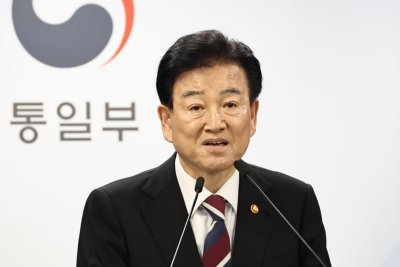
South Korean Unification Minister Chung Dong-young speaks to reporters at a press briefing in Seoul, South Korea, 18 February 2026. Chung said South Korea will seek to reinstate a no-fly zone over the border with North Korea under the suspended 2018 inter-Korean military pact aimed at easing tensions, and expressed regret over drones sent by South Korean civilians into North Korea earlier this month. Photo by YONHAP / EPA
March 13 (Asia Today) — South Korea’s Unification Minister Chung Dong-young warned Friday that preparing for war could increase the likelihood of conflict on the Korean Peninsula, emphasizing that “peace itself is the path forward.”
Chung made the remarks during the third meeting of the Korean Peninsula Peace Strategy Advisory Group held at the Inter-Korean Talks Headquarters in Seoul.
“People often speak lightly of war and repeat the phrase that if you want peace, you must prepare for war,” Chung said. “But preparing for war only raises the chances of war.”
Chung also pointed to growing global instability, citing the upcoming U.S.-China summit and tensions related to the Iran crisis.
“The Korean Peninsula sits on unstable ground and tends to sway whenever global events shift,” he said.
Noting the global interconnectedness of security issues, Chung said the distance between Seoul and Tehran is about 6,700 kilometers but developments in the Middle East can still affect the Korean Peninsula.
“A war 6,700 kilometers away is shaking the Korean Peninsula,” he said, adding that the situation underscored the importance of maintaining peace and stability in the region.
Experts attending the meeting suggested that North Korea’s recently proposed “two-state theory” should be reinterpreted in light of current conditions.
They proposed linking it to the inter-Korean confederation stage of South Korea’s long-standing National Community Unification Plan and called for the creation of a new peace roadmap for the Korean Peninsula reflecting changing security dynamics.
Participants also urged the government to shift from a “pace-maker” role to a more proactive “peace-maker” role by expanding diplomatic engagement.
They recommended exploring multilateral approaches involving neighboring countries and international organizations in addition to dialogue between the United States and China.
Seoul Mayor Oh Se-hoon speaks during a New Year’s greeting event at the headquarters of the Korea Chamber of Commerce and Industry in Seoul, South Korea, 07 January 2026. Photo by YONHAP / EPA
March 13 (Asia Today) — Several candidates from South Korea’s conservative People Power Party publicly urged Seoul Mayor Oh Se-hoon on Friday to apply for the party’s nomination for the upcoming local elections, as his refusal to do so has prolonged internal tensions.
Oh has delayed submitting his candidacy application while calling for broader party reforms, prompting criticism from party members who say the standoff is deepening divisions ahead of the June 3 local elections.
Incheon Mayor Yoo Jeong-bok, who has secured the party’s nomination for his reelection bid, visited the party’s headquarters in Seoul and called on Oh to move forward with the nomination process.
“The party is in confusion,” Yoo said. “I hope Mayor Oh will quickly apply for the nomination and confidently join the party’s path forward.”
Yoo also urged former nomination committee chairman Lee Jung-hyun – who abruptly resigned earlier in the day – to reconsider his decision and return to the role.
“I ask Chairman Lee to withdraw his resignation and fulfill his responsibility to ensure a successful nomination process,” Yoo said, while also calling on party leader Jang Dong-hyuk to strengthen unity within the party.
South Chungcheong Province Gov. Kim Tae-heum also called on Oh to demonstrate leadership as a senior party figure.
“I understand Mayor Oh’s position,” Kim said. “But as a senior member of the party, I hope he will show dedication to keeping the party united.”
Kim had previously delayed submitting his own nomination application alongside Oh but completed the process Thursday after discussions with party leadership.
Some party figures have issued sharper criticism.
Lee Sang-kyu, a People Power Party candidate for Seoul mayor, accused Oh of creating unnecessary pressure within the party while insisting on the creation of an “innovation campaign committee.”
Another mayoral hopeful, Yoon Hee-sook, wrote on social media that it is not the time for internal disputes over candidate registration.
“Primary candidates must unite and focus on confronting the Lee Jae-myung administration while working toward party reform,” she said.
Criticism has also emerged within the party leadership over Oh’s proposal to launch a reform-oriented campaign committee.
Park Jun-tae, chief of staff to the party leader, questioned whether the proposal effectively amounted to a demand for Jang to step down.
“If the proposal implies that the party leader should resign, it would be difficult for the party to accept,” Park said.
Senior lawmaker Na Kyung-won also criticized Oh’s position in a social media post Thursday, urging him to stop escalating tensions within the party.