World War 2

Pretty ‘jewel’ seaside town that gets the most sunshine in the UK

This beautiful town gets 573 hours more sunshine a year than the UK average

At this time of year, it can seem as if the weather in the UK is particularly miserable. The cold, wet weather isn’t helped by the fact the sun continues to set early in the day.

But this won’t be the case forever, with clocks set to go forward in March giving us much longer days. And some parts of the country will get even more sun than others.

Certain areas typically get more sunshine due to their location and local climate. Taking the top spot in the UK for this is a “small” but charming town you may not have heard of.

Located on the Isle of Wight off the south coast of England, Shanklin boasts the most sunshine hours a year. Based on Met Office data, it gets 1,976 hours of sunshine per year.

This is 573 hours more than the UK average and 44 more than the runner-up of Folkestone in Kent. This data was analysed by Sunsave Energy, which said on its website: “The Isle of Wight receives the gold medal for sunshine.

“Located just off the south coast of England, this little island is famous for its sunny weather, seafront promenades and beach huts. It’s no surprise that Queen Victoria regularly chose to retreat here.

“The Met Office has several climate stations on the Isle of Wight, but it’s the one in the small town of Shanklin (population: 9,000) that tops the UK sunshine charts. With 1,976 hours of sunshine per year, the Isle of Wight is a whopping 573 hours up on the UK average (1,403).”

READ MORE: ‘Record hot weather for 2026’ as Met Office says when UK will get warm againREAD MORE: Met Office says Northern Lights could be visible this week as maps reveal where

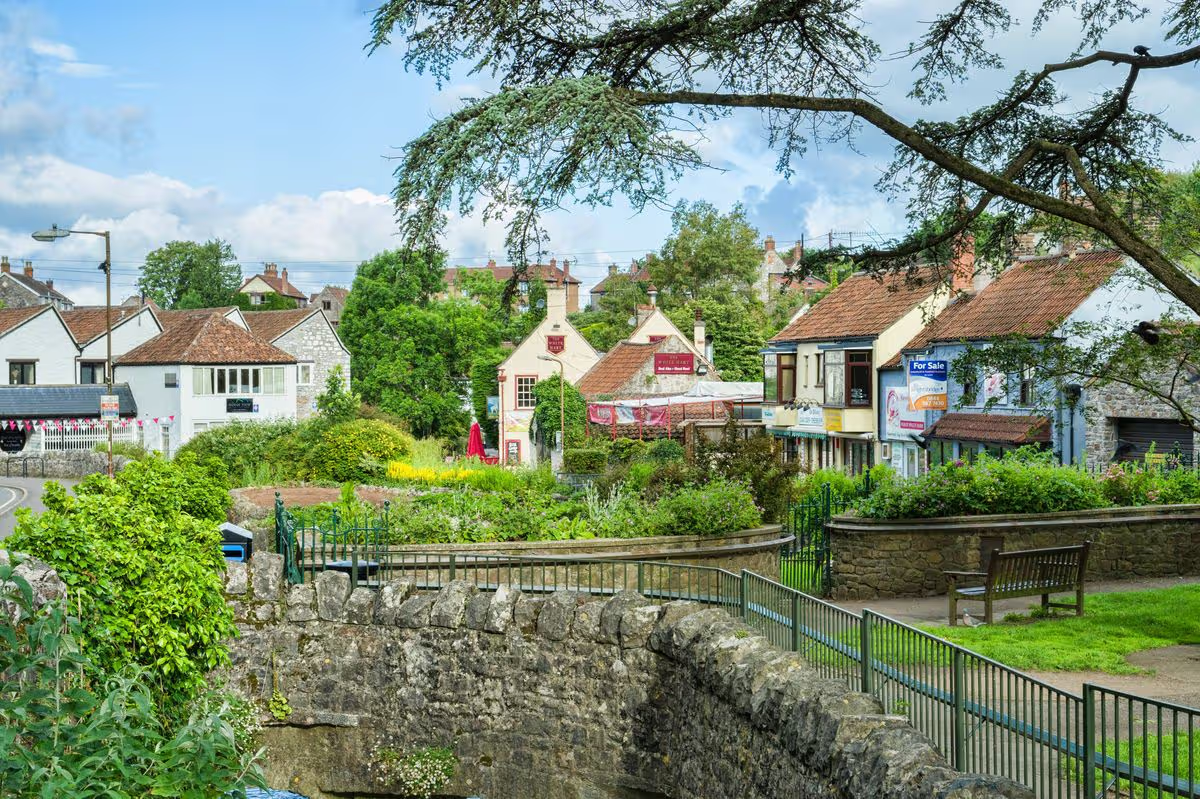
Shanklin is a well-established holiday spot that can be found on the south-east coast of the island. Families can enjoy its beautiful sandy beach, amusement arcades, and shops.

For nature lovers, Shanklin Chine is a must-see coastal ravine, featuring waterfalls, trees and lush vegetation. Visit Isle of Wight, the island’s official tourist information site, explains: “One of the jewels of Sandown Bay, the town of Shanklin has long been known as a traditional holiday destination and has everything you need for a great family holiday or to go to with friends or as a couple. With lots of seafront hotels, amusement arcades and crazy golf, it is the epitome of the British beach resort.

“But Shanklin these days is so much more than that. It has a thriving town centre with a host of independent shops, restaurants and pubs and its own theatre.

“Then there is the history of the town, from it being the home of the poet Keats to its vital role in the Second World War. Whatever you like to do on holiday, then Shanklin is certainly a place to ‘Say Yes’ to.”

The other sunniest places in Britain, as per Sunsave Energy, were:

  • Folkestone, Kent – 1,932 hours of sunshine a year
  • Bognor Regis, West Sussex – 1,919 hours
  • Hastings, East Sussex – 1,915 hours
  • Weymouth, Dorset – 1,904 hours
  • Eastbourne, East Sussex – 1,892 hours
  • Southend-on-Sea, Essex – 1,884 hours
  • Ramsgate, Kent – 1,846 hours
  • Walton-on-the-Naze, Essex – 1,824 hours
  • Swanage, Dorset – 1,806 hours
  • Bournemouth, Dorset – 1,779 hours

Source link

‘Emotional’ war series led by Hollywood legend coming soon

The Saving Private Ryan star will present the series with more than 20 episodes exploring the origins and turning points of the Second World War

A landmark documentary series spanning over 20 episodes is preparing for worldwide launch, with the factual programme, entitled World War II with Tom Hanks, to be both hosted and narrated by the acclaimed Hollywood star. The sweeping series will feature the Saving Private Ryan actor “present a sweeping and definitive retelling of the Second World War, drawing on rarely seen archival material, powerful, evocative storytelling, and insights from leading historians”.

Broadcasting on Sky History and The History Channel, each instalment will delve into the conflict’s origins alongside its pivotal moments. Audiences can expect deeply moving personal accounts woven throughout the narrative.

Hearst Networks, spearheading the ambitious project, promised “the series offers a panoramic and emotionally resonant perspective on the war that reshaped the modern world“. The American actor and filmmaker revealed his intimate ties to the conflict, admitting: “During my formative years, every single adult in my life would make references to two words: The War.

“The lasting effects of the Second World War on the world and my own family was not lost on me. I am thrilled to partner with The History Channel to produce this all-encompassing series with a long-form format that will give us the ability to tell this important piece of history in its entirety.”

Hanks is serving as executive producer alongside Gary Goetzman for Playtone. An official air date will be announced in the coming months.

Heather Jones of Hearst Networks commented: “World War II with Tom Hanks is a landmark series with deep relevance across all our markets. It’s a privilege to bring such a powerful and resonant project to audiences throughout EMEA simultaneously.

“Our ambition is to deliver premium, globally relevant storytelling at scale, and to remind viewers of all ages of the importance of understanding, and reflecting on, the events and impact of this pivotal moment in history.”

Hanks has featured in numerous productions portraying wartime scenarios, including the 2020 film Greyhound. He took on the role of Commander Ernie Krause, a US Navy officer on his maiden voyage commanding a multinational escort destroyer group, protecting an Allied convoy against U-boats during the Battle of the Atlantic.

In April 2025, news emerged that a follow-up to Greyhound was being developed, with Hanks, who penned the screenplay, returning as Captain Krause. The continuation will track Krause and the Greyhound crew “from the beaches of Normandy to the ocean in the Pacific as they help turn the tide of the war”.

His 1998 epic war drama, Saving Private Ryan, takes place in 1944 in Normandy during World War II and chronicles a group of soldiers tasked with finding Private James Francis Ryan (portrayed by Matt Damon ) and ensuring his safe return home following the deaths of his three brothers in combat. Hanks portrayed Captain John Miller in the film, drawing inspiration from Stephen E. Ambrose’s books and numerous soldiers’ accounts. The film is widely hailed as one of the finest war films ever produced.

Hanks also took centre stage in Steven Spielberg’s historical drama Bridge of Spies, set amidst the Cold War. It narrates the tale of lawyer James B.

Donovan, tasked with negotiating the release of Francis Gary Powers, a convicted Central Intelligence Agency pilot.

The Hollywood luminary played the lead role in the film, which bagged six Oscar nominations, including Best Picture and Best Original Screenplay.

World War II with Tom Hanks will be broadcast on Sky History in the UK and The History Channel elsewhere.

**For the latest showbiz, TV, movie and streaming news, go to the new Everything Gossip website**

Source link

‘World’s smallest town’ was once a bustling hub but now has just one resident

In a remote town in the heartland of the American Midwest, a 90-year-old resident named Elsie Eiler serves as the location’s mayor, clerk, treasurer, bartender, and librarian

A town that once buzzed with life now holds the title of the world’s smallest by population – with just one person calling it home. Nestled in America’s heartland, in the ‘Cornhusker State’, sits Monowi, which boasts the remarkable status of being the least populated incorporated village in the US.

Tucked away in northern Nebraska, merely five miles from the South Dakota border, Monowi’s sole inhabitant is 90-year-old Elsie Eiler, who juggles roles as mayor, clerk, treasurer, bartender, and librarian.

Back in its heyday, Monowi was what the BBC called a “bustling stop on the Elkhorn Railroad” and was home to 150 residents, complete with eateries and even a prison.

Following World War II, though, farming conditions worsened and rural economies took a battering, with American communities disappearing – a fate Monowi seemingly couldn’t avoid.

Over time, local amenities closed down, including grocery stores, the post office, and the school. By 1980, the population had dwindled to just 18 people and, 20 years on, only two remained – Elsie and her husband Rudy, who ran the local tavern.

Tragically, Rudy passed away in 2004, leaving Elsie as the town’s sole resident. The settlement now features in the Guinness World Records as the word’s least populated town.

In a clip shared on Instagram, user Seph Lawless dropped in on Elsie and captured a brief chat for his channel. In the caption, he penned: “In a town with a population of one, I stood face to face with Elsie Eiler – the last resident of Monowi, Nebraska.

“She lives alone in a town that once thrived – now a ghost echoing her memories. Meeting Elsie reminded me that sometimes, the strongest souls dwell in the quietest places.

“This is the story of the last heartbeat of America’s smallest town. One woman. One town. A thousand stories.”

A magnet for curious visitors, the sole establishments still operating are the Monowi Tavern and the poignantly named Rudy Eiler Memorial Library.

Back in 2020, when Elsie was 84, the BBC disclosed that she would put up a notice in the tavern calling for mayoral elections, then simply cast her ballot for herself.

At the time, it was noted that despite the town’s emptiness, folk would still come to her tavern, including her loyal patrons who travelled from 20 to 30 miles away. She told the broadcaster: “It’s like one big family.

“There are fourth and fifth-generation customers coming in. It’s pretty neat when the people you remember as babies are now bringing their babies in to show me.”

When Seph enquired whether she was actually the town mayor, a bemused Elsie highlighted that there was “no one else” and she had to “account for budget”, though she admitted it “doesn’t amount to much”.

In more poignant remarks, she explained that she’d likely remain in the town until they “carry me out”, and once the population dwindles to zero, Monowi would become just “another little place” on the road.

Source link

Abandoned UK ghost village that’s cut off for 310 days a year finally opens to public

A TOWN frozen in time since World War II will open to the public for a limited time.

The abandoned ghost village stays cut off from the world for most of the year, with visits only permitted this week.

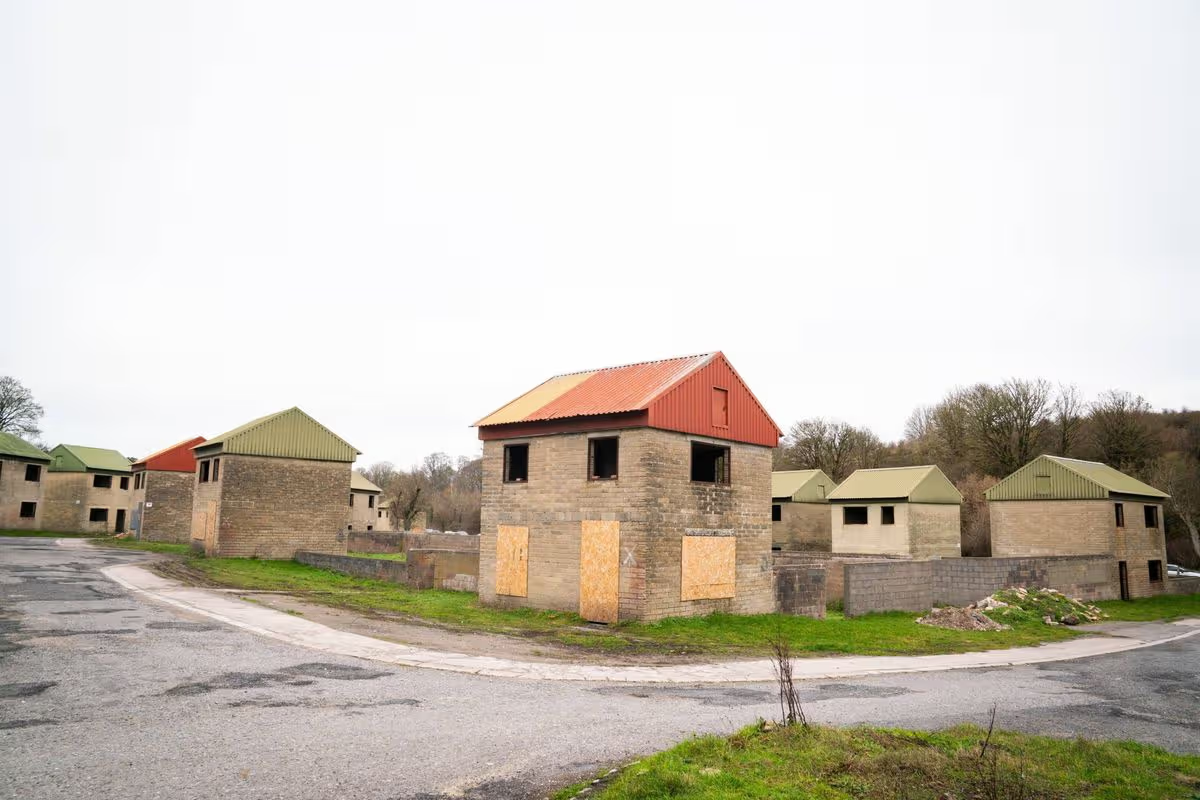
The abandoned village of Imber in Wiltshire is open to the public for a limited time this weekCredit: Alamy
The Ministry of Defence took over the town during World War II, converting it to a military training areaCredit: Alamy

History buffs and nature lovers alike swarm to the area, where 150 people once lived until 1943.

Since then, the abandoned village of Imber in Wiltshire, only sees visitors for 12 days out of the year.

During the second World War, residents of the area were given 47 days to evacuate their homes so the village could be turned into a military training area for troops.

While they were promised they would be able to return after the war, the village is still occupied by the Ministry of Defence (MoD) to this day.

Read More On Abandoned Towns

LEFT TO ROT

Inside abandoned town ‘haunted by ghosts’ where parents were made to leave kids


ICY ISOLATION

The eerie ghost town on world’s largest island, abandoned for 20 years

And now it has invited the public to visit, with roads opening through Imber this week, until 8am on Friday, January 2.

Public access has been granted to the village as well as the Grade I-listed St Giles Church, which will be open from 11am to 4pm daily.

The original surviving building is free to visit during open days with any donations going towards the Churches Conservation Trust (CCT) for maintenance and restoration.

Along with an old pub, the church is one of the few remaining original structures in the village.

Most of the larger stone buildings were damaged during military training, and were subsequently demolished.

Meanwhile, other houses in the village are either hollowed-out shells or have been converted into modern windowless buildings createdto simulate urban environments for military training.

While those who once lived in the village have the right to be buried on the church grounds, the only living residents now are an abundance of undisturbed wildlife, including owls, badgers, birds, and foxes.

Imber also holds open days during Easter weekend and a single day in summer, with all visitors required to adhere to the public rights of way and designated areas, and comply with signposting.

The public are permitted access to the town for 12 days out of the year, including this weekCredit: Alamy
Residents of the village were given 47 days to evacuate and never returnedCredit: Alamy

Source link