NEW YORK — Americans commemorated the 25th anniversary of 9/11 on Friday, remembering the shock, the dead and the sweeping consequences of the al Qaeda attacks on symbols of U.S. might and prosperity.
The milestone anniversary brought memorial rituals — wreath-laying, flag-flying, moments of silence, vigils and readings of victims’ names — and volunteer projects in tribute to a day that about half of U.S. adults remember as the most historic event of their lifetime, according to a new poll. On Sept. 11, 2001, al Qaeda extremists hijacked four commercial jets and crashed them into New York’s World Trade Center, the Pentagon and a field near Shanksville, Pennsylvania, killing nearly 3,000 people.
Elsie Caldwell carried a photograph of her son Kenny Caldwell to the trade center to hear his name and all the others read aloud Friday morning. She last spoke to him that morning a quarter-century ago.
“Mom, I just want to let you know that I love you,” Caldwell said he told her in a final phone call. His remains, like those of many other victims, have never been recovered.
Trump attends Pentagon observance
The attacks brought down the World Trade Center’s twin towers — icons of U.S. economic power, and among the tallest buildings on Earth — and blew a hole in the Pentagon, the U.S. military’s fortress-like headquarters near Washington. The fourth plane was headed for Washington, officials concluded, but the aircraft went down in Pennsylvania after passengers and crew members stormed the cockpit and fought the hijackers.
“Sept. 11 reminded us of the terrible power of hate,” President Trump said Friday at the Pentagon’s anniversary ceremony Friday.
“The 25 years since have shown us the even greater power of the American spirit to endure and prevail, and to win,” added the Republican, who was in his native New York on 9/11.
Former President George W. Bush, who was in office on 9/11, and ex-Presidents Clinton, Obama and Biden and current Vice President JD Vance convened for the observance at the National Sept. 11 Memorial in New York. Other administration officials went to the Flight 93 National Memorial in Pennsylvania.
At ground zero, a new tribute to those who fell ill
For Angilic Casalduc, attending the New York commemoration “helps to show you’re not alone.” She lost her mother, Vivian Casalduc.
“There’s no timeline for grief, and unfortunately, no one can say how can you can grieve, but coming here once a year makes it feel just a little bit better,” she said.
Traditionally, there are no political speeches at the ground zero commemoration, where victims’ relatives read aloud the long list of names and added personal messages. They thanked first responders and the military, invoked religious faith, appealed for national unity and touched on the U.S. relationship with Saudi Arabia. The kingdom was the homeland of most of the hijackers but denied any involvement in the attacks.
Mostly, relatives spoke of, and to, loved ones — who some were too young to remember.
“You dreamed my whole life for me, and you only got eight months of it,” said Trisha Pakka, who lost her mother, Deepa Pakkala.
The ceremony has long been punctuated with moments of silence at key points in the attack timeline and this year organizers added another moment to honor people who were exposed to the clouds of toxic dust released by the twin towers’ fiery collapse and have since died of cancer and other illnesses. Questions remain about how many people developed health problems linked to the dust.
The impact of 9/11 endures
It’s a reminder of how the attacks’ long shadow has reached into many corners of life in the U.S. and beyond.
The U.S.-led global war on terrorism included invasions of Iraq and Afghanistan — the latter Washington’s longest war — and detentions and harsh interrogation of terror suspects in an international network of secret CIA prisons. The U.S. found and killed al-Qaida leader Osama bin Laden in Pakistan in 2011, but accused 9/11 mastermind Khalid Sheikh Mohammed still awaits a trial 23 years after his capture.
The attacks changed U.S. air travel, led to the creation of the Department of Homeland Security, prompted new federal surveillance and intelligence-gathering powers and banking regulations and generated ongoing debate over the balance between security and freedom.
Sept. 11 engendered a culture of individual vigilance summed up by the slogan “ if you see something, say something,” while a wave of patriotism propelled some Americans to join the military, fire departments, police forces or other public agencies.
Casey Kloepfer became a New York police officer this June. He was 4 when his father, Officer Ronald Kloepfer, was killed at the trade center.
“It’s big footsteps to fill, but it’s definitely something that I take very seriously and want to continue to honor him and be the best police officer I can,” the 29-year-old, who wears his father’s badge number, said by phone this week.
New York’s mayor comes under scrutiny
Amid the post-9/11 calls to service and appeals for national unity, the attacks also fanned mistrust, prejudice and hate crimes directed at Muslims.
In the quarter-century since, Muslim Americans have played a growing role in public life from statehouses to Congress to New York City Hall, where Zohran Mamdani is the city’s first Muslim mayor. Yet he faced some criticism for attending the anniversary ceremony at ground zero.
Republican ex-Gov. George Pataki and 9/11 victims’ relatives cited, among other things, past remarks that some of Mamdani’s political associates have made about the attacks. Former Mayor Rudy Giuliani, a Republican, also inveighed against Mamdani attending the remembrance, though the two shook hands there Friday.
Mamdani, a Democrat, said this week he loves the city and country and that he wanted the anniversary to focus on victims’ families, first responders and New Yorkers who helped one another after the attacks, which he called a “horrific act of terror.” The 34-year-old mayor was an elementary school student in New York on 9/11.
Times Square billboards pause advertisements
Remembrances extended far from the attack sites, including beams of light projecting from New Hampshire’s Mount Washington, a stair climb at Mississippi State University’s football stadium and a ceremony at Honolulu’s 9/11 memorial.
Sept. 11 isn’t a federal holiday, but Congress has designated it both Patriot Day and a National Day of Service and Remembrance.
“One appropriate way to remember is by serving,” says Jay Winuk, who lost his brother Glenn Winuk and then co-founded the volunteer organization 9/11 Day with friend David Paine. The group helps people find volunteer opportunities and this year arranged for dozens of Times Square billboards to pause their advertising at 9:11 a.m. Friday.
Instead, they simply displayed the time.
Peltz and Shaffrey write for the Associated Press. AP journalists Michael R. Sisak, Anthony Izaguirre, and Julie Walker contributed to this report.
Today marks 25 years since the 9/11 attack on the Twin Towers in New York City
11:51, 11 Sep 2026Updated 11:51, 11 Sep 2026
Janice struggled to hold back tears as she recalled what happened on 9/11(Image: BBC)
A woman who was inside one of the Twin Towers during 9/11 said she can still hear the “screams”.
On Tuesday, 11 September 2001, hijackers seized US passenger jets and crashed them into two New York skyscrapers, killing thousands of people. Two planes hit the Twin Towers of the World Trade Center in New York, with the second strike 17 minutes after the first.
During a pre-recorded segment on BBC Breakfast, Janice Brooks shared her account of a day that she will always remember.
“I moved to New York on the 23rd of August 2001. I arrived in New York with the dog under one arm, a suitcase under the other, ready to begin the biggest adventure of my life,” Janice began in the interview.
Janice had only been in New York for a couple of weeks before the attack. She was working for a company called Euro Brokers, with offices on the 84th floor.
Recounting her steps on that day, Janice continued, “I left home at about probably 7.30am. Was at my desk by 7:45 at the latest. There was a bit of a bang, and I saw kind of like paper and dust swirling in the air. Suddenly, a man’s voice, top of his lungs, ‘Everybody out!’”
Janice didn’t know it, but a plane had just flown into the tower next to her. New York was under attack. As people looked on in horror, Janice was making her way down the steps. She’d reached the 70th floor when the second plane hit.
“I took two steps into the staircase, and there was this almighty thud,” she said. “The lights flickered on and off. Part of the ceiling came down. I was covered with dust and dirt. A couple of the girls at the front fell down to the floor. I was kind of like jostled against the wall.
“Then suddenly there was a scream-a woman screaming, one of those horror-filled screams that kind of lives in my head. ‘I can’t see! I can’t see!’ And all her eyes were covered with blood.
“She had long dark hair, and once she shook her head, glass covered everyone. Looked down at my shirt, and I had blood all over it. And I remember just standing there and pulling my shirt, looking at my shirt, and I’ve got blood on my shirt, and I started to cry.
“One of the brokers came running up, he took me by the shoulders and said, ‘It’s not your blood. We have to keep going. We have to get out of here’. I don’t even know your name. His name was Bob.”
As she finally reached the ground floor, Janice saw for the first time what had happened to the Twin Towers. “I looked up at the buildings, and where our floor should have been, there’s a big gaping hole, and I can see bits of building falling down,” Janice shared as she began to choke back tears.
“I can see flames. I can hear this awful bang-bang sound and this awful kind of twacking sound. And I just sat down and cried. Janice battled through the crowds and made it back to her apartment. She was in shock, completely traumatised.
After a little while, there was a huge bang. The whole building had collapsed. Janice added, “There was this billowing cloud going around my windows. One by one, the windows were blacked out until I was in the apartment. I couldn’t see my hand in front of my face.”
Janice eventually battled her way out of her apartment and, with help from strangers’ kindness, took the subway to a friend’s house.
As people around the world mark the 25th anniversary of the attack, Janice emotionally said, ” All those years have passed, and their faces start to blur in my memory. So I do my best to hold on to them, because 2,753 people were killed in the attack on the Twin Towers.”
On Sept. 11, 2001, there were no smartphones and no social media. What the country watched that morning — a jet airliner colliding with the south tower of the World Trade Center, the ash rolling through the streets, the paper still falling in the afternoon — was through a television set and the journalists who had to deliver the unfathomable details.
The jarring images shattered the peacefulness of a sunshine-filled late summer morning in New York.
“Everything seemed so perfect,” said MS NOW’s Chris Jansing, reflecting on the moments before anchoring her network’s continuous coverage. “It was another day of doing a job I loved, living in a city I loved.”
By nightfall, nearly 3,000 people were dead in lower Manhattan, at the Pentagon and in a field outside Shanksville, Pa. The experience of covering the terrorist attacks and their grim aftermath transformed Jansing and other journalists who were there. Twenty-five years later, it’s never far from their minds.
“It’s with me in ways large and small,” said NJ Burkett, a correspondent who covered the tragedy for New York station WABC. “When I look at my phone and it says 9:11, it takes me back.”
The Times asked five of the on-air personalities who are still working today to look back on the day they were called to cover the tragedy and its lasting impact.
Bret Baier: “I just said yes to everything.”
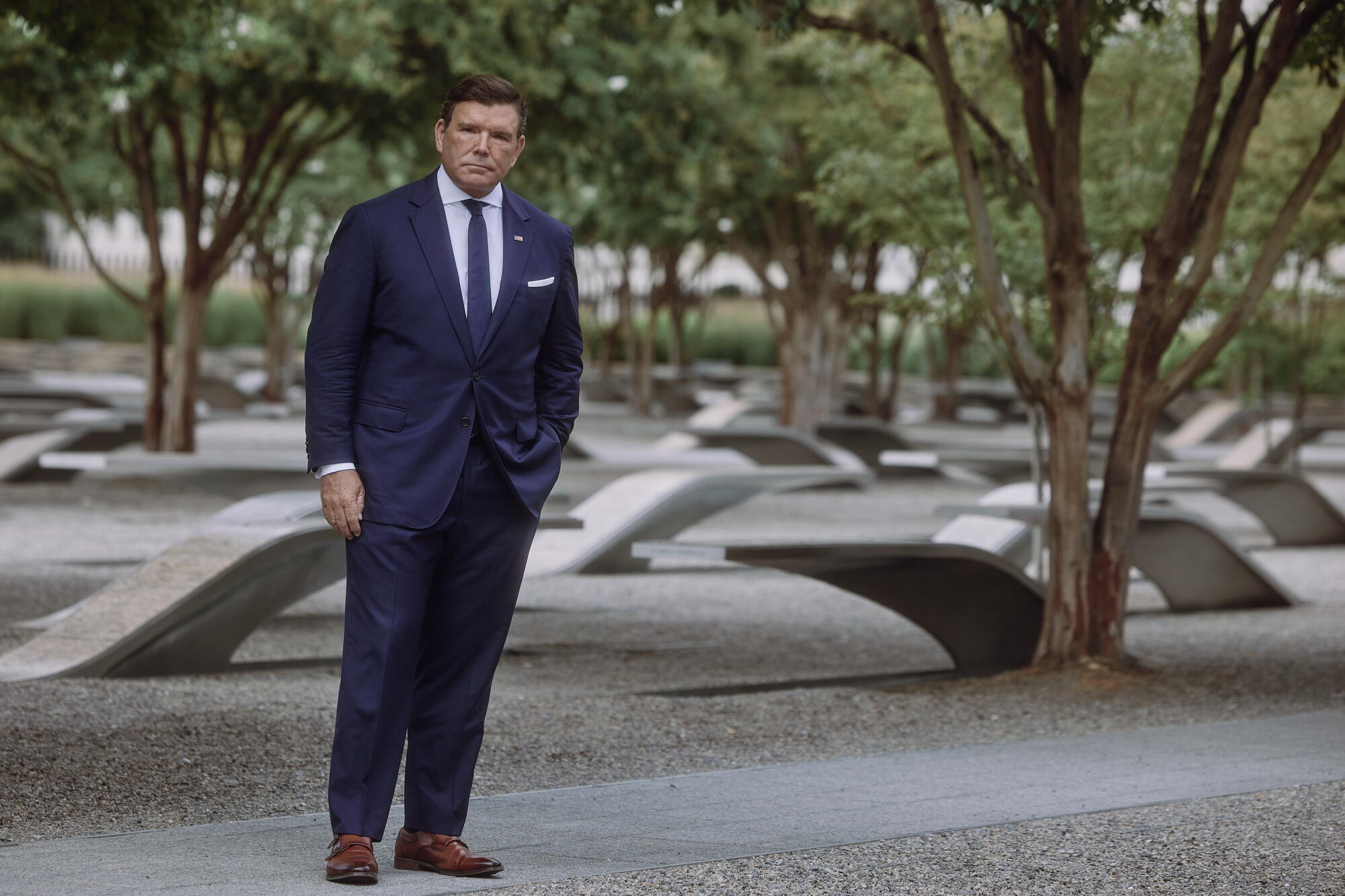
Fox News anchor Bret Baier at the National 9/11 Pentagon Memorial in Arlington, Va., on Aug. 25, 2026.
(Jared Soares/For The Times)
On every anniversary of Sept. 11, Fox News anchor Bret Baier uses the hashtag #NeverForget. He can recall every moment of that day.
Baier, 56, was driving to the Fox News bureau in Atlanta when he first heard on his car radio that a plane had hit the World Trade Center. He was a 31-year-old correspondent for the network, covering stories throughout the southeast U.S. and Latin America. When he arrived at the office, a call came from New York headquarters telling him to book a flight to the city so he could file reports from the World Trade Center site for Fox TV affiliates around the United States.
After a second plane hit the south tower of the World Trade Center 17 minutes later, all flights in the U.S. were halted. Baier and his producer were told to get a car and start driving.
“I just remember going really fast when I was driving,” Baier said. “I remember thinking what is happening with the world, and how big this story is. How big this moment is.”
By the time the duo reached northern Georgia, their plans changed again. A jetliner struck the Pentagon while a San Francisco-bound United Airlines flight crashed in Shanksville, Pa. Fox News executives told Baier and his producer to reroute to Arlington, Va.
After the 10-hour drive, Baier started the first of 10 straight days of reporting on the recovery efforts at the site. While the World Trade Center provided the most dramatic and enduring pictures of the stunning attack, the loss of life at the Pentagon was staggering as well, as 125 people died along with the 64 passengers and crew members on American Airlines Flight 77.
Baier was eventually pulled into the larger military story that followed 9/11. Fox News, just 5 years old, did not have a full-time Pentagon correspondent. Baier was offered the job while traveling overseas with Defense Secretary Donald Rumsfeld, who was making the case for war against Afghanistan.
“I called a buddy on a satellite phone to get me an apartment in Washington,” he said. “Fox packed up my stuff in Atlanta.”
But the unplanned move changed Baier’s life. In six years on the Pentagon beat, he traveled to 74 countries. He was embedded with the military in war zones. “I just said yes to everything,” said Baier, who has anchored Fox News’ Washington newscast “Special Report” since 2009.
Baier recalled it was in the weeks after Sept. 11 that he first wore an American flag pin on his lapel. He never felt conflicted about it, even though such displays were prohibited at other network news divisions. “I thought I could report on America, ask tough questions and still be an American, pulling for us to win,” he said. “I wanted to be tough but fair, but also show that as a country we were standing together against this horrible attack.”
Byron Pitts covering the terrorist attacks in lower Manhattan for CBS News on Sept. 11, 2001.
(CBS)
Byron Pitts: “It’s the only story I think about every day.”
A newcomer to New York 25 years ago, Byron Pitts, then a CBS News correspondent, admitted it took him a few moments to understand the massive scope of what happened the morning of Sept. 11, 2001. He arrived early at the network’s headquarters on the West Side of Manhattan to screen an interview he did with entertainer and civil rights icon Harry Belafonte. Shortly after he started, a producer knocked on his door and told him there was a plane crash at the World Trade Center.
Pitts, 65, acknowledged the producer but kept working. “I thought it was a novice pilot bumping into a building,” he recalled. “I thought it would be three hours out of my day and it won’t make television.”
The producer came back shortly and said, “You need to go down there.”
An irritated Pitts hailed a cab and headed down the West Side Highway. While in the car, he learned a second plane had hit the south tower. Traffic was stopped and he had to head downtown by foot.
As Pitts got closer to the site, he tried to use his past experiences covering fires and other disasters during his career to judge the severity of the situation.
But the horrible scenes that unfolded before him were incomparable. One was a lifeless body near the lobby of the north tower. He thought it was a homeless man until he saw a uniform. He later learned it was Father Mychal Judge, the chaplain of the New York Fire Department killed by fallen debris. Judge’s body was later carried away by a group of first responders. Pitts saw a woman and a man standing at a window of one of the towers holding hands, and then jumping.
“Gravity takes over and their hands split, and he moves a little faster than she does,” Pitts said. “And we see them on the ground. That was the moment I realized something significant was going on.”
Pitts crossed paths with Mika Brzezinski, then a CBS News correspondent, now the cohost of MS NOW’s “Morning Joe.” As debris came down and smoke filled the air, they headed into an elementary school that Pitts believes was a command post for the fire and police departments. They took turns calling into CBS News on a hard-line phone, one delivering accounts of the unfolding catastrophe while the other looked outside to gather details amid the blinding smoke and dust.
Pitts said from that day forward, he never went to a story assignment without a handkerchief.
Pitts was awed not just by the enormity of the event, but also by how despite the rigid hierarchy of CBS News, he was “the new kid on the block” who had to present the story on Dan Rather’s evening newscast that night.
“My approach became almost childlike, so I would not become overwhelmed,” he said. “I tried to make it as simple as possible. I said, ‘Dan, I’ve never heard New York City this quiet.’ I was thinking — what simple thing can I say that you would understand if you’ve never been in New York.”
A few weeks later, Pitts headed off to Afghanistan to cover the U.S. military action. His evening news report on Sept. 11 won an Emmy Award and his star rose at CBS News, leading to “60 Minutes” and then ABC News in 2014, where he is currently a co-anchor of “Nightline.”
Pitts knows the good fortune he’s had in TV journalism is linked to the tragedy that started with a producer’s knock on his door 25 years ago. “I feel some measure of guilt but mostly gratitude,” he said. “It’s the only story I think about every day.”
Pitts said he uses his 9/11 experience to provide perspective. “When we’re discussing politics, a mass shooting, or the latest awful day in Iran, I know for a fact there is one guy in the room who has seen worse and who can say, ‘we’ll be OK,’ ” he said.
Chris Jansing: “You had to balance the news response with the human response.”
Chris Jansing paid her dues as a local reporter in upstate New York before she joined MSNBC (now called MS NOW) as a daytime anchor in 1998. She loved living in Manhattan, and took friends from out of town to the World Trade Center observation decks and Windows on the World, the restaurant on the 106th floor of the north tower.
“It was so iconically New York,” she said. “And I was proud to live in the city.”
Jansing, 69, had little time to process her emotions when she was told to “get in the chair” before 9 a.m. that morning at MSNBC’s Secaucus, N.J., studios after the first plane hit.
“You had to balance the news response with the human response,” she recalled.
For several hours, Jansing co-anchored the network’s coverage alongside Gregg Jarrett. The look of 24-hour cable news evolved that day, as the tsunami of information led to Fox News, MSNBC and CNN all adding running tickers at the bottom of the screen.
Jansing went to the roof of the network’s building after Brian Williams took over the anchor chair. Trauma centers in the area had been alerted, and she was told to watch for ambulances. “There was still a hope and a prayer that there would be injured folks who would overwhelm the hospitals in New York and would need to be brought to New Jersey,” Jansing recalled. She saw none.
Jansing has never watched the coverage of that day, which is now on YouTube. She had real-life reminders every day in her Manhattan neighborhood when she walked by the Rescue Company 1 firehouse that lost half its battalion at the crash site. She adopted a dog left behind by a 9/11 victim, a Dachshund named Baron. She remains friends with every producer she worked with on the story. The experience also reinforced her purpose in a career approaching its 50th year.
“I will always think that those moments are what keep you going,” said Jansing, currently chief political reporter for MS NOW. “They were an affirmation that’s kept me in the job,”
NJ Burkett, a correspondent for WABC, on the 13th floor of the Walt Disney Co. offices in Manhattan on Aug. 31, 2026.
(Roshni Khatri/For The Times)
NJ Burkett: “I put myself in increasingly dangerous situations.”
Burkett, 64, recalls how pedestrians were gathered around WABC’s windowed street level studio on the Upper West Side of Manhattan when he arrived for work on 9/11. He presumed the crowd was there for a big name guest on “Live with Regis and Kelly.” They were actually watching monitors showing news reports of the first plane that hit the north tower.
As Burkett and his cameraman Marty Glembotzky headed downtown in a truck, he already knew it was a terror attack. He recalled covering the 1993 terrorist bombing of the World Trade Center and regretted not getting footage of the firefighters’ rescue efforts. This time around he wanted to go inside the buildings and document their heroism.
A police officer stopped Burkett and Glembotzky before they could get in, likely saving their lives. A short time later, they would escape death again.
Burkett was doing a second take for a taped report that would set the scene for viewers when he heard the rumbling that “sounded like Niagara Falls.” It was the south tower of the World Trade Center coming down behind him. “A huge explosion now raining debris on us — we better get out of the way,” he said in what may be the most terrifying video clip from that morning.
Burkett and Glembotzky took cover in an adjacent building. “We open up the door and in a weird way it’s sort of providential, right?” he said. “The door is a metaphor. It’s like the door into the rest of your life. If we had to run for half a block, we’d be dead.”
Glembotzky was so shaken by the experience, he stepped away from his career as a cameraman and became a wine seller before eventually returning. But Burkett took on more dangerous assignments in the Middle East, heading to Israel to cover the Palestinian uprising known as the Second Intifada. He later headed to Iraq to cover the run-up to the U.S. invasion in 2003.
Burkett won a George Foster Peabody Award for his work on 9/11. In retrospect, he believes he took on assignments in war zones to avoid dealing with the trauma of the day.
“I would put myself into increasingly dangerous situations,” he said. “Looking back, I was running from 9/11. That was my way of coping. Sometimes I wonder did I allow myself feel it enough. Or did I just run too far and too hard and it will all come down and crash on me one day?”
Occasionally he worries about 9/11-related illnesses. “If I start to cough — the slightest little cough — I’ll think ‘is this it?’” he said.
But as a New York TV fixture since 1989, Burkett still feels the appreciation from viewers for his efforts. “To this day, almost 25 years later, people will come up to me on the street and ask to hug me and say ‘NJ Burkett I’m glad you’re alive,’ ” he said.
Carson Daly at NBC’s “Today” show studio at Rockefeller Plaza in Manhattan on Sept. 3, 2026.
(Roshni Khatri/For The Times)
Carson Daly: “I remember how motionless the room was.”
As continuous news coverage of the Sept. 11 attacks saturated television for days, the makers of entertainment shows had to decide when it would be appropriate to go back to work. Carson Daly and the MTV executives mulled over the situation as their wildly popular program “Total Request Live” remained off the air for three days since the attacks.
“We had such a massive audience that the question was raised, ‘do we have a responsibility to simply show up?’ ” Daly, 53, recalled in a recent interview.
Daly, now a feature anchor on NBC’s “Today,” was not a journalist by trade. But he understood the trust that young viewers had in him and “TRL,” a live show that counted down the most popular music videos of the moment. The show had dealt with tragedy a few years before after the high school shooting in Columbine, Colo.
But 9/11 happened on the home turf of “TRL,” which aired from New York City’s Times Square. With the bridges and tunnels closed, getting a crew to the studio was a challenge.
“Everybody wore multiple hats,” said Daly, who also served as an executive producer.
By Sept. 14 of that week, the MTV studio on Broadway was filled with young “TRL” fans, but lacked the energy viewers were used to seeing on the screen. “They were frozen,” Daly recalled. “That was in such stark contrast to what the show was every day. I remember how motionless the room was and feeling like, ‘What am I doing on television?’ ”
Carson Daly shows a tattoo he got after the 9/11 attacks in New York.
(Roshni Khatri/For The Times)
Daly leaned on the MTV News team to update the audience on the 9/11 story developments. Music stars including Jay-Z, Justin Timberlake and Kid Rock called into the program to share their thoughts with Daly. Instead of music videos, the screen showed email messages from viewers expressing their feelings about the tragedy.
MTV News personality Sway delivered a music news report that noted how two new CD releases — “Party Music” by the American hip-hop group The Coup and Dream Theater’s “Live Scenes from New York” — were delayed because both used cover artwork that depicted the destruction of the World Trade Center.
Daly has a permanent remembrance of the week. When he arrived at the MTV offices the day before “TRL” returned, the building was evacuated after it received a bomb threat.
“I remember walking around Hell’s Kitchen,” he said. “I ended up getting a tattoo. A red, white and blue NYC on my right wrist.”
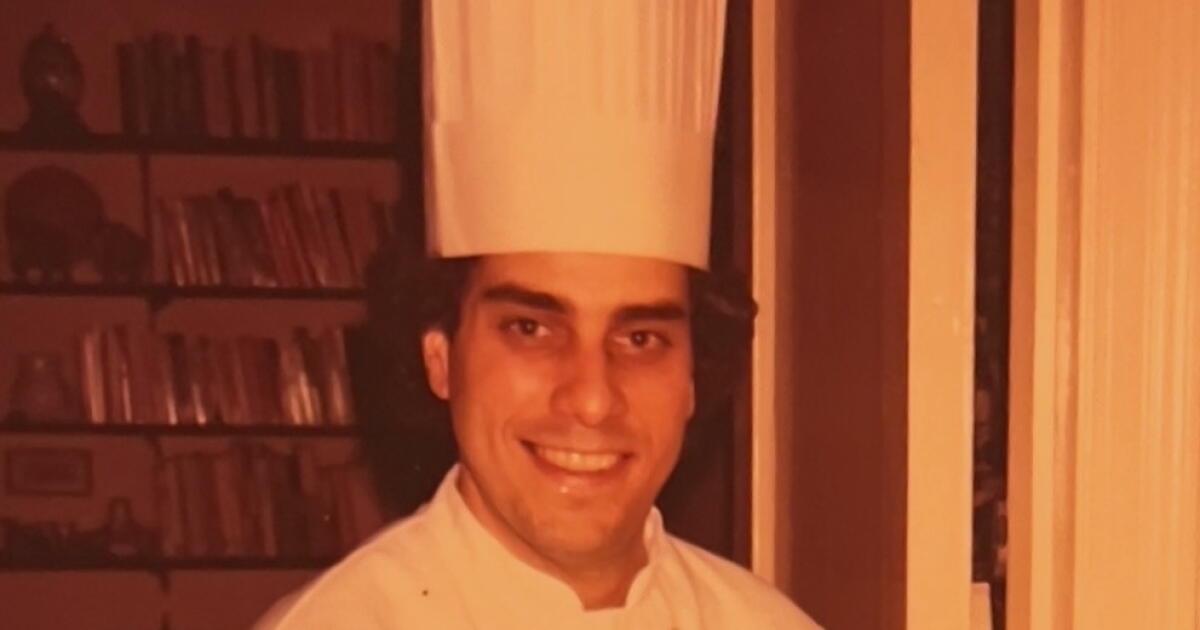
Michael Lomonaco can account for every minute of the morning of Sept. 11, 2001 — including the small decision that saved his life.
Lomonaco, the executive chef who ran Windows on the World on the 106th and 107th floors of the North Tower of the World Trade Center, was on his way up to his office when he stopped at an optometrist shop on the ground level to have his eyeglass frames adjusted.
He was still inside when American Airlines Flight 11 hit the tower above him at 8:46 a.m.
“I felt the buidling shake,” he recalled in the new CNN Films documentary “Top of the World.” “And I thought that can’t be the subway. That’s impossible.”
Lomonaco was evacuated. From the street, he watched employees of his own restaurant wave a white tablecloth from a window more than 100 floors up. Seventy-nine Windows on the World employees and 91 guests died that morning in the gastronomic soul of the Twin Towers — the one part of the complex that belonged to New Yorkers who didn’t work there, and to visitors from everywhere else.
“Top of the World” premieres Monday at 8 p.m. ET/PT on CNN and begins streaming the following day on the network’s subscription streaming platforms. The documentary short arrives on a double anniversary: 25 years since the attacks, and 50 years since Windows on the World opened on April 19, 1976.
It is the work of producer-director team Betsy West and Julie Cohen, who made “RBG,” the Oscar-nominated portrait of the late Supreme Court Justice Ruth Bader Ginsburg. The film is a production of CNN Films, TIME Studios and Tribeca Studios, in association with Montalto Pictures and Storyville Films, and was inspired by Tom Roston’s book “The Most Spectacular Restaurant in the World.” Actor Denis Leary voices the restaurant’s creator, Joe Baum, drawn from decades of archival recordings.
West and Cohen were reluctant to take it on. Both were working in network television news in 2001.
“There’s like a part of you that doesn’t want to go back there,” Cohen said in a recent interview. “But when we read this book and met some of the amazing people who had worked at Windows over its 25-year history, we realized this was actually a really good way into remembering there was a lot of beautiful stuff in the Twin Towers and like we shouldn’t let that disappear just because it ended so painfully.”
What emerges is a history of how a restaurant transformed the reputation of the monolithic Twin Towers, which received little respect from architecture critics and bafflement from a public that wondered why it was built in the 1970s by the Port Authority of New York and New Jersey as the city was fighting off financial collapse.
“This film tells a story of a restaurant that was very special to New York a time when New York was getting kicked in the teeth,” the Brooklyn-born Lomonaco said in a recent interview.
The World Trade Center operators turned to restaurant impresario Joe Baum to create a dining experience that would draw people to the Manhattan neighborhood largely known for its blocks of stores that sold radios and electronic parts. Baum was known for such New York dining landmarks as the Four Seasons and Tavern on the Green, and his new creation became an immediate hit after it opened in 1976, becoming a magnet for tourists and celebrities alike who came for the eye-popping views through the floor-to-ceiling windows.
At the time of the 9/11 attack, the World was the highest-revenue-generating privately owned restaurant in the U.S.
West noted another draw to the story was the stories of the many immigrants who worked at Windows, which proudly called itself “the U.N. of restaurants.” The film’s focus on the contribution of the foreign-born population to the restaurant industry stands in stark contrast to the image of immigrants conveyed by the Trump White House to justify its deportation efforts.
“Immigrants continue to make a contribution to our country and to the economy,” West said. “This was an opportunity to tell that positive story as opposed to what’s going on in our country now.”
Cohen and West scoured the Windows on the World Facebook page to find surviving former employees to help tell the story. Nathalie Tolentino was a hostess whose family came to the U.S. to escape political upheaval in Peru. Sekou Siby was a line cook from the Ivory Coast, who swapped shifts with one of the workers who died during a morning breakfast held in the restaurant on 9/11. Both talk about how the restaurant changed their lives.
Lomonaco is a central character in the “Top of the World,” as his arrival as the executive chef of Windows in 1997 boosted the restaurant’s culinary reputation. A hot chef who oversaw a turnaround at the 21 Club, another legendary New York dining spot, Lomonaco turned Windows into a destination for American cuisine along with the breathtaking views.
Lomonaco arrived after the restaurant was closed for three years following the first terrorist bombing of the World Trade Center in 1993 that killed six people and injured more than 1,000 but left the towers intact.
Once Windows on the World was gone, Lomonaco was offered high-profile restaurant jobs in other parts of the country. But he had unfinished business in New York.
“I didn’t want to abandon my city,” he said.
In the first days after the attacks, Lomonaco said, he read nothing about Windows on the World; coverage centered on the massive loss of life among the first responders and at the financial firms inside the World Trade Center. But over time, he got attention and support for the families of the employees who lost their lives that day.
Lomonaco and the restaurant’s owners formed Windows of Hope, a charitable foundation that raised more than $22 million to pay for healthcare and tuition costs for the children of the victims. “We were giving checks to people to pay their rent before federal funds came through,” he said.
Lomonaco said he still meets patrons who give him a matchbook or coaster from their visit to Windows. “They feel like they have to give me or send me these little artifacts,” he said. “That’s what has touched me the most.”