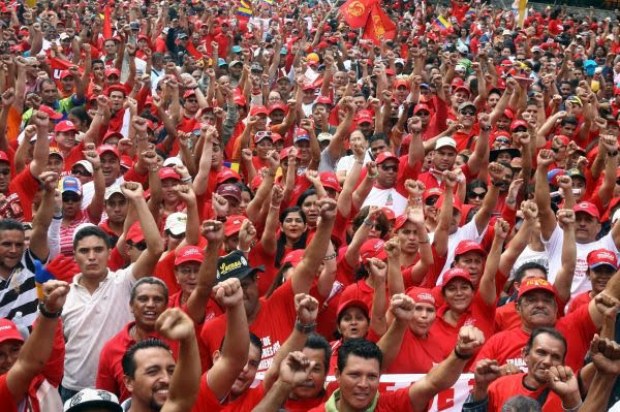
Merida, May 10th 2013 (Venezuelanalysis.com) – Venezuela’s new Labour Law for Workers (Lottt) came into effect this week, guaranteeing shorter working hours, longer maternity leave and pensions for all Venezuelans.
Described by the Venezuelan government as the “most advanced labour law in the world”, the Lottt reduces the working week from 44 hours to 40, and requires that employers provide two consecutive days a week off.
When the law came into effect on Tuesday, labour minister Maria Iglesias stated that the new working hours are part of the process towards a “just distribution of wealth”.
The following day, Carabobo state labour affairs committee president Jose Joaquin Vargas hailed the law as an important part of the transition from “capitalism to socialism”, while last week vice president of the National Federation of Public Sector Workers Franklin Rondon described it as “historic”.
“We are in a historic moment, in 14 years the achievements we have obtained for workers are numerous; we have achieved much more than in the last forty years,” Rondon told VTV on 5 May.
Vargas also urged workers to ensure their employers and unions act in accordance with the Lottt.
For the next six weeks, the government will be inspecting workplaces to ensure employers adhere to the new requirements. Although employers were informed earlier in the year that they would need to make any necessary changes prior to 7 May, on Tuesday Iglesias stated that inspections over the next six weeks will be “corrective in nature”. The minister warned that penalties will be imposed on employers who fail to adhere to the Lottt after 15 June.
However, workers are already reporting breaches of the new laws. In Miranda state, employees of processed meat manufacturer Industrias Alimenticias de Corralito (Inacor) have denounced their employer. A worker spokesperson, Peggy Serrano, alleged that management made a series of surprise changes to the timetable that could result in employees being forced to work overtime.
A Decade in the Making
Along with establishing new working hours, the Lottt prohibits unfair dismissal, outsourcing, guarantees the right to work for both women and people with disabilities and increases maternity leave.
Under the Lottt, Venezuela now has the world’s third longest maternity leave. Mothers are entitled to six weeks pre-natal leave, and twenty post-natal. Fathers are also entitled to two weeks paternal leave. Under the law, the same conditions apply to parents who adopt a child under three years of age.
All workers are also now entitled to retirement pensions, including full time mothers and the self employed.
The Lottt is the result of nearly a decade of discussions in both the national assembly and the labour movement.
When he approved the law last April, former president Hugo Chavez stated that, “In more than 200 years of republican history I am absolutely positive that there has never been a work law….that has been debated so much as this one.”
Toronto, Canada: As Canadian Prime Minister Mark Carney races to make the country less dependent on the United States, attract billions in new investment and get major projects built faster, his economic overhaul is running into resistance from a group that says it wants many of the same things: organised labour.
The latest clash, over the right to strike, comes after months of mounting pressure on Ottawa from Washington, DC.
Recommended Stories
list of 4 itemsend of list
US President Donald Trump, since taking up a second term in office last year, has imposed steep tariffs on Canadian goods and weakened trade agreements – perilous moves as Canada has historically sent close to 80 percent of its exports to its southern neighbour. He has repeatedly piled on with the tariff threats to make Canada the 51st US state.
Canada has responded with retaliatory tariffs, while a broader movement to “Buy Canadian” has taken hold. The hockey-inspired “elbows up” — meaning a readiness to defend against an opponent — has become a national rallying cry.
With trade talks stalled since August, Carney has moved with urgency to shore up the economy and invite new investments. Last month, he announced Bill C-39, known as the Building Canada Strong Act, promising to bring “speed, certainty and predictability” to investors.
Along with measures to speed up approvals for major projects, the bill would also give Ottawa clearer powers to intervene in legal strikes and lockouts in federally regulated workplaces — a provision that has put Carney on a collision course with unions.
Canada’s largest unions have come together against the changes. The largest, the Canadian Union of Public Employees (CUPE), had its national executive go as far as voting to defy the bill’s proposed limits on the right to strike if it passes Parliament without amendments.
CUPE National President Mark Hancock credited Carney’s handling of Trump and said the union’s 800,000 members, who work everywhere from hospitals to schools to municipal services, want to be part of “Team Canada”.
“But at what cost?” he said in an interview with Al Jazeera.
A fight over the right to strike
The controversy centres on Section 107 of the Canada Labour Code, which already gives the Labour Minister broad powers to step into disputes if needed to maintain “industrial peace”, end work stoppages and force the two sides into a binding arbitration.
Beginning in 2024, Ottawa used the provision eight times to intervene in disputes involving airlines, Canada’s two largest railways, three major ports and Canada Post and again during the Air Canada dispute in 2025 when flight attendants went on strike.
Unions have challenged the use of that law in court and had hoped the proposed C-39 would restrict, if not repeal, that clause while businesses wanted it strengthened.
The bill does neither. Instead, it introduces two conditions that the government would have to fulfil first before turning to Section 107.
Before stepping in, the government would have to appoint a special mediator, wait for a public report and consider whether a work stoppage is hurting the “national interest”.
Once a strike or lockout is underway, the minister could direct the Canada Industrial Relations Board to get operations running again and impose a binding process, such as arbitration.
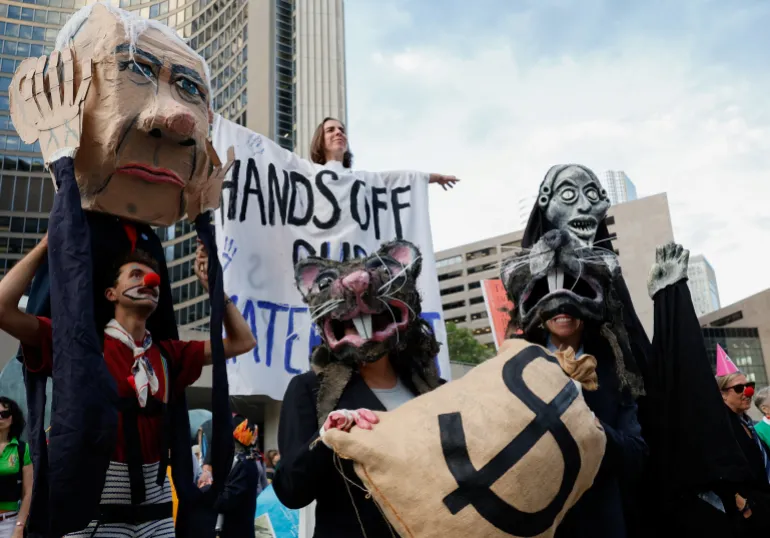
A protester carries an effigy depicting Canada’s Prime Minister Mark Carney as people march to protest against the Canada Investment Summit in Toronto in September [File: Carlos Osorio/Reuters]
The government says those steps put clearer guardrails around a power that already exists, and Carney has said the bill “absolutely reinforces the right to strike”, according to the Canadian Broadcasting Corporation.
Unions have rejected this defence, pointing out that the meaning of “national interest” would ultimately be decided by the minister. They also argue that the prospect of government intervention is bound to change what happens at the bargaining table.
“The political lesson that employers will draw from it is simple,” Larry Savage, a professor of labour studies at Brock University, told Al Jazeera. “Hold out long enough, emphasise the economic damage, and then Ottawa will remove the union’s leverage for you.”
Disruption, Savage said, is precisely what gives a strike its power. “Every effective strike is disruptive,” he said.
Unions say they have already seen employers expect Ottawa to intervene.
Teamsters Canada alleges the Canadian National Railway (CN) and the Canadian Pacific Kansas City (CPKC) railroad companies were counting on Ottawa to step in when they locked out thousands of workers in 2024. Section 107 was invoked within hours.
“Companies have gotten used to the idea that if there is a labour dispute, they can just wait for the government to intervene,” Christopher Monette, Teamsters Canada’s director of public affairs, told Al Jazeera.
CUPE said it saw a similar dynamic at Air Canada in August 2025. Hancock said bargaining stalled after more than 10,000 Air Canada flight attendants voted overwhelmingly to strike because the airline was “expecting the government of Canada to step in and end the strike” — an account Air Canada disputed.
Less than 12 hours after workers walked out, Ottawa invoked Section 107. Air Canada CEO Michael Rousseau later told BNN Bloomberg the airline had expected the provision to be enforced and did not expect a strike.
“That was why they didn’t have a strategy on how to deal with the strike,” Hancock said.
Building Canada faster
The fight over the right to strike is also part of a much bigger argument taking shape around Carney’s economic agenda: Who gets a say in how Canada should change, and how quickly, in the name of making itself less vulnerable to the US?
Critics accuse Carney of using the economic threat from the US to push through changes that go well beyond responding to Trump’s trade war.
New Democratic Party leader Avi Lewis has accused him of using the “fear and disorientation around the trade war to push through a series of unpopular measures that he did not run on, has no mandate for and would never get away with under normal circumstances”.
A protester carries an effigy depicting Canada’s Prime Minister Mark Carney outside the Canada Investment Summit in Toronto [File: Carlos Osorio/Reuters]
That tension was on display in Toronto just a week before C-39 was introduced. Inside Canada’s first national investment summit, hundreds of global investors met with government officials and executives as Carney pitched a country ready to build.
Outside, hundreds of protesters marched through downtown towards the summit’s opening gala under the banner “The Many vs The Money”. The rally brought together labour, Indigenous, environmental and migrant-rights groups, with signs and speeches taking aim at everything from fossil fuel and military projects to AI and the use of public money to attract private investment.
For unions, C-39 has sharpened that debate, pitting the government’s promise of greater certainty for investors against workers’ ability to exert pressure through strikes.
But Jim Stanford, an economist and director of the Vancouver-based Centre for Future Work, questions how much of an economic threat strikes actually pose.
While work stoppages can be costly for individual companies, Stanford said, “It is very, very rare that you would see a noticeable and sustained impact on GDP, employment or incomes.”
Production and transportation are often delayed rather than permanently lost, he added, with businesses catching up once work resumes.
Stanford also questioned the idea that strikes are driving away investment, noting that more than 95 percent of collective bargaining ends without a work stoppage and saying there is “no empirical evidence whatsoever” that strikes have reduced investment.
“This is more of the government giving some icing on the cake for business. It’s not that this has to happen or else our investment won’t work,” he said.
There is also an economic cost to weakening the right to strike, Stanford argued. Workers need bargaining power to win higher wages, which can support consumer spending, productivity and worker retention.
“It may seem like labour peace is a good thing, but if it means that a worker’s share of the pie shrinks, then this actually hurts the economy.”
For labour leaders, that’s where Carney’s economic push goes too far.
“Canada’s unions are part of Team Canada. We have our elbows up,” Canadian Labour Congress President Bea Bruske said in a statement. “But we can’t have our elbows up against Trump with our hands tied at the bargaining table.”
Savage said the government’s “Team Canada” rhetoric risks treating workers’ bargaining power as a national liability.
“I don’t think Canada becomes stronger by telling workers in ports or railways or airlines that their rights have to be surrendered whenever employers invoke competitiveness or the national interest,” he said.
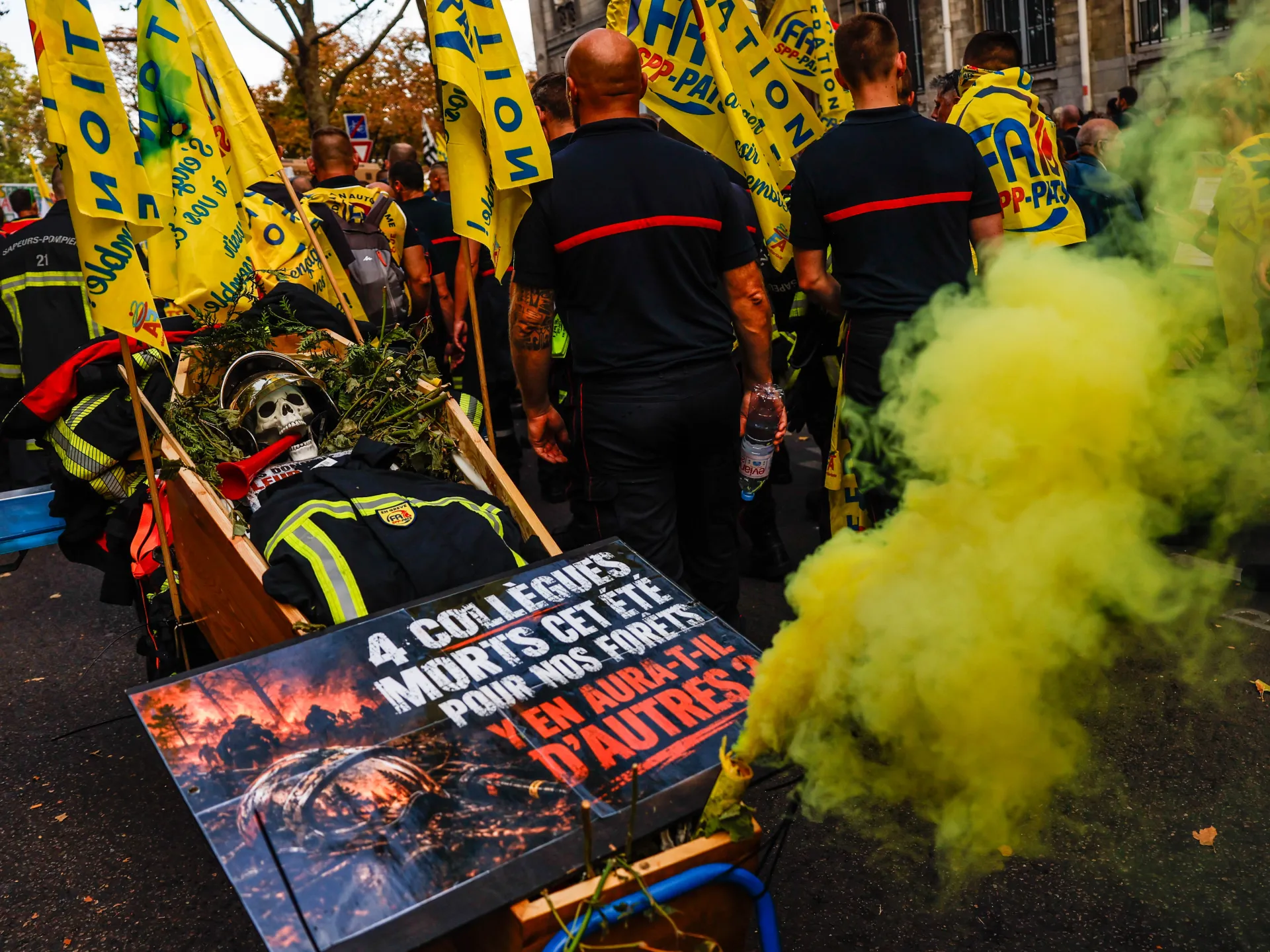
Tens of thousands of civil servants, including teachers, firefighters and healthcare workers, have marched in cities across France to demand higher pay, as students clashed with the police in separate protests over conditions at their schools.
Unions said some 300,000 people took part in the one-day strike action nationwide, while police on Tuesday estimated a turnout of 30,000 in the capital, Paris. The workers also demanded better working conditions and expressed anger at the government’s planned budget cuts.
Recommended Stories
list of 3 itemsend of list
Protests also took place at more than 400 schools, about 40 of which were blockaded and 44 of which faced attempted blockades.
Ten people, both students and staff members, were wounded, and at least 440 were detained, officials said.
The strikes and the student unrest came two days before the government is to unveil its draft budget and seven months before the presidential election. According to unions, the government proposes freezing base salaries for state employees in 2027 to save 2 billion euros ($2.3bn).
It would be the fourth consecutive annual freeze and the eighth during President Emmanuel Macron’s tenure. Unions say the freezes have cost workers a double-digit share of their purchasing power, and they are demanding a 6 percent raise.
‘Red alert’
Sophie Binet, general secretary of the General Confederation of Labor, called the protests “a red alert”.
“This anger is not going away. The government must look again at the budget,” she told Al Jazeera. She gave the government 48 hours to reverse the planned cuts before her union decides on further strike action.
The Education Ministry said just more than 11 percent of teachers and other school staff went on strike. French teachers are paid less on average than their counterparts in other European countries.
Fewer than 1 in 10 other civil servants took part, and fewer still in hospitals, with the loss of a day’s pay a likely factor in the turnout. France’s civil aviation regulator had warned of flight disruptions at some airports.
Professional firefighters, who say this summer’s huge wildfires exposed a lack of resources, were among those marching.
The government has already unveiled measures to help households cope with a spike in energy prices driven by the United States and Israel’s war on Iran, but it has failed to quell the discontent with Macron and his administration.
Student unrest
Students, meanwhile, have been protesting outside hundreds of schools over timetables, class sizes, teacher shortages and overheated classrooms during this year’s heatwaves. The demonstrations began in the Ile-de-France region around Paris and spread to other cities.
In addition to the 10 students and staff members who were hurt, 48 law enforcement officials were injured, authorities said, as students in some places set fire to rubbish bins and hurled projectiles, and officers responded with batons and tear gas.
Interior Minister Laurent Nunez told BFMTV that 440 people had been detained.
“We don’t have the final tally yet, but I’m told two thirds led to police custody,” he said. “Violence is never legitimate. There is nothing that justifies violence.”
Education Minister Edouard Geffray condemned the clashes on social media.
“This violence is unspeakable,” he wrote, adding that legal proceedings had begun. “To legitimize it or… call for an expansion of the blockades is to endanger both our students and public officials. It is irresponsible.”
‘Fewer cops, more money’
In Seine-Saint-Denis, a low-income suburb of Paris, Bally Bagayoko, the district’s mayor and a member of the hard-left France Unbowed party, joined hundreds of students protesting at the Lycee Paul-Eluard.
He led them in singing the national anthem and called the protests “completely legitimate”, saying poorer areas received fewer resources than wealthier ones.
Outside the Arago school in Paris, students, some with their faces covered, sat on dumpsters to block the entrance beneath a placard reading “Macron explosion”. A banner at the Helene-Boucher school read “Fewer cops, more money”.
“We want fewer police because we think there is a huge amount of police repression, both against high school student movements and social movements more generally,” said Mael Breton, a final-year student there. “This is a real problem, especially when there is such a lack of funding… here at our school and in the national education system more broadly.”
Prime Minister Sebastien Lecornu on Monday condemned the high school protests as irresponsible but acknowledged that the “difficulties of high schools must be heard and addressed”.
Jean-Luc Melenchon, a hard-left presidential contender, accused the government of steadily dismantling public services as he addressed protesters in Paris and urged his supporters to mobilise against the draft budget.
A Toluna Harris poll on Monday suggested that Melenchon and Marine Le Pen, the leader of the far-right National Rally, would advance to next year’s presidential run-off, with Le Pen best placed to win.