The San Diego Padres minor league catching coordinator is in the custody of the U.S. Immigration and Customs Enforcement and will remain so “pending removal proceedings,” a spokesperson for the Department of Homeland Security said Tuesday in a statement.
Oswaldo Pirela, a former Texas Rangers minor league player, was detained Sunday morning at El Paso International Airport.
Pirela, 34, was flying to Phoenix, where he lives with his wife and two daughters. The Padres’ triple-A affiliate is the El Paso Chihuahuas, and Pirela was with the team during its home game Saturday night against the Salt Lake City Bees, an Angels affiliate.
The Department of Homeland Security spokesperson said Pirela came to the United States from his native Venezuela in September 2014 and that his permission to remain expired Feb. 10, 2018.
Homeland Security said Pirela was not carrying his work permit at the time he was detained. Pirela’s brother Juan Pirela presented Phoenix multimedia news organization Arizona’s Family with Oswaldo’s work permit, which indicated it was issued in 2024 and is valid until 2029.
“It’s very hard. He’s authorized to work in the United States,” Juan Pirela said. “So, the same department, Homeland Security, issues a work permit but then somehow it’s not enough.”
The Homeland Security statement addressed the issue: “To be clear, work authorization or a pending application do NOT confer legal status in the United States.”
“In violation of our nation’s laws, [Pirela] overstayed his welcome. When approached by law enforcement officers, he was not in possession of legal documentation granting him status in the country. He will remain in ICE custody pending removal proceedings and will receive due process.
As a roving catching instructor, Pirela is based out of the Padres’ spring-training complex in Peoria, Ariz., and travels to the organization’s minor league affiliates in San Antonio, Fort Wayne, Ind., and Lake Elsinore in addition to El Paso. He spent the 2024 season as bench coach for the Class-A Lake Elsinore Storm and became the organization’s catching coordinator in 2025.
“We recently became aware of the detainment of minor league catching coordinator Oswaldo Pirela in El Paso, Texas,” the Padres club said in a statement. “We are working to gather additional information and will not have any further comment at this time.”
Pirela was signed by the Rangers at age 17 out of Barquisimeto, Venezuela, and played catcher, first base and the outfield from 2009 to 2011 for the team’s Dominican Republic Summer League affiliate.
WASHINGTON — A year after the Trump administration kicked off its aggressive immigration enforcement tour with military-style raids across greater Los Angeles, federal officials have veered toward a less flashy but broader strategy: making immigrants’ lives harder so they will leave.
The changes range in scale and scope, from disqualifying immigrants from certain jobs to indefinitely pausing the processing of visa applications. They target those lawfully present as well as the undocumented.
Since President Trump’s second term began, the administration has used executive orders and federal regulations to chip away at services or benefits, such as work permits and small business loans, that immigrants could obtain in the past.
Now, immigrants are finding that freedoms — the ones that once made the U.S. a desirable place to start over — are disappearing. Many are retreating back into the shadows as they fear previously routine tasks, such as traveling across states, filing taxes and seeking medical care.
“The priority is to force people to leave the country or not come, regardless of legal status or really any other criteria,” said David Bier, immigration studies director at the Libertarian think tank the Cato Institute. “They’re taking a sledgehammer to the system.”
Trump won the White House in part on his promise to clamp down on illegal immigration, but recent polling shows support for his agenda has waned, especially after immigration agents shot and killed two U.S. citizens in Minneapolis.
In a statement, White House spokesperson Abigail Jackson said Trump’s highest priority has always been the deportation of immigrants with criminal records. The Department of Homeland Security said Trump also prioritizes immigration that strengthens the country financially, socially and culturally.
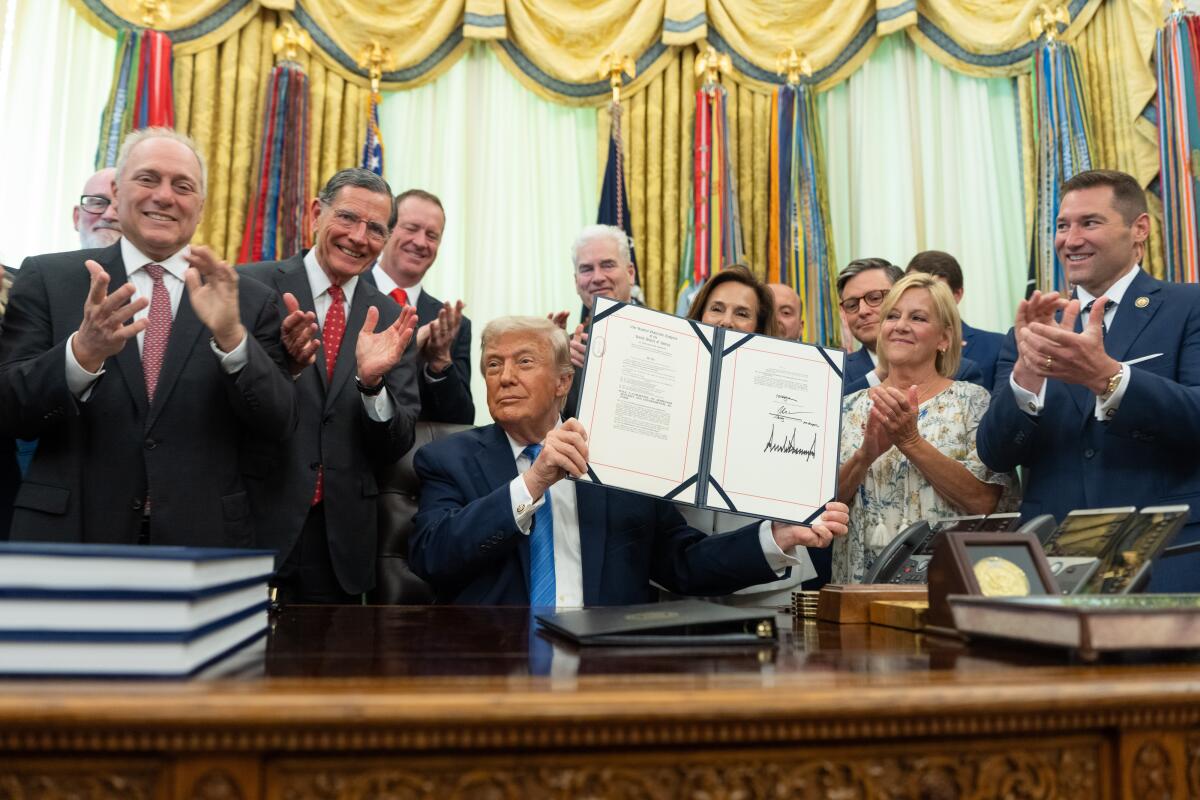
President Trump displays the signed “Secure America Act” during a ceremony in the Oval Office on Wednesday. The act provides $70 billion for immigration enforcement and border-security agencies.
(Aaron Schwartz / CNP, Bloomberg)
The number of arrests by ICE agents has declined. On average, ICE arrested about 1,000 immigrants per day in early March, down from a peak average of just under 1,400 in mid-January, agency data show. And there are fewer detained immigrants — facilities across the country held about 60,000 detainees in April, compared to more than 70,000 in late January.
The downturns prompted some Trump loyalists to say the administration is failing to fulfill his signature promise, which is an assertion the administration rejects.
“ICE is NOT slowing down,” said Homeland Security spokesperson Lauren Bis. “Since Day One, DHS law enforcement has been delivering on President Trump’s promise to the American people to arrest and deport criminal illegal aliens.”
At a border security conference last month, Tom Homan, who leads border policy for the White House, suggested immigration agents would return to more muscular enforcement tactics.
“You ain’t seen s— yet,” he told the audience.
But along with focusing on deportations, the administration is deploying other tactics to deter illegal — and legal —immigration.
ICE agents confront protesters on June 8 as they gather outside the federal immigration center at Delaney Hall in Newark, New Jersey, where ICE is housing detained immigrants.
(Spencer Platt / Getty Images)
Curtailing visas
Last month, the Department of Homeland Security announced that “except in extraordinary circumstances,” immigrants seeking lawful permanent residency must leave the U.S. to complete the process. After a backlash, the administration defended the policy, saying it won’t prevent anyone who qualifies for a green card from getting one.
U.S. Citizenship and Immigration Services, the agency in charge of processing immigration benefits, has upped security screening since Trump took office. The agency says that’s to root out fraud, but critics say all it does is unnecessarily slow down a system that already vets applicants vigorously.
The administration indefinitely banned people from 75 countries from receiving immigrant visas, which allow people to move permanently to the U.S.
In a similar move, the government halted the processing of immigration applications for people from 39 countries and who are already in the U.S. On June 5, a federal judge struck down the policy in a scathing ruling that said the administration “justifies its actions with pretextual concerns of ‘national security’ that mask anti-immigrant sentiments.”
Children of Guatemalan origin, from left, Areimy, Mariela and Enrique, arrive at Miami International Airport on Dec. 4, 2025, as they prepare to leave the United States to reunite with their recently deported parents in Guatemala.
(Chandan Khanna / AFP via Getty Images)
The judge’s ruling may offer relief, but for many immigrants, the effects of the policy are devastating. Armin, a 42-year-old from Iran, said he has racked up more than $15,000 in debt since the pause took effect in December. Armin asked The Times not to fully identify for fear of jeopardizing his immigration case.
The nutritional scientist came to the U.S. in 2019 on a student visa and has a pending green card application under a provision that allows certain highly skilled immigrants to apply for permanent residency without needing an employer to sponsor them.
After receiving his PhD and completing a postdoctoral program, Armin was in between jobs when he received a research grant in November. But with the processing of his work authorization halted, the university that issued the grant said it couldn’t hire him as a research associate. In February, he was turned down for another job.
Armin said he is confused about why the administration won’t differentiate between legal immigrants and those who should be deported.
“I can’t believe it,” he said. “I’m doing research and my research has national interest benefits. You expect support from the government. Unfortunately they don’t differentiate. They don’t care about your resume.”
Bier said the visa policies affect half of all legal immigrants coming from abroad. He published a report in April about how Trump has cut legal immigration far more than illegal immigration, noting that the administration’s policies have led to big drops in visas for international students, high-skilled workers and refugees.
“The legal immigration system is being used as a means to carry out the mass deportation agenda,” he said.
Alessandro Negrete, who lived most of his life in the U.S. undocumented, crosses into Mexico after deciding to leave.
(Robert Gauthier / Los Angeles Times)
Encouraging self-deportation
More than 90,000 immigrants have been granted voluntary departure since the start of the Trump administration, according to federal immigration court data through April that was analyzed by TRAC, a data research organization. Voluntary departure avoids official deportation and can leave open the possibility of an immigrant returning to the U.S. legally.
Homan, who declined to be interviewed for this story, has said self-deportations were part of the administration’s immigration plan all along.
“We knew if we surged unlimited ICE resources in the interior, and we do these operations, that that will force those that are here illegally to leave on their own,” he recently told the Washington Examiner.
Halting work permits
In the past, asylum seekers and others with deportation protections have had the ability to seek permits to work legally in the U.S. But work is now an administration target.
One proposed regulation would prevent asylum seekers from working legally in the U.S. Another proposal, published Friday, would further restrict access to work permits for other immigrants.
Under a rule that took effect last month, asylum seekers pay an annual $102 fee within 30 days of receiving a notice from U.S. Citizenship and Immigration Services. If the deadline is missed, their applications will be rejected — with no opportunity to appeal — and they could be placed in deportation proceedings. Those who apply for asylum with the agency have entered the U.S. legally, such as on a visa, and are not undocumented.
Asylum seekers rest at a Tijuana migrant shelter a day after President Trump began his second term in the White House.
(Robert Gauthier/Los Angeles Times)
Conchita Cruz, co-executive director of the Asylum Seeker Advocacy Project, said many asylum applicants have not received notice that the fee is due.
Cruz said she believes the Trump administration is using these changes as an excuse to dismiss people’s asylum claims. While the president has the power to decide whether to offer or rescind humanitarian programs, such as Temporary Protected Status, the right to seek asylum is enshrined in law.
“We’re worried this is a pretext for people to fall out of the asylum system and fall out of the workforce,” she said.
The processing of work permits has already been slowed, leaving many immigrants who still qualify for employment authorization unable to work.
During a House Homeland Security Committee hearing last week, Rep. Lou Correa (D-Santa Ana) asked Homeland Security Secretary Markwayne Mullin to help him speed up the work permit renewals for two police officers who were recently fired by agencies in his district because their DACA status expired.
Mullin said he would help but that Congress ultimately must pass a permanent solution for DACA recipients.
“These are police officers on Main Street, sir,” Correa responded.
“Not all of them are,” Mullin said. “I’m not just going to wave a magic wand and fix them all.”
“You have that magic wand — that’s your job,” Correa said.
It wasn’t just Democrats complaining about slow processing. Rep. Gabe Evans (R-Colo.) similarly asked Mullin for help because many of his constituents — “farm workers, youth ministers, nurses, grocery store business managers” — who have lived and worked in the U.S. legally for decades are now having trouble renewing their visas.
Secretary of Homeland Security Markwayne Mullin, left, and President Trump, center, walk to the motorcade after exiting Air Force One at Joint Base Andrews, Maryland, on May 20.
(Kent Nishimura / AFP via Getty Images)
Calls for mass deportations
Mullin, who took the reins in March after Trump fired his predecessor, Kristi Noem, rolled back some of Noem’s policies, including telling agents to stop entering homes without judicial warrants and canceling some contracts she had initiated.
But the changes and the downturn in arrests have drawn criticism from some fervent Trump supporters.
“Trump’s legacy is tied up in this,” said Mike Howell, a former DHS attorney who founded a group called the Mass Deportation Coalition. “It’s going to be hard to tell a younger voter to get excited to show up when one of their top issues is mass deportation and, a year and a half in, it doesn’t appear it’s going full-steam ahead.”
Howell said enforcement at work sites is critical to scaling up arrests and deportations. That more such operations haven’t happened, he said, is a political decision to appease wealthy donors and special interest groups who don’t want to see their workers deported.
The architect of Trump’s immigration agenda is Stephen Miller, a top White House aid who has called for a “moratorium on immigration from third-world countries,” demanded 3,000 arrests per day and said that immigrants and their descendants “recreate the conditions, and the terrors, of their broken homelands.”
Royce Bernstein Murray, a former Homeland Security official who worked on immigration policy under the Biden administration, said the winding down of flashy enforcement surges has given the administration more time to “focus on tearing down the legal immigration system.”
“This is Stephen Miller’s sweet spot,” she said. “He was never in enforcement — he’s a policy guy. This is really an opportunity for him to make good on all he has planned for years.”
While ICE has, in recent months, returned to its more conventional targeted enforcement tactics, Homan has sought to make clear that mass deportations are still a goal.
“For the people out there saying ‘President Trump’s getting weak on mass deportation,’ you don’t know what the hell you’re talking about,” Homan said at the border expo.
On Monday, Homan told Fox News that he had just reviewed plans for an ICE operation that would surge agents to New York City.
After their work permits expired, an immigration attorney near San Diego was fired and a nurse in the East Bay area was placed on unpaid leave.
Both depend on work permits and legal protection afforded under Deferred Action for Childhood Arrivals, a program created by President Obama in 2012 for immigrants who were brought to the U.S. as children. But recent processing delays at U.S. Citizenship and Immigration Services are leaving many DACA recipients vulnerable to arrest and deportation as their two-year work permits expire.
“It’s definitely an attack on the program,” said the lawyer, Maria Fernanda Madrigal. “My first thought was, ‘Oh, they’re so clever. They weren’t able to end the program through the courts, so this is what they’re doing.’”
The agency did not explain what’s causing the processing delays. Spokesperson Zach Kahler wrote in a statement that “under the leadership of President Trump, USCIS is safeguarding the American people by more thoroughly screening and vetting all aliens.”
DACA does not confer any form of legal status in this country, he said.
During his first term in office, Trump tried unsuccessfully to rescind DACA.
This time around, his administration has simply weakened its benefits.
And last month, a precedent-setting decision from the Board of Immigration Appeals, which will apply to immigration judges across the country, said having DACA is not enough to protect someone from deportation.
A Department of Homeland Security spokesperson said ICE arrested 650 DACA recipients between Jan. 20, 2025, and April 30, nearly 90% of whom had been charged with or convicted of a crime. The spokesperson did not say how many have been deported.
DACA recipient Javier Diaz, center, is welcomed by his neighbors including Martha Avelar, right, in South Los Angeles after returning home from a detention center in Texas in July 2025.
(Christina House / Los Angeles Times)
But in a February letter to U.S. senators, then-Homeland Security Secretary Kristi Noem said the agency had deported 86 DACA recipients between Jan. 1 and Nov. 19, 2025. Federal judges have ordered the agency to return some, including Maria de Jesus Estrada Juarez, a Sacramento mother who was deported a day after her green card interview.
Lawmakers are expressing alarm that DACA’s promise of protection is being undermined.
Last month, Democrats on the Senate Judiciary Committee held a forum on the Trump administration’s “all-out assault on DACA.” The forum featured Santa Ana Police Chief Robert Rodriguez, who testified that he had been forced to fire a police officer because their work permit renewal was not processed on time.
Last week, members of the House from California’s Central Valley, including Rep. David Valadao (R-Hanford), sent a letter to Homeland Security and Citizenship and Immigration Services leaders, urging them to expedite DACA processing.
“Our offices have seen a substantial increase in constituent cases involving pending renewals, with many remaining unresolved for more than six months,” the letter continued. “These extended processing times are creating avoidable hardships for our communities and our economy.”
California has more than a quarter of the nation’s approximately 500,000 DACA recipients, according to Citizenship and Immigration Services figures. On average, they are 31 years old.
To qualify for DACA, applicants had to pass background checks and meet certain educational or work requirements.
During a news conference ahead of the DACA forum last month, Sen. Dick Durbin (D-Ill.) reflected on the day in June 2012 when DACA applications first opened. He said parents of young immigrants asked him if it was safe for their children to sign up for the program, which required admitting their lack of legal status and home address.
“Are you sure that the government won’t use that information against us at some time?” he remembered them saying. “I said, ‘Follow the law exactly as it is written and announced in the executive order, and we’ll stand by you. Just believe in us to do that.’”
Sen. Dick Durbin (D-Ill.), foreground, speaks during a Homeland Security oversight hearing before the Senate Judiciary Committee in March.
(J. Scott Applewhite / Associated Press)
“Well, I didn’t anticipate the current president and what he is now doing,” Durbin continued.
Sarah Krieger, a former Citizenship and Immigration Services official who is now senior policy counsel at the National Immigration Law Center, said processing delays were caused, in part, by the agency temporarily pausing an automated system for processing DACA and other applications.
Krieger said that “streamlined case processing” was turned off about a month after Trump took office last year, in order to audit whether each process had sufficient security checks. The automated system was turned back on a couple of months later but was modified to include more manual security checks. Krieger left the agency last July.
Turning off the automated system was “a purposeful choice that doesn’t increase national security,” she said. “All it does is slow things down.”
Citizenship and Immigration Services recommends that applicants submit their paperwork and pay the $555 fee between 120 and 150 days before their benefits expire.
Among those who did so are two nurses who work for Kaiser Permanente in the Bay Area. Both requested anonymity out of concern over their immigration status.
One of the nurses, who came to the U.S. from the Philippines as a toddler, said she applied for renewal on Dec. 1. Her work authorization expired April 15.
Kaiser placed her on a 30-day unpaid leave of absence, after which she would be fired. Eventually, her work permit was renewed, but only after Sen. Alex Padilla (D-Calif.) and two other members of Congress lobbied the federal government on her behalf.
Sen. Alex Padilla (D-Calif.) speaks during a news conference on the DACA program on May 12 outside the U.S. Capitol.
(Graeme Sloan / Getty Images)
Padilla said his office has fielded requests from hundreds of DACA recipients this year.
Another Kaiser nurse, who also submitted her renewal paperwork in December, is still waiting. She has been on unpaid leave for nearly a month.
The nurse, who is from South America, said one Citizenship and Immigration Services officer told her it could take up to 10 months for her renewal to be processed.
The nurse is pregnant and she and her husband just bought a house. Losing her job would mean losing her healthcare and maternity leave benefits.
“I’ve spent years caring for others in my community, paying taxes, contributing to a healthcare system,” she said. “I worked through COVID and it’s heartbreaking to feel like you’re so easily discarded.”
Another DACA recipient, Elsa Sanchez, 35, of Georgia has maintained DACA status since 2012 and says she always follows the recommendation to submit the renewal application at least 120 days before the expiration date.
For the last three renewals, she said, she was approved within a week or two. This time, her work permit and DACA expired on April 1, more than four months after she submitted her application.
Elsa Sanchez, whose work permit expired because of DACA renewal delays, at her home in Atlanta.
(Emilie Megnien / Associated Press)
The healthcare IT company where Sanchez works as a senior customer success manager allowed her to take a 60-day unpaid leave of absence but said it would have to terminate her employment afterward.
Sanchez’s unpaid leave was set to run out on June 1. On May 20, she got notice that her DACA renewal had finally been approved. But by then Sanchez, a single mom, had had to pull funds out of the college savings account for her 19-year-old daughter, who is attending a local university. She put the money toward her nearly $2,000 rent and food.
“I feel so relieved and grateful,” she said in an Instagram video announcing the news. “I know that a lot of us are still being affected by these delays. I wish that I could share my approval with all of you and that we would all be celebrating today.”
Others have also turned to social media to share their experiences and swap resources. Madrigal, the fired attorney, pivoted to making daily videos. On Tuesday, she shared “day 35 of unemployment.”
“Some days look like big emotions and uncertainty,” she wrote. “Other days look like walks, toddler activities, cooking dinner and ending the night with tostadas. Trying to find joy and normalcy in the middle of it all.”