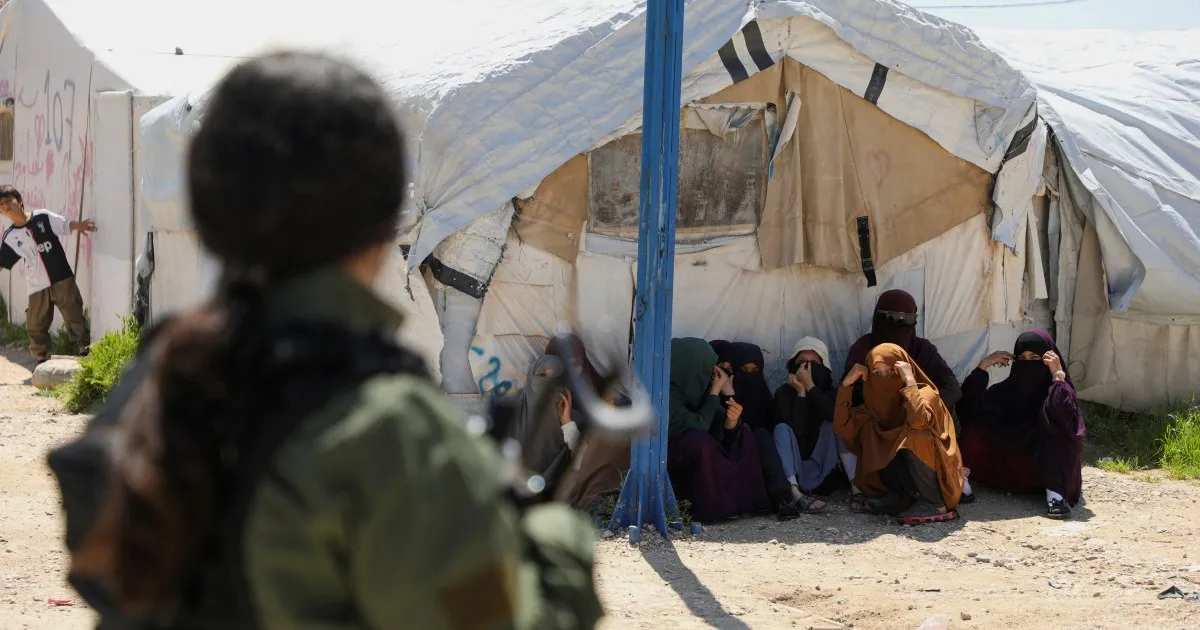
The image of the “fighter” often brings to mind a man, but women have always been present on and around the battlefield – in rebellion, defence and offence alike. Their contributions have shaped wars in ways history rarely records, and are often simplified or fetishised in popular narratives.
Around the world, women make up a far greater share of rebellions than of national armies. So what are the motivations, struggles and circumstances that drive women to take up arms and how significant is their impact on how battles are fought?
Join Ali Rae in Episode Four of All Hail the Military – a five-part series that reveals the systems, power and hidden complicities that sustain global militarism – and the profound impact it has on us all.
Serena Williams has shaken up the tennis world by announcing her competitive return to the game after a nearly four-year absence.
The 23-time Grand Slam winner and mother of two said on Monday that she will compete in women’s doubles at this month’s Queen’s Club Championships in the United Kingdom, where media reported she will play with 19-year-old Canadian Victoria Mboko.
Recommended Stories
list of 4 itemsend of list
The 44-year-old American great received a wildcard entry for the competition, which is seen as a warm-up for Wimbledon, the year’s third Grand Slam.
“I’m very happy. Me and Serena have stayed in touch, which is really, really nice because I really look up to her,” Mboko said at the French Open last week.
Williams ended months of speculation over a rumoured return with a cheeky social media video captioned: “Good news travels fast.”
‘It will bring people to watch tennis’
Former world number one Lindsay Davenport said she believes Williams could make an appearance at her home Grand Slam, the US Open, in a couple of months.
“It seems like she’s trying to work her way up maybe to the US Open, and those fans would be so ready to see her back on a singles court there,” Davenport said.
Williams won seven Wimbledon titles and six at the US Open before stepping away from the game in 2022. In doubles, she won six titles at Wimbledon and two at the US Open – all with her older sister Venus Williams.
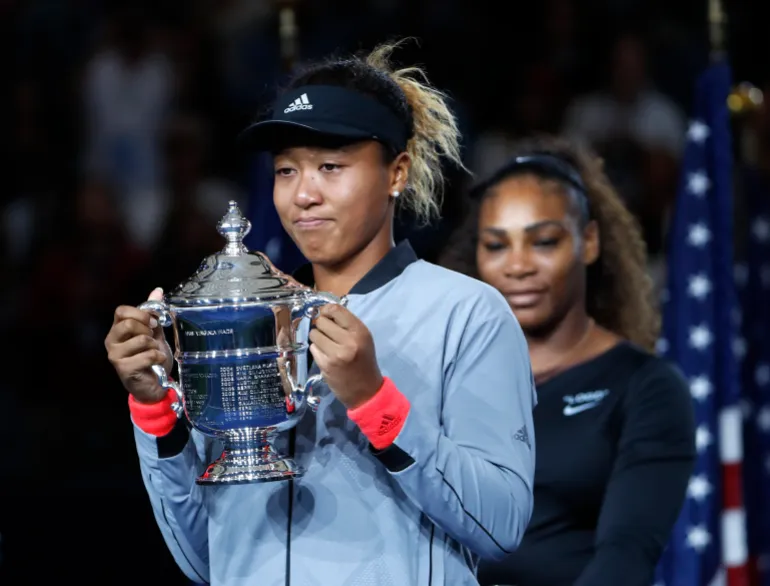
Four-time major champion Naomi Osaka, who beat Serena Williams in the 2018 US Open final for her first major title, was excited at the prospect.
“It will bring people to watch tennis,” Osaka said. “I’m going to be tuned in to the first match, for sure. I think a lot of people are. Everyone knows Serena and Venus were my role models growing up, so it’s going to be cool to see her on the grounds again.”
Osaka was joined by several current players in sharing their excitement at the news of Serena Williams’s return.
“She’s a legend. It’s inspiring to see,” top-ranked Aryna Sabalenka said at the ongoing French Open. “I’m excited to see her play and probably face her. … It’s very good news for tennis.”
Coco Gauff, who looked up to Serena Williams growing up, chimed in as well.
“One of my biggest regrets was not being able to play her,” the world number four said.
Gauff also commented on Williams’s Instagram post, saying, “Dreams come true.”
Naomi Osaka defeated Serena Williams in the women’s final of the US Open in 2018 [File: Adam Hunger/AP]
Singles return on the cards?
Fellow American and former champion John McEnroe suggested Williams could compete in singles at Wimbledon, which starts on June 28 .
“She’s not getting any younger, but she’s Serena Williams, so I bet you she would tell me about wanting to win the whole damn thing,” McEnroe said in Paris.
The Queen’s Club tournament starts on Monday, and the Women’s Tennis Association (WTA) said Williams will play “with a partner to be announced in due course”.
“Queen’s Club feels like the perfect place to begin this next chapter,” Williams said in a statement. “Grass has given me some of the most meaningful moments of my career, and I’m excited to be back competing on one of the sport’s most iconic stages.”
Davenport said some current women’s players travelled to Florida to practise with Williams recently.
“I don’t think anyone’s admitted to that, but I do know that some of them were,” Davenport said. “So I think she has kind of a handle on where the level is. But I don’t know if she’s been playing a two-hour singles match, right? We’ll have to see how she can handle that physically.”
Williams, who has won 14 Grand Slam doubles titles overall in her storied career, became eligible to compete in February after reregistering for a mandatory antidoping programme six months earlier – the first step towards a comeback.
Davenport admitted that her former opponent would face a tough challenge.
“It’s not going to be easy. If anyone could do it, certainly, it could be her.”
Grand Slam social media accounts used more playful language to celebrate her return, using the goat emoji to symbolise her status as the “greatest of all time”.
Williams joins list of champions making comebacks
Williams is not the only top-level athlete with unfinished business as advancements in training and medical care have allowed for longer careers across several sports.
Seven-time track gold medallist Allyson Felix said this year that she would try to make the US squad in what would be her sixth Olympics. She is aiming to secure a spot on the mixed 4x400m relay team at the 2028 Los Angeles Games despite having previously said the Tokyo Games would be her last.
“It’s just about testing the limits, kind of an experiment of what’s still left there,” the 40-year-old Felix, who gave birth to her second child in 2024, told the NBC TV network’s Today show last month.
Her fellow American Lindsey Vonn became the oldest downhill skier to win a World Cup race in December when she mounted a comeback after knee-replacement surgery.
Vonn, whose Milano-Cortina Olympics campaign ended abruptly with a horrific crash, was among the first top-level athletes to offer her encouragement to Williams on social media.
Vonn and Felix both celebrated Williams’s comeback announcement on social media.
In tennis, longtime Williams friend Caroline Wozniacki of Denmark made it to the fourth round at the US Open in 2023 and 2024 during her own comeback campaign while older sister Venus became the oldest WTA singles match winner since 2004 when she returned from a 16-month absence last year.
Serena Williams’s “return is an expression of her passion for competition”, WTA Chairwoman Valerie Camillo said in a statement on Monday. “I cannot wait to see her face a new generation.”
Here’s a low-key 68-year-old candidate who excited no one. And that apparently was a major strength. He was easygoing, non-threatening and a safe bet.
He also had an impressive resume — former U.S. health secretary, California attorney general, longtime congressman and state assemblyman. This seemed to attract voters.
People perpetually badmouth politicians. That’s in the American DNA. And in California, there’s always loud anti-Sacramento jabber. But voters tend to prefer politicians with Sacramento experience when electing governors — unless a celebrity entertainer is available.
You’re reading the L.A. Times Politics newsletter
George Skelton and Michael Wilner cover the insights, legislation, players and politics you need to know. In your inbox Monday and Thursday mornings.
By continuing, you agree to our Terms of Service, which include arbitration and a class action waiver. You agree that we and our third-party vendors may collect and use your information, including through cookies, pixels and similar technologies, for the purposes set forth in our Privacy Policy such as personalizing your experience and ads.
Politics is cyclical, however. In the past six decades, Californians have gone from electing fascinating Govs. Ronald Reagan and Jerry Brown to selecting uninspiring George Deukmejian, Pete Wilson and Gray Davis — then returning to headliners like Arnold Schwarzenegger, Brown again and Gavin Newsom.
Now we’re ready for boring Becerra?
The last pre-primary poll by UC Berkeley’s Institute of Governmental Studies found Democrat Becerra leading the pack. But he was closely trailed by Republican former Fox News commentator Steve Hilton and Democrat billionaire Tom Steyer, a hedge fund founder turned climate activist.
The large field of candidates wound up with those three leading — Becerra drawing 25% support, Hilton at 21% and Steyer with 19%.
A later Emerson College poll also found Becerra in front but Steyer and Hilton in a statistical dead heat: Becerra 28%, Steyer 22%, Hilton 21%.
The top two vote getters will qualify for the November general election.
In contrast to earlier hot speculation about two Republicans — Hilton and Riverside County Sheriff Chad Bianco — finishing in the top two and locking out any Democrat from the November ballot, the final IGS and Emerson polls showed that an opposite scenario was possible. Two Democrats could conceivably advance to the November voting.
As campaigning neared an end, Becerra apparently tried to help Hilton attract more MAGA support to prevent Steyer from edging out the Republican. Becerra would be a shoo-in over any GOP opponent in November, but could face a tough fight facing Steyer with his bottomless checkbook.
The games-playing involved Becerra running a statewide digital ad subtly reminding Republican voters that Hilton was President Trump’s “favorite” candidate for governor. The spot asserted that Becerra is “Trump’s worst nightmare.”
Another major poll completed a few days earlier by the Public Policy Institute of California found the same basic rankings as the IGS survey, but with Steyer a bit further back.
Becerra was leading with 23%, followed by Hilton at 20% and Steyer at 15%.
Every independent poll found Becerra surging from irrelevancy in March to leader of the pack by late May.
It’s “one of the most unusual gubernatorial election campaigns in modern California history,” IGS poll director Mark DiCamillo says.
Most of Swalwell’s voter support soon went to Becerra, which helped him attract campaign donors and endorsements by interest groups.
Becerra, who had been moseying along the race track, suddenly got a second wind. And voters sensed a breath of fresh air.
“Voters are exhausted by Trump. He makes it hard to sleep at night. ‘Cool and calm’ win,” says Chapman University political science professor Fred Smoller. “People want a candidate like a no-drama Becerra.
“The fact he has a charisma deficit may in fact be his political asset.”
But Becerra also has other assets, notes UC San Diego political science professor Thad Kousser — ”legislative and executive experience…. He was safe and predictable.
“And he’s second only to Gavin Newsom in opposing Donald Trump.”
Yes, a calm temperament appeals to voters fatigued by political fire and brimstone. But California Democrats also want someone who will fight back against Trump’s policies.
Becerra repeatedly points out that as state attorney general, he sued the first Trump administration more than 120 times and won the vast majority of cases.
“Becerra has caught the attention of Democratic voters who overwhelmingly disapprove of Trump,” says PPIC Poll Director Mark Baldassare.
How overwhelmingly? Ninety-five percent disapproval by Democrats in the latest PPIC survey, 70% among all likely voters.
Becerra “stood out from the rest of the candidates because of his background as attorney general,” Baldassare adds.
“And look at the other candidates. You can’t name one who has had experience in Sacramento.”
Among the last nine California governors, only Schwarzenegger and Reagan have been elected without serving prior Sacramento stints.
Becerra also has another asset: He’d be the first elected Latino governor in California history. He finished the primary campaign with a comfortable lead among Latino voters, as well as Asian American.
As Becerra’s political stock rose, Democratic rivals — especially Steyer — tried to portray him as incompetent, touched by scandal and a Chevron tool. But the mud didn’t seem to stick.
A natural Becerra strength is likability.
DiCamillo recalls what his mentor, the late legendary pollster Mervin Field, used to say about how voters choose between candidates for governor or president.
“It’s a highly personal choice,” DiCamillo says, quoting Field. “People put more mental energy into choosing a top-of-the-ticket candidate than any other.
“It’s like trying on a new suit. If it doesn’t fit well, you don’t buy it. You’ve got to be comfortable in the feel.”
Many California voters apparently feel that way about Becerra — nothing flashy, just plain but comfortable.
In each of the past three years, questions have been raised about whether the French Open should do more to showcase the women’s game.
“I don’t think they have daughters, because I don’t think they want to treat their daughters like this,” said Jabeur.
The lack of action prompted recently appointed WTA chief executive Valerie Camillo to seek answers from French Open tournament director Amelie Mauresmo – a former women’s world number one – when they met at Roland Garros this week.
In what the WTA describes as an open and productive conversation, Camillo underlined her belief that women’s players have delivered some of the “most exciting and dynamic competition in global sport” over recent months and years.
It remains to be seen whether Camillo’s call for action is listened to.
Mauresmo has consistently argued that the danger of women’s matches going “really fast” is the justification behind the choices.
With tickets ranging from €60 to €280 (£50 to £240), tournament organisers think the possibility of a short two-set women’s match does not represent value for money.
Mauresmo has insisted the night sessions will not be extended to two matches – like the Australian Open and US Open – in fear of creating late finishes.
Will the French Open be swayed? It refused to waver last year, despite pressure from players, the women’s governing body and – according to reports, external – broadcasters.
Former world number one Osaka will meet Aryna Sabalenka – the current top women’s player – in the last 16 on Monday.
The Japanese player said she did not know if that blockbuster match would be under consideration for the night session, but added she felt the slot was reserved for “popcorn matches”.
If Osaka against Sabalenka does not fulfil the French Open’s criteria, it feels like nothing will.
“I hope it will change,” added Ostapenko.
“Even if it’s not me playing, I would like to see some women’s matches there. But I don’t know that we will.”
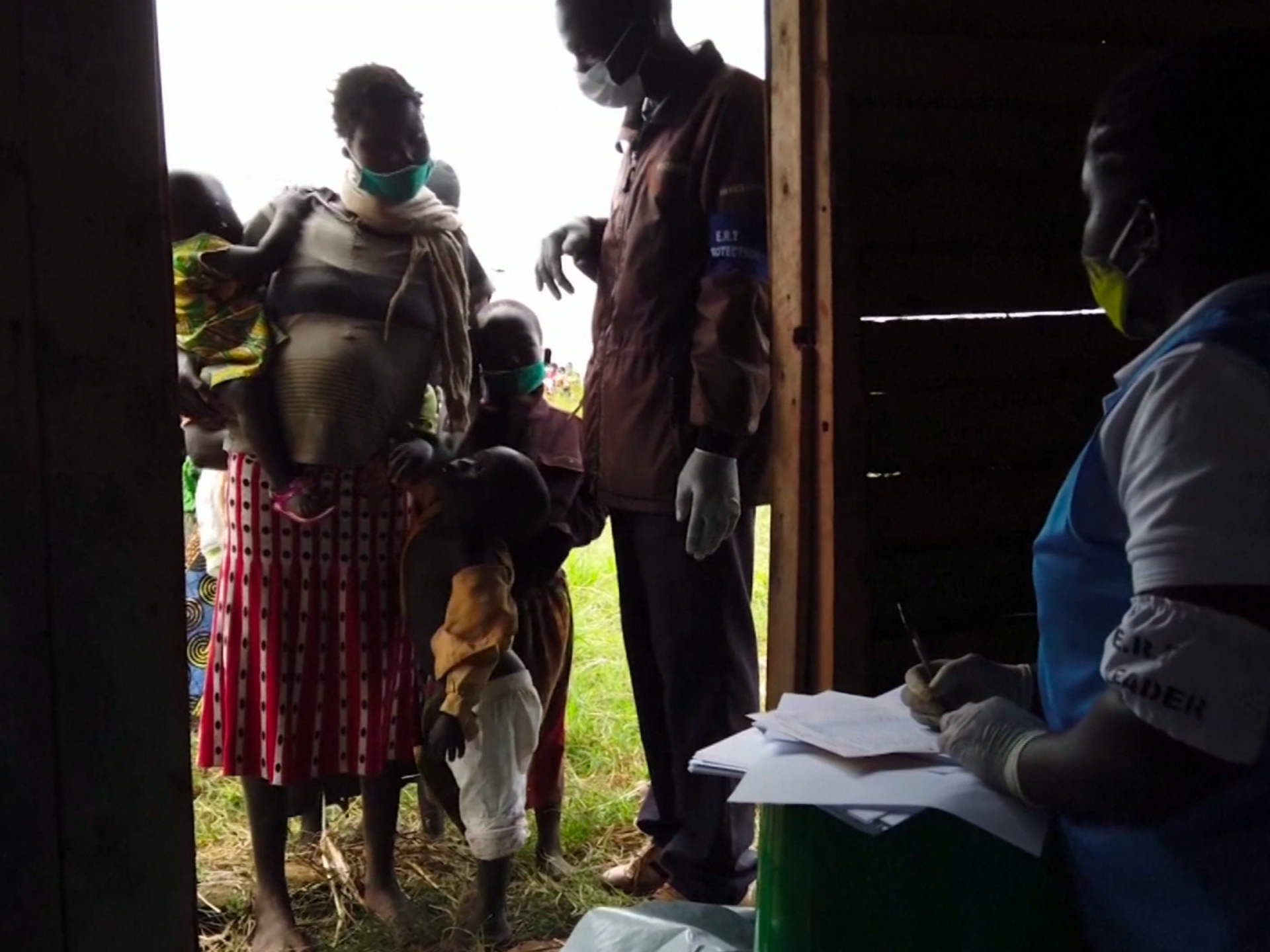
Women in eastern Democratic Republic of the Congo are disproportionately impacted by Ebola as shortages of protective gear amid funding cuts accelerate the spread of disease. Al Jazeera’s Imogen Kimber reports how these caregivers to the living and the dead are most at risk.
IN just three days, Katie Price’s husband Lee Andrews is due to be released from Dubai’s hell-hole Al Awir prison.
But the news of his imminent return to freedom has emboldened the women who have been caught up in his web of lies and deceit – and now they’re determined to see him locked up for good.
Lee Andrews has been at the centre of numerous fraud claimsCredit: InstagramKatie Price revealed this week that her husband had been found after disappearingCredit: mistraesthetics/Instagram
Over the past five months, I have spoken to the women who have survived Andrews, and their extraordinary stories are chilling.
From financial fraud on a life-changing scale to even more shocking allegations, the women painted a terrifying picture of the man Katie chose to marry just weeks after meeting him earlier this year.
Together they stood firm as he desperately tried to smear their reputations, telling me in a long and rambling voice note that one of the women was disturbed and had spent time inside a “mental institution”.
He claimed they were fantasists, liars and angrily declared: “I know you’re a lady and everything, but women can be very harsh.”
I didn’t believe a word he said to me then, and I still don’t now.
But the patience of the women involved is understandably wearing thin.
His arrest in Dubai on a civil matter has, they tell me, been for Andrews just a brief taste of what they hope is to come.
Justice for these women, however, will be a war that will not be easily won.
“Lee is a dangerous man, and the authorities need to act,” one of the women tells me from their home in the US.
“All of the women Lee has conned in the past have come together in a group, and we are determined to fight to get justice.
“It does feel incredibly hopeless at times. No one in power seems to be properly acting. But we’re standing together, and we will do everything we can to make the police act.”
Another of his victims, businesswoman Crystal Janke, reported an alleged theft of £123,000 to cops in America.
The uphill battle they face is the fact that Andrews resides in Dubai and is unable to leave due to a travel ban.
Andrews, ultimately, is able to dodge culpability because of where he is.
Hertfordshire Police confirmed to me they had handed the complaints filed to them to cops in Dubai because the alleged incidents happened in the UAE.
These allegations, to add, are incredibly serious.
They need to see him hauled in for questioning.
But so far, the police there have seemingly failed to act in any way to investigate Andrews, let alone arrest him.
The financial fraud complaint made to cops against Andrews in the US by Crystal is also dangling in the ether.
The police confirmed they can only act against Andrews if he lands on US soil.
He’s currently in Dubai’s hell-hole Al Awir prison after being arrestedCredit: AFPMany women have come forward to reveal they’ve been duped by LeeCredit: Instagram/wesleeeandrews
And let’s be honest, Andrews isn’t going to be leaving Dubai anytime soon.
From the number of phone calls I had in the days leading up to Andrews’ arrest, the women who have joined forces to try and bring the con-artist to justice are not alone in their plight.
Andrews is alleged to owe vast sums of money to several people in Dubai.
Each individual wants him taken to task, and no one more so than the women whose lives he has irrevocably damaged in one way or another.
“We see ourselves as survivors of Lee, not victims,” one woman tells me.
“But to say the slow progress by the police in Dubai is frustrating is an understatement.
“The complaints are racking up, and nothing is being done.
“Some of us have even gone to the lengths of contacting the police when we know where Lee is and pleading with them to arrest him.
Crystal Janke reported Lee to cops in America and claimed Lee took £123,000 from herCredit: InstagramShe dated him back in 2024Credit: Instagram
“Repeatedly, we have said, he is at this location, he is wanted for this, please act. And nothing ever seems to happen.
“We have no idea what else to do, but once he is out, we are going to carry on alerting the police, and we won’t stop until they act.”
It proved once again that Andrews is a devious liar – after he told Katie he had been arrested for espionage.
“Lee saying he was arrested for spying is nothing new,” one of the women explained to me.
“It’s a claim directly out of his conman playbook.
“He’s said to everyone in this group at some point that he worked for the secret services. He bragged about being in MI5 in the UK.
“Lee would just tell so many lies. He told Katie he was an international arms dealer, too.
“By this point, we don’t think Lee would know what the truth is – even if he slapped him around the face.”
Previously, Andrews denied every claim made against him by the women who spoke out against him.
In the face of the weight of evidence they provided me with, including their bank statements and correspondence with their relevant police forces, Andrews stood firm and tried to paint them as scorned fantasists.
These women are nothing of the sort.
And I, along with my colleagues, will keep banging this drum until Andrews is locked up.
When Congress passed the big, ugly bill known as HR 1 last year, most Americans understood it meant cuts to Medicaid, the safety net program millions rely on for medical insurance.
But few Californians realized just how much it will affect the Golden State when its provisions really kick in, starting after the midterms (the Republicans aren’t that dumb) and continuing on in cascading cuts for the next few years.
Millions of Californians — not just low-income folks — are going to feel the effects, whether through a loss of insurance, fewer providers able to keep their doors open, or rising premiums and costs.
“This problem trickles up,” state Senate leader Monique Limón (D-Goleta) told me. “This is not just going to impact the people that have a public healthcare plan. When you see a hospital close, when you see medical providers no longer being able to practice, it is absolutely going to impact everybody, the middle class included.”
Added to the loss of federal funds, Gov. Gavin Newsom’s most recent budget plan (which the Legislature has to debate in coming weeks) includes cuts at the state level. This is in part to contend with the loss of federal money, but also because healthcare costs keep rising and even in this wealthy state, we can’t afford the bills — at least not without some changes.
What those changes are — and who should bear the brunt of them — is a complicated and largely ignored debate happening right now. While our candidates for governor have been grilled on whether they support single-payer healthcare or not, (Becerra is a sort-of, Steyer is a yes) the real question isn’t how is the next governor going to expand access to care — but how are we going to keep the whole system from collapsing right now.
“This is not hypothetical, this is what’s coming down the line,” Limón said.
The problem
About 15 million adults and children, or about 1 in 3 of our state’s residents, rely on Medi-Cal, which is what California calls its Medicaid program.
Through a creative bit of state financing called the Managed Care Organization, or MCO, tax, the federal government has been paying for a big chunk of the costs of that insurance, about $7 billion a year. President Trump’s HR 1 makes that money go bye-bye by greatly reducing the MCO, leaving the state to figure out how to backfill that cash. And that’s just one of the ways the big, ugly bill hurts California. Yes, it’s complicated.
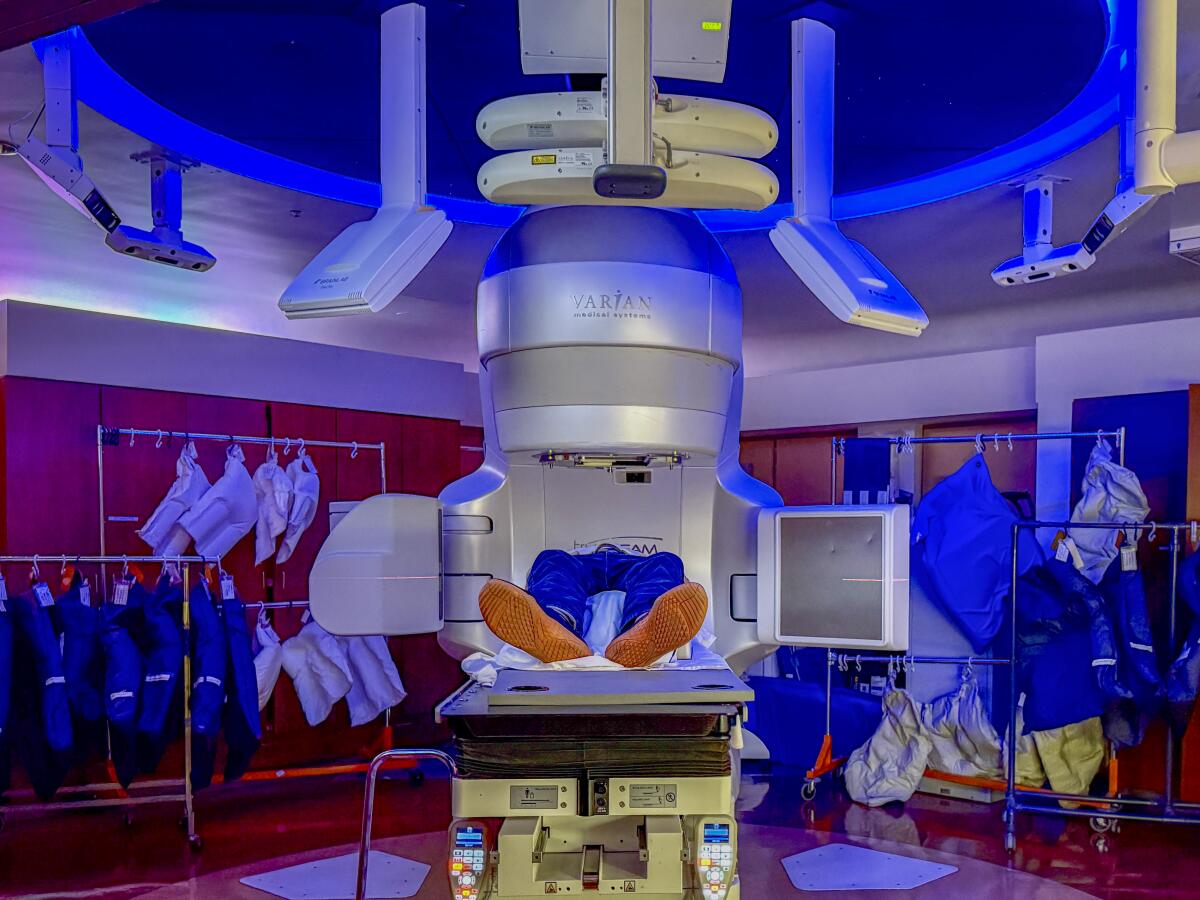
The number of Californians losing health insurance coverage could roughly double in the next four years. Above, a patient undergoes treatment for tongue cancer at Ronald Reagan UCLA Medical Center on March 6, 2026.
(David McNew / Getty Images)
Newsom’s budget plan relies in a not-small way on restructuring the MCO tax to fit HR 1’s new rules. But here’s the problem with that — any fix will require approval from the Trump administration, which has repeatedly shown the welfare of Californians is not a high priority. In fact, the Trump administration in March rejected California’s request to update another fee related to hospitals that also generates billions for Medi-Cal.
So maybe Newsom will be able to negotiate a plan that saves the MCO and California healthcare. But wouldn’t it be much better for the GOP, with a presidential election looming, to watch California (and her presidential-contender governor) tumble off a healthcare cliff? Few states rely on an MCO tax the way ours does, which means our pain is going to be far more visible and profound if we lose this funding.
That means if Newsom’s budget is approved by the state Legislature with the MCO fix, the state is taking a gamble. If the feds don’t approve some new version of the MCO tax, “it would have major implications,” Adriana Ramos-Yamamoto told me. She’s a senior policy fellow with the nonpartisan California Budget and Policy Center.
Sort-of solutions
What’s the fourth-largest economy in the world to do? Limón would like to see the state stop subsidizing corporations who pay so meagerly that their employees qualify for Medi-Cal.
“We don’t have the luxury of being able to provide these tax subsidies,” Limón said.
Turns out, 42% of Medi-Cal enrollees are full-time workers, according to a new report by the UC Berkeley Labor Center. Although most big corporations offer some sort of health insurance, it’s often tied to working a certain number of hours (which they then make sure not to schedule) or it has prohibitive costs or other barriers.
In 2022, the Labor Center found, 34% of low-wage workers received their health insurance through employers, compared with 69% of higher wage workers — meaning California is picking up insurance costs because low-wage employers are finding ways out of them.
“Over the decades, Medi-Cal has really undergone a significant transformation. It’s shifted from a program that primarily served the disabled and indigent and elderly folks to one that largely supports folks that work in low-wage industries,” Tia Orr, the executive director of SEIU California, told me. “Medi-Cal has now become a program where folks that work every single day have to rely on it. The idea that someone can work every day and qualify for food stamps and Medi-Cal, it should be eye-opening to folks.”
Right now, she points out, California taxpayers are paying about $7,800 a year for each person on Medi-Cal.
“The corporations that they work for don’t have to pay one dollar of that, right?”
Limón and her Senate colleagues would like to change that. They have proposed the “Fair Share” plan that would impose a tax on the state’s largest and wealthiest corporations whose employees rely on public assistance. It’s more of an idea than a fleshed-out policy at this point, but as ideas go, it ain’t a bad one. It’s been done in Massachusetts, and New Jersey’s governor has suggested it.
In California, it deserves more attention than it’s currently being given.
To be fair, Newsom’s plan also would also limit state corporate tax credits to $5 million, as my colleague Taryn Luna points out, or 50% of a firm’s tax liability, whichever is greater. That change could bring in $850 million next year to state coffers and grow to $1.8 billion by the end of the decade. That’s still not nearly enough to cover healthcare costs.
To add to the drama, the California Legislative Analyst’s Office predicts all this will get worse — that the number of Californians losing health insurance coverage could roughly double in the next four years. The Newsom administration projects federal Medi-Cal changes could push off 44,000 people in 2026-27, growing to 1.3 million people by 2029-30.
That means more people getting sick and dying because they can’t afford a doctor. It means more doctors, clinics and hospitals losing income vital to keeping their doors open, and more emergency rooms being overloaded because it’s the only option.
“The worst is yet to come,” Rachel Linn Gish, interim deputy director at Health Access California, a consumer healthcare advocacy coalition, told me. “If you wait to take action until it gets bad, it’s already going to be way too late.”
She’s right, and however you look at it, a fix should include corporations paying their fair share.
Australian Federal Police have not made any arrests but say inquiries are ongoing.
A group of 19 women and children with alleged links to ISIL (ISIS) has returned to Australia, with the government warning that anyone found to have engaged in criminal activity will be prosecuted.
The six women and 13 children arrived from a Syrian refugee camp on Tuesday, with one group landing in Sydney and the other in Melbourne.
Recommended Stories
list of 3 itemsend of list
It is the second cohort of Australian women and children to return from Syria this month. Responding to criticism over their arrival, the Australian government said it had not assisted them in any capacity.
“These are people who have made the horrific choice to join a dangerous terrorist organisation and to place their children in an unspeakable situation,” Minister for Home Affairs Tony Burke said.
Australian women began travelling to Syria to marry members of ISIL in 2012, with some allegedly taken against their will.
At the height of its power in 2015, ISIL controlled territory across Syria and Iraq roughly equivalent in size to the United Kingdom.
Australian Federal Police did not arrest any members of the group upon their arrival but said that investigations were ongoing.
The group’s return has sparked anger in some sections of Australian society.
According to local media, a large police presence was deployed at Melbourne airport, where a scuffle reportedly broke out as the group of women and children was escorted out through a side entrance.
Australia is one of several Western countries that have shown reluctance to repatriate citizens who travelled to the Middle East to join ISIL about a decade ago.
Both France and the UK have expressed opposition to allowing former ISIL members to return.
In 2022, the UN Committee on the Rights of the Child said that France’s failure to repatriate children born to French nationals in Syria violated their right to life and exposed them to inhumane treatment.
Meanwhile, the UK stripped British national Shamima Begum of her citizenship in 2019 on national security grounds.
In February, the Australian government issued a temporary exclusion order against a woman in Syria, preventing her from returning home.
Her child, who was not barred from returning, chose to stay with her.
The order prevents the woman from returning to Australia until February 2028, and her family is currently challenging the decision.
Afzal Ashraf, a visiting fellow at Loughborough University specialising in international relations and security, said the risk posed by people returning from countries including Syria needs to be viewed proportionately.
“There will be some security challenges, because people like this are likely to suffer from issues such as PTSD,” Ashraf told Al Jazeera.
“The fact of the matter is that there are security challenges in Australia and other countries, but statistically speaking, the return of these nationals doesn’t increase that risk very much, while the threat to life from terrorism is far lower than the threat posed by road accidents, for example.”
“That said, these threats can be reduced by providing comprehensive mental health support for returnees and ensuring they are reintegrated into society in a positive way, with follow-up programmes to address any dangerous ideas they may have adopted,” Ashraf said.
“It’s worth remembering that ISIL has killed far more Muslims than Westerners.”
Earlier this month, four women and 13 children arrived in Australia from Syria. Three of the women were arrested upon arrival.