Morocco have been declared the winners of the 2025 Africa Cup of Nations after the Confederation of African Football (Caf) overturned the result of their final defeat to Senegal.
Senegal beat Morocco 1-0 in the final on 18 January in a match which was overshadowed when the Senegalese players refused to play after the hosts were awarded a stoppage-time penalty with the match goalless.
Following a delay of around 17 minutes, the players did eventually return and Brahim Diaz’s penalty was saved before Senegal’s Pape Gueye scored an extra-time winner.
However, that result has now been overturned by African football’s governing body.
A statement from Caf said that Senegal are “declared to have forfeited the final match” with the “result of the match being recorded as 3-0 in favour” of Morocco.
Eighteen days into the war in Iran, and the scorecard for global equity markets makes for uncomfortable reading.
ADVERTISEMENT
ADVERTISEMENT
European benchmark indices have shed around 7% since hostilities began — the Euro STOXX 50 down 6.5%, Germany’s DAX off 7%, France’s CAC 40 down 7.2%, and Italy’s FTSE MIB lower by 6.4% — dwarfing the more modest 2.5% decline in the US S&P 500, which benefits from America’s status as the world’s largest oil producer and its relative insulation from the energy shock.
Yet the headline numbers tell only half the story.
Beneath the surface, an extraordinary divide has opened up — between European companies that thrive on expensive energy, and those being crushed by it.
The energy shock reshaping the continent
The conflict’s most immediate economic consequence has been a seismic repricing of energy.
Iran’s effective closure of the Strait of Hormuz — through which 20% of the world’s petroleum flows — caused Brent crude to surge from around $70 to nearly $120 per barrel within days.
As of Tuesday, Brent sits at approximately $105, a 42% rally from pre-war levels.
In an attempt to cap the oil price surge, the International Energy Agency coordinated a historic intervention.
More than 30 nations in Europe, North America, and northeast Asia agreed to release a combined 400 million barrels of oil from emergency reserves — the largest such action in the IEA’s 50-year history.
Yet the oil market has sent a clear signal that even this enormous release is nowhere near enough to address the unprecedented supply disruption, with crude prices surging more than 17% since the announcement.
Natural gas has been hit even harder. The Dutch TTF benchmark — Europe’s most important gas price reference — has surged 60% to €52 per megawatt-hour.
In a note this week, Goldman Sachs energy analyst Samantha Dart warned this week that approximately 80 million tonnes per annum of LNG supply — 19% of the global total — is currently offline following the Strait’s disruption and the shutdown of Qatar’s LNG production facilities.
Her team maintains a TTF forecast of €63/MWh for the second quarter of 2026, warning that tightening European physical balances could push prices into the gas-to-oil switching range before the conflict resolves.
The winners: Energy, renewables and fertilizer
The clearest beneficiaries have been European oil and gas producers, whose revenues move in lockstep with the commodity the war has repriced so dramatically.
Norwegian energy giant Equinor has surged 23.7% since the start of the month, as investors pile into one of the continent’s largest oil and gas producers with substantial assets well outside the conflict zone.
Fellow Norwegian producer Vår Energi is up 19.9%, while Aker BP has gained 17.1%. Italy’s Eni is up 14.7%, and Portugal’s Galp Energia has added 13.6%.
The most striking gains, however, have come from an unexpected corner: biofuels.
German renewable fuels producer Verbio SE has shot up 30.4%, and Finland’s Neste Oyj — the world’s largest producer of renewable diesel — has gained 28.1%.
As conventional fossil fuels become more expensive and supply chains more precarious, energy alternatives become dramatically more attractive to both buyers and investors.
German gas utility Uniper SE, which has spent recent years diversifying away from Russian supply, has rallied 19.1%.
The fertiliser sector has also attracted significant gains, with K+S rising 15.3% and Yara International rising 15.0%.
The moves reflect a commodity supply crisis hiding in plain sight: around one third of global seaborne fertiliser trade — roughly 16 million tonnes — passes through the Strait of Hormuz, including 43% of seaborne urea exports, 44% of sulphur, and over a quarter of traded ammonia.
The losers: Steel, airlines and construction
On the other side of the ledger, the losses have been equally dramatic. Energy-intensive industries and businesses exposed to higher costs with little pricing power have been savaged.
Airlines have taken some of the heaviest punishment. Wizz Air — the Budapest-based low-cost carrier with heavy exposure to Central and Eastern European routes — has collapsed 31.2%.
Air France-KLM has lost 22.1% and easyJet has dropped 21.8%. All three face the same brutal arithmetic: jet fuel costs have surged, hedging programmes offer only partial and temporary protection, and there is limited ability to pass costs on to passengers quickly enough to protect earnings.
Steel producers have been hit with similar force. Salzgitter has fallen 27.9%, thyssenkrupp is down 27.3%, and ArcelorMittal has shed 19.1%, joined by stainless steel specialist Aperam, which has dropped 24.5%.
Steel production ranks among the most energy-intensive industrial processes on earth, and mills operating on thin margins face an immediate profitability crisis when gas prices surge 60% in such a short period.
Spanish engineering contractor Técnicas Reunidas has dropped 23.7%, a casualty of its deep exposure to Middle Eastern energy infrastructure projects now thrown into uncertainty by the conflict.
Construction group Webuild has fallen 26.6%, reflecting broader fears that an energy-driven slowdown will freeze infrastructure investment across Europe’s most exposed economies.
Mining company Hochschild rounds out the list, down 21%, rising energy costs compress margins and risk appetite for smaller extractive names evaporates.
Europe enters this crisis in a structurally vulnerable position.
Despite having dramatically reduced its dependence on Russian pipeline gas since the invasion of Ukraine, the continent remains acutely sensitive to energy supply disruptions — and gas storage levels heading into 2026 offer less of a buffer than in prior years.
One Battle After Another was the big winner of the 98th Academy Awards, taking home six Oscars.
Paul Thomas Anderson’s black comedy about a has-been revolutionary won Best Picture, Best Director, Best Adapted Screenplay, Best Supporting Actor, Best Film Editing, and Best Casting.
Recommended Stories
list of 1 itemend of list
Sinners, which entered the ceremony with a record 16 nominations, was the second-biggest winner of the night, with four awards.
Michael B Jordan earned Best Actor for his leading role, while director Ryan Coogler picked up his first Oscar for Original Screenplay.
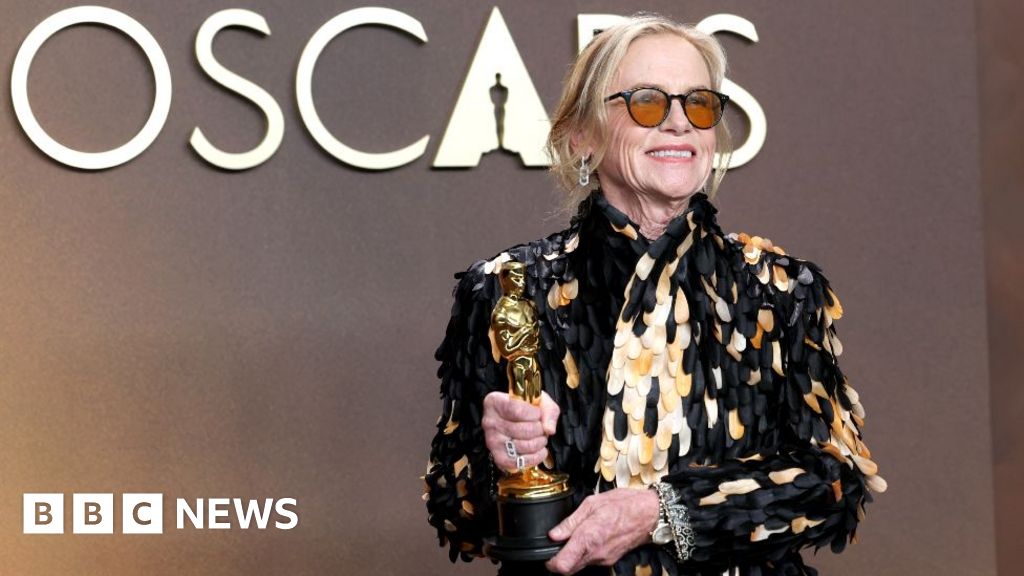
In the acting categories, Jessie Buckley won Best Actress for Hamnet, marking her first Academy Award, while Amy Madigan was recognised as Best Supporting Actress for Weapons.
Elsewhere, the South Korean musical fantasy KPop Demon Hunters won two Oscars, while Frankenstein also secured two awards.
Here is the full list of winners:
Best Picture One Battle After Another
Best Actress Jessie Buckley, Hamnet
Best Actor Michael B Jordan, Sinners
Best Supporting Actress Amy Madigan, Weapons
Best Supporting Actor Sean Penn, One Battle After Another
Best director Paul Thomas Anderson, One Battle After Another
Best Original Score Ludwig Göransson, Sinners
Best Animated Film KPop Demon Hunters
Best International Feature Sentimental Value
Best Documentary Feature Mr Nobody Against Putin
Best Casting Cassandra Kulukundis, One Battle After Another
Best Sound Gareth John, Al Nelson, Gwendolyn Yates Whittle, Gary A Rizzo and Juan Peralta, F1
Best Original Screenplay Ryan Coogler, Sinners
Best Adapted Screenplay Paul Thomas Anderson, One Battle After Another
Best Documentary Short All the Empty Rooms
Best Live Action Short Film The Singers and Two People Exchanging Saliva (tie)
Best animated short film The Girl Who Cried Pearls
Best Music (Original Song): EJAE, Mark Sonnenblick, Joong Gyu Kwak, Yu Han Lee, Hee Dong Nam, Jeong Hoon Seo and Teddy Park for Golden, KPop Demon Hunters
Best Film Editing: Andy Jurgensen, One Battle After Another
Best Cinematography: Autumn Durald Arkapaw, Sinners
Best Production Design: Tamara Deverell and Shane Vieau, Frankenstein
Best Costume Design Kate Hawley, Frankenstein
Best Makeup and Hairstyling Mike Hill, Jordan Samuel and Cliona Furey, Frankenstein
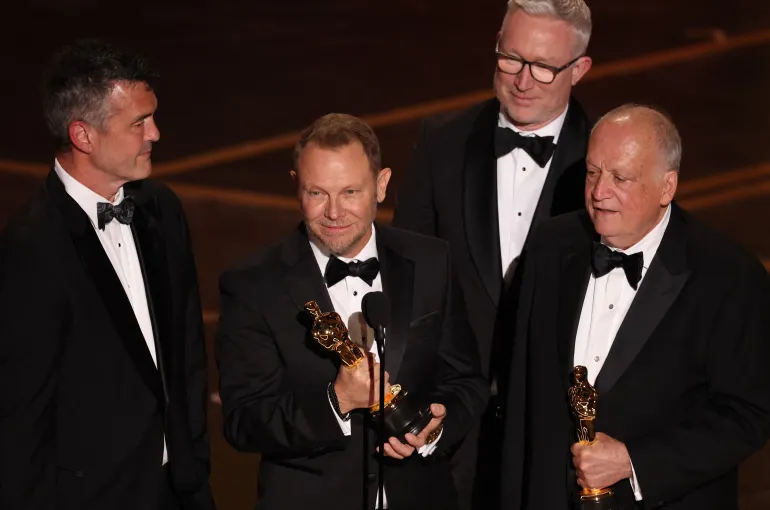
Best Visual Effects Joe Letteri, Richard Baneham, Eric Saindon and Daniel Barrett, Avatar: Fire and Ash
Visual effects supervisor Eric Saindon, visual effects artist Richard Baneham, Daniel Barrett and visual effects supervisor Joe Letteri accept the award for Best Visual Effects for Avatar: Fire and Ash [Patrick T. Fallon/AFP]
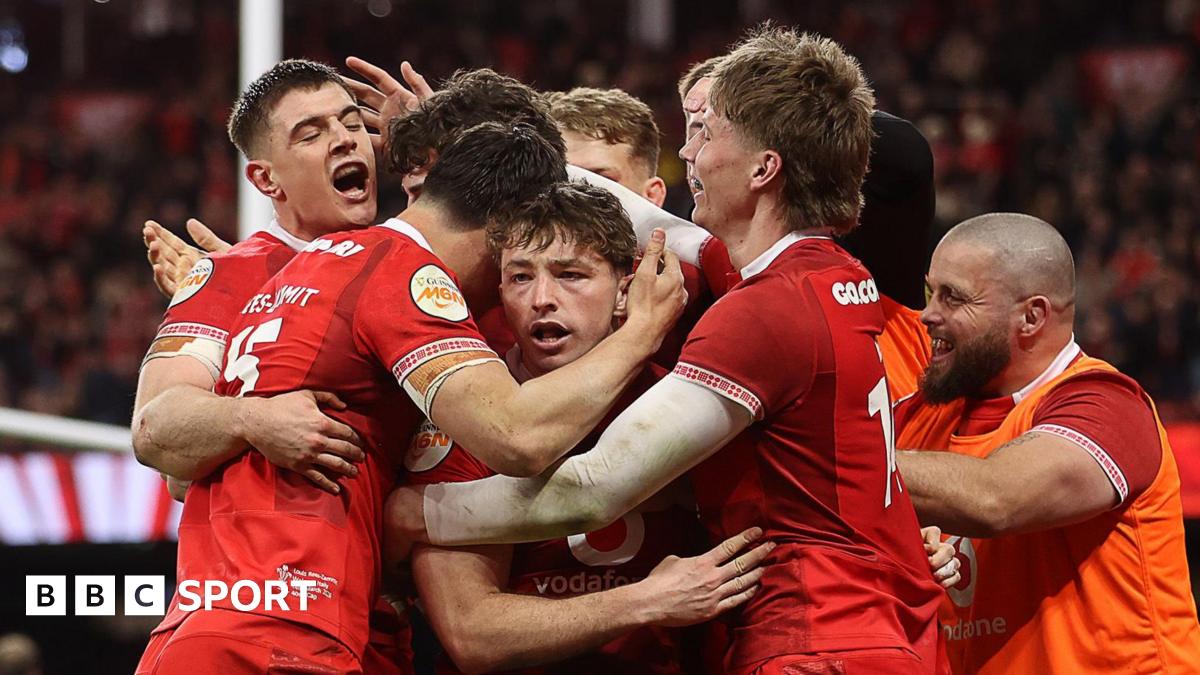
Wales continue to play fixtures amid off-field turmoil, with the Welsh Rugby Union (WRU) not budging on their plan to cut from four men’s professional teams to three.
Tandy and captain Dewi Lake have had to be the face of Welsh rugby and have conducted themselves impeccably.
The hooker will have played his last Ospreys game before a summer move to Gloucester when the Wales squad link up again in the summer.
“That was a performance we have built towards and this group deserves it massively,” said Lake after the win against Italy.
“We have gone through a lot of emotionally tough things recently, whether that is on the field or off it.”
It remains a cause for concern as Wales build towards the World Cup, with Scarlets and Ospreys on a Professional Rugby Agreement (PRA) that expires in the summer of 2027.
Tandy’s squad next take to the field against Barbarians at Twickenham in June before three Nations Championship fixtures in July against Fiji, Argentina and South Africa.
By then the WRU will have held an extraordinary general meeting, with chair Richard Collier-Keywood facing a vote of no confidence, while there is also a legal battle with Swansea Council over the future of Ospreys.
Tandy has created a positive environment for his players after outlining his approach before the campaign.
“If they’ve got something to share, if they’re seeking more clarity or anything they want to talk about then we have to be open,” he said.
“One thing we can’t do is run away from it or pretend it’s not happening.”
Tandy has allowed his players to grow in their Vale Resort bubble and will aim to keep taking everything in his stride in the summer.
Oscars viewers were left stunned when a tie was announced in one categoryThe Singers and Two People Exchanging Saliva received the win for Live Action Short FilmCredit: Getty
Comedian and actor Kumail Nanjiani presented the award on Sunday at the Dolby Theatre in Los Angeles, where he announced the unexpected outcome.
Before revealing the winner in the prestigious category, the actor warned that two names would be called, and that it indeed wasn’t a mistake.
He explained that both recipients would come onstage separately to accept their awards and give their speeches.
The Singers was the first announced, followed by Two People Exchanging Saliva, which experienced an awkward blunder when the spotlight went dark, cutting off the winners’ mid-speech.
After a few moments of silence and a perplexed reaction from host Conan O’Brien, the spotlight turned back on, and they resumed their speech.
Social media erupted with confusion among fans over whether it was normal to have two winners in one category.
“Today I learned that a tie at the Oscars is actually possible. I didn’t know that was a thing. Who knew?!” one viewer wrote on X.
“So far this #Oscars, we’ve got endless roasts about opera and ballet, an unusual amount of AI comments, and even an award that resulted in a tie… which I didn’t know was a thing (it’s only happened seven times in 98 years),” another said.
Most read in Entertainment
“A tie in 2026 is crazy,” a third reacted.
“We just had a tie in the #Oscars for best short film. I never knew that was a thing!” a fourth added.
There have only been six other times when a tie has occurred at the Academy Awards.
The first tie occurred at the 5th annual ceremony in 1932 when Fredric March (Dr. Jekyll and Mr. Hyde) and Wallace Beery (The Champ) both won the Best Actor award.
Technically, Fredric won by one vote over Wallace, but at the time, the rules stated that anyone within three votes of the winner would receive the award.
Today, ties only happen when two nominees receive the exact same number of votes.
A tie happened again in 1950 in the Best Documentary Short category, in which So Much for So Little and A Chance to Live both were awarded the trophy.
Who won on Hollywood’s biggest night?
One Battle After Another ran away with the night with six Oscars, while Sinners, which was nominated for a record-breaking 16 awards, came away with four. See the full winners list below:
Production Design: Frankenstein, Tamara Deverell and Shane Vieau
Sound: F1, Gareth John, Al Nelson, Gwendolyn Yates Whittle, Gary A. Rizzo and Juan Peralta
Visual Effects: Avatar: Fire and Ash, Joe Letteri, Richard Baneham, Eric Saindon and Daniel Barrett
Casting: One Battle After Another, Cassandra Kulukundis
This was the case in 1969 when Katharine Hepburn (The Lion in Winter) and Barbra Streisand (Funny Girl) both received the Best Actress honor.
The fourth tie occurred in 1987 when the award for Best Documentary (Feature) went to Artie Shaw: Time Is All You’ve Got and Down and Out in America.
It wasn’t until 1995 that another tie was called in the Best Live-Action Short Film category, with the statue going to Trevor and Franz Kafka’s It’s a Wonderful Life.
The last instance was in 2013 when the Sound Editing category had two Oscar winners: Zero Dark Thirty (Paul N. J. Ottosson) and Skyfall (Per Hallberg and Karen Baker Landers).
There was an awkward blunder when Two People Exchanging Saliva accepted their award and the spotlight was shut offCredit: ReutersConan O’Brien hosted the 98th annual Academy Awards ceremony in Los AngelesCredit: Getty
If April is the cruelest month, per T.S. Eliot, the Oscars surely must be the cruelest (and longest) season. Other awards shows push their way into the queue for moments of borrowed red carpet glory, but the Academy Awards are what the buildup is all about and the one people remember.
Thankfully, the countdown can now be measured in hours and minutes rather than months, with the 98th Academy Awards slated to start Sunday at 4 p.m. at the Dolby Theatre at Ovation Hollywood. Conan O’Brien is back to host the awards for the second straight year.
The 2026 Oscars will air on ABC, and those with cable subscriptions can also watch the show by logging in to the ABC app or abc.com. The telecast will stream live on Hulu, YouTube TV, AT&T TV and FuboTV. Internationally, the ceremony will be broadcast in more than 200 territories.
Beginning in 2029, the show will stream exclusively on YouTube.
Follow along live as we wait to hear the words “And the Oscar goes to … ”
Actress in a supporting role Elle Fanning, “Sentimental Value” Inga Ibsdotter Lilleaas, “Sentimental Value” Amy Madigan, “Weapons” Wunmi Mosaku, “Sinners” Teyana Taylor, “One Battle After Another”
Actor in a supporting role Benicio del Toro, “One Battle After Another” Jacob Elordi, “Frankenstein” Delroy Lindo, “Sinners” Sean Penn, “One Battle After Another” Stellan Skarsgård, “Sentimental Value”
Adapted screenplay “Bugonia,” Will Tracy “Frankenstein,” Guillermo del Toro “Hamnet,” Chloé Zhao and Maggie O’Farrell “One Battle After Another,” Paul Thomas Anderson “Train Dreams,” Clint Bentley and Greg Kwedar
Original screenplay “Blue Moon,” Robert Kaplow “It Was Just an Accident,” Jafar Panahi “Marty Supreme,” Josh Safdie and Ronald Bronstein “Sentimental Value,” Joachim Trier and Eskil Vogt “Sinners,” Ryan Coogler
Documentary short “All the Empty Rooms” “Armed Only with a Camera: The Life and Death of Brent Renaud” “Children No More: ‘Were and Are Gone’” “The Devil Is Busy” “Perfectly a Strangeness”
Animated short “Butterfly” “Forevergreen” “The Girl Who Cried Pearls” “Retirement Plan” “The Three Sisters”
Cinematography “Frankenstein,” Dan Laustsen “Marty Supreme,” Darius Khondji “One Battle After Another,” Michael Bauman “Sinners,” Autumn Durald Arkapaw “Train Dreams,” Adolpho Veloso
Costume design “Avatar: Fire and Ash,” Deborah L. Scott “Frankenstein,” Kate Hawley “Hamnet,” Malgosia Turzanska “Marty Supreme,” Miyako Bellizzi “Sinners,” Ruth E. Carter
Film editing “F1,” Stephen Mirrione “Marty Supreme,” Ronald Bronstein and Josh Safdie “One Battle After Another,” Andy Jurgensen “Sentimental Value,” Olivier Bugge Coutté “Sinners,” Michael P. Shawver
Live-action short “Butcher’s Stain” “A Friend of Dorothy” “Jane Austen’s Period Drama” “The Singers” “Two People Exchanging Saliva”
Makeup and hairstyling “Frankenstein,” Mike Hill, Jordan Samuel and Cliona Furey “Kokuho,” Kyoko Toyokawa, Naomi Hibino and Tadashi Nishimatsu “Sinners,” Ken Diaz, Mike Fontaine and Shunika Terry “The Smashing Machine,” Kazu Hiro, Glen Griffin and Bjoern Rehbein “The Ugly Stepsister,” Thomas Foldberg and Anne Cathrine Sauerberg
Original score “Bugonia,” Jerskin Fendrix “Frankenstein,” Alexandre Desplat “Hamnet,” Max Richter “One Battle After Another,” Jonny Greenwood “Sinners,” Ludwig Göransson
Original song “Dear Me” from “Diane Warren: Relentless” “Golden” from “KPop Demon Hunters” “I Lied to You” from “Sinners” “Sweet Dreams of Joy” from “Viva Verdi!” “Train Dreams” from “Train Dreams”
Production design “Frankenstein” “Hamnet” “Marty Supreme” “One Battle After Another” “Sinners”
Sound “F1” “Frankenstein” “One Battle After Another” “Sinners” “Sirāt”
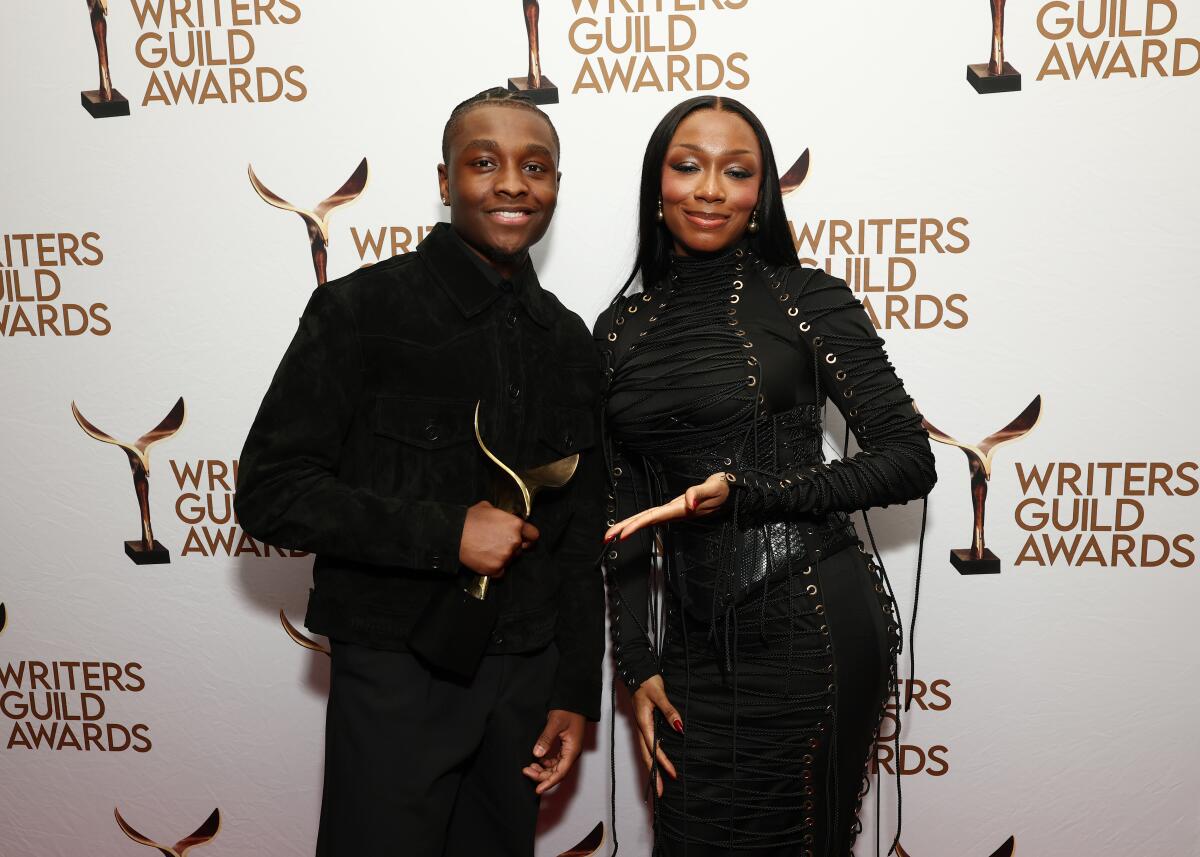
The already highly decorated “Sinners” was among the top winners at the 78th Writers Guild Awards on Sunday in New York City.
The Ryan Coogler-directed horror film won the award for original screenplay, and its primary Oscars best picture opponent, Paul Thomas Anderson’s “One Battle After Another,” clinched the win for adapted screenplay. “Sinners” star Miles Caton accepted the award for the former, and “One Battle” cast member Shayna McHayle for the latter.
“Sinners” star Miles Caton and “One Battle After Another” actor Shayna McHale accepted the awards for original and adapted screenplay, respectively.
(Cindy Ord / Getty Images for Writers Guild of America East)
In the TV realm, “The Pitt” made a splash with awards for drama series, new series and episodic drama.
As for lifetime achievement honors, Robert Smigel presented Stephen Colbert with the Walter Bernstein Award for critiquing the power elite on his late-night show, which will air its final episode in May. Terry George received the Ian McLellan Hunter Award for Career Achievement from Don Cheadle, and Diana Son the Richard B. Jablow Award for Devoted Service to the Guild from last year’s recipient, Kathy McGee.
Most years, the Writers Guild holds simultaneous ceremonies in New York and Los Angeles. But the East Coast edition became a solo affair after WGA West canceled its ceremony amid an ongoing strike by its own staff union, who claimed guild management had “surveilled workers for union activity, terminated union supporters, and engaged in bad faith surface bargaining.”
The L.A. ceremony was set to honor James Cameron with the Laurel Award for Screenwriting Achievement, Don Reo with the Paddy Chayefsky Laurel Award for Television Writing Achievement and Mstyslav Chernov with the Paul Selvin Award for “2,000 Meters to Andriivka,” which won the award for documentary screenplay Sunday evening.
While WGA West’s board of directors said the ceremony was postponed to give members “an uncomplicated celebration of their achievements,” the Writers Guild Staff Union characterized the cancellation as an attempt to sow division between management and unionized staff, which is ill-timed given upcoming contraction negotiations between the WGA and the Alliance of Motion Picture and Television Producers, which represents Hollywood studios and streamers. In 2023, the WGA went on its longest-ever strike, lasting 148 days.
Comedian and Emmy-nominated producer Roy Wood Jr., who this year hosted the WGA’s East Coast ceremony for the third time, during his opening monologue offered (in jest) his predictions for the negotiations, which begin later this month.
“First, I predict somebody’s gonna lose their s—,” the host said. “Cooler heads are gonna prevail, and then somebody else is gonna lose their s—.”
Here is the full list of Writers Guild Award winners:
Original screenplay: “Sinners,” written by Ryan Coogler; Warner Bro. Pictures
Adapted screenplay: “One Battle After Another,” screenplay by Paul Thomas Anderson, screen story by Paul Thomas Anderson, inspired by the novel “Vineland” by Thomas Pynchon; Warner Bros. Pictures
Documentary screenplay: “2,000 Meters to Andriivka,” written by Mstyslav Chernov; Frontline Features
Drama series: “The Pitt,” written by Cynthia Adarkwa, Simran Baidwan, Valerie Chu, R. Scott Gemmill, Elyssa Gershman, Joe Sachs, Noah Wyle; HBO Max
Comedy series: “The Studio,” written by Evan Goldberg, Alex Gregory, Peter Huyck, Frida Perez, Seth Rogen; Apple TV
New series: “The Pitt,” written by Cynthia Adarkwa, Simran Baidwan, Valerie Chu, R. Scott Gemmill, Elyssa Gershman, Joe Sachs, Noah Wyle; HBO Max
Limited series: “Dying for Sex,” written by Sheila Callaghan, Harris Danow, Madeleine George, Elizabeth Meriwether, Amelia Roper, Kim Rosenstock, Sasha Stewart, Sabrina Wu, Keisha Zollar; FX/Hulu
TV & Streaming Motion Pictures: “Deep Cover,” written by Derek Connolly and Colin Trevorrow; Prime Video
Animation: “Shira Can’t Cook” (“Long Story Short”), written by Mehar Sethi; Netflix
Episodic drama: “7:00 A.M.” (“The Pitt”), written by R. Scott Gemmill; HBO Max
Episodic comedy: “Prelude” (“The Righteous Gemstones”), written by John Carcieri, Jeff Fradley, Danny R. McBride; HBO Max
Comedy/variety series – talk or sketch: “Last Week Tonight with John Oliver,” senior writers: Daniel O’Brien, Owen Parsons, Charlie Redd, Joanna Rothkopf, Seena Vali; writers: Johnathan Appel, Ali Barthwell, Tim Carvell, Liz Hynes, Ryan Ken, Sofía Manfredi, John Oliver, Taylor Kay Phillips, Chrissy Shackelford; HBO Max
Comedy/variety specials: “Marc Maron: Panicked,” written by Marc Maron; HBO Max
Quiz and audience participation: “Celebrity Jeopardy!”, head writer: Bobby Patton; writers: Kyle Beakley, Michael Davies, Terence Gray, Amy Ozols, Tim Siedell, David Levinson-Wilk; ABC
Daytime drama: “The Young and the Restless,” associate head writers: Jeff Beldner, Marla Kanelos, Dave Ryan; writers: Susan Banks, Amanda L. Beall, Marin Gazzaniga, Rebecca McCarty, Madeleine Phillips; CBS/Paramount+
Children’s episodic, long form and specials: “When We Lose Someone” (“Tab Time”), written by Sean Presant; YouTube
Short form streaming: “The Rabbit Hole with Jimmy Kimmel,” writers: Jimmy Kimmel and Jesse Joyce; YouTube
Documentary script – current events: “Trump’s Power & the Rule of Law” (“Frontline”), written by Michael Kirk and Mike Wiser; PBS
Documentary script – other than current events: “Forgotten Hero: Walter White and the NAACP” (“American Experience”), written by Rob Rapley; PBS
News script – regularly scheduled, bulletin or breaking report: “Devastating Flooding in Texas” (“World News Tonight with David Muir”), written by David Muir, Karen Mooney and Dave Bloch; ABC News
News script – analysis, feature or commentary: “Remembering Palestinian Journalists Killed by Israeli Forces” (“Ayman”), written by Lisa Salinas; MSNBC
Digital news: “An Isolated Boarding School Promised to Help Troubled Girls. Former Students Say They Were Abused.,” written by Sebastian Murdock and Taiyler Mitchell; HuffPost
Radio/audio documentary: “Jerry Lewis’ Lost Holocaust Clown Movie” (“Decoder Ring”), written by Max Freedman; Slate
Radio/audio news script – regularly scheduled, bulletin or breaking report: “ABC News Radio Top of the Hour News”, written by Robert Hawley; ABC News Radio
Radio/audio news script – analysis, feature or commentary: “The Life and Legacy of Jimmy Carter,” written by Gail Lee; CBS News Radio
On air promotion: “CBS Comedy,” written by Dan Greenberger; CBS
Times staff writers Stacy Perman and Cerys Davies contributed to this report.