wilshire boulevard

Puppets, performers and politics filled the streets at LACMA’s first-ever Art Parade

Instead of the usual phalanx of cars and buses, Saturday evening traffic on Wilshire Boulevard was replaced by massive balloons, mobile sculptures, gaggles of gallerists and an endless array of elaborate costumes.

The first-ever Los Angeles Art Parade, a collaboration between the Los Angeles County Museum of Art (LACMA) and famed gallerist Jeffrey Deitch, transformed the stretch of Wilshire known as Museum Row into a human-powered exhibition of the city’s dynamic art scene.

About 146 groups, made up of more than 1,400 participants, marched in the parade, with projects ranging from larger-than-life marionette dolls to squads of children in do-it-yourself costumes to mobile re-creations of LACMA’s most iconic art pieces.

The parade followed an all-day block party thrown by LACMA as part of its Grand Opening Weekend, celebrating the new David Geffen Galleries and the completion of the 20-year-long, $724-million campus construction project. Together, the block party and art parade attracted an estimated 60,000 attendees, who swarmed the galleries, danced to explosive DJ sets, and lined the streets to watch the eclectic procession of artists.

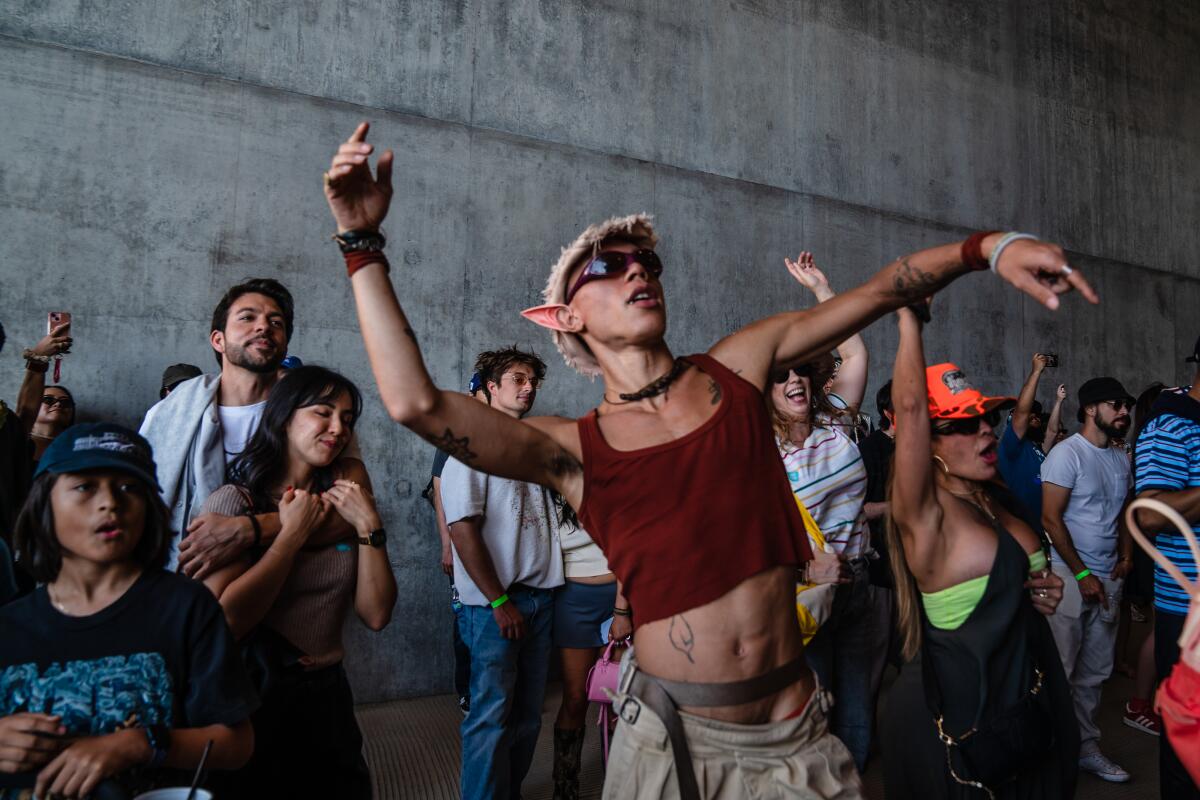
People dance

People dance during Flying Lotus’ DJ set at the Los Angeles County Museum of Art (LACMA) in Los Angeles.

(Ariana Drehsler/For The Times)

According to LACMA Director and Chief Executive Michael Govan, the event was a long time coming and “just the beginning” of how his team plans to use the campus space, which he previously called the city’s “living room.”

“We’re not gonna close Wilshire every weekend, but it’s an example of what we can do,” Govan said. “It’s really exciting to see the building work.”

Following a crowd-drawing DJ set from electronic low-fi hip-hop artist Flying Lotus, Govan introduced L.A. County District 2 Supervisor Holly J. Mitchell. She said the event made her “proud to represent LACMA” and to be a Metro board member, referencing the recently-opened Metro D-line extension, which dropped attendees off a quick stroll from LACMA’s entrance.

“Just seeing you all at this amazing public facility does my heart good,” she said. “This is your local government at work.”

1

Silhouettes of people watching the parade.

2

A man and woman wearing tulle over them walk in the parade.

3

The crowd at the Los Angeles County Museum of History, Science, and Art (LACMA) Block Party.

1. Silhouettes of people watching the parade. 2. A man and woman wearing tulle over them walk in the parade. 3. The crowd at the Los Angeles County Museum of History, Science, and Art (LACMA) Block Party. (Ariana Drehsler/For The Times)

As the party raged on LACMA’s campus, hundreds of parade participants hurriedly prepared for their debuts in the corners of nearby streets and parking lots. One group inflated a giant disco ball, while another smeared themselves with body paint next to a line of rehearsing dancers. Elsewhere, a megaphone-wielding leader herded dozens of black cats in the style of artist Gary Baseman into some semblance of order.

Deitch originally staged the first Art Parades in New York City’s SoHo neighborhood between 2005 and 2008. While those took a more art-world-exclusive approach, Deitch said the Los Angeles version was designed with inclusion in mind. The call for parade proposals was open to “emerging and established artists and creatives of all ages and backgrounds,” according to guidelines, as long as the work was appropriate for all ages and didn’t require a motorized element.

“The New York one was much more oriented toward people in the art community. We didn’t put out this kind of open call,” Deitch explained. “This is very different in its openness and its diversity. There are some famous artists and famous choreographers, L.A. legends. But there are also mothers from the San Fernando Valley with their children. I really love that.”

Devil Jack in a Box with Crocodile

Artist Jordan Rountree’s rolling woodcut-sculpture called the Devil Jack in a Box with Crocodile appeared in Saturday’s Block Party and Art Parade hosted by the Los Angeles County Museum of Art’s (LACMA).

(Ariana Drehsler/For The Times)

“It’s just a very open platform, so you don’t have to have an M.F.A. to express yourself as an artist,” he added.

The procession was dizzying in its variety and scale. While many projects leaned into beauty and whimsy, others took a more overtly political approach, displaying anti-ICE messages on T-shirts and signs, sporting trans pride flags, or, in the case of performance artist Amy Kaps, wearing an unraveling U.S. constitution.

Some even referenced local causes, such as the “Boo Boo Bandage Brigade for Safe Streets,” which advocated for fixing sidewalks and increasing accessibility downtown. One particularly moving display by the Pali-Altadena Collective featured participants carrying miniature models of buildings and landmarks lost in the 2025 fires.

Chicana artist Nao Bustamante and Track 16 Gallery brought “Brown Disco” to the streets, which featured a giant gold disco ball and figures from decades of L.A. queer nightlife.

The crowd at the Los Angeles County Museum of Art (LACMA) Art Parade.

The crowd at the Los Angeles County Museum of Art (LACMA) Art Parade.

(Ariana Drehsler/For The Times)

“As a brown, queer person, I think that this really brought a light into our community, and now its presence [creates] an intergenerational conversation,” said Track 16 Assistant Director Steve Galindo. “The nightlife scene is how we come out as queer people, so it’s really special to be in the parade.”

For Joie Mitchell, volunteer coordinator for the Bob Baker Marionette Theater, which recently purchased its permanent Highland Park home, the parade was an opportunity to “show up for L.A. and be involved in the art history of this city.”

“Puppetry has been part of the arts for so many years,” added Daisy Hernandez, the theater’s production manager. “It’s a way that people express themselves, just like every other art form. So that’s what we’re here to do: express ourselves through puppetry.”

Source link

A new photo exhibition shows the people behind the L.A. Metro D Line

In 1995, when the L.A. Metro system was in its most nascent stage, Ken Karagozian — then an amateur photographer in an Owens Valley, Calif., workshop — found his way underground to document the subterranean marriage between downtown L.A. and Westlake through Metro’s Red Line, now called the B Line.

From that came a feature in Life magazine, but more importantly, a driving principle: Karagozian believed that the construction workers, engineers and electricians who were subject to the whims of a city indecisive on the subway project were deserving of intimate documentation. The invisible many who built the pyramids and New York’s skyline never got that chance, he said, but the people who contributed to the historically controversial Metro D Line from Koreatown to Westwood would, if he had a say.

“When I did take photography workshops, they always said, ‘Do a project close to your home,’” Karagozian said on a call from his Agoura Hills residence. “I wrote a letter to [L.A. Metro], which said, ‘How can I get permission to photograph?’”

Days before the fires ravaged L.A. in 2025, Altadena-based historian and author India Mandelkern had a phone call with Karagozian, who was interested in collaborating on a project about the D Line. After publishing a book on the art and politics of street lighting in Los Angeles, Mandelkern worked on the L.A. Metro blog, soliciting interviews from Angelenos who seemed desperate for a line to the Westside.

A group of workers during the Section 2 breakthrough.

A Karagozian photo shows a group of workers during the Section 2 breakthrough during the underground construction of the Metro D Line.

(Ken Karagozian)

A photo by Karagozian shows sunlight filtering underground into the Wilshire/Fairfax site during construction.

A photo by Karagozian shows sunlight filtering underground into the Wilshire/Fairfax site during construction.

(Ken Karagozian)

After Mandelkern connected with Karagozian, their project had solid form: a photo book, titled “Wilshire Subway: The Making of the D Line Subway Extension,” about the history, conflict and people behind the scenes and underground ahead of the May 8 opening of the subway expansion along Wilshire Boulevard. (New stations will be added at Wilshire/La Brea, Wilshire/Fairfax and Wilshire/La Cienega. In the future, stations in Beverly Hills, Century City and Westwood will open.)

A related photo exhibition, “Wilshire Subway: Photographed by Ken Karagozian,” is on view through May 14 at the 1301PE art gallery on Wilshire Boulevard.

This week, we chatted more with Karagozian and Mandelkern about their project.

After writing a book about the social history of street lighting, what brought you underground?

Mandelkern: Well, a couple different reasons. First, I was very interested in Metro just because I had worked there as the blog editor, and in that role, I got to explore so many different stories. I thought Wilshire Boulevard was one of the most interesting places, the stories of this rail-building ambition that persisted for so many different years, and what that says about Angelenos. Second, I think that we talk about L.A. as a horizontal city, and that’s certainly true. If you go somewhere like Tokyo, you instantly see that this is what a vertical city is, but I wanted to bring a little bit of that to L.A. There is so much history buried beneath the ground that we seem to forget, and once you start tunneling, you realize that it’s always been there and it hasn’t disappeared. It’s just pushed beneath us.

India Mendelkern, left, and Ken Karagozian at the L.A. Times Festival of Books.

In support of their new project, writer India Mendelkern, left, and photographer Ken Karagozian appear at the Los Angeles Times Festival of Books in April.

(Ken Karagozian)

Of all the people you spoke to for this book, which one most influenced the way you understood what the D Line could provide for the city?

Karagozian: This was a joint venture between three contractors, and they each had their specialty. It was Skanska, Traylor [Bros.] and Shea. With Traylor, they were brothers and they were doing the tunneling. Richard McLane [chief mechanical engineer of Traylor Bros.] was very helpful in telling me a little bit about the history of Wilshire Boulevard and facts of tunneling. … All these different contractors impacted the project in some way.

Mandelkern: I always say Ken is one of the best construction photographers out there, but his specialty is really people. When I interviewed some of these individual workers, a whole different story came to light, and I realized that many of these workers came to L.A., started at the bottom of the totem pole, and through working on the subway have risen through the ranks, gotten promotions, become leaders, and their kids now work in construction. … It’s just so amazing that so many of these individuals are doing all this work behind the scenes that creates infrastructure that connects all of us.

1

Carpenter Jenna Dorough poses for a portrait by Karagozian during the underground construction of the Metro D Line.

2

A concrete supervisor photographed by Karagozian at the La Cienega Boulevard station.

1. Carpenter Jenna Dorough poses for a portrait by Karagozian during the underground construction of the Metro D Line. 2. A concrete supervisor photographed by Karagozian at the La Cienega Boulevard station. (Ken Karagozian)

There are many portraits in the book of the builders who created the D Line. India referred to the short lifespans of the workers compared to the marvelous structures they craft: Was it intentional that you documented most of the D Line’s visual history through the people who built it?

Karagozian: When I go down underground and after the stations are completed, to me, it’s the people that built it that should tell the story. I didn’t just want to get a shot of them from behind. I really like to photograph their faces. … When I photographed the workers from the Red Line, some of these workers from the middle ’90s are still working on the Purple Line. I’ve known them for years, and now their children are working in construction; it becomes a family issue. … Going down and photographing the tunnels with that lighting in that perspective, it’s always been so interesting.

Mandelkern: That just reminded me of one of the quotes in the book from John Yen, who is the VP of operations at Skanska. He said, “In construction, we work ourselves out of a job.” I always found it really interesting that, as we build, the whole point is to kind of disappear. It reminded me of one of my favorite quotes in the essay, when James [Rojas] writes [that] when the stations are open, they’ll be shiny and new, but that will kind of erase all the memories and all the work of the people who’ve been doing this for all this time. This book really became a way to sort of remember all of these different people that have been working on these projects for decades and decades, even if they’re not really remembered in the official record.

As the D Line prepares to open, does it somehow feel like the end of a journey?

Mandelkern: This just [started] so many other things for me. Afterwards, I decided I really want to learn about the geology of L.A., and I found an interest in paleontology, too. I hope with any book that it just gets people curious, and it gets them to start asking questions. I think that “Wilshire Subway” does accomplish that. L.A. is just this bowl with all these different salad layers, and as we penetrate down, we learn more and more about our history.

Karagozian: It does a little bit. With May 8 being the grand opening, and as the stations are complete and they’re testing the trains underground, it almost feels like it’s graduation time. Time to celebrate the journey of going through high school, college, whatever. I am still continuing to photograph the [Purple Line extension], which is Rodeo or Beverly [Hills] station … Now it’s just the accomplishment of celebrating all the work that I’ve put into this project and going down almost once a week and photographing the process for so many years.

Art exhibition

‘Wilshire Subway’ exhibition

“Wilshire Subway: Photographed by Ken Karagozian” is a new exhibition based on a new photo book by Karagozian and writer India Mandelkern.

Where: 1301PE art gallery, 6150 Wilshire Blvd., Los Angeles

When: Through May 14.

Hours: The gallery is open 10 a.m. to 6 p.m. Tuesday through Saturday. (There’s an opening reception and book signing from 4 to 7 p.m. Friday.)

Admission: Free


Source link

What to eat, drink and do along L.A.’s new Metro D Line extension

Don’t you ever wish you could explore one of L.A.’s most vibrant boulevards without a car? When the first phase of Metro’s extension to its D Line opens May 8, L.A.’s transit system will add what has long been a missing puzzle piece. A busy, traffic-snarled section of Wilshire Boulevard, home to world-class museums, restaurants and galleries, will at long last be significantly more accessible.

Ride and walk, for instance, to the newly reimagined Los Angeles County Museum of Art, and then stroll to the Original Farmers Market or the acclaimed République. Or take transit to a concert at the El Rey Theatre, then grab a pint at Tom Bergin’s. And do it all without stressing about valet or parking in a part of town where the latter is at a premium.

Though this initial phase of the D Line extension is only three stops, for residents and business owners in the community, it feels monumental.

“I’m so excited for Metro to open and for lots of people to hopefully come and peruse these streets,” says Christina Mullin, owner of Miracle Mile Toys & Gifts. Mullin, who also lives in the neighborhood, has seen the area disrupted by construction for the better part of a decade, and is hopeful the subway stops will bring in an influx of shoppers.

“It’s such a nice, walkable area,” Mullin says. “You can walk all of La Brea and all the way to the Sycamore Kitchen. This will be very good for the city.”

And it seems to be generating much excitement, at least if Metro’s own marketing is any indication. A line of innuendo-filled “Ride the D” shirts went viral and then almost instantaneously sold out. (Those looking for the shirts are likely out of luck, as a Metro spokesperson says the item was intended only as a limited-edition run.)

Here are some highlights of destinations along the new stations, which are located at Wilshire/La Brea, Wilshire/Fairfax, Wilshire/La Cienega and will collectively serve Koreatown, Miracle Mile, Hancock Park, Carthay Circle, the Fairfax District and Beverly Hills. All should be within about a 20- or 25 minute walk.

The second section of the D Line will continue west through Beverly Hills and Century City, and the third will extend to Westwood and UCLA. The full rail line, according to Metro, is expected to be open by the end of 2027.

Source link