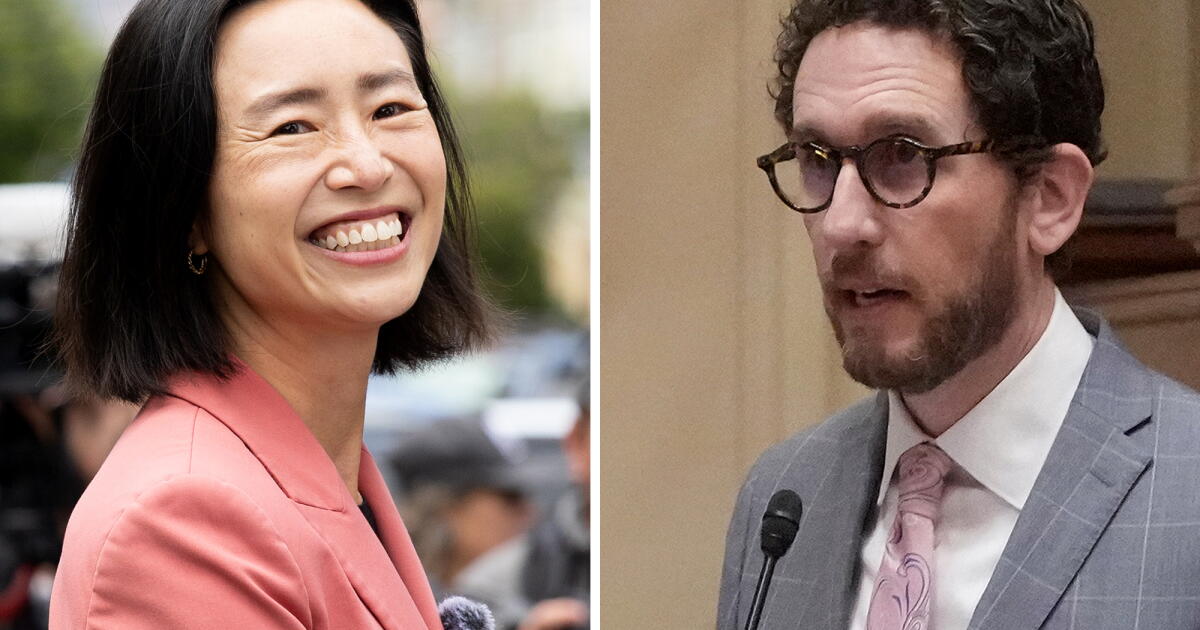
Race to replace Pelosi divides Democrats in San Francisco
After being securely held for nearly four decades by one of the most preeminent politicians in California history, the House seat to represent bright blue San Francisco in Congress is up for grabs in November — and dividing the Democratic Party.
Rep. Nancy Pelosi (D-San Francisco), 86, the powerful former House Speaker who’s held the seat since 1987, announced last year that she would not run again. In May, she passed over state Sen. Scott Wiener (D-San Francisco) — a prolific California legislator long considered a potential successor — to endorse San Francisco Supervisor Connie Chan, a local progressive with less legislative experience but strong support from labor.
Pelosi’s endorsement sent Chan, who had been languishing in polls, surging past Democratic tech millionaire Saikat Chakrabarti in the June primary. Chan finished with nearly 30% of the vote and Chakrabarti took 18%. Wiener won, with nearly 41% of the vote.
Both Wiener, a gay man and staunch advocate for the city’s large LGBTQ+ community, and Chan, who immigrated to the city from Hong Kong at age 13 and has deep ties to its large Chinese and immigrant communities, would make history by winning. Wiener would be the first out LGBTQ+ person to represent the city in Congress, and Chan the first Asian American immigrant woman.
The race has sharply divided the state’s Democratic establishment as a rare intraparty showdown between a deft legislator who has driven liberal California policy for years and a rising progressive with the powerful imprimatur of the icon they seek to replace.
Both acknowledge they would take the same or similar positions on many issues, and fiercely oppose President Trump’s agenda. But they also say San Franciscans face a real choice between them that will help define the city for years.
“There is a clear cut between the two of us,” Chan said. “He has long enjoyed establishment support and industry support, and we’ve been grassroots, on the ground, [Asian American and Pacific Islander] community, working people and labor unions — in collaboration and coalition building.”
“We need Democrats who are willing to fight — to fight in a smart way, and to fight in an aggressive way, to defeat Donald Trump and to lower the cost of living,” Wiener said. “We are past the time where we need Democrats in office who were just going along to get along, or who, like Connie Chan, are just part of the status quo.”
Wiener is a MAGA target
Wiener, 56, has lived in the Castro neighborhood since 1997 and was a deputy city attorney and local Democratic Party chair before being elected to the Board of Supervisors in 2010. He was elected in 2016 to the state Senate, where he’s had a massive influence, authoring more than 100 bills that have been signed into law. Allies and critics say he is a workhorse, and at times both effective and divisive.
Wiener has been endorsed by the state and local Democratic parties; a slew of state leaders including California Atty. Gen. Rob Bonta, state Senate President Pro Tempore Monique Limón (D-Santa Barbara) and Assembly Speaker Robert Rivas (D-Hollister); various queer and labor groups including AFSCME; more than half the city’s supervisors; and various members of Congress.
Wiener has passed some of the state’s most progressive laws on LGBTQ+ rights, including protections for gender-affirming care, and challenged federal immigration agents in California. He has also pushed progressive laws — backing safe injection sites, extending bar hours until 4 a.m., decriminalizing psychedelic drugs — that have put some of his fellow Democrats in uncomfortable spots when forced to vote on the controversial issues.
Some in San Francisco label him a moderate, though that designation would draw laughs elsewhere in the country and even in Sacramento. Wiener is one of the most reviled state politicians on the conservative right nationally, and has received scores of death threats for his work, particularly on transgender issues. His website touts a laundry list of profane and homophobic attacks from MAGA loyalists — Elon Musk called him a “scumbag,” former Rep. Marjorie Taylor Greene called him a “communist groomer” — that he wears as a badge of honor.
On housing, Wiener has pushed for deregulation and development near transit hubs statewide to solve the housing and affordability crises, riling some homeowners averse to increased density and some progressives who say his plan favors developers and threatens existing rent-controlled housing. On tech, Wiener has pushed for artificial intelligence regulation but also been criticized for taking a technocratic approach with buy-in from wealthy tech leaders.
Wiener has passed laws protecting net neutrality, capping prescription costs and mandating mental health parity, ending mandatory minimum sentences for nonviolent drug offenders, and requiring corporations disclose their greenhouse gas emissions. He has received substantial financial support from tech leaders and opposes Proposition 40, the ballot measure that seeks to impose a one-time tax on the state’s billionaires.
Rep. Robert Garcia (D-Long Beach), also gay and a former Long Beach mayor, said he considers Wiener a friend but also a generational legislator who has “led the country” on LGBTQ+ rights and housing policy. “I don’t think there’s a better legislator in the United States on housing,” Garcia said.
Rep. Laura Friedman (D-Glendale), who worked with Wiener for years in the state Legislature, said he has been a champion for many issues important to Californians — including the environment — while holding big industry accountable and backing labor. She said while many politicians decide to either rack up easy wins with legislation that barely moves the needle or focus on “progressive value signaling” without accomplishing much of anything, Wiener “takes on some of the most difficult and controversial progressive issues and really gets them done.”
Nancy Tung, the local Democratic Party chair, said many San Francisco politicians “recede” from the city’s raucous local policy debate once they reach higher office, but Wiener is “still is in the knife fight,” especially on housing and affordability issues — showing he cares about the city and making him “such a good fit” for Congress.
Tung said she understands the appeal of sending a fellow Asian American woman to Congress in this political moment, but that Chan “just does not have the legislative record that Scott has.”
Chan for ‘working people’
Chan, 47, who lived in a rent-controlled Chinatown apartment after immigrating with her mother and younger brother, now lives with her firefighter husband and son in the Richmond neighborhood. She was a community and legislative aide for years — including for then-Dist. Atty. Kamala Harris — before being elected to the Board of Supervisors in 2020. She has served as budget chair since 2023 and has centered her campaign, largely funded by Pelosi’s network, around what she calls her “career fighting for working people.”
Chan has been endorsed by a host of Congress members, including Pelosi and Sen. Adam Schiff (D-Calif.); major labor groups including the California Federation of Labor Unions and the California Teachers Assn.; various progressive organizations and fellow and former supervisors; former mayor and S.F. power broker Willie Brown; and Chakrabarti, who since the primary has shared his campaign staff and funding with her.
Chan, who supports Proposition 40, has helped create a $400-million reserve fund in San Francisco to make up for federal cuts to Medicaid and housing subsidies. She also passed a supplemental budget to fund immigration defense services for people targeted by the Trump administration and passed various labor-friendly measures, including a minimum wage increase for in-home workers and cost-of-living adjustments for city service workers.
Pelosi said Chan “understands that budgets are statements of our values,” has “championed justice and progress for working families” and “brings an important lived experience to this moment” as an immigrant woman. Schiff said Chan has impressed him as “a very powerful voice for those who are disenfranchised” and someone with “the potential of growing into” a leader like Pelosi.
Kim Tavaglione, executive director of the San Francisco Labor Council, said she encouraged Pelosi to endorse Chan because Chan “supports San Francisco values,” listens to labor and is a great strategist.
Cleve Jones, the San Francisco activist who has fought for gay political representation since Harvey Milk’s historic 1977 election to the Board of Supervisors, said Wiener “has done some very good things, particularly around LGBTQ issues and HIV/AIDS,” but also angered some in the LGBTQ+ community by repeatedly showing up to an annual Trans March that organizers ask politicians not to attend.
Wiener, who is Jewish, was aggressively heckled at this year’s march, namely for his stance on the Israeli war in Gaza, which he was slower than other progressives to label a genocide. Conservatives mocked him for being targeted by his base, and Wiener ended up fundraising off the incident — which Jones said was “so cynical.”
He said Wiener’s “loyalty is to big developers, big tech and big real estate,” and that he “doesn’t really see the urgency of yet another white man elected to Congress” when San Francisco can send a stronger message by electing Chan, an immigrant woman of color.
Affordability and Trump
Chan said she is a “pragmatic” progressive who has balanced the city’s budget while protecting “healthcare, education, immigration resources” and other working-class priorities. She said Wiener is focused on deregulation for market-rate housing development, whereas she has prioritized tenants’ rights and protecting existing rent-controlled housing in her push for affordable units.
Chan said she will “walk and chew gum at the same time” in Washington by working for affordability while battling Trump, including by reversing his healthcare cuts, expanding Medicaid, providing affordable childcare, abolishing U.S. Immigration and Customs Enforcement and finally figuring out meaningful immigration reform.
“I’m not sugarcoating it as if it’s easy. But we gotta be able to find ways to work together to push those things forward,” she said.
Wiener said he and Chan share the goal “of getting Trump and MAGA out of office, and then making sure that people never feel tempted to flirt with authoritarianism again.”
But he said the way to do that is to advance policies that will “lower people’s cost of living and make people’s lives more sustainable” — including by passing universal healthcare, building millions of new homes, creating low-cost child care and leading a clean energy transition — and that he is the only candidate in the race with a proven ability to do that.
“This is a race to succeed the most effective and operational member of Congress in modern American history,” Wiener said. “San Francisco should send someone who actually has a track record, a proven track record, of being able to deliver.”