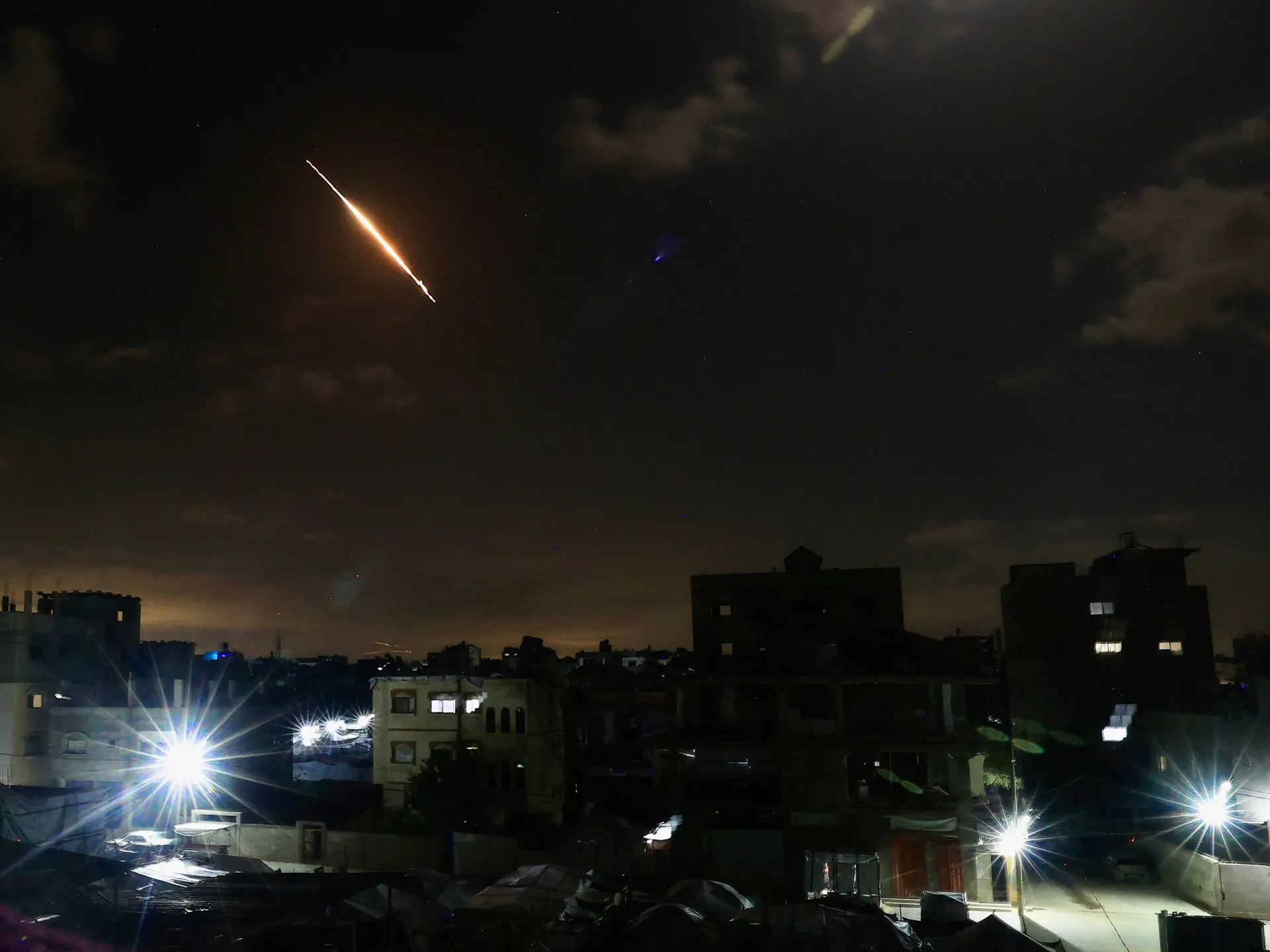
wider

Strikes kill two PMF fighters in northern Iraq amid wider war, group says | US-Israel war on Iran News

Air strikes come hours after pro-Iran armed group Kataib Hezbollah announces conditional suspension of US embassy attacks.

Air strikes have killed two fighters from the Popular Mobilisation Forces (PMF) in northern Iraq, the paramilitary group says from one of the fronts in the sprawling war engulfing the Middle East.

The two attacks targeted PMF positions early on Thursday in the Nineveh region, where Mosul city is located, and a military airport in Salah al-Din province, according to statements from the PMF, a predominantly Shia group that is part of Iraq’s security apparatus and includes several groups aligned with Iran.

Recommended Stories

list of 3 itemsend of list

The PMF blamed the attack on Israel and the United States. Iraq has been drawn into the US-Israeli war on Iran, now in its third week.

The PMF was formed in 2014 as a volunteer force supporting Iraqi security forces in the fight against ISIL (ISIS).

Strikes have targeted Iran-backed groups, which in turn have claimed near-daily attacks on US interests in Iraq and across the region.

Elsewhere, a fire broke out at a naval base in southern Iraq when it was hit by a drone overnight. An Iraqi security source told Al Jazeera that a drone crashed into a water treatment station at the Umm Qasr naval base near the border with Kuwait.

Footage from the scene circulating on social media and verified by Al Jazeera showed flames and smoke rising from the site.

US embassy attacks to be suspended

Hours before the attacks on PMF fighters, the pro-Iranian armed group Kataib Hezbollah said its secretary-general had “issued orders to suspend operations targeting the US embassy in Baghdad for a period of five days”.

Designated by Washington as a “terrorist organisation”, Iraq’s Kataib Hezbollah listed several conditions of the suspension, including Israel ceasing its bombardment of the southern suburbs of Beirut.

Kataib Hezbollah also demanded “a commitment to refrain from bombing residential areas in Baghdad and other provinces”.

Whenever “the enemy violates” the truce, “the response will be immediate”, the group said, warning of more strikes after the five-day period.

The US embassy has been targeted by drone and rocket attacks several times in recent days. Air defences have intercepted most of the projectiles.

The embassy is in the Green Zone, a heavily fortified district in central Baghdad that houses Iraqi government institutions and embassies.

A US diplomatic and logistics centre at Baghdad International Airport that houses military personnel has also been regularly targeted.

Source link

Brits warned Middle East war could have ‘knock-on’ effect on wider travel including UK breaks

In a blow to Brits planning to get away for summer 2026, experts have revealed that the situation in the Middle East could cause holiday prices to rise, even in destinations not affected by the conflict

Brits planning to get away overseas for Easter or summer this year are being warned they may need to expand their budget, as holiday prices could rise across all destinations.

Hannah Mayfield, a qualified financial advisor, has explained that the situation in the Middle East could have a “knock-on effect” on prices, following similar patterns seen during times of instability. Even those who opt for a UK-based staycation, or visit countries nowhere near the Middle East, could see higher prices for flights, accommodation, and even everyday spending.

Hannah explained: “Rising tensions in the Middle East can have a knock-on effect on holiday costs, even if you’re travelling somewhere completely different. But this isn’t a new phenomenon. We’ve seen similar patterns during previous periods of geopolitical instability, where travellers change their plans and demand shifts toward destinations perceived as safer.”

Hannah, who is working with travel insurers PayingTooMuch, gave the reasons why flight prices could rise: “Airlines can face higher operating costs during periods of geopolitical instability. If flights need to avoid certain airspaces, routes can become longer. At the same time, global oil prices usually rise during conflicts in major energy-producing regions, and that can eventually feed through into the price for fuel. For travellers, that might mean more expensive plane tickets.”

And it’s not just overseas jaunts that could become more expensive. Hannah said: “There’s also the potential impact on taking holidays, especially to destinations closer to home. If some holidaymakers decide not to travel as far afield, demand for popular destinations such as coastal towns, national parks and major cities can increase.

“When that happens, accommodation prices often rise during peak periods, particularly if availability is limited.” This could mean that, like during Covid, staycations could become pricier.

If you’re planning a trip, even to ‘safe’ destinations, you Hannah advises: “When travel feels more uncertain making sure you have the right level of cover for your trip becomes even more important, so you are less likely to face unexpected costs. Booking early, staying flexible with travel dates, comparing travel insurance policies and prices for flights can make a noticeable difference to the overall cost of a trip.”

She also had this warning: “Most standard travel insurance policies don’t cover acts of war, so conflicts itself may not typically have a direct impact on premiums. However, travellers should always check their policy details carefully, so they understand exactly what is and isn’t covered.

“Consider getting a policy that offers additional cover for travel disruptions which can offer another layer of protection in situations where official government travel advice changes and costs can’t be recovered elsewhere. It’s also worth noting that travel insurance does not cover events that are already known at the time the policy is purchased.”

Hannah, who also runs What is Wealth, which offers financial education for women, also gave some additional money saving tips for holidaymakers: “Keeping an eye on exchange rates and fuel prices can also help holidaymakers budget more accurately and avoid unexpected costs closer to their trip.”

Have a story you want to share? Email us at webtravel@reachplc.com
Source link

Trump’s Iran Uranium Plan Risks a Wider War

The reported idea of a special operation to seize Iran’s uranium should alarm anyone who still thinks there is a line between pressure and recklessness. Sending foreign forces into Iranian territory to capture nuclear material would be far beyond coercion. It would be war in plain sight. That risk looks even sharper when it is paired with talk of unconditional surrender and a revived maximum pressure campaign. Officials call that flexibility. In practice, it often creates confusion and a dangerous illusion of control.

Strategic Ambiguity Has Limits

Trump has long preferred threat inflation as a negotiating tool, and his administration’s National Security Presidential Memorandum on Iran makes clear that Washington wants to deny Tehran every path to a bomb. But there is a difference between pressure meant to shape diplomacy and rhetoric that drifts toward occupation logic. A raid assumes the United States can enter a sovereign state, take possession of fissile material, and leave without igniting a larger conflict. That is not strategy. It is a gamble.

A Raid Would Not Stay Small

Iran is not an isolated militia camp. It is a large state with layered security organs, missile capacity, regional partners, and a long memory of external intervention. Any attempt to seize uranium by force would expose American troops, bases, shipping lanes, diplomats, and partners to retaliation across several fronts. Even before talk of a raid, Washington and Tehran had been engaged in indirect nuclear talks in Oman. Replacing diplomacy with a ground mission would not create leverage. It would destroy what remains of a controlled bargaining space.

The Nuclear Picture Is Already Murky

The hardest fact in this debate is that the nuclear picture is already uncertain. In its February 2026 safeguards report, the IAEA said it could not verify the current status of facilities hit in June 2025. Reuters later highlighted that same report’s estimate that Iran had 440.9 kilograms enriched up to 60 percent before the strikes, while the Associated Press noted the wider stockpile had reached 9,874.9 kilograms of enriched uranium in total. Reuters also reported a cat-and-mouse hunt for missing material and confirmed that tunnel entrances at Isfahan were hit. Those facts do not make a commando operation look cleaner. They make it look less knowable.

Force Has Already Damaged Oversight

This is the contradiction hawks avoid. Military action may damage buildings, but it can also damage the inspection system needed to track what survives. The IAEA chief said that returning to Iranian sites was the top priority after the attacks because the agency had lost visibility. Reuters warned even before the war that any new Iran deal would have to address serious watchdog blind spots. Rafael Grossi had already reminded the Security Council that nuclear facilities must never be attacked and later stressed that inspectors must be allowed to do their job. Once oversight is broken, claims about perfect control become less credible.

Pressure Without Diplomacy Can Harden Iran

Advocates of seizure argue that urgency changes the rules. Their point is easy to grasp. If material has been moved, hidden, or split across sites, then delay is dangerous. But urgency cuts both ways. The less certainty there is, the more any raid grows in scope. A supposedly limited mission can quickly expand into repeated searches, broader strikes, and pressure for a longer presence. That trajectory sits uneasily with both the basic ban on the use of force in the UN Charter and the logic of the Nuclear Non-Proliferation Treaty, which depends on verification and compliance, not theatrical confiscation. Reuters has also shown that the damage from earlier strikes was difficult to measure and that U.S. officials later said there was no known intelligence that Iran had moved the uranium. That uncertainty is exactly why fantasies of a clean raid should be treated with suspicion.

Containment Is Less Dramatic, but Safer

There is another reason to reject this path. Public overstatement can create policy traps. Trump has already brushed aside internal caution, including when Reuters reported that he said his own intelligence chief was wrong about Iran’s program. Tehran, for its part, has insisted through officials speaking to Reuters that it will not give up enrichment under pressure. That is not a recipe for surrender. It is a recipe for concealment and hardening. Serious policy should focus on intelligence work, restored IAEA access, sustained diplomatic pressure backed by credible penalties, and a clear effort to prevent a regional war that would leave the uranium question even murkier.

The appeal of seizure is obvious. It sounds decisive and final. But nuclear crises rarely yield to cinematic solutions. They are managed through verification, containment, bargaining, and steady pressure, not through fantasies of absolute control. If this idea is truly being weighed in Washington, it should be rejected before rhetoric turns into mission planning. A ground effort to capture uranium inside Iran would not settle the problem. It could widen the war, shatter what diplomacy still exists, and leave the world with the same material, less oversight, and far more bloodshed.

Source link

Israel kills father, daughter in Gaza as genocide continues amid wider war | Israel-Palestine conflict News

A father and his daughter have been killed in an Israeli drone attack in central Khan Younis, southern Gaza, as Palestinians continue to suffer amid worldwide attention on the United States-Israeli war on Iran.

The two were killed early on Saturday. In a separate attack later in the day in Khan Younis, another person was killed and a young girl wounded, according to Al Jazeera correspondents on the ground.

Recommended Stories

list of 4 itemsend of list

Israeli forces continue carrying out air strikes, artillery shelling, and naval bombardment on Gaza on a daily basis, despite an October 11 “ceasefire” as Israel continues its ongoing genocide.

Suffering in Gaza and the occupied West Bank remains acute as the world focuses on the US-Israeli bombardment of Iran.

In the past 48 hours, two additional people have been wounded, the Palestinian Ministry of Health said.

Israeli army-affiliated militias, meanwhile, have advanced east of Gaza City, with heavy gunfire reported in the area. Initial reports also stated a member of the Palestinian police was abducted.

Israeli warplanes also struck several locations east of the Tuffah neighbourhood, near Gaza City, while the Israeli navy fired heavy machineguns and shells towards the coast of Gaza City, Palestinian news agency Wafa reported.

The Rafah border crossing, meanwhile, remains closed. Israel had shut it amid its attacks on Iran.

The Rafah crossing, located on Gaza’s southern border, had reopened only last month allowing a limited number of Palestinians to leave for the first time in months, including patients in urgent need of medical care. Thousands remain blocked from travelling for treatment.

The Karem Abu Salem crossing, also known to Israelis as Kerem Shalom, is partially open for the entry of humanitarian aid only, under strict restrictions.

Nearly all of Gaza’s population of more than two million people was displaced during Israel’s war on the territory, and the enclave remains heavily dependent on humanitarian assistance.

In a February report, Human Rights Watch said Israeli restrictions had contributed to shortages of medicine, reconstruction materials, food and water inside the Strip.

Since the ceasefire in Gaza, 640 Palestinians have been killed and at least 1,700 wounded, according to the Health Ministry. At least 72,123 Palestinians have been killed since October 2023, while 171,805 people have been injured.

Meanwhile, in the occupied West Bank, the Palestinian Red Crescent Society reported its teams in Hebron are treating a Palestinian injured by live fire near the illegal Karmei Tzur settlement, built on Palestinian land north of Hebron.

Three Palestinians were also injured on Saturday after being physically assaulted by Israeli settlers in the Ras al-Ahmar area, south of Tubas, Wafa reported. Medical sources at the Palestinian Red Crescent Society said their teams responded to three people with injuries.

Israeli forces also conducted raids in the towns of Qaffin and Kafr al-Labad, north of Tulkarem, early on Saturday, Wafa said.

A Palestinian man was also injured after being assaulted by Israeli soldiers near the village of Azmut, east of the occupied West Bank city of Nablus.

Palestinians have faced a wave of intensified Israeli military and settler violence across the West Bank since the war on Gaza began in October 2023.

At least 1,094 Palestinians have been killed by Israeli troops and settlers in the West Bank since October 2023, according to the latest United Nations figures.

Source link