WASHINGTON — The United States plunged further into conflict with Iran on Tuesday as a new round of strikes heightened fears of an expanding war in the Middle East, sending markets reeling and oil prices soaring and drawing urgent calls from European leaders for a plan forward.
President Trump acknowledged during an Oval Office appearance that the public would feel some economic pain as fighting continues to threaten areas that are critical to the world’s oil and natural gas production.
“As soon as this ends, those prices are going to drop, I believe lower than ever before,” Trump said, though he did not provide a clear time frame for when the conflict might end.
As the war stretched into its fourth day on Tuesday, Israel struck Iranian missile launch facilities and weapon factories and Iran retaliated across the Persian Gulf region, including attacks on U.S. diplomatic sites in Saudi Arabia, Kuwait and Dubai.
The conflict simultaneously set off alarms in the global markets, prompting stocks in Europe and Asia to plunge and the S&P 500 to drop nearly 1% after falling as much as 2.5% in early trading.
European governments were also forced to contend with the fallout, with some countries increasing their military presence in the region as their actions are closely monitored by Trump, who publicly singled out countries that he thought had been helpful in his war efforts so far.
“Spain has been terrible,” Trump told reporters in the Oval Office while threatening to “cut off all trade with Spain” after he said the country had denied American forces access to its military bases.
Trump said he was “not happy with the U.K. either” and complained about not being allowed to use a military base on Diego Garcia in the Chagos Islands. Without access to that military base, Trump said American planes were forced to fly “many extra hours.”
“We were very surprised. This is not Winston Churchill that we’re dealing with,” Trump said. Churchill served as Britain’s prime minister during World War II.
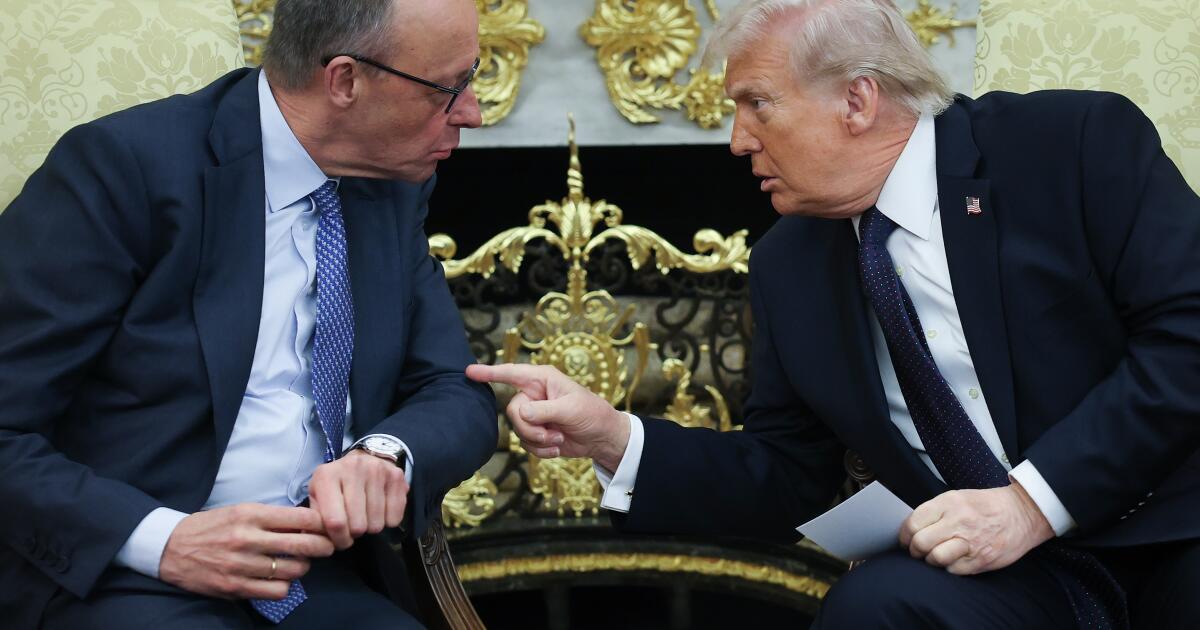
As Trump threatened European allies, he sat next to German Chancellor Friedrich Merz, underscoring the fraught landscape that world leaders are navigating as American and Israeli forces work to destroy Iran’s missile capabilities and nuclear program and eye a potential change in government.
During their meeting, Trump said Germany has allowed the United States to use its air bases. Beyond that help, Trump said, “we’re not asking them to put boots on the ground or anything.”
When asked by reporters how Germany intended to help in the conflict, Merz said he wanted to focus on talking to Trump about what comes “the day after” the war ends.
“We are on the same page in terms of getting this terrible regime in Iran away and we will talk about the day after, what will happen then, if they are out,” Merz said.
Trump talks about regime change options
Trump did not have much to say yet on what will come next and was unclear on who will lead the Iranian government, saying that U.S. and Israeli military operations had killed the people who he thought could have filled the leadership vacuum.
“Most of the people we had in mind are dead,” Trump said. “Now, we have another group, but they may be dead also based on reports so I guess you have a third wave coming in and pretty soon we’re not going to know anybody.”
His remarks were a startling acknowledgment in part because minutes earlier he said the worst-case scenario in his mind was that the military operation would take place and “then somebody takes over who is as bad as the previous person.”
“That could happen,” Trump said.
Asked if Crown Prince Reza Pahlavi, son of the former shah, is someone he would like to run the country, Trump said he is a “very nice person,” but did not say for sure whether he is his choice.
The president and his top aides have offered varying explanations when asked about regime change, drawing criticism from Democrats and some conservatives who are demanding to know why Americans are being dragged into a war with no clear end in sight.
On Saturday, when U.S. and Israeli forces first struck Iran, Trump said overthrowing Iran’s theocratic regime was part of his rationale. But on Monday, he emphasized that Iran’s missiles posed a threat to the United States, and therefore theattack was carried out to eradicate its missile capability and nuclear program.
After briefing lawmakers Monday afternoon, Secretary of State Marco Rubio told reporters that the United States launched a “preemptive” attack on Iran because officials knew Israel was going to strike the country — a move that he said would have put U.S. forces at risk and led to even more U.S. casualties. As of Tuesday, six American troops have been killed in combat.
House Speaker Mike Johnson (R-La.), after being briefed by Trump administration officials on Monday afternoon, said, “Israel was determined to act in their own defense, with or without American support.”
“If Israel fired upon Iran, and took action against Iran to take out the missiles, then they would have immediately retaliated against U.S. personnel and assets,” Johnson told reporters.
Trump disputed the suggestion that Israel’s plans to attack Iran prompted him to launch the strikes, saying it was the other way around.
“If anything, I might have forced Israel’s hand,” Trump said Tuesday. “But Israel was ready, and we were ready, and we’ve had a very, very powerful impact because virtually everything they have has been knocked out.”
But it was unclear how far along the U.S. military is in accomplishing its mission.
In a letter Monday, Trump told Congress that while the “United States desires a quick and enduring peace, it is not possible at this time to know the full scope and duration of military operations that may be necessary.”
Senate Minority Leader Chuck Schumer (D-New York) warned in a speech on the Senate floor that the administration’s murky strategy is not good for the country.
“History teaches us a simple lesson: Wars without a clear objective do not stay small. They get bigger, they get bloodier, they get longer, they get more expensive,” Schumer said. “This is not a defensive war. This is not a necessary war. This is a war of choice.”
The latest attacks on the region
Tuesday saw yet another expansion of the war when Israeli troops blitzed into Lebanon in a bid to dislodge the Iran-backed Shiite militant group Hezbollah.
The ground invasion comes one day after Hezbollah lobbed rockets and drones at an Israeli military position across the border; an attack, the group said, that was vengeance for the killing of Iranian Supreme Leader Ayatollah Ali Khamenei and a response to Israel’s near-daily violations of a ceasefire brokered by the U.S. in November 2024.
The attack sparked a massive Israeli assault on dozens of villages and towns in southern Lebanon, as well as on the southern suburbs of the Lebanese capital, Beirut. The strikes killed 40 people, wounded 246 others and saw tens of thousands forced to leave their homes and scramble for shelter in Beirut and elsewhere, according to Lebanese authorities.
The Lebanese army said Tuesday that it was withdrawing from positions in southern Lebanon ahead of a ground incursion by Israeli troops. The Israeli military’s Arabic-language spokesman then issued a warning to residents of some 80 towns and villages in that region to “immediately evacuate your homes” and move northward.
Hezbollah, meanwhile, maintained a defiant stance and continued rocket and drone launches into Israel.
“The era of patience has ended, and we have no option but to return to resistance,” said Mahmoud Qatari, who chairs Hezbollah’s Political Council. “If Israel wants an open war, so be it.”
The invasion comes more than a year after Israel occupied parts of southern Lebanon in 2024. After the ceasefire came into effect, Israel withdrew from most parts of the country save for five positions near the border. Yet in the 15 months since the ceasefire was signed, it has proved to be more notional for Lebanon, with Israeli warplanes and troops conducting well over 10,000 truce violations, according to the U.N.
Israel says its actions are to stop Hezbollah from reconstituting itself near the border, but the result has meant residents of border towns and villages in southern Lebanon have been unable to return home.
Israel’s military spokesman, Brigadier Gen. Effie Defrin, said in a statement that troops were “creating a buffer” inside Lebanon between residents in northern Israel “and any threat.”
As the conflict has escalated, some 1,600 Americans stranded across the region have requested assistance and the Trump administration is trying to help evacuate them, Rubio said. But the effort has faced challenges because Iranian missiles have struck many Mideast airports.
“We know we are going to be able to help them,” Rubio said. “It is going to take a little time because we do not control the airspace closures.”
Ceballos reported from Washington, Bulos from Khartoum, Sudan.